研究论文

不老莓果渣对产蛋高峰期蛋鸡生产性能和盲肠菌群的影响

  • 苟雯婷 , 1 ,
  • 李子尚 1 ,
  • 冯庆 1 ,
  • 袁玮 1 ,
  • 鲍晨光 1 ,
  • 李欣雨 1 ,
  • 张南翼 1 ,
  • 金周雨 , 2, * ,
  • 尚红梅 , 1, *
展开
  • 1 吉林农业大学林学与草学学院, 长春 130118
  • 2 吉林农业大学生命科学学院, 长春 130118
* 金周雨,实验师,硕士生导师,E-mail: ;
尚红梅,教授,硕士生导师,E-mail:

苟雯婷(2001—),女,甘肃定西人,硕士研究生,研究方向为草资源开发与利用。E-mail:

Office editor: 陈燕

收稿日期: 2026-01-14

  网络出版日期: 2026-07-13

基金资助

吉林省科技发展计划项目(20220202043NC)

Effects of Aronia melanocarpa Pomace on Performance and Cecal Microbiota of Laying Hens During Peak Laying Period

  • GOU Wenting , 1 ,
  • LI Zishang 1 ,
  • FENG Qing 1 ,
  • YUAN Wei 1 ,
  • BAO Chenguang 1 ,
  • LI Xinyu 1 ,
  • ZHANG Nanyi 1 ,
  • JIN Zhouyu , 2, * ,
  • SHANG Hongmei , 1, *
Expand
  • 1 College of Forestry and Grassland Science, Jilin Agricultural University, Changchun 130118, China
  • 2 College of Life Science, Jilin Agricultural University, Changchun 130118, China
* JIN Zhouyu, laboratory technician, E-mail: ;
SHANG Hongmei, professor, E-mail:

Received date: 2026-01-14

  Online published: 2026-07-13

摘要

本试验旨在研究不老莓果渣(AP)对产蛋高峰期蛋鸡生产性能、蛋品质、营养物质表观消化率以及盲肠菌群的影响。选取288只平均体重为(1 843.33±41.30) g、产蛋率[(90.40±0.35)%]无显著差异(P>0.05)的28周龄海兰褐蛋鸡,随机分为4个组,每组6个重复,每个重复12只。各组分别饲喂添加0(对照)、1%、2%和3% AP的试验饲粮。试验期33周,其中28~45周龄为产蛋高峰前期,46~60周龄为产蛋高峰期后期。结果表明:1)在产蛋高峰期前期,与对照组相比,3% AP组产蛋率显著提高(P<0.05),1%和2% AP组平均日采食量显著降低(P<0.05),2%和3% AP组料蛋比显著降低(P<0.05);在产蛋高峰期后期,与对照组相比,3% AP组产蛋率显著提高(P<0.05),2%和3% AP组平均蛋重和日产蛋重显著提高(P<0.05);在产蛋高峰期全期,与对照组相比,3% AP组产蛋率和日产蛋重显著升高(P<0.05),2% AP组平均蛋重和日产蛋重显著提高(P<0.05)。2)在蛋品质方面,饲粮中补充AP显著提高了产蛋高峰期前期蛋黄颜色(P<0.05)。3)在营养物质表观消化率方面,在产蛋高峰期前期,与对照组相比,1%、2%和3% AP组粗灰分和磷的表观消化率显著提高(P<0.05),1%、2% AP组总能表观消化率显著提高(P<0.05);在产蛋高峰期后期,与对照组相比,2%和3% AP组粗脂肪、粗纤维和粗灰分的表观消化率显著提高(P<0.05)。4)在属水平上,产蛋高峰期前期,与对照组相比,3%AP组盲肠中奥尔森菌属(Olsenella)、乳杆菌属(Lactobacillus)和丹毒丝菌属(Erysipelatoclostridium)的相对丰度显著增加(P<0.05),Colidextribacter、梭菌纲vadinBB60群(Clostridia_vadinBB60_group)和脱硫弧菌属(Desulfovibrio)的相对丰度显著降低(P<0.05);在产蛋高峰期后期,与对照组相比,1% AP组蛋鸡盲肠中乳杆菌属的相对丰度显著提高(P<0.05),3% AP组另枝菌属(Alistipes)和巨单胞菌属(Megamonas)的相对丰度显著降低(P<0.05)。由此可见,在产蛋高峰期饲粮中添加AP可调节蛋鸡盲肠菌群结构,改善生产性能和营养物质表观消化率,其中3%的AP添加水平效果最优。

本文引用格式

苟雯婷 , 李子尚 , 冯庆 , 袁玮 , 鲍晨光 , 李欣雨 , 张南翼 , 金周雨 , 尚红梅 . 不老莓果渣对产蛋高峰期蛋鸡生产性能和盲肠菌群的影响[J]. 动物营养学报, 2026 , 38(7) : 5061 -5077 . DOI: 10.12418/CJAN2026.406

Abstract

This experiment was aimed to investigate the effects of Aronia melanocarpa pomace (AP) on performance, egg quality, nutrient apparent digestibility and caecal microbiota of laying hens during the peak laying period. A total of 288 Hy-Line Brown laying hens at 28 weeks of age with average body weight of (1 843.33±41.30) g and laying rate of (90.40±0.35)% showing no significant difference (P>0.05) were randomly divided into 4 groups with 6 replicates per group and 12 hens per replicate. Hens in the four groups were fed experimental diets supplemented with 0 (control), 1%, 2% and 3% AP, respectively. The experiment lasted for 33 weeks, with weeks 28 to 45 of age as the early stage of peak laying period and weeks 46 to 60 of age as the late stage of peak laying period. The results showed as follows: 1) during the early stage of peak laying period, compared with the control group, laying rate in 3% AP group was significantly increased (P<0.05), average daily feed intake in 1% and 2% AP groups was significantly decreased (P<0.05), and feed-to-egg ratio in 2% and 3% AP groups was significantly decreased (P<0.05). During the late stage of peak laying period, compared with the control group, laying rate in 3% AP group was significantly increased (P<0.05), and average egg weight and daily egg mass in 2% and 3% AP groups were significantly increased (P<0.05). During the whole peak laying period, compared with the control group, laying rate and daily egg mass in 3% AP group were significantly increased (P<0.05), and average egg weight and daily egg mass in 2% AP group were significantly increased (P<0.05). 2) In terms of egg quality, dietary addition of AP significantly increased yolk color during the early stage of peak laying period (P<0.05). 3) Regarding nutrient apparent digestibility, during the early stage of peak laying period, compared with the control group, apparent digestibility of crude ash and phosphorus in 1%, 2% and 3% AP groups was significantly increased (P<0.05), and apparent digestibility of gross energy in 1% and 2% AP groups was significantly increased (P<0.05). During the late stage of peak laying period, compared with the control group, apparent digestibility of ether extract, crude fiber and ash in 2% and 3% AP groups was significantly increased (P<0.05). 4) At genus level, during the early stage of peak laying period, compared with the control group, the relative abundances of Olsenella, Lactobacillus and Erysipelatoclostridium in cecum of 3% AP group were significantly increased (P<0.05), while the relative abundances of Colidextribacter, Clostridia_vadinBB60_group and Desulfovibrio were significantly decreased (P<0.05). During the late stage of peak laying period, compared with the control group, the relative abundance of Lactobacillus in cecum of 1% AP group was significantly increased (P<0.05), and the relative abundances of Alistipes and Megamonas in 3% AP group were significantly decreased (P<0.05). In conclusion, dietary addition of AP during the peak laying period can modulate the cecal microbiota structure, improve performance and nutrient apparent digestibility of laying hens, with 3% AP addition level showing the best effect.

受制于饲料资源匮乏及食品产业链供给压力,将农业与工业副产品应用到动物饲粮,是提高资源利用效率、保障养殖业可持续发展的有效饲养策略。将农业副产品纳入动物饲粮体系,能够有效实现资源的循环利用,显著降低因废弃带来的环境负担,为生态环境的保护与改善提供有力支持,并缓解人类与动物之间对粮食的竞争,保障粮食安全[1]。因此,开发粮食、水果、蔬菜、肉、鱼、蛋等加工产品的皮、壳、籽、叶等资源,是提高畜牧业经济效益和资源利用效率的重要途径。加强对非传统饲料的研究和利用对于增强畜牧业的可持续发展至关重要。不老莓(Aronia melanocarpa)是蔷薇科灌木,原产于北美东部地区,目前已经在中国东北地区大量引进栽培[2]。不老莓果实含有丰富的花青素、黄酮、多酚、维生素和矿物质等营养和药用成分,其提取物对防治高血压、心脏病等心脑血管疾病效果显著[3]。Pearce等[4]研究结果表明,在断奶仔猪饲粮中添加0.5%或1.0%的不老莓粉,使得回肠白细胞介素-18(IL-18)含量呈下降趋势,有利于减轻肠道炎症并改善仔猪肠道健康。Jing等[5]在25周龄的罗曼褐蛋鸡饲粮中添加1%或4%不老莓粉可有效提高产蛋高峰期的产蛋率。不老莓果渣(AP)是果汁、果酱和果酒加工的副产品,在果汁和果酒的加工过程中会产生大量果渣,其质量约占加工水果总量的16%[6]。如不加以有效利用,会造成环境负担和经济损失[7]。研究发现,AP富含多种生物活性成分,包括膳食纤维、酚类化合物、多糖、花青素和原花青素,具有显著的抗炎和抗氧化特性[8]。Yang等[9]采用AP制备可食用明胶涂层用于冷藏猪肉保鲜,研究表明该涂层在保持猪肉品质的同时有效延长了其保质期。AP在动物饲粮中的应用已有相关报道。Liu等[10]研究发现,在断奶仔猪和肥育猪饲粮中添加AP,能够提高机体抗氧化酶活性,改善猪的生长性能和肉品质。此外,在345日龄蛋鸡饲粮中添加发酵AP,可优化盲肠菌群结构,提高鸡蛋的营养价值,具体表现为鸡蛋饱和脂肪酸含量下降,有益脂肪酸含量提高,且蛋黄氨基酸组成更优[11]。本实验室前期研究发现,在蛋鸡饲粮中添加AP,能够显著提升产蛋末期蛋鸡的生产性能,并有效改善机体代谢水平和健康状况[12]。基于已有研究成果,本次试验进一步拓展研究范围,通过在28周龄海兰褐蛋鸡饲粮中添加1%、2%和3% AP,研究其对产蛋高峰期蛋鸡生产性能、蛋品质、营养物质表观消化率和盲肠菌群的影响,为AP在养殖业的综合利用提供理论支撑和实践参考依据。

1 材料与方法

1.1 试验动物与材料

海兰褐蛋鸡和AP由吉林龙山蛋鸡科技小院提供。在风干基础下,AP的总能、粗蛋白质、粗脂肪、粗纤维、粗灰分、总酚、多糖和黄酮类化合物含量分别为21.30 MJ/kg、6.28%、5.43%、31.82%、2.33%、0.19%、11.80%和0.53%[12]

1.2 试验设计

所有程序均按照吉林农业大学动物保护与利用委员会规定执行(审批号:APUC-JLAU20220309)。
选取288只平均体重为(1 843.33±41.30) g、产蛋率[(90.40±0.35)%]无显著差异(P>0.05)的28周龄健康海兰褐蛋鸡,随机分为4个组,每组6个重复,每个重复12只。各组分别饲喂添加0(对照)、1%、2%、3% AP的试验饲粮。试验期33周,其中28~45周龄为产蛋高峰前期,46~60周龄为产蛋高峰期后期,分别在45和60周龄结束时取样。
对照组饲喂参照《产蛋鸡和肉鸡配合饲料》(GB/T 5916—2020)配制的基础饲粮;1%、2%、3% AP组饲粮基于AP营养物质含量对饲粮组成进行优化调整,保证各组主要营养指标与基础饲粮相近,使AP实际添加比例达到1%、2%、3%。试验饲粮组成及营养水平见表1。试验蛋鸡饲养在3层重叠笼中,每笼3只,均匀分布在鸡舍内。蛋鸡自由采食和饮水,每天16 h光照。
表1 试验饲粮组成及营养水平(风干基础)

Table 1 Composition and nutrient levels of experimental diets (air-dry basis) %

项目
Items
28~45周龄28 to 45 weeks of age 46~60周龄46 to 60 weeks of age
AP添加水平AP addition levels/% AP添加水平AP addition levels/%
0 1 2 3 0 1 2 3
原料Ingredients
玉米Corn 59.91 58.80 57.60 56.49 59.91 58.80 57.60 56.49
豆粕Soybean meal 25.29 25.40 25.65 25.76 24.79 24.90 25.15 25.26
石粉Limestone 8.00 8.00 8.00 8.00 8.50 8.50 8.50 8.50
脱胶骨粉
Deglued bone meal
0.70 0.70 0.60 0.60 0.70 0.70 0.60 0.60
大豆油Soybean oil 0.90 0.90 0.95 0.95 0.90 0.90 0.95 0.95
氯化胆碱Choline chloride 0.10 0.10 0.10 0.10 0.10 0.10 0.10 0.10
预混料Premix1) 5.00 5.00 5.00 5.00 5.00 5.00 5.00 5.00
L-赖氨酸盐酸盐
L-Lys·HCl
0.10 0.10 0.10 0.10 0.10 0.10 0.10 0.10
不老莓果渣AP 1.00 2.00 3.00 1.00 2.00 3.00
合计Total 100.00 100.00 100.00 100.00 100.00 100.00 100.00 100.00
营养水平Nutrient level2)
代谢能ME/(MJ/kg) 11.14 11.14 11.14 11.14 11.09 11.09 11.09 11.09
干物质DM 95.70 95.72 95.71 95.68 95.77 95.42 95.69 95.79
粗蛋白质CP 18.08 18.15 18.05 18.05 17.88 17.83 17.85 17.83
粗纤维CF 2.47 2.85 3.24 3.62 2.44 2.82 3.21 3.59
赖氨酸Lys 1.00 1.00 1.00 1.00 0.99 0.99 0.99 0.99
蛋氨酸Met 0.41 0.40 0.40 0.40 0.40 0.40 0.40 0.40
半胱氨酸Cys 0.30 0.29 0.29 0.29 0.29 0.29 0.29 0.29
钙Ca 3.98 3.97 3.99 3.97 4.13 4.16 4.14 4.15
总磷TP 0.44 0.43 0.42 0.42 0.41 0.43 0.42 0.42
有效磷AP 0.10 0.10 0.10 0.10 0.10 0.10 0.10 0.09

1)预混料为每千克饲粮提供 Premix provided the following per kg of diets:VA≥50 000 IU,VD≥30 000 IU,VE≥250 IU,VK≥25 mg,VB2≥100 mg,烟酸 niacin≥540 mg,Mn (MnSO4·H2O)≥1.5 g,Fe (FeSO4·H2O)≥3.1 g,Cu (CuSO4·5H2O)≥0.1 g,Zn (ZnSO4·H2O)≥0.8 g,Ca (CaHPO4·2H2O) 13~25 g,NaCl 3.0~3.5 g。

2)代谢能、有效磷和氨基酸为计算值,参照《中国饲料成分及营养价值表(2021年第32版)》计算得出,其余为实测值。ME, AP and AA were calculated values, all calculated with reference to the Tables of Feed Composition and Nutritive Values in China (32nd edition, 2021), while the others were measured values.

1.3 饲粮营养物质含量的测定

饲粮干物质、粗纤维、粗蛋白质、钙和总磷含量分别采用GB/T 6435—2014、GB/T 6434—2022、GB/T 6432—2018、GB/T 6436—2018、GB/T 6437—2018的方法测定。

1.4 生产性能的测定

试验期间,每天记录总蛋数、总蛋重和总采食量。计算平均蛋重、产蛋率、平均日采食量和料蛋比。计算公式如下:
产蛋率(%)=(总蛋数/蛋鸡数量)×100;
平均蛋重(g/枚)=总蛋重/总蛋数;
日产蛋重(g/d)=总蛋重/蛋鸡数量;
平均日采食量(g/d)=总采食量/蛋鸡数量;
料蛋比=总采食量/总蛋重。

1.5 蛋品质测定

试验45和60周龄结束时,每个重复随机抽取5只蛋(每组30只)进行蛋品质分析。测量鸡蛋的最大横径和纵径,计算蛋形指数。称重后将蛋黄和蛋清分开并称重,记录蛋重、蛋黄重和蛋清重。用游标卡尺分别测量蛋壳钝端、中端和尖端厚度,取平均值作为蛋壳厚度。使用鸡蛋质量分析仪(EA-01,ORKA,以色列)测量蛋黄颜色和哈氏单位。将蛋壳置于已知重量的开放式培养皿中,在60 ℃恒温干燥箱(GZX-9140MBE,上海博迅医疗生物仪器股份有限公司)中干燥,直至达到恒定重量,记录蛋壳重量。将蛋壳称重后,计算蛋壳相对重量。计算公式如下:
蛋形指数(%)=(鸡蛋最大横径/鸡蛋最大纵径)×100 ;
蛋壳相对重量(%)=(蛋壳重量/蛋重)×100。

1.6 营养物质表观消化率的测定

试验第45周和第60周最后3 d,每个重复随机选取3只蛋鸡(每组18只)单笼饲养,按全收粪法收集新鲜粪便,连续收集72 h。固氮、防腐后将粪便样本保存在-20 ℃冰箱待测。收集完全部粪便样本后,将同一重复的样本解冻并立即混合。将样本在65 ℃的恒温干燥箱中进行干燥,经粉碎后过40目筛。粪便的粗蛋白质、粗脂肪、粗灰分、粗纤维、钙、磷含量分别采用GB/T 6432—2018、GB/T 6433—2006、GB/T 6438—2007、GB/T 6434—2022、GB/T 6436—2018、GB/T 6437—2018的方法测定。采用全自动量热仪(ZDHW-6,河南华博电子科技有限公司)测定粪便和饲粮的总能水平。营养物质表观消化率的计算公式如下:
营养物质表观消化率(%)=[(采食量×饲粮中该营养物质含量-粪便重量×粪便中该营养物质含量)/(采食量×饲粮中该营养物质含量)]×100。

1.7 盲肠菌群分析

试验第45周和第60周结束时,每个重复随机抽取1只蛋鸡(每组6只)进行屠宰并分离盲肠内容物,经液氮快速冷冻后在-80 ℃保存。采用土壤和粪便基因组DNA提取试剂盒[TianGen,天根生化科技(北京)有限公司]从盲肠内容物样本中提取细菌DNA。使用Qubit 4.0荧光定量仪(Thermo Fisher,美国)和NanoDrop One超微量分光光度计(Thermo Fisher,美国)测定核酸浓度和纯度。针对细菌16S rRNA基因V4区设计带有条形码的融合引物。正向引物341F序列为5'-CCTACGGGNGGCWGCAG-3',反向引物806R序列为5'-GGACTACHVGGGTATCTAAT-3'。利用这些引物进行PCR扩增。经磁珠纯化后,构建测序文库。利用KAPA SYBR® FAST qPCR Kit试剂盒(KAPA,美国)对文库中有效片段的摩尔浓度进行了测定。通过Qubit 4.0荧光定量仪和2100生物分析仪(Agilent,美国)对片段大小进行验证,并根据实时荧光定量PCR(qPCR)结果调整文库混合比例。将调整后的文库集中在Illumina NovaSeq 6000平台上进行PE250双端测序,测序工作由北京诺禾致源生物科技有限公司完成。使用FastP 0.23.1软件对原始数据进行筛选,剔除了低质量(Q<20)和带有接头污染的读段,随后通过QIIME2-2022.2软件中的DADA2算法进行了噪声削减,生成扩增子序列变异体(amplicon sequence variants,ASVs)[13-15]。采用QIIME2-2022.2软件,参考Silva 138.1数据库进行物种注释,基于注释结果,进行物种组成、群落多样性和物种差异分析。

1.8 统计分析

使用SPSS 27.0软件对数据进行单因素方差分析。数据的模型为:
Yij=μ+ai+£ij
式中:Yij为因变量;μ为总体平均值;ai为饲粮AP添加水平的固定效应;£ij为随机误差。
数据组间差异采用Duncan氏法进行多重比较检验。通过线性与二次回归模型的曲线拟合程序,评估饲粮AP添加水平对各项指标的线性及二次效应。结果以平均值和均值标准误表示。P<0.05表示差异显著。

2 结果与分析

2.1 AP对蛋鸡生产性能的影响

表2可知,28~45周龄,与对照组相比,3% AP组产蛋率显著提高(P<0.05),1%和2% AP组平均日采食量显著降低(P<0.05),2%和3% AP组料蛋比显著降低(P<0.05);在46~60周龄,与对照组相比,3% AP组产蛋率显著提高(P<0.05),2%和3% AP组平均蛋重和日产蛋重显著提高(P<0.05);46~60周龄的平均蛋重和日产蛋重高于28~45周龄,料蛋比低于28~45周龄。在28~60周龄,与对照组相比,3% AP组产蛋率和日产蛋重显著升高(P<0.05),2% AP组平均蛋重和日产蛋重显著提高(P<0.05);随着AP添加水平的升高,产蛋率和日产蛋重均呈显著的线性和二次变化(P<0.05)。综上所述,饲粮添加3% AP提高了蛋鸡的生产性能,表现为产蛋率和日产蛋重提高。
表2 AP对蛋鸡生产性能的影响

Table 2 Effects of AP on performance of laying hens

项目
Items
AP添加水平AP addition levels/% 均值
标准误
SEM
PP-value
0 1 2 3 方差分析
ANOVA
线性
Linear
二次
Quadratic
产蛋率Laying rate/%
28~45周龄28 to 45 weeks of age 90.79b 92.10b 92.10b 95.23a 0.367 <0.001 <0.001 <0.001
46~60周龄46 to 60 weeks of age 92.38b 92.36b 93.21ab 94.90a 0.357 0.035 0.008 0.013
28~60周龄28 to 60 weeks of age 90.75b 90.32b 90.93b 94.49a 0.664 0.009 0.001 0.004
平均蛋重Average egg weight/(g/枚)
28~45周龄28 to 45 weeks of age 62.94ab 62.45ab 63.35a 61.28b 0.241 0.016 0.059 0.044
46~60周龄46 to 60 weeks of age 66.17b 66.54b 68.66a 67.95a 0.239 <0.001 <0.001 0.001
28~60周龄28 to 60 weeks of age 63.15b 63.88ab 65.77a 64.31ab 0.339 0.042 0.103 0.057
日产蛋重Daily egg mass/(g/d)
28~45周龄28 to 45 weeks of age 56.33 55.37 56.41 57.67 0.308 0.071 0.070 0.037
46~60周龄46 to 60 weeks of age 61.17b 61.48b 64.04a 64.48a 0.402 0.002 <0.001 0.002
28~60周龄28 to 60 weeks of age 57.51b 58.15ab 59.88a 60.77a 0.593 0.041 0.004 0.015
平均日采食量ADFI/(g/d)
28~45周龄28 to 45 weeks of age 125.65a 120.43b 119.53b 123.09ab 0.845 0.041 0.232 0.016
46~60周龄46 to 60 weeks of age 120.76 121.43 122.66 124.67 0.898 0.441 0.107 0.258
28~60周龄28 to 60 weeks of age 120.82 120.89 120.95 123.81 1.157 0.778 0.395 0.591
料蛋比F/E
28~45周龄28 to 45 weeks of age 2.24a 2.19ab 2.12b 2.14b 0.017 0.047 0.011 0.022
46~60周龄46 to 60 weeks of age 1.98 1.98 1.92 1.94 0.019 0.570 0.234 0.480
28~60周龄28 to 60 weeks of age 2.15 2.09 2.03 2.05 0.021 0.187 0.046 0.093

同行数据肩标无字母或相同字母表示差异不显著(P>0.05),不同小写字母表示差异显著(P<0.05)。下表同。

In the same row, values with no letter or the same letter superscripts mean no significant difference (P>0.05), while with different small letter superscripts mean significant difference (P<0.05). The same as below.

2.2 AP对蛋鸡蛋品质的影响

表3所示,在45周龄,与对照组相比,1%、2%和3% AP组的蛋黄颜色显著升高(P<0.05);在60周龄,与对照组相比,1% AP组蛋壳厚度显著降低(P<0.05)。
表3 AP对蛋鸡蛋品质的影响

Table 3 Effects of AP on egg quality of laying hens

项目
Items
AP添加水平AP addition levels/% 均值
标准误
SEM
PP-value
0 1 2 3 方差分析
ANOVA
线性
Linear
二次
Quadratic
蛋形指数Egg shape index/%
45周龄45 weeks of age 77.76 78.56 77.83 78.13 0.289 0.771 0.867 0.899
60周龄60 weeks of age 78.66 79.88 77.99 77.60 0.355 0.123 0.116 0.153
蛋重Egg weight/g
45周龄45 weeks of age 64.46 63.95 66.45 67.31 0.673 0.239 0.065 0.161
60周龄60 weeks of age 67.33 67.75 67.88 68.11 0.726 0.984 0.695 0.925
蛋黄重Yolk weight/g
45周龄45 weeks of age 16.56 16.98 16.30 17.22 0.179 0.264 0.396 0.553
60周龄60 weeks of age 17.00 17.78 17.05 17.91 0.213 0.290 0.255 0.525
蛋清重Egg white weight/g
45周龄45 weeks of age 38.08 37.57 40.55 40.52 0.516 0.068 0.024 0.077
60周龄60 weeks of age 39.09 38.65 38.14 38.88 0.631 0.960 0.844 0.882
蛋壳厚度Eggshell thickness/mm
45周龄45 weeks of age 0.49 0.47 0.47 0.47 0.006 0.340 0.161 0.216
60周龄60 weeks of age 0.44a 0.42b 0.44a 0.44a 0.003 0.016 0.760 0.290
蛋黄颜色Yolk color
45周龄45 weeks of age 8.93c 9.78a 9.14b 9.46ab 0.083 0.001 0.171 0.109
60周龄60 weeks of age 9.50 9.83 9.33 9.14 0.146 0.410 0.235 0.334
哈氏单位Haugh unit
45周龄45 weeks of age 72.18 73.57 76.25 75.37 1.728 0.847 0.430 0.696
60周龄60 weeks of age 77.16 75.48 78.31 78.30 1.057 0.779 0.525 0.760
蛋壳相对重量Relative weight of eggshell/%
45周龄45 weeks of age 15.20 14.54 14.44 14.24 0.424 0.869 0.427 0.707
60周龄60 weeks of age 16.73 16.81 18.71 16.65 0.394 0.212 0.682 0.372

2.3 AP对蛋鸡营养物质表观消化率的影响

表4所示,在45周龄,与对照组相比,1%、2%和3% AP组粗灰分和磷的表观消化率显著提高(P<0.05),1%、2% AP组总能表观消化率显著提高(P<0.05);随着AP添加水平的升高,磷表观消化率显著呈显著的线性和二次变化(P<0.05),粗灰分和总能的表观消化率呈显著的二次变化(P<0.05),粗脂肪和粗纤维的表观消化率呈显著的线性提高(P<0.05)。
表4 AP对蛋鸡营养物质表观消化率的影响

Table 4 Effects of AP on nutrient apparent digestibility of laying hens %

项目
Items
AP添加水平AP addition levels/% 均值
标准误
SEM
PP-value
0 1 2 3 方差分析
ANOVA
线性
Linear
二次
Quadratic
粗蛋白质CP
45周龄45 weeks of age 52.15 53.38 51.64 53.27 0.386 0.306 0.646 0.874
60周龄60 weeks of age 59.68 59.08 58.03 60.20 0.618 0.653 0.926 0.543
粗脂肪EE
45周龄45 weeks of age 75.66 77.13 75.94 78.97 0.499 0.066 0.048 0.105
60周龄60 weeks of age 75.35b 80.22a 78.23a 79.25a 0.673 0.049 0.108 0.094
粗灰分Ash
45周龄45 weeks of age 35.50b 41.80a 39.26a 39.10a 0.691 0.006 0.188 0.019
60周龄60 weeks of age 35.70b 39.99a 40.02a 38.42a 0.541 0.006 0.090 0.002
粗纤维CF
45周龄45 weeks of age 52.23 52.35 50.07 48.62 0.676 0.145 0.027 0.075
60周龄60 weeks of age 52.06b 57.17ab 62.78a 65.23a 1.771 0.027 0.002 0.009
钙Ca
45周龄45 weeks of age 61.28 62.31 60.17 63.39 0.458 0.072 0.314 0.300
60周龄60 weeks of age 53.46 53.41 55.93 54.35 0.972 0.801 0.562 0.790
磷P
45周龄45 weeks of age 32.48b 44.46a 41.01a 41.58a 1.138 <0.001 0.017 0.001
60周龄60 weeks of age 49.24 48.48 51.28 50.74 1.335 0.886 0.552 0.841
能量Energy
45周龄45 weeks of age 63.87c 72.39a 67.70b 66.07bc 0.657 <0.001 0.751 <0.001
60周龄60 weeks of age 76.37 76.02 76.03 75.50 0.277 0.764 0.304 0.590
在60周龄,与对照组相比,1%、2%和3% AP组粗脂肪和粗灰分的表观消化率显著提高(P<0.05),2%和3% AP组粗纤维表观消化率显著提高(P<0.05);随着AP添加水平的升高,粗纤维表观消化率显著呈显著的线性和二次变化(P<0.05),粗灰分表观消化率显著呈显著的二次变化(P<0.05)。

2.4 AP对蛋鸡盲肠菌群的影响

2.4.1 盲肠菌群组成分析

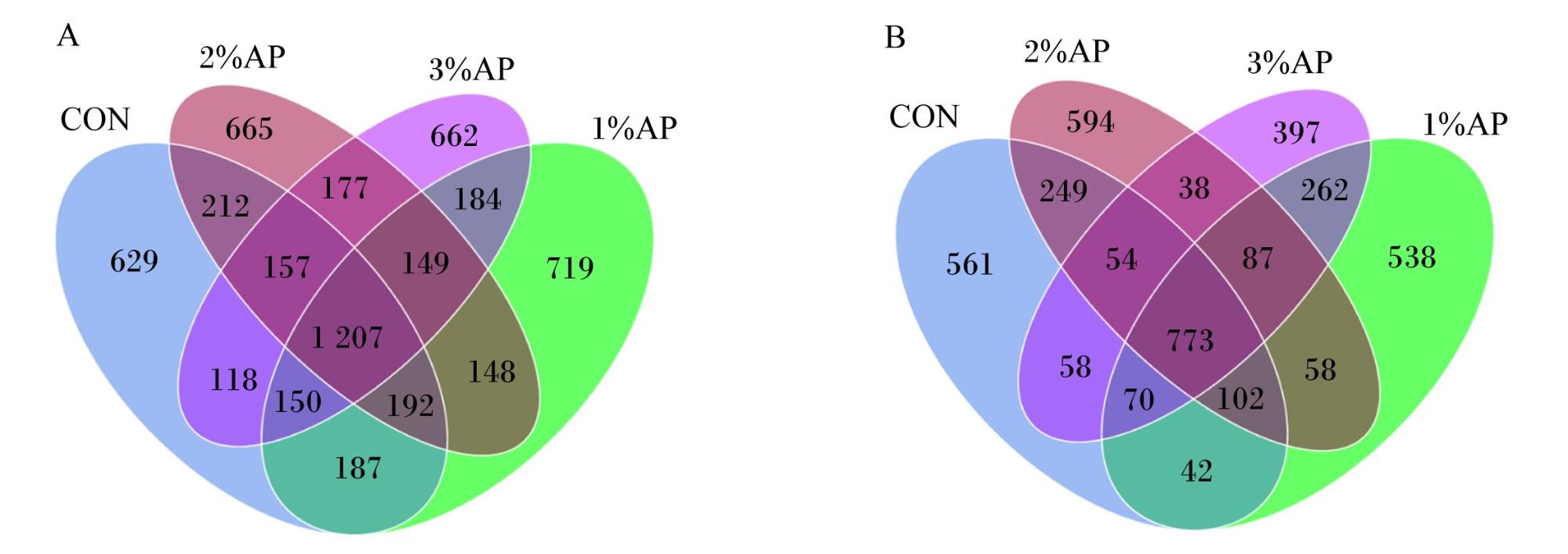
图1-A所示,在45周龄,4组共有ASVs数量为1 207个。其中1% AP组(719个)、2% AP添加组(665个)和3% AP添加组(662个)独有的ASVs数量均大于对照组(629个)。如图1-B所示,在60周龄,对照组和1%、2%和3% AP组共有ASVs数量为773个,各组独有的ASVs数量分别为561、538、594和397个。
图1 蛋鸡盲肠菌群韦恩图

A:45周龄 45 weeks of age;B:60周龄 60 weeks of age。图3图4同 the same as Fig.3 and Fig.4
CON:对照组 control group;2% AP:2% AP组 2% AP group;3% AP:3% AP组 3% AP group;1% AP:1% AP组 1% AP group。下图同 the same as below。

Fig.1 Venn diagram of cecal microbiota in laying hens

2.4.2 盲肠菌群多样性分析

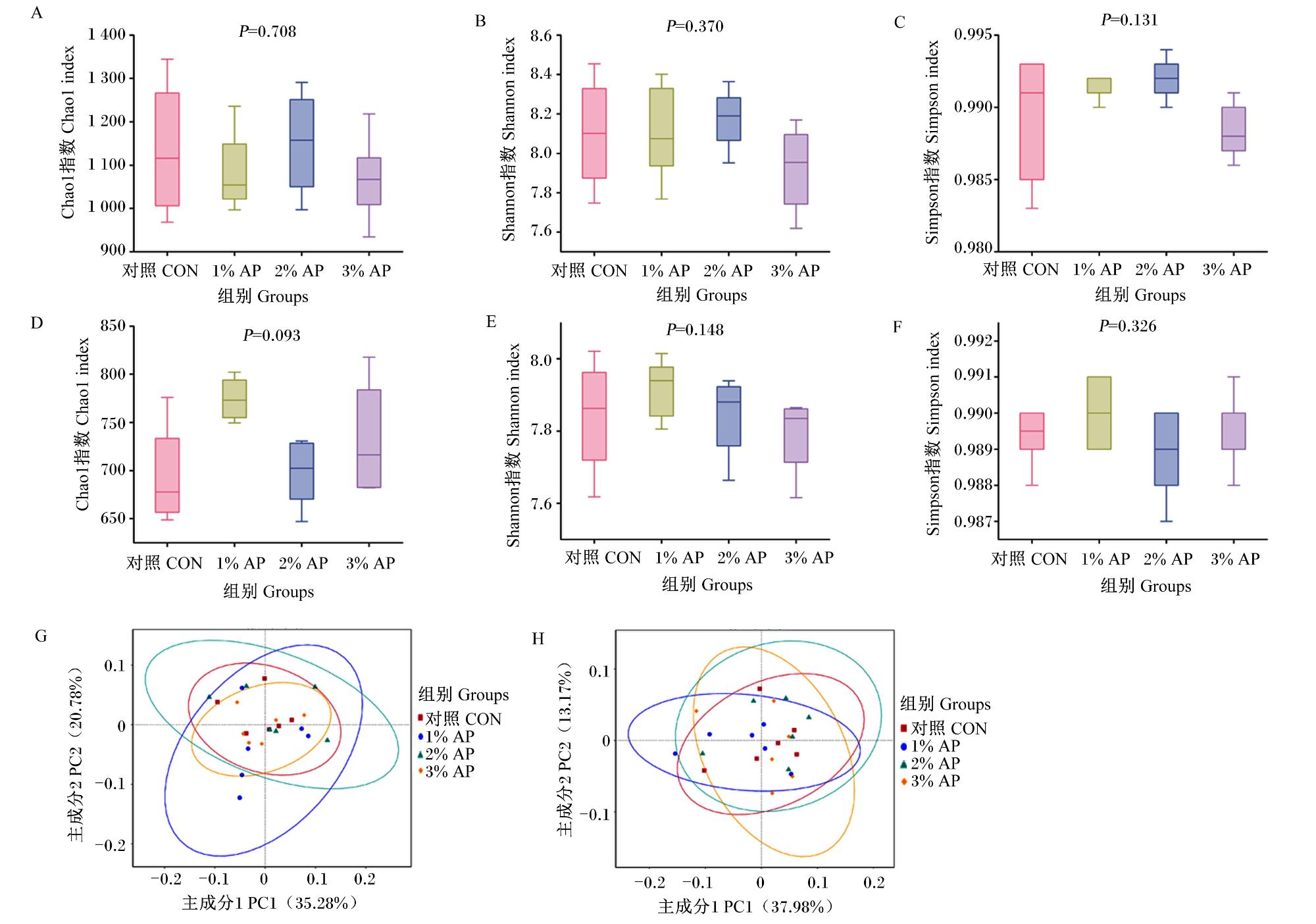
图2所示,根据α多样性分析结果,在45和60周龄,饲粮中添加AP对蛋鸡盲肠chao1指数、Simpson指数和Shannon指数均无显著影响(P>0.05);基于主成分分析(PCA)的β多样性分析显示,在45和60周龄,1%、2%和3% AP组盲肠菌群与对照组均无明显分离,表明各组间菌群结构无明显差异。
图2 AP对蛋鸡盲肠菌群多样性的影响

A、B、C、G:45周龄 45 weeks of age;D、E、F、H:60周龄 60 weeks of age。

Fig.2 Effects of AP on cecal microbial diversity of laying hens

2.4.3 盲肠菌群门和属水平相对丰度分析

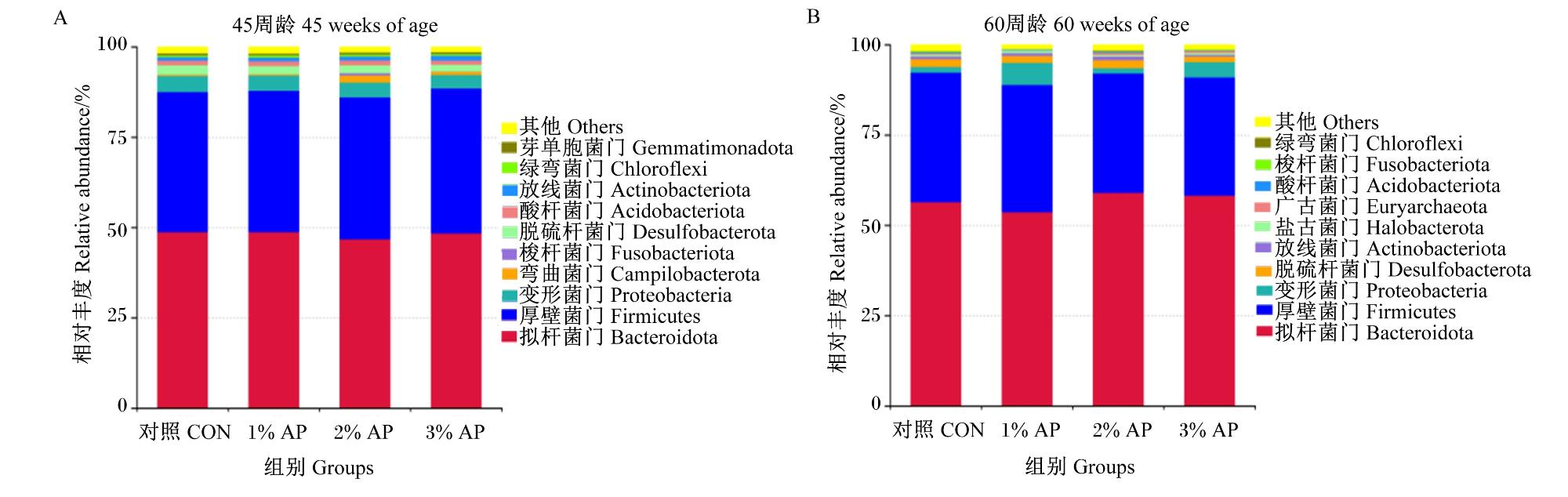
在门水平上,如图3-A所示,在45周龄,盲肠优势菌门为拟杆菌门(Bacteroidota)、厚壁菌门(Firmicutes)、变形菌门(Proteobacteria)、弯曲菌门(Campilobacterota)、梭杆菌门(Fusobacteriota)、脱硫杆菌门(Desulfobacterota)、酸杆菌门(Acidobacteriota)、放线菌门(Actinobacteriota)、绿弯菌门(Chloroflexi)和芽单胞菌门(Gemmatimonadota);如图3-B所示,在60周龄,盲肠优势菌门为拟杆菌门、厚壁菌门、变形菌门、脱硫杆菌门、放线菌门、盐古菌门(Halobacterota)、广古菌门(Euryarchaeota)、酸杆菌门、梭杆菌门和绿弯菌门。
图3 AP对蛋鸡盲肠菌群门水平相对丰度的影响

Fig.3 Effects of AP on relative abundance of cecal microflora of laying hens at phylum level

表5所示,在45周龄,3% AP组盲肠脱硫杆菌门的相对丰度显著降低(P<0.05),放线菌门的相对丰度显著提高(P<0.05)。如表6所示,在60周龄,各组间盲肠菌群在门水平上相对丰度无显著差异(P>0.05)。
表5 AP对产蛋高峰期前期蛋鸡盲肠菌群门水平相对丰度的影响

Table 5 Effects of AP on relative abundance of cecal microbiota of laying hens in early stage of peak laying period at phylum level %

项目
Items
AP添加水平AP addition levels/% 均值标准误
SEM
P
P-value
0 1 2 3
拟杆菌门Bacteroidota 48.77 48.79 46.82 48.45 0.885 0.857
厚壁菌门Firmicutes 38.79 39.15 39.30 40.10 0.868 0.965
变形菌门Proteobacteria 4.45 4.19 4.10 3.73 0.327 0.904
弯曲菌门Campilobacterota 0.30 0.31 1.94 0.92 0.255 0.065
梭杆菌门Fusobacteriota 0.06 0.08 0.62 0.07 0.142 0.455
脱硫杆菌门Desulfobacterota 2.62a 2.26a 2.25a 1.85b 0.083 0.005
酸杆菌门Acidobacteriota 1.22 1.28 1.26 1.14 0.125 0.985
放线菌门Actinobacteriota 1.03b 1.11ab 1.16ab 1.40a 0.011 0.043
绿弯菌门Chloroflexi 0.49 0.55 0.50 0.47 0.050 0.953
芽单胞菌门Gemmatimonadota 0.53 0.52 0.54 0.47 0.051 0.974
其他Others 1.72 1.75 1.51 1.39 0.100 0.555
表6 AP对产蛋高峰期后期蛋鸡盲肠菌群门水平相对丰度的影响

Table 6 Effects of AP on relative abundance of cecal microbiota of laying hens in late stage of peak laying period at phylum level %

项目
Items
AP添加水平AP addition levels/% 均值标准误
SEM
P
P-value
0 1 2 3
拟杆菌门Bacteroidota 56.48 53.74 59.07 58.29 1.229 0.450
厚壁菌门Firmicutes 35.86 35.21 33.08 32.75 0.956 0.610
变形菌门Proteobacteria 1.59 6.09 1.46 4.18 1.113 0.413
脱硫杆菌门Desulfobacterota 2.12 1.96 2.18 1.58 0.127 0.347
放线菌门Actinobacteriota 0.79 0.78 1.02 0.47 0.141 0.641
盐古菌门Halobacterota 0.47 0.66 0.40 0.53 0.131 0.922
广古菌门Euryarchaeota 0.33 0.05 0.65 0.60 0.149 0.491
酸杆菌门Acidobacteriota 0.30 0.22 0.33 0.12 0.111 0.920
梭杆菌门Fusobacteriota 0.27 0.07 0.11 0.28 0.055 0.418
绿弯菌门Chloroflexi 0.13 0.03 0.16 0.02 0.051 0.712
其他Others 1.62 1.18 1.54 1.19 0.180 0.748
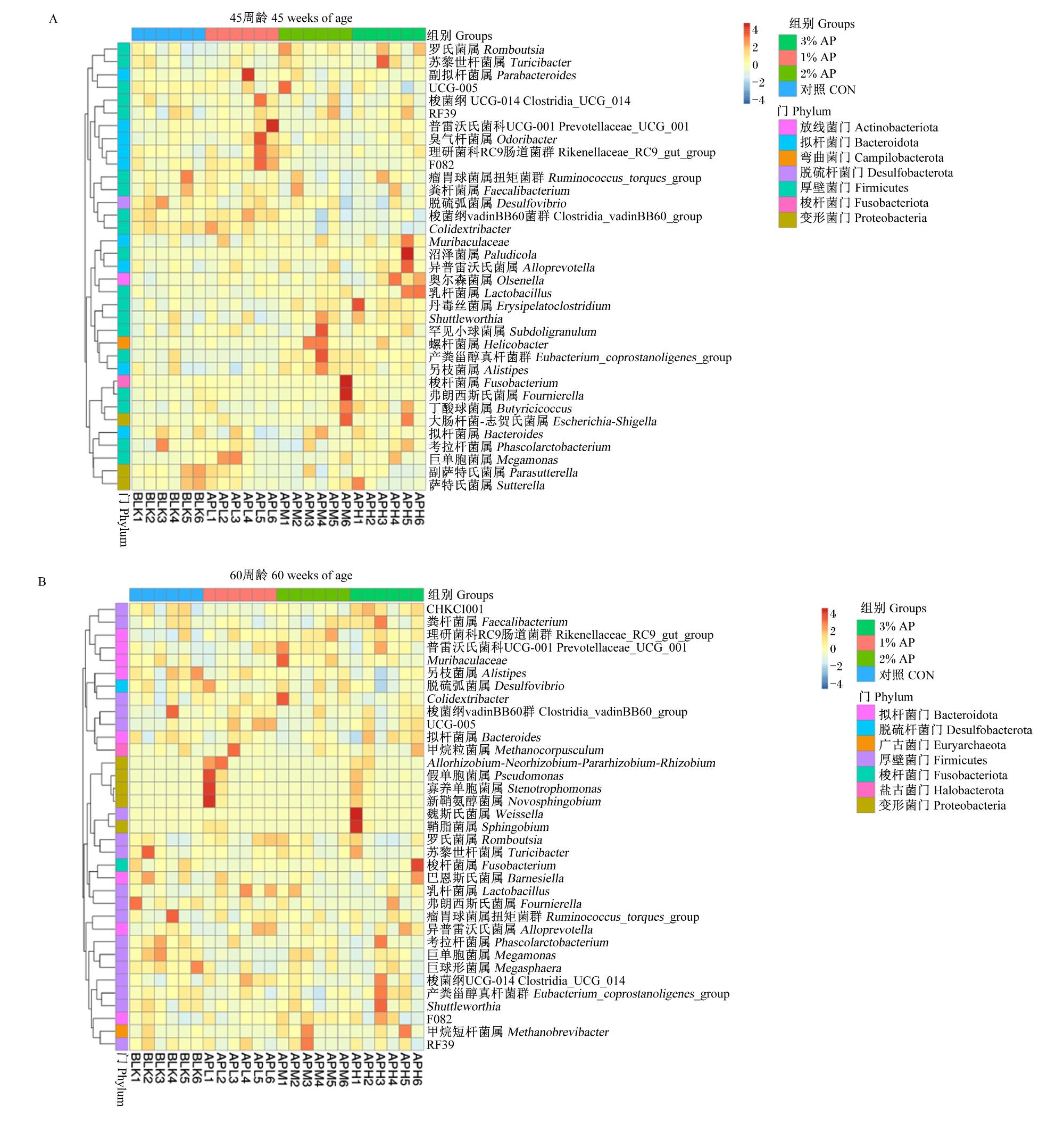
在属水平上,如图4-A表7所示,在45周龄,与对照组相比,2% AP组盲肠中产粪甾醇真杆菌群(Eubacterium_coprostanoligenes_group)和另枝菌属(Alistipes)的相对丰度显著提高(P<0.05);3% AP组盲肠中奥尔森菌属(Olsenella)、乳杆菌属(Lactobacillus)和丹毒丝菌属(Erysipelatoclostridium)的相对丰度显著提高(P<0.05),3% AP组盲肠中脱硫弧菌属(Desulfovibrio)的相对丰度显著降低(P<0.05);2%和3% AP组盲肠中Colidextribacter和梭菌纲vadinBB60群(Clostridia_vadinBB60_group)的相对丰度均显著降低(P<0.05)。如图4-B表8所示,在60周龄,饲粮中添加AP对盲肠中乳杆菌属相对丰度有显著影响(P<0.05),与对照组相比,1% AP组盲肠中乳杆菌属相对丰度显著升高(P<0.05);1%、3% AP组盲肠中巨单胞菌属(Megamonas)的相对丰度显著降低(P<0.05);1% AP组盲肠中巨球形菌属(Megasphaera)的相对丰度显著降低(P<0.05);3% AP组盲肠中另枝菌属的相对丰度显著降低(P<0.05)。
图4 蛋鸡盲肠菌群属水平相对丰度热图

红色表示正相关,蓝色表示负相关,颜色越深表示相关性越强。“BLK”代表来自对照组的样本;“APL”代表来自1% AP组的样本;“APM”代表来自2% AP组的样本;“APH”代表来自3% AP组的样本。

Fig.4 Heatmap of relative abundance of cecal microbiota of laying hens at genus level

Red indicated positive correlation, blue indicated negative correlation, and the deeper color indicated the stronger correlation. “BLK” represented samples from control group; “APL” represented samples from 1% AP group; "APM" represented samples from 2% AP group; “APH” represented samples from 3% AP group.

表7 AP对产蛋高峰期前期蛋鸡盲肠菌群属水平相对丰度的影响

Table 7 Effects of AP on relative abundance of cecal microbiota of laying hens in early stage of peak laying period at genus level %

项目
Items
AP添加水平AP addition levels/% 均值标准误
SEM
P
P-value
0 1 2 3
罗氏菌属Romboutsia 0.47 0.48 0.69 0.64 0.042 0.170
苏黎世杆菌属Turicibacter 0.29 0.24 0.34 0.43 0.041 0.414
副拟杆菌属Parabacteroides 0.31 0.49 0.35 0.35 0.038 0.380
UCG-005 0.63 0.57 0.65 0.50 0.038 0.499
梭菌纲UCG-014 Clostridia_UCG_014 1.70 1.93 1.57 1.55 0.102 0.557
RF39 1.01 1.09 1.04 1.15 0.066 0.886
普雷沃氏菌科UCG-001 Prevotellaceae_UCG_001 0.79 1.99 0.67 0.91 0.232 0.158
臭气杆菌属Odoribacter 0.29 0.46 0.33 0.31 0.032 0.204
理研菌科RC9肠道菌群
Rikenellaceae_RC9_gut_group
5.23 8.05 5.03 5.65 0.598 0.260
F082 0.61 1.19 0.39 0.42 0.088 0.051
瘤胃球菌属扭矩菌群Ruminococcus_torques_group 6.27 5.46 4.70 5.78 0.475 0.722
粪杆菌属Faecalibacterium 3.67 3.78 3.06 3.04 0.299 0.757
脱硫弧菌属Desulfovibrio 2.22a 1.94ab 1.85ab 1.69b 0.084 0.041
梭菌纲vadinBB60群Clostridia_vadinBB60_group 0.81a 1.00a 0.55b 0.53b 0.054 0.001
Colidextribacter 0.85a 0.84a 0.46b 0.37b 0.057 <0.001
Muribaculaceae 1.22 1.66 1.72 2.29 0.188 0.260
沼泽菌属Paludicola 0.07 0.12 0.16 0.53 0.098 0.354
异普雷沃氏菌属Alloprevotella 0.48 0.51 0.55 0.78 0.057 0.251
奥尔森菌属Olsenella 0.38b 0.44b 0.42b 0.63a 0.036 0.036
乳杆菌属Lactobacillus 1.28b 1.33b 2.17ab 3.19a 0.314 0.046
丹毒丝菌属Erysipelatoclostridium 0.48b 0.45b 0.70ab 0.90a 0.061 0.013
Shuttleworthia 0.87 0.86 1.15 1.19 0.066 0.154
罕见小球菌属Subdoligranulum 0.67 0.73 0.79 0.82 0.054 0.779
螺杆菌属Helicobacter 0.28 0.31 1.94 0.91 0.256 0.063
产粪甾醇真杆菌群
Eubacterium_coprostanoligenes_group
0.60b 0.34b 1.82a 1.10ab 0.167 0.003
另枝菌属Alistipes 1.07b 0.95b 1.58a 1.22ab 0.076 0.011
梭杆菌属Fusobacterium 0.06 0.08 0.61 0.07 0.142 0.459
弗朗西斯氏菌属Fournierella 0.46 0.47 1.21 0.58 0.194 0.491
丁酸球菌属Butyricicoccus 0.41 0.42 0.57 0.60 0.039 0.189
大肠杆菌-志贺氏菌属Escherichia-Shigella 0.07 0.15 0.34 0.33 0.093 0.699
拟杆菌属Bacteroides 23.10 18.40 22.25 21.94 1.182 0.539
考拉杆菌属Phascolarctobacterium 1.61 1.57 1.28 1.85 0.128 0.501
巨单胞菌属Megamonas 0.35 1.19 0.48 0.68 0.165 0.296
副萨特氏菌属Parasutterella 0.64 0.51 0.38 0.34 0.052 0.177
萨特氏菌属Sutterella 0.59 0.45 0.34 0.42 0.067 0.643
表8 AP对产蛋高峰期后期蛋鸡盲肠菌群属水平相对丰度的影响

Table 8 Effects of AP on relative abundance of cecal microbiota of laying hens in late stage of peak laying period at genus level %

项目
Items
AP添加水平AP addition levels/% 均值标准误
SEM
P
P-value
0 1 2 3
拟杆菌属Bacteroides 23.15 21.16 19.75 23.29 0.876 0.444
乳杆菌属Lactobacillus 1.92b 5.72a 3.42ab 2.77ab 0.613 0.046
理研菌科RC9肠道菌群
Rikenellaceae_RC9_gut_group
5.36 6.58 7.12 6.74 0.305 0.202
假单胞菌属Pseudomonas 0.07 1.93 0.08 1.06 0.370 0.231
考拉杆菌属Phascolarctobacterium 3.78 2.37 2.33 2.59 0.336 0.397
Muribaculaceae 2.69 1.89 3.69 2.39 0.269 0.105
瘤胃球菌属扭矩菌群Ruminococcus_torques_group 2.62 2.66 2.45 2.59 0.189 0.985
粪杆菌属Faecalibacterium 2.93 2.55 2.88 3.50 0.171 0.274
普雷沃氏菌科UCG-001 Prevotellaceae_UCG_001 1.48 1.70 2.43 1.96 0.181 0.296
巨单胞菌属Megamonas 2.31a 0.53b 1.50ab 1.12b 0.214 0.016
脱硫弧菌属Desulfovibrio 2.02 1.89 2.06 1.54 0.114 0.370
F082 1.32 1.45 1.84 1.62 0.106 0.355
甲烷粒菌属Methanocorpusculum 0.47 0.66 0.40 0.53 0.131 0.922
梭菌纲UCG-014 Clostridia_UCG_014 1.06 1.59 1.15 1.32 0.098 0.242
RF39 1.15 1.03 1.17 0.95 0.099 0.860
甲烷短杆菌属Methanobrevibacter 0.33 0.05 0.65 0.60 0.149 0.491
异普雷沃氏菌属Alloprevotella 0.87 1.10 0.79 1.22 0.124 0.609
弗朗西斯氏菌属Fournierella 1.03 0.61 0.61 0.65 0.099 0.387
巴恩斯氏菌属Barnesiella 1.03 0.81 0.66 0.81 0.103 0.677
梭菌纲vadinBB60群Clostridia_vadinBB60_group 0.59 0.68 0.51 0.59 0.078 0.907
Shuttleworthia 0.79 0.55 0.64 0.75 0.068 0.604
寡养单胞菌属Stenotrophomonas 0.00 0.34 0.00 0.17 0.075 0.338
苏黎世杆菌属Turicibacter 0.57 0.33 0.42 0.37 0.071 0.660
巨球形菌属Megasphaera 0.84a 0.32b 0.44ab 0.42ab 0.077 0.046
Allorhizobium-Neorhizobium-Pararhizobium-Rhizobium 0.01 0.44 0.01 0.24 0.083 0.205
鞘脂菌属Sphingobium 0.01 0.12 0.00 0.27 0.062 0.402
另枝菌属Alistipes 0.98a 0.80ab 0.75ab 0.61b 0.050 0.045
梭杆菌属Fusobacterium 0.27 0.07 0.11 0.28 0.055 0.417
Colidextribacter 0.59 0.68 0.74 0.57 0.034 0.278
魏斯氏菌属Weissella 0.00 0.00 0.00 0.20 0.050 0.413
CHKCI001 0.74 0.57 0.60 0.91 0.048 0.052
UCG-005 0.32 0.76 0.29 0.56 0.069 0.059
产粪甾醇真杆菌群
Eubacterium_coprostanoligenes_group
0.63 0.51 0.51 0.70 0.037 0.191
新鞘氨醇菌属Novosphingobium 0.00 0.22 0.01 0.10 0.050 0.378
罗氏菌属Romboutsia 0.50 0.73 0.67 0.51 0.059 0.420

3 讨论

3.1 AP对蛋鸡生产性能和营养物质表观消化率的影响

在蛋鸡养殖研究及生产实践领域,产蛋率和蛋重是评估蛋鸡生产性能的核心指标,保持较高的产蛋率对于实现蛋类产业的高经济效益至关重要[16]。AP作为果汁和果酱加工的副产品,合理利用不仅能够减少食物浪费,还能提升其经济价值[17]
本研究发现,与对照组相比,饲粮中添加3% AP可以显著提高蛋鸡产蛋高峰期前期、后期和全期的产蛋率及产蛋高峰期后期和全期的日产蛋重。AP含有0.53%的类黄酮,类黄酮具有多种生物活性,可能通过调节蛋鸡体内的激素水平、抗氧化能力以及免疫功能等途径,促进卵泡的发育和排卵,从而提高产蛋率和蛋重[18]。Habib等[19]的研究表明,在18周龄的伊莎(ISA)褐壳蛋鸡饲粮中添加1.5%~4.5%的橄榄果渣,尤其是在添加富含高浓度纤维素和酚类化合物的橄榄果渣组,产蛋率显著提高。Sosnówka-Czajka等[20]研究表明,饲粮中3%的AP能够增加蛋重,可能是由于AP中高浓度的花青素对整体代谢产生积极影响。花青素具有强大的抗氧化作用,可能会通过改善蛋鸡的代谢功能,促进营养物质的吸收和利用,为蛋的形成提供更充足的物质基础,进而对蛋重产生积极影响[21]。Vlaicu等[22]报道,在26周龄的罗曼褐蛋鸡饲粮中添加0.5%~1.0%的犬蔷薇叶,显著提高了产蛋率和蛋重,其中蛋重的增加可能得益于犬蔷薇叶对蛋鸡健康状态和繁殖性能的正向调控作用。
AP中富含的花青素等多酚类物质可能会通过激活维生素D3信号通路,上调肠道钠依赖性磷酸转运蛋白的表达,从而促进磷的主动吸收[23-24]。研究发现,在蛋鸡饲粮中添加发酵AP可以增加肠道短链脂肪酸含量,这可能是由于AP中的多糖和膳食纤维被肠道菌群发酵产生短链脂肪酸[11]。短链脂肪酸可以有效刺激肠上皮细胞的增殖,增强肠道屏障功能,从而提高营养物质消化率[25]。本研究发现,在产蛋高峰期前期,与对照组相比,1%、2%和3% AP组粗灰分和磷的表观消化率显著提高,1%、2% AP组总能表观消化率显著提高;在产蛋高峰期后期,与对照组相比,2%和3% AP组粗纤维、粗脂肪和粗灰分的表观消化率显著提高。总能表观消化率的提升,使得蛋鸡有更多的能量用于产蛋相关的生理活动,如卵泡发育、排卵以及蛋的形成等[26]。粗脂肪和粗纤维表观消化率的改善,能够优化蛋鸡的代谢过程,为产蛋提供更充足的营养支持,进而促进产蛋率和蛋重的增加[27]。Selim等[28]报道,在35周龄的罗曼褐蛋鸡饲粮中添加红葡萄渣提高了胫骨抗折强度,可能是因为红葡萄渣中的多酚促进钙的吸收和利用,从而改善胫骨健康,提高生产性能。这也从侧面印证了营养物质表观消化率提升对产蛋性能的积极影响。研究报道,植物多糖等膳食纤维具有多种生物功能,包括抗氧化、增强免疫和调节肠道功能等[29-30]。值得注意的是,本研究中AP的多糖含量为11.80%,其在提高蛋鸡营养表观消化率和饲料转化效率方面的作用可能与其高含量的多糖和膳食纤维有关。总的来说,在产蛋高峰期饲粮中添加AP带来的产蛋性能提升,可能归因于AP含有的类黄酮、多酚、花青素等生物活性成分,通过调节蛋鸡的内分泌系统、抗氧化系统和代谢系统等,改善了蛋鸡的生理状态,进而提高了生产性能,其中3%的AP添加水平效果最优。AP中各种成分的具体作用机制,以及不同成分之间的协同作用需要进一步深入研究。

3.2 AP对蛋鸡蛋品质的影响

蛋黄颜色是评价蛋品质的重要指标,广受消费者和商户关注。在本研究中,AP对蛋鸡产蛋高峰期前期(45周龄)蛋黄颜色的显著改善作用,可能与其富含多酚类物质(如花青素、黄酮)等抗氧化成分密切相关[19]。不老莓富含花青素等天然抗氧化剂,具有强大的抗氧化活性。在产蛋高峰期前期,蛋鸡机体处于较为活跃的代谢状态,此时这些抗氧化剂能够迅速发挥作用,有效保护蛋黄中的脂质和类胡萝卜素色素免受氧化降解[31]。同时,前期蛋鸡的消化系统对饲粮中营养物质的吸收能力较强,能够充分摄取AP中的色素和抗氧化物质,并将其高效转运至卵巢中的卵泡,进而在蛋黄形成过程中大量沉积,从而有助于显著维持或提高蛋黄颜色[32-33]。研究表明,在蛋鸡饲粮中添加富含花青素的植物提取物,可以有效地改善蛋品质,其中包括提高蛋黄颜色[34]。Romero等[35]的研究发现,在蛋鸡饲粮中添加葡萄渣可以提高蛋黄颜色,这主要归因于葡萄中花青素和多酚的协同作用。本研究中的AP同样富含这些活性成分,在产蛋高峰期前期为蛋黄颜色的改善提供了有力支持。
在产蛋高峰期后期(60周龄),添加AP对蛋黄颜色没有显著影响。本实验室前期研究表明,在产蛋末期蛋鸡饲粮中添加AP,并未对蛋黄颜色产生显著影响[12]。生理方面,随着产蛋周龄的增加,蛋鸡的卵巢功能逐渐衰退,卵泡的发育和成熟过程受到影响,对色素等的摄取能力下降[36]。代谢平衡方面,长期添加AP后,蛋鸡体内可能已经达到了相对稳定的代谢平衡状态,对AP中色素和抗氧化成分的吸收、利用和代谢形成了固定的模式,使得AP无法再对蛋黄颜色产生显著的积极影响[37]

3.3 AP对蛋鸡盲肠菌群的影响

盲肠菌群在营养物质代谢过程中发挥核心作用。植物性饲料添加剂可以稳定肠道菌群并减轻菌群失调[38]。果渣富含膳食纤维,包括纤维素、半纤维素、木质素和果胶,以及多酚、维生素和矿物质等其他生物活性成分,这些成分具有健康益处[17]。果渣中的膳食纤维为肠道菌群提供基质,促进有益菌生长,是影响肠道菌群组成的重要因素。多酚已被证明能影响菌群失调,减少潜在病原体或致病菌数量,增强有益菌群,从而在不同疾病中带来益处[39]。在门水平上,产蛋高峰期前期饲粮中添加3% AP显著降低了盲肠脱硫杆菌门的相对丰度,同时显著提高了放线菌门的相对丰度。脱硫杆菌门可产生脂多糖,该物质会引发炎症反应、代谢紊乱及免疫刺激[40]。放线菌门作为盲肠菌群的组成部分,在健康与病态状态下均普遍存在,能将纤维素、木质素等复杂有机物分解为简单形式,从而促进肠道内其他细菌的生长[41]
本研究表明,在属水平上,与对照组相比,3% AP组产蛋高峰期前期蛋鸡盲肠乳杆菌属、丹毒丝菌属和奥尔森菌属的相对丰度显著提高,同时Colidextribacter、梭菌纲vadinBB60群和脱硫弧菌属的相对丰度显著降低;在产蛋高峰期后期,3% AP组盲肠另枝菌属和巨单胞菌属的相对丰度显著降低。乳杆菌属作为具有益生特性的乳酸菌,能够在肠道中存活定植,调节肠道菌群组成,并减少梭菌属和肠杆菌科等有害菌数量[42]。研究发现,丹毒丝菌属是蛋鸡肠道的重要菌属,其代谢产物可调节蛋鸡脂质沉积[43]。Min等[44]发现,增加奥尔森菌属的相对丰度能增强机体免疫能力。脱硫弧菌属作为硫酸盐还原菌,在蛋鸡盲肠中可能通过产生硫化氢对肠道上皮产生毒性,导致胃肠道损伤和炎症[45]。Jiang等[46]探讨了肠道菌群对蛋鸡攻击行为的影响,发现高攻击性蛋鸡肠道菌群中的巨单胞菌属丰度高于低攻击性蛋鸡。另枝菌属归属于拟杆菌门,该门部分属种与肠道炎症及肠屏障功能障碍相关,其菌群丰度增加可能诱发肠道炎症,造成肠道屏障功能损伤[47]。这些发现揭示了AP在调节肠道菌群组成方面具有潜在的积极作用。这些结果表明,饲粮中添加AP对蛋鸡肠道健康具有积极影响,这可能归因于其富含的多糖、花青素、原花青素、黄酮类及其他生物活性成分。AP对蛋鸡肠道菌群的影响在产蛋高峰期前期和后期不一致,可能由于产蛋高峰期不同阶段的蛋鸡生理状态有差异,激素水平、消化及免疫状态不同[48]。产蛋高峰期后期肠道菌群结构趋于稳定,消化酶活性提高,对饲粮的消化吸收能力增强[49]。本实验室前期研究发现,在产蛋末期蛋鸡饲粮中添加AP后,蛋鸡盲肠巴恩斯氏菌属(Barnesiella)丰度下降,奥尔森菌属丰度上升[12]。而本研究在产蛋高峰期前期和产蛋高峰期后期均未观察到巴恩斯氏菌属的明显变化,这可能与蛋鸡周龄差异导致的肠道微生态基础结构不同有关。基于此,后续需要深入开展代谢组学、转录组学研究及肠道菌群-宿主相互作用研究以揭示分子机制。

4 结论

① 饲粮中添加3% AP可提高产蛋高峰期蛋鸡生产性能(提高产蛋率和日产蛋重),改善蛋黄颜色,并提高营养物质表观消化率。
② 饲粮中添加AP可调节蛋鸡盲肠菌群结构,在产蛋高峰期前期,盲肠乳杆菌属、丹毒丝菌属和奥尔森菌属相对丰度提高,脱硫弧菌属等条件致病菌的相对丰度降低;在产蛋高峰期后期,盲肠乳杆菌属的相对丰度提高,另枝菌属和巨单胞菌属的相对丰度降低。
③ 综上所述,在饲粮中添加AP可以提高产蛋高峰期蛋鸡的生产性能和营养物质表观消化率,并调节盲肠菌群结构,且3%的AP添加水平效果最优。本研究为AP在蛋鸡养殖中的资源化利用提供了科学依据。
[1]
SALAMI S A, VALENTI B, LUCIANO G, et al. Dietary cardoon meal modulates rumen biohydrogenation and bacterial community in lambs[J]. Scientific Reports, 2021, 11(1):16180.

DOI PMID

[2]
KALOUDI T, TSIMOGIANNIS D, OREOPOULOU V. Aronia melanocarpa:identification and exploitation of its phenolic components[J]. Molecules, 2022, 27(14):4375.

DOI

[3]
DOBROS N, ZIELIŃSKA A, SIUDEM P, et al. Profile of bioactive components and antioxidant activity of Aronia melanocarpa fruits at various stages of their growth,using chemometric methods[J]. Antioxidants, 2024, 13(4):462.

DOI

[4]
PEARCE S C, ANDERSON C L, KERR B J. Effects of Aronia melanocarpa juice-powder on hindgut function and performance in post-weaned pigs[J]. Journal of Functional Foods, 2024, 116:106196.

DOI

[5]
JING B, XIAO H W, YIN H X, et al. Feed supplemented with Aronia melanocarpa (AM) relieves the oxidative stress caused by ovulation in peak laying hens and increases the content of yolk precursors[J]. Animals, 2022, 12(24):3574.

DOI

[6]
SÓJKA M, KOŁODZIEJCZYK K, MILALA J. Polyphenolic and basic chemical composition of black chokeberry industrial by-products[J]. Industrial Crops and Products, 2013, 51:77-86.

DOI

[7]
KIM D H, SHIN D W, LIM B O. Fermented Aronia melanocarpa inhibits melanogenesis through dual mechanisms of the PI3K/AKT/GSK-3β and PKA/CREB pathways[J]. Molecules, 2023, 28(7):2981.

DOI

[8]
IQBAL A, SCHULZ P, RIZVI S S H. Valorization of bioactive compounds in fruit pomace from agro-fruit industries:present insights and future challenges[J]. Food Bioscience, 2021, 44(Pt A):101384.

[9]
YANG L, CHEN S, MA N, et al. Effect of gelatin edible coating with Aronia melanocarpa pomace polyphenols on the cold storage of chilled pork[J]. Meat Science, 2025, 219:109677.

DOI

[10]
LIU X Z, JU Y, BAO N, et al. Effects of polyphenol-rich Aronia melanocarpa pomace feeding on growth performance,biochemical profile,and meat quality in pigs at weaned and finishing stages[J]. Livestock Science, 2021, 252:104674.

DOI

[11]
LI Z H, QIN B H, CHEN T, et al. Fermented Aronia melanocarpa pomace improves the nutritive value of eggs,enhances ovarian function,and reshapes microbiota abundance in aged laying hens[J]. Frontiers in Microbiology, 2024, 15:1422172.

DOI

[12]
YUAN W, GOU W, LIU Y, et al. Aronia melanocarpa pomace enhances egg production and quality in late-laying hens via modulating gut microbiota and lipid metabolism[J]. British Poultry Science, 2026, 67(1):136-150.

DOI

[13]
EDGAR R C, HAAS B J, CLEMENTE J C, et al. UCHIME improves sensitivity and speed of chimera detection[J]. Bioinformatics, 2011, 27(16):2194-2200.

DOI PMID

[14]
WANG Y, GUO H, GAO X, et al. The intratumor microbiota signatures associate with subtype,tumor stage,and survival status of esophageal carcinoma[J]. Frontiers in Oncology, 2021, 11:754788.

DOI

[15]
BOKULICH N A, SUBRAMANIAN S, FAITH J J, et al. Quality-filtering vastly improves diversity estimates from Illumina amplicon sequencing[J]. Nature Methods, 2013, 10(1):57-59.

DOI PMID

[16]
ERINLE T J, OLADOKUN S, MACISAAC J, et al. Dietary grape pomace-effects on growth performance,intestinal health,blood parameters,and breast muscle myopathies of broiler chickens[J]. Poultry Science, 2022, 101(1):101519.

DOI

[17]
SHI D F, XU J, SHENG L, et al. Comprehensive utilization technology of Aronia melanocarpa[J]. Molecules, 2024, 29(6):1388.

DOI

[18]
LIU J Y, FU Y X, ZHOU S S, et al. Comparison of the effect of quercetin and daidzein on production performance,anti-oxidation,hormones,and cecal microflora in laying hens during the late laying period[J]. Poultry Science, 2023, 102(6):102674.

DOI

[19]
HABIB H G, AL-ZAMILI I F, AL-GHARAWI J K. Effect of different levels of olive pomace on some productive traits of ISA brown laying hens[J]. IOP Conference Series:Earth and Environmental Science, 2023, 1225(1):012039.

DOI

[20]
SOSNÓWKA-CZAJKA E, SKOMORUCHA I. Effect of supplementation with dried fruit pomace on the performance,egg quality,white blood cells,and lymphatic organs in laying hens[J]. Poultry Science, 2021, 100(9):101278.

DOI

[21]
刘喆, 孙二东, 徐大海, 等. 花青素对太行鸡生产性能、蛋品质、免疫功能、抗氧化能力及肠道组织形态的影响[J]. 动物营养学报, 2025, 37(3):1727-1737.

DOI

LIU Z, SUN E D, XU D H, et al. Effects of anthocyanins on performance,egg quality,immune function,antioxidant capacity and intestinal tissue morphology of Taihang chickens[J]. Chinese Journal of Animal Nutrition, 2025, 37(3):1727-1737. (in Chinese)

DOI

[22]
VLAICU P A, UNTEA A E, LEFTER N A, et al. Influence of rosehip (Rosa canina L.) leaves as feed additive during first stage of laying hens on performances and egg quality characteristics[J]. Poultry Science, 2024, 103(9):103990.

DOI

[23]
ADEDOKUN S A, ADEOLA O. Calcium and phosphorus digestibility:metabolic limits[J]. Journal of Applied Poultry Research, 2013, 22(3):600-608.

DOI

[24]
TAKAHASHI A, SHIMIZU H, OKAZAKI Y, et al. Anthocyanin-rich phytochemicals from aronia fruits inhibit visceral fat accumulation and hyperglycemia in high-fat diet-induced dietary obese rats[J]. Journal of Oleo Science, 2015, 64(12):1243-1250.

DOI PMID

[25]
WANG S P, ZHANG L T, HUANG J, et al. Dietary bile acids alleviate dextran sulfate sodium-induced enteritis in juvenile leopard coral grouper (Plectropomus leopardus)[J]. Aquaculture Reports, 2025, 43:102876.

DOI

[26]
成文韬, 单昊书, 蒋家森, 等. 饲粮代谢能和粗蛋白质水平对产蛋后期蛋鸡生产性能、蛋品质、血清生化指标和营养物质利用率的影响[J]. 动物营养学报, 2025, 37(4):2340-2353.

DOI

CHENG W T, SHAN H S, JIANG J S, et al. Effects of dietary metabolizable energy and crude protein levels on performance,egg quality,serum biochemical indices and nutrient utilization rates of laying hens in late laying period[J]. Chinese Journal of Animal Nutrition, 2025, 37(4):2340-2353. (in Chinese)

[27]
王书山, 徐国安, 孙展英, 等. 木聚糖酶对蛋鸡生产性能、营养物质利用率及相关理化指标的影响[J]. 饲料与畜牧, 2012(11):28-31.

WANG S S, XU G A, SUN Z Y, et al. Effect of xylanase on performance,nutrient utilization efficiency and biochemical index in laying hens[J]. Animal Agriculture, 2012(11):28-31. (in Chinese)

[28]
SELIM S, ABDEL-MEGEID N S, ALHOTAN R A, et al. Grape pomace:agrifood by-product with potential to enhance performance,yolk quality,antioxidant capacity,and eggshell ultrastructure in laying hens[J]. Veterinary Sciences, 2023, 10(7):461.

DOI

[29]
SHI P P, YAN Z H, CHEN M F, et al. Effects of dietary supplementation with Radix isatidis polysaccharide on egg quality,immune function,and intestinal health in hens[J]. Research in Veterinary Science, 2024, 166:105080.

DOI

[30]
FU J, ZHAO J C, SHANG H M. Functions and mechanisms of nonstarch polysaccharides in monogastric animal production[J]. International Journal of Biological Macromolecules, 2024, 281(Pt 1):136488.

DOI

[31]
L. C X, MO C L, ALAGAWANY M, et al. Health benefits and potential applications of anthocyanins in poultry feed industry[J]. World’s Poultry Science Journal, 2018, 74(2):251-264.

DOI

[32]
姜礼文, 冯京海, 张敏红, 等. 不同周龄蛋鸡卵巢机能及氧化还原状态的变化研究[J]. 中国畜牧兽医, 2013, 40(10):165-169.

JIANG L W, FENG J H, ZHANG M H, et al. Influence of age on ovary function and oxidative stress in laying hens[J]. China Animal Husbandry & Veterinary Medicine, 2013, 40(10):165-169. (in Chinese)

[33]
王景成, 周佳萍. 蛋黄颜色的着色机理及改善措施[J]. 饲料博览, 2008(6):17-18.

WANG J C, ZHOU J P. Mechanisms of egg yolk coloration and measures for improvement[J]. Feed Review, 2008(6):17-18. (in Chinese)

[34]
TUTǍ F, DUMITRU M, PANAITE T D, et al. Potential implications of natural antioxidants from plant to improve nutritional quality,oxidative stability and lipid degradation of egg yolk:a review[J]. Archiva Zootechnica, 2023, 26(1):28-55.

DOI

[35]
ROMERO C, ARIJA I, VIVEROS A, et al. Productive performance,egg quality and yolk lipid oxidation in laying hens fed diets including grape pomace or grape extract[J]. Animals, 2022, 12(9):1076.

DOI

[36]
OGUIKE M A, IGBOELI G, IBE S N, et al. Physiological and endocrinological mechanisms associated with ovulatory cycle and induced-moulting in the domestic chicken:a review[J]. World’s Poultry Science Journal, 2005, 61(4):625-632.

DOI

[37]
周建民, 武书庚, 王晶, 等. 产蛋后期蛋鸡生理特点与营养调控[J]. 中国家禽, 2021, 43(3):74-82.

ZHOU J M, WU S G, WANG J, et al. Physiological characteristics and nutritional regulation of aged laying hens[J]. China Poultry, 2021, 43(3):74-82. (in Chinese)

[38]
SANTHIRAVEL S, BEKHIT A E D A, MENDIS E, et al. The impact of plant phytochemicals on the gut microbiota of humans for a balanced life[J]. International Journal of Molecular Sciences, 2022, 23(15):8124.

DOI

[39]
MOLINARI R, MERENDINO N, COSTANTINI L. Polyphenols as modulators of pre-established gut microbiota dysbiosis:state-of-the-art[J]. BioFactors, 2022, 48(2):255-273.

DOI

[40]
WU L, LI Y B, CHEN S H, et al. Widely targeted lipidomics and microbiomics perspectives reveal the mechanism of Auricularia auricula polysaccharide’s effect of regulating glucolipid metabolism in high-fat-diet mice[J]. Foods, 2024, 13(17):2743.

DOI

[41]
PANERU D, TELLEZ-ISAIAS G, BOTTJE W G, et al. Modulation of immune response and cecal microbiota by dietary fenugreek seeds in broilers[J]. Veterinary Sciences, 2024, 11(2):57.

DOI

[42]
DEMPSEY E, CORR S C. Lactobacillus spp. for gastrointestinal health:current and future perspectives[J]. Frontiers in Immunology, 2022, 13:840245.

DOI

[43]
LIU J, WANG J, ZHOU Y, et al. Integrated omics analysis reveals differences in gut microbiota and gut-host metabolite profiles between obese and lean chickens[J]. Poultry Science, 2022, 101(11):102165.

DOI

[44]
MIN L, TUO Y, LI D G, et al. Impact of 5%-20% hydroponic wheat sprouts inclusion on growth and metabolic parameters of growing ewes[J]. Animals, 2024, 14(11):1630.

DOI

[45]
ZHOU H Y, HUANG D D, SUN Z T, et al. Effects of intestinal Desulfovibrio bacteria on host health and its potential regulatory strategies:a review[J]. Microbiological Research, 2024, 284:127725.

DOI

[46]
JIANG S, HU J Y, CHENG H W. The impact of probiotic Bacillus subtilis on injurious behavior in laying hens[J]. Animals, 2022, 12(7):870.

DOI

[47]
KOUTSOKOSTAS C, MERKOURIS E, GOULAS A, et al. Gut microbes associated with neurodegenerative disorders:a comprehensive review of the literature[J]. Microorganisms, 2024, 12(8):1735.

DOI

[48]
SHAHID M A H, JHA R, MISHRA B. Changes in the gut microbiome,metabolic pathways,and intestinal gene expression during the peak,mid,and decline egg production phases in laying hens[J]. Poultry Science, 2026, 105(3):106372.

DOI

[49]
魏涛. 产蛋高峰期后蛋鸡日粮添加复合酶制剂的效应及其机制研究[D]. 硕士学位论文. 杨凌: 西北农林科技大学, 2010.

WEI T. Effect and mechanism of diet adding enzyme preparation after egg laying peak[D]. Master’s Thesis. Yangling: Northwest A&F University, 2010. (in Chinese)

文章导航

/