研究论文

生物蛋白API和APL单独或联合添加对肉兔生长性能、免疫功能和肠道健康的影响

  • 杨林旭 , 1 ,
  • 孟嘉赓 1 ,
  • 尹胜港 1 ,
  • 蒋易龙 2 ,
  • 井金钟 1 ,
  • 陈小玲 1 ,
  • 冯斌 1 ,
  • 车炼强 1 ,
  • 陈鲜鑫 , 1, 2, * ,
  • 赵华 , 1, *
展开
  • 1 四川农业大学动物营养研究所, 动物抗病营养教育部重点实验室,农业农村部动物抗病营养与饲料重点实验室,动物抗病营养四川省重点实验室, 成都 611130
  • 2 乐山市农业科学研究院, 乐山 614000
* 陈鲜鑫,正高级畜牧师,E-mail: ;
赵 华,教授,博士生导师,E-mail:

杨林旭(2001—),男,河南汝州人,硕士研究生,从事饲料资源开发与利用研究。E-mail:

Office editor: 田艳明

收稿日期: 2025-12-11

  网络出版日期: 2026-07-14

基金资助

四川农业大学双支计划(03570126)

企业横向合作项目(2122319014)

Effects of Individual or Combined Supplementation of Biological Proteins API and APL on Growth Performance, Immune Function and Intestinal Health of Meat Rabbits

  • YANG Linxu , 1 ,
  • MENG Jiageng 1 ,
  • YIN Shenggang 1 ,
  • JIANG Yilong 2 ,
  • JING Jinzhong 1 ,
  • CHEN Xiaoling 1 ,
  • FENG Bin 1 ,
  • CHE Lianqiang 1 ,
  • CHEN Xianxin , 1, 2, * ,
  • ZHAO Hua , 1, *
Expand
  • 1 Key Laboratory of Animal Disease-Resistant Nutrition, Sichuan Province, Key Laboratory of Animal Disease-Resistant Nutrition and Feed, Ministry of Agriculture and Rural Affairs, Key Laboratory of Animal Disease-Resistant Nutrition, Ministry of Education, Institute of Animal Nutrition, Sichuan Agricultural University, Chengdu 611130, China
  • 2 Leshan Academy of Agriculture Sciences, Leshan 614000, China
* CHEN Xianxin, senior husbandry specialist, E-mail: ;
ZHAO Hua, professor, E-mail:

Received date: 2025-12-11

  Online published: 2026-07-14

摘要

本试验旨在探究饲粮单独及联合添加生物蛋白API(含鲶鱼抗菌肽parasin I)和APL(含菌丝霉素抗菌肽plectasin)对肉兔生长性能、免疫功能和肠道健康的影响。采用单因素试验设计,选取160只健康的35日龄断奶新西兰白兔,随机分为4组,每组10个重复,每个重复4只(公母各占1/2)。对照组(CON组)饲喂基础饲粮,试验组分别在饲喂基础饲粮的基础上添加1 000 mg/kg API(API组)、1 000 mg/kg APL(APL组)和500 mg/kg API+500 mg/kg APL(CBP组)。试验期35 d,分为第1~14天和第15~35天2个阶段。。结果表明:1)与CON组相比,API组和CBP组终末体重和第15~35天平均日增重(ADG)显著提高(P<0.05),第15~35天料重比显著降低(P<0.05);CBP组试验全期ADG显著提高(P<0.05);各试验组健康风险指数(HRI,腹泻率+死亡率)均显著降低(P<0.05)。2)与CON组相比,各试验组血清免疫球蛋白A含量均显著提高(P<0.05),APL组和CBP组血清免疫球蛋白G含量显著提高(P<0.05),CBP组血清免疫球蛋白M含量显著提高(P<0.05);同时,API组回肠分泌型免疫球蛋白A含量显著提高(P<0.05)。3)与CON组相比,APL组回肠密封蛋白-1(Claudin-1)mRNA相对表达量显著提高(P<0.05);CBP组十二指肠、空肠和回肠白细胞介素-10(IL-10)mRNA相对表达量显著提高(P<0.05),API组十二指肠肿瘤坏死因子-α(TNF-α)mRNA相对表达量显著降低(P<0.05);各试验组脾脏IL-10 mRNA相对表达量均显著提高(P<0.05)。4)与CON组相比,APL组和CBP组盲肠总菌数量显著降低(P<0.05),CBP组盲肠总挥发性脂肪酸含量有所提高(P>0.05)。综上所述,饲粮添加生物蛋白API和APL能够提高肉兔ADG,降低HRI,改善免疫功能和肠道屏障功能,降低盲肠总菌数量,从而提高肉兔生长性能和肠道健康水平,且联合添加效果优于单独添加。

本文引用格式

杨林旭 , 孟嘉赓 , 尹胜港 , 蒋易龙 , 井金钟 , 陈小玲 , 冯斌 , 车炼强 , 陈鲜鑫 , 赵华 . 生物蛋白API和APL单独或联合添加对肉兔生长性能、免疫功能和肠道健康的影响[J]. 动物营养学报, 2026 , 38(7) : 5364 -5374 . DOI: 10.12418/CJAN2026.429

Abstract

This experiment was conducted to explore the effects of dietary supplementation of biological proteins API (containing catfish antimicrobial peptide parasin I) and APL (containing mycelicin antimicrobial peptide plectasin) alone and in combination on growth performance, immune function and intestinal health of meat rabbits. Using a single-factor experimental design, a total of 160 healthy 35-day-old weaned New Zealand white rabbits were selected and randomly divided into 4 groups, with 10 replicates in each group and 4 rabbits in each replicate (half male and half female). The control group (CON group) was fed a basal diet, while the experimental groups were fed the basal diets supplemented with 1 000 mg/kg API (API group), 1 000 mg/kg APL (APL group), and 500 mg/kg API+500 mg/kg APL (CBP group), respectively. The experiment lasted for 35 days, and was divided into two stages: days 1 to 14 and days 15 to 35. The results showed as follows: 1) compared with CON group, the final body weight and average daily gain (ADG) from days 15 to 35 in API group and CBP group were significantly increased (P<0.05), and the feed to gain ratio from days 15 to 35 was significantly decreased (P<0.05); the ADG throughout the entire experimental period in CBP group was significantly increased (P<0.05); the health risk index (HRI, diarrhea rate+mortality) in each experimental group was significantly decreased (P<0.05). 2) Compared with CON group, the serum immunoglobulin A content in each experimental group was significantly increased (P<0.05), the serum immunoglobulin G content in APL group and CBP group was significantly increased (P<0.05), and the serum immunoglobulin M content in CBP group was significantly increased (P<0.05); meanwhile, the secretory immunoglobulin A content in ileum in API group was significantly increased (P<0.05). 3) Compared with CON group, the Claudin-1 mRNA relative expression level in ileum in APL group was significantly increased (P<0.05); the interleukin-10 (IL-10) mRNA relative expression level in duodenum, jejunum and ileum in CBP group was significantly increased (P<0.05), while the tumor necrosis factor-α (TNF-α) mRNA relative expression level in duodenum in API group was significantly decreased (P<0.05); the IL-10 mRNA relative expression level in spleen in each experimental group was significantly increased (P<0.05). 4) Compared with CON group, the total bacterial count in cecum in APL group and CBP group was significantly decreased (P<0.05), and the total volatile fatty acid content in cecum in CBP group was increased (P>0.05). In conclusion, dietary supplementation of biological proteins API and APL can increase ADG, reduce HRI, improve immune function and intestinal barrier function, and decrease the total bacterial count in cecum, thereby enhancing the growth performance and intestinal health of meat rabbits. Moreover, the combined supplementation effect is superior to that of individual supplementation.

我国是畜牧业大国,家兔养殖是我国畜牧业的重要组成部分,然而高密度养殖导致的生长抑制和肠道健康等问题制约了肉兔产业的发展。过去养殖户严重依赖抗生素提高肉兔养殖的经济效益,但抗生素滥用存在着细菌耐药性和环境污染等缺陷,因此寻找绿色安全的新型饲料添加剂成为我国畜牧业的热点研究问题。抗菌肽是一种广泛分布于自然界动植物中的小分子阳离子多肽,具有免疫调节、炎症调控和肠道屏障保护等生物学功能[1]。抗菌肽区别于传统抗生素的一个重要特征是它们攻击多个低亲和力靶点,这有效降低了抗菌肽的细菌耐药性[2],因此抗菌肽被认为是在全面禁抗背景下具有巨大利用价值的一种饲用添加剂[3]。研究表明,鲶鱼抗菌肽parasin I由19个氨基酸残基组成,是从受伤鲶鱼皮肤黏膜中提取的一种抗菌肽,其在没有溶血性的同时又具备广谱抗菌活性[4];菌丝霉素抗菌肽plectasin是一种由真菌假黑盘菌(Pseudoplectania nigrella)产生的含40个氨基酸残基的抗菌肽,对耐药革兰氏阳性菌展现出强效的抗菌活性[5]。本实验室基于现代生物合成技术创制了分别含parasin I和plectasin功能片段的生物蛋白API和APL,并发现其具有替抗促生长效应[6]。同时,本实验室前期研究发现,饲粮添加API和APL可以改善畜禽生长性能、免疫功能和肠道健康[7-8],在肉兔上降低了死亡率并提高了生长性能[9],但生物蛋白API与APL联合添加是否可以改善肉兔的生长性能和肠道健康有待进一步研究。因此,本试验旨在探究饲粮单独及联合添加生物蛋白API和APL对肉兔生长性能、免疫功能和肠道健康的影响,为该类生物蛋白在肉兔生产中的应用提供参考。

1 材料与方法

1.1 伦理声明

本动物试验已获得四川农业大学动物伦理委员会的伦理批准(批准号:SCAUAC202404-1),并严格遵守机构动物福利指南进行。

1.2 试验材料

试验用生物蛋白API和APL均为本实验室利用50 L发酵罐进行高密度发酵,所得发酵液经喷雾干燥制备,再通过载体稀释调配,最终制得成品(其中,API产物含API蛋白8~10 g/kg,APL产物含APL蛋白2~3 g/kg)。试验所用新西兰白兔购自四川省金堂县展宏家庭农场。

1.3 试验设计

采用单因素试验设计,选取160只健康的35日龄断奶新西兰白兔,随机分为4组,每组10个重复,每个重复4只(公母各占1/2)。对照组(CON组)饲喂基础饲粮,试验组分别在饲喂基础饲粮的基础上添加1 000 mg/kg API(API组)、1 000 mg/kg APL(APL组)和500 mg/kg API+500 mg/kg APL(CBP组)。API和APL的添加水平参考本实验室前期在肉兔上的研究[9]。基础饲粮参考《肉兔营养需要量》(NY/T 4049—2021)进行配制,其组成及营养水平见表1。试验期35 d,分为第1~14天和第15~35天2个阶段。
表1 基础饲粮组成及营养水平(干物质基础)

Table 1 Composition and nutrient levels of the basal diet (DM basis) %

项目Items 含量Content
原料Ingredients
玉米Corn 20.00
麦麸Wheat bran 22.00
苜蓿草颗粒Alfalfa pellet 24.00
豆粕Soybean meal 15.50
统糠Rice bran 14.50
磷酸氢钙CaHPO4 0.40
食盐NaCl 0.30
L-苏氨酸L-Thr 0.20
石粉Limestone 1.65
DL-蛋氨酸DL-Met 0.15
L-赖氨酸盐酸盐L-Lys·HCl 0.30
预混料Premix1) 1.00
合计Total 100.00
营养水平Nutrient levels2)
消化能DE/(MJ/kg) 10.31
粗蛋白质CP 17.39
粗纤维CF 17.63
中性洗涤纤维NDF 36.81
酸性洗涤纤维ADF 21.03
酸性洗涤木质素ADL 5.07
钙Ca 0.91
总磷TP 0.59
赖氨酸Lys 1.17
蛋氨酸+胱氨酸Met+Cys 0.60

1)预混料为每千克饲粮提供 The premix provided the following per kilogram of the diet:VA 10 000 IU,VD3 1 000 IU,VE 50 IU,VK3 2 mg,VB2 5 mg,VB12 10 μg,叶酸 folic acid 2 mg,D-泛酸 D-pantothenic acid 20 mg,烟酸niacin 40 mg,氯化胆碱 choline chloride 250 mg,Zn (as zinc sulfate) 65 mg,Fe (as ferrous sulfate) 50 mg,Mn (as manganese sulfate) 14 mg,Cu (as copper sulfate) 10 mg,Se (as sodium selenite) 0.05 mg,Co (as cobalt chloride) 0.3 mg,I (as potassium iodide) 1 mg。

2)消化能和氨基酸为计算值,其余为实测值。DE and amino acids were calculated values, while the others were measured values.

1.4 饲养管理

试验肉兔采用笼养形式饲养,试验前对兔舍、兔笼等进行全面消毒,并对每只肉兔进行常规免疫接种。试验期间肉兔自由采食和饮水,每日定时饲喂3次,并保证料槽内有余料。

1.5 样品采集及指标测定

1.5.1 饲粮营养水平

参照《肉兔营养需要量》(NY/T 4049—2021)计算饲粮消化能和氨基酸含量;分别参照GB/T 6432—2018、GB/T 6434—2022、GB/T 20806—2022、NY/T 1459—2022、GB/T 20805—2006、GB/T 6436—2018和GB/T 6437—2018中方法测定饲粮粗蛋白质(CP)、粗纤维(CF)、中性洗涤纤维(NDF)、酸性洗涤纤维(ADF)、酸性洗涤木质素(ADL)、钙和总磷含量。

1.5.2 生长性能和健康状况

分别于试验第1天、第15天和第36天对肉兔进行空腹称重,每周称重记录各组饲粮使用情况,根据称重结果对肉兔不同阶段平均日增重(ADG)、平均日采食量(ADFI)和料重比(F/G)进行计算。每日观察肉兔腹泻和死亡情况并记录,计算腹泻率和死亡率,并计算健康风险指数(health risk index,HRI),HRI计算公式如下:
HRI(%)=腹泻率+死亡率。

1.5.3 样品采集

试验结束后(第36天),每组各选择6只来源于不同重复且接近平均体重的试验兔,称重后采集心脏血液,随后屠宰取脾脏组织、十二指肠、空肠和回肠黏膜以及盲肠内容物样品并于-80 ℃保存备用。

1.5.4 血清和肠道免疫指标

采用酶联免疫吸附测定(ELISA)试剂盒(上海酶联生物科技有限公司)测定肉兔十二指肠、空肠和回肠黏膜分泌型免疫球蛋白A(sIgA)含量,以及血清免疫球蛋白A(IgA)、免疫球蛋白G(IgG)和免疫球蛋白M(IgM)含量,测定步骤严格按照试剂盒说明书进行。

1.5.5 实时荧光定量PCR

采用RNAiso Plus试剂(货号AO70712A,TaKaRa)从十二指肠、空肠、回肠黏膜及脾脏组织中提取总RNA,经琼脂糖凝胶电泳验证RNA质量合格,随后使用试剂盒(货号RR092S,TaKaRa)将RNA反转录为cDNA;采用SYBR® Premix Ex TaqTM Ⅱ试剂盒(货号RR820A,TaKaRa),以10 μL反应体系,使用实时荧光定量PCR仪(QuantStudio 6,Applied Biosystems,美国)对肠道紧密连接相关基因[密封蛋白-1(Claudin-1)、闭锁小带蛋白-1(ZO-1)、闭锁小带蛋白-2(ZO-2)]及免疫相关基因[白细胞介素-1β(IL-1β)、白细胞介素-2(IL-2)、白细胞介素-10(IL-10)、肿瘤坏死因子-α(TNF-α)、干扰素-γ(IFN-γ)]进行检测,引物序列见表2。内参基因为β-肌动蛋白(β-actin),目的基因mRNA相对表达量采用2-ΔΔCt法进行计算。
表2 引物序列

Table 2 Primers sequences

基因
Genes
引物序列
Primer sequences (5'—3')
产物大小
Product size/bp
β-肌动蛋白β-actin F:ACGCTCAAGTACCCGATCGA
R:TTGTAGAAGGTGTGGTGCCAGAT
80
白细胞介素-1β IL-1β F:TCCAGCCACTCTTCATTGTTCA
R:CATGTAATTGGGACCATCGGC
134
白细胞介素-2 IL-2 F:TCCAAACTTTCCAGGATGCTCA
R:TCCCCCATGAGAGTTTTTGCC
144
白细胞介素-10 IL-10 F:AAGGCGTCTACAAAGCCATGA
R:TCTAGCCGAGTTGCCATCCT
110
肿瘤坏死因子-α TNF-α F:CAGGTTCTCTTCAGCGGTCAA
R:GCGGCTGACAGTGTGAGTGA
63
干扰素-γ IFN-γ F:CCTAAAGAAGCGAAAAAGGAGTCA
R:TTGCAGGTGAGTTGATCAGTACTTG
76
密封蛋白-1 Claudin-1 F:CAGCCAGACAAGAAGGTTG
R:GCGTGAAGAGGGAAGGA
104
闭锁小带蛋白-1 ZO-1 F:GGAAGGGCAGGTGTTTG
R:CCGGAGCAGAGAAGAAGA
135
闭锁小带蛋白-2 ZO-2 F:GAGGAGAGACGCCAGCA
R:GGAGGACGTGAACGGAGT
138

1.5.6 盲肠发酵产物和微生物数量

采用气相色谱仪(CP-3800,Varian,美国)测定盲肠内容物挥发性脂肪酸(volatile fatty acid,VFA)含量,采用水杨酸-次氯酸盐光度法测定氨态氮(NH3-N)含量。盲肠内容物微生物总DNA采用粪样DNA提取试剂盒(货号D4015-01,Omega)按说明书步骤进行提取,微生物数量采用荧光定量PCR仪(CFX-96,Bio-Rad,美国)进行测定。采用TaqMan探针法测定大肠杆菌和乳酸杆菌数量,采用SYBRTM Green法测定总菌数量。

1.6 数据统计分析

采用Excel 2019对试验数据进行预处理,然后采用SPSS 25.0软件对数据进行统计分析,其中肉兔健康状况数据采用卡方检验分析,其他指标采用单因素方差分析(one-way ANOVA)和Duncan氏法多重比较,结果数据以“平均值±标准误(SE)”形式表示,P<0.05表示差异显著。

2 结果

2.1 生物蛋白API和APL单独或联合添加对肉兔生长性能和健康状况的影响

表3可知,与CON组相比,API组和CBP组肉兔第36天体重和第15~35天ADG显著提高(P<0.05),第15~35天F/G显著降低(P<0.05);同时,CBP组试验全期(第1~35天)ADG显著提高(P<0.05)。试验结束时,API组、APL组和CBP组终末组总重分别提高了11.76、6.60和14.15 kg。各组间各阶段ADFI无显著差异(P>0.05)。
表3 生物蛋白API和APL单独或联合添加对肉兔生长性能和健康状况的影响

Table 3 Effects of individual or combined supplementation of biological proteins API and APL on growth performance and health status of meat rabbits

项目
Items
组别Groups P
P-value
CON API APL CBP
体重BW/g
第1天Day 1 757.30±5.38 757.86±6.89 757.84±2.86 757.79±6.66 1.000
第15天Day 15 1 243.04±24.11 1 253.33±17.03 1 211.83±19.21 1 226.63±11.63 0.418
第36天Day 36 1 939.83±41.96b 2 054.24±26.33a 1 962.90±32.58b 2 122.39±26.33a <0.001
平均日增重ADG/(g/d)
第1~14天Days 1 to 14 34.57±1.61 35.58±1.15 32.31±1.15 33.39±0.86 0.275
第15~35天Days 15 to 35 33.12±2.45b 38.22±1.03a 35.84±1.30b 42.58±1.13a 0.002
第1~35天Days 1 to 35 33.79±1.22b 37.04±0.83ab 34.43±0.89b 38.99±0.56a <0.001
平均日采食量ADFI/(g/d)
第1~14天Days 1 to 14 73.26±1.24 77.73±3.68 70.44±2.82 72.31±1.68 0.235
第15~35天Days 15 to 35 150.30±6.43 149.96±8.20 162.02±7.10 162.43±3.04 0.338
第1~35天Days 1 to 35 119.69±5.01 121.07±3.79 125.39±3.00 126.39±4.66 0.784
料重比F/G
第1~14天Days 1 to 14 2.15±0.08 2.19±0.09 2.19±0.06 2.17±0.06 0.405
第15~35天Days 15 to 35 4.56±0.19a 3.96±0.26b 4.54±0.16a 3.84±0.14b 0.011
第1~35天Days 1 to 35 3.49±0.35 3.27±0.10 3.66±0.15 3.25±0.11 0.153
初始组总重Initial group weight/g 30 292.00 30 314.40 30 313.60 30 311.60
终末组总重Final group weight/g 60 134.73 71 898.40 66 738.60 74 283.65
腹泻率Diarrhea rate/% 30.00 20.00 15.00 12.50 0.203
死亡率Mortality/% 22.50 12.50 15.00 12.50 0.111
健康风险指数HRI/% 52.50a 32.50b 30.00b 25.00b 0.009

同行数据肩标不同字母表示差异显著(P<0.05),相同字母或无字母表示差异不显著(P>0.05)。下表同。

In the same row, values with different letter superscripts indicated significant difference (P<0.05), while with the same letter or no letter superscripts indicated no significant difference (P>0.05). The same as below.

与CON组相比,API组、APL组和CBP组肉兔腹泻率分别降低了33.33%、50.00%和58.33%(P>0.05),死亡率分别降低了44.44%、33.33%和44.44%(P>0.05),HRI分别降低了38.09%、42.86%和52.38%(P<0.05)。

2.2 生物蛋白API和APL单独或联合添加对肉兔血清和肠道免疫指标的影响

表4可知,与CON组相比,API组、APL组和CBP组肉兔血清IgA含量均显著提高(P<0.05),APL组和CBP组血清IgG含量显著提高(P<0.05),CBP组血清IgM含量显著提高(P<0.05);同时,API组回肠sIgA含量显著提高(P<0.05),CBP组回肠sIgA含量有所提高(P>0.05)。各组间十二指肠和空肠sIgA含量无显著差异(P>0.05)。
表4 生物蛋白API和APL单独或联合添加对肉兔血清和肠道免疫指标的影响

Table 4 Effects of individual or combined supplementation of biological proteins API and APL on serum and intestinal immune indices of meat rabbits

项目
Items
组别Groups P
P-value
CON API APL CBP
血清Serum
免疫球蛋白A IgA/(μg/mL) 1 418.54±71.56b 1 782.98±91.58a 1 847.28±88.81a 1 781.86±66.62a 0.005
免疫球蛋白G IgG/(g/L) 27.91±2.39c 25.98±3.04c 49.60±2.94a 38.03±1.41b <0.001
免疫球蛋白M IgM/(μg/mL) 1 557.39±113.56b 1 668.93±114.57b 1 880.32±84.55b 2 290.26±181.09a 0.004
分泌型免疫球蛋白A sIgA/(μg/mg prot)
十二指肠Duodenum 8.53±0.21 8.69±1.08 7.24±0.81 7.38±0.57 0.394
空肠Jejunum 6.15±0.24 7.06±0.53 6.51±0.28 6.08±0.38 0.259
回肠Ileum 0.95±0.04b 1.13±0.02a 0.99±0.03ab 1.07±0.07ab 0.013

2.3 生物蛋白API和APL单独或联合添加对肉兔肠道紧密连接相关基因表达的影响
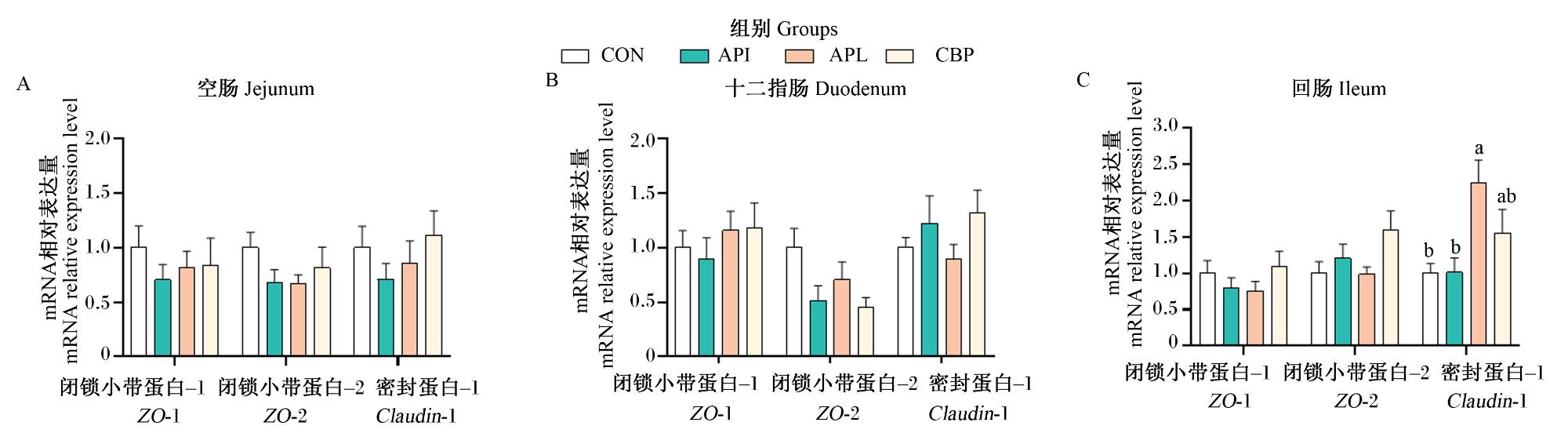
图1所示,与CON组相比,APL组肉兔回肠Claudin-1 mRNA相对表达量显著提高(P<0.05),CBP组回肠Claudin-1 mRNA相对表达量有所提高(P>0.05)。各组间空肠和十二指肠ZO-1、ZO-2和Claudin-1 mRNA相对表达量无显著差异(P>0.05)。
图1 生物蛋白API和APL单独或联合添加对肉兔肠道紧密连接相关基因表达的影响

数据柱标记不同字母表示差异显著(P<0.05)。图2同。

Fig.1 Effects of individual or combined supplementation of biological proteins API and APL on expression of genes related to intestinal tight junction of meat rabbits

Value columns with different letters indicated significant difference (P<0.05). The same as Fig.2.

2.4 生物蛋白API和APL单独或联合添加对肉兔肠道及脾脏免疫相关基因表达的影响
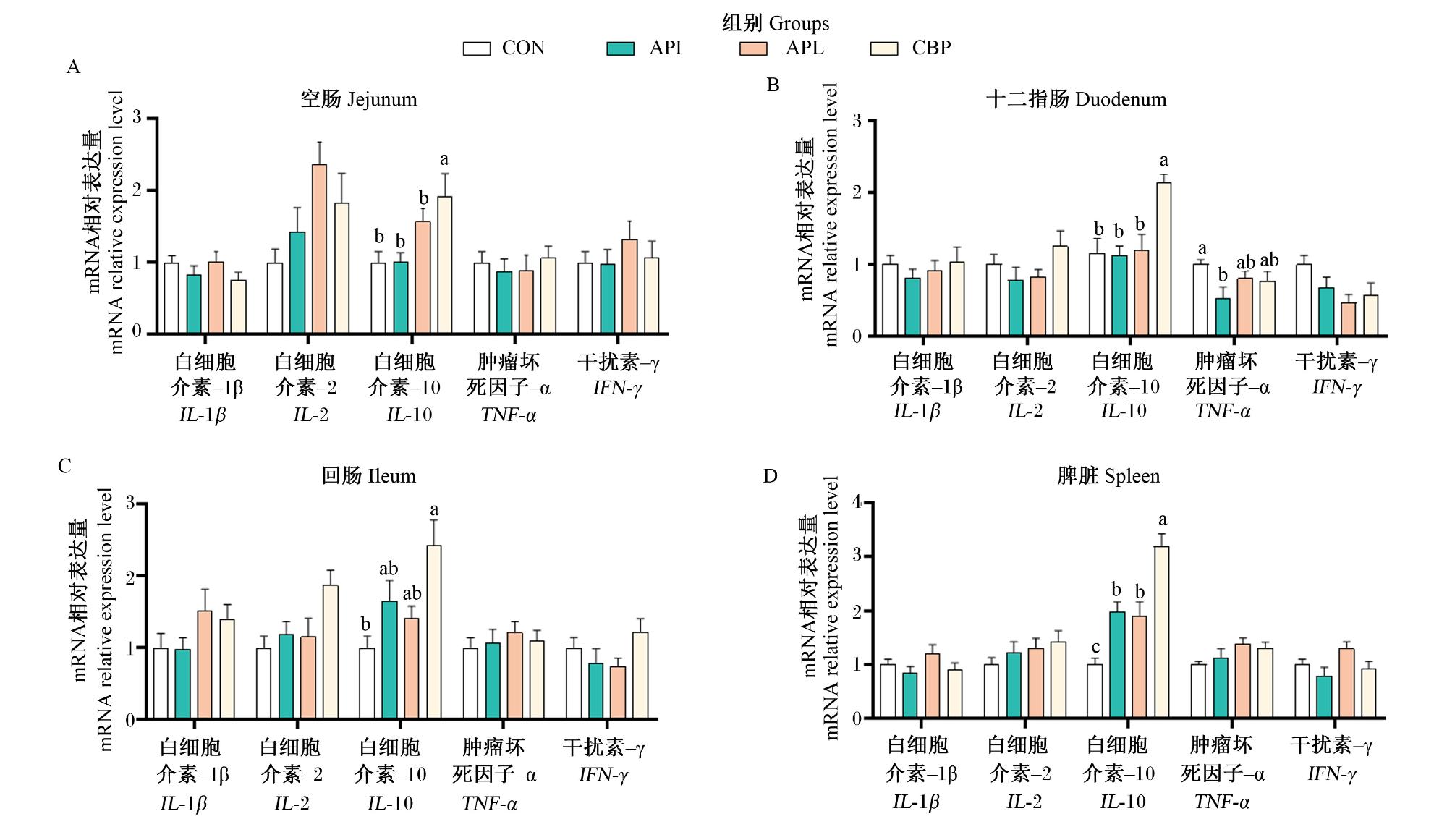
图2所示,与CON组相比,CBP组肉兔十二指肠、空肠和回肠IL-10 mRNA相对表达量均显著提高(P<0.05),API组十二指肠TNF-α mRNA相对表达量显著降低(P<0.05);API组、APL组和CBP组脾脏IL-10 mRNA相对表达量均显著提高(P<0.05),其中CBP组最高。各组间肠道和脾脏IL-1βIL-2和IFN-γ mRNA相对表达量无显著差异(P>0.05)。
图2 生物蛋白API和APL单独或联合添加对肉兔肠道及脾脏免疫相关基因表达的影响

Fig.2 Effects of individual or combined supplementation of biological proteins API and APL on expression of immune-related genes in intestine and spleen of meat rabbits

2.5 生物蛋白API和APL单独或联合添加对肉兔盲肠发酵产物和微生物数量的影响

表5所示,与CON组相比,CBP组肉兔盲肠总挥发性脂肪酸(TVFA)含量有所提高(P>0.05),APL组和CBP组盲肠总菌数量显著降低(P<0.05)。各组间盲肠大肠杆菌和乳酸杆菌数量以及NH3-N含量和各VFA比例均无显著差异(P>0.05)。
表5 生物蛋白API和APL单独或联合添加对肉兔盲肠发酵产物和微生物数量的影响

Table 5 Effects of individual or combined supplementation of biological proteins API and APL on cecal fermentation products and microbial count of meat rabbits

项目
Items
组别Groups P
P-value
CON API APL CBP
总菌Total bacteria/[lg(CFU/g)] 10.89±0.05a 10.82±0.03ab 10.71±0.03b 10.73±0.06b 0.023
大肠杆菌Escherichia coli/[lg(CFU/g)] 5.16±0.59 4.65±0.49 6.21±0.49 5.99±0.52 0.157
乳酸杆菌Lactobacillus/[lg(CFU/g)] 5.98±0.16 5.85±0.13 5.66±0.12 6.03±0.27 0.235
氨态氮NH3-N/(mmol/L) 48.38±3.80 42.72±2.10 47.09±2.77 42.57±1.36 0.315
乙酸比例Acetic acid ratio/% 78.67±1.21 77.42±0.95 75.99±1.24 75.63±1.10 0.239
丙酸比例Propionic acid ratio/% 6.98±0.35 6.41±0.69 5.93±0.39 6.34±0.56 0.563
丁酸比例Butyric acid ratio/% 14.24±1.01 15.17±1.01 16.16±1.45 17.53±0.80 0.208
总挥发性脂肪酸TVFA/(mg/g) 2.43±0.25 2.52±0.16 2.90±0.11 3.16±0.26 0.070

3 讨论

3.1 生物蛋白API和APL单独或联合添加对肉兔生长性能和健康状况的影响

抗菌肽具有改善畜禽生长性能的作用[10]。Yoon等[11]在仔猪上的研究发现,饲粮添加抗菌肽-A3可以显著提高仔猪ADG。Zhang等[12]研究发现,饲粮添加抗菌肽plectasin通过提高肉鸡ADG并降低F/G,从而改善肉鸡生长性能。API和APL是本实验室以抗菌肽为蓝本创制的生物蛋白,实验室前期在肉兔上的试验结果表明,饲粮添加API或APL改善了肉兔终末体重、ADG和F/G[8]。本试验中,饲粮单独添加API及联合添加API和APL也均显著改善了肉兔终末体重及试验后期ADG和F/G,同时联合添加API和APL还显著提高了全期ADG,表明生物蛋白API和APL改善了肉兔生长性能,且联合添加效果优于单独添加。
畜禽的健康状况常用腹泻率、死亡率和HRI来评定。Zhu等[13]研究发现,饲粮添加抗菌肽MccJ25可显著降低肉鸡死亡率;饲粮添加抗菌肽可显著降低肉兔腹泻率和死亡率[14]。本实验室前期在仔猪上的试验结果表明,饲粮添加API可显著降低产肠毒素大肠杆菌攻毒断奶仔猪腹泻率[7]。本试验中,饲粮单独添加API或APL及联合添加API和APL均降低了肉兔腹泻率、死亡率和HRI,且CBP组降低幅度最高,表明生物蛋白API和APL可以改善肉兔健康状况,且联合添加效果优于单独添加。

3.2 生物蛋白API和APL单独或联合添加对肉兔免疫功能的影响

免疫球蛋白是血液中存在的一类重要免疫分子,由B淋巴细胞分化成的浆细胞分泌,直接参与体液免疫应答,其中包括IgA、IgG和IgM等,具有识别、中和病原体以及调节免疫反应的功能[15]。Ren等[16]研究表明,饲粮添加抗菌肽可显著提高仔猪血清IgA、IgG和IgM含量;也有研究指出,在肉鸡饮水中添加鸡肠道抗菌肽同样提高了肉鸡血清IgG和IgM含量[17]。本试验中,饲粮单独添加API提高了肉兔血清IgA含量,饲粮单独添加APL提高了血清IgA和IgG含量,而饲粮联合添加API和APL同时提高了血清IgG、IgM和IgA含量。脾脏含有可分泌抗炎因子IL-10的调节性T淋巴细胞或巨噬细胞[18]。吕尊周等[19]在蛋鸡上的研究发现,饲粮添加抗菌肽上调了脾脏抗炎因子IL-2的mRNA相对表达量。本试验中,饲粮单独添加API或APL及联合添加API和APL均显著提高了肉兔脾脏IL-10 mRNA相对表达量,其中CBP组IL-10 mRNA相对表达量最高,表明饲粮添加生物蛋白API和APL可以提高肉兔免疫功能,且联合添加效果优于单独添加。

3.3 生物蛋白API和APL单独或联合添加对肉兔肠道健康的影响

3.3.1 生物蛋白API和APL单独或联合添加对肉兔肠道机械屏障的影响

肠道机械屏障的结构基础是肠黏膜上皮细胞和上皮细胞之间的紧密连接蛋白,其中包括密封蛋白(Claudin)家族和闭锁小带蛋白(ZO)家族等,它们对于维持上皮屏障的完整性具有重要意义[20-21]。Ouyang等[22]研究发现,饲粮添加天蚕素抗菌肽显著上调断奶仔猪回肠ZO-1和闭合蛋白(Occludin)mRNA相对表达量。本实验室前期研究表明,饲粮联合添加API和APL可上调肉鸡回肠Claudin-1和十二指肠黏蛋白-2(MUC-2)mRNA相对表达量[8]。本试验结果表明,饲粮单独添加APL显著提高肉兔回肠Claudin-1 mRNA相对表达量,表明饲粮添加APL可以维持肉兔肠道机械屏障的稳定性。

3.3.2 生物蛋白API和APL单独或联合添加对肉兔肠道免疫屏障的影响

肠道上皮细胞往往通过调整细胞因子、趋化因子和免疫球蛋白等免疫相关分子的分泌来维持肠道免疫功能[23-24],如促炎因子TNF-α和抗炎因子IL-10等[25-26]。Liu等[27]研究发现,饲粮添加美洲蟑螂抗菌肽下调了肉鸡肠道中促炎因子IL-1β、白细胞介素-6(IL-6)和TNF-α的mRNA相对表达量。本实验室前期在肉鸡上的研究表明,饲粮联合添加API和APL降低了十二指肠IFN-γ mRNA相对表达量,而提高了空肠IL-10 mRNA相对表达量[28]。本试验中,饲粮联合添加API和APL显著提高了肉兔十二指肠、空肠和回肠IL-10 mRNA相对表达量,饲粮单独添加API显著降低了十二指肠TNF-α mRNA相对表达量,表明生物蛋白API和APL改善了肉兔肠道免疫屏障,且联合添加效果优于单独添加。

3.3.3 生物蛋白API和APL单独或联合添加对肉兔盲肠发酵产物和微生物数量的影响

兔的盲肠与其他单胃动物相比较为发达,盲肠内容物占兔整个肠道内容物的40%,盲肠在兔的消化生理中起着重要作用[29]。家兔采食纤维素后通过盲肠微生物发酵产生的乙酸、丙酸和丁酸等VFA是兔重要的能量来源[30],盲肠微生物的组成和结构影响着这一过程,从而间接影响着兔的生长发育[31]。杜家华[32]研究发现,饲粮添加抗菌肽CC34可以提高羔羊瘤胃乙酸、丙酸和丁酸比例,同时降低胃肠道菌群多样性。本试验中,饲粮单独添加API或APL及联合添加API和APL降低了肉兔盲肠总菌数量,并且CBP组盲肠TVFA含量较CON组有所提高,但各组间盲肠NH3-N含量以及乙酸、丙酸和丁酸比例无显著差异,这与本实验室前期在兔上的研究结果[33]相似,表明生物蛋白API和APL可能对兔盲肠微生物发酵过程有益,具体作用机制有待进一步研究。

4 结论

在本试验条件下,饲粮添加生物蛋白API和APL能够提高肉兔ADG,降低HRI,改善免疫功能和肠道屏障功能,降低盲肠总菌数量,从而提高肉兔生长性能和肠道健康水平,且联合添加效果优于单独添加。
[1]
BIN HAFEEZ A, JIANG X K, BERGEN P J, et al. Antimicrobial peptides:an update on classifications and databases[J]. International Journal of Molecular Sciences, 2021, 22(21):11691.

DOI

[2]
MAHLAPUU M, BJÖRN C, EKBLOM J. Antimicrobial peptides as therapeutic agents:opportunities and challenges[J]. Critical Reviews in Biotechnology, 2020, 40(7):978-992.

DOI

[3]
UPTON M, COTTER P, TAGG J. Antimicrobial peptides as therapeutic agents[J]. International Journal of Microbiology, 2012, 2012(1):326503.

[4]
PARK I Y, PARK C B, KIM M S, et al. Parasin I,an antimicrobial peptide derived from histone H2A in the catfish,Parasilurus asotus[J]. FEBS Letters, 1998, 437(3):258-262.

DOI

[5]
SCHNEIDER T, KRUSE T, WIMMER R, et al. Plectasin,a fungal defensin,targets the bacterial cell wall precursor lipid Ⅱ[J]. Science, 2010, 328(5982):1168-1172.

DOI

[6]
ZHAO H, TANG J Y, CAO L, et al. Characterization of bioactive recombinant antimicrobial peptide parasin I fused with human lysozyme expressed in the yeast Pichia pastoris system[J]. Enzyme and Microbial Technology, 2015,77:61-67.

[7]
ZOU C Z, ZHAO W X, YIN S G, et al. Artificial parasin I protein (API) supplementation improves growth performance and intestinal health in weaned piglets challenged with enterotoxigenic Escherichia coli[J]. Animal Nutrition, 2024,18:154-165.

[8]
TANG Y T, YIN S G, PENG C F, et al. Compound bioengineering protein supplementation improves intestinal health and growth performance of broilers[J]. Poultry Science, 2023, 102(11):103037.

DOI

[9]
赵婉馨. 饲粮生物蛋白API和APL添加对肉兔生长性能和肠道健康的影响[D]. 硕士学位论文. 雅安: 四川农业大学, 2023.

ZHAO W X. Effects of bioengineering protein API and APL supplementation on growth performance and intestinal health of rabbits[D]. Master’s Thesis. Ya’an: Sichuan Agricultural University, 2023. (in Chinese)

[10]
XIAO H, SHAO F Y, WU M M, et al. The application of antimicrobial peptides as growth and health promoters for swine[J]. Journal of Animal Science and Biotechnology, 2015, 6(1):19.

DOI PMID

[11]
YOON J H, INGALE S L, KIM J S, et al. Effects of dietary supplementation of antimicrobial peptide-A3 on growth performance,nutrient digestibility,intestinal and fecal microflora and intestinal morphology in weanling pigs[J]. Animal Feed Science and Technology, 2012, 177(1/2):98-107.

DOI

[12]
ZHANG X H, ZHAO Q Q, WEN L J, et al. The effect of the antimicrobial peptide plectasin on the growth performance,intestinal health,and immune function of yellow-feathered chickens[J]. Frontiers in Veterinary Science, 2021,8:688611.

[13]
ZHU C L, BAI Y L, XIA X J, et al. Effects of the antimicrobial peptide mastoparan X on the performance,permeability and microbiota populations of broiler chickens[J]. Animals, 2022, 12(24):3462.

DOI

[14]
葛龙, 石永顺, 贺永超, 等. 噬菌体、益生菌、抗菌肽对肉兔生长性能、肠道菌群及屠宰性能的影响[J]. 饲料研究, 2022, 45(4):119-122.

GE L, SHI Y S, HE Y C, et al. Effect of bacteriophage,probiotics and antimicrobial peptides on growth performance,intestinal flora and slaughter performance of meat rabbits[J]. Feed Research, 2022, 45(4):119-122. (in Chinese)

[15]
KONG X F, YIN Y L, WU G Y, et al. Dietary supplementation with Acanthopanax senticosus extract modulates cellular and humoral immunity in weaned piglets[J]. Asian-Australasian Journal of Animal Sciences, 2007, 20(9):1453-1461.

DOI

[16]
REN Z H, YUAN W, DENG H D, et al. Effects of antibacterial peptide on cellular immunity in weaned piglets[J]. Journal of Animal Science, 2015, 93(1):127-134.

DOI PMID

[17]
YANG Y R, JIANG Y B, SHE R P, et al. Effects of chicken intestinal antimicrobial peptides on humoral immunity of chickens and antibody titres after vaccination with infectious bursal disease virus vaccine in chicken[J]. Archives of Animal Nutrition, 2006, 60(5):427-435.

PMID

[18]
BRANCHETT W J, SARAIVA M, O’GARRA A. Regulation of inflammation by interleukin-10 in the intestinal and respiratory mucosa[J]. Current Opinion in Immunology, 2024,91:102495.

[19]
吕尊周, 袁肖笑, 蔡兆伟, 等. 抗菌肽对蛋鸡血清免疫指标及脾脏白细胞介素2 mRNA表达量的影响[J]. 动物营养学报, 2011, 23(12):2183-2189.

LYU Z Z, YUAN X X, CAI Z W, et al. Effects of antimicrobial peptides on serum immune indices and IL-2 mRNA expression in spleen of laying hens[J]. Chinese Journal of Animal Nutrition, 2011, 23(12):2183-2189. (in Chinese)

[20]
CHELAKKOT C, GHIM J, RYU S H. Mechanisms regulating intestinal barrier integrity and its pathological implications[J]. Experimental & Molecular Medicine, 2018, 50(8):1-9.

[21]
FINDLEY M K, KOVAL M. Regulation and roles for claudin-family tight junction proteins[J]. IUBMB Life, 2009, 61(4):431-437.

DOI PMID

[22]
OUYANG K, CHEN T, SUN R P, et al. Effects of dietary cecropin on growth performance,diarrhea rate and intestinal health of nursery Hainan pigs[J]. Frontiers in Microbiology, 2024,15:1298703.

[23]
ANDREWS C, MCLEAN M H, DURUM S K. Cytokine tuning of intestinal epithelial function[J]. Frontiers in Immunology, 2018,9:1270.

[24]
PIETRZAK B, TOMELA K, OLEJNIK-SCHMIDT A, et al. Secretory IgA in intestinal mucosal secretions as an adaptive barrier against microbial cells[J]. International Journal of Molecular Sciences, 2020, 21(23):9254.

DOI

[25]
SARAIVA M, VIEIRA P, O’GARRA A. Biology and therapeutic potential of interleukin-10[J]. Journal of Experimental Medicine, 2020, 217(1):e20190418.

DOI

[26]
GUO H, CAO H X, LU Q, et al. TNF-α induces premature senescence in tendon stem cells via the NF-κB and p53/p21/cyclin E/CDK2 signaling pathways[J]. International Journal of Molecular Medicine, 2025, 56(3):140.

DOI

[27]
LIU T T, MA Y, CHEN S H, et al. Effects of dietary supplementation with Periplaneta americana-derived antimicrobial peptides on (PA-AMPs) growth performance,immune function,and gut health in yellow-feathered broilers[J]. Poultry Science, 2025, 104(10):105671.

DOI

[28]
YIN S G, SU L Z, SHAO Q J, et al. Compound bioengineering protein improves growth performance and intestinal health in broiler chickens under high-temperature conditions[J]. Journal of Animal Science, 2023,101:skad370.

[29]
MARTY J, VERNAY M. Absorption and metabolism of the volatile fatty acids in the hind-gut of the rabbit[J]. British Journal of Nutrition, 1984, 51(2):265-277.

PMID

[30]
XIAO J, METZLER-ZEBELI B U, ZEBELI Q. Gut function-enhancing properties and metabolic effects of dietary indigestible sugars in rodents and rabbits[J]. Nutrients, 2015, 7(10):8348-8365.

DOI PMID

[31]
BEAUMONT M, MUSSARD E, BARILLY C, et al. Developmental stage,solid food introduction,and suckling cessation differentially influence the comaturation of the gut microbiota and intestinal epithelium in rabbits[J]. The Journal of Nutrition, 2022, 152(3):723-736.

DOI

[32]
杜家华. 抗菌肽CC34工程菌粉对羔羊生长、免疫、抗氧化能力及胃肠道菌群的影响[D]. 硕士学位论文. 大庆: 黑龙江八一农垦大学, 2022.

DU J H. Effects of antimicrobial peptide CC34 engineered bacteria powder on growth,immunity,antioxidant capacity and gastrointestinal flora in lambs[D]. Master’s Thesis. Daqing: Heilongjiang Bayi Agricultural University, 2022. (in Chinese)

[33]
张莉. 抗菌蛋白API对肉兔生长性能、肠道健康及免疫的影响[D]. 硕士学位论文. 成都: 四川农业大学, 2021.

ZHANG L. Effect of antimicrobial protein API supplementation on the growth performance and intestinal health and immunity of Ira rabbits[D]. Master’s Thesis. Chengdu: Sichuan Agricultural University, 2021. (in Chinese)

文章导航

/