研究论文

磷虾油和磷虾粉对比格犬抗氧化能力、免疫调节和肠道健康的影响

  • 张媛媛 , 1 ,
  • 邵尉卿 1, * ,
  • 赵梦迪 , 2, ** ,
  • 李光玉 , 1, ** ,
  • 张超 3 ,
  • 邓志平 3
展开
  • 1 青岛农业大学动物科技学院, 青岛 266109
  • 2 山东农业大学动物科技学院, 泰安 271017
  • 3 青岛逢时宠科生物技术有限公司, 青岛 266061
** 赵梦迪,E-mail: ;
李光玉,教授,博士生导师,E-mail:

* 同等贡献作者

张媛媛(1998—),女,山东临沂人,硕士研究生,从事宠物营养调控和饲料资源开发利用研究。E-mail:

Office editor: 武海龙

收稿日期: 2025-12-10

  网络出版日期: 2026-07-14

基金资助

青岛农业大学高层次人才科研启动基金(1121021)

比格犬磷虾油及磷虾粉适宜添加量与功效评价项目(20250046)

Effects of Krill Oil and Krill Meal on Antioxidant Capacity, Immune Regulation and Intestinal Health of Beagle Dogs

  • ZHANG Yuanyuan , 1 ,
  • SHAO Weiqing 1, * ,
  • ZHAO Mengdi , 2, ** ,
  • LI Guangyu , 1, ** ,
  • ZHANG Chao 3 ,
  • DENG Zhiping 3
Expand
  • 1 College of Animal Science and Technology, Qingdao Agricultural University, Qingdao 266109, China
  • 2 College of Animal Science and Technology, Shandong Agricultural University, Tai’an 271017
  • 3 Qingdao Fengshi Pet Science Biotechnology Co., Ltd., Qingdao 266061, China
** ZHAO Mengdi, E-mail: ;
LI Guangyu, professor, E-mail:

* Contributed equally

Received date: 2025-12-10

  Online published: 2026-07-14

摘要

本试验旨在探究饲粮不同比例磷虾油和磷虾粉对比格犬抗氧化能力、免疫调节和肠道健康的影响。选取56只7~9月龄、体重为(7.20±1.09) kg的健康比格犬,随机分为7组,每组8只(公母各占1/2)。对照组(A组)饲喂不含磷虾原料的基础饲粮,试验组分别在基础饲粮中添加1.0 mL磷虾油+1.0%磷虾粉(B组)、2.0 mL磷虾油+1.0%磷虾粉(C组)、1.0 mL磷虾油+2.0%磷虾粉(D组)、2.0 mL磷虾油+2.0%磷虾粉(E组)、1.0 mL磷虾油+4.0%磷虾粉(G组)、2.0 mL磷虾油+4.0%磷虾粉(H组)。预试期7 d,正试期28 d。结果表明:与A组相比,1)D、E、G和H组血清超氧化物歧化酶(SOD)和谷胱甘肽过氧化物酶(GSH-Px)活性显著升高(P<0.05);2)E和G组血清总蛋白(TP)和球蛋白(GLOB)含量显著升高(P<0.05);3)E、G和H组血清免疫球蛋白A(IgA)、免疫球蛋白G(IgG)和免疫球蛋白M(IgM)含量显著升高(P<0.05);4)C、D、E、G和H组血清白细胞介素-10(IL-10)含量显著升高(P<0.05),E、G和H组血清白细胞介素-1β(IL-1β)含量显著降低(P<0.05);5)D和H组血清D-乳酸(D-LA)含量显著降低(P<0.05);6)B、C、D、E、G和H组粪便微生物Simpson指数显著增加(P<0.05),乳酸杆菌属和双歧杆菌属相对丰度有所增加。综上所述,饲粮中添加磷虾油和磷虾粉可提高比格犬抗氧化能力、抗炎能力和免疫功能,改善肠道屏障功能和肠道健康。本试验条件下,饲粮中添加2.0 mL磷虾油+2.0%磷虾粉、1.0 mL磷虾油+4.0%磷虾粉及2.0 mL磷虾油+4.0%磷虾粉时效果较好。

本文引用格式

张媛媛 , 邵尉卿 , 赵梦迪 , 李光玉 , 张超 , 邓志平 . 磷虾油和磷虾粉对比格犬抗氧化能力、免疫调节和肠道健康的影响[J]. 动物营养学报, 2026 , 38(7) : 5375 -5387 . DOI: 10.12418/CJAN2026.430

Abstract

The aim of this experiment was to investigate the effects of dietary different proportions of krill oil and krill meal on antioxidant capacity, immune regulation and intestinal health of Beagle dogs. Fifty-six 7 to 9-month-old healthy Beagle dogs with body weight of (7.20±1.09) kg were selected and randomly divided into 7 groups with 8 dogs in each group (half male and half female). The control group (group A) was fed a basal diet without krill ingredients, and the experimental groups were fed basal diets supplemented with 1.0 mL krill oil+1.0% krill meal (group B), 2.0 mL krill oil+1.0% krill meal (group C), 1.0 mL krill oil+2.0% krill meal (group D), 2.0 mL krill oil+2.0% krill meal (group E), 1.0 mL krill oil+4.0% krill meal (group G) and 2.0 mL krill oil+4.0% krill meal (group H). The pre-experimental period lasted for 7 days, and the experimental period lasted for 28 days. The results showed that compared with the control group: 1) the serum superoxide dismutase (SOD) and glutathione peroxidase (GSH-Px) activities of groups D, E, G and H were significantly increased (P<0.05); 2) the serum total protein (TP) and globulin (GLOB) contents of groups E and G were significantly increased (P<0.05); 3) the serum immunoglobulin A (IgA), immunoglobulin G (IgG) and immunoglobulin M (IgM) contents of groups E, G and H were significantly increased (P<0.05); 4) the serum interleukin-10 (IL-10) content of groups C, D, E, G and H was significantly increased (P<0.05), while the serum interleukin-1β (IL-1β) content of groups E, G and H was significantly decreased (P<0.05); 5) the serum D-lactic acid (D-LA) content of groups D and H was significantly decreased (P<0.05); 6) the fecal microbiota Simpson index of groups B, C, D, E, G and H was significantly increased (P<0.05), and the relative abundances of Lactobacillus and Bifidobacterium were increased. In summary, dietary supplemented with krill oil and krill meal can enhance the antioxidant capacity, anti-inflammatory capacity and immune function of Beagle dogs, and improve the intestinal barrier function and intestinal health. Under the conditions of this experiment, dietary 2.0 mL krill oil+2.0% krill meal, 1.0 mL krill oil+4.0% krill meal and 2.0 mL krill oil+4.0% krill meal have better effects.

人类与宠物的关系日益密切,多数宠物主人将宠物视为家庭成员或朋友,宠物拟人化倾向已非常普遍[1]。人们对维持和改善宠物健康的兴趣逐步增加,除了给宠物提供清洁安全的环境外,还努力为宠物提供高质量饮食。因此,许多能够调节新陈代谢、优化营养和健康的功能性宠物食品或原料成为研究热点[2]。南极磷虾是南极海洋的甲壳类动物,生物总量高达数10亿t,是世界上最丰富的生物之一[3]。磷虾油从南极磷虾中提取获得,富含n-3多不饱和脂肪酸,如二十二碳六烯酸(DHA)、二十碳五烯酸(EPA),同时富含磷脂、虾青素、维生素A、维生素E[4]。目前,磷虾油已被证明具有抗炎、抗氧化、调节血脂、神经保护及调节肠道菌群等多种生物学功能[5-6]。磷虾粉中蛋白质含量可达60%以上,并且氨基酸组成均衡,同时也含有丰富的n-3多不饱和脂肪酸、矿物质、几丁质和虾青素等成分,被认为是一种优质的饲料原料[7-8]
Meng等[9]研究表明,磷虾油通过降低活性氧产生来提高小鼠抗氧化能力,减少小鼠肝脏氧化损伤。Zhou等[10]研究表明,磷虾脂质可以降低促炎细胞因子肿瘤坏死因子-α(TNF-α)和白细胞介素-6(IL-6)含量。体外试验表明,磷虾油具有通过改善肠道上皮细胞间黏附和黏膜愈合从而改善肠道屏障的潜力[11]。此外,饲粮补充磷虾油和磷虾粉等南极磷虾产品具有调节动物肠道菌群组成和提高动物免疫力的功能[12-13]。因此,磷虾油和磷虾粉具有多种生物学功能,进而被众多宠物主选择。根据2025年《中国宠物分阶喂养与营养需求白皮书》数据显示,有46.1%宠物主给宠物饲喂过鱼油或磷虾油类的营养补充剂。然而,目前关于磷虾油和磷虾粉在犬食品中的应用多聚焦于单一产品,尚未系统探究磷虾油和磷虾粉的比例协同效应或者竞争关系,以及明确二者适宜配比。因此,本研究旨在探究饲粮中添加不同比例磷虾油和磷虾粉对比格犬抗氧化能力、免疫调节和肠道健康的影响,探究磷虾油和磷虾粉适宜配比,为其在犬食品中合理高效应用提供参考依据。

1 材料与方法

1.1 试验材料

磷虾油的磷脂含量为42.58%,EPA含量为11.01%,DHA含量为6.64%。
磷虾粉的水分含量为4.96%,粗蛋白质含量为55.34%,粗脂肪含量为25.61%,粗灰分含量为10.74%,磷脂含量为56.00%,EPA含量为17.00%,DHA含量为8.00%。

1.2 试验设计和饲养管理

试验动物由青岛农业大学实验动物伦理委员会批准(批准号:DKY2025012)。选取56只7~9月龄、体重为(7.20±1.09) kg的健康比格犬,随机分为7组,每组8只(公母各占1/2)。对照组(A组)饲喂不含磷虾原料的基础饲粮,试验组分别在基础饲粮中添加1.0 mL磷虾油+1.0%磷虾粉(B组)、2.0 mL磷虾油+1.0%磷虾粉(C组)、1.0 mL磷虾油+2.0%磷虾粉(D组)、2.0 mL磷虾油+2.0%磷虾粉(E组)、1.0 mL磷虾油+4.0%磷虾粉(G组)、2.0 mL磷虾油+4.0%磷虾粉(H组)。参考NRC(2006)犬猫营养需要和美国饲料管理协会(AAFCO)提供的犬营养需要配制基础饲粮,其组成及营养水平见表1,基础饲粮中添加磷虾粉和磷虾油后试验组饲粮主要营养成分含量见表2。预试期7 d,正试期28 d。试验期间每天观察犬的活动状态,根据每只犬体重的代谢能量需要量以及之前的饲喂记录计算饲喂量,分别在08:00和17:00进行饲喂,自由饮水。
表1 基础饲粮组成及营养水平(风干基础)

Table 1 Composition and nutrient levels of the basal diet (air-dry basis) %

原料Ingredients 含量Content 营养水平Nutrient levels2) 含量Content
膨化玉米Puffed corn 40.00 水分Moisture 8.19
膨化豆粕Puffed soybean meal 13.00 粗蛋白质CP 22.26
膨化小麦粉Puffed wheat flour 13.00 粗脂肪EE 5.33
麦麸Wheat bran 10.00 粗灰分Ash 5.81
鸡肉粉Chicken meal 10.00 碳水化合物CHO 54.50
肉骨粉Meat and bone meal 9.00 粗纤维CF 3.91
豆油Soybean oil 2.00 钙Ca 0.81
磷酸氢钙CaHPO4 0.80 总磷TP 0.76
石粉Limestone 0.10 赖氨酸Lys 1.34
赖氨酸Lys 0.60 蛋氨酸+胱氨酸Met+Cys 0.98
蛋氨酸Met 0.50 代谢能ME/(MJ/kg) 14.69
预混料Premix1) 1.00
合计Total 100.00

1)每千克预混料含有 One kilogram of the premix contained the following:VA 625 000 IU,VD3 100 000 IU,VE 6 000 IU,VK3 200 mg,VB1 1 250 mg,VB2 900 mg,VB6 750 mg,VB12 2.25 mg,生物素 biotin 10 mg,叶酸 folic acid 150 mg,烟酸 nicotinic acid 2 500 mg,泛酸钙 calcium pantothenate 1 750 mg,VC 10 050 mg,胆碱 choline 240 000 mg,Fe 9 600 mg,Cu 1 800 mg,Zn 7 800 mg,Mn 4 800 mg,I 144 mg,Co 24 mg,Se 30 mg。

2)代谢能和碳水化合物为计算值,其他营养水平为实测值。ME and CHO were calculated values, while the other nutrient levels were measured values.

表2 基础饲粮中添加磷虾粉和磷虾油后试验组饲粮主要营养成分含量

Table 2 Main nutrient contents of diets of experimental groups after adding krill meal and krill oil in basal diet %

项目
Items
粗蛋白质
CP
粗脂肪
EE
粗灰分
Ash
二十二碳六烯酸
EPA
二十碳五烯酸
DHA
B组Group B 22.37 5.65 5.80 0.28 0.14
C组Group C 22.37 5.65 5.80 0.39 0.21
D组Group D 22.69 5.85 5.85 0.45 0.22
E组Group E 21.39 5.97 5.79 0.55 0.29
G组Group G 23.35 6.26 5.95 0.78 0.38
H组Group H 23.12 6.37 5.89 0.88 0.44

1.3 样品采集

试验第28天早上晨饲前用一次性负压采血管采集犬前肢静脉血5 mL于促凝管中,静止30 min后464×g离心10 min,收集血清,然后置于-80 ℃保存待测。收集10 g新鲜粪便置于冻存管中,立即放入液氮速冻,然后置于-80 ℃保存待测。

1.4 指标测定

1.4.1 饲粮营养成分

根据国标方法对饲粮水分(GB/T 6432—2018)、粗蛋白质(GB/T 6432—2018)、粗脂肪(GB/T 6433—2006)、粗灰分(GB/T 6438—2007)、粗纤维(GB/T 6434—2022)、氨基酸(GB/T 18264—2019)、钙(GB/T 6436—2018)、总磷(GB/T 6437—2018)含量进行测定。碳水化合物=100-水分-粗蛋白质-粗脂肪-粗灰分-粗纤维,代谢能参考NRC(2006)[14]进行计算。

1.4.2 血清抗氧化指标

使用生化试剂盒(苏州格锐思生物科技有限公司)测定血清超氧化物歧化酶(SOD)、谷胱甘肽过氧化物酶(GSH-Px)和过氧化氢酶(CAT)活性及丙二醛(MDA)含量。

1.4.3 血清蛋白和免疫指标

使用生化试剂盒(南京建成科技有限公司)测定血清总蛋白(TP)、球蛋白(GLOB)、尿蛋白(PRO)含量,使用酶联免疫吸附测定法(ELISA)试剂盒(江苏酶免实业有限公司)测定血清免疫球蛋白A(IgA)、免疫球蛋白G(IgG)和免疫球蛋白M(IgM)含量。

1.4.4 血清炎症因子含量

使用ELISA试剂盒(江苏酶免实业有限公司)测定血清促炎细胞因子TNF-α、白细胞介素-1β(IL-1β)、IL-6和抗炎细胞因子白细胞介素-10(IL-10)含量。

1.4.5 血清肠道屏障标志物含量

使用试剂盒(苏州格锐思生物科技有限公司)测定血清总胆汁酸(TBA)、二胺氧化酶(DAO)和D-乳酸(D-LA)含量。

1.4.6 粪便微生物组成

提取粪便基因组DNA,然后使用琼脂糖凝胶电泳检测DNA的纯度和浓度,随后取适量DNA于离心管中,并用无菌水稀释至1 ng/μL。以稀释后的DNA为模板进行PCR扩增,扩增产物进行琼脂糖凝胶电泳检测,并对目的条带进行胶回收。然后进行文库构建,构建好的文库进行Qubit和PCR定量,文库检测合格后使用NovaSeq 6000进行上机测序。测序得到的下机数据使用FLASH 1.2.11软件对样本的reads进行拼接[15]。随后用Fastp 0.23.1软件进行质控后使用Usearch 2.21.4软件去除嵌合体,获得最终有效数据[16]。最后使用QIIME2-202202软件对有效数据进行过滤、降噪,得到最终的扩增子序列变异(ASVs)和特征表,进行物种注释和多样性分析[17-18]

1.5 数据统计分析

使用Excel 2019进行数据记录整理,采用SPSS 26.0统计软件进行单因素方差分析和Duncan氏法多重比较,结果以“平均值±标准差”表示,P<0.05表示有显著差异。

2 结果

2.1 饲粮不同比例磷虾油和磷虾粉对比格犬血清抗氧化指标的影响

表3所示,D、E、G和H组血清SOD活性显著高于A和B组(P<0.05),D、E、G和H组血清GSH-Px活性显著高于A组(P<0.05)。各组之间血清CAT活性和MDA含量无显著差异(P>0.05)。
表3 饲粮不同比例磷虾油和磷虾粉对比格犬血清抗氧化指标的影响

Table 3 Effects of dietary different proportions of krill oil and krill meal on serum antioxidant indices of Beagle dogs

项目
Items
超氧化物歧化酶
SOD/(U/mL)
谷胱甘肽过氧化物酶
GSH-Px/(U/mL)
过氧化氢酶
CAT/(U/mL)
丙二醛
MDA/(nmol/mL)
组别Groups
A 39.23±11.09c 308.51±5.01c 32.16±19.82 1.55±0.27
B 54.20±37.54c 310.21±2.58bc 44.55±31.16 1.64±0.21
C 64.87±20.05bc 311.54±2.46abc 48.11±7.86 1.99±0.37
D 90.68±35.57ab 312.15±2.19ab 58.38±8.39 1.77±0.18
E 95.52±17.77ab 313.24±0.80ab 54.20±18.17 2.00±0.57
G 95.06±13.67ab 314.21±1.57a 56.85±22.82 1.78±0.42
H 120.93±51.50a 312.87±0.76ab 52.93±6.98 1.49±0.26
PP-value <0.001 0.009 0.227 0.102

2.2 饲粮不同比例磷虾油和磷虾粉对比格犬血清蛋白指标影响

表4所示,E和G组血清TP含量显著高于A、B、C和D组(P<0.05),E和G组血清GLOB含量显著高于A、B、C、D和H组(P<0.05)。各组之间血清PRO含量无显著差异(P>0.05)。
表4 饲粮不同比例磷虾油和磷虾粉对比格犬血清蛋白指标的影响

Table 4 Effects of dietary different proportions of krill oil and krill meal on serum protein indices of Beagle dogs g/L

项目Items 总蛋白TP 球蛋白GLOB 尿蛋白PRO
组别Groups
A 99.13±30.19c 62.27±30.89c 98.39±10.87
B 97.60±20.77c 60.33±20.43c 95.17±12.86
C 123.07±29.63bc 83.12±35.11c 94.12±14.52
D 124.27±10.56bc 87.84±8.26bc 85.80±12.68
E 185.77±17.48a 148.23±15.18a 88.77±10.77
G 163.59±46.31a 126.38±47.72a 91.86±4.89
H 159.49±26.49ab 122.64±32.48b 87.46±13.59
PP-value <0.001 <0.001 0.061

2.3 饲粮不同比例磷虾油和磷虾粉对比格犬血清免疫指标影响

表5所示,G组血清IgA和IgG含量均为最高,G组血清IgA含量显著高于A、B和C组(P<0.05),G组血清IgG含量显著高于A、B、C和D组(P<0.05);H组血清IgM含量最高,显著高于A、B、C组(P<0.05)。
表5 饲粮不同比例磷虾油和磷虾粉对比格犬血清免疫指标的影响

Table 5 Effects of dietary different proportions of krill oil and krill meal on serum immune indices of Beagle dogs μg/mL

项目Items 免疫球蛋白A IgA 免疫球蛋白G IgG 免疫球蛋白M IgM
组别Groups
A 11.58±2.29c 211.09±54.22bc 3.28±1.47c
B 13.52±1.37bc 203.23±31.76c 4.08±1.80bc
C 13.57±1.95bc 227.75±18.44bc 4.06±1.07bc
D 14.71±2.11abc 212.03±26.96bc 4.96±0.96ab
E 15.78±2.82ab 254.96±25.90ab 5.28±0.48ab
G 17.87±4.67a 277.91±19.44a 5.34±0.76ab
H 15.89±2.17ab 255.58±68.40ab 5.77±1.10a
PP-value 0.008 0.014 0.008

2.4 饲粮不同比例磷虾油和磷虾粉对比格犬血清炎症因子含量的影响

表6所示,E、G和H组血清IL-1β含量显著低于A组(P<0.05),C、D、E、G和H组血清IL-10含量显著高于A组(P<0.05)。各组之间血清TNF-α和IL-6含量无显著差异(P>0.05)。
表6 饲粮不同比例磷虾油和磷虾粉对比格犬炎症因子含量的影响

Table 6 Effects of dietary different proportions of krill oil and krill meal on serum inflammatory factor contents of Beagle dogs

项目
Items
肿瘤坏死因子-α
TNF-α/(pg/mL)
白细胞介素-1β
IL-1β/(ng/L)
白细胞介素-6
IL-6/(pg/mL)
白细胞介素-10
IL-10/(ng/L)
组别Groups
A 66.52±28.94 53.17±21.08a 305.81±18.15 226.92±14.71c
B 55.64±7.63 42.14±12.15ab 252.36±39.23 241.51±12.10bc
C 53.18±5.73 39.13±13.57ab 306.02±38.49 258.33±23.76ab
D 59.05±6.33 39.44±7.47ab 306.22±33.22 264.74±21.11ab
E 55.90±15.40 36.90±6.89b 268.21±11.00 264.42±10.79ab
G 52.78±6.70 35.04±3.70b 255.00±21.49 272.92±29.69a
H 41.35±13.56 28.61±5.17b 235.28±29.83 272.28±23.01a
PP-value 0.154 0.036 0.454 0.003

2.5 饲粮不同比例磷虾油和磷虾粉对比格犬血清肠道屏障标志物含量的影响

表7所示,D和H组血清D-LA含量显著低于A、B和C组(P<0.05)。各组之间血清TBA和DAO含量无显著差异(P>0.05)。
表7 饲粮不同比例磷虾油和磷虾粉对比格犬血清肠道屏障标志物含量的影响

Table 7 Effects of dietary different proportions of krill oil and krill meal on serum intestinal barrier marker contents of Beagle dogs

项目
Items
总胆汁酸
TBA/(μmol/L)
二胺氧化酶
DAO/(nmol/mL)
D-乳酸
D-LA/(μg/L)
组别Groups
A 4.28±2.82 0.81±0.19 24.44±7.42a
B 3.54±3.25 0.75±0.50 20.46±3.22ab
C 2.40±1.37 0.69±0.16 20.65±2.92ab
D 3.42±2.13 0.50±0.24 14.65±4.21c
E 3.60±2.15 0.67±0.21 15.71±3.86bc
G 3.03±1.13 0.64±0.19 16.50±1.22bc
H 2.68±1.94 0.56±0.27 12.19±5.88c
PP-value 0.816 0.512 0.001

2.6 饲粮不同比例磷虾油和磷虾粉对比格犬粪便微生物组成的影响

2.6.1 α多样性
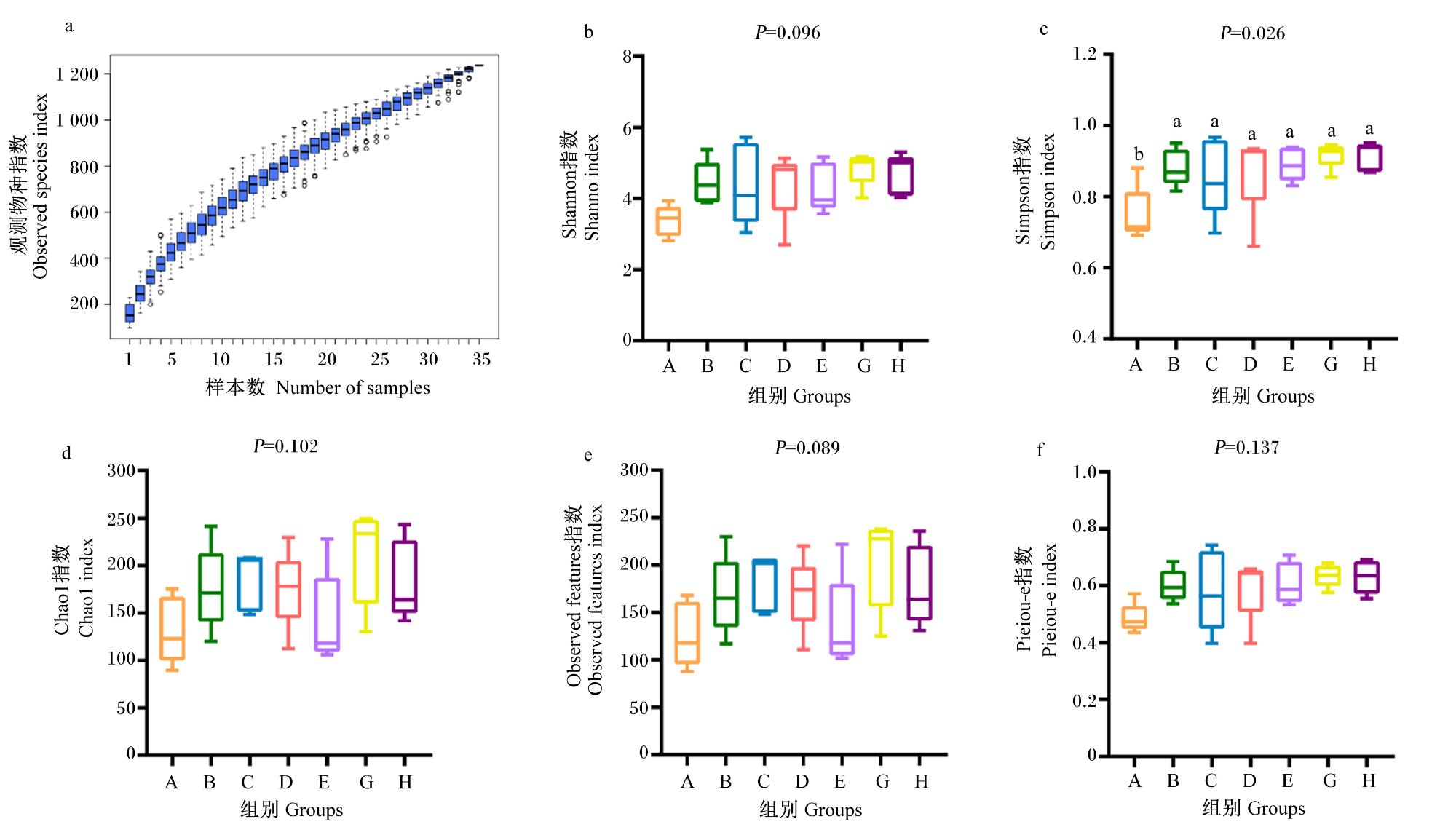
图1所示,物种累积曲线逐渐趋向平坦,说明在此环境中物种不会随样本量的增加而显著增多,样本量充分,可进行数据分析。α多样性指数分析结果显示,B、C、D、E、G和H组Simpson指数显著高于A组(P<0.05),各组之间Shannon指数、Chao1指数、Observed features指数、Pieiou-e指数无显著差异(P>0.05)。
图1 比格犬粪便微生物α多样性

数据柱标相同小写字母或无字母表示差异不显著(P>0.05),不同小写字母表示差异显著(P<0.05)。

Fig.1 Fecal microbial α diversity of Beagle dogs

Value columns with the same small letter or no letter mean no significant difference (P>0.05), while with different small letters mean significant difference (P<0.05).

2.6.2 β多样性

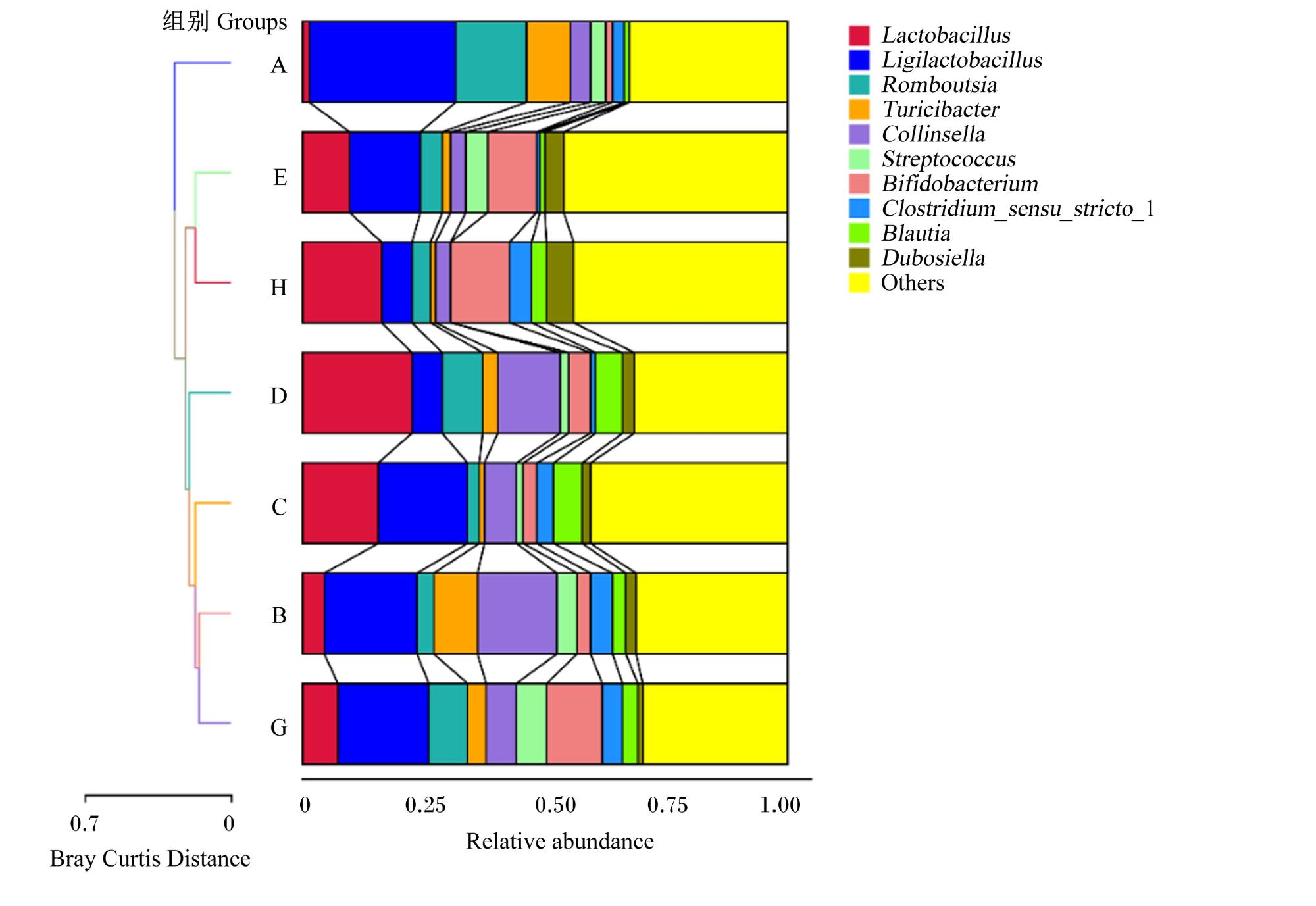
非加权组平均法(UPGMA)聚类分析是β多样性分析的一种,通过对样本进行聚类分析,构建属水平聚类树。如图2所示,A组与其他各组之间相比,单独为一个分支,说明A组与其他各组在微生物组成上差异较大,各自聚类。
图2 基于Bray-Curtis距离的属水平UPGMA聚类树

Bray Curtis Distance:Bray-Curtis距离;Relative abundance:相对丰度;Lactobacillus:乳杆菌属;Ligilactobacillus:联合乳杆菌属;Romboutsia:罗姆布茨菌属;Turicibacter:苏黎世杆菌属;Collinsella:柯林斯菌属;Streptococcus:链球菌属;Bifidobacterium:双歧杆菌属;Clostridium_sensu_stricto_1:狭义梭菌属1;Blautia:经黏液真杆菌属;Dubosiella:杜伯氏菌属;Others:其他。

Fig.2 Genus-level UPGMA clustering tree based on Bray-Curtis distance

2.6.3 物种组成

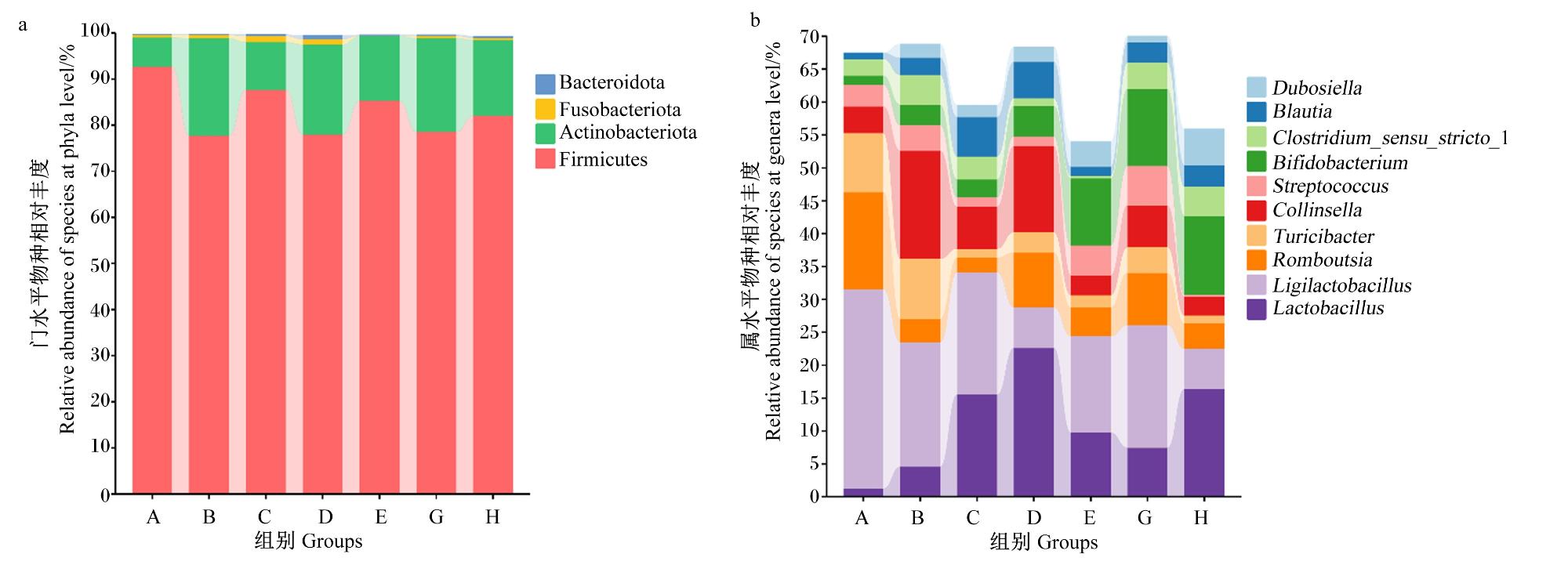
图3所示,在门水平上,各组的优势菌门主要为厚壁菌门(Firmicutes)和放线菌门(Actinobacteria),二者均为比格犬肠道的优势菌门。在属水平上,各组的优势菌属主要为乳杆菌属(Lactobacillus)、联合乳杆菌属(Ligilactobacillus)、罗姆布茨菌属(Romboutsia)、双歧杆菌属(Bifidobacterium)、柯林斯菌属(Collinsella)、苏黎世杆菌属(Turicibacter)等。与A组相比,其他各组乳杆菌属和双歧杆菌属相对丰度有所增加,罗姆布茨菌属相对丰度有所降低。
图3 比格犬粪便微生物物种组成

Firmicutes:厚壁菌门;Actinobacteriota:放线菌门;Fusobacteriota:梭杆菌门;Bacteroidota:拟杆菌门;Lactobacillus:乳杆菌属;Ligilactobacillus:联合乳杆菌属;Romboutsia:罗姆布茨菌属;Turicibacter:苏黎世杆菌属;Collinsella:柯林斯菌属;Streptococcus:链球菌属;Bifidobacterium:双歧杆菌属;Clostridium_sensu_stricto_1:狭义梭菌属1;Blautia:经黏液真杆菌属;Dubosiella:杜伯氏菌属。

Fig.3 Fecal microbial species composition of Beagle dogs

2.6.4 线性判别分析效应大小(LEfSe)分析

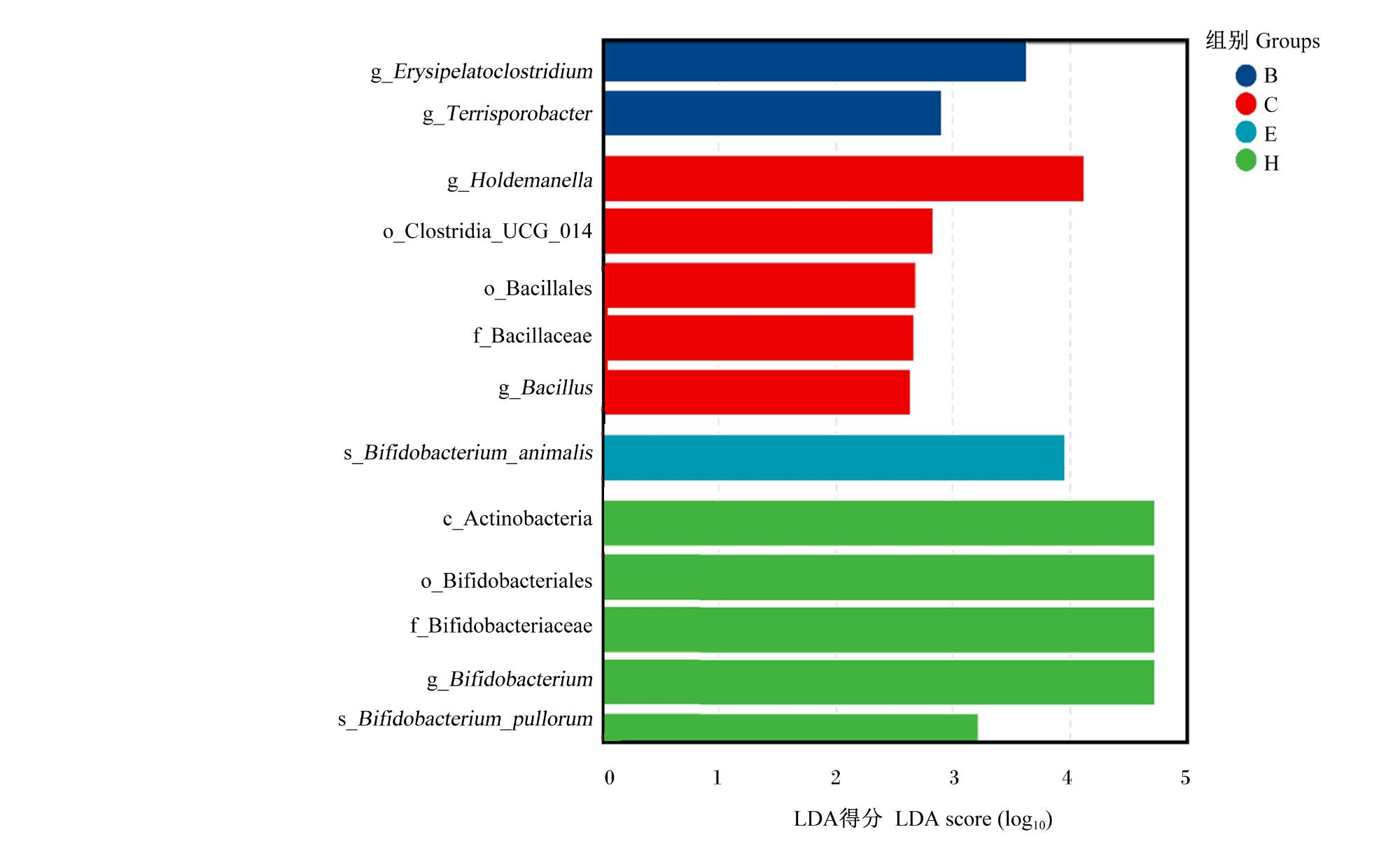
图4所示,以线性判别分析(LDA)得分≥2.5为标准,E、H组的显著生物标志物为动物双歧杆菌(Bifidobacterium_animalis)、双歧杆菌目(Bifidobacteriales)、双歧杆菌科(Bifidobacteriaceae)、双歧杆菌属、小鸡双歧杆菌(Bifidobacterium_pullorum);C组的显著生物标志物为芽孢杆菌目(Bacillales)、芽孢杆菌科(Bacillaceae)、芽孢杆菌属(Bacillus)。
图4 比格犬粪便微生物LEfSe分析

Erysipelatoclostridium:丹毒丝菌属;Terrisporobacter:土孢杆菌属:Holdemanella:霍尔德曼氏菌属:Clostridia_UCG_014:梭菌目UCG_014;Bacillales:芽孢杆菌目;Bacillaceae:芽孢杆菌科;Bacillus:芽孢杆菌属;Bifidobacterium_animalis:动物双歧杆菌;Actinobacteria:放线菌纲;Bifidobacteriales:双歧杆菌目;Bifidobacteriaceae:双歧杆菌科;Bifidobacterium:双歧杆菌属;Bifidobacterium_pullorum:小鸡双歧杆菌。

Fig.4 Fecal microbial LEfSe analysis of Beagle dogs

3 讨论

3.1 饲粮不同比例磷虾油和磷虾粉对比格犬抗氧化能力的影响

氧化应激是由活性氧和活性氮的积累引起的,会对动物的生长和健康构成威胁[19-20]。环境、温度、运动和竞争的变化会给犬带来压力,导致犬代谢和氧化应激疾病的发生[21]。因此,平衡有害自由基产生的氧化应激与代谢产生的保护性抗氧化分子之间的平衡至关重要。抗氧化酶SOD、GSH-Px、CAT等是血液抗氧化能力评估的常用指标[22-23]。本研究结果表明,D、E、G、H组比格犬血清SOD和GSH-Px活性显著高于A组,说明饲粮添加一定比例的磷虾油和磷虾粉会减少氧化应激反应,提高犬的抗氧化能力。先前已有研究表明,磷虾油和磷虾粉中的EPA、DHA和虾青素具有天然抗氧化剂的作用[3]。Wang等[24]研究发现,补充市售磷虾油零食能够显著提高犬血清SOD、CAT、GSH-Px活性和降低MDA含量。李辉等[25]研究发现,衰老模型小鼠补充磷虾油30 d可显著提高小鼠血清SOD、GSH-Px活性,提高衰老小鼠的抗氧化能力。因此,这些研究为磷虾油和磷虾粉作为犬饲粮的天然抗氧化剂奠定基础。

3.2 饲粮不同比例磷虾油和磷虾粉对比格犬炎症和免疫调节的影响

由于n-3多不饱和脂肪酸具有抑制炎症因子和调节T细胞反应的功能,因此磷虾油在多种物种中表现出抗炎特性[26]。Zhou等[10]研究表明,磷虾油中纯化的脂质可以通过阻断核因子-κB(NF-κB)信号通路,并以剂量依赖性显著降低细胞TNF-α和IL-6含量。Wang等[24]在给犬补充磷虾油发现,血清TNF-α、IL-1β和白细胞介素-8(IL-8)含量分别降低了50.86%、18.45%和33.55%。本研究也得到类似结果,比格犬血清中促炎因子IL-1β含量根据磷虾油和磷虾粉添加量以剂量依赖性降低,反之抗炎因子IL-10含量以剂量依赖性增加。磷虾油和磷虾粉在犬关节炎、运动犬赛后炎症降低方面也表现出抗炎效果[27-28]。此外,免疫系统作为机体重要的防御系统,在清除外来病原体,保护机体免受感染和疾病侵害方面发挥重要作用[29]。血清GLOB含量反映机体的免疫能力,其中免疫球蛋白是动物体液免疫的关键因素,IgG占血液免疫球蛋白的75%,具有抗菌、抗病毒和免疫调节功能,IgA是黏膜免疫系统的主要抗体,IgM是体液免疫反应中出现的第1种抗体,以多种不同的形式存在识别抗体调节免疫反应[30-32]。本研究中,与A组相比,E、G、H组比格犬血清IgG、IgA和IgM含量显著增加,反映了补充磷虾油和磷虾粉对比格犬免疫系统的有益影响。研究表明,n-3多不饱和脂肪酸,特别是EPA和DHA可通过调节T细胞和B细胞等免疫细胞功能、膜流动性和信号传导过程,增强免疫反应并减少炎症[33]。综上所述,磷虾油和磷虾粉可以调节比格犬的炎症反应和免疫功能,提高免疫力。

3.3 饲粮不同比例磷虾油和磷虾粉对比格犬肠道健康的影响

肠道屏障被认为是最重要的保护屏障之一,肠道屏障受损或功能障碍可能会导致炎症性肠病、溃疡性结肠炎等多种疾病的发生[34]。已有多项关于磷虾通过改善肠道屏障功能促进肠道健康的报道[35-36]。胆汁酸在肠上皮细胞更新、肠道黏液层保护以及肠道菌群调节方面发挥关键作用,肠道屏障破坏会导致胆汁酸大量进入血液循环,从而使血清中胆汁酸含量升高[37]。DAO是一种肠黏膜绒毛表达的细胞内酶,当肠道屏障完整性受到破坏时,DAO穿过小肠黏膜进入血液[38]。肠道中的某些细菌发酵碳水化合物产生D-LA,生态失调的情况下,D-LA的产生会增加穿过肠道屏障在血液中积累,而D-LA过度积累可能会导致代谢性酸中毒,因此D-LA常作为肠道完整性标志物。本研究中,各组之间血清TBA和DAO含量无显著差异,而D和H组比格犬血清D-LA含量较A组显著降低,说明磷虾油和磷虾粉可能具有改善肠道屏障功能的潜力。
肠道菌群通过调节新陈代谢和防御病原体来调节宿主的生理功能[38]。厚壁菌门、放线菌门、梭菌门、拟杆菌门和变形菌门在犬肠道中占主导地位[39]。同样,本研究中比格犬粪便优势菌门为厚壁菌门和放线菌门。厚壁菌门和放线菌门可以参与维持肠道免疫稳态,改善动物健康[40]。本研究中,比格犬粪便中占比最多的菌属是乳酸杆菌属。乳酸杆菌属一直以来被认为是肠道益生菌,在维持肠道稳态和减少病原菌定植方面发挥关键作用[41]。此外,本研究中B、C、D、E、G和H组比格犬α多样性Simpson指数均显著高于A组,β多样性中A组与试验组各自聚类,说明磷虾油和磷虾粉可以提高肠道菌群多样性和丰富度,改变粪便微生物群的物种组成。LEfSe分析表明,E和H组的显著生物标志物为双歧杆菌,C组的显著生物标志物为芽孢杆菌。双歧杆菌是肠道中最常见的益生菌之一,具有产生抗菌剂、合成维生素B、增强肠道免疫力和抑制促炎因子分泌缓解肠道炎症的功能[42-43]。Strompfová等[44]研究发现,双歧杆菌能够降低健康比格犬粪便中大肠杆菌数量并增加白细胞的吞噬作用。据报道,饲粮补充枯草芽孢杆菌可改善犬粪便质量,增加肠道短链脂肪酸含量,改善肠道菌群组成和缓解肠道炎症[45-47]。因此,磷虾油和磷虾粉可能通过改善肠道菌群来调节肠道免疫功能和屏障功能。
磷虾油与磷虾粉的添加在提升比格犬抗氧化能力、免疫功能和肠道健康方面具有一定积极作用。然而,由于额外添加磷虾油和磷虾粉后,各组饲粮的营养水平未完全实现等营养控制,导致不同组之间在蛋白质、脂肪等营养成分摄入量上可能存在一定差异。因此,本研究观察到的效果除与磷虾油和磷虾粉的添加比例这一主要因素有关外,也可能受到饲粮营养组成轻微变化的影响,从而在一定程度上限制了对2种原料独立效应及其交互作用的精确解析。针对上述不足,在未来研究中,计划采用等营养配比设计,严格控制各组饲粮的营养水平保持一致,结合营养物质的实际摄入量等数据进行分析,从而更准确地评估磷虾油和磷虾粉各自的独立效应及其交互作用,进一步验证磷虾粉替代磷虾油的可行性与成本优势,为磷虾粉在宠物食品中的应用提供更加严谨的科学依据。

4 结论

饲粮添加不同比例磷虾油和磷虾粉能够通过提高血清SOD和GSH-Px活性,提高比格犬抗氧化能力;通过降低促炎细胞因子IL-1β含量和增加抗炎细胞因子IL-10含量,以及提高血清免疫球蛋白含量以降低机体炎症,提高比格犬免疫功能;通过改善肠道屏障功能、调节粪便微生物组成,增加双歧杆菌和芽孢杆菌等益生菌数量,促进比格犬肠道健康。本试验条件下,饲粮中添加2.0 mL磷虾油+2.0%磷虾粉、1.0 mL磷虾油+4.0%磷虾粉及2.0 mL磷虾油+4.0%磷虾粉时效果较好。
[1]
BARITUGO K A, BAKHSH A, KIM B, et al. Perspectives on functional foods for improvement of canine health and treatment of diseases[J]. Journal of Functional Foods, 2023,109:105744.

[2]
SWANSON K S, SCHOOK L B, FAHEY G C Jr. Nutritional genomics:implications for companion animals[J]. Journal of Nutrition, 2003, 133(10):3033-3040.

DOI

[3]
DUO L, YANG J Z, WANG X, et al. Krill oil:nutraceutical potential in skin health and disease[J]. Frontiers in Nutrition, 2024,11:1388155.

[4]
马娜, 李静, 李桐, 等. 南极磷虾油的营养成分及健康功效研究进展[J]. 食品工业, 2023, 44(7):332-336.

MA N, LI J, LI T, et al. Advance on nutrition and health functions of Antarctic krill oil[J]. The Food Industry, 2023, 44(7):332-336. (in Chinese)

[5]
SHAHIDI F, ABAD A. Why is Antactic krill (Euphasia superba) oil on the spotlight?A review[J]. Food Production,Processing and Nutrition, 2024, 6(1):88.

DOI

[6]
GUO P Y, XUE M L, TENG X Y, et al. Antarctic krill oil ameliorates liver injury in rats exposed to alcohol by regulating bile acids metabolism and gut microbiota[J]. The Journal of Nutritional Biochemistry, 2022,107:109061.

[7]
WEI Y T, SHEN H H, XU W Q, et al. Replacement of dietary fishmeal by Antarctic krill meal on growth performance, intestinal morphology,body composition and organoleptic quality of large yellow croaker Larimichthys crocea[J]. Aquaculture, 2019,512:734281.

[8]
TRAN H Q, NGUYEN T T, PROKEŠOVÁ M D, et al. Impact of krill (Euphausia superba) meal on growth performance of aquatic animals:a Meta-analysis and prospective directions[J]. Animal Nutrition, 2025,20:487-498.

[9]
MENG H L, LI J, YANG Y, et al. Krill oil ameliorates liver injury in diabetic mice by activating antioxidant capacity and inhibiting ferroptosis[J]. Journal of Oleo Science, 2024, 73(8):1069-1082.

DOI PMID

[10]
ZHOU L, WU X, YANG F, et al. Characterization of molecular species and anti-inflammatory activity of purified phospholipids from Antarctic krill oil[J]. Marine Drugs, 2021, 19(3):124.

DOI

[11]
COSTANZO M, CESI V, PALONE F, et al. Krill oil,vitamin D and Lactobacillus reuteri cooperate to reduce gut inflammation[J]. Beneficial Microbes, 2018, 9(3):389-399.

DOI

[12]
MAI Z, WEI J, WANG Y K, et al. Effects of different feeding strategies for the frozen Antarctic krill meal on growth,muscle nutrition,digestive enzyme activity,immunity,molting,and gut microbiota structure of Cherax quadricarinatus[J]. Frontiers in Marine Science, 2025,12:1573152.

[13]
邹伟华, 郝青, 陈晓瑛, 等. 南极磷虾粉的饲用价值及其在水产饲料中研究进展[J]. 饲料工业, 2025, 46(14):31-38.

ZOU W H, HAO Q, CHEN X Y, et al. Feeding value of Antarctic krill meal and its research progress in aquatic feed[J]. Feed Industry, 2025, 46(14):31-38. (in Chinese)

[14]
NRC. Nutrient requirements of dogs and cats[S]. Washington,D.C.:The National Academies Press, 2006.

[15]
MAGOČ T, SALZBERG S L. FLASH:fast length adjustment of short reads to improve genome assemblies[J]. Bioinformatics, 2011, 27(21):2957-2963.

DOI

[16]
HAAS B J, GEVERS D, EARL A M, et al. Chimeric 16S rRNA sequence formation and detection in Sanger and 454-pyrosequenced PCR amplicons[J]. Genome Research, 2011, 21(3):494-504.

DOI PMID

[17]
BOKULICH N A, KAEHLER B D, RIDEOUT J R, et al. Optimizing taxonomic classification of marker-gene amplicon sequences with QIIME 2's q2-feature-classifier plugin[J]. Microbiome, 2018, 6(1):90.

DOI PMID

[18]
BOLYEN E, RIDEOUT J R, DILLON M R, et al. Reproducible,interactive,scalable and extensible microbiome data science using QIIME 2[J]. Nature Biotechnology, 2019, 37(8):852-857.

DOI

[19]
PAWAR M M, PATTANAIK A K, SINHA D K, et al. Effect of dietary mannanoligosaccharide supplementation on nutrient digestibility,hindgut fermentation,immune response and antioxidant indices in dogs[J]. Journal of Animal Science and Technology, 2017, 59(1):11.

DOI

[20]
MANTOVANI G, MACCIÒ A, MADEDDU C, et al. Quantitative evaluation of oxidative stress,chronic inflammatory indices and leptin in cancer patients:correlation with stage and performance status[J]. International Journal of Cancer, 2001, 98(1):84-91.

DOI

[21]
MCMICHAEL M A. Oxidative stress,antioxidants,and assessment of oxidative stress in dogs and cats[J]. Journal of the American Veterinary Medical Association, 2007, 231(5):714-720.

DOI

[22]
CHENG G Q, HU T T, ZENG Y, et al. Enhancing immune response,antioxidant capacity,and gut health in growing beagles through a chitooligosaccharide diet[J]. Frontiers in Veterinary Science, 2024,10:1283248.

[23]
ALESSIO H M, HAGERMAN A E, FULKERSON B K, et al. Generation of reactive oxygen species after exhaustive aerobic and isometric exercise[J]. Medicine & Science in Sports & Exercise, 2000, 32(9):1576-1581.

[24]
WANG W C, XU L, CAO Y, et al. Effects of supplementation with krill oil on blood parameters,hair quality,and fecal microbiota in male beagle dogs[J]. Frontiers in Microbiology, 2025,16:1587149.

[25]
李辉, 王廉馨, 韩昀稣, 等. 南极磷虾油对衰老模型小鼠抗氧化作用的研究[J]. 食品与发酵工业, 2021, 47(16):123-127.

DOI

LI H, WANG L X, HAN Y S, et al. Antioxidant effect of Antarctic krill oil on aging mice[J]. Food and Fermentation Industries, 2021, 47(16):123-127. (in Chinese)

DOI

[26]
CALDER P C. Omega-3 polyunsaturated fatty acids and inflammatory processes:nutrition or pharmacology?[J]. British Journal of Clinical Pharmacology, 2013, 75(3):645-662.

DOI

[27]
SOONTORNVIPART K, WONGSIRICHATCHAI P, PHONGPHUWANAN A, et al. Cannabidiol plus krill oil supplementation improves chronic stifle osteoarthritis in dogs:a double-blind randomized controlled trial[J]. Veterinary Journal, 2024,308:106227.

[28]
BURRI L, WYSE C, GRAY S R, et al. Effects of dietary supplementation with krill meal on serum pro-inflammatory markers after the Iditarod sled dog race[J]. Research in Veterinary Science, 2018,121:18-22.

[29]
张云海, 刘公言, 胡婉静, 等. 复合营养补充剂对犬猫采食性能、血液指标、免疫性能及抗氧化功能的影响[J]. 饲料研究, 2024, 47(1):137-142.

ZHANG Y H, LIU G Y, HU W J, et al. Effect of compound nutritional supplements on feeding performance,blood index,immune performance,and antioxidant function of dogs and cats[J]. Feed Research, 2024, 47(1):137-142. (in Chinese)

[30]
NAVOLOTSKAYA E V. The second life of antibodies[J]. Biochemistry (Moscow), 2014, 79(1):1-7.

DOI

[31]
LI Y, JIN L, CHEN T X. The effects of secretory IgA in the mucosal immune system[J]. BioMed Research International, 2020, 2020(1):2032057.

DOI

[32]
LI Y X, SHEN H, ZHANG R X, et al. Immunoglobulin M perception by FcμR[J]. Nature, 2023, 615(7954):907-912.

DOI

[33]
BODUR M, YILMAZ B, AČAGÜNDÜZ D, et al. Immunomodulatory effects of omega-3 fatty acids:mechanistic insights and health implications[J]. Molecular Nutrition & Food Research, 2025, 69(10):e202400752.

[34]
JIANG Z F, ZHANG L. LncRNA:a potential research direction in intestinal barrier function[J]. Digestive Diseases and Sciences, 2021, 66(5):1400-1408.

DOI

[35]
HE S S, LI X R, ZHOU M M, et al. Alleviation of Antarctic krill oil on dextran sulfate sodium exposure induced chronic ulcerative colitis and depressive-like behavior[J]. Journal of Functional Foods, 2024,121:106418.

[36]
WU S X, ZHAO X Y, YANG Y H, et al. Krill oil alleviates type 2 diabetes mellitus-induced sarcopenia in mice via attenuating insulin resistance,intestinal barrier dysfunction,and skeletal muscle protein turnover impairment[J]. Food & Function, 2025, 16(16):6434-6447.

[37]
SONG G Y, XIE Y X, YI L L, et al. Bile acids affect intestinal barrier function through FXR and TGR5[J]. Frontiers in Medicine, 2025,12:1607899.

[38]
MENG Y, ZHANG Y, LIU M, et al. Evaluating intestinal permeability by measuring plasma endotoxin and diamine oxidase in children with acute lymphoblastic leukemia treated with high-dose methotrexate[J]. Anti-Cancer Agents in Medicinal Chemistry, 2016, 16(3):387-392.

PMID

[39]
PILLA R, SUCHODOLSKI J S. The role of the canine gut microbiome and metabolome in health and gastrointestinal disease[J]. Frontiers in Veterinary Science, 2019,6:498.

[40]
LI X, LIU L L, CAO Z W, et al. Gut microbiota as an “invisible organ” that modulates the function of drugs[J]. Biomedicine & Pharmacotherapy, 2020,121:109653.

[41]
BAO W, HE Y X, YU J H, et al. Regulatory effect of Lactiplantibacillus plantarum 2-33 on intestinal microbiota of mice with antibiotic-associated diarrhea[J]. Frontiers in Nutrition, 2022,9:921875.

[42]
MARTINEZ F A C, BALCIUNAS E M, CONVERTI A, et al. Bacteriocin production by Bifidobacterium spp.,a review[J]. Biotechnology Advances, 2013, 31(4):482-488.

DOI

[43]
XU B F, WANG Z B, WANG Y Q, et al. Milk-derived Lactobacillus with high production of short-chain fatty acids relieves antibiotic-induced diarrhea in mice[J]. Food & Function, 2024, 15(10):5329-5342.

[44]
STROMPFOVÁ V, POGÁNY SIMONOVÁ M, GANCARČÍKOVÁ S, et al. Effect of Bifidobacterium animalis B/12 administration in healthy dogs[J]. Anaerobe, 2014,28:37-43.

[45]
KAHRAMAN O, GURBUZ E, INAL F, et al. Effects of Bacillus subtilis C-3102 addition on nutrient digestibility,faecal characteristics,blood chemistry and faecal Lactobacilli spp.,Enterococci spp.,and Escherichia coli in healthy dogs[J]. Italian Journal of Animal Science, 2023, 22(1):568-577.

DOI

[46]
OBA P M, SWANSON O, KANG Y, et al. PSIX-10 effects of Bacillus subtilis ATCC PTA-122264 on macronutrient digestibility and fecal characteristics,metabolites,and microbiota of healthy adult dogs subjected to an abrupt diet change[J]. Journal of Animal Science, 2024, 102(S3):579-580.

DOI

[47]
ISIDORI M, RUECA F, MASSACCI F R, et al. The use of ascophyllum nodosum and Bacillus subtilis C-3102 in the management of canine chronic inflammatory enteropathy:a pilot study[J]. Animals, 2021, 11(12):3417.

DOI

文章导航

/