研究论文

龙须菜对肉牛体外瘤胃发酵特性和微生物群落的影响

  • 杨佳纯 , 1, 2 ,
  • 赖洁微 1 ,
  • 孙怡 2, 3 ,
  • 李大刚 2 ,
  • 谭昇 2 ,
  • 童雄 2 ,
  • 张志飞 2 ,
  • 闵力 , 2, * ,
  • 杨舒黎 , 1, *
展开
  • 1 佛山大学动物科技学院, 广东省动物分子设计与精准育种重点实验室, 佛山 528225
  • 2 广东省农业科学院动物科学研究所, 农业农村部华南动物营养与饲料重点实验室,广东省畜禽育种与营养研究重点实验室, 广州 510640
  • 3 暨南大学生命科学技术学院, 南方海洋科学与工程广东省实验室(珠海), 广州 510632
* 闵 力,副研究员,硕士生导师,E-mail: ;
杨舒黎,教授,博士生导师,E-mail:

杨佳纯(2002—),女,广东汕头人,硕士研究生,从事反刍动物营养研究。E-mail:

Office editor: 田艳明

收稿日期: 2025-10-30

  网络出版日期: 2026-07-14

基金资助

广东省现代农业产业技术体系创新团队建设项目(2024CXTD13)

广东省基础与应用基础研究基金(2026A1515010802)

高水平农科院建设专项资助(NYQS202613)

西藏自治区重点研发计划项目(XZ202301ZY0008N)

西藏自治区区域科技协同创新专项项目(QYXTZX-RKZ2025-04-04)

西藏自治区区域科技协同创新专项项目(QYXTZX-RKZ2025-04-3)

Effects of Gracilaria lemaneiformis on Fermentation Characteristics and Microbiota in Rumen of Beef Cattle in Vitro

  • YANG Jiachun , 1, 2 ,
  • LAI Jiewei 1 ,
  • SUN Yi 2, 3 ,
  • LI Dagang 2 ,
  • TAN Sheng 2 ,
  • TONG Xiong 2 ,
  • ZHANG Zhifei 2 ,
  • MIN Li , 2, * ,
  • YANG Shuli , 1, *
Expand
  • 1 Guangdong Key Laboratory of Animal Molecular Design and Precision Breeding, School of Animal Science and Technology, Foshan University, Foshan 528225, China
  • 2 Guangdong Provincial Key Laboratory of Animal Breeding and Nutrition, Key Laboratory of Animal Nutrition and Feed Science in South China, Ministry of Agriculture and Rural Affairs, Institute of Animal Science, Guangdong Academy of Agricultural Sciences, Guangzhou 510640, China
  • 3 Southern Marine Science and Engineering Guangdong Laboratory (Zhuhai), College of Life Science and Technology, Jinan University, Guangzhou 510632, China
* MIN Li, associate professor, E-mail: ;
YANG Shuli, professor, E-mail:

Received date: 2025-10-30

  Online published: 2026-07-14

摘要

本试验旨在研究添加不同剂量龙须菜(Gracilaria lemaneiformis)对肉牛体外瘤胃发酵甲烷(CH4)排放、发酵参数、营养物质降解率和微生物群落的影响。以西门塔尔杂交牛为瘤胃液供体,体外发酵设置3个组,对照组(CON组)发酵底物为基础饲粮,试验组分别额外添加2%和5%(干物质基础)龙须菜干粉,每组10个重复。体外发酵48 h,测定产气参数、发酵参数和营养物质降解率,并采用16S rRNA基因测序技术分析微生物群落结构。结果表明:1)与CON组相比,2%龙须菜组CH4产量显著降低(P<0.05),每克底物CH4产量极显著降低(P<0.01);5%龙须菜组每克底物产气量和每克底物CH4产量极显著降低(P<0.01)。2)各组间体外发酵pH及氨态氮、微生物蛋白和挥发性脂肪酸含量均无显著差异(P>0.05)。3)与CON组相比,2%龙须菜组干物质降解率(DMD)无显著差异(P>0.05),5%龙须菜组DMD显著降低(P<0.05)。各组间中性洗涤纤维降解率和酸性洗涤纤维降解率均无显著差异(P>0.05)。4)与CON组相比,2%龙须菜组细菌和产甲烷古菌alpha和beta多样性无显著差异(P>0.05),但毛螺菌科AC2044群(Lachnospiraceae_AC2044_group)和罗姆布茨菌属(Romboutsia)的相对丰度显著降低(P<0.05),同时另枝菌属(Alistipes)和欧陆森氏菌属(Olsenella)的相对丰度显著提高(P<0.05)。综上所述,添加2%龙须菜能够通过调节微生物群落降低肉牛体外瘤胃发酵CH4产量,同时可维持瘤胃发酵稳态和饲料利用效率。

本文引用格式

杨佳纯 , 赖洁微 , 孙怡 , 李大刚 , 谭昇 , 童雄 , 张志飞 , 闵力 , 杨舒黎 . 龙须菜对肉牛体外瘤胃发酵特性和微生物群落的影响[J]. 动物营养学报, 2026 , 38(7) : 5518 -5530 . DOI: 10.12418/CJAN2026.440

Abstract

This experiment was conducted to investigate the effects of supplementation with different amounts of Gracilaria lemaneiformis on methane (CH4) emission, fermentation parameters, nutrient degradation rates and microbiota in rumen fermentation of beef cattle in vitro. Simmental hybrid cattle were used as rumen fluid donors. Three groups were set up for in vitro fermentation. The control group (CON group) used the basal diet as the fermentation substrate, while the experimental groups were supplemented with 2% and 5% (dry matter basis) of Gracilaria lemaneiformis dry powder, respectively, with 10 replicates in each group. The in vitro fermentation lasted for 48 hours. The gas production parameters, fermentation parameters and nutrient degradation rates were determined, and the microbiota structure was analyzed by 16S rRNA gene sequencing technology. The results showed as follows: 1) compared with CON group, the CH4 production in 2% Gracilaria lemaneiformis group was significantly decreased (P<0.05), and the CH4 production per gram of substrate was extremely significantly decreased (P<0.01); the gas production per gram of substrate and CH4 production per gram of substrate in 5% Gracilaria lemaneiformis group were extremely significantly decreased (P<0.01). 2) There were no significant differences in in vitro fermentation pH and contents of ammonia nitrogen, microbial protein and volatile fatty acids among all groups (P>0.05). 3) Compared with CON group, there was no significant difference in the dry matter degradation rate (DMD) in 2% Gracilaria lemaneiformis group (P>0.05), while the DMD in 5% Gracilaria lemaneiformis group was significantly decreased (P<0.05). There were no significant differences in the degradation rates of neutral detergent fiber and acid detergent fiber among all groups (P>0.05). 4) Compared with CON group, there were no significant differences in the alpha and beta diversities of bacteria and methanogenic archaea in 2% Gracilaria lemaneiformis group (P>0.05). However, the relative abundances of Lachnospiraceae_AC2044_group and Romboutsia were significantly decreased (P<0.05), and the relative abundances of Alistipes and Olsenella were significantly increased (P<0.05). In conclusion, the supplementation of 2% Gracilaria lemaneiformis can reduce the CH4 production in rumen fermentation of beef cattle in vitro by regulating the microbiota, while maintaining the rumen fermentation homeostasis and feed utilization efficiency.

反刍动物瘤胃发酵产生的甲烷(CH4)占全球人为CH4排放总量的1/4以上,这不仅加剧了实现“碳中和”的压力,还造成5%~15%的饲料能量损耗,降低了养殖效益[1]。海藻因富含溴仿、多酚等活性成分,可通过多种途径抑制CH4生成且不干扰瘤胃功能[2],被视为极具潜力的CH4调控剂。研究发现,在奶牛饲粮中添加0.5%紫杉状海门冬(Asparagopsis taxiformis)可使CH4排放量降低54%[3],但其高溴仿含量可能引发动物毒副作用[4]。相比之下,溴仿及多酚含量较低的江蓠属(Gracilaria)海藻展现出更好的应用前景[5]。龙须菜(Gracilaria lemaneiformis)隶属江蓠属,其粗蛋白质(CP)和总糖含量分别达19.14%和43.76%,并富含具有生物活性的硫酸化多糖[6],具备作为功能性饲料添加剂的潜力。我国龙须菜资源丰富,2022年干重产量达61.08万t[7],主产区山东荣成2024年养殖面积为1.9万亩(1亩≈666.67 m2)、年产量约为13.9万t[8],且近海养殖每年碳固定量可达818 g/m2,是野生状态的16倍[9]
本团队前期研究表明,在瘤胃液供体为荷斯坦牛、发酵底物精粗比为40∶60的体系中,添加2%、5%和10%龙须菜均能有效抑制CH4排放,且添加5%为减排阈值[10]。其减排作用主要归因于龙须菜富含的硫酸化多糖对胃肠道微生物的益生元式调控作用[11-13]。由于不同牛种(如奶牛和肉牛)在瘤胃微生物群落组成和发酵模式上存在差异,且目前关于龙须菜的研究主要集中于奶牛,其对肉牛的适用性及减排效果尚未明确。因此,本研究以西门塔尔杂交肉牛为瘤胃液供体,通过体外发酵试验,系统评估添加不同剂量(0、2%、5%)龙须菜对体外产气参数、发酵参数和营养物质降解率的影响以验证其发酵安全性,并结合16S rRNA基因测序分析其对细菌和产甲烷古菌的调控,旨在揭示其CH4减排机制,为龙须菜在肉牛低碳养殖中的应用提供依据。

1 材料与方法

1.1 试验材料

龙须菜采集自福建省漳州市东山岛,用清水充分清洗去除杂质后,在65 ℃下烘干48 h至恒重,然后用粉碎机粉碎成细粉,过1 mm筛保存备用。龙须菜营养水平见表1
表1 龙须菜营养水平(干物质基础)

Table 1 Nutrient levels of Gracilaria lemaneiformis (DM basis) %

项目Items 含量Content
粗蛋白质CP 25.00
中性洗涤纤维NDF 14.59
酸性洗涤纤维ADF 5.53
粗脂肪EE 0.71
本试验经广东省农业科学院动物科学研究所实验动物伦理委员会批准(批准文号:2024025)。试验在广东省农业科学院白云试验基地选取3头健康状况良好、24月龄、体重为(350.0±2.5) kg的西门塔尔杂交牛作为瘤胃液供体,饲喂相同的基础饲粮(精粗比为60∶40),基础饲粮组成及营养水平见表2。每天07:00和17:00各饲喂1次,试验牛自由采食和饮水。
表2 基础饲粮组成及营养水平(干物质基础)

Table 2 Composition and nutrient levels of the basal diet (DM basis) %

项目Items 含量Content
原料Ingredients
玉米Corn 43.40
麦麸Bran 5.00
豆粕Soybean meal 10.00
小麦秸秆Wheat straw 30.00
全株玉米青贮Whole plant corn silage 10.00
食盐NaCl 0.50
碳酸钙CaCO3 0.60
预混料Premix1) 0.50
合计Total 100.00
营养水平Nutrient levels2)
粗蛋白质CP 12.05
中性洗涤纤维NDF 30.94
酸性洗涤纤维ADF 19.01
粗脂肪EE 4.81
钙Ca 0.76
磷P 0.33
综合净能NEm/(MJ/kg) 6.38

1)预混料为每千克饲粮提供 The premix provided the following per kg of the diet:VA 2 200 IU,VD3 275 IU,VE 100 mg,Fe (as ferrous sulfate) 50 mg,Cu (as copper sulfate) 20 mg,Mn (as manganese sulfate) 20 mg,Zn (as zinc sulfate) 30 mg,Se (as sodium selenite) 0.1 mg,I (as potassium iodide) 0.5 mg,Co (as cobalt sulfate) 0.1 mg。

2)综合净能根据《中国饲料成分及营养价值表(2016年第27版)》计算,其他营养水平为实测值。NEm was a calculated value according to Tables of Feed Composition and Nutritive Values in China (27th edition, 2016), while the other nutrient levels were measured values.

发酵底物与饲喂供体牛的基础饲粮相同,经烘干、粉碎后过1 mm筛备用。

1.2 试验设计

体外发酵试验分为3组,对照组(CON组)发酵底物为0.5 g基础饲粮,试验组按干物质(DM)基础分别额外添加2%和5%龙须菜干粉,即2%龙须菜组发酵底物为0.5 g基础饲粮+0.010 g龙须菜干粉,5%龙须菜组发酵底物为0.5 g基础饲粮+0.025 g龙须菜干粉。每组设10个重复。
试验当天,于晨饲前采集3头供体牛的瘤胃液,经4层纱布过滤后混合,并迅速转移至已用二氧化碳(CO2)预冲洗并预热到39 ℃的保温瓶中,以保持瘤胃液活性。采集完成后,瘤胃液立即运输至实验室。到达实验室后,将瘤胃液与缓冲液按照1∶2的体积比在39 ℃下混合,形成发酵液。缓冲液的配制方法参考Menke等[14]的方案。为维持厌氧环境,在混合过程中持续通入CO2。随后,发酵液以75 mL体积分配到100 mL发酵瓶中,通入CO2 30 s驱氧后,用丁基橡胶塞和铝盖密封并置于水浴摇床中发酵,发酵条件为39 ℃、85 r/min,持续48 h。

1.3 测定指标及方法

1.3.1 产气参数

分别于发酵2、4、8、12、24和48 h时使用针筒注射器抽取发酵瓶内气体保存至单阀门铝箔集气袋中,记录每次抽气量,累加计算48 h总产气量(total gas production,TGP)。采用气相色谱仪(SP-2060T,北京北分天普仪器技术有限公司)测定气体样品中CH4的体积分数,设置参数为:柱温100 ℃,热导检测器(TCD)温度100 ℃;进样量1 mL;载气为高纯氩气,流速30 mL/min,压力0.5 MPa。
CH4产量(mL)=48 h TGP(mL)×CH4体积分数(%)。

1.3.2 发酵参数

发酵48 h后,立即将发酵瓶放入冰水中终止发酵,用300目尼龙袋过滤,收集发酵液,立即用雷磁PHS-25 pH计测定pH;然后将发酵液分装为4份,用于测定氨态氮(NH3-N)、微生物蛋白(MCP)、挥发性脂肪酸(VFA)含量以及微生物区系。所有样品存于-80 ℃用于后续分析。NH3-N含量采用苯酚-次氯酸钠比色法[15]测定,MCP含量采用考马斯亮蓝法[16]测定,VFA含量采用气相色谱仪(Agilent 6890N)测定[17]

1.3.3 营养物质降解率

基础饲粮、龙须菜和发酵残渣中的DM、CP、中性洗涤纤维(NDF)、酸性洗涤纤维(ADF)、粗脂肪(EE)、钙(Ca)和磷(P)含量分别参照GB/T 6435—2014、GB/T 6432—2018、GB/T 20806—2022、NY/T 1459—2022、GB/T 6433—2006、GB/T 6436—2018、GB/T 6437—2018中方法进行测定。采用以下公式计算干物质降解率(DMD)、中性洗涤纤维降解率(NDFD)和酸性洗涤纤维降解率(ADFD):
某营养物质降解率(%)=100×(发酵前该营养物质含量-发酵后该营养物质含量)/发酵前该营养物质含量。

1.3.4 微生物测序

采用MP-soil试剂盒(MP Biomedicals,美国)从发酵液样本中提取微生物基因组总DNA,然后采用1.0%琼脂糖凝胶电泳和NanoDrop 2000分光光度计测定DNA的质量和浓度。
对细菌16S rRNA基因V3~V4区(上游引物338F,5'-ACTCCTACGGGAGGCAGCAG-3';下游引物806R,5'-GGACTACHVGGGTWTCTAAT-3')和产甲烷古菌16S rRNA基因V3~V4区(上游引物349F,5'-CCCTACGGGGTGCASCAG-3';下游引物806R,5'-GGACTACVSGGGTATCTAAT-3')进行PCR扩增。Illumina MiSeq高通量测序委托上海美吉生物医药科技有限公司完成。

1.4 数据统计分析

试验数据采用Excel 2019进行初步整理后,采用SPSS 27软件的单因素方差分析(one-way ANOVA)进行差异显著性检验,并采用LSD和Duncan氏法进行多重比较,结果数据采用平均值和均值标准误(SEM)表示,P<0.05表示差异显著,P<0.01表示差异极显著。
细菌和产甲烷古菌分析:采用mothur软件计算alpha多样性指数(Ace、Chao、Shannon和Simpson指数),并通过Wilcoxon秩和检验分析组间差异。基于Bray-Curtis距离的主坐标分析(PCoA)评估各组样本间微生物群落结构的相似性(beta多样性),结合相似性分析(ANOSIM)检验组间微生物群落结构的差异显著性。采用Wilcoxon秩和检验鉴定组间微生物群落在属水平上的差异物种。

2 结果与分析

2.1 添加不同剂量龙须菜对肉牛体外瘤胃发酵产气参数的影响

表3可知,3组间肉牛体外瘤胃发酵TGP无显著差异(P>0.05);在每克底物产气量方面,2%龙须菜组低于CON组但差异不显著(P>0.05),5%龙须菜组较CON组极显著降低4.24%(P<0.01)。与CON组相比,2%龙须菜组CH4产量显著降低4.56%(P<0.05),5%龙须菜组CH4产量有所降低但差异不显著(P>0.05);在每克底物CH4产量方面,2%龙须菜组极显著降低6.48%(P<0.01),5%龙须菜组极显著降低5.76%(P<0.01)。
表3 添加不同剂量龙须菜对肉牛体外瘤胃发酵产气参数的影响

Table 3 Effects of supplementation with different amounts of Gracilaria lemaneiformis on gas production parameters in rumen fermentation of beef cattle in vitro

项目
Items
CON组
CON group
2%龙须菜组
2% Gracilaria
lemaneiformis
group
5%龙须菜组
5% Gracilaria
lemaneiformis
group
均值
标准误
SEM
P
P-value
总产气量Total gas production/mL 113.45 113.00 114.08 0.454 0.639
每克底物产气量
Gas production per gram of substrate/(mL/g)
226.81Aa 221.47ABab 217.20Bb 1.143 <0.001
CH4产量CH4 production/mL 8.33a 7.95b 8.24ab 0.057 0.012
每克底物CH4产量
CH4 production per gram of substrate/(mL/g)
16.66Aa 15.58Bb 15.70Bb 0.131 <0.001

同行数据肩标无字母或相同小写字母表示差异不显著(P>0.05),不同小写字母表示差异显著(P<0.05),不同大写字母表示差异极显著(P<0.01)。下表同。

In the same row, values with no letter or the same small letter superscripts mean no significant difference (P>0.05), while with different small letter superscripts mean significant difference (P<0.05), and with different capital letter superscripts mean extremely significant difference (P<0.01). The same as below.

2.2 添加不同剂量龙须菜对肉牛体外瘤胃发酵参数的影响

表4可知,与CON相比,添加2%和5%龙须菜对肉牛体外瘤胃发酵pH及NH3-N、MCP、总挥发性脂肪酸(TVFA)和各VFA含量均无显著影响(P>0.05)。在乙酸/丙酸值方面,5%龙须菜组较CON组显著提高(P<0.05)。
表4 添加不同剂量龙须菜对肉牛体外瘤胃发酵参数的影响

Table 4 Effects of supplementation with different amounts of Gracilaria lemaneiformis on fermentation parameters in rumen of beef cattle in vitro

项目
Items
CON组
CON group
2%龙须菜组
2% Gracilaria
lemaneiformis
group
5%龙须菜组
5% Gracilaria
lemaneiformis
group
均值
标准误
SEM
P
P-value
pH 6.80 6.83 6.80 0.013 0.541
氨态氮NH3-N/(mmol/L) 11.91 12.31 12.90 0.334 0.491
微生物蛋白MCP/(mg/dL) 12.42 13.02 14.88 0.441 0.054
总挥发性脂肪酸TVFA/(mmol/L) 29.44 29.43 29.18 0.532 0.978
乙酸Acetate/(mmol/L) 16.82 16.94 16.81 0.311 0.981
丙酸Propionate/(mmol/L) 7.76 7.75 7.61 0.137 0.898
异丁酸Isobutyrate/(mmol/L) 0.41 0.40 0.39 0.007 0.598
丁酸Butyrate/(mmol/L) 3.21 3.16 3.19 0.061 0.948
异戊酸Isovalerate/(mmol/L) 0.68 0.66 0.65 0.012 0.488
戊酸Valerate/(mmol/L) 0.55 0.53 0.53 0.009 0.440
乙酸/丙酸Acetate/propionate 2.17b 2.19ab 2.21a 0.006 0.022

2.3 添加不同剂量龙须菜对肉牛体外瘤胃发酵营养物质降解率的影响

表5可知,与CON组相比,2%龙须菜组肉牛体外瘤胃发酵DMD无显著差异(P>0.05),5%龙须菜组DMD显著降低(P<0.05);2个龙须菜添加组NDFD和ADFD均无显著差异(P>0.05)。
表5 添加不同剂量龙须菜对肉牛体外瘤胃发酵营养物质降解率的影响

Table 5 Effects of supplementation with different amounts of Gracilaria lemaneiformis on nutrient degradation rates in rumen fermentation of beef cattle in vitro %

项目
Items
CON组
CON group
2%龙须菜组
2% Gracilaria
lemaneiformis
group
5%龙须菜组
5% Gracilaria
lemaneiformis
group
均值
标准误
SEM
P
P-value
干物质降解率DMD 83.73a 83.51ab 82.91b 0.137 0.035
中性洗涤纤维降解率NDFD 66.33 66.37 65.28 0.265 0.162
酸性洗涤纤维降解率ADFD 60.47 60.52 59.26 0.310 0.172

2.4 添加不同剂量龙须菜对肉牛体外瘤胃发酵微生物群落的影响

上述结果表明,添加2%龙须菜可在有效减少CH4排放的同时不影响瘤胃发酵和营养物质利用,因此选择CON组和2%龙须菜组进行微生物群落比较分析。

2.4.1 alpha多样性分析

表6可知,与CON组相比,2%龙须菜组细菌和产甲烷古菌Ace和Chao指数无显著差异(P>0.05),表明2组间微生物群落丰富度未发生显著变化;同时,2%龙须菜组细菌和产甲烷古菌Shannon和Simpson指数无显著差异(P>0.05),表明2组间微生物群落多样性也无显著差异。
表6 添加不同剂量龙须菜对肉牛体外瘤胃发酵微生物群落alpha多样性的影响

Table 6 Effects of supplementation with different amounts of Gracilaria lemaneiformis on microbiota alpha diversity in rumen fermentation of beef cattle in vitro

项目
Items
CON组
CON group
2%龙须菜组
2% Gracilaria lemaneiformis
group
均值标准误
SEM
P
P-value
细菌Bacteria
Ace指数Ace index 1 395.83 1 386.67 10.640 0.679
Chao指数Chao index 1 366.67 1 355.20 10.974 0.615
Shannon指数Shannon index 5.05 5.02 0.014 0.214
Simpson指数Simpson index 0.02 0.02 <0.001 0.124
产甲烷古菌Methanogenic archaea
Ace指数Ace index 274.03 271.58 16.843 0.945
Chao指数Chao index 254.47 259.66 16.360 0.879
Shannon指数Shannon index 1.83 1.87 0.035 0.569
Simpson指数Simpson index 0.29 0.29 0.006 0.672

2.4.2 beta多样性分析

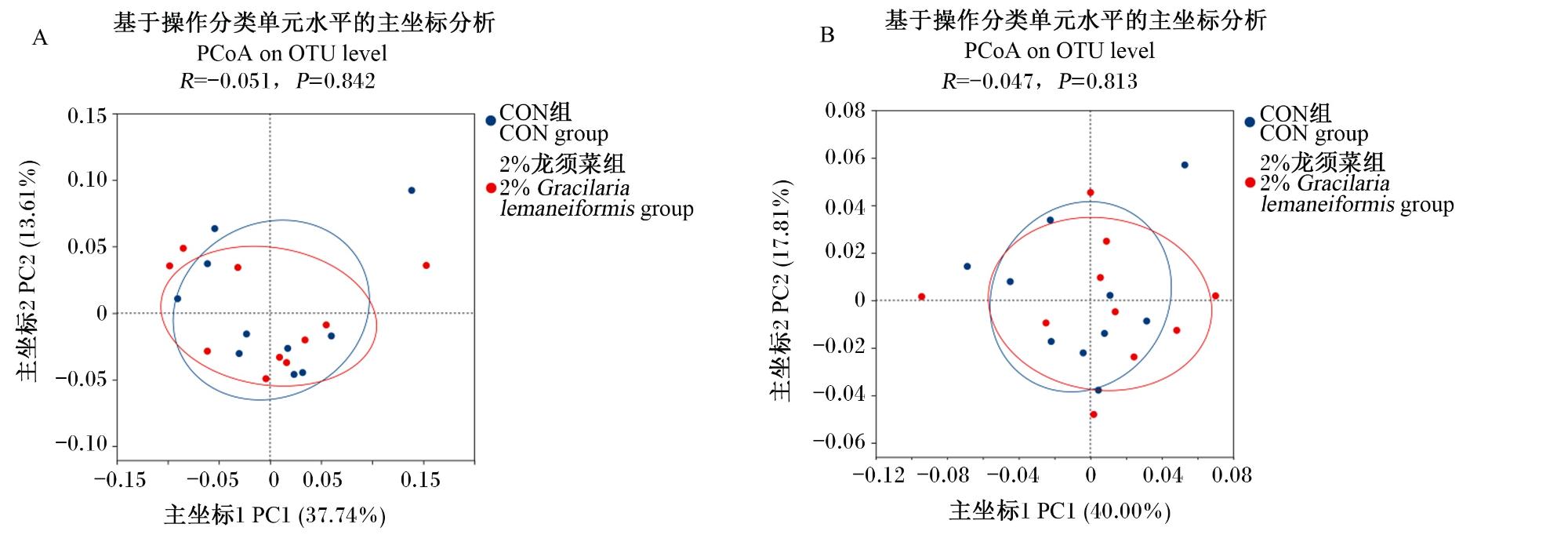
图1所示,PCoA结合ANOSIM结果显示,CON组和2%龙须菜组微生物群落样本点分布重叠度高,表明添加2%龙须菜对体外瘤胃发酵细菌和古菌群落结构无显著影响(P>0.05)。
图1 肉牛体外瘤胃发酵细菌(A)和产甲烷古菌(B)beta多样性主坐标分析

Fig.1 PCoA of beta diversity of bacteria (A) and methanogenic archaea (B) in rumen fermentation of beef cattle in vitro

2.4.3 微生物群落组成分析

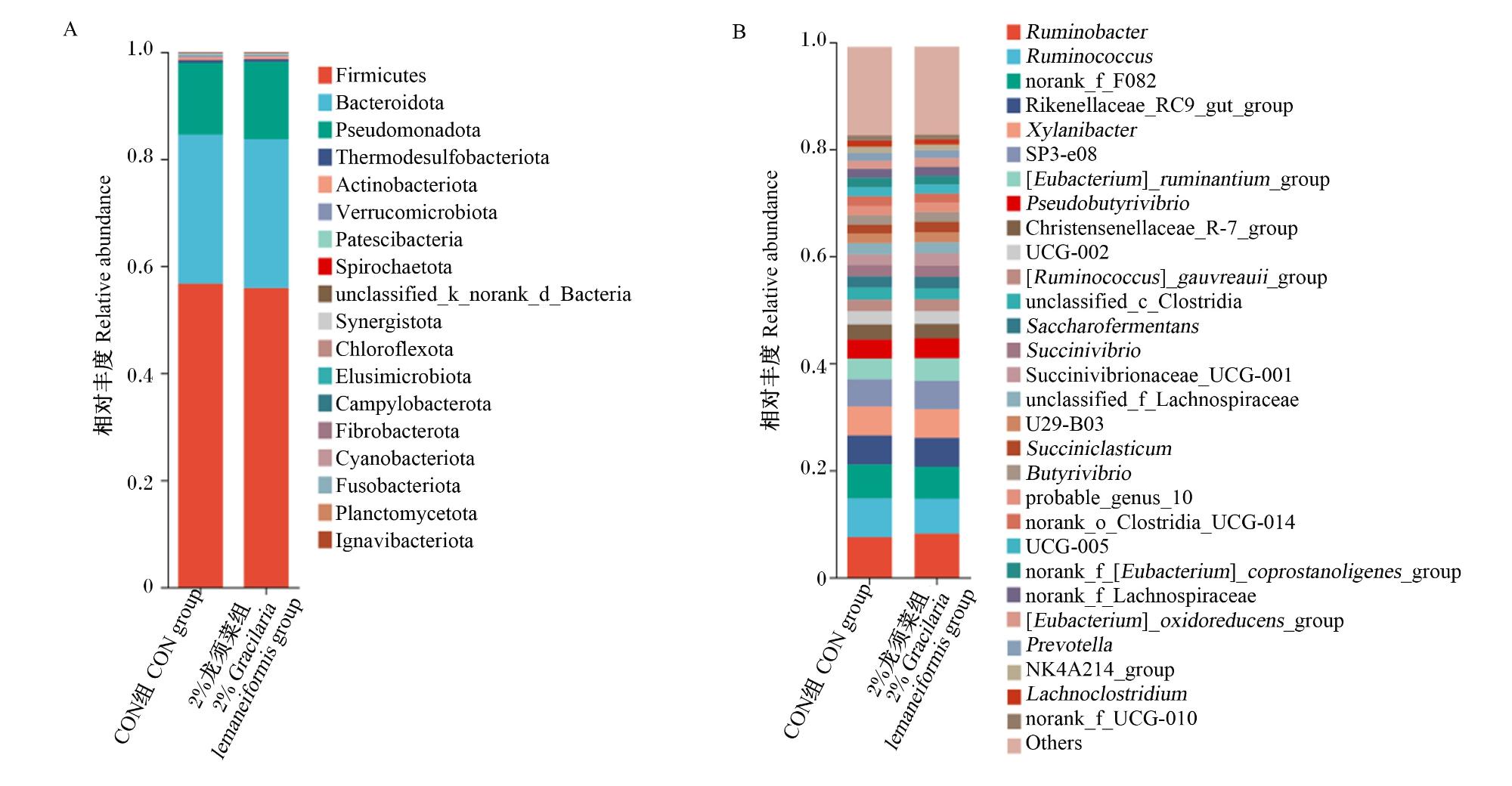
图2-A所示,在门水平上,厚壁菌门(Firmicutes)、拟杆菌门(Bacteroidota)和假单胞菌门(Pseudomonadota)相对丰度总和占总细菌的98%;如图2-B所示,在属水平,相对丰度>5%的优势菌属包括瘤胃杆菌属(Ruminobacter)、瘤胃球菌属(Ruminococcus)、未定级F082科(norank_f_F082)、理研菌科RC9肠道群(Rikenellaceae_RC9_gut_group)、木聚糖杆菌属(Xylanibacter)和SP3-e08。
图2 肉牛体外瘤胃发酵细菌在门(A)和属(B)水平上的组成分析

Firmicutes:厚壁菌门;Bacteroidota:拟杆菌门;Pseudomonadota:假单胞菌门;Thermodesulfobacteriota:热脱硫杆菌门;Actinobacteriota:放线菌门;Verrucomicrobiota:疣微菌门;Patescibacteria:髌骨菌门;Spirochaetota:螺旋体门;unclassified_k_norank_d_Bacteria:未定级域未分类界细菌;Synergistota:互养菌门;Chloroflexota:绿弯菌门;Elusimicrobiota:迷踪菌门;Campylobacterota:弯曲杆菌门;Fibrobacterota:纤维杆菌门;Cyanobacteriota:蓝细菌门;Fusobacteriota:梭杆菌门;Planctomycetota:浮霉菌门;Ignavibacteriota:惰杆菌门;Ruminobacter:瘤胃杆菌属;Ruminococcus:瘤胃球菌属;norank_f_F082:未定级F082科;Rikenellaceae_RC9_gut_group:理研菌科RC9肠道群;Xylanibacter:木聚糖杆菌属;[Eubacterium]_ruminantium_group:瘤胃真杆菌群;Pseudobutyrivibrio:假丁酸弧菌属;Christensenellaceae_R-7_group:克里斯滕森菌科R-7群;[Ruminococcus]_gauvreauii_group:高氏瘤胃球菌群;unclassified_c_Clostridia:未分类梭菌纲;Saccharofermentans:糖发酵菌属;Succinivibrio:琥珀酸弧菌属;Succinivibrionaceae_UCG-001:琥珀酸弧菌科UCG-001;unclassified_f_Lachnospiraceae:未分类毛螺菌科;Succiniclasticum:解琥珀酸菌属;Butyrivibrio:丁酸弧菌属;probable_genus_10:可能属10;norank_o_Clostridia_UCG-014:未定级梭菌纲UCG-014目;norank_f_[Eubacterium]_coprostanoligenes_group:未定级产粪甾醇真杆菌群科;norank_f_Lachnospiraceae:未定级毛螺菌科;[Eubacterium]_oxidoreducens_group:氧化还原真杆菌群;Prevotella:普雷沃氏菌属;NK4A214_group:NK4A214群;Lachnoclostridium:毛梭菌属;norank_f_UCG-010:未定级UCG-010科;Others:其他。

Fig.2 Composition analysis of bacteria at phylum level (A) and genus level (B) in rumen fermentation of beef cattle in vitro

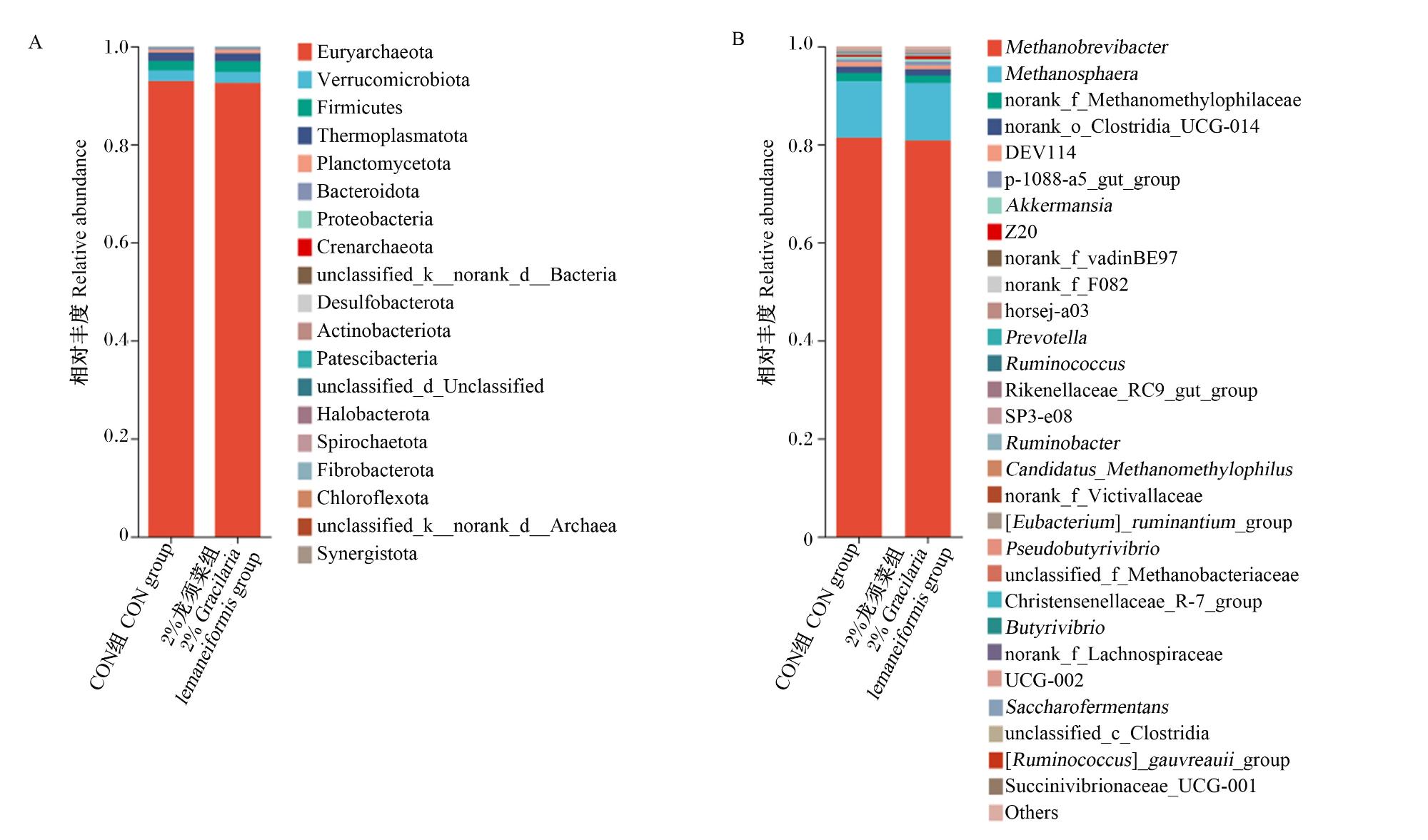
图3-A所示,在门水平上,广古菌门(Euryarchaeota)是产甲烷古菌中的优势菌门,相对丰度达92%;如图3-B所示,在属水平上,甲烷短杆菌属(Methanobrevibacter)相对丰度最高,约为81%;甲烷球形菌属(Methanosphaera)次之,相对丰度约为11%。
图3 肉牛体外瘤胃发酵产甲烷古菌在门(A)和属(B)水平上的组成分析

Euryarchaeota:广古菌门;Verrucomicrobiota:疣微菌门;Firmicutes:厚壁菌门;Thermoplasmatota:热原体门;Planctomycetota:浮霉菌门;Bacteroidota:拟杆菌门;Proteobacteria:变形菌门;Crenarchaeota:泉古菌门;unclassified_k_norank_d_Bacteria:未定级域未分类界细菌;Desulfobacterota:脱硫杆菌门;Actinobacteriota:放线菌门;Patescibacteria:髌骨菌门;unclassified_d_unclassified:未分类域;Halobacterota:盐杆菌门;Spirochaetota:螺旋体门;Fibrobacterota:纤维杆菌门;Chloroflexota:绿弯菌门;unclassified_k_norank_d_Archaea:未定级域未分类界古菌;Synergistota:互养菌门;Methanobrevibacter:甲烷短杆菌属;Methanosphaera:甲烷球形菌属;norank_f_Methanomethylophilaceae:未定级甲烷嗜甲基菌科;norank_o_Clostridia_UCG-014:未定级梭菌纲UCG-014目;p-1088-a5_gut_group:p-1088-a5肠道群;Akkermansia:阿克曼氏菌属;norank_f_vadinBE97:未定级vadinBE97科;norank_f_F082:未定级F082科;Prevotella:普雷沃氏菌属;Ruminococcus:瘤胃球菌属;Rikenellaceae_RC9_gut_group:理研菌科RC9肠道群;Ruminobacter:瘤胃杆菌属;Candidatus_Methanomethylophilus:暂定甲烷嗜甲基菌属;norank_f_Victivallaceae:未定级食物谷菌科;[Eubacterium]_ruminantium_group:瘤胃真杆菌群;Pseudobutyrivibrio:假丁酸弧菌属;unclassified_f_Methanobacteriaceae:未分类甲烷杆菌科;Christensenellaceae_R-7_group:克里斯滕森菌科R-7群;Butyrivibrio:丁酸弧菌属;norank_f_Lachnospiraceae:未分类毛螺菌科;Saccharofermentans:糖发酵菌属;unclassified_c_Clostridia:未分类梭菌纲;[Ruminococcus]_gauvreauii_group:高氏瘤胃球菌群;Succinivibrionaceae_UCG-001:琥珀酸弧菌科UCG-001;Others:其他。

Fig.3 Composition analysis of methanogenic archaea at phylum level (A) and genus level (B) in rumen fermentation of beef cattle in vitro

2.4.4 微生物群落差异物种分析

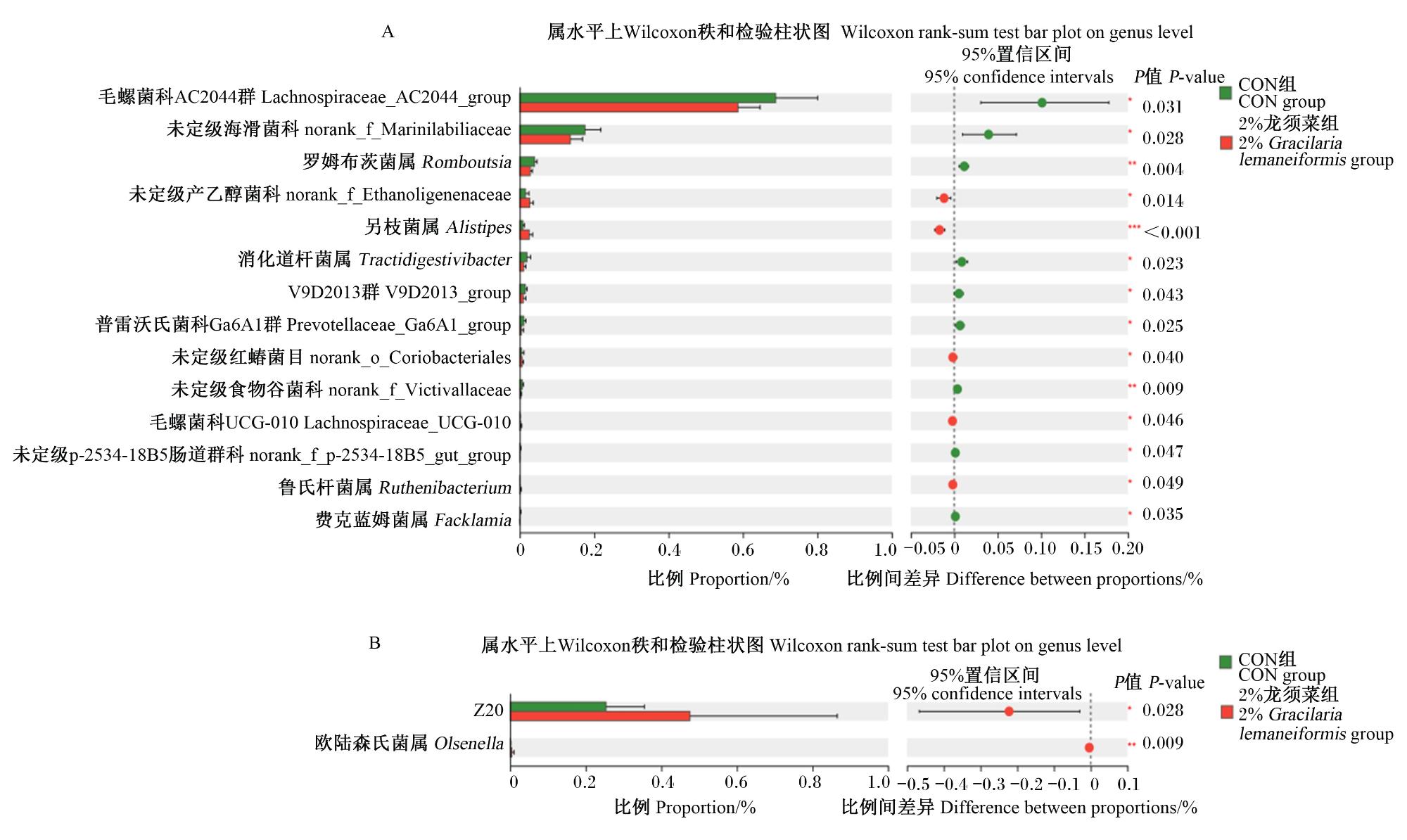
图4所示,在属水平上对微生物群落组成进行差异分析,结果表明,CON组与2%龙须菜组间共有14种细菌和2种产甲烷古菌的相对丰度存在显著差异(P<0.05)。其中,9种细菌的相对丰度在CON组中较高,包括毛螺菌科AC2044群(Lachnospiraceae_AC2044_group)、未定级海滑菌科(norank_f_Marinilabiliaceae)和罗姆布茨菌属(Romboutsia)等;而未定级产乙醇菌科(norank_f_Ethanoligenenaceae)、另枝菌属(Alistipes)等5种细菌以及古菌Z20、欧陆森氏菌属(Olsenella)的相对丰度在2%龙须菜组中较高。
图4 肉牛体外瘤胃发酵细菌(A)和产甲烷古菌(B)在属水平上的差异物种分析

*表示P<0.05,**表示P<0.01,***表示P<0.001。

Fig.4 Analysis of differential species in bacteria (A) and methanogenic archaea (B) at genus level in rumen fermentation of beef cattle in vitro

* mean P<0.05, ** mean P<0.01, and *** mean P<0.001.

3 讨论

研究表明,在体外发酵中添加海藻对瘤胃产气、发酵特征和微生物组成有所影响[18-19]。本研究中,添加龙须菜对肉牛体外瘤胃发酵CH4产量及DMD有显著影响,其他大部分指标未观察到显著变化。CH4产量是对反刍动物饲料营养价值和瘤胃发酵特性进行全面评估的一个重要指标[20]。本试验中,添加2%和5%龙须菜后,体外发酵每克底物CH4产量分别降低6.48%和5.76%,减排效果低于前期研究荷斯坦牛瘤胃体系的结果[10],这可能源于西门塔尔杂交牛瘤胃微生物群落结构与荷斯坦牛不同。不过,相较于其他大多数海藻而言,龙须菜的CH4减排效果在合理范围之内,Wasson等[21]研究报道,在调查的67种大型海藻(包括红藻、褐藻和绿藻)中,除紫杉状海门冬外,只有15种海藻在2%的添加剂量下能减少5%~14%的CH4排放。
瘤胃液pH以及VFA、NH3-N和MCP含量是评估瘤胃功能和稳定性的关键指标[22]。pH在调控微生物活性、VFA和CH4生成等方面具有重要意义[23],其正常值为6.0~7.0[24],本研究中3组样本pH均处于该范围内。龙须菜总糖含量为43.76%,在2%和5%的添加剂量下,额外引入的总糖含量分别为0.004 376和0.010 940 g。瘤胃发酵参数结果显示,2个龙须菜添加组pH以及TVFA和各单个VFA(乙酸、丙酸、丁酸等)含量均与CON组相比无显著差异,表明龙须菜在该添加剂量下不仅未对瘤胃发酵产生实质性影响,而且能够在降低CH4排放的同时,维持瘤胃发酵功能的稳定。Kung等[25]提出,当乙酸/丙酸值小于3时,瘤胃发酵模式为丙酸型发酵,反之为乙酸型发酵。本试验中,3组乙酸/丙酸值为2.17~2.21,属于丙酸型发酵模式,代表饲料中的营养成分更多地转化为葡萄糖向机体提供能量,而不是生成CH4排出体外[26];同时,5%龙须菜组乙酸/丙酸值较CON组显著提高了1.84%,可能是由于额外添加5%龙须菜提高了发酵底物中碳水化合物的含量[27]。NH3-N是瘤胃微生物合成MCP的重要底物[28]。本研究中,与CON组相比,2个龙须菜添加组NH3-N含量无显著差异,MCP含量有所提高且接近显著水平。这源于龙须菜CP含量较高(19.14%)且含18种氨基酸[6],可为瘤胃微生物提供优质的氮源,进而促进MCP合成[29]。Eikanger等[30]研究报道,在奶牛饲粮中添加0.25%紫杉状海门冬,CH4产量降低22%,但NH3-N含量以及DMD、NDFD未发生显著变化,这与本研究结果相似。
本研究中,添加2%龙须菜未显著改变瘤胃细菌和产甲烷古菌的alpha多样性指数(Ace、 Chao、Shannon和Simpson指数),与Li等[31]通过体外试验添加莫氏马尾藻的结果一致,表明试验组细菌和古菌的丰富度和多样性较CON组没有显著变化。这可能是源于16S rRNA基因测序只能检测菌群相对丰度变化,无法反映微生物的功能活性;或是龙须菜对菌群的影响体现在低相对丰度的功能菌属,而非优势菌属,因此仍需进一步挖掘低相对丰度物种的差异。
细菌是瘤胃中最主要的微生物,其数量超过90%,在反刍动物消化、代谢和生长发育中扮演着不可或缺的角色[32]。本试验检测到的优势细菌门为厚壁菌门、拟杆菌门和假单胞菌门,符合多数研究报道的拟杆菌门和厚壁菌门占主导地位[33-34]。差异菌属中相对丰度最高的毛螺菌科AC2044群在添加2%龙须菜后其相对丰度显著降低,这种细菌可能通过分解纤维促进乙酸生成,直接参与瘤胃生物氢化过程[35-36],因此其相对丰度降低直接导致产CH4底物减少。罗姆布茨菌属参与瘤胃中碳水化合物的发酵,进而生成VFA和氢气(H2)[37],其相对丰度在2%龙须菜组中显著降低同样有利于抑制CH4生成。另枝菌属不仅与瘤胃中寡糖降解和VFA生成相关[38-39],还参与个别氨基酸的分解代谢,且代谢过程中产生的氨可通过竞争氢间接抑制古菌的活性[40]
产甲烷古菌广泛存在于瘤胃中,可以利用H2、乙酸等发酵产物生成CH4,并维持瘤胃微生物的发酵环境[41]。添加龙须菜后,2%龙须菜组Z20和欧陆森氏菌属相对丰度显著提高。其中,Z20属于Oligosphaeraceae,该科细菌在反刍动物瘤胃中主要参与碳水化合物的发酵[42],但Z20的具体功能尚不明确,其相对丰度高低可能与瘤胃中特定的微生物群落变化有关[43],需通过进一步研究进行探索。欧陆森氏菌属是一种厌氧菌,能够通过发酵碳水化合物产生乳酸,进而将乳酸转化为以丙酸为主的VFA,与古菌竞争氢源[44]。Smith等[45]研究发现,欧陆森氏菌属在低CH4排放的育肥肉牛中相对丰度较高,与本研究结果一致。龙须菜的CH4减排作用与其对瘤胃菌群的调节密切相关。已知龙须菜多糖能够促进胃肠道有益菌群的生长,同时抑制有害菌群的增殖[46]。具体而言,在本研究中观察到添加龙须菜可降低能够提供产CH4底物的细菌毛螺菌科AC2044群和罗姆布茨菌属的相对丰度,并提高与产甲烷古菌竞争氢源的另枝菌属和欧陆森氏菌属的相对丰度,从而最终达到减少CH4排放的效果。但其在瘤胃中的具体作用途径还需进一步研究,并通过动物试验进行验证。
龙须菜在我国广东、山东等沿海省份已形成广泛养殖,其产业规模在生产力提高与技术进步的推动下持续增长。作为一种高效的固碳植物,龙须菜通过光合作用吸收水体中的CO2转化为有机碳储存在藻体中,同时释放氧气[47],年均固碳量十分可观[9]。此外,龙须菜还能吸收氮、磷等营养盐,缓解海水富营养化,发挥生物修复作用[48]。将龙须菜作为肉牛低碳饲料添加剂,能够起到固碳减排的双重效果。在本团队开展的为期70 d的西门塔尔杂交牛饲养试验中,饲粮添加2%龙须菜使每头牛饲料成本增加约98元(按日均干物质采食量10 kg及龙须菜价格7元/kg计)。结合其表现出的潜在生产效益和固碳减排效应,龙须菜在肉牛生产中具有实际应用价值。

4 结论

添加2%龙须菜能够显著降低西门塔尔杂交牛体外瘤胃发酵CH4产量,且对发酵参数、营养物质降解率和瘤胃微生物多样性无显著影响,同时降低了提供产CH4底物的细菌毛螺菌科AC2044群和罗姆布茨菌属的相对丰度,并提高了与产甲烷古菌竞争氢源的另枝菌属和欧陆森氏菌属的相对丰度。
[1]
刁其玉. 反刍动物甲烷生成与营养调控减排措施[J]. 畜牧产业, 2023(1):39-43.

DIAO Q Y. Methane production in ruminants and nutritional regulation measures for emission reduction[J]. Animal Agriculture, 2023(1):39-43. (in Chinese)

[2]
李帅, 闵力, 孙加节, 等. 大型海藻作为饲料添加剂缓解瘤胃甲烷排放的研究进展[J]. 动物营养学报, 2022, 34(9):5526-5534.

DOI

LI S, MIN L, SUN J J, et al. Research progress on application of large-sized seaweed as feed additive to alleviate methane emission of ruminants[J]. Chinese Journal of Animal Nutrition, 2022, 34(9):5526-5534. (in Chinese)

DOI

[3]
KRIZSAN S J, RAMIN M, CHAGAS J C C, et al. Effects on rumen microbiome and milk quality of dairy cows fed a grass silage-based diet supplemented with the macroalga Asparagopsis taxiformis[J]. Frontiers in Animal Science, 2023,4:1112969.

[4]
VUCKO M J, MAGNUSSON M, KINLEY R D, et al. The effects of processing on the in vitro antimethanogenic capacity and concentration of secondary metabolites of Asparagopsis taxiformis[J]. Journal of Applied Phycology, 2017, 29(3):1577-1586.

DOI

[5]
HIDAYAH N, KUSTANTINAH K, NOVIANDI C T, et al. Evaluation of rumen in vitro gas production and fermentation characteristics of four tropical seaweed species[J]. Veterinary Integrative Sciences, 2023, 21(1):229-238.

DOI

[6]
余杰, 王欣, 陈美珍, 等. 潮汕沿海龙须菜的营养成分和多糖组成分析[J]. 食品科学, 2006, 27(1):93-97.

YU J, WANG X, CHEN M Z, et al. Analysis on nutritional components and polysaccharide composition of Gracilaria lemaneiformis from Chaoshan coast[J]. Food Science, 2006, 27(1):93-97. (in Chinese)

[7]
ZHANG D, SUN J Z, FU M H, et al. Photosynthetic performance and antioxidant activity of Gracilariopsis lemaneiformis are sensitive to phosphorus deficiency in elevated temperatures[J]. Frontiers in Marine Science, 2024,11:1432937.

[8]
荣成市融媒体中心. 增种龙须菜“时间差”里增效益[EB/OL].(2024-07-04)[2025-09-24]. http://www.rongcheng.gov.cn/art/2024/7/4/art_40742_4710687.html.

Rongcheng Media Convergence Center. Increasing benefits by growing Gracilaria in a “time gap”[EB/OL].(2024-07-04)[2025-09-24]. http://www.rongcheng.gov.cn/art/2024/7/4/art_40742_4710687.html. (in Chinese)

[9]
ZHOU W, SUI Z H, WANG J G, et al. Biomass and carbon storage of Gracilariopsis lemaneiformis (Rhodophyta) in Zhanshan Bay,Qingdao,China[J]. Chinese Journal of Oceanology and Limnology, 2014, 32(5):1009-1015.

DOI

[10]
SUN Y, LI S, GUO T J, et al. Investigating the potential mechanism of methane mitigation in seaweed Gracilaria lemaneiformis via 16S rRNA gene sequencing and LC/MS-based metabolomics[J]. Agriculture, 2025, 15(16):1768.

DOI

[11]
LU S Y, LIU Y, TANG S J, et al. Gracilaria lemaneiformis polysaccharides alleviate colitis by modulating the gut microbiota and intestinal barrier in mice[J]. Food Chemistry:X, 2022,13:100197.

[12]
JIANG S W, YANG C Y, XIAO Y T, et al. Effects of polysaccharides-rich extract from Gracilaria lemaneiformis on growth performance,antioxidant capacity,immune function,and meat quality in broiler chickens[J]. The Journal of Poultry Science, 2023, 60(2):2023018.

[13]
JIA M Y, MA Q, WANG H J, et al. Exploring the effects of Gracilaria lemaneiformis polysaccharides on the fecal microbiota and fecal metabolites of fattening pigs based on 16S rDNA and metabolome sequencing[J]. Animals, 2025, 15(2):153.

DOI

[14]
MENKE K H, RAAB L, SALEWSKI A, et al. The estimation of the digestibility and metabolizable energy content of ruminant feedingstuffs from the gas production when they are incubated with rumen liquor in vitro[J]. The Journal of Agricultural Science, 1979, 93(1):217-222.

DOI

[15]
CHOI Y, LEE S J, KIM H S, et al. Red seaweed extracts reduce methane production by altering rumen fermentation and microbial composition in vitro[J]. Frontiers in Veterinary Science, 2022,9:985824.

[16]
MAKKAR H P, SHARMA O P, DAWRA R K, et al. Simple determination of microbial protein in rumen liquor[J]. Journal of Dairy Science, 1982, 65(11):2170-2173.

PMID

[17]
WISCHER G, BOGUHN J, STEINGAB H, et al. Effect of monensin on in vitro fermentation of silages and microbial protein synthesis[J]. Archives of Animal Nutrition, 2013, 67(3):219-234.

DOI

[18]
ROQUE B M, VENEGAS M, KINLEY R D, et al. Red seaweed (Asparagopsis taxiformis) supplementation reduces enteric methane by over 80 percent in beef steers[J]. PLoS One, 2021, 16(3):e0247820.

DOI

[19]
WANAPAT M, PRACHUMCHAI R, DAGAEW G, et al. Potential use of seaweed as a dietary supplement to mitigate enteric methane emission in ruminants[J]. Science of the Total Environment, 2024,931:173015.

[20]
王萌. 秸秆日粮添加过瘤胃蛋氨酸对滩羊生产性能的影响[D]. 硕士学位论文. 银川: 宁夏大学, 2017.

WANG M. The effects of the straw diet added rumen protected methionine on the performance of Tan sheep[D]. Master’s Thesis. Yinchuan: Ningxia University, 2017. (in Chinese)

[21]
WASSON D E, STEFENONI H, CUEVA S F, et al. Screening macroalgae for mitigation of enteric methane in vitro[J]. Scientific Reports, 2023, 13(1):9835.

DOI

[22]
ZHANG F, WANG Y, WANG H, et al. Calcium propionate supplementation has minor effects on major ruminal bacterial community composition of early lactation dairy cows[J]. Frontiers in Microbiology, 2022,13:847488.

[23]
BHATTA R, TAJIMA K, KURIHARA M. Influence of temperature and pH on fermentation pattern and methane production in the rumen simulating fermenter (RUSITEC)[J]. Asian-Australasian Journal of Animal Sciences, 2006, 19(3):376-380.

DOI

[24]
MELO L Q, COSTA S F, LOPES F, et al. Rumen morphometrics and the effect of digesta pH and volume on volatile fatty acid absorption[J]. Journal of Animal Science, 2013, 91(4):1775-1783.

DOI PMID

[25]
KUNG L Jr, SHEPERD A C, SMAGALA A M, et al. The effect of preservatives based on propionic acid on the fermentation and aerobic stability of corn silage and a total mixed ration[J]. Journal of Dairy Science, 1998, 81(5):1322-1330.

PMID

[26]
高鑫, 李秀芝, 黄炜乾, 等. 动物源性抗菌肽对荷斯坦奶公牛生长性能、瘤胃发酵指标、粪便评分、血清生化和免疫指标的影响[J]. 动物营养学报, 2024, 36(2):1029-1038.

DOI

GAO X, LI X Z, HUANG W Q, et al. Effects of animal-derived antimicrobial peptides on growth performance,rumen fermentation indexes,fecal score,serum biochemical and immune indexes of Holstein dairy bulls[J]. Chinese Journal of Animal Nutrition, 2024, 36(2):1029-1038. (in Chinese)

DOI

[27]
索效军, 杨前平, 张年, 等. 青贮桑叶替代全株玉米青贮对肉牛生长性能、屠宰性能、瘤胃发酵参数及肉品质的影响[J]. 饲料研究, 2025, 48(3):28-33.

SUO X J, YANG Q P, ZHANG N, et al. Effects of silage mulberry leaves replacing whole corn silage on growth performance,slaughter performance,rumen fermentation parameters,and meat quality of beef cattle[J]. Feed Research, 2025, 48(3):28-33. (in Chinese)

[28]
覃一耕, 王莹, 蒋林树, 等. 葡萄籽原花青素提取物对体外瘤胃发酵参数、营养物质消化率和微生物区系的影响[J]. 动物营养学报, 2025, 37(7):4823-4836.

DOI

QIN Y G, WANG Y, JIANG L S, et al. Effects of grape seed proanthocyanidin extract on rumen fermentation parameters,nutrient digestibility and microbial flora in vitro[J]. Chinese Journal of Animal Nutrition, 2025, 37(7):4823-4836. (in Chinese)

[29]
黎凌铄. 不同蛋白水平日粮中添加过瘤胃蛋氨酸对牦牛生长性能、血清指标、瘤胃发酵和菌群组成的影响[D]. 硕士学位论文. 成都: 西南民族大学, 2021.

LI L S. Effects of rumen protected methionine in diets with different protein levels on growth performance,serum indices,rumen fermentation and bacterial composition of yak[D]. Master’s Thesis. Chengdu: Southwest Minzu University, 2021. (in Chinese)

[30]
EIKANGER K S, KJÆR S T, DÖRSCH P, et al. Asparagopsis taxiformis inclusion in grass silage-based diets fed to Norwegian red dairy cows:effects on ruminal fermentation,milk yield,and enteric methane emission[J]. Livestock Science, 2024,285:105495.

[31]
LI S, SUN Y, GUO T J, et al. Sargassum mcclurei mitigating methane emissions and affecting rumen microbial community in in vitro rumen fermentation[J]. Animals, 2024, 14(14):2057.

DOI

[32]
ZHANG C Y, LA Y F, MA X M, et al. The effects of different doses of compound enzyme preparations on the production performance,meat quality and rumen microorganisms of yak were studied by metagenomics and transcriptomics[J]. Frontiers in Microbiology, 2024,15:1491551.

[33]
WALLACE R J, SASSON G, GARNSWORTHY P C, et al. A heritable subset of the core rumen microbiome dictates dairy cow productivity and emissions[J]. Science Advances, 2019, 5(7):eaav8391.

DOI

[34]
LÓPEZ-GARCÍA A, SABORÍO-MONTERO A, GUTIÉRREZ-RIVAS M, et al. Fungal and ciliate protozoa are the main rumen microbes associated with methane emissions in dairy cattle[J]. GigaScience, 2022,11:giab088.

[35]
HAO Y Y, GONG Y, HUANG S, et al. Effects of age,diet CP,NDF,EE,and starch on the rumen bacteria community and function in dairy cattle[J]. Microorganisms, 2021, 9(8):1788.

DOI

[36]
HUANG Q Q, CHEN Y H, WANG X X, et al. Effects of phlorotannins from Sargassum on in vitro rumen fermentation,microbiota and fatty acid profile[J]. Animals, 2023, 13(18):2854.

DOI

[37]
FAN Q S, WANAPAT M, YAN T H, et al. Altitude influences microbial diversity and herbage fermentation in the rumen of yaks[J]. BMC Microbiology, 2020, 20(1):370.

DOI PMID

[38]
YANG H, TAN S W, CHEN S Y, et al. Effects of fermented Yupingfeng on intramuscular fatty acids and ruminal microbiota in Qingyuan black goats[J]. Animal Science Journal, 2021, 92(1):e13554.

DOI

[39]
MU Y Y, QI W P, ZHANG T, et al. Gene function adjustment for carbohydrate metabolism and enrichment of rumen microbiota with antibiotic resistance genes during subacute rumen acidosis induced by a high-grain diet in lactating dairy cows[J]. Journal of Dairy Science, 2021, 104(2):2087-2105.

DOI PMID

[40]
RYAZANOV V, TARASOVA E, DUSKAEV G, et al. Changes in the concentration of amino acids and bacterial community in the rumen when feeding Artemisia absinthium and cobalt chloride[J]. Fermentation, 2023, 9(8):751.

DOI

[41]
XUE M Y, SUN H Z, WU X H, et al. Multi-omics reveals that the rumen microbiome and its metabolome together with the host metabolome contribute to individualized dairy cow performance[J]. Microbiome, 2020, 8(1):64.

DOI

[42]
LONG T H, LI Y S, LI M Y, et al. Effects of rice straw variety on rumen fermentation,bacterial community,and metabolite profile[J]. Agriculture, 2025, 15(7):739.

DOI

[43]
HARTINGER T, KRÖGER I, NEUBAUER V, et al. Zearalenone and its emerging metabolites promptly affect the rumen microbiota in Holstein cows fed a forage-rich diet[J]. Toxins, 2023, 15(3):185.

DOI

[44]
LI J H, YAN H, CHEN J X, et al. Correlation of ruminal fermentation parameters and rumen bacterial community by comparing those of the goat,sheep,and cow in vitro[J]. Fermentation, 2022, 8(9):427.

DOI

[45]
SMITH P E, KELLY A K, KENNY D A, et al. Differences in the composition of the rumen microbiota of finishing beef cattle divergently ranked for residual methane emissions[J]. Frontiers in Microbiology, 2022,13:855565.

[46]
HAN R, PANG D R, WEN L R, et al. In vitro digestibility and prebiotic activities of a sulfated polysaccharide from Gracilaria lemaneiformis[J]. Journal of Functional Foods, 2020,64:103652.

[47]
徐一凡, 刘焕平, 杨宇峰, 等. 大型海藻江蓠(Gracilaria)栽培碳汇潜力评估及甲烷减排情景分析[J]. 中国科学(地球科学), 2023, 53(5):1039-1056.

XU Y F, LIU H P, YANG Y F, et al. Assessment of carbon sink potential and methane reduction scenarios of marine macroalgae (Gracilaria) cultivation[J]. Science China (Earth Sciences), 2023, 53(5):1039-1056. (in Chinese)

[48]
杨红生, 许帅, 林承刚, 等. 典型海域生境修复与生物资源养护研究进展与展望[J]. 海洋与湖沼, 2020, 51(4):809-820.

YANG H S, XU S, LIN C G, et al. Research progress and prospects of restoration and resource conservation in typical sea areas[J]. Oceanologia et Limnologia Sinica, 2020, 51(4):809-820. (in Chinese)

文章导航

/