综述

γ-多聚谷氨酸的研究进展及其作为动物饲料添加剂的开发前景

  • 孙燕勇 ,
  • 宋利文 ,
  • 张兴夫 , *
展开
  • 内蒙古自治区农牧业科学院,呼和浩特 010031
* 张兴夫,副研究员,E-mail:

孙燕勇(1988—),女,河北张家口人,讲师,博士,主要从事反刍动物营养基因组学研究。E-mail:

Copy editor: 田艳明

收稿日期: 2024-07-07

  网络出版日期: 2025-01-10

基金资助

内蒙古农村中小规模肉牛养殖精准饲喂体系及技术服务平台搭建和示范(2021GG0061)

γ-多聚谷氨酸对绵羊瘤胃钙吸收的影响机制及其产品稳定性研究(2025CXJJM01)

Research Progress of Poly-γ-Glutamic Acid and Its Development Prospect as Animal Feed Additive

  • SUN Yanyong ,
  • SONG Liwen ,
  • ZHANG Xingfu , *
Expand
  • Inner Mongolia Academy of Agricultural & Animal Husbandry Sciences, Hohhot 010031, China
* associate professor, E-mail:

Received date: 2024-07-07

  Online published: 2025-01-10

摘要

γ-多聚谷氨酸(γ-PGA)是一种阴离子假多肽,主要由芽孢杆菌产生和分泌,是天然、安全、无免疫原性、可生物降解以及环保的生物聚合物,在食品与饲料添加剂、医学制药、污水处理、化妆品以及农作物等领域表现出优良特性。本文从γ-PGA的理化性质、生产制备和应用角度出发,结合国内外的研究进展,对其微生物发酵合成途径、生产工艺优化和在动物饲养及其他方面的应用研究进行综述,旨在全面解读γ-PGA的特征,为将其进一步开发为饲料添加剂提供依据。

本文引用格式

孙燕勇 , 宋利文 , 张兴夫 . γ-多聚谷氨酸的研究进展及其作为动物饲料添加剂的开发前景[J]. 动物营养学报, 2025 , 37(1) : 22 -35 . DOI: 10.12418/CJAN2025.003

Abstract

Poly-γ-glutamic acid (γ-PGA) is an anionic pseudopolypeptide, mainly produced and secreted by bacillus, is a natural, safe, non-immunogenic, biodegradable and environmentally friendly biopolymer, and shows excellent properties in food and feed additives, medicine and pharmaceuticals, wastewater disposal, cosmetics and crops and other fields. Based on the physicochemical properties, production, preparation and application of γ-PGA, this paper reviewed the synthesis pathway of microbial fermentation, production process optimization, and application in animal feeding and other aspects of γ-PGA, aiming to comprehensively understand the characteristics of γ-PGA and provide a basis for its further development as a feed additive.

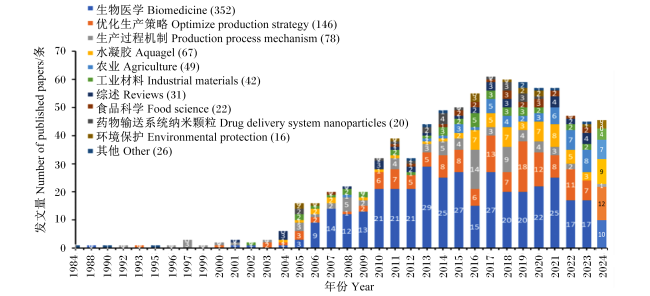
γ-多聚谷氨酸(poly-γ-glutamic acid,γ-PGA)是一种常见的生物聚合物,是由D-谷氨酸和(或)L-谷氨酸通过α-氨基和γ-羧基以酰胺键连接而成的阴离子型高分子聚合物[1],具有可生物降解、无毒和无免疫原性等特性。γ-PGA最早由Ivanovics等[2]发现,炭疽芽孢杆菌是第一个γ-PGA产生菌。尽管经过几十年的发展,但γ-PGA的研究主要还处于实验室阶段,包括理化性质、产生菌的改良、基因调控、发酵条件优化和提取纯化过程以及衍生物的生产和性质研究等。进入21世纪,个别国际知名公司开始进行γ-PGA的生产和应用的研究,国内部分大学和研究所也积极开展了相关的应用研究,国内更有数家企业开始计划进行γ-PGA的大规模廉价生产。这些产业化研究的跟进使得γ-PGA成为现阶段备受关注的生物制品之一。γ-PGA的分子质量、分子组成、合成效率和产率等特性决定了它的生物学特性,其化学性质的高度变异使γ-PGA能够对抗高盐[3]、重金属[4]等极端条件,因此被广泛应用于食品与饲料添加剂[5-6]、医疗材料[7]、生物修复剂[8]、农作物[9]、污水处理[10]以及化妆品[11]等领域(图1)。
图1 以“poly-γ-glutamic acid”为关键词在PubMed检索849条文献分类柱状图

不同颜色表示不同研究方向,括号中的数字表示截止2024年7月2日的累积发文量。

Fig.1 Histogram of 849 literature classification retrieved in PubMed with “poly-γ-glutamic acid” as key words

Different colors indicated different research directions, and the numbers in brackets indicated the cumulative number of published papers as of July 2, 2024.

本文综述了γ-PGA的理化性质、生产制备及生产工艺优化、生物合成及代谢过程、在动物饲养中的研究与应用以及在食品、农业、工业、医学方面的应用研究。

1 γ-PGA的理化性质

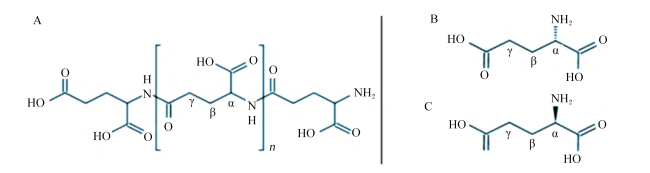
γ-PGA是以左旋和(或)右旋光性的谷氨酸为单元体,以γ位上的醯胺键聚合而成同质多肽,聚合度在1 000~15 000。γ-PGA存在3种不同的立体构型,包括γ-DL-PGA(D-谷氨酸与L-谷氨酸随机组成)、γ-D-PGA(D-谷氨酸组成)和γ-L-PGA(L-谷氨酸组成)[12],这决定了它存在5种二级结构构象,即α-螺旋、β-折叠、螺旋-无规卷曲、无规卷曲和环形聚集体。γ-PGA的性质与构型和分子质量有关,其不同性质适应于相应的领域。γ-PGA分子侧链上带有大量活性较高的羧基,易与其他物质合成复合物,且合成过程受酶活性调控,因此在生产中存在聚合物链摩尔质量、右旋/左旋比以及与盐的可变链等变异问题[13],这种不稳定性和分子复杂性显著影响链的物理排列以及最终的聚合物特性,使其很难获得均匀的聚合物链。通常情况下,调整pH、聚合物浓度和离子强度能改变γ-PGA构象,例如:当pH为中性时,为α-螺旋;当pH碱性时,为β-折叠[14]。γ-PGA可溶于水,是一种极易吸潮的白色粉末,即使浓度较低其黏度也较高[15]。Shih等[16]通过改变介质组成、碱性水解、超声波降解、微生物或酶降解等方法来改变γ-PGA的分子质量。其中,超声波降解方法可以在不干扰聚合物化学组成的情况下降低γ-PGA的分子质量和多分散性[17]。韩国有专利报道,与化妆品保湿剂及肥料增效剂的分子质量和构型不同,当γ-PGA的分子质量为3 000 ku以上时,可促进人体对钙、铁、镁、锌、铜和硒等的吸收[18]。γ-PGA的结构及其组成单位见图2[19]
图2 γ-PGA的结构及其组成单位

n表示重复单位,至少为10 000;A为γ-PGA的结构,B为D-谷氨酸,C为L-谷氨酸。

Fig.2 Structure and units of γ-PGA[19]

n indicated duplicate unit, which was at least 10 000; A was structure of γ-PGA, B was D-glutamic acid, and C was L-glutamic acid.

2 γ-PGA的生产制备及生产工艺优化

2.1 γ-PGA的生产制备

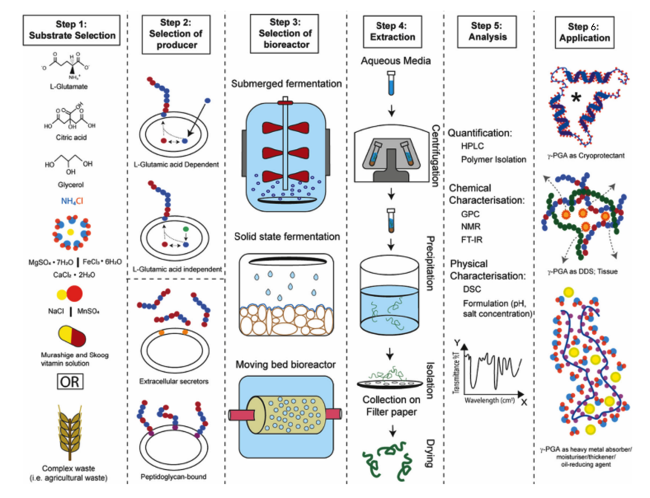
γ-PGA的生产制备包括化学合成、多肽合成、生物转化和微生物发酵4种方法。大多数商业化的γ-PGA采用微生物发酵方法生产,具有原料相对便宜、对环境污染小、天然产物纯度高以及反应条件温和等优点。不过,微生物产生γ-PGA的原因仍然未知,目前的观点是微生物为了保护细胞免受噬菌体、抗体、抗菌肽和有害环境条件的侵害,同时γ-PGA有助于微生物黏附营养颗粒,或作为饥饿状态下的可利用氮源与碳源[20]。微生物发酵涉及外消旋、聚合、转移和分解代谢等代谢途径[21]。γ-PGA的唯一合成前体谷氨酸有2种来源:一种是来源于葡萄糖或其他碳源的内源性谷氨酸[22];另一种是直接添加外源谷氨酸[23]。γ-PGA的单体为L/D-谷氨酸,L-谷氨酸主要来源于2-酮戊二酸,而D-谷氨酸是由L-谷氨酸经谷氨酸催化而成。γ-PGA的微生物发酵很大程度上取决于底物[24]、微生物[25]、发酵容器、发酵条件和提取方法[26]等因素。γ-PGA的生物合成过程及应用见图3[27]
图3 γ-PGA的生物合成过程及应用

Step 1: Substrate selection:第1步:底物筛选;L-Glutamate:L-谷氨酸;Citric acid:柠檬酸;Glycerol:甘油;Murashige and Skoog vitamin solution:Murashige和Skoog维生素溶液;Complex waster (i.e. agricultural waster):复合废料(即农业废料);Step 2: Selection of produce:第2步:生产类型选择;L-Glutamic acid dependent:L-谷氨酸依赖;L-Glutamic acid independent:L-谷氨酸独立;Extracellular secretors:细胞外分泌物;Peptidoglycan-bound:肽聚糖结合;Step 3: Selection of bioreactor:第3步:生物反应器选择;Submerged fermentation:深层发酵;Solid state fermentation:固态发酵;Moving bed bioreactor:移动床生物反应器;Step 4: Extraction:第4步:提取;Aqueous media:水性介质;Centrifugation:离心;Precipitation:沉淀;Isolation:分离;Collection on filter paper:滤纸收集;Drying:干化;Step 5: Analysis:第5步:分析;Quantification:定量;HPLC:高效液相色谱 high performance liquid chromatography;Polymer isolation:聚合物分离;Chemical characterization:化学特征;GPC:凝胶渗透色谱 gel permeation chromatography;NMR:核磁共振 nuclear magnetic resonance;FT-IR:傅里叶变换红外 Fourier transform infrared;DSC:差示扫描量热法 differential scanning calorimetry;Formulation (pH, salt concentration):配方(pH、盐浓度);Wavelength:波长;Transmittance:透光率;Step 6: Application:第6步:应用;*:一种益生菌菌株(如双歧杆菌或乳酸杆菌) a probiotic strain (such as bifidobacterium or lactic acid bacillus);γ-PGA as cryoprotectant:γ-PGA作为冷冻保护剂;γ-PGA as DDS, tissue:γ-PGA作为药物缓释剂、组织;γ-PGA as heavy metal absorber/moisturiser/thickener/oil-reducing agent:γ-PGA作为重金属吸附剂/保湿霜/增稠剂/降油剂。

Fig.3 Biosynthesis process and application of γ-PGA[27]

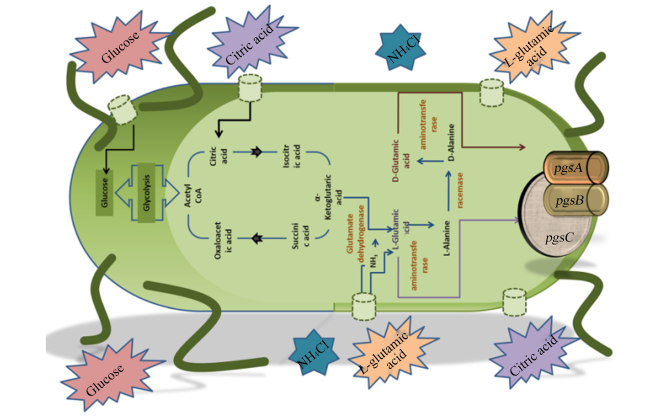
近年来,多项研究通过利用廉价的废料作为碳源替代昂贵的培养基,试图降低成本来增加γ-PGA生产的可持续性,如菊粉底物[23]、水解废渣粉[28]、玉米秸秆、豆粕[29]、糖蜜[30]和黄腐酸粉[31]、稻草、大型藻类、鹅毛、纸屑、猪粪[32]、牛粪、鸡粪及米糠[33]等。但是,在废料预处理过程中需要额外添加营养物质来增进对糖的有效利用,如柠檬酸、蛋白胨和微量元素,这进一步增加了成本。这些营养物质底物能够降解为C6和C5化合物,通过糖酵解和戊糖磷酸途径进入主要的碳代谢过程。此外,甘油以及柠檬酸循环的代谢中间体也被用作候选底物[34],主要副产物为乙酮和2,3-丁二醇,其他产量很少的副产物有乳酸盐、乙醇和醋酸盐[35]。γ-PGA产生的代谢途径及相关基因簇如图4所示[36]。内源性的前体可以有效地激活L-谷氨酸通路,通过糖酵解将培养基中的碳源转化为乙酰辅酶A,然后以三羧酸循环为基础合成α-酮戊二酸。α-酮戊二酸前体转化为L-谷氨酸有2条不同的途径:一条途径是谷氨酸脱氢酶在没有谷氨酰胺的情况下,采用谷氨酸脱氢酶将α-酮戊二酸和氯化铵转化为L-谷氨酸;另一条途径是在有L-谷氨酸存在情况下,谷氨酰胺合成酶与谷氨酰胺-2-氧戊二酸转氨酶被激活,后者催化α-酮戊二酸和L-谷氨酰胺生成L-谷氨酸,而谷氨酰胺合成酶催化L-谷氨酸与氯化铵生成谷氨酰胺。聚合是一个ATP依赖的过程,其中ATP依赖底物的水解导致磷酸化基转移到细长γ-PGA的末端羧基。然后,谷氨酸的氨基对磷酸化的羧基进行亲核攻击,形成酰胺键,并在合成酶复合物PgsBCA活性位点继续进行γ-PGA聚合。PgsBCA活性依赖于镁离子(Mg2+),PgsCPgsB共同形成了复合物催化位点的大部分,而PgsA有助于从活性位点去除长链,从而允许添加下一个单体,并且可能还参与γ-PGA的运输。另外,细胞膜上较低的磷脂含量有利于细胞外γ-PGA的运输。
图4 γ-PGA产生的代谢途径及相关基因簇

Glucose:葡萄糖;Glycolysis:糖酵解;Citric acid:柠檬酸;Acetyl CoA:乙酰辅酶A;L-glutamic acid:L-谷氨酸;Oxaloacetic acid:草酰乙酸;Succinic acid:琥珀酸;Isocitric acid:异柠檬酸;α-Ketoglutaric acid:α-酮戊二酸;Glutamate dehydrogenase:谷氨酸脱氢酶;Aminotransferase:氨基转移酶;L-alanine:L-丙氨酸;D-alanine:D-丙氨酸;Racemase:消旋酶。

Fig.4 Metabolic pathways of γ-PGA production and related gene clusters[36]

2.2 γ-PGA的生产工艺优化策略

γ-PGA是一种分子质量为104~107 u的天然高分子肽,高分子质量(>7.0×10⁵ u)或超高分子质量(>5.0×10⁶ u)的γ-PGA在组织工程材料、絮凝剂和重金属去除剂等方面具有重要的应用价值。因此,如何以低成本、高效率的方式生产高分子质量的γ-PGA受到了广泛关注。近年来的研究报道旨在通过分离新菌株、培养基优化[37]、改造代谢途径基因[38]和诱导环境冲击来上调γ-PGA合成酶操纵子[39],并以此来改进生产过程。其中,微生物产生菌的筛选通常有3种:1)基于216 nm紫外线吸光度来确认γ-PGA;2)在中性红色存在的情况下检测菌落周围的同心区;3)添加甲醇/乙醇在生产介质中形成纤维状沉淀物。而用于发酵的微生物主要是芽孢杆菌,如地衣芽孢杆菌、枯草芽孢杆菌和解淀粉芽孢杆菌,它们以菌株依赖的方式分泌γ-PGA[40]

2.2.1 优化发酵工艺

众多报道显示,通过改变发酵底物形态,如液态或固态,以及调整发酵底物与发酵类型[40-41]、温度、pH、离心速度和培养时间等方法优化发酵工艺来提高γ-PGA产量。例如:在42 ℃利用枯草芽孢杆菌GXD-20制备的超高分子质量(>6.0×10⁶ u)γ-PGA,其浓度高达(22.29±0.59) g/L,该过程由γ-PGA降解酶PgdS的特异蛋白序列和亚细胞定位、蔗糖转运利用酶、氮转运酶、内源谷氨酸合成酶和γ-PGA合成酶编码基因的高表达调控[42]L-谷氨酰胺与三羧酸循环中间体α-酮戊二酸能够作为代谢前体物,提高地衣芽孢杆菌NCIM2324菌株发酵过程中对谷氨酸的利用率,生产γ-PGA最大产量达35.75 g/L,且比不添加前体物高出9.63 g/L[24]。李淑英等[43]使用枯草芽孢杆菌BSNK-5来生产γ-PGA,先采用单因素试验筛选最佳条件分别为蔗糖25.0 g/L、氯化铵5.0 g/L、pH 8、37 ℃、接种量4.0%、发酵48 h,再根据正交试验优化最佳组合参数为蔗糖25 g/L、氯化铵5.0 g/L、接种量3.5%、初始pH 7.5,γ-PGA产量高达1.617 g/L,产量提升了2.44倍。Kouchesfahani等[44]筛选出L-谷氨酸、柠檬酸和甘油等培养基中最关键的成分,采用响应面法和中心复合设计算法进行优化,γ-PGA的产量从11.2 g/L提高到47.2 g/L,提高了3.2倍以上,与传统的基础培养基相比,这是迄今为止使用优化培养基报道的该菌株在液态分批发酵中的最高产量之一;在此基础上,继续将L-谷氨酸添加到优化的培养基中,使生物聚合物的产量从47.2 g/L提高到66.1 g/L,这是该菌株在已发表的文献中报道的最高值。这种简单、可重复和廉价的发酵工艺可大大提高地衣芽孢杆菌ATCC 9945a合成γ-PGA的商业应用价值。
有研究采用分段发酵的方法,结果产量不尽相同,这可能与γ-PGA发酵液的高黏度和低溶解氧有关。Guo等[45]对枯草芽孢杆菌进行分批发酵,在单因素优化试验的基础上,选择温度(42和37 ℃)、pH(7.0和未控制)、曝气率[1.2和1.0 m3/(m3·min)]和搅拌速度(700和500 r/min)进行2段控制发酵,分段发酵的γ-PGA浓度为19.79~22.17 g/L,与无阶段控制发酵的(21.25±1.26) g/L相比无显著变化;继而将分段发酵与降黏策略相结合,提高γ-PGA的浓度达到25.00~30.67 g/L,较无阶段控制发酵提高了17.66%~32.94%。He等[46]对芽孢杆菌YJY-8采用分批补料发酵的方法,在30 L发酵罐中经72 h后,γ-PGA的发酵浓度达到最高,为88.42 g/L。

2.2.2 调控细菌基因表达

目前,合成γ-PGA主要依赖微生物发酵,自然界筛选的野生型芽孢杆菌产量通常较低,产品生产成本高,难以实现规模化生产。多数报道采用超表达合成途径中关键酶基因、敲除副产物合成中的关键基因以及加强合成途径中所需辅酶的供应等方法来提高γ-PGA的产量。γ-PGA的生物合成涉及多种酶的活性,如肽酶、消旋酶、降解酶和合成酶。γ-PGA合成酶分为2类,Cap酶与Pgs酶。炭疽芽孢杆菌中Cap基因合成的γ-PGA会结合在细胞壁上,成为荚膜的主要成分,而芽孢杆菌Pgs合成的γ-PGA会游离在微生物周围的环境中。PgsBCA是γ-PGA合成酶复合物,其重要组分PgsBPgsCPgsA基因共同联合发挥作用[47],是芽孢杆菌合成γ-PGA的必要条件,只有当这些酶的基因联合表达时,才能检测到γ-PGA[48]。为提高产量,Xu等[49]PgsBCA基因导入到其他宿主细胞中进行表达,如将甲基营养型芽孢杆菌的PgsB取代地衣芽孢杆菌PgsBCA中的PgsB,γ-PGA的浓度从(8.24±0.10) g/L提升为(17.14±0.62) g/L;对基因取代后的菌株进一步加大溶解氧水平,在5 L发酵罐中得到38.26 g/L的γ-PGA;再利用补料的方法,通过补充葡萄糖,发酵48 h,γ-PGA浓度提高到50.2 g/L。PgsB基因被认为是构成γ-PGA合成的最主要催化部分。当纳豆芽孢杆菌中PgsB基因被敲除后,对菌体的生长无显著影响,但可以降低发酵液中γ-PGA的浓度和发酵液黏度,提高纳豆激酶的分离纯化效率[50]
PgdS基因紧靠Pgs基因操作子下游,可以编码γ-PGA降解酶,将高分子质量的γ-PGA降解为分子质量为200~450 ku的大片段与分子质量为2~5 ku的小片段[51]。超表达PgdS基因,不仅降低了解淀粉酶芽孢杆菌生产γ-PGA的分子质量,提高了γ-PGA的产量[52];而且能够提高地衣芽孢杆菌中γ-PGA的浓度至(21.67±0.76) g/L,比野生型提高了6.59%[53]。Wei等[54]利用实时荧光定量聚合酶链式反应(RT-qPCR)和代谢组学的方法,选择地衣芽孢杆菌中不同的内源启动子来调控PgdS的表达水平,形成了分子质量为1.61×103~2.03×104 ku的γ-PGA,在分子质量和黏度最低的情况下,γ-PGA产量有所增加,这表明PgdS表达的提高导致γ-PGA的分子质量降低,从而刺激γ-PGA的产生。
γ-PGA合成过程需要还原型烟酰胺腺嘌呤二核苷酸磷酸(NADPH)的供应[55],过表达NADPH生成相关基因ZwfUdhAPntABGndPpnk,有利于增加NADPH供应,对解淀粉芽孢杆菌LL3合成γ-PGA有显著影响,其中Zwf过表达菌株表现最佳,γ-PGA产量提高35%。另外,通过降低Pgi基因的表达水平,能够增强磷酸戊糖途径的通量,产生更多的NADPH,重组菌株NK-A8的NADPH与烟酰胺腺嘌呤二核苷酸磷酸(NADP+)比值为0.546,是对照菌株的2.29倍,但重组菌株的γ-PGA产量下降了29.3%,这可能是由于NK-A8细胞生长不良所致[56]。同样,过表达解淀粉芽孢杆菌LL3中NADPH生成的重要基因GndA,突变菌株在发酵培养基中表现出较差的稳健性,重组菌株的γ-PGA产量并未增加[38]
Zhang等[57]通过筛选T1型信号肽SPYwbN和启动子Pvgb进行透明颤菌血红蛋白定位表达,有助于地衣芽孢杆菌氧传递和ATP生成,在3 L发酵罐中γ-PGA产量提高49.26%,达到46.39 g/L。过表达地衣芽孢杆菌WX-02甘油激酶途径,替换启动子加强甘油代谢,导致甘油消耗增加30.9%,γ-PGA产量提高33.71%[58];过表达将甘油分解为γ-PGA的4个关键酶GlpKGlpXZwfTkt1,γ-PGA产量显著提高至1.5倍[56]表1汇总了γ-PGA的生产菌株、发酵底物、发酵方法和条件以及产量。
表1 γ-PGA的生产菌株、发酵底物、发酵方法和条件以及产量

Table 1 Production strains, fermentation substrates, fermentation methods and conditions and yields of γ-PGA

菌株
Strains
发酵底物
Fermentation
substrates
发酵方法和条件
Fermentation methods and
conditions
产量
Yields/
(g/L)
参考文献
References
谷氨酸棒杆菌
Corynebacterium glutamicum
葡萄糖、玉米浆、FeSO4·7H2O、
KH2PO4、MgSO4
MnCl2·4H2O、尿素
发酵罐,pH 7.3、37 ℃、
900 r/min、48 h
50.2 [49]
地衣芽孢杆菌WX/pPvgb-
YwbN-Vgb
Bacillus licheniformis
WX/pPvgb-YwbN-Vgb
葡萄糖、谷氨酸钠、柠檬酸钠、
NaNO3、NH4Cl、K2HPO4
MgSO4·7H2O、ZnSO4·7H2O、
MnSO4·H2O、CaCl2
发酵罐,pH 7.2、
32 ℃、230 r/min、32 h
46.39 [57]
纳豆芽孢杆菌
Bacillus natto
葡萄糖、大豆粉、K2HPO4、MgSO4
NaH2PO4、CaCl2、MnSO4
消泡剂、蔗糖
pH 7.2、30 ℃、
100 r/min、12 h
28.46 [50]
枯草芽孢杆菌
Bacillus subtilis
pH 7.0、42 ℃,700 r/min、
18.52 h,37 ℃、500 r/min、
2.82 h
25.00~
30.67
[45]
枯草芽孢杆菌ATCC 6051
Bacillus subtilis ATCC 6051
葡萄糖、L-谷氨酸、FeSO4·6H2O、
NH4Cl、K2HPO4、MgSO4·7H2O、
MnCl2·H2O、CaCl2·2H2O、NaCl
烧杯,35 ℃、
200 r/min、48 h
23.1±1.6 [40]
枯草芽孢杆菌GXD-20
Bacillus subtilis GXD-20
发酵罐,42 ℃ 22.29±0.59 [42]
枯草芽孢杆菌BSNK-5
Bacillus subtilis BSNK-5
1.617 [43]
枯草芽孢杆菌CCTCC202048
Bacillus subtilis CCTCC202048
猪粪、柠檬酸、谷氨酸、豆饼、
麦麸、MnSO4·H2O
烧杯,pH 9.0、
37 ℃、48 h
6% [32]
地衣芽孢杆菌ATCC 9945a
Bacillus licheniformis ATCC 9945a
66.1 [44]
地衣芽孢杆菌NCIM2324
Bacillus licheniformis NCIM 2324
甘油、柠檬酸、L-谷氨酸、
(NH4)2SO4、K2HPO4
MgSO4·7H2O、MnSO4·7H2O、
CaCl2·2H2O
烧杯,pH 6.5、37 ℃、
200 r/min、96 h
35.75 [24]
地衣芽孢杆菌WX-02
Bacillus licheniformis WX-02
甘油、柠檬酸钠、NaNO3、NH4Cl、
ZnSO4·7H2O、K2HPO4·3H2O、
MgSO4·7H2O、MnSO4·H2O、CaCl2
烧杯,pH 7.2、
37 ℃、230 r/min、
8 h
19.20±1.57 [56]
地衣芽孢杆菌WX-02
Bacillus licheniformis WX-02
16.63 [58]
地衣芽孢杆菌WX-02
Bacillus licheniformis WX-02
葡萄糖、NaNO3、柠檬酸钠、NH4Cl、
ZnSO4·7H2O、K2HPO4·3H2O、
MgSO4·7H2O、MnSO4·7H2O、
CaCl2
烧杯,pH 7.2、
37 ℃、180 r/min、
10 h
9.13 [55]
地衣芽孢杆菌pP2967-pgdS
Bacillus licheniformis pP2967-pgdS
葡萄糖、尿素、酵母膏、KH2PO4
K2HPO4、MgSO4、NaCl
发酵罐,pH 7.2、
37 ℃、200 r/min、56 h
4.22 [54]
芽孢杆菌YJY-8
Bacillus sp. YJY-8
葡萄糖、甘油、谷氨酸钠、L-谷氨酸、
酵母膏、色氨酸、(NH4)2SO4
FeCl3·6H2O、KH2PO4、MgSO4·7H2O、
MnSO4·H2O、钼酸铵、CaCl2
发酵罐,pH 7.0、
35 ℃、72 h
88.42 [46]
解淀粉芽孢杆菌NK-A11
Bacillus amyloliquefaciens NK-A11
木糖、氨苄西林、
氯霉素、四环素
烧杯,pH 7.4、
37 ℃、180 r/min、48 h
7.53 [38]

3 γ-PGA在动物饲养中的研究与应用

在过去的20年里,氨基酸饲料添加剂占氨基酸总市场的56%[59]。γ-PGA作为潜在的饲料添加剂受到了动物营养学者的关注。据报道称,γ-PGA能够促进钙吸收,减少发酵豆渣中抗营养因子的含量,提高动物体增重、饲料转化率以及蛋破损率等。Jiang等[60]采用固态发酵法对大豆渣进行生物转换,使用解淀粉芽孢杆菌NX-2S生产γ-PGA,发酵后的大豆渣不仅胰蛋白酶抑制剂、植酸与单宁等抗营养因子含量分别降低了98.7%、97.8%和63.2%,而且添加到饲粮中饲喂大鼠后可以显著提高体增重达15.6%。产蛋后期蛋鸡饲粮中添加0.5% γ-PGA,蛋破损和畸形率下降52.6%;添加0.5%和2.0% γ-PGA,血清钙含量分别降低16.5%和22.9%,且能够提高平均蛋重、蛋黄颜色和蛋壳强度,调节蛋鸡脂代谢,使血清甘油三酯和胆固醇维持在正常水平[61]。玉蕾叶等[62]通过对小鼠饲粮进行体外发酵,测定添加不同浓度γ-PGA处理后的钙离子含量,结果表明γ-PGA在一定程度上能够促进钙的溶解;同时,γ-PGA能够提高小鼠小肠近端和远端钙的溶解,且与无机钙相比,γ-PGA更有利于提高小鼠对矿物质的吸收,提高体内钙的含量。此外,Su等[63]研究表明,γ-PGA与磷酸三钙复合物能够促进小管间和小管内牙本质再矿化。张彩霞[15]利用大鼠建立缺钙模型,证明了γ-PGA能显著提高股骨钙和磷含量,促进骨骼发育。
γ-PGA也显示出改善瘤胃功能、提高菌群多样性的特性。小尾寒羊饲粮中添加20 g/(只·d)γ-PGA,对瘤胃乙酸、氨态氮含量以及纤维素降解菌的生长有显著影响,可提高拟杆菌门、互养菌门和普雷沃氏菌属的相对丰度[64]。一项体外瘤胃液发酵的试验表明,不同浓度的γ-PGA与发酵时间影响菌体蛋白、pH、氨态氮、挥发性脂肪酸、原虫数量以及干物质降解率,当添加1 mg/g时,组合效应最高[65]。断奶犊牛饲粮中添加0.5%含量为20%的γ-PGA,对肝脏功能、能量代谢、能量平衡以及蛋白质利用无负面影响,但可促进维生素C、维生素A以及矿物质的吸收利用[66]
γ-PGA具有抗氧化性和较强的稳定性,可以帮助改善高脂饮食引起的肥胖和血脂异常。小鼠高脂饲粮中添加5% γ-PGA可以显著降低血清甘油三酯、总胆固醇、低密度脂蛋白胆固醇、胰岛素和瘦素含量,减少肝脏和脂肪细胞内的脂肪堆积和炎症程度,具有抗肥胖效果[67]。Tamura等[68]也证实了富含γ-PGA的发酵纳豆对葡萄糖和脂质代谢的显著影响,能改善饲喂高脂饲粮小鼠肠道菌群数量和脂质代谢,显著提高血浆葡萄糖和甘油三酯含量、肝脏脂肪酸合酶表达以及乳杆菌科的相对丰度。γ-PGA能够与金属离子螯合,具有抗氧化与胃肠保护功能。体外研究表明,约400 ku的γ-PGA通过螯合过渡金属离子和清除过氧化氢以及直接清除羟基自由基表现出显著的抗羟基自由基能力;此外,γ-PGA的超氧自由基清除能力和脂质过氧化抑制能力也同样优异,在体外模拟胃肠道消化模型中,其抗氧化活性保持在90%以上;1 mg/mL γ-PGA对DNA、蛋白质、肠道有益菌和Caco-2细胞均有稳定的保护作用,且不影响细胞活力和毒性[69]。王薛雪等[70]报道,γ-PGA在较宽的温度(10~100 ℃)和pH(2~11)范围内保持12 h稳定的抗羟基自由基能力,即使在100 ℃以及pH 2或11被视为极端的条件下,γ-PGA的相对抗羟基自由基能力仍保持在90%。

4 γ-PGA在食品、农业、工业、医学方面的应用

新型食品添加剂γ-PGA,是一种从大豆发酵食品中提取的水溶性物质,对人体无毒[71-72]。γ-PGA的人体每日摄取量可达60~70 mg[73],且广泛应用于食品增稠剂[74]、掩味剂[71]、稳定剂、质地改良剂[75]、保湿剂、减苦剂、益生菌冷冻保护剂、蛋白质结晶剂以及递送肠道载体[76]等。γ-PGA在农业上主要用于稳定剂,如环保型肥料增效剂[77-78]、植物生长促进剂[79]、土壤重金属元素吸附剂[80],能有效提高土壤肥力、缓解土壤酸性和铝毒性[81],改善土壤性状[82-86],提高作物产量[77,87],保持果实品质[88]。在工业应用方面,γ-PGA与壳聚糖的复合材料被称为热塑性材料,是再生医学或生物医学设备、食品包装和3D打印的有效成分[89]。此外,γ-PGA也被用于工业油水分离[90]、美白化妆品制备[91]等方面。众多研究显示,γ-PGA在生物医学上有益于降低血压[92],改善肠道微生物群落[93],促进钙在体内的吸收[94],改善睡眠状态[95],保护肾脏功能[96],促进感染伤口的愈合[97-98],促进骨修复和再生[99],增强药物缓释性、稳定性与生物相容性,用于抗原载体和抗癌疫苗佐剂[100-101]等。

5 小结与展望

天然生物聚合物γ-PGA在各个领域的需求量越来越大,其具有生物相容性、非免疫原性以及可生物降解等特性,已经在食品和饲料添加剂、医疗保健、污水处理以及化妆品等方面进行了广泛研究。γ-PGA的功能随着分子质量、分子组成、合成效率和产率变化而改变,生产上需要根据特定的属性与纯度要求,采用适当的发酵条件来获得特定用途的性质。当前,提高生产率、降低生产成本依然是γ-PGA规模化生产的重中之重,更多研究的方向将集中在开发农业、食品、饲料和工业废料为发酵底物,重点研究毒性和药代动力学,全面评估其生物分布等特性。
此外,γ-PGA可以提高动物体增重,降低抗营养因子含量,改善胃肠道菌群结构,促进钙吸收等,其本身具有抗氧化性和较强的稳定性。随着饲料中抗生素类添加剂的全面禁用,开发具有多种功效的用于替代抗生素的潜在γ-PGA饲料添加剂产品具有广阔的前景。未来还需要开展不同γ-PGA剂量和分子质量的动物试验研究、生物安全性检测、畜禽饲料添加安全剂量鉴定、应用效果评价、短期/长期有效性评价以及其与畜禽体内矿物质的螯合结构表征与影响机制等研究工作,并充分利用生物信息学和基因靶向敲除等技术全面揭示其分子调控信号通路、基因表达网络、核心调控基因以及关键代谢产物,以深入阐明其作用机理与分子机制,为γ-PGA的开发应用提供科学依据。
[1]
CANDELA T, FOUET A. Poly-gamma-glutamate in bacteria[J]. Molecular Microbiology, 2006, 60(5):1091-1098.

PMID

[2]
IVANOVICS G, BRUCKNER V. The chemical nature of the immuno-specific capsule substance of anthrax Bacillus[J]. Naturwissenschaften, 1937,25:250.

[3]
HEZAYEN F F, REHM B H, TINDALL B J, et al. Transfer of Natrialba asiatica B1T to Natrialba taiwanensis sp. nov. and description of Natrialba aegyptiaca sp. nov.,a novel extremely halophilic,aerobic,non-pigmented member of the archaea from Egypt that produces extracellular poly (glutamic acid)[J]. International Journal of Systematic and Evolutionary Microbiology, 2001, 51(Pt 3):1133-1142.

[4]
DEOL R, LOUIS A, GLAZER H L, et al. Polygamma-glutamic acid secretion protects Bacillus subtilis from zinc and copper intoxication[J]. Microbiology Spectrum, 2022, 10(2):e0132921.

[5]
GHOSH K, KANG H S, HYUN W B, et al. High prevalence of Bacillus subtilis-infecting bacteriophages in soybean-based fermented foods and its detrimental effects on the process and quality of Cheonggukjang[J]. Food Microbiology, 2018,76:196-203.

[6]
TANIMOTO H, MORI M, MOTOKI M, et al. Natto mucilage containing poly-gamma-glutamic acid increases soluble calcium in the rat small intestine[J]. Bioscience, Biotechnology, and Biochemistry, 2001, 65(3):516-521.

DOI PMID

[7]
LEE B, JO S, KIM S M, et al. Poly-γ-glutamic acid suppresses osteoclastogenesis in human osteoclast precursors and prevents joint damage in a collagen-induced murine arthritis model[J]. Immunology Letters, 2018,203:80-86.

[8]
BAI N L, HE Y, ZHANG H L, et al. γ-polyglutamic acid production, biocontrol, and stress tolerance: multifunction of Bacillus subtilis A-5 and the complete genome analysis[J]. International Journal of Environmental Research and Public Health, 2022, 19(13):7630.

[9]
YIN A M, JIA Y P, QIU T L, et al. Poly-γ-glutamic acid improves the drought resistance of maize seedlings by adjusting the soil moisture and microbial community structure[J]. Applied Soil Ecology, 2018,129:128-135.

[10]
RYU M, NAKAZAWA T, AKAGI T, et al. Suppression of phagocytic cells in retinal disorders using amphiphilic poly (γ-glutamic acid) nanoparticles containing dexamethasone[J]. Journal of Controlled Release, 2011, 151(1):65-73.

[11]
SUNG M H, PARK C, KIM C J, et al. Natural and edible biopolymer poly-gamma-glutamic acid: synthesis, production, and applications[J]. Chemical Record, 2005, 5(6):352-366.

[12]
ASHIUCHI M, SHIMANOUCHI K Z A, NAKAMURA H, et al. Enzymatic synthesis of high-molecular-mass poly-gamma-glutamate and regulation of its stereochemistry[J]. Applied and Environmental Microbiology, 2004, 70(7):4249-4255.

PMID

[13]
PEREIRA C L, ANTUNES J C, GONÇALVES R M, et al. Biosynthesis of highly pure poly-γ-glutamic acid for biomedical applications[J]. Journal of Materials Science. Materials in Medicine, 2012, 23(7):1583-1591.

[14]
BHAT A R, IRORERE V U, BARTLETT T, et al. Bacillus subtilis natto:a non-toxic source of poly-γ-glutamic acid that could be used as a cryoprotectant for probiotic bacteria[J]. AMB Express, 2013, 3(1):36.

[15]
张彩霞. γ-聚谷氨酸对铁和钙吸收率影响及毒理安全性评价[D]. 硕士学位论文. 武汉: 华中农业大学, 2011.

ZHANG C X. The effects of γ-poly-glutamic acid on iron and calcium absorption and assessment its toxicology and safety[D]. Master’s Thesis. Wuhan: Huazhong Agricultural University, 2011. (in Chinese)

[16]
SHIH I L, VAN Y T. The production of poly-(gamma-glutamic acid) from microorganisms and its various applications[J]. Bioresource Technology, 2001, 79(3):207-225.

DOI PMID

[17]
PÉREZ-CAMERO G, CONGREGADO F, BOU J J, et al. Biosynthesis and ultrasonic degradation of bacterial poly (gamma-glutamic acid)[J]. Biotechnology and Bioengineering, 1999, 63(1):110-115.

[18]
ASHIUCHI M, SODA K, HONG S P, et al. Composition for promoting absorption of mineral into body which comprising gamma-poly-glutamic acid having ultra high molecular weight and mineral:KR20050006910A[P].2005-01-17.

[19]
李华, 胡丽娜, 焦磊. γ-聚谷氨酸的研究进展[J]. 微生物学免疫学进展, 2024, 52(1):84-90.

LI H, HU L N, JIAO L. Research progress of poly-γ-glutamic acid[J]. Progress in Microbiology and Immunology, 2024, 52(1):84-90. (in Chinese)

[20]
SIRISANSANEEYAKUL S, CAO M F, KONGKLOM N, et al. Microbial production of poly-γ-glutamic acid[J]. World Journal of Microbiology & Biotechnology, 2017, 33(9):173.

[21]
KREYENSCHULTE D, KRULL R, MARGARITIS A. Recent advances in microbial biopolymer production and purification[J]. Critical Reviews in Biotechnology, 2014, 34(1):1-15.

DOI PMID

[22]
CAO M F, FENG J, SIRISANSANEEYAKUL S, et al. Genetic and metabolic engineering for microbial production of poly-γ-glutamic acid[J]. Biotechnology Advances, 2018, 36(5):1424-1433.

DOI PMID

[23]
QIU Y B, ZHANG Y T, ZHU Y F, et al. Improving poly-(γ-glutamic acid) production from a glutamic acid-independent strain from inulin substrate by consolidated bioprocessing[J]. Bioprocess and Biosystems Engineering, 2019, 42(10):1711-1720.

DOI PMID

[24]
BAJAJ I B, SINGHAL R S. Enhanced production of poly (gamma-glutamic acid) from Bacillus licheniformis NCIM 2324 by using metabolic precursors[J]. Applied Biochemistry and Biotechnology, 2009, 159(1):133-141.

[25]
KEDIA G, HILL D, HILL R, et al. Production of poly-γ-glutamic acid by Bacillus subtilis and Bacillus licheniformis with different growth media[J]. Journal of Nanoscience and Nanotechnology, 2010, 10(9):5926-5934.

[26]
MANOCHA B, MARGARITIS A. A novel method for the selective recovery and purification of gamma-polyglutamic acid from Bacillus licheniformis fermentation broth[J]. Biotechnology Progress, 2010, 26(3):734-742.

[27]
PARATI M, KHALIL I, TCHUENBOU M F, et al. Building a circular economy around poly (D/L-γ-glutamic acid)-a smart microbial biopolymer[J]. Biotechnology Advances, 2022,61:108049.

[28]
SCHEEL R A, FUSI A D, MIN B C, et al. Increased production of the value-added biopolymers poly (R-3-hydroxyalkanoate) and poly (γ-glutamic acid) from hydrolyzed paper recycling waste fines[J]. Frontiers in Bioengineering and Biotechnology, 2019,7:409.

[29]
FANG J N, HUAN C C, LIU Y, et al. Bioconversion of agricultural waste into poly-γ-glutamic acid in solid-state bioreactors at different scales[J]. Waste Management, 2020,102:939-948.

[30]
WANG D X, KIM H, LEE S, et al. High-level production of poly-γ-glutamic acid from untreated molasses by Bacillus siamensis IR10[J]. Microbial Cell Factories, 2020, 19(1):101.

[31]
LI Y Z, WANG J H, LIU N, et al. Microbial synthesis of poly-γ-glutamic acid (γ-PGA) with fulvic acid powder, the waste from yeast molasses fermentation[J]. Biotechnology for Biofuels, 2020,13:180.

[32]
CHEN X, CHEN S W, SUN M, et al. High yield of poly-gamma-glutamic acid from Bacillus subtilis by solid-state fermentation using swine manure as the basis of a solid substrate[J]. Bioresource Technology, 2005, 96(17):1872-1879.

[33]
XAVIER J R, MADHAN KUMARR M M, NATARAJAN G, et al. Optimized production of poly (γ-glutamic acid) (γ-PGA) using Bacillus licheniformis and its application as cryoprotectant for probiotics[J]. Biotechnology and Applied Biochemistry, 2020, 67(6):892-902.

[34]
PENG Y Y, ZHANG T, MU W M, et al. Intracellular synthesis of glutamic acid in Bacillus methylotrophicus SK19.001,a glutamateindependent poly (γ-glutamic acid)-producing strain[J]. Journal of the Science of Food and Agriculture, 2016, 96(1):66-72.

[35]
ZHU F, CAI J, WU X T, et al. The main byproducts and metabolic flux profiling of γ-PGA-producing strain B. subtilis ZJU-7 under different pH values[J]. Journal of Biotechnology, 2013, 164(1):67-74.

[36]
ELBANNA K, ALSULAMI F S, NEYAZ L A, et al. Poly (γ) glutamic acid: a unique microbial biopolymer with diverse commercial applicability[J]. Frontiers in Microbiology, 2024,15:1348411.

[37]
WANG D X, KIM H, LEE S, et al. Simultaneous production of poly-γ-glutamic acid and 2,3-butanediol by a newly isolated Bacillus subtilis CS13[J]. Applied Microbiology and Biotechnology, 2020, 104(16):7005-7021.

[38]
GAO W X, HE Y L, ZHANG F, et al. Metabolic engineering of Bacillus amyloliquefaciens LL3 for enhanced poly-γ-glutamic acid synthesis[J]. Microbial Biotechnology, 2019, 12(5):932-945.

[39]
SONG Y, ZHANG Y, HE M, et al. Enhancing the production of poly-γ-glutamate in Bacillus subtilis ZJS18 by the heat-and osmotic shock and its mechanism[J]. Preparative Biochemistry and Biotechnology, 2020,50:1023-1030.

[40]
ADILKHANOVA A, ORMANTAYEVA A, KAZIULLAYEVA A, et al. Electrofermentation increases concentration of poly γ-glutamic acid in Bacillus subtilis biofilms[J]. Microbial Biotechnology, 2024, 17(3):e14426.

[41]
严德林, 黄雷, 邱婧, 等. PB试验结合BBD响应面法优化纳豆γ-聚谷氨酸发酵条件[J]. 食品工业科技, 2024, 45(1):208-215.

YAN D L, HUANG L, QIU J, et al. Optimization of the fermentation conditions of poly-γ-glutamic acid from natto by PB experiment combined with BBD response surface method[J]. Science and Technology of Food Industry, 2024, 45(1):208-215. (in Chinese)

[42]
ZENG W, LIU Y Y, SHU L, et al. Production of ultra-high-molecular-weight poly-γ-glutamic acid by a newly isolated Bacillus subtilis strain and genomic and transcriptomic analyses[J]. Biotechnology Journal, 2024, 19(4):e2300614.

[43]
李淑英, 侯丽真, 高雅鑫, 等. 枯草芽孢杆菌BSNK-5合成γ-聚谷氨酸发酵工艺优化[J]. 食品与发酵科技, 2023, 59(4):14-19,50.

LI S Y, HOU L Z, GAO Y X, et al. Optimization of the fermentation process of γ-polyglutamic acid produced by Bacillus subtilis BSNK-5[J]. Food and Fermentation Technology, 2023, 59(4):14-19,50. (in Chinese)

[44]
KOUCHESFAHANI M E, BAHRAMI A, BABAEIPOUR V. Poly-γ-glutamic acid overproduction of Bacillus licheniformis ATCC 9945a by developing a novel optimum culture medium and glutamate pulse feeding using different experimental design approaches[J]. Biotechnology and Applied Biochemistry, 2024, 71(3):565-583.

[45]
GUO Y, LIU Y Y, YANG Z J, et al. Enhanced production of poly-γ-glutamic acid by Bacillus subtilis using stage-controlled fermentation and viscosity reduction strategy[J]. Applied Biochemistry and Biotechnology, 2024, 196(3):1527-1543.

[46]
HE F, GAO B, CHENG X, et al. High-level production of poly-γ-glutamic acid by a newly isolated Bacillus sp. YJY-8 and potential use in increasing the production of tomato[J]. Preparative Biochemistry & Biotechnology, 2024, 54(5):637-646.

[47]
K H, SAKUTA M, TSUNODA T, et al. Peptide epimerase responsible for D-amino acid introduction in poly-γ-glutamic acid biosynthesis[J]. Biomacromolecules, 2024, 25(1):349-354.

[48]
LIU C L, DONG H G, XUE K, et al. Biosynthesis of poly-γ-glutamic acid in Escherichia coli by heterologous expression of pgsBCAE operon from Bacillus[J]. Journal of Applied Microbiology, 2020, 128(5):1390-1399.

DOI PMID

[49]
XU G Q, WANG J Y, SHEN J C, et al. Enhanced poly-γ-glutamic acid synthesis in Corynebacterium glutamicum by reconstituting PgsBCA complex and fermentation optimization[J]. Metabolic Engineering, 2024,81:238-248.

[50]
韩宇星, 孟凡强, 周立邦, 等. 通过敲除聚谷氨酸合成基因提高纳豆杆菌纳豆激酶的生产效率[J]. 食品与发酵工业, 2022, 48(2):224-230.

DOI

HAN Y X, MENG F Q, ZHOU L B, et al. Improve the production efficiency of Bacillus natto nattokinase by knocking out the γ-PGA synthetic gene[J]. Food and Fermentation Industries, 2022, 48(2):224-230. (in Chinese)

[51]
王计伟, 施庆珊, 欧阳友生, 等. 地衣芽胞杆菌ATCC9945A中γ-聚谷氨酸降解酶基因的克隆、表达及降解性能鉴定[J]. 生物技术, 2012, 22(1):13-18.

WANG J W, SHI Q S, OU YANG Y S, et al. Cloning, expression and degradation of the γ-PGA degrading enzyme gene from Bacillus licheniformis ATCC9945A[J]. Biotechnology, 2012, 22(1):13-18. (in Chinese)

[52]
SHA Y Y, ZHANG Y T, QIU Y B, et al. Efficient biosynthesis of low-molecular-weight poly-γ-glutamic acid by stable overexpression of PgdS hydrolase in Bacillus amyloliquefaciens NB[J]. Journal of Agricultural and Food Chemistry, 2019, 67(1):282-290.

[53]
周彩霞. 超表达pgsBCApgdS改良地衣芽孢杆菌产聚谷氨酸的研究[D]. 硕士学位论文. 雅安: 四川农业大学, 2021.

Zhou C X. Enhanced production of poly-γ-glutamic acid by overexpression of the pgsBCA and pgdS in Bacillus licheniformis[D]. Master’s Thesis. Ya’an: Sichuan Agriculture University, 2021. (in Chinese)

[54]
WEI X, YANG L, CHEN Z, et al. Molecular weight control of poly-γ-glutamic acid reveals novel insights into extracellular polymeric substance synthesis in Bacillus licheniformis[J]. Biotechnology for Biofuels and Bioproducts, 2024, 17(1):60.

[55]
CAI D, HE P, LU X C, et al. A novel approach to improve poly-γ-glutamic acid production by NADPH regeneration in Bacillus licheniformis WX-02[J]. Scientific Reports, 2017,7:43404.

[56]
ZHAN Y Y, SHENG B J, WANG H, et al. Rewiring glycerol metabolism for enhanced production of poly-γ-glutamic acid in Bacillus licheniformis[J]. Biotechnology for Biofuels, 2018,11:306.

[57]
ZHANG Q, CHEN Y Z, GAO L, et al. Enhanced production of poly-γ-glutamic acid via optimizing the expression cassette of Vitreoscilla hemoglobin in Bacillus licheniformis[J]. Synthetic and Systems Biotechnology, 2022, 7(1):567-573.

[58]
ZHAN Y Y, ZHU C J, SHENG B J, et al. Improvement of glycerol catabolism in Bacillus licheniformis for production of poly-γ-glutamic acid[J]. Applied Microbiology and Biotechnology, 2017, 101(19):7155-7164.

[59]
LEUCHTENBERGER W, HUTHMACHER K, DRAUZ K. Biotechnological production of amino acids and derivatives:current status and prospects[J]. Applied Microbiology and Biotechnology, 2005, 69(1):1-8.

[60]
JIANG K, TANG B, WANG Q, et al. The bio-processing of soybean dregs by solid state fermentation using a poly γ-glutamic acid producing strain and its effect as feed additive[J]. Bioresource Technology, 2019,291:121841.

[61]
陈晓飞, 赵俊强, 张立恒, 等. 一种富含γ-聚谷氨酸的发酵饲料对蛋鸡产蛋后期生产性能、蛋品质、血清生化指标及脂代谢的影响[J]. 中国饲料, 2024(7):114-120.

CHEN X F, ZHAO J Q, ZHANG L H, et al. Effects of fermented feed rich in γ-polyglutamic acid on performance,egg quality,serum biochemical parameters and lipid metabolism of laying hens during later laying period[J]. China Feed, 2024(7):114-120. (in Chinese)

[62]
玉蕾叶, 孙洪敏, 杜朝, 等. 聚谷氨酸对小鼠钙吸收的影响[J]. 华北农学报, 2014(增刊1):202-205.

YU L Y, SUN H M, DU C, et al. The impact of polyglutamic acid on calcium absorption in mice[J]. Acta Agriculturae Boreali-Sinica, 2014(Suppl.1):202-205. (in Chinese)

[63]
SU Q Q, ZHANG C, MAI S, et al. Effect of poly (γ-glutamic acid)/tricalcium phosphate (γ-PGA/TCP) composite for dentin remineralization in vitro[J]. Dental Materials Journal, 2021, 40(1):26-34.

[64]
曹琪娜, 张艳梅, 敖长金, 等. γ-聚谷氨酸对小尾寒羊瘤胃发酵及菌群结构的影响[J]. 中国畜牧杂志, 2021, 57(2):136-142.

CAO Q N, ZHANG Y M, AO C J, et al. Effect of poly-γ-glutamate on rumen fermentation parameters and rumen microbiota of small tail Han sheep[J]. Chinese Journal of Animal Science, 2021, 57(2):136-142. (in Chinese)

[65]
曹琪娜, 王晓渊, 张兴夫, 等. γ-聚谷氨酸对肉羊体外瘤胃发酵的影响[J]. 中国畜牧杂志, 2023, 59(5):200-206.

CAO Q N, WANG X Y, ZHANG X F, et al. Effect of γ-polyglutamic acid on rumen fermentation of meat sheep in vitro[J]. Chinese Journal of Animal Science, 2023, 59(5):200-206. (in Chinese)

[66]
朱春侠, 凤英, 张金文, 等. γ-聚谷氨酸对断奶犊牛血清生化指标的影响[J]. 畜牧与饲料科学, 2021, 42(2):37-41.

ZHU C X, FENG Y, ZHANG J W, et al. Effects of dietary supplementation of γ-polyglutamic acid on serum biochemical parameters of weaned calves[J]. Animal Husbandry and Feed Science, 2021, 42(2):37-41. (in Chinese)

[67]
JANG K H, KIM M J. A mixture of poly-γ-glutamic acid and levan ameliorates obesity in high fat diet-induced mice[J]. Food Science and Biotechnology, 2022, 31(3):349-356.

[68]
TAMURA M, WATANABE J, NOGUCHI T, et al. High poly-γ-glutamic acid-containing natto improves lipid metabolism and alters intestinal microbiota in mice fed a high-fat diet[J]. Journal of Clinical Biochemistry and Nutrition, 2024, 74(1):47-56.

DOI PMID

[69]
LEE J M, JANG W J, PARK S H, et al. Antioxidant and gastrointestinal cytoprotective effect of edible polypeptide poly-γ-glutamic acid[J]. International Journal of Biological Macromolecules, 2020,153:616-624.

[70]
王薛雪, 李莎, 任战坤, 等. γ-聚谷氨酸的抗氧化及对UV辐射致皮肤细胞光老化的修复作用[J]. 生物加工过程, 2020, 18(5):561-566.

WANG X X, LI S, REN Z K, et al. Antioxidation of poly-γ-glutamic acid and repair of photoaging fibroblasts induced by UV radiation[J]. Chinese Journal of Bioprocess Engineering, 2020, 18(5):561-566. (in Chinese)

[71]
SEO H J, CHUNG S J, CHO M S, et al. Consumer acceptance of texture-modified mackerel stew products in older adults[J]. Foods, 2023, 12(22):4049.

[72]
PRAKASH TAMANG J, KHARNAIOR P, PARIYAR P. Whole genome sequencing of the poly-γ-glutamic acid-producing novel Bacillus subtilis Tamang strain, isolated from spontaneously fermented kinema[J]. Food Research International, 2024,190:114655.

[73]
Ministry of Food and Drug Safety. Food code (MFDS notice No.2023-29)[S]. Cheongju: Ministry of Food and Drug Safety, 2023.

[74]
雷威利, 谢新华, 朱鸿帅, 等. γ-聚谷氨酸对糯米粉特性及速冻汤圆品质影响[J]. 食品与发酵工业, 2024, 50(19):251-256.

DOI

LEI W L, XIE X H, ZHU H S, et al. Effect of γ-poly glutamic acid on characteristics of glutinous rice flour and quality of quick-frozen glutinous rice dumpling[J]. Food and Fermentation Industries, 2024, 50(19):251-256. (in Chinese)

DOI

[75]
XIE X H, WU X Y, SHEN Y, et al. Effect of poly-γ-glutamic acid on hydration and structure of wheat gluten[J]. Journal of Food Science, 2020, 85(10):3214-3219.

[76]
ZHANG W, SHEN H, LI Y, et al. Preparation of type-A gelatin/poly-γ-glutamic acid nanoparticles for enhancing the stability and bioavailability of (-)-epigallocatechin gallate[J]. Foods, 2023, 12(9):1748.

[77]
李方勇, 刘庆叶, 黄忠阳, 等. γ-聚谷氨酸和鱼蛋白水溶肥对松花菜生长和产量的影响[J]. 长江蔬菜, 2024(4):68-71.

LI F Y, LIU Q Y, HUANG Z Y, et al. Effects of γ-poly (glutamic acid) and fish protein water soluble fertilizer on growth and yield of cauliflower[J]. Journal of Changjiang Vegetables, 2024(4):68-71. (in Chinese)

[78]
ZHAO X Y, ZHU D, TAN J, et al. Cooperative action of fulvic acid and Bacillus paralicheniformis ferment in regulating soil microbiota and improving soil fertility and plant resistance to bacterial wilt disease[J]. Microbiology Spectrum, 2023, 11(2):e0407922.

[79]
GUO J, ZHANG J, ZHANG K, et al. Effect of γ-PGA and γ-PGA SAP on soil microenvironment and the yield of winter wheat[J]. PLoS One, 2023, 18(7):e0288299.

[80]
XU J, XING Y, WANG J, et al. Effect of poly-γ-glutamic acid on the phytoremediation of ramie (Boehmeria nivea L.) in the Hg-contaminated soil[J]. Chemosphere, 2023, 312(Pt 1):137280.

[81]
陶龙锦, 张经博, 董正武, 等. γ-聚谷氨酸配施化肥对新疆棉田土壤微生物群落结构及功能的影响[J]. 微生物学报, 2024, 64(10):3702-3722.

TAO L J, ZHANG J B, DONG Z W, et al. Effects of γ-polyglutamic acid combined with chemical fertilizer on soil microbial community structure and function in Xinjiang cotton fields[J]. Acta Microbiologica Sinica, 2024, 64(10):3702-3722. (in Chinese)

[82]
KANG F, LV Q L, FAN J B, et al. Ameliorative effect of calcium poly (aspartic acid) (PASP-Ca) and calcium poly-γ-glutamic acid (γ-PGA-Ca) on soil acidity in different horizons[J]. Environmental Science and Pollution Research, 2023, 30(30):75681-75693.

[83]
KANG F, MENG Y S, GE Y N, et al. Calcium-based polymers for suppression of soil acidification by improving acid-buffering capacity and inhibiting nitrification[J]. Journal of Environmental Sciences, 2024,139:138-149.

[84]
陶龙锦, 张经博, 董正武, 等. γ-聚谷氨酸对棉花生长与根际微生物的影响[J]. 山西农业大学学报(自然科学版), 2023, 43(4):33-44.

TAO L J, ZHANG J B, DONG Z W, et al. Effects of γ-polyglutamic acid on cotton growth and rhizosphere microorganisms[J]. Journal of Shanxi Agricultural University (Natural Science Edition), 2023, 43(4):33-44. (in Chinese)

[85]
肖天昊, 曹辉, 周昕. 不同施肥梯度下γ-聚谷氨酸肥料增效剂对草坪的影响[J]. 草学, 2024(2):58-62,83.

XIAO T H, CAO H, ZHOU X. Effects of different fertilization gradients and different γ-polyglutamic acid chemical fertilizer synergist levels on turf[J]. Journal of Grassland and Forage Science, 2024(2):58-62,83. (in Chinese)

[86]
王瀚. γ-聚谷氨酸对盐碱化土壤水盐运移及棉花生长的影响研究[D]. 硕士学位论文. 西安: 西安理工大学, 2024.

WANG H. Effects of γ-polyglutamic acid on water and salt transport in saline-alkali soil and cotton growth[D]. Master’s Thesis. Xi’an: Xi’an University of Technology, 2024. (in Chinese)

[87]
JING B, SHI W, LIU L, et al. Poly-γ-glutamic acid improved biological nitrogen fixation,water-nitrogen productivity,and nitrate residue in cotton/soybean intercropping[J]. Journal of the Science of Food and Agriculture, 2023, 103(14):7284-7292.

[88]
SHAN C J, LUO Y, YANG C, et al. The effects of poly-γ-glutamic acid on the postharvest physiology and quality of strawberry cv. Hongyan during cold storage[J]. Foods, 2023, 12(15):2944.

[89]
HEJAZI S, RESTAINO O F, SABBAH M, et al. Physicochemical characterization of chitosan/poly-γ-glutamic acid glass-like materials[J]. International Journal of Molecular Sciences, 2023, 24(15):12495.

[90]
SUN J R, SUN Y, DENG G Y, et al. Hollow carbon spheres derived from self-assembled chitosan/poly (γ-glutamic acid) nanoparticles for oil-in-water emulsion separation[J]. International Journal of Biological Macromolecules, 2024, 254(Part 3):128076.

[91]
CHEN H J, ZHUANG J, WU X, et al. Preparation of the chitosan/poly-γ-glutamic acid/glabrid in hybrid nanoparticles and study on its releasing property[J]. Current Drug Delivery, 2023, 20(8):1195-1205.

[92]
UMEKI Y, HAYABUCHI H, ADACHI H, et al. Feasibility of low-sodium,high-potassium processed foods and their effect on blood pressure in free-living Japanese men:a randomized,double-blind controlled trial[J]. Nutrients, 2021, 13(10):3497.

[93]
UMEDA K, IKEDA A, UCHIDA R, et al. Combination of poly-γ-glutamic acid and galactooligosaccharide improves intestinal microbiota,defecation status,and relaxed mood in humans:a randomized,double-blind,parallel-group comparison trial[J]. Bioscience of Microbiota,Food and Health, 2023, 42(1):34-48.

[94]
TANIMOTO H, FOX T, EAGLES J, et al. Acute effect of poly-gamma-glutamic acid on calcium absorption in post-menopausal women[J]. Journal of the American College of Nutrition, 2007, 26(6):645-649.

PMID

[95]
GARCÍA-GARCÍA C, BAIK I. Effects of poly-gamma-glutamic acid and vitamin B6 supplements on sleep status:a randomized intervention study[J]. Nutrition Research and Practice, 2021, 15(3):309-318.

[96]
WANG Q L, HAN S P, ZHU Y Q, et al. Poly-γ-glutamic acid coating polymeric nanoparticles enhance renal drug distribution and cellular uptake for diabetic nephropathy therapy[J]. Journal of Drug Targeting, 2023, 31(1):89-99.

[97]
HU Z W, LIU D D, WANG M M, et al. β-Alanine enhancing the crosslink of chitosan/poly-(γ-glutamic acid) hydrogel for a potential alkaline-adapted wound dressing[J]. International Journal of Biological Macromolecules, 2023,231:123157.

[98]
BIAN D J, CHEN Z, OUYANG Y L, et al. Ultrafast self-gelling,sprayable,and adhesive carboxymethyl chitosan/poly-γ-glutamic acid/oxidized dextran powder for effective gastric perforation hemostasis and wound healing[J]. International Journal of Biological Macromolecules, 2024, 254(Pt 3):127960.

[99]
YANG Q, ZHU J, CHEN J, et al. An injectable bioactive poly (γ-glutamic acid)modified magnesium phosphate bone cement for bone regeneration[J]. Journal of Biomedical Materials:Part B, Applied Biomaterials, 2024, 112(1):e35316.

[100]
DOROST P, GARCÍA-ALVAREZ M, MARTÍNEZ DE ILARDUYA A. Hydrophobic modification of poly (γ-glutamic acid) by grafting 4-phenyl-butyl side groups for the encapsulation and release of doxorubicin[J]. Pharmaceutics, 2023, 15(5):1377.

[101]
MOHAMMADZADEH V, RAHIMAN N, CABRAL H, et al. Poly-γ-glutamic acid nanoparticles as adjuvant and antigen carrier system for cancer vaccination[J]. Journal of Controlled Release:Official Journal of the Controlled Release Society, 2023,362:278-296.

文章导航

/