RESEARCH PAPER

Effects of Rapeseed Meal from Different Sources on Growth, Digestive Physiology, Antioxidant Capacity and Health of Common Carp

  • YUAN Mengying , 1 ,
  • WANG Hengzhi 2 ,
  • MI Haifeng 3 ,
  • ZHANG Lu 3 ,
  • DENG Junming , 1, 2, *
Expand
  • 1 School of Fisheries, Guangdong Ocean University, Zhanjiang 524088, China
  • 2 College of Animal Science and Technology, Yunnan Agricultural University, Kunming 650201, China
  • 3 Tongwei Co., Ltd., Chengdu 610041, China
* professor, E-mail:

Received date: 2022-06-22

  Online published: 2023-01-11

Abstract

The purpose of this experiment was to investigate the difference of utilization efficiency of five kinds of rapeseed meal [Canadian rapeseed meal (CCM), Indian rapeseed meal (ICM), cold pressed rapeseed cake (CPCC), domestic type 95 rapeseed meal (C95CM) and domestic type 200 rapeseed meal (C200CM)) by common carp, in order to provide theoretical basis for the application of rapeseed meal in carp feed. The basal diet was formulated with 46% soybean meal as the main protein source. In the basal diet (control group), eleven isonitrogenous and isoenergetic diets were prepared by replacing isoprotein soybean meal with rapeseed meal from five different sources with 20% (CCM-Ⅰ group, ICM-Ⅰ group, CPCC-Ⅰ group, C95CM-Ⅰ group and C200CM-Ⅰ group) or 35% (CCM-Ⅱ group, ICM-Ⅱ group, CPCC-Ⅱ group, C95CM-Ⅱ group and C200CM-Ⅱ group), respectively. A total of 990 healthy and uniform young common carp were randomly divided into 11 groups with 3 cages per group and 30 fish per cage. They were fed for 8 weeks. The results showed as follows: 1) the contents of glucosinolate (GLS), isothiocyanate (ITC) and oxazolidine thione (OZT) in diets in CPCC-Ⅰ, CPCC-Ⅱ, ICM-Ⅰ and ICM-Ⅱ groups were 1.31%, 0.26 g/kg and 0.62 mg/g, 2.30%, 0.45 g/kg and 1.08 mg/g, 0.12%, 0.37 g/kg and 0.01 mg/g, and 0.21%, 0.65 g/kg and 0.02 mg/g, respectively. The contents of GLS and OZT in CPCC groups and ITC content in ICM groups were higher than those in the other four groups, and the contents of GLS and OZT in ICM groups were very low. 2) At 20% replacement level, the daily gain coefficient (DGC) in CPCC-Ⅰ and ICM-Ⅰ groups was significantly lower than that in the control group (P<0.05), which in CPCC-Ⅰ group was significantly lower than that in C95CM-Ⅰ, C200CM-Ⅰ and CCM-Ⅰ groups (P<0.05), and was lower than that in ICM-Ⅰ group (P>0.05); the DGC in ICM-Ⅰ group was significantly lower than that in C200CM-Ⅰ group (P<0.05), and was lower than that in C95CM-Ⅰ and CCM-Ⅰ groups (P>0.05); the feed conversion ratio (FCR) in CPCC-Ⅰ group was significantly higher than that in the control, C200CM-Ⅰ, ICM-Ⅰ and CCM-Ⅰ groups (P<0.05), and was higher than that in C95CM-Ⅰ group (P>0.05). However, at 35% replacement level, the DGC in ICM-Ⅱ and CPCC-Ⅱ groups was significantly lower than that in the control, C95CM-Ⅱ, C200CM-Ⅱ and CCM-Ⅱ groups (P<0.05), and which in ICM-Ⅱ group was lower than that in CPCC-Ⅱ group (P>0.05); the FCR in C95CM-Ⅱ, CPCC-Ⅱ and ICM-Ⅱ groups was significantly higher than that in the control group (P<0.05), which in ICM-Ⅱ group was significantly higher than that in C200CM-Ⅱ and CCM-Ⅱ groups (P<0.05), and was higher than that in C95CM-Ⅱ and CPCC-Ⅱ groups (P>0.05). 3) At 20% and 35% replacement levels, the activities of intestinal trypsin and lipase in rapeseed meal groups were decreased, and the trypsin activity of in CPCC and ICM groups (especially in ICM groups) and lipase activity in CPCC groups were significantly decreased (P<0.05). At the same time, the hematoxylin-eosin (HE) staining and electron microscope scanning of intestinal tissue showed that goblet cells increased in all rapeseed meal groups, especially in ICM-Ⅱ group, a large number of lipid droplets were exposed to microvilli. 4) At 20% replacement level, the serum catalase (CAT) activity in C95CM-Ⅰ and ICM-Ⅰ groups was significantly lower than that in the control group (P<0.05), and the liver CAT activity in CPCC-Ⅰ group was significantly lower than that in the control, C95CM-Ⅰ, C200CM-Ⅰ and CCM-Ⅰ groups (P<0.05). At 35% replacement level, except for C200CM-Ⅱ group, the serum CAT activity in all rapeseed meal groups, as well as the liver CAT activity and serum triiodothyronine (T3) content in CPCC-Ⅱ and ICM-Ⅱ groups were significantly lower than those in the control group (P<0.05); the serum alkaline phosphatase (AKP) activity in CPCC-Ⅱ, ICM-Ⅱ and CCM-Ⅱ groups was significantly higher than that in the control group (P<0.05). In addition, HE staining of liver tissue showed that the C200CM-Ⅱ, CPCC-Ⅱ and ICM-Ⅱ groups had symptoms of fatty liver. Meanwhile, the results of electron microscope scanning showed that the liver membrane in ICM-Ⅱ group was destroyed, and a large number of lipid droplets and mitochondria were leaked out. The thyroid follicular structure was irregular and the height of follicular epithelial cells increased in all rapeseed meal groups. 5) At 20% replacement level, the serum contents of immunoglobulin M (IgM) and complement 4 (C4) in ICM-Ⅰ group and serum C4 content in CPCC-Ⅰ group were significantly lower than those in the control group (P<0.05), and the survival rate of challenge in both groups was the lowest (46.7%). At the 35% replacement level, the serum IgM content in C95CM-Ⅱ and ICM-Ⅱ groups was significantly lower than that in the control, C200CM-Ⅱ and CCM-Ⅱ groups (P<0.05); the serum C4 content in ICM-Ⅱ group was significantly lower than that in the control, C95CM-Ⅱ and C200CM-Ⅱ groups (P<0.05), which in CPCC-Ⅱ group was significantly lower than that in the control group (P<0.05), and the survival rate of challenge in ICM-Ⅱ group was the lowest (36.7%). 6) With the increase of rapeseed meal supplemental level, the negative effects on the growth, digestion and health of common carp were aggravated, and the DGC in ICM group was significantly decreased (P<0.05), while FCR was significantly increased (P<0.05). In conclusion: 1) ITC, GLS and OZT in rapeseed meal diets are the key factors that harm the growth, digestion and health of common carp, especially ITC. When 0.37 mg/g ITC in the diet, the growth rate of common carp slows down, but there is no significant negative effect on FCR. However, when 0.65 mg/g ITC in the diet, it will have serious negative effects on the growth, digestive ability, antioxidant capacity and health of common carp. 2) The negative effects of five kinds of rapeseed meal (20% or 35%) from different sources on the growth, digestion and health of common carp are in the order of ICM>CPCC>C95CM>CCM>C200CM. 3) Based on FCR, when soybean meal is replaced with rapeseed meal in the diet of 8.84 to 60 g juvenile carp, the supplemental level of CPCC should not exceed 20%, the supplemental level of ICM or C95CM should not exceed 35%, and the supplemental level of CCM or C200CM should not exceed 35%. 4) Under the condition of ensuring the immunity and liver health of common carp, the supplemental level of CPCC, ICM or C95CM should not exceed 20%, and the supplemental level of CCM or C200CM can reach 35%.

Cite this article

YUAN Mengying , WANG Hengzhi , MI Haifeng , ZHANG Lu , DENG Junming . Effects of Rapeseed Meal from Different Sources on Growth, Digestive Physiology, Antioxidant Capacity and Health of Common Carp[J]. Chinese Journal of Animal Nutrition, 2023 , 35(1) : 469 -493 . DOI: 10.3969/j.issn.1006-267x.2023.01.046

近年来养殖业迅速发展,配合饲料需求量逐年增加,饲料资源日益紧张,高效利用传统蛋白质源、开发优质新型蛋白质源显得尤为重要[1]。目前,水产饲料主要以鱼粉和豆粕为主要蛋白质源。然而,近年来环境污染日愈严重,鱼粉质量随之下降,来源日益紧张[2],价格也日渐攀升。豆粕可广泛替代水产饲料中的鱼粉,其成分稳定、可利用蛋白质含量高、氨基酸组成均衡[3],然而其中的多种抗营养因子会损害肠道健康,降低鱼类消化、吸收和利用营养物质的效率。更重要的是,近年来豆粕在畜禽养殖业和渔业的应用技术日益成熟,我国饲料生产对豆粕的需求急剧增加,国内产能不足,原料获取途径主要依赖于进口大豆。由于疫情反复,加之自然灾害、战争等因素,国外豆粕来源不稳定性增强,安全性也有所降低。目前,世界豆粕消费呈跳跃式增长,甚至曾几度呈现供需紧张之态,从而导致其价格一路攀升,饲料价格居高不下[4],一定程度上限制了豆粕在饲料中的应用发展。因此,提高菜籽粕等低廉蛋白质源在水产饲料中的利用率是水产养殖业亟待解决的问题[5]。菜籽粕是油菜籽浸提出油的副产物,蛋白质含量高达37%~39%,氨基酸组成平衡,是动物饲料蛋白质源中仅次于豆粕的优质且廉价的蛋白质源[6],可被广泛应用于鱼类饲料中。我国油菜产量大、种植面积广,菜籽粕适量替代豆粕势必能降低鲤鱼的饲料成本,同时也可一定程度缓解目前我国大豆及其副产品过度依赖进口的压力。
不过,菜籽粕中含有多种有毒害作用的物质和抗营养因子,会危害鱼类健康和生长性能,限制了其在鱼类饲料中的使用量[7-8];且生产工艺差异会使菜籽粕营养价值存在较大差异,源产地差异也会使菜籽粕抗营养因子含量存在较大差异。目前,菜籽粕主要产出于中国、欧洲部分国家、印度和加拿大[9];基于压榨工艺差异,国产菜籽粕又可分为冷生榨菜籽饼(CPCC)、国产200型菜籽粕(C200CM)、国产95型菜籽粕(C95CM)和混合型菜籽粕等。其中,印度菜籽粕(ICM)和CPCC中硫代葡萄糖苷(glucosinolate,GLS)及其降解产物含量较高,而C95CM、C200CM和加拿大菜籽粕(CCM)中抗营养因子含量相对较低[10]。在青鱼[11-12]、草鱼[13]、异育银鲫[14]、大西洋鲑[15]和虹鳟[16]等上的研究表明,菜籽粕过量使用时,其中的抗营养因子会对免疫、消化和生理机能等造成不同程度的损伤并抑制其生长。而机体对疾病的抵抗力和抗氧化防御能力的高低与其健康生长密切相关。正常情况下,机体氧化和抗氧化系统处于平衡状态,一旦失衡,如超氧化物自由基($\cdot \mathrm{O}_{2}^{-}$)或过氧化氢(H2O2)极易与周围的分子相互作用并诱导其氧化,就会使机体处于一种可致许多慢性疾病的毒性状态,危害机体健康[17]
鲤鱼作为我国主要淡水养殖种类,产量高、价格亲民,且是典型的杂食性鱼类,饲料中添加适宜菜籽粕、降低豆粕的使用量势必会一定程度降低鲤鱼的养殖成本。目前已经针对菜籽粕的表观消化率[18]及双低菜籽粕、C200CM[19-20]和CPCC[21-22]对鲤鱼生长性能的影响进行了探索,不过主要为单一品种对鲤鱼生长性能的影响,不同类型菜籽粕对鲤鱼的研究也仅限于C95CM和C200CM对鲤鱼生长性能的比较[23],不同类型菜籽粕对鲤鱼生长、消化吸收及抗氧化能力有怎样的影响尚值得探究。因此,为了在鲤鱼饲料中更精准高效地利用菜籽粕,本试验以鲤鱼为研究对象,选用5种不同来源菜籽粕以不同水平等蛋白替代豆粕,探究其利用效率的差异,着重从比较其对鲤鱼生长性能、消化、抗氧化能力和维持机体健康的能力入手,探究其对5种菜籽粕利用效率的差异,以期为指导菜籽粕在水产饲料中的使用提供参考依据。

1 材料与方法

1.1 试验饲料

试验分别以豆粕和豆油为主要蛋白质源和脂肪源配制基础饲料,于基础饲料中分别添加20%或35%的5种不同来源的菜籽粕(C95CM、C200CM、CPCC、ICM和CCM,营养水平及抗营养因子含量见表1)等蛋白质替代豆粕,并于饲料中添加晶体氨基酸以保证其中蛋氨酸和赖氨酸含量基本一致,且满足鲤鱼必需氨基酸需要,共配制11种等氮等能饲料[对照(CON)、C95CM-Ⅰ、C200CM-Ⅰ、CPCC-Ⅰ、ICM-Ⅰ、CCM-Ⅰ、C95CM-Ⅱ、C200CM-Ⅱ、CPCC-Ⅱ、ICM-Ⅱ和CCM-Ⅱ,饲料组成及营养水平见表2]。试验饲料原料经粉碎后过60目筛,按照配方逐级预混饲料原料,混匀后将大豆卵磷脂于豆油中混匀后,分别添加至上述原料中再次混匀。最后,用制粒机将混匀原料挤压成1.5 mm条状颗粒,常温风干室风干,-20 ℃冰箱保存备用。
表1 不同来源菜籽粕营养水平及抗营养因子含量(干物质基础)

Table 1 Nutrient levels and antinutritional factor contents of rapeseed meal from different sources (DM basis)

项目
Items
国产95型
菜籽粕
C95CM
国产200型
菜籽粕
C200CM
冷生榨
菜籽饼
CPCC
印度
菜籽粕
ICM
加拿大
菜籽粕
CCM
营养水平Nutrient levels/%
干物质DM 90.04 88.42 91.40 91.00 90.98
粗蛋白质CP 37.65 35.86 34.16 39.10 36.41
粗脂肪EE 0.73 1.52 8.52 0.60 1.49
粗灰分Ash 7.80 7.20 6.62 7.20 7.20
钙Ca 0.75 0.77 0.68 0.31 0.81
总磷TP 1.10 1.06 1.07 1.06 1.03
抗营养因子含量Antinutritional factor content
硫代葡萄糖苷Glucosinolate/% 0.60 0.97 6.56 4.93 ND
异硫氰酸酯Isothiocyanate/(g/kg) 0.53 0.76 1.29 13.53 0.15
唑烷硫酮Oxazolidine thione/(mg/g) 0.05 0.42 3.08 4.70 0.40
单宁Tannin/(mg/g) 4.11 4.24 4.72 4.81 1.30
植酸Phytic acid/(mg/g) 8.45 6.95 6.35 6.68 0.52
芥子碱Sinapine/(mg/g) 2.55 2.53 2.59 2.88 1.80
芥酸Erucic acid/% 0.06 0.09 1.64 0.34 0.06
氨基酸组成Amino acid composition/%
天冬氨酸Asp 1.96 2.07 2.05 2.26 2.09
项目
Items
国产95型
菜籽粕
C95CM
国产200型
菜籽粕
C200CM
冷生榨
菜籽饼
CPCC
印度
菜籽粕
ICM
加拿大
菜籽粕
CCM
谷氨酸Glu 5.06 4.98 4.85 6.50 5.11
丝氨酸Ser 1.06 1.05 1.05 1.41 1.09
甘氨酸Gly 0.99 0.97 0.93 1.66 0.96
组氨酸His 0.90 0.88 0.87 0.93 0.91
精氨酸Arg 1.49 1.65 1.70 2.11 1.75
苏氨酸Thr 1.76 1.61 1.57 1.36 1.55
丙氨酸Ala 1.56 1.55 1.44 1.53 1.49
脯氨酸Pro 4.00 3.92 3.37 2.24 3.79
酪氨酸Tyr 0.74 0.75 0.75 0.75 0.73
缬氨酸Val 1.90 1.87 1.77 1.53 1.81
蛋氨酸Met 0.20 0.18 0.19 0.46 0.18
半胱氨酸Cys 0.05 0.04 0.04 0.04 0.04
异亮氨酸Ile 1.36 1.35 1.28 1.16 1.31
亮氨酸Leu 2.44 2.40 2.28 2.25 2.31
苯丙氨酸Phe 1.19 1.17 1.10 1.44 1.14
赖氨酸Lys 0.95 1.58 1.79 1.66 1.70

色氨酸未检出;ND:未检出。

Trp was not detected; ND: not detected.

表2 饲料组成及营养水平(干物质基础)

Table 2 Composition and nutrient levels of diets (DM basis)%

项目
Items
对照
CON
20%替代豆粕20% instead of soybean meal 35%替代豆粕35% instead of soybean meal
C95
CM-Ⅰ
C200
CM-Ⅰ
CPCC-
ICM-
CCM-
C95
CM-Ⅱ
C200
CM-Ⅱ
CPCC-
ICM-
CCM-
原料Ingredients
鱼粉Fish meal 7.00 7.00 7.00 7.00 7.00 7.00 7.00 7.00 7.00 7.00 7.00
豆粕Soybean meal 46.00 28.20 28.70 30.10 28.20 28.90 14.80 15.70 18.10 14.80 16.10
小麦粉Wheat flour 23.30 21.40 21.20 20.40 21.40 21.00 20.50 20.00 18.60 20.50 19.80
麦麸Wheat bran 16.23 15.49 15.54 16.41 15.49 15.39 14.45 14.52 16.21 14.45 14.15
国产95型菜籽粕
C95CM
20.00 35.00
国产200型菜籽粕
C200CM
20.00 35.00
冷生榨菜籽饼CPCC 20.00 35.00
印度菜籽粕ICM 20.00 35.00
加拿大菜籽粕CCM 20.00 35.00
大豆油Soybean oil 3.20 3.30 3.10 1.70 3.30 3.10 3.40 3.10 0.60 3.40 3.10
大豆卵磷脂
Soybean lecithin
0.50 0.50 0.50 0.50 0.50 0.50 0.50 0.50 0.50 0.50 0.50
磷酸二氢钙
Ca(H2PO4)2
1.00 1.00 1.00 1.00 1.00 1.00 1.00 1.00 1.00 1.00 1.00
氯化胆碱
Choline chloride
0.30 0.30 0.30 0.30 0.30 0.30 0.30 0.30 0.30 0.30 0.30
项目
Items
对照
CON
20%替代豆粕20% instead of soybean meal 35%替代豆粕35% instead of soybean meal
C95
CM-Ⅰ
C200
CM-Ⅰ
CPCC-
ICM-
CCM-
C95
CM-Ⅱ
C200
CM-Ⅱ
CPCC-
ICM-
CCM-
氯化钠NaCl 0.20 0.20 0.20 0.20 0.20 0.20 0.20 0.20 0.20 0.20 0.20
维生素C磷酸酯
Vitamin C phosphate
0.02 0.02 0.02 0.02 0.02 0.02 0.02 0.02 0.02 0.02 0.02
矿物质预混料
Mineral premix1)
0.80 0.80 0.80 0.80 0.80 0.80 0.80 0.80 0.80 0.80 0.80
维生素预混料
Vitamin premix2)
0.80 0.80 0.80 0.80 0.80 0.80 0.80 0.80 0.80 0.80 0.80
赖氨酸Lysine 0.35 0.62 0.47 0.41 0.62 0.62 0.82 0.65 0.46 0.82 0.82
蛋氨酸Methionine 0.30 0.37 0.37 0.36 0.37 0.37 0.41 0.41 0.41 0.41 0.41
合计Total 100.00 100.00 100.00 100.00 100.00 100.00 100.00 100.00 100.00 100.00 100.00
营养水平Nutrient levels
干物质DM 87.27 88.61 88.48 87.31 89.63 88.61 88.61 87.31 88.43 89.63 88.34
粗蛋白质CP 33.22 33.49 33.52 33.08 33.31 33.12 32.98 32.88 33.24 33.23 33.18
粗脂肪EE 4.67 4.86 4.99 4.75 4.59 4.88 5.02 4.94 5.11 4.94 5.04
粗灰分Ash 6.16 6.12 6.26 6.12 6.26 6.38 6.72 7.47 6.72 7.47 6.64
总能GE/(MJ/kg) 19.19 19.33 19.46 19.48 19.17 19.43 19.44 19.58 19.52 19.37 19.72
抗营养因子含量Antinutritional factor content
硫代葡萄糖苷
Glucosinolate/%3)
ND 0.12 0.19 1.31 0.12 ND 0.21 0.34 2.30 0.21 ND
异硫氰酸酯
Isothiocyanate/
(g/kg)
0.01 0.11 0.15 0.26 0.37 0.03 0.19 0.27 0.45 0.65 0.05
唑烷硫酮
Oxazolidine thione/
(mg/g)
0.01 0.01 0.08 0.62 0.01 0.08 0.02 0.15 1.08 0.02 0.14
单宁
Tannin/(mg/g)
0.17 0.82 0.85 0.94 0.82 0.26 1.44 1.48 1.65 1.44 0.46
植酸
Phytic acid/(mg/g)
0.27 1.69 1.39 1.27 1.69 0.10 2.96 2.43 2.22 2.96 0.18
芥子碱
Sinapine/(mg/g)
0.05 0.51 0.51 0.52 0.51 0.36 0.89 0.89 0.91 0.89 0.63
芥酸
Erucic acid/%
0.01 0.01 0.02 0.33 0.07 0.01 0.02 0.03 0.57 0.11 0.02

1)矿物质预混料为每千克饲料提供 Mineral premix provided the following per kilogram of diets:MgSO4·7H2O 0.9 g,FeSO4·H2O 1.3 g,ZnSO4·H2O 0.9 g,CuSO4·5H2O 0.125 g,MnSO4·H2O 0.9 g,KI 5 mg,Na2Se2O3 0.05 mg,CoCl2·6H2O 3.75 mg。

2)维生素预混料为每千克饲料提供 Vitamin premix provided the following per kilogram of diets:VA 2 800 IU,VD3 0.15 mg,VK3 15 mg,VB1 40 mg,VB2 55 mg,VB6 40 mg,VB12 0.1 mg,叶酸 folic acid 5 mg,生物素 biotin 0.5 mg,烟酸 niacin 0.15 g,泛酸钙 calcium pantothenate 0.16 g,肌醇 inositol 0.125 g,VE 0.15 g,抗坏血酸 ascorbic acid 0.25 g。

3)ND:未检出 not detected。

1.2 试验动物及饲养管理

试验用鲤鱼幼鱼为当年人工培育的同一批苗种。试验前,用商业饲料(粗蛋白质35%、粗脂肪6%,通威股份有限公司提供)暂养2周,每天07:00、17:00饱食投喂。暂养结束后,禁食24 h;选取990尾初始重为(8.84±0.02) g的健壮幼鲤,随机分成11个组,每组3个网箱(搭建在水泥池中,规格为0.7 m×0.7 m×1.0 m),每网箱30尾鱼,养殖8周;期间每天07:00、17:00饱食投喂,循环流水系统(含机械和生物过滤介质及紫外灯消毒装置),24 h连续充氧,自然光照;水温24~28 ℃,pH 7.5~7.9,溶氧量浓度≥6 mg/L,氨氮浓度0.04~0.07 mg/L。

1.3 样品采集

试验结束后,禁食24 h,每网箱计数、称量,计算生长性能指标。每网箱随机选取6尾全鱼测定鱼体常规组成;随机选取6尾鱼用丁香酚(1∶12 000)麻醉后进行尾静脉取血,一部分收集于普通离心管中,一部分收集于抗凝离心管中,4 000 r/min下离心10 min,取上清液于-80 ℃下保存备用;随机选取2尾鱼,按照杜艺[24]的方法于冰浴中将肠道分为前肠(第一转折前部分)、中肠和后肠(最末转折后部分),前肠用于消化酶活性测定,后肠截取1 cm等分为2份,同时随机取2尾鱼的适量肝脏,分别浸润在戊二醛电镜固定液和4%甲醛固定液中,以制备电镜切片和石蜡切片;取2尾鱼的适量鳃,于4%甲醛中固定保存,以制备石蜡切片。

1.4 测定方法

参照AOAC(2000)测定原料、饲料和鱼体的常规成分。采用105 ℃恒温烘箱测水分含量,以石油醚为溶剂用索氏提取仪测定粗脂肪含量,采用全自动凯氏定氮仪(JK9830,济南精密科学仪器仪表有限公司)测定粗蛋白质含量,采用550 ℃箱式电阻炉(SX-410,北京市永光明医疗仪器有限公司)灼烧16 h测定粗灰分含量,采用氧弹式能量仪(ZDHW-6,鹤壁市华泰仪器仪表有限公司)测定总能。切片制作方法参照陈路斯等[5]。原料和饲料中GLS含量参照NY/T 417—2000方法测定,异硫氰酸酯(isothiocyanate,ITC)含量参照GB/T 13087—1991方法测定,噁唑烷硫酮含量参照董晓芳等[25]的方法测定,单宁含量参照GB/T 27985—2011方法测定,植酸含量参照GB/T 5009.153—2003方法测定,芥子碱含量参照Luo等[26]的方法测定,芥酸含量参照GB/T 22223—2008方法测定。采用南京建成生物工程研究所生产的试剂盒测定以下指标:采用甲基试卤灵底物法测定肠道脂肪酶活性,采用紫外比色法测定肠道胰蛋白酶活性,采用淀粉-碘比色法测定肠道淀粉酶活性[27],采用比色法测定肠道乳糖酶活性,采用化学发光法测定血清三碘甲状腺原氨酸(T3)、甲状腺素(T4)和皮质醇含量,采用氧化酶法测定血清总胆固醇(TC)含量,采用甘油氧化酶法测定血清甘油三酯(TAG)含量,采用脲酶法测定血清尿素氮(UN)含量,采用考马斯亮蓝法测定血清总蛋白(TP)含量,采用过氧化物酶法测定血清葡萄糖(GLU)含量,采用免疫比浊法测定血清和肝脏溶菌酶(LZM)活性以及血清免疫球蛋白M(IgM)、补体3(C3)和补体4(C4)含量,采用连续监测法测定血清碱性磷酸酶(AKP)活性,采用赖氏法测定血清谷草转氨酶(AST)和谷丙转氨酶(ALT)活性,采用可见光法测定血清和肝脏丙二醛(MDA)含量以及谷胱甘肽过氧化物酶(GSH-Px)、过氧化物酶(POD)、过氧化氢酶(CAT)和谷胱甘肽还原酶(GR)活性,采用黄嘌呤氧化酶法测定血清和肝脏超氧化物歧化酶(SOD)活性。吞噬活性参照周霞[28]的方法测定,呼吸爆发活性参照Iftikhar等[29]的氯化硝基四氮唑蓝(NBT)法测定。

1.5 指标计算公式

平均代谢体重(MBW,g)=[(初重/1 000)0.75+(末重/1 000)0.75]/2;
体增重(WG,g)=(末重-初重)/初重;
日增重系数(DGC,%/d)=100×(末重1/3-初重1/3)/饲喂天数;
摄食率[FI,g/(kg MBW·d)]=摄食量/(MBW×饲喂天数);
饲料系数(FCR)=摄食量/(末重-初重);
蛋白质效率(PER)=(末重-初重)/摄入饲料粗蛋白质含量;
脏体比(VSI,%)=100×(内脏重量/鱼体重量);
肝体比(HSI,%)=100×(肝脏重量/鱼体重量)。

1.6 数据统计分析

采用SPSS 17.0软件进行单因素方差分析(one-way ANOVA);当组间存在显著差异时,采用Duncan氏法进行多重比较分析。试验结果以平均值±标准误表示,P<0.05表示差异显著。

2 结果

2.1 不同来源菜籽粕对鲤鱼生长性能的影响

表3可知,养殖试验结束后,各组鲤鱼成活率为93.33%~100.00%,且不同组之间成活率无显著差异(P>0.05)。
表3 不同来源菜籽粕对鲤鱼生长性能的影响

Table 3 Effects of rapeseed meal from different sources on growth performance of common carp

项目
Items
初重
IBW/g
末重
FBW/g
体增重
WG
日增重
系数
DGC/
(%/d)
摄食率
FI/[g/
(kg MB
W·d)]
饲料
系数
FCR
蛋白质
效率
PER
成活率
SR/%
脏体比
VSI/%
肝体比
HSI/%
对照组
CON group
8.84
±0.01
54.44
±0.29e
5.16
±0.03e
2.00
±0.01e
2.15
±0.03a
1.31
±0.03a
2.30
±0.05e
95.56
±2.94
4.92
±0.17a
1.31
±0.09a
20%替代豆粕20% instead of soybean meal
C95CM-Ⅰ组
C95CM-Ⅰ
group
8.84
±0.01
53.33
±0.22de
5.03
±0.02de
1.97
±0.01de
2.37
±0.09abc
1.44
±0.06abcd
2.09
±0.09bcde
97.78
±2.22
5.56
±0.23abc
1.30
±0.09a
C200CM-Ⅰ组
C200CM-Ⅰ
group
8.84
±0.01
57.01
±1.48e
5.45
±0.17e
2.07
±0.04e
2.19
±0.10a
1.30
±0.06a
2.30
±0.10e
96.67
±3.33
5.57
±0.13abc
1.66
±0.08abc
CPCC-Ⅰ组
CPCC-Ⅰ
group
8.84
±0.01
47.44
±1.09bc
4.37
±0.12bc
1.80
±0.03bc
2.67
±0.02c
1.69
±0.02de
1.79
±0.02ab
97.78
±2.22
5.39
±0.13abc
1.57
±0.05ab
ICM-Ⅰ组
ICM-Ⅰ
group
8.83
±0.01
48.69
±1.53bcd
4.51
±0.17bcd
1.84
±0.05bcd
2.23
±0.06ab
1.39
±0.03abc
2.17
±0.05cde
100.00
±0.00
5.23
±0.18ab
1.43
±0.06ab
CCM-Ⅰ组
CCM-Ⅰ
group
8.84
±0.01
53.96
±0.74de
5.11
±0.09de
1.99
±0.02de
2.21
±0.02a
1.34
±0.01ab
2.25
±0.02de
95.56
±1.11
5.64
±0.14abc
1.61
±0.11abc
35%替代豆粕35% instead of soybean meal
C95CM-Ⅱ组
C95CM-Ⅱ
group
8.84
±0.01
52.57
±0.34cde
4.95
±0.04cde
1.95
±0.01cde
2.52
±0.03abc
1.59
±0.09bcde
1.92
±0.11abcd
95.00
±5.00
6.16
±0.15cd
1.98
±0.07c
C200CM-Ⅱ组
C200CM-Ⅱ
group
8.84
±0.01
56.38
±1.41e
5.38
±0.16e
2.06
±0.04e
2.46
±0.09abc
1.48
±0.06abcd
2.06
±0.08abcde
94.45
±2.22
5.75
±0.14abcd
1.50
±0.05ab
项目
Items
初重
IBW/g
末重
FBW/g
体增重
WG
日增重
系数
DGC/
(%/d)
摄食率
FI/[g/
(kg MB
W·d)]
饲料
系数
FCR
蛋白质
效率
PER
成活率
SR/%
脏体比
VSI/%
肝体比
HSI/%
CPCC-Ⅱ组
CPCC-Ⅱ
group
8.84
±0.01
46.33
±1.20ab
4.24
±0.14ab
1.77
±0.04ab
2.54
±0.10abc
1.63
±0.05cde
1.85
±0.05abc
96.67
±1.93
6.01
±0.28bcd
1.76
±0.14bc
ICM-Ⅱ组
ICM-Ⅱ
group
8.83
±0.01
41.84
±0.87a
3.74
±0.10a
1.63
±0.02a
2.60
±0.11bc
1.78
±0.09e
1.70
±0.09a
93.33
±3.85
6.50
±0.23d
1.81
±0.08bc
CCM-Ⅱ组
CCM-Ⅱ
group
8.83
±0.01
51.22
±0.85cde
4.88
±0.09cde
1.91
±0.02cde
2.34
±0.07abc
1.41
±0.04abc
2.06
±0.04bcde
100.00
±0.00
5.94
±0.15bcd
1.69
±0.06abc

同列数据肩标不同字母表示差异显著(P<0.05)。下表同。

Values in the same column with different letter superscripts mean significant difference (P<0.05). The same as below.

在20%替代水平下,CPCC-Ⅰ组和ICM-Ⅰ组末重、WG和DGC显著低于对照组(P<0.05);且CPCC-Ⅰ组上述指标显著低于C95CM-Ⅰ组、C200CM-Ⅰ组和CCM-Ⅰ组(P<0.05),ICM-Ⅰ组上述指标显著低于C200CM-Ⅰ组(P<0.05);CPCC-Ⅰ组FI和FCR显著高于对照组、C200CM-Ⅰ组、ICM-Ⅰ组和CCM-Ⅰ组(P<0.05),PER显著低于对照组、C200CM-Ⅰ组、ICM-Ⅰ组和CCM-Ⅰ组(P<0.05)。
在35%替代水平下,CPCC-Ⅱ组和ICM-Ⅱ组末重、WG和DGC均显著低于对照组、C95CM-Ⅱ组、C200CM-Ⅱ组和CCM-Ⅱ组(P<0.05),且ICM-Ⅱ组低于CPCC-Ⅱ组(P>0.05);ICM-Ⅱ组FI显著高于对照组(P<0.05);C95CM-Ⅱ组、CPCC-Ⅱ组和ICM-Ⅱ组FCR显著高于CON组(P<0.05),PER显著低于对照组(P<0.05),且ICM-Ⅱ组FCR显著高于C200CM-Ⅱ和CCM-Ⅱ组(P<0.05),ICM-Ⅱ组PER显著低于CCM-Ⅱ组(P<0.05);C95CM-Ⅱ组、CPCC-Ⅱ组和ICM-Ⅱ组VSI和HSI显著高于对照组(P<0.05),CCM-Ⅱ组VSI显著高于对照组(P<0.05),C95CM-Ⅱ组HSI显著高于C200CM-Ⅱ组(P<0.05)。
随着菜籽粕添加水平的提高,各菜籽粕组末重、WG、DGC和PER均下降,且ICM组显著下降(P<0.05);C95CM组、C200CM组、ICM组和CCM组FI和FCR升高,且ICM组FCR显著升高(P<0.05);各菜籽粕组VSI升高(P>0.05),且ICM组显著升高(P<0.05);C95CM组、CPCC组、ICM组和CCM组HSI升高(P>0.05),且C95CM组显著升高(P<0.05)。

2.2 不同来源菜籽粕对鲤鱼肠道消化酶活性的影响

表4可知,在20%替代水平下,CPCC-Ⅰ组和ICM-Ⅰ组肠道胰蛋白酶活性显著低于对照组、C95CM-Ⅰ组、C200CM-Ⅰ组和CCM-Ⅰ组(P<0.05);CPCC-Ⅰ组肠道脂肪酶活性显著低于对照组(P<0.05),CCM-Ⅰ组肠道脂肪酶活性显著高于C95CM-Ⅰ组、C200CM-Ⅰ组、CPCC-Ⅰ组和ICM-Ⅰ组(P<0.05)。
表4 不同来源菜籽粕对鲤鱼肠道消化酶活性的影响

Table 4 Effects of rapeseed meal from different sources on intestinal digestive enzyme activities of common carp

项目
Items
胰蛋白酶
Trypsin/
(U/mg prot)
脂肪酶
Lipase/
(U/g prot)
淀粉酶
Amylase/
(mg/g prot)
乳糖酶
Lactase/
(mg/g prot)
对照组CON group 20.86±2.02d 18.24±1.71de 0.23±0.01 1.43±0.18
20%替代豆粕20% instead of soybean meal
C95CM-Ⅰ组C95CM-Ⅰ group 19.02±1.24cd 13.41±0.37bcd 0.22±0.04 1.10±0.10
C200CM-Ⅰ组C200CM-Ⅰ group 22.38±1.25d 13.84±1.28bcd 0.21±0.01 1.18±0.22
CPCC-Ⅰ组CPCC-Ⅰ group 12.53±0.51ab 7.87±0.97ab 0.18±0.02 1.59±0.07
ICM-Ⅰ组ICM-Ⅰ group 12.82±0.83ab 12.62±1.50abcd 0.26±0.02 1.33±0.17
CCM-Ⅰ组CCM-Ⅰ group 18.47±0.76cd 22.02±2.01e 0.28±0.02 1.45±0.19
35%替代豆粕35% instead of soybean meal
C95CM-Ⅱ组C95CM-Ⅱ group 14.94±0.99bc 8.97±0.59ab 0.25±0.01 1.29±0.16
C200CM-Ⅱ组C200CM-Ⅱ group 19.20±1.10cd 10.31±0.73ab 0.22±0.01 1.53±0.13
CPCC-Ⅱ组CPCC-Ⅱ group 11.04±0.89ab 6.78±0.34a 0.21±0.02 1.59±0.31
ICM-Ⅱ组ICM-Ⅱ group 8.45±0.61a 11.21±1.20abc 0.19±0.03 1.26±0.15
CCM-Ⅱ组CCM-Ⅱ group 15.43±0.34bc 17.71±2.08cde 0.22±0.02 1.73±0.17
在35%替代水平下,C95CM-Ⅱ组、CPCC-Ⅱ组、ICM-Ⅱ组和CCM-Ⅱ组肠道胰蛋白酶活性显著低于对照组(P<0.05),且ICM-Ⅱ组显著低于C95CM-Ⅱ组、C200CM-Ⅱ组和CCM-Ⅱ组(P<0.05),低于CPCC-Ⅱ组(P>0.05);C95CM-Ⅱ组、C200CM-Ⅱ组和CPCC-Ⅱ组肠道脂肪酶活性显著低于对照组和CCM-Ⅱ组(P<0.05),ICM-Ⅱ组肠道脂肪酶活性显著低于对照组(P<0.05),低于CCM-Ⅱ组(P>0.05)。
随着菜籽粕添加水平的提高,各菜籽粕组肠道胰蛋白酶和脂肪酶活性下降(P>0.05)。

2.3 不同来源菜籽粕对鲤鱼肠道形态结构的影响

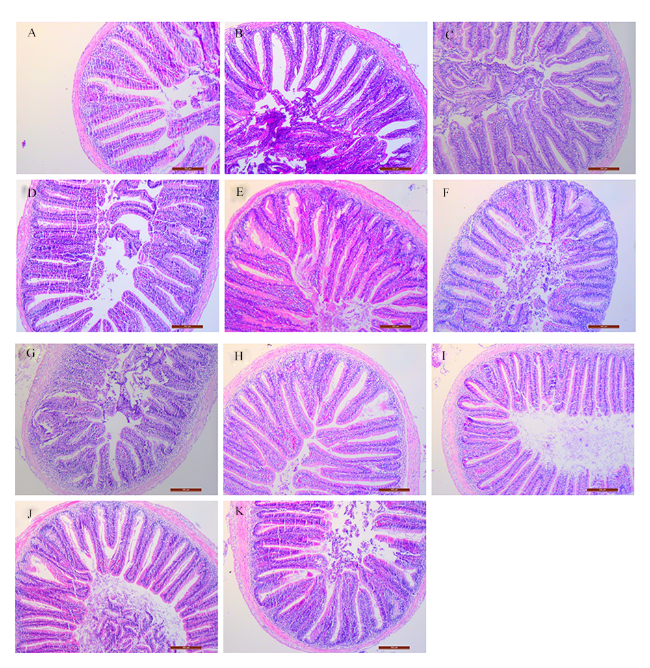
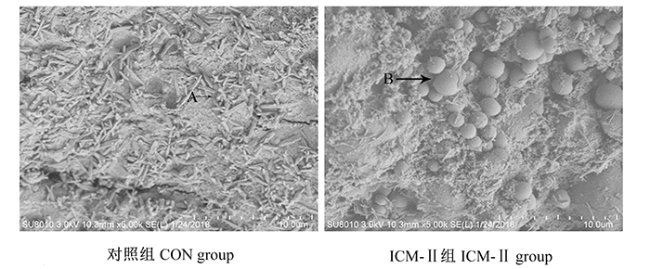
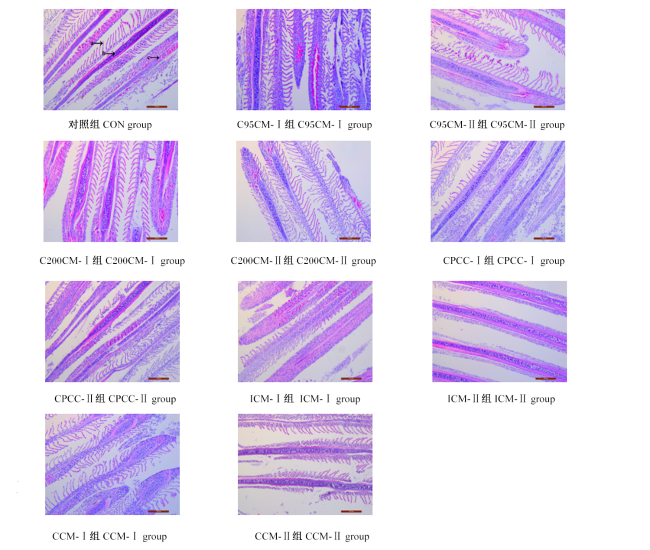
图1可知,各菜籽粕组肠道浆膜、肌层、黏膜下层和黏膜层等结构均较清晰,且均出现杯状细胞增多的现象。经电镜扫描比对后发现,对照组微绒毛形态正常,但ICM-Ⅱ组微绒毛间暴露出大量脂滴(图2)。
图1 不同来源菜籽粕对鲤鱼肠道形态结构的影响(苏木精-伊红染色)

A~K分别为对照组、C95CM-Ⅰ组、C95CM-Ⅱ组、C200CM-Ⅰ组、C200CM-Ⅱ组、CPCC-Ⅰ组、CPCC-Ⅱ组、ICM-Ⅰ组、ICM-Ⅱ组、CCM-Ⅰ组和CCM-Ⅱ组。

Fig.1 Effects of rapeseed meal from different sources on intestinal morphology and structure of common carp (HE staining, 100×)

A to K were CON group, C95CM-Ⅰ group, C95CM-Ⅱ group, C200CM-Ⅰ group, C200CM-Ⅱ group, CPCC-Ⅰ group, CPCC-Ⅱ group, ICM-Ⅰ group, ICM-Ⅱ group, CCM-Ⅰ group and CCM-Ⅱ group, respectively.

图2 不同来源菜籽粕对鲤鱼肠道上皮细胞结构的影响(扫描电镜)

A:微绒毛 microvillus;B:脂滴 lipid droplet。

Fig.2 Effects of rapeseed meal from different sources on intestinal epithelial cell structure of common carp (SEM,5 000×)

2.4 不同来源菜籽粕对鲤鱼体组成的影响

表5可知,在20%替代水平下,ICM-Ⅰ组鱼体水分含量显著高于对照组和C200CM-Ⅰ组(P<0.05),且粗蛋白质含量显著低于C200CM-Ⅰ组(P<0.05)。在35%替代水平下,C95CM-Ⅱ组和ICM-Ⅱ组鱼体水分含量均显著高于对照组(P<0.05),且ICM-Ⅱ组显著高于C200CM-Ⅱ组(P<0.05);C200CM-Ⅱ组粗蛋白质含量显著高于C95CM-Ⅱ组、CPCC-Ⅱ组、ICM-Ⅱ组和CCM-Ⅱ组(P<0.05)。
表5 不同来源菜籽粕对鲤鱼体组成的影响

Table 5 Effects of rapeseed meal from different sources on body composition of common carp

项目
Items
水分
Moisture/%
粗蛋白质
CP/%
粗脂肪
EE/%
粗灰分
Ash/%
总能
GE/(MJ/kg)
对照组CON group 74.69±0.32abc 16.73±0.31abc 5.22±0.36ab 2.72±0.02 23.58±0.23
20%替代豆粕20% instead of soybean meal
C95CM-Ⅰ组C95CM-Ⅰ group 75.49±0.19abcde 16.32±0.15ab 4.97±0.15ab 2.88±0.03 23.25±0.09
C200CM-Ⅰ组C200CM-Ⅰ group 74.34±0.21a 17.68±0.23bc 5.42±0.80b 3.04±0.18 23.62±0.14
CPCC-Ⅰ组CPCC-Ⅰ group 75.10±0.10abcd 16.72±0.16abc 5.07±0.09ab 2.89±0.10 23.48±0.14
ICM-Ⅰ组ICM-Ⅰ group 76.28±0.42de 16.19±0.19a 3.97±0.34ab 2.91±0.05 23.17±0.17
CCM-Ⅰ组CCM-Ⅰ group 74.95±0.27abcd 17.07±0.33abc 4.06±0.06ab 2.99±0.14 23.74±0.17
35%替代豆粕35% instead of soybean meal
C95CM-Ⅱ组C95CM-Ⅱ group 76.24±0.15de 15.74±0.06a 4.79±0.05ab 2.86±0.11 23.41±0.07
C200CM-Ⅱ组C200CM-Ⅱ group 74.49±0.45ab 17.80±0.34c 4.38±0.04ab 3.03±0.10 22.98±0.06
CPCC-Ⅱ组CPCC-Ⅱ group 76.17±0.32cde 16.15±0.50a 4.74±0.17ab 2.85±0.06 23.55±0.23
ICM-Ⅱ组ICM-Ⅱ group 76.78±0.31e 15.68±0.20a 3.71±0.32a 3.06±0.07 22.87±0.19
CCM-Ⅱ组CCM-Ⅱ group 75.87±0.15bcde 16.30±0.11ab 3.72±0.15a 2.90±0.10 23.38±0.22

2.5 不同来源菜籽粕对鲤鱼血清生化指标的影响

表6可知,与对照组相比,20%替代豆粕组血清生化指标均无显著差异(P>0.05)。在35%替代水平下,CPCC-Ⅱ组和ICM-Ⅱ组血清UN含量显著高于对照组(P<0.05),血清T3含量显著低于对照组(P<0.05),且ICM-Ⅱ组血清UN含量显著高于C200CM-Ⅱ组(P<0.05);C95CM-Ⅱ组和ICM-Ⅱ组血清AST活性显著高于对照组(P<0.05)。
表6 不同来源菜籽粕对鲤鱼血清生化指标的影响

Table 6 Effects of rapeseed meal from different sources on serum biochemical indices of common carp

项目
Items
总蛋白
TP/(g/L)
总胆
固醇
TC/
(mmol/L)
甘油
三酯
TAG/
(mmol/L)
葡萄糖
GLU/
(mmol/L)
尿素氮
UN/
(mmol/L)
谷草
转氨酶
AST/
(U/L)
谷丙转
氨酶
ALT/
(U/L)
三碘甲状
腺原氨酸
T3/
(ng/mL)
甲状
腺素
T4/
(ng/mL)
对照组
CON group
27.63
±0.38
2.23
±0.07
1.34
±0.21
3.70
±0.32ab
2.38
±0.13ab
23.21
±1.86a
12.28
±1.22abc
3.82
±0.11b
7.98
±0.53ab
项目
Items
总蛋白
TP/(g/L)
总胆
固醇
TC/
(mmol/L)
甘油
三酯
TAG/
(mmol/L)
葡萄糖
GLU/
(mmol/L)
尿素氮
UN/
(mmol/L)
谷草
转氨酶
AST/
(U/L)
谷丙转
氨酶
ALT/
(U/L)
三碘甲状
腺原氨酸
T3/
(ng/mL)
甲状
腺素
T4/
(ng/mL)
20%替代豆粕20% instead of soybean meal
C95CM-Ⅰ组
C95CM-Ⅰ
group
28.36
±0.48
2.39
±0.25
1.69
±0.15
3.31
±0.19ab
2.47
±0.08abc
27.45
±2.41ab
13.44
±0.93abc
3.36
±0.22ab
7.34
±0.08ab
C200CM-Ⅰ组
C200CM-Ⅰ
group
28.20
±0.82
2.78
±0.69
1.83
±0.14
4.96
±0.67ab
2.35
±0.13a
21.25
±1.88a
10.05
±1.01a
3.83
±0.41b
8.37
±0.24b
CPCC-Ⅰ组
CPCC-Ⅰ
group
27.33
±0.76
2.94
±0.15
1.76
±0.23
5.31
±0.27b
3.12
±0.20abcd
24.19
±1.46ab
14.14
±0.81bc
3.21
±0.25ab
7.56
±0.23ab
ICM-Ⅰ组
ICM-Ⅰ
group
28.05
±0.64
2.30
±0.33
2.06
±0.41
3.25
±0.52ab
3.21
±0.11bcd
30.19
±0.77ab
14.30
±0.18bc
2.96
±0.19ab
7.51
±0.29ab
CCM-Ⅰ组
CCM-Ⅰ
group
28.62
±0.50
2.49
±0.35
1.80
±0.11
5.13
±0.74b
2.75
±0.11abcd
25.03
±2.29ab
10.04
±0.91a
3.68
±0.15ab
8.13
±0.30ab
35%替代豆粕35% instead of soybean meal
C95CM-Ⅱ组
C95CM-Ⅱ
group
26.98
±0.14
2.46
±0.53
2.04
±0.26
3.36
±0.41ab
2.81
±0.22abcd
33.19
±1.84b
13.61
±1.05abc
2.99
±0.24ab
7.23
±0.30ab
C200CM-Ⅱ组
C200CM-Ⅱ
group
29.97
±1.75
3.55
±0.11
1.74
±0.30
4.09
±0.76ab
2.41
±0.37abc
25.48
±1.20ab
10.62
±0.47ab
3.06
±0.12ab
7.70
±0.23ab
CPCC-Ⅱ组
CPCC-Ⅱ
group
30.22
±0.87
2.16
±0.10
2.12
±0.37
3.26
±0.23ab
3.24
±0.05cd
26.53
±0.72ab
15.77
±0.33c
2.61
±0.23a
6.75
±0.18a
ICM-Ⅱ组
ICM-Ⅱ
group
28.07
±0.16
2.17
±0.25
2.52
±0.50
2.60
±0.35a
3.55
±0.19d
32.86
±0.80b
14.86
±0.80c
2.59
±0.20a
7.09
±0.06ab
CCM-Ⅱ组
CCM-Ⅱ
group
28.48
±0.47
2.23
±0.13
1.46
±0.27
4.28
±0.30ab
2.96
±0.21abcd
26.72
±3.07ab
12.07
±0.49abc
3.59
±0.16ab
7.17
±0.17ab
随着菜籽粕添加水平的提高,各菜籽粕组血清T3和T4含量下降,血清UN含量升高,但均无显著差异(P>0.05)。

2.6 不同来源菜籽粕对鲤鱼血清抗氧化指标的影响

表7可知,在20%替代水平下,C95CM-Ⅰ组和ICM-Ⅰ组血清CAT活性均显著低于对照组(P<0.05);且ICM-Ⅰ组血清MDA含量显著高于对照组、C200CM-Ⅰ组和CCM-Ⅰ组(P<0.05)。在35%替代水平下,C95CM-Ⅱ组、CPCC-Ⅱ组、ICM-Ⅱ组和CCM-Ⅱ组血清CAT活性均显著低于对照组(P<0.05);C200CM-Ⅱ组和ICM-Ⅱ组血清GSH-Px活性显著低于对照组(P<0.05),且ICM-Ⅱ组显著低于C95CM-Ⅱ组(P<0.05);C95CM-Ⅱ组和ICM-Ⅱ组血清GR活性显著低于对照组(P<0.05),且ICM-Ⅱ组显著低于C200CM-Ⅱ组(P<0.05);CPCC-Ⅱ组、ICM-Ⅱ组和CCM-Ⅱ组血清AKP显著高于对照组(P<0.05);C95CM-Ⅱ组、CPCC-Ⅱ组和ICM-Ⅱ组血清MDA含量显著高于对照组(P<0.05),且ICM-Ⅱ组显著高于CCM-Ⅱ组(P<0.05)。
表7 不同来源菜籽粕对鲤鱼血清抗氧化指标的影响

Table 7 Effects of rapeseed meal from different sources on serum antioxidant indices of common carp

项目
Items
超氧化物
歧化酶
SOD/
(U/mL)
过氧化
氢酶
CAT/
(U/mL)
过氧化
物酶
POD/
(U/mL)
谷胱甘肽过
氧化物酶
GSH-Px/
(U/μL)
谷胱甘肽
还原酶
GR/(U/L)
碱性磷酸酶
AKP/
(U/dL)
皮质醇
Cortisol/
(μg/mL)
丙二醛
MDA/
(nmol/mL)
对照组
CON group
21.16
±0.40
14.45
±1.64b
22.89
±1.46ab
66.56
±2.50cdef
36.44
±2.15cd
2.32
±0.21a
0.45
±0.03abcd
8.03
±0.23ab
20%替代豆粕20% instead of soybean meal
C95CM-Ⅰ组
C95CM-Ⅰ group
20.75
±0.28
10.06
±0.18a
18.67
±1.11a
68.48
±4.96def
30.01
±2.14abcd
2.76
±0.24ab
0.43
±0.02abc
10.51
±0.74bcd
C200CM-Ⅰ组
C200CM-Ⅰ group
20.32
±0.19
12.80
±0.35ab
22.96
±1.00ab
76.80
±3.09ef
40.73
±2.14d
3.42
±0.61abc
0.38
±0.01ab
7.86
±0.37a
CPCC-Ⅰ组
CPCC-Ⅰ group
21.09
±0.68
10.45
±0.55ab
22.29
±1.16ab
50.24
±1.69abc
27.86
±2.14abcd
3.10
±0.06abc
0.50
±0.01cd
9.49
±0.15abcd
ICM-Ⅰ组
ICM-Ⅰ group
21.77
±0.12
9.66
±0.32a
19.41
±1.44ab
55.68
±2.54abcd
30.01
±2.14abcd
4.44
±0.37abc
0.50
±0.02cd
11.20
±0.84d
CCM-Ⅰ组
CCM-Ⅰ group
20.82
±0.49
11.83
±0.94ab
25.56
±0.34b
81.28
±5.58f
34.30
±2.15bcd
3.98
±0.68abc
0.36
±0.02a
7.78
±0.56a
35%替代豆粕35% instead of soybean meal
C95CM-Ⅱ组
C95CM-Ⅱ group
20.66
±0.10
9.13
±1.09a
17.00
±0.33a
60.96
±1.44bcde
22.51
±3.22ab
3.54
±0.06abc
0.47
±0.00cde
10.90
±0.38cd
C200CM-Ⅱ组
C200CM-Ⅱ group
20.43
±0.90
10.54
±0.23ab
16.52
±1.33a
48.64
±3.93ab
34.30
±2.15bcd
3.47
±0.42abc
0.46
±0.02abcd
10.30
±0.50abcd
CPCC-Ⅱ组
CPCC-Ⅱ group
20.29
±0.48
8.89
±1.07a
20.74
±2.09ab
57.60
±2.00abcd
25.72
±3.71abc
5.51
±0.06c
0.54
±0.03cd
10.68
±0.68cd
ICM-Ⅱ组
ICM-Ⅱ group
20.98
±0.40
9.24
±0.92a
19.19
±1.87ab
42.56
±1.15a
19.29
±3.71a
5.55
±0.68c
0.55
±0.01d
11.88
±0.23d
CCM-Ⅱ组
CCM-Ⅱ group
21.09
±0.18
9.35
±0.64a
20.70
±0.66ab
58.88
±4.51abcd
23.58
±2.14abc
4.94
±0.79bc
0.44
±0.00abcd
8.46
±0.15abc
随着菜籽粕添加水平的提高,各菜籽粕组血清CAT活性均下降,血清MDA含量均升高,但均无显著差异(P>0.05);各菜籽粕组血清AKP活性均升高,但无显著差异(P>0.05)。

2.7 不同来源菜籽粕对鲤鱼肝脏抗氧化指标的影响

表8可知,在20%替代水平下,CPCC-Ⅰ组肝脏CAT活性显著低于对照组、C95CM-Ⅰ组、C200CM-Ⅰ组和CCM-Ⅰ组(P<0.05),肝脏GSH-Px和GR活性显著低于C200CM-Ⅰ组(P<0.05);ICM-Ⅰ组肝脏MDA含量显著高于对照组、C95CM-Ⅰ组、C200CM-Ⅰ组和CCM-Ⅰ组(P<0.05),肝脏GR活性显著低于C200CM-Ⅰ组(P<0.05)。
表8 不同来源菜籽粕对鲤鱼肝脏抗氧化指标的影响

Table 8 Effects of rapeseed meal from different sources on antioxidant indices in liver of common carp

项目
Items
超氧化物
歧化酶
SOD/
(U/mg prot)
过氧化氢酶
CAT/
(U/mg prot)
过氧化物酶
POD/
(U/mg prot)
谷胱甘肽
过氧化物酶
GSH-Px/
(U/μg prot)
谷胱甘肽
还原酶GR/
(U/g prot)
丙二醛
MDA/
(nmol/g prot)
对照组CON group 22.43±0.29 0.60±0.06de 10.96±1.06abc 24.81±2.07ab 57.77±1.63bc 5.90±0.52a
20%替代豆粕20% instead of soybean meal
C95CM-Ⅰ组
C95CM-Ⅰ group
22.97±0.17 0.57±0.08de 9.76±0.75abc 23.92±1.64ab 48.38±3.11bc 7.27±0.48a
C200CM-Ⅰ组
C200CM-Ⅰ group
22.77±0.19 0.65±0.10e 12.72±1.26c 32.07±2.32b 62.24±2.39c 5.56±0.45a
CPCC-Ⅰ组
CPCC-Ⅰ group
21.80±0.64 0.25±0.04abc 7.25±0.58ab 22.20±1.85a 46.55±3.50b 8.38±0.22abc
ICM-Ⅰ组
ICM-Ⅰ group
21.86±0.11 0.32±0.02abcd 7.19±0.48ab 23.20±2.16ab 46.52±2.64b 11.62±0.75cd
CCM-Ⅰ组
CCM-Ⅰ group
22.48±0.35 0.58±0.06de 11.71±1.65bc 25.72±2.03ab 58.14±1.17bc 6.45±0.70a
35%替代豆粕35% instead of soybean meal
C95CM-Ⅱ组
C95CM-Ⅱ group
22.89±0.40 0.51±0.03bcde 8.35±0.66abc 22.23±0.85ab 45.21±4.92b 7.95±0.77ab
C200CM-Ⅱ组
C200CM-Ⅱ group
22.62±0.89 0.53±0.06cde 9.64±0.87abc 23.22±1.79ab 49.96±1.81bc 7.69±0.65ab
CPCC-Ⅱ组
CPCC-Ⅱ group
21.97±0.70 0.20±0.02a 6.56±0.53a 20.47±1.89a 30.89±2.71a 10.94±0.75bc
ICM-Ⅱ组
ICM-Ⅱ group
22.21±0.14 0.23±0.03ab 6.34±0.66a 22.06±1.09a 45.29±2.96b 14.53±1.23d
CCM-Ⅱ组
CCM-Ⅱ group
22.36±0.13 0.40±0.05abcde 8.05±0.73abc 23.38±0.83ab 45.07±2.96b 8.55±0.37abc
在35%替代水平下,CPCC-Ⅱ组和ICM-Ⅱ组肝脏CAT活性显著低于对照组(P<0.05),且CPCC-Ⅱ组肝脏CAT活性显著低于C95CM-Ⅱ组和C200CM-Ⅱ组(P<0.05),肝脏GR活性显著低于对照组、C95CM-Ⅱ组、C200CM-Ⅱ组、ICM-Ⅱ组和CCM-Ⅱ组(P<0.05);CPCC-Ⅱ组和ICM-Ⅱ组肝脏MDA含量显著高于对照组(P<0.05),且ICM-Ⅱ组显著高于其余4组(P<0.05)。

2.8 不同来源菜籽粕对鲤鱼免疫力和抗病力的影响

表9可知,在20%替代水平下,ICM-Ⅰ组血清IgM含量显著低于对照组、C200CM-Ⅰ组和CCM-Ⅰ组(P<0.05);CPCC-Ⅰ组和ICM-Ⅰ组血清C4含量显著低于对照组、C200CM-Ⅰ组和CCM-Ⅰ组(P<0.05),且ICM-Ⅰ组显著低于C95CM-Ⅰ组(P<0.05);CPCC-Ⅰ组和ICM-Ⅰ组肝脏LZM活性显著低于对照组和其余3组(P<0.05),吞噬活性显著低于对照组、C200CM-Ⅰ组和CCM-Ⅰ组(P<0.05);ICM-Ⅰ组呼吸爆发显著低于对照组、C95CM-Ⅰ组、C200CM-Ⅰ组和CCM-Ⅰ组(P<0.05)。
表9 不同来源菜籽粕对鲤鱼免疫力和抗病力的影响

Table 9 Effects of rapeseed meal from different sources on immunity and disease resistance of common carp

项目
Items
免疫球蛋白M
IgM/(g/L)
补体3
C3/(g/L)
补体4
C4/(g/L)
血清溶菌酶
LZM in
serum/
(μg/mL)
肝脏溶菌酶
LZM in
liver/
(μg/mg prot)
呼吸爆发
Respiratory
burst
吞噬活性
Phagocytic
activity
攻毒成活率
Survival rate
of challenge/
%
对照组
CON group
1.95±0.10cd 0.88±0.02c 0.45±0.01de 5.66±0.37bc 0.32±0.00ef 2.58±0.09bcd 0.32±0.01d 56.7
20%替代豆粕20% instead of soybean meal
C95CM-Ⅰ组
C95CM-Ⅰ group
1.57±0.03abc 0.79±0.02abc 0.40±0.03bcd 5.21±0.06abc 0.28±0.01de 2.55±0.03bcd 0.29±0.01cd 50.0
C200CM-Ⅰ组
C200CM-Ⅰ group
2.04±0.05d 0.86±0.03bc 0.47±0.01e 5.80±0.23bc 0.35±0.00f 2.67±0.08cd 0.32±0.01d 60.0
CPCC-Ⅰ组
CPCC-Ⅰ
group
1.83±0.11bcd 0.82±0.01abc 0.33±0.02ab 4.90±0.12abc 0.20±0.00ab 2.36±0.04ab 0.27±0.00bc 46.7
ICM-Ⅰ组
ICM-Ⅰ
group
1.50±0.15ab 0.81±0.02abc 0.30±0.01a 5.00±0.12abc 0.22±0.01bc 2.41±0.03a 0.27±0.00bc 46.7
CCM-Ⅰ组
CCM-Ⅰ
group
1.98±0.06cd 0.86±0.02bc 0.42±0.01cde 6.15±0.33c 0.34±0.00f 2.70±0.05d 0.32±0.00d 56.7
35%替代豆粕35% instead of soybean meal
C95CM-Ⅱ组
C95CM-Ⅱ
group
1.34±0.06a 0.77±0.03ab 0.39±0.01bcd 4.69±0.10ab 0.26±0.01cd 2.42±0.02abc 0.22±0.01a 50.0
C200CM-Ⅱ组
C200CM-Ⅱ
group
1.89±0.07bcd 0.77±0.03ab 0.39±0.01bcd 5.07±0.41abc 0.25±0.01cd 2.43±0.07abc 0.27±0.01bc 56.7
CPCC-Ⅱ组
CPCC-Ⅱ
group
1.58±0.10abc 0.76±0.02a 0.33±0.01ab 4.58±0.16ab 0.17±0.00a 2.28±0.04a 0.24±0.01ab 40.0
ICM-Ⅱ组
ICM-Ⅱ
group
1.34±0.10a 0.76±0.02a 0.29±0.01a 4.31±0.33a 0.19±0.01ab 2.36±0.02abc 0.21±0.01a 36.7
CCM-Ⅱ组
CCM-Ⅱ
group
1.79±0.03bcd 0.78±0.01ab 0.36±0.01abc 5.38±0.24abc 0.27±0.01d 2.53±0.06abcd 0.28±0.00c 43.4
在35%替代水平下,C95CM-Ⅱ组和ICM-Ⅱ组血清IgM含量显著低于对照组、C200CM-Ⅱ组和CCM-Ⅱ组(P<0.05);各菜籽粕组血清C3含量、肝脏LZM活性和吞噬活性显著低于对照组(P<0.05),且CPCC-Ⅱ组和ICM-Ⅱ组肝脏LZM活性显著低于其余3组(P<0.05),C95CM-Ⅱ组和ICM-Ⅱ组吞噬活性显著低于C200CM-Ⅱ组和CCM-Ⅱ组(P<0.05);CPCC-Ⅱ组、ICM-Ⅱ组和CCM-Ⅱ组血清C4含量显著低于对照组(P<0.05),且ICM-Ⅱ组显著低于C95CM-Ⅱ组和C200CM-Ⅱ组(P<0.05);CPCC-Ⅱ组呼吸爆发显著低于对照组(P<0.05)。
随着菜籽粕添加水平的提高,各菜籽粕组血清IgM、C3和C4含量以及血清和肝脏LZM活性、吞噬活性和呼吸爆发均出现不同程度的下降。

2.9 不同来源菜籽粕对鲤鱼肝脏组织形态结构的影响

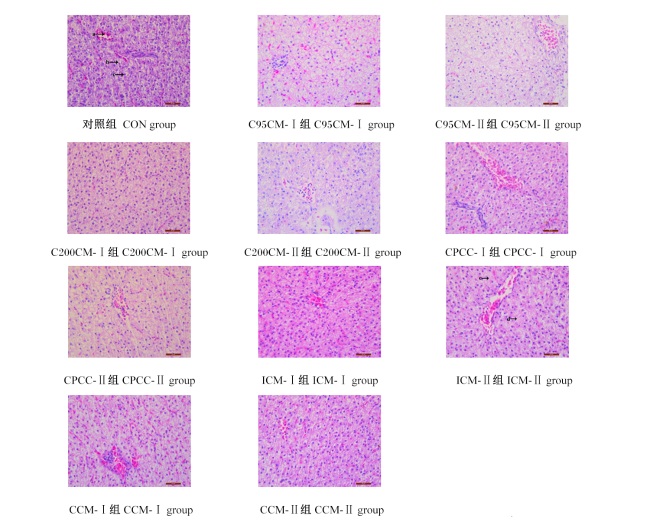
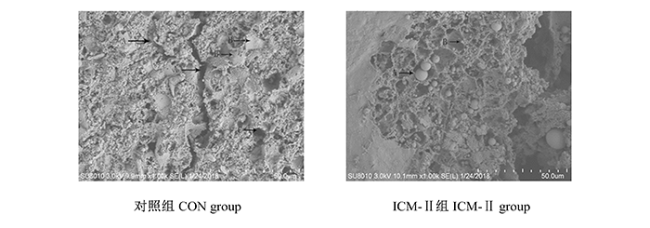
图3可知,对照组肝脏细胞形态正常,小叶间静脉(a)、细胞质(b)和细胞核(c)等结构清晰;C200CM-Ⅱ组、CPCC-Ⅱ组和ICM-Ⅱ组均出现脂肪肝症状,存在大量脂肪液泡,部分位置出现细胞膜破裂,细胞核浓缩甚至溶解消失,细胞边界模糊。且经电镜扫描(如图4所示)发现对照组窦状隙和肝血窦结构清晰,肝细胞形态正常;ICM-Ⅱ组肝脏被膜被破坏,漏出大量脂滴和线粒体。
图3 不同来源菜籽粕对鲤鱼肝脏组织形态的影响(苏木精-伊红染色)

a:小叶间静脉 interlobular vein;b:细胞质 cytoplasm;c:细胞核 nucleus;d:细胞空泡化 cell vacuolation;e:细胞核偏移 nuclear migration。

Fig.3 Effects of rapeseed meal from different sources on morphology of liver tissue of common carp (HE staining, 400×)

图4 不同来源菜籽粕对鲤鱼肝脏组织结构的影响(扫描电镜)

A:窦状隙 sinusoidal ostium;B:肝细胞 hepatocyte;C:肝血窦 hepatic sinusoid;D:脂滴 lipid droplet;E:线粒体 mitochondria。

Fig.4 Effects of rapeseed meal from different sources on structure of liver tissue of common carp (SEM,1 000×)

2.10 不同来源菜籽粕对鲤鱼鳃结构的影响

图5可知,各组甲状腺滤泡、鳃丝和鳃小片等结构清晰,各菜籽粕组均出现甲状腺滤泡结构不规则、滤泡上皮细胞高度增加等现象。
图5 不同来源菜籽粕对鲤鱼鳃结构的影响(苏木精-伊红染色)

a:鳃小片 gill lamella;b:甲状腺滤泡 thyroid follicle;c:鳃丝 branchial filament。

Fig.5 Effects of rapeseed meal from different sources on gill structure of common carp (HE staining, 100×)

3 讨论

3.1 不同来源菜籽粕对鲤鱼生长性能的影响

本试验结果表明,20%或35% C200CM替代豆粕对鲤鱼生长性能无显著不良影响;C95CM、CPCC、ICM和CCM均不同程度降低鲤鱼生长性能和饲料利用率,其中CPCC-Ⅰ组和ICM-Ⅰ组DGC显著降低;ICM-Ⅱ组生长性能最差,其次依次是CPCC-Ⅱ、ICM-Ⅰ和CPCC-Ⅰ组,且随着替代水平增高ICM组生长性能显著下降。该结果与Xu等[30]、Dossou等[31]和金素雅等[32]报道的菜籽粕水平过高时会导致鱼类生产性能下降类似。李云兰等[20]用ICM替代C200CM的饲料饲喂鲤鱼(12~60 g),ITC和OZT含量分别为1 537和303 mg/kg,导致其生长性能下降。此外,研究表明,菜籽粕中有苦味的有害成分GLS可分解成有毒物质OZT[33],危害水产动物健康,降低水产动物生产性能[34-35]。本试验饲料中,CPCC-Ⅰ组、CPCC-Ⅱ组、ICM-Ⅰ组和ICM-Ⅱ组GLS、ITC和OZT含量分别为1.31%、0.26 g/kg和0.62 mg/g,2.30%、0.45 g/kg和1.08 mg/g,0.12%、0.37 g/kg和0.01 mg/g,0.21%、0.65 g/kg和0.02 mg/g,其中CPCC组GLS和OZT含量最高,且OZT含量均远超303 mg/kg;ICM组GLS和OZT含量极低,ITC含量分别高于其余4组,且随着菜籽粕添加水平的提高,饲料中抗营养因子含量皆随之升高,但ICM-Ⅱ组ITC含量最高(0.65 mg/g)却远低于1 537 mg/kg,且GLS和OZT含量极低。研究还表明,饲料中单宁、植酸和芥酸含量分别达到1.75%[36]、2.17%[37]和0.64%[38]时会导致草鱼生长性能下降;饲料中植酸添加量为0.5%时会导致虹鳟生长性能下降[39-40];本试验中,单宁、植酸和芥酸最高分别仅为1.65 mg/g、2.96 mg/g和0.57%,远低于上述量。
由上述可见,CPCC组极可能是因为高含量的GLS、OZT导致了鲤鱼生长性能显著下降,但ICM组GLS、OZT含量不足以致使鲤鱼生长性能下降并呈现ICM-Ⅱ组生长性能最差的结果,这可能是相对于GLS和OZT鲤鱼对ITC更不耐受。不过,本试验中各菜籽粕组FI未出现下降的现象,这可能是由于鲤鱼对这种苦味因子耐受性较强。综上所述,本试验条件下,ICM组中主要是ITC导致了鲤鱼生长性能的下降,CPCC组中主要是较高含量的ITC同时和高含量的GLS和OZT作用导致了鲤鱼生长性能的下降。当鲤鱼饲料中含0.37 mg/g的ITC时即可导致鲤鱼生长速度减慢,但对FCR无显著负面影响;然而当鲤鱼饲料中ITC达到0.65 mg/g时,会对鲤鱼的生长性能和饲料利用率产生严重负面影响。

3.2 不同来源菜籽粕对鲤鱼肠道消化酶活性和形态结构的影响

肠是鱼类最主要的消化器官,其消化吸收能力可直接影响鱼的生长。脂肪酶和胰蛋白酶是肠道消化酶的重要组成部分,可分别将脂肪和多种蛋白质水解为甘油、脂肪酸和多肽或氨基酸,以利于肠道吸收利用。本试验中,各菜籽粕组肠道胰蛋白酶和脂肪酶活性皆有所下降。且以CPCC组和ICM组胰蛋白酶活性(尤其是ICM组)和CPCC组脂肪酶活性下降尤为显著。由此可见,胰蛋白酶活性下降可能是CPCC和ICM导致鲤鱼生长性能下降的关键因素之一。综上所述,可能是ICM中ITC可通过降低胰蛋白酶活性从而降低鲤鱼生长性能;CPCC组中的GLS和OZT主要通过同时降低胰蛋白酶和脂肪酶活性导致鲤鱼生长性能下降,且很可能高含量的GLS和OZT导致脂肪酶活性显著性降低是CPCC组鲤鱼生长性能显著下降的关键原因。
ITC会刺激消化道黏膜,影响鱼类消化吸收。为了探究鲤鱼是否也具有这一特性,本试验对各组鲤鱼肠道进行苏木精-伊红(HE)染色和电镜扫描,结果显示各菜籽粕组均出现杯状细胞增多的现象。经电镜扫描后发现,ICM-Ⅱ组微绒毛间暴露出大量脂滴。由于杯状细胞的分泌物是肠道黏液屏障的重要组成成分,对维持肠道黏膜的完整和稳定具有重要作用,并参与多种肠病的发生和发展,是肠道先天性第1道免疫屏障的重要组成部分[41]。因此,这一结果可能是由于菜籽粕中的抗营养因子刺激消化道黏膜,从而引起杯状细胞增多。饲料GLS及其水解产物可刺激鱼体消化道黏膜而影响饲料利用率[42]与本试验结果类似。综上可以推断,饲料中ITC、GLS和OZT会通过损伤肠黏膜而导致肠道胰蛋白酶和脂肪酶活性下降,从而导致机体生长性能下降,尤其是0.65 mg/g ITC的毒害性最强。

3.3 不同来源菜籽粕对鲤鱼血清生化指标的影响

AST和ALT是2种主要转氨酶,可一定程度上反映肝脏受损情况及蛋白质代谢情况[43],其含量在血清中大幅上升时说明肝脏组织发生了病变或损伤。本试验中,与对照组相比,C95CM-Ⅱ组和ICM-Ⅱ组血清AST活性均显著升高,这说明饲料中添加35%的C95CM和ICM可导致鲤鱼发生肝损或病变。甲状腺激素有T3和T4 2种形式,可对机体三大营养物质的代谢产生影响。研究表明,添加30%菜籽粕的虹鳟饲料可引起其血清T3、T4含量呈下降趋势[44]。本试验饲料中随菜籽粕添加水平的升高,各菜籽粕组血清T3、T4含量均有不同程度的下降,且CPCC-Ⅱ组和ICM-Ⅱ组血清T3显著低于对照组,血清UN含量显著高于对照组。由此推断,35%替代水平下CPCC和ICM主要通过降低血清T3含量导致机体蛋白质代谢异常。综上可知,ICM-Ⅱ组和CPCC-Ⅱ组主要通过GLS、ITC和OZT降低血清T3含量,导致机体蛋白质代谢异常。且相较而言,CPCC-Ⅱ组三者含量整体远高于ICM-Ⅱ组,但结果显示2组之间血清T3和UN含量并无显著差异,由此可知,ITC很可能是导致T3含量下降的关键因素。

3.4 不同来源菜籽粕对鲤鱼抗氧化能力的影响

CAT可加速机体内H2O2分解以保护细胞,在肝脏中浓度最高,是生物防御体系的关键酶之一[45]。本试验鲤鱼饲料中添加20%水平的C95CM或ICM、35%水平的CPCC或CCM即可导致血清CAT活性显著下降;添加20%水平的CPCC或35%水平的ICM即可导致肝CAT活性下降,从而降低鲤鱼的抗氧化能力;且ICM更易导致血清CAT活性显著下降;CPCC更易导致肝脏CAT活性显著下降,这可能与2种菜籽粕中GLS、ITC和OZT含量的差异有关。AKP是衡量机体免疫功能及状态的指标之一[46],其活性升高时即肝功能障碍。本试验中CPCC-Ⅱ组、ICM-Ⅱ组和CCM-Ⅱ组血清AKP显著升高,表明其鲤鱼出现严重肝功能障碍。生物体内脂质过氧化反应最终产生MDA,其具有细胞毒性,可加剧膜损伤,因而细胞损伤的程度可通过测定其含量间接反映出来[47]。本试验中,ICM组、CPCC-Ⅱ组血清和肝脏MDA含量以及C95CM-Ⅱ组血清MDA含量显著升高,可能是其肝细胞或红细胞损伤严重,尤其是ICM组。由此可见,5种菜籽粕主要通过引起CAT活性下降,H2O2和MDA累积,从而损伤肝细胞和红细胞,导致鲤鱼抗氧化能力下降,尤其是ICM尤为显著,CPCC次之,接着依次是C95CM和CCM。由于肝脏健康与鱼体健康关系尤为密切,因此,在保障鲤鱼肝脏健康的情况下,饲料中ICM的添加量最好应控制在20%以下,当水平到达35%时会导致鲤鱼严重的肝功能障碍危害机体健康;CPCC的水平应控制在35%以下。综上所述,ICM中较高含量的ITC和CPCC中较高的GLS和OZT可能是导致鲤鱼抗氧化能力下降的关键因素,尤其是ITC。

3.5 不同来源菜籽粕对鲤鱼免疫力和抗病力的影响

鱼类以非特异性免疫为主,IgM存在于细胞外液及其他外分泌液中,在其中发挥着重要作用。本试验饲料中添加20%的ICM或35%的C95CM时即可显著降低鲤鱼血清IgM含量,这与Kokou等[48]提出的菜籽粕会使鱼类血清中IgM含量下降类似。LZM是参与非特异性免疫的一种关键酶,在硬骨鱼发育早期抵御病原体方面发挥重要作用[49-50],其专门破坏细菌细胞壁的肽聚糖,使得细菌溶解、坏死[51],尤其是革兰氏阳性菌,其活性可显示机体对外界细菌的抵抗能力[52]。本试验饲料中添加20%的ICM或CPCC即可显著降低鲤鱼肝脏LZM活性,导致鲤鱼抗病力下降;当添加水平达到35%时,ICM-Ⅱ组血清LZM活性也显著下降;添加35%的C95CM、C200CM或CCM时可引起肝脏LZM活性显著下降,从而导致鲤鱼抗病力下降,且ICM-Ⅱ组攻毒成活率最低(36.7%),其次是CPCC-Ⅱ组(40.0%)。由此推断,5种菜籽粕通过降低机体非特异性免疫能力降低鲤鱼抗病力的程度依次是:ICM>CPCC>C95CM>C200CM或CCM。体液免疫是机体特异性免疫的重要部分,C3和C4是机体体液中的一组球蛋白,具有酶原活性,是补体系统中的主要成分,通过调理吞噬细胞、免疫复合物等机制来调节机体的免疫功能[53],而呼吸爆发是吞噬细胞的一种氧依赖的杀伤机制[54]。本试验饲料中添加20%的ICM或CPCC即可显著降低血清C4含量,引起吞噬活性显著下降,导致鲤鱼呼吸爆发显著降低,从而显著降低鲤鱼的免疫力;添加35%的CCM即可显著降低血清C3和C4含量;添加35%的5种菜籽粕即可导致吞噬活性不同程度的显著下降。由此可见,5种菜籽粕降低鲤鱼免疫力的程度依次是ICM>CPCC>C95CM>CCM>C200CM。综上所述,5种菜籽粕降低鲤鱼免疫力及抗病力的程度依次是:ICM>CPCC>C95CM>CCM>C200CM。

3.6 不同来源菜籽粕对鲤鱼肝脏健康的影响

肝脏是鱼类重要的免疫器官,其健康程度一定程度上决定了鱼体健康情况及免疫力抗病力的强弱。本试验通过肝脏HE染色切片观察发现,C200CM-Ⅱ组、CPCC-Ⅱ组和ICM-Ⅱ组均存出现脂肪肝症状;且ICM-Ⅱ组电镜扫描切片显示其鲤鱼肝脏被膜被破坏,漏出大量脂滴和线粒体。此结果与尼罗罗非鱼饲料中添加超过25%的菜籽粕会对其肝脏产生负面影响[55],杂交鲟饲料中随混合植物蛋白源替代比例升高、肝脏空泡化严重暴露出大量脂滴[56],鲈鱼饲料中30%的菜籽粕会导致肝脏组织炎症的出现及肝脏水样变性和脂肪变性[57],草鱼饲料中5种菜籽粕随添加比例的升高肝脏损伤加重[5],以及吉富罗非鱼饲料中30%的菜籽粕导致肝细胞空泡变性、核偏移及核浓缩[58]结果类似。综上所述,菜籽粕中的有害因子可损伤肝细胞、造成脂肪肝以影响机体的肝代谢功能和免疫功能,尤其是ITC。

3.7 不同来源菜籽粕对鲤鱼鳃结构的影响

鳃是鱼类的呼吸器官,且是鱼类最起码最基本、最重要的器官之一。鲤鱼的甲状腺由散点分布的甲状腺滤泡组成,正常的甲状腺滤泡应为由单层上皮细胞组成的多数形状近似卵圆形的囊泡型结构,滤泡腔内充满胶质;滤泡上皮细胞高度增加、增生时,鲤鱼会出现T3、T4含量显著降低的现象[59]。本试验通过观察鳃的HE染色切片发现,各菜籽粕组均出现甲状腺滤泡结构不规则、滤泡上皮细胞高度增加等现象。且研究表明,GLS、OZT和ITC可导致动物甲状腺肿[60]。综上所述,菜籽粕中的GLS、OZT和ITC可通过导致甲状腺滤泡的功能异常,甲状腺滤泡上皮细胞加厚导致其体积异常增大,影响鲤鱼腮的呼吸速率导致鲤鱼的呼吸爆发下降,从而降低机体免疫力,且以CPCC-Ⅱ组和ICM-Ⅱ组影响尤为显著,尤其是ICM-Ⅱ组,这可能与ICM-Ⅱ组中含有的ITC含量最高有关。

4 结论

① 菜籽粕饲料中的ITC、GLS和OZT是危害鲤鱼生长、消化和健康的关键因素,尤其是ITC。饲料中含0.37 mg/g的ITC即可导致鲤鱼生长速度减慢,但对FCR无显著负面影响;然而当饲料中含0.65 mg/g的ITC时,会对鲤鱼的生长、消化能力、抗氧化能力和健康产生严重负面影响。
② 饲料中添加5种不同来源的菜籽粕(20%或35%)对鲤鱼生长、消化和健康的负面影响程度从大到小依次为:ICM>CPCC>C95CM>CCM>C200CM。
③ 以FCR为衡量指标,8.84~60 g的幼鲤饲料中以菜籽粕替代豆粕时,CPCC添加量不宜超过20%,ICM或C95CM添加量不宜超过35%,CCM或C200CM添加量可达35%。
④ 在保证鲤鱼免疫力和肝脏健康的情况下,CPCC、ICM或C95CM的添加量不宜超过20%,CCM或C200CM的添加量可达35%。
[1]
钟小群, 李向飞, 蔡万存, 等. 发酵饲料对鲤鱼幼鱼生长性能、消化酶活性、肌肉品质和免疫机能的影响[J]. 南京农业大学学报, 2018, 41(1):154-162.

ZHANG X Q, LI X F, CAI W C, et al. Effects of fermented diets on growth performance,digestive enzyme activity,muscle quality and immune function of juvenile carp[J]. Journal of Nanjing Agricultural University, 2018, 41(1):154-162. (in Chinese)

[2]
李柯懋. 水产饲料廉价蛋白源的开发利用研究概述[J]. 中国水产, 2005(11):63-64.

LI K M. Research overview on development and utilization of cheap protein source of aquatic feed[J]. China Fisheries, 2005(11):63-64. (in Chinese)

[3]
王婷婷. 混合植物蛋白替代豆粕对黄河鲤鱼生长、免疫及肝脏GH/IGF-基因表达的影响[D]. 硕士学位论文. 泰安: 山东农业大学, 2017.

WANG T T. Effects of substitution of soybean meal with mixed plant protein on growth immunity and expression of GH/IGF- gene in liver of yellow river carp[D]. Master’s Thesis. Tai’an: Shandong Agricultural University, 2017. (in Chinese)

[4]
章双杰, 张斌, 刘宏祥, 等. 不同水平棉籽粕和菜籽粕对育肥期肉鹅生产及屠宰性能的影响[J]. 中国家禽, 2019, 41(20):28-32.

ZHANG S J, ZHANG B, LIU H X, et al. Effects of cottonseed meal and rapeseed meal at different levels on the production and slaughtering performance of geese in the fattening stage[J]. China Poultry, 2019, 41(20):28-32. (in Chinese)

[5]
陈路斯, 王恒志, 米海峰, 等. 不同类型菜籽粕对草鱼生长、抗氧化能力、非特异性免疫力及肝脏组织形态的影响[J]. 动物营养学报, 2020, 32(9):4260-4276.

CHEN L S, WANG H Z, MI H F, et al. Effects of different types of rapeseed meal on growth,antioxidant capacity,non-specific immunity and hepatic histology of grass carp (Ctenopharyngodon idella)[J]. Chinese Journal of Animal Nutrition, 2020, 32(9):4260-4276. (in Chinese)

[6]
ZHANG T, LIU L, PIAO X S. Predicting the digestible energy of rapeseed meal from its chemical composition in growing-finishing pigs[J]. Asian-Australasian Journal of Animal Sciences, 2012, 25(3):375-381.

DOI PMID

[7]
ZHU L P, WANG J P, DING X M, et al. Effects of dietary rapeseed meal on laying performance,egg quality,apparent metabolic energy,and nutrient digestibility in laying hens[J]. Livestock Science, 2018, 214:265-271.

DOI

[8]
陈倩, 周群兰, 戈贤平, 等. 氨基酸经雷帕霉素靶蛋白和氨基酸应答信号通路提高团头鲂幼鱼对棉籽粕和菜籽粕的利用[J]. 动物营养学报, 2020, 32(12):5850-5863.

CHEN Q, ZHOU Q L, GE X P, et al. Amino acids improve cottonseed meal and rapeseed meal utilization in blunt snout bream (Megalobrama amblycephala) via target of rapamycin and amino acid response signal pathways[J]. Chinese Journal of Animal Nutrition, 2020, 32(12):5850-5863.

[9]
ATSBEHA D M, FLATEN O, OLSEN H F, et al. Technical and economic performance of alternative feeds in dairy and pig production[J]. Livestock Science, 2020, 240:104123.

DOI

[10]
李波. 不同来源菜籽饼粕对生长猪的消化能值及氨基酸回肠消化率的测定[D]. 硕士学位论文. 雅安: 四川农业大学, 2011:1-72.

LI B. Determination of digestibility value and amino acid ileum digestibility of rapeseed cake from different sources on grown pigs[D]. Master’s Thesis. Ya’an: Sichuan Agricultural University, 2011:1-72. (in Chinese)

[11]
孙盛明, 叶金云, 陈建明, 等. 配合饲料中豆粕、菜粕替代鱼粉对青鱼消化酶活力和表观消化率的影响[J]. 浙江海洋学院学报(自然科学版), 2008, 27(4):395-400.

SUN S M, YE J Y, CHEN J M, et al. Effects of fishmeal replacement by mixture of soybean meal and rapeseed meal on digestive enzyme activities and apparent digestibility of the black carp (Mylopharyngodon piceus)[J]. Journal of Zhejiang Ocean University (Natural Science), 2008, 27(4):395-400. (in Chinese)

[12]
黄云, 胡毅, 肖调义, 等. 双低菜粕替代豆粕对青鱼幼鱼生长及生理生化指标的影响[J]. 水生生物学报, 2012, 36(1):41-48.

HUANG Y, HU Y, XIAO D Y, et al. Influence of dietary canola meal levels on growth and biochemical indices in juvenile Mylopharvngodon piceus[J]. Acta Hydrobiologica Sinica, 2012, 36(1):41-48. (in Chinese)

[13]
马利, 黄峰, 吴建开, 等. 不同菜粕水平对草鱼生长、血清生化指标和毒素残留的影响[J]. 水产学报, 2005, 29(6):798-803.

MA L, HUANG F, WU J K, et al. Effects of different rapeseed meal levels on growth,serum biochemical indices and toxins residues in Ctenoparyngodon idellus[J]. Journal of Fisheries of China, 2005, 29(6):798-803. (in Chinese)

[14]
赵飞, 吴志新, 庞素风, 等. 菜籽粕对异育银鲫免疫应答能力的影响[J]. 华中农业大学学报, 2007, 26(3):361-366.

ZHAO F, WU Z X, PANG S F, et al. Effects of rapeseed meal on the ability of immune response of gibel carp (Carassius auratus gibelio)[J]. Journal of Huazhong Agricultural University, 2007, 26(3):361-366. (in Chinese)

[15]
MCCURDY S M, MARCH B E. Processing of canola meal for incorporation in trout and salmon diets[J]. Journal of the American Oil Chemists Society, 1992, 69(3):213-220.

DOI

[16]
COLLINS S A, DESAI A R, MANSFIELD G S, et al. The effect of increasing inclusion rates of soybean,pea and canola meals and their protein concentrates on the growth of rainbow trout:concepts in diet formulation and experimental design for ingredient evaluation[J]. Aquaculture, 2012,344-349:90-99.

[17]
张桥鉴. 毒死蜱通过诱导程序性坏死和负调控PKC/MAPK-呼吸爆发通路抑制鲤鱼NETs释放的研究[D]. 硕士学位论文. 哈尔滨: 东北农业大学, 2020.

ZHANG Q J. Inhibition of NETs release by chlorpyrifos through induction of programmed necrosis and negative regulation of PKC/MAPK-respiratory burst pathway in common carp[D]. Master’s Thesis.Harbin:Northeast Agricultural University, 2020. (in Chinese)

[18]
梁丹妮. 建鲤(Cpyrinus carpio var.Jian)对18种饲料原料营养物质的表观消化率研究[D]. 硕士学位论文. 南京: 南京农业大学, 2011.

LIANG D N. The apparent digestibility of eighteen feed ingredients for Jian carp (Cpyrinus carpio Var.Jian)[D]. Master’s Thesis. Nanjing: Nanjing Agricultural University, 2011. (in Chinese)

[19]
覃江凤. 双低菜籽粕对草鱼和鲤生长性能和内脏器官的影响[D]. 硕士学位论文. 武汉: 华中农业大学, 2004.

QIN J F. Effects of double low rapeseed Meal on growth Performance and Visceral Organs of grass carp and Cyprinus carpio[D]. Master’s Thesis. Wuhan: Huazhong Agricultural University, 2004. (in Chinese)

[20]
李云兰, 高启平, 帅柯, 等. 印度菜粕替代200型菜粕对鲤鱼生长性能的影响[J]. 饲料工业, 2014, 35(20):24-28.

LI Y L, GAO Q P, SHUAI K, et al. Effect of Indian rapeseed meal in substitution for 200-type rapeseed meal on growth performance of common carp (Cyprinus carpio)[J]. Feed Industry, 2014, 35(20):24-28. (in Chinese)

[21]
MAZURKIEWICZ J,PRZYBYŁ A,CZYŻAK-RUNOWSKA G,et al. Cold-pressed rapeseed cake as a component of the diet of common carp (Cyprinus carpio L.):effects on growth,nutrient utilization,body composition and meat quality[J]. Aquaculture Nutrition,2011,17(4):387-394.

[22]
MAZURKIEWICZ J, ANDRZEJEWSKI W, ŻOLNIEROWICZ K M, et al. Effects of incorporating in diets cold-pressed rapeseed cake on the growth performance,nutrient utilization,and body composition of common carp (Cyprinus carpio L.)[J]. Fisheries & Aquatic Life, 2015,23(2):113-120.

[23]
陆有宽, 李国立, 高淑慧. 不同菜粕对鲤鱼生长影响的比较[J]. 河北渔业, 2012(10):15-16.

LU Y K, LI G L, GAO S H. Effects of different rapeseed meal on growth of common carp[J]. Hebei Fisheries, 2012(10):15-16. (in Chinese)

[24]
杜艺. 丁酸梭菌和丁酸钠对鲤鱼生长和肠道免疫的影响[D]. 硕士学位论文. 南京: 南京农业大学, 2019:13.

DU Y. Effects of clostridium butyricum and sodium butyrate on growth and intestinal immunity of common carp[D]. Master’s Thesis. Nanjing: Nanjing Agricultural University, 2019:13. (in Chinese)

[25]
董晓芳, 佟建明. 饲料中硫代葡萄糖苷、异硫氰酸酯和噁唑烷硫酮生物作用及其检测方法[J]. 动物营养学报, 2013, 25(3):469-478.

DONG X F, TONG J M. Glucosinolates, isothiocyanates and vinylthiooxazolidone:biological function and its detection method[J]. Chinese Journal of Animal Nutrition, 2013, 25(3):469-478. (in Chinese)

[26]
LUO Z, LIU C X, WEN H. Effect of dietary fish meal replacement by canola meal on growth performance and hepatic intermediary metabolism of genetically improved farmed tilapia strain of Nile Tilapia,Oreochromis niloticus,reared in fresh water[J]. Journal of the World Aquaculture Society, 2012, 43(5):670-678.

DOI

[27]
林艾影, 王维政, 陈刚, 等. 2种乳酸菌对军曹鱼幼鱼生长及消化酶、免疫酶活性的影响[J]. 广东海洋大学学报, 2020, 40(5):112-117.

LIN A Y, WANG W Z, CHEN G, et al. Effects of two lactic acid bacteria on growth performance and activities of digestive and non-specific immune enzymes of juvenile cobia (Rachycentron canadum)[J]. Journal of Guangdong Ocean University, 2020, 40(5):112-117. (in Chinese)

[28]
周霞. 黄连须及其主要生物碱对非特异性免疫及鲤鱼抗病力的影响[D]. 硕士学位论文. 重庆: 西南大学, 2016.

ZHOU X. Effects of the fibrous root of Rhizoma Coptidis and its main alkaloids on non-specific immunity and disease resistance of common carp[D]. Master’s Thesis. Chongqing: Southwest University, 2016. (in Chinese)

[29]
IFTIKHAR N, HASHMI I. Assessment of immunohematological,hematological and biochemical responses in cultivable fish Cyprinus carpio exposed to an antibiotic sulfamethoxazole (SMX)[J]. Journal of Water and Health, 2021, 19(1):108-119.

DOI

[30]
XU W J, JIN J Y, HAN D, et al. Physiological and transcriptomic responses to fishmeal-based diet and rapeseed meal-based diet in two strains of gibel carp (Carassius gibelio)[J]. Fish Physiology and Biochemistry, 2019, 45(1):267-286.

DOI PMID

[31]
DOSSOU S, KOSHIO S, ISHIKAWA M, et al. Effects of replacing fishmeal with fermented and nonfermented rapeseed meal on the growth,immune and antioxidant responses of Red Sea bream (Pagrus major)[J]. Aquaculture Nutrition, 2019, 25(2):508-517.

DOI

[32]
金素雅, 叶元土, 肖顺应, 等. 不同菜籽饼粕对草鱼生长性能及生理指标的影响[J]. 饲料研究, 2011(5):5-8.

JIN S Y, YE Y T, XIAO S Y, et al. Effects of different rapeseed cake on growth performance and physiological indexes of grass carp[J]. Feed Research, 2011(5):5-8. (in Chinese)

[33]
马燕梅, 梅景良, 林树根. 鳜胃肠道和肝脏主要消化酶活性的研究[J]. 江西农业大学学报, 2004, 26(4):584-588.

MA Y M, MEI J L, LIN S G. Studies on the main digestive enzyme activities in stomach intestine and liver of Siniperca chautsi[J]. Acta Agriculturae Universitatis Jiangxiensis, 2004, 26(4):584-588. (in Chinese)

[34]
梅景良, 马燕梅, 王宏, 等. pH值对黑鲷胃肠道及肝胰脏主要消化酶活力的影响[J]. 云南农业大学学报, 2004, 19(5):592-595,610.

MEI J L, MA Y M, WANG H, et al. The effects of pH value on the main digestive enzyme activities in intestinal canal and hepatopancreas in Sparus macrocephalus[J]. Journal of Yunnan Agricultural University, 2004, 19(5):592-595,610. (in Chinese)

[35]
李晋南, 王常安, 王连生, 等. 不同糖种类及糖水平对松浦镜鲤肠道消化酶活性及肠道和肝脏组织结构的影响[J]. 动物营养学报, 2016, 28(10):3217-3224.

LI J N, WANG C A, WANG L S, et al. Effects of different sugar types and sugar levels on intestinal digestive enzyme activity and intestinal and liver tissue structure in cypresses Songpu[J]. Chinese Journal of Animal Nutrition, 2016, 28(10):3217-3224. (in Chinese)

[36]
FRANCIS G, MAKKAR H P S, BECKER K. Antinutritional factors present in plant-derived alternate fish feed ingredients and their effects in fish[J]. Aquaculture, 2001, 199(3/4):197-227.

DOI

[37]
RICHARDSON N L, HIGGS D A, BEAMES R M, et al. Influence of dietary calcium,phosphorus,zinc and sodium phytate level on cataract incidence,growth and histopathology in juvenile chinook salmon (Oncorhynchus tshawytscha)[J]. The Journal of Nutrition, 1985, 115(5):553-567.

DOI

[38]
刘文斌, 王爱民, 王恬. 菜籽粕中芥子酸和硫甙对异育银鲫生长和生理机能的影响[J]. 南京农业大学学报, 2004, 27(1):78-80.

LIU W B, WANG A M, WANG T. Effects of erucic and glucosinolate in rapeseed meal on the growth and physiological performance of allogynogenetic crucian carp[J]. Journal of Nanjing Agricultural University, 2004, 27(1):78-80. (in Chinese)

[39]
SPINELLI J, HOULE C R, WEKELL J C. The effect of phytates on the growth of rainbow trout (Salmo gairdneri) fed purified diets containing varying quantities of calcium and magnesium[J]. Aquaculture, 1983, 30(1/2/3/4):71-83.

DOI

[40]
ZHONG J R, FENG L, JIANG W D, et al. Phytic acid disrupted intestinal immune status and suppressed growth performance in on-growing grass carp (Ctenopharyngodon idella)[J]. Fish & Shellfish Immunology, 2019, 92:536-551.

[41]
董文逍, 曹海龙, 王邦茂. 杯状细胞在肠道疾病发病中作用的研究进展[J]. 国际消化病杂志, 2015, 35(4):244-246,269.

DONG W X, CAO H L, WANG B M. Progress in studies on the role of goblet cells in the pathogenesis of intestinal diseases[J]. International Journal of Digestive Diseases, 2015, 35(4):244-246, 269. (in Chinese)

[42]
程进. 菜籽饼硫代葡萄糖苷降解产物对猪、鸡、鸭甲状腺的影响[J]. 浙江农业大学学报, 1993(2):92-97.

CHENG J. Effects of glucosinolates degradation products of rapeseed cakes on thyroid glands of pigs,chickens and ducks[J]. Journal of Zhejiang Agricultural University, 1993(2):92-97. (in Chinese)

[43]
邵彦翔, 陈超, 张廷廷, 等. 高温胁迫对2种杂交石斑鱼存活率及血清生化指标的影响[J]. 广东海洋大学学报, 2017, 37(6):89-95.

SHAO Y X, CHEN C, ZHANG T T, et al. Influence of high temperature stress on survival rate and serum biochemical indexes of 2 epinephelus hybrids[J]. Journal of Guangdong Ocean University, 2017, 37(6):89-95. (in Chinese)

[44]
BUREL C, BOUJARD T, ESCAFFRE A M, et al. Dietary low-glucosinolate rapeseed meal affects thyroid status and nutrient utilization in rainbow trout (Oncorhynchus mykiss)[J]. The British Journal of Nutrition, 2000, 83(6):653-664.

DOI

[45]
王芳, 符晨星, 陈家顺, 等. 过氧化氢酶的生物学功能及在动物中的应用[J]. 饲料研究, 2021, 44(5):126-129.

WANG F, FU C X, CHEN J S, et al. Biological function of catalase and its application in animals[J]. Feed Research, 2021, 44(5):126-129. (in Chinese)

[46]
马粒雅, 王闻, 迟雯丹, 等. 溶解氧变化对中华乌塘鳢酶活的影响及其低氧耐受力研究[J]. 安徽农业科学, 2020, 48(3):91-94.

MA L Y, WANG W, CHI W D, et al. Study on the effects of dissolved oxygen changes on the enzyme activity of Chinese black sleeper and its low-oxygen tolerance[J]. Journal of Anhui Agricultural Sciences, 2020, 48(3):91-94. (in Chinese)

[47]
严秋萍. 酸解氧化魔芋葡甘露聚糖及其复合物对齐口裂腹鱼免疫功能及相关基因表达的影响[D]. 硕士学位论文. 雅安: 四川农业大学, 2018.

YAN Q P. Effects of citrate acidolysis oxidized konjac glucomannan and its complexs on immune function and related gene expression of Schizothorax prenanti[D]. Master’s Thesis. Ya’an: Sichuan Agricultural University, 2018. (in Chinese)

[48]
KOKOU F, RIGOS G, HENRY M, et al. Growth performance,feed utilization and non-specific immune response of gilthead sea bream (Sparus aurata L.) fed graded levels of a bioprocessed soybean meal[J]. Aquaculture, 2012, 364/365:74-81.

DOI

[49]
WU L L, WANG Y N, HAN M M, et al. Growth,stress and non-specific immune responses of turbot (Scophthalmus maximus) larvae exposed to different light spectra[J]. Aquaculture, 2020, 520:734950.

DOI

[50]
刘海芳, 王凡, 张思琪, 等. 复方中草药对虹鳟免疫保护力的影响[J]. 广东海洋大学学报, 2022, 42(1):7-12.

LIU H F, WANG F, ZHANG S Q, et al. Effect of Chinese herbal compound on immune protection of rainbow trout (Oncorhynchus mykiss)[J]. Journal of Guangdong Ocean University, 2022, 42(1):7-12. (in Chinese)

[51]
黄艳青, 高露姣, 陆建学, 等. 饲料中添加南极大磷虾粉对点带石斑鱼幼鱼生长与肌肉营养成分的影响[J]. 海洋渔业, 2010, 32(4):440-446.

HUANG Y Q, GAO L J, LU J X, et al. Effects of dietary freeze-dried krill powder level on growth of juvenile grouper (Epimephelus malabaricus)[J]. Marine Fisheries, 2010, 32(4):440-446. (in Chinese)

[52]
李维康, 李立贤, 刘泓宇, 等. 低鱼粉饲料添加丁酸梭菌对凡纳滨对虾生长、抗氧化能力和非特异性免疫的影响[J]. 广东海洋大学学报, 2022, 42(2):29-37.

LI W K, LI L X, LIU H Y, et al. Effects of Clostridium butyricum on growth, antioxidant capacity and non-specific immunology of Litopenaeus vannamei fed with concentrated cottonseed protein replacement of fishmeal[J]. Journal of Guangdong Ocean University, 2022, 42(2):29-37. (in Chinese)

[53]
王志平, 张士璀, 王光锋. 鱼类补体系统成分及补体特异性和功能的研究进展[J]. 水生生物学报, 2008, 32(5):760-769.

WANG Z P, ZHANG S C, WANG G F. Advances on the complement components,characteristic and function of complement system in fish[J]. Acta Hydrobiologica Sinica, 2008, 32(5):760-769. (in Chinese)

DOI

[54]
ZHENG S F, WANG S C, ZHANG Q J, et al. Avermectin inhibits neutrophil extracellular traps release by activating PTEN demethylation to negatively regulate the PI3K-ERK pathway and reducing respiratory burst in carp[J]. Journal of Hazardous Materials, 2020, 389:121885.

DOI

[55]
MOHAMMADI M, IMANI A, FARHANGI M, et al. Replacement of fishmeal with processed canola meal in diets for juvenile Nile tilapia (Oreochromis niloticus):growth performance,mucosal innate immunity,hepatic oxidative status,liver and intestine histology[J]. Aquaculture, 2020, 518:734824.

DOI

[56]
宋娇. 混合植物蛋白替代鱼粉对杂交鲟幼鱼生长和免疫机能的影响研究[D]. 硕士学位论文. 贵阳: 贵州大学, 2016.

SONG J. Effects of fish meal replacement by mixed plant protein on growth and immune function of juvenile hybrid sturgeon[D]. Master’s Thesis. Guiyang: Guizhou University, 2016. (in Chinese)

[57]
韩庆炜, 梁萌青, 姚宏波, 等. 鲈鱼对7种饲料原料的表观消化率及其对肝脏、肠道组织结构的影响[J]. 渔业科学进展, 2011, 32(1):32-39.

HAN Q W, LIANG M Q, YAO H B, et al. Effects of seven feed ingredients on growth performance,and liver and intestine histology of Lateolabrax japonicas[J]. Marine Fisheries Research, 2011, 32(1):32-39. (in Chinese)

[58]
张明明, 文华, 蒋明, 等. 饲料菜粕水平对吉富罗非鱼幼鱼生长、肝脏组织结构和部分非特异性免疫指标的影响[J]. 水产学报, 2011, 35(5):748-755.

ZHANG M M, WEN H, JIANG M, et al. Effects of dietary rapeseed meal levels on growth,liver tissue structure and some nonspecific immunity indices of juvenile GIFT tilapia (Oreochromis niloticus)[J]. Journal of Fisheries of China, 2011, 35(5):748-755. (in Chinese)

[59]
木伟娜. 低剂量三丁基锡和镉联合暴露对鲤鱼甲状腺轴及抗氧化指标的影响[D]. 硕士学位论文. 武汉: 华中农业大学, 2017.

MU W N. Effects of low-concentration tributyltin,cadmium and their combination on the hypothalamic-pituitary-thyroid axis and antioxidant index in Cyprinus carpio[D]. Master’s Thesis. Wuhan: Huazhong Agricultural University, 2017. (in Chinese)

[60]
何小丽. 生物发酵法改善菜粕品质的研究[D]. 硕士学位论文. 武汉: 华中农业大学, 2015.

HE X L. The study on biological fermentation to improve the quality of rapeseed meal[D]Master’s Thesis. Wuhan: Huazhong Agricultural University, 2015. (in Chinese)

Outlines

/