RESEARCH PAPER

Effects of Dietary Ampitheoe sp. Powder on Growth and Lipid Contents of Litopenaeus vannamei

  • GENG Zexing , 1 ,
  • CHEN Chaotong 1 ,
  • WU Peng 2 ,
  • LI Jiqing 3 ,
  • SHAN Hongwei , 1, **
Expand
  • 1 Key Laboratory of Mariculture, Ministry of Education, Ocean University of China, Qingdao 266003, China
  • 2 Weihai Wendeng District Marine Development Affairs Center, Weihai 264400, China
  • 3 Weihai Taiyu Aquatic Breeding Company Limited, Weihai 264400, China
** associate professor, E-mail:

* Contributed equally

Received date: 2022-06-22

  Online published: 2023-01-11

Abstract

This experiment was conducted to investigate the effects of dietary Ampitheoe sp. powder on the growth and the contents of astaxanthin, triglyceride (TG), total cholesterol (TCHO) and fatty acids of Litopenaeus vannamei. A total of approximately 6 777 L. vannamei with an initial body weight of (1.80±0.72) g were randomly divided into 3 groups, and there were 3 replicates (753 shrimp per replicate) in each group. Those shrimp fed diets containing 0 (D0 group), 8.25% (D8.25 group) and 33% (D33.00 group) Ampitheoe sp. powder, respectively. The feeding trial lasted for 40 days. The results showed as follows: 1) the final body weight, weight gain rate, specific growth rate, yield and survival rate in D33.00 group were significantly higher than those in D0 group (P<0.05), whereas the feed conversion ratio was significantly lower than that in D0 group (P<0.05). However, there was no significant difference between D33.00 group and the D8.25 group in those indexes (P>0.05). 2) The astaxanthin content in carapace, hepatopancreas and muscle of L. vannamei in D8.25 and D33.00 groups was significantly higher than that in D0 group (P<0.05); that in D33.00 group was significantly higher than that in D8.25 group (P<0.05). 3) TG content in haemolymph, hepatopancreas and muscle in D8.25 and D33.00 groups was significantly lower than that in D0 group (P<0.05); the TCHO content in hepatopancreas in D8.25 group was significantly higher than that in D0 and D33.00 groups (P<0.05); TCHO content in muscle in D33.00 group was significantly higher than that in D0 group (P<0.05). 4) The contents of eicosapentaenoic acid (EPA) and arachidonic acid (AA) in hepatopancreas in D33.00 group were significantly higher than those in D0 group (P<0.05). The EPA content in muscle in D33.00 group was significantly higher than that in D0 group (P<0.05). In conclusion, adding Ampitheoe sp. powder into the diet can improve the growth performance, the contents of astaxanthin, EPA and AA in L. vannamei, and affect the accumulation of TG and TCHO, which can be used as a functional diet in aquaculture. Considering the cost, the supplementation level of 8.25% Ampitheoe sp. powder is more appropriate.

Cite this article

GENG Zexing , CHEN Chaotong , WU Peng , LI Jiqing , SHAN Hongwei . Effects of Dietary Ampitheoe sp. Powder on Growth and Lipid Contents of Litopenaeus vannamei[J]. Chinese Journal of Animal Nutrition, 2023 , 35(1) : 514 -526 . DOI: 10.3969/j.issn.1006-267x.2023.01.049

凡纳滨对虾(Litopenaeus vannamei)又称凡纳对虾,生长速度快、活力强、口感诱人且营养丰富,目前是世界主要的对虾养殖品种[1]。近年来,随着凡纳滨对虾养殖密度的逐渐增加,养殖环境有害物质大量积累,造成对虾处于各种环境胁迫之下,影响对虾正常的生理代谢,降低对虾的生长性能。养殖过程中,可以通过营养强化手段提高水生动物的生长和环境抗逆性[2]。研究表明,通过营养改善可以提高低盐度胁迫下凡纳滨对虾的成活率[3]。生物饵料能够提供大量可消化的营养物质,如必需氨基酸和矿物质等,对虾摄食生物饵料,如南极磷虾(Euphausia superba)、黑水虻(Hermetia illucens)等,利于提高对虾的生长性能,因此,比摄食单一配合饲料的产量更高[4]。此外,生物饵料还可以作为营养强化剂来增强对虾的应激耐受性[5]
藻钩虾(Ampithoe sp.)属于节肢动物门(Arthropoda),甲壳纲(Crustacea),端足目(Gammarid),藻钩虾亚目(Gammaridea),主要分布于中国黄海、渤海、东海、日本和北太平洋海岸,栖息于滩涂湿地的海藻,主要以动物碎屑为食[6]。藻钩虾体内富含蛋白质、多不饱和脂肪酸(PUFA)和必需氨基酸,已被证明是一种优良的对虾生物饵料[7]。然而,藻钩虾的繁殖能力在夏季较弱,并且可能携带病原,活体不易储存和运输,导致对虾养殖中直接使用鲜活的藻钩虾存在不便。将鲜活的藻钩虾通过冷冻干燥的方法制成藻钩虾粉可能是一种解决方法。藻钩虾粉很好地保存了藻钩虾的营养成分,易保存和方便运输,同时降低了引入病原的风险。Shan等[8]研究表明,饲喂藻钩虾粉对凡纳滨对虾的生长性能、能量代谢、抗氧化和氨氮耐受性均有积极的影响,是一种很好的营养强化剂。
脂类物质在水生动物的生长以及能量代谢、环境抗逆性等生理过程中起着重要作用,是维持机体内环境稳态的一种必不可少的成分[9]。例如,脂类中的虾青素是对虾体色最主要的类胡萝卜素,能够影响对虾蜕皮、生长、免疫等生理过程[10]。为了满足凡纳滨对虾的生长需求,饲料必须含有足量的亚油酸(LA)、亚麻酸(ALA)、二十碳五烯酸(EPA)和二十二碳六烯酸(DHA)等必需脂肪酸,它们可以提高对虾的生长性能、饲料利用率、抗氧化能力并减少脂肪沉积[11]。藻钩虾含有丰富的脂类物质,可能通过影响对虾脂类组成影响对虾健康水平,但相关研究资料匮乏。
因此,本研究以凡纳滨对虾为研究对象,投喂添加藻钩虾粉的饲料,探究饲喂藻钩虾粉对凡纳滨对虾生长性能以及虾青素、甘油三酯(TG)、总胆固醇(TCHO)、脂肪酸等脂类含量的影响,为进一步揭示藻钩虾粉的功能提供基础数据,为饵料生物在对虾养殖中的应用提供参考。

1 材料与方法

1.1 试验饲料

藻钩虾购买于潍坊昌邑,生长水域盐度35。藻钩虾使用冷冻干燥机进行冻干处理,粉碎,制成藻钩虾粉。以鱼粉、藻钩虾粉、豆粕为蛋白质源,以面粉为糖源,以鱼油和磷脂为脂肪源,配制3种等氮等能的饲料,饲料中藻钩虾粉的质量分数分别为0、8.25%、33.00%,分别标记为D0、D8.25和D33.00。饲料制作过程如下:饲料原料经粉碎后过80目筛,采用逐级扩大法混合均匀,随后添加鱼油、卵磷脂,再添加水和氯化胆碱,混匀,压制成粒径为1.0 mm的颗粒饲料,55 ℃烘干,自然冷却后放入密封袋中,置于-20 ℃冰箱中保存备用。试验饲料组成及营养水平见表1,试验饲料脂肪酸组成见表2,其中总能使用氧弹仪(Parr 6400,Parr Instrument Company,美国)测定,粗蛋白质含量使用凯氏定氮仪(2300-Kjeldahl apparatus,FOSS,丹麦)测定,粗脂肪含量用索氏抽提仪(Soxhlet extraction system B-811,瑞士)测定。
表1 试验饲料组成及营养水平(风干基础)

Table 1 Composition and nutrient levels of experimental diets (air-dry basis)%

项目
Items
饲料Diets
D0 D8.25 D33.00
原料Ingredients
鱼粉Fish meal 40.00 36.07 24.29
藻钩虾粉Ampitheoe sp. powder 8.25 33.00
豆粕Soybean meal 15.00 15.00 15.00
面粉Wheat flour 21.16 20.43 18.21
高岭土Kaolin 14.34 10.75
鱼油Fish oil 3.00 3.00 3.00
磷脂Lecithin 2.00 2.00 2.00
预混料Premix1) 1.00 1.00 1.00
诱食剂Phagostimulant 0.50 0.50 0.50
抗氧化剂Antioxidant 0.05 0.05 0.05
防霉剂Mold inhibitor 0.10 0.10 0.10
项目
Items
饲料Diets
D0 D8.25 D33.00
氯化胆碱Choline chloride 0.50 0.50 0.50
磷酸二氢钙Ca(H2PO4)2 2.00 2.00 2.00
褐藻酸钠Sodium alginate 0.35 0.35 0.35
合计Total 100.00 100.00 100.00
营养水平Nutrient levels2)
总能GE/(MJ/kg) 16.83 16.80 16.75
粗蛋白质CP 36.62 35.61 35.89
粗脂肪EE 7.74 5.88 5.37

1)预混料为每千克饲料提供 The premix provided the following per kg of diets:VA 32 mg,VB1 25 mg,VB2 45 mg,VB5 60 mg,VB6 20 mg,VB12 0.1 mg,VD3 5 mg,VK3 10 mg,生物素 biotin 1.20 mg,肌醇 inositol 800 mg,叶酸 folic acid 20 mg,烟酸 nicotinic acid 200 mg,50%醋酸α-生育酚 50% alpha-tocopheryl acetate 240 mg,35%抗坏血酸聚磷酸盐 35% ascorbic acid polyphosphate 2 000 mg,氯化胆碱 choline chloride 2 500 mg,乙氧基喹啉 ethoxyquin 150 mg,面粉 flour 14.012 g,沸石 zoelite 15.447 g,NaF 2 mg,KI 0.8 mg,CoCl2·6H2O (1%) 50 mg,CuSO4·5H2O 10 mg,FeSO4·H2O 80 mg,ZnSO4·H2O 50 mg,MnSO4·H2O 60 mg,MgSO4·7H2O 1 200 mg,Ca (H2PO4)2·H2O 3 000 mg,NaCl 100 mg。

2)营养水平为实测值。Nutrient levels were measured values.

表2 试验饲料脂肪酸组成(占总脂肪酸的比例)

Table 2 Fatty acid composition of experimental diets (percentage of total fatty acid)%

项目
Items
饲料Deits
D0 D8.25 D33.00
C14∶0 4.17±0.27 4.72±0.45 4.66±0.22
C15∶0 0.41±0.02c 0.46±0.01b 0.60±0.02a
C16∶0 22.18±0.52 23.75±0.28 24.81±0.99
C17∶0 0.42±0.03c 0.49±0.01b 0.66±0.04a
C18∶0 5.28±0.19 5.22±0.04 5.45±0.31
C20∶0 0.23±0.01b 0.27±0.03b 0.36±0.03a
C22∶0 0.24±0.03b 0.25±0.01b 0.33±0.03a
C23∶0 0.10±0.00 0.11±0.01 0.09±0.02
C24∶0 0.15±0.00b 0.17±0.02ab 0.22±0.03a
总饱和脂肪酸ΣSFA 33.13±0.79b 35.41±0.37ab 37.19±1.58a
C15∶1 0.12±0.04 0.12±0.02 0.09±0.01
C16∶1n7 4.87±0.03c 5.40±0.16b 6.33±0.02a
C17∶1 0.23±0.02 0.24±0.13 0.34±0.07
C18∶1n9 10.07±0.23b 10.30±0.03ab 10.70±0.23a
C20∶1n9 0.74±0.48 1.08±0.06 0.82±0.45
C21∶1n9
C22∶1n9 2.57±1.36 1.34±0.55 1.49±0.61
C24∶1n9 0.98±0.01a 0.91±0.04b 0.62±0.01c
总单不饱和脂肪酸ΣMUFA 19.58±1.15 19.39±0.52 20.39±0.80
C18∶2n6(亚油酸LA) 5.97±0.14b 6.11±0.02ab 6.35±0.14a
C18∶3n6 0.14±0.04 0.11±0.01 0.19±0.06
C18∶3n3(亚麻酸ALA) 17.48±0.90a 16.39±0.09ab 14.82±0.63b
C20∶2n6 0.07±0.04 0.10±0.01 0.08±0.04
C20∶4n6(二十碳四烯酸AA) 1.18±0.05 1.25±0.02 1.26±0.02
项目
Items
饲料Deits
D0 D8.25 D33.00
C20∶5n3(二十碳五烯酸EPA) 8.55±0.24 8.40±0.18 8.11±0.15
C20∶3n6 0.13±0.01 0.16±0.03 0.16±0.02
C20∶3n3 2.33±0.58 1.50±0.05 2.03±0.62
C22∶2n6 1.09±0.07 1.02±0.02 1.14±0.06
C22∶6n3(二十二碳六烯酸DHA) 10.34±0.35a 10.15±0.08a 8.28±0.23b
总多不饱和脂肪酸ΣPUFA 47.29±1.52a 45.20±0.25ab 42.42±1.67b
n-6多不饱和脂肪酸n-6 PUFA 8.59±0.30b 8.76±0.06ab 9.18±0.16a
n-3多不饱和脂肪酸n-3 PUFA 38.70±1.27a 36.44±0.22a 33.24±1.52b
二十碳五烯酸+二十二碳六烯酸EPA+DHA 18.89±0.59a 18.55±0.26a 16.38±0.39b
n-3多不饱和脂肪酸/n-6多不饱和脂肪酸
n-3 PUFA/n-6 PUFA
4.51±0.10a 4.16±0.03b 3.62±0.10c

同行数据肩标不同小写字母表示差异显著(P<0.05)。下表同。

In the same row, values with different small letter superscripts mean significant difference (P<0.05). The same as below.

1.2 试验设计与饲养管理

养殖试验在文登市泰裕水产良种繁育有限公司室内9个水泥池中进行,水泥池规格为206 cm×137 cm×97 cm,养殖水体为2.26 m3。试验用凡纳滨对虾约6 777尾,初始规格为体长(5.32±0.69) cm,体重(1.80±0.72) g,活力好,不携带病原。试验分为3组,每组3个重复(每个水泥池为1个重复),分别投喂含藻钩虾粉为0、8.25%和33.00%的试验饲料,组别分别记为D0组、D8.25组和D33.00组。每个水泥池放养凡纳滨对虾(753±36)尾(放养密度为333尾/m2),养殖试验持续40 d。养殖过程中,每天按照对虾体重的8%投喂,投喂4次(06:00、10:00、18:00、22:00),每次投喂1 h后查看残饵情况,以便调整下次投喂量。养殖过程中,水质参数如下:溶氧含量>6 mg/L,水温(24.7±3.5) ℃,盐度30.0±0.5,pH 7.6~8.0。

1.3 样品采集

在试验第0(开始投喂试验饲料)、10、20、30、40天取样,随机从各组中选取9尾对虾(每个重复3尾虾),从对虾血窦处按血淋巴与抗凝剂[12]体积比1∶3的比例抽取血淋巴,抽出的血淋巴立即离心(4 000 r/min,10 min),取上清置于-80 ℃冰箱内保存待测。取对虾肝胰腺、肌肉、甲壳置于-80 ℃冰箱内保存待测。

1.4 指标测定

1.4.1 生长性能

对虾相对增重率(WGR)、特定生长率(SGR)、成活率(SR)、饲料系数(FCR),分别按照以下公式进行计算:
WGR(%)=[(Wt-W0)/W0]×100;
SGR(%/d)=[(ln Wt-ln W0)/T]×100;
SR(%)=(Nt/N0)×100;
FCR=M/AY
式中:W0表示养殖初始时凡纳滨对虾的平均质量(g);Wt表示养殖结束时凡纳滨对虾的平均质量(g);T表示养殖天数(d);N0表示养殖初始时的凡纳滨对虾数量;Nt表示养殖结束时凡纳滨对虾的数量;M表示养殖过程中投喂量(kg);AY表示对虾收获量(kg)。

1.4.2 组织生化指标

血淋巴、肝胰腺和肌肉中的TG、TCHO含量均采用南京建成生物工程研究所的试剂盒进行测定。脂肪酸的提取主要根据Hazel[13]方法,采用气相色谱法测定,脂肪酸甲酯含量的检测使用气相色谱仪(Shimadzu GC-2010 plus,日本)完成。虾青素含量的测定按照Yi等[14]方法,采用分光光度法测定。

1.5 数据统计与分析

试验数据用平均值±标准差表示。试验数据分析采用SPSS 22.0软件,先进行正态性分析(Shapiro-Wilk)和方差齐性检验(Levene),对于符合正态性和方差齐性的数据进行单因素方差分析(one-way ANOVA),采用Tukey检验进行组间差异显著性分析。若数据不符合方差齐性,则采用Tamhane’s T2(M)检验进行组间差异显著性分析,P<0.05为差异显著。

2 结果与分析

2.1 饲料藻钩虾粉水平对凡纳滨对虾生长性能的影响

表3所示,D8.25组和D33.00组对虾的终末体重、WGR、SGR、SR均高于D0组,其中D8.25组对虾终末体重、SR和D33.00组对虾终末体重、WGR、SGR、SR、PR显著高于D0组(P<0.05)。D8.25组和D33.00组对虾的FCR低于D0组,其中D33.00组对虾的FCR显著低于D0组(P<0.05)。以上结果表明,饲料添加藻钩虾粉可以提高凡纳滨对虾的生长性能,但D8.25组和D33.00组没有显著差异(P>0.05)。
表3 饲料藻钩虾粉水平对凡纳滨对虾生长性能的影响

Table 3 Effects of dietary Ampitheoe sp. powder level on growth performance of L.vannamei

项目
Items
组别Groups
D0 D8.25 D33.00
终末体重FBW/g 9.73±0.32b 10.70±0.12a 10.43±0.34a
相对增重率WGR/% 395.97±95.48b 509.08±98.16ab 553.51±56.98a
特定生长率SGR/(%/d) 3.97±0.47b 4.50±0.40ab 4.69±0.22a
成活率SR/% 69.42±3.67b 79.44±5.64a 79.77±6.37a
产量PR/(kg/m2) 2.24±0.08b 2.50±0.20ab 2.55±0.16a
饲料系数FCR 1.46±0.03a 1.33±0.12ab 1.30±0.10b

2.2 饲料藻钩虾粉水平对凡纳滨对虾虾青素含量的影响

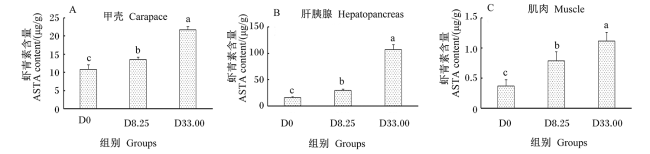
图1所示,D8.25组对虾甲壳、肝胰腺、肌肉中虾青素含量均显著高于D0组(P<0.05),D33.00组对虾甲壳、肝胰腺、肌肉中虾青素含量均显著高于D8.25组(P<0.05)。以上结果表明,饲料添加藻钩虾粉能提高凡纳滨对虾的虾青素含量,且效果与藻钩虾粉添加水平呈正相关。
图1 饲料藻钩虾粉水平对凡纳滨对虾甲壳(A)、肝胰腺(B)、肌肉(C)中虾青素含量的影响

数据柱标注不同字母表示差异显著(P<0.05)。下图同。

Fig.1 Effects of dietary Ampitheoe sp. powder level on astaxanthin content in carapace (A), hepatopancreas (B) and muscle (C) of L.vannamei

Date bars with different letters mean significant difference (P<0.05). The same as below.

2.3 饲料藻钩虾粉水平对凡纳滨对虾体内TG和TCHO含量的影响

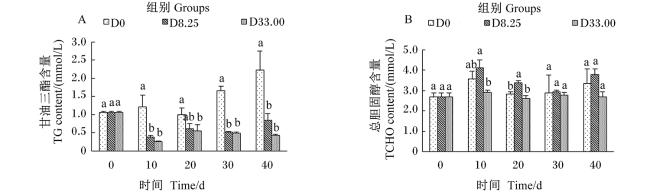
图2所示,整个养殖过程中,D0组血淋巴TG含量呈逐渐升高趋势,而D8.25组和D33.00组相对稳定。除第20天外,D8.25组对虾血淋巴TG含量均显著低于D0组(P<0.05);D33.00组对虾血淋巴TG含量均显著低于D0组(P<0.05)。第20天时,D8.25组血淋巴TCHO含量显著高于D0组和D33.00组(P<0.05)。
图2 饲料藻钩虾粉水平对凡纳滨对虾血淋巴甘油三酯(A)、总胆固醇(B)含量的影响

Fig.2 Effects of dietary Ampitheoe sp. powder level on TG (A) and TCHO (B) contents in haemolymph of L.vannamei

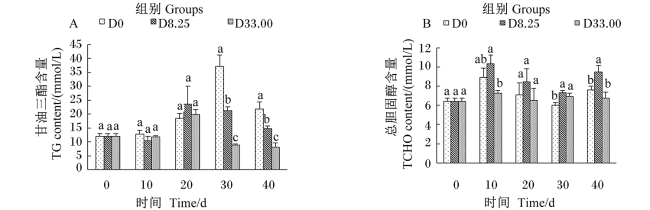
图3所示,在第30和40天,D8.25组肝胰腺TG含量显著低于D0组(P<0.05),D33.00组的TG含量显著低于D8.25组(P<0.05)。第30天时,D8.25组和D33.00组的肝胰腺TCHO含量显著高于D0组(P<0.05)。第40天时,D8.25组肝胰腺TCHO含量显著高于D0组和D33.00组(P<0.05)。
图3 饲料藻钩虾粉水平对凡纳滨对虾肝胰腺甘油三酯(A)、总胆固醇(B)含量的影响

Fig.3 Effects of dietary Ampitheoe sp. powder level on TG (A) and TCHO (B) contents in hepatopancreas of L.vannamei

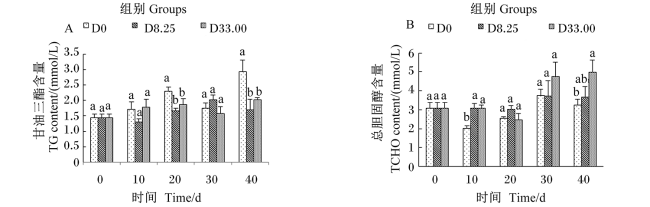
图4所示,第20和40天时,D8.25组和D33.00组肌肉TG含量均显著低于D0组(P<0.05)。第20天时,D8.25组和D33.00组的肌肉TCHO含量显著高于D0组(P<0.05);第40天时,D33.00组肌肉TCHO含量显著高于D0组(P<0.05)。
图4 饲料藻钩虾粉水平对凡纳滨对虾肌肉甘油三酯(A)、总胆固醇(B)含量的影响

Fig.4 Effects of dietary Ampitheoe sp. powder level on TG (A) and TCHO (B) contents in muscle of L.vannamei

以上结果表明,饲料添加藻钩虾粉能够影响对虾TG和TCHO的积累,具体表现为TG积累量减少,TCHO积累量增加。

2.4 饲料藻钩虾粉对凡纳滨对虾脂肪酸组成的影响

表4所示,D8.25组对虾肝胰腺的EPA含量显著高于D0组(P<0.05),D33.00组对虾肝胰腺的EPA和AA含量显著高于D0组和D8.25组(P<0.05)。各组对虾肝胰腺的总饱和脂肪酸(ΣSFA)、总单不饱和脂肪酸(ΣMUFA)、总多不饱和脂肪酸(ΣPUFA)、LA、ALA和DHA含量均无显著差异(P>0.05)。
表4 饲料藻钩虾粉水平对凡纳滨对虾肝胰腺脂肪酸组成的影响(占总脂肪酸的比例)

Table 4 Effects of dietary Ampitheoe sp. powder level on fatty acid composition of hepatopancreas of L.vannamei (percentage of total fatty acid) %

项目
Items
组别Groups
D0 D8.25 D33.00
C14∶0 2.79±0.12a 2.10±0.05b 1.76±0.18c
C15∶0 0.55±0.03 0.51±0.02 0.55±0.04
C16∶0 20.91±0.65ab 21.77±0.30a 19.17±1.18b
C17∶0 0.62±0.03b 0.83±0.12a 0.84±0.03a
C18∶0 5.89±0.31 6.42±0.41 6.63±0.29
C20∶0 0.28±0.02b 0.29±0.04b 0.35±0.01a
C22∶0 0.28±0.03 0.23±0.08 0.29±0.18
C23∶0 0.16±0.02 0.16±0.02 0.17±0.01
C24∶0 0.14±0.02 0.15±0.02 1.27±1.99
总饱和脂肪酸ΣSFA 31.61±0.97 32.37±0.69 30.97±1.45
C15∶1 0.20±0.01 0.22±0.07 0.27±0.07
C16∶1n7 3.11±2.53 3.81±0.08 3.70±0.16
C17∶1 0.42±0.10 0.49±0.06 0.38±0.05
C18∶1n9 13.29±0.33 13.66±0.42 12.85±0.91
C20∶1n9 1.14±0.04 1.10±0.10 1.02±0.07
C21∶1n9 0.15±0.02 0.13±0.06 0.30±0.15
C22∶1n9 0.95±0.26 1.15±0.36 1.57±0.16
C24∶1n9 0.66±0.04 0.47±0.23 0.55±0.13
总单不饱和脂肪酸ΣMUFA 19.92±2.43 20.99±0.63 20.64±0.72
C18∶2n6(亚油酸LA) 5.76±0.14 5.92±0.18 5.57±0.39
C18∶3n6 0.11±0.05 0.20±0.01 0.25±0.06
C18∶3n3(亚麻酸ALA) 13.86±0.44 11.95±0.21 11.73±0.85
C20∶2n6 1.00±0.03 0.97±0.09 0.90±0.06
C20∶4n6(二十碳四烯酸AA) 1.93±0.01b 2.22±0.16b 2.85±0.30a
C20∶5n3(二十碳五烯酸EPA) 8.45±0.3c 9.34±0.62b 10.36±0.42a
C20∶3n6 0.20±0.02 0.24±0.02 0.30±0.02
C20∶3n3 2.93±0.08 2.71±0.22 2.64±0.18
C22∶2n6 1.74±0.08 1.34±0.09 0.67±0.45
C22∶6n3(二十二碳六烯酸DHA) 11.76±0.72 11.05±1.07 12.52±0.60
总多不饱和脂肪酸ΣPUFA 47.74±1.46 45.89±0.08 47.67±0.68
n-6多不饱和脂肪酸n-6 PUFA 10.73±0.26 10.83±0.42 10.43±0.65
n-3多不饱和脂肪酸n-3 PUFA 37.00±1.37ab 35.06±0.35b 37.24±0.24a
二十碳五烯酸+二十二碳六烯酸EPA+DHA 20.21±0.91b 20.40±0.60b 22.87±0.98a
n-3多不饱和脂肪酸/n-6多不饱和脂肪酸
n-3 PUFA/n-6 PUFA
3.45±0.13 3.24±0.16 3.58±0.22
表5所示,D33.00组对虾肌肉的AA含量显著高于D0组(P<0.05)。各组对虾肝胰腺的ΣSFA、ΣMUFA、ΣPUFA、LA、ALA、EPA和DHA含量均无显著差异(P>0.05)。
表5 饲料藻钩虾粉水平对凡纳滨对虾肌肉脂肪酸组成的影响(占总脂肪酸的比例)

Table 5 Effects of dietary Ampitheoe sp. powder level on fatty acid composition of muscle of L.vannamei (percentage of total fatty acid) %

项目
Items
组别Groups
D0 D8.25 D33.00
C14∶0 0.64±0.01b 0.92±0.11a 0.75±0.06ab
C15∶0 0.34±0.01b 0.40±0.03ab 0.44±0.03a
C16∶0 22.18±0.56 21.70±1.26 21.75±1.63
C17∶0 1.02±0.02 0.92±0.35 1.07±0.03
C18∶0 11.51±0.63 10.77±0.01 10.63±0.52
C20∶0 0.53±0.04b 0.54±0.03b 0.65±0.04a
C22∶0 0.52±0.03 0.43±0.19 0.56±0.07
C23∶0 0.19±0.04 0.22±0.02
C24∶0 0.23±0.02 0.26±0.02 0.24±0.04
总饱和脂肪酸ΣSFA 37.09±0.20 35.85±0.90 36.31±2.20
C15∶1 0.17±0.01 0.32±0.20 0.21±0.04
C16∶1n7 1.83±0.05 1.82±0.20 1.99±0.19
C17∶1 0.32±0.02 0.40±0.12 0.34±0.02
C18∶1n9 10.39±0.04 9.83±0.90 9.87±0.52
C20∶1n9 0.59±0.03a 0.52±0.02b 0.52±0.03b
C21∶1n9 0.16±0.00 0.17±0.00
C22∶1n9 3.26±0.79 8.29±5.41 6.78±4.19
C24∶1n9 0.35±0.09 0.45±0.07 0.43±0.05
总单不饱和脂肪酸ΣMUFA 16.90±0.63 21.52±4.07 20.19±3.59
C18∶2n6(亚油酸LA) 5.38±0.02 5.09±0.46 5.11±0.27
C18∶3n6 0.21±0.03 0.22±0.01 0.21±0.04
C18∶3n3(亚麻酸ALA) 10.03±0.04 9.27±0.56 9.65±0.72
C20∶2n6 0.52±0.03a 0.46±0.02b 0.46±0.02b
C20∶4n6(二十碳四烯酸AA) 2.11±0.07b 2.03±0.12b 2.19±0.09a
C20∶5n3(二十碳五烯酸EPA) 11.09±0.21 10.29±0.85 10.17±0.56
C20∶3n6 0.26±0.10 0.22±0.04 0.18±0.00
C20∶3n3 1.83±0.07 1.73±0.13 1.72±0.05
C22∶2n6 0.34±0.25 0.50±0.12 0.42±0.00
C22∶6n3(二十二碳六烯酸DHA) 14.25±0.57 13.14±0.86 13.59±0.71
总多不饱和脂肪酸ΣPUFA 46.01±0.53 42.64±3.17 43.50±1.96
n-6多不饱和脂肪酸n-6 PUFA 8.81±0.17 8.21±0.94 8.37±0.47
n-3多不饱和脂肪酸n-3 PUFA 37.20±0.68 34.43±2.24 35.13±1.60
二十碳五烯酸+二十二碳六烯酸EPA+DHA 25.33±0.59 23.43±1.66 23.76±1.05
n-3多不饱和脂肪酸/n-6多不饱和脂肪酸
n-3 PUFA/n-6 PUFA
4.22±0.16 4.21±0.20 4.20±0.17

3 讨论

3.1 饲料藻钩虾粉对对虾生长性能的影响

天然生物饵料富含营养和活性物质,能够提高水产动物的生长性能和健康水平,如南极磷虾粉能促进凡纳滨对虾亲虾的生长和性腺发育[15],黑水虻幼虫粉可提高凡纳滨对虾幼虾抗氧化能力和促进脂质代谢[16]。藻钩虾是生物饵料的一种,彭瑞冰等[17]通过分析藻钩虾的营养成分,确认藻钩虾氨基酸含量丰富、结构合理,PUFA丰富,EPA含量高,营养效能高。已有相关研究报道,藻钩虾能够提高对虾的生长性能,Shan等[18]研究发现,饲料添加藻钩虾粉可以提高凡纳滨对虾的生长性能;韩永望等[19]研究发现,在中国明对虾(Fenneropenaeus chinensis)和日本囊对虾(Marsupenaeus japonicus)的养殖试验中,相比于人工配合饲料,投喂鲜活藻钩虾能显著提高对虾的SGR、SR和抗逆性。本试验结果与前人研究结果相似,当藻钩虾粉的添加水平达到8.25%时,对虾的终末体重、SR显著提高;当藻钩虾粉的添加水平达到33.00%时,对虾的终末体重、WGR、SGR、PR、SR均显著提高,同时FCR显著下降,提示藻钩虾粉添加水平越高,对对虾生长性能的提升作用越明显。由此可见,将鲜活的藻钩虾制成藻钩虾粉,能够提高对虾的生长性能和SR。藻钩虾粉能够促进对虾的生长,体现了藻钩虾粉的营养强化作用,推测与饲喂藻钩虾粉能够提高对虾的虾青素、TCHO含量和改变对虾的脂肪酸组成有关,具体分析将在下文阐述。此外,D8.25组和D33.00组对虾的生长性能没有显著差异,因此,从经济角度考虑,饲料中添加8.25%的藻钩虾粉较为适宜。

3.2 饲料藻钩虾粉对对虾虾青素含量的影响

虾青素是一种类胡萝卜素,对水产动物的体色、肉质、抗氧化性等有积极作用,然而对虾自身无法直接合成虾青素,因此其体内虾青素含量取决于饲料的虾青素或相关类胡萝卜素前体的含量[20]。本试验中,对虾甲壳、肝胰腺、肌肉中虾青素含量随着藻钩虾粉添加水平的增加而提高,表明饲料中添加藻钩虾粉可以提高对虾的虾青素含量。藻钩虾含有丰富的虾青素以及其他类胡萝卜素[10],前期研究发现,添加藻钩虾粉能够显著提高对虾饲料中虾青素的含量[21],因此,以上结果是由于添加藻钩虾粉提高了饲料的虾青素含量所导致。天然的虾青素比人工合成的虾青素更安全、更有利于被吸收和利用[20],未来可以考虑在饲料中添加藻钩虾粉从而使水产动物获得天然的虾青素。
虾青素对于对虾至关重要,能够提高对虾的生长性能,并且通过清除活性氧来减轻环境胁迫对对虾产生的危害[22]。Yamada等[23]研究发现,饲料中添加一定量的虾青素可以显著提高对虾SR;Chien等[24]研究发现,当对虾受到温度胁迫、盐度胁迫、缺氧胁迫或氨氮胁迫时,添加虾青素可以显著提高对虾的SR。已有研究发现,虾青素通过激活半胱氨酸和蛋氨酸代谢、丙酮酸代谢、糖酵解和糖异生途径等能量代谢途径来提高对虾的生长性能[25]。综上所述,饲料中添加钩虾粉可以显著提高对虾体内的虾青素含量,这可能是对虾生长性能提高的重要原因,并且对对虾环境抗逆性的提高也有重要意义。

3.3 饲料藻钩虾粉对对虾TG和TCHO含量的影响

肝胰腺是对虾脂类代谢的中心,而血淋巴起到脂类物质运输的作用,肝胰腺和血淋巴TG和TCHO含量可以反映对虾脂类代谢的水平。饲料中高粗脂肪水平可以显著提高动物血液TG水平[26]。本试验中,D0组对虾饲料粗脂肪含量高于D8.25组和D33.00组,当饲养结束后,D0组对虾血淋巴TG含量显著高于D8.25组和D33.00组,表明饲喂钩虾粉会降低对虾血淋巴TG的含量。Chen等[27]用黑水虻幼虫粉替代鱼粉饲喂凡纳滨对虾后,对虾血淋巴TG含量下降,代谢组学结果表明,黑水虻幼虫粉促进了对虾的脂类代谢,因此推测饲喂钩虾粉能够促进对虾的脂类代谢水平。除此之外,Yang等[28]研究发现,虾青素可以减少肥胖小鼠血液中TG的含量,因此,本试验中藻钩虾粉提高了对虾的虾青素含量可能是对虾血淋巴TG含量下降的原因之一。本试验中,对虾肝胰腺TG含量变化与血淋巴基本一致,这可能与血淋巴的TG主要来源于肝胰腺的脂类代谢有关。
TCHO对对虾的生长、蜕皮、繁殖等具有重要作用,可以提高凡纳滨对虾的生长性能、抗氧化能力和免疫力,是对虾的必需营养物质[29-31]。然而,虾类本身不具有合成TCHO的能力,所以对虾体内TCHO含量主要受食物源的影响[32]。本试验中,饲养结束后的对虾肌肉TCHO含量随着藻钩虾粉水平的增加而提高,提示投喂藻钩虾粉可以提高对虾肌肉的TCHO含量,这可能是对虾生长性能提高的主要原因之一。D33.00组对虾血淋巴和肝胰腺TCHO含量皆低于D8.25组,推测是因为当藻钩虾粉添加水平进一步提高时,对虾脂类代谢水平也随之提高使得胆固醇转运速率加快,TCHO转移到了肌肉组织中储存,从而引起了肝胰腺和血淋巴TCHO含量的降低,具体原因有待进一步揭示。

3.4 饲料藻钩虾粉对对虾脂肪酸组成的影响

PUFA可以改善对虾的生理代谢和健康水平,是对虾的必需脂肪酸。本试验中,藻钩虾粉饲料和基础饲料的EPA和AA含量无显著差异,但饲喂藻钩虾粉可以显著提高对虾肝胰腺的EPA和AA含量、肌肉的AA含量。可能是因为藻钩虾粉能提高对虾的抗氧化能力[18],保护PUFA免受氧化,所以EPA和AA在对虾体内得以保留的更多。对虾可以利用AA合成前列腺素类等物质,是合成多种激素的前体[33];EPA具有抗氧化能力,能够提高对虾的抗逆性[34],鉴于上述方面,饲料添加藻钩虾粉能够通过增加对虾体内EPA和AA含量来改善对虾的脂肪酸组成,从而提高对虾的生长性能和抗逆性。
已有研究表明,对虾肝胰腺和肌肉的n-3和n-6 PUFA含量与饲料的n-3和n-6 PUFA含量呈显著正相关性[35]。但是本试验中,从表2中可得藻钩虾粉饲料中ΣPUFA、ALA和DHA含量显著低于基础饲料,并没有显著降低D8.25组和D33.00组对虾肝胰腺和肌肉的ΣPUFA、ALA和DHA含量,这可能与前文提到藻钩虾粉能提高对虾的抗氧化能力,减少了机体PUFA消耗有关。以上结果提示,藻钩虾粉饲料中较低的ΣPUFA、ALA和DHA含量并不会给对虾的PUFA组成带来明显的负面影响。此外,已有研究发现,将饲料PUFA含量提高到一定水平会导致对虾生长下降,影响脂肪酸营养的重要因素是膳食中n-3和n-6 PUFA的比例,而不仅是个别必需脂肪酸含量的多少[36],所以从D8.25组和D33.00组对虾的生长性能高于D0组对虾的结果得出,藻钩虾粉饲料的脂肪酸组成符合凡纳滨对虾的脂肪酸营养需求。此外,本试验中,各组对虾肝胰腺和肌肉的ΣSFA、ΣMUFA和ΣPUFA含量皆无显著差异,提示在本试验条件下,饲料添加藻钩虾粉尚不足以显著改变凡纳滨对虾肝胰腺和肌肉组织的总脂肪酸组成。

4 结论

综上所述,饲料中添加藻钩虾粉能够满足凡纳滨对虾生长的基本营养需求,可以通过提高对虾的虾青素、TCHO、EPA和AA含量来促进对虾的生长性能,藻钩虾粉饲料可以作为功能饲料提高对虾的生长和抗逆性,从经济角度考虑,8.25%的藻钩虾粉添加水平较为适宜。
[1]
STANKUS A. State of world aquaculture 2020 and regional reviews:FAO webinar series[J]. FAO Aquaculture Newsletter, 2021(63):17-18.

[2]
麦康森, 艾庆辉, 徐玮, 等. 水产养殖中的环境胁迫及其预防——营养学途径[J]. 中国海洋大学学报(自然科学版), 2004, 34(5):767-774.

MAI K S, AI Q H, XU W, et al. Stress in aquaculture and its prevention with emphasis on nutritional methods[J]. Periodical of Ocean University of China (Natural Science), 2004, 34(5):767-774. (in Chinese)

[3]
PALACIOS E, BONILLA A, PÉREZ A, et al. Influence of highly unsaturated fatty acids on the responses of white shrimp (Litopenaeus vannamei) postlarvae to low salinity[J]. Journal of Experimental Marine Biology and Ecology, 2004, 299(2):201-215.

DOI

[4]
GAMBOA-DELGADO J. Nutritional role of natural productivity and formulated feed in semi-intensive shrimp farming as indicated by natural stable isotopes[J]. Reviews in Aquaculture, 2014, 6(1):36-47.

DOI

[5]
NUNES A J P, SOARES A N, SABRY-NETO H, et al. Effect of dietary graded levels of astaxanthin krill oil and high protein krill meal on the growth performance and stress resistance of post larval Litopenaeus vannamei under hyper-intensive nursery culture[J]. Aquaculture Nutrition, 2021, 27(2):327-341.

DOI

[6]
任先秋. 中国动物志-第四十一卷,一, 无脊椎动物, 甲壳动物亚门, 端足目, 钩虾亚目[M]. 北京: 科学出版社, 2006:36-37.

REN X Q. Fauna sinica-Vol.41,1,invertebrata,crustacea,amphipoda,gammaridea[M]. Beijing: Science Press, 2006:36-37. (in Chinese)

[7]
PENG R B, LE K X, JIANG X M, et al. Effects of different diets on the growth,survival,and nutritional composition of juvenile cuttlefish,Sepia pharaonis[J]. Journal of the World Aquaculture Society, 2015, 46(6):650-664.

DOI

[8]
SHAN H W, DONG Y, MA S, et al. Effects of dietary supplementation with freeze-dried powder of Ampithoe sp. on the growth performance,energy metabolism,and ammonia-nitrogen tolerance of the Pacific white shrimp,Litopenaeus vannamei[J]. Aquaculture Research, 2018, 49(8):2633-2643.

DOI

[9]
LEE M C, PARK J C, LEE J S. Effects of environmental stressors on lipid metabolism in aquatic invertebrates[J]. Aquatic Toxicology, 2018, 200:83-92.

DOI

[10]
石婧, 顾赛麒, 王锡昌. 水产动物组织中类胡萝卜素的研究进展[J]. 食品工业科技, 2014, 35(12):373-377,383.

SHI J, GU S Q, WANG X C. Research progress in carotenoids in aquatic animal[J]. Science and Technology of Food Industry, 2014, 35(12):373-377,383. (in Chinese)

[11]
GONZÁLEZ-FÉLIX M L, GATLIN III D M, LAWRENCE A L, et al. Nutritional evaluation of fatty acids for the open thelycum shrimp,Litopenaeus vannamei:Ⅱ.Effect of dietary n-3 and n-6 polyunsaturated and highly unsaturated fatty acids on juvenile shrimp growth,survival,and fatty acid composition[J]. Aquaculture Nutrition, 2003, 9(2):115-122.

DOI

[12]
VARGAS-ALBORES F, GUZMÁN M A, OCHOA J L. An anticoagulant solution for haemolymph collection and prophenoloxidase studies of penaeid shrimp (Penaeus californiensis)[J]. Comparative Biochemistry and Physiology Part A:Physiology, 1993, 106(2):299-303.

DOI

[13]
HAZEL J R. Influence of thermal acclimation on membrane lipid composition of rainbow trout liver[J]. The American Journal of Physiology, 1979, 236(1):R91-R101.

[14]
YI X W, XU W, ZHOU H H, et al. Effects of dietary astaxanthin and xanthophylls on the growth and skin pigmentation of large yellow croaker Larimichthys croceus[J]. Aquaculture, 2014, 433:377-383.

DOI

[15]
张玉玲, 罗坤, 孔杰, 等. 饲料中添加南极磷虾粉对凡纳滨对虾亲虾生长,性腺发育及脂肪酸积累的影响[J]. 中国水产科学, 2017, 24(2):306-316.

ZHANG Y L, LUO K, KONG J, et al. A comparative study on growth and gonadal development of Litopenaeus vannamei broodstock fed different formulated feeds[J]. Journal of Fishery Sciences of China, 2017, 24(2):306-316. (in Chinese)

DOI

[16]
陈永康, 郑朝中, 章双, 等. 黑水虻幼虫粉对凡纳滨对虾生长、免疫和脂质代谢的影响[J/OL]. 水生生物学报, 2022:1-11[2022-10-14]. http://kns.cnki.net/kcms/detail/42.1230.Q.20220905.0930.020.html.

CHEN Y K, ZHENG Z Z, ZHANG S, et al. Effect of dietary black soldier fly (Hermetia illucens) larvae meal on growth performance,non-specific immunity and lipid metabolism of Litopenaeus vannamei[J/OL]. Acta Hydrobiologica Sinica, 2022:1-11[2022-10-14]. http://kns.cnki.net/kcms/detail/42.1230.Q.20220905.0930.020.html. (in Chinese)

[17]
彭瑞冰, 蒋霞敏, 乐可鑫, 等. 5种饵料动物的营养成分分析及评价[J]. 水产学报, 2014, 38(2):257-264.

PENG R B, JIANG X M, LE K X, et al. Nutritive composition and evaluation of five food animals[J]. Journal of Fisheries of China, 2014, 38(2):257-264. (in Chinese)

[18]
SHAN H W, WANG T, DONG Y, et al. Effects of dietary Ampithoe sp. supplementation on the growth,energy status,antioxidant capacity,and ammonia-N tolerance of the shrimp Litopenaeus vannamei:continuous versus interval feeding[J]. Aquaculture, 2019, 509:32-39.

DOI

[19]
韩永望, 李健, 李吉涛, 等. 强壮藻钩虾对中国明对虾与日本囊对虾生长和抗病力的影响[J]. 水产学报, 2012, 36(9):1443-1449.

HAN Y W, LI J, LI J T, et al. Effects of ampithoe valida on growth and anti-disease ability of the Fenneropenaeus chinensis and Marsupenaeus japonicas[J]. Journal of Fisheries of China, 2012, 36(9):1443-1449. (in Chinese)

DOI

[20]
STACHOWIAK B, SZULC P. Astaxanthin for the food industry[J]. Molecules, 2021, 26(9):2666.

DOI

[21]
WANG T, SHAN H W, GENG Z X, et al. Dietary supplementation with freeze-dried Ampithoe sp. enhances the ammonia-N tolerance of Litopenaeus vannamei by reducing oxidative stress and endoplasmic reticulum stress and regulating lipid metabolism[J]. Aquaculture Reports, 2020, 16:100264.

DOI

[22]
WADE N M, GABAUDAN J, GLENCROSS B D. A review of carotenoid utilisation and function in crustacean aquaculture[J]. Reviews in Aquaculture, 2017, 9(2):141-156.

DOI

[23]
YAMADA S, TANAKA Y, SAMESHIMA M, et al. Pigmentation of prawn (Penaeus japonicus) with carotenoids:Ⅰ. Effect of dietary astaxanthin,β-carotene and canthaxanthin on pigmentation[J]. Aquaculture, 1990, 87(3/4):323-330.

DOI

[24]
CHIEN Y H, PAN C H, HUNTER B. The resistance to physical stresses by Penaeus monodon juveniles fed diets supplemented with astaxanthin[J]. Aquaculture, 2003, 216(1/2/3/4):177-191.

DOI

[25]
WANG Y C, WANG B J, LIU M, et al. Comparative transcriptome analysis reveals the potential influencing mechanism of dietary astaxanthin on growth and metabolism in Litopenaeus vannamei[J]. Aquaculture Reports, 2020, 16:100259.

DOI

[26]
关媛媛, 郑燕飞, 朱玲慧, 等. 高甘油三酯血症动物模型研究进展[J]. 中国实验动物学报, 2022, 30(1):146-152.

GUAN Y Y, ZHENG Y F, ZHU L H, et al. Research progress on animal models of hypertriglyceridemia[J]. Acta Laboratorium Animalis Scientia Sinica, 2022, 30(1):146-152. (in Chinese)

[27]
CHEN Y K, CHI S Y, ZHANG S, et al. Effect of black soldier fly (Hermetia illucens) larvae meal on lipid and glucose metabolism of Pacific white shrimp Litopenaeus vannamei[J]. British Journal of Nutrition, 2021:1-15.

[28]
YANG Y, PHAM T X, WEGNER C J, et al. Astaxanthin lowers plasma TAG concentrations and increases hepatic antioxidant gene expression in diet-induced obesity mice[J]. The British Journal of Nutrition, 2014, 112(11):1797-1804.

DOI PMID

[29]
CHEN H Y, JENN J S. Combined effects of dietary phosphatidylcholine and cholesterol on the growth,survival and body lipid composition of marine shrimp,Penaeus penicillatus[J]. Aquaculture, 1991, 96(2):167-178.

DOI

[30]
GU X Z, FU H T, SUN S M, et al. Effects of cholesterol on growth,feed utilization,body composition and immune parameters in juvenile oriental river prawn,Macrobrachium nipponense (De Haan)[J]. Aquaculture Research, 2017, 48(8):4262-4271.

DOI

[31]
KUMAR V, SINHA A K, ROMANO N, et al. Metabolism and nutritive role of cholesterol in the growth,gonadal development,and reproduction of crustaceans[J]. Reviews in Fisheries Science & Aquaculture, 2018, 26(2):254-273.

[32]
FORSTER I P, DOMINY W G, OBALDO L G. Effect of diet manipulation on cholesterol and docosahexaenoic acid levels in shrimp,Litopenaeus vannamei[J]. Journal of the World Aquaculture Society, 2010, 41(2):240-249.

DOI

[33]
WOUTERS R, MOLINA C, LAVENS P, et al. Lipid composition and vitamin content of wild female Litopenaeus vannamei in different stages of sexual maturation[J]. Aquaculture, 2001, 198(3/4):307-323.

DOI

[34]
JANNATHULLA R, CHITRA V, VASANTHAKUMAR D, et al. Effect of dietary lipid/essential fatty acid level on Pacific whiteleg shrimp,Litopenaeus vannamei (Boone,1931) reared at three different water salinities-emphasis on growth,hemolymph indices and body composition[J]. Aquaculture, 2019, 513:734405.

DOI

[35]
ARAÚJO B C, FLORES-GALVEZ K, HONJI R M, et al. Arachidonic acid effects on the overall performance,fatty acid profile,hepatopancreas morphology and lipid-relevant genes in Litopenaeus vannamei juveniles[J]. Aquaculture, 2020, 523:735207.

DOI

[36]
GLENCROSS B D, SMITH D M, THOMAS M R, et al. The effect of dietary n-3 and n-6 fatty acid balance on the growth of the prawn Penaeus monodon[J]. Aquaculture Nutrition, 2002, 8(1):43-51.

DOI

Outlines

/