RESEARCH PAPER

Effects of Dietary Protein Levels on Growth Performance, Digestive Enzyme Activities, Protein Metabolism and Intestinal Morphology of Juvenile Spinibarbus caldwelli

  • QIN Zhiqing ,
  • LIANG Ping ,
  • LIN Jianbin , * ,
  • GAO Surui ,
  • QIU Manli ,
  • LI Xuegui ,
  • LIU Yinhua ,
  • LAI Mingyong ,
  • WU Bin
Expand
  • Freshwater Fisheries Research Institute of Fujian Province, Fuzhou 350002, China
* professor, E-mail:

Received date: 2022-07-27

  Online published: 2023-02-13

Abstract

This experiment was conducted to study the effects of dietary protein levels on growth performance, digestive enzyme activities, protein metabolism and intestinal morphology of juvenile Spinibarbus caldwelli, and to explore the protein requirement of juvenile Spinibarbus caldwelli. A total of 450 juvenile Spinibarbus caldwelli with initial body weight of (8.4±0.1) g were randomly divided into 6 groups with 3 replicates per group and 25 fish per replicate. The brown fishmeal and soybean meal were used as protein sources for six kinds of iso-energy diets with protein levels of 29.83%, 33.96%, 38.52%, 42.43%, 46.33% and 50.67%, respectively. The experiment lasted for 56 days. The results showed as follows: 1) the final body weight, weight gain rate (WGR) and specific growth rate (SGR) of 46.33% protein level group were significantly higher than those of 29.83%, 33.96%, 38.52% and 50.67% protein level groups (P<0.05), the feed conversion ratio (FCR) of 42.43%, 46.33% and 50.67% protein level groups was significantly higher than that of 29.83%, 33.96% and 38.52% protein level groups (P<0.05), the protein efficiency ratio (PER) of 42.43% protein level group was significantly higher than that of other groups (P<0.05), the intestinal length index (ILI) of 29.83% protein level group was significantly lower than that of other groups (P<0.05), and the condition factor (CF) of 38.52%, 42.43%, 46.33% and 50.67% protein level groups was significantly higher than that of 29.83% and 33.96% protein level groups (P<0.05). 2) The hepatopancreatic trypsin (TPS) activity of 42.43% protein level group was significantly higher than that of other groups (P<0.05), and the intestinal TPS activity of 38.52%, 42.43%, 46.33% and 50.67% protein level groups was significantly higher than that of 29.83% and 33.96% protein level groups (P<0.05). The hepatopancreatic lipase (LPS) activity of 50.67% protein level group was significantly higher than that of 29.83% and 33.96% protein level groups (P<0.05), and the intestinal LPS activity of 46.33% and 50.67% protein level groups was significantly higher than that of 29.83% protein level group (P<0.05). The hepatopancreatic amylase (AMS) activity of 46.33% and 50.67% protein level groups was significantly lower than that of 29.83%, 33.96% and 38.52% protein level groups (P<0.05), and the intestinal AMS activity of 46.33% and 50.67% protein level groups was significantly lower than that of other groups (P<0.05). 3) The contents of urea nitrogen (UN) and ammonia in serum of 42.43%, 46.33% and 50.67% protein level groups were significantly higher than those of 29.83% and 33.96% protein level groups (P<0.05), and the serum total protein (TP) content of 42.43%, 46.33% and 50.67% protein level groups was significantly higher than that of 29.83%, 33.96% and 38.52% protein level groups (P<0.05). 4) The activities of alanine transaminase (ALT) and aspartate transaminase (AST) in serum of 50.67% protein level group were significantly higher than those of 29.83%, 33.96% and 38.52% protein level groups (P<0.05). The hepatopancreatic ALT activity of 46.33% protein level group was significantly higher than that of 50.67% protein level group (P<0.05), and the hepatopancreatic AST activity of 46.33% protein level group was significantly higher than that of 33.96% and 38.52% protein level groups (P<0.05). 5) The intestinal fold height and muscular thickness of 42.43% protein level group were significantly higher than those of other groups (P<0.05), the intestinal epithelium height of 42.43% protein level group was significantly higher than that of 29.83%, 33.96%, 46.33% and 50.67% protein level groups (P<0.05), and the intestinal goblet cell number of 42.43%, 46.33% and 50.67% protein level groups was significantly higher than that of 29.83%, 33.96% and 38.52% protein level groups (P<0.05). In conclusion, when dietary protein level is too low, the juvenile Spinibarbus caldwelli grows slowly, TPS activity is low, and intestinal morphology is poorly developed; when dietary protein level is too high, the hepatopancreatic function and intestinal development of juvenile Spinibarbus caldwelli are affected. Under the conditions of this experiment, the suitable dietary protein level for juvenile Spinibarbus caldwelli is 42.10% to 42.71% according to SGR and FCR as evaluation indicators.

Cite this article

QIN Zhiqing , LIANG Ping , LIN Jianbin , GAO Surui , QIU Manli , LI Xuegui , LIU Yinhua , LAI Mingyong , WU Bin . Effects of Dietary Protein Levels on Growth Performance, Digestive Enzyme Activities, Protein Metabolism and Intestinal Morphology of Juvenile Spinibarbus caldwelli[J]. Chinese Journal of Animal Nutrition, 2023 , 35(2) : 1134 -1146 . DOI: 10.12418/CJAN2023.107

黑脊倒刺鲃(Spinibarbus caldwelli),又称光倒刺鲃,属鲤形目(Cypriniformes),鲤科(Cyprinidae),鲃亚科(Barbinae),倒刺鲃属(Spinibarbus),主要分布于钱塘江、闽江、珠江等,其肉质鲜美,且有一定的药用价值,为重要的淡水经济鱼类[1-2]。该鱼生长速度较快、善跳、喜欢集群、不耐低氧、非常恐惧浑水、喜欢阴凉环境,是一种淡水中下层的广温性鱼类[3]。目前黑脊倒刺鲃已成为池塘和水库网箱养殖的优质品种,受到了广大养殖户的青睐。
蛋白质作为鱼类生长发育过程中必需的营养物质,不仅用于鱼体组织的更新和修复,而且是构成机体内各种激素和酶类的重要成分,为鱼类的生长和代谢提供能量,在其生命活动中发挥着不可替代的作用[4-5]。同时蛋白质也是影响饲料成本的一个关键因素,饲料蛋白质水平过高,会增加鱼类消化系统负担,降低其对营养物质的利用率,同时增加饲料成本,破坏养殖水体环境;饲料蛋白质水平过低,则会导致鱼类营养不足、生长缓慢,影响经济效益[6]。因此,研究养殖鱼类对蛋白质的需要量既有利于掌握鱼类对饲料蛋白质的吸收状况,也是设计成本合理、蛋白质均衡饲料配方的重要环节[7]。黑脊倒刺鲃作为我国特有的淡水经济鱼类,目前还没有该鱼的全价配合饲料,有关黑脊倒刺鲃营养方面的研究,主要见于对其肌肉[8-9]、鱼皮和鱼鳞[10]营养成分的研究,而对于其主要营养参数的研究鲜有报道。因此,本试验应用蛋白质水平梯度法设计6组等能饲料,探讨饲料中不同蛋白质水平对黑脊倒刺鲃幼鱼生长性能、消化酶活性、血清生化指标、蛋白质代谢关键酶活性及肠道形态的影响,以期明确黑脊倒刺鲃幼鱼饲料中蛋白质的适宜需要量,旨在为确定黑脊倒刺鲃幼鱼的蛋白质营养标准和开发低成本、高效益的饲料配方提供基础数据和理论依据。

1 材料与方法

1.1 试验用鱼

试验用黑脊倒刺鲃幼鱼为福建省淡水水产研究所榕桥中试基地(黑脊倒刺鲃良种场)自繁培育而成,平均体重为(8.4±0.1) g。

1.2 试验设计和试验饲料

选择黑脊倒刺鲃幼鱼450尾,随机分为6组,每组3个重复,每个重复25尾。以进口红鱼粉和豆粕为主要蛋白质源,配制蛋白质水平分别为29.83%、33.96%、38.52%、42.43%、46.33%、50.67%(干物质基础)的6种等能饲料,试验饲料组成及营养水平见表1
表1 试验饲料组成及营养水平(干物质基础)

Table 1 Composition and nutrient levels of experimental diets (DM basis)%

项目
Items
饲料蛋白质水平 Dietary protein levels/%
29.83 33.96 38.52 42.43 46.33 50.67
原料 Ingredients
红鱼粉 Brown fishmeal 24.00 29.90 36.10 42.20 48.40 54.50
豆粕 Soybean meal 19.00 19.00 19.00 19.00 19.00 19.00
面粉 Wheat flour 15.00 15.00 15.00 15.00 15.00 15.00
糊精 Dextrin 31.60 25.70 19.50 13.40 7.20 1.10
纤维素 Cellulose 5.00 5.00 5.00 5.00 5.00 5.00
鱼油 Fish oil 1.00 1.00 1.00 1.00 1.00 1.00
豆油 Soybean oil 2.00 2.00 2.00 2.00 2.00 2.00
维生素-矿物质预混料 Vitamin-mineral premix1) 1.20 1.20 1.20 1.20 1.20 1.20
氯化胆碱 Choline chloride 0.20 0.20 0.20 0.20 0.20 0.20
项目
Items
饲料蛋白质水平 Dietary protein levels/%
29.83 33.96 38.52 42.43 46.33 50.67
磷酸二氢钙 Ca(H2PO42 1.00 1.00 1.00 1.00 1.00 1.00
合计 Total 100.00 100.00 100.00 100.00 100.00 100.00
营养水平 Nutrient levels2)
粗灰分 Ash 8.73 9.62 11.08 12.41 13.78 15.29
粗蛋白质 CP 29.83 33.96 38.52 42.43 46.33 50.67
粗脂肪 EE 5.58 5.76 6.04 6.85 7.37 7.59
总能 GE/(kJ/g) 15.30 15.26 15.23 15.20 15.15 15.10

1)维生素-矿物质混料为每千克饲料提供 The vitamin-mineral premix provided the following per kg of diets: VA 20 000 IU,VD 310 000 IU,VE 800 mg,VK 300 mg,VB1 80 mg,VB2 400 mg,VB6 400 mg,VB12 3 mg,VC酯 vitamin C ester 1 000 mg,叶酸 folic acid 3 000 mg,烟酸 niacin 2 000 mg,泛酸钙 calcium pantothenate 1 200 mg,生物素 biotin 3 mg,肌醇 inositol 15 000 mg,Mg (as magnesium sulfate) 600 mg,Mn (as manganese sulfate) 800 mg,Zn (as zinc sulfate) 1 100 mg,Cu (as copper sulfate) 100 mg,Fe (as ferrous sulfate) 6 000 mg,Se (as sodium selenite) 5 mg,Co (as cobalt chloride) 50 mg,I (as potassium iodide) 15 mg。

2)营养水平为实测值。Nutrient levels were measured values.

1.3 饲养管理

试验在福建省淡水水产研究所榕桥中试基地循环水系统中进行。停食24 h后,从苗种培育池挑选规格基本一致、健康无伤的黑脊倒刺鲃幼鱼,放入室内循环水系统中(试验桶直径1.0 m,水深0.8 m),每桶25尾。试验分6个组,每组3个重复。试验用水为曝气后的自来水,试验期间水温25~30 ℃,溶解氧浓度≥5.0 mg/L,pH 6.9~7.2。循环效率为2 h/全循环,每隔1星期排污1次。投饵采取饱食投喂法,每天2次(08:00—09:00,13:00—14:00),以30 min内摄食完为准。试验期56 d,从2021年7月16日至2021年9月9日。

1.4 样品采集和指标测定

1.4.1 生长指标

在养殖试验结束后,禁饲24 h,计数各桶黑脊倒刺鲃数量并称量总重。统计5个生长指标:增重率(weight gain rate,WGR)、特定生长率(specific growth rate,SGR)、饲料系数(feed conversion ratio,FCR)、蛋白质效率(protein efficiency ratio,PER,%)、成活率(survival rate,SR);4个形态学指标:肠长指数(intestinal length index,ILI)、脏体指数(viscera-somatic index,VSI)、肝体指数(hepato-somatic index,HSI)、肥满度(condition factor,CF)。相关指标计算方法如下:
WGR(%)=100×(终末体重-初始体重)/初始体重;
SGR(%/d)=100×(ln终末体重-ln初始体重)/试验天数;
FCR=摄食量/(终末体重-初始体重);
PER(%)=(终末体重-初始体重)/(摄食量×饲料粗蛋白质含量);
SR(%)=100×终末尾数/初始尾数;
ILI(%)=100×肠长度/体长度;
VSI(%)=100×内脏重/体重;
HSI(%)=100×肝胰脏重/体重;
CF(%)=100×体重/体长3

1.4.2 血清生化指标

饲养试验结束后,取禁饲24 h后的试验鱼,尾静脉采血,将血样于室温静置2 h,3 000 r/min离心10 min,取上清液分装,并于-80 ℃超低温冰箱(MDF-193,Panasonic公司,日本)保存。采用全自动生化分析仪(Chemray 800,深圳雷杜生命科学股份有限公司)测定血清总蛋白(TP)、尿素氮(UN)、氨(ammonia)含量和谷丙转氨酶(ATL)和谷草转氨酶(ASL)活性。

1.4.3 肠道消化酶和肝胰脏转氨酶活性测定

将试验鱼解剖,取出内脏,置于操作台上分别分离出肝胰脏和肠道,剔除肝胰脏表面的脂肪块和肠道内容物,用滤纸吸干水分后称重,加入10倍体积的磷酸盐缓冲溶液(PBS),冰水浴条件下,机械匀浆,制备成10%的匀浆液,3 000 r/min离心10 min,取上清液进行测定。试验鱼肠道和肝胰脏的ɑ-淀粉酶(AMS)、脂肪酶(LPS)和胰蛋白酶(TPS)活性,以及肝胰脏的ATL和ASL活性均采用试剂盒(南京建成生物工程研究所)分别测定,具体方法参照试剂盒使用说明书。

1.4.4 肠道组织切片固定和测定

肠道均取试验鱼的中肠,经4%多聚甲醛固定后,进行修剪、脱水、包埋、切片、染色及封片。用显微镜(Eclipse Ci-L,Nikon公司,日本)进行图像采集,成像完成后使用Image-Pro Plus 6.0分析软件,以毫米作为标准单位,于40倍视野下,分别测量每张切片中5处皱襞高度、肌层厚度;100倍视野下,分别测量中肠上皮细胞高度和杯状细胞数量。

1.5 数据统计分析

试验数据运用SPSS 21.0软件进行单因素方差分析(one-way ANOVA),若差异显著则进行Duncan氏法多重比较检验。结果以平均值±标准差(mean±SD)表示,P<0.05表示差异显著。使用Excel 2019软件绘图。

2 结果

2.1 饲料蛋白质水平对黑脊倒刺鲃幼鱼生长性能的影响

饲料蛋白质水平对黑脊倒刺鲃生长性能的影响见表2。随着饲料蛋白质水平的增加,终末体重、WGR和SGR呈先上升后下降的趋势,在46.33%蛋白质水平组达到最高值;其中,46.33%蛋白质水平组终末体重、WGR和SGR显著高于29.83%、33.96%、38.52%和50.67%蛋白质水平组(P<0.05),但与42.43%蛋白质水平组无显著差异(P>0.05)。随着饲料蛋白质水平的增加,FCR呈先下降后上升的趋势,在42.43%蛋白质水平组达到最低值;其中,42.43%、46.33%和50.67%蛋白质水平组FCR显著低于29.83%、33.96%和38.52%蛋白质水平组(P<0.05)。随着饲料蛋白质水平的增加,PER呈上升后下降的趋势,在42.43%蛋白质水平组达到最高值;其中,42.43%蛋白质水平组PER显著高于其他各组(P<0.05)。各组试验鱼的SR均为100%。
表2 饲料蛋白质水平对黑脊倒刺鲃幼鱼生长性能的影响

Table 2 Effects of dietary protein levels on growth performance of juvenile Spinibarbus caldwelli

项目
Items
饲料蛋白质水平 Dietary protein levels/%
29.83 33.96 38.52 42.43 46.33 50.67
初始体重 IBW/g 8.36±0.06 8.44±0.06 8.46±0.03 8.38±0.03 8.42±0.03 8.40±0.06
终末体重 FBW/g 36.23±0.46e 40.39±0.76d 43.33±1.05c 44.67±1.43ab 45.48±0.66a 43.63±1.07bc
增重率 WGR/% 333.32±2.58e 378.60±12.22d 412.13±10.66c 433.03±18.90ab 440.09±5.98a 419.33±9.26bc
特定生长率
SGR/(%/d)
2.62±0.01e 2.80±0.05d 2.92±0.04c 2.99±0.06ab 3.01±0.02a 2.94±0.03bc
饲料系数 FCR 3.09±0.12a 2.67±0.08b 2.31±0.08c 1.89±0.09d 1.91±0.05d 2.02±0.07d
蛋白质效率 PER/% 1.09±0.04b 1.11±0.03b 1.13±0.04b 1.25±0.06a 1.13±0.03b 0.98±0.03c
肠长指数 ILI/% 199.63±12.46b 222.63±17.14a 229.68±5.99a 226.83±12.23a 228.16±5.42a 219.29±16.04a
脏体指数 VSI/% 12.20±0.88 12.17±0.61 12.55±0.78 12.32±0.40 12.39±0.47 12.02±0.44
肝体指数 HSI/% 2.02±0.05 2.15±0.24 2.13±0.15 2.17±0.16 2.28±0.07 1.95±0.11
肥满度 CF/% 2.14±0.06c 2.15±0.06c 2.23±0.05b 2.30±0.07ab 2.35±0.08a 2.28±0.08ab
成活率 SR/% 100.00 100.00 100.00 100.00 100.00 100.00

同行数据肩标不同小写字母表示差异显著(P<0.05),相同或无字母表示差异不显著(P>0.05)。下表同。

In the same row, values with different small letter superscripts mean significant difference (P<0.05), while with the same or no letter superscripts mean no significant difference (P>0.05). The same as below.

在形体指标方面,29.83%蛋白质水平组ILI均显著低其他各组(P<0.05),其他各组之间无显著差异(P>0.05)。各组之间VSI和HIS无显著差异(P>0.05)。随着饲料蛋白质水平的增加,CF呈上升后下降的趋势,在46.33%蛋白质水平组达最高值;其中,38.52%、42.43%、46.33%和50.67%蛋白质水平组CF显著高于29.83%和33.96%蛋白质水平组(P<0.05)。
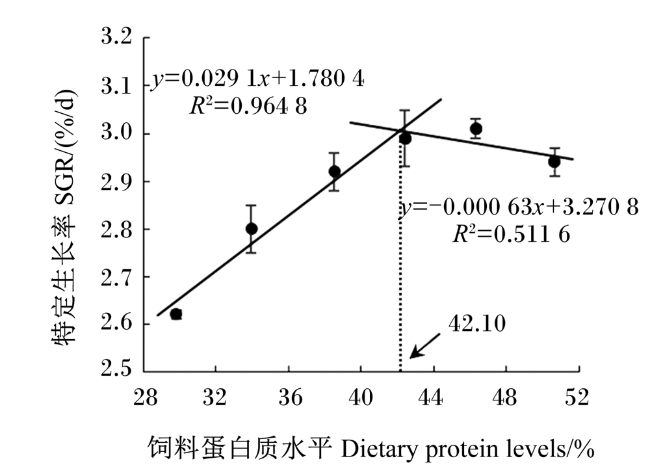
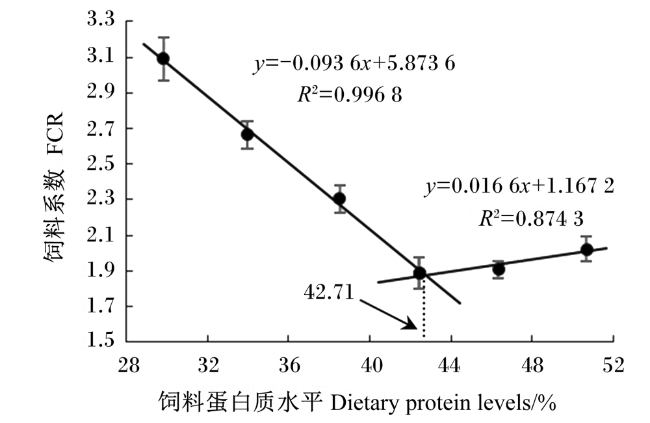
图1图2可见,通过对SGR和FCR与饲料蛋白质水平拟合折线模型进行回归分析,得到黑脊倒刺鲃幼鱼对饲料蛋白质的适宜需要量分别为42.10%和42.71%。
图1 特定生长率与饲料蛋白质水平的回归分析

Fig.1 Regression analysis of SGR with dietary protein levels

图2 饲料系数与饲料蛋白质水平的回归分析

Fig.2 Regression analysis of FCR with dietary protein levels

2.2 饲料蛋白质水平对黑脊倒刺鲃幼鱼消化酶活性的影响

饲料蛋白质水平对黑脊倒刺鲃幼鱼消化酶的影响见表3。随着饲料蛋白质水平的增加,肝胰脏和肠道TPS活性呈上升后下降的趋势,且均在42.43%蛋白质水平组达到最高值;其中,42.43%蛋白质水平组肝胰脏TPS活性显著高于其他各组(P<0.05),38.52%、42.43%、46.33%和50.67%蛋白质水平组肠道TPS活性显著高于29.83%和33.96%蛋白质水平组(P<0.05)。随着饲料蛋白质水平的增加,肝胰脏和肠道LPS活性呈上升趋势;其中,50.67%蛋白质水平组肝胰脏LPS活性显著高于29.83%和33.96%蛋白质水平组(P<0.05),46.33%和50.67%蛋白质水平组肠道LPS活性显著高于29.83%蛋白质水平组(P<0.05)。随着饲料蛋白质水平的增加,肝胰脏和肠道AMS活性呈下降趋势;其中,46.33%和50.67%蛋白质水平组肝胰脏AMS活性显著低于29.83%、33.96%和38.52%蛋白质水平组(P<0.05),46.33%和50.67%蛋白质水平组肠道AMS活性显著低于其他各组(P<0.05)。
表3 饲料蛋白质水平对黑脊倒刺鲃幼鱼消化酶活性的影响

Table 3 Effects of dietary protein levels on digestive enzyme activities of juvenile Spinibarbus caldwelli

项目
Items
饲料蛋白质水平 Dietary protein levels/%
29.83 33.96 38.52 42.43 46.33 50.67
胰蛋白酶 TPS/(U/μg)
肝胰脏 Hepatopancreas 0.68±0.08e 1.13±0.14d 1.37±0.05bc 1.68±0.04a 1.45±0.12b 1.21±0.08cd
肠道 Gut 15.49±0.48d 17.56±0.73c 21.03±1.11b 23.62±0.85a 23.24±0.59a 22.11±0.89ab
脂肪酶 LPS/(U/g)
肝胰脏 Hepatopancreas 0.26±0.07b 0.27±0.05b 0.33±0.08ab 0.37±0.07ab 0.43±0.06ab 0.45±0.14a
肠道 Gut 0.95±0.15b 1.07±0.22ab 1.20±0.29ab 1.33±0.28ab 1.38±0.11a 1.39±0.12a
淀粉酶 AMS/(U/mg)
肝胰脏 Hepatopancreas 5.58±0.97a 4.66±0.76ab 4.39±1.47ab 3.50±0.37bc 2.67±0.31c 2.36±0.26c
肠道 Gut 21.05±1.30a 19.24±1.52ab 18.20±1.77b 13.51±1.06c 10.24±1.67d 9.03±1.10d

2.3 饲料蛋白质水平对黑脊倒刺鲃幼鱼血清生化指标的影响

饲料蛋白质水平对黑脊倒刺鲃幼鱼血清生化指标的影响见表4。随着饲料蛋白质水平的增加,血清UN、TP和氨含量呈上升趋势;其中,42.43%、46.33%和50.67%蛋白质水平组血清UN和氨含量显著高于29.83%和33.96%蛋白质水平组(P<0.05),42.43%、46.33%和50.67%蛋白质水平组血清TP含量显著高于29.83%、33.96%和38.52%蛋白质水平组(P<0.05)。
表4 饲料蛋白质水平对黑脊倒刺鲃幼鱼血清生化指标的影响

Table 4 Effects of dietary protein levels on serum biochemical indexes of juvenile Spinibarbus caldwelli

项目
Items
饲料蛋白质水平 Dietary protein levels/%
29.83 33.96 38.52 42.43 46.33 50.67
尿素氮
UN/(mg/dL)
5.29
±0.26c
5.85
±0.45b
6.20
±0.25ab
6.48
±0.19a
6.51
±0.11a
6.62
±0.41a
总蛋白
TP/(mg/dL)
41.93
±0.55c
42.80
±1.25bc
43.84
±0.68b
45.61
±1.22a
45.73
±0.83a
45.90
±0.92a

Ammonia/(μmol/L)
1 831.66
±56.25c
1 962.78
±156.79bc
2 129.17
±68.78ab
2 182.78
±126.81a
2 214.44
±79.91a
2 259.45
±98.87a

2.4 饲料蛋白质水平对黑脊倒刺鲃幼鱼蛋白质代谢关键酶活性的影响

饲料蛋白质水平对黑脊倒刺鲃幼鱼蛋白质代谢关键酶活性的影响见表5。随着饲料蛋白质水平的增加,血清ALT和AST活性呈先下降后上升的趋势;其中,50.67%蛋白质水平组血清ALT和AST活性显著高于29.83%、33.96%和38.52%蛋白质水平组(P<0.05)。随着饲料蛋白质水平的增加,肝胰脏ALT和AST活性呈先下降后上升再下降的趋势,且均在46.33%蛋白质水平组达到最高值;其中,46.33%蛋白质水平组肝胰脏ALT活性显著高于50.67%蛋白质水平组(P<0.05),46.33%蛋白质水平组肝胰脏AST活性显著高于33.96%和38.52%蛋白质水平组(P<0.05)。
表5 饲料蛋白质水平对黑脊倒刺鲃幼鱼蛋白质代谢关键酶活性的影响

Table 5 Effects of dietary protein levels on protein metabolism key enzyme activities of juvenile Spinibarbus caldwelli

项目
Items
饲料蛋白质水平 Dietary protein levels/%
29.83 33.96 38.52 42.43 46.33 50.67
血清 Serum/(U/L)
谷丙转氨酶 ALT 236.31±5.09b 230.09±6.66b 233.07±11.87b 239.02±6.31ab 243.58±8.56ab 252.67±5.79a
谷草转氨酶 AST 3.66±0.40c 3.43±0.49c 3.38±0.24c 4.35±0.43bc 4.93±0.74ab 5.84±1.02a
肝胰脏 Hepatopancreas/(U/g)
谷丙转氨酶 ALT 2.58±0.11ab 2.16±0.55ab 2.29±0.50ab 2.57±0.50ab 2.94±0.31a 2.06±0.55b
谷草转氨酶 AST 15.15±1.56abc 12.96±3.40c 13.39±1.99bc 17.62±2.16ab 18.39±1.87a 16.13±2.25abc

2.5 饲料蛋白质水平对黑脊倒刺鲃幼鱼肠道形态的影响

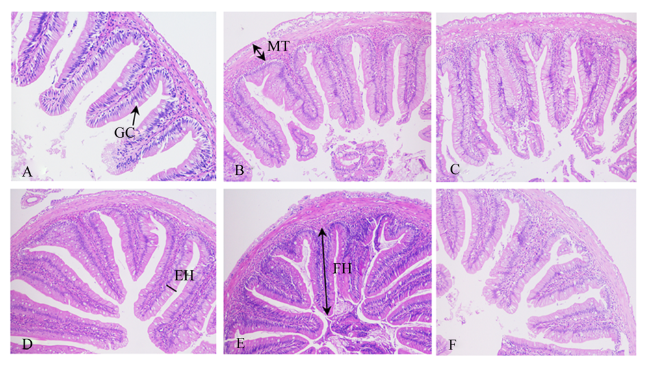
饲料蛋白质水平对黑脊倒刺鲃幼鱼肠道形态的影响见表6,不同饲料蛋白质水平组黑脊倒刺鲃幼鱼肠道组织切片观察见图3。随着饲料蛋白质水平的增加,肠道皱壁高度、肌层厚度、上皮细胞高度和杯状细胞个数均呈先上升后下降的趋势,均在42.43%蛋白质水平组达到最高值;其中,42.43%蛋白质水平组肠道皱壁高度和肌层厚度显著高于其他各组(P<0.05),42.43%蛋白质水平组肠道上皮细胞高度显著高于29.83%、33.96%、46.33%和50.67%蛋白质水平组(P<0.05),42.43%、46.33%和50.67%蛋白质水平组肠道杯状细胞个数显著高于29.83%、33.96%和38.52%蛋白质水平组(P<0.05)。
表6 饲料蛋白质水平对黑脊倒刺鲃幼鱼肠道形态的影响

Table 6 Effects of dietary protein levels on intestinal morphology of juvenile Spinibarbus caldwelli

项目
Items
饲料蛋白质水平 Dietary protein levels/%
29.83 33.96 38.52 42.43 46.33 50.67
皱壁高度
Fold height/μm
346.24±35.56d 475.12±25.05c 538.04±49.46b 631.20±15.57a 536.86±15.76b 495.51±30.68bc
肌层厚度
Muscular thickness/μm
86.78±10.05c 88.98±4.64c 92.86±4.80c 113.60±10.56a 103.53±6.63b 94.67±6.74c
上皮细胞高度
Epithelium height/μm
39.99±6.29c 41.33±2.38c 47.30±1.72ab 51.68±7.53a 44.47±3.21bc 43.74±4.64bc
杯状细胞个数
Goblet cells number/个
17.50±2.88b 20.09±3.30b 20.25±3.58b 26.13±4.85a 24.71±2.43a 24.43±4.12a
图3 不同饲料蛋白质水平组黑脊倒刺鲃幼鱼肠道组织切片观察

A、B、C、D、E、F分别表示29.83%、33.96%、38.52%、42.43%、46.33%和50.67%蛋白质水平组。FH:皱襞高度;MT:肌层厚度;EH:上皮细胞高度;GC:杯状细胞。

Fig.3 Observation of intestinal tissue section of juvenile Spinibarbus caldwelli in different protein level groups

A, B, C, D, E and F indicated the treatment groups with feed protein levels of 29.83%, 33.96%, 38.52%, 42.43%, 46.33% and 50.67% protein level groups, respectively. FH: fold height; MT: muscular thickness; EH: epithelium height; GC: goblet cell.

3 讨论

3.1 饲料蛋白质水平对黑脊倒刺鲃幼鱼生长性能的影响

水生动物的生长本质上是体内蛋白质的合成,外在体现为体长和体重的增加,内在表现为组织体积重量的增加、细胞数量的增多以及营养物质和能量的积累[11]。饲料蛋白质水平是决定水生动物生长的关键因素,其水平过低或过高均会对水生动物的生长产生不利影响。饲料蛋白质水平过低难以满足鱼体的最低生长需求,导致生长缓慢;而饲料蛋白质水平过高又会增加鱼体自身的代谢负担,导致营养物质利用率下降,饲料成本增加,甚至会引起氨中毒[12]。本试验中,不同饲料蛋白质水平对黑脊倒刺鲃幼鱼的SR无显著影响,说明黑脊倒刺鲃幼鱼对不同蛋白质水平饲料耐受性较强。黑脊倒刺鲃幼鱼的WGR、SGR和PER均随饲料蛋白质水平的增加先升高后下降,说明幼鱼生长阶段对蛋白质需求量较高,提高饲料蛋白质水平有助于促进其快速生长[13];但过高的饲料蛋白质水平对黑脊倒刺鲃幼鱼的生长贡献值降低。在低蛋白质水平下,鱼体生长缓慢,FCR较高;随着饲料蛋白质水平的增加,FCR在42.43%蛋白质水平组达到最低值,说明在该蛋白质水平下黑脊倒刺鲃幼鱼对饲料的转化率最高。
ILI经常用来反映鱼类食性的主要特征。一般来说,肉食性鱼类的肠道较短,而草食性和杂食性鱼类的肠道较长,可达其体长的2~5倍[14-15]。从ILI来看,黑脊倒刺鲃有杂食性鱼类特征,除29.83%低蛋白质水平组显著低于其他各组外,其他各组之间均无显著差异,说明黑脊倒刺鲃幼鱼在达到最低蛋白质需求量后,ILI趋于稳定。肝胰脏被视为脂肪和糖原沉积的主要场所,VSI和HSI通常也被视为肝胰脏或内脏中脂肪或者糖原蓄积的表观指标,因此可以在一定程度上反映鱼类的营养状况[16]。本研究发现,饲料蛋白质水平对黑脊倒刺鲃幼鱼的VSI和HSI无显著影响,说明饲料蛋白质水平对黑脊倒刺鲃幼鱼的肝胰脏和内脏质量影响不大,这与李成等[17]对光倒刺鲃和孙瑞健等[18]对大黄鱼上研究结果一致。CF通常用来作为评价鱼类生长状况和渔产品优劣的指标,CF的变化可能预示着鱼体本身营养状态的改变[19]。在本研究中,黑脊倒刺鲃幼鱼的CF随饲料蛋白质水平的增加呈先升高后降低的趋势,42.43%和46.33%蛋白质水平组CF显著高于29.83%和33.96%蛋白质水平组,说明较高蛋白质水平的饲料会使鱼体质量增长更快。此外,由于本研究中的饲料蛋白质水平是通过饲料中鱼粉的添加水平进行调节的,可能会造成各试验饲料之间的氨基酸组成产生细微的差异。

3.2 饲料蛋白质水平对黑脊倒刺鲃幼鱼消化酶活性的影响

消化酶是反映鱼类消化生理机能的一项重要指标,水产动物摄食后,饲料中的营养物质成为消化酶的作用底物,从而影响消化酶的分泌[20],进而直接影响饲料利用效率,因此研究水产动物消化酶活性对研究鱼类配合饲料和其消化吸收机理有重要意义[21]。本研究发现,饲料蛋白质水平对黑脊倒刺鲃幼鱼的消化酶活性具有显著影响;肠道TPS活性高于肝胰脏TPS活性,这是由于肝胰脏虽然作为蛋白酶的主要分泌器官,但TPS需要在肠黏膜分泌的肠致活酶作用下才能激活为有活性的蛋白酶[22]。黑脊倒刺鲃肠TPS活性随饲料蛋白质水平的增加而呈现先升高后降低的趋势,与刺鲃幼鱼[23]的肠道蛋白酶活性在饲料蛋白质水平超过40%后显著下降结果一致。这说明蛋白酶活性与一定范围内的饲料蛋白质水平呈正相关,可改善鱼类生长性能;但过高饲料蛋白质水平在经过鱼体内代谢后会产生较多有毒的含氮物质,使鱼类对蛋白酶的分泌产生负反馈调节(分泌抑制)[24],继而表现为蛋白酶活性降低、消化负担增加、生长减缓。
有研究发现,鱼类的肝胰脏可能是AMS的主要分泌器官,而肠道则是AMS的主要消化场所[25]。本试验中黑脊倒刺鲃肠道AMS活性因饲料蛋白质水平升高而持续下降,这可能是由于低蛋白质水平的饲料中碳水化合物水平相对较高,使得AMS活性较高,这与对刺鲃(Barbudes caldwell[23]的研究结论一致。鱼类的LPS主要由肝胰脏分泌,且属于底物依赖型酶[26]。本研究中,黑脊倒刺鲃幼鱼的肝胰脏和肠道LPS活性随着试验饲料脂肪水平的增加而逐步升高,说明其活性与鱼类饲料脂肪水平呈正相关[27-28]

3.3 饲料蛋白质水平对黑脊倒刺鲃幼鱼血清生化指标的影响

食物中的蛋白质经消化分解产生氨基酸,其中部分氨基酸经过脱氨基作用产生氨和尿素等,因此血清氨和UN含量可以较准确反映动物体内蛋白质分解代谢情况[29]。本研究中,随饲料蛋白质水平的升高,黑脊倒刺鲃血清UN和氨含量均呈上升趋势,与在克林雷氏鲶(Rhamdia quelen[30]和欧洲鲈鱼(Dicentrarchus labrax[31]上研究结果一致。分析认为,随着饲料蛋白质水平的升高,鱼类消化吸收进入体内的蛋白质含量增加,同时在肠道菌群作用下,用于分解供能的蛋白质增加,导致血清氨和UN含量增加,进而增加鱼体代谢产物,造成养殖水体污染。血清TP含量的变化在一定程度上可以反映饲料中蛋白质的营养水平及鱼体对蛋白质的代谢程度。本研究发现,血清TP含量随着饲料蛋白质水平的升高而逐步增加,当饲料蛋白质水平达到42.43%后趋于稳定。这说明在一定范围内黑脊倒刺鲃吸收进入血液的蛋白质会随饲料蛋白质水平的升高而不断增加,但当饲料蛋白质水平超过其代谢能力时,无法被鱼体有效地消化吸收,多余的蛋白质可能以氨等形式排出体外,进而污染养殖水体。

3.4 饲料蛋白质水平对黑脊倒刺鲃幼鱼蛋白质代谢关键酶活性的影响

ALT与AST是水产动物体内发挥氨基酸转运功能的2种重要的酶类,在鱼体内蛋白质代谢方面发挥重要关键作用[32]。正常情况下,肝脏中转氨酶活性较高,而血清中转氨酶活性较低,当鱼体营养不良或者受到胁迫作用,尤其是肝胰脏受损时,这2种酶会大量释放到血清中,造成血清的转氨酶活性升高,因此可以作为衡量肝功能健康与否的重要评价指标[33-34]。本研究中,肝胰脏的ALT和AST活性均呈现随饲料蛋白质水平的增加而先下降后上升再下降的趋势,说明黑脊倒刺鲃在摄食低蛋白质水平饲料时,其肝胰脏通过升高转氨酶活性来促进体内氨基酸代谢,提高机体对蛋白质的吸收利用;随着饲料蛋白质水平的升高,肝功能慢慢恢复正常,ALT和AST活性有逐渐升高的趋势,说明饲料蛋白质水平的升高会使氨基酸分解增加,从而作为糖异生作用的底物进而转化为能量[30];但当饲料蛋白质水平过高时,长期的高蛋白质摄入量会对鱼体肝胰脏代谢产生压力,可能导致肝细胞受损或细胞膜的通透性加大,使大量ALT和AST渗入血清中,因此出现50.67%蛋白质水平组血清ALT和AST活性显著高于29.83%、33.96%和38.52%蛋白质水平组的现象。

3.5 饲料蛋白质水平对黑脊倒刺鲃幼鱼肠道形态的影响

肠道是鱼类食物消化吸收的重要场所,其组织结构的完整性对于鱼类的生长发育非常重要。肠道皱壁高度和上皮细胞高度是反映鱼类肠道生长发育和吸收能力的重要标志[35]。投喂高蛋白质水平的饲料可促进鱼体肠道皱壁增高,进而增加肠道对营养物质的吸收面积[14]。肌层厚度则反映肠壁肌肉收缩能力,收缩能力越强越有利于营养物质的吸收和运输[36]。本研究中,随着饲料蛋白质水平的增加,肠道皱壁高度、肌层厚度呈先上升后下降的趋势,均在42.43%蛋白质水平组达到最高值,这与王建等[37]对于拉萨裸裂尻幼鱼的研究结果一致;且42.43%蛋白质水平组黑脊倒刺鲃幼鱼肠道TPS活性最高,说明该蛋白质水平饲料可促进黑脊倒刺鲃幼鱼肠道组织的生长和分化,提高消化吸收能力[36]。但当饲料蛋白质水平高于42.43%时,其皱壁高度与肌层厚度又降低,推测可能与饲料蛋白质水平超过了鱼体本身消化吸收上限,进而抑制了肠道形态正常发育有关。
杯状细胞可分泌大量的黏蛋白,这种黏蛋白具有丰富的丝氨酸、苏氨酸等,其形成的黏液层使得杯状细胞在肠黏膜中抵御外源细菌和肠道固有微生物侵袭时发挥重要作用[38]。因此,杯状细胞数量对维持肠道稳态有重要作用,可作为肠道屏障功能和肠道发育的重要判断指标。本试验结果表明,适当增加饲料蛋白质水平可提高肠道中杯状细胞数量,但当饲料蛋白质水平达到42.43%时,其增加趋于平缓。这可能是由于饲料蛋白质水平过高使肠道组织抗氧化能力降低,部分杯状细胞因氧化损伤而凋亡。

4 结论

饲料蛋白质水平过低时,黑脊倒刺鲃幼鱼生长缓慢,TPS活性低,肠道形态发育不良;而过高的饲料蛋白质水平则会影响黑脊倒刺鲃肝胰脏功能和肠道发育。在本试验条件下,以SGR和FCR为评价指标,得出黑脊倒刺鲃幼鱼饲料适宜蛋白质水平为42.10%~42.71%。
[1]
唐良华, 苏敏, 吕博彦, 等. 黑脊倒刺鲃vasa同源基因的克隆及表达分析[J]. 水产学报, 2012, 36(6):868-878.

TANG L H, SU M, LYU B Y, et al. cDNA cloning and expression analysis of a vasa-like gene in Spinibarbus caldwelli[J]. Journal of Fisheries of China, 2012, 36(6):868-878. (in Chinese)

DOI

[2]
林丹军, 尤永隆, 苏敏. 黑脊倒刺鲃精巢结构和精子发生的研究[J]. 水生生物学报, 2003, 27(6):563-571.

LIN D J, YOU Y L, SU M. Studies on testicular histology and spermatogenesis of teleost,Spinibarbus caldwelli (Nichols)[J]. Acta Hydrobiologica Sinica, 2003, 27(6):563-571. (in Chinese)

[3]
庹云, 肖调义, 李伟臣. 刺鲃幼鱼消化系统形态学和组织学研究[J]. 水生态学杂志, 2019, 40(4):83-92.

TUO Y, XIAO T Y, LI W C. Morphological and histological characteristics of the digestive system in Spinibarbus caldwelli[J]. Journal of Hydroecology, 2019, 40(4):83-92. (in Chinese)

[4]
WILSON R P, HALVER J E. Protein and amino acid requirements of fishes[J]. Annual Review of Nutrition, 1986, 6(1):225-244.

DOI

[5]
钱雪桥, 崔奕波, 解绶启, 等. 养殖鱼类饲料蛋白需要量的研究进展[J]. 水生生物学报, 2002, 26(4):410-416.

QIAN X Q, CUI Y B, XIE S Q, et al. A review on dietary protein requirement for aquaculture fishes[J]. Acta Hydrobiologica Sinica, 2002, 26(4):410-416. (in Chinese)

[6]
YANG S D, LIN T S, LIOU C H, et al. Influence of dietary protein levels on growth performance,carcass composition and liver lipid classes of juvenile Spinibarbus hollandi (Oshima)[J]. Aquaculture Research, 2003, 34(8):661-666.

DOI

[7]
余含, 戈贤平, 孙盛明, 等. 膨化饲料中蛋白水平对大规格鳙生长、消化酶活性和抗氧化能力的影响[J]. 南京农业大学学报, 2019, 42(6):1158-1166.

YU H, GE X P, SUN S M, et al. The effect of dietary protein level on the growth,digestive enzymes activities and antioxidant ability of the bighead carp (Aristichthys nobilis)[J]. Journal of Nanjing Agricultural University, 2019, 42(6):1158-1166. (in Chinese)

[8]
程小飞, 宋锐, 徐远琴, 等. 网箱养殖刺鲃肌肉营养成分分析及评价[J]. 现代食品科技, 2019, 35(6):245-250,236.

CHENG X F, SONG R, XU Y Q, et al. Nutritional analysis and evaluation on muscle of Spinibarbus caldwelli[J]. Modern Food Science & Technology, 2019, 35(6):245-250,236. (in Chinese)

[9]
吕耀平, 黄旭雄, 杨燕波, 等. 瓯江刺鲃肌肉营养成分分析与品质评价[J]. 华中农业大学学报, 2008, 27(1):86-90.

LV Y P, HUANG X X, YANG Y B, et al. Analysis and evaluation on nutritive composition and quality in the muscle of Spinibarbus caldwelli (Nichols)[J]. Journal of Huazhong Agricultural University, 2008, 27(1):86-90. (in Chinese)

[10]
程小飞, 洪波, 苏东旭, 等. 刺鲃鱼皮和鱼鳞营养成分的分析与评价[J]. 现代食品科技, 2019, 35(5):259-267.

CHENG X F, HONG B, SU D X, et al. Nutritional analysis and evaluation on skin and scales of Spinibarbus caldwelli[J]. Modern Food Science & Technology, 2019, 35(5):259-267. (in Chinese)

[11]
JIN Y, TIAN L X, XIE S W, et al. Interactions between dietary protein levels,growth performance,feed utilization,gene expression and metabolic products in juvenile grass carp (Ctenopharyngodon idella)[J]. Aquaculture, 2015, 437:75-83.

DOI

[12]
王双, 李战福, 李虹, 等. 大鲵幼体蛋白质的需求量[J]. 水产学报, 2020, 44(1):99-110.

WANG S, LI Z F, LI H, et al. Dietary protein requirement of juvenile giant salamander (Andrias davidianus)[J]. Journal of Fisheries of China, 2020, 44(1):99-110. (in Chinese)

[13]
KIM K I, KAYES T B, AMUNDSON C H. Purified diet development and re-evaluation of the dietary protein requirement of fingerling rainbow trout (Oncorhynchus mykiss)[J]. Aquaculture, 1991, 96(1):57-67.

DOI

[14]
韩步鹰, 孟玉琼, 刘小红, 等. 饲料蛋白质水平对三倍体虹鳟生长和肠道组织形态的影响[J]. 水产学杂志, 2020, 33(1):1-7.

HAN B Y, MENG Y Q, LIU X H, et al. Effect of dietary protein levels on growth and intestinal histological morphology of triploid rainbow trout[J]. Chinese Journal of Fisheries, 2020, 33(1):1-7. (in Chinese)

[15]
尹海富, 崔中倩, 宋洪建, 等. 兴凯湖翘嘴鲌消化道指数及消化酶活性分布的年龄差异[J]. 东北农业大学学报, 2013, 44(3):101-107.

YIN H F, CUI Z Q, SONG H J, et al. Differences of gastrointestinal index and digestive enzyme activity in different ages of Culter alburnus in Khanka lake[J]. Journal of Northeast Agricultural University, 2013, 44(3):101-107. (in Chinese)

[16]
郭鑫伟, 谭北平, 迟淑艳, 等. 摄食不同蛋白质水平饲料的珍珠龙胆石斑鱼幼鱼生长与血清激素和消化酶活性的相关性分析[J]. 水产学报, 2019, 43(8):1808-1820.

GUO X W, TAN B P, CHI S Y, et al. Correlation analysis of fish growth performance and serum hormone and digestive enzyme activities of juvenile pearl gentian grouper (Epinephelus lanceolatus♂×E. fuscoguttatus♀) fed with different protein levels diets[J]. Journal of Fisheries of China, 2019, 43(8):1808-1820. (in Chinese)

[17]
李成, 秦溱, 李金龙, 等. 不同蛋白水平饲料对光倒刺鲃幼鱼生长、消化酶及体成分的影响[J]. 饲料工业, 2018, 39(24):34-39.

LI C, QIN Q, LI J L, et al. Effect of dietary with different protein levels on the growth,digestive enzyme activities and body composition of the juvenile Spinibarbus hollandi Oshima[J]. Feed Industry, 2018, 39(24):34-39. (in Chinese)

[18]
孙瑞健, 张文兵, 徐玮, 等. 饲料蛋白质水平与投喂频率对大黄鱼生长、体组成及蛋白质代谢的影响[J]. 水生生物学报, 2013, 37(2):281-289.

SUN R J, ZHANG W B, XU W, et al. Effects of dietary protein level and feeding frequency on the growth performance,body composition and protein metabolism of juvenile large yellow croakers,Pseudosciaena crocea R.[J]. Acta Hydrobiologica Sinica, 2013, 37(2):281-289. (in Chinese)

[19]
潘庭双, 程玉冰, 侯冠军, 等. 不同蛋白水平饲料对斑点叉尾鮰生长的影响[J]. 饲料研究, 2008(4):56-58.

PAN T S, CHENG Y B, HOU G J, et al. Effects of different protein levels on the growth of Ictalurus punctatus[J]. Feed Research, 2008(4):56-58. (in Chinese)

[20]
张蕉南. 饲料蛋白质水平对大刺鳅幼鱼生长性能、消化酶和肝转氨酶活性的影响[J]. 饲料工业, 2018, 39(6):19-25.

ZHANG J N. Effects of dietary protein levels on growth performance,digestive enzyme and liver transaminase activities of juvenile Mastacembelus aculeatus[J]. Feed Industry, 2018, 39(6):19-25. (in Chinese)

[21]
刘敏, 张辉. 鱼类消化酶的研究进展[J]. 渔业经济研究, 2008(6):6-10.

LIU M, ZHANG H. Research progress on the digestive enzyme of the fish[J]. Fisheries Economy Research, 2008(6):6-10. (in Chinese)

[22]
黄瑾, 熊邦喜, 陈洁, 等. 鱼类消化酶活性及其影响因素的研究进展[J]. 湖南农业科学, 2011(5):129-131,141.

HUANG J, XIONG B X, CHEN J, et al. Research advances in digestive enzyme of fish and its influencing factors[J]. Hunan Agricultural Sciences, 2011(5):129-131,141. (in Chinese)

[23]
吕耀平, 陈建明, 叶金云, 等. 饲料蛋白质水平对刺鲃幼鱼的生长、胴体营养组成及消化酶活性的影响[J]. 农业生物技术学报, 2009, 17(2):276-281.

LV Y P, CHEN J M, YE J Y, et al. Effects of diet protein level on the growth,body composition and digestive enzyme activities of the Barbudes caldwell juvenile[J]. Journal of Agricultural Biotechnology, 2009, 17(2):276-281. (in Chinese)

[24]
石英, 冷向军, 李小勤, 等. 饲料蛋白水平对血鹦鹉幼鱼生长、体组成和肠道蛋白消化酶活性的影响[J]. 水生生物学报, 2009, 33(5):874-880.

SHI Y, LENG X J, LI X Q, et al. Effect of dietary protein levels on growth performance,whole body composition and intestinal digestive enzyme activities of Cichlasoma sp. juvenile[J]. Acta Hydrobiologica Sinica, 2009, 33(5):874-880. (in Chinese)

DOI

[25]
孙海涛, 吉红. 饲料蛋白水平对匙吻鲟幼鱼肌肉营养成分及消化酶活力的影响[J]. 水产科学, 2011, 30(12):721-725.

SUN H T, JI H. Effects of dietary protein levels on muscle composition and digestive enzyme activities in juvenile paddlefish Polyodon spathula[J]. Fisheries Science, 2011, 30(12):721-725. (in Chinese)

[26]
LUNDSTEDT L M, BIBIANO MELO J F, MORAES G. Digestive enzymes and metabolic profile of Pseudoplatystoma corruscans (Teleostei:Siluriformes) in response to diet composition[J]. Comparative Biochemistry and Physiology Part B:Biochemistry and Molecular Biology, 2004, 137(3):331-339.

DOI

[27]
杨代勤, 严安生, 陈芳, 等. 不同饲料对黄鳝消化酶活性的影响[J]. 水产学报, 2003, 27(6):558-563.

YANG D Q, YAN A S, CHEN F, et al. Effects of different diets on activities of digestive enzymes of Monopterus albus[J]. Journal of Fisheries of China, 2003, 27(6):558-563. (in Chinese)

[28]
徐革锋, 陈侠君, 杜佳, 等. 鱼类消化系统的结构、功能及消化酶的分布与特性[J]. 水产学杂志, 2009, 22(4):49-55.

XU G F, CHEN X J, DU J, et al. Fish digestive system:it’s structure,function and the distrbutions and characteristics of digestive enzymes[J]. Chinese Journal of Fisheries, 2009, 22(4):49-55. (in Chinese)

[29]
林淑琴, 成琳, 张文兵, 等. 饲料蛋白质水平对大黄鱼体内蛋白质的沉积和代谢反应的影响[J]. 中国海洋大学学报(自然科学版), 2014, 44(5):32-39.

LIN S Q, CHENG L, ZHANG W B, et al. Effect of dietary protein content on the protein retention and nitrogenous metabolism of large yellow croaker[J]. Periodical of Ocean University of China, 2014, 44(5):32-39. (in Chinese)

[30]
BIBIANO MELO J F, LUNDSTEDT L M, METÓN I, et al. Effects of dietary levels of protein on nitrogenous metabolism of Rhamdia quelen (Teleostei:Pimelodidae)[J]. Comparative Biochemistry and Physiology Part A:Molecular & Integrative Physiology, 2006, 145(2):181-187.

[31]
PERES H, OLIVA-TELES A. Effect of dietary protein and lipid level on metabolic utilization of diets by European sea bass (Dicentrarchus labrax) juveniles[J]. Fish Physiology and Biochemistry, 2001, 25(4):269-275.

DOI

[32]
曾本和, 刘海平, 王建, 等. 饲料蛋白质水平对拉萨裸裂尻鱼幼鱼肌肉氨基酸及蛋白质代谢的影响[J]. 中国水产科学, 2019, 26(6):1153-1163.

ZENG B H, LIU H P, WANG J, et al. Effects of dietary protein levels on muscular amino acids and protein metabolism of Schizopygopsis younghusbandi younghusbandi Regan[J]. Journal of Fishery Sciences of China, 2019, 26(6):1153-1163. (in Chinese)

[33]
卜远富, 杨严鸥, 万全, 等. 大米蛋白粉替代商品饲料对黄鳝生长及转氨酶、脂肪代谢酶等指标的影响[J]. 饲料工业, 2015, 36(18):13-15.

BU Y F, YANG Y O, WAN Q, et al. Effects of dietary supplementation with rice protein powder on growth performance and several physiological indexes in rice fieless eel (Monopterus albus)[J]. Feed Industry, 2015, 36(18):13-15. (in Chinese)

[34]
杨贺舒, 孙俊霄, 杨慧君, 等. 低蛋白饲料对杂交黄颡鱼幼鱼生长性能、体组成、转氨酶活性和抗氧化能力的影响[J]. 水生生物学报, 2022, 46(1):79-87.

YANG H S, SUN J X, YANG H J, et al. Effects of low-protein diet on growth performance,body composition,transaminase activity and antioxidant capacity of yellow catfish hybrid[J]. Acta Hydrobiologica Sinica, 2022, 46(1):79-87. (in Chinese)

[35]
李晋南, 王常安, 张圆圆, 等. 高淀粉水平下精氨酸对松浦镜鲤肠道形态与功能的影响[J]. 广东海洋大学学报, 2021, 41(1):39-46.

LI J N, WANG C A, ZHANG Y Y, et al. Effect of arginine supplementation in high starch diets on intestinal digestive enzyme activities and intestinal morphology of Songpu mirror carp (Cyprinus carpio L.)[J]. Journal of Guangdong Ocean University, 2021, 41(1):39-46. (in Chinese)

[36]
麦浩彬, 郭鑫伟, 王金港, 等. 摄食不同水平饲料蛋白质对珍珠龙胆石斑鱼幼鱼肠道组织形态和菌群组成的影响[J]. 大连海洋大学学报, 2020, 35(1):63-70.

MAI H B, GUO X W, WANG J G, et al. Effects of dietary protein levels on intestinal tract histomorphology and microflora composition in juvenile pearl gentian grouper (Epinephelus lanceolatu♂×E. fuscoguttatus♀)[J]. Journal of Dalian Fisheries University, 2020, 35(1):63-70. (in Chinese)

[37]
王建, 曾本和, 徐兆利, 等. 饲料蛋白水平对拉萨裸裂尻幼鱼肠道和肝脏的消化酶活性及组织结构的影响[J]. 南方水产科学, 2019, 15(6):112-119.

WANG J, ZENG B H, XU Z L, et al. Effect of dietary protein level on digestive enzyme activity and histological structure in intestine and liver of juvenile Schizopygopsis younghusbandi[J]. South China Fisheries Science, 2019, 15(6):112-119. (in Chinese)

[38]
杨文娟, 来利华, 王青青. 肠道杯状细胞在肠道免疫调控中作用的研究进展[J]. 细胞与分子免疫学杂志, 2018, 34(11):1046-1050.

YANG W J, LAI L H, WANG Q Q. Progress in the role of intestinal goblet cells in intestinal immune regulation[J]. Chinese Journal of Cellular and Molecular Immunology, 2018, 34(11):1046-1050. (in Chinese)

Outlines

/