RESEARCH PAPER

Whole Intestinal Succession of Dominant Lactobacilli in Small Intestine of Piglets Before and after Weaning and Their Comparative Metabolomics

  • LIU Moyan , 1 ,
  • HAO Youling 1, * ,
  • SONG Qingqing 1, 2 ,
  • CHEN Hui 1 ,
  • SUN Shiqiang 1 ,
  • LI Ju 3 ,
  • WU Zhenlong 1 ,
  • DAI Zhaolai , 1, **
Expand
  • 1 College of Animal Science and Technology, China Agricultural University, Beijing 100193, China
  • 2 Miyun High School Affiliated to Capital Normal University, Beijing 101520, China
  • 3 Henan Yinfa Animal Husbandry Co., Ltd., Zhengzhou 451100, China
**associate professor, E-mail:

*Contributed equally

Received date: 2022-09-15

  Online published: 2023-03-16

Abstract

This experiment aimed to study the whole intestinal number changes of the dominant Lactobacilli in small intestine of piglets before and after weaning, and to study the metabolic differences of some dominant Lactobacilli by comparative metabolomics. The dominant Lactobacilli in small intestine of suckling piglets at 21 days of age were isolated using the gradient dilution and culture-based method. Besides, twenty-four 21-day-old weaned Landrace×Large Yorkshire cross-breed barrows with an average body weight of (7.00±0.50) kg were selected and divided into 4 groups with 6 replicates in each group and 1 pig in each replicate. At 21, 24, 28 and 35 days of age, one piglet from each group was selected and slaughtered, the luminal contents from stomach, jejunum, ileum, caecum and colon were collected and the numbers of different kinds of Lactobacilli in the samples were quantified by real-time PCR. In addition, three dominant Lactobacilli strains were selected for the comparative metabolomics study. The results showed that five dominant Lactobacilli strains were isolated and identified as Lactobacillus amylovorus, Limosilactobacillus reuteri, Lactobacillus johnsonii, Limosilactobacillus mucosae and Ligilactobacillus salivarius. The number of Lactobacilli in the stomach and intestine of piglets was decreased and gradually recovered after weaning, but did not reach the level of suckling period. After weaning, the dominant Lactobacilli in the stomach were Ligilactobacillus salivarius, Limosilactobacillus mucosae and Lactobacillus amylovorus; the dominant Lactobacilli in the small intestine and large intestine were Lactobacillus amylovorus, Limosilactobacillus reuteri and Lactobacillus johnsonii, however, there were difference in the number of three Lactobacilli in different intestinal segments. The comparative metabolomics and liquid chromatographic analysis showed that the major differential metabolic pathways were arginine biosynthesis in amino acid metabolism and citric acid cycle in carbohydrate metabolism of Lactobacillus amylovorus, Limosilactobacillus reuteri and Limosilactobacillus mucosae. This study provides the basis for the dietary regulation of Lactobacilli composition and metabolism in different parts of the intestinal tract of weaned piglets and improve intestinal function and health of weaned piglets.

Cite this article

LIU Moyan , HAO Youling , SONG Qingqing , CHEN Hui , SUN Shiqiang , LI Ju , WU Zhenlong , DAI Zhaolai . Whole Intestinal Succession of Dominant Lactobacilli in Small Intestine of Piglets Before and after Weaning and Their Comparative Metabolomics[J]. Chinese Journal of Animal Nutrition, 2023 , 35(3) : 1501 -1512 . DOI: 10.12418/CJAN2023.142

肠道微生物是调控动物营养和健康的重要因素之一,乳酸杆菌作为肠道中的核心菌群[1],在生产中通过促进营养物质消化吸收、改善肠道屏障功能与抗氧化能力等方式,调节肠道微生物功能,降低腹泻率,改善动物的生长性能[2-4]。对乳酸杆菌在肠道相对丰度和分布的研究显示,不同日龄和不同肠段的乳酸杆菌的组成存在差异。对仔猪断奶前和断奶后3 d胃和小肠中总乳酸杆菌的定量研究显示,乳酸杆菌在哺乳仔猪回肠中的数量最高,断奶显著降低了前肠各肠段中的总乳酸杆菌数量,其中食淀粉乳杆菌(Lactobacillus amylovorus)的数量变化与总乳酸杆菌的数量变化一致,食淀粉乳杆菌是断奶后仔猪回肠的优势乳酸杆菌;在结肠中总乳酸杆菌和食淀粉乳杆菌的数量变化与小肠类似[5-7]。以上研究阐明了总乳酸杆菌在仔猪断奶早期部分肠段的变化规律,然而肠道中其他种类的乳酸杆菌在断奶前后的全肠道演替规律不清。高通量测序分析显示,哺乳仔猪回肠和结肠的优势乳酸杆菌为食淀粉乳杆菌、阴道乳杆菌(Lactobacillus vaginalis)、约氏乳杆菌(Lactobacillus johnsonii)和德氏乳杆菌(Lactobacillus delbrueckii)等;而21日龄断奶仔猪回肠中优势乳酸杆菌为罗伊氏乳杆菌(Limosilactobacillus reuteri)、食淀粉乳杆菌、约氏乳杆菌、黏液乳杆菌(Limosilactobacillus mucosae)和唾液乳杆菌(Ligilactobacillus salivarius)等[8]。由于不同乳酸杆菌的益生作用方式和机制可能存在差异[3-4,6],因此有必要探明仔猪肠道不同优势乳酸杆菌在仔猪断奶前后胃肠道中的时空变化规律。
此外,肠道乳酸杆菌的代谢对宿主肠道的功能和健康存在互作,并有重要调节作用。近年来对仔猪肠道乳酸杆菌调节代谢的研究显示,罗伊氏乳杆菌增加了断奶仔猪回肠氨基酸转运载体的表达并调节了肝脏的氨基酸代谢,提示该菌可通过调节断奶仔猪的氨基酸代谢促进仔猪的生长[9]。食淀粉乳杆菌可通过调节基因表达响应不同的饲粮氮源(肽或氨基酸)并产生不同量的乳酸和乙酸,影响宿主的健康和细菌的定植[10]。断奶仔猪饲粮添加植物乳杆菌(Lactobacillus plantarum)调节了仔猪的色氨酸代谢和脂质的消化吸收[11]。通过比较低出生体重和正常出生体重仔猪出生后肠道菌群的演替以及仔猪代谢的变化显示,受调节的代谢通路主要为氨基酸代谢和能量代谢,肠道中的主要差异乳酸杆菌——罗伊氏乳杆菌和食淀粉乳杆菌可能与不同出生体重仔猪哺乳期的生长密切相关[12]。可能的作用解释和作用机制是,这些乳酸杆菌可产生多种消化酶,改善低出生体重仔猪对养分的消化吸收[13]。然而,目前对肠道优势乳酸杆菌的代谢比较研究不多,有必要明确不同种类乳酸杆菌的代谢特性与差异,从而合理优化不同种类乳酸杆菌在生产中的使用。
因此,本研究旨在定量分析明确仔猪肠道优势乳酸杆菌在断奶前后全肠段的时空演替规律,并通过比较代谢组学探究优势乳酸杆菌的代谢差异,研究结果可为深入探明猪肠道优势乳酸杆菌的断奶前后分布与代谢特征及其优化益生作用效果改善动物健康与生长提供理论基础。

1 材料与方法

1.1 试验设计与肠道样品采集

饲养试验在河南银发牧业公司进行,选取24头平均体重为(7.00±0.50) kg的21日龄长×大二元杂交去势公猪,仔猪于21日龄断奶,按照窝别与体重分为4组,每组6个重复,每个重复1头猪,每头断奶仔猪进行单栏独立饲养。各组的断奶仔猪均饲喂不含抗生素的玉米-豆粕型饲粮,所有试验仔猪自由采食和饮水。分别于21、24、28和35日龄,每组随机选取1头仔猪屠宰,每日龄共屠宰4头仔猪。采集仔猪胃、空肠、回肠、盲肠、结肠的肠道内容物样品,用于乳酸杆菌的定量分析。

1.2 优势乳酸杆菌的分离和分子生物学鉴定

每组选取1头中间体重且无腹泻发生的仔猪进行屠宰,无菌采集仔猪回肠食糜,将各管食糜均匀混合并与灭菌厌氧生理盐水1:10(体积比)混合转入通用二氧化碳(CO2)的离心管中,剧烈摇匀1 min。转移到通有CO2的无菌离心管中,250×g离心5 min,吸取上清转移至灭菌并通入CO2的厌氧管。将含有细菌的上清液用MRS培养基10倍梯度稀释,每个梯度3个重复,置于37 ℃培养24 h后,选择有细菌生长的最高3个梯度培养物进行涂板和分离培养。收集纯菌培养物离心后的细菌沉淀用于核酸提取和分子生物学鉴定。
参考Zoetendal等[14]方法,使用酚和氯仿/异戊醇提取细菌样品的总DNA。用细菌的16S rRNA基因通用引物8-f(5'-AGAGTTTGATCCTGGCTCAG-3')和1510-r(5'-GGCTACCTTGTTACGA-3')进行PCR扩增[10],扩增产物送公司进行测序(北京华大基因科技有限公司)。测序结果利用PubMed BLAST数据库与细菌序列进行同源性比对分析,鉴定菌株种属。

1.3 实时荧光定量PCR(real-time PCR)法对细菌进行定量分析

选取分离获得的5株乳酸杆菌以及本实验室保存的1株链球菌制作细菌real-time PCR定量标准曲线。提取已知细菌数量的单一菌株样品的DNA,将获得的单一菌株DNA样品进行10倍梯度稀释(10-1~10-7),利用特异性引物对各样品DNA进行real-time PCR扩增,建立循环阈值(Ct)与各菌株数量的标准曲线,用链球菌制作总菌的绝对定量曲线。用于细菌绝对定量的引物信息如下,用于定量总细菌、总乳酸杆菌、食淀粉乳杆菌、约氏乳杆菌、唾液乳杆菌、黏液乳杆菌的引物参考Li等[12],用于定量罗伊氏乳杆菌的引物:上游5'-TGTTCGAGCTAAAGGAACTTTGT-3',下游5'-AGTGGCAACAATCTGGGTGT-3'。通过对不同日龄仔猪胃肠道样品DNA进行real-time PCR扩增,并将所得Ct值通过建立的标准曲线进行计算,得到不同日龄仔猪各肠段食糜中各种乳酸杆菌的数量。

1.4 仔猪肠道优势乳酸杆菌的培养与比较代谢组学分析

为了比较不同菌株的代谢差异,结合乳酸杆菌体外培养和比较代谢组学方法比较分析了3株仔猪小肠优势乳酸杆菌(罗伊氏乳杆菌、食淀粉乳杆菌和黏液乳杆菌)的代谢差异。为了明确各株乳酸杆菌产生化合物的情况,使用化学成分已知的完全合成培养基用于试验[15],培养基中的氨基酸组成参照实验室前期研究[16]配制。使用MRS液体培养基对3株乳酸杆菌进行复苏和培养后,按10%接种量传代于完全合成培养基中37 ℃培养24 h,将以上24 h培养物离心后用完全合成培养基重悬调整细菌数量,之后转移至新鲜完全合成培养基中,使各菌株的初始细菌数量为1×10⁷ CFU/mL,各菌株设置6个重复,于37 ℃培养6 h后,采集培养液13 000×g离心10 min后取上清,培养液上清用-80 ℃预冷的液相色谱甲醇按1:1(体积比)混合,涡旋混匀后于-20 ℃冰箱中静置30 min,取出后21 000×g在-20 ℃下离心10 min,取100 μL上清液过滤后保存于-80 ℃,用于比较代谢组学测定分析。由于约氏乳杆菌不能在该完全合成培养基中良好生长,因此未包括在此试验内。
提取后的细菌代谢物经ACQUITY UPLC I-Class超高效液相色谱(Waters,美国)分离,通过电喷雾离子源(HESI)加热离子化后进入Q-Exactive高分辨质谱(Thermo,美国)收集数据。每分析10个样品,使用1个所有样品的混合样品作为分析质控(QC)进样分析。使用Progenesis QI软件(Waters,美国)对液质联用仪收集到的原始数据进行分析处理,如保留时间对齐、去除背景、提取特征峰,并以所有化合物的峰强度为基础对原始峰强度进行归一化处理、方差分析(ANOVA)。使用Simca 14.1软件(Umetrics,瑞典)对化合物矩阵进行统计分析,选取变量投影重要性(variable importance in projection,VIP)>1且P<0.05的化合物为差异化合物,并对其进行二级质谱鉴定确定化学式和结构式。使用Progenesis QI软件将化合物的精准分子质量与实验室数据库比对,检索获取相关候选化合物列表。通过化合物的二级图谱与公共数据库化合物图谱比对,确定差异化合物的结构和名称。

1.5 培养液中游离氨基酸浓度测定

为了确认比较代谢组学分析结果,研究不同种乳酸杆菌的氨基酸利用代谢差异,用色相色谱方法分析比较了在比较代谢组中研究的3种乳酸杆菌培养液中的游离氨基酸浓度,样品用高氯酸沉淀蛋白并用碳酸钾中和反应液pH后,用液相色谱水稀释后,用高效液相色谱(Waters,美国)测定培养6 h后不同种乳酸杆菌培养液中氨基酸浓度,并用培养前(0 h)培养液中的各种氨基酸培养液中的游离氨基酸浓度进行比较计算,测定方法参照Dai等[16]的方法进行。

1.6 数据统计与分析

细菌定量分析数据以平均值±标准误表示,采用SAS 9.1软件对数据进行线性回归分析、单因素方差分析(one-way ANOVA)和Tukey氏多重比较,对于不符合正态分布的数据,使用卡方检验进行分析,P<0.05表示差异显著。
代谢组学数据通过MetaboAnalyst网站(https://www.metaboanalyst.ca)对确定结构式的化合物进行数据归一化处理(normalization)、基于多维模型的偏最小二乘法判别分析(partial least squares discriminant analysis,PLS-DA)、变量投影重要性分析、热图分析(heatmap analysis)和代谢通路分析(metabolic pathway analysis)。

2 结果与分析

2.1 仔猪小肠优势乳酸杆菌菌株的分子生物学鉴定结果

本试验从仔猪小肠中共分离获得5株不同种类的乳酸杆菌,鉴定结果如下:菌株6-3为黏液乳杆菌(相似性:100%),菌株6-8为约氏乳杆菌(相似性:99%),菌株7-1为罗伊氏乳杆菌(相似性:100%),菌株7-3为食淀粉乳杆菌(相似性:99%),菌株8-7为唾液乳杆菌(相似性:99%)。将各菌株的16S rRNA基因序列提交至NCBI库,序列号如下,菌株6-3:KU612251.1,菌株6-8:KU612252.1,菌株7-1:KU612253.1,菌株7-3:KU612254.1,菌株8-7:MG674666.1。

2.2 不同日龄仔猪各肠段食糜中乳酸杆菌的定量分析结果

断奶前后优势乳酸杆菌在仔猪胃中的变化情况见表1,乳酸杆菌是断奶前(21日龄)仔猪胃中的优势细菌,总乳酸杆菌/总细菌为8.13%。断奶后(24、28和35日龄),乳酸杆菌数量的下降主要是由于胃中总细菌的数量在断奶后迅速增加。断奶前后,各种乳酸杆菌在胃中的数量先增加后降低,数量较多的乳酸杆菌为唾液乳杆菌、黏液乳杆菌和食淀粉乳杆菌。各日龄胃中黏液乳杆菌的数量无显著差异(P>0.05)。
表1 断奶前后优势乳酸杆菌在仔猪胃中的变化情况

Table 1 Changes of dominant Lactobacilli in stomach of piglets before and after weaning (n=4)

项目
Items
日龄 Days of age
21 24 28 35
总细菌 Total bacteria/[lg(CFU/g)] 5.64±0.11c 7.92±0.21a 7.86±0.08a 6.79±0.23b
总乳酸杆菌 Total Lactobacilli/[lg(CFU/g)] 4.55±0.05b 6.04±0.44a 5.27±0.12b 4.59±0.08b
总乳酸杆菌/总细菌
Total Lactobacilli/total bacteria/%
8.13±0.12a 1.32±0.07b 0.26±0.01c 0.63±0.02bc
食淀粉乳杆菌
Lactobacillus amylovorus/[lg(CFU/g)]
4.10±0.04c 5.62±0.07a 4.97±0.17b 3.54±0.08d
罗伊氏乳杆菌
Limosilactobacillus reuteri/[lg(CFU/g)]
3.06±0.08b 5.15±0.26a 4.85±0.10a 2.64±0.31b
约氏乳杆菌
Lactobacillus johnsonii/[lg(CFU/g)]
3.93±0.01c 5.51±0.16a 4.82±0.02b 3.41±0.01d
唾液乳杆菌
Ligilactobacillus salivarius/[lg(CFU/g)]
3.28±0.32ab 3.05±0.18b 3.43±0.12ab 4.06±0.47a
黏液乳杆菌
Limosilactobacillus mucosae/[lg(CFU/g)]
4.08±0.23 3.47±0.36 4.39±0.44 3.75±0.07

同行数据肩标不同小写字母表示差异显著(P<0.05),相同或无字母表示差异不显著(P>0.05)。下表同。

In the same row, values with different small letter superscripts mean significant difference (P<0.05), while with the same or no letter superscripts mean no significant difference (P>0.05). The same as below.

断奶前后优势乳酸杆菌在仔猪小肠中的变化情况见表2,断奶前后,食淀粉乳杆菌、罗伊氏乳杆菌和约氏乳杆菌均是小肠中的优势乳酸杆菌,且食淀粉乳杆菌的数量最多;断奶后,食淀粉乳杆菌和罗伊氏乳杆菌是小肠中的优势乳酸杆菌,但在空肠中罗伊氏乳杆菌的数量较多,而在回肠中食淀粉乳杆菌的数量较多。断奶前,仔猪回肠中总细菌和总乳酸杆菌的数量高于空肠中;断奶后,空肠和回肠中总细菌和总乳酸杆菌的数量无明显差异。
表2 断奶前后优势乳酸杆菌在仔猪小肠中的变化情况

Table 2 Changes of dominant Lactobacilli in small intestine of piglets before and after weaning (n=4)

项目
Items
日龄 Days of age
21 24 28 35
空肠 Jejunum
总细菌 Total bacteria/[lg(CFU/g)] 8.96±0.07 8.83±0.39 8.80±0.16 8.95±0.15
总乳酸杆菌 Total Lactobacilli/[lg(CFU/g)] 8.03±0.05a 5.60±0.16d 6.11±0.17c 6.87±0.13b
总乳酸杆菌/总细菌
Total Lactobacilli/total bacteria/%
11.74±0.08a 0.06±0.00d 0.20±0.00c 0.83±0.01b
项目
Items
日龄 Days of age
21 24 28 35
食淀粉乳杆菌
Lactobacillus amylovorus/[lg(CFU/g)]
7.08±0.16a 5.06±0.12c 5.50±0.21bc 5.82±0.14b
罗伊氏乳杆菌
Limosilactobacillus reuteri/[lg(CFU/g)]
6.96±0.11a 4.10±0.03d 5.64±0.10c 6.42±0.14b
约氏乳杆菌
Lactobacillus johnsonii/[lg(CFU/g)]
6.41±0.02a 4.28±0.19c 3.74±0.14a 5.25±0.12b
唾液乳杆菌
Ligilactobacillus salivarius/[lg(CFU/g)]
4.91±0.02a 3.46±0.17c 4.22±0.32b 4.46±0.17ab
黏液乳杆菌
Limosilactobacillus mucosae/[lg(CFU/g)]
5.27±0.13a 3.57±0.20b 4.60±0.16a 4.69±0.45a
回肠 Ileum
总细菌 Total bacteria/[lg(CFU/g)] 9.72±0.34a 8.29±0.23b 8.78±0.26ab 8.77±0.33ab
总乳酸杆菌 Total Lactobacilli/[lg(CFU/g)] 9.01±0.12a 6.80±0.09bc 6.91±0.10b 6.99±0.21b
总乳酸杆菌/总细菌
Total Lactobacilli/total bacteria/%
19.50±0.47a 3.24±0.07b 1.35±0.03c 1.66±0.06c
食淀粉乳杆菌
Lactobacillus amylovorus/[lg(CFU/g)]
8.65±0.24a 5.94±0.03b 6.67±0.55b 6.03±0.33b
罗伊氏乳杆菌
Limosilactobacillus reuteri/[lg(CFU/g)]
7.76±0.20a 6.57±0.17b 6.44±0.15b 5.83±0.20c
约氏乳杆菌
Lactobacillus johnsonii/[lg(CFU/g)]
8.55±0.11a 4.70±0.28b 4.72±0.11b 4.42±0.22b
唾液乳杆菌
Ligilactobacillus salivarius/[lg(CFU/g)]
4.54±0.30a 3.15±0.23b 3.96±0.07ab 4.59±0.51a
黏液乳杆菌
Limosilactobacillus mucosae/[lg(CFU/g)]
5.08±0.38a 4.01±0.06b 4.30±0.36ab 3.94±0.06b
断奶前后优势乳酸杆菌在仔猪大肠中的变化情况见表3,断奶前,食淀粉乳杆菌、罗伊氏乳杆菌和约氏乳杆菌是盲肠和结肠中的优势乳酸杆菌,且食淀粉乳杆菌数量最多;断奶后,约氏乳杆菌是盲肠和回肠中的优势乳酸杆菌,其次为食淀粉乳杆菌和罗伊氏乳杆菌。
表3 断奶前后优势乳酸杆菌在仔猪大肠中的变化情况

Table 3 Changes of dominant Lactobacilli in large intestine of piglets before and after weaning (n=4)

项目
Items
日龄 Days of age
21 24 28 35
盲肠 Cecum
总细菌 Total bacteria/[lg(CFU/g)] 11.34±0.20a 10.73±0.05b 10.74±0.07b 10.62±0.07b
总乳酸杆菌 Total Lactobacilli/[lg(CFU/g)] 9.40±0.18a 7.43±0.10c 7.65±0.15c 8.43±0.36b
总乳酸杆菌/总细菌
Total Lactobacilli/total bacteria/%
1.15±0.02a 0.05±0.01c 0.08±0.01c 0.65±0.02b
食淀粉乳杆菌
Lactobacillus amylovorus/[lg(CFU/g)]
8.18±0.34a 5.20±0.13c 7.09±0.26b 6.43±0.44b
罗伊氏乳杆菌
Limosilactobacillus reuteri/[lg(CFU/g)]
7.24±0.15 6.72±0.84 7.04±0.15 5.95±0.38
项目
Items
日龄 Days of age
21 24 28 35
约氏乳杆菌
Lactobacillus johnsonii/[lg(CFU/g)]
7.34±0.03a 6.66±0.08b 6.25±0.04b 7.20±0.29a
唾液乳杆菌
Ligilactobacillus salivarius/[lg(CFU/g)]
6.30±0.12a 5.99±0.21ab 3.70±0.21c 5.44±0.38b
黏液乳杆菌
Limosilactobacillus mucosae/[lg(CFU/g)]
6.23±0.36a 5.39±0.65a 3.37±0.45b 4.82±0.35ab
结肠 Colon
总细菌 Total bacteria/[lg(CFU/g)] 10.81±0.08 10.65±0.17 10.94±0.03 10.65±0.08
总乳酸杆菌 Total Lactobacilli/[lg(CFU/g)] 9.52±0.14a 6.93±0.14d 7.44±0.06c 8.29±0.22b
总乳酸杆菌/总细菌
Total Lactobacilli/total bacteria/%
5.13±0.06a 0.02±0.00c 0.03±0.00c 0.44±0.01b
食淀粉乳杆菌
Lactobacillus amylovorus/[lg(CFU/g)]
8.48±0.35a 6.08±0.53b 7.11±0.07b 6.78±0.28b
罗伊氏乳杆菌
Limosilactobacillus reuteri/[lg(CFU/g)]
7.24±0.08a 6.00±0.50b 7.26±0.01a 6.59±0.18ab
约氏乳杆菌
Lactobacillus johnsonii/[lg(CFU/g)]
7.31±0.06a 5.72±0.02c 6.38±0.15b 7.27±0.30a
唾液乳杆菌
Ligilactobacillus salivarius/[lg(CFU/g)]
5.97±0.16a 5.79±0.17a 3.26±0.22b 5.39±0.42a
黏液乳杆菌
Limosilactobacillus mucosae/[lg(CFU/g)]
7.03±0.16a 4.56±0.46b 3.68±0.07b 4.27±0.25b

2.3 非靶向代谢组学比较仔猪肠道优势乳酸杆菌的代谢差异

2.3.1 不同乳酸杆菌差异化合物偏最小二乘法判别分析
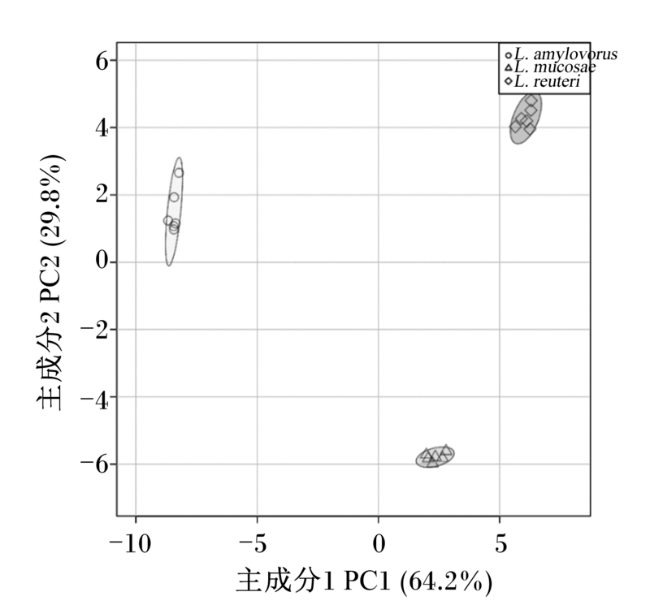
各菌株样品非靶向代谢组学检测后,对鉴定的化合物进行归一化处理,并对归一化后的数据进行了偏最小二乘法判别分析,结果如图1所示。由图可知,3株猪源优势乳酸杆菌在相同培养条件下所产生的代谢物组成及相对丰度存在显著差异(P<0.05)。
图1 3株优势乳酸杆菌的差异代谢物最小偏二乘法判别分析

L. amylovorus:食淀粉乳杆菌 Lactobacillus amylovorus;L. mucosae:黏液乳杆菌Limosilactobacillus mucosae;L. reuteri:罗伊氏乳杆菌 Limosilactobacillus reuteri。下图同 The same as below。

Fig.1 Partial least squares discriminant analysis of differential metabolites of three dominant Lactobacilli

2.3.2 差异化合物代谢组变量投影重要性分析与代谢组热图分析

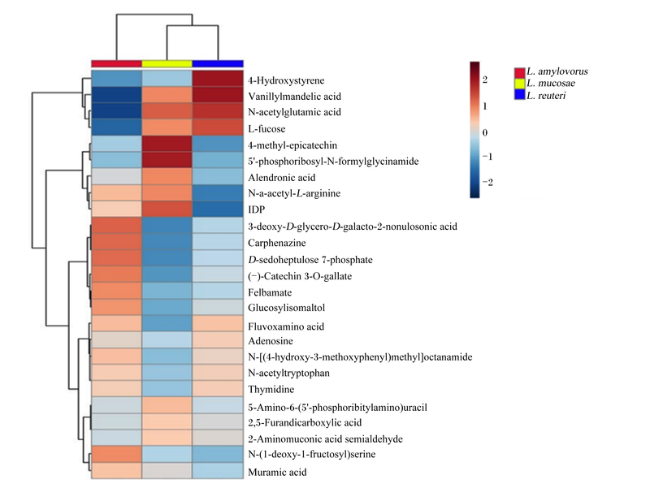
图2所示,根据变量投影重要性分析可知,与乳酸杆菌黏液乳杆菌和罗伊氏乳杆菌相比,食淀粉乳杆菌培养液中3-脱氧-D-甘油-D-半乳糖-2-壬基磺酸(3-deoxy-D-glycero-D-galacto-2-nonulosonic acid)、苯丙嗪(carphenazine)、D-七庚糖7-磷酸(D-sedoheptulose 7-phosphate)和儿茶素没食子酸酯[(-)-catechin 3-O-gallate]等化合物的相对丰度较高。
图2 3株优势乳酸杆菌差异代谢物变量投影重要性分析

Vanillylmandelic acid:香草扁桃酸;N-a-acetyl-L-arginine:N-乙酰基-L-精氨酸;3-deoxy-D-glycero-D-galacto-2-nonulosonic acid:3-脱氧-D-甘油-D-半乳糖-2-壬基磺酸;IDP:5'-二磷酸肌苷 inosine 5'-diphosphate;N-(1-deoxy-1-fructosyl)serine:N-(1-脱氧-1-果糖基)丝氨酸;Carphenazine:苯丙嗪;D-sedoheptulose 7-phosphate:D-七庚糖7-磷酸;(-)-catechin 3-O-gallate:儿茶素没食子酸酯;Felbamate:氨基甲酸酯;Glucosylisomaltol:葡萄糖基异麦芽酚;Muramic acid:胞壁酸;N-acetylglutamic acid:N-乙酰谷氨酸;Alendronic acid:阿仑膦酸;4-methyl-epicatechin:4-甲基表儿茶素;N-[(4-hydroxy-3-methoxyphenyl)methyl]octanamide:N-[(4-羟基-3-甲氧基苯基)甲基]辛酰胺;N-acetyltryptophan:N-乙酰色氨酸;Thymidine:胸苷;5-amino-6-(5'-phosphoribitylamino)uracil:5-氨基-6-(5'-磷酰氨基)尿嘧啶;5'-phosphoribosyl-N-formylglycinamide:5'-磷酸核糖基-N-甲酰甘氨酰胺;2,5-furandicarboxylic acid:2,5-呋喃二甲酸;Adenosine:腺苷;L-fucose:L-岩藻糖;2-aminomuconic acid semialdehyde:2-氨基黏康酸半醛;4-hydroxystyrene:4-羟基苯乙烯。图3同 the same as Fig.3

Fig.2 Variable importance in projection analysis of differential metabolites of three dominant Lactobacilli

乳酸杆菌食淀粉乳杆菌培养液中N-乙酰基-L-精氨酸(N-a-acetyl-L-arginine)、5'-二磷酸肌苷(IDP)、N-(1-脱氧-1-果糖基)丝氨酸[N-(1-deoxy-1-fructosyl)serine]、氨基甲酸酯(felbamate)、葡萄糖基异麦芽酚(glucosylisomaltol)、胞壁酸(muramic acid)、阿仑膦酸(alendronic acid)、N-[(4-羟基-3-甲氧基苯基)甲基]辛酰胺[N-[(4-hydroxy-3-methoxyphenyl)methyl] octanamide]、N-乙酰色氨酸(N-acetyltryptophan)、胸苷(thymidine)、5-氨基-6-(5'-磷酰氨基)尿嘧啶[5-amino-6-(5'-phosphoribitylamino)uracil]、2,5-呋喃二甲酸(2,5-furandicarboxylic acid)和腺苷(adenosine)、2-氨基黏康酸半醛(2-aminomuconic acid semialdehyde)等化合物的相对丰度较高,而罗伊氏乳杆菌培养液中上述化合物的相对丰度较低。
与其他2株乳酸杆菌相比,黏液乳杆菌培养液中N-乙酰谷氨酸(N-acetylglutamic acid)、4-甲基表儿茶素(4-methyl-epicatechin)、5'-磷酸核糖基-N-甲酰甘氨酰胺(5'-phosphoribosyl-N-formylglycinamide)和L-岩藻糖(L-fucose)等化合物的相对丰度较高。
3株乳酸杆菌的比较代谢组热图分析如图3所示,热图中所展示的差异代谢物相对丰度变化趋势与变量投影重要性分析结果保持一致。
图3 3株优势乳酸杆菌的差异代谢物热图分析

Fig.3 Heatmap analysis of differential metabolites of three dominant Lactobacilli

2.3.3 代谢组代谢通路预测分析

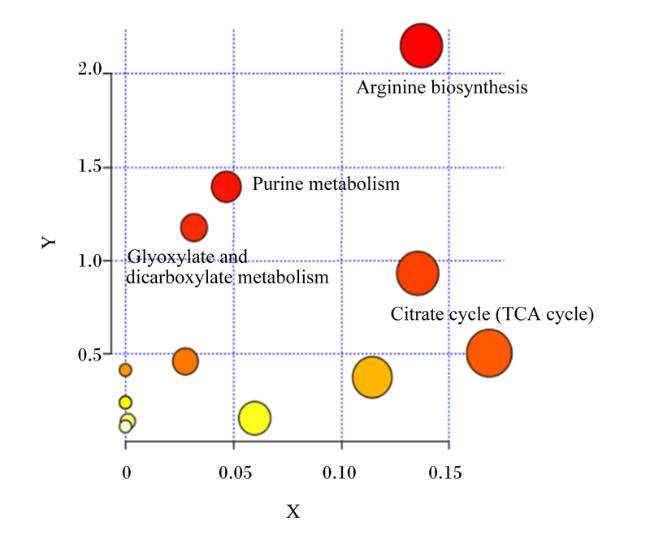
图4所示,在相同的培养条件下,3株猪源优势乳酸杆菌在氨基酸代谢中的精氨酸生物合成代谢途径(arginine biosynthesis)以及能量代谢中的柠檬酸循环(citrate cycle)代谢途径存在显著差异。
图4 3株优势乳酸杆菌间差异代谢物的代谢通路分析

Arginine biosynthesis:精氨酸生物合成;Purine metabolism:嘌呤代谢;Glyoxylate and dicarboxylate metabolism:乙醛酸和二甲酸代谢;Citrate cycle (TCA cycle):柠檬酸循环(三羧酸循环)。

图中每个点代表1种代谢通路。X轴代表代谢通路的影响值,Y轴代表富集分析P值的负对数。图中点的面积越大颜色越深,分别代表代谢通路的影响值越大以及富集程度越强。

Fig.4 Metabolic pathway analysis of differential metabolites of three dominant Lactobacilli

Each dot in the plot represents a metabolic pathway. The X-axis represents the influence value of metabolic pathway, and the Y-axis represents the negative logarithm of P-value of enrichment analysis. The larger in area and the darker in color of the dot represent the greater the influence value of metabolic pathway and the stronger the enrichment degree, respectively.

2.4 仔猪肠道优势乳酸杆菌对氨基酸利用代谢的差异

表4所示,不同仔猪肠道优势乳酸杆菌对精氨酸家族氨基酸(精氨酸、鸟氨酸、瓜氨酸、谷氨酰胺、谷氨酸等)的利用存在差异。在本试验的培养条件下,黏液乳杆菌对精氨酸的利用最多,并代谢产生鸟氨酸和瓜氨酸,其次为罗伊氏乳杆菌和食淀粉乳杆菌;黏液乳杆菌和罗伊氏乳杆菌代谢精氨酸产生鸟氨酸为精氨酸代谢的主要途径之一;3株优势乳酸杆菌在谷氨酸和谷氨酰胺的相互代谢转化中存在显著差异(P<0.05)。与其他2种乳酸杆菌相比,黏液乳杆菌对大部分的氨基酸的利用代谢能力较强,而食淀粉乳杆菌对氨基酸的利用代谢能力较弱。
表4 3株优势乳酸杆菌对氨基酸利用代谢的差异

Table 4 Difference of amino acids utilization and metabolism of three dominant Lactobacilli (n=3)nmol/(×108 CFU·h)

氨基酸
Amino acids
食淀粉乳杆菌
Lactobacillus
amylovorus
罗伊氏乳杆菌
Limosilactobacillus
reuteri
黏液乳杆菌
Limosilactobacillus
mucosae
丙氨酸 Alanine -7.0±1.7c 71.6±2.4b 159.0±7.8a
精氨酸 Arginine 143±3c 278±2b 493±2a
天冬酰胺 Asparagine 101.0±6.7a 78.6±1.3b 76.2±1.7b
天冬氨酸 Aspartate -163±10c 115±2b 160±0a
瓜氨酸 Citrulline 5.70±0.68a -18.80±1.64b -21.40±4.07b
谷氨酰胺 Glutamine 28.30±0.03a 8.20±2.48b -17.60±1.07c
谷氨酸 Glutamate -69±1c 151±3b 204±2a
甘氨酸 Glycine 104±8c 180±2b 290±1a
组氨酸 Histidine 22.3±3.1b 29.6±0.9b 46.3±0.5a
异亮氨酸 Isoleucine 36.5±2.5c 52.9±4.0b 83.2±1.9a
亮氨酸 Leucine 52.8±8.5b 68.2±2.1b 120.0±3.4a
赖氨酸 Lysine 8.1±1.4c 33.9±1.4b 66.9±1.6a
蛋氨酸 Methionine 4.2±0.7c 17.8±2.0b 29.0±0.7a
鸟氨酸 Ornithine -5±1c -166±7b -285±9a
苯丙氨酸 Phenylalanine 36.9±5.0b 51.0±3.7b 78.7±0.9a
丝氨酸 Serine 0.4±0.2c 93.4±1.8b 159.0±2.9a
苏氨酸 Threonine -27.1±6.0c 45.6±1.5b 71.0±1.5a
色氨酸 Tryptophan 14.6±1.6a 8.2±1.3b 17.2±0.4a
酪氨酸 Tyrosine 13.2±2.7c 44.4±4.2b 71.1±2.0a
缬氨酸 Valine 15.1±2.9c 54.3±4.3b 78.4±1.9a

3 讨论

仔猪断奶后由于饲料的转换以及断奶分群应激等因素导致胃肠道屏障受损、功能失调以及肠道内环境改变,从而引起肠道菌群的改变[12,17]。乳酸杆菌是已被确认的一类具有潜在益生作用的肠道固有菌群,在断奶前后的肠道中的变化已有一些报道[5-6,12]。然而,已有研究只关注特定肠段或者部分种属的变化,对粪样的研究不能完全反映不同肠段的差异,需要进一步试验系统比较在相同饲养环境下不同种肠道优势乳酸杆菌在仔猪断奶前后的演替规律。研究结果可为饲粮策略靶向调节不同肠段乳酸杆菌的定植,改善哺乳和断奶仔猪的肠道功能与健康提供基础。
本研究结果表明,仔猪不同肠段微生物菌群在断奶初期对断奶的响应存在差异,具体表现为胃中的总细菌数量先增加后降低,空肠中的总细菌数量变化不大,而回肠和后肠中的总细菌数量有所降低。已有的关于仔猪断奶前后细菌在胃和小肠的数量变化研究显示,断奶后第3天,胃中的总细菌和乳酸杆菌的绝对数量上升,而回肠中的总细菌和乳酸杆菌的绝对数量下降,空肠中只有总乳酸杆菌的绝对数量降低而总细菌的绝对数量无显著变化,胃和小肠中总乳酸杆菌占总细菌的比例由断奶前的13%~37%下降到断奶后的0.23%~3.24%[5],这与本研究结果一致。然而,关于大肠中细菌在断奶前后变化的绝对定量分析结果不多,基于高通量微生物测序数据的分析显示,哺乳仔猪粪样中的总乳酸杆菌的相对丰度从8.67%下降到保育仔猪粪样中的6.25%[18]。而关于断奶仔猪结肠中的高通量测序分析结果显示,总乳酸杆菌的相对丰度在0.06%~0.71%[8]。不同研究和分析的数值差异较大的原因可能是不同研究使用的猪种、饲粮、日龄的差异以及高通量测序中PCR扩增的偏好对分析结果的影响[18]。与传统基于培养的细菌鉴定计数方法相比,高通量测序可以发现更多的仔猪回肠和结肠中的乳酸杆菌,虽然相对丰度有所差异,但研究结果均显示约氏乳杆菌是仔猪大肠中的优势乳酸杆菌[8]。后肠乳酸杆菌数量在断奶后2周有所回升,可能是因为肠道菌群之间存在交互饲喂,产生的底物促进了特定种类的乳酸杆菌的生长。目前,断奶对仔猪各肠段主要菌群代谢变化的影响尚不明确,有待进一步研究。
本研究还发现,断奶前后仔猪各肠段的优势乳酸杆菌的菌群演替存在肠段特异性。断奶后2周,胃中的优势乳酸杆菌中的唾液乳杆菌数量增加,小肠中食淀粉乳杆菌和约氏乳杆菌数量减少,约氏乳杆菌在断奶后为大肠中的优势乳酸杆菌。Hoeflinger等[8]研究表明,约氏乳杆菌在21日龄回肠和结肠中是优势乳酸杆菌。关于不同出生体重仔猪肠道菌群的研究显示,与正常体重仔猪相比,低出生体重21日龄仔猪回肠和结肠中的食淀粉乳杆菌的数量较少[12]。此外,黏液乳杆菌与唾液乳杆菌的相对丰度在仔猪断奶后1周内持续降低,之后呈现上升的趋势,这可能是由于不同种类乳酸杆菌在肠道中参与饲粮营分消化代谢的方式存在差异[19-20]。因此,有必要深入研究这些不同肠段的优势乳酸杆菌在断奶前后参与不同肠段的特定肠道生理功能以及在促进肠道发育中的关键作用与可能的作用机制[2,4,9-10,13]
微生物可通过改变肠道中营养物质的代谢发挥益生作用[21],本试验通过比较代谢组学技术分析发现3株优势乳酸杆菌在氮代谢中的精氨酸生物合成和碳代谢中的柠檬酸循环中存在差异。进一步的液相色谱分析乳酸杆菌对培养基中游离氨基酸利用代谢特性显示,3株乳酸杆菌在精氨酸代谢生成鸟氨酸以及谷氨酸和谷氨酰胺代谢存在差异。有研究表明,在许多细菌中,谷氨酸可通过N-乙酰谷氨酸激酶从谷氨酸合成精氨酸[22]。结合我们的代谢组学和液相色谱结果分析可知,黏液乳杆菌和罗伊氏乳杆菌可通过利用大量谷氨酸代谢为N-乙酰谷氨酸,从而进一步参与合成精氨酸,然而这2株乳酸杆菌可大量利用精氨酸说明对精氨酸的代谢较多,并产生大量的鸟氨酸,这可能和细菌对外界环境的变化(如pH)等相关[23]。乳酸杆菌对特定氨基酸代谢的诱因和具体作用机制及其对肠道功能和健康的影响有待进一步研究。

4 结论

综上所述,断奶后,仔猪胃肠内的乳酸杆菌数量整体降低。优势乳酸杆菌中的食淀粉乳杆菌、罗伊氏乳杆菌和约氏乳杆菌在不同肠段的相对丰度存在差异。黏液乳杆菌的氨基酸代谢能力强于其他乳酸杆菌,其中精氨酸代谢存在显著差异。
[1]
ALAIN B PAJARILLO E, CHAE J P, BALOLONG M P, et al. Assessment of fecal bacterial diversity among healthy piglets during the weaning transition[J]. Journal of General and Applied Microbiology, 2014, 60(4):140-146.

DOI PMID

[2]
SUN Z Y, LI H H, LI Y P, et al. Lactobacillus salivarius,a potential probiotic to improve the health of LPS-challenged piglet intestine by alleviating inflammation as well as oxidative stress in a dose-dependent manner during weaning transition[J]. Frontiers in Veterinary Science, 2020, 7:547425.

[3]
WU T, SHI Y T, ZHANG Y Y, et al. Lactobacillus rhamnosus LB1 alleviates enterotoxigenic Escherichia coli-induced adverse effects in piglets by improving host immune response and anti-oxidation stress and restoring intestinal integrity[J]. Frontiers in Cellular and Infection Microbiology, 2021, 11:724401.

[4]
LIU H B, HOU C L, WANG G, et al. Lactobacillus reuteri I5007 modulates intestinal host defense peptide expression in the model of IPEC-J2 cells and neonatal piglets[J]. Nutrients, 2017, 9(6):559.

DOI

[5]
SU Y, YAO W, PEREZ-GUTIERREZ O N, et al. Changes in abundance of Lactobacillus spp. and Streptococcus suis in the stomach,jejunum and ileum of piglets after weaning[J]. FEMS Microbiology Ecology, 2008, 66(3):546-555.

DOI

[6]
SU Y, YAO W, PEREZ-GUTIERREZ O N, et al. 16S ribosomal RNA-based methods to monitor changes in the hindgut bacterial community of piglets after oral administration of Lactobacillus sobrius S1[J]. Anaerobe, 2008, 14(2):78-86.

DOI

[7]
PIEPER R, JANCZYK P, ZEYNER A, et al. Ecophysiology of the developing total bacterial and Lactobacillus communities in the terminal small intestine of weaning piglets[J]. Microbial Ecology, 2008, 56(3):474-483.

DOI

[8]
HOEFLINGER J L, KASHTANOV D O, COX S B, et al. Characterization of the intestinal lactobacilli community following galactooligosaccharides and polydextrose supplementation in the neonatal piglet[J]. PLoS One, 2015, 10(8):e0135494.

[9]
YI H B, YANG G D, XIONG Y X, et al. Integrated metabolomic and proteomics profiling reveals the promotion of Lactobacillus reuteri LR1 on amino acid metabolism in the gut-liver axis of weaned pigs[J]. Food & Function, 2019, 10(11):7387-7396.

[10]
JING Y J, MU C L, WANG H S, et al. Amino acid utilization allows intestinal dominance of Lactobacillus amylovorus[J]. The ISME Journal, 2022, 16(11):2491-2502.

DOI

[11]
GENG T, SU S, SUN K, et al. Effects of feeding a Lactobacillus plantarum JL01 diet on caecal bacteria and metabolites of weaned piglets[J]. Letters in Applied Microbiology, 2021, 72(1):24-35.

DOI

[12]
LI N, HUANG S M, JIANG L L, et al. Characterization of the early life microbiota development and predominant Lactobacillus species at distinct gut segments of low- and normal-birth-weight piglets[J]. Frontiers in Microbiology, 2019, 10:797.

DOI

[13]
SHEN J K, ZHANG J, ZHAO Y, et al. Tibetan pig-derived probiotic Lactobacillus amylovorus SLZX20-1 improved intestinal function via producing enzymes and regulating intestinal microflora[J]. Frontiers in Nutrition, 2022, 9:846991.

[14]
ZOETENDAL E G, HEILIG H G H J, KLAASSENS E S, et al. Isolation of DNA from bacterial samples of the human gastrointestinal tract[J]. Nature Protocols, 2006, 1(2):870-873.

DOI PMID

[15]
TEUSINK B, VAN ENCKEVORT F H J, FRANCKE C, et al. In silico reconstruction of the metabolic pathways of Lactobacillus plantarum:comparing predictions of nutrient requirements with those from growth experiments[J]. Applied and Environmental Microbiology, 2005, 71(11):7253-7262.

DOI

[16]
DAI Z L, LI X L, XI P B, et al. Metabolism of select amino acids in bacteria from the pig small intestine[J]. Amino Acids, 2012, 42(5):1597-1608.

DOI

[17]
LIANG H W, DAI Z L, LIU N, et al. Dietary L-tryptophan modulates the structural and functional composition of the intestinal microbiome in weaned piglets[J]. Frontiers in Microbiology, 2018, 9:1736.

DOI

[18]
LUO Y H, REN W, SMIDT H, et al. Dynamic distribution of gut microbiota in pigs at different growth stages:composition and contribution[J]. Microbiology Spectrum, 2022, 10(3):e0068821.

[19]
VALERIANO V D V, BALOLONG M P, KANG D K. Probiotic roles of Lactobacillus sp. in swine:insights from gut microbiota[J]. Journal of Applied Microbiology, 2017, 122(3):554-567.

DOI

[20]
YU C Y, ZHANG S H, YANG Q, et al. Effect of high fibre diets formulated with different fibrous ingredients on performance,nutrient digestibility and faecal microbiota of weaned piglets[J]. Archives of Animal Nutrition, 2016, 70(4):263-277.

DOI

[21]
ROWLAND I, GIBSON G, HEINKEN A, et al. Gut microbiota functions:metabolism of nutrients and other food components[J]. European Journal of Nutrition, 2018, 57(1):1-24.

[22]
YANG X R. Conformational dynamics play important roles upon the function of N-acetylglutamate kinase[J]. Applied Microbiology and Biotechnology, 2017, 101(9):3485-3492.

DOI PMID

[23]
ARAQUE I, BORDONS A, REGUANT C. Effect of ethanol and low pH on citrulline and ornithine excretion and arc gene expression by strains of Lactobacillus brevis and Pediococcus pentosaceus[J]. Food Microbiology, 2013, 33(1):107-113.

DOI

Outlines

/