RESEARCH PAPER

Effects of Selenium Yeast Supplementation during Preperinatal Period on Milk Metabolites in Dairy Cows

  • DU Zhenlong , 1, 2 ,
  • FU Lili 1 ,
  • LUO Zhengzhong 1 ,
  • MA Li 1 ,
  • ZHOU Tao 1 ,
  • YAO Xueping 1 ,
  • SHEN Liuhong 1 ,
  • YU Shumin 1 ,
  • YAN Zuoting 2 ,
  • CAO Suizhong , 1, *
Expand
  • 1 College of Veterinary Medicine, Sichuan Agricultural University, Chengdu 611130, China
  • 2 Lanzhou Institute of Husbandry and Pharmaceutical, Chinese Academy of Agricultural Sciences, Lanzhou 730050, China
*professor, E-mail:

Received date: 2022-08-11

  Online published: 2023-03-16

Abstract

The purpose of this study was to reveal the effects of selenium yeast supplementation during preperinatal period on metabolic components of milk and to elucidate the biological function of selenium yeast from the perspective of milk metabolites. Twenty healthy Holstein dairy cows in late pregnancy were randomly divided into control group and experimental group, with 10 cows in each group. Cows in the control group were fed a basal diet, and those in the experimental group were fed the basal diet supplemented with 0.15 g/kg DM yeast selenium for 21 days before the expected date of calving, and the supplementation was stopped on the day of calving. The milk of cows in the two groups was collected on the day of calving and day 21 after calving, and the milk metabolites were detected based on ultra-high liquid chromatography-tandem mass spectrometry. Principal component analysis, orthogonal partial least square discriminant analysis and single factor statistical analysis (t-test, fold change) were used to analyze the differences of metabolites in the milk of the control group and the experimental group on the day of calving and day 21 after calving. Differential metabolites were screened with variable importance in projection (VIP)>1 and P<0.05, and cluster analysis and pathway enrichment analysis were performed for the selected differential metabolites. The results show that a total of 20 different metabolites were screened in the milk on the day of calving after selenium yeast supplementation, among which energy-related metabolites, such as L-phenylalanine, α-lactose, galactose-1-phosphate and phosphohydroxypyruvic acid, et al, were significantly up-regulated (P<0.05), and the main metabolic pathway involved in differential metabolites was galactose metabolism [impact value of pathway topology analysis (Impact value)>0.1 and P<0.05]. A total of 20 differential metabolites were screened from the milk on day 21 after calving, among which inflammatory related metabolites, such as leukotriene A4, phytosphingosine, et al, were significantly down-regulated (P<0.05), and the metabolic pathway mainly involved in the biosynthesis of phenylalanine, tyrosine and tryptophan (Impact value>0.1 and P<0.05). In conclusion, the selenium yeast supplementation during preperinatal period can change the nutritional composition of milk on the day of calving and reduce the pro-inflammatory metabolites in milk on day 21 after calving, which indirectly affects the health of calves.

Cite this article

DU Zhenlong , FU Lili , LUO Zhengzhong , MA Li , ZHOU Tao , YAO Xueping , SHEN Liuhong , YU Shumin , YAN Zuoting , CAO Suizhong . Effects of Selenium Yeast Supplementation during Preperinatal Period on Milk Metabolites in Dairy Cows[J]. Chinese Journal of Animal Nutrition, 2023 , 35(3) : 1666 -1674 . DOI: 10.12418/CJAN2023.157

奶牛围产期分为围产前期(产前21 d)和围产后期(产后21 d),是奶牛疾病的高发期[1]。其中,氧化应激是奶牛围产期炎症性疾病(如子宫炎、乳房炎)高发的一个诱因,影响奶牛的生产性能,制约奶业的发展[2]。研究表明,氧化应激会导致乳腺上皮细胞凋亡,造成泌乳量下降,乳汁体细胞升高;同时,氧化应激会损害奶牛免疫系统,使乳房炎患病率提高[3-4]。因此,通过缓解围产期氧化应激以提高乳腺健康是近期的研究热点。
硒以硒代半胱氨酸形式参与谷胱甘肽过氧化物酶的组成,使机体清除活性氧能力增强,起到抗氧化作用[5-6]。此外,硒作为一种外源性抗氧化剂,可通过饲粮添加的方式提高奶牛的抗氧化能力,其中酵母硒是较为优质的硒源补充剂[7]。研究指出,围产前期补饲酵母硒能够改善奶牛机体状态,缓解围产期应激反应[8],降低产后患病风险[9-10],提高生产性能[11]。Sun等[12]研究发现,在奶牛饲粮中添加不同水平的酵母硒,乳汁中硒和硒代半胱氨酸的含量随着酵母硒添加水平的提高而提高;当添加5 mg/kg酵母硒时,乳汁体细胞数显著下降。同时,饲粮中添加硒也能够影响乳腺脂质代谢,增加乳汁中多不饱和脂肪酸的含量[13]。Mohrekesh等[14]研究指出,产前21 d添加0.3 mg/kg酵母硒,可以增加犊牛的初生重,使犊牛断奶时血清硒含量明显上升。然而,围产前期补饲酵母硒对分娩当天和产后第21天的乳汁组分的影响尚不清楚。
因此,本试验运用超高液相色谱-串联质谱(UPLC-MS/MS)技术,旨在通过分析围产前期补饲酵母硒对奶牛分娩当天和产后第21天乳汁中代谢物的影响,揭示酵母硒与产后乳汁代谢谱的关联性,为酵母硒在生产中的应用提供理论基础。

1 材料与方法

1.1 主要仪器和试剂

色谱仪Ultimate 3000 UHPLC(美国赛默飞世尔科技有限公司),色谱柱HSS-T3(2.1 mm×100 mm,1.8 μm)(美国Waters公司),质谱仪TripleTOFTM 5600(美国ABSCIEX公司)。
酵母硒由巴西奥特奇公司惠赠,其中硒含量为2 000 mg/kg;乙腈、甲醇购自德国Merck公司;甲酸购自上海安谱实验科技股份有限公司;2-氯苯丙氨酸购自吉尔生化有限公司。

1.2 试验动物和试验设计

本试验在四川省普洲奶牛养殖有限公司进行。使用牧场智能管理系统筛选出月龄为(39.21±5.68)月龄、胎次为(2.25±0.44)胎、体况评分为(3.39±0.27)分和预产期相近的20头健康荷斯坦奶牛,随机分为对照组与试验组,每组10头。对照组奶牛饲喂基础饲粮,试验组于产前21 d在基础饲粮中添加0.15 g/kg DM酵母硒,分娩当天停止添加;基础饲粮组成和酵母硒的添加量与前期的研究[8]一致,其中酵母硒的添加量根据奶牛营养需要NRC(2001)的硒添加量等量换算得到。每头牛分娩当天采集4个乳区初乳并混匀,4 ℃下956×g离心30 min,分离乳清,-80 ℃保存,对照组和试验组分娩当天初乳分别编号为C0组和T0组;产后第21天采集4个乳区常乳并混匀,分离乳清,对照组和试验组分别编号为C21组和T21组。

1.3 UPLC-MS/MS检测条件

将样品放置在室温下自然解冻后,吸取100 μL样品置于1.5 mL EP管中;加入300 μL甲醇,并加入10 μL 3 mg/mL的2-氯苯丙氨酸作为内标;涡旋混匀30 s,-20 ℃静置1 h;4 ℃下14 167×g离心15 min;吸取200 μL上清液,转入进样小瓶中待测。每组随机挑选5个样品,每个样品取80 μL混合后均分为8份质量控制(QC)样品,每份200 μL转入进样小瓶中待测。所有待测样品在装有UPLC-HSS-T3色谱柱的色谱仪中进行分离。分离得到的物质用TripleTOFTM 5600质谱仪进行质谱分析,色谱分离条件和质谱条件参考本实验室前期的研究[15]

1.4 数据处理与统计分析

原始质谱数据转化为mzXML格式后,导入XCMS程序进行峰面积的提取。经缺失值剔除(>50%)后,采用精确质量数匹配(<25×10-6)和二级质谱匹配的方式鉴定得到代谢物数将代谢物数据导入MetaboAnalyst 5.0(https://www.metaboanalyst.ca/)进行多元统计分析,包括主成分分析(principal component analysis,PCA)和正交偏最小二乘法判别分析(orthogonal partial least square discriminant analysis,OPLS-DA)。PCA反映样品的聚集和分离趋势,OPLS-DA用于确定组间的差异,其参数R2Y表示模型解释率,Q2表示模型预测率,当R2YQ2≥0.5时,认为模型稳定可靠。将代谢物数据导入SPSS 25.0软件进行差异分析,并计算各组的差异倍数(fold change,FC)。

1.5 差异代谢物筛选与生物学功能分析

根据OPLS-DA获得的变量投影重要度(variable importance in projection,VIP)>1和P<0.05为条件筛选出分娩当天和产后第21天的差异代谢物。使用生科云分析平台(https://www.bioincloud.tech)进行差异代谢物的聚类分析,并使用MetaboAnalyst 5.0(https://www.metaboanalyst.ca/)对差异代谢物进行代谢通路富集分析。

2 结果

2.1 代谢物鉴定及多元统计分析

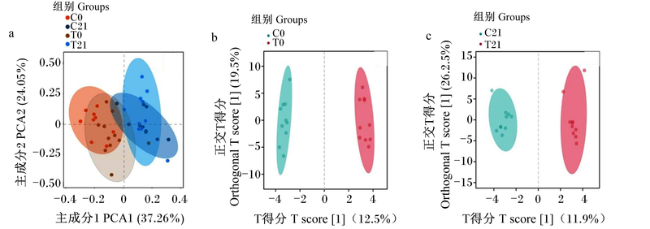
正模式条件下,原始数据经峰面积提取、缺失值剔除及二级质谱鉴定后得到92个代谢物。对鉴定到的代谢物进行多元统计分析,结果如图1所示,PCA显示组内(C0组与T0组、C21组与T21组)有分离趋势,表明产前补饲酵母硒对分娩当天和产后第21天乳汁代谢物产生了影响。图1-b为C0与T0组OPLS-DA,模型参数为R2Y=0.952,Q2=0.786;图1-c为C21与T21组OPLS-DA,模型参数为R2Y=0.706,Q2=0.510。R2YQ2≥0.5,说明2个比较组模型稳定可靠。
图1 已鉴定代谢物的多元统计分析

图a为PCA,图b为C0与T0组OPLS-DA,图c为C21与T21组OPLS-DA。C0组和T0组表示分娩当天的对照组和试验组,C21组和T21组表示产后第21天的对照组和试验组。

Fig.1 Multivariate statistical analysis of identified metabolites

Figure amean PCA, figure b mean OPLS-DA of C0 and T0 groups, and figure c mean OPLS-DA of C21 and T21 groups. Group C0 and group T0 represented the control group and the experimental group on day of calving, and group C21 and group T21 represented the control group and the experimental group on day 21 after calving.

2.2 差异代谢物筛选及聚类分析

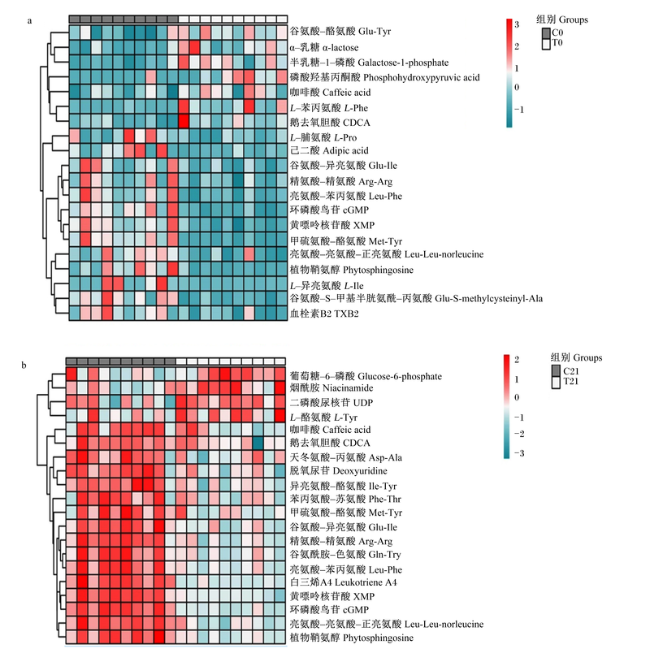
以VIP>1和P<0.05为筛选条件,分娩当天,C0组(对照组)与T0组(试验组)共筛选出20种差异代谢物(表1);产后第21天,C21组(对照组)与T21组(试验组)共筛选出20种差异代谢物(表2);分娩当天和产后第21天的差异代谢物聚类分析结果如图2所示。其中,分娩当天,T0组的L-苯丙氨酸、α-乳糖、半乳糖-1-磷酸及磷酸羟基丙酮酸等代谢物相比于C0组显著上调(P<0.05);T0组L-异亮氨酸、甲硫氨酸-酪氨酸等代谢物相比于C0组显著下调(P<0.05);聚类分析(图2-a)发现,相同变化趋势的代谢物能够聚在一类,且分支节点越多相关性越强,如α-乳糖和半乳糖-1-磷酸。产后第21天,T21组的烟酰胺、L-酪氨酸等代谢物相比于C21组显著上调(P<0.05);白三烯A4、苯丙氨酸-苏氨酸、亮氨酸-亮氨酸-正亮氨酸等代谢物相比于C21组显著下调(P<0.05);聚类分析(图2-b)发现,葡萄糖-6-磷酸、烟酰胺、二磷酸尿核苷等能量相关代谢物聚类在同一个分支,促炎代谢物如白三烯A4、植物鞘氨醇等代谢物聚类在同一个分支。分娩当天与产后第21天的共同的差异代谢物共10个,分别为鹅去氧胆酸、亮氨酸-亮氨酸-正亮氨酸、谷氨酸-异亮氨酸、亮氨酸-苯丙氨酸、环磷酸鸟苷、甲硫氨酸-酪氨酸、植物鞘氨醇、咖啡酸、精氨酸-精氨酸以及黄嘌呤核苷酸。
表1 分娩当天C0组(对照组)与T0组(试验组)筛选的差异代谢物

Table 1 Differential metabolites between C0 group (control group) and T0 group (experimental group) on day of calving

代谢物
Metabolites
变量投影重要度
VIP
P
P-value
差异倍数
FC
变化趋势
Variation trend
氨基酸及其衍生物(10种) Amino acids and their derivatives (10 kinds)
L-苯丙氨酸 L-Phe 2.06 0.009 11.18 上调
谷氨酸-酪氨酸 Glu-Tyr 1.65 0.005 1.53 上调
精氨酸-精氨酸 Arg-Arg 1.36 0.027 0.81 下调
谷氨酸-异亮氨酸 Glu-Ile 1.56 0.012 0.75 下调
L-脯氨酸 L-Pro 1.16 0.044 0.69 下调
亮氨酸-苯丙氨酸 Leu-Phe 2.00 0.001 0.67 下调
亮氨酸-亮氨酸-正亮氨酸 Leu-Leu-norleucine 1.74 0.009 0.59 下调
谷氨酸-S-甲基半胱氨酰-丙氨酸 Glu-S-methylcysteinyl-Ala 2.16 <0.001 0.46 下调
代谢物
Metabolites
变量投影重要度
VIP
P
P-value
差异倍数
FC
变化趋势
Variation trend
甲硫氨酸-酪氨酸 Met-Tyr 2.51 <0.001 0.38 下调
L-异亮氨酸 L-Ile 1.55 0.027 0.08 下调
碳水化合物(3种) Carbohydrates (3 kinds)
磷酸羟基丙酮酸 Phosphohydroxypyruvic acid 1.64 0.013 3.26 上调
半乳糖-1-磷酸 Galactose-1-phosphate 1.63 0.001 2.45 上调
α-乳糖 α-lactose 1.57 0.011 1.64 上调
脂质(4种) Lipids (4 kinds)
咖啡酸 Caffeic acid 1.13 0.049 1.40 上调
血栓素B2 TXB2 1.60 0.010 0.67 下调
己二酸 Adipic acid 1.37 0.022 0.62 下调
植物鞘氨醇 Phytosphingosine 2.07 0.001 0.51 下调
其他代谢物(3种) Other metabolites (3 kinds)
鹅去氧胆酸 CDCA 1.53 0.030 1.44 上调
黄嘌呤核苷酸 XMP 2.15 <0.001 0.62 下调
环磷酸鸟苷 cGMP 2.34 <0.001 0.45 下调
表2 产后第21天C21组(对照组)与T21组(试验组)筛选的差异代谢物

Table 2 Differential metabolites between C21 group (control group) and T21 group (experimental group) on day 21 after calving

代谢物
Metabolites
变量投影重要度
VIP
P
P-value
差异倍数
FC
变化趋势
Variation trend
氨基酸及其衍生物(10种) Amino acids and their derivatives (10 kinds)
L-酪氨酸 L-Tyr 1.16 0.041 2.21 上调
天冬氨酸-丙氨酸 Asp-Ala 1.47 0.014 0.84 下调
精氨酸-精氨酸 Arg-Arg 2.07 <0.001 0.66 下调
亮氨酸-苯丙氨酸 Leu-Phe 2.14 <0.001 0.65 下调
谷氨酸-异亮氨酸 Glu-Ile 2.03 <0.001 0.65 下调
谷氨酰胺-色氨酸 Gln-Try 1.97 <0.001 0.63 下调
甲硫氨酸-酪氨酸 Met-Tyr 1.76 0.007 0.62 下调
异亮氨酸-酪氨酸 Ile-Tyr 1.76 0.001 0.59 下调
亮氨酸-亮氨酸-正亮氨酸 Leu-Leu-norleucine 2.23 <0.001 0.55 下调
苯丙氨酸-苏氨酸 Phe-Thr 1.08 0.021 0.55 下调
碳水化合物(1种) Carbohydrates (1 kind)
葡萄糖-6-磷酸 Glucose-6-phosphate 1.38 0.033 1.16 上调
脂质(3种) Lipids (3 kinds)
植物鞘氨醇 Phytosphingosine 2.20 <0.001 0.64 下调
咖啡酸 Caffeic acid 1.36 0.019 0.60 下调
白三烯A4 Leukotriene A4 2.47 <0.001 0.24 下调
其他代谢物(6种) Other metabolites (6 kinds)
烟酰胺 Niacinamide 1.26 0.009 2.11 上调
二磷酸尿核苷 UDP 1.35 0.019 1.09 上调
鹅去氧胆酸 CDCA 1.11 0.026 0.81 下调
脱氧尿苷 Deoxyuridine 1.66 0.001 0.76 下调
黄嘌呤核苷酸 XMP 2.29 <0.001 0.51 下调
环磷酸鸟苷 cGMP 2.39 <0.001 0.24 下调
图2 差异代谢物聚类热图

图a为C0与T0组的差异代谢物聚类热图,图b为C21与T21组的差异代谢物聚类热图。C0组和T0组表示分娩当天的对照组和试验组,C21组和T21组表示产后第21天的对照组和试验组。

Fig.2 Cluster heatmap of differential metabolites

Figure a was the cluster heatmap of differential metabolites between C0 group and T0 group, and figure b was the cluster heatmap of differential metabolites between C21 group and T21 group. Group C0 and group T0 represented the control group and the experimental group on day of calving, and group C21 and group T21 represented the control group and the experimental group on day 21 after calving.

2.3 差异代谢物的代谢通路富集分析

使用MetaboAnalyst 5.0分析平台分别对分娩当天C0组与T0组和产后第21天C21组与T21组的差异代谢物进行代谢通路富集分析,以通路拓扑分析的影响值(Impact值)>0.1为条件筛选20种差异代谢物参与的代谢通路,结果见表3。结合Impact值和P值发现,补饲酵母硒后分娩当天的主要参与的代谢通路为半乳糖代谢,而产后第21天的主要参与的代谢通路为苯丙氨酸、酪氨酸和色氨酸生物合成。
表3 分娩当天和产后第21天差异代谢物富集通路

Table 3 Enrichment pathway of differential metabolites on day of calving and day 21 after calving

通路
Pathway
P
P-value
Impact值
Impact value
分娩当天 On day of calving
苯丙氨酸代谢 Phenylalanine metabolism 0.11 0.36
半乳糖代谢 Galactose metabolism 0.02 0.14
产后第21天 On day 21 after calving
苯丙氨酸、酪氨酸和色氨酸生物合成 Phenylalanine, tyrosine and tryptophan biosynthesis 0.03 0.50
烟酸和烟酰胺代谢 Nicotinate and nicotinamide metabolism 0.10 0.19
酪氨酸代谢 Tyrosine metabolism 0.29 0.14
淀粉和蔗糖代谢 Starch and sucrose metabolism 0.13 0.14
嘧啶代谢 Pyrimidine metabolism 0.03 0.10

Impact值为通路拓扑分析的影响值。

Impact value was impact value of pathway topology analysis.

3 讨论

3.1 产前补饲酵母硒对分娩当天乳汁组分的影响

奶牛产前补饲酵母硒可以影响初乳中氨基酸及其衍生物、能量物质的代谢。差异代谢物聚类热图和富集分析发现,补饲酵母组可以增加乳汁中苯丙氨酸的含量,影响苯丙氨酸的代谢。研究表明,乳腺上皮细胞随着苯丙氨酸添加量的增加,葡萄糖转运蛋白1(glucose transporter 1,GLUT1)的mRNA表达量逐渐增加;蛋白质的表达量也出现差异,差异蛋白质主要与能量代谢相关[16]。差异代谢物聚类热图显示,分娩当天显著上调L-苯丙氨酸、α-乳糖、半乳糖-1-磷酸及磷酸羟基丙酮酸等代谢物;通路富集分析显示,补饲酵母硒显著影响了半乳糖代谢。乳腺上皮细胞基底膜外侧的GLUT1将葡萄糖转运至胞内,葡萄糖在酶的作用下生成半乳糖,葡萄糖和半乳糖在高尔基体上形成乳糖[17]。乳糖的含量决定了渗透压梯度,使细胞外的水分细胞内渗透。乳糖、水分和乳蛋白在高尔基体上以胞吐的形式转运到腺泡腔,它的分泌受血液中葡萄糖的含量调控[18-19]。研究表明,随着葡萄糖含量的增加,乳腺上皮细胞乳糖合成增多[20]。乳糖含量的增加也间接反映出补饲酵母硒提高了分娩当天的血糖水平,改善了奶牛能量代谢[21]。乳糖作为乳汁中的主要能量物质,不仅促进犊牛的生长,而且能改变胃肠道微生物组成,提高胃肠道中丁酸的含量[22]。肠道微生物以乳糖为底物发酵产生乳酸和短链脂肪酸,对肠道微环境和微生物群有积极的调节作用,从而改善犊牛的胃肠健康[23]

3.2 产前补饲酵母硒对产后第21天乳汁组分的影响

奶牛在围产期动员脂肪产生氧化应激,氧化应激会激活脂肪组织的炎症通路,通过加剧脂肪组织炎症,进一步抑制了脂肪组织对胰岛素的敏感性,脂肪动员的过程会使奶牛围产期处于一个低度炎症的状态[24]。差异代谢物聚类热图发现,白三烯A4、植物鞘氨醇等促炎代谢物显著下调。白三烯A4是花生四烯酸的代谢产物,花生四烯酸通过5-脂氧合酶催化生成白三烯A4,白三烯A4在水解酶的作用下生成白三烯B4,介导炎症反应[25]。5-脂氧合酶是催化花生四烯酸生成白三烯的关键酶[26],硒可以抑制核转录因子-κB、脂氧化酶、环氧化酶、5-脂氧化酶激活蛋白和白三烯B4受体的表达,从而抑制白三烯途径的炎症通路[27]。而产后第21天乳汁中白三烯A4的含量下降,提示着酵母硒可能通过下调5-脂氧合酶的活性,起到抗炎作用[28-29]。研究表明,咖啡酸作为一种天然的5-脂氧合酶抑制剂,具有抗炎作用[30]。而产后第21天乳汁中的咖啡酸含量下降,这可能与补饲酵母硒后奶牛的炎症反应降低有关。小肽是蛋白质在动物肠道内消化形成的小分子物质,一般由2~3个氨基酸组成,具有促进蛋白质合成、促进矿物质吸收以及提高动物生产性能的作用[31]。补饲酵母硒后在分娩当天和产后第21天的乳汁中小肽含量显著下降,相关的作用机制有待进一步研究。
综上所述,奶牛围产前期补饲酵母硒可以提高初乳中苯丙氨酸的含量,影响支链氨基酸和芳香族氨基酸相关通路;苯丙氨酸引起乳腺上皮细胞GLUT1表达增加,促进乳糖的生成,改善犊牛肠道微环境,有利于犊牛的健康。随着泌乳时间的延长,在产后第21天,可以降低乳汁中促炎物质白三烯A4的含量,影响乳腺的脂质代谢,降低奶牛产后炎症。然而酵母硒对奶牛乳腺的氨基酸代谢、脂质代谢的调控机制仍不清楚,未来的研究建议利用转录组学和微生物组学技术开展酵母硒的调控机制研究。

4 结论

通过围产前期补饲0.15 g/kg酵母硒,可以改变初乳的营养成分,如苯丙氨酸、乳糖和小肽等代谢物;并改变产后第21天乳汁中炎症相关代谢物的水平,如白三烯A4、植物鞘氨醇和咖啡酸,间接影响犊牛的健康。
[1]
李胜利, 郝阳毅, 王蔚, 等. 围产期奶牛糖脂代谢与健康养殖研究进展[J]. 动物营养学报, 2020, 32(10):4708-4715.

DOI

LI S L, HAO Y Y, WANG W, et al. Research progress on glucose-lipid metabolism and healthy feeding in transition dairy cows[J]. Chinese Journal of Animal Nutrition, 2020, 32(10):4708-4715. (in Chinese)

[2]
XIAO J X, KHAN M Z, MA Y L, et al. The antioxidant properties of selenium and vitamin E;their role in periparturient dairy cattle health regulation[J]. Antioxidants (Basel,Switzerland), 2021, 10(10):1555.

[3]
KHAN M Z, MA Y L, XIAO J X, et al. Role of selenium and vitamins E and B9 in the alleviation of bovine mastitis during the periparturient period[J]. Antioxidants (Basel,Switzerland), 2022, 11(4):657.

[4]
MIRANDA S G, PURDIE N G, OSBORNE V R, et al. Selenomethionine increases proliferation and reduces apoptosis in bovine mammary epithelial cells under oxidative stress[J]. Journal of Dairy Science, 2011, 94(1):165-173.

DOI PMID

[5]
HARIHARAN S, DHARMARAJ S. Selenium and selenoproteins:it's role in regulation of inflammation[J]. Inflammopharmacology, 2020, 28(3):667-695.

DOI

[6]
ARSHAD M A, EBEID H M, HASSAN F U. Revisiting the effects of different dietary sources of selenium on the health and performance of dairy animals:a review[J]. Biological Trace Element Research, 2021, 199(9):3319-3337.

DOI

[7]
AYEMELE A G, TILAHUN M, LINGLING S, et al. Oxidative stress in dairy cows:insights into the mechanistic mode of actions and mitigating strategies[J]. Antioxidants (Basel,Switzerland), 2021, 10(12):1918.

[8]
罗正中, 白利鹏, 黄逸馨, 等. 酵母硒对分娩应激状态下围产期奶牛代谢的影响[J]. 西北农林科技大学学报(自然科学版), 2019, 47(2):7-15.

LUO Z Z, BAI L P, HUANG Y X, et al. Effect of selenium yeast on plasma metabolism of transition dairy cow in parturition stress status[J]. Journal of Northwest A&F University (Natural Science Edition), 2019, 47(2):7-15. (in Chinese)

[9]
GONG J, XIAO M. Effect of organic Selenium supplementation on selenium status,oxidative stress,and antioxidant status in selenium-adequate dairy cows during the periparturient period[J]. Biological Trace Element Research, 2018, 186(2):430-440.

DOI

[10]
REN Z H, BAI L P, SHEN L H, et al. Comparative iTRAQ proteomics reveals multiple effects of selenium yeast on dairy cows in parturition[J]. Biological Trace Element Research, 2020, 197(2):464-474.

DOI

[11]
CARPINELLI N A, HALFEN J, TREVISI E, et al. Effects of peripartal yeast culture supplementation on lactation performance,blood biomarkers,rumen fermentation,and rumen bacteria species in dairy cows[J]. Journal of Dairy Science, 2021, 104(10):10727-10743.

DOI

[12]
SUN L L, LIU G T, XU D M, et al. Milk Selenium content and speciation in response to supranutritional selenium yeast supplementation in cows[J]. Animal Nutrition, 2021, 7(4):1087-1094.

DOI PMID

[13]
RAN L W, WU X S, SHEN X Z, et al. Effects of selenium form on blood and milk selenium concentrations,milk component and milk fatty acid composition in dairy cows[J]. Journal of the Science of Food and Agriculture, 2010, 90(13):2214-2219.

DOI

[14]
MOHREKESH M, SHAHRAKI A D F, GHALAMKARI G R, et al. Effects of three methods of oral selenium-enriched yeast supplementation on blood components and growth in Holstein dairy calves[J]. Animal Production Science, 2019, 59(2):260-265.

DOI

[15]
LUO Z Z, SHEN L H, JIANG J, et al. Plasma metabolite changes in dairy cows during parturition identified using untargeted metabolomics[J]. Journal of Dairy Science, 2019, 102(5):4639-4650.

DOI PMID

[16]
KIM J, LEE J E, LEE J S, et al. Phenylalanine and valine differentially stimulate milk protein synthetic and energy-mediated pathway in immortalized bovine mammary epithelial cells[J]. Journal of Animal Science and Technology, 2020, 62(2):263-275.

DOI PMID

[17]
REZAEI R, WU Z L, HOU Y Q, et al. Amino acids and mammary gland development: nutritional implications for milk production and neonatal growth[J]. Journal of Animal Science and Biotechnology, 2016, 7:20.

DOI PMID

[18]
DUNN A, ASHFIELD A, EARLEY B, et al. Evaluation of factors associated with immunoglobulin G,fat,protein,and lactose concentrations in bovine colostrum and colostrum management practices in grassland-based dairy systems in Northern Ireland[J]. Journal of Dairy Science, 2017, 100(3):2068-2079.

DOI

[19]
LIN Y, SUN X X, HOU X M, et al. Effects of glucose on lactose synthesis in mammary epithelial cells from dairy cow[J]. BMC Veterinary Research, 2016, 12:81.

DOI PMID

[20]
孙晓旭. 葡萄糖对奶牛乳腺上皮细胞乳糖合成的影响[D].硕士学位论文. 哈尔滨: 东北农业大学, 2013:18-24.

SUN X X. Interaction of glucose on lactose bio-synthesis in dairy cow mammary epithelial cells[D].Master's Thesis.Harbin:Northeast Agricultural University, 2013:18-24. (in Chinese)

[21]
罗正中. 非靶向代谢组学研究酵母硒对奶牛分娩应激中血浆代谢物的影响[D].硕士学位论文. 雅安: 四川农业大学, 2018:48-49.

LUO Z Z. Effects of Selenium yeast on plasma metabolites of dairy cows in parturition stress using untargeted metabolomics[D].Master's Thesis. Ya'an: Sichuan Agricultural University, 2018:48-49. (in Chinese)

[22]
KOIKE S, UENO M, MIURA H, et al. Rumen microbiota and its relation to fermentation in lactose-fed calves[J]. Journal of Dairy Science, 2021, 104(10):10744-10752.

DOI PMID

[23]
ZHAO J B, ZHANG Z Y, ZHANG S, et al. The role of lactose in weanling pig nutrition: a literature and meta-analysis review[J]. Journal of Animal Science and Biotechnology, 2021, 12(1):10.

DOI PMID

[24]
ZACHUT M, CONTRERAS G A. Symposium review:mechanistic insights into adipose tissue inflammation and oxidative stress in periparturient dairy cows[J]. Journal of Dairy Science, 2022, 105(4):3670-3686.

DOI

[25]
NAKAMURA M, SHIMIZU T. Leukotriene receptors[J]. Chemical Reviews, 2011, 111(10):6231-6298.

DOI PMID

[26]
黄凯, 蒋世云, 陈柳军. 5-脂氧合酶及其抑制剂[J]. 中国生物化学与分子生物学报, 2014, 30(12):1190-1196.

HUANG K, JIANG S Y, CHEN L J. 5-lipoxygenase and its inhibitors[J]. Chinese Journal of Biochemistry and Molecular Biology, 2014, 30(12):1190-1196. (in Chinese)

[27]
DHANYA B L, SWATHY R P, INDIRA M. Selenium downregulates oxidative stress-induced activation of leukotriene pathway in experimental rats with diabetic cardiac hypertrophy[J]. Biological Trace Element Research, 2014, 161(1):107-115.

DOI PMID

[28]
任善茂, 陶勇, 李春梅. 硒对母牛免疫功能及健康的改善作用研究进展[J]. 畜牧与兽医, 2015, 47(2):123-126.

REN S M, TAO Y, LI C M. Research progress of selenium on improving immune function and health of cows[J]. Animal Husbandry & Veterinary Medicine, 2015, 47(2):123-126. (in Chinese)

[29]
PANICKER S, SWATHY S S, JOHN F, et al. Impact of selenium on the leukotriene B4 synthesis pathway during isoproterenol-induced myocardial infarction in experimental rats[J]. Inflammation, 2012, 35(1):74-80.

DOI PMID

[30]
张雯, 孙雅丽, 王琳, 等. 咖啡酸及其衍生物药理作用研究进展[J]. 动物医学进展, 2021, 42(8):103-106.

ZHANG W, SUN Y L, WANG L, et al. Advance in pharmacological action of caffeic acid and its derivatives[J]. Progress in Veterinary Medicine, 2021, 42(8):103-106. (in Chinese)

[31]
王彩红. 小肽转运载体2在奶牛乳腺上皮细胞Met-Met摄取中的作用及其调控机制研究[D].博士学位论文. 杭州: 浙江大学, 2018:10-12.

WANG C H. The regulation of PepT2 on the uptake of Met-Met in bovine mammary epithelial cells[D]. Ph.D.Thesis. Hangzhou: Zhejiang University, 2018:10-12. (in Chinese)

Outlines

/