RESEARCH PAPER

Effects of Feeding Starter during Lactation on Growth Performance and Intestinal Development of Yak Calves

  • AN Lele ,
  • GUO Wenjie * ,
  • CAO Jun ,
  • LIU Shujie ,
  • YANG Deyu ,
  • CUI Zhanhong , **
Expand
  • Key Laboratory of Plateau Grazing Animal Nutrition and Feed Science of Qinghai Province, Yak Engineering Technology Research Center of Qinghai Province, Ministry of Agriculture and Rural Affairs Key Laboratory of Animal Nutrition and Forage-Feed of Grazing Yak and Tibetan Sheep in Qinghai-Tibetan Plateau, Qinghai Academy of Animal Husbandry and Veterinary Sciences in Qinghai University, Xining 810016, China
**associate professor, E-mail:

*Contributed equally

Received date: 2022-08-11

  Online published: 2023-03-16

Abstract

The purpose of the study was to explore effects of feeding starter during lactation on growth performance and intestinal development of yak calves. Twenty healthy 1-month-old male yak calves with similar body weight of (30.79±3.43) kg were selected and randomly divided into 2 groups (control group and test group), each group contained 10 calves. The pre-feeding period was 30 days, and the experimental period was 165 days. During days 1 to 100, the yak calves in control group were fed with milk replacer and alfalfa hay, the yak calves in test group were fed with milk replacer, alfalfa hay and starter, and the yak calves in two groups were fed with the same amount of milk replacer and the dry matter feeding amount. During days 101 to 165, the yak calves in two groups stopped feeding milk replacer, and changed to feeding the same amount of concentrate and forage combination diet. The results showed as follows: 1) during days 1 to 100, the dry matter intake and body weight of yak calves in test group were significantly higher than those in control group (P<0.05); during days 101 to 165, the body weight and average daily gain of yak calves in test group were significantly higher than those in control group (P<0.05), and the feed to gain ratio was significantly lower than that in control group (P<0.05). 2) The peyer,s patches thickness in ileum of yak calves in test group was significantly higher than that in control group (P<0.05). The activities of trypsin in duodenum and jejunum, chymotrypsin in ileum and α-amylase in cecum of yak calves in test group were significantly higher than those in control group (P<0.05), while the activities of chymotrypsin in duodenum and α-amylase, lipase and cellulase in colon were significantly lower than those in control group (P<0.05). 3) There was no significant difference in the operation classification units (OTUs) and alpha diversity of bacterial flora in jejunum and colon between test group and control group (P>0.05). In jejunum, the relative abundance of Firmicutes at phylum level was the highest, and the relative abundance of Firmicutes in test group was significantly lower than that in control group (P<0.05); at genus level, the relative abundance of Alloprevotella in test group was significantly higher than that in control group (P<0.05). In colon, the relative abundances of Firmicutes and Bacteroidota at phylum level were higher, and there was no significant difference between the two groups (P>0.05); at genus level, the relative abundance of Lactobacillus in test group was significantly higher than that in control group (P<0.05). 4) The metabolic pathways significantly enriched in jejunum were phenylalanine metabolism and valine, leucine and isoleucine degradation, the differential metabolites were 2-phenylethylamine, 2-hydroxyphenylacetic acid and methylmalonate. The metabolic pathways significantly enriched in colon were nicotinate and nicotinamide metabolism, glycolysis/gluconeogenesis and citrate cycle (TCA cycle), et al, the differential metabolites were carboxylated coenzyme, phosphoenolpyruvic acid and oxaloacetate, et al. In conclusion, feeding starter during lactation can promote the growth and development of yak calves, it mainly promotes intestinal digestion, metabolism and immune function by regulating intestinal development and function, changing the richness of intestinal microorganisms and the concentration of metabolites, so as to improve the growth performance of yak calves.

Cite this article

AN Lele , GUO Wenjie , CAO Jun , LIU Shujie , YANG Deyu , CUI Zhanhong . Effects of Feeding Starter during Lactation on Growth Performance and Intestinal Development of Yak Calves[J]. Chinese Journal of Animal Nutrition, 2023 , 35(3) : 1716 -1728 . DOI: 10.12418/CJAN2023.162

牦牛是高海拔地区特有的反刍动物,在青藏高原地区牦牛不仅为当地牧民提供重要的生产生活资料,也促进了当地经济的发展[1-2]。牦牛犊牛是牦牛产业持续高质量发展的基础。在传统的放牧模式下,犊牛跟随母牦牛放牧哺乳,不仅会延长母牦牛的繁殖周期[3],而且到9月中下旬牧草迅速枯萎,带犊母牦牛的泌乳量不能满足犊牛生长发育所需,导致犊牛免疫力低下,并且哺乳犊牛消化系统发育不完全,加之受到寒冷应激的刺激,容易引发犊牛腹泻,严重时会导致犊牛死亡,死亡率约为30%[4-5]。因此,探究牦牛犊牛合理的饲喂模式及促进牦牛犊牛消化器官的发育是亟待解决的问题。有研究者开展了牦牛犊牛人工代乳及补饲的初步研究[6-9],发现相较于传统犊牛培育模式,其对犊牛生长性能和瘤胃发育更好。但在人工代乳时补饲开食料对后期牦牛的生长性能及消化道发育相关研究鲜见报道。反刍动物肠道是重要的消化吸收器官,食物在瘤胃中发酵产生有机酸,而未能分解的食物和瘤胃微生物到达肠道,在消化酶和肠道微生物的作用下被分解吸收,为机体生长发育提供营养物质与能量。除此之外,肠道也是重要的免疫器官,肠道微生物与宿主肠道黏膜免疫系统互作,影响宿主免疫反应[10]。因此,本试验旨在探究哺乳期饲喂开食料对牦牛犊牛后期生长性能及肠道发育的影响,为牦牛犊牛前期的合理饲喂及断奶提供一定参考。

1 材料与方法

1.1 试验动物与分组

选取1月龄、体重[(30.79±3.43) kg]相近的20头健康牦牛犊牛(公)作为试验动物,随机分为2组:对照组和试验组,每组10头。预试期30 d,正试期从2020年8月15日至2021年1月26日,共计165 d。在青海省海北州海晏县高原现代生态畜牧业科技试验示范园进行饲养试验,试验基地位于东经100°96',北纬36°92',海拔3 010 m,年平均气温1.5 ℃。

1.2 牦牛犊牛的饲养管理

牦牛犊牛经过30 d的预饲,逐渐适应代乳粉和苜蓿干草,试验组牦牛犊牛也适应了开食料,开始正式试验。在第1~100天,对照组牦牛犊牛饲喂代乳粉和苜蓿干草,试验组牦牛犊牛饲喂代乳粉、苜蓿干草和开食料。2组代乳粉的饲喂量及对照组的苜蓿干草和试验组的苜蓿干草+开食料的干物质饲喂量相同。代乳粉饲喂量为0.48 kg/(头·d),代乳粉每5 d增加0.01 kg,代乳粉和温水(煮沸冷却到42 ℃左右)按1:5的质量比进行混合搅拌均匀,倒入奶瓶中,放置在奶瓶架上,犊牛主动进行吸吮,分早、中、晚3次饲喂。在第1~50天,试验组苜蓿干草和开食料按2:1的比例(干物质基础)进行饲喂;在第51~100天,根据实际情况,调整苜蓿干草和开食料按1:1的比例(干物质基础)进行饲喂。第101~165天,当牦牛犊牛固体物质的干物质采食量达到1 kg时,2组牦牛犊牛均停止饲喂代乳粉,改为饲喂等量的精粗组合饲粮,饲粮精粗比为7:3,粗饲料由苜蓿干草和燕麦干草按1:1的比例(干物质基础)混合组成。试验牛采用单栏饲养,可在室内牛圈和室外牛圈活动,有足够的空间和阳光照射。自由饮水,每周对牛圈进行打扫及消毒。代乳粉和开食料购自北京精准动物营养研究中心;精料购自于青海河湟青牧饲料科技开发有限公司。开食料的营养组成见本课题组已发表文章[11],代乳粉、苜蓿干草、燕麦干草、开食料、精料营养水平见表1
表1 饲料营养水平(干物质基础)

Table 1 Nutrient levels of diets (DM basis)%

项目
Items
代乳粉
Milk replacer
苜蓿干草
Alfalfa hay
开食料
Starter
燕麦干草
Oaten hay
精料
Concentrate
粗蛋白质 CP 26.24 12.50 20.00 3.92 15.56
粗脂肪 EE 27.90 0.90 4.70 3.11 3.12
中性洗涤纤维 NDF 56.45 10.90 84.40 14.19
酸性洗涤纤维 ADF 40.40 4.10 45.18 8.51
钙 Ca 2.50 0.98 0.80 0.48 1.49
磷 P 1.40 0.18 0.45 0.15 0.56

1.3 样品采集

饲喂试验结束后,每组随机选取5头牦牛犊牛进行屠宰,分离肠道组织,取十二指肠、空肠、回肠、盲肠和结肠中段组织放置于4%的多聚甲醛中。取十二指肠、空肠、回肠、盲肠和结肠中段组织中的内容物于5 mL无菌冻存管中,立即投入到液氮中备用。

1.4 生长性能测定

正试期每天记录每头牦牛犊牛的给料量和剩料量,计算牦牛犊牛停止饲喂代乳粉前后的干物质采食量。在停止饲喂代乳粉后和饲喂试验结束后对每头牦牛犊牛进行称重,计算停止饲喂代乳粉前后平均日增重和料重比。

1.5 肠道组织形态和消化酶活性测定

取肠道组织制作石蜡切片及进行苏木精-伊红(HE)染色,测定十二指肠、空肠绒毛长度、隐窝深度,回肠绒毛长度、隐窝深度和淋巴集结厚度,盲肠和结肠黏膜厚度。使用酶联免疫吸附测定(ELISA)试剂盒(江苏酶标生物科技有限公司)测定十二指肠内容物中的胰蛋白酶和糜蛋白酶活性,空肠和回肠内容物中的胰蛋白酶、糜蛋白酶、α-淀粉酶和脂肪酶活性,盲肠和结肠内容物中的α-淀粉酶、脂肪酶和纤维素酶活性。

1.6 16S rRNA测序分析

16S rRNA测序分析由北京诺禾致源科技股份有限公司完成,测序流程为:将空肠和结肠内容物样品中的总基因组DNA使用磁珠法土壤和粪便基因组DNA提取试剂盒[天根生化科技(北京)有限公司]进行提取。使用通用引物V341F(5'-CCTAYGGGRBGCASCAG-3')和V806R(5'-GGACTACHVGGGTWTCTAAT-3')对微生物基因组总DNA的16S rRNA V3~V4高变区进行PCR扩增。使用TruSeq DNA PCR-Free Libraray Preparation Kit建库试剂盒(美国Illumina公司)进行文库构建,并经过Qubit和定量PCR(Q-PCR)定量和检验合格后,使用NovaSeq6000进行上机测序。测序数据去除无用序列得到最终的有效序列(effective tags)。利用Uparse v7.0.1001软件对所有样本的全部有效序列进行聚类,以97%的一致性将序列聚类成为操作分类单元(OTUs),并筛选代表序列。用Mothur方法与SILVA132的SSUrRNA数据库进行物种注释分析,并统计在门和属水平上的群落组成。对各样本的数据进行均一化处理,使用Qiime 1.9.1软件和R 2.15.3软件进行多样性分析。

1.7 代谢组学分析

代谢组学分析由北京诺禾致源科技股份有限公司完成,测序流程为:分别将100 mg空肠和结肠内容物样品放置在EP管中,加入500 μL的80%甲醇水溶液,振荡混匀后冰浴静置5 min,15 000 r/min、4 ℃离心20 min,取一定量的上清液加入质谱级水以稀释甲醇含量为53%,再15 000 r/min、4 ℃离心20 min,收集上清液,进行相色谱-质谱联用(LC-MS)分析。色谱条件:使用Hypesil Gold色谱柱(100 mm×2.1 mm,1.9 μm,美国赛默飞公司)进行分离,流速为0.2 mL/min。正模式下洗脱液为流动相A(0.1%甲酸)和流动相B(甲醇),负模式下洗脱液为流动相A(5 mmol/L醋酸铵,pH 9.0)和流动相B(甲醇)。洗脱程序为:2%流动相B,1.5 min;2%~100%流动相B,12.0 min;100%流动相B,14.0 min;100%~2%流动相B,14.1 min;2%流动相B,17 min。质谱条件:使用Q ExactiveTM HF-X质谱仪(德国赛默飞公司),扫描范围选择质荷比(m/z)100~1 500,电喷雾离子源(ESI)参数设置如下:喷雾电压为3.2 kV;鞘气流速为40 arb;辅助气流速为10 arb;毛细管温度为320 ℃;正离子和负离子2种模式;二级质谱(MS/MS)扫描为数据依赖性扫描(data-dependent scans)。基于Linux操作系统(CentOS版本6.6)以及R、Python软件进行数据处理,得到代谢物的鉴定和相对定量结果,之后进行数据统计分析。使用KEGG数据库(https://www.genome.jp/kegg/pathway.html)、HMDB数据库(https://hmdb.ca/metabolites)和LIPIDMaps数据库(http://www.lipidmaps.org/)对鉴定到的代谢物进行注释,使用代谢组学数据处理软件metaX对数据进行转换后进行偏最小二乘法-判别分析(PLS-DA),进而得到每个代谢物的变量重要性投影(VIP),再基于t检验来计算各代谢物在2组间统计学显著性(P值),并计算代谢物在2组间的差异倍数(fold change,FC)。2组差异代谢物筛选的阈值为VIP>1.0,FC>1.5或FC<0.667,P<0.05,并根据KEGG Pathway富集分析确定差异代谢物参与的生化代谢途径和信号转导途径。

1.8 数据处理

试验数据使用Excel 2019进行初步整理分析,使用SPSS 20.0软件进行t检验分析,判断标准是以P<0.05为差异显著。数据结果用“平均值±标准误”表示。

2 结果

2.1 哺乳期饲喂开食料对牦牛犊牛生长性能的影响

表2可知,在第1~100天,试验组牦牛犊牛的干物质采食量和体重均显著高于对照组(P<0.05),2组牦牛犊牛的平均日增重和料重比无显著差异(P>0.05)。在第101~165天,试验组牦牛犊牛的体重和平均日增重均显著高于对照组(P<0.05),料重比显著低于对照组(P<0.05);2组牦牛犊牛的干物质采食量无显著差异(P>0.05)。
表2 哺乳期饲喂开食料对牦牛犊牛生长性能的影响

Table 2 Effects of feeding starter during lactation on growth performance of yak calves

项目
Items
时间
Time
对照组
Control group
试验组
Test group
P
P-value
干物质采食量 第1~100天 Days 1 to 100 1 191.08±26.38b 1 296.80±9.13a 0.001
DMI/g 第101~165天 Days 101 to 165 1 759.48±18.93 1 800.94±38.29 0.360
体重 第100天 Day 100 69.30±1.16b 76.13±1.80a 0.005
BW/kg 第165天 Day 165 77.96±2.04b 90.46±3.03a 0.009
平均日增重 第1~100天 Days 1 to 100 426.68±8.89 449.23±10.65 0.121
ADG/g 第101~165天 Days 101 to 165 170.75±17.74b 280.45±24.27a 0.007
料重比 第1~100天 Days 1 to 100 2.86±0.07 2.96±0.06 0.304
F/G 第101~165天 Days 101 to 165 10.42±1.01a 6.41±0.53b 0.008

同行数据肩标不同小写字母表示差异显著(P<0.05),无字母表示差异不显著(P>0.05)。下表同。

In the same row, values with different small letter superscripts mean significant difference (P<0.05), while with no letter mean no significant difference (P>0.05). The same as below.

2.2 哺乳期饲喂开食料对牦牛犊牛肠道组织形态和消化酶活性的影响

表3可知,试验组牦牛犊牛回肠淋巴集结厚度显著高于对照组(P<0.05),其他肠道组织形态指标无显著差异(P>0.05)。
表3 哺乳期饲喂开食料对牦牛犊牛肠道组织形态的影响

Table 3 Effects of feeding starter during lactation on intestinal morphology of yak calves

项目
Items
指标
Indexes
对照组
Control group
试验组
Test group
P
P-value
十二指肠
Duodenum
绒毛长度 Villus length/μm 843.09±35.80 840.76±49.90 0.971
隐窝深度 Crypt depth/μm 524.12±38.39 514.50±33.90 0.857
绒毛长度/隐窝深度 V/C 1.62±0.09 1.64±0.05 0.898
空肠
Jejunum
绒毛长度 Villus length/μm 974.11±26.30 1065.43±4.03 0.082
隐窝深度 Crypt depth/μm 599.86±25.05 642.45±67.43 0.488
绒毛长度/隐窝深度 V/C 1.64±0.06 1.70±0.18 0.676
回肠
Ileum
绒毛长度 Villus length/μm 860.52±68.20 861.40±131.86 0.995
隐窝深度 Crypt depth/μm 532.21±43.13 535.31±61.54 0.970
绒毛长度/隐窝深度 V/C 1.62±0.05 1.60±0.06 0.851
淋巴集结厚度 Peyer's patches thickness/μm 1 415.25±18.30b 1 598.91±28.05a 0.008
盲肠 Cecum 黏膜厚度 Mucosal thickness/μm 559.24±5.60 643.21±41.92 0.122
结肠 Colon 黏膜厚度 Mucosal thickness/μm 690.49±24.25 694.01±31.89 0.933
表4可知,试验组牦牛犊牛十二指肠和空肠胰蛋白酶、回肠糜蛋白酶和盲肠α-淀粉酶活性显著高于对照组(P<0.05),而十二指肠糜蛋白酶以及结肠α-淀粉酶、脂肪酶和纤维素酶活性显著低于对照组(P<0.05)。
表4 哺乳期饲喂开食料对牦牛犊牛肠道消化酶活性的影响

Table 4 Effects of feeding starter during lactation on intestinal digestive enzyme activities of yak calvesU/L

项目
Items
消化酶
Digestive enzymes
对照组
Control group
试验组
Test group
P
P-value
十二指肠 胰蛋白酶 Trypsin 155.78±3.83b 173.27±3.21a 0.008
Duodenum 糜蛋白酶 Chymotrypsin 207.33±3.71a 194.55±3.54b 0.024
胰蛋白酶 Trypsin 126.97±3.49b 147.25±2.49a <0.001
空肠 糜蛋白酶 Chymotrypsin 171.50±4.60 171.20±5.94 0.986
Jejunum α-淀粉酶 α-amylase 296.03±6.96 298.51±2.21 0.741
脂肪酶 Lipase 584.92±6.00 603.07±9.35 0.113
胰蛋白酶 Trypsin 139.23±3.18 149.87±6.32 0.121
回肠 糜蛋白酶 Chymotrypsin 172.25±3.82b 194.52±4.02a 0.001
Ileum α-淀粉酶 α-amylase 289.36±1.68 291.36±2.40 0.520
脂肪酶 Lipase 574.58±8.81 556.99±8.97 0.200
α-淀粉酶 α-amylase 264.76±1.19b 296.91±7.46a 0.007
盲肠 脂肪酶 Lipase 551.40±9.44 549.30±4.17 0.846
Cecum 纤维素酶 Cellulase 197.46±3.74 207.99±4.81 0.119
α-淀粉酶 α-amylase 297.94±7.25a 255.72±11.10b 0.009
结肠 脂肪酶 Lipase 568.62±9.45a 390.09±9.57b <0.001
Colon 纤维素酶 Cellulase 211.51±6.79a 178.37±7.47b 0.007

2.3 哺乳期饲喂开食料对牦牛犊牛肠道细菌区系的影响

表5可知,2组的覆盖指数都超过了98%,这表明测序的准确性和重现性高,试验组和对照组牦牛犊牛空肠和结肠细菌区系OTUs和alpha多样性无显著差异(P>0.05)。
表5 哺乳期饲喂开食料对牦牛犊牛肠道细菌区系OTUs和alpha多样性的影响

Table 5 Effects of feeding starter during lactation on OTUs and alpha diversity of intestinal bacterial flora of yak calves

项目
Items
指标
Indexes
对照组
Control group
试验组
Test group
P
P-value
操作分类单元 OTUs 1 178.800 0±113.056 3 1 176.000 0±89.006 1 0.985
覆盖指数 Goods_coverage 0.987 2±0.001 3 0.988 6±0.001 0 0.427
空肠 Chao1指数 Chao1 index 1 597.990 0±156.222 4 1 530.977 4±116.943 4 0.740
Jejunum ACE指数 ACE index 1 635.014 6±163.496 6 1 573.230 4±126.035 6 0.772
Shannon指数 Shannon index 4.501 6±0.348 1 5.629 8±0.490 9 0.098
Simpson指数 Simpson index 0.800 0±0.037 2 0.893 2±0.043 2 0.141
操作分类单元 OTUs 1 768.600 0±144.650 5 1 778.600 0±167.169 6 0.965
覆盖指数 Goods_coverage 0.986 4±0.000 8 0.986 4±0.002 4 1.000
结肠 Chao1指数 Chao1 index 2 277.196 0±241.443 4 2 150.925 6±163.581 5 0.676
Colon ACE指数 ACE index 2 174.152 6±125.393 8 2 176.707 6±176.345 0 0.991
Shannon指数 Shannon index 7.738 8±0.393 2 8.032 6±0.171 8 0.513
Simpson指数 Simpson index 0.967 0±0.010 4 0.981 4±0.004 0 0.231
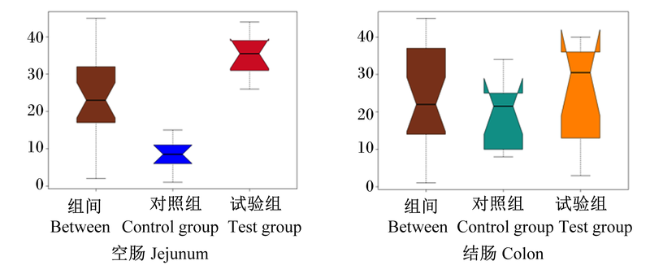
图1可知,根据Anosim分析,2组空肠细菌区系beta多样性中位数相距较远,具有明显差异。
图1 哺乳期饲喂开食料对牦牛犊牛肠道细菌区系beta多样性的影响

Fig.1 Effects of feeding starter during lactation on beta diversity of intestinal bacterial flora of yak calves

表6表7列出了空肠和结肠中相对丰度前5的菌门、相对丰度前30的菌属中相对丰度大于1%的菌属或2组具有显著差异的菌属。在空肠中发现,门水平上厚壁菌门(Firmicutes)相对丰度最高,试验组牦牛犊牛的厚壁菌门相对丰度显著低于对照组(P<0.05);属水平上类芽孢杆菌属(Paeniclostridium)相对丰度最高,试验组牦牛犊牛的拟普雷沃菌属(Alloprevotella)相对丰度显著高于对照组(P<0.05),而龈乳杆菌属(Olsenella)和瘤胃球菌属扭链群(Ruminococcus_torques_group)相对丰度显著低于对照组(P<0.05)。在结肠中发现,门水平上厚壁菌门和拟杆菌门(Bacteroidota)相对丰度较高,并且2组之间无显著差异(P>0.05);属水平上艾克曼菌属(Akkermansia)和UCG-005相对丰度较高,试验组牦牛犊牛的乳杆菌属(Lactobacillus)相对丰度显著高于对照组(P<0.05)。
表6 哺乳期饲喂开食料对牦牛犊牛空肠细菌区系组成的影响

Table 6 Effects of feeding starter during lactation on jejunal bacterial flora composition of yak calves%

项目 Items 对照组 Control group 试验组 Test group PP-value
厚壁菌门 Firmicutes 84.12±2.41a 66.06±6.08b 0.025
广古菌门 Euryarchaeota 3.72±0.86 9.05±3.84 0.212
放线菌门 Actinobacteriota 3.83±0.84 3.36±1.20 0.753
变形菌门 Proteobacteria 2.73±0.58 4.34±1.82 0.424
拟杆菌门 Bacteroidota 0.79±0.09 1.22±0.51 0.381
类芽孢杆菌属 Paeniclostridium 35.85±5.59 23.04±8.74 0.239
罗姆布茨菌属 Romboutsia 27.27±3.41 17.21±2.80 0.064
甲烷短杆菌属 Methanobrevibacter 2.73±0.58 8.35±3.52 0.205
克氏菌科R-7群 Christensenellaceae_R-7_group 3.52±1.35 5.07±1.38 0.443
Family_ⅩⅢ_AD3011_group 1.29±0.06 3.40±1.71 0.200
苏黎世杆菌属 Turicibacter 2.13±0.39 2.67±0.79 0.536
狭义梭菌属1 Clostridium_sensu_stricto_1 1.66±0.17 1.48±0.18 0.535
龈乳杆菌属 Olsenella 0.41±0.06a 0.19±0.04b 0.015
NK4A214群 NK4A214_group 0.38±0.03 0.29±0.02 0.085
瘤胃球菌属扭链群 Ruminococcus_torques_group 0.09±0.01a 0.03±0.01b 0.006
拟普雷沃菌属 Alloprevotella 0.01±0.00b 0.04±0.01a 0.030
琥珀酸弧菌属 Succinivibrio 0.000±0.000 0.005±0.002 0.084
表7 哺乳期饲喂开食料对牦牛犊牛结肠细菌区系组成的影响

Table 7 Effects of feeding starter during lactation on colonic bacterial flora composition of yak calves%

项目 Items 对照组 Control group 试验组 Test group PP-value
厚壁菌门 Firmicutes 49.14±2.64 51.61±2.29 0.499
拟杆菌门 Bacteroidota 17.65±1.22 23.91±3.68 0.118
疣微菌门 Verrucomicrobiota 17.39±4.37 11.29±3.39 0.302
变形菌门 Proteobacteria 6.15±1.09 4.90±0.79 0.409
放线菌门 Actinobacteriota 2.00±0.64 1.28±0.26 0.328
艾克曼菌属 Akkermansia 17.22±4.40 11.15±3.35 0.305
UCG-005 10.59±0.89 12.75±1.07 0.159
理研菌科RC9肠道类群Rikenellaceae_RC9_gut_group 6.20±0.50 8.61±1.65 0.200
另枝菌属 Alistipes 4.56±0.88 3.43±0.36 0.269
类芽孢杆菌属 Paeniclostridium 3.92±0.64 2.14±0.64 0.114
拟杆菌属 Bacteroides 2.81±0.57 3.30±0.13 0.383
Monoglobus 2.63±0.27 2.37±0.23 0.491
罗姆布茨菌属 Romboutsia 2.52±0.41 2.49±0.58 0.974
克氏菌科R-7群Christensenellaceae_R-7_group 2.09±0.40 1.80±0.12 0.508
乳杆菌属 Lactobacillus 0.25±0.10b 1.65±0.24a 0.002

2.4 哺乳期饲喂开食料对牦牛犊牛肠道代谢组的影响

差异代谢物的筛选参考PLS-DA模型第1主成分的VIP、FC和P值这3个参数,以阈值为VIP>1.0,FC>1.5或FC<0.667,P<0.05的条件筛选出差异代谢物,并根据KEGG Pathway富集分析确定差异代谢物参与的最主要生化代谢途径和信号转导途径。在空肠中,正负离子模式下共鉴定出97个差异代谢物,表8展示了在空肠中显著富集的代谢通路(P<0.05)以及与这些通路相关的差异代谢物,显著富集的代谢通路是苯丙氨酸代谢和缬氨酸、亮氨酸和异亮氨酸降解,差异代谢物有2-苯基乙胺、2-羟基苯乙酸和丙二酸二甲脂。
表8 空肠中显著富集的代谢通路及相关的差异代谢物

Table 8 Significantly enriched metabolic pathways and related differential metabolites in jejunum

项目
Items
差异代谢物
Differential metabolites
苯丙氨酸代谢 Phenylalanine metabolism 2-苯基乙胺↑,2-羟基苯乙酸↓
缬氨酸、亮氨酸和异亮氨酸降解 Valine, leucine and isoleucine degradation 丙二酸二甲脂↑

↑:上调 up-regulated;↓:下调 down-regulated。下表同 the same as below。

在结肠中,正负离子模式下共鉴定出67个差异代谢物,表9展示了在结肠中显著富集的代谢通路(P<0.05)以及与这些通路相关的差异代谢物,显著富集的代谢通路是烟酸和烟酰胺代谢、糖酵解/糖异生、柠檬酸循环(TCA循环)、丙酮酸代谢、丙酸代谢、缝隙连接、色氨酸代谢、氨基酸的生物合成和磷酸酯和磷酸酯代谢,差异代谢物有羧化辅酶、磷酸烯醇丙酮酸和草酰乙酸等。
表9 结肠中显著富集的代谢通路及相关的差异代谢物

Table 9 Significantly enriched metabolic pathways and related differential metabolites in colon

项目
Items
差异代谢物
Differential metabolites
烟酸和烟酰胺代谢 Nicotinate and nicotinamide metabolism 葫芦巴碱↑,烟酰甘氨酸↑
糖酵解/糖异生 Glycolysis/gluconeogenesis 羧化辅酶↑,磷酸烯醇丙酮酸↑,草酰乙酸↑
柠檬酸循环(TCA循环) Citrate cycle (TCA cycle) 羧化辅酶↑,磷酸烯醇丙酮酸↑,草酰乙酸↑
丙酮酸代谢 Pyruvate metabolism 羧化辅酶↑,磷酸烯醇丙酮酸↑,草酰乙酸↑
丙酸代谢 Propanoate metabolism 羧化辅酶↑
缝隙连接 Gap junction 5-羟色胺↑
色氨酸代谢 Tryptophan metabolism 犬尿喹啉酸↓,5-羟色胺↑
氨基酸的生物合成 Biosynthesis of amino acids 磷酸烯醇丙酮酸↑,S-磺基-L-半胱氨酸↑
磷酸酯和磷酸酯代谢 Phosphonate and phosphinate metabolism 磷酸烯醇丙酮酸↑

3 讨论

3.1 哺乳期饲喂开食料对牦牛犊牛生长性能、肠道发育及肠道消化酶活性的影响

本试验给哺乳期牦牛犊牛在饲喂代乳粉和苜蓿干草的基础上饲喂开食料,结果发现试验组牦牛犊牛的体重显著高于对照组,分析原因可能是试验组牦牛犊牛的干物质采食量较高,使其营养物质摄入量增加,进而促进了牦牛犊牛的生长发育。有研究表明,开食料不仅易消化吸收,还能显著提高犊牛的采食量,促进其生长发育[11],与本文研究结果一致。本试验牦牛犊牛固体饲粮干物质采食量达1 kg左右时停止饲喂代乳粉,可减少牦牛犊牛应激,有助于断代乳粉后牦牛犊牛的生长[12-13]。停止饲喂代乳粉以后2组牦牛犊牛饲喂相同的饲粮且试验期间2组牦牛犊牛干物质采食量无显著差异,试验结果发现试验组牦牛犊牛体重和平均日增重都显著高于对照组,料重比显著低于对照组,说明早期饲喂开食料有利于牦牛犊的生长发育,提高了饲料利用率,饲料利用率的提高以及蛋白质和能量摄入的提高,均有利于肠道发育[14-15]。通过对肠道组织形态的观察,发现试验组牦犊牛回肠淋巴集结厚度显著高于对照组,回肠淋巴集结内含大量的免疫细胞,是黏膜免疫反应的诱导部位[16],回肠淋巴集结厚度的增加可有效增加其在黏膜反应中的功能,提高肠道黏膜免疫功能[17],保证犊牛建康,促进犊牛生长发育。
肠道中消化酶的活性受摄入营养物质的影响[18],Wang等[19]、Huntington等[20]研究发现,提高绵羊和牛饲粮中的蛋白质和能量水平可以增加肠道中α-淀粉酶活性。Guilloteau等[21]给犊牛饲喂高蛋白质水平的饲粮,增加了肠道中胰蛋白酶和糜蛋白酶活性;仁瑞清等[22]给犊牛饲喂开食料,增加了胰腺内脂肪酶活性。本试验结果显示,试验组犊牛肠道消化酶中蛋白消化酶活性增加,是因为饲喂开食料后增加了蛋白质的摄入量,进而引起相应酶活性的增加,结果中还发现对照组结肠中α-淀粉酶、脂肪酶和纤维素酶活性较高,可能是因为犊牛干物质采食量相近,但对照组不饲喂开食料,故干草摄入量较多,中性洗涤纤维摄入较多,饲料难以消化吸收,因此有更多的未消化的物质到达结肠,增加了结肠细菌区系的丰富度和多样性,使得细菌分泌更多的消化酶,将底物发酵成挥发性脂肪酸(VFA)[23]。淀粉若在大肠发酵,只有部分VFA被机体吸收,而在小肠内能被彻底地分解释放出更多的能量[20]。这预示补饲开食料后牦牛犊牛对饲料的能量利用效率较高。

3.2 哺乳期饲喂开食料对牦牛犊牛肠道细菌区系及代谢产物的影响

反刍动物的小肠是消化吸收的主要场所,大肠是消化道的第二大发酵区,其内的微生物发挥着营养、代谢和保护作用[24]。哺乳期饲喂开食料主要影响了牦犊牛空肠细菌组成。开食料降低了空肠细菌区系的丰富度,这与Qiu等[25]的研究相一致,分析原因是补饲精料后非结构性碳水化合物会随着增加,在肠道细菌作用下产生较多短链脂肪酸会抑制酸敏感菌的活性,从而导致细菌区系丰富度下降[26]。厚壁菌门是空肠的优势菌门,它主要参与寡糖、淀粉和纤维素的降解[27]。类芽孢杆菌属和罗姆布茨菌属(Romboutsia)是空肠的主要菌属,Han等[28]研究发现,在45~50月龄的牦牛空肠中的类芽孢杆菌属相对丰度最高。罗姆布茨菌属是产丁酸菌,在健康肠道中更为丰富[29]。试验组牦牛犊牛的拟普雷沃菌属相对丰度显著高于对照组,拟普雷沃菌属可产生醋酸和琥珀酸,有利于维持肠道稳态[30]。而龈乳杆菌属和瘤胃球菌属扭链群相对丰度显著低于对照组,龈乳杆菌是一种乳酸菌,耐胆汁酸并且可以利用黏蛋白[31],黏蛋白是肠黏膜屏障黏液层的主要主要成分,可以润滑肠道、抵抗致病菌、参与细胞间信号传导及调控免疫因子,对肠道健康具有重要意义[32-33]。瘤胃球菌属扭链群也具有降解肠道中的黏蛋白的功能,还与胃肠道疾病有关[34-35]。对于结肠,试验组牦牛犊牛结肠乳杆菌属相对丰度增加,乳杆菌属具有益生作用,它可以通过与病原菌竞争黏附位点和营养物质产生抗菌肽,改善肠道微生物群来减轻动物腹泻[36-39]。综上所述,饲喂开食料更有利于建立肠道细菌区系的平衡及肠道发挥消化吸收和免疫功能。
大部分肠道菌群是通过细菌代谢产物间接调节物质吸收、调控免疫应答、参与能量代谢、激活信号通路等多种重要生命过程的[40]。通过非靶向代谢组学进一步探究哺乳期饲喂开食料对牦牛犊牛肠道内代谢物的影响,结果显示开食料会影响肠道代谢产物的浓度,在空肠中试验组的2-苯基乙胺浓度显著上调,而2-羟基苯乙酸浓度显著下调,2-苯基乙胺可作为中枢神经系统中儿茶酚胺神经传递的神经调节剂,调节能量代谢[41]。2-苯基乙胺在苯丙氨酸代谢中可以转化为2-羟基苯乙酸,而2-羟基苯乙酸浓度也受肠道细菌的影响[42],所以导致试验组2-羟基苯乙酸浓度的降低。在缬氨酸、亮氨酸和异亮氨酸降解的过程中,试验组空肠生成的丙二酸二甲脂浓度显著上调,这会促进脂肪的生成[43]。在结肠中大多数差异代谢物浓度在试验组显著上调,差异代谢物显著富集到烟酸和烟酰胺代谢、糖酵解/糖异生、TCA循环、丙酮酸代谢、丙酸代谢、缝隙连接、色氨酸代谢、氨基酸的生物合成和磷酸酯和磷酸酯代谢这9个代谢通路中。TCA循环负责糖、脂肪和氨基酸的氧化降解,丙酮酸也是参与TCA循环的重要中间体[44],烟酸代谢产生葫芦巴碱和烟酰甘氨酸可以调节糖代谢[45]。这些通路中的差异代谢物在试验组均显著上调,说明开食料可以增加肠道中的能量代谢。色氨酸及其代谢物5-羟色胺具有调节体温、运动和心血管等广泛的生理功能。脑肠轴是大脑和肠道之间的双向通信系统,5-羟色胺在肠神经系统和中枢神经系统是关键的神经递质[46],肠道微生物组在调节该轴的正常功能方面发挥着关键作用,可能是直接或间接的影响色氨酸的代谢和5-羟色胺信号以调节宿主行为[47-48]。综上所述,哺乳期饲喂开食料的牦牛可能通过神经系统及肠道微生物调控能量代谢以促进生长发育。

4 结论

哺乳期饲喂开食料对牦牛犊牛的生长发育具有促进作用,其主要是通过调节肠道发育和功能,改变肠道微生物丰富度和代谢产物浓度来促进肠道消化代谢与免疫功能的发挥,进而提高牦牛犊牛的生长性能。
[1]
董众祥, 张汉武. 高原之舟——牦牛[J]. 生命世界, 2013(8):92-93.

DONG Z X, ZHANG H W. The boat of plateaus,yaks[J]. Life World, 2013(8):92-93. (in Chinese)

[2]
张越杰, 王芳. 我国牦牛市场与产业调查分析报告[J]. 农产品市场, 2021(23):54-55.

ZHANG Y J, WANG F. Analysis report on yak market and industry in China[J]. Agricultural Products Market, 2021(23):54-55. (in Chinese)

[3]
LIU P P, DONG Q M, LIU S J, et al. Postpartum oestrous cycling resumption of yak cows following different calf weaning strategies under range conditions[J]. Animal Science Journal, 2018, 89(10):1492-1503.

DOI PMID

[4]
MA J, SHAH A M, WANG Z S, et al. Dietary supplementation with glutamine improves gastrointestinal barrier function and promotes compensatory growth of growth-retarded yaks[J]. Animal, 2021, 15(2):100108.

[5]
才文加. 牦牛犊牛腹泻病的原因及治疗方法[J]. 畜牧业环境, 2020(12):78.

CAI W J. Causes and treatment of diarrhoeal disease in yak calves[J]. Animal Industry and Environment, 2020(12):78. (in Chinese)

[6]
朱彦宾, 巴桑旺堆, 旦久罗布, 等. 早期断奶对犊牛生产性能和母牦牛繁殖性能的影响[J]. 基因组学与应用生物学, 2019, 38(1):89-92.

ZHU Y B, BA S W D, DAN J L B, et al. Effects of early weaning on production performance of calf and the reproductive performance of female yaks[J]. Genomics and Applied Biology, 2019, 38(1):89-92. (in Chinese)

[7]
马涛, 崔凯, 张成福, 等. 不同培育模式对牦牛犊牛生长性能、瘤胃发酵参数和血清生化指标的影响[J]. 动物营养学报, 2021, 33(4):2055-2062.

DOI

MA T, CUI K, ZHANG C F, et al. Effects of different feeding modes on growth performance,rumen fermentation parameters and serum biochemical indices of yak calves[J]. Chinese Journal of Animal Nutrition, 2021, 33(4):2055-2062. (in Chinese)

[8]
鲍宇红, 宋天增, 冯柯, 等. 不同蛋白质水平代乳粉对牦犊牛体重及血清生化指标的影响[J]. 中国农业大学学报, 2020, 25(5):78-85.

BAO Y H, SONG T Z, FENG K, et al. Effects of different protein levels of milk replacer on the body weight and serum biochemical indexes of yak calves[J]. Journal of China Agricultural University, 2020, 25(5):78-85. (in Chinese)

[9]
CUI Z H, WU S R, LIU S J, et al. From maternal grazing to barn feeding during pre-weaning period:altered gastrointestinal microbiota contributes to change the development and function of the rumen and intestine of yak calves[J]. Frontiers in Microbiology, 2020, 11:485.

DOI

[10]
RAABIS S, LI W L, CERSOSIMO L. Effects and immune responses of probiotic treatment in ruminants[J]. Veterinary Immunology and Immunopathology, 2019, 208:58-66.

DOI PMID

[11]
王音, 郭文杰, 郝文君, 等. 哺乳期补饲开食料对牦牛犊牛生长性能、瘤胃发育和微生物区系的影响[J]. 动物营养学报, 2022, 34(5):3066-3076.

DOI

WANG Y, GUO W J, HAO W J, et al. Effects of supplementary starter feed on growth performance,rumen development and microbiome of yak calves during lactation[J]. Chinese Journal of Animal Nutrition, 2022, 34(5):3066-3076. (in Chinese)

DOI

[12]
DE PASSILLÉ A M, BORDERAS T F, RUSHEN J. Weaning age of calves fed a high milk allowance by automated feeders:effects on feed,water,and energy intake,behavioral signs of hunger,and weight gains[J]. Journal of Dairy Science, 2011, 94(3):1401-1408.

DOI

[13]
HILL T M, BATEMAN II H G, ALDRICH J M, et al. Methods of reducing milk replacer to prepare dairy calves for weaning when large amounts of milk replacer have been fed[J]. The Professional Animal Scientist, 2012, 28(3):332-337.

DOI

[14]
景小平, 彭全辉, 胡瑞, 等. 冷季补饲对藏羊小肠形态发育及营养物质转运载体基因表达量的影响[J]. 畜牧兽医学报, 2017, 48(2):260-271.

JING X P, PENG Q H, HU R, et al. Effects of supplementation in cold season on morphological development of small intestine and the expression of nutrient transporter gene[J]. Acta Veterinaria et Zootechnica Sinica, 2017, 48(2):260-271. (in Chinese)

[15]
崔占鸿. 牦牛犊牛培育方式对生长和消化道发育的影响[D].博士学位论文. 杨凌: 西北农林科技大学, 2020.

CUI Z H. Effects of rearing patterns on growth and digestive tract development in yak calves[D]. Ph.D.Thesis. Yangling: Northwest A&F University, 2020. (in Chinese)

[16]
杨淑静. 粘膜免疫[J]. 国外医学(免疫学分册), 2001(6):296-299.

YANG S J. Mucosal immunity[J]. Foreign Medicine(Immunology), 2001(6):296-299. (in Chinese)

[17]
祁珊珊, 郑红星. 牦牛肠源Lactobacillus acidophilus L3对其小肠黏膜形态结构的影响[J]. 四川动物, 2015, 34(1):76-80.

QI S S, ZHENG H X. Effect of intestinal Lactobacillus acidophilus L3 on the morphological structure of small intestine in yaks[J]. Sichuan Journal of Zoology, 2015, 34(1):76-80. (in Chinese)

[18]
范小红, 郝力壮, 刘书杰, 等. 双低油菜籽不同添加水平对牦牛空肠和盲肠食糜消化酶活性的影响[J]. 中国饲料, 2017(18):15-18,23.

FAN X H, HAO L Z, LIU S J, et al. Effects of different addition level of rapeseed in diet on the activity of digestive enzymes in jejunum and cecum chyme of yak[J]. China Feed, 2017(18):15-18,23. (in Chinese)

[19]
WANG X B, TANIGUCHI K, OBITSU T. Response of pancreatic exocrine secretion in sheep fed different type and amount of hay[J]. Asian-Australasian Journal of Animal Sciences, 2000, 13(8):1044-1049.

DOI

[20]
HUNTINGTON G B, HARMON D L, RICHARDS C J. Sites,rates,and limits of starch digestion and glucose metabolism in growing cattle[J]. Journal of Animal Science, 2006,84 (Suppl.13):E14-E24.

[21]
GUILLOTEAU P, CORRING T, TOULLEC R, et al. Enzyme potentialities of the abomasum and pancreas of the calf.Effect of age in the preruminant[J]. Reproduction Nutrition Developement, 1984, 24(3):315-325.

[22]
仁瑞清, 高艳霞, 曹玉凤, 等. 不同饲喂模式对犊牛小肠及胰腺内消化酶活性的影响[J]. 中国畜牧杂志, 2013, 49(3):72-76.

REN R Q, GAO Y X, CAO Y F, et al. Effects of different feed patterns on enzyme activity in the small intestine and pancreas of pre-weaning calves[J]. Chinese Journal of Animal Science, 2013, 49(3):72-76. (in Chinese)

[23]
STEVENS C E, ARGENZIO R A, CLEMENS E T. Microbial digestion:rumen versus large intestine[M]// RUCKEBUSCHY, THIVENDP.Digestive physiology and metabolism in ruminants. Dordrecht:Springer, 1980:685-706.

[24]
O'HARA E, NEVES A L A, SONG Y, et al. The role of the gut microbiome in cattle production and health:driver or passenger?[J]. Annual Review of Animal Biosciences, 2020, 8:199-220.

DOI

[25]
QIU Q H, GAO C Y, AZIZ UR RAHMAN M, et al. Digestive ability,physiological characteristics,and rumen bacterial community of Holstein finishing steers in response to three nutrient density diets as fattening phases advanced[J]. Microorganisms, 2020, 8(3):335.

DOI

[26]
GONZALEZ-SANTANA A, DIAZ HEIJTZ R. Bacterial peptidoglycans from microbiota in neurodevelopment and behavior[J]. Trends in Molecular Medicine, 2020, 26(8):729-743.

DOI

[27]
AHMAD A A, YANG C, ZHANG J B, et al. Effects of dietary energy levels on rumen fermentation,microbial diversity,and feed efficiency of yaks (Bos grunniens)[J]. Frontiers in Microbiology, 2020, 11:625.

DOI

[28]
HAN X P, LIU H J, HU L Y, et al. Bacterial community characteristics in the gastrointestinal tract of yak (Bos grunniens) fully grazed on pasture of the Qinghai-Tibetan Plateau of China[J]. Animals, 2021, 11(8):2243.

DOI

[29]
MANGIFESTA M, MANCABELLI L, MILANI C, et al. Mucosal microbiota of intestinal polyps reveals putative biomarkers of colorectal cancer[J]. Scientific Reports, 2018, 8(1):13974.

DOI PMID

[30]
DOWNES J, DEWHIRST F E, TANNER A C R, et al. Description of Alloprevotella rava gen. nov.,sp. nov.,isolated from the human oral cavity,and reclassification of Prevotella tannerae moore et al.1994 as Alloprevotella tannerae gen. nov.,comb. nov[J]. International Journal of Systematic and Evolutionary Microbiology, 2013, 63(Pt.4):1214-1218.

DOI

[31]
KRAATZ M, WALLACE R J, SVENSSON L. Olsenella umbonata sp. nov.,a microaerotolerant anaerobic lactic acid bacterium from the sheep rumen and pig jejunum,and emended descriptions of Olsenella,Olsenella uli and Olsenella profusa[J]. International Journal of Systematic and Evolutionary Microbiology, 2011, 61(Pt.4):795-803.

DOI

[32]
ANTONISSEN G, VAN IMMERSEEL F, PASMANS F, et al. Mycotoxins deoxynivalenol and fumonisins alter the extrinsic component of intestinal barrier in broiler chickens[J]. Journal of Agricultural and Food Chemistry, 2015, 63(50):10846-10855.

DOI PMID

[33]
贺欣, 张目涵, 路瑶, 等. 黏蛋白在肠黏膜屏障中的保护调节机制[J]. 医学综述, 2017, 23(1):1-5.

HE X, ZHANG M H, LU Y, et al. Protection and regulation mechanism of mucins in intestinal mucosal barrier[J]. Medical Recapitulate, 2017, 23(1):1-5. (in Chinese)

[34]
MALINEN E, KROGIUS-KURIKKA L, LYRA A, et al. Association of symptoms with gastrointestinal microbiota in irritable bowel syndrome[J]. World Journal of Gastroenterology, 2010, 16(36):4532-4540.

DOI PMID

[35]
DE CESARE A, SIRRI F, MANFREDA G, et al. Effect of dietary supplementation with Lactobacillus acidophilus D2/CSL (CECT 4529) on caecum microbioma and productive performance in broiler chickens[J]. PLoS One, 2017, 12(5):e0176309.

[36]
SADOWSKA B, WALENCKA E, WIECKOWSKA-SZAKIEL M, et al. Bacteria competing with the adhesion and biofilm formation by Staphylococcus aureus[J]. Folia Microbiologica, 2010, 55(5):497-501.

DOI

[37]
HUANG W C, PAN C H, WEI C C, et al. Lactobacillus plantarum PS128 improves physiological adaptation and performance in triathletes through gut microbiota modulation[J]. Nutrients, 2020, 12(8):2315.

DOI

[38]
WANG G, HUANG S, CAI S, et al. Lactobacillus reuteri ameliorates intestinal inflammation and modulates gut microbiota and metabolic disorders in dextran sulfate sodium-induced colitis in mice[J]. Nutrients, 2020, 12(8):2298.

DOI

[39]
DONG H L, LIU B X, LI A Y, et al. Microbiome analysis reveals the attenuation effect of Lactobacillus from yaks on diarrhea via modulation of gut microbiota[J]. Frontiers in Cellular and Infection Microbiology, 2021, 10:610781.

[40]
郑军平, 曹亚楠, 刘雨, 等. 关键肠道细菌及其代谢分子检测与疾病风险管控[C]// 中国化学会第十四届全国电分析化学学术会议会议论文集(第二分册). 南京: 中国化学会, 2020:448-449.

ZHENG J P, CAO Y N, LIU Y, et al. Biosensing key gut bacteria and their metabolic molecules and disease risk management[C]// Proceedings of the 14th National Conference on Electroanalytical Chemistry of the Chinese Chemical Society (Volume 2). Nanjing: Chinese Chemical Society, 2020:448-449. (in Chinese)

[41]
PATERSON I A, JUORIO A V, BOULTON A A. 2-phenylethylamine:a modulator of catecholamine transmission in the mammalian central nervous system?[J]. Journal of Neurochemistry, 1990, 55(6):1827-1837.

DOI

[42]
WIKOFF W R, ANFORA A T, LIU J, et al. Metabolomics analysis reveals large effects of gut microflora on mammalian blood metabolites[J]. Proceedings of the National Academy of Sciences of the United States of America, 2009, 106(10):3698-3703.

DOI PMID

[43]
MOLLOY A M, PANGILINAN F, MILLS J L, et al. A common polymorphism in HIBCH influences methylmalonic acid concentrations in blood independently of cobalamin[J]. American Journal of Human Genetics, 2016, 98(5):869-882.

DOI PMID

[44]
LI Y, GUO Y, WEN Z S, et al. Weaning stress perturbs gut microbiome and its metabolic profile in piglets[J]. Scientific Reports, 2018, 8(1):18068.

DOI PMID

[45]
YOSHINARI O, IGARASHI K. Anti-diabetic effect of trigonelline and nicotinic acid,on KK-Ay mice[J]. Current Medicinal Chemistry, 2010, 17(20):2196-2202.

DOI

[46]
MAWE G M, HOFFMAN J M. Serotonin signalling in the gut—functions,dysfunctions and therapeutic targets[J]. Nature Reviews Gastroenterology & Hepatology, 2013, 10(8):473-486.

[47]
COLLINS S M, SURETTE M, BERCIK P. The interplay between the intestinal microbiota and the brain[J]. Nature Reviews Microbiology, 2012, 10(11):735-742.

DOI PMID

[48]
O'MAHONY S M, CLARKE G, BORRE Y E, et al. Serotonin,tryptophan metabolism and the brain-gut-microbiome axis[J]. Behavioural Brain Research, 2015, 277:32-48.

DOI

Outlines

/