RESEARCH PAPER

Determination of Spectinomycin in Feed by Solid Phase Extraction-Ultra Performance Liquid Chromatography-Tandem Mass Spectrometry

  • WANG Fengqin ,
  • KAI Lixia ,
  • CHENG Yuanzhi ,
  • WANG Yizhen , *
Expand
  • Key Laboratory of Animal Nutrition and Feed Science of Zhejiang Province, Key Laboratory of Animal Nutrition and Feed Science in Eastern China, Ministry of Agriculture and Rural Affairs, Key Laboratory of Molecular Animal Nutrition, Ministry of Education, College of Animal Sciences, Zhejiang University, Hangzhou 310058, China
*professor, E-mail:

Received date: 2022-08-24

  Online published: 2023-03-16

Abstract

The aim of this study was to establish an accurate method for the determination of spectinomycin in feed. The sample was extracted with 2% trichloroacetic acid aqueous solution [containing 0.4% ethylenediaminetetraacetic acid disodium salt (EDTA-2Na)]. After its pH was adjusted to (4.7±0.2) and the sample was cleaned-up on the mixed-mode cation-exchange (MCX) solid-phase extraction (SPE). The spectinomycin was separated by a hydrophilic interaction liquid chromatography (HILIC) column with gradient elution using 0.01 mol/L ammonium formate aqueous solution (containing 0.4% formic acid) and 0.01 mol/L ammonium formate acetonitrile-aqueous solution (containing 0.4% formic acid) as mobile phases and finally confirmed and quantified in multiple reaction monitoring (MRM) mode with the electrospray ionization (ESI) positive ion scanning by matrix matching external calibration method. The results show that the limit of detection and limit of quantification of spectinomycin in feed using this solid phase extraction-ultra performance liquid chromatography-tandem mass spectrometry method was 1.0 and 2.0 mg/kg, respectively. The regression coefficient (R2) of linear calibration curve for spectinomycin in different feed substrates was over 0.99 within the concentration range from 0.1 to 10.0 μg/mL. At the four spiked levels (2.0, 20.0, 200.0 and 1 000.0 mg/kg), the average recovery rate of spectinomycin was from 91.3% to 104.2% and the relative standard deviation (RSD) was from 1.5% to 9.4%. As a result, the solid phase extraction-ultra performance liquid chromatography-tandem mass spectrometry method was sensitive and practical for the determination of spectinomycin in feed.

Cite this article

WANG Fengqin , KAI Lixia , CHENG Yuanzhi , WANG Yizhen . Determination of Spectinomycin in Feed by Solid Phase Extraction-Ultra Performance Liquid Chromatography-Tandem Mass Spectrometry[J]. Chinese Journal of Animal Nutrition, 2023 , 35(3) : 2004 -2017 . DOI: 10.12418/CJAN2023.188

大观霉素曾被广泛用于治疗猪、家禽的细菌和寄生虫感染,或作为生长促进剂[1]。考虑到饲用抗生素的不合理及违法使用带来的抗生素在食物中残留、细菌耐药性以及环境污染等系列问题,建立饲用抗生素检测技术对相关行业的监管显得尤为重要。此外,从源头掌握动物食品安全状况也越来越需要灵敏、可靠的分析方法作为饲料和食品检验的保障[2]
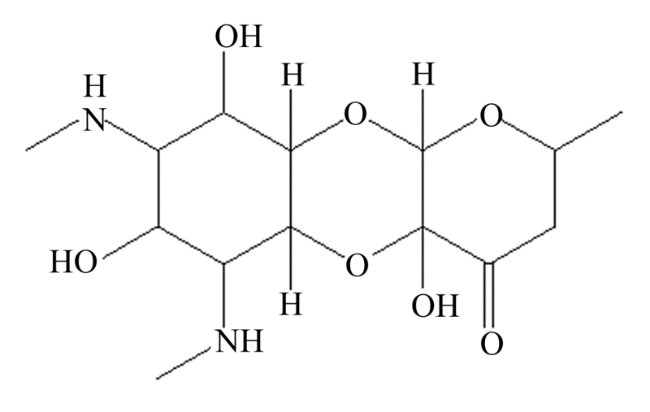
大观霉素(化学结构见图1),属于氨基糖苷类化合物,结构上由氨基糖与氨基环醇组成。大观霉素具有热稳定性和非挥发性,使用气相色谱或气质联用法分析需要较长时间的衍生化反应[3];其结构上没有发色光团和荧光光团,使用液相色谱法分析通常需要柱前或柱后衍生,然后用紫外或荧光检测器检测[4]。上述方法均会因衍生效率或衍生物的稳定性低而导致方法的精密度较差[5-7]。脉冲安培计[8]、蒸发光散射[9]和化学发光检测[10]无需任何衍生,可以直接检测氨基糖苷类化合物,但不能进行确证,同时灵敏度也不高[11]
图1 大观霉素的化学结构

Fig.1 Chemical structure of spectinomycin

液相色谱-质谱联用(LC-MS/MS)因其高选择性和准确性在饲料质量控制中占有突出地位[12-13],然而氨基糖苷类化合物极性大的特性又限制了其在常规反相色谱-质谱联用上的应用[1]。离子对液相色谱法采用添加离子对试剂的方法延长了极性目标物在反相色谱柱上的保留,但是离子对试剂的使用会严重抑制质谱仪的电喷雾离子化效果,大幅度降低仪器灵敏度[14]。作为离子对液相色谱法的替代,亲水相互作用液相色谱法(HILIC)在分析过程中对极性目标物具有较强的保留,并且HILIC流动相中高比例的有机相在电喷雾电离(ESI)过程中快速反应蒸发,相对于离子对液相色谱,HILIC与ESI联用可以获得更高的灵敏度[15]。已有多篇文献报道,采用HILIC分离大观霉素等氨基糖苷类化合物[14,16]
来自样品中的基质效应往往限制了LC-MS/MS方法的重现性和准确度[17]。在去除样品基质的前处理方法中,固相萃取(SPE)相对于在流动相加入改进剂[18]、稀释[19]以及稳定同位素标记的内标物[20-21]等方面普遍被认为更易于实现[11]。各种性能的离子型SPE小柱和亲水亲脂型(HLB)SPE小柱常常用于去除样品中的基质[22-23]。氨基糖苷类化合物的净化涉及离子交换机制,通常采用阳离子交换小柱,其填料的性质对加载的提取液pH有较为严格的要求,因此采用SPE小柱净化提取液时,往往需要调节上样溶液的pH,而使得氨基糖苷类化合物在SPE小柱上得以保留[24]。关于饲料中大观霉素的测定,我国现行标准《饲料中大观霉素的测定》(农业部2086号公告-7—2014)[25]提供了2种分析方法:高效液相色谱-蒸发光散射检测法和液相色谱-质谱联用法。其中,高效液相色谱-蒸发光散射检测法不能满足确证需要,且只适用于配合饲料中大观霉素的检测,而液相色谱-质谱联用法的前处理和液相条件也不能满足稳定和准确检测的需要。到目前为止,还没有针对饲料样品中大观霉素测定的系统解决方案。
总而言之,定量分析氨基糖苷类化合物,需要克服提取、净化、分离和检测等方面的困难[24]。鉴于此,本研究针对不同饲料样品,对前处理方法及仪器条件进行优化,拟建立一种准确检测饲料中大观霉素含量的固相萃取-超高效液相色谱-串联质谱(SPE-UPLC-MS/MS)法。

1 材料与方法

1.1 试验材料

1.1.1 试剂

盐酸大观霉素(纯度:99.9%)购自坛墨质检科技股份有限公司;色谱级甲醇、乙腈和甲酸购自美国Sigma-Aldrich公司;Oasis混合型阳离子交换(MCX)SPE柱(60 mg,3 mL)、Oasis MCX SPE(150 mg,6 mL)、Oasis MCX SPE柱(500 mg,6 mL)和Oasis弱阳离子交换(WCX)SPE柱(60 mg,3 mL)购自美国Waters公司;分析纯三氯乙酸(TCA)、氨水和乙二胺四乙酸二钠(EDTA-2Na)均购自国药集团化学试剂有限公司。

1.1.2 主要仪器

主要仪器包括超高效液相色谱-质谱联用(UPLC-MS/MS)仪(Waters ACQUITYTM UPLC TQ Mass detector,美国Waters公司)、KQ-500E超声波清洗器(昆山市超声仪器有限公司)、超纯水仪(德国EMD Millipore公司)、电子分析天平(瑞士Mettler Toledo公司)、ST 40R离心机(美国Thermo公司)和氮吹仪(美国Organomation公司)。

1.2 UPLC-MS/MS分析条件

1.2.1 色谱条件

色谱柱:HILIC,50 mm×2.1 mm,粒径1.7 μm;进样量:5 μL;流速:0.5 mL/min;流动相A:0.01 mol/L甲酸铵水溶液(含0.4%甲酸);流动相B:0.01 mol/L甲酸铵溶液[乙腈:水=9:1(体积比),含0.4%甲酸]。色谱分离梯度洗脱条件如表1所示。
表1 色谱分离梯度洗脱条件

Table 1 Gradient elution conditions for chromatographic separation

时间
Time/min
流动相A
Mobile phase A/%
流动相B
Mobile phase B/%
曲线类型
Curve type
0.0 0 100 6
1.0 0 100 6
1.5 50 50 6
3.0 50 50 6
3.1 0 100 6
5.0 0 100 6

1.2.2 质谱条件

电离方式:ESI,正离子模式(ESI+);检测方式:多级反应监测(MRM);毛细管电压:0.5 kV;离子源温度:150 ℃;脱溶剂气温度:550 ℃;脱溶剂气流速:1 000 L/h。雾化气、干燥气为高纯氮气,碰撞气为高纯氩气。喷雾电压、碰撞能量等参数优化至最佳灵敏度。质谱分析条件见表2
表2 质谱分析条件

Table 2 Conditions used for mass spectrum analysis

定性离子对
Qualitative ion pair/(m/z)
定量离子对
Quantitative ion pair/(m/z)
驻留时间
Dwell time/s
锥孔电压
Cone voltage/V
碰撞能量
Collision energy/V
351.2/333.3
351.2/207.2
351.2/333.3 0.061
0.061
30 34
22

1.3 样品的前处理

1.3.1 提取

称取2.50 g(精确至0.01 g)饲料样品于50 mL塑料离心管中,加入23 mL 2% TCA溶液,再加入2 mL 5% EDTA-2Na溶液,常温水浴超声20 min,于8 000 r/min离心5 min,转移上清液至另一只50 mL塑料离心管中。将沉淀重复提取1次并离心,合并2次上清液,混匀。准确移取3 mL提取液至10 mL塑料离心管中,用10%氨水溶液准确调节pH至(4.7±0.2)后,于8 000 r/min离心5 min,制得样品备用液。

1.3.2 净化

依次用3 mL甲醇和3 mL水活化MCX SPE小柱,将样品备用液全部上样,分别用3 mL水和3 mL甲醇淋洗,抽干。用3 mL 10%氨化甲醇溶液洗脱,收集洗脱液,于40 ℃氮气吹干,准确加入3 mL样品溶解液(流动相A和B各50%)复溶,过0.22 μm有机滤膜,待UPLC-MS/MS检测。

1.4 标准曲线的制备

空白基质标准工作曲线:称取空白饲料2.50 g,置于50 mL塑料离心管中,按样品试验步骤1.3进行处理,以获得的复溶液作为空白基质,稀释200 μg/mL的大观霉素标准溶液,得到0、0.1、0.2、0.5、1.0、2.0、5.0和10.0 μg/mL的空白基质标准工作溶液,上机测试;以浓度为横坐标,以定量离子的峰面积为纵坐标,绘制空白基质标准工作曲线。
基质匹配标准工作曲线:称取各空白饲料样品8份,每份2.50 g,置于50 mL塑料离心管中,向其中加入一系列标准溶液,静置过夜。按样品试验步骤1.3进行处理,形成理论添加浓度为0、0.1、0.2、0.5、1.0、2.0、5.0和10.0 μg/mL的标准溶液,上机测试;以浓度为横坐标,以定量离子的峰面积为纵坐标,绘制基质匹配标准工作曲线。
溶剂标准工作曲线:同时制备溶剂标准溶液,一并上机测试;以标准工作溶液的浓度为横坐标,以定量离子的峰面积为纵坐标,绘制溶剂标准工作曲线。

1.5 方法的准确度与精密度

提取、净化等前处理条件的优化通过提取回收率考察,提取回收率为加入溶剂标准溶液的饲料样品经前处理后的峰面积与溶剂标准溶液峰面积的比值[26]。方法的准确度以回收率来评价[27],分别移取25、250、2 500和4 000 μg/mL 4个浓度的大观霉素标准溶液,加入到空白饲料样品中,得到最终计算浓度为2.0、20.0、200.0和1 000.0 mg/kg的4个添加水平。每种饲料在每个浓度下设6个平行,以基质匹配标准工作曲线计算回收率,精密度以相对标准偏差(RSD)表示。

1.6 数据处理与分析

数据处理采用Excel 2016软件进行处理和计算,结果以平均值来表示。

2 结果与分析

2.1 流动相的组成

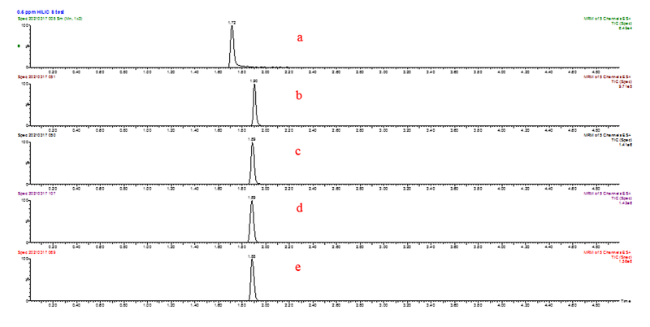
在流动相中分别添加0.005、0.010和0.020 mol/L甲酸铵,以考察甲酸铵含量对峰形、质谱强度以及稳定性的影响,色谱图见图2,结果发现:流动相中不加甲酸铵,色谱谱峰会产生拖尾现象;高浓度甲酸铵(0.020 mol/L)会使大观霉素产生较强的离子抑制现象,大观霉素的灵敏度相对较低;随着甲酸铵浓度降低,灵敏度逐渐升高,而当甲酸铵浓度低至0.005 mol/L时,大观霉素峰面积重复性变差。因此,最终确定0.010 mol/L甲酸铵水溶液(含0.4%甲酸)和0.010 mol/L甲酸铵溶液[乙腈:水=9:1(体积比),含0.4%甲酸]作为流动相。
图2 大观霉素在不同流动相体系中总离子流图

a:0.3%甲酸水-乙腈 0.3% formic water-acetonitrile;b:0.020 mol/L甲酸铵水溶液(含0.4%甲酸)-0.020 mol/L甲酸铵溶液[乙腈:水=9:1(体积比),含0.4%甲酸] 0.020 mol/L ammonium formate aqueous solution (containing 0.4% formic acid)-0.020 mol/L ammonium formate solution [acetonitrile to water=9:1 (volume ratio), containing 0.4% formic acid];c:0.020 mol/L甲酸铵水溶液(含0.4%甲酸)-0.010 mol/L甲酸铵溶液[乙腈:水=9:1(体积比),含0.4%甲酸] 0.020 mol/L ammonium formate aqueous solution (containing 0.4% formic acid)-0.010 mol/L ammonium formate solution [acetonitrile to water=9:1 (volume ratio), containing 0.4% formic acid];d:0.010 mol/L甲酸铵水溶液(含0.4%甲酸)-0.010 mol/L甲酸铵溶液[乙腈:水=9:1(体积比),含0.4%甲酸] 0.010 mol/L ammonium formate aqueous solution (containing 0.4% formic acid)-0.010 mol/L ammonium formate solution [acetonitrile to water=9:1 (volume ratio), containing 0.4% formic acid];e:0.005 mol/L甲酸铵水溶液(含0.4%甲酸)-0.005 mol/L甲酸铵溶液[乙腈:水=9:1(体积比),含0.4%甲酸] 0.005 mol/L ammonium formate aqueous solution (containing 0.4% formic acid)-0.005 mol/L ammonium formate solution [acetonitrile to water=9:1 (volume ratio), containing 0.4% formic acid]。

Fig.2 Total ion chromatograms of spectinomycin in different mobile phase systems (5.0 μg/mL)

2.2 质谱条件

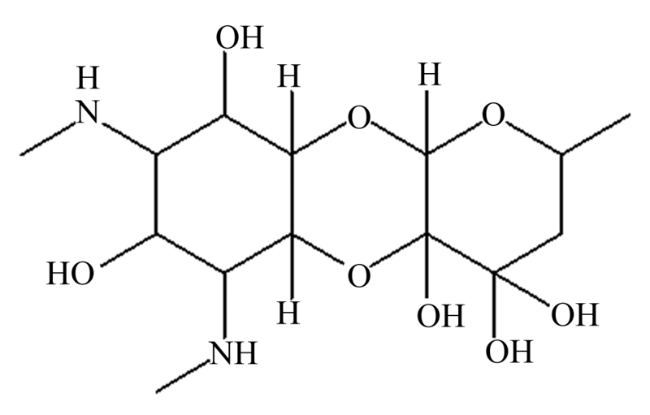
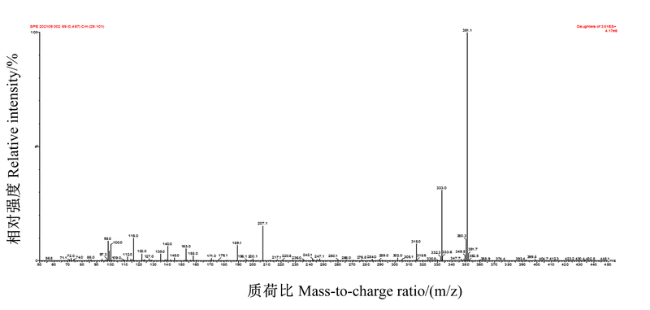
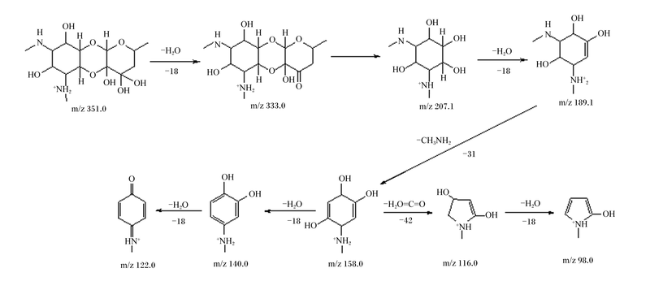
图1所示,大观霉素具有独特的三元环结构,2个糖苷通过缩酮和半缩醛相连,其分子中的羰基以酮水合形式存在[28-29](图3)。母离子扫描,质谱图中出现丰度较高的准分子离子峰[M+H2O+H]+,故选择m/z 351作为母离子[30]。对母离子进行轰击碎裂,产生相应的子离子,质谱图见图4。可能质谱裂解途径如图5所示,大观霉素在B环的同侧C—O键间断裂生成m/z 207的碎片,再经过一系列脱水或—CH3NH2等残基生成多级碎片。选择丰度较强的二级碎片离子m/z 333作为定量离子,m/z 207作为定性离子。
图3 大观霉素水合物结构

Fig.3 Chemical structure of spectinomycin hydrate

图4 大观霉素子离子质谱图

Fig.4 Daughter ion mass spectrum of spectinomycin (5.0 μg/mL)

图5 大观霉素可能质谱裂解途径

Fig.5 Proposed fragmentation scheme of spectinomycin

2.3 提取液的确定

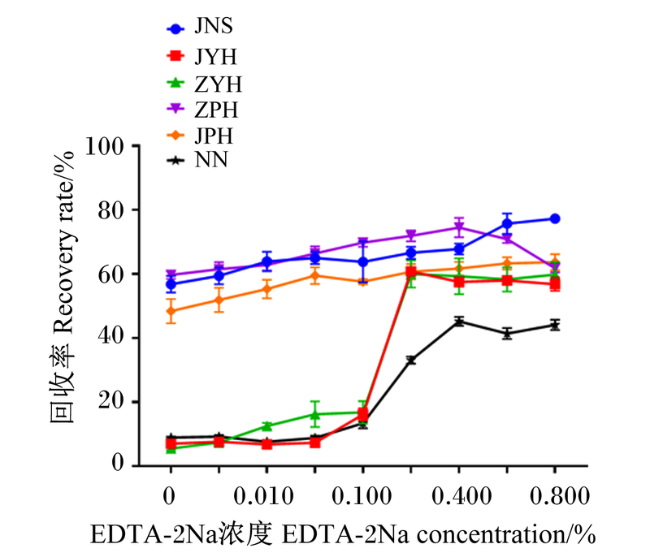
试验考察了2% TCA溶液中添加不同浓度的EDTA-2Na对饲料中大观霉素提取效率的影响。分别称取鸡配合饲料、鸡预混料(指复合预混合饲料,下同)、鸡浓缩饲料、猪配合饲料、猪预混料和奶牛精料补充料等空白饲料各18份试样(用于平行2份试验),每份试样2.50 g,置于50 mL塑料离心管中,添加250 μL浓度为2 000 μg/mL的大观霉素,室温放置过夜。向2% TCA中添加EDTA-2Na,并参考了不同基质中EDTA-2Na的添加量[24,31-42],使2% TCA提取液分别含0.005%、0.010%、0.050%、0.100%、0.200%、0.400%、0.600%和0.800%的EDTA-2Na,按样品试验步骤1.3进行处理。试验结果发现:添加EDTA-2Na可以获得更高且更稳定的回收率,而当EDTA-2Na的浓度为0.400%时,大观霉素回收率普遍较高(图6)。因此,最后确定采用含0.400% EDTA-2Na的2% TCA溶液作为饲料中大观霉素的提取液。
图6 不同浓度EDTA-2Na对大观霉素回收率的影响(添加20.0 mg/kg)

JPH:鸡配合饲料 compound feed for chicken;JYH:鸡预混料 premix for chicken;JNS:鸡浓缩饲料 concentrated feed for chicken;ZPH:猪配合饲料 compound feed for pig;ZYH:猪预混料 premix for pig;NN:奶牛精料补充料 concentrate supplement for cow。

Fig.6 Effects of different concentrations of EDTA-2Na on recovery rate of spectinomycin (spiking 20.0 mg/kg)

2.4 提取液pH的优化

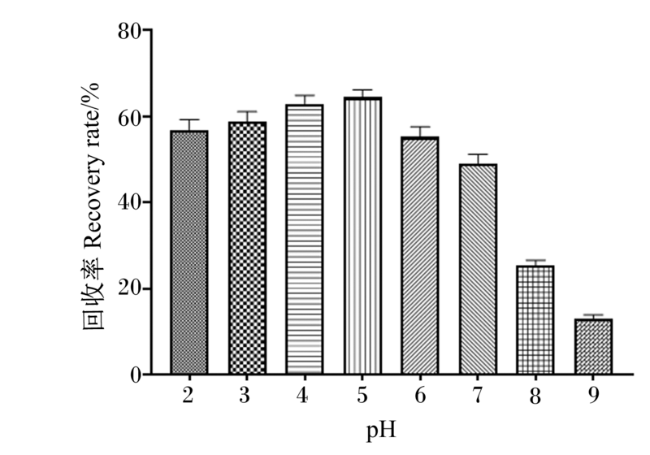
本研究考察了10%氨水调节鸡预混料提取液pH在2、3、4、5、6、7、8和9时的大观霉素回收率,平行做8份试样。称取鸡预混料空白饲料2.50 g,置于50 mL塑料离心管中,添加200 μL浓度为250.0 μg/mL的大观霉素,室温放置过夜,按照1.3.1的方法进行提取。从每份试样中准确移取3 mL提取液各5份,至10 mL塑料离心管中,用10%氨水准确调节pH为2、3、4、5、6、7、8和9,后经MCX小柱净化,浓缩后复溶,上机测定。试验结果表明:调节提取液pH为4~5时,可以获得更高的回收率(图7)。
图7 提取液pH(2~9)对大观霉素回收率的影响(添加20.0 mg/kg)

Fig.7 Effects of pH (2 to 9) of extraction on recovery rate of spectinomycin (spiking 20.0 mg/kg)

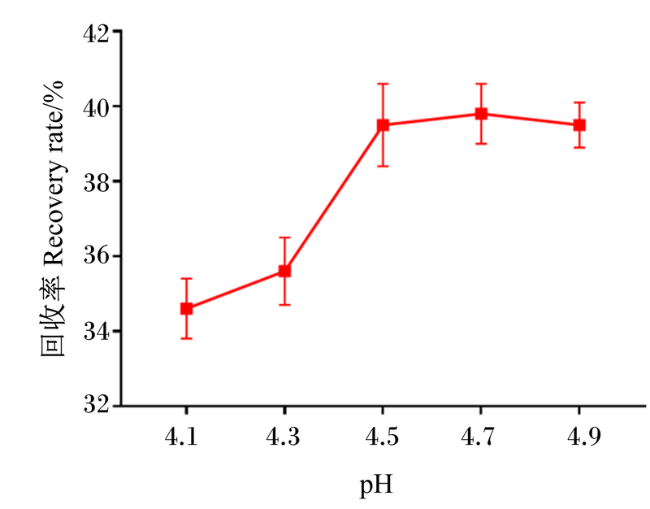
在上述基础上继续采用奶牛精料补充料对pH在4~5时的大观霉素回收率进行进一步考察。称取奶牛精料补充料空白饲料2.50 g,置于50 mL塑料离心管中,添加200 μL浓度为250.0 μg/mL的大观霉素,室温放置过夜。按照1.3.1的方法进行提取。从试样中准确移取3 mL提取液15份,至10 mL塑料离心管中,用10%氨水准确调节pH为4.1、4.3、4.5、4.7和4.9(3个重复),后经MCX小柱净化,浓缩后复溶,上机测定。试验结果表明:pH为4.5~4.9时,可以获得更高且更稳定的回收率(图8),所以最终将上样溶液pH调节为(4.7±0.2)。
图8 提取液pH(4.1~4.9)对大观霉素回收率的影响(添加20.0 mg/kg)

Fig.8 Effects of pH (4.1 to 4.9) of extraction on recovery rate of spectinomycin (spiking 20.0 mg/kg)

2.5 净化条件的优化

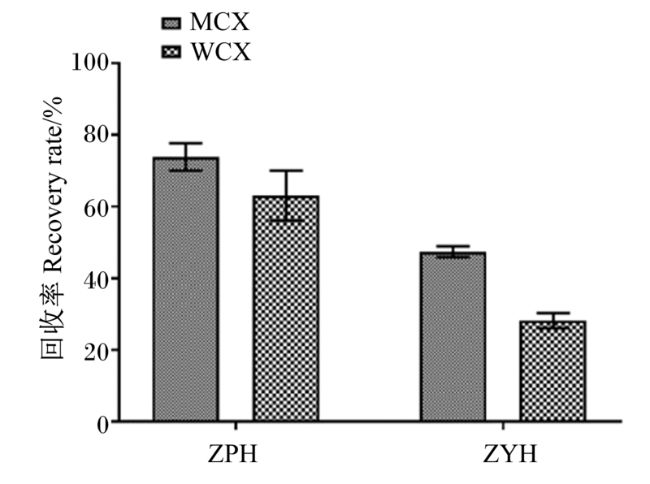
试验选取了Oasis MCX(60 mg,3 mL)和Oasis WCX(60 mg,3 mL)2种常见阳离子型SPE小柱净化猪配合饲料和猪预混料提取液。分别称取猪配合饲料和猪预混合空白饲料各5份试样,每份试样2.50 g,置于50 mL塑料离心管中,添加200 μL浓度为250.0 μg/mL的大观霉素,室温放置过夜。按样品试验步骤1.3进行提取,调节pH后,经MCX小柱或WCX小柱净化,浓缩后复溶,上机测定。试验结果表明:对于猪配合饲料和猪预混料,Oasis MCX小柱比Oasis WCX SPE小柱在相同的洗脱体系下能获得更高的回收率(图9),因此选用MCX SPE小柱用于提取液的净化。
图9 MCX和WCX SPE小柱对大观霉素回收率的影响(添加20.0 mg/kg)

ZPH:猪配合饲料 compound feed for pig;ZYH:猪预混料 premix for pig。

Fig.9 Effects of MCX and WCX SPE column on recovery rate of spectinomycin (spiking 20.0 mg/kg)

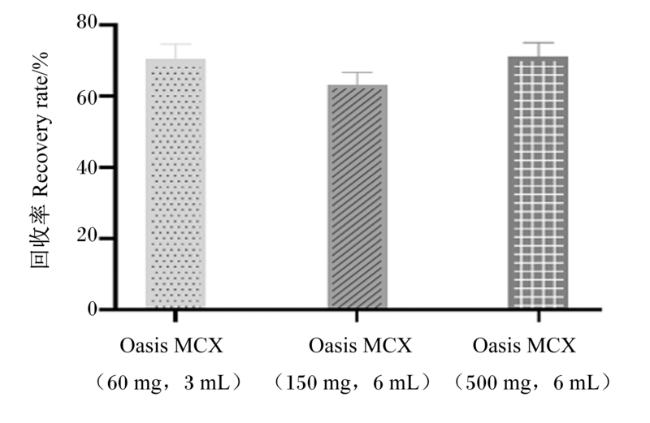
在此基础上,考察了不同规格的MCX SPE小柱的净化效果,选取了Oasis MCX(60 mg,3 mL)、Oasis MCX(150 mg,6 mL)和Oasis MCX(500 mg,6 mL)3种不同规格的SPE小柱对猪配合饲料提取液进行净化。称取猪配合饲料空白饲料2份,各2.50 g,置于50 mL塑料离心管中,其中一份添加625 μL浓度为4 000 μg/mL(饲料中最高添加水平为1 000.0 mg/kg)的大观霉素,室温放置过夜。按样品试验步骤1.3进行处理。用空白饲料提取液将对应规格的MCX SPE小柱净化后复溶液稀释10倍后上机测定。试验结果表明:3种不同规格MCX SPE小柱在相同的洗脱体系下均能获得60%~70%的回收率(图10),可见Oasis MCX的最小规格即可对最高浓度添加(1 000.0 mg/kg)的大观霉素进行有效的净化。因此选择Oasis MCX(60 mg,3 mL)用于提取液的净化。
图10 不同规格MCX SPE小柱对大观霉素回收率的影响(添加1 000.0 mg/kg)

Fig.10 Effects of MCX SPE columns with different specifications on recovery rate of spectinomycin (spiking 1 000.0 mg/kg)

2.6 基质的影响

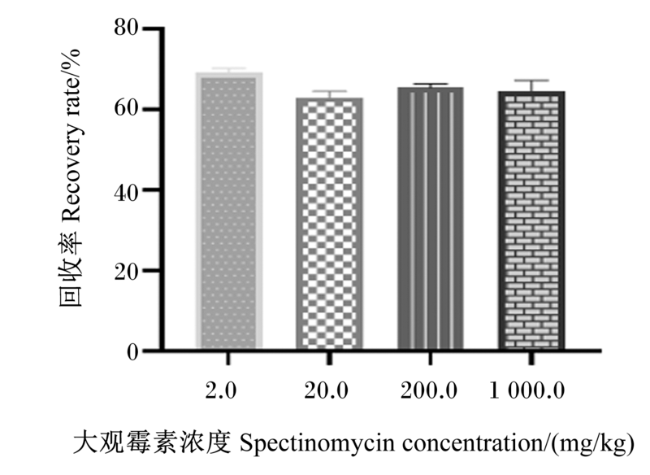
溶剂标准工作曲线、空白基质标准工作曲线、基质匹配标准工作曲线方程、相关系数(R2)和基质效应见表3。结果表明:一方面,不同种类的饲料基质会对大观霉素产生大小不一的增强或抑制效应;另一方面,除了鸡浓缩饲料中基质效应为0.67外,其余饲料中基质效应为0.81~1.13,即其他饲料基质未产生明显的增强或抑制效应。但对空白鸡配合饲料分别添加4个浓度(2.0、20.0、200.0和1 000.0 mg/kg)的大观霉素,经前处理后的复溶液与其相应的溶剂标准溶液(0.1、1.0、5.0和10.0 μg/mL)比较发现,回收率仅为60%~70%(图11);而如表3所示,基质匹配标准工作曲线方程在0.1~10.0 μg/mL内,线性关系良好(R2均大于0.99)。综上所述,采用基质匹配标准工作曲线对饲料中大观霉素进行定量分析。
表3 不同饲料基质中大观霉素的标准曲线方程、相关系数和基质效应

Table 3 Calibration curve equation, regression coefficient and matrix effect of spectinomycin in different feed substrates

饲料样品
Feed samples
溶剂标准曲线方程
Solvent calibration
curve equation
相关系数
Regression
coefficient
(R2)
空白基质标准曲线方程
Blank matrix
calibration
curve equation
相关系数
Regression
coefficient (R2)
基质效应
Matrix
effect/%
基质匹配标准曲线方程
Matrix-match
calibration curve
equation
相关系数
Regression
coefficient
(R2)
鸡配合饲料
Compound feed for chicken
y=8 128.9x-3 023.4 0.993 1 y=6 613.2x-2 232.9 0.990 4 0.81 y=5 607.4x-1 759.6 0.995 0
鸡预混合饲料
Premix for chicken
y=8 298.3x-2 800.8 0.993 0 y=5 532.2x-1 867.2 0.993 0 0.96 y=5 709.6x-973.3 0.996 8
鸡浓缩饲料
Concentrated feed for chicken
y=8 260.2x-2 757.5 0.994 4 y=7 891.3x-1 045.2 0.996 8 0.67 y=6 477.9x-1 004.3 0.997 7
猪配合饲料
Compound feed for pig
y=8 228.3x-2 970.1 0.994 4 y=9 265.7x-857.2 0.999 5 1.13 y=6 437.8x-448.7 0.999 6
猪预混合饲料
Premix for pig
y=8 173.2x-2 564.4 0.995 8 y=7 092.9x+4 313.3 0.993 0 0.87 y=4 142.9x-1 268.8 0.994 5
奶牛精料补充料
Concentrate supplement for cow
y=8 314.6x-2 748.3 0.994 9 y=6 225.8x-541.4 0.993 0 1.11 y=3 349.5x-1 495.4 0.992 0

线性范围:0.1~10.0 μg/mL。

Linear range: 0.1 to 10.0 μg/mL.

图11 饲料中大观霉素不同添加水平回收率

Fig.11 Recovery rate of spectinomycin at different spiked levels

2.7 线性方程和线性范围

添加系列大观霉素标准溶液至空白饲料样品中,经提取、净化等处理后得到理论添加浓度为0、0.1、0.2、0.5、1.0、2.0、5.0和10.0 μg/mL的标准溶液,在线性范围0.1~10.0 μg/mL,大观霉素的标准工作曲线见表3,R2均大于0.99。

2.8 方法的检出限和定量限

向空白试样中添加大观霉素使之添加浓度为2.0 mg/kg,其信躁比(S/N)均大于10,并且经前处理后其浓度在线性范围内,该方法的检出限则根据S/N=3,确定的检出限可达到1.0 mg/kg。所以最终确定方法的定量限为2.0 mg/kg,检出限为1.0 mg/kg。

2.9 方法的准确度和精密度

选用畜禽配合饲料、浓缩饲料、精料补充料和预混合饲料分别进行加标回收试验,每种饲料采用不同的添加浓度,每个添加浓度制备6个平行样品,结果见表4。结果表明,在1.0~1 000.0 mg/kg添加浓度范围内,大观霉素回收率为91.3%~104.2%,RSD为1.5%~9.4%。由此可见,回收率和重复性较好,说明本方法能满足饲料中大观霉素含量测定需要。
表4 饲料样品中的大观霉素回收率

Table 4 Recovery rate of spectinomycin in feed samples (n=6)%

添加水平
Spiking levels/
(mg/kg)
鸡配合饲料
Compound feed for chicken
鸡预混料
Premix for chicken
鸡浓缩饲料
Concentrated feed for chicken
回收率
Recovery rate
相对标准偏差
RSD
回收率
Recovery rate
相对标准偏差
RSD
回收率
Recovery rate
相对标准偏差
RSD
2.0 104.2 3.6 91.7 7.5 91.7 5.6
20.0 91.7 7.9 91.3 9.4 95.8 8.0
200.0 92.6 8.3 98.8 4.5 98.3 5.7
1 000.0 92.2 5.0 92.0 7.4 94.1 7.6
添加水平
Spiking levels/
(mg/kg)
猪配合饲料
Compound feed for pig
猪预混料
Premix for pig
奶牛精料补充料
Concentrate supplement for cow
回收率
Recovery rate
相对标准偏差
RSD
回收率
Recovery rate
相对标准偏差
RSD
回收率
Recovery rate
相对标准偏差
RSD
2.0 93.3 8.1 93.3 5.5 94.2 4.0
20.0 100.3 5.8 99.8 6.0 95.3 7.2
200.0 95.6 3.4 95.0 3.9 96.6 1.5
1 000.0 96.3 6.4 103.4 5.7 98.0 4.4

3 讨论

3.1 流动相的组成

据文献报道,在流动相中使用甲酸铵或乙酸铵有助于改善氨基糖苷类物质在HILIC分离过程中的峰形和离子化[43]。因此,为解决上述色谱峰拖尾的问题,本研究在优化参考文献[14]分析氨基糖苷类化合物所使用的甲酸-挥发性铵盐-水-乙腈的流动相体系基础上,采用了甲酸-甲酸铵-水-乙腈流动相体系,即在甲酸铵水溶液和甲酸铵乙腈/水溶液中均加入0.4%甲酸。在试验过程中发现,随着流动相中有机相比例增加,大观霉素保留时间变大,梯度洗脱起始阶段使用高比例有机相,延长了大观霉素在色谱柱上的保留,后期逐渐提高水相比例,促进了大观霉素出峰。同时,HILIC因为流动相中富含有机溶剂,增强了去溶剂和离子源的离子化效率,从而获得更高的灵敏度[38]

3.2 样品前处理条件

TCA溶液作为一种蛋白沉淀剂常用于目标化合物的提取,而氨基糖苷类物质又能够在酸性环境下稳定存在[24],因此,TCA溶液被用作饲料中的大观霉素[22,24,42]提取液。低浓度的TCA溶液不能有效的沉淀蛋白质,并且混浊的提取液往往造成SPE小柱的堵塞,太高浓度的TCA溶液则引入较高强度的离子而影响SPE小柱的净化效果[24],因此,TCA溶液浓度至关重要。此外,在TCA溶液中往往加入EDTA-2Na[41,44],对于提取液中加入EDTA-2Na的作用机制还不是十分明确[41],有研究认为其作用是络合金属离子,但又有学者认为在低pH环境下,EDTA-2Na络合能力比较有限[24]。此外,考虑到后续的样品净化,一些提取液在净化前还需要对其pH进行严格的控制[24]。因此,本研究对上样溶液的pH进行了考察。

3.3 固相萃取柱的选择

饲料样品提取过程中的基质杂质可能会在色谱柱上吸附,不能被洗脱,造成色谱柱柱效降低,同时造成系统压力升高,另外无机盐类也会抑制质谱信号。2% TCA作为提取液只能沉淀部分蛋白质,还需要进一步净化。氨基糖苷类物质具有强极性和弱碱性,对这些化合物的净化涉及离子交换机制,常用的反相SPE往往不能凑效,而需要使用阳离子交换SPE取而代之[38]。通常采用弱阳离子交换[44]和强阳离子交换SPE小柱[27]。当采用强阳离子交换SPE小柱时,氨基糖苷类化合物与填料上的磺酸基位点结合牢固,使得定量洗脱困难[38]。而当采用弱阳离子交换SPE小柱时,需要对上样溶液的pH进行严格的控制,一方面需要确保离子交换小柱的去质子化,另一方面需要使氨基糖苷类化合物质子化而在SPE小柱上得以保留[24]
本试验发现,未经固相萃取柱净化的样品会产生较强的基质效应[43],造成色谱柱污染,峰形变宽、柱压升高以及灵敏度下降等一系列问题。在这种情况下,本试验在参考文献[10-11]的基础上,尝试了3种规格的MCX固相萃取柱3CC(60 mg)、6CC(150 mg)和6CC(500 mg),结果发现2种6CC规格的固相萃取柱需要更多的洗脱液,而样品经3CC(60 mg)规格的固相萃取柱净化后可完全消除基质效应,并且得到可靠的试验结果。因此,从效率和经济的角度考虑,本试验最终选择了3CC(60 mg)这个规格的MCX固相萃取柱用于饲料样品的净化。

3.4 样品基质效应

试验比较了溶剂标准工作曲线、空白基质标准工作曲线和基质匹配标准工作曲线,空白基质标准工作曲线斜率与溶剂标准工作曲线的比值反映基质效应的强弱,基质匹配法作为基质校准的替代方法旨在补偿基质效应和回收率损失。基质匹配法选取类型相同,均匀一致、且在大观霉素保留时间处,质谱响应值小于方法定量限30%的饲料样品,作为空白样品。第1次分析时,制备基质匹配标准溶液首先对残留物量进行初步分析,根据分析结果确定标准物质添加量,使得添加到试验部分的标准物质为已存在于样品中的残留物估计量的1~5倍。

4 结论

① 本试验采用2% TCA水溶液(含EDTA-2Na)提取饲料中的大观霉素,并将提取液的pH调节至(4.7±0.2),经MCX固相萃取柱净化,成功建立了提取和净化程序。
② 试样经HILIC色谱柱分离,流动相为0.01 mol/L甲酸铵水溶液(含0.4%甲酸)-0.01 mol/L甲酸铵乙腈-水溶液(含0.4%甲酸),梯度洗脱,以ESI正离子扫描方式,在MRM模式下进行测定,成功建立了仪器分析方法。
③ 本试验通过基质匹配外标法校正基质干扰,通过UPLC-MS/MS分析,建立了定量测定饲料中大观霉素的方法;该方法中大观霉素的检出限和定量限分别为1.0和2.0 mg/kg。
④ 大观霉素在1.0~10.0 μg/mL线性关系良好,R2均大于0.99;在4个浓度(2.0、20.0、200.0和1 000.0 mg/kg)进行添加试验,大观霉素的回收率为91.3%~104.2%,RSD为1.5%~9.4%。
综上所述,本试验建立的SPE-UPLC-MS/MS法操作简单,准确度高,可应用于饲料中大观霉素的快速定量分析。
[1]
MOLOGNONI L, DE SOUZA N C, DE SÁ PLOÊNCIO L A, et al. Simultaneous analysis of spectinomycin,halquinol,zilpaterol,and melamine in feedingstuffs by ion-pair liquid chromatography-tandem mass spectrometry[J]. Journal of Chromatography A, 2018, 1569:110-117.

DOI

[2]
MOLOGNONI L, DAGUER H, DE SÁ PLOÊNCIO L A, et al. A multi-purpose tool for food inspection:simultaneous determination of various classes of preservatives and biogenic amines in meat and fish products by LC-MS[J]. Talanta, 2018, 178:1053-1066.

DOI

[3]
PREU M, GUYOT D, PETZ M. Development of a gas chromatography-mass spectrometry method for the analysis of aminoglycoside antibiotics using experimental design for the optimisation of the derivatisation reactions[J]. Journal of Chromatography A, 1998, 818(1):95-108.

PMID

[4]
FAROUK F, AZZAZY H M E, NIESSEN W M A. Challenges in the determination of aminoglycoside antibiotics,a review[J]. Analytica Chimica Acta, 2015, 890:21-43.

DOI

[5]
POSYNIAK A, ZMUDZKI J, NIEDZIELSKA J. Sample preparation for residue determination of gentamicin and neomycin by liquid chromatography[J]. Journal of Chromatography A, 2001, 914(1/2):59-66.

DOI

[6]
VIÑAS P, BALSALOBRE N, HERNÁNDEZ-CÓRDOBA M. Liquid chromatography on an amide stationary phase with post-column derivatization and fluorimetric detection for the determination of streptomycin and dihydrostreptomycin in foods[J]. Talanta, 2007, 72(2):808-812.

DOI PMID

[7]
KIM B H, KIM Y K, OK J H. Development of liquid chromatographic method for the analysis of kanamycin residues in varicella vaccine using phenylisocyanate as a derivatization reagent[J]. Journal of Chromatography B:Biomedical Sciences and Applications, 2001, 752(1):173-177.

DOI

[8]
CAI Y Q, CAI Y, CHENG J, et al. Comparative study on the analytical performance of three waveforms for the determination of several aminoglycoside antibiotics with high performance liquid chromatography using amperometric detection[J]. Journal of Chromatography A, 2005, 1085(1):124-130.

PMID

[9]
SARRI A K, MEGOULAS N C, KOUPPARIS M A. Development of a novel method based on liquid chromatography-evaporative light scattering detection for the direct determination of streptomycin and dihydrostreptomycin in raw materials,pharmaceutical formulations,culture media and plasma[J]. Journal of Chromatography A, 2006, 1122(1/2):275-278.

DOI

[10]
SERRANO J M, SILVA M. Rapid and sensitive determination of aminoglycoside antibiotics in water samples using a strong cation-exchange chromatography non-derivatisation method with chemiluminescence detection[J]. Journal of Chromatography A, 2006, 1117(2):176-183.

PMID

[11]
ZHU W X, YANG J Z, WEI W, et al. Simultaneous determination of 13 aminoglycoside residues in foods of animal origin by liquid chromatography-electrospray ionization tandem mass spectrometry with two consecutive solid-phase extraction steps[J]. Journal of Chromatography A, 2008, 1207(1/2):29-37.

DOI

[12]
TKACHENKO A, CLARK J, KNUTSON N, et al. Investigation of melamine and cyanuric acid deposition in pig tissues using LC-MS/MS methods[J]. Food and Chemical Toxicology, 2015, 80:310-318.

DOI PMID

[13]
VALESE A C, MOLOGNONI L, DE SOUZA N C, et al. Development, validation and different approaches for the measurement uncertainty of a multi-class veterinary drugs residues LC-MS method for feeds[J]. Journal of Chromatography. B, Analytical Technologies in the Biomedical and Life Sciences, 2017, 1053:48-59.

DOI

[14]
CHEN L Y, CHEN H S, SHEN M. Hydrophilic interaction chromatography combined with tandem mass spectrometry method for the quantification of tobramycin in human plasma and its application in a pharmacokinetic study[J]. Journal of Chromatography B:Analytical Technologies in the Biomedical and Life Sciences, 2014, 973C:39-44.

[15]
BUSZEWSKI B, NOGA S. Hydrophilic interaction liquid chromatography (HILIC)—a powerful separation technique[J]. Analytical and Bioanalytical Chemistry, 2012, 402(1):231-247.

DOI

[16]
STYPULKOWSKA K, BLAZEWICZ A, BRUDZIKOWSKA A, et al. Development of high performance liquid chromatography methods with charged aerosol detection for the determination of lincomycin, spectinomycin and its impurities in pharmaceutical products[J]. Journal of Pharmaceutical and Biomedical Analysis, 2015, 112:8-14.

DOI PMID

[17]
VAN DE STEENE J C, MORTIER K A, LAMBERT W E. Tackling matrix effects during development of a liquid chromatographic-electrospray ionisation tandem mass spectrometric analysis of nine basic pharmaceuticals in aqueous environmental samples[J]. Journal of Chromatography a, 2006, 1123(1):71-81.

PMID

[18]
BENIJTS T, DAMS R, LAMBERT W, et al. Countering matrix effects in environmental liquid chromatography-electrospray ionization tandem mass spectrometry water analysis for endocrine disrupting chemicals[J]. Journal of Chromatography A, 2004, 1029(1/2):153-159.

DOI

[19]
FERRER C, LOZANO A, AGÜERA A, et al. Overcoming matrix effects using the dilution approach in multiresidue methods for fruits and vegetables[J]. Journal of Chromatography A, 2011, 1218(42):7634-7639.

DOI PMID

[20]
WU J M, QIAN X Q, YANG Z G, et al. Study on the matrix effect in the determination of selected pharmaceutical residues in seawater by solid-phase extraction and ultra-high-performance liquid chromatography-electrospray ionization low-energy collision-induced dissociation tandem mass spectrometry[J]. Journal of Chromatography A, 2010, 1217(9):1471-1475.

DOI PMID

[21]
MARÍN J M, GRACIA-LOR E, SANCHO J V, et al. Application of ultra-high-pressure liquid chromatography-tandem mass spectrometry to the determination of multi-class pesticides in environmental and wastewater samples.Study of matrix effects[J]. Journal of Chromatography A, 2009, 1216(9):1410-1420.

DOI

[22]
LOU X Y, TANG Y Y, FANG C L, et al. Simultaneous determination of ten aminoglycoside antibiotics in aquatic feeds by high-performance liquid chromatography quadrupole-orbitrap mass spectrometry with pass-through cleanup[J]. Chirality, 2020, 32(3):324-333.

DOI PMID

[23]
DÍEZ C, GUILLARME D, STAUB SPÖRRI A, et al. Aminoglycoside analysis in food of animal origin with a zwitterionic stationary phase and liquid chromatography-tandem mass spectrometry[J]. Analytica Chimica Acta, 2015, 882:127-139.

DOI PMID

[24]
KAUFMANN A, BUTCHER P, MADEN K. Determination of aminoglycoside residues by liquid chromatography and tandem mass spectrometry in a variety of matrices[J]. Analytica Chimica Acta, 2012, 711:46-53.

DOI PMID

[25]
中华人民共和国农业部. 饲料中大观霉素的测定:农业部2086号公告-7—2014[S]. 北京: 中国农业出版社, 2014.

Ministry of Agriculture of the People's Republic of China. Determination of spectinomycin in feeds:Ministry of Agriculture Announcement No.2086-7—2014[S]. Beijing: China Agricultural Publishing House, 2014. (in Chinese)

[26]
VARGA E, FODOR P, SOROS C. Multi-mycotoxin LC-MS/MS method validation and its application to fifty-four wheat flours in Hungary[J]. Food Additives and Contaminants Part A:Chemistry Analysis Control Exposure & Risk Assessment, 2021, 38(4):670-680.

[27]
FRENICH A G, ROMERO-GONZÁLEZ R, GÓMEZ-PÉREZ M L, et al. Multi-mycotoxin analysis in eggs using a QuEChERS-based extraction procedure and ultra-high-pressure liquid chromatography coupled to triple quadrupole mass spectrometry[J]. Journal of Chromatography A, 2011, 1218(28):4349-4356.

DOI PMID

[28]
SAVOY M C, WOO P M, ULRICH P, et al. Determination of 14 aminoglycosides by LC-MS/MS using molecularly imprinted polymer solid phase extraction for clean-up[J]. Food Additives and Contaminants Part A:Chemistry Analysis Control Exposure & Risk Assessment, 2018, 35(4):675-686.

[29]
鲍颖, 王静康, 黄向荣, 等. 盐酸大观霉素的晶体结构[J]. 华东理工大学学报(自然科学版), 2003, 29(4):336-340.

BAO Y, WANG J K, HUANG X R, et al. Crystal structure of spectinomycin dihydrochloride[J]. Journal of East China University of Science and Technology(Natural Science), 2003, 29(4):336-340. (in Chinese)

[30]
MOKH S, EL HAWARI K, NASSAR R, et al. Optimization of a solid-phase extraction method for the determination of 12 aminoglycosides in water samples using LC-ESI-MS/MS[J]. Chromatographia, 2015, 78(9):631-640.

DOI

[31]
DE ALWIS H, HELLER D N. Multiclass, multiresidue method for the detection of antibiotic residues in distillers grains by liquid chromatography and ion trap tandem mass spectrometry[J]. Journal of Chromatography A, 2010, 1217(18):3076-3084.

DOI PMID

[32]
SHAO B, CHEN D, ZHANG J, et al. Determination of 76 pharmaceutical drugs by liquid chromatography-tandem mass spectrometry in slaughterhouse wastewater[J]. Journal of Chromatography A, 2009, 1216(47):8312-8318.

DOI PMID

[33]
WANG Y, LI S H, ZHANG F F, et al. Study of matrix effects for liquid chromatography-electrospray ionization tandem mass spectrometric analysis of 4 aminoglycosides residues in milk[J]. Journal of Chromatography a, 2016, 1437:8-14.

DOI PMID

[34]
PAOLETTI F, SDOGATI S, BAROLA C, et al. Development and validation of a multiclass confirmatory method for the determination of over 60 antibiotics in eggs using liquid-chromatography high-resolution mass spectrometry[J]. Food Control, 2021, 127:108109.

[35]
WANG J, LEUNG D, CHOW W, et al. Development and validation of a multiclass method for analysis of veterinary drug residues in milk using ultrahigh performance liquid chromatography electrospray ionization quadrupole orbitrap mass spectrometry[J]. Journal of Agricultural and Food Chemistry, 2015, 63(41):9175-9187.

DOI PMID

[36]
WANG X R, YANG S P, LI Y, et al. Optimization and application of parallel solid-phase extraction coupled with ultra-high performance liquid chromatography-tandem mass spectrometry for the determination of 11 aminoglycoside residues in honey and royal jelly[J]. Journal of Chromatography A, 2018, 1542:28-36.

DOI PMID

[37]
GAJDA A, NOWACKA-KOZAK E, GBYLIK-SIKORSKA M, et al. Multi-residues UHPLC-MS/MS analysis of 53 antibacterial compounds in poultry feathers as an analytical tool in food safety assurance[J]. Journal of Chromatography B, 2019, 1104:182-189.

DOI PMID

[38]
YANG B X, WANG L, LUO C Y, et al. Simultaneous determination of 11 aminoglycoside residues in honey,milk,and pork by liquid chromatography with tandem mass spectrometry and molecularly imprinted polymer solid phase extraction[J]. Journal of AOAC International, 2017, 100(6):1869-1878.

DOI

[39]
魏莉莉, 薛霞, 武传香, 等. 混合型离子交换液相色谱-串联质谱法检测鸡蛋中10种氨基糖苷类药物残留[J]. 色谱, 2021, 39(12):1374-1381.

DOI

WEI L L, XUE X, WU C X, et al. Determination of ten aminoglycoside residues in eggs by mixed-mode ion exchange liquid chromatography-tandem mass spectrometry[J]. Chinese Journal of Chromatography, 2021, 39(12):1374-1381. (in Chinese)

DOI

[40]
LÓPEZ-SERNA R, PÉREZ S, GINEBREDA A, et al. Fully automated determination of 74 pharmaceuticals in environmental and waste waters by online solid phase extraction-liquid chromatography-electrospray-tandem mass spectrometry[J]. Talanta, 2010, 83(2):410-424.

DOI

[41]
ISHII R, HORIE M, CHAN W, et al. Multi-residue quantitation of aminoglycoside antibiotics in kidney and meat by liquid chromatography with tandem mass spectrometry[J]. Food Additives & Contaminants Part A:Chemistry Analysis Control Exposure & Risk Assessment, 2008, 25(12):1509-1519.

[42]
KUMAR P, RÚBIES A, COMPANYÓ R, et al. Determination of aminoglycoside residues in kidney and honey samples by hydrophilic interaction chromatography-tandem mass spectrometry[J]. Journal of Separation Science, 2012, 35(20):2710-2717.

DOI PMID

[43]
MORENO-GONZÁLEZ D, HAMED A M, GARCÍA-CAMPAÑA A M, et al. Evaluation of hydrophilic interaction liquid chromatography-tandem mass spectrometry and extraction with molecularly imprinted polymers for determination of aminoglycosides in milk and milk-based functional foods[J]. Talanta, 2017, 171:74-80.

DOI

[44]
BABIN Y, FORTIER S. A high-throughput analytical method for determination of aminoglycosides in veal tissues by liquid chromatography/tandem mass spectrometry with automated cleanup[J]. Journal of AOAC International, 2007, 90(5):1418-1426.

PMID

Outlines

/