REVIEW

Research Progress on Change Rules of Glucose-Lipid Metabolism of Ketosis in Dairy Cows and Nutritional Regulation

  • KONG Fanlin , 1 ,
  • WEI Yong 2 ,
  • WANG Wei 1 ,
  • LI Shengli , 1, *
Expand
  • 1 Beijing Engineering Technology Research Center of Raw Milk Quality and Safely Control, State Key Laboratory of Animal Nutrition, College of Animal Science and Technology, China Agricultural University, Beijing 100193, China
  • 2 Xinjiang Tianrun Dairy Co., Ltd., Urumuqi 830000, China
*professor, E-mail:

Received date: 2022-09-06

  Online published: 2023-04-12

Abstract

Transition dairy cows are characteristic as complex changes of internal metabolism and drastic changes of environment, which always lead to high mortality. Hence, the regulation of transition period is the “window period” to support health of dairy cows, and guarantee the economic benefits. Ketosis is one of the most high-incidence and massive disease during transition period, and the happen and cure processes of ketosis make the great threat to cow welfare and economic benefits. Therefore, this review described the change rules of glucose-lipid metabolism during transition and concluded the features of dairy cows with ketosis and the latest research findings. The intent was to provide theoretical basis for us to control the glucose-lipid metabolism and prevent dairy cows from ketosis during transition period.

Cite this article

KONG Fanlin , WEI Yong , WANG Wei , LI Shengli . Research Progress on Change Rules of Glucose-Lipid Metabolism of Ketosis in Dairy Cows and Nutritional Regulation[J]. Chinese Journal of Animal Nutrition, 2023 , 35(4) : 2041 -2052 . DOI: 10.12418/CJAN2023.191

我国既是奶牛养殖大国,也是奶牛养殖强国。根据国家奶牛产业技术体系调研结果显示,我国2020年规模化牧场奶牛年均单产达到9.6 t,其在世界范围内处于中高水平;同时,奶牛养殖规模不断扩大,平均存栏数高达2 203.3头[1]。相关数据均说明我国奶业发展正朝着集约化和机械化迈进。此外,2021年我国乳制品总需求量首次超过6 000万t,与2020年相比增幅高达10.9%[2],乳制品消费需求的快速增长进一步为乳业发展提供了增长潜力。然而,奶牛养殖集约化及智能化发展模式下同样存在诸多问题,我国多地区规模化牧场的成母牛平均利用胎次约为2.7胎[3-4],而研究表明获得最佳经济效益的胎次为5胎[5]。因此,高淘汰率和利用年限短是目前我国奶牛养殖发展的特点之一。
马佳莹[4]对我国百头以上牧场成母牛淘汰原因进行调查后发现,淘汰成母牛的泌乳天数主要分布在产后60 d内和450 d以上,二者占总淘汰率的40%以上;其中,奶牛在产后450 d后淘汰的主要原因为繁殖问题,产后60 d内淘汰的主要原因为消化代谢疾病。因此,奶牛围产期消化代谢病及导致的繁殖障碍是制约奶业发展的重要因素。在围产期阶段,奶牛一方面需要适应包括激素、体脂动员等在内的机体内部变化,另一方面还需要适应包括更换圈舍和饲粮等在内的外部变化,以上特征导致围产期成为确保后期充分发挥泌乳性能的调控“窗口期”,这一阶段奶牛的饲养管理也因此显得极为重要和关键。
围产后期奶牛由于多种原因造成采食量不足,但泌乳营养需求的快速提升导致奶牛体脂大量动员,该过程一方面为乳脂合成提供前体物质,另一方面通过非酯化脂肪酸(non-esterified fatty acid,NEFA)的不完全氧化产生酮体,用于弥补机体能量供给不足[6]。但酮体[β-羟基丁酸(BHBA)、丙酮和乙酰乙酸]在体循环中的大量堆积对生产性能和繁殖性能有严重损害,酮病(包括亚临床酮病和临床酮病)是我国奶牛养殖中群发性且高发性疾病之一,调查结果表明我国部分地区酮病发病率在9.82%~20.00%[7-8],且研究表明酮病与多种产后疾病相关联[9-10],中国治疗酮病的成本为每头奶牛3 200元[11],酮病每年造成我国奶牛场经济损失超11亿元[12]。加之我国奶业发展正处于高速发展阶段,急需更加清楚了解酮病的严重性及病牛的代谢特征,从而有效预防该病的发生。本文将总结国内外围产期奶牛糖、脂代谢最新的研究进展,旨在通过阐明围产期奶牛糖、脂代谢主要器官的动态变化并在此基础上揭示酮病奶牛的代谢特征,为预防和治疗酮病提供科学思路和作用靶点,最终提高我国奶牛使用寿命和终身产奶量。

1 酮病奶牛各组织器官糖、脂代谢变化规律

1.1 瘤胃糖、脂代谢变化规律

奶牛进入围产期后瘤胃乳头面积显著下降,从产后10 d开始瘤胃乳头面积逐渐恢复[13]。当产前高粗料比例饲粮转化为产后高精料比例饲粮时,微生物丰富度分析揭示围产后期奶牛菌群丰富度与围产前期相比显著降低,瘤胃拟杆菌门与厚壁菌门的比例由围产前期的6∶1提高到围产后期的12∶1;变形菌门丰度提高,表现为围产后期丙酸产量增多,且拟杆菌门中普雷沃氏菌属与丙酸盐含量和比例之间呈极显著正相关,瘤胃球菌属与乙酸盐含量呈正相关,发酵模式的改变通过增加氢离子竞争而改变古菌区系,如产甲烷杆菌数量增加[14-15]。以上研究说明,瘤胃微生物区系在围产后期倾向于产生丙酸,而丙酸可通过肝脏糖异生作用弥补葡萄糖需要。Gebreyesus等[16]发现,瘤胃微生物组成相比宿主遗传更能解释牛奶中丙酮和BHBA含量的变化,相关研究证明血清中BHBA与瘤胃中乙酸、丙酸、丁酸和乙酸与丙酸比存在相关性[17],其根本原因在于瘤胃发酵所产生的挥发性脂肪酸广泛参与糖、脂代谢过程中[18]。以上研究结果提示围产期奶牛瘤胃发酵模式改变与酮病之间存在关联性。
研究进一步对围产期健康、酮病及泌乳高峰奶牛瘤胃微生物进行16S rRNA测序后发现,酮病奶牛瘤胃中产丙酸微生物包括埃氏巨球形菌(Megasphaera elsdenii)和反刍兽新月形单胞菌(Selenomonas ruminantium)相对丰度显著降低,牛链球菌(Streptococcus bovis)作为产乳酸菌相对丰度显著升高[19]。使用代谢组学对酮病奶牛瘤胃中代谢物分布进行分析后发现,酮病奶牛瘤胃液中能量类物质(乙酸、葡萄糖和丙酸)含量显著降低[20],由于葡萄糖及其前体物是预防和治疗酮病的主要手段,该研究结果表明围产后期奶牛瘤胃发酵模式的变化可能在酮病发生中发挥作用。此外,奶牛个体差异已在多个研究中报道[21-22],奶牛瘤胃微生物区系在围产期需要接受机体内部及外部变化的双重刺激且变化剧烈,奶牛个体差异是否在酮病发生中发挥作用还需进一步研究。

1.2 脂肪组织糖、脂代谢变化规律

1.2.1 重量变化

脂肪组织以脂质的形式储存能量,同时也是奶牛的免疫和内分泌器官,参与奶牛机体供能、免疫、炎症反应和氧化应激[13]。研究发现,围产后期奶牛将动员30%的脂肪组织用于弥补能量不足[23],但过量脂肪动员也是导致酮病的主要原因。体况评分(body condition scoring,BCS)被广泛用于监控围产期奶牛的脂肪组织变化,具有快速和廉价的特点,可以近似评估奶牛皮下脂肪量,1单位BCS(5分制)对应40~55 kg的脂肪[24]。已有大量研究探究奶牛围产期不同体况对泌乳性能、繁殖性能、疾病发病率和产后死淘率等的影响,结果表明围产期奶牛BCS理想值为3.25,推荐范围为3.0~3.5[25]。其中,奶牛产犊时BCS低于3.0与生产和繁殖性能下降有关,大于3.5与干物质采食量和泌乳性能减少以及代谢紊乱有关[26]。然而,研究表明具有相同BCS奶牛的总腹部脂肪或内脏脂肪重量可相差2倍[27],进一步研究表明腹部脂肪组织重量始终大于皮下脂肪重量,且围产后期奶牛腹部脂肪动员优先级要高于皮下脂肪[28]。因此,使用BCS监控围产期奶牛体脂动员和预防酮病仍缺乏准确性。但除屠宰试验外,目前仍缺乏非侵入性且稳定的检测手段用于腹部脂肪组织重量的测定,未来开发用于评估奶牛各脂肪组织重量的方法或仪器将有助于精准制定饲养管理计划。

1.2.2 糖、脂代谢变化

Kenéz等[29]发现,围产后期奶牛胰岛素传导信号相关蛋白含量下调,表明脂肪组织发生胰岛素抵抗,且葡萄糖转运蛋白4在围产后期表达降低[30],这进一步削弱了胰岛素依赖的葡萄糖摄取过程,因此围产期奶牛胰岛素-葡萄糖系统的顺势变化可确保葡萄糖流向乳腺。Karis等[31]对奶牛围产期脂肪组织脂质代谢基因表达量进行测定,与产前相比,产后脂肪组织中能量释放相关基因显著上调,且脂肪生成相关基因表达量下调。与健康奶牛相比,研究表明酮病奶牛皮下脂肪中磷酸化激素敏感性脂肪酶与非磷酸化激素敏感性脂肪酶比例显著上调,且三酰甘油脂肪酶蛋白含量显著上调[32],这说明患酮病奶牛脂肪组织进一步分解。

1.2.3 脂肪因子变化

脂肪组织产生和分泌的信号因子称为脂肪因子,包括细胞因子、激素、生长因子及趋化因子等。目前对于脂肪因子在围产期的动态变化主要来源于mRNA水平,其关键在于蛋白质水平上检测方法的限制[33]表1汇总了围产期奶牛脂肪组织释放的主要脂肪因子及其功能、围产后期脂肪因子的变化以及酮病奶牛脂肪因子的变化[34-43],可以发现脂肪因子功能繁多,广泛参与调节脂质稳态、胰岛素敏感性、葡萄糖代谢、脂肪分布和炎症反应[33],且各个脂肪因子在围产后期的变化表现不一,脂联素和瘦素在脂肪组织中表达量下降且在血液中含量同时下降,而成纤维细胞生长因子21、趋化素和抵抗素在围产期血液中含量升高。此外,脂肪因子在患酮病期间同样出现差异,脂联素含量降低,瘦素无显著变化[34],而成纤维细胞生长因子21、趋化素和抵抗素含量升高[35-37]。如表1中脂肪因子功能所示,酮病奶牛血液中脂联素和抵抗素的变化与促进脂肪分解相关。
表1 围产期奶牛脂肪因子功能和变化

Table 1 Functions and changes of adipokines during transition period

脂肪因子
Adipokines
功能
Functions[33]
围产期变化
Transition period changes
酮病变化
Changes under
ketosis
mRNA表达
mRNA
expression
血液
Blood
文献
Literature
血液
Blood
文献
Literature
脂联素
Adiponectin
增强胰岛素敏感性,抗炎,增加
肝细胞和肌细胞中游离脂肪酸氧化,增加
葡萄糖摄取,增加脂肪生成和脂质储存
[34,38] [34]
瘦素
Leptin
促进脂肪分解和脂肪氧化,抑制
脂肪细胞分化和脂肪生成
[34,39] [34]
Apelin 抗炎,增加体组织对葡萄糖的吸收 * [40] * *
成纤维细胞生长因子21
Fibroblast growth factor 21
影响肝脏和骨骼肌的能量代谢、
葡萄糖稳态和胰岛素敏感性
[41] [35]
趋化素
Chemerin
调节免疫、炎症、脂肪生成和
葡萄糖代谢
[42] [36]
抵抗素
Resistin
通过中枢系统调控生殖和
代谢,其功能与瘦素类似
* [43] [37]

↓:降低 reduce;↑:上升 increase;—:无变化 no change;*:结果缺失 no results。

1.3 肝脏糖、脂代谢变化规律

1.3.1 脂肪酸代谢变化

肝脏对于围产期奶牛的重要性已被详细综述[18],研究表明产后21 d肝脏重量与产后10 d相比显著上升[13],围产期体脂和体蛋白动员后主要在肝脏中进行重新分配。体脂动员产生的脂肪酸在肝脏中有4条主要代谢途径:1)合成甘油三酯;2)组装为低密度脂蛋白从肝脏输出;3)完全氧化供能;4)不完全氧化生成酮体用于供能。全基因组关联分析发现荷斯坦奶牛肝脏中酰基辅酶A-胆固醇酰基转移酶2和胰岛素样生长因子1(insulin-like growth factor 1,IGF1)基因与酮病有关[44]。Piechotta等[45]进一步发现产后临床酮病奶牛产前血浆IGF1含量低于健康奶牛,这可能增加生长激素的分泌并促进产前脂肪分解,进而引发酮病。
Ha等[46]使用转录组学对围产期奶牛肝脏基因表达进行分析后发现,与分娩前相比,产后奶牛肝脏能量动员增强。此外,产后肉毒碱棕榈酰转移酶(carnitine palmitoyltransferase,CPT)1的显著表达表明线粒体脂肪酸代谢增强[47]。而酮病奶牛长链脂酰辅酶A合成酶表达显著提高,CPT1、CPT2、长链脂酰辅酶A脱氢酶、羟甲基戊二酰辅酶A合酶和乙酰辅酶A羧化酶的mRNA水平显著降低,这表明酮病奶牛产后脂肪酸β氧化减少并通过合成甘油三酯而引起脂肪肝[48]。进一步对亚临床酮病和临床酮病奶牛肝脏基因进行研究后发现,与健康奶牛相比,亚临床酮病奶牛过氧化物酶体增值物激活受体α及其靶基因CPT1ACPT2的表达水平显著提高,但在临床酮病奶牛中显著降低,且红油O染色发现临床酮病奶牛肝脏中脂质累积[49],这表明亚临床酮病奶牛肝脏脂肪β氧化增加,而临床酮病奶牛脂肪氧化显著降低且甘油三酯合成增加。以上研究结果表明,亚临床酮病及临床酮病奶牛肝脏脂质代谢并不相同,临床酮病奶牛肝脏易形成脂肪肝。此外,研究证明酮病奶牛肝脏中肿瘤坏死因子-α、一氧化氮合酶2、白细胞介素-18和白细胞介素-1β在酮病奶牛中显著表达,白细胞介素-10表达量下降,且NOD样受体热蛋白结构域相关蛋白3(NLRP3)和含半胱氨酸的天冬氨酸蛋白水解酶-1(Caspase-1)的mRNA表达量和蛋白表达量提高,Caspase-1的活性更高,表明酮病奶牛伴随发生核因子-κB(NF-κB)信号通路和NLRP3炎性小体的激活[50],然而炎性反应与酮病之间的因果关系尚未可知。进一步研究表明,患亚临床酮病奶牛线粒体自噬增强,而临床酮病奶牛肝脏中该途径受到抑制[51]。以上研究均说明,临床酮病及亚临床酮病奶牛肝脏代谢和基因表达方面均存在明显差异,临床酮病伴随脂肪肝和炎症的发生,且自噬相关通路受损,可能无法及时清除无用或有毒的细胞基质,而亚临床酮病与肝脏中脂肪酸氧化增加和自噬增加有关。

1.3.2 胆汁酸代谢变化

与产前3周相比,产后1周肝脏中胆固醇合成、胆汁酸合成、胆固醇转运、胆固醇酯化和参与极低密度脂蛋白组装相关基因的表达量上升,且肝脏中胆固醇含量在产后1周含量最高,随后逐渐下降[52]。杨威等[53]对产后健康奶牛和酮病奶牛血液生化指标进行比较,发现酮病奶牛产后3 d的血浆甘油三酯、总胆固醇和高密度脂蛋白胆固醇含量显著高于对照组,产后7、14和21 d的血浆葡萄糖含量显著低于对照组。胆汁酸在单胃动物肠道微生物稳态及调控靶器官糖、脂代谢的作用已详细综述[54],研究证明胆汁酸及其受体在控制能量稳态、炎症以及细胞增殖过程中有重要作用,且通过调节肝细胞和免疫细胞的细胞因子分泌进而发挥免疫调节作用。Reiter等[55]使用靶向代谢组学对多种动物各组织中胆汁酸分布进行检测,结果表明奶牛主要胆汁酸是以胆酸、牛磺胆酸和甘氨胆酸为主要成分的复合胆酸,该特征区别于禽类和猪。目前胆汁酸在调控围产期奶牛糖、脂代谢中的作用仍有待研究。

1.3.3 个体差异

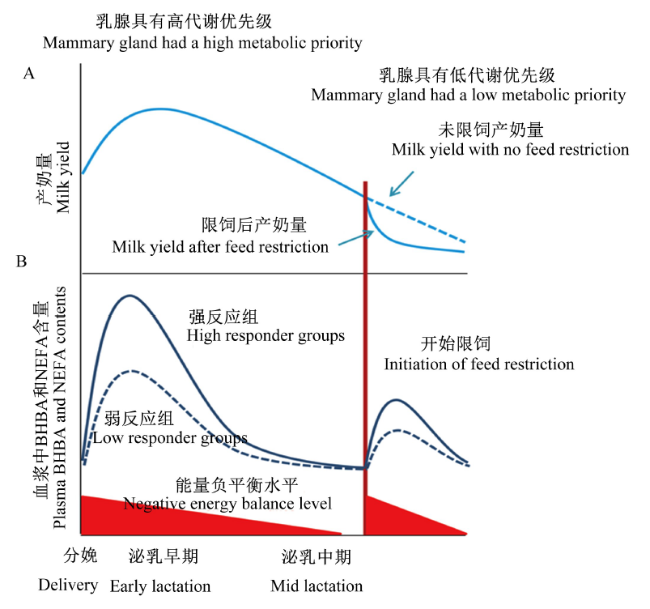
尽管我国奶牛养殖模式呈现规模化和集约化,但奶牛个体差异在围产期代谢紊乱中起到重要作用。Graber等[56]对232头奶牛肝脏糖、脂代谢相关基因mRNA表达量进行检测,结果表明乙酰辅酶A羧化酶和甘油-3-磷酸脱氢酶2呈现明显个体差异(变异系数分别为11.4%和11.1%)。Schären等[57]对80头奶牛围产期肝脏代谢进行靶向代谢组学检测,发现可分为a、b和c 3种代谢型,与b代谢型相比,c代谢型奶牛肝脏中氨基酸、酰基肉碱、鞘磷脂和硬脂酰溶血软磷脂含量较高,且c代谢型奶牛对丁磷酰胺和氰钴胺素联合治疗的反应较小,而治疗针对b代谢型奶牛效果明显,且以酰基肉碱和磷脂酰胆碱的增加为特征,表明线粒体中脂肪酸的氧化和转运更为有效,从而增加肝脏能量供应并将甘油三酯从肝脏中输出。此外,Gross等[58]对25头奶牛泌乳早期能量负平衡阶段和泌乳中期限饲阶段血清生化指标进行检测发现(图1),一方面,泌乳早期以维持产奶量为主要目的,而泌乳中期限饲后产奶量受损,表明机体代谢倾向由泌乳需要转为其他需要;另一方面,部分奶牛在泌乳早期表现为低血浆BHBA和NEFA含量,为弱反应组(low responder groups,LR),另一部分奶牛在泌乳早期表现为高血浆BHBA和NEFA含量,为强反应组(high responder groups,HR),在泌乳中期限饲以模拟能量负平衡后,LR和HR仍表现为相对应的低血浆BHBA、NEFA含量和高血浆BHBA、NEFA含量,这说明奶牛在相同饲养条件下存在代谢上的个体差异,代谢适应性不足的奶牛可能更易患围产期代谢疾病。
图1 奶牛泌乳早期处于能量负平衡状态及泌乳中期处于限饲状态下的泌乳曲线(A)和血浆中BHBA和NEFA含量曲线(B)

Fig.1 Lactation curves (A) and plasma BHBA and NEFA content curves (B) in dairy cows exposed to negative energy balance in early lactation and feed restriction in mid lactation[58]

1.4 骨骼肌糖、脂代谢变化规律

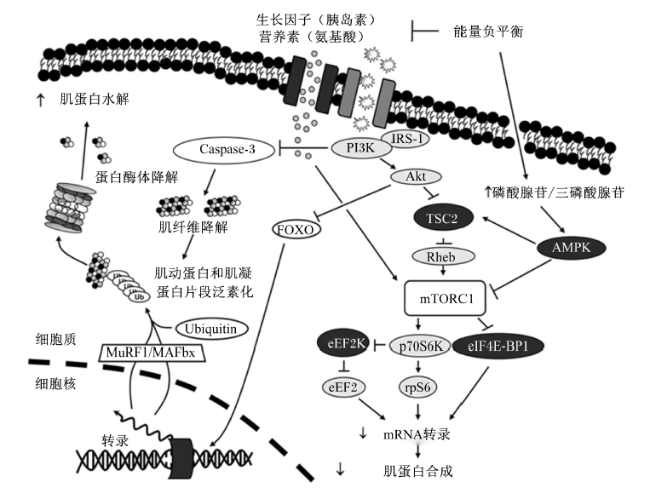
能量负平衡期间体重持续减少,体重损失的75%来自脂肪组织,25%的损失来自骨骼肌等非脂肪组织[59],二者共同用于肝脏糖异生等功能,动员的蛋白质大部分来自骨骼肌[60]。Carbone等[61]对能量负平衡阶段骨骼肌分解和合成代谢机制进行综述(图2),由于能量负平衡状态,营养素及生长因子含量降低,一方面导致哺乳动物雷帕霉素靶蛋白复合体1(mechanistic target of rapamycin complex 1,mTORC1)活化降低,使得mRNA翻译明显下调,最终导致肌肉蛋白质合成减少;另一方面导致叉头盒O(Forkhead box O,FOXO)核定位增加并进一步萎缩相关基因的表达,并且含半胱氨酸的天冬氨酸蛋白水解酶-3(Caspase-3)基因的上调和肌肉蛋白质泛素化可能同样参与到能量负平衡阶段的肌肉损失过程。尽管以上过程提示肌肉含量较高的奶牛可能通过在围产期分解肌肉来防止酮病的发生,但对238头经产奶牛围产期背最长肌厚度进行跟踪后发现肌肉厚度增加对亚临床酮病发病率无显著影响,而背部脂肪厚度与亚临床酮病发病率之间呈正相关关系[62],这表明肌肉动员主要目的并非用于糖异生。研究同时发现,初始体况、胎次和观测时间点对背最长肌厚度均有影响[63]。因此,还需进一步研究肌肉动员在围产期奶牛中的具体作用,并在探究其在酮病中的作用时控制初始体况和胎次。
图2 能量负平衡阶段骨骼肌蛋白质合成与分解的调控机制

Caspase-3:含半胱氨酸的天冬氨酸蛋白水解酶-3 cysteine-containing aspartic proteolytic enzyme-3;Akt:蛋白激酶B protein kinase B;AMPK:腺苷酸活化蛋白激酶 adenosine monophosphate activated protein kinase;eEF2:真核细胞翻译延长因子2 eukaryotic translation elongation factor 2;eEF2K:真核细胞延长因子2激酶 eukaryotic translation elongation factor 2 kinase;eIF4E-BP1:真核细胞翻译抑制因子4E-结合蛋白1 eukaryotic translation inhibitor 4E-binding protein 1;FOXO:叉头盒O Forkhead box O;IRS-1:胰岛素受体底物-1 insulin receptor substrate-1;MAFbx:肌肉游离移植后泛素连接酶 ubiquitin ligase after free muscle transplantation;mTORC1:哺乳动物雷帕霉素靶蛋白复合体1 mechanistic target of rapamycin complex 1;MuRF1:肌肉特异性环指蛋白1 muscle-specific RING finger protein 1;p70S6K:p70 S6激酶 p70 S6 kinase;PI3K:磷脂酰肌醇三羟基激酶 phosphatidylinositol trihydroxy kinase;Rheb:脑Ras同源蛋白 brain Ras homologous protein;rpS6:核糖体蛋白S6 ribosomal protein S6;TSC2:结节性硬化复合物2 tuberous sclerosis complex 2;Ubiquitin:泛素。

Fig.2 Regulation mechanism contributing to skeletal muscle synthesis and loss response to periods of negative energy balance[61]

2 营养干预调控措施

酮病奶牛以体循环中高含量NEFA和BHBA为特征,目前可通过血液、尿液和牛奶中的酮体含量判定是否患酮病[64]。酮病按照致病机理可分为3类:在能量负平衡状态下,奶牛脂肪组织释放大量NEFA进入肝脏,经β氧化后生成乙酰辅酶A,乙酰辅酶A理论上将与草酰乙酸在三羧酸循环中合成柠檬酸,但由于草酰乙酸参与糖异生途径,使得多余的乙酰辅酶A通过生酮作用产生BHBA、丙酮和乙酰乙酸,进而引发Ⅰ型酮症;对于肥胖奶牛,由于围产期体脂大量动员并囤积在肝脏中,脂质浸润使得包括糖异生在内的肝功能受损而引发Ⅱ型酮病;青贮丁酸型酮症则是由于饲喂奶牛腐败、含高丁酸青贮导致的酮病[65]
全株玉米青贮在机械化制备流程下可有效防止青贮丁酸型酮病,据调查显示,我国全株玉米青贮使用普及率达99.0%,青贮制备相关环节以地上式等先进技术为主体[1]。而其他2类型酮病的发生一方面与体脂动员程度有关,另一方面与机体能量代谢适应性有关。尽管目前用于预防和治疗酮病的手段众多,但均与减低体脂动员或提高围产期奶牛自身能量代谢适应性有关。

2.1 降低体脂动员

在规模化和机械化养殖模式下,牧场在干奶期可通过分群肥胖奶牛并饲喂低能饲粮来控制体况(BCS为3.25~3.50),进而有效防止酮病的发生,其机理在于通过减少产前脂肪储备,进而减少产后脂肪动员,且研究发现产前低能(泌乳净能5.4 MJ/kg)饲粮可增加产后奶牛干物质采食量并提高肝脏糖异生能力[66]。此外,娜仁高娃[67]研究发现,围产期奶牛饲粮中添加20 g/d的过瘤胃烟酸可降低产前脂肪组织的炎症反应和降低产后脂肪动员。然而,研究同样发现,产前限制饲喂后将导致产后免疫能力下降,增加患病风险[68]。Horst等[69]对通过减少奶牛体脂动员来预防酮病这一观点提出质疑,认为体循环中BHBA和NEFA的变化是动物的一种高度保守反应,同样出现在泌乳及长时间禁食的熊、海豹、海豚和蓝鲸身上,血液中BHBA和NEFA的变化不能完全代表围产期疾病和代谢障碍。Gross等[58]发现高BHBA和NEFA奶牛产奶量、能量校正乳产量显著高于低BHBA和NEFA奶牛。Riosa等[70]对1 709头奶牛围产期背膘厚损失与产奶量之间的关系进行分析,结果发现背膘厚损失越大的奶牛产奶量也越大。Rodriguez等[71]按照四分位法将奶牛分为高产奶牛和低产奶牛,结果表明低产奶牛中酮病和繁殖性能降低有关,而患酮病高产奶牛的繁殖性能与健康高产奶牛相似。且通过在泌乳早期淘汰高BHBA的奶牛可有效提高奶牛的繁殖性能和使用寿命[72]。综上可知,通过减少围产后期体脂动员来减少酮病的发生将以牺牲产奶量为代价。因此,如何通过选育及饲养管理手段使奶牛既有效动员体脂且降低BHBA的产生是未来的研究方向。

2.2 提高能量代谢适应性

基于酮病发病机理,通过在饲粮中补充葡萄糖前体物质可有效防止酮病的发生,如丙二醇及甘油[8]。Maldini等[73]通过瘤胃灌注丙酸探究其对酮病奶牛的影响,研究结果发现丙酸灌注后显著增加血浆葡萄糖和胰岛素含量,并降低血浆NEFA含量,进而减少乙酰辅酶A的氧化供应,预计将增加采食间隔并减少采食频率。而丙二醇添加可增加瘤胃中丙酸的含量,并有效降低酮病奶牛血液中BHBA的含量。同时,丙二醇能够显著提高普雷沃氏菌属(Prevotella)和琥珀酸弧菌属(Succinivibrio)的相对丰度[74],而微生物群落组成的变化将缓解能量负平衡并治疗酮病,其治疗机理包括:1)通过直接补充葡萄糖前体缓解能量负平衡并减缓胰岛素抵抗;2)直接补充草酰乙酸前体物质以缓解生酮反应;3)减缓异柠檬酸脱氢酶和延胡索酸酶在柠檬酸循环中的活性,使得草酰乙酸与乙酰辅酶A反应。

3 小结与展望

围产期奶牛通过调节多方面代谢过程以维持泌乳,包括体组织胰岛素抵抗、骨骼肌及脂肪组织动员、脂肪因子分泌改变以及瘤胃发酵模式改变等,但还需对围产期奶牛变化进行全面性和系统性研究,以更有针对性地调整饲养管理措施。此外,围产期奶牛特点在于体循环BHBA和NEFA增加,在体况控制良好的前提下,通过减少体脂动员预防酮病的发生将以损失产奶量为代价,如何提升奶牛自身能量代谢适应性可能是平衡奶牛健康及经济效益的关键,在此过程中,奶牛在肝脏代谢、瘤胃发酵模式和体脂动员上表现出的个体差异可能为新技术、新理念的开发提供理论依据。
[1]
夏建民, 李胜利, 王蔚, 等. 2020年中国规模奶牛场产业素质研究报告[J]. 中国畜牧杂志, 2021, 57(9):267-271.

XIA J M, LI S L, WANG W, et al. China scale dairy farm industry quality research report in 2020[J]. Chinese Journal of Animal Science, 2021, 57(9):267-271. (in Chinese)

[2]
刘长全. 2021年中国奶业经济形势回顾及2022年展望[J]. 中国畜牧杂志, 2022, 58(3):232-238.

LIU C Q. Review of China dairy industry economic situation in 2021 and outlook for 2022[J]. Chinese Journal of Animal Science, 2022, 58(3):232-238. (in Chinese)

[3]
彭朋, 杨影, 张海亮, 等. 北京与上海地区中国荷斯坦牛长寿性及淘汰原因分析[J]. 中国奶牛, 2020(9):23-27.

PENG P, YANG Y, ZHANG H L, et al. Analysis of longevity and elimination reason of Chinese Holstein in Beijing and Shanghai regions[J]. China Dairy Cattle, 2020(9):23-27. (in Chinese)

[4]
马佳莹. 中国百头以上牧场成母牛长寿性及主要淘汰原因的调查分析[D]. 硕士学位论文. 北京: 中国农业大学, 2016.

MA J Y. Research on cow longevity and primary reasons for culling in China dairy farm with more than 100 cows[D]. Master's Thesis. Beijing: China Agricultural University, 2016. (in Chinese)

[5]
DE VRIES A. Symposium review:why revisit dairy cattle productive lifespan?[J]. Journal of Dairy Science, 2020, 103(4):3838-3845.

DOI

[6]
李胜利, 郝阳毅, 王蔚, 等. 围产期奶牛糖脂代谢与健康养殖研究进展[J]. 动物营养学报, 2020, 32(10):4708-4715.

DOI

LI S L, HAO Y Y, WANG W, et al. Research progress on glucose-lipid metabolism and healthy feeding in transition dairy cows[J]. Chinese Journal of Animal Nutrition, 2020, 32(10):4708-4715. (in Chinese)

[7]
刘志超. 山东省规模化牛场酮病发病率调查及分析[D]. 硕士学位论文. 邯郸: 河北工程大学, 2018.

LIU Z C. Investigation and analysis on the incidence of ketosis in large scale cattle farm in Shandong province[D]. Master's Thesis. Handan: Hebei University of Engineering, 2018. (in Chinese)

[8]
边四辈, 黄克和. 上海地区奶牛产后低钙血症及酮病发病率调查[J]. 中国畜牧杂志, 2018, 54(1):147-150,155.

BIAN S B, HUANG K H. Survey of incidence of hypocalcemia,ketosis of dairy cows in Shanghai area[J]. Chinese Journal of Animal Science, 2018, 54(1):147-150,155. (in Chinese)

[9]
BERGE A C, VERTENTEN G. A field study to determine the prevalence,dairy herd management systems,and fresh cow clinical conditions associated with ketosis in western European dairy herds[J]. Journal of Dairy Science, 2014, 97(4):2145-2154.

DOI

[10]
DUFFIELD T F, LISSEMORE K D, MCBRIDE B W, et al. Impact of hyperketonemia in early lactation dairy cows on health and production[J]. Journal of Dairy Science, 2009, 92(2):571-580.

DOI PMID

[11]
徐硕烁, 吴兆海, 都文, 等. 奶牛酮病经济损失评估[J]. 中国奶牛, 2014(15):62-64.

XU S S, WU Z H, DOU W, et al. The economic loss evaluation of ketosis in dairy cows[J]. China Dairy Cattle, 2014(15):62-64. (in Chinese)

[12]
孙照磊. 奶牛酮病的发病调查及酮病与胰岛素抵抗的关系[D]. 硕士学位论文. 大庆: 黑龙江八一农垦大学, 2013.

SUN Z L. The investigating of cow ketosis and the relationship between cow ketosis and insulin resistance[D]. Master's Thesis. Daqing: Heilongjiang Bayi Agricultural University, 2013. (in Chinese)

[13]
REYNOLDS C K, DÜRST B, LUPOLI B, et al. Visceral tissue mass and rumen volume in dairy cows during the transition from late gestation to early lactation[J]. Journal of Dairy Science, 2004, 87(4):961-971.

DOI PMID

[14]
ZHU Z G, KRISTENSEN L, DIFFORD G F, et al. Changes in rumen bacterial and archaeal communities over the transition period in primiparous Holstein dairy cows[J]. Journal of Dairy Science, 2018, 101(11):9847-9862.

DOI PMID

[15]
PITTA D W, KUMAR S, VECCHIARELLI B, et al. Temporal dynamics in the ruminal microbiome of dairy cows during the transition period[J]. Journal of Animal Science, 2014, 92(9):4014-4022.

DOI PMID

[16]
GEBREYESUS G, DIFFORD G F, BUITENHUIS B, et al. Predictive ability of host genetics and rumen microbiome for subclinical ketosis[J]. Journal of Dairy Science, 2020, 103(5):4557-4569.

DOI PMID

[17]
PECHOVÁ A, NEČASOVÁ A. The relationship between subclinical ketosis and ruminal dysfunction in dairy cows[J]. Annals of Animal Science, 2018, 18(4):955-971.

DOI

[18]
孙博非, 余超, 曹阳春, 等. 奶牛围产期典型代谢特征及其营养调控的技术途径[J]. 动物营养学报, 2018, 30(2):428-436.

SUN B F, YU C, CAO Y C, et al. Typical metabolic characteristics and potential technical approaches of nutritional regulation in transition dairy cows:a review[J]. Chinese Journal of Animal Nutrition, 2018, 30(2):428-436. (in Chinese)

[19]
WANG X X, LI X B, ZHAO C X, et al. Correlation between composition of the bacterial community and concentration of volatile fatty acids in the rumen during the transition period and ketosis in dairy cows[J]. Applied and Environmental Microbiology, 2012, 78(7):2386-2392.

DOI PMID

[20]
EOM J S, KIM H S, LEE S J, et al. Metabolic profiling of rumen fluid and milk in lactating dairy cattle influenced by subclinical ketosis using proton nuclear magnetic resonance spectroscopy[J]. Animals:an Open Access Journal From MDPI, 2021, 11(9):2526.

[21]
XUE M Y, SUN H Z, WU X H, et al. Multi-omics reveals that the rumen microbiome and its metabolome together with the host metabolome contribute to individualized dairy cow performance[J]. Microbiome, 2020, 8(1):64.

DOI

[22]
TAN R S G, ZHOU M, LI F Y, et al. Identifying active rumen epithelial associated bacteria and archaea in beef cattle divergent in feed efficiency using total RNA-seq[J]. Current Research in Microbial Sciences, 2021, 2:100064.

DOI

[23]
AKTER S H, HÄUSSLER S, DÄNICKE S, et al. Physiological and conjugated linoleic acid-induced changes of adipocyte size in different fat depots of dairy cows during early lactation[J]. Journal of Dairy Science, 2011, 94(6):2871-2882.

DOI PMID

[24]
KOMARAGIRI M V, ERDMAN R A. Factors affecting body tissue mobilization in early lactation dairy cows. 1.Effect of dietary protein on mobilization of body fat and protein[J]. Journal of Dairy Science, 1997, 80(5):929-937.

DOI

[25]
韩春林. 围产期奶牛管理参数研究[J]. 今日畜牧兽医(奶牛), 2018(9):16-21.

HAN C L. Study on management parameters of perinatal cows[J]. Today Livestock and Veterinary (Dairy Cow), 2018(9):16-21. (in Chinese)

[26]
ROCHE J R, FRIGGENS N C, KAY J K, et al. Invited review:body condition score and its association with dairy cow productivity,health,and welfare[J]. Journal of Dairy Science, 2009, 92(12):5769-5801.

DOI

[27]
DRACKLEY J K, WALLACE R L, GRAUGNARD D, et al. Visceral adipose tissue mass in nonlactating dairy cows fed diets differing in energy density[J]. Journal of Dairy Science, 2014, 97(6):3420-3430.

DOI

[28]
RUDA L N, RASCHKA C, HUBER K, et al. Gain and loss of subcutaneous and abdominal fat depot mass from late pregnancy to 100 days in milk in German Holsteins[J]. Journal of Dairy Research, 2019, 86(3):296-302.

DOI PMID

[29]
KENÉZ Á, RUDA L, DÄNICKE S, et al. Insulin signaling and insulin response in subcutaneous and retroperitoneal adipose tissue in Holstein cows during the periparturient period[J]. Journal of Dairy Science, 2019, 102(12):11718-11729.

DOI PMID

[30]
JAAKSON H, KARIS P, LING K, et al. Adipose tissue insulin receptor and glucose transporter 4 expression,and blood glucose and insulin responses during glucose tolerance tests in transition Holstein cows with different body condition[J]. Journal of Dairy Science, 2018, 101(1):752-766.

DOI

[31]
KARIS P, JAAKSON H, LING K, et al. Body condition and insulin resistance interactions with periparturient gene expression in adipose tissue and lipid metabolism in dairy cows[J]. Journal of Dairy Science, 2020, 103(4):3708-3718.

DOI PMID

[32]
YU H, FAN M H, CHEN X Y, et al. Activated autophagy-lysosomal pathway in dairy cows with hyperketonemia is associated with lipolysis of adipose tissues[J]. Journal of Dairy Science, 2022, 105(8):6997-7010.

DOI PMID

[33]
HÄUSSLER S, SADRI H, GHAFFARI M H, et al. Symposium review:adipose tissue endocrinology in the periparturient period of dairy cows[J]. Journal of Dairy Science, 2022, 105(4):3648-3669.

DOI

[34]
MANN S, URH C, SAUERWEIN H, et al. Short communication:the association of adiponectin and leptin concentrations with prepartum dietary energy supply,parity,body condition,and postpartum hyperketonemia in transition dairy cows[J]. Journal of Dairy Science, 2018, 101(1):806-811.

DOI

[35]
CHEN Y Y, DONG Z H, LI R R, et al. Changes in selected biochemical parameters during subclinical and clinical ketosis in dairy cows[J]. Medycyna Weterynaryjna-Veterinary Medicine-Science & Practice, 2018, 74(11):727-730.

[36]
FRIEDRICHS P, KHALILVANDI-BEHROOZYAR H, LOCHER L, et al. mRNA expression of chemerin and its receptor in a subcutaneous and a visceral fat depot of dairy cows fed with high or low portions of concentrate during the transition period[C]// ADSA-ASAS Joint Annual Meetin. Kansas City: American Dairy Science Association, 2014.

[37]
贺鹏飞. 酮病奶牛脂肪细胞的抵抗素表达水平的变化及其真核表达[D]. 硕士学位论文. 长春: 吉林大学, 2008.

HE P F. The abundant change of bovine resistin mRNA level in fat of ketotic cows and its eukaryotic expression[D]. Master's Thesis. Changchun: Jilin University, 2008. (in Chinese)

[38]
MANN S, NYDAM D V, ABUELO A, et al. Insulin signaling,inflammation,and lipolysis in subcutaneous adipose tissue of transition dairy cows either overfed energy during the prepartum period or fed a controlled-energy diet[J]. Journal of Dairy Science, 2016, 99(8):6737-6752.

DOI

[39]
SAREMI B, WINAND S, FRIEDRICHS P, et al. Longitudinal profiling of the tissue-specific expression of genes related with insulin sensitivity in dairy cows during lactation focusing on different fat depots[J]. PLoS One, 2014, 9(1):e86211.

DOI

[40]
WEBER M, LOCHER L, HUBER K, et al. Longitudinal changes in adipose tissue of dairy cows from late pregnancy to lactation.Part 1:the adipokines apelin and resistin and their relationship to receptors linked with lipolysis[J]. Journal of Dairy Science, 2016, 99(2):1549-1559.

DOI

[41]
SCHOENBERG K M, GIESY S L, HARVATINE K J, et al. Plasma FGF21 is elevated by the intense lipid mobilization of lactation[J]. Endocrinology, 2011, 152(12):4652-4661.

DOI PMID

[42]
MELLOUK N, RAMÉ C, DIOT M, et al. Possible involvement of the RARRES2/CMKLR1-system in metabolic and reproductive parameters in Holstein dairy cows[J]. Reproductive Biology and Endocrinology, 2019, 17(1):25.

DOI PMID

[43]
SHEN L H, ZHU Y K, XIAO J B, et al. Serum adipokines play different roles in type Ⅰ and Ⅱ ketosis[J]. Asian-Australasian Journal of Animal Sciences, 2020, 33(12):1930-1939.

DOI

[44]
SOARES R A N, VARGAS G, DUFFIELD T, et al. Genome-wide association study and functional analyses for clinical and subclinical ketosis in Holstein cattle[J]. Journal of Dairy Science, 2021, 104(9):10076-10089.

DOI PMID

[45]
PIECHOTTA M, MYSEGADES W, LIGGES U, et al. Antepartal insulin-like growth factor 1 and insulin-like growth factor binding protein 2 concentrations are indicative of ketosis in dairy cows[J]. Journal of Dairy Science, 2015, 98(5):3100-3109.

DOI PMID

[46]
HA N T, DRÖGEMÜLLER C, REIMER C, et al. Liver transcriptome analysis reveals important factors involved in the metabolic adaptation of the transition cow[J]. Journal of Dairy Science, 2017, 100(11):9311-9323.

DOI PMID

[47]
DANN H M, DRACKLEY J K. Carnitine palmitoyltransferase I in liver of periparturient dairy cows:effects of prepartum intake,postpartum induction of ketosis,and periparturient disorders[J]. Journal of Dairy Science, 2005, 88(11):3851-3859.

DOI

[48]
LI P, LI X B, FU S X, et al. Alterations of fatty acid β-oxidation capability in the liver of ketotic cows[J]. Journal of Dairy Science, 2012, 95(4):1759-1766.

DOI PMID

[49]
ZHU Y W, LIU G W, DU X L, et al. Expression patterns of hepatic genes involved in lipid metabolism in cows with subclinical or clinical ketosis[J]. Journal of Dairy Science, 2019, 102(2):1725-1735.

DOI PMID

[50]
SHEN T Y, LI X W, LOOR J J, et al. Hepatic nuclear factor kappa B signaling pathway and NLR family pyrin domain containing 3 inflammasome is over-activated in ketotic dairy cows[J]. Journal of Dairy Science, 2019, 102(11):10554-10563.

DOI PMID

[51]
SHEN T Y, XU F, FANG Z Y, et al. Hepatic autophagy and mitophagy status in dairy cows with subclinical and clinical ketosis[J]. Journal of Dairy Science, 2021, 104(4):4847-4857.

DOI PMID

[52]
SCHLEGEL G, RINGSEIS R, KELLER J, et al. Changes in the expression of hepatic genes involved in cholesterol homeostasis in dairy cows in the transition period and at different stages of lactation[J]. Journal of Dairy Science, 2012, 95(7):3826-3836.

DOI PMID

[53]
杨威, 夏成, 陈媛媛, 等. 围产期酮病奶牛血液生化指标特征分析[J]. 中国兽医学报, 2019, 39(4):756-761.

YANG W, XIA C, CHEN Y Y, et al. Analysis of blood biochemistry characteristics in dairy cows with ketosis during transition period[J]. Chinese Journal of Veterinary Science, 2019, 39(4):756-761. (in Chinese)

[54]
FUCHS C D, TRAUNER M. Role of bile acids and their receptors in gastrointestinal and hepatic pathophysiology[J]. Nature Reviews Gastroenterology & Hepatology, 2022, 19(7):432-450.

[55]
REITER S, DUNKEL A, DAWID C, et al. Targeted LC-MS/MS profiling of bile acids in various animal tissues[J]. Journal of Agricultural and Food Chemistry, 2021, 69(36):10572-10580.

DOI PMID

[56]
GRABER M, KOHLER S, KAUFMANN T, et al. A field study on characteristics and diversity of gene expression in the liver of dairy cows during the transition period[J]. Journal of Dairy Science, 2010, 93(11):5200-5215.

DOI PMID

[57]
SCHÄREN M, SNEDEC T, RIEFKE B, et al. Aspects of transition cow metabolomics-part Ⅰ:effects of a metaphylactic butaphosphan and cyanocobalamin treatment on the metabolome in liver,blood,and urine in cows with different liver metabotypes[J]. Journal of Dairy Science, 2021, 104(8):9205-9226.

DOI

[58]
GROSS J J, BRUCKMAIER R M. Repeatability of metabolic responses to a nutrient deficiency in early and mid lactation and implications for robustness of dairy cows[J]. Journal of Dairy Science, 2015, 98(12):8634-8643.

DOI PMID

[59]
WEINHEIMER E M, SANDS L P, CAMPBELL W W. A systematic review of the separate and combined effects of energy restriction and exercise on fat-free mass in middle-aged and older adults:implications for sarcopenic obesity[J]. Nutrition Reviews, 2010, 68(7):375-388.

DOI

[60]
BELL A W, BURHANS W S, OVERTON T R. Protein nutrition in late pregnancy,maternal protein reserves and lactation performance in dairy cows[J]. Proceedings of the Nutrition Society, 2000, 59(1):119-126.

DOI

[61]
CARBONE J W, MCCLUNG J P, PASIAKOS S M. Skeletal muscle responses to negative energy balance:effects of dietary protein[J]. Advances in Nutrition, 2012, 3(2):119-126.

DOI

[62]
SIACHOS N, OIKONOMOU G, PANOUSIS N, et al. Skeletal muscle and adipose tissue reserves and mobilisation in transition Holstein cows:part 2 association with postpartum health,reproductive performance and milk production[J]. Animal, 2022, 16(9):100626.

DOI

[63]
SIACHOS N, OIKONOMOU G, PANOUSIS N, et al. Skeletal muscle and adipose tissue reserves and mobilisation in transition Holstein cows:part 1 biological variation and affecting factors[J]. Animal, 2022, 16(9):100627.

DOI

[64]
SERRENHO R C, WILLIAMSON M, BERKE O, et al. An investigation of blood,milk,and urine test patterns for the diagnosis of ketosis in dairy cows in early lactation[J]. Journal of Dairy Science, 2022, 105(9):7719-7727.

DOI

[65]
孙晓格, 张俊, 郝阳毅, 等. 奶牛亚临床酮症的研究进展[J]. 中国畜牧兽医, 2020, 47(7):2277-2283.

SUN X G, ZHANG J, HAO Y Y, et al. Research advances on subclinical ketosis in dairy cows[J]. China Animal Husbandry & Veterinary Medicine, 2020, 47(7):2277-2283. (in Chinese)

[66]
黄文明. 围产前期日粮能量水平对奶牛能量代谢和瘤胃适应性影响的研究[D]. 博士学位论文. 北京: 中国农业大学, 2014.

HUANG W M. Studies on different energy density of close-up diets on energy metabolism and ruminal adaption in multiparous Holstein cows[D]. Ph.D.Thesis. Beijing: China Agricultural University, 2014. (in Chinese)

[67]
娜仁高娃. 过瘤胃烟酸对围产期奶牛生产性能及脂肪和肝脏组织转录机制研究[D]. 博士学位论文. 北京: 中国农业大学, 2021.

NAREN G W. Mechanistic studies of rumen-protected niacin on performance,adipose tissue transcriptomics,and liver transcriptomics in transition cows[D].Ph.D. Thesis. Beijing: China Agricultural University, 2021. (in Chinese)

[68]
ROCHE J R, MEIER S, HEISER A, et al. Effects of precalving body condition score and prepartum feeding level on production,reproduction,and health parameters in pasture-based transition dairy cows[J]. Journal of Dairy Science, 2015, 98(10):7164-7182.

DOI

[69]
HORST E A, KVIDERA S K, BAUMGARD L H. Invited review:the influence of immune activation on transition cow health and performance—a critical evaluation of traditional dogmas[J]. Journal of Dairy Science, 2021, 104(8):8380-8410.

DOI

[70]
RIOSA R, GHAFFARI M H, HAMMON H M, et al. Identification and characterization of dairy cows with different backfat thickness antepartum in relation to postpartum loss of backfat thickness:a cluster analytic approach[J]. Journal of Dairy Science, 2022, 105(7):6327-6338.

DOI

[71]
RODRIGUEZ Z, WYNANDS E, SHEPLEY E, et al. Exploring the role of milk yield in the first week of lactation on the association between hyperketonemia and reproductive performance in dairy cattle[J]. JDS Communications, 2022, 3(1):7-12.

DOI PMID

[72]
LOU W, ZHANG H, LUO H, et al. Genetic analyses of blood β-hydroxybutyrate predicted from milk infrared spectra and its association with longevity and female reproductive traits in Holstein cattle[J]. Journal of Dairy Science, 2022, 105(4):3269-3281.

DOI

[73]
MALDINI G, KENNEDY K M, ALLEN M S. Temporal effects of ruminal infusion of propionic acid on hepatic metabolism in cows in the postpartum period[J]. Journal of Dairy Science, 2019, 102(11):9781-9790.

DOI PMID

[74]
XIANG K H, LI S, TUNIYAZI M, et al. Changes in the rumen microbiota community in ketosis cows during propylene glycol treatment[J]. Food & Function, 2022, 13(13):7144-7156.

Outlines

/