REVIEW

Research Progress of Fecal Microbiota Transplantation in Improving Intestinal Barrier Function in Pigs

  • TIAN Yu ,
  • YANG Lingyuan , * ,
  • HUANG Xingguo ,
  • YIN Jie
Expand
  • College of Animal Science and Technology, Hunan Agricultural University, Changsha 410128, China
*professor, E-mail:

Received date: 2022-09-28

  Online published: 2023-04-12

Abstract

Intestinal flora is an important part of animal intestinal system and plays an important role in intestinal development and immune function maturation. Moreover, imbalance of intestinal flora is related to a variety of intestinal diseases. Fecal microbiota transplantation (FMT) is one of the most direct, rapid and effective methods to improve the intestinal flora by transplanting healthy donor fecal bacteria into the recipient and treating intestinal diseases by improving the intestinal flora. Recent studies have shown that FMT has a positive effect on the intestinal health and growth performance of livestock and poultry. It can regulate the intestinal flora, maintain the intestinal mechanical barrier, improve the intestinal mucus environment, promote intestinal immunity, and has a good effect on maintaining intestinal health. This paper reviewed the effects of FMT on intestinal barrier of pigs, and discussed the safety and precautions of FMT, in order to provide reference for the application of FMT technology in pig production.

Cite this article

TIAN Yu , YANG Lingyuan , HUANG Xingguo , YIN Jie . Research Progress of Fecal Microbiota Transplantation in Improving Intestinal Barrier Function in Pigs[J]. Chinese Journal of Animal Nutrition, 2023 , 35(4) : 2072 -2080 . DOI: 10.12418/CJAN2023.194

肠道是机体消化吸收营养物质的重要场所,因此肠道状况对动物健康至关重要。肠道屏障是维护动物机体安全的防线,肠道上皮细胞通过紧密连接、黏附连接等构成机械屏障,保护肠道组织免受毒素、病原微生物及其他有害物质入侵,维护肠道内环境稳定[1]。肠道是机体最大的免疫器官,分布着大量的淋巴组织,能够清除进入肠道的抗原物质,保护肠道健康[2]。猪肠道内还存在许多微生物,这些微生物种类多样,与宿主之间互利共生,能通过肠-脑轴[3]、肠-肝轴[4]等途径对大脑、肝脏等多种内脏器官的生理代谢产生影响。肠道菌群结构主要受遗传[5]、环境[6]、药物[7]和营养[8]等多种因素调控干预,所以一旦肠道菌群发生紊乱就可能引发多种代谢疾病。近年来,粪菌移植(fecal microbiota transplantation,FMT)在人类医学上作为一种治疗肠道疾病的方法越来越受关注。研究发现,FMT不仅对肠道疾病有良好的治疗效果,对其他代谢疾病也有一定作用,如在炎症性肠病[9]、肠易激综合征[10]和一些神经性疾病[11]的治疗中效果也十分显著。FMT虽然在人类医学上已经开始应用,但在动物方面的研究还不多,将FMT作为一种新的改善猪肠道健康的方法还需要研究完善。本文主要阐述了FMT对猪肠道屏障的影响及在猪生产上应用的局限性。

1 FMT

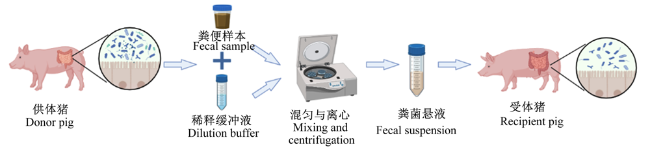
FMT是指通过筛选健康个体作为供体,将供体粪便菌群通过科学的途径移植到病患受体肠道内(FMT流程如图1所示),以治疗因肠道菌群结构变化引起的疾病[12]。肠道菌群不仅可以消化食物(特别是对粗纤维的消化),还会刺激免疫系统,诱导细胞因子产生和免疫细胞分化[13]。肠道菌群平衡增强了肠上皮细胞间的紧密连接,促进了肠道黏液分泌,从而维护肠道物理屏障和肠道内环境稳态[14]。Huang等[15]通过FMT缓解了帕金森氏病人的病情及便秘。Hu等[16]研究发现,FMT能改善试验性自身免疫性心肌炎小鼠肠道菌群并减轻炎症反应,缓解心肌损伤。还有报道显示,FMT对肥胖[17]、抑郁症[18]和糖尿病[19]等多种代谢综合征具有一定的治疗效果。基于FMT的多种功能,可以将FMT引入到畜牧业与畜禽生产实际相结合,用以提高畜禽生产性能。Lin等[20]对新生仔猪进行母体粪便微生物移植,第7天时受体仔猪结肠中梭状芽孢杆菌的相对丰度降低,而且对碳水化合物和氨基酸代谢有显著影响。不仅如此,通过将健康断奶仔猪粪便微生物移植给刚断奶仔猪,受体仔猪肠道微生物多样性增加,肠道消化不良症状也得到缓解[21]。李天天等[22]将不同饲料利用效率的猪粪菌悬液移植给伪无菌小鼠,结果显示,小鼠的表现型与供体猪一致,且高饲料利用效率受体小鼠的肠道微生物多样性提高。表1列举了部分FMT在猪上应用的试验研究。
图1 FMT流程

Fig.1 FMT process[23]

表1 猪FMT试验

Table 1 Research of FMT on pigs

出版年
Publication year
作者
Author
供体动物
Donor animal
受体动物
Recipient
animal
FMT处理方式
FMT processing
method
结果
Result
2017 Hu等[24] 成年金华猪 杜×长×大
(1日龄)
每天灌喂1.5 mL粪菌悬液,
连续27 d
腹泻率降低,肠道
形态得到改善
2018 Lin等[20] 成年母猪 杜×长×大
(1日龄)
每天灌喂3 mL粪菌悬液,
连续6 d
碳水化合物和氨基酸
代谢能力显著增加
2020 Xu等[25] 成年母猪 杜×长×大
(1日龄)
每天灌喂3 mL粪菌悬液,
连续6 d
肠道屏障功能和回肠
免疫系统得到改善
2021 Zhou等[26] 巴马母猪 无菌巴马仔猪
(7日龄)
每天灌喂1 mL粪菌悬液,
连续3 d
生长性能和养分消化率
得到提高
2021 Ma等[27] 成年金华猪 杜×长×大
(1日龄)
每隔1 d灌喂1.5 mL粪
菌悬液,连续21 d
肠道形态和完整性得到改善,
肠道微生物种群多样性提高

2 FMT对猪肠道屏障的影响

FMT作为一种新的调节肠道菌群的方法,能够提高肠道的消化吸收能力,改善肠道菌群平衡及肠道内环境稳态等,对肠道多方面功能都会产生影响。

2.1 FMT对猪肠道微生物屏障的影响

肠道微生物屏障是肠道微生物黏附在肠道黏膜表面,由微生物构成的一层生物防线[28]。这些肠道微生物能提高消化酶活性,影响消化酶合成,如地衣芽孢杆菌能提高肠黏膜中麦芽糖酶、乳糖酶和蔗糖酶的活性[29];还能发酵原本消化系统无法消化或消化不完全的物质,生成可被机体吸收的营养物质,如短链脂肪酸[30]。不仅如此,肠道微生物还能阻止外来致病菌的侵入,保护肠道健康[31]。肠道微生物群落之间通过相互影响构成一种动态的、复杂的微生态平衡[32],受外界环境、饲养条件和自身生理状态等因素的影响,肠道微生物群落结构极易发生改变,微生态平衡被打破,从而引起肠道疾病。
FMT通过直接接入微生物的方法来改善肠道微生物群落的结构,帮助机体维护健康稳定的肠道菌群。相较于成年猪,新生仔猪肠道菌群可塑性更大,更易改变。Hu等[24]在第1~11天每天给新生仔猪灌喂1.5 mL健康金华猪粪菌悬液,27 d后比灌服生理盐水的对照组结肠菌群中厚壁菌门、普雷沃氏菌科和乳杆菌科等相对丰度增高,变形菌门、梭杆菌科和梭状芽孢杆菌科相对丰度降低,同时大肠埃希菌数量减少。Qi等[33]在仔猪出生后3~7 d每天灌喂成年猪粪菌悬浮液,结果显示,FMT可促进哺乳仔猪的生长并改善肠道功能,受体仔猪肠道有益菌或功能菌如乳杆菌属和普雷沃氏菌属2的丰度升高,致病菌如埃希氏杆菌-志贺氏菌属的丰度减少,其原因可能是FMT改善了受体仔猪肠道微生态平衡,增加了肠道有益菌群数量,通过有益菌与致病菌争夺氧气和营养物质来抑制致病菌过度增殖,且与致病菌争夺肠道中的结合位点,使致病菌无法在肠道中黏附定植。如乳酸菌能通过自身较强的黏附能力在肠道内拮抗弯曲杆菌定植,并产生有机酸抑制弯曲杆菌生长[34]。同时,有研究发现,干酪乳杆菌能降低大肠杆菌中hfq基因的表达量,而hfq基因在革兰氏阴性菌和革兰氏阳性菌的发病机制中均起重要作用[35]。有些有益菌还可以分泌细菌素、乳酸和乙酸等物质抑制外来菌侵入繁殖,如嗜酸性乳杆菌能产生细菌素Lactobacillin XH2破坏大肠杆菌细胞壁,使菌体变形,细菌内生物大分子物质流失,引起细菌物质能量代谢紊乱,导致菌体死亡[36]

2.2 FMT对肠道黏液屏障的影响

肠道黏液屏障主要是由胃酸、胆汁、黏蛋白(mucoprotein,MUC)、水、无机盐和防御素等组成的胶状黏液[37],其能将肠道内环境和肠腔内容物、内毒素和病原微生物等分隔开,将有害物质阻挡在黏液外层,保护肠道上皮细胞[38]。MUC是黏液屏障的核心,由肠道上皮杯状细胞分泌,主要有MUC2、MUC5AC、MUC5B、MUC6及MUC19等,其中MUC2含量最多,能将肠腔中的细菌与上皮细胞分隔开,并为肠道微生物提供附着位点[39]。肠道黏液屏障受肠道微生物、细菌毒素等影响较大,这些刺激可能会抑制杯状细胞活性,使MUC分泌减少,让黏液屏障的成分发生变化,完整性受损,导致肠道渗透性增加,影响肠道内环境稳态。
胡栾莎等[40]研究显示,FMT能够缓解仔猪感染大肠杆菌K88(E. coli K88)的症状,提高空肠和结肠中杯状细胞数目及MUC2的蛋白表达水平,降低攻毒后仔猪肠道通透性。肠道黏液的理化性质对黏液屏障的作用也有很大影响,如黏液pH对肠道微生物群落结构有很大的影响,而短链脂肪酸对黏液屏障的理化性质有改善作用。Zhou等[26]研究发现,FMT能使受体仔猪盲肠食糜pH降低。FMT能改善肠道黏液屏障的原因可能是将健康供体粪便菌群直接接入受体的肠道中,改变了受体的肠道菌群结构,使受体的肠道菌群更加趋向于供体,达到新的肠道微生态平衡。肠道微生物利用肠腔中的营养物质产生短链脂肪酸,降低肠道黏液pH,抑制有害菌生长,短链脂肪酸通过调节肠道炎症反应中免疫细胞分化和细胞因子产生,促进肠道免疫反应,缓解炎症[41];同时,丁酸盐还能促进肠道发育,提高杯状细胞数量[42],促进MUC2分泌,而MUC也为微生物提供附着位点,两者相互促进共同维护肠道黏液屏障[39]。经研究发现,不同移植途径,FMT的效果也有所差别。与灌喂生理盐水的对照组比较,口腔+直肠FMT受体猪胃内乙酸盐和丁酸盐含量显著增加,总有机酸含量也增加;而直肠FMT受体猪胃内pH降低,结肠内pH升高[43]。这些可能是由于不同移植途径下刺激的部位不同,同时菌液到达肠道时的质量有一定偏差导致的。

2.3 FMT对肠道机械屏障的影响

肠道机械屏障是由肠道上皮细胞和细胞间的紧密连接构成[44]。肠道上皮细胞主要包括潘氏细胞、杯状细胞和肠细胞等,将肠腔与肠道组织分开,使肠道组织免受肠腔内物质的刺激。肠道相邻上皮细胞间连接方式有紧密连接、黏附连接和桥粒,紧密连接是肠道上皮细胞间重要的连接方式,主要是由闭锁蛋白(Occludin)、闭合蛋白(Claudin)和闭锁小带蛋白(ZO)等多种蛋白分子组成,能封闭细胞间隙,有选择性地让物质通过[45],并能阻止病原菌及一些有害生物大分子进入肠道组织,避免肠黏膜异常免疫反应[46]。Occludin是肠道机械屏障中最重要的跨膜紧密连接蛋白,对紧密连接蛋白在肠道上皮细胞内的定位有重要影响,同时还维护肠道紧密连接的完整性[47]。支架蛋白ZO-1能将Claudin和Occludin等跨膜蛋白与细胞骨架结合起来,协助建立肠道紧密连接,还对肠上皮细胞顶基极性的维持有重要作用[48]
FMT能维护肠道机械屏障,加强细胞间紧密连接,提高Claudin和ZO-1的蛋白表达水平。Ma等[27]研究发现,早期FMT能使受体仔猪空肠中Occludin和ZO-1蛋白表达得到显著增强,肠道形态和完整性得到明显改善,仔猪腹泻率显著降低。Cheng等[49]研究发现,FMT受体仔猪血清二胺氧化酶(DAO)活性和D-乳酸含量显著降低,结肠黏膜中ZO-1和Occludin蛋白表达水平显著升高,肠道通透性明显降低,同时缓解大肠杆菌K88感染引起的空肠绒毛损伤。在Hu等[24]的试验中,FMT受体仔猪相较于对照组仔猪空肠绒毛形态排列合理,绒毛光滑完整,而且空肠和结肠中ZO-1和Occludin的蛋白相对表达上皮显著升高。FMT还能通过促进肠道短链脂肪酸合成,增强上皮细胞紧密连接,缓解肠道损伤。在Xu等[50]的试验中,从健康小鼠中分离出粪便微生物,之后移植到由葡聚糖硫酸钠诱导的结肠炎小鼠体内,发现受体小鼠肠道菌群多样性得到改善,产丁酸细菌丰度和丁酸含量显著提高。而且Feng等[51]研究发现,在断奶仔猪饲粮中添加丁酸钠能降低肠道通透性,增强肠道机械屏障功能,丁酸钠能通过G蛋白偶联受体109A调控蛋白激酶B(Akt)信号通路,促进Claudin-3的蛋白表达。

2.4 FMT对肠道免疫屏障的影响

肠道免疫屏障主要由免疫细胞、相关细胞因子、抗体和肠道相关淋巴组织构成[52]。肠道相关淋巴组织是肠道免疫主要的诱导部位和效应部位,能摄取和转运抗原并分泌免疫球蛋白和细胞因子[53]。此外,分泌型免疫球蛋白(sIgA)也是抵抗病原微生物的重要物质,主要通过受体阻滞、空间障碍和免疫排斥拦截病原体,阻止病毒侵入上皮细胞,防止病原微生物在肠道黏膜黏附定植[54]。sIgA的分泌过程受到多种细胞因子影响,研究显示早期FMT干预会导致受体仔猪空肠和结肠中白细胞介素-6(IL-6)和肿瘤坏死因子-α(TNF-α)mRNA表达水平降低,白细胞介素-10(IL-10)mRNA表达水平升高,促进未成熟的B细胞增殖及向分泌SIgA的浆细胞分化,同时影响CD4+T细胞极化[27]
FMT主要通过肠道微生物群落对肠道细胞免疫进行调节。定植在肠道的微生物群落通过直接刺激树突状细胞(DC细胞)进行抗原呈递同时促进IL-10分泌,影响调节性T细胞(Tregs细胞)的产生,而且肠道微生物的代谢产物如短链脂肪酸和色氨酸代谢产物等也能直接促进T细胞调节[55]。Tregs细胞在机体微生物群的耐受、抗炎反应中有重要作用。短链脂肪酸是促进CD4+ T细胞分化的重要代谢物,研究发现,将健康从江仔猪的粪便菌群移植入长白仔猪体内,受体仔猪肠道菌群丙酸盐代谢和丁酸盐代谢显著提高,而丁酸盐能刺激DC细胞分泌TGF-β,并通过G蛋白偶联受体促进Tregs细胞分化,而且肠道内的丁酸还能促进抗炎细胞因子反应和CD4+ T细胞活化,减少活性氧产生[56-57]。FMT还能使定植在肠道的微生物刺激CD4+ T细胞向Th17细胞分化。Qi等[33]研究发现,FMT促进受体仔猪色氨酸代谢,使肠道中3-吲哚乙酸和3-吲哚丙酸含量升高,而吲哚丙酸能刺激Th17细胞上的芳香烃受体使其向Tregs细胞转化。FMT也促进了肠道非特异性免疫反应。给受体仔猪每天灌喂金华猪粪菌悬浊液,其结肠Toll样受体(TLR)2和TLR4的 mRNA表达水平在第12天显著升高,且结肠sIgA+细胞数量也显著提高[24]。Xu等[25]通过对新生仔猪进行母体FMT早期干预,发现FMT能显著增加血液中白细胞介素-8(IL-8)的含量,且能促进参与TLR信号通路的趋化因子的表达,影响细胞因子与受体的相互作用。FMT还能促进免疫球蛋白分泌,提高肠道黏膜中免疫球蛋白含量。Teng等[58]研究发现,FMT能使受体仔猪空肠黏膜免疫球蛋白M(IgM)、免疫球蛋白G(IgG)含量和回肠黏膜IgG含量升高。

3 FMT的局限性和发展前景

虽然FMT对猪肠道健康有非常大的益处,但也有一些研究指出FMT会对受体仔猪造成负面影响。Qi等[33]将成年猪粪便微生物移植到新生仔猪体内,仔猪血液中炎症因子含量和二胺氧化酶活性显著升高,紧密连接蛋白和TLR蛋白表达水平显著降低。Diao等[59]将藏猪、约克夏猪和荣昌猪的粪便微生物分别移植给断奶仔猪,接受藏猪粪便微生物的仔猪肠道屏障功能得到增强,腹泻率降低;而接受约克夏猪和荣昌猪粪便微生物的仔猪肠道菌群遭到破坏,肠道健康受到损害。这些研究结果表明,有些FMT会在一定程度上对肠道屏障造成损伤,诱导肠道炎症发生,对仔猪健康有潜在危险,原因可能是供体粪菌中的一些致病菌大量繁殖影响了受体的肠道微生态平衡所导致的。这就提示供体选择的重要性,不同物种粪便微生物组成有所不同,对受体肠道健康造成的影响也有差异,因此供体物种的选择是影响FMT效果的重要因素。此外,不同的移植途径对FMT的效果也有所影响,且对受体带来的致病风险不同。Brunse等[43]研究发现,通过口服途径进行FMT会提高细菌黏附性和死亡率,促进病原菌在内脏定植,而通过直肠途径进行FMT可以减少对上消化道的刺激,提高FMT效果;主要原因可能是口服途径的FMT会使上消化道暴露于细菌环境中,增加FMT的风险。而在实际生产中口服途径比其他途径更方便快捷,所以这也限制了FMT在畜牧生产中的应用。
FMT的致病风险主要来自供体粪菌的安全性,健康安全的供体对FMT效果有决定性的影响[60]。因此,要建立一个严格的供体选择标准,详细评估供体猪的遗传背景和表型,并进行常见病原体检查,淘汰具有传染性疾病或其他病原体的个体;同时建立一个大型粪菌库,把通过检测的个体作为超级供体进行长期粪菌采集,保证供体粪菌安全性。安全的供体粪菌还能降低口服途径移植的风险,而对一些比较敏感的猪,可以通过直肠途径进行移植,提高FMT的安全性。如果能够确定FMT中真正起效果的菌群或具体成分,可通过选择性直接添加的方式进行应用,就能避免粪菌中具有潜在危险性的其他成分的影响,极大提高FMT的安全性,进而有效地将FMT应用于生产实践中。Liu等[61]就通过改善怀孕母猪肠道微生物群缓解了母猪便秘,提高了哺乳仔猪的生长性能。Xiang等[62]也通过FMT对断奶仔猪肠道菌群进行早期干预,促进肠道发育和免疫功能成熟,改善仔猪肠道微生物群落结构来缓解断奶应激。随着技术的成熟和FMT作用机制研究的深入,FMT将成为改善断奶仔猪肠道健康、缓解母猪便秘等生产问题的方法之一。

4 小结与展望

FMT作为一种新的调节肠道内环境的方法,被当作一种特殊的器官移植来改善肠道健康。FMT通过重塑受体猪肠道菌群结构,恢复肠道微生态平衡,加强肠道紧密连接,维护肠道机械屏障,促进MUC、防御素等生物大分子分泌,改善肠道黏液环境,而且,FMT还能促进肠道免疫系统快速激活,促进抗原呈递过程。但由于FMT本身的原因,不可控因素较多,在现实生产中应用仍有一定局限性。随着对FMT研究的不断深入,未来可能会采用人工的方法配制供体微生物,减少FMT的负面作用。通过制定科学的标准,完善移植过程,降低致病风险,FMT会更加简单高效,将成为改善动物肠道健康的常用方法之一。
[1]
SALVO-ROMERO E, ALONSO-COTONER C, PARDO-CAMACHO C, et al. Función barrera intestinal y su implicación en enfermedades digestivas[J]. Revista Española de Enfermedades Digestivas, 2015, 107(11):686-696.

[2]
MÖRBE U M, JØRGENSEN P B, FENTON T M, et al. Human gut-associated lymphoid tissues (GALT);diversity,structure,and function[J]. Mucosal Immunology, 2021, 14(4):793-802.

DOI

[3]
DONOSO F, EGERTON S, BASTIAANSSEN T F S, et al. Polyphenols selectively reverse early-life stress-induced behavioural,neurochemical and microbiota changes in the rat[J]. Psychoneuroendocrinology, 2020, 116:104673.

DOI

[4]
WANG T Y, TAO S Y, WU Y X, et al. Quinoa reduces high-fat diet-induced obesity in mice via potential microbiota-gut-brain-liver interaction mechanisms[J]. Microbiology Spectrum, 2022, 10(3):e0032922.

DOI

[5]
GUO Y J, WANG Z L, CHEN L, et al. Diet induced maternal obesity affects offspring gut microbiota and persists into young adulthood[J]. Food & Function, 2018, 9(8):4317-4327.

[6]
DENG L, XU H C, LIU P, et al. Prolonged exposure to high humidity and high temperature environment can aggravate influenza virus infection through intestinal flora and Nod/RIP2/NF-κB signaling pathway[J]. Veterinary Microbiology, 2020, 251:108896.

DOI

[7]
CHEN R Z, WU P, CAI Z, et al. The combination of Puerariae Lobatae Radix and Chuanxiong Rhizoma enhanced the absorption and pharmacokinetics of puerarin by modulating the intestinal barrier and influenced gut microbiota[J]. Journal of Functional Foods, 2018, 47:72-82.

DOI

[8]
BAI C, LIU T G, XU J N, et al. Effect of high calorie diet on intestinal flora in LPS-induced pneumonia rats[J]. Scientific Reports, 2020, 10(1):1701.

DOI PMID

[9]
WU Z H, HUANG S M, LI T T, et al. Gut microbiota from green tea polyphenol-dosed mice improves intestinal epithelial homeostasis and ameliorates experimental colitis[J]. Microbiome, 2021, 9(1):184.

DOI PMID

[10]
HUANG H L, CHEN H T, LUO Q L, et al. Relief of irritable bowel syndrome by fecal microbiota transplantation is associated with changes in diversity and composition of the gut microbiota[J]. Journal of Digestive Diseases, 2019, 20(8):401-408.

DOI PMID

[11]
WANG M, CAO J N, GONG C C, et al. Exploring the microbiota-Alzheimer's disease linkage using short-term antibiotic treatment followed by fecal microbiota transplantation[J]. Brain Behavior and Immunity, 2021, 96:227-238.

DOI PMID

[12]
ZHONG Y F, CAO J H, MA Y F, et al. Fecal microbiota transplantation donor and dietary fiber intervention collectively contribute to gut health in a mouse model[J]. Frontiers in Immunology, 2022, 13:842669.

DOI

[13]
LI X L, SONG Y, MA X Y, et al. Lactobacillus plantarum and Lactobacillus fermentum alone or in combination regulate intestinal flora composition and systemic immunity to alleviate obesity syndrome in high-fat diet rat[J]. International Journal of Food Science & Technology, 2018, 53(1):137-146.

[14]
MA X, XU T T, QIAN M Q, et al. Faecal microbiota transplantation alleviates early-life antibiotic-induced gut microbiota dysbiosis and mucosa injuries in a neonatal piglet model[J]. Microbiological Research, 2021, 255:126942.

DOI

[15]
HUANG H L, XU H M, LUO Q L, et al. Fecal microbiota transplantation to treat Parkinson's disease with constipation:a case report[J]. Medicine, 2019, 98(26):e16163.

DOI

[16]
HU X F, ZHANG W Y, WEN Q, et al. Fecal microbiota transplantation alleviates myocardial damage in myocarditis by restoring the microbiota composition[J]. Pharmacological Research, 2019, 139:412-421.

DOI

[17]
LAI Z L, TSENG C H, HO H J, et al. Fecal microbiota transplantation confers beneficial metabolic effects of diet and exercise on diet-induced obese mice[J]. Scientific Reports, 2018, 8(1):15625.

DOI

[18]
DOLL J P K, VÁZQUEZ-CASTELLANOS J F, SCHAUB A C, et al. Fecal microbiota transplantation (FMT) as an adjunctive therapy for depression-case report[J]. Frontiers in Psychiatry, 2022, 13:815422.

DOI

[19]
GAO J M, RAO J H, WEI Z Y, et al. Transplantation of gut microbiota from high-fat-diet-tolerant cynomolgus monkeys alleviates hyperlipidemia and hepatic steatosis in rats[J]. Frontiers in Microbiology, 2022, 13:876043.

DOI

[20]
LIN C H, WAN J J, SU Y, et al. Effects of early intervention with maternal fecal microbiota and antibiotics on the gut microbiota and metabolite profiles of piglets[J]. Metabolites, 2018, 8(4):89.

DOI

[21]
NOWLAND T L, TOROK V A, LOW W Y, et al. A single faecal microbiota transplantation altered the microbiota of weaned pigs[J]. Life, 2020, 10(9):203.

DOI

[22]
李天天, 何贝贝, 李娜, 等. 移植不同饲料利用效率猪的粪便可定向改变伪无菌小鼠的生长性能[J]. 中国实验动物学报, 2018, 26(2):181-187.

LI T T, HE B B, LI N, et al. Fecal microbiota transplantation from growing pigs with different feed efficiency to pseudo-germ-free mice can result in reappearance of the original phenotype[J]. Acta Laboratorium Animalis Scientia Sinica, 2018, 26(2):181-187. (in Chinese)

[23]
XIE C L, ZHU X Y, XU B Y, et al. Integrated analysis of multi-tissues lipidome and gut microbiome reveals microbiota-induced shifts on lipid metabolism in pigs[J]. Animal Nutrition, 2022, 10:280-293.

DOI PMID

[24]
HU L S, GENG S J, LI Y, et al. Exogenous fecal microbiota transplantation from local adult pigs to crossbred newborn piglets[J]. Frontiers in Microbiology, 2017, 8:2663.

DOI PMID

[25]
XU R Y, WAN J J, LIN C H, et al. Effects of early intervention with antibiotics and maternal fecal microbiota on transcriptomic profiling ileal mucusa in neonatal pigs[J]. Antibiotics, 2020, 9(1):35.

DOI

[26]
ZHOU H, SUN J, YU B, et al. Gut microbiota absence and transplantation affect growth and intestinal functions:an investigation in a germ-free pig model[J]. Animal Nutrition, 2021, 7(2):295-304.

DOI

[27]
MA X, ZHANG Y C, XU T T, et al. Early-life intervention using exogenous fecal microbiota alleviates gut injury and reduce inflammation caused by weaning stress in piglets[J]. Frontiers in Microbiology, 2021, 12:671683.

DOI

[28]
LUO X, XU B, XIONG T Q, et al. Hepatic dysfunction induced by intestinal dysbacteriosis mainly manifests as immunologic abnormity in mice[J]. Pathogens and Disease, 2020, 78(6):ftaa041.

DOI

[29]
徐小明, 白建勇, 宦海琳, 等. 地衣芽孢杆菌对发酵床饲养仔猪生长性能、消化酶活性及肠道主要菌群数量的影响[J]. 中国畜牧兽医, 2015, 42(4):923-928.

XU X M, BAI J Y, HUAN H L, et al. Effect of Bacillus licheniformis on growth performance,digestive enzymes and the number of intestinal main microbial flora of piglets raised in fermentation bed[J]. China Animal Husbandry & Veterinary Medicine, 2015, 42(4):923-928. (in Chinese)

[30]
FU Y S, ZHANG J N, CHEN K N, et al. An in vitro fermentation study on the effects of Dendrobium officinale polysaccharides on human intestinal microbiota from fecal microbiota transplantation donors[J]. Journal of Functional Foods, 2019, 53:44-53.

DOI

[31]
CHEN J M, WANG M C, ZHANG P, et al. Cordycepin alleviated metabolic inflammation in Western diet-fed mice by targeting intestinal barrier integrity and intestinal flora[J]. Pharmacological Research, 2022, 178:106191.

DOI

[32]
WANG W Y, LI X, YAO X H, et al. The characteristics analysis of intestinal microecology on cerebral infarction patients and its correlation with apolipoprotein E[J]. Medicine, 2018, 97(41):e12805.

DOI

[33]
QI R L, ZHANG Z, WANG J, et al. Introduction of colonic and fecal microbiota from an adult pig differently affects the growth,gut health,intestinal microbiota and blood metabolome of newborn piglets[J]. Frontiers in Microbiology, 2021, 12:623673.

DOI

[34]
王刚, 贺禹丰, 陈晓华, 等. 乳酸菌生物学特性与其拮抗空肠弯曲杆菌在小鼠肠道定植能力的分析[J]. 食品与发酵工业, 2017, 43(8):73-80.

WANG G, HE Y F, CHEN X H, et al. Analysis on biological characteristics of lactic acid bacteria and its antagonistic activity against Campylobacter jejuni colonization in mice[J]. Food and Fermentation Industries, 2017, 43(8):73-80. (in Chinese)

[35]
MAHDAVI S, ISAZADEH A. Lactobacillus casei suppresses hfq gene expression in Escherichia coli O157∶H7[J]. British Journal of Biomedical Science, 2019, 76(2):92-94.

DOI

[36]
赵瑞香, 段改丽, 杨天佑, 等. 嗜酸乳杆菌细菌素Lactobacillin XH2抑制大肠杆菌作用机理的探讨[J]. 食品科学, 2015, 36(3):75-79.

ZHAO R X, DUAN G L, YANG T Y, et al. Antibacterial mechanism of Lactobacillin XH2 from Lactobacillus acidophilus on Escherichia coli[J]. Food Science, 2015, 36(3):75-79. (in Chinese)

[37]
张德明, 黄嘉訸, 李劲树, 等. 猪肠道微生物及其代谢产物与肠道屏障研究进展[J]. 畜牧兽医学报, 2022, 53(5):1334-1344.

ZHANG D M, HUANG J H, LI J S, et al. Research progress of gut microbiota,metabolites and gut barrier in pigs[J]. Acta Veterinaria et Zootechnica Sinica, 2022, 53(5):1334-1344. (in Chinese)

[38]
SHARMA A, KWAK J G, KOLEWE K W, et al. In vitro reconstitution of an intestinal mucus layer shows that cations and pH control the pore structure that regulates its permeability and barrier function[J]. ACS Applied Bio Materials, 2020, 3(5):2897-2909.

DOI

[39]
JOHANSSON M E V, AMBORT D, PELASEYED T, et al. Composition and functional role of the mucus layers in the intestine[J]. Cellular and Molecular Life Sciences, 2011, 68(22):3635-3641.

DOI PMID

[40]
胡栾莎, 扶雄锋, 耿世杰, 等. 外源粪菌干预对E. coli K88感染仔猪肠形态及肠道屏障功能的影响[J]. 中国兽医学报, 2018, 38(10):1887-1892.

HU L S, FU X F, GENG S J, et al. Effect of fecal microbiota transplantation on intestinal mucosal barrier of E. coli K88 challenged piglets[J]. Chinese Journal of Veterinary Science, 2018, 38(10):1887-1892. (in Chinese)

[41]
AKHTAR M, CHEN Y, MA Z Y, et al. Gut microbiota-derived short chain fatty acids are potential mediators in gut inflammation[J]. Animal Nutrition, 2022, 8:350-360.

DOI PMID

[42]
LAN R X, LI S Q, CHANG Q Q, et al. Sodium butyrate enhances growth performance and intestinal development in broilers[J]. Czech Journal of Animal Science, 2020, 65(1):1-12.

DOI

[43]
BRUNSE A, MARTIN L, RASMUSSEN T S, et al. Effect of fecal microbiota transplantation route of administration on gut colonization and host response in preterm pigs[J]. The ISME Journal, 2019, 13(3):720-733.

DOI

[44]
孙永波, 王亚, 萨仁娜, 等. 家禽肠道健康评价指标研究进展[J]. 动物营养学报, 2017, 29(12):4266-4272.

SUN Y B, WANG Y, SA R N, et al. Research progress on evaluation indicators of intestinal health in poultry[J]. Chinese Journal of Animal Nutrition, 2017, 29(12):4266-4272. (in Chinese)

[45]
KIM Y, WEST G A, RAY G, et al. Layilin is critical for mediating hyaluronan 35kDa-induced intestinal epithelial tight junction protein ZO-1 in vitro and in vivo[J]. Matrix Biology, 2018, 66:93-109.

DOI

[46]
MIRANDA-RIBERA A, ENNAMORATI M, SERENA G, et al. Exploiting the zonulin mouse model to establish the role of primary impaired gut barrier function on microbiota composition and immune profiles[J]. Frontiers in Immunology, 2019, 10:2233.

DOI

[47]
RAWAT M, NIGHOT M, AL-SADI R, et al. IL1B increases intestinal tight junction permeability by up-regulation of MIR200C-3p,which degrades occludin mRNA[J]. Gastroenterology, 2020, 159(4):1375-1389.

DOI

[48]
ODENWALD M A, CHOI W, KUO W T, et al. The scaffolding protein ZO-1 coordinates actomyosin and epithelial apical specializations in vitro and in vivo[J]. Journal of Biological Chemistry, 2018, 293(45):17317-17335.

DOI

[49]
CHENG S S, MA X, GENG S J, et al. Fecal microbiota transplantation beneficially regulates intestinal mucosal autophagy and alleviates gut barrier injury[J]. mSystems, 2018, 3(5):e00137-18.

[50]
XU H M, HUANG H L, XU J, et al. Cross-talk between butyric acid and gut microbiota in ulcerative colitis following fecal microbiota transplantation[J]. Frontiers in Microbiology, 2021, 12:658292.

DOI

[51]
FENG W Q, WU Y C, CHEN G X, et al. Sodium butyrate attenuates diarrhea in weaned piglets and promotes tight junction protein expression in colon in a GPR109A-dependent manner[J]. Cellular Physiology and Biochemistry, 2018, 47(4):1617-1629.

DOI PMID

[52]
王宗伟, 付建中, 李洪涛, 等. 丁酸梭菌对肠道屏障的影响机制及其在畜禽养殖中应用的研究进展[J]. 动物营养学报, 2022, 34(6):3519-3528.

DOI

WANG Z W, FU J Z, LI H T, et al. Research progress on mechanism of Clostridium butyricum affecting intestinal barrier and its application in livestock and poultry breeding[J]. Chinese Journal of Animal Nutrition, 2022, 34(6):3519-3528. (in Chinese)

[53]
兰聪, 何俊, 李华, 等. 不同类型饲粮纤维对葡聚糖硫酸钠诱导的结肠炎小鼠生长性能、血清生化指标和免疫相关指标的影响[J]. 动物营养学报, 2021, 33(9):5277-5289.

DOI

LAN C, HE J, LI H, et al. Effects of different types of dietary fibers on growth performance,biochemical indexes in serum and indexes related to immunity of mice with colitis induced by dextran sulfate sodium[J]. Chinese Journal of Animal Nutrition, 2021, 33(9):5277-5289. (in Chinese)

[54]
BELLER A, KRUGLOV A, DUREK P, et al. Specific microbiota enhances intestinal IgA levels by inducing TGF-β in T follicular helper cells of Peyer's patches in mice[J]. European Journal of Immunology, 2020, 50(6):783-794.

DOI PMID

[55]
DE NADAI MARCON L, DE SOUSA MORAES L F, DOS SANTOS CRUZ B C, et al. Yacon (Smallanthus sonchifolius)-based product increases fecal short-chain fatty acids and enhances regulatory T cells by downregulating RORγt in the colon of BALB/c mice[J]. Journal of Functional Foods, 2019, 55:333-342.

DOI

[56]
HU J, MA L B, NIE Y F, et al. A microbiota-derived bacteriocin targets the host to confer diarrhea resistance in early-weaned piglets[J]. Cell Host & Microbe, 2018, 24(6):817-832.e8.

[57]
SMITH P M, HOWITT M R, PANIKOV N, et al. The microbial metabolites,short-chain fatty acids,regulate colonic Treg cell homeostasis[J]. Science, 2013, 341(6145):569-573.

DOI

[58]
TENG T, GAO F, HE W, et al. An early fecal microbiota transfer improves the intestinal conditions on microflora and immunoglobulin and antimicrobial peptides in piglets[J]. Journal of Agricultural and Food Chemistry, 2020, 68(17):4830-4843.

DOI PMID

[59]
DIAO H, YAN H L, XIAO Y, et al. Modulation of intestine development by fecal microbiota transplantation in suckling pigs[J]. RSC Advances, 2018, 8(16):8709-8720.

DOI

[60]
WANG X F, TSAI T, ZUO B, et al. Donor age and body weight determine the effects of fecal microbiota transplantation on growth performance,and fecal microbiota development in recipient pigs[J]. Journal of Animal Science and Biotechnology, 2022, 13(1):49.

DOI

[61]
LIU B S, ZHU X Y, CUI Y L, et al. Consumption of dietary fiber from different sources during pregnancy alters sow gut microbiota and improves performance and reduces inflammation in sows and piglets[J]. mSystems, 2021, 6(1):e00591-20.

[62]
XIANG Q H, WU X Y, PAN Y, et al. Early-life intervention using fecal microbiota combined with probiotics promotes gut microbiota maturation,regulates immune system development,and alleviates weaning stress in piglets[J]. International Journal of Molecular Sciences, 2020, 21(2):503.

DOI

Outlines

/