REVIEW

Effect and Regulatory Mechanisms of Magnolol on Animal Intestinal Health

  • MEI Huadi , 1 ,
  • LI Yuanfei 1 ,
  • MA Xianyong 1, 2 ,
  • YU Miao , 1, 2, *
Expand
  • 1 Guangdong Engineering and Technology Research Center for Quality and Safety Control and Evaluation of Livestock and Poultry Meat, Guangdong Key Laboratory of Livestock and Poultry Breeding and Nutrition, State Key Laboratory of Livestock and Poultry Breeding, South China Key Laboratory of Animal Nutrition and Feed, Ministry of Agriculture, Institute of Animal Science, Guangdong Academy of Agricultural Sciences, Guangzhou 510640, China
  • 2 Maoming Branch, Guangdong Laboratory for Lingnan Modern Agriculture, Maoming 525000, China
*associate professor, E-mail:

Received date: 2022-09-26

  Online published: 2023-04-12

Abstract

The animal intestine is an important digestive, absorptive, and immune organ of the body, as well as an important line of defense against the external environment. Therefore, maintaining a healthy intestine can not only enhance the absorption of nutrients by animals, but also is an important for animals' overall health, thereby improving animal performance and production levels. Magnolol is a kind of plant polyphenol isolated from the stem bark of Magnolia officinalis, which has been widely used in livestock and poultry production. Researches showed that magnolol could maintain the health of the intestinal and even the whole body by improving intestinal morphology, regulating intestinal peristalsis function, and enhancing intestinal barrier function. The present study mainly reviewed the mechanism of magnolol on regulating intestinal health in animals, in order to provide a reference for developing new feed additives and its application in livestock and poultry production.

Cite this article

MEI Huadi , LI Yuanfei , MA Xianyong , YU Miao . Effect and Regulatory Mechanisms of Magnolol on Animal Intestinal Health[J]. Chinese Journal of Animal Nutrition, 2023 , 35(4) : 2111 -2118 . DOI: 10.12418/CJAN2023.199

肠道是动物体内最大的器官之一,具有消化和吸收、屏障作用、内分泌与免疫应答等生理功能[1],其健康对动物整体的健康必不可少。而肠道形态、肠道屏障完整性、肠道菌群组成和肠道免疫反应等是影响肠道健康的重要因素[2]
厚朴酚(magnolol)是厚朴中主要的活性成分之一,与和厚朴酚(honokiol)互为同分异构体,两者具有相似的生物活性,但在理化性质方面存在一定差异[3]。已有研究报道,厚朴酚可通过提高肠道抗氧化能力[4]、维系肠道微生态稳定[5]、增强肠道紧密连接蛋白(tight junctions,TJs)表达等途径[6],进而维护肠道健康。本文以肠道健康作为切入口,总结厚朴酚在改善肠道形态、调节胃肠蠕动和增强肠道屏障等方面的功能,探讨厚朴酚调控动物肠道健康的可能机制,以期为深入研究厚朴酚对动物肠道健康的调控作用及其在畜禽生产中的应用提供参考。

1 厚朴酚的结构和理化性质

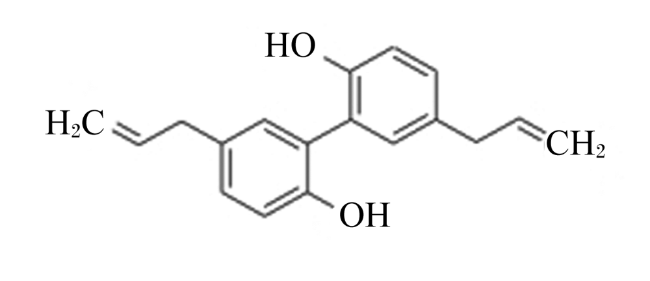
厚朴酚是植物木兰科、厚朴属厚朴中的一种成分,木脂素类植物多酚(结构式见图1)。厚朴的主要活性成分其分子式为C18H18O2,化学名为5',5-二烯丙基-2,2'-联苯二酚。单体为无色针状结晶,溶于氯仿、乙醚和丙酮等有机溶剂,难溶于水,酚羟基和烯丙基是其主要功能基团。厚朴酚具有较好的热稳定性,可在25 ℃环境下存放47 d,80 ℃以下降解较慢,100 ℃时半衰期为70 h左右[7]
图1 厚朴酚的化学结构式

Fig.1 Chemical structure of magnolol

2 厚朴酚对肠道健康的调控及其作用机制

肠道既是动物对营养素消化吸收的场所,也是机体最大的免疫器官。动物的健康生长和较高的生产效益离不开健全的肠道功能。研究发现,厚朴酚可通过改善肠道形态、促进消化液分泌、调节肠道平滑肌的收缩和舒张以及调节肠道机械、化学、生物和免疫屏障功能等途径来维护机体的肠道健康。

2.1 厚朴酚对肠道形态的影响

营养物质的消化吸收是动物肠道的基本生理功能,一方面高效的消化吸收是肠道健康的标志;另一方面高效的消化吸收也影响着肠道结构的完整性及其正常生理功能的发挥。肠道形态,如绒毛高度、隐窝深度及绒毛高度与隐窝深度的比值(绒隐比)是影响动物肠道营养物质吸收效率的关键要素之一。
诸多研究表明,厚朴酚可提高不同动物、不同生理状况下肠道的绒毛高度及绒隐比。在正常生理情况下,饲粮中添加300 mg/kg厚朴酚均可不同程度提高肉鸡和肉鸭回肠绒毛高度及绒隐比以及蛋鸡空肠和回肠绒毛高度,表明厚朴酚可促进肠道消化吸收功能[6,8-10];而饲粮中添加300 mg/kg厚朴酚还可改善受鸡白痢沙门菌属(Salmonella pullorum)感染肉鸡的空肠和回肠的绒毛高度及绒隐比[11]。对在小鼠上的研究发现,厚朴酚可改善奥沙利铂(oxaliplatin,OXL)和葡聚糖硫酸钠(dextran sulphate sodium,DSS)引起的结肠绒毛损伤、肠隐窝结构破坏和结肠长度缩短[12-14]。此外,厚朴酚还可改善由产肠毒素大肠杆菌(enterotoxigenic Escherichia coli,ETEC)和脂多糖(lipopolysaccharide,LPS)诱导的小鼠和大鼠回肠绒毛高度、隐窝深度下调或回肠绒毛断裂、固有层暴露[15-16]。以上结果表明,厚朴酚具有修复受损的肠道形态结构的作用,这对肠道营养物质的消化吸收具有潜在积极影响。此外,除通过改善肠道形态外,厚朴酚还可通过促进胃泌素和胃动素分泌,部分改善了小鼠功能性消化不良[17]

2.2 厚朴酚对肠道蠕动功能的影响

肠道蠕动过快或过慢对肠道健康都是不利的,过快会导致营养素吸收不良,电解质和水分在肠道内的相对含量增加,进而引起腹泻;过慢则会导致肠道内容物的过度发酵及病原微生物的大量繁殖,产生有毒、有害物质,破坏肠黏膜而引起腹泻[18-19]
胃肠运动主要由平滑肌收缩和舒张来调节,而厚朴酚对不同功能状态肠道平滑肌的调节具有二元性,既可兴奋被抑制的肠道平滑肌,亦可抑制过度兴奋的肠道平滑肌。有研究表明,厚朴酚可通过靶向瞬时受体电位通道蛋白4(transient receptor potential vanilloid 4,TRPV4),减少细胞外钙离子(Ca2+)内流,调节大鼠十二指肠平滑肌的舒张,抑制乙酰胆碱对肠道的收缩[20]。另有研究显示,厚朴酚可明显促进L-精氨酸诱导的有胃肠蠕动障碍的大鼠胃排空和小肠蠕动,其机制一方面可能是通过减少一氧化氮(nitric oxide,NO)的产生,从而削弱NO舒张胃肠道平滑肌的作用;同时通过增加5-羟色胺的含量,进而促进胃肠道蠕动和营养物质吸收;另一方面,增加胃窦中干细胞因子(stem cell factor,SCF)和络氨酸激酶受体(c-kit)的mRNA和蛋白表达水平,来促进胃肠道蠕动[17,21]。在LPS诱导的胃肠动力障碍的研究中发现,厚朴酚一方面可通过调节炎症介质,减轻回肠平滑肌收缩力损伤,增强其转运[22];另一方面通过激活SCF/c-kit信号转导途径,抑制NO信号通路,进而维持Cajal间质细胞的功能,以加速回肠转运、促进回肠平滑肌收缩,最终改善LPS诱导的回肠蠕动障碍[23]。此外,厚朴酚还可抑制卡巴胆碱、5-羟色胺或乙酰胆碱诱导的豚鼠或大鼠结肠收缩,其原因可能与厚朴酚阻碍电压门控钙通道和受体门控钙通道的钙内流,阻断三磷酸肌醇敏感通路和兰尼碱敏感通路,抑制肌浆网膜对钙的释放,以及抑制大鼠结肠平滑肌细胞电压敏感L型Ca2+通道的活性有关[24-25]

2.3 厚朴酚对肠道屏障功能的影响

肠道屏障根据功能的不同可分为机械屏障、化学屏障、生物屏障和免疫屏障。保持完整的肠道屏障对维持动物正常的肠道生理功能至关重要,任何一个屏障受损可能都会导致肠道功能紊乱[26]。而厚朴酚可通过维护细胞间TJs结构、维持肠道微生物稳定、降低肠道炎症反应和提高肠道抗氧化能力等维护肠道屏障功能的完整性。

2.3.1 机械屏障

机械屏障主要由肠上皮细胞及细胞间TJs构成,它不仅维护肠道屏障结构和功能的基础,也是抵御有害物质侵袭的第1道防线[27]
肠道机械屏障是由单层柱状上皮细胞构成的一个动态的、可渗透的屏障,宿主可选择性地吸收营养物质,也可同时抵御病原体和食源性抗原的入侵[28]。在小鼠上的研究显示,厚朴酚可有效抑制ETEC诱导的小鼠回肠细胞凋亡,保护肠道机械屏障功能[15]。在大鼠小肠上皮细胞(IEC-6细胞)上的研究表明,厚朴酚可通过降低p21、p27和Rb基因表达,提高细胞周期蛋白D1、细胞周期蛋白依赖性激酶4和E2F1基因表达,进而抑制热应激诱导的细胞周期停止,防止热应激对IEC-6细胞的细胞活力、形态和增殖造成的损伤,最终促进IEC-6细胞增殖,这有利于增强机械屏障完整性[29]。此外,在OXL导致的小鼠肠道损伤中发现,厚朴酚还可通过提高回肠和结肠隐窝内增殖性隐窝细胞数量,以提高隐窝的增殖活性,继而修复受损肠道组织,恢复肠道机械屏障功能的完整性[12]
TJs蛋白是组成肠道机械屏障的重要结构,主要由闭合蛋白(Claudin)、闭锁蛋白(Occludin)和闭合小带蛋白(zonaul occludens,ZO)构成,在维持肠道屏障功能完整性、调节细胞通透性等方面扮演着不可或缺的角色[30]。厚朴酚可提高不同动物、生理状况下的肠道TJs蛋白表达,以维护机械屏障的完整性,进而保证肠道机械屏障功能的正常发挥。在正常生理条件下,厚朴酚可通过提高肉鸡空肠Claudin-1的mRNA表达水平[6],增强蛋鸡回肠OccludinClaudin-1的基因转录[9-10],从而增强肠道机械屏障。此外,厚朴酚还可修复OXL、DSS或Salmonella pullorum诱导的小鼠回肠、结肠或肉鸡回肠肠道损伤,继而保护肠道屏障,其原因可能与厚朴酚提高小鼠回肠Occludin蛋白表达量、结肠Occludin和ZO-1蛋白表达量或肉鸡回肠Claudin-5的mRNA表达水平有关[11-12,14]

2.3.2 化学屏障

肠道的化学屏障主要由胃肠道分泌的消化液、消化酶等化学物质和肠道微生物产生的短链脂肪酸等抑菌物质组成,对抵御微生物入侵和维持肠道健康有重要作用[31]。厚朴酚可通过促进微生物对碳水化合物的发酵和提高肠道碱性磷酸酶(intestinal alkaline phosphatase,IAP)的活性,以改善肠道化学屏障功能。
断奶仔猪的研究表明,饲喂400 mg/kg厚朴酚35 d后可提高其粪便乙酸和总短链脂肪酸含量[32],而短链脂肪酸可为肠上皮细胞提供能源,在促进肠上皮细胞增殖、分化的同时,还可改善肠道形态结构及其屏障功能,对维持肠道健康和促进营养物质的消化吸收发挥不可或缺的作用[33-34],其中,乙酸既能作为外周组织的能量基底,又具有良好的抗炎和免疫调节作用[35]。除提高粪便短链脂肪酸含量外,厚朴酚还可降低断奶仔猪粪便pH[32],而pH的降低一方面可促进有益菌的定植,抑制致病菌的增殖,进而维护肠道微生物平衡[36];另一方面还可能改善微生物的发酵模式,降低其所分泌蛋白酶的活性,从而减少含氮代谢产物的腐败发酵[37]。因此,上述结果表明,厚朴酚可能增加有利于肠道健康的短链脂肪酸含量,减少有害于肠道健康的含氮代谢产物含量,从而对肠道健康发挥潜在的积极作用。另有研究发现,厚朴酚还可提高罗非鱼肠道IAP活性[38],而IAP不仅可解毒肠腔中的细菌LPS并抑制肠道炎症,而且还可以限制LPS易位,进入全身循环,从而降低LPS诱导的肠道和机体发生炎症的风险[39]

2.3.3 生物屏障

肠道中的生物屏障是由肠道驻留细菌形成的,各菌群之间形成了相互依存、相互制约的肠道微生物稳态系统。在正常生理情况下,肠道以专性厌氧菌为优势菌群,如双歧杆菌、乳酸杆菌等益生菌,它们可对病原体的入侵起屏障作用,具有抵抗其他致病菌黏附或定植的能力[40]。如果肠道微生物菌群失调,定植抵抗力下降,外源病原菌就会黏附在肠道黏膜上,诱发一系列肠道疾病,如腹泻、肠炎等[41-42]
研究发现,厚朴酚可通过选择性促进有益菌在肠道的定植,抑制肠道致病菌的增殖,以优化肠道菌群结构,继而维护肠道健康。在肉鸡中的研究发现,厚朴酚可增加盲肠粪杆菌属(Faecalibacterium)相对丰度,减少盲肠粪芽孢杆菌属(Coprobacillus)相对丰度[5]Faecalibacterium与肠道健康密切相关,其发酵主要产生丁酸[43-45],丁酸是肠上皮细胞的主要能源,它可通过促进肠道健康间接改善动物的生长性能和肠道功能[46-47]。在断奶仔猪上的研究显示,厚朴酚可提高粪便乳酸杆菌属(Lactobacillus)、双歧杆菌属(Bifidobacterium)和瘤胃球菌属(Ruminococcus)数量,降低粪便大肠杆菌(Escherichia coli)数量[32]BifidobacteriumLactobacillus是猪肠道中的优势菌群,可直接或通过产生乳酸、乙酸间接调节肠道免疫反应[48-49];还可分泌抗菌因子,竞争性抑制致病菌的增殖,继而维护肠道正常生理功能[50-51]Ruminococcus是产短链脂肪酸菌,产生的短链脂肪酸可增加肠道免疫球蛋白含量,进而增强肠道免疫力[52-54]Escherichia coli是一种潜在致病菌,被认为与结肠炎、克罗恩和腹泻等疾病和症状密切相关[55-57]。此外,厚朴酚还可逆转OXL或Salmonella pullorum对小鼠粪便或肉鸡肠道微生物的影响,上调小鼠粪便拟杆菌门(Bacteroidetes)相对丰度,下调其粪便变形菌门(Protebacteria)相对丰度;或增加肉鸡回肠微生物α多样性和β多样性,并上调其回肠Lactobacillus相对丰度,最终维护肠道微生态平衡[11-12]

2.3.4 免疫屏障

研究发现,炎症反应和氧化应激会破坏动物肠道免疫力[58-59],而厚朴酚可通过降低肠道炎症反应、提高肠道抗氧化功能,增强肠道免疫屏障。在LPS诱导的大鼠回肠炎症中,厚朴酚可能通过抑制核转录因子-κB(nuclear factor-κB,NF-κB)信号通路,调节活化正常T细胞表达分泌因子的蛋白表达和分泌,提高白细胞介素-10(interleukin-10,IL-10)的mRNA表达水平,从而减弱肿瘤坏死因子-α(tumor necrosis factor-α,TNF-α)、单核细胞趋化蛋白-1和诱导型一氧化氮合酶(inducible nitric oxide synthase,iNOS)的基因转录,降低TNF-α、IL-6和IL-1β含量,以减轻肠道炎症反应;同时通过增强超氧化物歧化酶(superoxide dismutase,SOD)活性,降低丙二醛(malondialdehyde,MDA)含量,改善肠道氧化应激,最终改善肠道免疫屏障功能[16,22]。厚朴酚还可通过增强肉鸡空肠SOD1、谷胱甘肽过氧化物酶基因表达,提高空肠T-SOD、SOD活性、总抗氧化能力(T-AOC)和谷胱甘肽含量,降低空肠MDA含量,进而提高肠道抗氧化能力[5-6]。在对DSS引发的小鼠结肠炎症研究中表明,厚朴酚可能通过抑制NF-κB信号转导途径,激活过氧化物酶体增殖物激活受体-γ,同时提高色氨酸代谢物的血清含量,如犬尿酸、5-羟基吲哚乙酸、吲哚乙酸、吲哚乳酸和吲哚硫酸,继而减少TNF-α、IL-6等促炎细胞因子的含量和mRNA表达水平,以缓解结肠炎症[13-14]。同时,厚朴酚还可降低OXL小鼠回肠iNOS和环氧合酶-2含量[12],下调ETEC小鼠回肠NO含量和iNOS活性[15],降低蛋鸡回肠iNOS的mRNA表达水平和NO含量[9],这些结果表明厚朴酚具有较好的抗炎能力,可改善肠道免疫屏障。此外,厚朴酚还可通过降低肉鸡回肠免疫相关基因如JCHAIN、血清趋化因子配体19(CCL19)及其受体7(CCR7)表达,提高回肠营养代谢相关基因(SAT1与ENPP7)表达,以减弱Salmonella pullorum诱发的肠道免疫反应[11]。另有研究显示,厚朴酚还可通过提高罗非鱼肠道谷胱甘肽氧化还原酶、SOD、过氧化氢酶活性以及T-AOC,降低肠道MDA和活性氧含量,进而改善肠道氧化应激,维护肠道氧化平衡[38]

3 小结

综上所述,厚朴酚通过改善肠道消化形态、蠕动功能和屏障功能来维持动物肠道健康。但是,在畜禽上的研究相对有限,不够系统和深入,在畜禽中的最适添加剂量也不明确,且其作用机制和靶点也有待深入探究。因此,未来可加强厚朴酚在畜禽肠道方面的研究。深入研究厚朴酚在不同动物、不同生长阶段、不同生理状况下对肠道形态、肠道蠕动功能和肠道屏障功能具体的调控机制和信号转导通路;确定厚朴酚在畜禽动物不同生长阶段的适宜添加剂量,以期为厚朴酚作为畜禽饲料添加剂的开发应用和维护动物肠道健康提供科学依据。
[1]
MOWAT A M, AGACE W W. Regional specialization within the intestinal immune system[J]. Nature Reviews Immunology, 2014, 14(10):667-685.

DOI PMID

[2]
孙永波, 王亚, 萨仁娜, 等. 家禽肠道健康评价指标研究进展[J]. 动物营养学报, 2017, 29(12):4266-4272.

SUN Y B, WANG Y, SA R N, et al. Research progress on evaluation indicators of intestinal health in poultry[J]. Chinese Journal of Animal Nutrition, 2017, 29(12):4266-4272. (in Chinese)

[3]
ZHANG J H, CHEN Z X, HUANG X H, et al. Insights on the multifunctional activities of magnolol[J]. BioMed Research International, 2019, 2019:1847130.

[4]
PANG Y L, HAN X F, BAMIKOLE M A, et al. Anti-diarrhea and anti-oxidant properties of Magnolol[J]. Tropical Journal of Pharmaceutical Research, 2013, 12(1):85-91.

[5]
XIE Q, XIE K H, YI J H, et al. The effects of magnolol supplementation on growth performance,meat quality,oxidative capacity,and intestinal microbiota in broilers[J]. Poultry Science, 2022, 101(4):101722.

DOI

[6]
DU E C, FAN Q W, ZHAO N, et al. Supplemental magnolol improves the antioxidant capacity and intestinal health of broiler chickens[J]. Animal Science Journal, 2021, 92(1):e13665.

DOI

[7]
田琦, 高凤仙, 马现永, 等. 厚朴酚的生理功能及其在家禽生产中的应用[J]. 动物营养学报, 2022, 34(4):2114-2122.

DOI

TIAN Q, GAO F X, MA X Y, et al. Biological function of magnolol and its application in poultry production[J]. Chinese Journal of Animal Nutrition, 2022, 34(4):2114-2122. (in Chinese)

[8]
LIN Q, ZHAO J F, XIE K, et al. Magnolol additive as a replacer of antibiotic enhances the growth performance of Linwu ducks[J]. Animal Nutrition, 2017, 3(2):132-138.

DOI

[9]
CHEN F, ZHANG H, DU E C, et al. Effects of magnolol on egg production,egg quality,antioxidant capacity,and intestinal health of laying hens in the late phase of the laying cycle[J]. Poultry Science, 2021, 100(2):835-843.

DOI

[10]
CHEN F, ZHANG H, ZHAO N, et al. Effects of magnolol and honokiol blend on performance,egg quality,hepatic lipid metabolism,and intestinal morphology of hens at late laying cycle[J]. Animal, 2022, 16(6):100532.

DOI

[11]
CHEN F, ZHANG H, DU E C, et al. Supplemental magnolol or honokiol attenuates adverse effects in broilers infected with Salmonella pullorum by modulating mucosal gene expression and the gut microbiota[J]. Journal of Animal Science and Biotechnology, 2021, 12(1):87.

DOI

[12]
XIA T, ZHANG J Z, HAN L Y, et al. Protective effect of magnolol on oxaliplatin-induced intestinal injury in mice[J]. Phytotherapy Research, 2019, 33(4):1161-1172.

DOI PMID

[13]
ZHAO L, XIAO H T, MU H X, et al. Magnolol,a natural polyphenol,attenuates dextran sulfate sodium-induced colitis in mice[J]. Molecules, 2017, 22(7):1218.

DOI

[14]
SHEN P, ZHANG Z C, HE Y, et al. Magnolol treatment attenuates dextran sulphate sodium-induced murine experimental colitis by regulating inflammation and mucosal damage[J]. Life Sciences, 2018, 196:69-76.

DOI PMID

[15]
DENG Y L, HAN X F, TANG S X, et al. Magnolol and honokiol attenuate apoptosis of enterotoxigenic Escherichia coli-induced intestinal epithelium by maintaining secretion and absorption homeostasis and protecting mucosal integrity[J]. Medical Science Monitor, 2018, 24:3348-3356.

DOI

[16]
MAO S H, FENG D D, WANG X, et al. Magnolol protects against acute gastrointestinal injury in sepsis by down-regulating regulated on activation,normal T-cell expressed and secreted[J]. World Journal of Clinical Cases, 2021, 9(34):10451-10463.

DOI

[17]
王振奋, 黄平, 蔡国豪. 厚朴酚对功能性消化不良小鼠消化液分泌和胃肠运动功能的影响[J]. 现代消化及介入诊疗, 2020, 25(4):454-458.

WANG Z F, HUANG P, CAI G H. Effects of magnolol on digestive fluid secretion and gastrointestinal motion function in mice with functional dyspepsia[J]. Modern Digestion & Intervention, 2020, 25(4):454-458. (in Chinese)

[18]
FIELD M. Intestinal ion transport and the pathophysiology of diarrhea[J]. The Journal of Clinical Investigation, 2003, 111(7):931-943.

DOI

[19]
李江, 谷子林. 家兔腹泻发生机制及调控研究进展[J]. 中国兽医杂志, 2003, 39(5):41-43.

LI J, GU Z L. Research progress in diarrhoetic pathogenesis and regulation of rabbits[J]. Chinese Journal of Veterinary Medicine, 2003, 39(5):41-43. (in Chinese)

[20]
NIU L, WANG J, SHEN F K, et al. Magnolol and honokiol target TRPC4 to regulate extracellular calcium influx and relax intestinal smooth muscle[J]. Journal of Ethnopharmacology, 2022, 290:115105.

DOI

[21]
WANG X, ZHANG C, ZHENG M Y, et al. Metabolomics analysis of L-arginine induced gastrointestinal motility disorder in rats using UPLC-MS after magnolol treatment[J]. Frontiers in Pharmacology, 2019, 10:183.

DOI

[22]
YANG T C, ZHANG S W, SUN L N, et al. Magnolol attenuates sepsis-induced gastrointestinal dysmotility in rats by modulating inflammatory mediators[J]. World Journal of Gastroenterology, 2008, 14(48):7353-7360.

DOI

[23]
MIAO B, ZHANG S W, WANG H, et al. Magnolol pretreatment prevents sepsis-induced intestinal dysmotility by maintaining functional interstitial cells of Cajal[J]. Inflammation, 2013, 36(4):897-906.

DOI PMID

[24]
BIAN Z X, ZHANG G S, WONG K L, et al. Inhibitory effects of magnolol on distal colon of guinea pig in vitro[J]. Biological and Pharmaceutical Bulletin, 2006, 29(4):790-795.

DOI

[25]
ZHANG M, ZANG K H, LUO J L, et al. Magnolol inhibits colonic motility through down-regulation of voltage-sensitive L-type Ca2+ channels of colonic smooth muscle cells in rats[J]. Phytomedicine, 2013, 20(14):1272-1279.

DOI

[26]
梅华迪, 李袁飞, 马现永, 等. 槲皮素对动物肠道黏膜屏障功能的影响及其调控机制[J]. 动物营养学报, 2022, 34(9):5475-5488.

DOI

MEI H D, LI Y F, MA X Y, et al. Effects and regulatory mechanisms of quercetin on animal intestinal mucosal barrier function[J]. Chinese Journal of Animal Nutrition, 2022, 34(9):5475-5488. (in Chinese)

DOI

[27]
PENG H, SHEN Y, ZHANG Q, et al. Qihuang decoction promotes the recovery of intestinal immune barrier dysfunction after gastrectomy in rats[J]. American Journal of Translational Research, 2018, 10(3):827-836.

PMID

[28]
LUISSINT A C, PARKOS C A, NUSRAT A. Inflammation and the intestinal barrier:leukocyte-epithelial cell interactions,cell junction remodeling,and mucosal repair[J]. Gastroenterology, 2016, 151(4):616-632.

DOI

[29]
MEI C, HE S S, YIN P, et al. Magnolol pretreatment attenuates heat stress-induced IEC-6 cell injury[J]. Journal of Zhejiang University.Science.B, 2016, 17(6):413-424.

[30]
LEE S H. Intestinal permeability regulation by tight junction:implication on inflammatory bowel diseases[J]. Intestinal Research, 2015, 13(1):11-18.

DOI

[31]
REN Z H, GUO C Y, YU S M, et al. Progress in mycotoxins affecting intestinal mucosal barrier function[J]. International Journal of Molecular Sciences, 2019, 20(11):2777.

DOI

[32]
梅华迪, 李袁飞, 田琦, 等. 厚朴酚对断奶仔猪营养物质表观消化率、血清生化指标、粪便主要微生物数量及其代谢产物含量的影响[J]. 动物营养学报, 2022, 34(8):4919-4931.

DOI

MEI H D, LI Y F, TIAN Q, et al. Effects of magnolol on nutrient apparent digestibility,serum biochemical indices,main fecal microorganism numbers and their metabolite contents of weaned piglets[J]. Chinese Journal of Animal Nutrition, 2022, 34(8):4919-4931. (in Chinese)

[33]
COTTER P D, HILL C. Surviving the acid test:responses of gram-positive bacteria to low pH[J]. Microbiology and Molecular Biology Reviews, 2003, 67(3):429-453.

DOI

[34]
MA J Y, PIAO X S, SHANG Q H, et al. Mixed organic acids as an alternative to antibiotics improve serum biochemical parameters and intestinal health of weaned piglets[J]. Animal Nutrition, 2021, 7(3):737-749.

DOI PMID

[35]
TREMAROLI V, BÄCKHED F. Functional interactions between the gut microbiota and host metabolism[J]. Nature, 2012, 489(7415):242-249.

DOI

[36]
黄修奇, 王中华. 酸化玉米对断奶仔猪生长性能和胃肠道内环境的影响[J]. 中国畜牧杂志, 2011, 47(17):31-33.

HUANG X Q, WANG Z H. Effect of acidified maize on growth performance and gastrointestinal environment in weaned piglets[J]. Chinese Journal of Animal Science, 2011, 47(17):31-33. (in Chinese)

[37]
PI Y, GAO K, PENG Y, et al. Antibiotic-induced alterations of the gut microbiota and microbial fermentation in protein parallel the changes in host nitrogen metabolism of growing pigs[J]. Animal, 2019, 13(2):262-272.

DOI PMID

[38]
HUANG H, SU L H, SUN Y, et al. Dietary magnolol inclusion improves the antioxidant and immune responses,and resistance to Aeromonas hydrophila in genetically improved farmed tilapia (Oreochromis niloticus)[J]. Aquaculture Reports, 2022, 23:101017.

DOI

[39]
GHOSH S S, WANG J, YANNIE P J, et al. Over-expression of intestinal alkaline phosphatase attenuates atherosclerosis[J]. Circulation Research, 2021, 128(11):1646-1659.

DOI PMID

[40]
SOKOL H. Probiotics and antibiotics in IBD[J]. Digestive Diseases, 2014,32 (Suppl.1):10-17.

[41]
HAO W D, HAO C Y, WU C R, et al. Aluminum induced intestinal dysfunction via mechanical,immune,chemical and biological barriers[J]. Chemosphere, 2022, 288:132556.

DOI

[42]
LEE S H, INGALE S L, KIM J S, et al. Effects of dietary supplementation with Bacillus subtilis LS 1-2 fermentation biomass on growth performance,nutrient digestibility,cecal microbiota and intestinal morphology of weanling pig[J]. Animal Feed Science and Technology, 2014, 188:102-110.

DOI

[43]
MINAMOTO Y, OTONI C C, STEELMAN S M, et al. Alteration of the fecal microbiota and serum metabolite profiles in dogs with idiopathic inflammatory bowel disease[J]. Gut Microbes, 2015, 6(1):33-47.

DOI PMID

[44]
LI H, LI H W, XIE P F, et al. Dietary supplementation with fermented Mao-tai lees beneficially affects gut microbiota structure and function in pigs[J]. AMB Express, 2019, 9(1):26.

DOI

[45]
YE G Y, ZHANG L, WANG M, et al. The gut microbiota in women suffering from gestational diabetes mellitus with the failure of glycemic control by lifestyle modification[J]. Journal of Diabetes Research, 2019, 2019:6081248.

[46]
SO D, WHELAN K, ROSSI M, et al. Dietary fiber intervention on gut microbiota composition in healthy adults:a systematic review and Meta-analysis[J]. The American Journal of Clinical Nutrition, 2018, 107(6):965-983.

DOI

[47]
WANG Z C, YU H M, XIE J J, et al. Effect of pectin oligosaccharides and zinc chelate on growth performance,zinc status,antioxidant ability,intestinal morphology and short-chain fatty acids in broilers[J]. Journal of Animal Physiology and Animal Nutrition, 2019, 103(3):935-946.

DOI

[48]
PARK J, KIM M, KANG S G, et al. Short-chain fatty acids induce both effector and regulatory T cells by suppression of histone deacetylases and regulation of the mTOR-S6K pathway[J]. Mucosal Immunology, 2015, 8(1):80-93.

DOI PMID

[49]
VLASOVA A N, CHATTHA K S, KANDASAMY S, et al. Lactobacilli and Bifidobacteria promote immune homeostasis by modulating innate immune responses to human rotavirus in neonatal gnotobiotic pigs[J]. PLoS One, 2013, 8(10):e76962.

DOI

[50]
LIÉVIN V, PEIFFER I, HUDAULT S, et al. Bifidobacterium strains from resident infant human gastrointestinal microflora exert antimicrobial activity[J]. Gut, 2000, 47(5):646-652.

DOI

[51]
PENG M F, REICHMANN G, BISWAS D. Lactobacillus casei and its byproducts alter the virulence factors of foodborne bacterial pathogens[J]. Journal of Functional Foods, 2015, 15:418-428.

DOI

[52]
JI Y, FAN X X, ZHANG Y C, et al. Glycine regulates mucosal immunity and the intestinal microbial composition in weaned piglets[J]. Amino Acids, 2022, 54(3):385-398.

DOI

[53]
XU W, LIN L, LIU A, et al. L-theanine affects intestinal mucosal immunity by regulating short-chain fatty acid metabolism under dietary fiber feeding[J]. Food & Function, 2020, 11(9):8369-8379.

[54]
YU M, LI Z M, CHEN W D, et al. Hermetia illucens larvae as a fishmeal replacement alters intestinal specific bacterial populations and immune homeostasis in weanling piglets[J]. Journal of Animal Science, 2020, 98(3):skz395.

DOI

[55]
CHEN X Y, SONG P X, FAN P X, et al. Moderate dietary protein restriction optimized gut microbiota and mucosal barrier in growing pig model[J]. Frontiers in Cellular and Infection Microbiology, 2018, 8:246.

DOI PMID

[56]
MU C L, YANG Y X, SU Y, et al. Differences in microbiota membership along the gastrointestinal tract of piglets and their differential alterations following an early-life antibiotic intervention[J]. Frontiers in Microbiology, 2017, 8:797.

DOI PMID

[57]
BARNICH N, CARVALHO F A, GLASSER A L, et al. CEACAM6 acts as a receptor for adherent-invasive E. coli,supporting ileal mucosa colonization in Crohn disease[J]. The Journal of Clinical Investigation, 2007, 117(6):1566-1574.

DOI

[58]
ZHANG L, FENG L, JIANG W D, et al. Vitamin a deficiency suppresses fish immune function with differences in different intestinal segments:the role of transcriptional factor NF-κB and p38 mitogen-activated protein kinase signalling pathways[J]. British Journal of Nutrition, 2017, 117(1):67-82.

DOI

[59]
SONG Z X, JIANG W D, LIU Y, et al. Dietary zinc deficiency reduced growth performance,intestinal immune and physical barrier functions related to NF-κB,TOR,Nrf2,JNK and MLCK signaling pathway of young grass carp (Ctenopharyngodon idella)[J]. Fish & Shellfish Immunology, 2017, 66:497-523.

Outlines

/