RESEARCH PAPER

Effects of Organic Trace Elements on Trace Element Metabolism and Intestine Development of Meat Ducks

  • HUANG Xuan , 1 ,
  • DENG Ping 1 ,
  • CHEN Juan 2 ,
  • WU Shujun 2 ,
  • LIU Yang 1 ,
  • LI Chuang 1 ,
  • ZHANG Xu 1 ,
  • JIANG Guitao 1 ,
  • DAI Qiuzhong , 1, *
Expand
  • 1 Animal Nutrition and Feeding Technology Laboratory, Hunan Institute of Animal Science and Veterinary Medicine, Changsha 410131, China
  • 2 Changsha Xinjia Bioengineering Limited Company, Changsha 410300, China
*professor, E-mail:

Received date: 2022-08-18

  Online published: 2023-04-12

Abstract

This experiment was conducted to investigate the effects of different levels of organic trace elements replacing all inorganic trace elements on the deposition of copper (Cu), iron (Fe), manganese (Mn) and zinc (Zn) in liver, breast muscle, tibia and whole blood as well as intestinal development and morphology of Cherry Valley ducks aged from 1 to 42 days, and to determine the appropriate supplemental level of organic trace elements in diets. A total of 525 healthy Cherry Valley ducks of 1-day-old were randomly divided into 5 groups with 7 replicates per group and 15 ducks per replicate. The control group (100% inorganic group) was provided with 100% trace elements in the form of inorganic salts at the recommended amount, while the four organic groups were provided with 25%, 50%, 75% and 100% Cu, Fe, Mn and Zn in form of hydroxy-methionine chelate at the recommended amount, respectively. The experiment lasted for 42 days. The experimental diets were divided into two stages (1 to 21 days of age in the early stage and 22 to 42 days of age in the late stage), and all groups maintained the same nutrient levels except Cu, Fe, Mn and Zn. The results showed as follows: 1) at 21 days of age, there were no significant differences in the contents of Cu, Fe, Mn and Zn in liver, breast muscle, tibia and whole blood among all groups (P>0.05). At 42 days of age, the contents of Cu and Zn in liver of meat ducks in 25% organic group were the lowest, and significantly lower than those in 75% and 100% organic groups (P<0.05); the Fe content in tibia of meat ducks in 75% and 100% organic groups was significantly higher than that in the control group and 25% organic group (P<0.05); and the contents of Cu and Fe in whole blood of meat ducks in 100% organic group were the highest, and significantly higher than those in 25% organic group (P<0.05). 2) Compared with the control group, the relative weight of small intestine in four organic groups was increased but did not reach the significant difference level (P>0.05). There were no significant differences in villus height, crypt depth and ratio of villus height to crypt depth in duodenum, jejunum and ileum among all groups (P>0.05). In conclusion, Cherry Valley ducks aged from 1 to 42 days fed diets supplemented with 50% to 100% Cu, Fe, Mn and Zn in form of hydroxy-methionine chelate at the standard recommended amount can increase the deposition of trace elements in tissues, improve intestinal morphology and promote intestine development. Considering the production cost, it is recommended that Cherry Valley ducks aged from 1 to 42 days should be supplemented with 50% organic trace elements of the standard recommended amount.

Cite this article

HUANG Xuan , DENG Ping , CHEN Juan , WU Shujun , LIU Yang , LI Chuang , ZHANG Xu , JIANG Guitao , DAI Qiuzhong . Effects of Organic Trace Elements on Trace Element Metabolism and Intestine Development of Meat Ducks[J]. Chinese Journal of Animal Nutrition, 2023 , 35(4) : 2316 -2325 . DOI: 10.12418/CJAN2023.218

铜、铁、锰和锌是动物机体内必不可少的微量元素,其在组织中含量可以有效反映出微量元素营养状况和利用情况[1-2]。另外,饲粮中适宜水平微量元素能够改善畜禽肠道形态、肠道菌群以及肠道屏障功能,促进养分吸收利用,从而提高生产性能[3]。诸多研究表明,无机来源的复合无机微量元素(氧化物、硫酸盐)生物学利用率差,可引起肠黏膜炎症导致微量元素排放量增加[4-5];而复合有机微量元素可调控肠道健康,维持饲粮中维生素、金属离子的稳定性,具有更高利用率[6-8],因此其在畜禽养殖中应用效果优于无机微量元素,同时还可减少相应微量元素使用量,从而进一步提高养殖效益。关于肉鸭饲粮中适宜有机微量元素添加剂量的研究多集中在单一元素上[4,9],然而饲粮中微量元素是复合添加且各元素之间存在着交互作用,因此随着有机微量元素的广泛使用,研究如何在肉鸭生产中科学使用组合的有机微量元素高效、低成本替代无机微量元素已成为目前生产和科研关注的热点问题。本试验以行业标准给出的铜、铁、锰和锌水平为依据,研究不同水平有机微量元素替代无机微量元素对樱桃谷肉鸭肝脏、胸肌、胫骨和全血中铜、铁、锰及锌沉积量以及肠道发育和形态的影响,以确定其在肉鸭饲粮中的适宜添加量,为有机微量元素在肉鸭养殖和饲料生产中科学应用提供数据支撑。

1 材料与方法

1.1 试验材料

试验所需的有机铜、铁、锰、锌(99%羟基蛋氨酸螯合盐)和无机铜、铁、锰、锌(98.5%五水硫酸铜、98.5%一水硫酸亚铁、98.5%一水硫酸锌、99%一水硫酸锰)均由长沙某生物工程有限公司提供。

1.2 试验设计和试验饲粮

试验采用单因素随机设计,选择525羽健康的1日龄樱桃谷肉鸭,随机分为5个组,每组7个重复,每个重复15羽。试验期42 d。按照《肉鸭饲养标准》(NY/T 2122—2012)中的微量元素(铜、铁、锰、锌)推荐量,对照组以硫酸盐形式添加,各有机组分别按照25%、50%、75%和100%微量元素(铜、铁、锰、锌)推荐量以蛋氨酸螯合物形式添加。参照《肉鸭饲养标准》(NY/T 2122—2012)中的1~21日龄和22~42日龄北京鸭营养推荐量配制前期和后期的基础饲粮,并在保持其他营养水平一致基础上,按以上处理在基础饲粮的微量元素中添加不同形式和水平的铜、铁、锰、锌(表1)。各组饲粮均制成颗粒料,前期和后期基础饲粮组成及营养水平见表2
表1 饲粮中微量元素添加水平和实测值

Table 1 Supplemental levels and measured values of trace elements in diets mg/kg

项目
Items
微量元素来源
Trace element
sources
添加水平Supplemental levels 实测值Measured values
1~21日龄
1 to 21
days of age
22~42日龄
22 to 42
days of age
1~21日龄
1 to 21
days of age
22~42日龄
22 to 42
days of age
对照组
Control group
五水硫酸铜Cu sulfate pentahydrate 8 8 11.15 10.93
一水硫酸亚铁Fe sulfate monohydrate 60 60 192.18 184.25
一水硫酸锰Mn sulfate monohydrate 100 100 123.79 119.37
一水硫酸锌Zn sulfate monohydrate 60 60 93.73 92.87
25%有机组
25% organic group
蛋氨酸铜Cu methionine 2 2 5.21 5.14
蛋氨酸铁Fe methionine 15 15 148.68 140.73
蛋氨酸锰Mn methionine 25 25 49.89 46.52
蛋氨酸锌Zn methionine 15 15 48.58 47.93
50%有机组
50% organic group
蛋氨酸铜Cu methionine 4 4 7.84 7.76
蛋氨酸铁Fe methionine 30 30 161.45 160.85
蛋氨酸锰Mn methionine 50 50 76.84 75.99
蛋氨酸锌Zn methionine 30 30 63.13 62.55
75%有机组
75% organic group
蛋氨酸铜Cu methionine 6 6 9.48 9.18
蛋氨酸铁Fe methionine 45 45 176.26 173.27
蛋氨酸锰Mn methionine 75 75 103.38 101.43
蛋氨酸锌Zn methionine 45 45 79.42 76.39
100%有机组
100% organic
group
蛋氨酸铜Cu methionine 8 8 12.21 11.36
蛋氨酸铁Fe methionine 60 60 193.46 188.38
蛋氨酸锰Mn methionine 100 100 126.65 125.55
蛋氨酸锌Zn methionine 60 60 92.67 91.77

实测值包含了基础饲粮中微量元素(铜、铁、锰、锌)含量和添加量;数值为3个平行测定值的平均值。4个有机组剔除了有机微量元素中所带入的蛋氨酸,以保持各组蛋氨酸水平一致。

Measured values included the trace element (Cu, Fe, Mn, Zn) contents in the basal diet and added amount; values were the means of triplicate determinations. Methionine was removed from the organic trace elements in four organic groups to keep the methionine levels consistent in each group.

表2 基础饲粮组成及营养水平(风干基础)

Table 2 Composition and nutrient levels of basal diets (air-dry basis) %

项目
Items
1~21日龄
1 to 21 days of age
22~42日龄
22 to 42 days of age
原料Ingredients
玉米Corn 43.20 47.00
面粉Flour 10.00 10.00
豆粕Soybean meal 28.00 20.00
次粉Wheat middling 10.00 10.00
玉米蛋白粉Corn gluten meal 3.00 3.00
大豆油Soybean oil 1.00 5.50
石粉Limestone 1.50 1.50
磷酸氢钙CaPHO4 1.30 1.00
氯化钠NaCl 0.30 0.30
赖氨酸硫酸盐Lys sulfate (70%) 0.83 0.86
DL-蛋氨酸DL-Met (98%) 0.23 0.20
L-苏氨酸L-Thr (98%) 0.22 0.22
维生素预混料Vitamin premix1) 0.03 0.03
微量元素预混料Trace element premix2) 0.10 0.10
氯化胆碱Choline chloride (50%) 0.10 0.10
复合酶Compound enzyme 0.02 0.02
防霉剂Antimold 0.10 0.10
抗氧化剂Antioxidant 0.02 0.02
耐高温植酸酶High temperature resistance phytase 0.02 0.02
益生菌Probiotics 0.01 0.01
葡萄糖氧化酶Glucose oxidase 0.02 0.02
合计Total 100.00 100.00
营养水平Nutrient levels3)
代谢能ME/(MJ/kg) 12.05 13.39
粗蛋白质CP 20.52 17.36
钙Ca 1.00 0.90
总磷TP 0.62 0.53
非植酸磷NPP 0.36 0.29
粗纤维CF 3.18 2.77
亚油酸Linoleic acid 1.82 4.20
赖氨酸Lys 1.36 1.18
蛋氨酸Met 0.50 0.44
苏氨酸Thr 0.91 0.79
色氨酸Trp 0.21 0.17

1)维生素预混料为每千克饲粮提供 The vitamin premix provided the following per kg of diets:VA 5 000 IU,VB1 2 mg,VB2 15 mg,VB6 4 mg,VB12 0.02 mg,VD3 800 IU,VE 20 IU,VK3 0.5 mg,生物素 biotin 0.2 mg,叶酸 folic acid 0.6 mg,D-泛酸 D-pantothenic acid 60 mg,烟酸 nicotinic acid 60 mg。

2)微量元素预混料为每千克饲粮提供 The trace element premix provided the following per kg of diets:I (as potassium iodide) 0.40 mg,Se (as sodium selenite) 0.20 mg。

3)粗蛋白质、钙和总磷为实测值,其他营养水平均为计算值。CP, Ca and TP were measured values, while the other nutrient levels were calculated values.

1.3 饲养管理

试验在湖南省沅江市中国农业科学院麻类所石矶湖动物房试验鸭场进行,采用网上饲养,自由饮水和自由采食,人工光照,常规免疫。

1.4 指标测定及方法

1.4.1 肝脏、胫骨、胸肌和全血中铜、铁、锰、锌含量

在试验第21天和第42天从每个重复抽取试验鸭2只,翅下静脉采血5 mL,摇匀置于含肝素钠的采血管中。各重复试验鸭屠宰完后取肝脏、左侧胫骨和胸肌,剔除附着组织后放入封口袋中,贮存于-20 ℃低温保存,待测。饲粮、肝脏、胸肌、胫骨和全血参照邱家凌[5]的方法进行前处理后,再用火焰原子吸收分光光度计测定以上样品中铜、铁、锰、锌含量。

1.4.2 肠道发育指标

于42日龄进行屠宰测定时,取出小肠并去除内容物后称重,并用卷尺量取长度后,计算小肠相对重量和相对长度:
小肠相对重量(g/kg)=小肠鲜重(g)/活体重(kg);
小肠相对长度(cm/kg)=小肠长度(cm)/活体重(kg)。

1.4.3 小肠形态结构

在42日龄时,分离屠宰鸭的十二指肠、空肠和回肠,剪取各肠段1 cm左右,将新鲜的组织固定于4%多聚甲醛24 h以上,将固定的标本经脱水→浸蜡→包埋→修块→切片→展片→常规苏木精-伊红(HE)染色等处理后,制成石蜡切片。用显微镜选择多个非连续性视野观察切片,并挑选典型视野拍摄成图片,使用NDP.view2软件观察和量取各肠段绒毛高度和隐窝深度,并计算绒毛高度/隐窝深度值。

1.5 数据统计分析

试验数据先用Excel 2021进行整理和初步计算,再采用SPSS 22.0统计软件中的ANOVA程序进行方差分析,对差异显著者作Duncan氏法多重比较;各组试验结果均用“平均值±标准差”表示,P<0.05表示差异显著。

2 结果与分析

2.1 不同水平有机微量元素对肉鸭组织中铜、铁、锰、锌沉积的影响

表3可知,各组间21日龄肉鸭肝脏中铜、铁、锰、锌含量均无显著差异(P>0.05)。25%有机组42日龄肉鸭肝脏中铜、锌含量最低,显著低于75%和100%有机组(P<0.05),但与对照组和50%有机组相比无显著差异(P>0.05)。由表4可知,饲粮不同形式和水平微量元素对21和42日龄肉鸭胸肌中铜、铁、锰、锌含量均无显著影响(P>0.05)。由表5可知,饲粮不同形式和水平微量元素对21日龄肉鸭胫骨中铜、铁、锰、锌含量均无显著影响(P>0.05);75%和100%有机组42日龄试验鸭胫骨中铁含量显著高于对照组和25%有机组(P<0.05)。由表6可知,42日龄肉鸭全血中铜和铁含量以100%有机组最高,且显著高于25%有机组(P<0.05)。
表3 不同水平有机微量元素对肉鸭肝脏中铜、铁、锰、锌含量的影响

Table 3 Effects of different levels of organic trace elements on contents of Cu, Fe, Mn and Zn in liver of meat ducks mg/kg

项目
Items
对照组
Control
group
25%有机组
25% organic
group
50%有机组
50% organic
group
75%有机组
75% organic
group
100%有机组
100% organic
group
21日龄21 days of age
铜Cu 53.02±10.78 47.79±10.50 48.66±14.83 50.01±10.09 49.96±9.82
铁Fe 151.03±44.36 117.18±40.54 125.45±34.60 130.10±81.60 153.77±31.19
锌Zn 59.04±3.76 55.74±4.05 54.75±9.32 58.00±4.82 59.19±8.53
锰Mn 6.10±0.49 6.26±0.91 5.42±0.95 5.79±0.65 5.43±0.55
42日龄42 days of age
铜Cu 50.82±9.04ab 41.88±7.92b 50.26±11.8ab 58.37±14.58a 59.75±12.47a
铁Fe 168.89±45.74 146.47±60.35 134.76±35.07 164.88±49.66 124.92±22.33
锌Zn 48.45±5.58ab 44.17±3.67b 49.56±4.93ab 51.05±11.12a 52.80±10.77a
锰Mn 3.88±0.50 4.53±1.27 3.63±0.87 4.53±0.58 4.25±0.55

同行数据肩标相同小写字母或无字母表示差异不显著(P>0.05),不同小写字母表示差异显著(P<0.05)。下表同。

In the same row, values with the same small letter or no letter superscripts mean no significant difference (P>0.05), while with different small letter superscripts mean significant different (P<0.05). The same as below.

表4 不同水平有机微量元素对肉鸭胸肌中铜、铁、锰、锌含量的影响

Table 4 Effects of different levels of organic trace elements on contents of Cu, Fe, Mn and Zn in breast muscle of meat ducks mg/kg

项目
Items
对照组
Control
group
25%有机组
25% organic
group
50%有机组
50% organic
group
75%有机组
75% organic
group
100%有机组
100% organic
group
21日龄21 days of age
铜Cu 2.57±0.29 2.35±0.66 2.69±1.24 2.62±0.46 2.61±0.33
铁Fe 30.33±6.29 28.63±4.71 29.07±2.67 31.69±12.95 32.59±8.34
锌Zn 17.57±0.94 16.16±2.49 17.38±1.57 17.61±2.50 18.02±2.99
锰Mn 0.32±0.11 0.33±0.03 0.31±0.09 0.35±0.06 0.35±0.04
42日龄42 days of age
铜Cu 2.57±0.58 2.40±0.35 2.78±0.68 2.98±0.54 2.88±0.54
铁Fe 46.88±6.81 43.53±8.00 46.05±5.50 47.46±5.54 49.33±12.44
锌Zn 12.23±3.70 11.04±2.53 11.43±2.00 12.49±1.62 13.15±4.54
锰Mn 0.30±0.04 0.31±0.03 0.30±0.04 0.32±0.05 0.35±0.08
表5 不同水平有机微量元素对肉鸭胫骨中铜、铁、锰、锌含量的影响

Table 5 Effects of different levels of organic trace elements on contents of Cu, Fe, Mn and Zn in tibia of meat ducks mg/kg

项目
Items
对照组
Control
group
25%有机组
25% organic
group
50%有机组
50% organic
group
75%有机组
75% organic
group
100%有机组
100% organic
group
21日龄21 days of age
铜Cu 1.39±0.32 1.34±0.67 1.38±1.32 1.48±1.54 1.51±0.22
铁Fe 41.26±6.74 40.43±7.47 42.32±13.76 41.79±6.86 42.67±8.28
锌Zn 71.52±16.59 69.97±8.58 73.80±19.45 75.85±12.76 74.81±18.33
锰Mn 2.89±0.46 2.76±0.88 2.91±1.01 3.01±0.70 3.07±0.46
42日龄42 days of age
铜Cu 1.58±0.37 1.39±0.16 1.51±0.35 1.60±0.23 1.61±0.26
铁Fe 30.14±2.43b 30.28±1.81b 33.18±2.21ab 35.46±2.31a 35.60±2.90a
锌Zn 79.84±12.35 77.86±8.70 78.84±5.81 83.52±7.53 83.84±10.48
锰Mn 2.95±0.27 2.88±0.55 3.25±0.30 3.25±0.57 2.92±0.48
表6 不同水平有机微量元素对肉鸭全血中铜、铁、锰、锌含量的影响

Table 6 Effects of different levels of organic trace elements on contents of Cu, Fe, Mn and Zn in whole blood of meat ducks

项目
Items
对照组
Control
group
25%有机组
25% organic
group
50%有机组
50% organic
group
75%有机组
75% organic
group
100%有机组
100% organic
group
21日龄21 days of age
铜Cu/(mg/L) 2.37±0.69 2.17±0.47 2.69±1.50 2.82±1.56 2.95±0.93
铁Fe/(mg/L) 314.60±24.31 301.93±54.32 314.34±33.80 332.46±54.45 328.18±43.43
锌Zn/(mg/L) 7.77±1.22 7.28±1.68 7.60±1.18 8.07±0.66 8.81±1.51
锰Mn/(μg/L) 95.82±17.68 94.26±17.55 97.70±15.59 100.80±19.44 103.32±20.77
42日龄42 days of age
铜Cu/(mg/L) 1.75±0.50ab 1.48±0.54b 1.82±0.59ab 2.01±0.75a 2.16±0.64a
项目
Items
对照组
Control
group
25%有机组
25% organic
group
50%有机组
50% organic
group
75%有机组
75% organic
group
100%有机组
100% organic
group
铁Fe/(mg/L) 352.77±15.02a 307.21±28.23b 336.16±30.36ab 354.37±34.72a 360.84±24.20a
锌Zn/(mg/L) 7.83±1.14 7.44±0.66 7.78±0.56 8.28±1.11 8.51±0.95
锰Mn/(μg/L) 96.86±16.59 94.53±20.27 97.36±18.87 101.53±17.58 102.25±16.57

2.2 不同水平有机微量元素对肉鸭肠道发育的影响

表7可知,不同水平有机微量元素对肉鸭小肠相对重量和相对长度均无显著影响(P>0.05)。
表7 不同水平有机微量元素对肉鸭肠道发育的影响

Table 7 Effects of different levels of organic trace elements on intestine development of meat ducks

项目
Items
对照组
Control
group
25%有机组
25% organic
group
50%有机组
50% organic
group
75%有机组
75% organic
group
100%有机组
100% organic
group
小肠相对重量
Relative weight of small
intestine/(g/kg)
30.37±11.46 32.85±8.93 40.50±6.02 36.46±10.19 39.71±7.75
小肠相对长度
Relative length of small
intestine/(cm/kg)
75.02±6.11 77.45±9.65 75.22±7.12 76.55±9.65 87.62±8.08

2.3 不同水平有机微量元素对肉鸭小肠形态结构的影响

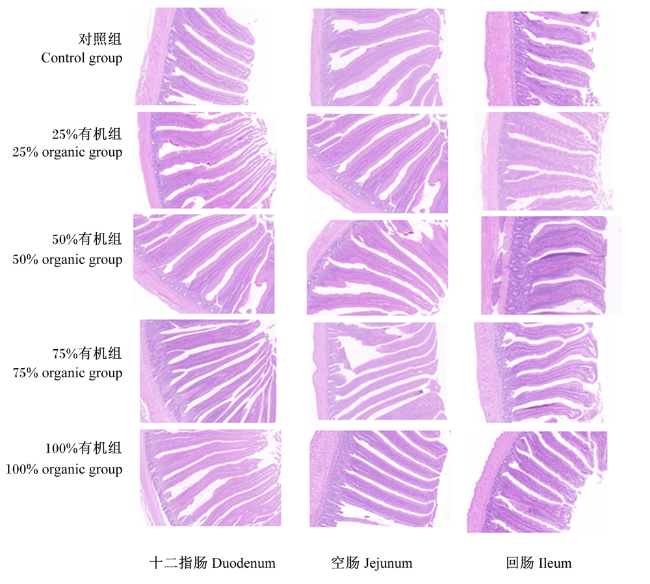
表8图1可知,与对照组相比,50%、75%和100%有机组肉鸭十二指肠、空肠和回肠的绒毛高度均有所提高,但各组间差异均不显著(P>0.05);各组间肉鸭十二指肠、空肠和回肠的隐窝深度和绒毛高度/隐窝深度值均无显著差异(P>0.05)。
表8 不同水平有机微量元素对肉鸭小肠形态结构的影响

Table 8 Effects of different levels of organic trace elements on morphological structure of small intestine of meat ducks

项目
Items
对照组
Control
group
25%有机组
25% organic
group
50%有机组
50% organic
group
75%有机组
75% organic
group
100%有机组
100% organic
group
绒毛高度
Villus height/
μm
十二指肠Duodenum 699.83±67.76 711.43±51.50 742.14±50.49 778.43±50.84 757.43±48.40
空肠Jejunum 680.33±60.76 679.71±80.35 685.57±63.19 686.00±58.73 701.14±45.48
回肠Ileum 478.17±29.58 455.43±34.83 496.14±35.09 497.00±37.10 490.71±45.22
隐窝深度
Crypt depth/
μm
十二指肠Duodenum 199.00±24.22 206.00±36.46 226.14±13.58 220.29±45.51 220.86±64.26
空肠Jejunum 202.83±10.34 190.43±43.61 187.71±32.31 191.00±21.91 203.86±21.84
回肠Ileum 125.50±6.66 120.43±6.00 121.57±9.76 121.86±5.52 124.00±6.03
绒毛高度/
隐窝深度
Villus height/
crypt depth
十二指肠Duodenum 3.51±0.78 3.45±0.43 3.28±0.47 3.53±0.42 3.43±0.36
空肠Jejunum 3.35±0.29 3.57±0.35 3.64±0.60 3.59±0.46 3.43±0.35
回肠Ileum 3.81±0.54 3.78±0.41 3.86±0.51 4.07±0.31 3.96±0.45
图1 不同水平有机微量元素对肉鸭小肠形态结构的影响

Fig.1 Effects of different levels of organic trace elements on morphological structure of small intestine of meat ducks (500×)

3 讨论

3.1 不同水平有机微量元素对肉鸭组织中铜、铁、锰、锌沉积的影响

微量元素在动物体内的周转速度差异较大,同一种元素在不同组织器官中的周转速率也不一致,如铁是血红蛋白的重要组成部分,而血红蛋白是体内运载氧气(O2)和二氧化碳(CO2)的载体,因此铁主要存储于红细胞中[10];锌主要参与核酸和蛋白质合成,故主要存在代谢旺盛的肌肉组织中用于细胞增殖[2];骨骼中锰的含量受摄入量的影响较大,机体缺锰会影响骨骼的形成和发育[11];肝脏作为微量元素代谢的主要器官也是微量元素的贮存器官[8]。因此,机体中不同组织器官中微量元素的含量可作为评定动物体内微量元素利用效率的重要依据。诸多研究表明,使用有机铜、锰、锌等量替代其硫酸盐形式饲喂蛋鸡可显著提高肝脏、胰脏、脾脏组织及蛋黄中铜和锌的沉积[12]。另外,Mwangi等[4]研究指出,低锌饲粮饲喂的雏鸡在第21天的肝脏锌含量与正常饲粮饲喂的雏鸡相同,表明在饲粮锌含量较低的情况下,雏鸡具有通过调节锌的利用达到体内平衡的能力,铁、锰和铜亦是如此;Song等[13]研究了樱桃谷肉鸭不同组织器官矿物元素沉积情况发现,在肌肉和肝脏中锌的沉积量随年龄的增加而降低,其他组织微量元素动态随年龄增长均呈增加趋势,在49~63日龄时达到峰值,这与本研究结果相似。Bao等[9]比较不同微量元素添加水平对于肝脏微量元素沉积的影响,相比铜、铁和锌,饲粮中锰水平的变化对于肝脏中锰含量的影响更明显。本试验通过对肉鸭肝脏、胸肌、胫骨和全血中铜、铁、锰、锌的含量进行测定发现,各组肉鸭前期(21日龄)肝脏、胸肌、胫骨和全血中铜、铁、锰、锌含量无显著差异;与100%无机组(对照组)相比,75%和100%有机组试验后期(42日龄)肉鸭肝脏、胫骨和全血中铜、铁、锰、锌的含量均有所提高,而试验各组中25%有机组组织中铜、铁、锰、锌的含量最低,这说明试验后期肉鸭饲粮中有机微量元素添加量需达到标准推荐量的75%~100%,其对铜、铁、锰、锌的利用效率才更高。

3.2 不同水平有机微量元素对肉鸭肠道发育的影响

肠道长度和重量变化与营养物质的吸收密切相关,肠道越长说明营养物质在消化道中停留的时间越长,从而提高饲粮消化吸收、加快生长发育;而肠道重量可以反映出肠黏膜和肌底层的发育情况[14]。铜、铁、锰、锌是动物体内酶的组成部分和激活剂,参与肠道发育和内环境的稳态调控[15-16]。本试验结果显示,各组间小肠相对长度和相对重量均无显著差异,但25%~100%有机组小肠相对重量均有所提高,由此可见肉鸭饲粮中按标准推荐量添加25%~100%有机微量元素可促进肠道黏膜和基底层发育。胡凯等[17]研究表明,包被微量元素可降低矿物质对生长中期草鱼肠道刺激,促进其发育。另外有研究结果指出,锌对仔猪肠道发育有促进作用,其效果有机优于无机[18],这与本试验结果基本一致。
肠道通过肠隐窝、褶皱和绒毛的形成增大肠黏膜的表面积,从而影响营养物质的吸收效率,而绒毛高度与隐窝深度的比值高低反映出肠道吸收功能的强弱[19]。在本试验条件下,与对照组相比,添加不同水平有机微量元素对42日龄肉鸭十二指肠、空肠和回肠的绒毛高度、隐窝深度和绒毛高度/隐窝深度值均未达到显著影响,但有机微量元素添加量达到标准推荐量50%以上,小肠各肠段绒毛高度有所提高,说明按标准推荐量50%~100%添加有机铜、铁、锰、锌能促进小肠绒毛生长,提高小肠吸收能力。张敏等[20]研究表明,与常规微量元素(500 mg/kg)相比,黄羽肉鸡饲粮中添加300~400 mg/kg包被微量元素可提高十二指肠绒毛高度/隐窝深度值。另外,刁慧等[21]研究有机微量元素对断奶仔猪肠道形态的影响发现,有机微量元素能提高十二指肠绒毛高度/隐窝深度值和空肠绒毛高度。肉鸭饲粮中有机微量元素(铜、铁、锰和锌)达到标准推荐量的50%以上时,绒毛高度均有所提高说明其小肠黏膜表面积增加,肠道吸收效率提高,同时结合肠道发育的差异,原因可能是50%、75%和100%有机组小肠绒毛高度增加,肠道发育情况更好。与100%无机组相比,由此可见,有机微量元素添加量达到标准推荐量的50%~100%,肠道发育更完善,拥有更高的消化吸收能力。

4 结论

1~42日龄樱桃谷肉鸭饲粮中有机微量元素(铜、铁、锰、锌)以标准推荐量的25%添加可达到100%无机微量元素添加量相近的效果;且以标准推荐量的50%~100%添加可提高试验鸭后期微量元素在组织中的沉积,改善肠道形态,促进肠道发育。
综合以上指标和生产成本考虑,建议1~42日龄樱桃谷肉鸭饲粮中蛋氨酸螯合形式铜、铁、锰、锌添加量分别为4、30、50、30 mg/kg。
[1]
孙静静, 张炳坤. 家禽微量元素敏感指标研究进展[J]. 动物营养学报, 2021, 33(4):1841-1850.

DOI

SUN J J, ZHANG B K. Research progress of trace element sensitive indexes for poultry[J]. Chinese Journal of Animal Nutrition, 2021, 33(4):1841-1850. (in Chinese)

[2]
OLUKOSI O A, VAN KUIJK S, HAN Y M. Copper and zinc sources and levels of zinc inclusion influence growth performance,tissue trace mineral content,and carcass yield of broiler chickens[J]. Poultry Science, 2018, 97(11):3891-3898.

DOI

[3]
SIRRI F, MAIORANO G, TAVANIELLO S, et al. Effect of different levels of dietary zinc,manganese,and copper from organic or inorganic sources on performance,bacterial chondronecrosis,intramuscular collagen characteristics,and occurrence of meat quality defects of broiler chickens[J]. Poultry Science, 2016, 95(8):1813-1824.

DOI

[4]
MWANGI S, TIMMONS J, AO T, et al. Effect of manganese preconditioning and replacing inorganic manganese with organic manganese on performance of male broiler chicks[J]. Poultry Science, 2019, 98(5):2105-2113.

DOI PMID

[5]
邱家凌. 有机微量元素减量取代对蛋鸡生产、蛋品质和微量元素代谢的影响[D]. 硕士学位论文. 杭州: 浙江大学, 2020.

QIU J L. Effects of low-levels of organic trace minerals substitution on production,egg quality and trace mineral metabolism of laying hens[D]. Master's Thesis. Hangzhou: Zhejiang University, 2020. (in Chinese)

[6]
ZHU Z P, YAN L, HU S D, et al. Effects of the different levels of dietary trace elements from organic or inorganic sources on growth performance,carcass traits,meat quality,and faecal mineral excretion of broilers[J]. Archives of Animal Nutrition, 2019, 73(4):324-337.

DOI

[7]
DE MARCO M, ZOON M V, MARGETYAL C, et al. Dietary administration of glycine complexed trace minerals can improve performance and slaughter yield in broilers and reduces mineral excretion[J]. Animal Feed Science and Technology, 2017, 232:182-189.

DOI

[8]
ZHANG K K, HAN M M, DONG Y Y, et al. Low levels of organic compound trace elements improve the eggshell quality,antioxidant capacity,immune function,and mineral deposition of aged laying hens[J]. Animal, 2021, 15(12):100401.

DOI

[9]
BAO Y M, CHOCT M. Trace mineral nutrition for broiler chickens and prospects of application of organically complexed trace minerals:a review[J]. Animal Production Science, 2009, 49(4):269-282.

DOI

[10]
王鑫, 杨在宾, 周建群, 等. 寡二糖螯合微量元素对肉鸡生产性能、微量元素代谢和抗氧化性能的影响[J]. 中国兽医学报, 2020, 40(8):1624-1631.

WANG X, YANG Z B, ZHOU J Q, et al. Effects of oligosaccharide-chelated trace elements on growth performance,trace element metabolism and antioxidant properties of broilers[J]. Chinese Journal of Veterinary Science, 2020, 40(8):1624-1631. (in Chinese)

[11]
JASEK A, COUFAL C D, PARR T M, et al. Evaluation of increasing manganese hydroxychloride level on male broiler growth performance and tibia strength[J]. Journal of Applied Poultry Research, 2019, 28(4):1039-1047.

DOI

[12]
孙秋娟, 呙于明, 张天国, 等. 羟基蛋氨酸螯合铜/锰/锌对产蛋鸡蛋壳品质、酶活及微量元素沉积的影响[J]. 中国农业大学学报, 2011, 16(4):127-133.

SUN Q J, GUO Y M, ZHANG T G, et al. Effects of 2-hydroxy-4-(methylthio)-butanoic acid chelated Cu/Mn/Zn on eggshell quality,enzyme activity and trace mineral retention in laying hens[J]. Journal of China Agricultural University, 2011, 16(4):127-133. (in Chinese)

[13]
SONG Q Q, ZHANG Y, BAI H, et al. Mineral element deposition and gene expression across different tissues of cherry valley ducks[J]. Animals, 2021, 11(1):238.

DOI

[14]
LU L, WALKER W A. Pathologic and physiologic interactions of bacteria with the gastrointestinal epithelium[J]. The American Journal of Clinical Nutrition, 2001, 73(6):1124S-1130 S.

[15]
ROSELLI M, FINAMORE A, GARAGUSO I, et al. Zinc oxide protects cultured enterocytes from the damage induced by Escherichia coli[J]. The Journal of Nutrition, 2003, 133(12):4077-4082.

DOI

[16]
刘少青. 包被微量元素对肉鸡生产性能及健康的影响[D]. 硕士学位论文. 雅安: 四川农业大学, 2019.

LIU S Q. Effects of coated trace minerals on the performance and health of broilers[D]. Master's Thesis. Ya'an: Sichuan Agricultural University, 2019. (in Chinese)

[17]
胡凯, 陈康, 周小秋. 包被复合微量元素与常规微量元素对生长中期草鱼生产性能、消化吸收能力和肠道生长发育的比较研究[J]. 四川农业大学学报, 2019, 37(4):557-565.

HU K, CHEN K, ZHOU X Q. A comparative study:effects of the coated slow-release multi-trace elements and trace elements on growth performance,digestion and absorption capacities and growth development in the intestine of young grass carp (Ctenopharyngodon idella)[J]. Journal of Sichuan Agricultural University, 2019, 37(4):557-565. (in Chinese)

[18]
PEARCE S C, SANZ FERNANDEZ M V, TORRISON J, et al. Dietary organic zinc attenuates heat stress-induced changes in pig intestinal integrity and metabolism[J]. Journal of Animal Science, 2015, 93(10):4702-4713.

DOI PMID

[19]
余海花. 饲粮添加甘氨酸亚铁对肉鸭生长性能、胴体品质及肠道健康的影响[D]. 硕士学位论文. 雅安: 四川农业大学, 2020.

YU H H. Effect of dietary ferrous glycine supplementation on growth performance、carcass quality and intestinal health of meat ducks[D]. Master's Thesis. Ya'an: Sichuan Agricultural University, 2020. (in Chinese)

[20]
张敏, 任欣, 柯芙容, 等. 包被复合微量元素对黄羽肉鸡生长性能、粪便微量元素含量及小肠黏膜形态的影响[J]. 中国农学通报, 2017, 33(17):108-112.

DOI

ZHANG M, REN X, KE F R, et al. Coating compound trace elements affecting growth performance,fecal trace elements contents and intestinal mucosal morphology of yellow broilers[J]. Chinese Agricultural Science Bulletin, 2017, 33(17):108-112. (in Chinese)

[21]
刁慧, 晏家友, 张锦秀, 等. 有机微量元素和酵母培养物替代氧化锌对断奶仔猪生长性能和肠道健康的影响[J]. 中国饲料, 2020(19):40-48.

DIAO H, YAN J Y, ZHANG J X, et al. Effects of combinations of organic trace minerals and yeast cultures as a replacement of zinc oxide on the growth performance and intestinal healthy in weaned piglets[J]. China Feed, 2020(19):40-48. (in Chinese)

Outlines

/