RESEARCH PAPER

Effects of Dietary Fucoidan on Growth Performance, Intestinal Digestive Enzyme Activities and Microbial Flora of Lambs

  • WANG Jialin , 1 ,
  • WU Pengxin 1, * ,
  • WANG Shengnan 1 ,
  • XU Yuewen 1 ,
  • QIU Xiaoyuan 1 ,
  • GAO Zhenhua 1 ,
  • ZHAO Zhihui 1 ,
  • LU Yanli 1 ,
  • YU Hui 2 ,
  • YIN Fuquan , 1, **
Expand
  • 1 Binhai Agricultural College, Guangdong Ocean University, Zhanjiang 524088, China
  • 2 School of Life and Engineering, Foshan University, Foshan 528225, China
** professor, E-mail:

*Contributed equally

Received date: 2022-10-12

  Online published: 2023-04-12

Abstract

This experiment was conducted to investigate the effects of dietary fucoidan on growth performance, intestinal digestive enzyme activities and microbial flora of lambs. Sixty 2-month-old healthy weaned castrated male lambs (Chuanzhong black goats) with similar body weight were randomly divided into 4 groups with 15 replicates per group and 1 lamb per replicate. Lambs in the control group (CON group) were fed a basal diet, and others in F1, F2 and F3 groups were fed the basal diets supplemented with 0.1%, 0.3% and 0.5% fucoidan, respectively. The pre-experimental period lasted for 7 days. and the experimental period lasted for 30 days. The results showed as follows: 1) compared with the CON group, the body weight at day 30 of F2 and F3 groups was significantly increased (P<0.05), the average daily gain and average daily feed intake during days 16 to 30 and days 1 to 30 of F2 and F3 groups were significantly increased (P<0.05), the feed conversion rate during days 16 to 30 and days 1 to 30 of F1, F2 and F3 groups were significantly decreased (P<0.05). 2) Compared with the CON group, the activity of lipase in jejunum and caecum of F3 group was significantly increased (P<0.05). 3) Compared with the CON group, the ileum microorganism Chao1 index of F1, F2 and F3 groups was significantly increased (P<0.05), the ileum microorganism Shannon index of F2 and F3 groups was significantly increased (P<0.05), and the ileum microorganism Simpson index of F1 and F2 groups was significantly increased (P<0.05); the jejunum microorganism Chao1 index of F2 and F3 groups was significantly increased (P<0.05); the duodenum microorganism Chao1 index of F1 group was significantly increased (P<0.05), the duodenum microorganism Shannon index of F1, F2 and F3 groups was significantly decreased (P<0.05), and the duodenum microorganism Simpson index of F2 group was significantly decreased (P<0.05). 4) At the phyla level, compared with the CON group, the relative abundances of Firmicutes and Bacteroides in ileum, jejunum and duodenum of F2 and F3 groups were significantly increased (P<0.05), and the relative abundance of Proteobacteria in ileum, jejunum and duodenum of F2 and F3 groups was significantly decreased (P<0.05). At genera level, compared with the CON group, the relative abundances of unspecified_Clostridiales, unspecified_Clostridiales and unspecified_Ruminococcaceae in ileum of F2 and F3 groups were significantly increased (P<0.05), and the relative abundance of Clostridium in ileum of F2 and F3 groups was significantly decreased (P<0.05); the relative abundances of unspecified_Ruminococcaceae, unspecified_Lachnospiraceae and unspecified_Bacteroidales in jejunum of F2 and F3 groups were significantly increased (P<0.05), and the relative abundance of unspecified_Clostridiales in jejunum of F1, F2 and F3 groups was significantly increased (P<0.05); the relative abundances of unspecified_Bifidobacteriaceae, unspecified_Clostridiales, unspecified_Lachnospiraceae, Ruminococcus and Oscillospira in duodenum of F2 and F3 groups were significantly increased (P<0.05), and the relative abundance of unspecified_Ruminococcaceae in duodenum of F2 and F3 groups was significantly decreased (P<0.05). In summary, dietary fucoidan can improve the intestinal digestive enzyme activities, change the composition of microorganisms in small intestine, and increase the relative abundance of probiotics of lambs. Besides, in this study, dietary appropriate fucoidan supplemental level is 0.3%.

Cite this article

WANG Jialin , WU Pengxin , WANG Shengnan , XU Yuewen , QIU Xiaoyuan , GAO Zhenhua , ZHAO Zhihui , LU Yanli , YU Hui , YIN Fuquan . Effects of Dietary Fucoidan on Growth Performance, Intestinal Digestive Enzyme Activities and Microbial Flora of Lambs[J]. Chinese Journal of Animal Nutrition, 2023 , 35(4) : 2417 -2430 . DOI: 10.12418/CJAN2023.227

肠道是动物对营养物质消化吸收的重要场所,有各种消化酶和微生物的存在,其中微生物菌群的数量庞大且结构复杂,它们之间相互作用形成一个复杂的网络,并保持一种动态平衡。这些微生物在维持机体内部环境方面发挥重要作用,包括防御病原体、利用可利用的营养物质以及抑制有害微生物的数量等。而外界因素的刺激会诱导肠道微生物区系紊乱,进而影响肠道消化功能和屏障功能[1-3]。如幼龄反刍动物由于肠道消化机能和免疫功能发育不全,易受到致病菌的感染,临床表现为腹泻、肠炎、消化能力下降等,给养羊业带来严重经济损失[4]。岩藻多糖又名褐藻多糖硫酸酯,由Kylin[5]于1913年首次发现并从海带中提取。作为一种天然糖聚合物,岩藻多糖无毒副作用,不仅具有抗氧化[6]、抗病毒[7]、抗肿瘤[8]、抗凝血[9]、抗菌[10]等特点,还能够调节肠道菌群、修复肠道黏膜以及增强肠道消化酶活性,进而达到保护肠道屏障完整性和提高肠道对物质消化吸收的作用[11-12]。武丹[13]研究表明,在肉仔鸡饲粮中添加岩藻多糖能提高肠道消化酶活性,进而提高其生长性能。此外,Shang等[14]研究发现,岩藻多糖能够抑制有害微生物的生长,显著增加小鼠肠道中微生物的丰富度。上述研究均表明岩藻多糖对于动物肠道消化酶活性以及肠道菌群具有积极的调节作用。然而有关岩藻多糖对反刍动物作用的报道甚少。因此,本研究提出进一步假设,岩藻多糖对于羔羊肠道酶消化活性和微生物区系均有积极影响,探究在饲粮中添加岩藻多糖对羔羊生长性能、肠道消化酶活性和微生物区系的影响,为幼龄反刍动物的健康养殖提供理论依据。

1 材料与方法

1.1 试验材料

本试验中使用的岩藻多糖是由青岛某生物科技有限公司提供,呈黄色粉末状,具有海藻气味,纯度为98%,硫酸基含量为28.9%。

1.2 试验设计与饲养管理

本试验于2021年4月至2021年6月在广东省湛江市雷羊牧业有限公司进行。试验选用60只健康且平均初始体重为(12.5±0.5) kg的2月龄断奶川中黑山羊(去势公羔),先进行为期7 d的预试验,期间对羔羊编号、驱虫、接种疫苗,再进行为期30 d的正式试验。60只羔羊随机分为4个组,每组15个重复,每个重复1只。对照组(CON组)饲喂基础饲粮,F1、F2和F3组分别在基础饲粮中添加0.1%、0.3%和0.5%的岩藻多糖,岩藻多糖添加水平参考Yang等[15]。每天08:30和17:30各饲喂1次,将每日饲喂的岩藻多糖均匀拌入精料中。先精后粗,自由饮水。饲养期间各组饲喂方式、试验环境及管理模式均相同。基础饲粮符合我国《肉羊饲养标准》(NY/T 861—2004)的营养要求,其组成及营养水平见表1
表1 基础饲粮组成及营养水平(干物质基础)

Table 1 Composition and nutrient levels of the basal diet (DM basis) %

项目Items 含量Content
原料Ingredients
象草Pennisetum purpureum 35.00
玉米Corn 40.89
豆粕Soybean meal 13.98
麸皮Wheat bran 7.15
食盐NaCl 0.65
磷酸氢钙CaHPO4 0.84
石粉Limestone 0.84
预混料Premix1) 0.65
合计Total 100.00
营养水平Nutrient levels2)
代谢能ME/(MJ/kg) 10.43
粗蛋白质CP 12.06
中性洗涤纤维NDF 30.06
酸性洗涤纤维ADF 16.39
钙Ca 0.67
磷P 0.54

1)预混料为每千克饲粮提供 The premix provided the following per kg of the diet:VA 8 000 IU,VD 2 000 IU,VE 40 IU,Cu 12 mg,Fe 70 mg,Mn 50 mg,Zn 80 mg,I 1.0 mg,Se 0.27 mg,Co 0.3 mg。

2)代谢能为计算值,其余为实测值。ME was a calculated value, while the others were measured values.

1.3 样品采集

试验结束时,每组随机选择6只羊,采用颈动脉放血法屠宰,屠宰前禁食、禁水12 h,采集十二指肠、空肠、回肠和盲肠中段3 cm部位内容物样品于15 mL试管中,编号,转入液氮中速冻,之后转入-80 ℃冰箱中保存,用于检测肠道消化酶活性和微生物区系。

1.4 测定指标与方法

1.4.1 生长性能

在试验第1天、第15天和第30天晨饲前测定体重,并记录每天投料量和余料量,用于计算羔羊的平均日增重(ADG)、平均日采食量(ADFI)和饲料转化率(FCR),计算公式如下:
ADG=(末重-初重)/试验天数;
ADFI=(投料量-余料量)/试验天数;
FCR=ADFI/ADG。

1.4.2 肠道消化酶活性

样品前处理:取出冷冻的空肠和盲肠内容物样品,解冻后用冷冻离心机在4 ℃条件下12 000 r/min离心10 min,取上清后分装至2 mL无酶离心管中,置于-80 ℃冰箱中保存。
空肠和盲肠α-淀粉酶、脂肪酶、胰蛋白酶和糜蛋白酶活性均使用相应酶联免疫吸附测定(ELISA)试剂盒(苏州格锐思生物科技有限公司)进行检测,操作时严格按照试剂盒说明书进行。

1.4.3 肠道微生物区系

采用十六烷基三甲基溴化铵(CTAB)的方法[16]提取小肠内容物样本的总基因组DNA,用1%琼脂糖凝胶评估DNA浓度和质量,同时用无菌水将样品稀释至1 ng/μL。然后使用特异性引物341F(5'-CCTAYGGRBGCASCAG-3')和806R(5'-GGACTACNNGGGTATCTAAT-3')对可变区(V3~V4)进行PCR扩增。最后,用凝胶回收试剂盒(Qiagen公司,德国)对PCR产物进行纯化。序列库由建库试剂盒(Illumina公司,美国)进行文库构建,通过Qubit定量试剂盒(Thermo Scientific公司,美国)检测文库质量。然后,在Illumina NovaSeq平台上对文库进行测序,生成250 bp配对末端读数。使用QIIME2 data2对原始数据进行质控、修剪、去噪和拼接,然后用QIIME2 feature-classifier将扩增子序列变异(ASV)的代表序列与预先设置好的13.8版本99%相似度的Greengens数据库进行比对,得到微生物物种的分类信息表。使用ANOVA方法鉴定分组间相对丰度有差异的细菌。多样性指数用QIIME2 core-diversity插件计算,α多样性用Chao1、Shannon和Simpson指数表示。

1.5 数据分析

试验数据先用Excel 2019进行整理计算,之后使用SPSS 26.0软件中的ANOVA程序进行单因素方差分析,并采用Duncan氏法进行多重比较,结果用平均值和均值标准误差(SEM)表示,P<0.05表示差异显著。

2 结果

2.1 饲粮中添加岩藻多糖对羔羊生长性能的影响

表2所示,各组之间第1天和第15天体重无显著差异(P>0.05)。与CON组相比,F2和F3组第30天体重显著提高(P<0.05)。各组之间第1~15天ADG、ADFI和FCR均无显著差异(P>0.05)。与CON组相比,F2和F3组第16~30天和第1~30天ADG和ADFI均显著提高(P<0.05),F1、F2和F3组第16~30天和第1~30天FCR均显著降低(P<0.05)。
表2 饲粮中添加岩藻多糖对羔羊生长性能的影响

Table 2 Effects of dietary fucoidan on growth performance of lambs (n=15)

项目
Items
组别Groups SEM P
P-value
CON F1 F2 F3
体重
BW/kg
第1天Day 1 12.20 11.38 12.27 12.98 0.99 0.26
第15天Day 15 12.47 11.58 13.25 12.78 1.08 0.12
第30天Day 30 12.85b 12.88b 15.28a 15.13a 1.09 0.02
第1~15天
Days 1 to 15
平均日增重ADG/(g/d) 30.00 31.78 51.78 53.22 10.41 0.10
平均日采食量ADFI/(g/d) 432.01 427.02 484.05 445.01 24.41 0.16
饲料转化率FCR 14.52 12.01 9.41 11.62 1.61 0.08
第16~30天
Days 16 to 30
平均日增重ADG/(g/d) 80.01b 110.01b 141.78a 121.04a 13.90 0.01
平均日采食量ADFI/(g/d) 569.05c 620.67b 711.03a 863.04a 16.08 <0.01
饲料转化率FCR 9.97a 5.79b 5.02b 6.22b 0.69 <0.01
项目
Items
组别Groups SEM P
P-value
CON F1 F2 F3
第1~30天
Days 1 to 30
平均日增重ADG/(g/d) 45.00c 50.06c 100.33a 72.01b 9.71 0.02
平均日采食量ADFI/(g/d) 501.09b 525.08b 597.01a 565.02a 22.71 0.01
饲料转化率FCR 11.25a 10.60b 6.05c 8.25c 1.08 0.01

同行数据肩标不同小写字母表示差异显著(P<0.05),相同或无字母表示差异不显著(P>0.05)。下表同。

In the same row, values with different small letter superscripts mean significant difference (P<0.05), while with the same or no letter superscripts mean no significant difference (P>0.05). The same as below.

2.2 饲粮中添加岩藻多糖对羔羊空肠消化酶活性的影响

表3所示,与CON组相比,F3组空肠脂肪酶活性显著提高(P<0.05),F1和F2组空肠脂肪酶活性无显著差异(P>0.05)。各组之间空肠α-淀粉酶、糜蛋白酶和胰蛋白酶活性无显著差异(P>0.05)。
表3 饲粮中添加岩藻多糖对羔羊空肠消化酶活性的影响

Table 3 Effects of dietary fucoidan on jejunal digestive enzyme activities of lambs (n=6) U/g prot

项目
Items
组别Groups SEM P
P-value
CON F1 F2 F3
α-淀粉酶α-amylase 220.88 231.77 234.99 343.85 55.92 0.18
糜蛋白酶Chymotrypsin 12.93 30.63 50.17 27.46 23.74 0.51
胰蛋白酶Trypsin 54.54 91.05 117.09 75.12 28.86 0.25
脂肪酶Lipase 3.11b 5.34ab 4.71b 8.88a 1.68 0.04

2.3 饲粮中添加岩藻多糖对羔羊盲肠消化酶活性的影响

表4所示,与CON组相比,F3组盲肠脂肪酶活性显著提高(P<0.05),且F3组盲肠脂肪酶活性显著高于F1和F2组(P<0.05)。各组之间盲肠α-淀粉酶、糜蛋白酶和胰蛋白酶活性无显著差异(P>0.05)。
表4 饲粮中添加岩藻多糖对羔羊盲肠消化酶活性的影响

Table 4 Effects of dietary fucoidan on cecal digestive enzyme activities of lambs (n=6) U/g prot

项目
Items
组别Groups SEM P
P-value
CON F1 F2 F3
α-淀粉酶α-amylase 220.11 253.99 199.08 236.17 71.71 0.89
糜蛋白酶Chymotrypsin 4.30 5.84 12.53 8.62 4.40 0.33
胰蛋白酶Trypsin 7.12 14.02 8.89 29.91 10.56 0.20
脂肪酶Lipase 198.74b 203.14b 205.01b 398.51a 20.31 <0.01

2.4 饲粮中添加岩藻多糖对羔羊肠道微生物菌群组成的影响

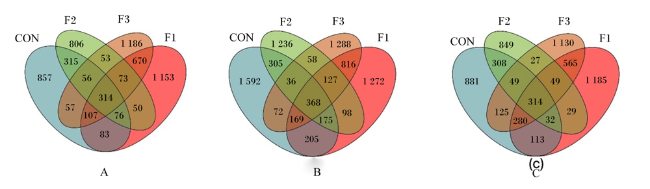
基于相似性大于97%原则,对每个样品进行操作分类单位(OTU)聚类,如图1所示,回肠中共获得5 856个OTU,其中CON组包含1 865个OTU,F1组包含2 526个OTU,F2组包含1 743个OTU,F3组包含2 516个OTU;4组共有314个共享的OTU;CON、F1、F2和F3组独有的OTU数量分别为857、1 153、806和1 186个。空肠中共获得7 817个OTU,其中CON组包含2 922个OTU,F1组包含3 230个OTU,F2组包含2 403个OTU,F3组包含2 934个OTU;4组共有368个共享的OTU;CON、F1、F2和F3组独有的OTU数量分别为1 592、1 272、1 236和1 288个。十二指肠中共获得5 936个OTU,其中CON组包含2 102个OTU,F1组包含2 567个OTU,F2组包含1 657个OTU,F3组包含2 539个OTU;4组共有314个共享的OTU;CON、F1、F2和F3组独有的OTU数量分别为881、1 185、849和1 130个。
图1 羔羊肠道微生物菌群OTU数目Venn图

A:回肠 ileum;B:空肠 jejunum;C:十二指肠 duodenum。

Fig.1 Venn diagram of intestinal microflora OTU number of lambs

CON:对照组 control group;F1:F1组 F1 group;F2:F2组 F2 group;F3:F3组 F3 group。下图同 the same as below。

2.5 饲粮中添加岩藻多糖对羔羊肠道微生物菌群α-多样性的影响

表5所示,与CON组相比,F1、F2和F3组回肠微生物的Chao1指数显著提高(P<0.05),分别提高了34.93%、43.37%和50.12%;与CON组相比,F2和F3组回肠微生物的Shannon指数显著提高(P<0.05),分别提高了18.79%和13.51%,且F2和F3组回肠微生物的Shannon指数显著高于F1组(P<0.05);与CON组相比,F1和F2组回肠微生物的Simpson指数显著提高(P<0.05),且F1和F2组回肠微生物的Simpson指数显著高于F3组(P<0.05)。
表5 饲粮中添加岩藻多糖对羔羊肠道微生物菌群α-多样性的影响

Table 5 Effects of dietary fucoidan on intestinal microflora α-diversity of lambs (n=6)

项目
Items
组别Groups SEM P
P-value
CON F1 F2 F3
回肠
Ileum
Chao1指数Chao1 index 808.10d 1 090.40c 1 158.54b 1 213.15a 19.14 <0.01
Shannon指数Shannon index 6.44b 6.76b 7.65a 7.31a 0.25 <0.01
Simpson指数Simpson index 0.96b 0.98a 0.98a 0.91c 0.01 <0.01
空肠
Jejunum
Chao1指数Chao1 index 1 550.16b 1 552.36b 1 594.44a 1 604.30a 15.26 <0.01
Shannon指数Shannon index 8.43 8.61 8.72 8.87 0.19 0.16
Simpson指数Simpson index 0.99 0.99 0.98 0.99 0.01 0.10
十二指肠
Duodenum
Chao1指数Chao1 index 1 274.35b 1 348.47a 861.78d 1 084.95c 30.31 <0.01
Shannon指数Shannon index 8.87a 8.08b 7.31c 7.86b 0.17 <0.01
Simpson指数Simpson index 0.99a 0.98a 0.92b 0.98a 0.02 <0.01
与CON组相比,F2和F3组空肠微生物的Chao1指数显著提高(P<0.05),且F2和F3组空肠微生物的Chao1指数显著高于F1组(P<0.05);各组之间空肠微生物的Shannon指数和Simpson指数均无显著差异(P>0.05)。
与CON组相比,F1组十二指肠微生物的Chao1指数显著提高(P<0.05),提高了5.82%,F2和F3组十二指肠微生物的Chao1指数显著下降(P<0.05),分别降低了32.37%和14.86%;与CON组相比,F1、F2、F3组十二指肠微生物的Shannon指数显著降低(P<0.05),分别降低了8.91%、17.59%和11.39%,且F1和F3组之间差异不显著(P>0.05);与CON组相比,F2组十二指肠微生物的Simpson指数显著降低(P<0.05),降低了7.07%。

2.6 饲粮中添加岩藻多糖对羔羊肠道微生物菌群组成的影响

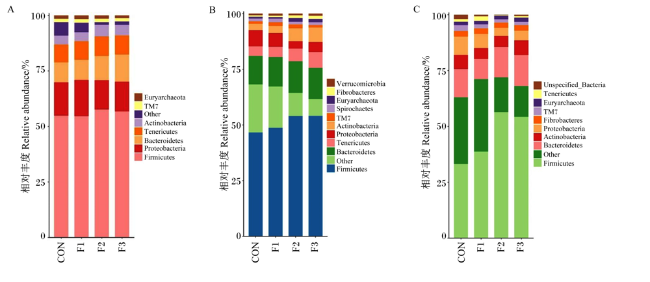
图2所示,在羔羊饲粮中添加岩藻多糖后,通过16S rDNA技术对羔羊肠道微生物进行测序,回肠总共鉴定出7个门类细菌,空肠总共鉴定出10个门类细菌,十二指肠总共鉴定出9个门类细菌,主要包括厚壁菌门、变形菌门、纤维杆菌门、拟杆菌门、放线菌门、TM7菌门、疣微菌门等。其中,厚壁菌门、变形菌门、拟杆菌门和放线菌门为回肠、空肠和十二指肠微生物的优势菌门,其总相对丰度分别为82.88%、69.51%和60.35%。
图2 门水平上羔羊肠道微生物菌群结构分布柱状图

A:回肠ileal;B:空肠jejunum;C:十二指肠 duodenum。

Firmicutes:厚壁菌门;Proteobacteria:变形菌门;Tenericutes:软壁菌门;Bacteroidetes:拟杆菌门;Actinobacteria:放线菌门;Euryarchaeota:广古菌门;TM7:TM7菌门;Spirochaetes:螺旋体菌门;Verrucomicrobia:疣微菌门;Fibrobacteres:纤维杆菌门;Unspecified_Bacteria:未分类细菌;Other:其他。

Fig.2 Histogram of intestinal microflora structure distribution of lambs at phylum level

表6所示,与CON组相比,F2和F3组回肠厚壁菌门、软壁菌门、拟杆菌门和放线菌门的相对丰度显著提高(P<0.05),F2和F3组回肠变形菌门的相对丰度显著降低(P<0.05)。与CON组相比,F2和F3组空肠厚壁菌门、软壁菌门、拟杆菌门和放线菌门的相对丰度显著提高(P<0.05),F1、F2和F3组空肠变形菌门的相对丰度显著降低(P<0.05)。与CON组相比,F1、F2和F3组十二指肠厚壁菌门的相对丰度显著提高(P<0.05),F1、F2和F3组十二指肠变形菌门和TM7菌门的相对丰度显著降低(P<0.05),F1和F2组十二指肠放线菌门的相对丰度显著降低(P<0.05),F2和F3组十二指肠拟杆菌门的相对丰度显著提高(P<0.05)。
表6 饲粮中添加岩藻多糖对门水平上羔羊肠道微生物菌群相对丰度的影响(前5)

Table 6 Effects of dietary fucoidan on intestinal microflora relative abundance of lambs at phylum level (top 5) %

项目
Items
组别Groups SEM P
P-value
CON F1 F2 F3
回肠Ileum
厚壁菌门Firmicutes 54.82b 54.58b 57.62a 56.75a 0.47 <0.01
变形菌门Proteobacteria 15.06b 16.35a 13.18c 13.40c 0.29 <0.01
软壁菌门Tenericutes 8.06b 8.36ab 8.78a 8.58a 0.23 0.03
拟杆菌门Bacteroidetes 8.94c 9.07c 10.93b 12.25a 0.27 <0.01
项目
Items
组别Groups SEM P
P-value
CON F1 F2 F3
放线菌门Actinobacteria 4.06b 4.07b 5.29a 4.77a 0.26 <0.01
空肠Jejunum
厚壁菌门Firmicutes 46.64c 48.73b 54.00a 54.10a 0.56 <0.01
拟杆菌门Bacteroidetes 12.78b 13.15ab 14.18a 14.00a 0.49 0.03
变形菌门Proteobacteria 7.28a 6.13b 3.31c 4.49d 0.29 <0.01
软壁菌门Tenericutes 4.30c 4.67c 5.72b 7.13a 0.31 <0.01
放线菌门Actinobacteria 2.81c 3.19c 5.82b 6.53a 0.33 <0.01
十二指肠Duodenum
厚壁菌门Firmicutes 33.21d 38.70c 56.43a 54.26b 0.70 <0.01
变形菌门Proteobacteria 8.21a 6.37b 3.62d 4.32c 0.31 <0.01
放线菌门Actinobacteria 6.29a 4.87b 4.91b 6.55a 0.48 <0.01
拟杆菌门Bacteroidetes 12.64b 9.00c 13.66a 13.88a 0.29 <0.01
TM7菌门TM7 2.67a 1.80b 1.54b 1.44b 0.21 <0.01
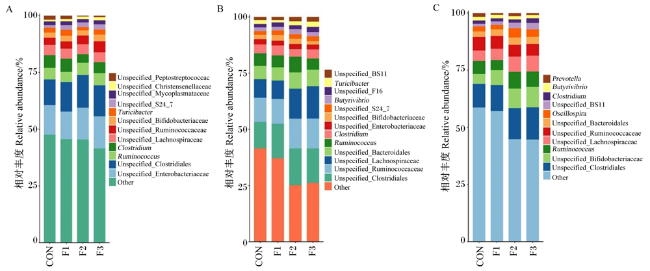
图3所示,通过对4组微生物属水平上的分析,从回肠、空肠和十二指肠中分别检测到12、13和11个微生物属种,由未分类肠杆菌科、未分类梭菌目、瘤胃球菌属、未分类毛螺菌科、未分类瘤胃球菌科、梭菌属、未分类双歧杆菌科、未分类拟杆菌目等菌属组成,其在回肠、空肠和十二指肠中总相对丰度分别为52.42%、58.44%和41.26%。
图3 属水平上羔羊肠道菌群结构分布柱状图

A:回肠ileal;B:空肠jejunum;C:十二指肠 duodenum。

Unspecified_Enterobacteriaceae:未分类肠杆菌科;Unspecified_Clostridiales:未分类梭菌目;Ruminococcus:瘤胃球菌属;Unspecified_Lachnospiraceae:未分类毛螺菌科;Unspecified_Ruminococcaceae:未分类瘤胃球菌科;Clostridium:梭菌属;Turicibacter:绿脓杆菌属;Unspecified_Mycoplasmataceae:未分类支原体科;Unspecified_Bifidobacteriaceae:未分类双歧杆菌科;Unspecified_S24_7:未分类S24-7菌属;Unspecified_Peptostreptococcaceae:未分类消化链球菌科;Unspecified_Christensenellaceae:未分类克里斯藤森菌科;Unspecified_Bacteroidales:未分类拟杆菌目;Butyrivibrio:丁酸弧菌属;Unspecified_F16:未分类F16菌属;Unspecified_BS11:未分类BS11菌属;Prevotella:普雷沃氏菌属;Oscillospira:颤螺菌属;Other:其他。

Fig.3 Histogram of intestinal microflora structure distribution of lambs at genus level

表7所示,与CON组相比,F2和F3组回肠未分类肠杆菌科、未分类梭菌目和未分类瘤胃球菌科的相对丰度显著提高(P<0.05),F2和F3组回肠梭菌属的相对丰度显著降低(P<0.05),F2组回肠绿脓杆菌属的相对丰度显著降低(P<0.05),F1组瘤胃球菌属的相对丰度显著降低(P<0.05)。各组之间回肠未分类毛螺菌科和未分类双歧杆菌科的相对丰度无显著差异(P>0.05)。
表7 饲粮中添加岩藻多糖对属水平上羔羊肠道微生物菌群相对丰度的影响(前8)

Table 7 Effects of dietary fucoidan on intestinal microflora relative abundance of lambs at genus level (top 8) %

项目
Items
组别Groups SEM P
P-value
CON F1 F2 F3
回肠Ileum
未分类肠杆菌科Unspecified_Enterobacteriaceae 13.02b 12.15c 13.96a 14.05a 0.344 <0.01
未分类梭菌目Unspecified_Clostridiales 11.30c 13.03b 14.46a 13.70b 0.351 <0.01
瘤胃球菌属Ruminococcus 5.13a 4.45b 5.34a 5.39a 0.304 0.02
未分类毛螺菌科Unspecified_Lachnospiraceae 4.63 4.47 4.38 4.39 0.226 0.66
未分类瘤胃球菌科Unspecified_Ruminococcaceae 3.09c 3.11c 3.82b 4.81a 0.201 <0.01
梭菌属Clostridium 5.55a 5.81a 3.77c 4.79b 0.244 <0.01
绿脓杆菌属Turicibacter 2.06a 2.55a 1.39b 2.22a 0.316 0.01
未分类双歧杆菌科Unspecified_Bifidobacteriaceae 2.30 2.58 2.36 2.94 0.325 0.22
空肠Jejunum
未分类梭菌目Unspecified_Clostridiales 11.69c 15.37b 16.30a 15.30b 0.364 <0.01
未分类瘤胃球菌科Unspecified_Ruminococcaceae 10.78b 11.07b 13.22a 13.25a 0.553 <0.01
未分类毛螺菌科Unspecified_Lachnospiraceae 8.25c 8.11c 13.33b 14.37a 0.240 <0.01
瘤胃球菌属Ruminococcus 5.57b 5.28b 6.96a 5.01c 0.226 <0.01
未分类拟杆菌目Unspecified_Bacteroidales 5.94b 5.88b 7.29a 7.34a 0.287 <0.01
梭菌属Clostridium 4.00b 4.50a 3.44c 4.06b 0.136 <0.01
未分类双歧杆菌科Unspecified_Bifidobacteriaceae 1.95bc 2.55a 2.40ab 1.54c 0.222 0.01
未分类肠杆菌科Unspecified_Enterobacteriaceae 2.28 2.05 2.16 2.14 0.222 0.78
十二指肠Duodenum
未分类双歧杆菌科Unspecified_Bifidobacteriaceae 4.26d 6.54c 8.50b 8.95a 0.206 <0.01
未分类梭菌目Unspecified_Clostridiales 10.34c 11.38b 13.62a 14.10a 0.298 <0.01
未分类毛螺菌科Unspecified_Lachnospiraceae 4.61b 5.00b 6.73a 6.98a 0.523 <0.01
未分类瘤胃球菌科Unspecified_Ruminococcaceae 5.88a 5.58ab 5.15b 5.00b 0.330 0.04
瘤胃球菌属Ruminococcus 5.73b 4.42c 7.33a 6.73a 0.353 <0.01
梭菌属Clostridium 1.30b 1.37b 1.47b 1.97a 0.156 <0.01
未分类拟杆菌目Unspecified_Bacteroidales 2.46 2.86 3.19 3.19 0.279 0.05
颤螺菌属Oscillospira 2.19c 1.96c 4.04a 3.23b 0.265 <0.01
与CON组相比,F2和F3组空肠未分类瘤胃球菌科、未分类毛螺菌科和未分类拟杆菌目的相对丰度显著提高(P<0.05),F1、F2和F3组空肠未分类梭菌目的相对丰度显著提高(P<0.05);F2组空肠瘤胃球菌属的相对丰度显著提高(P<0.05),F3组空肠瘤胃球菌属的相对丰度显著降低(P<0.05);F1组空肠梭菌属和未分类双歧杆菌科的相对丰度显著提高(P<0.05),F2组空肠梭菌属的相对丰度显著降低(P<0.05)。各组之间空肠未分类肠杆菌科的相对丰度无显著差异(P>0.05)。
与CON组相比,F1、F2和F3组十二指肠未分类双歧杆菌科、未分类梭菌目的相对丰度显著提高(P<0.05),F2和F3组十二指肠未分类毛螺菌科、瘤胃球菌属和颤螺菌属的相对丰度均显著提高(P<0.05),F2和F3组十二指肠未分类瘤胃球菌科的相对丰度显著降低(P<0.05),F3组十二指肠梭菌属的相对丰度显著提高(P<0.05)。各组之间十二指肠未分类拟杆菌目的相对丰度无显著差异(P>0.05)。

3 讨论

3.1 饲粮中添加岩藻多糖对羔羊生长性能的影响

断奶时期是幼龄动物生长过程中的重要阶段,对于幼龄动物的生长性能有着重要影响,但早期断奶会导致幼畜的生理和心理产生巨大应激,影响幼畜消化功能的发挥,引起肠道内环境失衡,进而抑制其正常的生长发育[17-18]。近些年来,有研究表明岩藻多糖能够提高机体代谢强度,改善肠道形态结构,减少饲料消耗,降低料重比,从而提高生长性能[19]。如郭广振等[20]研究发现,在代乳粉中添加0.3%的岩藻多糖可以改善断奶羔羊血清生化指标,提高ADFI和ADG。此外,车小蛟等[21]研究同样表明,饲粮中添加400 mg/kg的岩藻多糖能够显著提高羔羊体重和ADG,降低腹泻率和料重比。本研究发现,饲粮中添加岩藻多糖提高了断奶羔羊第60天体重;此外,第1~15天时,各组之间的ADG、ADFI和FCR均无显著差异,但是在第16~30天和1~30天时,饲粮中添加岩藻多糖显著影响了ADG、ADFI和FCR,其中岩藻多糖添加水平为0.3%时效果较好。这与Rattigan等[22]、Draper等[23]和郭广振等[20]的研究结果相似,表明饲粮中添加岩藻多糖能够提高羔羊ADG和ADFI,降低料重比,进而增强羔羊生长性能。

3.2 饲粮中添加岩藻多糖对羔羊肠道消化酶活性的影响

消化酶是畜禽肠道中重要的活性物质,由消化器官及消化腺分泌,具有酶类的全部特征,不仅能反映动物对营养物质的消化吸收程度,还对其生长发育和生产性能有着重要影响。在畜禽的消化过程中,机体主要通过淀粉酶、脂肪酶、胰蛋白酶和糜蛋白酶等消化酶促进对碳水化合物和蛋白质等营养物质的消化吸收。其中,淀粉酶主要参与肠道中碳水化合物的消化分解;脂肪酶主要将粗脂肪水解为甘油和脂肪酸;而胰蛋白酶和糜蛋白酶两者共同作用将蛋白质分解为大小不同等的肽段[24],更有助于肠道对蛋白质的分解消化。近些年来,大量研究表明天然多糖能够提高动物肠道中消化酶的活性,增强机体对营养物质的吸收。武丹[13]研究发现,饲粮中添加岩藻多糖可以显著提高肉仔鸡小肠中淀粉酶和糜蛋白酶活性;Cui等[25]也发现,在鱼饲料中添加30 g/kg的岩藻多糖可以显著提高6周龄银鲫肠道中脂肪酶和淀粉酶活性。本研究中,随着饲粮中岩藻多糖添加水平的提高,断奶羔羊空肠和盲肠中的α-淀粉酶、糜蛋白酶和胰蛋白酶活性均有不同程度的上升,与CON组相比,F3组空肠和盲肠脂肪酶活性显著提高。这与武梦丽[26]、尚庆辉[27]的研究结果一致,可能是由于岩藻多糖中所含的硫酸基岩藻糖与少量半乳糖和甘露糖等天然杂多糖的成分结构,能够改善肠内环境,进而使羔羊肠道消化酶活性提高,最终增强断奶羔羊对营养物质的消化吸收,达到提高其生长性能的作用。

3.3 饲粮中添加岩藻多糖对羔羊肠道微生物区系的影响

动物肠道内定植着约1014个细菌、真菌及病毒等微生物,这些肠道微生物的定植对于营养物质吸收效率起着重要作用,尤其对于肠道仍未健全的断奶羔羊更是如此[28-29]。岩藻多糖作为植物多糖,具有抑制肠道中有害菌生长繁殖、改善肠道稳态的能力,因此也被视为一种天然的肠道微生态调节剂[30]。黄娟等[31]研究发现,岩藻多糖水溶液能显著提高小鼠肠道有益菌的数量,抑制有害菌的生长,从而改善肠道菌群结构。肠道微生物丰富度及多样性在过往的研究[32-33]中常用OTU数量及α-多样性指数来直观表达。本研究基于16S rRNA基因扩增Illumina novaSeq测序,对小肠各段(空肠、回肠、十二指肠)内容物的微生物群落进行分析。通过Venn图可以发现,饲粮中添加岩藻多糖后,T1、T2和T3组OTU无论在独有数量亦或者共享数量上均与对照组存在差异,这表明岩藻多糖能在一定程度上影响早期断奶羔羊肠道菌群结构。此外,与CON组对比,T1、T2和T3组空肠、回肠有着更高的Chao1和Shannon指数,而Chao1和Shannon指数分别代表微生物群落丰富度和多样性,且数值越高,其丰富度和多样性越高[34]。这表明岩藻多糖能够提高肠道微生物的复杂性和多样性,而高多样性的菌群定植也被认为是肠道菌群成熟的重要标志[35]
在门水平上,综合来看,在本试验结果中小肠肠道微生物主要优势菌门为厚壁菌门、变形菌门、拟杆菌门、放线菌门等,这与刘婷等[36]的研究基本一致。肠道健康状态的改变与菌群复杂性的联系不大,往往是与某些有害细菌数量上的变动所引起的[37],而变形菌门则是一类多数为有害细菌的“集合”,其中包括大肠杆菌、沙门氏菌、霍乱弧菌等。本研究发现,与CON组相比,F2和F3组回肠、空肠和十二指肠变形菌门的相对丰度显著降低,可能是由于岩藻多糖能够抑制肠道微生物中有害菌的生长。这一结果与前人的研究结果[14]基本一致。厚壁菌门作为分解胃肠道中纤维素最主要的一类菌群,其相对丰度影响宿主对纤维素分解利用速率以及糖代谢[38]。同时也有报道表明拟杆菌门的相对丰度也与纤维素分解有关[39]。本研究发现,与CON组相比,F2和F3组回肠、空肠和十二指肠厚壁菌门和拟杆菌门的相对丰度显著提高,这可能与岩藻多糖能够抑制变形菌门生长,从而促进厚壁菌门和拟杆菌门的生长有关。此外,在属水平上,岩藻多糖对于回肠、空肠和十二指肠的未分类梭菌目、未分类肠杆菌科、未分类瘤胃球菌科、未分类毛螺菌科和未分类双歧杆菌科等菌属都具有的促进作用。其中,未分类梭菌目能够通过分解肠道中纤维以及半纤维物质产生丁酸,从而降低肠道pH,抑制有害菌的生长[40];未分类瘤胃球菌科具有分泌多种消化酶(如纤维素酶、淀粉酶等)的能力[41];未分类毛螺菌科属于厚壁菌门,是一种潜在的有益菌,能够通过参与多种碳水化合物的代谢,从而为宿主提供主要的能量来源——丁酸和乙酸[42];未分类双歧杆菌科对于肠道菌群和肠道免疫的稳定发育起着重要的作用[43]。综上所述,饲粮中添加岩藻多糖对于肠道菌群结构具有正面的调节作用,可能是因为岩藻多糖具有较强的抑菌作用,能够与细菌细胞膜蛋白结合,破坏其磷脂双分子层和细胞膜的完整性[44],进而减少了外来有害菌的侵入,最终提高肠道中有益菌的数量,抑制有害菌的生长。

4 结论

饲粮中添加岩藻多糖能够提高羔羊生长性能和肠道消化酶活性,改变小肠(回肠、空肠、十二指肠)中微生物菌群结构,提高有益菌的相对丰度。在本试验条件下,饲粮中添加0.3%的岩藻多糖为宜。
[1]
LANDETE J M, ARQUÉS J, MEDINA M, et al. Bioactivation of phytoestrogens:intestinal bacteria and health[J]. Critical Reviews in Food Science and Nutrition, 2016, 56(11):1826-1843.

DOI

[2]
潘杰, 刘来浩, 牟建伟. 肠道菌群与人类健康研究进展[J]. 山东师范大学学报(自然科学版), 2021, 36(4):337-365.

PAN J, LIU L H, MU J W. Research progress of gut microbiota and human health[J]. Journal of Shandong Normal University (Natural Science Edition), 2021, 36(4):337-365. (in Chinese)

[3]
YOON M Y, LEE K, YOON S S. Protective role of gut commensal microbes against intestinal infections[J]. Journal of Microbiology, 2014, 52(12):983-989.

DOI PMID

[4]
SHARMA V, PRUTHI A K, MISHRA S K, et al. Bacteriological studies on faecal samples collected from diarrhoeic sheep[J]. Haryana Veterinarian, 2007, 46:56-58.

[5]
KYLIN H. Biochemistry of sea algae[Z]. [s.L.]:[s.n.], 1913.

[6]
LIM S J, WAN MUSTAPHA W A, MASKAT M Y, et al. Isolation and antioxidant capacity of fucoidan from selected Malaysian seaweeds[J]. Food Hydrocolloids, 2014, 42(Part 2):280-288.

DOI

[7]
XUE M L, LIANG H, TANG Q J, et al. The protective and immunomodulatory effects of fucoidan against 7,12-dimethyl benz[a]anthracene-induced experimental mammary carcinogenesis through the PD1/PDL1 signaling pathway in rats[J]. Nutrition and Cancer, 2017, 69(8):1234-1244.

DOI

[8]
KIM I H, KWON M J, NAM T J. Differences in cell death and cell cycle following fucoidan treatment in high-density HT-29 colon cancer cells[J]. Molecular Medicine Reports, 2017, 15(6):4116-4122.

DOI

[9]
GRAUFFEL V, KLOAREG B, MABEAU S, et al. New natural polysaccharides with potent antithrombic activity:fucans from brown algae[J]. Biomaterials, 1989, 10(6):363-368.

DOI

[10]
孙占一, 申培丽, 王盼. 岩藻多糖改善胃肠道功效研究进展[J]. 食品与发酵科技, 2019, 55(6):91-97.

SUN Z Y, SHEN P L, WANG P. Research progress on improving gastrointestinal effect of fucoidan[J]. Sichuan Food and Fermentation, 2019, 55(6):91-97. (in Chinese)

[11]
ZUO T, LI X M, CHANG Y G, et al. Dietary fucoidan of Acaudina molpadioides and its enzymatically degraded fragments could prevent intestinal mucositis induced by chemotherapy in mice[J]. Food & Function, 2015, 6(2):415-422.

[12]
郭广振, 陈佳怡, 彭苏, 等. 岩藻多糖对断奶羔羊小肠组织形态、消化酶活性和抗氧化指标的影响[J]. 动物营养学报, 2022, 34(8):5206-5218.

DOI

GUO G Z, CHEN J Y, PENG S, et al. Effects of fucoidan on small intestinal tissue morphology,digestive enzyme activity and antioxidant indices of weaned lambs[J]. Chinese Journal of Animal Nutrition, 2022, 34(8):5206-5218. (in Chinese)

[13]
武丹. 岩藻多糖对肉仔鸡生长性能、消化酶活性和肉品质的影响[D]. 硕士学位论文. 呼和浩特: 内蒙古农业大学, 2021.

WU D. Effects of fucoidan on growth performance,digestive enzyme activity and meat quality of broilers[D]. Master's Thesis. Hohhot: Inner Mongolia Agricultural University, 2021. (in Chinese)

[14]
SHANG Q S, SHAN X D, CAI C, et al. Dietary fucoidan modulates the gut microbiota in mice by increasing the abundance of Lactobacillus and Ruminococcaceae[J]. Food & Function, 2016, 7(7):3224-3232.

[15]
YANG W G, CHEN J Y, GUO G Z, et al. The effects of fucoidan dietary supplementation on growth performance,serum antioxidant capacity,immune function indices and intestinal morphology in weaned kids[J]. Animals, 2022, 12(5):574.

DOI

[16]
WEI H Y, DING L M, WANG X J, et al. Astragalus root extract improved average daily gain,immunity,antioxidant status and ruminal microbiota of early weaned yak calves[J]. Journal of the Science of Food and Agriculture, 2021, 101(1):82-90.

DOI

[17]
史晨迪, 赵晓雅, 田沛知, 等. 羔羊断奶应激期饲喂方式对其生长性能和血清生化指标的影响[J]. 动物营养学报, 2022, 34(6):3799-3813.

DOI

SHI C D, ZHAO X Y, TIAN P Z, et al. Effects of feeding methods on growth performance and serum biochemical indices of lambs during weaning stress period[J]. Chinese Journal of Animal Nutrition, 2022, 34(6):3799-3813. (in Chinese)

DOI

[18]
李永洙, 杨燕, 金太花, 等. 早期断奶对沂蒙黑山羊羔羊生长性能、盲肠短链脂肪酸含量和菌群多样性的影响[J]. 中国农业大学学报, 2022, 27(1):156-170.

LI Y Z, YANG Y, JIN T H, et al. Effects of early weaning on growth performance cecum flora and short chain fatty acid content of Yimeng black lamb[J]. Journal of China Agricultural University, 2022, 27(1):156-170. (in Chinese)

[19]
杨晋. 海藻多糖替代抗生素对断奶仔猪生长性能和肠道屏障功能的影响[D]. 硕士学位论文. 南昌: 江西农业大学, 2019.

YANG J. Effects of seaweed polysaccharide substitute for antibiotics on growth performance and intestinal barrier function of weaned piglets[D]. Master's Thesis. Nanchang: Jiangxi Agricultural University, 2019. (in Chinese)

[20]
郭广振, 杨伟光, 刘娟, 等. 岩藻多糖对断奶羔羊生长性能、器官指数及血清生化、抗氧化和免疫指标的影响[J]. 动物营养学报, 2022, 34(5):3122-3131.

DOI

GUO G Z, YANG W G, LIU J, et al. Effects of fucoidan on growth performance,organ indices and serum biochemical,antioxidant and immune indices of weaned lambs[J]. Chinese Journal of Animal Nutrition, 2022, 34(5):3122-3131. (in Chinese)

[21]
车小蛟, 雷宏东, 高军军. 不同水平岩藻多糖对羔羊生长性能、免疫力及抗氧化功能的影响[J]. 饲料研究, 2022, 45(17):13-16.

CHE X J, LEI H D, GAO J J. Effect of different levels of fucoidan on growth performance,immunity and antioxidant function of lambs[J]. Feed Research, 2022, 45(17):13-16. (in Chinese)

[22]
RATTIGAN R, SWEENEY T, VIGORS S, et al. The effect of increasing inclusion levels of a fucoidan-rich extract derived from Ascophyllum nodosum on growth performance and aspects of intestinal health of pigs post-weaning[J]. Marine Drugs, 2019, 17(12):680.

DOI

[23]
DRAPER J, WALSH A M, MCDONNELL M, et al. Maternally offered seaweed extracts improves the performance and health status of the postweaned pig[J]. Journal of Animal Science, 2016, 94(Suppl_3):391-394.

[24]
曲星梅, 薛复来, 黄晓瑜, 等. 断奶日龄和日粮营养水平对陕北白绒山羊小肠形态发育和消化酶活性的影响[J]. 中国农业科学, 2019, 52(19):3460-3470.

DOI

QU X M, XUE F L, HUANG X Y, et al. Effects of weaning age and dietary nutritional levels on intestinal morphology and activity of digestive enzymes in 6-month-old Shaanbei white cashmere goats[J]. Scientia Agricultura Sinica, 2019, 52(19):3460-3470. (in Chinese)

[25]
CUI H, WANG Z G, LIU J, et al. Effects of a highly purified fucoidan from Undaria pinnatifida on growth performance and intestine health status of gibel carp Carassius auratus gibelio[J]. Aquaculture Nutrition, 2020, 26(1):47-59.

DOI

[26]
武梦丽. 硒化甘草多糖对雏鸡血液指标、肠道菌群和肠道消化酶活性的影响[D]. 硕士学位论文. 石河子: 石河子大学, 2021.

WU M L. Effects of selenium Glycyrrhiza polysaccharide on blood indices intestinal microflora and intestinal digestive enzyme activities of chickens[D]. Master's Thesis. Shihezi: Shihezi University, 2021. (in Chinese)

[27]
尚庆辉. 苜蓿多糖对仔猪生产性能的影响及其机理的研究[D]. 硕士学位论文. 泰安: 山东农业大学, 2016.

SHANG Q H. Effects of alfalfa polysaccharides on the growth performance of piglets and its mechanisms[D]. Master's Thesis. Tai'an: Shandong Agricultural University, 2016. (in Chinese)

[28]
ZHAO Q, ELSON C O. Adaptive immune education by gut microbiota antigens[J]. Immunology, 2018, 154(1):28-37.

DOI PMID

[29]
郭芸芳, 徐晓锋, 张力莉. 幼龄反刍动物胃肠道发育与微生物演变及其调控[J]. 中国饲料, 2021(23):1-7.

GUO Y F, XU X F, ZHANG L L. Development,microbial evolution and regulation of gastrointestinal tract in young ruminants[J]. China Feed, 2021(23):1-7. (in Chinese)

[30]
郭建行, 王慧茹, 钱振鹏, 等. 植物多糖结构类型及对肠道微生态影响研究进展[J]. 食品研究与开发, 2021, 42(20):198-205.

GUO J H, WANG H R, QIAN Z P, et al. Different structural types of plant polysaccharides and their effects on intestinal microecology:a comprehensive review[J]. Food Research and Development, 2021, 42(20):198-205. (in Chinese)

[31]
黄娟, 黄金莉, 孙佳悦, 等. 岩藻多糖对免疫低下小鼠模型免疫功能和肠道菌群的调节作用[J]. 中国食品学报, 2022, 22(5):92-102.

HUANG J, HUANG J L, SUN J Y, et al. The effect of fucoidan on immune and intestinal flora in immunocompromised mice[J]. Journal of Chinese Institute of Food Science and Technology, 2022, 22(5):92-102. (in Chinese)

[32]
李玉, 孟新月, 凌嫄, 等. 茶皂素对安徽白山羊小肠黏膜形态及肠道菌群的影响[J]. 扬州大学学报(农业与生命科学版), 2021, 42(5):25-32.

LI Y, MENG X Y, LING Y, et al. Effects of tea saponin on intestinal mucosa morphology and intestinal flora of Anhui white goat[J]. Journal of Yangzhou University(Agricultural and Life Science Edition), 2021, 42(5):25-32. (in Chinese)

[33]
李红英, 贺琴, 黄恩福, 等. 植物精油对山麻鸭免疫功能、抗氧化能力和肠道微生物的影响[J]. 中国畜牧兽医, 2022, 49(7):2586-2592.

LI H Y, HE Q, HUANG E F, et al. Effects of plant essential oils on immune function,antioxidant capacity and gut microbiota of Shan partridge ducks[J]. China Animal Husbandry & Veterinary Medicine, 2022, 49(7):2586-2592. (in Chinese)

[34]
彭婉婉, 马忠杰, 王彦, 等. 日粮中添加不同比例葡萄籽对多浪羊瘤胃真菌菌群结构的影响[J]. 塔里木大学学报, 2020, 32(4):7-16.

PENG W W, MA Z J, WANG Y, et al. Effects of supplements of different proportions grape seeds to diets on rumen fungi flora in Duolang sheep[J]. Journal of Tarim University, 2020, 32(4):7-16. (in Chinese)

[35]
LE CHATELIER E, NIELSEN T, QIN J J, et al. Richness of human gut microbiome correlates with metabolic markers[J]. Nature, 2013, 500(7464):541-546.

DOI

[36]
刘婷, 王柏辉, 刘畅, 等. 乳酸菌对苏尼特羊肠道菌群组成及肉品质的影响[J]. 中国食品学报, 2022, 22(2):131-139.

LIU T, WANG B H, LIU C, et al. Effects of Lactobacillus on intestinal flora composition and meat quality of Sunit sheep[J]. Journal of Chinese Institute of Food Science and Technology, 2022, 22(2):131-139. (in Chinese)

[37]
刘福鑫, 来宁洁, 于志凯, 等. 香芹酚对肉兔肠道形态、胃肠道pH、盲肠发酵和微生物区系的影响[J]. 动物营养学报, 2022, 34(6):3906-3917.

DOI

LIU F X, LAI N J, YU Z K, et al. Effects of carvacrol on intestinal morphology,gastrointestinal pH,cecal fermentation and microflora of meat rabbits[J]. Chinese Journal of Animal Nutrition, 2022, 34(6):3906-3917. (in Chinese)

[38]
PATEL V, PATEL A K, PARMAR N R, et al. Characterization of the rumen microbiome of Indian Kankrej cattle (Bos indicus) adapted to different forage diet[J]. Applied Microbiology and Biotechnology, 2014, 98(23):9749-9761.

DOI PMID

[39]
刘文舒, 郭小泽, 陈彦良, 等. 养殖黑斑蛙肠道微生物结构与功能分析[J]. 经济动物学报, 2021, 25(2):68-76.

LIU W S, GUO X Z, CHEN Y L, et al. Analysis of microbial structure and function in the intestine of farmed black-spot frog[J]. Journal of Economic Animal, 2021, 25(2):68-76. (in Chinese)

[40]
JIANG L, ZHU L Y, XU X, et al. Genome sequence of Clostridium tyrobutyricum ATCC 25755,a butyric acid-overproducing strain[J]. Genome Announcements, 2013, 1(3):e00308-13.

[41]
SUEN G, STEVENSON D M, BRUCE D C, et al. Complete genome of the cellulolytic ruminal bacterium Ruminococcus albus 7[J]. Journal of Bacteriology, 2011, 193(19):5574-5575.

DOI

[42]
CARASSO S, FISHMAN B, LASK L S, et al. Metagenomic analysis reveals the signature of gut microbiota associated with human chronotypes[J]. The FASEB Journal, 2021, 35(11):e22011.

[43]
SHENG K L, HE S M, SUN M, et al. Synbiotic supplementation containing Bifidobacterium infantis and xylooligosaccharides alleviates dextran sulfate sodium-induced ulcerative colitis[J]. Food & Function, 2020, 11(5):3964-3974.

[44]
LIU M, LIU Y X, CAO M J, et al. Antibacterial activity and mechanisms of depolymerized fucoidans isolated from Laminaria japonica[J]. Carbohydrate Polymers, 2017, 172:294-305.

DOI

Outlines

/