RESEARCH PAPER

Effects of Soybean Meal Replaced by Fermented Plant Protein Compound on Growth, Immune, Antioxidant and Intestinal Microflora Structure of Black Carp (Mylopharyngodon piceus)

  • CHEN Nihui ,
  • YANG Xia , * ,
  • SUN Shanshan ,
  • LEI Xiting ,
  • SHAO Xianping ,
  • WU Chenglong ,
  • YE Jinyun , *
Expand
  • Zhejiang Provincial Key Laboratory of Aquatic Resources Conservation and Development, National-Local Joint Engineering Laboratory of Aquatic Animal Breeding and Nutrition, College of Life Science, Huzhou University, Huzhou 313000, China
*YANG Xia, associate professor, E-mail: ;
YE Jinyun, professor, E-mail:

Received date: 2022-09-28

  Online published: 2023-04-12

Abstract

This experiment was conducted to study the effects of soybean meal replaced by fermented plant protein compound on growth, immune, antioxidant and intestinal microflora structure of black carp (Mylopharyngodon piceus). The different proportions (1∶1 and 2∶1) of fermented cottonseed meal and fermented rapeseed meal were used to replace 0 (control group), 50% and 75% soybean meal in the basic diet, respectively, 5 kinds of isonitrogenous and isoenergetic experimental diets were prepared, and the black carp with initial weight of (6.04±0.18) g were fed for 8 weeks. The results showed that there were no significant differences on growth performance, morphological indicators and body composition among all group (P>0.05). There were no significant differences on serum complement 3, malondialdehyde, albumin contents and lysozyme activity among all group (P>0.05). The serum complement 4 content in 50% replacement group was significantly higher than that in other groups (P<0.05), and the serum immunoglobulin M content in 75% replacement group was significantly higher than that in the control group (P<0.05). There were no significant differences on hepatopancreas superoxide dismutase, catalase, alkaline phosphatase activities and total antioxidant capacity and total cholesterol content among all group (P>0.05). There were no significant differences on intestinal α-amylase and lipase activities among all group (P>0.05), and the intestinal pepsin activity in fermented cottonseed meal and fermented rapeseed meal replacing 75% soybean meal with 1∶1 proportion group was significantly higher than that in the control group (P<0.05). The dominant microflora in intestine of black carp at the phylum level were Proteobacteria, Firmicutes, Fusobacteria and Planctomycotes, and the dominant bacteria at the genus level were Aeromonas, Cetobacterium, Ralstonia and Plesiomonas. There were no significant differences on the relative abundances of intestinal main microflora among all group (P>0.05). To sum up, under the experimental conditions, the high proportion (75%) of fermented plant protein replacing soybean meal do not cause hepatopancreas damage and intestinal microflora structure change of black carp, and even improve the activities of some immune indicators in serum and intestinal protease activity, and the compound proportion of fermented cottonseed meal and fermented rapeseed meal have no significant effects on growth performance, morphological indicators, body composition, hepatopancreas antioxidant indexes and intestinal microflora structure of black carp.

Cite this article

CHEN Nihui , YANG Xia , SUN Shanshan , LEI Xiting , SHAO Xianping , WU Chenglong , YE Jinyun . Effects of Soybean Meal Replaced by Fermented Plant Protein Compound on Growth, Immune, Antioxidant and Intestinal Microflora Structure of Black Carp (Mylopharyngodon piceus)[J]. Chinese Journal of Animal Nutrition, 2023 , 35(4) : 2478 -2489 . DOI: 10.12418/CJAN2023.232

豆粕作为我国主要的植物蛋白质饲用原料,在水产和畜禽饲料中应用广泛。长期以来,鱼粉资源短缺,导致豆粕供求关系紧张,价格波动不规律,限制了其在水产饲料中的广泛应用,其他植物蛋白质饲用原料(如棉籽粕、菜籽粕、花生粕、葵仁粕等)的使用量因此逐渐提高。其中,棉籽粕和菜籽粕蛋白质含量较高,来源广泛,但抗营养因子水平高、适口性差等因素制约了二者在水产类饲料中的广泛应用。棉籽粕中的抗营养因子不仅会对养殖对象的消化道造成损伤,还会导致低血钾以及影响其繁殖性能[1-2]。菜籽粕中抗营养因子,如硫代葡萄糖苷、芥酸、植酸、单宁等,会造成水产动物免疫力下降,肝脏组织受损等[3-4]。而经过微生物发酵的棉籽粕和菜籽粕,其抗营养因子水平大大降低,蛋白质含量增加,且所含的大分子蛋白质被分解成小肽[5-6],具有良好的应用前景。一些学者已在草鱼(Ctenopharyngodon idella)[7]、鲫鱼(Carassius auratus)[8]等水产动物上进行了关于发酵棉籽粕(fermented cottonseed meal,FCM)替代豆粕的研究,还有以尼罗罗非鱼(Oreochromis aureus)[9]、红鲷(Red snapper)[10]等为养殖对象的有关发酵菜籽粕(fermented rapeseed meal,FRM)在饲料中的应用研究。
青鱼(Mylopharyngodon piceus)是我国传统的淡水养殖鱼类,具有较高的营养及药用价值,深受消费者的喜爱。目前,发酵植物蛋白质替代豆粕在青鱼饲料中的应用研究鲜有报道。有研究表明,食物中蛋白质来源和含量对宿主肠道微生物菌群的组成、代谢过程以及代谢产物有显著影响[11-12]。动物肠道菌群能够预防病原体定植,具有调节宿主新陈代谢、免疫系统以及营养吸收的能力[13]。基于此,本试验旨在研究饲料中FCM和FRM不同复配比例替代豆粕对青鱼生长性能、形体指标、体组成、血清免疫指标、肝胰腺抗氧化指标、肠道消化酶活性以及肠道菌群结构的影响,以期为发酵植物蛋白质源在青鱼配合饲料中的应用提供理论基础。

1 材料与方法

1.1 试验设计和饲料

选择平均体重为(6.04±0.18) g的健康青鱼1 050尾,随机分为5组,每组3个重复,每个重复70尾。以进口鱼粉、豆粕、FCM、FRM、玉米蛋白粉和花生粕为主要蛋白质源,鱼油为主要脂肪源,配制5组等氮等脂的试验饲料。RC0组(对照组)试验饲料中未添加FCM和FRM,RC1组试验饲料中以FCM和FRM(FCM∶FRM=1∶1)替代50%的豆粕,RC2组试验饲料中以FCM和FRM(FCM∶FRM=2∶1)替代50%的豆粕,RC3组试验饲料中以FCM和FRM(FCM∶FRM=1∶1)替代75%的豆粕,RC4组试验饲料中以FCM和FRM(FCM∶FRM=2∶1)替代75%的豆粕。试验饲料组成及营养水平见表1。原料经粉碎机粉碎,过60目筛,按饲料配方进行称重混匀,然后添加脂肪源混合均匀,再加水混合至适合湿度且无颗粒感,最后用螺杆压条机制成粒径为1.5 mm的颗粒料,至烘箱低温烘干至水分小于10%后,保存于-20 ℃的冰柜中备用。
表1 试验饲料组成及营养水平(风干基础)

Table 1 Composition and nutrient levels of experimental diets (air-dry basis) %

项目
Items
组别Groups
RC0 RC1 RC2 RC3 RC4
原料Ingredients
鱼粉Fish meal (CP 67.0%) 20.00 20.00 20.00 20.00 20.00
豆粕Soybean meal (CP 43.2%) 30.00 15.00 15.00 7.50 7.50
花生粕Peanut meal (CP 49.2%) 8.00 8.00 8.00 8.00 8.00
玉米蛋白粉Com gluten meal (CP 58.3%) 12.00 12.00 12.00 12.00 12.00
发酵菜籽粕Fermented cottonseed meal1) 7.31 4.61 10.97 6.92
发酵棉籽粕Fermented rapeseed meal2) 7.31 9.22 10.97 13.82
木薯淀粉Tapioca starch 20.50 20.38 21.67 21.06 22.26
鱼油Fish oil 2.00 2.00 2.00 2.00 2.00
大豆卵磷脂Soybean lecithin 2.00 2.10 2.10 2.20 2.20
磷酸二氢钙Ca(H2PO4)2 2.00 2.00 2.00 2.00 2.00
氯化胆碱Choline chloride 0.50 0.50 0.50 0.50 0.50
预混料Premix3) 1.50 1.50 1.50 1.50 1.50
粘合剂Binder 1.50 1.50 1.50 1.50 1.50
合计Total 100.00 100.00 100.00 100.00 100.00
营养水平Nutrient levels4)
干物质DM 91.55 91.60 91.74 91.87 91.78
粗蛋白质CP 38.09 38.26 38.02 38.36 37.99
项目
Items
组别Groups
RC0 RC1 RC2 RC3 RC4
粗脂肪EE 6.31 6.17 6.16 6.10 6.09
粗灰分Ash 7.32 6.96 7.09 6.85 6.98

1)发酵棉籽粕营养水平 Nutrient levels of fermented cottonseed meal:干物质 DM 97.20%,粗蛋白质 CP 54.97%,粗脂肪 EE 0.47%,粗灰分 Ash 8.06%,酸溶蛋白 acid soluble protein 2.75%。

2)发酵菜籽粕营养水平 Nutrient levels of fermented rapeseed meal:干物质 DM 85.80%,粗蛋白质 CP 39.09%,粗脂肪 EE 0.64%,粗灰分 Ash 8.65%,酸溶蛋白 acid soluble protein 2.53%。

3)预混料为每千克饲料提供 Premix provided the following per kg of diets:MgSO4·7H2O 554 mg,ZnSO4·7H2O 487 mg,FeSO4·7H2O 886 mg,CuSO4·5H2O 44 mg,MnSO4·H2O 89 mg,Na2SO3 1.8 mg,KI 0.4 mg,CoCl2·6H2O 2.2 mg,沸石粉 zeolite 11.2 g,VA 17.7 mg,VB12 0.4 mg,VD 1.3 mg,VE 88.6 mg,VK 177.2 mg,硫胺素 thiamine 44.3 mg,核黄素 riboflavin 44.3 mg,泛酸 pantothenic acid 133 mg,吡哆醇 pyridoxine 44.3 mg,叶酸 folic acid 11 mg,尼克酸 niacin 332 mg,肌醇 inositol 886 mg。

4)计算值 Calculated values。

1.2 饲养管理

养殖试验在湖州师范学院水生生物养殖实验中心内进行,试验所用青鱼鱼苗购于湖州当地某苗种培育场。正式养殖试验前,进行周期为14 d的暂养,暂养期均使用基础饲料。暂养结束后,选出平均体重为(6.04±0.18) g的健康青鱼,随机分配到养殖中心水泥池(长×宽×高=4 m×2 m×1 m)的网箱(长×宽×高=2 m×1 m×1 m)中,每组3个重复(网箱),每个网箱投放70尾青鱼。正式试验开始前禁食1 d,正式养殖期间每天投喂2次(08:00、16:30),采用饱食投喂的方法。养殖期间每日24 h不间断曝气充氧,每日吸污,根据养殖水体情况进行换水,换水量约为水泥池高度的1/3。养殖试验期间,自然光照,水温(27±1) ℃,水体溶氧浓度≥6 mg/L,pH 7.6~8.0。试验期8周。

1.3 样品采集与指标分析

1.3.1 样品采集

养殖结束后,禁食24 h,对每个网箱中的青鱼进行计数并称重,分别计算增重率(weight gain ratio,WGR)、特定生长率(specific growth ratio,SGR)、成活率(survival ratio,SR);随机取6尾鱼用于全鱼体组成分析,再取若干尾进行解剖用于肝体比(hepatosomatic index,HSI)、脏体比(viscerosomatic index,VSI)分析。试验鱼经MS-222麻醉后,使用1 mL针剂器进行尾静脉采血,血样于4 ℃中静置过夜后,4 ℃、3 500 r/min离心10 min,取上层血清备用,用于血清免疫指标检测。鱼体采血后迅速剖开腹腔,取肝胰腺用于抗氧化指标检测,取肠道用于消化酶活性和肠道菌群检测,取背肌用于化学成分检测,全部样品-80 ℃储存。

1.3.2 生长和形体指标的测定

生长指标计算公式如下:
成活率(%)=100×终末尾数/初始尾数;
增重率(%)=100×(终末体重-初始体重)/初始体重;
特定生长率(%/d)=100×(ln终末体重-ln初始体重)/养殖天数。
形体指标计算公式如下:
肝体比(%)=100×肝胰腺重/终末体重;
脏体比(%)=100×内脏团重/终末体重。

1.3.3 体组成测定

青鱼全鱼和肌肉水分含量采用105 ℃干燥法测定,粗蛋白质含量采用凯氏定氮法测定,粗脂肪含量采用索氏抽提法测定,粗灰分含量采用马弗炉灼烧法测定。

1.3.4 血清免疫指标、肝胰腺抗氧化指标和肠道消化酶活性测定

血清免疫指标包括补体3(C3)、补体4(C4)、免疫球蛋白M(IgM)、丙二醛(MDA)、溶菌酶(LZM)和白蛋白(ALB);肝胰腺抗氧化指标包括总抗氧化能力(T-AOC)、过氧化氢酶(CAT)、碱性磷酸酶(AKP)、超氧化物歧酶(SOD)和总胆固醇(TC);肠道消化酶为α-淀粉酶(AMS)、胃蛋白酶(PEP)和脂肪酶(LPS)。以上指标均采用试剂盒购进行检测,试剂盒均购自南京建成生物工程研究所。

1.3.5 肠道菌群结构测定

将采集的肠道及其内容物(每组3个平行)送至广州基迪奥科技服务有限公司进行样品DNA提取、建库和16S rRNA扩增子高通量测序。具体流程参照吴金平等[14]的方法,进行物种注释分析的数据库为RDP Classifier[15]、SILVA[16]和Greengene[17]。测定结果已上传至NCBI,SRA登录号为SRR22386503-22386513。

1.4 数据统计分析

采用SPSS 25.0软件对所得数据进行单因素方差分析(one-way ANOVA),若差异达到显著水平,则进行Turkey氏多重比较。结果采用平均值±标准误表示,P<0.05表示差异显著。

2 结果与分析

2.1 发酵植物蛋白复配替代豆粕对青鱼生长性能及形体指标的影响

表2可见,各组之间青鱼生长性能及形体指标均无显著差异(P>0.05)。其中,RC2组的成活率最低,RC3组的成活率最高;RC1、RC2、RC3和RC4组增重率分别比RC0组增加了0.12%、0.48%、0.77%、0.48%;RC1、RC2、RC3和RC4组的肝体比和脏体比均低于RC0组。
表2 发酵植物蛋白复配替代豆粕对青鱼生长性能及形体指标的影响

Table 2 Effects of soybean meal replaced by fermented plant protein compound on growth performance and morphological indicators of black carp

组别
Groups
初始体重
IBW/g
终末体重
FBW/g
特定生长率
SGR/(%/d)
增重率
WGR/%
肝体比
HSI/%
脏体比
VSI/%
成活率
SR/%
RC0 6.18±0.08 19.89±0.11 2.03±0.03 224.28±4.88 0.64±0.02 6.55±0.06 85.24±4.12
RC1 5.85±0.05 19.23±0.23 2.04±0.03 224.55±5.01 0.57±0.02 6.27±0.03 86.67±10.53
RC2 6.16±0.04 19.88±0.11 2.03±0.01 225.36±4.01 0.62±0.02 6.28±0.14 80.00±4.29
RC3 5.85±0.02 19.71±0.77 2.05±0.04 226.00±8.66 0.60±0.02 6.23±0.12 88.10±7.33
RC4 6.18±0.04 19.91±0.38 2.03±0.01 225.36±2.50 0.62±0.01 6.31±0.06 87.62±2.18

同列数据肩标无字母表示差异不显著(P>0.05)。表6同。

In the same column, values with no letter superscripts mean no significant difference (P>0.05). The same as Table 6.

2.2 发酵植物蛋白复配替代豆粕对青鱼全鱼和肌肉组成的影响

表3可见,各组之间青鱼全鱼和肌肉的水分、粗蛋白质、粗脂肪、粗灰分含量均无显著差异(P>0.05)。
表3 发酵植物蛋白复配替代豆粕对青鱼全鱼和肌肉组成的影响(湿重基础)

Table 3 Effects of soybean meal replaced by fermented plant protein compound on whole body and muscle composition of black carp (wet weight basis) %

项目
Items
组别Groups
RC0 RC1 RC2 RC3 RC4
全鱼Whole body
水分Moisture 75.17±0.13 75.29±0.27 75.06±0.16 75.38±0.10 75.47±0.32
粗蛋白质CP 15.21±0.13 15.39±0.30 15.44±0.16 15.23±0.12 15.07±0.31
粗脂肪EE 6.17±0.02 6.12±0.04 6.20±0.05 6.13±0.01 6.24±0.03
粗灰分Ash 3.25±0.02 3.23±0.01 3.20±0.04 3.25±0.03 3.23±0.03
肌肉Muscle
水分Moisture 75.33±0.22 75.47±0.28 75.00±0.49 75.59±0.03 74.73±0.19
粗蛋白质CP 21.27±0.18 21.29±0.20 21.61±0.43 21.30±0.19 22.12±0.10
粗脂肪EE 2.13±0.05 2.26±0.09 2.24±0.08 2.12±0.17 2.24±0.16
粗灰分Ash 1.00±0.01 0.99±0.03 1.04±0.03 1.02±0.02 0.99±0.03

同行数据肩标不同小写字母表示差异显著(P<0.05),相同或无字母表示差异不显著(P>0.05)。表4表5同。

In the same row, values with different small letter superscripts mean significant difference (P<0.05), while with the same or no letter superscripts mean no significant difference (P>0.05). The same as Table 4 and Table 5.

2.3 发酵植物蛋白复配替代豆粕对青鱼血清免疫指标的影响

表4可见,各组之间青鱼血清C3、MDA、ALB含量以及LZM活性均无显著差异(P>0.05)。与RC0组相比,RC3和RC4组血清IgM含量显著提高(P<0.05),RC1和RC2组血清IgM含量无显著差异(P>0.05);RC1和RC2组血清C4含量显著提高(P<0.05),RC3和RC4组血清C4含量无显著差异(P>0.05)。RC1和RC2组之间、RC3和RC4组之间血清IgM、C4含量均无显著差异(P>0.05)。
表4 发酵植物蛋白复配替代豆粕对青鱼血清免疫指标的影响

Table 4 Effects of soybean meal replaced by fermented plant protein compound on serum immune indexes of black carp

项目
Items
组别Groups
RC0 RC1 RC2 RC3 RC4
免疫球蛋白M IgM/(mg/L) 43.7±1.7c 47.2±4.6bc 43.7±1.7c 57.7±1.8ab 59.4±1.8a
补体3 C3/(mg/L) 57.4±1.0 59.4±4.6 60.4±4.4 63.4±2.7 55.4±2.0
补体4 C4/(mg/L) 17.8±0.6b 24.8±0.4a 24.4±1.1a 20.9±1.7b 20.9±1.0b
丙二醛MDA/(nmol/mL) 2.06±0.08 2.06±0.17 2.01±0.21 2.01±0.18 2.01±0.05
溶菌酶LZM/(U/mL) 3.06±0.06 3.12±0.13 3.28±0.20 3.24±0.04 3.13±0.03
白蛋白ALB/(g/L) 1.13±0.03 0.98±0.20 1.13±0.14 1.15±0.15 1.04±0.10

2.4 发酵植物蛋白复配替代豆粕对青鱼肝胰腺抗氧化指标的影响

表5可见,各组之间青鱼肝胰腺CAT、SOD、AKP活性和TC含量及T-AOC均无显著差异(P>0.05)。
表5 发酵植物蛋白复配替代豆粕对青鱼肝胰腺抗氧化指标的影响

Table 5 Effects of soybean meal replaced by fermented plant protein compound on hepatopancreas antioxidant indexes of black carp

项目
Items
组别Groups
RC0 RC1 RC2 RC3 RC4
总抗氧化能力T-AOC/(U/mg prot) 1.57±0.11 1.64±0.07 1.59±0.08 1.62±0.05 1.57±0.03
过氧化氢酶CAT/(U/mg prot) 14.80±0.19 15.10±0.60 15.22±0.44 15.14±0.09 14.75±0.17
超氧化物歧化酶SOD/(U/mg prot) 22.77±0.51 23.06±0.48 23.29±0.20 23.20±0.43 22.94±0.26
碱性磷酸酶AKP/(U/mg prot) 3.02±0.05 3.06±0.11 2.97±0.11 3.02±0.06 2.90±0.12
总胆固醇TC/(mmol/g prot) 1.91±0.09 1.88±1.12 1.85±0.22 1.85±1.66 1.89±0.13

2.5 发酵植物蛋白复配替代豆粕对青鱼肠道消化酶活性的影响

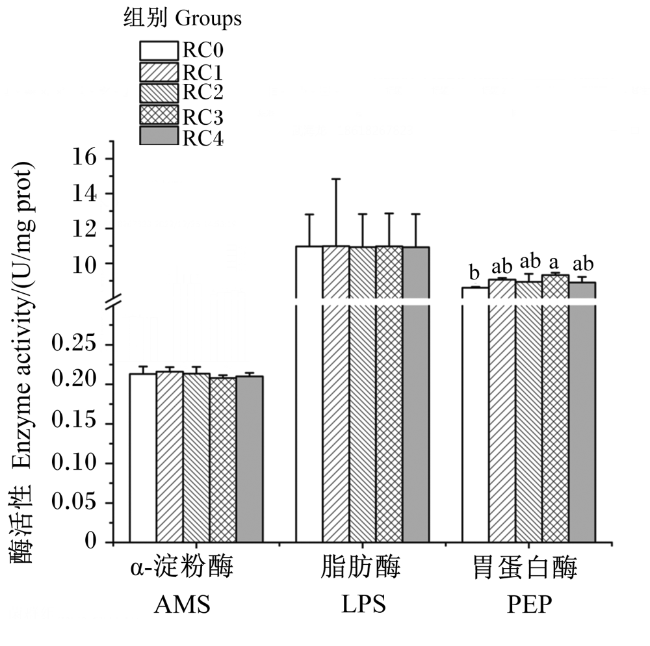
图1可见,各组之间青鱼的肠道AMS和LPS活性均无显著差异(P>0.05)。与RC0组相比,RC3组的肠道PEP活性显著提高(P<0.05),RC1、RC2和RC4组的肠道PEP活性无显著差异(P>0.05)。
图1 发酵植物蛋白复配替代豆粕对青鱼肠道消化酶活性的影响

数据柱标不同小写字母表示差异显著(P<0.05),相同或无字母表示差异不显著(P>0.05)。

Fig.1 Effects of soybean meal replaced by fermented plant protein compound on intestinal digestive enzyme activities of black carp

Value columns with different small letters mean significant difference (P<0.05), while with the same or no letter superscripts mean no significant difference (P>0.05).

2.6 发酵植物蛋白复配替代豆粕对青鱼肠道菌群结构的影响

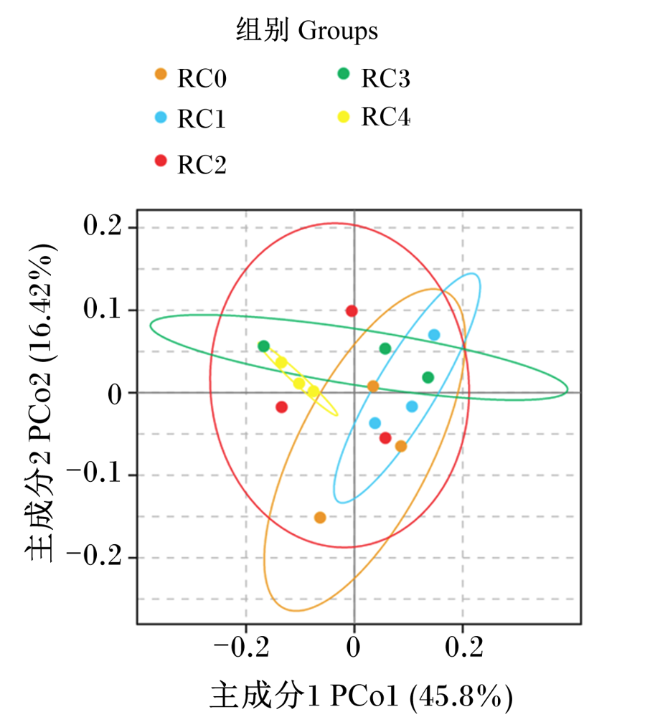
根据UniFrac距离,用主坐标分析(PCoA)图显示发酵植物蛋白复配替代豆粕对青鱼肠道菌群组成模式的影响。由图2可见,在主成分2水平上,RC3组和RC4组与RC0组的菌群组成模式存在一定的差异。
图2 青鱼肠道菌群的主坐标分析

Fig.2 PCoA of intestinal bacteria if black carp

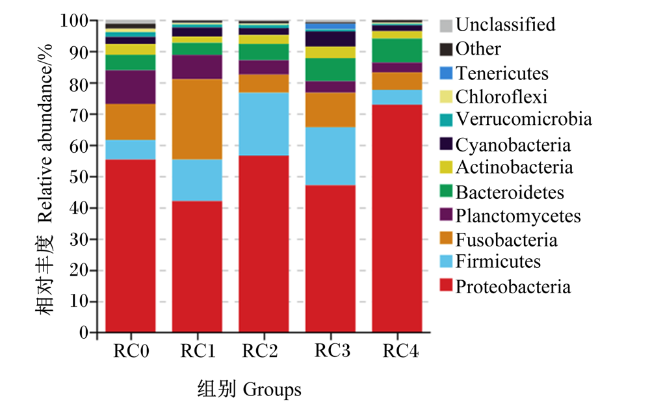
图4可见,在门水平下,RC0、RC1、RC2、RC3和RC4组肠道变形菌门相对丰度分别为55.30%、42.03%、56.53%、47.08%和72.84%,肠道厚壁菌门相对丰度分别为6.26%、13.25%、20.11%、18.57%和4.77%,肠道梭杆菌门相对丰度分别为11.52%、25.70%、5.82%、10.10%和5.55%,肠道浮霉菌门相对丰度分别为10.73%、7.77%、4.59%、3.71%、3.16%。变形菌门、厚壁菌门、梭杆菌门和浮霉菌门为青鱼肠道菌群中相对丰度排行前4的菌门,是青鱼肠道中的核心菌群。
图3 门水平下青鱼肠道菌群相对丰度

Proteobacteria:变形菌门;Firmicutes:厚壁菌门;Fusobacteria:梭杆菌门;Planctomycetes:浮霉菌门;Bacteroidetes:拟杆菌门;Actinobacteria:放线菌门;Cyanobacteria:蓝藻菌门;Verrucomicrobia:疣微菌门;Chloroflexi:绿弯菌门;Tenericutes:软壁菌门;Unclassified:未分类;Other:其他。

Fig.3 Relative abundance of intestinal microflora at phylum level of black carp

表6可见,所有组别的覆盖率均在0.999 0以上,说明各试验组的微生物种类均已检测到。各组操作分类单元(OTU)数量无显著差异(P>0.05)。各组之间肠道菌群ACE指数、Chaol指数、Shannon指数和Simpson指数均无显著差异(P>0.05)。其中,ACE指数、Chaol指数均为RC4组最低,RC2组最高;Shannon指数以RC0组最高,RC1组最低;Simpson指数以RC3组最高,RC1组最低。
表6 发酵植物蛋白对青鱼肠道菌群α多样性的影响

Table 6 Effects of fermented plant protein on α diversity of intestinal microflora of black carp

组别
Groups
操作分类单元
OTU/个
ACE指数
ACE index
Chaol指数
Chaol index
Shannon指数
Shannon index
Simpson指数
Simpson index
覆盖率
Goods coverage/%
RC0 594±60 667.57±20.94 657.07±29.06 5.53±0.49 0.90±0.04 0.999 3
RC1 584±100 657.66±60.53 658.79±69.48 4.78±0.54 0.88±0.03 0.999 3
RC2 613±62 691.85±31.48 679.63±32.90 4.95±0.59 0.90±0.04 0.999 3
RC3 569±94 664.90±75.70 643.36±70.38 5.15±0.22 0.93±0.02 0.999 1
RC4 527±45 624.96±28.59 610.52±28.66 5.09±0.51 0.91±0.03 0.999 2
在门、纲、目、科、属、种水平下,对各组青鱼肠道主要菌群进行常规方差分析,结果见表7。由表可知,各组之间主要菌群相对比较稳定,但组间差异较大导致标准差偏大的情况也存在。在门水平下,主要为变形菌门、厚壁菌门、梭杆菌门、浮霉菌门、拟杆菌门;在纲水平下,主要为γ-变形菌纲、浮霉菌纲;在目水平下,主要为气单胞菌目;在科水平下,主要为气单胞菌科;在属水平下,主要为气单胞菌属、鲸杆菌属、青枯菌属、邻单胞菌属;在种水平下,主要为维氏气单胞菌。各组之间青鱼肠道主要菌群的相对丰度均无显著差异(P>0.05)。
表7 青鱼肠道主要菌群的相对丰度

Table 7 Relative abundance of intestinal main microflora of black carp %

项目
Items
主要菌群
Main flora
组别Groups
RC0 RC1 RC2 RC3 RC4
门Phylum 变形菌门Proteobacteria 55.30±9.49 42.03±6.51 56.53±21.94 47.08±11.71 72.84±5.48
厚壁菌门Firmicutes 6.26±2.09 13.25±6.09 20.11±4.78 18.57±7.14 4.77±0.23
梭杆菌门Fusobacteria 11.52±5.76 25.70±6.10 5.82±3.07 11.00±5.68 5.55±1.46
浮霉菌门Planctomycetes 10.73±3.17 7.77±2.60 4.59±3.84 3.71±1.92 3.16±1.76
拟杆菌门Bacteroidetes 4.96±1.45 3.88±1.39 5.19±2.41 7.37±2.86 7.66±2.77
纲Class γ-变形菌纲
Gammaproteobacteria
45.16±18.98 35.82±9.93 49.76±23.51 38.33±15.52 58.54±14.18
浮霉菌纲Planctomycetacia 10.56±5.41 7.65±4.41 4.56±6.63 3.68±3.36 3.00±4.96
目Order 气单胞菌目Aeromonadales 21.41±14.86 15.35±6.80 12.17±11.48 8.79±4.64 8.56±2.02
科Family 气单胞菌科Aeromonadaceae 21.41±14.86 15.34±6.80 12.16±11.48 8.79±4.64 8.57±2.01
属Genus 气单胞菌属Aeromonas 21.41±8.58 15.34±3.93 12.16±6.63 8.79±2.68 8.57±1.16
青枯菌属Ralstonia 4.81±1.02 7.06±0.55 13.07±3.40 8.67±3.81 17.27±7.68
鲸杆菌属Cetobacterium 11.52±5.76 25.69±6.12 5.82±3.07 11.00±5.68 5.55±1.46
邻单胞菌属Plesiomonas 6.85±3.65 3.07±1.25 11.37±7.64 4.67±1.76 7.85±5.51
种Species 维氏气单胞菌
Aeromonas veronii
21.39±14.83 15.33±6.80 12.13±11.50 8.75±4.67 8.55±2.02

3 讨论

3.1 发酵植物蛋白复配替代豆粕对青鱼生长性能、形体指标和体组成的影响

不同来源的植物蛋白质源对鱼类生长性能有一定的影响,而生长性能是判定发酵植物蛋白替代豆粕可行性最直观的指标。李浩波[9]研究发现,饲料中添加FCM和FRM对尼罗罗非鱼的生长性能无显著影响。陈道仁等[7]研究表明,FCM替代草鱼饲料中的豆粕能显著提高其增重率。张秀敏[8]研究指出,在一定饲养期内,随着饲料中FCM比例的增加,鲫的摄食量和日增重都呈上升趋势,但无显著差异。Dossou等[18]在红鲷中的研究结果表明,FRM替代饲料中的豆粕可以提高其生长性能。孙宏等[19]研究指出,饲料中FCM替代鱼粉的比例超过16%时,黑鲷幼鱼的生长性能显著降低。以上结果表明,在水产饲料中合理添加发酵植物蛋白是可行的,但受养殖对象、饲料配比、替代对象和添加水平等诸多影响,产生的效果存在一定差异。本试验采用FCM和FRM以不同的比例(FCM∶FRM=1∶1和RCM∶FRM=2∶1)替代不同水平(50%和75%)的豆粕,从试验结果可以看出,FCM和FRM的比例以及替代豆粕的水平均未对青鱼的增重率和特定生长率产生显著影响。这表明FCM和FRM替代75%的豆粕时不会影响青鱼的生长,可能是由于FCM和FRM中的抗营养因子水平大大降低,青鱼的食欲和生理机能未受到损害。
不同来源的饲料蛋白质源对鱼类的体组成有一定影响。黄云等[4]试验证明,随着饲料中双低菜籽粕水平的升高,青鱼全鱼粗蛋白质含量无显著变化,而全鱼粗脂肪和粗灰分含量有显著变化。魏逸峰等[20]研究表明,鳙鱼饲料中添加发酵饲料(原料为豆粕、菜籽粕、玉米、麸皮等),肌肉粗脂肪含量显著降低,而肌肉水分、粗蛋白质和粗灰分含量则无显著差异。本研究中,发酵植物蛋白复配替代豆粕对青鱼全鱼和肌肉的水分、粗蛋白质、粗脂肪和粗灰分含量都没有显著影响,产生该结果的原因可能与各组之间特定生长率无显著差异有关。

3.2 发酵植物蛋白复配替代豆粕对青鱼血清免疫指标的影响

补体系统是广泛参与机体的免疫调节和抗微生物防御的效应系统,对鱼体免疫有重要意义[21],补体系统中,C3、C4具有清除病原微生物和活化炎性细胞的作用[22]。IgM是颌类脊椎动物体内重要的免疫球蛋白,是其进化过程中首先产生的免疫球蛋白[23],也是硬骨鱼类参与完成补体固定、调理细胞毒作用等多种效应功能的关键免疫因子[24]。LZM存在于大多数鱼类的血清、淋巴组织、黏液以及其他组织液中,是脊椎动物和非脊椎动物免疫防御系统重要组成部分之一[25]。本试验中,发酵植物蛋白复配替代豆粕后,血清LZM活性和ALB含量没有显著差异,50%替代组血清C4含量和75%替代组血清IgM含量均显著提高。但血清免疫指标提高不能排除应激反应等的原因,可结合肠道微生物变化进一步分析。

3.3 发酵植物蛋白复配替代豆粕对青鱼肝胰腺抗氧化指标的影响

在机体抗氧化体系中,SOD和CAT具有清除自由基的作用[26],SOD能够催化氧离子( O 2 -)歧化为过氧化氢(H2O2)和氧气(O2)[27],CAT则催化分解利用H2O2,避免细胞损伤[28]。T-AOC反映各种抗氧化酶的总活性,具有消除活性氧自由基,分解过氧化物,阻断过氧化链等重要作用[29]。因而,SOD和CAT活性以及T-AOC为常作为抗氧化指标。陈道仁等[7]研究指出,用23%的FCM替代9%的豆粕和全部棉籽粕,草鱼肝脏SOD活性显著提高。Lim等[29]试验结果表明,饲料中添加FCM能显著提高尼罗罗非鱼的抗氧化能力。本试验结果显示,FCM和FRM复配替代豆粕后,青鱼肝胰腺T-AOC和SOD、CAT活性均无显著差异,但是SOD活性有上升的趋势,发酵植物蛋白替代豆粕对青鱼的肝胰腺抗氧化能力无显著影响。AKP参与机体内某些营养物质的代谢过程,其活性大小会影响到水生动物的生长[30-31]。本试验中,发酵植物蛋白替代豆粕后,青鱼肝胰腺AKP活性无显著差异,说明发酵植物蛋白替代豆粕未对青鱼的肝胰腺造成损伤。

3.4 发酵植物蛋白替代豆粕对青鱼肠道消化酶活性的影响

消化酶活性是鱼类饲料消化吸收率的重要影响因子,可以影响鱼类的生长,AMS、LPS、蛋白酶为3种重要的消化酶[32]。而在人工养殖模式下,鱼类肠道消化酶的分泌受饲料的影响[33]。本试验结果表明,饲料中添加FCM和FRM,青鱼肠道AMS和LPS活性无显著差异。这与李浩波[9]的研究结果相符,产生这一结果的原因可能是各组饲料淀粉和粗脂肪水平差异不大。有研究指出,在饲料中添加脱粉棉籽粕会降低罗非鱼肠道PEP活性[34]。而本试验所用的蛋白质源为发酵植物蛋白,其抗营养因子水平大大减少,因而替代豆粕后青鱼肠道消化酶活性未受到负面影响,PEP活性呈上升趋势。

3.5 发酵植物蛋白复配替代豆粕对青鱼肠道菌群结构的影响

鱼体肠道微生物影响鱼的摄食、生长、代谢以及免疫[35]。此外,肠道菌群对营养吸收和代谢机制也有着重要影响,肠道菌群的动态平衡以及正常分布是鱼健康生长的重要基础[36]。因此,研究发酵植物蛋白替代豆粕对青鱼肠道菌群结构的影响有重要意义。本试验通过16S rRNA Illumina高通量测序揭示了FCM和FRM复配替代豆粕对青鱼肠道菌群结构的影响,通过α多样性分析,可以看出青鱼肠道微生物群落的丰富度和多样性[37]。本试验中,青鱼幼鱼肠道菌群的相对丰度(ACE指数、Chao1指数)和多样性(Shannon指数、Simpson指数)均没有显著差异。此外,测序结果显示,在门水平上,各组变形菌门、厚壁菌门、浮霉菌门以及梭杆菌门的总相对丰度分别为83.83%、88.75%、87.06%、80.35%、86.32%,优势菌群中,变形菌门占绝对优势,其次是厚壁菌门、梭杆菌门,这与鲤科鱼类的肠道菌群组成相似[37],表明FCM和FRM复配替代豆粕未影响青鱼肠道核心菌群结构。有研究表明,变形菌门可作为鱼体的健康指标[38],增加变形菌门相对丰度可改善鱼体的健康状况。本试验结果表明,在门水平上,各组优势菌群的相对丰度有一定变化,但均无显著差异,说明发酵植物蛋白未对青鱼的健康状况产生不良影响。在属水平上,主要菌群中有益菌为几丁质杆菌属[39],有害或潜在有害菌为气单胞菌属[40]、邻单胞菌属[41]。本试验条件下,饲料中添加FCM和FRM,青鱼肠道中几丁质杆菌属相对丰度有增加的趋势,且气单胞菌属随着替代豆粕的水平以及FCM比例的增加而降低,结果表明发酵植物蛋白复配替代豆粕有改善青鱼肠道菌群结构的趋势。
本试验中,结合青鱼肠道菌群中变形菌门和几丁质杆菌属的相对丰度有上升的趋势,潜在致病菌气单胞菌属和邻单胞菌属的相对丰度有下降的趋势,以及替代组青鱼血清C3和C4含量提高,可以推测出饲料中添加发酵植物蛋白有提升青鱼免疫能力的趋势。可进行抗病力的检测,进一步对此进行分析。
肠道菌群是宿主蛋白质代谢中的重要角色。健康鱼类肠道中的气单胞菌属可以分泌蛋白酶,在蛋白质代谢中发挥重要作用[42]。宿主摄食的蛋白质被肠道中相应的菌属产生的蛋白酶和肽酶水解,水解形成的游离氨基酸被肠壁吸收以及被肠道微生物利用。本试验中,各组之间肠道气单胞菌属相对丰度无显著差异,但RC3组的肠道PEP较对照组显著提高,因此为验证肠道菌群对肠道蛋白酶活性的影响,需进一步检测肠道总蛋白酶活性。

4 结论

FCM和FRM复配替代豆粕的比例达75%时,提高了肠道消化酶活性,没有造成青鱼肝胰腺的损伤以及肠道菌群结构的改变,且FCM和FRM的复配比例也不会对青鱼生长性能、形体指标、体组成、肝胰腺抗氧化指标和肠道菌群结构产生显著影响。
[1]
ROYCHOUDHURY S, MASSANYI P, SLAMECKA J, et al. In vitro gossypol induced spermatozoa motility alterations in rabbits[J]. Journal of Environmental Science and Health,Part B, 2009, 44(7):730-741.

DOI

[2]
SANTOS J E P, VILLASENOR M, ROBINSON P H, et al. Type of cottonseed and level of gossypol in diets of lactating dairy cows:plasma gossypol,health,and reproductive performance[J]. Journal of Dairy Science, 2003, 86(3):892-905.

DOI

[3]
周歧存, 麦康森, 刘永坚, 等. 动植物蛋白源替代鱼粉研究进展[J]. 水产学报, 2005, 29(3):404-410.

ZHOU Q C, MAI K S, LIU Y J, et al. Advances in animal and plant protein sources in place of fish meal[J]. Journal of Fisheries of China, 2005, 29(3):404-410. (in Chinese)

[4]
黄云, 胡毅, 肖调义, 等. 双低菜粕替代豆粕对青鱼幼鱼生长及生理生化指标的影响[J]. 水生生物学报, 2012, 36(1):41-48.

HUANG Y, HU Y, XIAO T Y, et al. Influence of dietary canola meal levels on growth and biochemical indices in juvenile Mylopharvngodon piceus[J]. Acta Hydrobiologica Sinica, 2012, 36(1):41-48. (in Chinese)

[5]
GADELHA I C N, FONSECA N B S, OLORIS S C S, et al. Gossypol toxicity from cottonseed products[J]. The Scientific World Journal, 2014, 2014:231635.

[6]
WANG Y, LIU J, WEI F H, et al. Improvement of the nutritional value, sensory properties and bioavailability of rapeseed meal fermented with mixed microorganisms[J]. LWT, 2019, 112:108238.

DOI

[7]
陈道仁, 冷向军, 肖昌武. 发酵棉粕对草鱼生长的影响[J]. 中国饲料添加剂, 2011(1):34-36.

CHEN D R, LENG X J, XIAO C W. The effect of fermented cottonseed meal on Chinese carp growth[J]. China Feed Additive, 2011(1):34-36. (in Chinese)

[8]
张秀敏. 棉粕的发酵工艺及其在鲫鱼饲料中的应用研究[D]. 硕士学位论文. 南京: 南京农业大学, 2014.

ZHANG X M. Study on solid fermentation techniques of cottonseed protein and effects of application of its product in Carassius auratus[D]. Master's Thesis. Nanjing: Nanjing Agricultural University, 2014. (in Chinese)

[9]
李浩波. 棉粕菜粕发酵工艺的优化及发酵杂粕在罗非鱼养殖中的应用[D]. 硕士学位论文. 广州: 华南农业大学, 2010.

LI H B. Optimization of fermentation technology of cottonseed and rapeseed meal and application of fermented miscellaneous meal in tilapia culture[D]. Master's Thesis. Guangzhou: South China Agricultural University, 2010. (in Chinese)

[10]
ROBLES ALONSO V, GUARNER F. Linking the gut microbiota to human health[J]. British Journal of Nutrition, 2013, 109(Suppl.2):S21-S26.

DOI

[11]
GERAYLOU Z, SOUFFREAU C, RURANGWA E, et al. Prebiotic effects of arabinoxylan oligosaccharides on juvenile Siberian sturgeon (Acipenser baerii) with emphasis on the modulation of the gut microbiota using 454 pyrosequencing[J]. FEMS Microbiology Ecology, 2013, 86(2):357-371.

DOI PMID

[12]
周群兰. 棉粕和菜粕经TOR、AAR信号通路调控团头鲂生长及肠道微生态的研究[D]. 博士学位论文. 南京: 南京农业大学, 2016.

ZHOU Q L. Cottonseed meal and canola meal regulate growth performance via TOR and AAR pathway and affect gut microflora of blunt snout bream,Megalobrama amblycephala[D]. Ph.D.Thesis. Nanjing: Nanjing Agricultural University, 2016. (in Chinese)

[13]
BEAUMONT M, PORTUNE K J, STEUER N, et al. Quantity and source of dietary protein influence metabolite production by gut microbiota and rectal mucosa gene expression:a randomized,parallel,double-blind trial in overweight humans[J]. The American Journal of Clinical Nutrition, 2017, 106(4):1005-1019.

DOI

[14]
吴金平, 杨代勤, 杜浩, 等. 饲料锌对长江鲟幼鱼肠道微生物组成的影响[J]. 淡水渔业, 2021, 51(4):88-94.

WU J P, YANG D Q, DU H, et al. Effects of dietary zinc on the intestinal microbiota composition of juvenile Acipenser dabryanus[J]. Freshwater Fisheries, 2021, 51(4):88-94. (in Chinese)

[15]
WANG Q, GARRITY G M, TIEDJE J M, et al. Naive Bayesian classifier for rapid assignment of rRNA sequences into the new bacterial taxonomy[J]. Applied and Environmental Microbiology, 2007, 73(16):5261-5267.

DOI PMID

[16]
PRUESSE E, QUAST C, KNITTEL K, et al. SILVA:a comprehensive online resource for quality checked and aligned ribosomal RNA sequence data compatible with ARB[J]. Nucleic Acids Research, 2007, 35(21):7188-7196.

DOI

[17]
DESANTIS T Z, HUGENHOLTZ P, LARSEN N, et al. Greengenes,a chimera-checked 16S rRNA gene database and workbench compatible with ARB[J]. Applied and Environmental Microbiology, 2006, 72(7):5069-5072.

DOI

[18]
DOSSOU S, KOSHIO S, ISHIKAWA M, et al. Effects of replacing fishmeal with fermented and non-fermented rapeseed meal on the growth,immune and antioxidant responses of Red Sea bream (Pagrus major)[J]. Aquaculture Nutrition, 2019, 25(2):508-517.

DOI

[19]
孙宏, 叶有标, 姚晓红, 等. 发酵棉籽粕部分替代鱼粉对黑鲷幼鱼生长性能、体成分及血浆生化指标的影响[J]. 动物营养学报, 2014, 26(5):1238-1245.

DOI

SUN H, YE Y B, YAO X H, et al. Effects of partial replacement of fish meal by fermented cottonseed meal on growth performance,body composition and plasma biochemical indices of juvenile Black Sea bream[J]. Chinese Journal of Animal Nutrition, 2014, 26(5):1238-1245. (in Chinese)

[20]
魏逸峰, 陈金涛, 宋正星, 等. 发酵饲料对鳙鱼生长及体成分的影响[J]. 科学养鱼, 2021(8):68-70.

WEI Y F, CHEN J T, SONG Z X, et al. Effect of fermented feed on growth and body-composition of bighead carp[J]. Scientific Fish Farming, 2021(8):68-70. (in Chinese)

[21]
万金娟, 刘波, 戈贤平, 等. 硬骨鱼补体系统的研究进展[J]. 江西农业学报, 2011, 23(11):159-164.

WAN J J, LIU B, GE X P, et al. Research advances in complement system of teleost fish[J]. Acta Agriculturae Jiangxi, 2011, 23(11):159-164. (in Chinese)

[22]
龚福来, 林雪, 王红权. 不同维生素C源对吉富罗非鱼生长性能、抗氧化能力和免疫力的影响[J]. 动物营养学报, 2021, 33(4):2378-2389.

DOI

GONG F L, LIN X, WANG H Q, et al. Effects of different vitamin C sources on growth performance,antioxidant capacity and immunity of genetically improved farmed tilapia[J]. Chinese Journal of Animal Nutrition, 2021, 33(4):2378-2389. (in Chinese)

[23]
BOES M. Role of natural and immune IgM antibodies in immune responses[J]. Molecular Immunology, 2000, 37(18):1141-1149.

DOI PMID

[24]
SONG Z F, WU T X, CAI L S, et al. Effects of dietary supplementation with Clostridium butyricum on the growth performance and humoral immune response in Miichthys miiuy[J]. Journal of Zhejiang University.Science.B, 2006, 7(7):596-602.

[25]
REYES-BECERRIL M, TOVAR-RAMÍREZ D, ASCENCIO-VALLE F, et al. Effects of dietary supplementation with probiotic live yeast Debaryomyces hansenii on the immune and antioxidant systems of leopard grouper Mycteroperca rosacea infected with Aeromonas hydrophila[J]. Aquaculture Research, 2011, 42(11):1676-1686.

DOI

[26]
孙立梅, 陈立侨, 李二超, 等. 高比例棉粕饲料中补充蛋氨酸对中华绒螯蟹幼蟹摄食、生长及抗氧化酶活性的影响[J]. 水生生物学报, 2013, 37(2):336-343.

SUN L M, CHEN L Q, LI E C, et al. Effects of dietary methionine supplementation on feeding,growth and antioxidant ability of juvenile Chinese mitten crab,Eriocheir sinensis[J]. Acta Hydrobiologica Sinica, 2013, 37(2):336-343. (in Chinese)

[27]
高春生, 王春秀, 张书松. 水体铜对黄河鲤肝胰脏抗氧化酶活性和总抗氧化能力的影响[J]. 农业环境科学学报, 2008, 27(3):1157-1162.

GAO C S, WANG C X, ZHANG S S. Effects of copper on activities of antioxidant enzymes and total antioxidative competence in hepatopancreas of Cyprinus carpio[J]. Journal of Agro-Environment Science, 2008, 27(3):1157-1162. (in Chinese)

[28]
刘松岩. 环境胁迫对中华鲟体内自由基水平和抗氧化酶活力的影响[D]. 硕士学位论文. 武汉: 华中农业大学, 2006.

LIU S Y. Effect of environmental stress on free radical level and antioxidant enzymes activities of Chinese sturgeon, Acipenser sinensis[D]. Master's Thesis. Wuhan: Huazhong Agricultural University, 2006. (in Chinese)

[29]
LIM S J, LEE K J. A microbial fermentation of soybean and cottonseed meal increases antioxidant activity and gossypol detoxification in diets for Nile tilapia,Oreochromis niloticus[J]. Journal of the World Aquaculture Society, 2011, 42(4):494-503.

DOI

[30]
CHEN Q X, ZHENG W Z, LIN J Y, et al. Effect of metal ions on the activity of green crab (Scylla serrata) alkaline phosphatase[J]. The International Journal of Biochemistry & Cell Biology, 2000, 32(8):879-885.

DOI

[31]
BALOI M F, STERZELECKI F C, SUGAI J K, et al. Growth performance,body composition and metabolic response to feeding rates in juvenile Brazilian sardine Sardinella brasiliensis[J]. Aquaculture Nutrition, 2017, 23(6):1458-1466.

DOI

[32]
杨代勤, 严安生, 陈芳, 等. 不同饲料对黄鳝消化酶活性的影响[J]. 水产学报, 2003, 27(6):558-563.

YANG D Q, YAN A S, CHEN F, et al. Effects of different diets on activities of digestive enzymes of Monopterus albus[J]. Journal of Fisheries of China, 2003, 27(6):558-563. (in Chinese)

[33]
YUE Y R, ZHOU Q C. Effect of replacing soybean meal with cottonseed meal on growth,feed utilization,and hematological indexes for juvenile hybrid tilapia,Oreochromis niloticus×O. aureus[J]. Aquaculture, 2008, 284(1/2/3/4):185-189.

DOI

[34]
YUKGEHNAISH K, KUMAR P, SIVACHANDRAN P, et al. Gut microbiota metagenomics in aquaculture:factors influencing gut microbiome and its physiological role in fish[J]. Reviews in Aquaculture, 2020, 12(3):1903-1927.

[35]
PÉREZ T, BALCÁZAR J L, RUIZ-ZARZUELA I, et al. Host-microbiota interactions within the fish intestinal ecosystem[J]. Mucosal Immunology, 2010, 3(4):355-360.

DOI PMID

[36]
LI B, ZHANG X X, GUO F, et al. Characterization of tetracycline resistant bacterial community in saline activated sludge using batch stress incubation with high-throughput sequencing analysis[J]. Water Research, 2013, 47(13):4207-4216.

DOI PMID

[37]
马阿敏, 李娜, 覃虹焱, 等. 淡水鱼类肠道微生物菌群研究进展[J]. 甘肃畜牧兽医, 2021, 51(5):9-13.

MA A M, LI N, QIN H Y, et al. Research progress on intestinal microflora of freshwater fish[J]. Gansu Animal and Veterinary Sciences, 2021, 51(5):9-13. (in Chinese)

[38]
FOYSAL M J, ALAM M, MOMTAZ F, et al. Dietary supplementation of garlic (Allium sativum) modulates gut microbiota and health status of tilapia (Oreochromis niloticus) against Streptococcus iniae infection[J]. Aquaculture Research, 2019, 50(8):2107-2116.

DOI

[39]
韩凤禄. 大豆抗原蛋白对中华绒螯蟹生长性能和肠道健康的影响及其改善对策[D]. 博士学位论文. 上海: 华东师范大学, 2020.

HAN F L. Effect of soybean antigen proteins on growth performance and intestinal health of Chinese mitten crab (Eriocheir sinensis) and regulation strategy[D]. Ph.D.Thesis. Shanghai: East China Normal University, 2020. (in Chinese)

[40]
IRIANTO A, AUSTIN B. Use of probiotics to control furunculosis in rainbow trout,Oncorhynchus mykiss (Walbaum)[J]. Journal of Fish Diseases, 2002, 25(6):333-342.

DOI

[41]
张明洋. 类志贺邻单胞菌感染对鲟转录组及其肠道菌群的影响[D]. 硕士学位论文. 贵阳: 贵州大学, 2019.

ZHANG M Y. Effects of Plesimonas shigelloides infection on transcriptome and gut microbiota of sturgeons[D]. Master's Thesis. Guiyang: Guizhou University, 2019. (in Chinese)

[42]
NAYAK S K. Role of gastrointestinal microbiota in fish[J]. Aquaculture Research, 2010, 41(11):1553-1573.

DOI

Outlines

/