REVIEW

Biological Function and Anti-Inflammatory Mechanism of Vitamin B6

  • OUYANG Jingxin ,
  • LI Qiufen ,
  • ZHOU Hua ,
  • LI Guanhong , *
Expand
  • Jiangxi Province Key Laboratory of Animal Nutrition, College of Animal Science and Technology, Jiangxi Agricultural University, Nanchang 330045, China
*professor, E-mail:

Received date: 2022-11-09

  Online published: 2023-05-11

Abstract

Vitamin B6 is an essential micronutrient for the healthy growth and normal physiological function of animals. It not only participates in the normal metabolic reaction of the body as a coenzyme, but also has a variety of biological functions such as neuromodulation, antioxidant, anti-inflammatory, immunomodulatory and anti-tumor. Low plasma vitamin B6 level status is strongly associated with higher risk of a variety of inflammatory disease. The inverse association is thought to be the result of mobilization of vitamin B6 to the site of inflammation, for use of regulation of tryptophan and sphingolipid metabolism, modulation of lymphocyte trafficking, number and function, and inhibition of inflammatory signaling pathway, to exert their immunomodulatory and anti-inflammatory properties. This article reviewed the biological functions, potential anti-inflammatory mechanism and application in feed of vitamin B6, in order to provide reference for the application of vitamin B6 in animal husbandry.

Cite this article

OUYANG Jingxin , LI Qiufen , ZHOU Hua , LI Guanhong . Biological Function and Anti-Inflammatory Mechanism of Vitamin B6[J]. Chinese Journal of Animal Nutrition, 2023 , 35(5) : 2738 -2747 . DOI: 10.12418/CJAN2023.256

维生素B6是一种低分子有机化合物,在促进动物健康生长发育和维持正常生理功能上发挥着重要作用。磷酸吡哆醛(pyridoxal 5’-phosphate,PLP)是维生素B6最活跃的形式,它作为辅酶参与了氨基酸、碳水化合物、脂类及核酸代谢等140多种生化反应。此外,在临床研究中发现,维生素B6还具有调节氧化应激和炎症反应的作用[1-3]。维生素B6缺乏与多种炎症性疾病的患病风险增加有着密切联系。因此,本文就维生素B6的多种生物学功能及其抗炎作用机制展开综述,以期为其在生产实践上的应用提供参考。

1 维生素B6的来源和代谢

维生素B6是一种水溶性维生素,有6种异构体,包括吡哆醛(pyridoxal,PL)、吡哆醇(pyridoxine,PN)、吡哆胺(pyridoxamine,PM)及其相对应的3种5’-磷酸化形式——PLP、磷酸吡哆醇(PNP)、磷酸吡哆胺(PMP)。维生素B6在肉类、奶制品、谷物、坚果和多种水果蔬菜中含量较多。PLP和PMP是维生素B6在动物产品中的主要存在形式,植物产品中以PN和PNP为主。微生物以5-磷酸脱氧木酮糖和4-磷酸羟基-L-苏氨酸或3-磷酸甘油醛和5-磷酸核酮糖为前体,合成PLP[4]。肝脏和肠道是维生素B6代谢的主要部位,摄入的磷酸化形式的维生素B6先被肠道磷酸酶去磷酸化为PL、PN、PM,而后主要在空肠和回肠中以被动扩散的方式被吸收,PL、PN、PM通过门静脉运输到肝脏,在肝脏中在吡哆醛激酶(pyridoxal kinase,PDXK)的催化下重新磷酸化,PMP和PNP在磷酸吡哆醇氧化酶(pyridoxine phosphate oxidase,PNPO)的催化作用下转化为PLP,PLP释放到血液与白蛋白结合,通过血液循环运送到其他的组织器官[5]。4-吡哆酸(4-pyridoxic acid,4-PA)是维生素B6的主要代谢产物,随尿液排出。

2 维生素B6的生物学功能

2.1 代谢功能

维生素B6对维持机体正常生长、发育和细胞代谢至关重要。PLP是维生素B6的生物活性形式,作为辅酶因子参与了细胞中140多种生化反应,包括关键的代谢反应,如氨基酸的合成、相互转化和降解,碳水化合物、脂类、核酸的代谢以及血红素的合成过程[6-7]。维生素B6的缺乏影响蛋白质和氨基酸的正常代谢,降低蛋白质在机体内的吸收利用效率,最终导致动物出现厌食、生长迟缓、神经失调以及贫血等症状。Mayengbam等[8]指出,与对照组和高水平维生素B6组相比,维生素B6缺乏组大鼠的体重、采食量和体脂率显著降低,血清代谢产物中维生素B6代谢、赖氨酸降解以及烟酸和烟酰胺代谢受到干扰。Martinez等[9]利用同位素标记法证实了维生素B6摄入不足会导致大鼠肝脏中S-腺苷甲硫氨酸含量减少,丝氨酸羟甲基转移酶活性降低,机体蛋白质周转率降低。在脂肪酸代谢中,PLP依赖性酶催化必需多不饱和脂肪酸的合成,对维持细胞完整性、信号转导、免疫调节功能的脂质代谢物的产生和机体的健康发育至关重要[10-12]

2.2 神经调节功能

维生素B6是肾上腺素、去甲肾上腺素、多巴胺、5-羟色胺和γ-氨基丁酸等神经递质合成过程中的辅助因子,对机体维持神经系统的正常发育和功能非常重要[13]。5-羟色胺可以调节认知、情绪、睡眠,常见于镇定剂、抗抑郁、抗焦虑的药物中。氨基丁酸是一种抑制性神经递质,具有镇定作用。维生素B6通过调节神经递质的合成,影响机体的心理健康和认知能力,具有神经保护作用[14-15]。维生素B6的缺乏与多种神经系统类疾病的发生有关[16-17]。ATP门控嘌呤能P2X7受体(ATP-gated purinergic P2X7 receptor,P2X7)是脑内的炎症开关,介导中枢和外周神经系统的快速兴奋性神经递质的释放,促进星形胶质细胞和小胶质细胞的分裂,增加促炎细胞因子和其他炎症介质释放,引发癫痫发作,被认为是治疗包括癫痫在内的一系列神经疾病的新药物靶点[18]。研究发现,维生素B6是P2X7受体的拮抗剂,具有抑制癫痫发作和神经保护作用[19-20]

2.3 抗氧化功能

维生素B6的吡啶环上包含羟基和胺基基团,能直接与活性氧(reactive oxygen species,ROS)自由基发生反应,被认为是一种有效的抗氧化剂。Ehrenshaft等[21]首次报道了维生素B6的抗氧化能力,他们观察到维生素B6表现出与维生素C和维生素E相似的氧自由基清除率。Kannan等[22]研究报道,维生素B6可以降低过氧化氢(hydrogen peroxide,H2O2)处理的血管内皮细胞的超氧自由基含量和脂质过氧化水平。维生素B6是谷胱甘肽抗氧化防御系统中的辅酶,还是超硫反应中必不可缺的辅酶,能够促进同型半胱氨酸转化为半胱氨酸,而半胱氨酸又是合成谷胱甘肽的重要底物[23]。因此,维生素B6可能直接或间接参与抗氧化防御。研究发现,与对照组相比,缺乏维生素B6的大鼠肝组织抗氧化潜能(antioxidant potential,AOP)以及超氧化物歧化酶(superoxide dismutase,SOD)、谷胱甘肽过氧化物酶(glutathione peroxidase,GSH-Px)、谷胱甘肽硫转移酶(glutathione-S-transferase,GST)活性与谷胱甘肽(glutathione,GSH)含量显著降低,而谷胱甘肽还原酶(glutathione reductase,GR)活性、丙二醛(malondialdehyde,MDA)含量显著升高[24]。这些结果表明,维生素B6缺乏会导致抗氧化防御能力减弱和氧化应激加重。然而,Lima等[25]研究表明,饲粮维生素B6缺乏反而增加了肝脏GSH含量。因此,GSH含量和维生素B6状态之间的具体关联还有待进一步研究。多项研究表明,补充维生素B6可提高GST、GSH-Px和过氧化氢酶(catalase,CAT)等抗氧化酶的活性[2,26-27]。Abdullah等[28]研究发现,在四氧嘧啶诱导的糖尿病大鼠中,补充维生素B6可显著降低氧化应激参数和ROS产生量,改善大鼠肝脏和肾脏的病理损伤,从而缓解蛋白质、脂质和核酸等生物大分子的氧化损伤。
另外,维生素B6参与多种生物活性物质的产生。牛磺酸和硫化氢都来源于含硫氨基酸,它们的合成都需要维生素B6依赖性酶的参与[29]。研究发现,牛磺酸和低水平的硫化氢都具有较强的抗氧化和抗炎作用[30-32]。肌肽和鹅氨酸具有抗氧化、抗炎、抗糖基化、抗缺血和抗衰老等多种生理功能[33-35],它们的前体物质β-丙氨酸的合成需要维生素B6依赖性酶的催化。研究发现,与维生素B6缺乏大鼠相比,饲粮添加维生素B6显著升高大鼠心脏和骨骼肌中咪唑二肽、肌肽和鹅氨酸水平[36]。因此,维生素B6也可能通过促进具有抗氧化活性的物质的生成,间接发挥其抗氧化作用。

2.4 免疫调节和抗炎功能

维生素B6是维持先天和适应性免疫系统功能的重要化合物,特别是抗炎免疫反应所必需的[37]。研究发现,维生素B6的缺乏会影响细胞免疫和体液免疫反应,导致机体的免疫能力下降,如淋巴结、淋巴器官及脾脏萎缩,淋巴细胞数量减少,血液中抗体[免疫球蛋白G(IgG)、免疫球蛋白M(IgM)]产生量减少,细胞因子产生量改变[38-40]。同样,Zheng等[41]研究指出,饲料中缺乏维生素B6降低了草鱼幼鱼肠道中先天免疫成分如溶菌酶和酸性磷酸酶活性、补体和抗菌肽含量以及适应性免疫成分如免疫球蛋白的含量,并下调抗炎细胞因子表达,上调促炎细胞因子表达,最终损草鱼肠道免疫功能。相反,适量补充维生素B6有助于增强免疫功能,也有助于细胞因子和趋化因子之间的相互作用达到免疫稳态[42]。维生素B6还具有抗炎特性。此前有研究报道,在脂多糖诱导的巨噬细胞中,维生素B6可通过抑制核因子-κB(nuclear factor kappa-B,NF-κB)信号通路的激活以降低一氧化氮合成酶(nitric oxide synthase,iNOS)和环氧合酶-2(cyclooxygenage-2,COX-2)的mRNA和蛋白的表达水平[43]。维生素B6还可以干扰NOD样受体蛋白3(NOD-like receptor protein 3,NLRP3)信号通路的激活,从而抑制白细胞介素-1β(interleukin-1β,IL-1β)和白细胞介素-18(interleukin-18,IL-18)的成熟分泌[44]。在脂多糖诱导的小鼠急性肺炎中,维生素B6下调了炎症因子IL-1β、白细胞介素-6(interleukin-6,IL-6)和肿瘤坏死因子-α(tumor necrosis factor-α,TNF-α)的mRNA表达水平,缓解炎症损伤[45]。然而维生素B6抗炎作用的确切机制尚不清楚,需要进一步研究。

2.5 抗肿瘤功能

流行病学研究已经报道了维生素B6摄入量和结肠癌风险之间呈负相关。研究发现,维生素B6的抗肿瘤作用主要与抑制细胞增殖、氧化应激、炎症反应、一氧化氮(nitric oxide,NO)合成和血管生成有关[46]。Komatsu等[47]研究发现,在结直肠癌小鼠饲粮中补充维生素B6显著降低肿瘤发生率和结肠肿瘤数量,并抑制细胞增殖,显著降低结肠隐窝中与细胞增殖相关的原癌基因(c-Myc和c-Fos)的蛋白表达,而对结肠上皮细胞凋亡无显著影响。体外试验研究发现,维生素B6可抑制原单核细胞淋巴瘤细胞的增殖和迁移,增加IL-8和IL-10的含量,降低IL-1β的含量,阻碍肿瘤的发生进程[48]

3 维生素B6在炎症下的动员

血浆PLP水平是衡量组织维生素B6状态的最常用、最敏感的指标,可以反映肝脏PLP水平和存储。多项临床研究结果表明,血浆PLP的低水平状态与新冠肺炎[49]、心血管疾病[29]、癌症[50]、炎症性肠病[51]、类风湿性关节炎[52]等多种炎症性疾病的患病风险的增加有着密切的联系;而且血浆PLP水平与多种炎症标志物的含量呈负相关,这些炎症标志物包括C-反应蛋白、IL-1β、TNF-α含量以及白细胞数量、犬尿氨酸/色氨酸比值等[53-55]。目前研究表明,维生素B6状态与炎症标志物的反向关联可能不是由维生素B6摄入量不足或过度代谢造成,而更可能是因为肝脏和血浆中的PLP被动员到炎症部位,被炎症过程中PLP依赖性的酶和代谢途径利用,在免疫反应中发挥重要作用[56]。然而,随着炎症期间维生素B6的周转和利用增加,可能导致炎症状态下维生素B6的耗竭和缺乏,并可能进一步以正反馈的方式驱动免疫-炎症反应,导致与维生素B6相关的炎症通路功能异常。炎症状况下或者应激激素存在会降低体内维生素B6水平。研究发现,热应激导致家兔粪便中的4-PA、犬尿氨酸(kynurenine,Kyn)、多巴胺的水平增加,PL的水平降低,这些差异代谢物说明热应激影响家兔肠道维生素B6和色氨酸代谢[57]。相似地,Allen等[58]研究发现,压力应激引起小鼠胃肠道色氨酸代谢紊乱,显著降低结肠内容物中维生素B1、维生素B3、维生素B5和维生素B6含量。这些结果表明,在炎症或应激状况下,机体免疫系统对维生素B6的需要量可能会增加。本文总结了与维生素B6相关的炎症途径和具有免疫调节作用的代谢物,如色氨酸代谢、1-磷酸鞘氨醇(sphingosine 1-phosphate,S1P)代谢和NLRP3炎症信号通路。

4 维生素B6的抗炎机制

4.1 维生素B6和色氨酸代谢

色氨酸及其代谢物具有提高采食量、神经调节、免疫调节和肠道稳态等多种生理功能,对动物机体健康非常重要。色氨酸代谢失调会引起其代谢中间产物的产生失衡,这与多种疾病如神经类疾病、癌症、炎症性肠病、心血管疾病等的发生机制有关[59]。因此,明确调节色氨酸通量的交叉点对疾病的治疗具有重大的意义。维生素B6的活性形式PLP,是色氨酸主要代谢途径——犬尿氨酸途径的犬尿氨酸酶(kynureninase,KYNU)和犬尿氨酸转氨酶(kynurenine aminotransferase,KAT)的辅酶(图1)。KYNU催化水解Kyn转化为邻氨基苯甲酸(anthranilic acid,AA)和3-羟基犬尿氨酸(3-hydroxykynurenine,3-HK)转化为3-羟基邻氨基苯甲酸(3-hydroxyanthranilic acid,3-HAA)。KAT将Kyn转化为犬尿喹啉酸(kynurenic acid,KA)和3-HK转化为黄尿酸(xanthurenic acid,XA)[60]。这些犬尿氨酸相关的代谢物被认为具有积极的免疫调节作用。然而,在维生素B6缺乏的情况下,色氨酸分解代谢为烟酰胺腺嘌呤二核苷酸(nicotinamide adenine dinucleotide,NAD+)的过程被阻碍,NAD+的生成受阻,造成能量产生减少和抗应激能力减弱;与此同时,研究证实,在维生素B6缺乏的情况下,尿中XA、Kyn和3-HK的浓度升高[61-62]。尿XA排泄量和血浆HK/XA比值也成为反映维生素B6状态的功能标志物[63]。Kyn浓度的增加会降低自然杀伤细胞活性和阻碍T细胞增殖,导致细胞死亡增加;3-HK具有神经毒性作用[64]。另外,PLP也是色氨酸的5-羟色胺途径和微生物代谢途径中的辅酶[65]。5-羟色胺对正常的肠道运动很重要,是一种调节情绪和认知的重要的神经递质[66]。研究发现,皮下注射600 mg/kg维生素B6干预犬尿氨酸途径的激活,改善神经化学和神经炎症参数,从而改善脓毒症大鼠的认知功能[67]。这些结果表明,色氨酸代谢依赖于维生素B6。因此,维生素B6可能通过调节色氨酸通量和选择性生成色氨酸代谢物,调控机体的炎症反应进程。
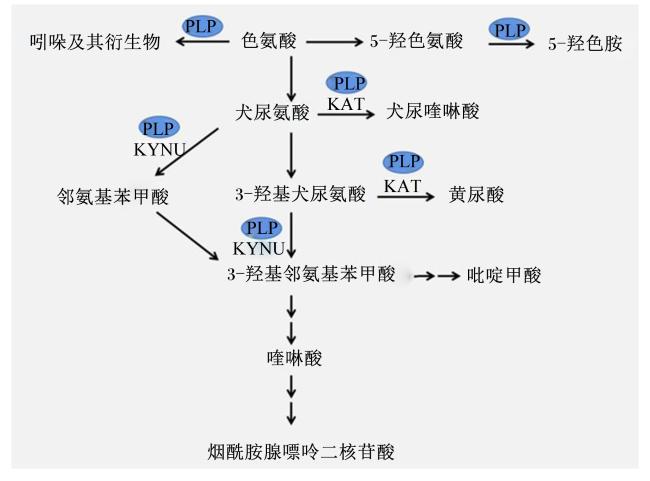
图1 维生素B6与色氨酸代谢途径

PLP:磷酸吡哆醛 pyridoxal 5’-phosphate;KAT: 犬尿氨酸转氨酶 kynurenine aminotransferase; KYNU:犬尿氨酸酶 kynureninase。

Fig.1 Vitamin B6 and tryptophan metabolism pathway

4.2 维生素B6与炎症小体

炎症小体是细胞质内的多蛋白复合物,在各种生理或病理刺激下,能够招募和激活促炎蛋白酶半胱天冬酶-1(Caspase-1),导致促炎因子IL-1β和IL-18的成熟释放[68]。目前,NLRP3炎症小体是所有炎症小体中研究最为广泛深入的一种,它能通过独特的模式识别受体,响应多种外源性(包括脂多糖、细菌鞭毛等)和内源性危险信号分子(包括ROS、K+外流、Ca2+内流和溶酶体损伤等)的刺激。NLRP3炎症小体的激活与各种自身炎症性疾病的发病机制有关,包括痛风、动脉粥样硬化和2型糖尿病等[69]。适度的炎症小体激活是天然免疫系统的关键组成部分,可以清除病原微生物,修复受损组织。然而,过度激活可能发展为宿主的过度炎症损伤和细胞死亡。研究报道,维生素B6可以通过抑制多种外源危险信号分子(脂多糖、ATP)诱导的NLRP3炎症小体的激活,来减少促炎因子IL-1β和IL-18的分泌,此外,还显著减少了巨噬细胞中ROS的产生,ROS也是一种常见的NLRP3炎症小体激活物[44]。这些结果揭示了维生素B6可能通过抑制炎症小体的组装和功能,干扰炎症细胞因子的分泌,发挥其抗炎特性。

4.3 维生素B6与S1P代谢

S1P是一种具有生物活性的鞘脂类代谢物,具有调节炎症和免疫反应的作用,如细胞生长、生存、分化、淋巴细胞运输、内皮屏障的完整性以及细胞因子和趋化因子的产生[70]。维生素B6是丝氨酸棕榈酰转移酶和S1P裂合酶(sphingosine 1-phosphate lyase,SPL)的辅酶,分别作用于S1P的合成和分裂,直接调节S1P的活性。来自胸腺和外周淋巴器官中的淋巴细胞(特别是T细胞)的成熟和转运都依赖于S1P的活性梯度,而这种梯度则需通过维生素B6依赖性的SPL对S1P的不可逆降解来实现[71]。研究发现,服用维生素B6拮抗剂4’脱氧吡啶后,小鼠免疫器官中的SPL活性被抑制,导致成熟淋巴细胞在胸腺和炎症部位中累积滞留,不能进入血液循环,造成淋巴细胞减少和免疫抑制;而通过在饲粮中补充维生素B6可以逆转这些情况[72]。Kunisawa等[73]研究发现,S1P也调节B细胞运输进入肠间隔以产生肠道IgA的过程。因此,维生素B6可能通过调节脂质介质S1P的代谢,在维持肠道免疫屏障功能中发挥重要作用。
此外,S1P还是维持上皮细胞和内皮细胞屏障功能的重要信号分子,通过调节黏附连接、紧密连接的形成来维持上皮细胞和内皮细胞屏障功能[74]。当PLP受限时,失调的S1P循环可能经某几种S1P受体介导,造成内皮屏障渗漏性增加、炎症组织内液体滞留增加。另外,S1P可激活NF-κB和转录激活因子3(signal transducer and activator of transcription 3,STAT3),这2种转录调节因子在炎症和致癌过程中起主开关作用,引起细胞内级联反应,导致细胞因子过量产生和炎症组织损伤[75]。Du等[76]研究发现,补充维生素B6可通过提高SPL活性来减少S1P的积累,并通过抑制NF-κB信号通路的激活降低促炎因子的表达,从而显著抑制脂多糖诱导的小鼠急性炎症。因此,我们猜测炎症引起的肠道损伤与维生素B6缺乏引起的S1P代谢失调有关,维生素B6可能通过恢复S1P循环系统的稳态,以平衡肠道免疫屏障和机械屏障功能而维持机体的正常生理功能,其中的具体机制还有待研究。

5 维生素B6在饲粮中的应用

动物的健康生长都离不开维生素B6,然而哺乳动物和家禽自身不能从头合成维生素B6,而微生物合成量不足,因此通常需要通过外源补充以满足机体生理需要。盐酸吡哆醇是动物饲粮中维生素B6常见的添加形式。畜禽对维生素B6的需要量一般为每千克饲粮1~3.5 mg,鱼类为3~6 mg。但随着饲粮蛋白质水平、动物生长阶段、环境温度及应激条件等因素的变化,动物对维生素B6的需要量也随之改变。近年来,维生素B6在水产动物饲料中的应用研究较多,在家禽和猪饲粮中的应用研究较少。
对于水产动物而言,维生素B6主要影响动物生长、存活率、酶活性、蛋白质和氨基酸代谢及免疫功能等[77]。刘坤[78]研究发现,维生素B6是鲶鱼生长中必要的营养素,饲喂缺乏维生素B6的饲料显著降低鲶鱼的生长性能,升高鲶鱼死亡率。在鳙鱼饲料中添加4 mg/kg维生素B6,可以改善鳙鱼生长性能、血液学指标,显著提高溶菌酶、碱性磷酸酶活性[79]。Huang等[80]研究发现,与对照组相比,在幼金鲳鱼幼鱼饲料中添加维生素B6显著提高幼鱼的增重率、生长速率和饲料转化率。在家禽生产中,维生素B6缺乏会导致鸡只出现食欲丧失、产蛋率和孵化率降低、皮炎、脱羽、肌胃糜烂和瘫痪等症状[81]。研究发现,在蛋鸡饲粮中添加维生素B6可以提高蛋黄中脂肪酸的含量,提高蛋重[82-83]。在妊娠母猪饲粮中补充1 mg/kg维生素B6可增加窝产仔数和断奶仔猪数,改善断奶仔猪的生长性能,提高日增重和采食量[84]。另一项研究表明,随着断奶仔猪饲粮中维生素B6添加量的增加,断奶仔猪的平均日增重和平均日采食量有增加趋势,其中,断奶后0~14 d补充3.3 mg/kg的维生素B6可改善仔猪的生长性能[85]

6 小结

维生素B6是维持正常代谢和免疫反应所必需的,具有代谢功能、神经调节、抗肿瘤、抗氧化功能和抗炎等生物学功能。越来越多的证据表明,维生素B6状态与炎症性疾病密切相关,低浓度的血浆PLP与患病风险呈正相关。维生素B6可能通过直接或间接参与抗氧化防御以及调节平衡色氨酸代谢,细胞因子的分泌和信号转导,淋巴细胞的运输、数量和功能,内皮屏障完整性,起到缓解氧化应激和炎症损伤的作用。然而,不同生理或病理状况下动物对维生素B6的需要量以及维生素B6的关键抗炎机制有待深入研究。
[1]
LEE M S, SU T C, HUANG Y C, et al. Effects of vitamin B-6 supplementation on oxidative stress and inflammatory response in neonatal rats receiving hyperoxia therapy[J]. Journal of Food and Drug Analysis, 2018, 26(3):1086-1096.

DOI

[2]
GIUSTINA A D, DANIELSKI L G, NOVOCHADLO M M, et al. Vitamin B6 reduces oxidative stress in lungs and liver in experimental sepsis[J]. Anais da Academia Brasileira de Ciências, 2019, 91(4):e20190434.

DOI

[3]
DANIELYAN K E, SIMONYAN A A. Protective abilities of pyridoxine in experimental oxidative stress settings in vivo and in vitro[J]. Biomedicine & Pharmacotherapy, 2017, 86:537-540.

DOI

[4]
YOSHII K, HOSOMI K, SAWANE K, et al. Metabolism of dietary and microbial vitamin B family in the regulation of host immunity[J]. Frontiers in Nutrition, 2019, 6:48.

DOI PMID

[5]
DI SALVO M L, CONTESTABILE R, SAFO M K. Vitamin B6 salvage enzymes:mechanism,structure and regulation[J]. Biochimica et Biophysica Acta:Proteins and Proteomics, 2011, 1814(11):1597-1608.

DOI

[6]
COMBS G F Jr, MCCLUNG J P. The vitamins:fundamental aspects in nutrition and health[M]. 5th ed. London: Academic Press, 2017:351-370.

[7]
MOONEY S, LEUENDORF J E, HENDRICKSON C, et al. Vitamin B6:a long known compound of surprising complexity[J]. Molecules, 2009, 14(1):329-351.

DOI

[8]
MAYENGBAM S, CHLEILAT F, REIMER R A. Dietary vitamin B6 deficiency impairs gut microbiota and host and microbial metabolites in rats[J]. Biomedicines, 2020, 8(11):469.

DOI

[9]
MARTINEZ M, CUSKELLY G J, WILLIAMSON J, et al. Vitamin B-6 deficiency in rats reduces hepatic serine hydroxymethyltransferase and cystathionine β-synthase activities and rates of in vivo protein turnover,homocysteine remethylation and transsulfuration[J]. The Journal of Nutrition, 2000, 130(5):1115-1123.

DOI

[10]
JANSSEN C I F, KILIAAN A J. Long-chain polyunsaturated fatty acids (LCPUFA) from genesis to senescence:the influence of LCPUFA on neural development,aging,and neurodegeneration[J]. Progress in Lipid Research, 2014, 53:1-17.

DOI

[11]
DENNIS E A, NORRIS P C. Eicosanoid storm in infection and inflammation[J]. Nature Reviews Immunology, 2015, 15(8):511-523.

DOI PMID

[12]
ZHAO M, LAMERS Y, RALAT M A, et al. Marginal vitamin B-6 deficiency decreases plasma (n-3) and (n-6) PUFA concentrations in healthy men and women[J]. The Journal of Nutrition, 2012, 142(10):1791-1797.

DOI

[13]
STOVER P J, FIELD M S. Vitamin B-6[J]. Advances in Nutrition, 2015, 6(1):132-133.

DOI PMID

[14]
HUANG S K, LU C W, LIN T Y, et al. Neuroprotective role of the B vitamins in the modulation of the central glutamatergic neurotransmission[J]. CNS & Neurological Disorders Drug Targets, 2022, 21(4):292-301.

[15]
DAKSHINAMURTI K, SHARMA S K, GEIGER J D. Neuroprotective actions of pyridoxine[J]. Biochimica et Biophysica Acta, 2003, 1647(1/2):225-229.

[16]
HUGHES C F, WARD M, TRACEY F, et al. B-vitamin intake and biomarker status in relation to cognitive decline in healthy older adults in a 4-year follow-up study[J]. Nutrients, 2017, 9(1):53.

DOI

[17]
HVAS A M, JUUL S, BECH P, et al. Vitamin B6 level is associated with symptoms of depression[J]. Psychotherapy and Psychosomatics, 2004, 73(6):340-343.

DOI

[18]
BEAMER E, FISCHER W, ENGEL T. The ATP-Gated P2X7 receptor as a target for the treatment of drug-resistant epilepsy[J]. Frontiers in Neuroscience, 2017, 11:21.

DOI PMID

[19]
THÉRIAULT O, POULIN H, THOMAS G R, et al. Pyridoxal-5’-phosphate (MC-1),a vitamin B6 derivative,inhibits expressed P2X receptors[J]. Canadian Journal of Physiology and Pharmacology, 2014, 92(3):189-196.

DOI

[20]
罗蓉, 潘涵, 安迪, 等. 维生素B6相关性癫痫进展[J]. 中风与神经疾病杂志, 2021, 38(2):182-185.

LUO R, PAN H, AN D, et al. Progression of vitamin B6-associated epilepsy[J]. Journal of Apoplexy and Nervous Diseases, 2021, 38(2):182-185. (in Chinese)

[21]
EHRENSHAFT M, BILSKI P, LI M Y, et al. A highly conserved sequence is a novel gene involved in De novo vitamin B6 biosynthesis[J]. Proceedings of the National Academy of Sciences of the United States of America, 1999, 96(16):9374-9378.

[22]
KANNAN K, JAIN S K. Effect of vitamin B6 on oxygen radicals,mitochondrial membrane potential,and lipid peroxidation in H2O2-treated U937 monocytes[J]. Free Radical Biology & Medicine, 2004, 36(4):423-428.

DOI

[23]
DALTO D B, MATTE J J. Pyridoxine (vitamin B6) and the glutathione peroxidase system;a link between one-carbon metabolism and antioxidation[J]. Nutrients, 2017, 9(3):189.

DOI

[24]
TAYSI S. Oxidant/antioxidant status in liver tissue of vitamin B6 deficient rats[J]. Clinical Nutrition, 2005, 24(3):385-389.

DOI

[25]
LIMA C P, DAVIS S R, MACKEY A D, et al. Vitamin B-6 deficiency suppresses the hepatic transsulfuration pathway but increases glutathione concentration in rats fed AIN-76A or AIN-93G diets[J]. The Journal of Nutrition, 2006, 136(8):2141-2147.

DOI

[26]
ROH T, DE U, LIM S K, et al. Detoxifying effect of pyridoxine on acetaminophen-induced hepatotoxicity via suppressing oxidative stress injury[J]. Food and Chemical Toxicology, 2018, 114:11-22.

DOI PMID

[27]
HU K, HE W, FENG L, et al. Effects of pyridoxine on antioxidative parameters in juvenile Jian carp (Cyprinus carpio var. Jian)[J]. Aquaculture Nutrition, 2011, 17(2):e226-e232.

DOI

[28]
ABDULLAH K M, ABUL QAIS F, HASAN H, et al. Anti-diabetic study of vitamin B6 on hyperglycaemia induced protein carbonylation,DNA damage and ROS production in alloxan induced diabetic rats[J]. Toxicology Research, 2019, 8(4):568-579.

DOI

[29]
BIRD R P. The emerging role of vitamin B6 in inflammation and carcinogenesis[J]. Advances in Food and Nutrition Research, 2018, 83:151-194.

[30]
HASSANEIN E H M, ALTHAGAFY H S, ATWA A M, et al. Taurine attenuated methotrexate-induced intestinal injury by regulating NF-κB/iNOS and Keap1/Nrf2/HO-1 signals[J]. Life Sciences, 2022, 311(Pt A):121180.

[31]
LIU J X, GUO H Y, ZHU K C, et al. Effects of exogenous taurine supplementation on the growth,antioxidant capacity,intestine immunity,and resistance against Streptococcus agalactiae in juvenile golden pompano (Trachinotus ovatus) fed with a low-fishmeal diet[J]. Frontiers in Immunology, 2022, 13:1036821.

DOI

[32]
CORSELLO T, KOMARAVELLI N, CASOLA A. Role of hydrogen sulfide in NRF2- and sirtuin-dependent maintenance of cellular redox balance[J]. Antioxidants, 2018, 7(10):129.

DOI

[33]
BOLDYREV A A, ALDINI G, DERAVE W. Physiology and pathophysiology of carnosine[J]. Physiological Reviews, 2013, 93(4):1803-1845.

DOI PMID

[34]
ZHANG J, WANG X X, LI H, et al. Immunomodulatory effects of chicken broth and histidine dipeptides on the cyclophosphamide-induced immunosuppression mouse model[J]. Nutrients, 2022, 14(21):4491.

DOI

[35]
TEERAVIROTE K, SUTTHANUT K, THONSRI U, et al. Anserine/carnosine-rich extract from Thai native chicken suppresses melanogenesis via activation of ERK signaling pathway[J]. Molecules, 2022, 27(21):7440.

DOI

[36]
SUIDASARI S, HASEGAWA T, YANAKA N, et al. Dietary supplemental vitamin B6 increases carnosine and anserine concentrations in the heart of rats[J]. SpringerPlus, 2015, 4:280.

DOI

[37]
CALDER P C, CARR A C, GOMBART A F, et al. Optimal nutritional status for a well-functioning immune system is an important factor to protect against viral infections[J]. Nutrients, 2020, 12(4):1181.

DOI

[38]
RALL L C, MEYDANI S N. Vitamin B6 and immune competence[J]. Nutrition Reviews, 1993, 51(8):217-225.

DOI

[39]
QIAN B J, SHEN S Q, ZHANG J H, et al. Effects of vitamin B6 deficiency on the composition and functional potential of T cell populations[J]. Journal of Immunology Research, 2017, 2017:2197975.

[40]
BARGIELA D, CUNHA P P, VELIÇA P, et al. Vitamin B6 metabolism determines T cell anti-tumor responses[J]. Frontiers in Immunology, 2022, 13:837669.

DOI

[41]
ZHENG X, FENG L, JIANG W D, et al. Dietary pyridoxine deficiency reduced growth performance and impaired intestinal immune function associated with TOR and NF-κB signalling of young grass carp (Ctenopharyngodon idella)[J]. Fish & Shellfish Immunology, 2017, 70:682-700.

[42]
ASLAM M F, MAJEED S, ASLAM S, et al. Vitamins:key role players in boosting up immune response—a mini review[J]. Vitamins & Minerals, 2017, 6(1):1000153.

[43]
YANAKA N, KOYAMA T A, KOMATSU S I, et al. Vitamin B6 suppresses NF-kappaB activation in LPS-stimulated mouse macrophages[J]. International Journal of Molecular Medicine, 2005, 16(6):1071-1075.

[44]
ZHANG P P, TSUCHIYA K, KINOSHITA T, et al. Vitamin B6 prevents IL-1β protein production by inhibiting NLRP3 inflammasome activation[J]. Journal of Biological Chemistry, 2016, 291(47):24517-24527.

DOI

[45]
SHAN M R, ZHOU S N, FU C N, et al. Vitamin B6 inhibits macrophage activation to prevent lipopolysaccharide-induced acute pneumonia in mice[J]. Journal of Cellular and Molecular Medicine, 2020, 24(5):3139-3148.

DOI

[46]
KOMATSU S, YANAKA N, MATSUBARA K, et al. Antitumor effect of vitamin B6 and its mechanisms[J]. Biochimica et Biophysica Acta:Proteins and Proteomics, 2003, 1647(1/2):127-130.

DOI

[47]
KOMATSU S I, WATANABE H, OKA T, et al. Vitamin B-6-supplemented diets compared with a low vitamin B-6 diet suppress azoxymethane-induced colon tumorigenesis in mice by reducing cell proliferation[J]. The Journal of Nutrition, 2001, 131(8):2204-2207.

DOI

[48]
MIKKELSEN K, PRAKASH M D, KUOL N, et al. Anti-tumor effects of vitamin B2,B6 and B9 in promonocytic lymphoma cells[J]. International Journal of Molecular Sciences, 2019, 20(15):3763.

DOI

[49]
KUMRUNGSEE T, ZHANG P P, CHARTKUL M, et al. Potential role of vitamin B6 in ameliorating the severity of COVID-19 and its complications[J]. Frontiers in Nutrition, 2020, 7:562051.

DOI

[50]
GYLLING B, MYTE R, SCHNEEDE J, et al. Vitamin B-6 and colorectal cancer risk:a prospective population-based study using 3 distinct plasma markers of vitamin B-6 status[J]. The American Journal of Clinical Nutrition, 2017, 105(4):897-904.

DOI

[51]
SAIBENI S, CATTANEO M, VECCHI M, et al. Low vitamin B(6) plasma levels,a risk factor for thrombosis,in inflammatory bowel disease:role of inflammation and correlation with acute phase reactants[J]. The American Journal of Gastroenterology, 2003, 98(1):112-117.

DOI

[52]
CHIANG E P I, BAGLEY P J, ROUBENOFF R, et al. Plasma pyridoxal 5’-phosphate concentration is correlated with functional vitamin B-6 indices in patients with rheumatoid arthritis and marginal vitamin B-6 status[J]. The Journal of Nutrition, 2003, 133(4):1056-1059.

DOI

[53]
FRISO S, JACQUES P F, WILSON P W, et al. Low circulating vitamin B(6) is associated with elevation of the inflammation marker C-reactive protein independently of plasma homocysteine levels[J]. Circulation, 2001, 103(23):2788-2791.

PMID

[54]
MORRIS M S, SAKAKEENY L, JACQUES P F, et al. Vitamin B-6 intake is inversely related to,and the requirement is affected by,inflammation status[J]. The Journal of Nutrition, 2010, 140(1):103-110.

DOI

[55]
UELAND P M, MCCANN A, MIDTTUN Ø, et al. Inflammation, vitamin B6 and related pathways[J]. Molecular Aspects of Medicine, 2017, 53:10-27.

DOI

[56]
CHIANG E P, SMITH D E, SELHUB J, et al. Inflammation causes tissue-specific depletion of vitamin B6[J]. Arthritis Research & Therapy, 2005, 7(6):R1254-R1262.

[57]
BAI X, SHI Y, TANG L P, et al. Heat stress affects faecal microbial and metabolic alterations of rabbits[J]. Frontiers in Microbiology, 2021, 12:817615.

DOI

[58]
ALLEN J M, JAGGERS R M, SOLDEN L M, et al. Dietary oligosaccharides attenuate stress-induced disruptions in immune reactivity and microbial B-vitamin metabolism[J]. Frontiers in Immunology, 2019, 10:1774.

DOI PMID

[59]
COMAI S, BERTAZZO A, BRUGHERA M, et al. Tryptophan in health and disease[J]. Advances in Clinical Chemistry, 2020, 95:165-218.

DOI PMID

[60]
PAUL L, UELAND P M, SELHUB J. Mechanistic perspective on the relationship between pyridoxal 5’-phosphate and inflammation[J]. Nutrition Reviews, 2013, 71(4):239-244.

DOI

[61]
BENDER D A, NJAGI E N, DANIELIAN P S. Tryptophan metabolism in vitamin B6-deficient mice[J]. British Journal of Nutrition, 1990, 63(1):27-36.

PMID

[62]
RIOS-AVILA L, NIJHOUT H F, REED M C, et al. A mathematical model of tryptophan metabolism via the kynurenine pathway provides insights into the effects of vitamin B-6 deficiency,tryptophan loading,and induction of tryptophan 2,3-dioxygenase on tryptophan metabolites[J]. The Journal of Nutrition, 2013, 143(9):1509-1519.

DOI

[63]
UELAND P M, ULVIK A, RIOS-AVILA L, et al. Direct and functional biomarkers of vitamin B6 status[J]. Annual Review of Nutrition, 2015, 35:33-70.

DOI

[64]
WANG Q X, LIU D X, SONG P, et al. Tryptophan-kynurenine pathway is dysregulated in inflammation,and immune activation[J]. Frontiers in Bioscience, 2015, 20(7):1116-1143.

DOI

[65]
CELLINI B, ZELANTE T, DINDO M, et al. Pyridoxal 5’-phosphate-dependent enzymes at the crossroads of host-microbe tryptophan metabolism[J]. International Journal of Molecular Sciences, 2020, 21(16):5823.

DOI

[66]
O’MAHONY S M, CLARKE G, BORRE Y E, et al. Serotonin,tryptophan metabolism and the brain-gut-microbiome axis[J]. Behavioural Brain Research, 2015, 277:32-48.

DOI

[67]
DANIELSKI L G, GIUSTINA A D, GOLDIM M P, et al. Vitamin B6 reduces neurochemical and long-term cognitive alterations after polymicrobial sepsis:involvement of the kynurenine pathway modulation[J]. Molecular Neurobiology, 2018, 55(6):5255-5268.

DOI

[68]
KELLEY N, JELTEMA D, DUAN Y H, et al. The NLRP3 inflammasome:an overview of mechanisms of activation and regulation[J]. International Journal of Molecular Sciences, 2019, 20(13):3328.

DOI

[69]
JO E K, KIM J K, SHIN D M, et al. Molecular mechanisms regulating NLRP3 inflammasome activation[J]. Cellular & Molecular Immunology, 2016, 13(2):148-159.

[70]
SPIEGEL S, MILSTIEN S. The outs and the ins of sphingosine-1-phosphate in immunity[J]. Nature Reviews Immunology, 2011, 11(6):403-415.

DOI PMID

[71]
CYSTER J G, SCHWAB S R. Sphingosine-1-phosphate and lymphocyte egress from lymphoid organs[J]. Annual Review of Immunology, 2012, 30:69-94.

DOI PMID

[72]
SCHWAB S R, PEREIRA J P, MATLOUBIAN M, et al. Lymphocyte sequestration through S1P lyase inhibition and disruption of S1P gradients[J]. Science, 2005, 309(5741):1735-1739.

PMID

[73]
KUNISAWA J, KURASHIMA Y, GOHDA M, et al. Sphingosine 1-phosphate regulates peritoneal B-cell trafficking for subsequent intestinal IgA production[J]. Blood, 2007, 109(9):3749-3756.

DOI PMID

[74]
梅慧芳, 孙丽新, 江振洲, 等. S1P信号通路:上皮细胞和内皮细胞屏障功能调控的新靶点[J]. 中国药科大学学报, 2016, 47(6):654-660.

MEI H F, SUN L X, JIANG Z Z, et al. Sphingosine 1-phosphate signaling pathway:a novel target for regulation of epithelial and endothelial barrier function[J]. Journal of China Pharmaceutical University, 2016, 47(6):654-660. (in Chinese)

[75]
LIANG J, NAGAHASHI M, KIM E Y, et al. Sphingosine-1-phosphate links persistent STAT3 activation,chronic intestinal inflammation,and development of colitis-associated cancer[J]. Cancer Cell, 2013, 23(1):107-120.

DOI

[76]
DU X L, YANG Y L, ZHAN X X, et al. Vitamin B6 prevents excessive inflammation by reducing accumulation of sphingosine-1-phosphate in a sphingosine-1-phosphate lyase-dependent manner[J]. Journal of Cellular and Molecular Medicine, 2020, 24(22):13129-13138.

DOI

[77]
蒋卫亮, 曹俊明, 赵红霞, 等. 维生素B6在水产养殖上应用研究的进展[J]. 现代渔业信息, 2010, 25(2):15-18.

JIANG W L, CAO J M, ZHAO H X, et al. Research progress on application vitamin B6 in aquaculture[J]. Modern Fisheries Information, 2010, 25(2):15-18. (in Chinese)

[78]
刘坤. 水溶性维生素对鲶鱼生长的必要性[J]. 农业与技术, 2008, 28(2):66-67.

LIU K. The necessity of water-soluble vitamins for catfish growth[J]. Agriculture & Technology, 2008, 28(2):66-67. (in Chinese)

[79]
KHAN Y M, KHAN M A. Optimization of dietary pyridoxine improved growth performance,hematological indices,antioxidant capacity,intestinal enzyme activity,non-specific immune response,and liver pyridoxine concentration of fingerling major carp Catla catla (Hamilton)[J]. Aquaculture, 2021, 541:736815.

DOI

[80]
HUANG Q Q, LIN H Z, WANG R X, et al. Effect of dietary vitamin B6 supplementation on growth and intestinal microflora of juvenile golden pompano (Trachinotus ovatus)[J]. Aquaculture Research, 2019, 50(9):2359-2370.

DOI

[81]
冯静芳. 维生素B6对鸡的作用及缺乏症的防治[J]. 国外畜牧学(猪与禽), 2002(6):26-28.

FENG J F. Effect of vitamin B6 on chicken and prevention and treatment of deficiency[J]. Animal Science Abroad (Pigs and Poultry), 2002(6):26-28. (in Chinese)

[82]
GHOLIZADEH H, TORKI M, MOHAMMADI H. Production performance,egg quality and some blood parameters of heat-stressed laying hens as affected by dietary supplemental Vit B6,Mg and Zn[J]. Veterinary Medicine and Science, 2022, 8(2):681-694.

DOI

[83]
KHAN S A. Inclusion of pyridoxine to flaxseed cake in poultry feed improves productivity of omega-3 enriched eggs[J]. Bioinformation, 2019, 15(5):333-341.

DOI PMID

[84]
EASTER R A, ANDERSON P A, MICHEL E J, et al. Response of gestating gilts and starter,grower and finisher swine to biotin,pyridoxine,folacin and thiamine additions to corn-soybean meal diets[J]. Nutrition Reports International, 1983, 28(5):945-954.

[85]
WOODWORTH J C, GOODBAND R D, NELSSEN J L, et al. Added dietary pyridoxine,but not thiamin,improves weanling pig growth performance[J]. Journal of Animal Science, 2000, 78(1):88-93.

DOI

Outlines

/