RESEARCH PAPER

Effects of Different Feeding Time under Restricted Feeding Conditions on Carcass Quality, Meat Quality and Serum Biochemical Indices of Finishing Pigs

  • CHEN Sisi , 1, 2 ,
  • HAN Mengmeng 1, 2 ,
  • GONG Saiming 1, 3 ,
  • YIN Yunju 1, 3 ,
  • LUO Jie 4 ,
  • SHU Jiancheng 4 ,
  • DENG Dun 4 ,
  • YANG Feilai 4 ,
  • LI Fengna 1, 2 ,
  • GUO Qiuping , 1, *
Expand
  • 1 Hunan Provincial Key Laboratory of Animal Nutritional Physiology and Metabolic Process, Key Laboratory of Agro-Ecological Processes in Subtropical Region, Institute of Subtropical Agriculture, Chinese Academy of Sciences, Changsha 410125, China
  • 2 University of Chinese Academy of Sciences, Beijing 100049, China
  • 3 College of Animal Science and Technology, Hunan Agricultural University, Changsha 410128, China
  • 4 Tangrenshen Group Limited Company, Zhuzhou 412007, China
*research assistant, E-mail:

Received date: 2022-11-11

  Online published: 2023-05-11

Abstract

This experiment was conducted to investigate the effects of different feeding time under restricted feeding conditions on carcass quality, meat quality and serum biochemical indices of finishing pigs. Thirty healthy three-way crossbred weaned piglets with similar body weight [(10.11±0.10) kg] were randomly divided into 3 groups (10 replicates in each group and 1 piglet in cah replicate): group A (feeding for 5 months), group B (feeding for 6 months) and group C (feeding for 7 months). The feed intake was controlled to 85% and 80% of group A, respectively, the 3 groups started at different time, when the average weight of experimental pigs in 3 groups reached 120 kg, slaughtered at the same time. The results showed that compared with the group A: 1) the average daily gain and average daily feed intake of groups B and C were significantly decreased (P<0.05), the carcass straight length was significantly increased (P<0.05); the backfat thickness of group B was significantly decreased (P<0.05); the longissimus dorsi redness (a*) value at 45 min after slaughter of groups B and C was significantly increased (P<0.05), and the brightness (L*) value was significantly decreased (P<0.05); 2) the serum urea nitrogen content of group B was significantly decreased (P<0.05), the contents of total protein, albumin, glucose, cholesterol, low density lipoprotein cholesterol and free fatty acid in serum of group C were significantly decreased (P<0.05), and the serum high-density lipoprotein cholesterol content of groups B and C was significantly increased (P<0.05); 3) the taste strength value of sweet amino acids, such as serine, glycine and arginine in longissimus dorsi of group B was significantly increased (P<0.05), and the taste strength value of bitter amino acid, such as phenylalanine in longissimus dorsi of groups B and C was significantly decreased (P<0.05); 4) the proportions of C18∶3n3 and C20∶2 in longissimus dorsi of group B were significantly increased (P<0.05), and the proportions of C18∶3n3, C20∶2, C22∶6n3 and total n-3 polyunsaturated fatty acids in longissimus dorsi of group C were significantly increased (P<0.05); 5) the glucose content and porcine hexokinase activity in longissimus dorsi of groups B and C were significantly increased (P<0.05), the glycolysis potential and glycogen content in longissimus dorsi of group C were significantly decreased (P<0.05), and the mRNA expression level of myosin heavy chain Ⅰ in longissimus dorsi of groups B and C was significantly increased (P<0.05). In conclusion, the longissimus dorsi fatty acid composition, muscle fiber type and meat quality of finishing pigs can be improved by extending the feeding time to 7 months under restricted feeding conditions, but the growth performance can be decreased, it increases the cost of making meat to some extent.

Cite this article

CHEN Sisi , HAN Mengmeng , GONG Saiming , YIN Yunju , LUO Jie , SHU Jiancheng , DENG Dun , YANG Feilai , LI Fengna , GUO Qiuping . Effects of Different Feeding Time under Restricted Feeding Conditions on Carcass Quality, Meat Quality and Serum Biochemical Indices of Finishing Pigs[J]. Chinese Journal of Animal Nutrition, 2023 , 35(5) : 2847 -2858 . DOI: 10.12418/CJAN2023.267

限饲是指人为限制动物采食量或某一营养素摄入,以求达到相应饲养目标的一种饲养管理技术。该技术已经被广泛应用于养殖业中,常用于改善机体代谢状态、提高产品品质和免疫力等方面[1]。常见的限饲方法有:采食量限饲、营养水平限饲和采食时间限饲。不同水平限饲可调控营养物质沉积,改善生长发育、肉品质、胴体品质及脂质代谢[2]。限饲期间,猪的代谢和营养利用发生变化,生长速度和饲料效率降低[3-4]。此外,限饲还可以降低猪血清胆固醇含量[5]。总之,在经过一段时间的正常生长所需营养被限制后,动物在日增重、采食量、蛋白质和脂肪沉积等方面表现出特殊的生理变化,从而导致胴体品质、肌肉中呈味物质以及营养物质发生改变,最终改变肉品质[6]。过去研究多采用于同一时间开始限饲并同时屠宰的方式,育肥猪出栏体重有着较大差异,对猪肉品质有一定影响。因此,本试验通过限饲以延长饲喂时间,并控制出栏体重,研究限饲条件下不同饲养时长对育肥猪胴体品质、肉品质和血清生化指标的影响,确定相同出栏体重条件下的适宜饲养时长,以期为养猪生产提供参考。

1 材料与方法

1.1 试验设计

选取体况良好、体重[(10.11±0.10) kg]接近的三元杂交(杜×长×大)断奶仔猪,采用单因子试验设计,将试验猪随机分成3组:A组(对照组,饲养5个月)、B组(饲养6个月)、C组(饲养7个月),每组10个重复,每个重复1头猪。B组和C组采食量分别控制为对照组的85%和80%,各组均充足饮水,按正常免疫程序进行免疫接种。3组试验于不同时间开始,待3组猪平均体重达到120 kg后,同时屠宰。试验采用玉米-豆粕型基础饲粮,参考NRC(2012)营养水平配制,其组成及营养水平见表1
表1 基础饲粮组成及营养水平(风干基础)

Table 1 Composition and nutrient levels of basal diets (air-dry basis) %

项目
Items
阶段Stages
10~30 kg 31~60 kg 61~90 kg 91~120 kg
原料Ingredients
玉米Corn 36.40 40.20 39.70 40.00
小麦Wheat 28.20 33.70 39.10
豆粕Soybean meal 15.60 17.60 12.60 6.90
小麦麸Wheat bran 5.00 6.00 6.00 6.00
生物饲料Biological feed 4.00 4.00 4.00 4.00
发酵豆粕Fermented soybean meal 4.00
速爆大豆Puffed soybeans 4.00
碎米Broken rice 25.20
豆油Soybean oil 1.80
预混料Premix1) 4.00 4.00 4.00 4.00
合计Total 100.00 100.00 100.00 100.00
营养水平Nutrient levels2)
消化能DE/(MJ/kg) 14.19 13.69 13.48 13.31
粗蛋白质CP 17.12 15.84 13.94 12.05
赖氨酸Lys 1.28 1.10 0.90 0.82
蛋氨酸Met 0.37 0.33 0.27 0.26
苏氨酸Thr 0.84 0.74 0.61 0.56
色氨酸Try 0.21 0.18 0.15 0.14
缬氨酸Val 0.73 0.60 0.54 0.44
钙Ca 0.52 0.70 0.66 0.57
有效磷AP 0.48 0.40 0.34 0.26

1)预混料为每千克饲粮提供 The premix provided the following per kg of diets:10~30 kg阶段 10 to 30 kg stage,VA 10 000 IU,VD3 5 000 IU,VE 50 IU,VK3 4 mg,VB1 6 mg,VB2 12 mg,VB6 6 mg,VB12 0.05 mg,生物素 biotin 0.2 mg,叶酸 folic acid 2 mg,烟酸 niacin 50 mg,泛酸 pantothenic acid 25 mg,胆碱 choline 500 mg,Cu (CuSO4·5H2O) 20 mg,Fe (FeSO4) 100 mg,Mn (MnSO4·H2O) 40 mg,Zn (ZnSO4) 50 mg,I (KI) 0.5 mg,Se (Na2SeO3) 0.3 mg;31~120 kg阶段 31 to 120 kg stage,VA 6 000 IU,VD3 3 000 IU,VE 40 IU,VK3 3 mg,VB1 1.8 mg,VB2 6 mg,VB6 6 mg,VB12 0.024 mg,生物素 biotin 4.5 mg,叶酸 folic acid 0.3 mg,烟酸 niacin 24 mg,泛酸 pantothenic acid 20 mg,胆碱 choline 500 mg,Cu (CuSO4·5H2O) 15 mg,Fe (FeSO4) 100 mg,Mn (MnSO4·H2O) 100 mg,Zn (ZnSO4)50 mg,I (KI) 0.5 mg,Se (Na2SeO3) 0.3 mg。

2)消化能为计算值,其余为实测值。DE was a calculated value, while the others were measured values.

1.2 样品采集与处理

试验结束时,全部猪只运往当地屠宰场进行屠宰和样品采集。颈静脉采血后,血液样品静置0.5 h后离心分离血清,于-20 ℃保存;取右半边胴体的背最长肌用于现场检测肉品质的感官指标和后续肌肉化学组成的分析,另取背最长肌样品于液氮速冻后于-80 ℃保存,用于分子生物学检测。

1.3 指标测定与方法

1.3.1 生长性能

试验开始和结束时称量体重,记录耗料量,统计并计算各组的平均日增重(ADG)、平均日采食量(ADFI)和料重比。

1.3.2 胴体品质

将30头试验猪屠宰后,对胴体称重(含头),计算胴体重和屠宰率,按照NY/T 825—2004《瘦肉型猪胴体性状测定技术规范》[7]测定左半胴体的胴体直长、眼肌面积以及背膘厚度。

1.3.3 感官指标

按照NY/T 821—2019《猪肉品质测定技术规程》[8]检测试验猪屠宰后45 min和24 h背最长肌的pH、肉色、滴水损失和系水力;其中,pH采用手持pH计(Matthaus pH star,德国)测定,屠宰后45 min和24 h肉样的亮度(L*)、红度(a*)及黄度(b*)值采用色差计(CR-410,Konica Minolta Sensing Inc.,日本)测定,系水力采用压肉仪(Bulader-M10,北京布拉德科技发展有限公司)测定。剪切力按照NY/T 1180—2006《肉嫩度的测定剪切力法》[9]采用质构仪(TMS-pro,FTC,英国)测定。

1.3.4 肌肉化学组成

肌肉样品的干物质(DM)、肌内脂肪(IMF)、粗蛋白质(CP)和肌苷酸(IMP)含量分别参照《食品安全国家标准 食品中水分的测定》(GB 5009.3—2016)、《食品安全国家标准 食品中脂肪的测定》(GB 5009.6—2016)、《食品安全国家标准 食品中蛋白质的测定》(GB 5009.5—2016)和《肌肉中肌苷 肌苷酸的测定 高效液相色谱法》(T/NAIA 003—2020)进行测定。

1.3.5 血清生化指标

用全自动生化分析仪(Cobas C311,Basel,瑞士)和试剂盒(利德曼生物技术有限公司)测定血清总蛋白(total protein,TP)、白蛋白(albumin,ALB)、尿素氮(urea nitrogen,UN)、葡萄糖(glucose,GLU)、甘油三酯(triglyceride,TG)、总胆固醇(total cholesterol,TC)、低密度脂蛋白胆固醇(low density lipoprotein cholesterol,LDL-C)、高密度脂蛋白胆固醇(high density lipoprotein cholesterol,HDL-C)和游离脂肪酸(free fatty acid,FFA)含量。血清极低密度脂蛋白胆固醇(very low density lipoprotein cholesterol,VLDL-C)含量采用长沙奥基生物科技有限公司生产的酶联免疫吸附测定(ELISA)试剂盒检测,具体操作步骤参照试剂盒说明书。

1.3.6 背最长肌游离氨基酸味道强度值、中长链脂肪酸含量及糖酵解潜力

背最长肌中的游离氨基酸含量采用氨基酸自动分析仪法,中长链脂肪酸含量采用气相色谱法,糖酵解潜力采用pH-XtraTM糖酵解试剂盒,分别采用L-8800型全自动氨基酸分析仪(L-8800,Hitachi,日本)、气相色谱仪(安捷伦 7890A,Agilent Technologies Inc.,美国)及超高效液相色谱仪(Waters ACQUITY H-class,Waters,美国)测定。参照文献[10]确定氨基酸的呈味阈值和味道强度值的计算方法,味道强度值计算公式如下:
味道强度值=呈味氨基酸含量/呈味氨基酸的呈味阈值。

1.3.7 肌纤维类型相关的关键基因表达水平

总RNA提取和实时荧光定量PCR(RT-PCR):采用TRIzol(Invitrogen,美国)提取背最长肌中的总RNA并测定其浓度和纯度,吸光度(OD)260/280在1.8~2.2为合格样品,将所有样品RNA浓度调整到1 000 ng/μL再用Evo M-MLV反转录试剂盒(湖南生物工程有限公司)反转录成cDNA。使用SYBR Green Premix Pro Taq HS qPCR试剂盒(湖南生物工程有限公司)进行PCR检测。PCR体系由5 μL SYBR Green Pro Taq HS Premix、2 μL cDNA、2.2 μL无RNA酶的水和0.4 μL引物对组成,总体积为10 μL。荧光定量PCR仪程序包括95 ℃ 30 s 1个循环,95 ℃ 5 s 40个循环,60 ℃ 30 s。检测4种不同肌纤维类型(慢速氧化型-Ⅰ型、快速氧化型-Ⅱa型、中间型-Ⅱx型、快速酵解型-Ⅱb型)的4种肌球蛋白重链(MyHC)亚型(Ⅰ、Ⅱa、Ⅱx和Ⅱb)在背最长肌中的mRNA相对表达水平。以甘油醛-3-磷酸脱氢酶(glyceraldehyde-3-phosphate dehydrogenase,GAPDH)为内参基因,按照2-ΔΔCt法计算各目的基因mRNA相对表达水平。RT-PCR引物信息如表2所示。
表2 RT-PCR引物序列

Table 2 Primer sequences for RT-PCR

基因
Genes
登录号
Accession No.
引物核酸序列
Primer sequences (5'—3')
长度
Length/bp
肌球蛋白重链Ⅰ
MyHC
AK147031 F:GGCCCCTTCCAGCTTGA
R:TGGCTGCGCCTTGGTTT
63
肌球蛋白重链Ⅱa
MyHC Ⅱa
AY963799 F:TTAAAAAGCTCCAAGAACTGTTTCA
R:CCATTTCCTGGTCGGAACTC
100
肌球蛋白重链Ⅱx
MyHC Ⅱx
AY963800 F:AGCTTCAAGTTCTGCCCCACT
R:GGCTGCGGGTTATTGATGG
76
肌球蛋白重链Ⅱb
MyHC Ⅱb
BC037757 F:CACTTTAAGTAGTTGTCTGCCTTGAG
R:GGCAGCAGGGCACTAGATGT
80
甘油醛-3-磷酸脱氢酶
GAPDH
XM_021091114.1 F:CAAAGTGGACATTGTCGCCATCA
R:AGCTTCCCATTCTCAGCCTTGACT
123

1.4 数据处理与统计方法

试验数据采用SPSS 26.0软件中的ANOVA过程进行单因素方差分析,试验数据用平均值和均值标准误(SEM)表示,P<0.05表示差异显著。

2 结果

2.1 限饲条件下不同饲养时长对育肥猪生长性能的影响

在本试验中,B组和C组进行不同程度限饲并延长饲养时长以达到同时出栏的目的,其中A组饲养时长为150 d,B组饲养时长为180 d,C组饲养时长为210 d。由表3可知,与A组相比,B组和C组的平均日增重和平均日采食量显著降低(P<0.05),C组的料重比显著提高(P<0.05)。
表3 限饲条件下不同饲养时长对育肥猪生长性能的影响

Table 3 Effects of different feeding time under restricted feeding conditions on growth performance of finishing pigs

项目
Items
A组
Group A
B组
Group B
C组
Group C
SEM P
P-value
始重IBW/kg 10.04 10.18 10.10 0.09 0.84
末重FBW/kg 120.90 119.00 117.95 1.08 0.55
平均日增重ADG/kg 0.74a 0.60b 0.52c 0.02 <0.01
平均日采食量ADFI/kg 1.96a 1.70b 1.55c 0.06 <0.01
料重比F/G 2.65b 2.82ab 2.98a 0.05 0.01

同行数据肩标不同小写字母表示差异显著(P<0.05),相同或无字母表示差异不显著(P>0.05)。下表同。

In the same row, values with different small letter superscripts mean significant difference (P<0.05), while with the same or no letter superscripts mean no significant difference (P>0.05). The same as below.

2.2 限饲条件下不同饲养时长对育肥猪胴体品质的影响

表4可知,与A组相比,B组的胴体直长显著提高(P<0.05),背膘厚度显著降低(P<0.05);C组的胴体直长、背膘厚度显著提高(P<0.05),眼肌面积显著降低(P<0.05);B组和C组的屠宰率显著降低(P<0.05)。
表4 限饲条件下不同饲养时长对育肥猪胴体品质的影响

Table 4 Effects of different feeding time under restricted feeding conditions on carcass quality of finishing pigs

项目
Items
A组
Group A
B组
Group B
C组
Group C
SEM P
P-value
胴体重Carcass weight/kg 99.46 95.39 93.71 1.64 0.06
屠宰率Slaughter rate/% 82.25a 80.15b 79.43c 0.25 <0.01
胴体直长Carcass straight length/cm 89.20b 93.88a 95.34a 0.70 <0.01
背膘厚度Backfat thickness/cm 2.77b 2.13c 3.23a 0.14 <0.01
眼肌面积Loin-eye area/cm2 46.67a 44.00ab 40.68b 1.35 0.02

2.3 限饲条件下不同饲养时长对育肥猪背最长肌肉品质和肌肉营养成分的影响

表5可知,与A组相比,屠宰后45 min,B组的背最长肌pH显著降低(P<0.05);B组和C组的背最长肌a*值显著提高(P<0.05),背最长肌L*值显著降低(P<0.05)。与A组相比,屠宰后24 h,C组的背最长肌a*、b*值显著提高(P<0.05)。与A组相比,B组的背最长肌滴水损失和蒸煮损失显著提高(P<0.05)。
表5 限饲条件下不同饲养时长对育肥猪背最长肌肉品质的影响

Table 5 Effects of different feeding time under restricted feeding conditions on longissimus dorsi meat quality of finishing pigs

项目
Items
A组
Group A
B组
Group B
C组
Group C
SEM P
P-value
pH 5.89a 5.66b 5.95a 0.06 <0.01
亮度L* 47.64a 46.64b 45.38c 0.31 <0.01
45 min 红度a* 15.38c 16.20b 16.78a 0.18 <0.01
黄度b* 3.44b 4.07a 4.04a 0.17 0.02
黄度/红度b*/a* 0.22 0.24 0.25 0.01 0.21
pH 5.37 5.30 5.31 0.02 0.06
亮度L* 52.48 51.98 51.48 0.40 0.25
24 h 红度a* 14.92b 14.75b 15.86a 0.19 <0.01
黄度b* 5.93b 6.10b 6.72a 0.19 0.03
黄度/红度b*/a* 0.40 0.41 0.43 0.01 0.27
滴水损失Drip loss/% 2.35b 3.31a 2.69b 0.18 0.01
蒸煮损失Cooking loss/% 41.37b 46.36a 42.70b 0.52 <0.01
失水率Water loss rate/% 15.38 14.90 15.76 0.39 0.34
剪切力Shear stress/N 50.05 57.05 51.91 2.92 0.25
大理石纹评分Marbling score 1.73ab 1.28b 2.18a 0.12 <0.01
表6可知,与A组相比,B组的背最长肌肌苷酸含量显著提高(P<0.05)。
表6 限饲条件下不同饲养时长对育肥猪背最长肌营养成分的影响(鲜样基础)

Table 6 Effects of different feeding time under restricted feeding conditions on longissimus dorsi nutritional composition of finishing pigs (fresh sample basis)

项目
Items
A组
Group A
B组
Group B
C组
Group C
SEM P
P-value
干物质DM/% 23.83 23.66 23.44 0.09 0.24
肌内脂肪IMF/% 2.26 1.95 1.81 0.21 0.68
粗蛋白质CP/% 20.79 19.79 18.97 0.35 0.10
肌苷酸IMP/(mg/g) 2.04b 2.59a 2.10b 0.09 <0.01

2.4 限饲条件下不同饲养时长对育肥猪血清生化指标的影响

表7可知,与A组相比,B组的血清UN含量显著降低(P<0.05),血清HDL-C含量显著提高(P<0.05);C组的血清TP、ALB、GLU、TC、LDL-C和FFA含量显著降低(P<0.05),血清HDL-C含量显著提高(P<0.05)。
表7 限饲条件下不同饲养时长对育肥猪血清生化指标的影响

Table 7 Effects of different feeding time under restricted feeding conditions on serum biochemical indices of finishing pigs

项目
Items
A组
Group A
B组
Group B
C组
Group C
SEM P
P-value
总蛋白TP/(g/L) 72.33a 70.54a 67.05b 0.98 <0.01
白蛋白ALB/(g/L) 54.79a 54.64a 49.03b 0.74 <0.01
尿素氮UN/(mmol/L) 3.73a 3.21b 4.19a 0.16 <0.01
葡萄糖GLU/(mmol/L) 9.65a 8.26a 5.67b 0.53 <0.01
甘油三酯TG/(mmol/L) 0.45 0.47 0.55 0.03 0.20
总胆固醇TC/(mmol/L) 3.09a 3.20a 2.81b 0.08 <0.01
低密度脂蛋白胆固醇LDL-C/(mmol/L) 2.33a 2.28a 1.77b 0.09 <0.01
高密度脂蛋白胆固醇HDL-C/(mmol/L) 1.17b 1.33a 1.34a 0.03 <0.01
游离脂肪酸FFA/(mmol/L) 0.09a 0.07a 0.02b 0.01 <0.01

2.5 限饲条件下不同饲养时长对育肥猪背最长肌游离氨基酸味道强度值的影响

表8可知,与A组相比,B组的背最长肌甜味氨基酸丝氨酸、甘氨酸和精氨酸味道强度值显著提高(P<0.05),C组的背最长肌甜味氨基酸丝氨酸味道强度值显著提高(P<0.05);B组的背最长肌苦味氨基酸苯丙氨酸和组氨酸味道强度值显著降低(P<0.05),C组的背最长肌苦味氨基酸苯丙氨酸和亮氨酸味道强度值显著降低(P<0.05)。
表8 限饲条件下不同饲养时长对育肥猪背最长肌游离氨基酸味道强度值的影响

Table 8 Effects of different feeding time under restricted feeding conditions on taste activity value of free amino acids in longissimus dorsi of finishing pigs

项目
Items
A组
Group A
B组
Group B
C组
Group C
SEM P
P-value
鲜味氨基酸Flavor amino acids
天冬氨酸Asp 0.004 0.004 0.003 0.001 0.14
谷氨酸Glu 0.192 0.201 0.140 0.018 0.06
甜味氨基酸Sweet amino acids
苏氨酸Thr 0.057a 0.056a 0.036b 0.002 <0.01
丝氨酸Ser 0.027b 0.035a 0.032a 0.002 0.01
甘氨酸Gly 0.152b 0.241a 0.186b 0.013 <0.01
丙氨酸Ala 0.817a 0.762a 0.679b 0.027 0.01
精氨酸Arg 0.381b 0.445a 0.346b 0.016 <0.01
苦味氨基酸Bitter amino acids
缬氨酸Val 0.225 0.228 0.214 0.016 0.83
蛋氨酸Met 0.105 0.092 0.084 0.007 0.13
异亮氨酸Ile 0.057 0.066 0.054 0.004 0.15
亮氨酸Leu 0.072a 0.079a 0.053b 0.003 <0.01
苯丙氨酸Phe 0.092a 0.082b 0.069c 0.002 <0.01
组氨酸His 0.223a 0.184b 0.239a 0.012 0.01

2.6 限饲条件下不同饲养时长对育肥猪背最长肌中长链脂肪酸组成的影响

表10可知,与A组相比,B组的背最长肌C18∶3n3和C20∶2比例显著提高(P<0.05),C组的背最长肌C18∶3n3、C20∶2、C22∶6n3和总n-3多不饱和脂肪酸比例显著提高(P<0.05)。
表10 限饲条件下不同饲养时长对育肥猪背最长肌中长链脂肪酸组成的影响

Table 10 Effects of different feeding time under restricted feeding conditions on composition of medium-long chain fatty acids in longissimus dorsi of finishing pigs

项目
Items
A组
Group A
B组
Group B
C组
Group C
SEM P
P-value
C10∶0/% 0.13 0.10 0.09 0.01 0.17
C12∶0/% 0.09 0.08 0.08 0.01 0.54
C14∶0/% 1.19 1.23 1.29 0.04 0.50
C16∶0/% 25.41 25.24 24.57 0.20 0.21
C16∶1/% 2.76 2.79 2.74 0.06 0.96
C17∶0/% 0.17 0.19 0.18 0.01 0.18
C18∶0/% 14.11 14.46 14.39 0.19 0.73
C18∶1n9t/% 0.14 0.13 0.11 0.01 0.05
C18∶1n9c/% 40.18 38.96 36.85 0.58 0.06
C18∶2n6c/% 11.33 11.63 13.52 0.46 0.10
C20∶0/% 0.19 0.19 0.20 0.01 0.74
C18∶3n6/% 0.04 0.03 0.06 0.01 0.49
C20∶1/% 0.56 0.70 0.67 0.03 0.17
C18∶3n3/% 0.47b 0.55a 0.59a 0.02 <0.01
C20∶2/% 0.37b 0.43a 0.46a 0.01 0.01
C20∶3n6/% 0.25 0.26 0.33 0.02 0.18
C20∶3n3/% 0.03 0.03 0.06 0.01 0.43
C20∶4n6/% 2.43 2.86 3.48 0.26 0.26
C24∶0/% 0.11 0.10 0.19 0.02 0.27
C22∶6n3/% 0.05b 0.05b 0.12a 0.01 0.04
饱和脂肪酸SFA/% 41.39 41.59 40.99 0.35 0.80
不饱和脂肪酸UFA/% 58.61 58.41 59.01 0.35 0.80
单不饱和脂肪酸MUFA/% 43.65 42.58 40.37 0.62 0.09
多不饱和脂肪酸PUFA/% 56.35 57.42 59.63 0.62 0.09
总多不饱和脂肪酸∶总饱和脂肪酸
∑PUFA∶∑SFA
1.36 1.38 1.46 0.02 0.12
总n-3多不饱和脂肪酸
∑n-3 PUFA/%
0.55b 0.62b 0.77a 0.03 <0.01
总n-6多不饱和脂肪酸
∑n-6 PUFA/%
14.04 14.78 17.39 0.72 0.14
总n-6多不饱和脂肪酸∶总n-3
多不饱和脂肪酸
∑n-6 PUFA∶∑n-3 PUFA
26.09 23.86 22.92 1.10 0.50

2.7 限饲条件下不同饲养时长对育肥猪背最长肌糖酵解潜力的影响

表11可知,与A组相比,B组的背最长肌葡萄糖、乳酸含量和猪己糖激酶活性显著提高(P<0.05);C组的背最长肌中葡萄糖含量和猪己糖激酶活性显著提高(P<0.05),糖酵解潜力和糖原含量显著降低(P<0.05)。
表11 限饲条件下不同饲养时长对育肥猪背最长肌糖酵解潜力的影响

Table 11 Effects of different feeding time under restricted feeding conditions on glycolysis potential of longissimus dorsi muscle of finishing pigs

项目
Items
A组
Group A
B组
Group B
C组
Group C
SEM P
P-value
葡萄糖Glucose/(μmol/g) 34.82b 37.60a 40.45a 1.26 0.02
乳酸Lactic acid/(μmol/g) 18.55b 25.11a 16.86b 0.73 <0.01
糖原Glycogen/(μmol/g) 156.01a 167.51a 118.34b 5.58 <0.01
肌球蛋白腺苷三磷酸酶
mATPase/(IU/g)
1.25 1.53 1.36 0.08 0.10
猪己糖激酶Porcine hexokinase/(IU/g) 2.88b 3.22a 3.24a 0.09 0.02
猪磷酸肌酸
Porcine creatine phosphate/(ng/g)
2.26 2.49 2.35 0.15 0.55
糖酵解潜力
Glycolytic potential/(μmol/g)
396.51a 435.13a 343.96b 13.84 <0.01

2.8 限饲条件下不同饲养时长对育肥猪背最长肌的肌纤维类型关键基因mRNA相对表达水平的影响
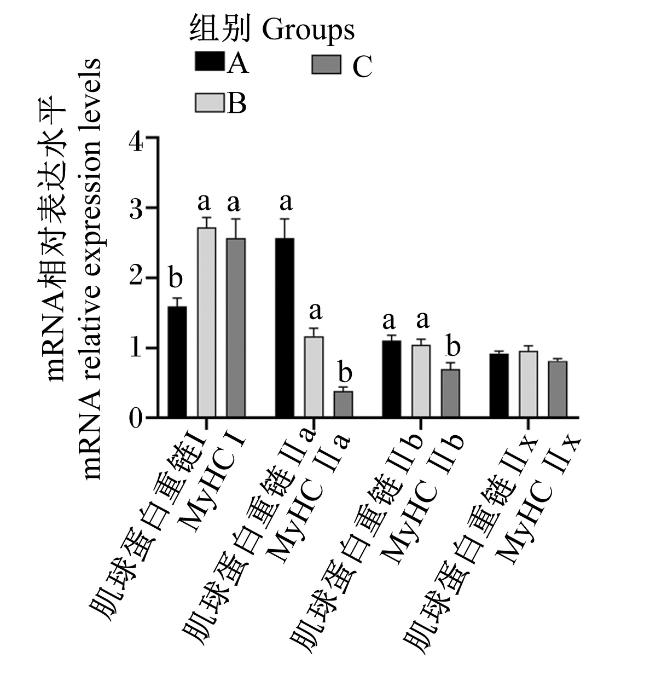
图1可知,与A组相比,B组和C组的背最长肌MyHC Ⅰ mRNA相对表达水平显著提高(P<0.05),C组的背最长肌MyHCaMyHCx mRNA相对表达水平显著降低(P<0.05)。
图1 限饲条件下不同饲养时长对育肥猪背最长肌的肌纤维类型关键基因mRNA相对表达水平的影响

数据柱标相同小写字母表示差异不显著(P>0.05),不同小写字母表示差异显著(P<0.05)。

Fig.1 Effects of different feeding time under restricted feeding conditions on mRNA relative expression levels of key genes of muscle fiber types in longissimus dorsi of finishing pigs

Value columns with the same small letter mean no significant difference (P>0.05), while with different small letters mean significant difference (P<0.05).

3 讨论

3.1 限饲条件下不同饲养时长对育肥猪生长性能、胴体品质和肉品质的影响

肥育期限饲对生长性能有一定的影响,但可显著提高胴体瘦肉量,如限制采食-自由采食组与自由采食-自由采食组相比,虽然限制采食-自由采食组肥育期末的猪胴体重低,但2组间胴体瘦肉量无差异,说明前期限饲可提高胴体瘦肉率[11]。目前生产中猪场普遍采用肥育期限饲以提高猪胴体瘦肉率和饲料转化率。赵燕等[12]的试验也表明,限饲可提高生长肥育猪的瘦肉率,同时也降低了背膘厚度及胴体脂肪含量。这与本研究通过限饲延长1个月的饲养期试验结果一致。但过度限饲使得猪前期肌肉生长受到限制,而对后期的脂肪沉积影响较小,最终导致瘦肉率下降。在本试验中,限饲并延长饲养时长降低了育肥猪平均日增重,增加了料重比,生长性能下降,出栏时间延长。但是限饲使肉色加深,改善了肌肉感观特性[13]。任善茂等[14]报道,限饲能通过改变肌肉的颜色改善肌肉的感官特性。本试验中,与对照组相比,限饲并延长饲时长2个月的猪背最长肌a*值显著提高,L*值显著降低。

3.2 限饲条件下不同饲养时长对育肥猪血清氮代谢指标、背最长肌游离氨基酸组成的影响

猪肉中的单核苷酸与游离氨基酸是猪肉中最主要的滋味呈味物质,其可作为前体物质与还原糖发生美拉德反应,提高肉的鲜味和甜味等风味[15]。本试验发现,限饲可提高肌肉中肌苷酸含量和大理石纹评分,增加了猪肉的鲜味。猪机体蛋白质沉积是肌肉组织生长的基本要素。Heyer等[16]研究表明,限饲会促进猪皮下脂肪沉积,减少蛋白质沉积。限饲条件下,蛋白质合成速度下降,氮排泄也相应减少。Sun等[17]研究发现,UN为蛋白质分解的产物,限饲使血清UN含量显著降低,代谢废物减少,降低肾脏高滤过,保护肾功能。蛋白质代谢主要受氨基酸浓度的调节,组织中游离氨基酸及其代谢产物可以用于机体的功能或作为信号分子参与到信号转导过程。限饲刺激肌肉组织蛋白质代谢,可能机制是循环系统中可利用的氨基酸浓度发生了变化[18-20]。限饲条件下,机体会动员肌肉中的蛋白质分解为氨基酸作为糖异生的原料。Ribeiro等[21]研究表明,限饲降低脱羧和转氨的分解代谢速率,从而不利于支链氨基酸亮氨酸的合成,降低了肉中的苦味,这一过程受哺乳动物雷帕霉素靶蛋白复合物1(mTORC1)信号通路的调节,mTORC1启动mRNA翻译,促进肌肉组织生长,并抑制蛋白质降解[22]。Li等[23]研究发现,限饲可使甜味氨基酸丝氨酸含量提高,猪肉的营养与风味增加,与本试验结果一致。

3.3 限饲条件下不同饲养时长对育肥猪血清脂质代谢指标、背最长肌中长链脂肪酸组成的影响

动物体脂的沉积量是脂肪摄取、脂肪酸从头合成、体脂的合成与降解过程动态平衡的结果,其体脂的沉积能力受脂肪的合成、分解和脂肪的转运3个方面共同调控[24]。高密度脂蛋白可以从细胞膜上摄取胆固醇,经卵磷脂胆固醇酰基转移酶催化而成胆固醇酯,再将携带的胆固醇酯转移到极低密度脂蛋白和低密度脂蛋白上[25]。限饲可提高高密度脂蛋白含量,减少白色脂肪组织含量,增加能量消耗,促进脂肪源性细胞因子脂酮的产生[26]。在本研究中,B组血清HDL-C含量显著增加,而背膘厚度降低,可能与此有关。多不饱和脂肪酸对能量代谢、肠道发育、免疫功能和基因表达调控等方面均发挥着重要作用[27],限饲使多不饱和脂肪酸在其整体结构中比例相对增加[28]。n-6与n-3多不饱和脂肪酸比值的平衡对人体的平衡十分重要,在一定范围内n-6与n-3多不饱和脂肪酸比值越小对人体营养吸收越有益,在n-3不饱和脂肪酸中,对人体最重要的不饱和脂肪酸是二十五烯酸,可以降低血管中胆固醇含量,本试验血清生化结果中TC含量降低可能与此有关。脂肪组织是肉特殊风味的来源,是形成肉产品风味的一个重要因素。脂肪酸随着不饱和度增加,熔点降低,肉中脂质的柔软性提高。不饱和脂肪酸还是重要的芳香物质与芳香物质前体,含有一定量多不饱和脂肪酸的猪肉食用价值较高,其嫩度、多汁性、香味及总体可接受的评分值高[29]。本试验中,限饲条件下延长饲养时长育肥猪背最长肌总n-3多不饱和脂肪酸的比例升高,肉的风味提升,与以往的研究结果[2]一致。

3.4 限饲条件下不同饲养时长对育肥猪背最长肌糖酵解潜力、肌纤维类型关键基因表达的影响

Heyer等[16]报道,限饲可抑制糖酵解过程及其内源性分子毒性[30]。本试验发现,限饲条件下延长饲养时长使猪背最长肌无氧酵解减少,pH下降的速度延缓。肌纤维由Ⅰ型氧化型肌纤维和Ⅱ型酵解型肌纤维组成,后者分为3种类型(Ⅱa、Ⅱx和Ⅱb)[31]。成熟期的MyHC异构体之间的转化具有一定规律,4种类型一般按Ⅰ→Ⅱa→Ⅱx→Ⅱb顺序相互转化,且转化速率不同。本试验中,糖酵解潜力下降的原因可能是肌纤维从酵解型肌纤维向氧化型发育。钙调神经磷酸酶/活化T细胞核因子(CaN/NFAT)信号通路被认为是动物出生后维持和调节骨骼肌肌纤维类型特异基因表达的重要通路之一,可激活慢肌纤维类型特异基因的表达,本试验中作为激活该通路的信号分子的前体物质的丝氨酸含量增加可能与这一过程有关[32]。肌纤维直径越小,横截面积越小,则密度越大,肌肉系水力越强,嫩度越大,肉质越鲜美[33],限饲过度则导致前期肌纤维细胞增多的发育受阻[34]。本试验中,饲养时长延长2个月,显著提高了背最长肌MyHCⅠ mRNA相对表达水平,改善了肌纤维类型的组成,提高了肉的嫩度,与Yang等[35]的研究结果一致。

4 结论

通过限饲延长饲养时长,可降低育肥猪机体脂肪沉积,并改善脂肪酸和肌纤维类型组成,从而提高肉品质,饲养时长延长2个月时肉品质显著提高,但过度限饲会导致生长性能和胴体品质下降,且在一定程度上增加了造肉成本。
[1]
李佳凝, 刘洋, 刘大伟, 等. 能量限饲对肉种鸡肉品质的影响[J]. 黑龙江畜牧兽医, 2018(15):116-119.

LI J N, LIU Y, LIU D W, et al. Effect of energy restricted feeding on meat quality of broiler breeders[J]. Heilongjiang Animal Science and Veterinary Medicine, 2018(15):116-119. (in Chinese)

[2]
WIECEK J, REKIEL A, BATORSKA M, et al. Effect of restricted feeding and realimentation periods on pork quality and fatty acid profile of M. longissimus thoracis[J]. Meat Science, 2011, 87(3):244-249.

DOI

[3]
POULLET N, BAMBOU J C, LOYAU T, et al. Effect of feed restriction and refeeding on performance and metabolism of European and Caribbean growing pigs in a tropical climate[J]. Scientific Reports, 2019, 9(1):4878.

DOI PMID

[4]
CARCÒ G, GALLO L, DALLA BONA M, et al. The influence of feeding behaviour on growth performance,carcass and meat characteristics of growing pigs[J]. PLoS One, 2018, 13(10):e0205572.

DOI

[5]
RAJMAN M, JURÁNI M, LAMOSOVÁ D, et al. The effects of feed restriction on plasma biochemistry in growing meat type chickens (Gallus gallus)[J]. Comparative Biochemistry and Physiology. Part A:Molecular & Integrative Physiology, 2006, 145(3):363-371.

[6]
WIECEK J, REKIEL A, SKOMIAŁ J. Effect of restricted feeding and realimentation periods on compensatory growth performance and physiological characteristics of pigs[J]. Archives of Animal Nutrition, 2011, 65(1):34-45.

PMID

[7]
中华人民共和国农业部. 瘦肉型猪胴体性状测定技术规范:NY/T 825—2004[S]. 北京: 中国农业出版社, 2004.

Ministry of Agriculture of the PRC. Technical regulation for testing of carcass traits in lean-type pig:NY/T 825—2004[S]. 北京: China Agriculture Press, 2004. (in Chinese)

[8]
中国人民共和国农业农村部. 猪肉品质测定技术规程:NY/T 821—2019[S]. 北京: 中国农业出版社, 2019.

Ministry of Agriculture and Rural Affairs of the People’s Republic of China. Technical code of practice for pork quality assessment:NY/T 821—2019[S]. 北京: China Agriculture Press, 2019. (in Chinese)

[9]
中华人民共和国农业部. 肉嫩度的测定剪切力测定法:NY/T 1180—2006[S]. 北京: 中国农业出版社, 2006.

Ministry of Agriculture of the PRC. Beijing[S]. 北京: China Agriculture Press, 2006. (in Chinese)

[10]
CHEN D W, ZHANG M. Non-volatile taste active compounds in the meat of Chinese mitten crab (Eriocheir sinensis)[J]. Food Chemistry, 2007, 104(3):1200-1205.

DOI

[11]
邓跃林, OKSBJERG, N. 不同饲养水平对生长肥育猪生产性能和血清类胰岛素生长因子-Ⅰ的影响[J]. 华南农业大学学报, 2002, 23(4):64-67.

DENG Y L, OKSBJERG N. The effect of different feeding levels on performance and serum insulin-like growth factor-Ⅰ of growing-finishing pigs[J]. Journal of South China Agricultural University, 2002, 23(4):64-67. (in Chinese)

[12]
赵燕, 石云龙, 李步高, 等. 饲喂水平对公、母分群饲养的生长肥育猪生产性能及肉品质的影响[J]. 黑龙江畜牧兽医, 2020(8):46-50.

ZHAO Y, SHI Y L, LI B G, et al. Effects of feeding level on performance and meat quality of growing-finishing pigs fed in separate groups of male and female[J]. Heilongjiang Animal Science and Veterinary Medicine, 2002(8):46-50. (in Chinese)

[13]
WEIBMANN F. An exemplary view on the influence of genotype and feeding on growth performance,carcass quality,and meat quality in organic pig fattening[J]. Agriculture and Forestry Research, 2011, 61:75-82.

[14]
任善茂, 张牧, 陶勇, 等. 瘦肉型猪育肥后期不同饲喂方式对肉质的影响[J]. 动物科学与动物医学, 2002, 19(9):7-11.

REN S M, ZHANG M, TAO Y, et al. Effect of the different feeding regimes on meat quality in the latter finishing period in lean pigs[J]. Animal Science & Veterinary Medicine, 2002, 19(9):7-11. (in Chinese)

[15]
DASHDORJ D, AMNA T, HWANG I. Influence of specific taste-active components on meat flavor as affected by intrinsic and extrinsic factors:an overview[J]. European Food Research and Technology, 2015, 241(2):157-171.

DOI

[16]
HEYER A, LEBRET B. Compensatory growth response in pigs:effects on growth performance,composition of weight gain at carcass and muscle levels,and meat quality[J]. Journal of Animal Science, 2007, 85(3):769-778.

DOI

[17]
SUN Y C, TENG T, BAI G D, et al. Protein-restricted diet balanced for lysine,methionine,threonine,and tryptophan for nursery pigs elicits subsequent compensatory growth and has long term effects on protein metabolism and organ development[J]. Animal Feed Science and Technology, 2020, 270:114712.

DOI

[18]
MIYAZAKI M, ESSER K A. Cellular mechanisms regulating protein synthesis and skeletal muscle hypertrophy in animals[J]. Journal of Applied Physiology, 2009, 106(4):1367-1373.

DOI PMID

[19]
SALES F, PACHECO D, BLAIR H, et al. Muscle free amino acid profiles are related to differences in skeletal muscle growth between single and twin ovine fetuses near term[J]. SpringerPlus, 2013, 2:483.

DOI PMID

[20]
DAVIS T A, FIOROTTO M L. Regulation of muscle growth in neonates[J]. Current Opinion in Clinical Nutrition and Metabolic Care, 2009, 12(1):78-85.

DOI PMID

[21]
RIBEIRO D M, MADEIRA M S, KILMINSTER T, et al. Amino acid profiles of muscle and liver tissues of Australian Merino,Damara and Dorper lambs under restricted feeding[J]. Journal of Animal Physiology and Animal Nutrition, 2019, 103(5):1295-1302.

DOI

[22]
HORNICK J L, VAN EENAEME C, GÉRARD O, et al. Mechanisms of reduced and compensatory growth[J]. Domestic Animal Endocrinology, 2000, 19(2):121-132.

DOI PMID

[23]
LI Y H, LI F N, DUAN Y H, et al. Low-protein diet improves meat quality of growing and finishing pigs through changing lipid metabolism,fiber characteristics,and free amino acid profile of the muscle[J]. Journal of Animal Science, 2018, 96(8):3221-3232.

DOI

[24]
刘莹莹. 日粮、品种和生长阶段对猪肉品质的影响及机制研究[D].博士学位论文. 北京: 中国科学院大学, 2016:1-131.

LIU Y Y. Effects of diet, variety, and growth stage on pork quality and its mechanism[D]. Ph.D.Thesis. Beijing: University of Chinese Academy of Sciences, 2016:1-131. (in Chinese)

[25]
YU J H, LI P. The size matters:regulation of lipid storage by lipid droplet dynamics[J]. Science China.Life Sciences, 2017, 60(1):46-56.

[26]
MINEO C, SHAUL P W. Novel biological functions of high-density lipoprotein cholesterol[J]. Circulation Research, 2012, 111(8):1079-1090.

PMID

[27]
左正三, 郭东升, 纪晓俊, 等. 肠道中多不饱和脂肪酸及其衍生物研究进展[J]. 中国生物工程杂志, 2018, 38(11):66-75.

ZUO Z S, GUO D S, JI X J, et al. Polyunsaturated fatty acids and their derivatives in the intestinal tract:a review[J]. China Biotechnology, 2018, 38(11):66-75. (in Chinese)

[28]
DAZA A, REY A I, MENOYO D, et al. Effect of level of feed restriction during growth and/or fattening on fatty acid composition and lipogenic enzyme activity in heavy pigs[J]. Animal Feed Science and Technology, 2007, 138(1):61-74.

DOI

[29]
郎婧, 石宝明, 张宏宇, 等. 亚麻籽中n-3多不饱和脂肪酸对猪肌体脂肪酸组成和肉品质的影响[J]. 中国饲料, 2010(8):9-12.

LANG J, SHI B M, ZHANG H Y, et al. Effects of n-3 PUFA in linseed on fatty acid composition and quality of pork[J]. China Feed, 2010(8):9-12. (in Chinese)

[30]
HIPKISS A R. On the mechanisms of ageing suppression by dietary restriction-is persistent glycolysis the problem?[J]. Mechanisms of Ageing and Development, 2006, 127(1):8-15.

PMID

[31]
LISTRAT A, GAGAOUA M, NORMAND J, et al. Are there consistent relationships between major connective tissue components,intramuscular fat content and muscle fibre types in cattle muscle?[J]. Animal, 2020, 14(6):1204-1212.

DOI

[32]
BURNLEY M. The limit to exercise tolerance in humans:validity compromised by failing to account for the power-velocity relationship[J]. European Journal of Applied Physiology, 2010, 109(6):1225-1226.

DOI

[33]
FAHEY A J, BRAMELD J M, PARR T, et al. The effect of maternal undernutrition before muscle differentiation on the muscle fiber development of the newborn lamb[J]. Journal of Animal Science, 2005, 83(11):2564-2571.

PMID

[34]
王震, 马铁伟, 邓凯平, 等. 能量限饲和补偿对湖羊生长性能及相关激素和肉品质的影响[J]. 南京农业大学学报, 2018, 41(4):722-729.

WANG Z, MA T W, DENG K P, et al. Effects of energy restriction and compensation on growth performance,and related hormones and meat quality of Hu sheep[J]. Journal of Nanjing Agricultural University, 2018, 41(4):722-729. (in Chinese)

[35]
YANG C, WANG W L, TANG X W, et al. Comparison of the meat quality and fatty acid profile of muscles in finishing Xiangcun black pigs fed varied dietary energy levels[J]. Animal Nutrition, 2022, 11:15-24.

DOI

Outlines

/