RESEARCH PAPER

Effects of Reducing Dietary n-6/n-3 Polyunsaturated Fatty Acid Ratio with Vegetable Oil Supplementation on Fat Deposition, Fatty Acid Composition and Expression of Genes Involved in Lipid Metabolism of Growing-Finishing Pigs

  • WEI Fang , 1 ,
  • JIANG Susu 1, 2 ,
  • TIAN Chengcheng 1 ,
  • FU Lu 1 ,
  • YU Qi 1 ,
  • DAI Hongwei 1 ,
  • LU Jianxiong , 1, * ,
  • ZHANG Guohua , 1, *
Expand
  • 1 College of Life Science and Engineering, Northwest Minzu University, Lanzhou 730124, China
  • 2 Gansu Agriculture Vocational and Technical College, Lanzhou 730030, China
*LU Jianxiong, professor, E-mail: ;
ZHANG Guohua, professor, E-mail:

Received date: 2022-10-13

  Online published: 2023-05-11

Abstract

This experiment was conducted to investigate the effects of reducing dietary n-6/n-3 polyunsaturated fatty acid (PUFA) ratio with vegetable oil supplementation on fat deposition, fatty acid composition and the expression of genes involved in lipid metabolism of growing-finishing pigs. Fifty-four growing pigs (Duroc×Landrace×Yorkshire) at a live weight of (45.30±1.72) kg were randomly allocated to 3 groups with 6 replicates per group and 3 pigs per replicate. The control group was fed a basal diet, and the experimental groups were fed diets containing 4.5% rapeseed oil (rapeseed oil group) and 4.5% mixed oil (mixed oil group, rapeseed oil∶linseed oil=1∶1), respectively. The levels of digestible energy and crude protein in all diets were the same except that the ether extract contents were 2.76%, 7.24% and 7.24%, and the n-6/n-3 PUFA ratios were about 10∶1, 4∶1 and 2∶1, respectively. The experiment lasted for 42 d after 7 d adaption. The results showed as follows: 1) compared with the control group, dietary vegetable oils significantly increased the intramuscular fat (IMF) content in longissimus dorsi muscle of growing-finishing pigs (P<0.05), but had no effects on the average daily gain (ADG), average daily feed intake (ADFI), and feed to gain ratio (F/G) as well as the backfat thickness (P>0.05). 2) Compared with the control group, dietary vegetable oils significantly increased the contents of n-3 and total PUFAs in longissimus dorsi muscle and subcutaneous fat (P<0.05), and significantly decreased the n-6/n-3 PUFA ratio (P<0.05); compared with rapeseed oil group, the n-3 PUFA content was significantly increased in longissimus dorsi muscle and subcutaneous fat in mixed oil group (P<0.05), while the n-6/n-3 PUFA ratio was significantly decreased (P<0.05). 3) Compared with the control group, dietary vegetable oils significantly increased the mRNA relative expression levels of fatty acid translocase/CD36 (FAT/CD36) and fatty acid transport protein 1 (FATP1) in longissimus dorsi muscle and subcutaneous adipose tissue (P<0.05), and the mRNA relative expression levels of FAT/CD36 and fatty acid transport protein 4 (FATP4) in longissimus dorsi muscle in mixed oil group was significantly higher than that in rapeseed oil group (P<0.05). 4) Compared with the control group, dietary vegetable oils significantly increased the mRNA relative expression levels of carbohydrate response element binding protein (ChREBP), glucose transporter 4 (Glut4), and lipogenic genes such as fatty acid synthase (FAS), acetyl-CoA carboxylase (ACC), fatty acid elongase 5 (Elovl5) and fatty acid elongase 6 (Elovl6) in longissimus dorsi muscle, and significantly decreased the mRNA relative expression levels of peroxisome proliferator-activated receptor γ (PPARγ), retinoid X receptor α (RXRα) and lipogenic genes in subcutaneous adipose tissue (P<0.05). It is concluded that reducing dietary n-3/n-6 PUFA ratio with vegetable oil supplementation stimulates the absorption and utilization of dietary long-chain fatty acids for fat synthesis in muscle and subcutaneous adipose tissue by increasing the expression of FAT/CD36 and FATP1; inhibits de novo lipogenesis by decreasing the expression of PPARγ and lipogenic genes in subcutaneous adipose tissue, and stimulates the lipogenesis by increasing the expression of ChREBP and lipogenic genes in longissimus dorsi muscle, increasing IMF content. Furthermore, the n-3 PUFA content and n-6/n-3 PUFA ratio in the tissues can be more effectively improved by the dietary n-6/n-3 PUFA ratio of 2∶1.

Cite this article

WEI Fang , JIANG Susu , TIAN Chengcheng , FU Lu , YU Qi , DAI Hongwei , LU Jianxiong , ZHANG Guohua . Effects of Reducing Dietary n-6/n-3 Polyunsaturated Fatty Acid Ratio with Vegetable Oil Supplementation on Fat Deposition, Fatty Acid Composition and Expression of Genes Involved in Lipid Metabolism of Growing-Finishing Pigs[J]. Chinese Journal of Animal Nutrition, 2023 , 35(5) : 2867 -2881 . DOI: 10.12418/CJAN2023.269

体脂含量是生长肥育猪重要的经济性状,皮下脂肪影响胴体质量,肌内脂肪(intramuscular fat,IMF)含量与肌肉的多汁性、风味和嫩度等肉质性状正相关。研究表明,IMF含量低于2.5%时猪肉感官品质下降,影响消费者的接受度[1]。然而,以提高瘦肉率和生长速度为目标的高强度遗传选育,导致多数现代商业猪种IMF含量低于1.5%,脂肪酸组成也发生变化[2-3]。α-亚麻酸(C18∶3,n-3)等n-3多不饱和脂肪酸(polyunsaturated fatty acid,PUFA)可降低人体血液低密度脂蛋白、胆固醇和甘油三酯含量,参与调节机体免疫和炎症反应[4]。高n-6/n-3 PUFA比值饮食是诱发心血管疾病、炎症和代谢紊乱等疾病的重要因素之一[5]。因此,提高猪肉IMF含量、改善脂肪酸组成是养猪生产亟待解决的重要问题[1]
脂肪性状表型变异受许多环境因素和遗传因素的影响,饲粮营养组成及水平是影响猪脂肪沉积和脂肪酸组成的主要因素之一。n-3和n-6 PUFA具有多种不同的生物学功能,影响白色脂肪组织[6]和其他组织或细胞的功能[7]。n-3 PUFA可防止高脂饲粮诱导的小鼠脂肪细胞肥大和脂肪组织重量的过度增加[8],而亚油酸通过上调脂肪细胞过氧化物酶体增殖物激活受体γ(peroxisome proliferator-activated receptor γ,PPARγ)磷酸化促进脂质积累[9]。适当的饲粮n-6/n-3 PUFA比值有利于改善脂质代谢和炎症反应,促进能量和营养物质的有效利用[10],改善猪的生长性能、肉品质和健康状况[11-13]。然而,研究发现饲粮添加PUFA、植物油及动物脂肪对猪生长性能、胴体质量、脂肪沉积和脂肪酸组成等有不同的影响[14-17]。这些结果的分歧可能与饲粮脂质含量及PUFA组成不同从而造成不同组织脂代谢相关基因表达的差异有关。
研究发现,共轭亚油酸以组织特异性方式影响肥育猪肝脏、肌肉和脂肪组织脂肪代谢及PPARγ、脂肪酸合酶(fatty acid synthase,FAS)和乙酰辅酶A羧化酶(acetyl-CoA carboxylase,ACC)等生脂基因表达[18],二十二碳六烯酸(docosahexaenoic acid,DHA)差异调控生长肥育猪肝脏和背最长肌2,4-二烯酰辅酶A还原酶2(2,4-dienoyl CoA reductase 2,DECR2)和固醇调节元件结合蛋白-1(sterol regulatory element binding protein-1,SREBP-1)等脂代谢调控基因表达[19]。近年来,一些研究者应用RNA高通量测序(RNA-Seq)技术研究了饲粮n-3和n-6 PUFA及其比值对猪脂肪组织和肌肉转录谱的影响[20-21],并获得许多有价值的差异表达基因信息。然而,脂肪沉积是多基因参与的复杂生物学过程,涉及多种转录因子的表达、激活及对下游靶基因的调控,目前对饲粮脂质及PUFA影响猪脂肪沉积的分子调控途径仍缺乏深入了解。因此,本试验通过添加不同植物油,降低饲粮n-6/n-3 PUFA比值,研究其对生长肥育猪肌肉和皮下脂肪组织脂肪沉积、脂肪酸组成及生脂相关转录因子和脂肪酸合成、延长、去饱和及脂解等基因表达的影响,为改善IMF含量及脂肪酸组成、提高猪肉品质提供依据。

1 材料与方法

1.1 试验动物及饲粮组成

选择54头年龄、体重[(45.30±1.72) kg]相近的“杜×大×长”三元杂交猪,随机分为3组,每组18头,每组分为6栏(重复),每栏3头。对照组饲喂基础饲粮,试验组分别饲喂含4.5%菜籽油(菜籽油组)和4.5%混合油(混合油组,菜籽油∶亚麻籽油=1∶1)的饲粮。饲粮参照《猪饲养标准》(NY/T 65—2004)瘦肉型生长肥育猪饲养标准配制,其组成及营养水平见表1[22]。3组饲粮粗脂肪含量分别为2.76%、7.24%和7.24%,n-6/n-3 PUFA比值分别约为10∶1、4∶1和2∶1,消化能、粗蛋白质和酸性洗涤纤维等营养成分含量基本相同。预试期7 d,正试期42 d。试验期间,早(08:00)、晚(17:00)2次定时喂料,自由采食,自由饮水。
表1 饲粮组成及营养水平(风干基础)

Table 1 Composition and nutrient levels of diets (air-dry basis) %

项目
Items
对照组
Control group
菜籽油组
Rapeseed oil group
混合油组
Mixed oil group
原料Ingredients
玉米Corn 60.50 56.00 56.00
豆粕Soybean meal 23.00 22.00 22.00
麦麸Wheat bran 5.25 9.00 9.00
预混料Premix1) 4.00 4.00 4.00
氯化钠NaCl 0.25 0.25 0.25
菜籽油Rapeseed oil 4.50 2.25
亚麻籽油Linseed oil 2.25
苜蓿草粉Alfalfa meal 4.25 4.25
淀粉Starch 7.00
合计Total 100.00 100.00 100.00
营养水平Nutrient levels2)
消化能DE/(MJ/kg) 13.66 13.79 13.79
粗蛋白质CP 15.84 15.99 15.99
粗脂肪EE 2.76 7.24 7.24
粗纤维CF 2.68 4.07 4.07
中性洗涤纤维NDF 11.08 12.67 12.67
酸性洗涤纤维ADF 4.41 4.56 4.56
钙Ca 0.72 0.75 0.75
总磷TP 0.45 0.46 0.46
有效磷AP 0.23 0.23 0.23
赖氨酸Lys 0.91 0.93 0.93
蛋氨酸Met 0.23 0.23 0.23
色氨酸Trp 0.18 0.19 0.19
n-6多不饱和脂肪酸n-6 PUFA3) 15.54 27.81 24.48
n-3多不饱和脂肪酸n-3 PUFA3) 1.63 6.53 14.12
n-6/n-3多不饱和脂肪酸n-6/n-3 PUFA 9.53 4.18 1.74

1)每千克预混料含有 One kilogram of premix contained the following:VA 120 000 IU,VD3 16 000 IU,VE 440 IU,VK3 80 mg,VB1 40 mg,VB2 120 mg,VB6 40 mg,VB12 0.40 mg,烟酰胺 nicotinamide 560 mg,泛酸 pantothenic acid 400 mg,生物素 biotin 4.00 mg,叶酸 folic acid 24 mg,Fe 2 000 mg,Cu 640 mg,Zn 1 600 mg,Mn 320 mg,I 9.60 mg,Se 4.00 mg,赖氨酸 lysine 32 g,Ca 150 g,总磷 TP 21 g,氯化钠 NaCl 70 g。

2)营养水平为计算值。Nutrient levels were calculated values.

3)n-6 PUFA和n-3 PUFA含量为测定值,以占总脂肪酸的百分数表示。n-6 PUFA and n-3 PUFA contents were measured values and expressed as a percentage of total fatty acids.

1.2 生长性能测定及样品采集

试验期间以重复为单位,每日记录喂料量和余料量。正试期第1、21和42天对所有试验猪进行空腹称重,计算平均日采食量(ADFI)、平均日增重(ADG)及料重比(F/G)。试验结束时,每个重复选取接近平均体重的试验猪1头,每组6头;禁食12 h,屠宰,迅速采集右半侧胴体第13~14肋骨处背最长肌和皮下脂肪组织,用磷酸盐缓冲液冲洗后,在液氮中冷冻,用于脂肪酸含量和基因表达分析。

1.3 脂肪性状测定

背膘厚:屠宰后用游标卡尺测定左半侧胴体肩胛后沿、胸腰结合和腰荐结合处的皮下脂肪厚度,以3点的平均值为背膘厚度。
IMF含量:背最长肌IMF含量采用索氏抽提法测定,以占肌肉鲜重的百分数表示。
脂肪酸含量:用氯仿∶甲醇(2∶1,体积比)提取背最长肌和皮下脂肪样品脂质,然后用氢氧化钾-甲醇溶液制备脂肪酸甲酯,置于DB5毛细管柱(30 m×0.25 mm),用气相色谱质谱分析联用仪(Agilent 6890N/5975B)测定脂肪酸含量。测定结果用各脂肪酸占总脂肪酸的百分数表示。

1.4 实时荧光定量PCR检测基因表达

采用RNA提取试剂盒(TaKaRa公司,日本)按操作说明书提取各组织总mRNA,并用琼脂糖电泳检测mRNA完整性,NanoDrop 1000超微量分光光度计检测纯度和定量。取1 μL总mRNA,用反转录试剂盒(TaKaRa公司,日本)合成cDNA。实时荧光定量PCR扩增体系为10.0 μL,包括:SYBR Premix Ex TaqTM 5.0 μL,上、下游引物各0.4 μL,cDNA 1.0 μL,ddH2O 3.2 μL。PCR反应程序:95 ℃预变性30 s;95 ℃变性5 s,60 ℃退火30 s,共40个循环。以β-肌动蛋白(β-actin)为内参基因,采用2-ΔΔCt法计算目标基因mRNA相对表达量。引物信息见表2
表2 引物信息

Table 2 Primer information

基因及功能分类
Genes and function
classification
登录号
Accession
number
引物序列
Primer sequences
(5'—3')
产物长度
Product
length/bp
长链脂肪酸转运Long-chain fatty acid transport
脂肪酸转运蛋白1
FATP1
NM_001083931.1 F:CCTGAACTTCTGGGAGCTGG
R:CAGCAACCATAGCAGGACCA
101
脂肪酸转运蛋白4
FATP4
XM_013993903 F:GCATAAACAGGGACTTTCAAGC
R:TCTTTCACGACTGCTGGGTC
75
脂肪酸转位酶/CD36
FAT/CD36
NM_001044622.1 F:CACTGCCTCACTGGAGTGTT
R:TGCTTCAAGTGCTGGGTCAA
104
脂肪分解Lipolysis
脂蛋白酯酶
LPL
NM_214286.1 F:CGACGCAGATTTTGTAGACG
R:CTCATGGGAGCACTTCACG
205
激素敏感脂肪酶
HSL
NM_214315.2 F:GGATATGCCTCGCAGGAGAC
R:AGTTGGGTCGGGACTTGTG
324
脂肪生成和调控Lipogenesis and regulation
长链酰基辅酶A合成酶4
ACSL4
NM_001038694.1 F:TGTGCAGTAACTTGTGTGGC
R:CAAGTGTGACTATTTAGCAGGGA
85
脂肪酸结合蛋白4
FABP4
NM_001002817.1 F:TGAAAGAAGTGGGAGTGGGC
R:CTGGCCCAATTTGAAGGCAA
146
脂肪酸结合蛋白5
FABP5
DQ523618.3 F:ACGGGAAGGAGAGCACAATC
F:AGAAGTCAGGCACTTACCACC
70
脂肪酸延伸酶5
Elovl5
XM_021098832.1 F:GACGCCCTTCCTGCTTTGAG
R:GTCCCAGCCACACAATTAGC
179
脂肪酸延伸酶6
Elovl6
XM_021100708 F:ATAGTGAAATTGTCCTCCTCGCC
R:GAACACTGCAAGGCTCAGAGA
165
乙酰辅酶A羧化酶
ACC
NM_001114269.1 F:AAGGGCTGCCTCTAATG
R:GATGTAAGCGCCGAACT
287
脂肪酸合酶
FAS
NM_001099930.1 F:CGTTGGGTCGACTCACTGAA
R:GAGACAGTTCACCATGCCCA
111
硬脂酰辅酶A去饱和酶
SCD
XM_021072070.1 F:TGCTGATCCCCACAATTCCC
R:CTCCCGGGGGCTAATAGTCT
352
过氧化物酶体增殖物激活受体γ
PPARγ
NM_214379.1 F:TTATTGACCCAGAAAGCG
R:AGGATTTCATACCGCAGG
88
维甲酸X受体α
RXRα
DQ279926.1 F:AACACAAGTACCCCGAGCAG
R:AAGAAGAGGTGTTCCAGGCG
100
肝X受体α
LXRα
XM_013994348.2 F:CTCGGACAGTCCCTTGGTAA
R:TCAGGAGAAACATCAGGCACA
185
固醇调节元件结合蛋白-1c
SREBP-1c
XM_021066226.1 F:TCTACCACAAGCTGCACCAG
R:GGAGACTGGTCTTGACTCGC
177
碳水化合物反应元件结合蛋白
ChREBP
XM_013985609.2 F:GCTCAACGCTGCCATCAA
R:GTCCCGCATCTGGTCAAAG
395
葡萄糖转运子4
Glut4
NM_001128433 F:AGTGGCTGGGAAGGAAGAAG
R:TGAGGAACCGTCCAAGAATG
164
β-肌动蛋白
β-actin
DQ845171.1 F:AGGCCAACCGTGAGAAGATG
R:CATGACAATGCCAGTGGTGC
122

1.5 统计分析

采用SPSS 20.0统计软件进行单因素方差分析(one-way ANOVA),并用Duncan氏法进行多重比较,P<0.05表示差异显著,0.05<P<0.10表示差异有显著趋势,试验结果以“平均值±标准差”表示。

2 结果

2.1 饲粮添加植物油对生长肥育猪生长性能和脂肪性状的影响

表3所示,生长肥育猪ADG、ADFI和F/G在各组间均无显著差异(P>0.05)。与对照组相比,混合油组生长肥育猪背膘厚无显著差异(P>0.05),菜籽油组背膘厚有提高的趋势(P=0.076);菜籽油组和混合油组猪背最长肌IMF含量均显著提高(P<0.05),但二者之间无显著差异(P>0.05)。
表3 饲粮添加植物油对生长肥育猪生长性能和脂肪性状的影响

Table 3 Effects of dietary vegetable oils on growth performance and fat traits of growing-finishing pigs

项目
Items
对照组
Control group
菜籽油组
Rapeseed oil group
混合油组
Mixed oil group
P
P-value
初始体重IBW/kg 45.95±1.26 45.25±1.43 45.06±1.33 0.868
终末体重FBW/kg 88.18±3.55 87.83±3.01 88.65±2.47 0.565
平均日增重ADG/(kg/d) 1.01±0.11 1.02±0.12 1.04±0.14 0.986
平均日采食量ADFI/(kg/d) 2.82±0.51 2.77±0.18 2.83±0.35 0.743
料重比F/G 2.79±0.30 2.72±0.35 2.73±0.13 0.743
背膘厚Backfat thickness/mm 23.17±0.14 24.99±1.38 22.95±0.42 0.147
肌内脂肪含量IMF content/% 3.48±0.83b 4.15±0.65a 4.18±0.76a 0.042

同行数据肩标不同字母表示差异显著(P<0.05),相同字母或无字母表示差异不显著(P>0.05)。

In the same row, values with different letter superscripts mean significant difference (P<0.05), and with the same letter or no letter superscripts mean no significant difference (P>0.05).

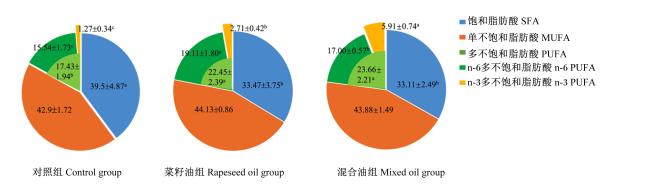
图1所示,与对照组相比,菜籽油组和混合油组生长肥育猪皮下脂肪饱和脂肪酸(saturated fatty acid,SFA)含量显著降低(P<0.05),PUFA、n-6 PUFA和n-3 PUFA含量显著提高(P<0.05),n-6/n-3 PUFA比值由12.24分别显著降低为7.05和2.88(P<0.05),但单不饱和脂肪酸(monounsaturated fatty acid,MUFA)含量无显著差异(P>0.05)。与菜籽油组相比,混合油组猪皮下脂肪n-3 PUFA含量显著提高(P<0.05),n-6 PUFA含量和n-6/n-3 PUFA比值显著降低(P<0.05),但SFA、MUFA和PUFA含量无显著差异(P>0.05)。
图1 饲粮添加植物油对生长肥育猪皮下脂肪脂肪酸组成的影响

同一指标数据标注不同字母表示差异显著(P<0.05),相同字母或无字母表示差异不显著(P>0.05)。图2同。

Fig.1 Effects of dietary vegetable oils on fatty acid composition in subcutaneous fat of growing-finishing pigs

Values of the same index with different letters mean significant difference (P<0.05), and with the same letters or no letters mean no significant difference (P>0.05). The same as Fig.2.

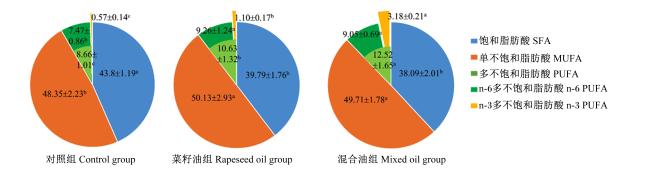
图2所示,与对照组相比,菜籽油组和混合油组生长肥育猪背最长肌SFA含量显著降低(P<0.05),MUFA、PUFA、n-6 PUFA和n-3 PUFA含量显著提高(P<0.05),n-6/n-3 PUFA比值由13.33分别降低为8.42和2.85(P<0.05)。与菜籽油组相比,混合油组猪背最长肌PUFA和n-3 PUFA含量显著提高(P<0.05),但SFA、MUFA和n-6 PUFA含量无显著差异(P>0.05),n-6/n-3 PUFA比值显著降低(P<0.05)。
图2 饲粮添加植物油对生长肥育猪背最长肌脂肪酸组成的影响

Fig.2 Effects of dietary vegetable oils on fatty acid composition in longissimus dorsi muscle of growing-finishing pigs

2.2 饲粮添加植物油对生长肥育猪背最长肌和皮下脂肪组织基因表达的影响

2.2.1 长链脂肪酸转运蛋白编码基因表达
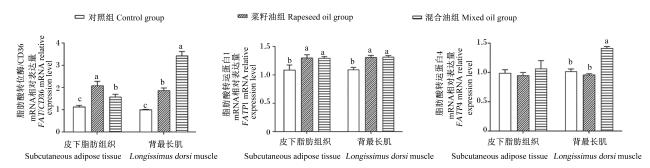
图3所示,与对照组相比,菜籽油组和混合油组生长肥育猪皮下脂肪组织和背最长肌脂肪酸转位酶/CD36(FAT/CD36)和脂肪酸转运蛋白1(FATP1)mRNA相对表达量均显著提高(P<0.05),混合油组背最长肌脂肪酸转运蛋白4(FATP4)mRNA相对表达量显著提高(P<0.05),菜籽油组背最长肌和皮下脂肪组织FATP4 mRNA相对表达量均无显著差异(P>0.05)。此外,混合油组猪背最长肌FAT/CD36和FATP4 mRNA相对表达量均显著高于菜籽油组(P<0.05)。
图3 饲粮添加植物油对生长肥育猪背最长肌和皮下脂肪组织长链脂肪酸转运蛋白编码基因表达的影响

数据柱标注不同字母表示差异显著(P<0.05),相同字母或无字母表示差异不显著(P>0.05)。下图同。

Fig.3 Effects of dietary vegetable oils on expression of genes encoding long-chain fatty acid transport proteins in longissimus dorsi muscle and subcutaneous adipose tissue of growing-finishing pigs

Value columns with different letters mean significant difference (P<0.05), and with the same letters or no letters mean no significant difference (P>0.05). The same below.

2.2.2 脂肪生成相关蛋白和酶编码基因表达

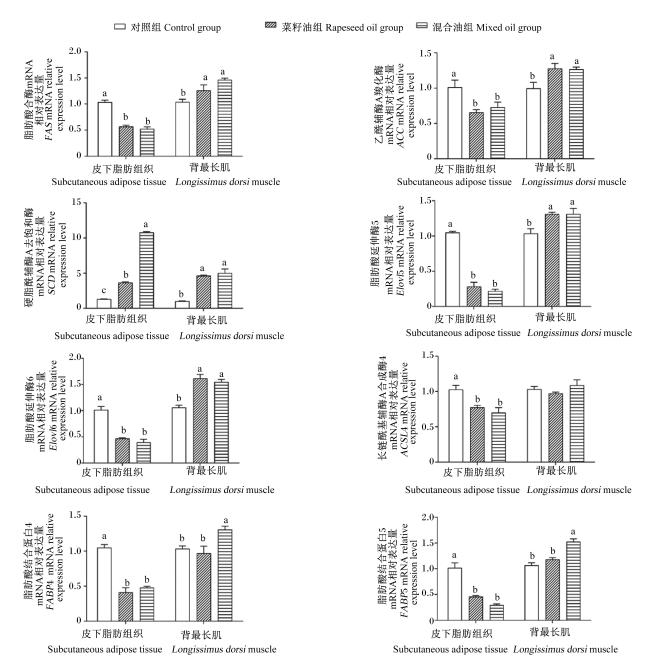
图4所示,与对照组相比,菜籽油组和混合油组生长肥育猪皮下脂肪组织FASACC、脂肪酸延伸酶5(Elovl5)、脂肪酸延伸酶6(Elovl6)、脂肪酸结合蛋白4(FABP4)、脂肪酸结合蛋白5(FABP5)和长链酰基辅酶A合成酶4(ACSL4)mRNA相对表达量均显著降低(P<0.05),而背最长肌FASACCElovl5和Elovl6 mRNA相对表达量显著提高(P<0.05);菜籽油组和混合油组皮下脂肪组织和背最长肌硬脂酰辅酶A去饱和酶(SCD)mRNA相对表达量均显著提高(P<0.05),且混合油组皮下脂肪组织SCD mRNA相对表达量显著高于菜籽油组(P<0.05)。此外,与对照组相比,菜籽油组猪背最长肌FABP4和FABP5 mRNA相对表达量无显著差异(P>0.05),但混合油组背最长肌FABP4和FABP5 mRNA相对表达量则显著提高(P<0.05)。
图4 饲粮添加植物油对生长肥育猪背最长肌和皮下脂肪组织脂肪生成相关蛋白和酶编码基因表达的影响

Fig.4 Effects of dietary vegetable oils on expression of genes encoding proteins and enzymes involved in lipogenesis in longissimus dorsi muscle and subcutaneous adipose tissue of growing-finishing pigs

2.2.3 脂肪分解酶编码基因表达

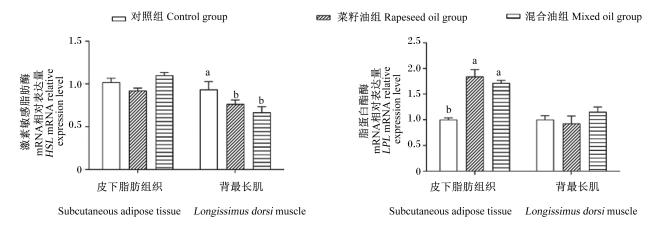
图5所示,与对照组相比,菜籽油组和混合油组生长肥育猪皮下脂肪组织脂蛋白酯酶(LPL)mRNA相对表达量显著提高(P<0.05),但在背最长肌中则无显著差异(P>0.05);相反,激素敏感脂肪酶(HSL)mRNA相对表达量在背最长肌中显著降低(P<0.05),而在皮下脂肪组织中则无显著差异(P>0.05)。
图5 饲粮添加植物油对生长肥育猪背最长肌和皮下脂肪组织脂肪分解酶编码基因表达的影响

Fig.5 Effects of dietary vegetable oils on expression of genes encoding lipolytic enzymes in longissimus dorsi muscle and subcutaneous adipose tissue of growing-finishing pigs

2.2.4 脂肪生成和调控相关蛋白编码基因表达

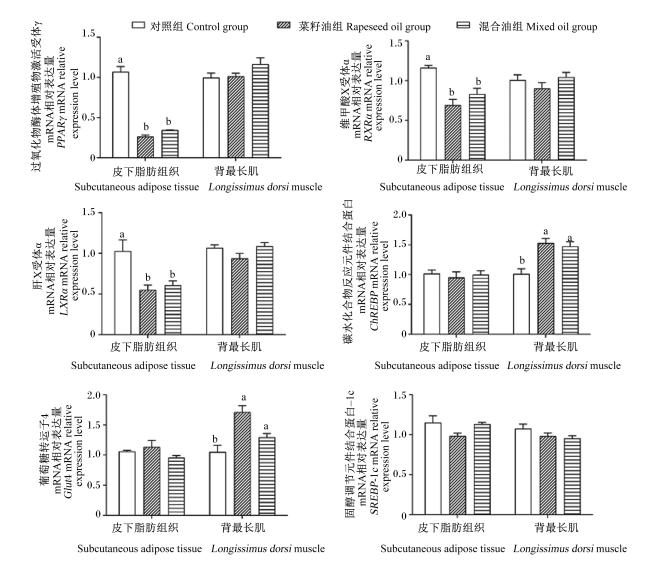
图6所示,与对照组相比,菜籽油组和混合油组生长肥育猪皮下脂肪组织PPARγ、维甲酸X受体α(RXRα)和肝X受体α(LXRα)mRNA相对表达量显著降低(P<0.05),但在背最长肌中则无显著差异(P>0.05);菜籽油组和混合油组皮下脂肪组织碳水化合物反应元件结合蛋白(ChREBP)和葡萄糖转运子4(Glut4)mRNA相对表达量无显著差异(P>0.05),但在背最长肌中则显著提高(P<0.05)。此外,各组猪皮下脂肪组织和背最长肌SREBP-1c mRNA相对表达量均无显著差异(P>0.05)。
图6 饲粮添加植物油对生长肥育猪背最长肌和皮下脂肪组织脂肪生成和调控相关蛋白编码基因表达的影响

Fig.6 Effects of dietary vegetable oils on expression of genes encoding proteins involved in lipogenesis and regulation in longissimus dorsi muscle and subcutaneous adipose tissue of growing-finishing pigs

3 讨论

通过添加PUFA或不同脂质改变饲粮脂肪酸组成,提高IMF含量和改善组织脂肪酸组成,是提高猪肉感官品质和营养价值的重要营养策略之一,但目前的研究结果尚不一致。研究表明,1%亚麻籽油与1%~5%家禽脂肪组成的脂质[15]、4%菜籽油或大豆油[17]或降低饲粮n-6/n-3 PUFA比值[13],对猪IMF含量和背膘厚均无显著影响。然而,含6%和10%亚麻籽的饲粮可以提高猪IMF含量,但不影响背膘厚[23]。Li等[24]报道,3%亚麻籽油或用大豆油部分替代亚麻籽油构成n-6/n-3 PUFA比值分别为1.0∶1.0、2.5∶1.0、5.0∶1.0和10.0∶1.0的饲粮,肥育猪背膘厚无显著差异,但n-6/n-3 PUFA比值为2.5∶1.0的饲粮有最高的IMF含量。由此可见,饲粮脂质含量和n-6/n-3 PUFA比值协同影响猪脂肪沉积。本试验表明,饲粮添加4.5%菜籽油和菜籽油与亚麻籽油组成的混合油构成n-6/n-3 PUFA比值为4∶1和2∶1的饲粮,可显著提高生长肥育猪背最长肌IMF含量,但对背膘厚无显著影响。此外,添加n-3 PUFA降低玉米-豆粕型饲粮n-6/n-3 PUFA比值至5∶1时,可显著提高猪ADG[12]。然而,Nong等[13]给肥育猪分别饲喂n-6/n-3 PUFA比值为8∶1、5∶1和3∶1的饲粮时,n-6/n-3 PUFA比值为8∶1的饲粮显著降低猪F/G,但对ADG和ADFI无显著影响。饲粮添加大豆油或亚麻籽油[25]、牛油、葵花油或亚麻籽油[26]对猪生长性能均无影响。用4%亚麻籽或富含DHA的微藻替代饲粮大豆油和棕榈油对猪生长性能和背膘厚无影响,但IMF含量显著提高[27]。与此一致,本试验中饲粮添加植物油对生长肥育猪ADG、ADFI和F/G均无显著影响。由此可见,饲粮添加富含n-6和n-3 PUFA的植物油降低n-6/n-3 PUFA比值,对生长肥育猪生长性能无不利影响,但可提高IMF含量,改善猪肉感官品质。
膳食n-3 PUFA含量及n-6/n-3 PUFA比值与人类健康密切相关。众多研究发现,饲粮添加富含n-3 PUFA的植物油、油料种子、鱼油和海藻等可以提高猪肉n-3 PUFA含量,降低n-6/n-3 PUFA比值[27-29]。饲粮添加亚麻籽和亚麻籽油可提高除脑组织外其他如肌肉、皮下脂肪组织等α-亚麻酸和二十碳五烯酸(eicosapentaenoic acid,EPA)含量[30]。膨化亚麻籽可提高猪横膈膜、皮下脂肪等多种组织n-3 PUFA及其衍生物含量,并在背最长肌和半膜肌中效果最为显著[31]。本试验表明,饲粮添加菜籽油和混合油均可显著提高生长肥育猪皮下脂肪和背最长肌n-3 PUFA含量,降低n-6/n-3 PUFA比值,但用混合油降低饲粮n-6/n-3 PUFA比值为2∶1,能更有效地提高皮下脂肪和背最长肌n-3 PUFA含量,n-6/n-3 PUFA比值分别降低至2.88和2.85。与此类似,饲粮n-6/n-3 PUFA比值为4∶1和2∶1时,猪背最长肌总PUFA和α-亚麻酸含量提高,n-6/n-3 PUFA比值分别降低为4.06和3.41[11]。肥育猪肌肉和皮下脂肪n-6/n-3 PUFA比值随饲粮n-6/n-3 PUFA比值(3∶1~8∶1)的降低而降低[13]。n-6/n-3 PUFA比值为1∶1~5∶1的饲粮可促进脂肪酸吸收和利用,改善皮下脂肪组织和背最长肌脂肪酸组成,降低n-6/n-3 PUFA比值[24]。Turner等[32]报道,肌肉和脂肪组织n-3 PUFA含量的提高依赖于饲粮α-亚麻酸的水平。由此可见,饲粮添加植物油并降低n-6/n-3 PUFA比值可提高肌肉及脂肪组织n-3 PUFA含量,降低n-6/n-3 PUFA比值。
动物体脂沉积源于外源性的饲粮脂质和内源性的脂肪从头合成。饲粮长链脂肪酸(long-chain fatty acid,LCFA)以乳糜微粒形式被单胃动物吸收,可不经修饰直接掺入动物体脂肪,影响组织脂肪酸组成和脂肪沉积[33]。LCFA经FAT/CD36和脂肪酸转运蛋白(FATP)等蛋白转运系统的介导摄入细胞内,合成甘油三酯和进行脂质代谢。跨膜蛋白FATP与FAT/CD36共定位于细胞膜,参与长链和超长链脂肪酸的吸收[34]。在脂肪含量相同的条件下,n-6/n-3 PUFA比值为1.0∶1.0~2.5∶1.0的饲粮会降低猪背最长肌FATP1表达,而n-6/n-3 PUFA比值为5.0∶1.0和10.0∶1.0的饲粮则促进皮下脂肪组织FATP1和FATP4表达[24]。本试验中,n-6/n-3 PUFA比值为4∶1和2∶1的饲粮均显著上调生长肥育猪皮下脂肪组织和背最长肌FATP1和FAT/CD36表达,由此提示,饲粮富含亚油酸、α-亚麻酸等PUFA的植物油及低n-6/n-3 PUFA协同促进FATP基因表达,增强细胞对LCFA的转运和吸收,从而促进外源性脂肪在体组织的沉积,提高PUFA含量和降低n-6/n-3 PUFA比值。此外,添加植物油对皮下脂肪组织FATP4表达均无影响,但混合油促进背最长肌FATP4和FAT/CD36的表达。FATP4表达的这种差异可能与其功能的组织细胞差异有关。研究表明,3T3-L1脂肪细胞FATP1基因敲除导致脂肪酸基础吸收率降低25%,但3T3-L1细胞敲除FATP4及HEK-293细胞过表达FATP4均不影响脂肪酸吸收[35]。然而,C2C12肌细胞过表达FATP4使油酸吸收率提高2倍[36]。因此,饲粮n-6/n-3 PUFA比值为2∶1较4∶1能更有效地促进背最长肌对饲粮LCFA的吸收和利用,导致更高的n-3 PUFA含量。
典型的生长肥育猪饲粮富含碳水化合物,由葡萄糖合成的脂肪占脂肪组织甘油三酯的74%~77%[15]。从头脂肪合成是多种酶和蛋白参与的复杂生物学过程,葡萄糖、蛋白质或酮体在线粒体中生成乙酰辅酶A(CoA),经柠檬酸-丙酮酸循环转移到胞浆,在ACC催化下生成丙二酰CoA,然后通过与乙酰CoA缩合、加氢、脱水等过程生成棕榈酸(C16∶0)。棕榈酸经碳链延长、去饱和等过程生成除必需脂肪酸外的其他SFA及不饱和脂肪酸(UFA)[37]。多种延伸酶参与脂肪酸链延长,Elovl6催化SFA和MUFA延伸,而Eelovl5催化C18~22 PUFA及C16∶1 n-7延伸[38-40]。FAS是从头脂肪酸合成的限速酶,ACC是脂肪酸氧化或进入从头合成途径的决定因子[33]。本试验中,饲粮添加植物油显著降低生长肥育猪皮下脂肪组织FASACCElovl5、Elovl6、ACSL4、FABP4和FABP5等生脂基因表达,而促进FASACCElovl5和Elovl6在背最长肌中表达。与此一致,n-6/n-3 PUFA比值为1.0∶1.0和2.5∶1.0的饲粮显著降低猪皮下脂肪组织ACC表达,提高其在背最长肌的表达[24]。n-3 PUFA促进猪背最长肌ACCElovl6、FASSCD等生脂基因表达[41]。n-3 PUFA丰富的高鱼油饲粮显著降低猪皮下脂肪组织FAS表达[42],n-6/n-3 PUFA比值为4∶1和2∶1的饲粮显著降低皮下脂肪组织ACC表达[11]。由此可见,通过添加植物油提高饲粮脂质含量并降低n-6/n-3 PUFA比值,可通过差异调控生脂基因表达,抑制猪皮下脂肪组织从头脂肪合成,促进肌内脂肪合成。
与检测的其他生脂基因不同,饲粮添加植物油对猪皮下脂肪组织和背最长肌SCD表达均有显著促进作用。去饱和是脂肪酸从头合成必经的生物学过程,在哺乳动物体内Δ5、Δ6和Δ9等酰基辅酶A脱氢酶执行脂肪酸去饱和。Δ5和Δ6主要以外源性α-亚油酸和亚麻酸为底物催化PUFA生物合成,而Δ9去饱和酶SCD催化C16∶0和C18∶0 SFA生成C16∶1和C18∶1 MUFA[38-40],是内源性MUFA生物合成的限速酶,在单不饱和脂肪不足时可保持MUFA的持续合成[43]。SCD主导猪肌肉和脂肪组织转化C18∶0为C18∶1,调控MUFA含量[44]。棕榈仁油和大豆油可提高肌肉SCD活性和蛋白表达,棕榈仁油还可提高皮下脂肪组织SCD活性,且SCD表达水平与肌肉脂肪酸总量呈正相关[33]。此外,植物油和n-6/n-3 PUFA比值影响猪肌肉和脂肪组织C16∶0和C18∶0及C16∶1和C18∶1含量[11,26,30]。n-6/n-3 PUFA比值为5∶1和3∶1的饲粮提高皮下和肌内脂肪n-3 PUFA含量,但MUFA含量未受影响[13]。本试验也发现,饲粮添加植物油对猪皮下脂肪MUFA含量没有显著影响,但显著提高其在背最长肌中的含量。因此,饲粮添加植物油可能通过上调SCD表达促进MUFA合成,从而使猪在摄入丰富的PUFA后仍保持组织MUFA含量不变甚至提高。
脂肪生成是多个转录调控通路控制的复杂过程,皮下和肌内脂肪组织脂肪生成的不同机制导致了ACCFAS等生脂基因表达的组织差异[45]。PPARγ、ChREBP、LXRα和SREBP-1c是目前已知涉及猪脂肪细胞分化和脂肪生成调控的重要转录因子,在转录水平共同调控ACCFAS等生脂靶基因表达[45-49]。LXRα在脂肪细胞能量稳态的调节中发挥着重要作用,胰岛素通过SREBP-1c和LXRα/SREBP-1c通路诱导猪皮下脂肪细胞生脂[50],PPARγ直接调节LXRα启动子的转录活性,PPARγ激活增强LXRα表达[51]。与Huang等[15]研究结果一致,本试验中饲粮添加植物油对生长肥育猪背最长肌和皮下脂肪组织SREBP-1c表达均无影响。PPARγ是调控脂肪细胞分化和脂质代谢的关键转录因子,与伴侣分子RXRα形成异二聚体后,与过氧化物酶体增殖物反应元件(peroxisome proliferator response element,PPRE)结合,以配体应答方式激活生脂相关靶基因表达[52]。n-3 PUFA及其代谢物作为PPARγ的天然配体抑制其反式激活活性,低n-6/n-3 PUFA饲粮降低猪脂肪组织PPARγ表达[10]。α-亚麻酸代谢中间产物十八碳四烯酸(stearidonic acid,SDA)以剂量依赖方式下调皮下脂肪组织PPARγ及其靶基因表达,抑制脂肪生成[53]。EPA和DHA等n-3 PUFA通过下调PPARγSREBP-1c和生脂基因FABP4、FASSCDGlut4表达,抑制脂肪细胞分化及脂质积累[54]。与此一致,本试验中,饲粮添加植物油降低生长肥育猪皮下脂肪组织PPARγRXRαLXRα及生脂基因表达,但未影响ChREBPSREBP-1c表达,提示添加植物油降低饲粮n-6/n-3 PUFA比值可能通过下调PPARγ信号通路抑制猪皮下脂肪组织从头脂肪合成。
与皮下脂肪组织不同,饲粮添加植物油显著提高背最长肌ChREBPGlut4及生脂基因表达,但对PPARγRXRαLXRα表达没有影响。Vitali等[41]观察到n-3 PUFA促进猪背最长肌ChREBPACCElovl6、FASSCD等生脂基因表达。Puig-Oliveras等[55]研究认为,ChREBP可能是决定IMF含量的关键因子。ChREBP是介导葡萄糖诱导生脂的主要转录因子;而Glut4是脂肪细胞主要的葡萄糖转运子,可促进细胞对葡萄糖的摄取及糖酵解。糖酵解中间产物葡萄糖-6磷酸作为信号分子促进ChREBP转录表达并活化其反式激活活性,调控猪脂肪细胞脂肪生成及生脂基因表达[50]。饲粮添加植物油未影响Glut4在皮下脂肪组织的表达,但在背最长肌中的表达显著提高,其原因可能一是饲粮碳水化合物仍保持了较高水平,二是肌内和皮下脂肪细胞合成脂肪酸的碳源有所不同,肌内脂肪细胞能更多地摄取和利用葡萄糖[56-57]。由此推测,饲粮植物油可能通过增强肌内脂肪细胞对葡萄糖的摄取,促进ChREBP和生脂基因表达及IMF生成。
脂肪沉积是脂肪合成与分解的动态平衡。LPL是组织分解甘油三酯及利用游离脂肪酸的关键酶,HSL是脂肪代谢的限速酶,能够调节脂肪库脂肪酸的释放。添加亚麻籽降低饲粮n-6/n-3 PUFA比值可提高猪脂肪组织HSL表达[58]。饲粮n-6/n-3 PUFA比值为2∶1和4∶1[11]及1.0∶1.0和2.5∶1.0[24]可提高HSL表达,促进皮下脂肪组织脂肪分解。然而,高鱼油饲粮显著降低猪皮下脂肪组织LPLHSL表达[42]。本试验发现,饲粮添加植物油能够提高生长肥育猪皮下脂肪组织LPL表达,而降低背最长肌HSL表达,表明降低饲粮n-6/n-3 PUFA比值可在一定程度上促进猪脂肪组织脂肪分解,而抑制背最长肌脂肪分解。

4 结论

① 添加4.5%菜籽油和混合油(菜籽油∶亚麻籽油=1∶1)并降低饲粮n-6/n-3 PUFA比值,可提高生长肥育猪IMF含量,改善肌肉和皮下脂肪脂肪酸组成,且饲粮n-6/n-3 PUFA比值为2∶1时能更有效地提高组织n-3 PUFA含量和降低n-6/n-3 PUFA比值。
② 降低饲粮n-6/n-3 PUFA比值,可通过提高FATP1和FAT/CD36表达,促进猪肌肉和皮下脂肪组织利用饲粮LCFA合成脂肪,其中饲粮n-6/n-3 PUFA比值为2∶1时,可通过促进FATP4和FAT/CD36表达,进一步提高肌肉对饲粮LCFA的生脂利用。
③ 低n-6/n-3 PUFA饲粮调控从头脂肪合成的分子通路具有组织特异性,通过下调PPARγ及生脂基因表达,抑制猪皮下脂肪组织脂肪从头合成;上调ChREBP及生脂基因表达,促进背最长肌脂肪合成。
[1]
ALFAIA C M, LOPES P A, MADEIRA M S, et al. Current feeding strategies to improve pork intramuscular fat content and its nutritional quality[J]. Advances in Food and Nutrition Research, 2019, 89:53-94.

DOI PMID

[2]
HERNÁNDEZ-SÁNCHEZ J, AMILLS M, PENA R N, et al. Genomic architecture of heritability and genetic correlations for intramuscular and back fat contents in Duroc pigs[J]. Journal of Animal Science, 2013, 91(2):623-632.

DOI

[3]
BA H V, SEO H W, SEONG P N, et al. Live weights at slaughter significantly affect the meat quality and flavor components of pork meat[J]. Animal Science Journal, 2019, 90(5):667-679.

DOI PMID

[4]
D’ANGELO S. MOTTI M L, MECCARIELLO R. ω-3 and ω-6 polyunsaturated fatty acids,obesity and cancer[J]. Nutrients, 2020, 12(9):2751.

DOI

[5]
MARTÍNEZ-FERNÁNDEZ L, LAIGLESIA L M, HUERTA A E, et al. Omega-3 fatty acids and adipose tissue function in obesity and metabolic syndrome[J]. Prostaglandins & Other Lipid Mediators, 2015,121,Part A:24-41.

[6]
FLECKENSTEIN-ELSEN M, DINNIES D, JELENIK T, et al. Eicosapentaenoic acid and arachidonic acid differentially regulate adipogenesis,acquisition of a brite phenotype and mitochondrial function in primary human adipocytes[J]. Molecular Nutrition & Food Research, 2016, 60(9):2065-2075.

[7]
MONTECILLO-AGUADO M, TIRADO-RODRIGUEZ B, TONG Z, et al. Importance of the role of ω-3 and ω-6 polyunsaturated fatty acids in the progression of brain cancer[J]. Brain Sciences, 2020, 10(6):381.

DOI

[8]
BALOGUN K A, CHEEMA S K. Dietary omega-3 fatty acids prevented adipocyte hypertrophy by downregulating DGAT-2 and FABP-4 in a sex-dependent fashion[J]. Lipids, 2016, 51(1):25-38.

DOI

[9]
YU C H, XI L L, CHEN J, et al. PAM,OLA,and LNA are differentially taken up and trafficked via different metabolic pathways in porcine adipocytes[J]. Lipids, 2017, 52(11):929-938.

DOI

[10]
DUAN Y H, LI F N, LI L L, et al. n-6∶n-3 PUFA ratio is involved in regulating lipid metabolism and inflammation in pigs[J]. British Journal of Nutrition, 2014, 111(3):445-451.

DOI

[11]
SONG C H, OH S M, LEE S, et al. The ratio of dietary n-3 polyunsaturated fatty acids influences the fat composition and lipogenic enzyme activity in adipose tissue of growing pigs[J]. Food Science of Animal Resources, 2020, 40(2):242-253.

DOI PMID

[12]
NGUYEN D H, YUN H M, KIM A I H. Evaluating impacts of different omega-6 to omega-3 fatty acid ratios in corn-soybean meal-based diet on growth performance,nutrient digestibility,blood profiles,fecal microbial,and gas emission in growing pigs[J]. Animals, 2019, 10(1):42.

DOI

[13]
NONG Q Y, WANG L Y, ZHOU Y B, et al. Low dietary n-6/n-3 PUFA ratio regulates meat quality,reduces triglyceride content,and improves fatty acid composition of meat in Heigai pigs[J]. Animals, 2020, 10(9):1543.

DOI

[14]
DING S T, LAPILLONNE A, HEIRD W C, et al. Dietary fat has minimal effects on fatty acid metabolism transcript concentrations in pigs[J]. Journal of Animal Science, 2003, 81(2):423-431.

PMID

[15]
HUANG C, CHIBA L I, MAGEE W E, et al. Effect of flaxseed oil,poultry fat,and vitamin E supplementation on physical and organoleptic characteristics and fatty acid profile of pork,and expression of genes associated with lipid metabolism[J]. Livestock Science, 2020, 231:103849.

DOI

[16]
BRAUNDMEIER-FLEMING A G, SKENANDORE C S, GIL L, et al. Dietary substitution of soybean oil with coconut oil in the absence of dietary antibiotics supports growth performance and immune function in nursery and grower pigs[J]. Journal of Animal Science and Biotechnology, 2020, 11(1):27.

DOI

[17]
VEHOVSKý K, STUPKA R, ZADINOVÁ K, et al. Effect of dietary rapeseed and soybean oil on growth performance,carcass traits,and fatty acid composition of pigs[J]. Revista Brasileira de Zootecnia, 2019, 48:e20180131.

[18]
TOUS N, THEIL P K, LAURIDSEN C, et al. Dietary conjugated linoleic acid modify gene expression in liver,muscles,and fat tissues of finishing pigs[J]. Journal of Animal Science, 2012,90 (Suppl.4):340-342.

[19]
DE TONNAC A, LABUSSIÈRE E, VINCENT A, et al. Effect of α-linolenic acid and DHA intake on lipogenesis and gene expression involved in fatty acid metabolism in growing-finishing pigs[J]. British Journal of Nutrition, 2016, 116(1):7-18.

DOI

[20]
OGŁUSZKA M, SZOSTAK A, TE PAS M F W, et al. A porcine gluteus medius muscle genome-wide transcriptome analysis:dietary effects of omega-6 and omega-3 fatty acids on biological mechanisms[J]. Genes & Nutrition, 2017, 12:4.

[21]
VITALI M, SIRRI R, ZAPPATERRA M, et al. Functional analysis finds differences on the muscle transcriptome of pigs fed an n-3 PUFA-enriched diet with or without antioxidant supplementations[J]. PLoS One, 2019, 14(2):e0212449.

DOI

[22]
于淇. 日粮添加不同植物油对猪生长性能、肉质及健康的影响[D].硕士毕业论文. 兰州: 西北民族大学, 2020.

YU Q. Effects of dietary different vegetable oils on growth performance,meat quality and health of pigs[D].Master’s Thesis. Lanzhou: Northwest Minzu University, 2020. (in Chinese)

[23]
HUANG F R, ZHAN Z P, LUO J, et al. Duration of dietary linseed feeding affects the intramuscular fat,muscle mass and fatty acid composition in pig muscle[J]. Livestock Science, 2008, 118(1/2):132-139.

DOI

[24]
LI F N, DUAN Y H, LI Y H, et al. Effects of dietary n-6∶n-3 PUFA ratio on fatty acid composition,free amino acid profile and gene expression of transporters in finishing pigs[J]. British Journal of Nutrition, 2015, 113(5):739-748.

DOI

[25]
MOREL P C H, LEONG J, NUIJTEN W G M, et al. Effect of lipid type on growth performance,meat quality and the content of long chain n-3 fatty acids in pork meat[J]. Meat Science, 2013, 95(2):151-159.

DOI

[26]
REALINI C E, DURAN-MONTGÉ P, LIZARDO R, et al. Effect of source of dietary fat on pig performance,carcass characteristics and carcass fat content,distribution and fatty acid composition[J]. Meat Science, 2010, 85(4):606-612.

DOI

[27]
DE TONNAC A, MOUROT J. Effect of dietary sources of n-3 fatty acids on pig performance and technological,nutritional and sensory qualities of pork[J]. Animal, 2018, 12(7):1527-1535.

DOI

[28]
NGUYEN Q V, MALAU-ADULI B S, CAVALIERI J, et al. Enhancing omega-3 long-chain polyunsaturated fatty acid content of dairy-derived foods for human consumption[J]. Nutrients, 2019, 11(4):743.

DOI

[29]
BURNETT D D, LEGAKO J F, PHELPS K J, et al. Biology,strategies,and fresh meat consequences of manipulating the fatty acid composition of meat[J]. Journal of Animal Science, 2020, 98(2):skaa033.

DOI

[30]
NUERNBERG K, FISCHER K, NUERNBERG G, et al. Effects of dietary olive and linseed oil on lipid composition,meat quality,sensory characteristics and muscle structure in pigs[J]. Meat Science, 2005, 70(1):63-74.

DOI

[31]
DE TONNAC A, KARIM-LUISSET S, MOUROT J. Effect of different dietary linseed sources on fatty acid composition in pig tissues[J]. Livestock Science, 2017, 203:124-131.

DOI

[32]
TURNER T D, MAPIYE C, AALHUS J L, et al. Flaxseed fed pork:n-3 fatty acid enrichment and contribution to dietary recommendations[J]. Meat Science, 2014, 96(1):541-547.

DOI

[33]
DORAN O, MOULE S K, TEYE G A, et al. A reduced protein diet induces stearoyl-CoA desaturase protein expression in pig muscle but not in subcutaneous adipose tissue:relationship with intramuscular lipid formation[J]. British Journal of Nutrition, 2006, 95(3):609-617.

DOI

[34]
HUANG J P, ZHU R R, SHI D S. The role of FATP1 in lipid accumulation:a review[J]. Molecular and Cellular Biochemistry, 2021, 476(4):1897-1903.

DOI

[35]
LOBO S, WICZER B M, SMITH A J, et al. Fatty acid metabolism in adipocytes:functional analysis of fatty acid transport proteins 1 and 4[J]. Journal of Lipid Research, 2007, 48(3):609-620.

DOI

[36]
DIGEL M, STAFFER S, EHEHALT F, et al. FATP4 contributes as an enzyme to the basal and insulin-mediated fatty acid uptake of C2C12 muscle cells[J]. American Journal of Physiology. Endocrinology and Metabolism, 2011, 301(5):E785-E796.

DOI

[37]
COLLINS J M, NEVILLE M J, PINNICK K E, et al. De novo lipogenesis in the differentiating human adipocyte can provide all fatty acids necessary for maturation[J]. Journal of Lipid Research, 2011, 52(9):1683-1692.

DOI

[38]
DRAG J, GOŻDZIALSKA A, KNAPIK-CZAJKA M, et al. Effect of high carbohydrate diet on elongase and desaturase activity and accompanying gene expression in rat’s liver[J]. Genes & Nutrition, 2017, 12:2.

[39]
GREEN C D, OZGUDEN-AKKOC C G, WANG Y, et al. Role of fatty acid elongases in determination of de novo synthesized monounsaturated fatty acid species[J]. Journal of Lipid Research, 2010, 51(7):1871-1877.

DOI PMID

[40]
CEDERNAES J, ALSIÖ J, VÄSTERMARK A, et al. Adipose tissue stearoyl-CoA desaturase 1 index is increased and linoleic acid is decreased in obesity-prone rats fed a high-fat diet[J]. Lipids in Health and Disease, 2013, 12:2.

DOI PMID

[41]
VITALI M, DIMAURO C, SIRRI R, et al. Effect of dietary polyunsaturated fatty acid and antioxidant supplementation on the transcriptional level of genes involved in lipid and energy metabolism in swine[J]. PLoS One, 2018, 13(10):e0204869.

DOI

[42]
GUO Q P, LI F N, WEN C Y, et al. The changes in growth performance and lipid metabolism of pigs with yellow fat induced by high dietary fish oil[J]. Canadian Journal of Animal Science, 2020, 100(1):154-164.

DOI

[43]
ALJOHANI A M, SYED D N, NTAMBI J M. Insights into stearoyl-CoA desaturase-1 regulation of systemic metabolism[J]. Trends in Endocrinology & Metabolism, 2017, 28(12):831-842.

[44]
ROS-FREIXEDES R, GOL S, PENA R N, et al. Genome-wide association study singles out SCD and LEPR as the two main loci influencing intramuscular fat content and fatty acid composition in duroc pigs[J]. PLoS One, 2016, 11(3):e0152496.

DOI

[45]
ZHANG P, ZHANG B, SHANG P, et al. Comparative transcriptomic profiles of differentiated adipocytes provide insights into adipogenesis mechanisms of subcutaneous and intramuscular fat tissues in pigs[J]. Cells, 2022, 11(3):499.

DOI

[46]
JOIS T, HOWARD V, YOUNGS K, et al. Dietary macronutrient composition directs ChREBP isoform expression and glucose metabolism in mice[J]. PLoS One, 2016, 11(12):e0168797.

DOI

[47]
QIN Y, DALEN K T, GUSTAFSSON J A, et al. Regulation of hepatic fatty acid elongase 5 by LXRalpha-SREBP-1c[J]. Biochimica et Biophysica Acta:Molecular and Cell Biology of Lipids, 2009, 1791(2):140-147.

[48]
DUCHEIX S, MONTAGNER A, POLIZZI A, et al. Dietary oleic acid regulates hepatic lipogenesis through a liver X receptor-dependent signaling[J]. PLoS One, 2017, 12(7):e0181393.

DOI

[49]
JAZUREK M, DOBRZYÑ P, DOBRZYÑ A. Regulation of gene expression by long-chain fatty acids[J]. Postepy Biochemii, 2008, 54(3):242-250.

[50]
HUA Z G, XIONG L J, YAN C, et al. Glucose and insulin stimulate lipogenesis in porcine adipocytes:dissimilar and identical regulation pathway for key transcription factors[J]. Molecules and Cells, 2016, 39(11):797-806.

DOI

[51]
QI Y M, ZHANG H C, FAN H, et al. PPARγ/LXRα axis mediated phenotypic plasticity of lung fibroblasts in silica-induced experimental silicosis[J]. Environmental Pollution, 2022,292,Part A:118272.

[52]
HU W X, JIANG C J, KIM M, et al. Isoform-specific functions of PPARγ in gene regulation and metabolism[J]. Genes & Development, 2022, 36(5/6):300-312.

DOI

[53]
LI Y R, RONG Y H, BAO L S, et al. Suppression of adipocyte differentiation and lipid accumulation by stearidonic acid (SDA) in 3T3-L1 cells[J]. Lipids in Health and Disease, 2017, 16(1):181.

DOI PMID

[54]
PROSTEK A, GAJEWSKA M, BAŁASIÑSKA B. The influence of eicosapentaenoic acid and docosahexaenoic acid on expression of genes connected with metabolism and secretory functions of ageing 3T3-L1 adipocytes[J]. Prostaglandins & Other Lipid Mediators, 2016, 125:48-56.

[55]
PUIG-OLIVERAS A, RAMAYO-CALDAS Y, COROMINAS J, et al. Differences in muscle transcriptome among pigs phenotypically extreme for fatty acid composition[J]. PLoS One, 2014, 9(6):e99720.

DOI

[56]
WANG S B, ZHOU G X, SHU G, et al. Glucose utilization,lipid metabolism and BMP-Smad signaling pathway of porcine intramuscular preadipocytes compared with subcutaneous preadipocytes[J]. Cellular Physiology and Biochemistry, 2013, 31(6):981-996.

DOI

[57]
LUO N, SHU J T, YUAN X Y, et al. Differential regulation of intramuscular fat and abdominal fat deposition in chickens[J]. BMC Genomics, 2022, 23(1):308.

DOI PMID

[58]
DURAN-MONTGÉ P, THEIL P K, LAURIDSEN C, et al. Dietary fat source affects metabolism of fatty acids in pigs as evaluated by altered expression of lipogenic genes in liver and adipose tissues[J]. Animal, 2009, 3(4):535-542.

DOI

Outlines

/