RESEARCH PAPER

Effects of Corn Stored for Four Years on Growth Performance, Slaughter Performance, Meat Quality and Intestinal Microbiota of Broiler Chickens

  • YAN Lei , 1 ,
  • AN Sha 2, 3 ,
  • LYU Zunzhou 2, 3 ,
  • LYU Xiaoguo 2, 3 ,
  • YUAN Jianmin 4 ,
  • ZHANG Qianfang 1 ,
  • LI Yong , 2, 3, * ,
  • ZHOU Guilian , 3, *
Expand
  • 1 Laiyang Liuhe Feed Co., Ltd., Laiyang 265200, China
  • 2 Shandong New Hope Liuhe Co., Ltd., Qingdao 266061, China
  • 3 Key Laboratory of Quality Control for Feed and Products of Livestock and Poultry, Ministry of Agriculture, New Hope Liuhe Co., Ltd., Chengdu 610101, China
  • 4 College of Animal Science and Technology, China Agricultural University, Beijing 100193, China
*LI Yong, E-mail: ;
ZHOU Guilian, professor, E-mail:

Received date: 2022-08-30

  Online published: 2023-05-11

Abstract

This experiment was conducted to investigate the effects of feeding diets with different levels of corn stored for 4 years instead of normal corn on growth performance, slaughter performance, meat quality and intestinal microbiota of broiler chickens. A total of 500 healthy Ross 308 commercial male broiler chickens of one-day-old with similar body weight were randomly divided into 5 groups with 10 replicates per group and 10 broilers per replicate. Broilers in the control group (group A) were fed a normal corn-soybean meal type diet, and those in groups B, C, D and E were fed diets containing 15%, 30%, 45% and 60% corn stored for 4 years, respectively. The experiment lasted for 35 days. The results showed as follows: 1) from 1 to 14 days of age, there were no significant differences in growth performance indices of broiler chickens among all groups (P>0.05); from 15 to 24 days of age, compared with the normal corn (control group), 45% or more corn stored for 4 years (groups D and E) significantly decreased the body weight at 24 days of age, average daily gain (ADG) and average daily feed intake (ADFI) of broiler chickens (P<0.05), and significantly increased the ratio of feed to gain (F/G) (P<0.05); from 25 to 35 days of age, compared with the normal corn, 45% or more corn stored for 4 years significantly decreased the body weight at 35 days of age (P<0.05), but had no significant effects on ADG, ADFI and F/G of broiler chickens (P>0.05); from 1 to 35 days of age, compared with the normal corn, 45% or more corn stored for 4 years significantly decreased ADG and ADFI of broiler chickens (P<0.05), and tended to increase F/G, but the difference was not significant (P>0.05). 2) Compared with the control group, except that the thigh muscle rate in group D was significantly increased (P<0.05), there were no significant differences in slaughter performance indices and immune organ indices in the other groups (P<0.05). 3) Compared with the control group, the malondialdehyde (MDA) content in breast muscle of broiler chickens in group E was significantly increased (P<0.05). 4) Compared with the normal corn, 30% or more corn stored for 4 years significantly increased the thiobarbiturate (TBA) value in breast muscle of broiler chickens (P<0.05), 60% corn stored for 4 years significantly decreased the pH in breast muscle (P<0.05), and the shear force of breast muscle in group E was significantly higher than that in the other groups (P<0.05). 5) Compared with the control group, the ACE index of intestinal microbiota of broiler chickens s in groups C and D was significantly decreased (P<0.05). At the phylum level, different levels of corn stored for 4 years had a negative correlation with the intestinal Firmicutes relative abundance of broiler chickens (R2=0.839 8), and had a positive correlation with the intestinal Proteobacteria relative abundance of broiler chickens (R2=0.890 5); at the genus level, there was a strong negative correlation between different levels of corn stored for 4 years and the intestinal Lactobacillus relative abundance of broiler chickens (R2=0.937 5). In conclusion, under the conditions of this experiment, broiler chickens fed diets containing more than 30% corn stored for 4 years with high fatty acid values can decrease the growth performance, antioxidant capacity and meat quality of broiler chickens, and disorder the intestinal microbiota.

Cite this article

YAN Lei , AN Sha , LYU Zunzhou , LYU Xiaoguo , YUAN Jianmin , ZHANG Qianfang , LI Yong , ZHOU Guilian . Effects of Corn Stored for Four Years on Growth Performance, Slaughter Performance, Meat Quality and Intestinal Microbiota of Broiler Chickens[J]. Chinese Journal of Animal Nutrition, 2023 , 35(5) : 2890 -2903 . DOI: 10.12418/CJAN2023.271

玉米在我国种植广泛,其中70%~80%的玉米用做饲料。储存时间超过3年的玉米通常被认定为陈化玉米,在储存期间,籽粒本身进行呼吸氧化并受到各种酶的作用,营养物质有所改变;且玉米中的脂肪在存放过程中,易与氧接触,发生自发氧化酸败[1]。陈化玉米的自身氧化不仅导致饲料品质下降、适口性降低,还会产生一些对动物机体有害的物质,如不饱和脂肪酸氧化产生的大量自由基和脂质过氧化产物丙二醛(malondialdehyde,MDA)以及霉菌毒素等,导致机体的不良反应[2]。长期储存的玉米对家禽生长及免疫功能有一定影响,同时,造成一定的抗氧化损伤[3-4]。研究表明,饲喂100%陈化玉米代替正常玉米的饲粮会显著降低蛋鸡产蛋率和肝脏抗氧化功能,且会降低蛋品质指标[5]。崔小燕[6]研究发现,饲喂储存4年玉米配制的试验饲粮的肉鸡胸腺、脾脏和法氏囊指数显著降低,淋巴细胞对伴刀豆球蛋白A的反应性、血清免疫球蛋白G含量、新城疫抗体效价和溶菌酶活性也均显著降低,但储存2年的玉米则无上述不良反应。然而,陈化玉米在肉鸡饲粮中不会影响其健康和生产的使用比例以及其对肉鸡屠宰性能、肉品质和肠道菌群的影响目前研究较少。因此,本试验选取粮库中储存4年的玉米代替正常玉米,研究其对肉鸡生长性能、屠宰性能、肉品质和肠道菌群的影响,为陈化玉米的合理使用提供理论依据。

1 材料与方法

1.1 试验材料

试验使用的陈化玉米为河南粮库储存4年的玉米;正常玉米使用当年收获的当地玉米,玉米收获后保存5~6个月时间,储存条件均符合GB/T 7415—2008要求。试验所用储存4年玉米和正常玉米营养指标见表1。霉菌毒素含量和脂肪酸值检测方法按照国家和行业标准进行,其中玉米赤霉烯酮、呕吐毒素、黄曲霉毒素B1、赭曲霉毒素、伏马毒素含量及脂肪酸值分别按照GB/T 23504—2009、GB/T 23503—2009、GB/T 5009.22—2016、GB/T 30957—2014、LS/T 6130—2017以及GB/T 29405—2012方法测定。测定结果表明,储存4年玉米脂肪酸值为1 190.0 mg KOH/kg,远超过国家标准GB/T 20570—2015规定的780 mg KOH/kg的储存标准,但5种霉菌毒素含量并未超过国家《饲料卫生标准》(GB 13078—2017)。
表1 储存4年玉米和正常玉米营养指标

Table 1 Nutritional indices of corn stored for 4 years and common corn

项目
Items
营养水平
Nutrient levels
项目
Items
氨基酸水平
Amino acid levels/%
储存4年玉米
Corn stored
for 4 years
正常玉米
Common
corn
储存4年玉米
Corn stored
for 4 years
正常玉米
Common
corn
水分 Moisture/% 12.40 13.00 赖氨酸 Lys 0.25 0.25
粗蛋白质 CP/% 7.53 8.46 蛋氨酸 Met 0.15 0.17
粗脂肪 EE/% 3.50 3.30 半胱氨酸 Cys 0.17 0.19
粗灰分 Ash/% 1.10 1.10 谷氨酸 Glu 1.33 1.64
粗纤维 CF/% 2.00 2.00 亮氨酸 Leu 0.90 1.02
中性洗涤纤维 NDF/% 6.90 8.20 异亮氨酸 Ile 0.25 0.29
酸性洗涤纤维 ADF/% 1.70 1.50 苯丙氨酸 Phe 0.36 0.40
钙 Ca/% 0.02 0.02 天冬氨酸 Asp 0.52 0.56
总磷 TP/% 0.26 0.26 缬氨酸 Val 0.37 0.41
总能 GE/(MJ/kg) 16.40 16.45 丝氨酸 Ser 0.33 0.40
容重 Unit weight/(g/L) 648 748 丙氨酸 Ala 0.56 0.64
脂肪酸值
Fatty acid value/(mg KOH/kg)
1 190.0 412.0 组氨酸 His 0.22 0.23
玉米赤霉烯酮 Zearalenone/(μg/kg) 21.30 96.50 甘氨酸 Gly 0.29 0.31
呕吐毒素 Vomitoxin/(mg/kg) 1.20 <0.2 苏氨酸 Thr 0.27 0.30
黄曲霉毒素B1
Aflatoxin B1/(μg/kg)
<1.0 <1.0
赭曲霉毒素 Ochratoxin/(μg/kg) <2.0 <2.0
伏马毒素 Fumonisins/(mg/kg) <0.25 <0.25

1.2 试验动物及分组

试验选取1日龄体重接近、健康的罗斯308商品肉仔鸡公鸡500只,随机分为5个组,每组10个重复,每个重复10只鸡。

1.3 试验设计和饲粮

对照组(A组)饲喂正常玉米-豆粕型饲粮;B组、C组、D组和E组饲粮中分别使用15%、30%、45%和60%的储存4年玉米。试验饲粮参照育种公司推荐标准及NRC(1994)配制,其组成及营养水平见表2。试验期35 d,分1~14日龄、15~24日龄和25~35日龄3个阶段进行,每阶段各组饲粮营养水平一致,1~14日龄饲喂破碎料,其他阶段均为颗粒料。
表2 试验饲粮组成及营养水平(风干基础)

Table 2 Composition and nutrient levels of basal diets (air-dry basis)%

项目
Items
1~14日龄 1 to 14 days of age 15~24日龄 15 to 24 days of age 25~35日龄 25 to 35 days of age
A组(对照组)
Group A
(control
group)
B组
Group
B
C组
Group
C
D组
Group
D
E组
Group
E
A组(对照组)
Group A
(control
group)
B组
Group
B
C组
Group
C
D组
Group
D
E组
Group
E
A组(对照组)
Group A
(control
group)
B组
Group
B
C组
Group
C
D组
Group
D
E组
Group
E
原料 Ingredients
玉米 Corn 60.55 45.22 29.90 14.64 62.27 46.94 31.70 16.36 1.03 65.08 49.75 34.40 19.18 3.83
储存4年玉米
Corn stored for 4 years
15.00 30.00 45.00 59.31 15.00 30.00 45.00 60.00 15.00 30.00 45.00 60.00
豆粕 Soybean meal 29.30 29.70 30.09 30.40 30.80 23.70 24.10 24.40 24.80 25.20 18.40 18.80 19.20 19.50 19.90
花生粕 Peanut meal 3.00 3.00 3.00 3.00 3.00 3.50 3.50 3.50 3.50 3.50 4.00 4.00 4.00 4.00 4.00
玉米蛋白粉
Corn protein powder
2.00 2.00 2.00 2.00 2.00 3.00 3.00 3.00 3.00 3.00 4.00 4.00 4.00 4.00 4.00
玉米干酒糟及其可溶物
Corn DDGS
2.00 2.00 2.00 2.00 2.00 3.00 3.00 3.00 3.00 3.00
石粉 Limestone 1.52 1.52 1.53 1.53 1.54 1.34 1.35 1.35 1.36 1.36 1.32 1.33 1.33 1.33 1.34
磷酸氢钙 CaHPO4 1.33 1.33 1.32 1.32 1.31 1.17 1.16 1.16 1.15 1.15 0.66 0.65 0.65 0.64 0.64
大豆油 Soybean oil 0.75 0.68 0.61 0.55 0.48 1.48 1.41 1.34 1.28 1.21 2.01 1.94 1.88 1.81 1.75
氯化钠 NaCl 0.30 0.30 0.30 0.30 0.30 0.30 0.30 0.30 0.30 0.30 0.30 0.30 0.30 0.30 0.30
DL-蛋氨酸 DL-Met 0.25 0.25 0.25 0.26 0.26 0.24 0.24 0.25 0.25 0.25 0.23 0.23 0.24 0.24 0.24
预混料 Premix1) 1.00 1.00 1.00 1.00 1.00 1.00 1.00 1.00 1.00 1.00 1.00 1.00 1.00 1.00 1.00
合计 Total 100.00 100.00 100.00 100.00 100.00 100.00 100.00 100.00 100.00 100.00 100.00 100.00 100.00 100.00 100.00
营养水平 Nutrients levels2)
表观代谢能
AME/(MJ/kg)
11.95 11.95 11.95 11.95 11.95 12.34 12.34 12.34 12.34 12.34 12.70 12.70 12.70 12.70 12.70
粗蛋白质 CP 21.50 21.50 21.50 21.50 21.50 20.50 20.50 20.50 20.50 20.50 19.50 19.50 19.50 19.50 19.50
钙 Ca 0.85 0.85 0.85 0.85 0.85 0.75 0.75 0.75 0.75 0.75 0.65 0.65 0.65 0.65 0.65
总磷 TP 0.66 0.66 0.66 0.66 0.66 0.61 0.61 0.61 0.61 0.61 0.48 0.48 0.48 0.48 0.48
赖氨酸 Met 1.31 1.31 1.31 1.31 1.31 1.25 1.25 1.25 1.25 1.25 1.19 1.19 1.19 1.19 1.19
蛋氨酸 Met 0.58 0.58 0.58 0.58 0.58 0.57 0.57 0.57 0.57 0.57 0.55 0.55 0.55 0.55 0.55

1)预混料为每千克饲粮提供 The premix provided the following per kg of diets:VA 13 000 IU,VD3 2 300 IU,VE 40 mg,VK3 5 mg,VB1 6 mg,VB2 10 mg,VB6 15 mg,VB12 0.02 mg,烟酸 nicotinic acid 50 mg,D-泛酸 D-pantothenic acid 15 mg,叶酸 folic acid 2 mg,生物素 biotin 0.2 mg,Fe (as ferrous sulfate) 60 mg,Cu (as copper sulfate) 80 mg,Mn (as manganese sulfate) 100 mg,Zn (as zinc sulfate) 80 mg,I (as potassium iodide) 0.1 mg,Se (as sodium selenite) 0.3 mg。

2)营养水平为计算值。Nutrient levels were calculated values.

1.4 饲养管理

试验鸡分笼饲养,养殖密度为每0.96 m2 10只,每笼为1个重复。试验期间试验鸡自由采食和饮水,每日观察鸡群健康情况与精神状况。采用整舍育雏,暖风炉水暖控温,最初进雏时舍温为32 ℃,以后每周降低2 ℃,直到26 ℃为止。按正常免疫程序进行免疫。鸡舍内温度、相对湿度、光照和卫生学指标符合肉鸡饲养的卫生要求(GB 14925—1994)。

1.5 测定指标及方法

1.5.1 生长性能

分别在肉鸡14、24和35日龄时,对整栏试验鸡进行空腹称重并统计采食量,以计算平均日增重(ADG)、平均日采食量(ADFI)和料重比(F/G);试验期间记录试验鸡死淘情况,计算成活率。

1.5.2 样品采集

第36日龄时,从每个组每个重复中随机选择1只鸡,称重后颈部放血屠宰,分离肌胃、腺胃、法氏囊和脾脏称重,取回肠中段食糜放入2 mL冻存管内,液氮速冻后,-80 ℃保存。剥离腹脂(包括腹部和肌胃周围的所有脂肪)、双侧胸肌和腿肌,取胸肌和肝脏样品,于-20 ℃保存待测。

1.5.3 免疫器官指数

将屠宰摘取的法氏囊、脾脏称重,计算免疫器官指数。
免疫器官指数(%)=100×器官重量(g)/活体重(g)。

1.5.4 屠宰性能

称量净膛重,计算全净膛率、胸肌率、腿肌率、
腹脂率以及肌胃和腺胃相对重量(相对于活体重的比值)。
全净膛率(%)=100×全净膛重(g)/活体重(g);
胸(腿)肌率(%)=100×胸(腿)肌重(g)/活体重(g);
腹脂率(%)=100×腹脂重(g)/活体重(g);
肌(腺)胃相对重量(%)=100×肌(腺)胃重(g)/活体重(g)。

1.5.5 抗氧化能力

称取肌肉和肝脏样品各1 g,加入9 mL生理盐水,匀浆后于冷冻离心机上,4 ℃、3 000 r/min,离心12 min,取上清液检测肌肉和肝脏总抗氧化能力(T-AOC)和丙二醛(MDA)含量。试剂盒购自南京建成生物工程研究所,操作步骤按试剂盒说明书进行。

1.5.6 肉品质

取1侧胸肌和腿肌进行肉品质的检测,具体检测指标及方法如下。
pH:屠宰后45 min,用pH计(TESTO-205,德国)固体探头直接插入样品0.5~1.0 cm深处,测定3次,取平均值。pH计使用前要用pH=7和pH=4的校正液进行校正,每次测定前,都要清洗、沥干,以免影响测定结果。
肉色:屠宰后24 h,用便携式色度仪(SP62,爱色丽,美国),根据CIELAB表色系统,测定胸肌亮度(L*)、红度(a*)和黄度(b*)值,每块肌肉重复测定6次,取平均值。
剪切力:将胸肌样品约100 g放入水浴锅中,水浴加热使肉的中心温度达到75 ℃,取出用真空包装袋包装,2 ℃条件下保存12 h。用肌肉标准取样器取样(肉柱直径1.27 cm),使用TA-XT Plus质构仪(Stable Micro System,英国)及燕尾式探头,负载25 kg,测中速4.2 mm/s,测定距离55 mm,最大应力即为剪切力值。
滴水损失:沿肌纤维垂直方向切长5 cm、宽3 cm、厚2 cm长条形肉样,精确称重后(精确至0.000 1 g)用细绳系其一端,置于密封的袋子中,并向袋中吹气使肉样不与袋子接触,悬挂于4 ℃冰箱内静置24 h,然后取出再次称量肉样的重量。
滴水损失(%)=100×(悬挂前肉样重-悬挂后肉样重)/悬挂前肉样重。
硫巴比妥酸(TBA)值:取肌肉样品加25 mL水,低速均质2 min,加入25 mL 10%的三氯乙酸溶液,过滤,取上清液4 mL,再加1 mL 0.06 mol/L的TBA溶液,在80 ℃条件下水浴90 min,冰水浴,待溶液冷却后,在532 nm处测吸光度值(2 mL水+2 mL三氯乙酸溶液+1 mL TBA溶液做空白对照)。
TBA值=吸光度值×3.463。

1.5.7 肠道菌群

将冷冻的回肠中段食糜样品送检,进行细菌16S rDNA V3~V4高通量测序,包括总DNA提取、PCR扩增和Illumina HiSeq测序及结果分析。采用高通量测序技术,以得到高质量的Tags数据(clean Tags),在Tags数据的基础上进行操作分类单元(OTU)聚类以及物种分类的分析。根据OTU聚类的结果,对各OTU序列进行物种注释,以获取相对应的物种信息和以物种丰度的基础分布状况。同时,计算OTU丰度、alpha多样性等指标。

1.6 数据处理

试验数据采用SPSS 16.0统计软件中GLM模型以ANOVA方法进行分析,所有指标以每个重复为试验单位。若组间差异显著,则用Duncan氏法进行多重比较检验。结果用平均值和均值标准误(SEM)表示,P<0.05为差异显著。

2 结果与分析

2.1 不同水平储存4年玉米对肉鸡生长性能的影响

不同水平储存4年玉米对肉鸡生长性能的影响见表3。1~14日龄,各组之间肉鸡生长性能指标均无显著差异(P>0.05);15~24日龄,与正常玉米[A组(对照组)]相比,45%以上储存4年玉米(D组和E组)会导致肉鸡24日龄体重、ADG和ADFI显著降低(P<0.05),F/G显著提高(P<0.05);25~35日龄,与正常玉米相比,45%以上储存4年玉米会导致肉鸡35日龄体重显著降低(P<0.05),但对ADG、ADFI和F/G均无显著影响(P>0.05);从全期(1~35日龄)来看,与正常玉米相比,45%以上储存4年玉米导致肉鸡ADG和ADFI显著降低(P<0.05),F/G有所提高,但差异不显著(P>0.05);试验各个阶段,各组肉鸡成活率均无显著差异(P>0.05)。
表3 不同水平储存4年玉米对肉鸡生长性能的影响

Table 3 Effects of different levels of corn stored for 4 years on growth performance of broiler chickens

项目
Items
组别 Groups SEM P
P-value
A(对照
Control)
B C D E
1~14日龄 1 to 14 days of age
入雏重 Incoming weight/g 46.42 46.32 46.58 46.82 46.64 0.07 0.251
14日龄体重 BW at 14 days of age/g 542.80 541.40 531.40 542.60 526.40 2.67 0.169
平均日采食量 ADFI(g/d) 40.08 40.10 39.62 40.10 39.86 0.23 0.964
平均日增重 ADG(g/d) 35.44 35.36 34.62 35.40 34.30 0.19 0.178
料重比 F/G 1.13 1.13 1.14 1.13 1.16 0.01 0.410
成活率 Survival rate/% 98.00 99.00 98.00 100.00 99.00 0.45 0.601
15~24日龄 15 to 24 days of age
24日龄体重 BW at 24 days of age/g 1 438.20a 1 384.60ab 1 383.20ab 1 365.00bc 1 321.20c 10.57 0.003
平均日采食量 ADFI(g/d) 116.50a 111.70ab 111.90ab 111.22b 107.36b 0.90 0.018
平均日增重 ADG(g/d) 89.60a 84.40b 84.60b 82.40bc 79.40c 0.93 0.003
料重比 F/G 1.30b 1.33ab 1.32ab 1.35a 1.35a 0.01 0.008
成活率 Survival rate/% 100.00 99.00 100.00 99.00 100.00 0.28 0.570
25~35日龄 25 to 35 days of age
35日龄体重 BW at 35 days of age/g 2 654.40a 2 558.00ab 2 544.60ab 2 474.20b 2 425.60b 26.08 0.044
平均日采食量 ADFI(g/d) 173.26 165.52 161.40 160.56 156.76 1.99 0.078
平均日增重 ADG(g/d) 110.80 106.60 105.60 100.80 100.40 1.65 0.243
料重比 F/G 1.57 1.55 1.53 1.60 1.56 0.01 0.289
成活率 Survival rate/% 96.90 97.94 100.00 96.00 99.00 0.66 0.333
1~35日龄 1 to 35 days of age
平均日采食量 ADFI(g/d) 103.76a 99.98ab 98.52b 98.26b 95.88b 0.85 0.036
平均日增重 ADG(g/d) 74.52a 71.76ab 71.38ab 69.38b 67.94b 0.74 0.042
料重比 F/G 1.39 1.39 1.38 1.42 1.41 0.01 0.103
成活率 Survival rate/% 95.00 96.00 98.00 95.00 98.00 0.79 0.603

同行数据肩标无字母或相同字母表示差异不显著(P>0.05),不同字母表示差异显著(P<0.05)。下表同。

In the same row, values with no letter or the same letter superscripts mean no significant difference (P>0.05), while with different letter superscripts mean significant difference (P<0.05). The same as below.

2.2 不同水平储存4年玉米对肉鸡屠宰性能和免疫器官指数的影响

不同水平储存4年玉米对肉鸡屠宰性能和免疫器官指数的影响见表4表5。由表4可知,与对照组(A组)相比,除D组腿重率显著提高(P<0.05)外,其他组屠宰性能指标差异均不显著(P>0.05)。由表5可知,与正常玉米相比,不同水平储存4年玉米对肉鸡免疫器官指数均无显著影响(P>0.05)。
表4 不同水平储存4年玉米对肉鸡屠宰性能的影响

Table 4 Effects of different levels of stored corn for years on slaughter performance of broiler chickens%

项目
Items
组别 Groups SEM P
P-value
A(对照
Control)
B C D E
全净膛率 All eviscerated rate 72.3 71.1 71.9 71.5 72.5 0.41 0.85
胸肌率 Breast muscle rate 21.4 20.9 21.2 19.6 20.8 0.28 0.32
腿肌率 Thigh muscle rate 22.8b 22.7b 22.8b 24.3a 23.7ab 0.19 0.01
腹脂率 Abdominal fat rate 1.49 1.59 1.37 1.59 1.57 0.05 0.65
肌胃相对重量 Gizzard relative weight 0.87 0.88 0.92 0.94 0.78 0.02 0.16
腺胃相对重量
Proventriculus relative weight
0.40 0.41 0.45 0.47 0.43 0.02 0.69
表5 不同水平储存4年玉米对肉鸡免疫器官指数的影响

Table 5 Effects of different levels of corn stored for 4 years on immune organ indexes of broiler chickens%

项目
Items
组别 Groups SEM P
P-value
A(对照
Control)
B C D E
脾脏指数 Spleen index 1.12 1.02 1.04 0.97 0.99 0.05 0.85
法氏囊指数 Bursa of Fabricius index 1.22 1.13 1.35 1.44 1.16 0.08 0.74

2.3 不同水平储存4年玉米对肉鸡抗氧化能力的影响

不同水平储存4年玉米对肉鸡抗氧化能力的影响见表6。随着饲粮中储存4年玉米水平的提高,肉鸡胸肌MDA含量有所提高,且E组最高,显著高于对照组(P<0.05);与正常玉米相比,45%以上储存4年玉米导致肝脏MDA含量有所提高,但差异不显著(P>0.05)。
表6 不同水平储存4年玉米对肉鸡抗氧化能力的影响

Table 6 Effects of different levels of corn stored for 4 years on antioxidant capacity of broiler chickens

项目
Items
组别 Groups SEM P
P-value
A(对照
Control)
B C D E
胸肌 Breast muscle
总抗氧化能力 T-AOC/(U/mg prot) 111.9 107.6 113.1 114.0 114.5 1.15 0.34
丙二醛 MDA/(nmol/mg prot) 0.16b 0.15b 0.18b 0.19ab 0.24a 0.01 0.01
肝脏 Liver
总抗氧化能力 T-AOC/(U/mg prot) 73.3 69.5 66.7 62.8 70.7 1.57 0.26
丙二醛 MDA/(nmol/mg prot) 1.57 1.56 1.58 1.70 1.67 0.06 0.92

2.4 不同水平储存4年玉米对肉鸡肉品质的影响

不同水平储存4年玉米对肉鸡肉品质的影响见表7。与正常玉米相比,肉鸡饲粮中替代30%以上储存4年玉米导致肉鸡胸肌TBA值显著提高(P<0.05),60%储存4年玉米导致胸肌pH显著降低(P<0.05),且E组胸肌剪切力显著高于其他各组(P<0.05);不同水平储存4年玉米对肉色和滴水损失无显著影响(P>0.05)。
表7 不同水平储存4年玉米对肉鸡肉品质的影响

Table 7 Effects of different levels of corn stored for 4 years on meat quality of broiler chickens

项目
Items
组别 Groups SEM P
P-value
A(对照
Control)
B C D E
TBA值 TBA value 0.164c 0.166c 0.227a 0.192b 0.200ab 0.004 0.01
肉色 Meat color
亮度 L* 56.91 59.10 59.09 57.68 59.79 0.47 0.19
红度 a* 6.71 6.02 7.16 6.70 5.98 0.19 0.24
黄度 b* 14.46 13.92 14.00 13.23 12.79 0.30 0.56
剪切力 Shear force/g 2 780.4b 2 653.6b 2 625.5b 2 742.2b 3 462.7a 69.9 0.01
pH 6.8ab 6.9a 6.7b 6.7b 6.4c 0.04 0.01
滴水损失 Drip loss/% 0.72 0.75 0.76 0.70 0.64 0.02 0.58

2.5 不同水平储存4年玉米对肉鸡肠道菌群的影响

2.5.1 不同水平储存4年玉米对肉鸡肠道菌群多样性的影响
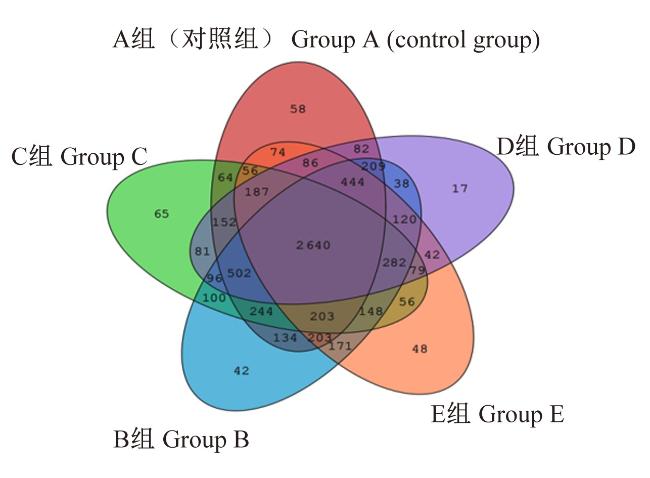
图1所示,本试验中,5个组(A组、B组、C组、D组和E组)肉鸡肠道菌群所独有的OTU数量分别为58、42、65、17和48个,其中5个组共有的OTU数量为2 640个。
图1 肉鸡肠道菌群维恩图

Fig.1 Venn diagram of intestinal microbiota of broiler chickens

不同水平储存4年玉米对肉鸡肠道菌群alpha多样性的影响见表8。与对照组相比,C组和D组肉鸡肠道菌群ACE指数显著降低(P<0.05),各组间肠道菌群其他alpha多样性指数无显著差异(P>0.05)。
表8 不同水平储存4年玉米对肉鸡肠道菌群alpha多样性的影响

Table 8 Effects of different levels of corn stored for 4 years on alpha diversity of intestinal microbiota of broiler chickens

项目
Items
组别 Groups SEM P
P-value
A(对照
Control)
B C D E
Simpson指数 Simpson index 0.960 0.951 0.959 0.956 0.947 0.005 0.93
Chao1指数 Chao1 index 2 068.39 1 959.74 1 586.15 1 614.87 1 677.79 68.37 0.08
ACE指数 ACE index 2 135.29a 2037.29ab 1 611.41b 1 621.95b 1 726.68ab 71.58 0.04
Shannon指数 Shannon index 7.82 7.55 7.36 7.28 7.25 0.12 0.30
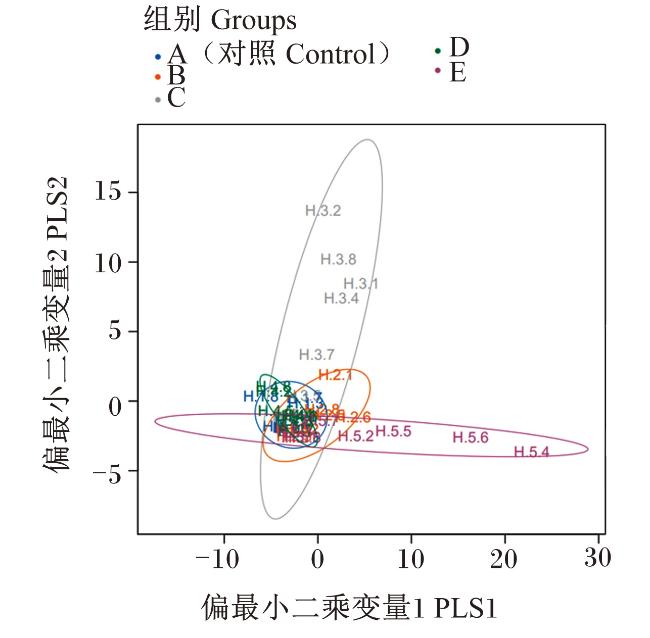
图2所示,β多样性结果表明,A组、B组和D组间肠道菌群差异不明显,而C组和D组间差异较为明显。
图2 肉鸡肠道菌群偏最小二乘回归分析图

Fig.2 PLS-DA chart of intestinal microbiota of broiler chickens

2.5.2 不同水平储存4年玉米对肉鸡肠道菌群组成的影响

2.5.2.1 门水平

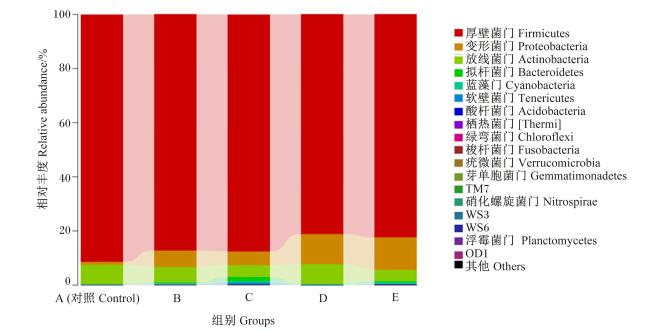
不同水平储存4年玉米对肉鸡肠道菌群在门水平上相对丰度的影响见表9图3。在门水平上,肉鸡肠道菌群中相对丰度最高的4个门分别为厚壁菌门(Firmicutes)、变形菌门(Proteobacteria)、放线菌门(Actinobacteria)以及拟杆菌门(Bacteroidetes),且各组之间门水平上菌群相对丰度差异均不显著(P>0.05),但与对照组相比,替代不同水平储存4年玉米导致厚壁菌门相对丰度逐渐降低,变形菌门相对丰度逐渐升高。
表9 不同水平储存4年玉米对肉鸡肠道菌群在门水平上相对丰度的影响

Table 9 Effects of different levels of corn stored for 4 years on relative abundance of intestinal microbiota of broiler chickens at phylum level%

项目
Items
组别 Groups SEM P
P-value
A(对照
Control)
B C D E
厚壁菌门 Firmicutes 91.31 87.25 87.50 81.18 82.35 1.87 0.43
变形菌门 Proteobacteria 1.18 6.00 5.09 11.02 11.93 1.58 0.17
放线菌门 Actinobacteria 7.11 5.75 4.37 7.31 4.30 1.04 0.84
拟杆菌门 Bacteroidetes 0.16 0.29 1.44 0.17 0.39 0.29 0.59
图3 不同水平储存4年玉米对肉鸡肠道菌群在门水平上相对丰度的影响

Fig.3 Effects of different levels of corn stored for 4 years on relative abundance of intestinal microbiota of broiler chickens at phylum level

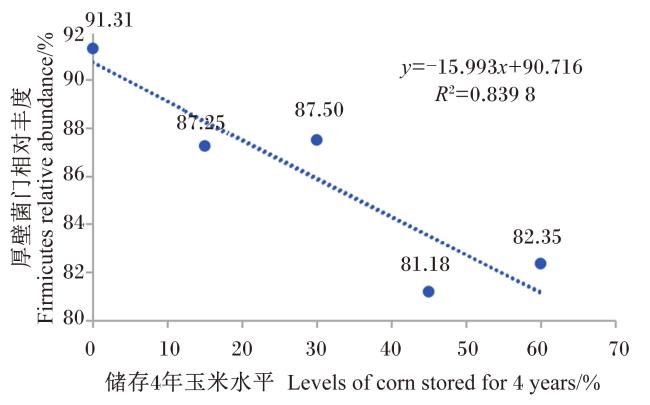
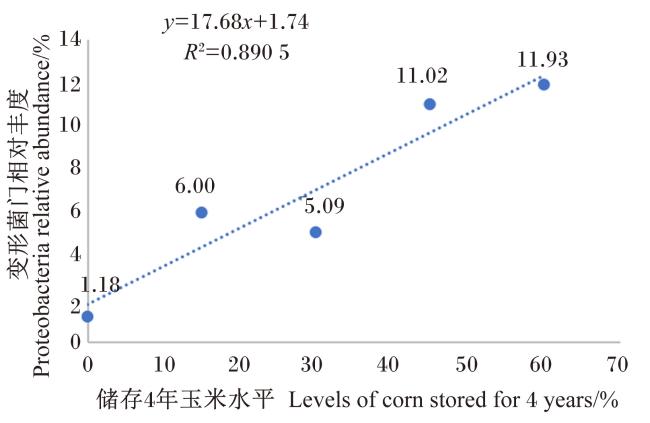
图4图5可知,不同水平储存4年玉米与肉鸡肠道厚壁菌门相对丰度有一定的负相关性(R2=0.839 8),不同水平储存4年玉米与肉鸡肠道变形菌门相对丰度关系有一定的正相关性(R2=0.890 5)。
图4 不同水平储存4年玉米与肉鸡肠道厚壁菌门相对丰度关系

Fig.4 Relationship between different levels of corn stored for 4 years and intestinal Firmicutes relative abundance of broiler chickens

图5 不同水平储存4年玉米与肉鸡肠道变形菌门相对丰度关系

Fig.5 Relationship between different levels of corn stored for 4 years and intestinal Proteobacteria relative abundance of broiler chickens

2.5.2.2 属水平

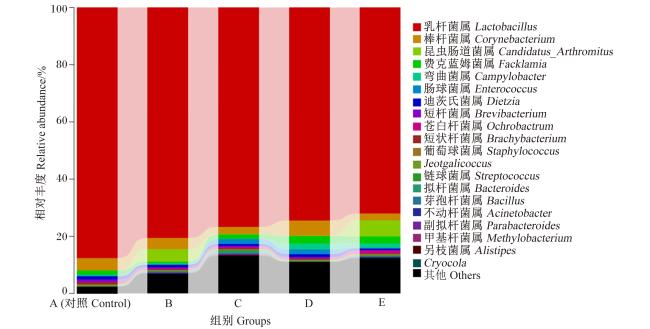
不同水平储存4年玉米对肉鸡肠道菌群在属水平上相对丰度的影响见表10图6。在属水平上,各组肉鸡肠道菌群在属水平上的相对丰度差异均不显著(P>0.05),但是对照组乳杆菌属(Lactobacillus)相对丰富最高,昆虫肠道菌属(Candidatus_Arthromitus)相对丰度最低;30%储存4年玉米组(C组)肠球菌属(Enterococcus)相对丰度最高;而45%储存4年玉米组(D组)棒杆菌属(Corynebacterium)、费克蓝姆菌属(Facklamia)和弯曲菌属(Campylobacter)相对丰度最高;60%储存4年玉米组(E组)昆虫肠道菌属相对丰度最高。
表10 不同水平储存4年玉米对肉鸡肠道菌群在属水平上相对丰度的影响

Table 10 Effects of different levels of corn stored for 4 years on relative abundance of intestinal microbiota of broiler chickens at genus level%

项目
Items
组别 Groups SEM P
P-value
A(对照
Control)
B C D E
乳杆菌属 Lactobacillus 87.56 80.65 76.72 74.49 72.08 3.09 0.57
棒杆菌属 Corynebacterium 4.33 3.89 2.49 5.31 2.34 0.72 0.67
昆虫肠道菌属 Candidatus_Arthromitus 0.00 4.37 0.08 0.09 5.62 1.33 0.51
费克蓝姆菌属 Facklamia 1.48 0.51 1.55 2.58 2.42 0.53 0.76
弯曲菌属 Campylobacter 0.34 0.46 0.09 2.15 1.63 0.44 0.53
肠球菌属 Enterococcus 0.31 0.04 1.80 1.62 0.21 0.38 0.42
图6 不同水平储存4年玉米对肉鸡肠道菌群在属水平上相对丰度的影响

Fig.6 Effects of different levels of corn stored for 4 years on relative abundance of intestinal microbiota of broiler chickens at genus level

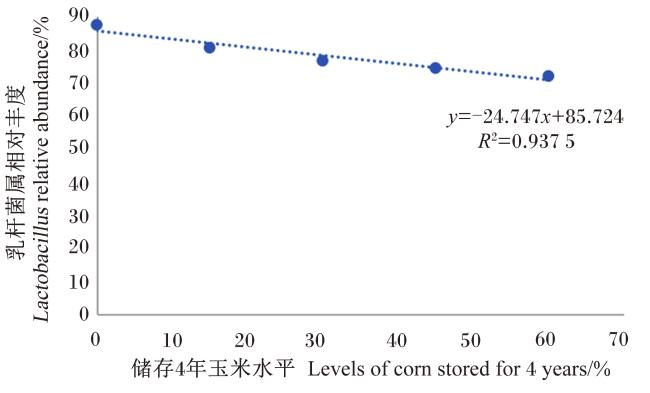
图7可知,不同水平储存4年玉米与肉鸡肠道乳杆菌属相对丰度存在较强的负相关性(R2=0.937 5)。
图7 不同水平储存4年玉米与肉鸡肠道乳杆菌属相对丰度关系

Fig.7 Relationship between different levels of corn stored for 4 years and intestinal Lactobacillus relative abundance of broiler chickens

3 讨论

3.1 不同水平储存4年玉米对肉鸡生长性能的影响

玉米在储存期间,其脂肪含量受含水量和贮藏条件的影响。在储存期间,玉米不断的呼吸作用和大量的水解酶使玉米中脂质发生水解产生大量的游离脂肪酸,导致脂肪酸值升高[5]。动物采食陈化玉米饲粮后更易产生氧化损伤,这种损伤可能会引起采食量和体重降低,降低生长性能[2]。本试验结果表明,45%以上储存4年玉米替代正常玉米会导致肉鸡ADG和ADFI显著降低,从而导致肉鸡生长性能下降,这种影响可能与脂肪酸及氧化损伤有关。同时,本试验发现,肉鸡生长前期使用60%储存4年玉米会提高肉鸡F/G,中期使用45%储存4年玉米就有显著降低肉鸡生长性能的作用,后期使用30%储存4年玉米就对肉鸡生长不利,这说明储存4年玉米对肉鸡生长的影响有个累积过程,越到后期对肉鸡的损伤越大。因此,在肉鸡饲粮中使用储存4年玉米应根据不同饲喂阶段适当替代。

3.2 不同水平储存4年玉米对肉鸡屠宰性能和免疫器官指数的影响

本试验结果表明,除腿重率外,不同水平储存4年玉米对肉鸡屠宰性能均无显著影响,这可能由于各组饲粮营养水平一致,脂肪酸值的差异并未对蛋白质和脂肪沉积产生影响。脾脏和法氏囊是禽类的主要免疫器官,其发育状态能间接反映免疫细胞的功能状况和机体的免疫水平[7]。本试验中,不同水平储存4年玉米对肉鸡免疫器官发育也未产生显著影响。崔小燕[6]报道,储存4年玉米显著降低21日龄肉鸡的免疫器官指数,同时降低了肉鸡的非特异性免疫能力。这与本试验结果不尽一致,可能与动物日龄不同有关,这也说明储存4年玉米对肉鸡免疫器官发育的影响还需进一步证实。

3.3 不同水平储存4年玉米对肉鸡抗氧化能力的影响

玉米长时间储存,产生的游离脂肪酸和脂质易受自由基攻击而发生氧化和过氧化反映,从而产生大量分子量较小的烃类、醛酮类等挥发性物质以及更多的自由基和最终过氧化产物MDA。玉米中不饱和脂肪酸含量高达80%以上,容易氧化酸败。研究认为,玉米长期储存后过氧化氢酶和过氧化物酶活性下降,游离脂肪酸含量升高,部分中性脂肪中的油酸和亚油酸含量降低,自由基蓄积,自身抗氧化能力降低[8]。Cowell等[10]研究表明,储存期较长的玉米显著增加了过氧化脂质和游离脂肪酸含量,高游离脂肪酸也是导致脂质过氧化的原因之一。崔小燕[6]研究表明,储存4年的玉米脂肪酸价显著升高,且有大量的游离脂肪酸存在。刘比一等[10]报道,饲喂长期储存的玉米会降低肉鸡血清抗氧化能力。同样,Yin等[11]研究发现,高脂肪酸陈化玉米导致肉鸡过氧化氢酶显著下降,生长性能有所影响。本试验与前人研究结果一致,高脂肪酸的储存4年玉米导致肉鸡组织氧化损伤,主要表现在MDA含量显著升高,抗氧化应激能力减弱,进而导致生长性能下降。

3.4 不同水平储存4年玉米对肉鸡肉品质的影响

肉色、剪切力及肌肉pH是评定鸡肉品质最重要的感官和理化指标,且各指标间都有一定程度的相关。剪切力代表肉质嫩度,主要由肌肉中结缔组织、肌原纤维、肌浆蛋白含量和化学结构状态决定,剪切力值越大,肌肉嫩度越小,反之则嫩度越大[12]。本试验结果表明,60%储存4年玉米显著提高肉鸡肌肉剪切力,显著降低pH,使肉质风味降低,口感变差,但对肉色影响不大。肉类在贮存过程中,脂类氧化产生醛、醇和酮等有机化合物,其气味难以被接受。因此,脂质氧化也是评价肉质的一项重要指标,一般是通过测定肉中的TBA含量实现。本试验发现,肉鸡饲粮中使用30%以上储存4年玉米导致肉鸡胸肌中TBA值显著提高,即脂质氧化升高,这会缩短鸡肉货架期,使鸡肉的食用品质下降。这说明高脂肪酸玉米与肌肉品质有一定关联,其作用机理还需进一步研究探讨。

3.5 不同水平储存4年玉米对肉鸡肠道菌群的影响

肠道微生物菌群的平衡有利于保持动物机体的健康,肠道微生物区系极为复杂,包含各种各样的菌群,它们不仅对机体消化吸收营养物质方面起作用,还可以起到保护肠道,刺激免疫的功能。已有研究表明,肉鸡肠道菌群受多种因素的影响,如饲粮、遗传、环境和垫料等,与十二指肠和空肠相比,回肠微生物菌群更加多样化以及不稳定[13]
本研究中,不同水平储存4年玉米对肉鸡回肠菌群Simpson指数、Chao1指数和Shannon指数均无显著影响,而对ACE指数有显著影响。其中个,30%和45%储存4年玉米组ACE指数显著低于对照组,这表明30%和45%储存4年玉米降低了肉鸡回肠菌群的丰富度。造成此结果的原因可能是玉米在储存过程中发生霉变产生的霉菌毒素以及油脂氧化产生的醛和酮等有毒物质对肉鸡肠道形态结构和黏膜造成了一定的损伤,如增大紧密连接间隙和损伤肠绒毛等[14],导致可以供给肠道菌所黏附的位点减少,使肠黏膜内的原有菌群大量流失,从而造成肠道菌群丰富度下降。
在本研究中,各组肉鸡回肠菌群在门水平上的相对丰度没有显著差异。其中,厚壁菌门是优势菌群,占微生物群落总数的80%以上,这与以往的研究[15]相一致。厚壁菌门在门水平上构成了绝大多数微生物群落,并在能量产生和代谢中起到巨大的作用[16],而本试验条件下随着储存4年玉米替代水平的提高,厚壁菌门相对丰度呈现出降低的趋势,这表明储存4年玉米在一定程度上可能是通过降低厚壁菌门相对丰度而影响到肉鸡对营养物质的消化与吸收,最终降低饲料效率。而变形菌门中含有许多如大肠杆菌、幽门螺旋杆菌一类的病原体细菌,随着储存4年玉米替代水平的提高,变形菌门相对丰度呈现出提高的趋势,较高的变形菌门有可能会导致机体炎症的发生。而在属水平上,各组肉鸡空肠菌群在属水平上以乳杆菌属为优势菌属,占80%左右。乳杆菌属可以通过其代谢产物与肠黏膜上皮细胞形成屏障,这一方面可以减少其他致病菌的黏附定植;另一方面可以提高肠道屏障功能,在预防肠道相关疾病方面具有重要意义[17]。本研究发现,不同水平储存4年玉米与肉鸡肠道乳杆菌属相对丰度存在较强的负相关性。储存4年玉米中所含的霉菌毒素以及脂质过氧化物等可能直接对乳杆菌属繁殖产生了抑制作用,而乳杆菌属相对丰度的降低可能会导致肠道屏障功能的降低,导致致病菌大量繁殖,间接造成肠道炎症反应,从而降低了免疫功能,继而提高了机体对环境中致病菌的易感性以及降低了肠道对营养物质的吸收利用效率[18]

4 结论

本试验条件下,储存4年玉米脂肪酸值较高时(1 190.0 mg KOH/kg),在肉鸡饲粮中使用30%以上会导致其生长性能、抗氧化能力和肉品质下降,并致使肠道菌群紊乱。
[1]
聂大娃. 不同地区玉米肉仔鸡代谢能研究[D].硕士学位论文. 北京: 中国农业科学院, 2008.

NIE D W. Broiler apparent metabolizeble energy determination of corns from different regions in China[D].Master’s Thesis. Beijing: Chinese Academy of Agricultural Sciences, 2008. (in Chinese)

[2]
ZIA-UR-REHMAN. Storage effects on nutritional quality of commonly consumed cereals[J]. Food Chemistry, 2006, 95(1):53-57.

DOI

[3]
SETIAWAN S, WIDJAJA H, RAKPHONGPHAIROJ V, et al. Effects of drying conditions of corn kernels and storage at an elevated humidity on starch structures and properties[J]. Journal of Agricultural and Food Chemistry, 2010, 58(23):12260-12267.

DOI PMID

[4]
王超, 顾云锋, 杜明芳, 等. 陈化玉米对蛋鸡生产性能、消化与抗氧化功能及蛋品质的影响[J]. 动物营养学报, 2021, 33(3):1440-1450.

DOI

WANG C, GU Y F, DU M F, et al. Effects of aging corn on performance,digestive and antioxidant functions and egg quality of laying hens[J]. Chinese Journal of Animal Nutrition, 2021, 33(3):1440-1450. (in Chinese)

[5]
MCDONOUGH C M, FLOYD C D, WANISKA R D, et al. Effect of accelerated aging on maize,sorghum,and sorghum meal[J]. Journal of Cereal Science, 2004, 39(3):351-361.

DOI

[6]
崔小燕. 初探不同储存期玉米对雉科鸟类抗氧化及免疫功能的影响[D].硕士学位论文. 哈尔滨: 东北林业大学, 2013.

CUI X Y. Effects of maize at different storage periods on antioxidant abilities and immune function of birds[D].Master’s Thesis. Harbin: Northeast Forestry University, 2013. (in Chinese)

[7]
刘建欣, 郑昌学. 现代免疫学:免疫的细胞和分子基础[M]. 北京: 清华大学出版社, 2002:599.

LIU J X, ZHENG C X. Modern immunology:the cellular and molecular basis of immunity[M]. Beijing: Tsinghua University Press, 2002:599. (in Chinese)

[8]
周显青, 张勇, 张玉荣. 储存玉米膜脂过氧化指标的研究[J]. 玉米科学, 2007, 15(3):80-83.

ZHOU X Q, ZHANG Y, ZHANG Y R. Studies on membrane lipid peroxidatic indexes of stored-maize[J]. Journal of Maize Sciences, 2007, 15(3):80-83. (in Chinese)

[9]
COWELL R L. Veterinary clinical pathology secrets[M]. Amsterdam:Elsevier, 2004:306.

[10]
刘比一, 何玉英, 尹达菲, 等. 不同储存时间的玉米对肉鸡血清抗氧化功能的影响[J]. 动物营养学报, 2013, 25(5):1077-1084.

DOI

LIU B Y, HE Y Y, YIN D F, et al. Corn at different storage periods affects serum antioxidant function of broilers[J]. Chinese Journal of Animal Nutrition, 2013, 25(5):1077-1084. (in Chinese)

[11]
YIN D F, YUAN J M, GUO Y M, et al. Effect of storage time on the characteristics of corn and efficiency of its utilization in broiler chickens[J]. Animal Nutrition, 2017, 3(3):252-257.

DOI PMID

[12]
刘博, 陈玉敏, 宋小珍, 等. 饲粮中添加葛根总黄酮对爱拔益加肉鸡生长性能及肉品质的影响[J]. 动物营养学报, 2016, 28(7):2243-2249.

DOI

LIU B, CHEN Y M, SONG X Z, et al. Effects of dietary Puerarin flavonoids on growth performance and meat quality of Arbor Acre broilers[J]. Chinese Journal of Animal Nutrition, 2016, 28(7):2243-2249. (in Chinese)

[13]
POURABEDIN M, ZHAO X. Prebiotics and gut microbiota in chickens[J]. FEMS Microbiology Letters, 2015, 362(15):fnv122.

DOI

[14]
赵楠. 陈玉米应用之Q&A[J]. 中国畜牧杂志, 2017, 53(11):153-158.

ZHAO N. Q&A of stale maize application[J]. Chinese Journal of Animal Science, 2017, 53(11):153-158. (in Chinese)

[15]
刘石. 饮水中添加复合益生菌对岭南黄羽肉鸡生长性能、肠道微生物组和代谢组的影响[D].硕士学位论文. 武汉: 华中农业大学, 2020.

LIU S. Effects of compound probiotics in drinking water on growth performance,gut microbiome and metabolome of Lingnan yellow-feather broilers[D].Master’s Thesis. Wuhan: Huazhong Agricultural University, 2020. (in Chinese)

[16]
PANDIT R J, HINSU A T, PATEL N V, et al. Microbial diversity and community composition of caecal microbiota in commercial and indigenous Indian chickens determined using 16s rDNA amplicon sequencing[J]. Microbiome, 2018, 6(1):115.

DOI PMID

[17]
黄回, 韩春茂. 乳杆菌生态免疫营养在维护肠黏膜屏障中的作用[J]. 中华烧伤杂志, 2005, 21(2):155-157.

HUANG H, HAN C M. The role of Lactobacillus eco-immunonutrition in maintaining intestinal mucosal barrier[J]. Chinese Journal of Burns, 2005, 21(2):155-157. (in Chinese)

[18]
王丽凤. 益生菌L. plantarum P-8对肉鸡肠道菌群、肠道免疫和生长性能影响的研究[D].博士学位论文. 呼和浩特: 内蒙古农业大学, 2014.

WANG L F. Effects of probiotic L.plantarum P-8 on intestinal flora,intestinal immunity and growth performance of broilers[D].Ph.D. Thesis. Hohhot: Inner Mongolia Agricultural University, 2014. (in Chinese)

Outlines

/