RESEARCH PAPER

Effects of Alfalfa Hay, Oat Hay and Their Mixed Feeding on Compound Stomach Morphology and Digestive Enzyme Activities of Yak Calves during Lactation Period

  • ZHOU Yanan ,
  • LIU Shujie ,
  • YANG Deyu ,
  • ZHANG Xiaowei ,
  • FENG Yuzhe , * ,
  • CUI Zhanhong , *
Expand
  • Key Laboratory of Plateau Grazing Animal Nutrition and Feed Science of Qinghai Province, Yak Engineering Technology Research Center of Qinghing Province, Ministry of Ariculture and Rural Affairs Key Laboratory of Animal Nutrition and Forage-Feed of Grazing Yak and Tibetan Sheep in Qinghai-Tibetan Plateau, Academy of Animal Husbandry and Veterinary Sciences, Qinghai University, Xining 810016, China
*FENG Yuzhe, professor, E-mail: ;
CUI Zhanhong, associate professor, E-mail:

Received date: 2022-11-11

  Online published: 2023-05-11

Abstract

The purpose of this experiment was to investigate the effects of alfalfa hay, oat hay and their mixed feeding on compound stomach morphology and digestive enzyme activities of yak calves during lactation period. Twenty-one healthy 45-day-old yak calves (males) with similar body weight were randomly divided into 3 groups: AH group (milk replacer+starter+alfalfa hay), OH group (milk replacer+starter+oat hay) and AO group (milk replacer+starter+alfalfa hay+oat hay, alfalfa hay∶oat hay=1∶1), each group contained 7 calves. The dietary roughage to concentrate ratio was 3∶7. The pre-experimental period lasted for 21 days, and the experimental period lasted for 120 days. The results showed as follows: 1) the final body weight, rumen weight, reticulum weight, omasum weight and abomasum weight of AO group were significantly higher than those of AH and OH groups (P<0.05). 2) The papillary width, muscular layer thickness, mucosal epithelium thickness, submucous layer thickness and plasma membrane layer thickness in rumen of AO group were extremely significantly higher those of AH and OH groups (P<0.01). 3) The mucosal epithelium thickness papillary width and muscular layer thickness in reticulum of AO group were significantly higher than those of AH and OH groups (P<0.05), and the submucous layer, thickness papillary length and plasma membrane layer thickness were extremely significantly higher than those of AH and OH groups (P<0.01). 4) The muscular layer thickness in omasum of AO group was significantly higher than that of AH and OH groups (P<0.05), and the mucosal epithelium thickness, submucous layer thickness, papillary width, papillary length and plasma membrane layer thickness were extremely significantly higher than those of AH and OH groups (P<0.01). 5) The mucosal epithelium thickness and mucosal muscle layer thickness in abomasum of AO group were significantly higher than those of AH and OH groups (P<0.05), and the submucous layer thickness, muscular layer, thickness and plasma membrane layer thickness were extremely significantly higher than those of AH and OH groups (P<0.01). 6) In rumen, the cellulase, amylase and xylanase activities of AO group were extremely significantly higher than those of AH and OH groups (P<0.05), and the endoglucanase activity was significantly higher than that of AH and OH groups (P<0.05); in reticulum, the lipase activity of AO group was extremely significantly higher than that of AH and OH groups (P<0.01), and the cellulase and pepsin activities were significantly higher than that of AH and OH groups (P<0.05); in omasum, the lipase activity of AO group was extremely significantly higher than that of AH and OH groups (P<0.01), and the cellulase and aminopeptidase activities were significantly higher than that of AH and OH groups (P<0.05); in abomasum, the chymosin activity of AO group was extremely significantly higher than that of AH and OH groups (P<0.01). In conclusion, on the basis of feeding milk substitute and starter of yak calves, compare with the single feeding alfalfa hay or oat hay diets, feeding the combination of alfalfa hay and oat hay is more beneficial to the development of compound stomach and secretion of digestive enzymes of yak calves during lactation period.

Cite this article

ZHOU Yanan , LIU Shujie , YANG Deyu , ZHANG Xiaowei , FENG Yuzhe , CUI Zhanhong . Effects of Alfalfa Hay, Oat Hay and Their Mixed Feeding on Compound Stomach Morphology and Digestive Enzyme Activities of Yak Calves during Lactation Period[J]. Chinese Journal of Animal Nutrition, 2023 , 35(5) : 3141 -3153 . DOI: 10.12418/CJAN2023.292

哺乳期犊牛的前胃(瘤胃、网胃、瓣胃)与皱胃相比发育较不完全,同成年牛相比不具备完善的生理功能[1]。在犊牛哺乳期,仅饲喂母乳或代乳粉,液体营养物质不经过前胃而是直接流入皱胃内进行化学性消化,在此期间前胃因未经过饲粮的刺激,未产生机械性运动以及微生物对饲粮的发酵,前胃发育将会极其缓慢甚至停止[2-3]。对于犊牛而言,哺乳期内提供适量的粗饲料能够增强瘤胃发育,这些物质除了需要在瘤胃中发酵分解外,还会通过瘤胃、网胃以及瓣胃的机械运动来完成对粗饲料的物理消化[3-4]。粗饲料经犊牛采食后,为犊牛提供主要的纤维物质来源,在此基础上前胃逐渐建立反刍功能,并开始进行物理和微生物发酵,因此粗饲料能直接促进前胃的发育[5-6]。研究也发现,在饲粮中添加一定量的粗饲料可促进犊牛的前胃胃壁发育、肌层增厚、乳头增高[7-8];犊牛会由完全哺乳的非反刍消化逐渐过渡到适应固体饲料采食的反刍消化状态[9]
瘤胃主要功能是饲料的存储及其微生物发酵,采食的饲料经过瘤胃壁产生的节律性运动将饲料搅拌均匀并磨碎[5-6],通过微生物分泌的各种酶去降解营养物质。网胃主要接收来自瘤胃中未消化完全的饲料残渣,作为瘤胃和瓣胃的承接点,在进行收缩的同时,将一部分饲料残渣反馈回瘤胃,一部分残渣则会流入瓣胃[10]。瓣胃是对饲料进行再一次的研磨,瓣胃是反刍动物吸收小肽的主要部位,其中小肽可被瓣胃分泌的氨基肽酶所消化。最后得到的营养物质进入皱胃后,被其消化吸收,除此之外,皱胃黏膜可分泌凝乳酶和胃蛋白酶来消化母乳和蛋白质。牦牛作为高原地区主要家畜品种,在实际养殖过程中,缺乏系统的研究,尤其对于牦牛犊牛早期培育中网胃、瓣胃、皱胃形态与功能发育的研究较少。牦牛犊牛是后期发育的基础,本研究以牦牛犊牛为对象,探究苜蓿干草与燕麦干草及其混合饲喂对哺乳期牦牛犊牛复胃组织形态和消化酶活性的影响,预期结果为牦牛犊牛早期健康高效饲养提供理论指导。

1 材料与方法

1.1 试验设计

选取21只体重[(36.47±0.99) kg]相近、健康的45日龄牦牛犊牛(公),采用单因素试验设计将其随机分3组,即AH组(代乳粉+开食料+苜蓿干草)、OH组(代乳粉+开食料+燕麦干草)和AO组(代乳粉+开食料+苜蓿干草+燕麦干草,苜蓿干草∶燕麦干草=1∶1),每组7头。饲粮精粗比为3∶7。预试期21 d,正试期120 d。试验时间为2021年8月至2021年12月,牦牛犊牛饲养于青海省海北州海晏县高原现代生态畜牧业科技试验示范园。

1.2 试验饲粮

3组试验动物每日饲喂相同量代乳粉,且3组试验犊牛的固体饲料(粗饲料和开食料)采食量保持一致,代乳粉、开食料均来自北京精准动物营养研究中心,开食料组成见表1,代乳粉、开食料、苜蓿干草和燕麦干草营养水平见表2
表1 开食料组成(干物质基础)

Table 1 Composition of the starter (DM basis) %

原料Ingredients 含量Content
玉米Corn 46.5
豆粕Soybean meal 27.0
麸皮Bran 9.5
膨化大豆Expanded soybean 8.0
乳清粉Dried whey powder 5.0
细石粉Fine limestone 1.6
预混料Premix 1.0
脂肪粉Fat powder 0.5
磷酸氢钙CaHPO4 0.5
食盐NaCl 0.4
合计Total 100.0

预混料为每千克开食料提供

The premix provided the following per kg of the starter:Fe 22.1 mg,Mn 9.82 mg,Cu 2.25 mg,Zn 27.0 mg,Se 0.19 mg,I 0.54 mg,Co 0.09 mg,VA 30 000 IU,VD 30 000 IU,VE 4 000 IU。

表2 代乳粉、开食料、苜蓿干草和燕麦干草营养水平(干物质基础)

Table 2 Nutrient levels of milk replacer, starter, alfalfa hay and oat hay (DM basis)

营养水平
Nutrient levels
代乳粉
Milk replacer
开食料
Starter
燕麦干草
Oat hay
苜蓿干草
Alfalfa hay
干物质DM/% 95.00 87.90 93.00 95.00
粗蛋白质CP/% 26.24 20.00 4.08 14.19
粗脂肪EE/% 27.79 4.70 4.20 3.39
中性洗涤纤维NDF/% 10.90 84.40 64.86
酸性洗涤纤维ADF/% 4.10 45.18 46.13
钙Ca/% 2.50 0.80 1.05 1.55
磷P/% 1.40 0.45 0.15 0.74
钙/磷Ca/P 1.79 1.78 7.00 2.10

1.3 饲养管理

牦牛犊牛单栏饲养,代乳粉早、晚各饲喂1次,饲喂时间为每日08:30、16:30,预试期为减少牦牛犊牛应激,采用牦牛奶与代乳粉混合饲喂,且代乳粉比例逐渐升高,直至犊牛适应代乳粉后,不再添加牦牛奶。试验期沸水冷却至42 ℃,代乳粉和温水按1∶5比例配制,灌入奶瓶,牦牛犊牛主动吮吸。正试期开始后代乳粉添加量为0.48 kg/d,代乳粉每隔7 d增加15 g;试验初期饲喂140 g/d粗饲料,每隔7 d增加70 g;试验初期饲喂60 g/d开食料,每隔7 d增加30 g。AO组燕麦干草和苜蓿干草干物质比例为1∶1,开食料和苜蓿干草分开进行饲喂(干草长度为3~10 cm),控制粗精比在7∶3。犊牛自由饮水,圈舍光源充足,可在室内外自由活动,每周对圈舍进行消毒处理,并定时清理粪便。

1.4 样品采集

于屠宰前1天16:00之后断食断水,次日清晨对牦牛犊牛进行空腹称重,作为试验终末体重;每组随机选取5头牦牛犊牛屠宰。屠宰后,将复胃与其他组织分离称重后(此时重量为复胃总重),取各个胃中部的内容物于5 mL无菌冻存管并置液氮中保存;再取各个胃组织块约2 cm×2 cm,用生理盐水冲洗干净,固定于4%的多聚甲醛溶液,连续换液,直至多聚甲醛溶液澄清透明(换液至最后保存始终使用的是4%的多聚甲醛溶液),用于后续组织形态学观察。待取完组织样品清洗干净各个胃食糜后,称重并记录。

1.5 指标测定

1.5.1 复胃组织形态

将固定于4%多聚甲醛中的组织样品取出,采用苏木精-伊红(HE)染色法制备组织切片,制备组织切片的顺序为:石蜡切片脱蜡至水、苏木精和伊红分别染细胞核、细胞质、不同浓度的酒精脱水封片,利用电子显微镜对复胃分别观察瘤胃后腹盲囊、网胃、瓣胃的黏膜上层厚度、黏膜下层厚度、乳头宽度、乳头高度、肌层厚度以及浆膜层厚度,皱胃的黏膜上皮厚度、黏膜肌层厚度、黏膜下层厚度、肌层厚度、浆膜层厚度。每张组织切片在电子显微镜下观察6个不连续视野,每个视野中需测量3个试验数据。

1.5.2 复胃消化酶活性

采用酶联免疫吸附测定(ELISA)法检测瘤胃内容物中的纤维素酶、胃蛋白酶、脂肪酶、淀粉酶、木聚糖酶和内切葡聚糖酶活性;网胃内容物中的纤维素酶、胃蛋白酶、脂肪酶和淀粉酶活性;瓣胃内容物中的纤维素酶、胃蛋白酶、脂肪酶、淀粉酶和氨基肽酶活性;皱胃内容物中的纤维素酶、胃蛋白酶、脂肪酶、淀粉酶和凝乳酶活性。首先对复胃内容物进行前处理,将内容物按照1∶9(质量∶体积)的比例置于生理盐水中,混匀,2 500 r/min离心20 min,收集上清液待测。严格按照ELISA试剂盒(江苏酶标生物科技有限公司)中的说明书进行操作,最后通过标准曲线计算样品中消化酶活性。

1.6 数据处理与统计分析

试验数据先经Excel 2016初步处理后,再经SPSS 20.0软件的ANOVA程序进行单因素方差分析,并采用Duncan氏法进行多重比较。以P<0.05表示差异显著,P<0.01表示差异极显著,结果用平均值±标准差(mean±SD)表示。

2 结果

2.1 苜蓿干草与燕麦干草及其混合饲喂对哺乳期牦牛犊牛复胃器官发育的影响

表3可知,3组之间牦牛犊牛初始体重、复胃总重差异不显著(P>0.05);AO组终末体重、瘤胃重、网胃重、瓣胃重、皱胃重显著高于AH组和OH组(P<0.05)。
表3 苜蓿干草与燕麦干草及其混合饲喂对哺乳期牦牛犊牛复胃器官发育的影响

Table 3 Effects of alfalfa hay, oat hay and their mixed feeding on compound stomach organ development of yak calves during lactation period

项目
Items
组别Groups P
P-value
AH OH AO
初始体重Initial body weight/kg 36.000±0.707 35.800±0.374 37.600±0.244 0.053
终末体重Final body weight/kg 71.200±0.800b 70.600±0.245b 74.800±1.392a 0.017
复胃总重Total weight of compound stomach/kg 10.100±0.300 10.600±0.000 11.000±0.200 0.119
瘤胃重Rumen weight/kg 0.863±0.012b 0.850±0.010b 0.963±0.038a 0.049
网胃重Reticulum weight/g 110.697±1.890b 113.780±1.944b 122.210±2.031a 0.015
瓣胃重Omasum weight/g 196.670±13.231b 168.610±12.284b 226.070±3.360a 0.045
皱胃重Abomasum weight/g 165.797±11.350b 172.660±1.947b 196.970±1.492a 0.037

同行数据肩标不同小写字母表示差异显著(P<0.05),不同大写字母表示差异极显著(P<0.01),相同小写字母或无字母表示差异不显著(P>0.05)。下表同。

In the same row, values with different small letter superscripts mean significant difference (P<0.05), and with different capital letter superscripts mean extremely significant difference (P<0.01), while with the same small letter or no letter superscripts mean no significant difference (P>0.05). The same as below.

2.2 苜蓿干草与燕麦干草及其混合饲喂对哺乳期牦牛犊牛前胃组织形态的影响

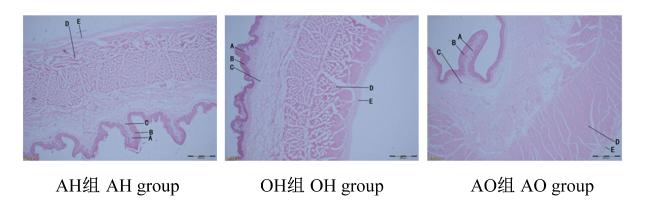
图1为苜蓿干草与燕麦干草及其混合饲喂哺乳期牦牛犊牛的瘤胃上皮组织切片。由表4可知,AO组瘤胃的乳头宽度、肌层厚度、黏膜上皮厚度、黏膜下层厚度、浆膜层厚度极显著高于AH组和OH组(P<0.01)。
图1 哺乳期牦牛犊牛的瘤胃上皮组织切片

A:乳头 papillary;B:黏膜上皮 mucosal epithelium;C:黏膜下层 submucous layer;D:肌层 muscular layer;E:浆膜层 plasma membrane layer。

Fig.1 Section of rumen epithelium tissue of yak calves during lactation period (400×)

表4 苜蓿干草与燕麦干草及其混合饲喂对哺乳期牦牛犊牛瘤胃组织形态的影响

Table 4 Effects of alfalfa hay, oat hay and their mixed feeding on rumen morphology of yak calves during lactation period μm

项目
Items
组别Groups P
P-value
AH OH AO
黏膜上皮厚度Mucosal epithelium thickness 114.563±1.913B 83.193±1.262C 212.173±6.986A <0.001
黏膜下层厚度Submucous layer thickness 752.195±11.605Bb 632.855±75.539Bb 1 232.974±129.221Aa 0.008
乳头宽度Papillary width 982.908±43.973B 342.146±4.205C 1 245.405±24.700A <0.001
乳头高度Papillary height 733.667±25.224Bb 708.1466±4.205Bb 1 742.405±24.701Aa <0.001
肌层厚度Muscular layer thickness 1 285.647±66.588B 902.785±16.045C 1 590.354±14.841A <0.001
浆膜层厚度Plasma membrane layer thickness 137.805±5.705B 82.683±1.703C 162.323±3.636A 0.005

2.3 苜蓿干草与燕麦干草及其混合饲喂对哺乳期牦牛犊牛网胃组织形态的影响

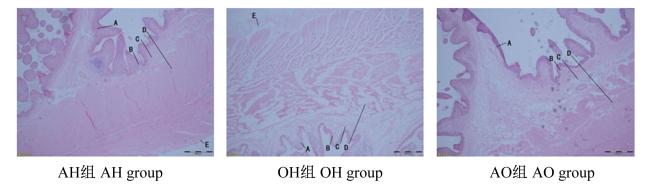
图2为苜蓿干草与燕麦干草及其混合饲喂哺乳期牦牛犊牛的网胃上皮组织切片。由表5可知,AO组网胃的黏膜上皮厚度、乳头宽度、肌层厚度显著高于AH组和OH组(P<0.05),黏膜下层厚度、乳头高度、浆膜层厚度极显著高于AH组和OH组(P<0.01)。
图2 哺乳期牦牛犊牛的网胃上皮组织切片

A:乳头 papillary;B:黏膜上皮 mucosal epithelium;C:黏膜下层 submucous layer;D:肌层 muscular layer;E:浆膜层 plasma membrane layer。

Fig.2 Section of reticulum epithelium tissue of yak calves during lactation period (400×)

表5 苜蓿干草与燕麦干草及其混合饲喂对哺乳期牦牛犊牛网胃组织形态的影响

Table 5 Effects of alfalfa hay, oat hay and their mixed feeding on reticulum morphology of yak calves during lactation period μm

项目
Items
组别Groups P
P-value
AH OH AO
黏膜上皮厚度Mucosal epithelium thickness 129.253±4.821b 73.808±9.950c 311.333±65.797a 0.046
黏膜下层厚度Submucous layer thickness 456.985±76.587Bb 259.180±35.068Bb 1 125.980±39.739Aa <0.001
乳头宽度Papillary width 633.225±102.787b 316.240±25.466c 2 221.677±1 142.035a 0.030
乳头高度Papillary height 5 028.460±149.981B 2 792.007±233.970C 7 654.460±694.703A <0.001
肌层厚度Muscular layer thickness 2 358.213±322.604b 1 562.030±121.292c 3 936.570±586.794a 0.013
浆膜层厚度Plasma membrane layer thickness 138.725±18.674Bb 103.708±13.689Bb 293.417±31.371Aa 0.001

2.4 苜蓿干草与燕麦干草及其混合饲喂对哺乳期牦牛犊牛瓣胃组织形态的影响

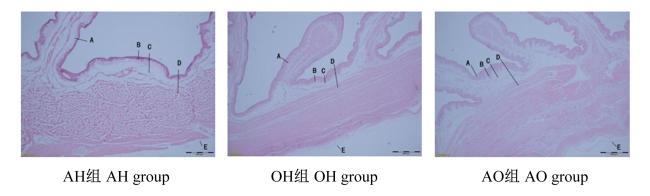
图3为苜蓿干草与燕麦干草及其混合饲喂哺乳期牦牛犊牛的瓣胃上皮组织切片。由表6可知,AO组瓣胃的肌层厚度显著高于AH组和OH组(P<0.05),黏膜上皮厚度、黏膜下层厚度、乳头宽度、乳头高度、浆膜层厚度极显著高于AH组和OH组(P<0.01)。
图3 哺乳期牦牛犊牛瓣胃上皮组织切片

A:乳头 papillary;B:黏膜上皮 mucosal epithelium;C:黏膜下层 submucous layer;D:肌层 muscular layer;E:浆膜层 plasma membrane layer。

Fig.3 Section of omasum epithelium tissue of yak calves during lactation period (400×)

表6 苜蓿干草与燕麦干草及其混合饲喂对哺乳期牦牛犊牛瓣胃组织形态的影响

Table 6 Effects of alfalfa hay, oat hay and their mixed feeding on omasum morphology of yak calves during lactation period μm

项目
Items
组别Groups P
P-value
AH OH AO
黏膜上皮厚度Mucosal epithelium thickness 108.450±5.701Bb 70.875±4.209Bb 179.917±3.260Aa 0.001
黏膜下层厚度Submucous layer thickness 362.650±24.749B 174.018±5.163C 649.953±25.355A <0.001
乳头宽度Papillary width 747.550±13.520B 577.682±19.243C 919.583±62.598A 0.009
乳头高度Papillary height 6 216.365±94.957Bb 3 767.900±120.113Bb 14 210.518±240.226Aa <0.001
肌层厚度Muscular layer thickness 1 105.653±42.665b 825.678±41.957c 1 346.383±45.138a 0.014
浆膜层厚度Plasma membrane layer thickness 158.980±10.055B 78.857±3.563C 300.243±31.315A 0.001

2.5 苜蓿干草与燕麦干草及其混合饲喂对哺乳期牦牛犊牛皱胃组织形态的影响

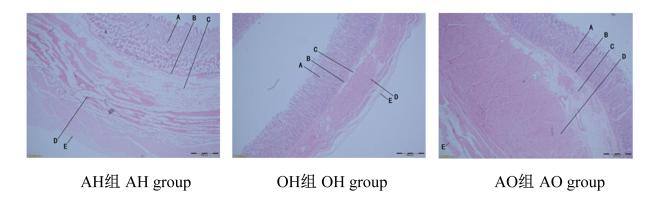
图4为苜蓿干草与燕麦干草及其混合饲喂哺乳期牦牛犊牛的皱胃上皮组织切片。由表7可知,AO组皱胃的黏膜上皮厚度、黏膜肌层厚度显著高于AH组和OH组(P<0.05),黏膜下层厚度、肌层厚度、浆膜层厚度极显著高于AH组和OH组(P<0.01)。
图4 哺乳期牦牛犊牛的皱胃上皮组织切片

A:黏膜上皮 mucosal epithelium;B:黏膜肌层 mucosal muscle layer;C:黏膜下层 submucous layer;D:肌层 muscular layer;E:浆膜层 plasma membrane layer。

Fig.4 Section of abomasum epithelium tissue of yak calves during lactation period (400×)

表7 苜蓿干草与燕麦干草及其混合饲喂对哺乳期牦牛犊牛皱胃组织形态的影响

Table 7 Effects of alfalfa hay, oat hay and their mixed feeding on abomasum morphology of yak calves during lactation period μm

项目
Items
组别Groups P
P-value
AH OH AO
黏膜上皮厚度Mucosal epithelium thickness 658.730±8.593b 561.660±6.009c 692.907±7.588a 0.035
黏膜肌层厚度Mucosal muscle layer thickness 36.235±1.116b 28.498±1.897c 49.503±1.817a 0.022
黏膜下层厚度Submucous layer thickness 384.043±35.230Bb 314.600±21.119Bb 648.608±23.311Aa 0.001
肌层厚度Muscular layer thickness 1 113.423±74.867Bb 1 050.620±69.623Bb 1 938.850±77.986Aa 0.001
浆膜层厚度Plasma membrane layer thickness 101.190±7.352B 56.990±6.335C 159.493±7.573A 0.002

2.6 苜蓿干草与燕麦干草及其混合饲喂对哺乳期牦牛犊牛复胃消化酶活性的影响

表8可知,在瘤胃中,AO组纤维素酶、淀粉酶和木聚糖酶活性极显著高于AH组和OH组(P<0.01),内切葡聚糖酶活性显著高于AH组和OH组(P<0.05);在网胃中,AO组脂肪酶活性极显著高于AH组和OH组(P<0.01),纤维素酶和胃蛋白酶活性显著高于AH组和OH组(P<0.05);在瓣胃中,AO组脂肪酶活性极显著高于AH组和OH组(P<0.01),纤维素酶和氨基肽酶活性显著高于AH组和OH组(P<0.05);在皱胃中,AO组凝乳酶活性极显著高于AH组和OH组(P<0.01)。
表8 苜蓿干草与燕麦干草及其混合饲喂对哺乳期牦牛犊牛复胃消化酶活性的影响

Table 8 Effects of alfalfa hay, oat hay and their mixed feeding on compound stomach digestive enzyme activities of yak calves during lactation period U/L

项目
Items
组别Groups P
P-value
AH OH AO
瘤胃Rumen
纤维素酶Cellulase 0.758±0.015Bb 0.046±0.014Bb 0.156±0.011Aa 0.002
胃蛋白酶Pepsin 0.130±0.008 0.117±0.005 0.146±0.008 0.058
脂肪酶Lipase 0.254±0.009 0.255±0.007 0.253±0.007 0.974
淀粉酶Amylase 0.092±0.001Bb 0.094±0.004Bb 0.110±0.003Aa 0.007
木聚糖酶Xylanase 0.083±0.003Bb 0.074±0.009Bb 0.114±0.006Aa 0.007
内切葡聚糖酶Endoglucanase 0.023±0.002b 0.024±0.002b 0.045±0.009a 0.011
网胃Reticulum
纤维素酶Cellulase 0.043±0.011b 0.058±1.060b 0.119±0.012a 0.014
胃蛋白酶Pepsin 0.133±0.001b 0.113±0.003b 0.222±0.074a 0.047
脂肪酶Lipase 0.229±0.007Bb 0.216±0.002Bb 0.256±0.008Aa 0.006
淀粉酶Amylase 0.093±0.002 0.095±0.004 0.114±0.039 0.790
瓣胃Omasum
纤维素酶Cellulase 0.037±0.008b 0.033±0.004b 0.063±0.007a 0.020
胃蛋白酶Pepsin 0.263±0.008 0.273±0.011 0.265±0.004 0.297
脂肪酶Lipase 0.090±0.011Bb 0.066±0.007Bb 0.121±0.003Aa 0.008
淀粉酶Amylase 0.157±0.006 0.164±0.008 0.178±0.005 0.163
氨基肽酶Aminopeptidase 0.014±0.001b 0.014±0.001b 0.021±0.002a 0.049
皱胃Abomasum
纤维素酶Cellulase 0.050±0.009 0.022±0.004 0.062±0.009 0.059
胃蛋白酶Pepsin 0.229±0.019b 0.277±0.007a 0.308±0.005a 0.015
脂肪酶Lipase 0.119±0.015Aa 0.066±0.141Bb 0.174±0.007Aa 0.004
淀粉酶Amylase 0.146±0.012 0.156±0.002 0.148±0.009 0.098
凝乳酶Chymosin 0.081±0.008B 0.016±0.002C 0.148±0.009A <0.001

3 讨论

3.1 苜蓿干草与燕麦干草及其混合饲喂对哺乳期牦牛犊牛前胃器官发育的影响

犊牛的复胃发育根据饲喂饲料不同一般分为全哺乳期,哺乳为主、草料为辅期,开食料加草料期,颗粒型固体饲料期[11]。研究表明,犊牛出生后仅依赖母乳将导致前胃的发育减慢甚至停滞[9]。因此,固体饲料对瘤胃的刺激是犊牛由哺乳阶段向反刍阶段转化的重要因素之一,而不同粗饲料来源饲料因所含营养物质不同,影响哺乳期犊牛的发育程度也有所差异[12]。本试验以本研究团队的前期研究结果[13]为基础,在饲喂开食料基础上添加粗饲料:苜蓿干草(豆科牧草)和燕麦干草(禾本科牧草)。本研究中,苜蓿干草与燕麦干草混合饲喂牦牛犊牛终末体重表现优于苜蓿干草组或燕麦干草单独饲喂,说明在补饲开食料基础上饲喂苜蓿干草与燕麦干草可以提高哺乳期牦牛犊牛体重,改善饲料转化率,促进其快速生长,这与Castells等[14]、Van Ackeren等[15]研究结果一致。同时,崔利宏等[16]认为混合干草更能够促进犊牛发育,Tamate等[17]研究也发现粗饲料能够促进反刍动物前胃发育。改变粗饲料中的中性洗涤纤维水平是主要营养措施之一,燕麦干草虽是犊牛期常用干草,但纤维含量较高,苜蓿干草虽粗蛋白质含量较高,但在青海高原地区成本较高。而本研究中苜蓿干草与燕麦干草混合饲喂的牦牛犊牛瘤胃重、网胃重、瓣胃重、皱胃重显著高于2种干草单独饲喂,说明燕麦干草与苜蓿干草组合时形成了优势互补,故二者混合饲喂更有利于牦牛犊牛的生长和复胃发育。
饲粮营养组成是影响牦牛犊牛早期瘤胃发育的重要因素,研究表明哺乳期牦牛犊牛摄入精料后能够刺激瘤胃发育[13],精料被犊牛摄入后,在瘤胃主要以产乙酸和丙酸为主[14];但仅饲喂精料会降低瘤胃pH[18],瘤胃机械性运动减弱[19],最终导致犊牛瘤胃酸中毒以及瘤胃乳头过度角质化和结块[18,20-22];在补饲精料的基础上犊牛摄入粗饲料后,刺激瘤胃使其逐渐产生反刍行为后,复胃将会迅速发育并对营养物质进行消化[23]。本研究中,哺乳期牦牛犊牛在苜蓿干草与燕麦干草混合饲喂后,瘤胃的黏膜上皮、黏膜下层、乳头、浆膜层发育最好。研究者发现,粗饲料含有较高的纤维物质,当反刍动物摄入后纤维能够充分与瘤胃上皮产生摩擦,可抵消精料产生的角质化,从而促进瘤胃上皮的发育[24]。Wardrop[25]也发现粗饲料能促进瘤胃乳头发育,粗饲料还能刺激瘤胃肌层发育并促进瘤胃进行反刍行为[17,26-27]。犊牛瘤胃发育最明显的特征是肌层和瘤胃乳头的发育,肌层能够使瘤胃产生胃蠕动,从而进行反刍。本研究发现,苜蓿干草与燕麦干草混合饲喂的牦牛犊牛瘤胃发育最好,说明粗饲料优化组合对哺乳期牦牛犊牛瘤胃发育有正向调控作用,苜蓿干草与燕麦干草混合饲喂弥补了单一饲喂燕麦干草纤维水平高、适口性差及单一饲喂苜蓿成本过高的缺点,这也印证了吴美玲[28]研究的饲喂单一饲料类型前胃的组织形态不易发生改变的结论。
网胃具有独特的生理结构,同时连接瘤胃和瓣胃,可连续收缩2次,能够对饲料进行研磨和微生物消化[29];与瘤胃进行瘤-网节律性运动后将食物充分混合均匀同时将未消化的食物残渣向网胃转移进行二次消化[30]。因此,网胃同样在反刍动物消化过程中扮演着重要的角色。本试验中,苜蓿干草与燕麦干草混合饲喂后牦牛犊牛网胃的黏膜上皮、黏膜下层、乳头、肌层、浆膜层发育明显优于二者单一饲喂。这与乔灵等[31]所研究的当粗饲料适口性差时可直接导致网胃发育减缓的结果一致。因此,在开食料的基础上混合添加苜蓿干草与燕麦干草,哺乳期牦牛犊牛网胃的发育较好,且黏膜角质化程度较高。
瓣胃又称百叶胃,独特的百叶结构使瓣胃面积大大增加,连接在瘤-网胃交界右方[10]。饲料经过瘤胃、网胃消化后仍含有大量未消化的纤维素,瓣胃的百叶结构使未消化的饲料再次进行研磨、揉搓以及过滤,形成的液体性物质被再次送入皱胃,可提高饲料的利用率[32]。有试验表明粗饲料是促进瓣胃形态发育的主要因素[33],由于反刍动物独特的消化结构,粗饲料被摄入后,需要瘤胃进行微生物消化以及网胃、瓣胃共同进行机械性收缩活动,高强度的活动促使瓣胃的肌层发育[34]。本研究中,苜蓿干草与燕麦干草混合饲喂的牦牛犊牛瓣胃组织形态发育显著优于二者单独饲喂。前人研究发现,反刍动物饲喂单一粗饲料相较于饲喂组合粗饲料,瓣胃在组织形态差异较小[35];孔令强[3]研究发现,饲料的改变会影响犊牛瓣胃角质层的厚度;摄入粗饲料后物理刺激前胃消化,能够加剧瓣胃上皮的角质化以及黏膜、肌层的发育[36-37]

3.2 苜蓿干草与燕麦干草及其混合饲喂对哺乳期牦牛犊牛皱胃组织形态的影响

犊牛刚出生时皱胃的功能与单胃相似,具有消化腺,能够分泌脂肪酶、凝乳酶等,与前胃不同,皱胃作为反刍动物营养物质的主要消化部位,采取的是化学性消化[38-39]。周力等[34]研究发现,当提高饲粮中粗饲料水平,藏羊的黏膜层厚度、肌层厚度将会增大;王娇等[40]研究表明,混合饲料对反刍动物的皱胃组织形态发育具有正向调控作用。本试验也发现粗饲料能够改变皱胃的组织形态,苜蓿干草与燕麦干草混合饲喂的牦牛犊牛皱胃的黏膜上皮、黏膜肌层、黏膜下层、肌层以及浆膜层发育较好,说明粗饲料组合的效果最好,皱胃发育较快。目前,对于牦牛犊牛皱胃的研究甚少,具体影响机制需要进一步研究。

3.3 苜蓿干草与燕麦干草及其混合饲喂对哺乳期牦牛犊牛复胃消化酶活性的影响

动物的生长发育和屠宰性能与消化酶活性密切相关,消化酶活性能直接反映出动物对饲粮中营养物质的吸收程度[41]。本试验中,苜蓿干草与燕麦干草混合饲喂显著提高了哺乳期牦牛犊牛胃内消化酶活性。瘤胃中的纤维素酶、木聚糖酶、淀粉酶、内切葡聚糖酶与瘤胃微生物密切相关[42],且由其所产生,而瘤胃微生物区系主要受饲粮的影响,因此,反刍动物摄入不同粗饲料后,消化酶活性将会改变。苜蓿干草相较于燕麦干草粗蛋白质含量较高、粗纤维含量较低,可以为反刍动物提供较多的蛋白质和能量。但苜蓿比例过高会使反刍运动减弱,瘤胃内pH降低,不利于瘤胃微生物的繁殖。因此,本试验中混合饲喂苜蓿干草与燕麦干草,可以使哺乳期牦牛犊牛瘤胃处于正常反刍运动过程中,且相较于单独饲喂燕麦干草提供更多的蛋白质和能量,使瘤胃微生物蛋白合成增加,纤维素酶、木聚糖酶、淀粉酶、内切葡聚糖酶由瘤胃微生物产生,因此这些酶活性增加;另外,酶活性增加能提高犊牛对饲粮的利用,进而促进瘤胃的发育,使其一系列活动形成一个反馈调节。王娇[43]的研究也证明了粗饲料中添加一定比例的苜蓿草能够提高反刍动物瘤胃的消化酶活性。本试验中,哺乳期牦牛犊牛同时摄入苜蓿干草与燕麦干草后显著提高了网胃和瓣胃的纤维素酶和脂肪酶活性,与刘宏伟等[44]研究发现饲粮是酶的底物,能引起消化酶的“适应性分泌”的结果一致。
胃蛋白酶可以分解蛋白质,催化多肽;氨基肽酶能够分解小肽,而反刍动物瓣胃是吸收小肽的主要部位[45];凝乳酶则由皱胃黏膜所分泌,促进哺乳期犊牛对母乳的消化和吸收。本研究结果表明,苜蓿干草和燕麦干草混合饲喂与二者单独饲喂相比,网胃的胃蛋白酶活性显著提高,瓣胃的氨基肽酶活性显著提高,皱胃的凝乳酶活性显著提高。王娇[43]研究发现,发酵饲粮中添加一定比例的苜蓿能够提高反刍动物胃蛋白酶和氨基肽酶活性,但过高水平的苜蓿提供的蛋白质水平超过了反刍动物所需的最大值,其酶活性也不会因此而提高,这一研究与本试验结果一致。对于反刍动物的皱胃,Williams等[46]研究发现其主要受摄入饲粮引起采食情况变化后的刺激才能分泌各种酶,但是有关刺激皱胃分泌消化酶的具体机理研究较少,有待进一步探究。

4 结论

在采用代乳粉和开食料饲喂的基础上,相较单独饲喂苜蓿干草或燕麦干草,采用苜蓿干草和燕麦干草组合饲喂能提高哺乳期牦牛犊牛终末体重,促进复胃发育和消化酶分泌,该研究结果为牦牛犊牛早期饲养中饲粮粗饲料营养供给提供了重要指导。
[1]
冯仰廉. 反刍动物营养学[M]. 北京: 科学出版社, 2004.

FENG Y L. Nutrition of ruminants[M]. Beijing: Science Press, 2004. (in Chinese)

[2]
吴志强. 不同喂奶量和不同类型开食料对哺乳期犊牛胃肠道发育的影响[D].硕士学位论文. 泰安: 山东农业大学, 2016.

WU Z Q. Effect of different milk allowances and different starter on gastrointestinal development of dairy calves[D].Master’s Thesis. Tai’an: Shandong Agricultural University, 2016. (in Chinese)

[3]
孔令强. 不同饲喂条件下犊牛胃解剖组织学结构的比较研究[D].硕士学位论文. 兰州: 甘肃农业大学, 2011.

KONG L Q. The comparative study of calf stomach anatomy and histological structure development under the different feeding condition[D].Master’s Thesis. Lanzhou: Gansu Agricultural University, 2011. (in Chinese)

[4]
崔占鸿. 牦牛犊牛培育方式对生长和消化道发育的影响[D].博士学位论文. 杨凌: 西北农林科技大学, 2020.

CUI Z H. Effects of rearing patterns on growth and digestive tract development in yak calves[D].Ph.D.Thesis. Yangling: Northwest A&F University, 2020. (in Chinese)

[5]
王惠生, 张周, 原积友. 反刍动物消化生理特点与旱区秸秆畜牧业的发展[J]. 黄牛杂志, 2000, 26(5):32-36.

WANG H S, ZHANG Z, YUAN J Y. The characteristics of digestive physiology in ruminants and the development of animal husbandry with straws in arid areas[J]. Journal of Yellow Cattle Science, 2000, 26(5):32-36. (in Chinese)

[6]
庞伟英, 阎宏. 反刍动物对纤维素的消化利用及调控[J]. 草食家畜, 2007(1):46-47.

PANG W Y, YAN H. Digestion,utilization and regulation of fiber in ruminant[J]. Grass-Feeding Livestock, 2007(1):46-47. (in Chinese)

[7]
王彩莲, 郝正里, 李发弟, 等. 放牧条件下甘肃高山细毛羊公羔胃的组织形态学变化[J]. 甘肃农业大学学报, 2009, 44(3):10-15.

WANG C L, HAO Z L, LI F D, et al. Histomorphometric changes of stomach in grazing Gansu alpine fine-wool sheep[J]. Journal of Gansu Agricultural University, 2009, 44(3):10-15. (in Chinese)

[8]
姜丹, 吴树清, 杜山, 等. 不同舍饲阶段山羊前胃组织学变化[J]. 黑龙江畜牧兽医, 2010(21):65-67.

JIANG D, WU S Q, DU S, et al. Histological changes of goat’s proventriculus in different stages of barn feeding[J]. Heilongjiang Animal Science and Veterinary Medicine, 2010(21):65-67. (in Chinese)

[9]
王斯琴塔娜. 探讨粗饲料品质对犊牛消化道组织形态及内脏器官发育的影响[D].硕士学位论文. 呼和浩特: 内蒙古农业大学, 2007.

WANG S Q T N. The effect of forage quality on morphology of gastrointestinal tract and visceral tissues growth in Holstein calves[D].Master’s Thesis. Hohhot: Inner Mongolia Agricultural University, 2007. (in Chinese)

[10]
郇凯. 营养限制与补偿对蒙古羊网胃和瓣胃及小肠组织形态学的影响[D].硕士学位论文. 呼和浩特: 内蒙古农业大学, 2016.

XUN K. Effect of nutrient restriction and compensation on the reticulum,omasum and small intestine tissue morphology in Mongolian sheep[D].Master’s Thesis. Hohhot: Inner Mongolia Agricultural University, 2016. (in Chinese)

[11]
李伟, 苗树君, 曲永利. 饲料性质对犊牛瘤胃发育及其消化机能的影响[J]. 草食家畜, 2004(4):50-53.

LI W, MIAO S J, QU Y L. Effects of characteristics of forage and digest function of calves[J]. Grass-Feeding Livestock, 2004(4):50-53. (in Chinese)

[12]
周芳芳. 不同粗饲料来源饲粮对荷斯坦奶公犊生长性能、养分消化及瘤胃细菌区系的影响[D].硕士学位论文. 南宁: 广西大学, 2020.

ZHOU F F. Effects of different roughage sources on growth performence,nutrient digestibility and rumen bacterial flora of Holstein calves[D].Master’s Thesis. Nanning: Guangxi University, 2020. (in Chinese)

[13]
王音, 郭文杰, 郝文君, 等. 哺乳期补饲开食料对牦牛犊牛生长性能、瘤胃发育和微生物区系的影响[J]. 动物营养学报, 2022, 34(5):3066-3076.

DOI

WANG Y, GUO W J, HAO W J, et al. Effects of supplementary starter feed on growth performance,rumen development and microbiome of yak calves during lactation[J]. Chinese Journal of Animal Nutrition, 2022, 34(5):3066-3076. (in Chinese)

DOI

[14]
CASTELLS L, BACH A, ARAUJO G, et al. Effect of different forage sources on performance and feeding behavior of Holstein calves[J]. Journal of Dairy Science, 2012, 95(1):286-293.

DOI PMID

[15]
VAN ACKEREN C, STEINGAB H, HARTUNG K, et al. Effect of roughage level in a total mixed ration on feed intake,ruminal fermentation patterns and chewing activity of early-weaned calves with ad libitum access to grass hay[J]. Animal Feed Science and Technology, 2009, 153(1/2):48-59.

DOI

[16]
崔利宏, 于彦, 王斯琴塔娜, 等. 不同品质粗饲料对断奶至7月龄犊牛生长发育及营养物质消化率的影响[J]. 中国畜牧兽医, 2008, 35(9):9-11.

CUI L H, YU Y, WANG S Q T N, et al. Effect of different forages quality on nutrient digestibility and growth in calves weaning to 7-month-old[J]. China Animal Husbandry & Veterinary Medicine, 2008, 35(9):9-11. (in Chinese)

[17]
TAMATE H, MCGILLIARD A D, JACOBSON N L, et al. Effect of various dietaries on the anatomical development of the stomach in the calf[J]. Journal of Dairy Science, 1962, 45(3):408-420.

DOI

[18]
BEHARKA A A, NAGARAJA T G, MORRILL J L, et al. Effects of form of the diet on anatomical,microbial,and fermentative development of the rumen of neonatal calves[J]. Journal of Dairy Science, 1998, 81(7):1946-1955.

DOI

[19]
CLARKE R T J, REID C S W. Foamy bloat of cattle.A review[J]. Journal of Dairy Science, 1974, 57(7):753-785.

DOI

[20]
BULL L S, BUSH L J, FRIEND J D, et al. Incidence of ruminal parakeratosis in calves fed different rations and its relation to volatile fatty acid absorption[J]. Journal of Dairy Science, 1965, 48(11):1459-1466.

PMID

[21]
ANDERSON K L, NAGARAJA T G, MORRILL J L. Ruminal metabolic development in calves weaned conventionally or early[J]. Journal of Dairy Science, 1987, 70(5):1000-1005.

PMID

[22]
SUÁREZ B J, VAN REENEN C G, BELDMAN G, et al. Effects of supplementing concentrates differing in carbohydrate composition in veal calf diets:Ⅰ.Animal performance and rumen fermentation characteristics[J]. Journal of Dairy Science, 2006, 89(11):4365-4375.

DOI

[23]
刁其玉, 王吉峰. 犊牛早期断奶新招[M]. 北京: 中国农业科学技术出版社, 2006.

DIAO Q Y, WANG J F. A new method for early weaning of calves[M]. Beijing: China Agricultural Science and Technology Press, 2006. (in Chinese)

[24]
BEIRANVAND H, GHORBANI G R, KHORVASH M, et al. Interactions of alfalfa hay and sodium propionate on dairy calf performance and rumen development[J]. Journal of Dairy Science, 2014, 97(4):2270-2280.

DOI PMID

[25]
WARDROP I D. Some preliminary observations on the histological development of the fore-stomachs of the lamb I.Histological changes due to age in the period from 46 days of foetal life to 77 days of post-natal life[J]. The Journal of Agricultural Science, 1961, 57(3):335-341.

DOI

[26]
HODGSON J. The development of solid food intake in calves.1.The effect of previous experience of solid food,and the physical form of the diet,on the development of food intake after weaning[J]. Animal Production, 1971, 13(1):15-24.

[27]
PHILLIPS C J C. The effects of forage provision and group size on the behavior of calves[J]. Journal of Dairy Science, 2004, 87(5):1380-1388.

PMID

[28]
吴美玲. 1.5岁阿尔巴斯绒山羊在不同饲养条件下瓣胃与皱胃形态变化的研究[D].硕士学位论文. 呼和浩特: 内蒙古农业大学, 2005.

WU M L. Study of morphologic variety of Aerbasi cashmere’s omasum and abomasum’s mucosa on different raising conditions[D].Master’s Thesis. Hohhot: Inner Mongolia Agricultural University, 2005. (in Chinese)

[29]
姜丹. 舍饲羊前胃组织形态学变化的研究[D].硕士学位论文. 呼和浩特: 内蒙古农业大学, 2010.

JIANG D. Studies on morphologic changes of sheep’s proventriculus in the condition of house feeding[D].Master’s Thesis. Hohhot: Inner Mongolia Agricultural University, 2010. (in Chinese)

[30]
郭江鹏, 潘建忠, 李发弟, 等. 不同早期断奶日龄对舍饲肉用羔羊胃组织形态发育变化的影响[J]. 畜牧兽医学报, 2018, 49(5):971-985.

GUO J P, PAN J Z, LI F D, et al. Effect of different early weaned day on morphological development of stomach for housed lambs[J]. Acta Veterinaria et Zootechnica Sinica, 2018, 49(5):971-985. (in Chinese)

[31]
乔灵, 包花尔, 吴美玲, 等. 8-9个月龄阿尔巴斯绒山羊在不同饲养条件下网胃的形态学变化[J]. 黑龙江畜牧兽医, 2005(9):7-9.

QIAO L, BAO H E, WU M L, et al. The morphology changes of eight-to-nine month old Aerbasi cashmere goat’s reticulum under different raising conditions[J]. Heilongjiang Animal Science and Veterinary Medicine, 2005(9):7-9. (in Chinese)

[32]
韩正康, 杨传任, 何炎武. 家畜生理学[M]. 2版. 北京: 农业出版社, 1984:116-117.

HAN Z K, YANG C R, HE Y W. Physiology of domestic animals[M]. 2nd ed. Beijing: Agricultural Press, 1984:116-117. (in Chinese)

[33]
HARRISON D G, BEEVER D E, THOMSON D J, et al. Manipulation of rumen fermentation in sheep by increasing the rate of flow of water from the rumen[J]. The Journal of Agricultural Science, 1975, 85(1):93-101.

DOI

[34]
周力, 李雪清, 王志有, 等. 不同非纤维性碳水化合物/中性洗涤纤维饲粮对高原型藏羊复胃形态发育的影响[J]. 动物营养学报, 2021, 33(2):986-998.

DOI

ZHOU L, LI X Q, WANG Z Y, et al. Effects of diets with different ratios of non-fibrous carbohydrate to neutral detergent fiber on morphological development of compound stomach of plateau type Tibetan sheep[J]. Chinese Journal of Animal Nutrition, 2021, 33(2):986-998. (in Chinese)

[35]
PELAGALLI G V. Morphostructural and ultrastructural characteristics of buffalo stomach[M]. Napoli: Facoltà di Medicina Veterinaria,1997.

[36]
李辉. 蛋白水平与来源对早期断奶犊牛消化代谢及胃肠道结构的影响[D].博士学位论文. 北京: 中国农业科学院, 2008.

LI H. Effects of protein level and source on nutrient utilization and gastrointestinal characteristics in early-weaning calves[D].Ph.D.Thesis. Beijing: Chinese Academy of Agricultural Sciences, 2008. (in Chinese)

[37]
ARTHINGTON J D, KALMBACHER R S. Effect of early weaning on the performance of three-year-old,first-calf beef heifers and calves reared in the subtropics[J]. Journal of Animal Science, 2003, 81(5):1136-1141.

DOI

[38]
SUN D M, LI H W, MAO S Y, et al. Effects of different starch source of starter on small intestinal growth and endogenous GLP-2 secretion in preweaned lambs[J]. Journal of Animal Science, 2018, 96(1):306-317.

DOI PMID

[39]
周玉香, 卢德勋, 孙海洲. 犊牛胃肠道生长发育以及促进其早期生长发育的措施[J]. 黑龙江畜牧兽医, 2005(9):18-20.

ZHOU Y X, LU D X, SUN H Z. Gastrointestinal growth and development of calves and measures to promote their early growth and development[J]. Heilongjiang Animal Science and Veterinary Medicine, 2005(9):18-20. (in Chinese)

[40]
王娇, 杨宝钰, 阿依古丽·艾买尔, 等. 甜高粱与苜蓿混合青贮对肉羊消化道组织形态的影响[J]. 饲料工业, 2021, 42(7):54-60.

WANG J, YANG B Y, AIMAIER A Y G L, et al. Effects of sweet sorghum and alfalfa silage mixtures on digestive tissue morphology in meat sheep[J]. Feed Industry, 2021, 42(7):54-60. (in Chinese)

[41]
孙娟, 闫素梅. 反刍动物的消化道发育及酶活性影响因素研究进展[J]. 饲料研究, 2015(2):24-28.

SUN J, YAN S M. Research progress on influencing factors of digestive tract development and enzyme activity in ruminants[J]. Feed Research, 2015(2):24-28. (in Chinese)

[42]
MOHARRERY A, DAS T K. Correlation between microbial enzyme activities in the rumen fluid of sheep under different treatments[J]. Reproduction,Nutrition,Development, 2001, 41(6):513-529.

DOI

[43]
王娇. 甜高粱与苜蓿混合青贮对卡拉库尔羊消化道组织形态、酶活性及菌群的影响[D].硕士学位论文. 阿拉尔: 塔里木大学, 2021.

WANG J. Effects of mixed silage of sweet sorghum and alfalfa on tissue morphology,enzyme activity and flora of karakul sheep digestive tract[D].Master’s Thesis. Alaer: Tarim University, 2021. (in Chinese)

[44]
刘宏伟, 王康宁. 日粮碳水化合物/蛋白质水平对240日龄不同品种猪肌内脂肪含量和胃肠道重量、长度及消化酶活性的影响[J]. 动物营养学报, 2009, 21(4):447-453.

LIU H W, WANG K N. Effects of dietary carbohydrate/protein levels on intramuscular fat concentration and gastrointestinal tract weight,length and digestive enzyme activity in different breeds of 240-day-old pigs[J]. Chinese Journal of Animal Nutrition, 2009, 21(4):447-453. (in Chinese)

[45]
许晴, 王斌星, 郭春华, 等. 小肽在反刍动物营养中的应用[J]. 家畜生态学报, 2017, 38(4):86-89.

XU Q, WANG B X, GUO C H, et al. The application of small peptide in ruminant nutrition[J]. Acta Ecologae Animalis Domastici, 2017, 38(4):86-89. (in Chinese)

[46]
WILLIAMS V J, ROY J H, GILLIES C M. Milk-substitute diet composition and abomasal secretion in the calf[J]. British Journal of Nutrition, 1976, 36(3):317-335.

PMID

Outlines

/