RESEARCH PAPER

Effects of Dietary Clostridium butyricum on Cecal Flora Structure and Fecal Short Chain Fatty Acids Contents of Ira Rabbits

  • LU Jianing , 1 ,
  • LI Keyao 1 ,
  • ZHOU Liwen 1 ,
  • YE Xiaoxing 1 ,
  • LI Yafei 1 ,
  • LIU Haoyu 1 ,
  • WANG Junhui 2 ,
  • CHEN Dongjin 3 ,
  • YE Dingcheng 3 ,
  • FANG Shaoming 1 ,
  • GAN Qianfu , 1, *
Expand
  • 1 College of Animal Science (College of Bee Science), Fujian Agricultural and Forestry University, Fuzhou 350002, China
  • 2 Fujian Provincial Animal Husbandry Station, Fuzhou 350000, China
  • 3 Institute of Animal Husbandry and Veterinary Medicine, Fujian Academy of Agricultural Sciences, Fuzhou 350013, China
*associate professor, E-mail:

Received date: 2022-10-10

  Online published: 2023-05-11

Abstract

The purpose of this experiment was to study the effects of dietary Clostridium butyricum on cecal flora structure and fecal short chain fatty acids (SCFAs) contents of Ira rabbits. A total of 216 weaned male Ira rabbits at 28 days of age with similar body weight were randomly divided into 4 groups with 6 replicates in each group and 9 rabbits in each replicate. The control group (CG group) was fed a basal diet, and the experimental groups were fed basal diets supplemented with 200 (LC group), 400 (MC group) and 600 mg/kg (HC group) Clostridium butyricum, respectively. The pre-experimental period lasted for 4 days, and the experimental period lasted for 35 days. The results showed as follows: 1) the dominant bacteria in caecum in all groups were Firmicutes, Bacteroides, Verrucomicrobia and Actinobacia. 2) At 32 and 39 days of age, the cecal Actinobacia relative abundance of MC group was significantly lower than that of CG group (P<0.05). At 60 and 67 days of age, the cecal Verrucomicrobia relative abundance of LC, MC and HC groups was significantly lower than that of CG group (P<0.05). 3) At 53 and 67 days of age, the content of acetic acid and propionic acid in feces of experimental groups were increased compared with CG group. At 53 days of age, the fecal butyric acid content of LC group was significantly lower than that of CG group (P<0.05); at 67 days of age, the fecal isovaleric acid of LC group was significantly lower than that of CG group (P<0.05). 4) At 53 days of age, the Bacteroides relative abundance was significant positively correlated with the acetic acid content (P<0.05); the Ruminococcaceae_UCG-013 relative abundance was significant negatively correlated with the propionic acid content (P<0.05), and extremely significant negatively correlated with the butyric acid content (P<0.01). At 67 days of age, the Ruminococcaceae_NK4A214_group relative abundance was significant negatively correlated with the acetic acid content (P<0.05), and the Ruminococcaceae_UCG-013 relative abundance was significant negatively correlated with the propionic acid and butyric acid contents (P<0.05). To sum up, dietary Clostridium butyricum can change the cecal flora structure and microbial diversity, change the fecal SCFAs contents, and the cecal flora relative abundance is correlated with the fecal SCFAs contents.

Cite this article

LU Jianing , LI Keyao , ZHOU Liwen , YE Xiaoxing , LI Yafei , LIU Haoyu , WANG Junhui , CHEN Dongjin , YE Dingcheng , FANG Shaoming , GAN Qianfu . Effects of Dietary Clostridium butyricum on Cecal Flora Structure and Fecal Short Chain Fatty Acids Contents of Ira Rabbits[J]. Chinese Journal of Animal Nutrition, 2023 , 35(5) : 3249 -3265 . DOI: 10.12418/CJAN2023.302

我国农业部在2019年正式发布了饲料禁抗公告。因此,寻找单一或复合饲用益生菌“替抗物”成为养殖行业的关注热点。丁酸梭菌(Clostridium butyricum,C. butyricum)是一种具有较高耐受性的益生菌,因其可以改善肠道应激、缓解炎症、增强免疫[1-4]、维持或恢复动物肠道优势菌群[5-7],在一众新型微生物饲料添加剂中脱颖而出,被广泛应用于动物饲粮中。Zhang等[8]研究发现,丁酸梭菌能调节反刍动物肠道菌群,维持菌群稳态。孙铁虎等[9]研究表明,丁酸梭菌可以维持或调节仔猪肠道健康,改善消化吸收能力,减少腹泻率,提高机体的抗氧化能力和免疫功能。有报道称,肠道中的有益菌可以将碳水化合物转化为短链脂肪酸(short chain fatty acids,SCFAs)[10-12],而丁酸梭菌可以通过影响SCFAs含量,促进上皮细胞分化,增强肠道免疫屏障,提高平均日增重[13-14]。由此可见,在饲粮中添加丁酸梭菌可以维持动物肠道健康,提高生长性能。但是,目前关于丁酸梭菌对肉兔肠道健康影响机制的研究较少。因此,本试验旨在研究饲粮中添加不同水平丁酸梭菌对肉兔盲肠菌群结构及粪便SCFAs含量的影响,为丁酸梭菌在肉兔饲粮中的应用和改善肉兔肠道健康提供参考。

1 材料与方法

1.1 试验设计

试验采用完全随机分组设计,选取216只健康、体重相近的28日龄雄性断奶伊拉兔,随机分为4组,每组6个重复,每个重复9只。对照组(CG组)饲喂基础饲粮,试验组分别在基础饲粮中添加200(LC组)、400(MC组)和600 mg/kg(HC组)的丁酸梭菌。丁酸梭菌由湖北某生物科技有限公司提供,粉剂,活菌数为2×108 CFU/g。基础饲粮参照De Blas等[15]推荐的生长肉兔营养需要配制,其组成及营养水平见表1。预试期4 d,正试期35 d。
表1 基础饲粮组成及营养水平(干物质基础)

Table 1 Composition and nutrient levels of the basal diet (DM basis) %

项目Items 含量Content
原料Ingredients
玉米Corn 12.00
小麦麸Wheat bran 13.90
豆粕Soybean meal 13.00
玉米胚芽粕Corn germ meal 10.60
次粉Wheat middling 6.00
艾叶粉Mugwort powder 5.00
花生秧粉Peanut powder 20.00
花生壳粉Peanut shell powder 10.00
谷糠Chaff 5.00
氯化钠NaCl 0.30
DL-蛋氨酸DL-Met 0.20
L-赖氨酸L-Lys 0.30
预混料Premix1) 4.00
合计Total 100.00
营养水平Nutrient levels2)
消化能DE/(MJ/kg) 10.61
粗蛋白质CP 15.39
粗纤维CF 18.50
粗脂肪EE 2.25
钙Ca 0.98
有效磷AP 0.56
赖氨酸Lys 0.81
蛋氨酸+半胱氨酸Met+Cys 0.61
中性洗涤纤维NDF 36.44
酸性洗涤纤维ADF 22.09
酸性洗涤木质素ADL 5.60

1)预混料为每千克饲粮提供 The premix provided the following per kg of the diet:Fe 70 mg,Cu 20 mg,Zn 70 mg,Mn 10 mg,Co 0.15 mg,I 0.2 mg,Se 0.25 mg,VA 10 000 IU,VD 900 IU,VE 50 mg,VK2 2 mg,硫胺素 thiamine 2 mg,核黄素 riboflavin 6 mg,泛酸 pantothenic acid 50 mg,吡哆醇 pyridoxine 2 mg,VB12 0.02 mg,烟酸 nicotinic acid 50 mg,叶酸 folic acid 44 mg,胆碱 choline 1 000 mg,生物素 biotin 0.2 mg。

2)计算值 Calculated values。

1.2 饲养管理

饲养试验在密闭风机水帘兔舍内进行,采用3层单笼饲养模式,每笼3只肉兔,兔笼尺寸为0.9 m×0.9 m×0.4 m。每天08:00和18:00各饲喂1次,自由饮水。每日07:00—19:00日光照射,19:00至次日07:00关闭舍内光源。免疫接种及疾病防疫、消毒按常规方法进行。

1.3 样品采集与指标测定

1.3.1 样品采集

分别于肉兔32、39、46、53、60和67日龄时,从每个组中各选取体重接近组内平均水平的6只试验肉兔(每个重复1只)称重并采集粪便样。使用心脏气体栓塞法处死试验肉兔,打开腹腔分离出盲肠,并快速采集盲肠内容物置于1 mL EP管中。每只兔子的样品各取3管,置于-80 ℃冰箱保存。

1.3.2 盲肠菌群高通量测序

采用十六烷基三甲基溴化铵裂解缓冲液(CTAB)提取盲肠微生物基因组DNA。使用引物341F(5'-CCTACGGGNGGCWGCAG-3')和806R(5'-GGACTACHVGGGTATCTAAT-3')扩增细菌16S rDNA基因的可变区V3+V4。在100 ng模板、融合PCR引物和PCR主混合物的50 μL反应中进行PCR富集。PCR循环调节为:95 ℃预变性2 min,98 ℃变性10 s,62 ℃退火30 s,68 ℃延伸30 s,进行27个循环,最后再68 ℃延伸10 min。PCR产物使用AxyPrepDNA凝胶回收试剂盒(美国AXYGEN公司)回收,然后使用QuantiFluorTM荧光计进行定量,利用Illumina Hiseq 2500 PE250对PCR产物进行上机测序。将测序得到的原始数据过滤得到高质量序列,使用FLASH v 1.2.13对序列进行拼接,得到Tags序列。使用USEARCH v 10.0对Tags序列进行质控并去除嵌合体。按照序列97%的相似性进行聚类,得到可操作分类单元(operational taxonomic units,OTUs)。使用Silva v132对OTUs进行物种注释,并用QIIME v 1.9.1进行Alpha和Beta多样性分析。

1.3.3 粪便SCFAs含量测定

取20 mg粪便样品,加入1 mL磷酸(0.5%)和1颗小钢珠,球磨仪20 Hz、10 s,重复2次,涡旋10 min,冰浴超声5 min,12 000 r/min、4 ℃离心10 min,取0.1 mL上层清液加入0.5 mL甲基叔丁基醚(MTBE)溶液,涡旋3 min,再以12 000 r/min、4 ℃离心10 min。离心结束后,取200 μL上清液,用气相色谱仪测定SCFAs含量。

1.4 数据分析

试验数据使用Excel 2010进行初步整理,利用R软件进行单因素方差分析(one-way ANOVA),采用Tukey氏法进行多重比较检验,并结合线性判别分析(LEfSe)表示样品间的差异性富集OTUs。试验结果用平均值±标准差表示。P<0.05为差异显著,P<0.01为差异极显著。

2 结果

2.1 饲粮中添加丁酸梭菌对肉兔盲肠菌群结构的影响

2.1.1 Alpha多样性

表2可知,随着饲粮中丁酸梭菌添加水平的增加,不同日龄肉兔盲肠菌群Alpha多样性不同。32日龄时,肉兔盲肠菌群Chao1指数、Ace指数和Shannon指数先增加后减少,LC组Chao1指数、Ace指数和Shannon指数显著高于CG组、MC组和HC组(P<0.05)。39日龄时,各组之间Chao1指数差异不显著(P>0.05),LC组Ace指数显著高于CG组和HC组(P<0.05),LC组Shannon指数显著高于MC组和HC组(P<0.05)。46日龄时,各组之间Chao1指数差异不显著(P>0.05),CG组和MC组Ace指数显著高于LC组和HC组(P<0.05),HC组Shannon指数显著高于CG组、LC组和MC组(P<0.05)。53日龄时,MC组Chao1指数和Ace指数显著高于CG组、LC组和HC组(P<0.05),LC组Shannon指数显著低于CG组、MC组和HC组(P<0.05)。60日龄时,LC组Chao1指数显著高于CG组、MC组和HC组(P<0.05),LC组Ace指数显著高于MC组(P<0.05),HC组Shannon指数显著高于CG组、LC组和MC组(P<0.05)。67日龄时,LC组和MC组Chao1指数显著高于CG组和HC组(P<0.05),LC组Ace指数显著高于CG组、MC组和HC组(P<0.05),MC组Shannon指数显著高于LC组和MC组(P<0.05)。
表2 饲粮中添加丁酸梭菌对肉兔盲肠菌群Alpha多样性的影响

Table 2 Effects of dietary C. butyricum on cecal flora Alpha diversity of meat rabbits

项目
Items
组别Groups P
P-value
CG LC MC HC
32日龄32 days of age
Chao1指数Chao1 index 747.18±14.05c 979.72±26.90a 881.43±22.23b 858.92±75.60b <0.001
Ace指数Ace index 728.86±21.60c 985.76±10.06a 844.77±3.12b 829.22±17.35b <0.001
Shannon指数Shannon index 4.37±0.28b 5.32±0.03a 4.56±0.11b 2.75±0.68c <0.001
39日龄39 days of age
Chao1指数Chao1 index 1 020.38±23.66 1 039.74±7.07 983.04±15.94 986.91±39.73 0.052
Ace指数Ace index 973.37±14.95b 1 032.04±9.31a 987.12±13.37ab 936.84±48.69b <0.001
Shannon指数Shannon index 5.11±0.10ab 6.00±0.16a 4.92±0.24c 5.22±0.21b <0.001
46日龄46 days of age
Chao1指数Chao1 index 1 155.45±29.38 1 108.54±76.29 1 132.39±15.05 1 073.95±28.47 0.202
Ace指数Ace index 1 132.09±13.08b 1 078.33±12.44c 1 194.38±26.51a 1 074.92±48.40c <0.001
Shannon指数Shannon index 6.21±0.23a 6.11±0.12a 6.14±0.04a 5.33±0.23b <0.001
53日龄53 days of age
Chao1指数Chao1 index 1 063.97±43.26bc 1 104.43±79.83b 1 270.89±17.67a 1 005.48±18.67c <0.001
Ace指数Ace index 1 100.74±53.61b 1 023.50±11.41c 1 259.40±7.69a 972.00±21.97d <0.001
Shannon指数Shannon index 5.80±0.04a 5.06±0.16b 5.85±0.22a 5.58±0.19a <0.001
60日龄60 days of age
Chao1指数Chao1 index 1 053.57±35.97b 1 138.02±27.50a 1 071.79±8.70b 1 090.20±13.08b 0.007
Ace指数Ace index 1 111.45±76.05ab 1 131.00±13.49a 1 046.96±43.97b 1 113.27±7.71ab <0.001
Shannon指数Shannon index 5.67±0.27b 5.71±0.09b 5.85±0.21b 6.34±0.16a 0.003
67日龄67 days of age
Chao1指数Chao1 index 1 062.78±31.48b 1 163.47±17.26a 1 134.32±24.85a 1 079.31±21.77b 0.002
Ace指数Ace index 1 101.47±22.51c 1 257.00±25.45a 1 141.40±8.68b 1 091.22±19.49c <0.001
Shannon指数Shannon index 5.46±0.12ab 5.16±0.15c 5.63±0.09a 5.30±0.29bc 0.019

同行数据肩标不同小写字母表示差异显著(P<0.05),相同或无字母表示差异不显著(P>0.05)。下表同。

In the same row, values with different small letter superscripts mean significant difference (P<0.05), while with the same or no letter superscripts mean no significant difference (P>0.05). The same as below.

2.1.2 Beta多样性

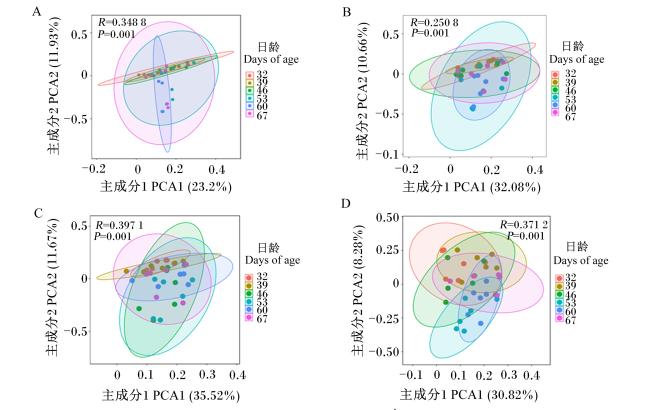
主成分分析(PCA)中样本距离越近,表明样本的组成结构越相似。由图1可知,随着饲粮中丁酸梭菌添加水平的增加,肉兔盲肠菌群结构的波动逐渐加强,各组的间距逐渐变远,表明饲粮中添加丁酸梭菌对不同时期肉兔肠道菌群Beta多样性存在影响。
图1 饲粮中添加丁酸梭菌对肉兔盲肠菌群Beta多样性的影响

A:CG组 CG group;B:LC组 LC group;C:MC组 MC group;D:HC组 HC group。

Fig.1 Effects of dietary C. butyricum on cecal flora Beta diversity of meat rabbits

2.1.3 门水平上相对丰度

表3可知,各组肉兔盲肠门水平上的优势菌门均为厚壁菌门(Firmicutes)、拟杆菌门(Bacteroidetes)、疣微菌门(Verrucomicrobia)和放线菌门(Actinobacteria),其中,厚壁菌门和拟杆菌门相对丰度的占比最大。不同日龄各组之间肉兔盲肠厚壁菌门和拟杆菌门相对丰度无显著差异(P>0.05)。32和39日龄时,MC组盲肠放线菌门相对丰度显著低于CG组(P<0.05)。60和67日龄时,LC组、MC组和HC组盲肠疣微菌门相对丰度显著低于CG组(P<0.05)。
表3 饲粮中添加丁酸梭菌对肉兔盲肠菌群门水平上相对丰度的影响

Table 3 Effects of dietary C. butyricum on cecal flora relative abundance of meat rabbits at phylum level %

项目
Items
组别Groups P
P-value
CG LC MC HC
32日龄32 days of age
厚壁菌门Firmicutes 34.76±8.54 43.47±6.16 44.46±5.46 44.37±4.14 0.095
拟杆菌门Bacteroidetes 53.67±8.00 45.00±6.87 46.26±5.64 44.36±4.77 0.152
疣微菌门Verrucomicrobia 6.70±1.43 6.80±0.13 6.37±0.34 6.47±0.35 0.815
放线菌门Actinobacteria 2.86±0.48a 2.51±0.54a 1.77±0.49b 2.61±0.23a 0.014
其他Other 1.59±0.69 1.74±0.95 0.72±0.43 1.67±0.94 0.176
未归类Unclassified 0.39±0.24 0.44±0.36 0.39±0.37 0.49±0.41 0.972
39日龄39 days of age
厚壁菌门Firmicutes 42.20±11.84 47.47±10.32 51.88±11.06 55.21±17.64 0.483
拟杆菌门Bacteroidetes 47.54±10.69 42.59±10.27 38.85±10.80 34.01±18.16 0.467
疣微菌门Verrucomicrobia 5.36±0.93 6.03±0.76 5.95±0.27 5.76±0.22 0.395
放线菌门Actinobacteria 2.70±0.37ab 2.42±0.33bc 2.12±0.45c 2.98±0.16a 0.012
其他Other 1.45±0.14 1.12±0.46 0.95±0.49 1.58±0.43 0.128
未归类Unclassified 0.71±0.28 0.34±0.28 0.22±0.12 0.43±0.34 0.059
46日龄46 days of age
厚壁菌门Firmicutes 55.33±8.92 53.31±11.34 65.83±8.28 65.18±12.74 0.140
拟杆菌门Bacteroidetes 34.57±8.76 35.82±11.31 23.12±8.22 24.38±12.74 0.129
疣微菌门Verrucomicrobia 5.52±0.35 6.07±0.59 6.05±0.42 6.07±0.23 0.144
放线菌门Actinobacteria 2.53±0.26 2.76±0.35 2.91±0.31 2.51±0.36 0.181
其他Other 1.51±0.41 1.49±0.41 1.53±0.36 1.32±0.31 0.781
未归类Unclassified 0.51±0.27 0.51±0.10 0.53±0.34 0.52±0.43 1.000
53日龄53 days of age
厚壁菌门Firmicutes 54.10±16.83 56.43±15.21 58.47±14.00 61.43±7.56 0.834
拟杆菌门Bacteroidetes 36.34±16.39 32.88±15.07 31.11±14.57 28.50±7.34 0.812
疣微菌门Verrucomicrobia 5.66±0.77 5.81±0.47 5.98±0.35 5.85±0.66 0.890
放线菌门Actinobacteria 2.43±0.35 2.63±0.35 2.70±0.21 2.46±0.19 0.416
其他Other 0.92±0.56 1.75±1.10 1.14±0.61 1.26±0.50 0.351
未归类Unclassified 0.52±0.42 0.47±0.27 0.58±0.40 0.48±0.23 0.966
60日龄60 days of age
厚壁菌门Firmicutes 61.44±6.18 66.77±9.33 65.79±6.51 65.63±10.05 0.794
拟杆菌门Bacteroidetes 28.65±5.92 24.69±9.74 25.30±6.39 26.34±9.25 0.895
疣微菌门Verrucomicrobia 5.18±0.21a 4.14±0.59b 4.14±0.46b 3.56±0.51b 0.001
放线菌门Actinobacteria 2.82±0.14 2.42±0.36 2.72±0.34 2.46±0.32 0.183
其他Other 1.37±0.40 1.46±0.34 1.54±0.51 1.39±0.65 0.952
未归类Unclassified 0.51±0.22 0.49±0.27 0.48±0.30 1.75±2.96 0.443
67日龄67 days of age
厚壁菌门Firmicutes 68.33±8.62 67.85±12.13 72.53±14.61 72.71±11.36 0.854
拟杆菌门Bacteroidetes 21.71±8.71 23.54±13.18 19.16±14.77 19.56±11.50 0.925
疣微菌门Verrucomicrobia 5.34±0.17a 4.11±0.38bc 4.19±0.50b 3.56±0.54c <0.001
放线菌门Actinobacteria 3.06±0.29 2.55±0.39 2.48±0.30 2.66±0.31 0.073
其他Other 0.88±0.36 1.30±0.78 0.95±0.34 1.00±0.33 0.522
未归类Unclassified 0.65±0.33 0.62±0.37 0.67±0.26 0.48±0.28 0.755

2.1.4 LEfSe分析结果

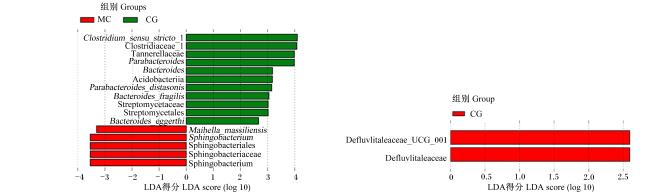
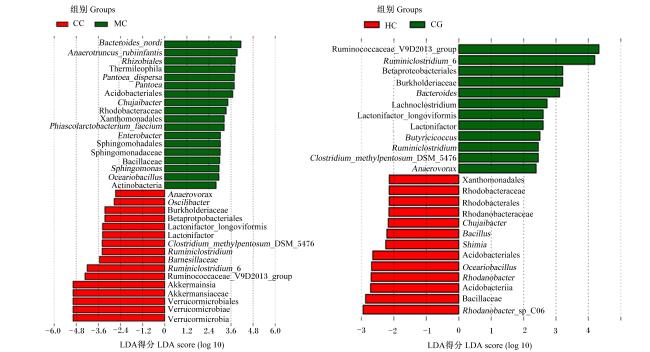
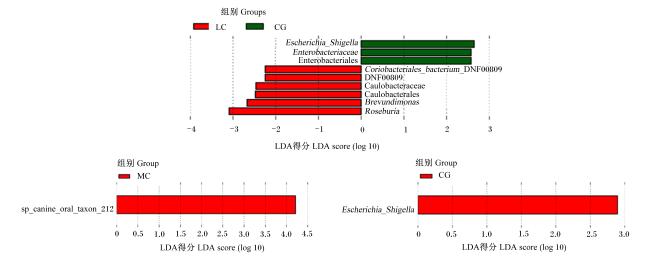
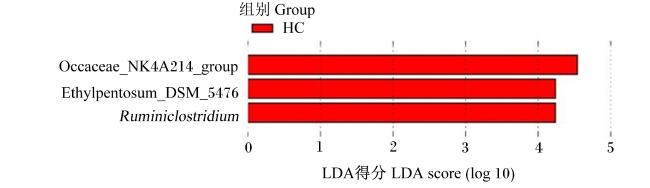
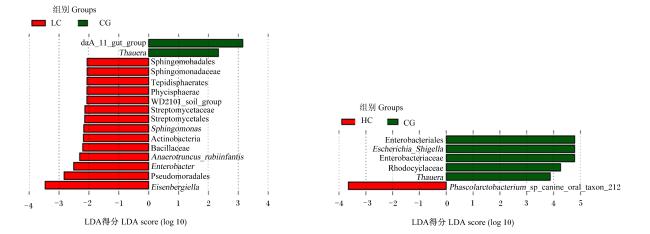
图2图7所示,LC组与CG组之间在32、39、53和69日龄时无显著富集的OTUs(P>0.05)。32日龄时,MC组与CG组之间存在16个差异性富集的OTUs(P<0.05);HC组与CG组之间存在2个差异性富集的OTUs(P<0.05)。39日龄时,MC组与CG组之间存在34个差异性富集的OTUs(P<0.05),HC组与CG组之间存在25个差异性富集的OTUs(P<0.05)。46日龄时,LC组与CG组之间存在9个差异性富集的OTUs(P<0.05),MC组与CG组之间存在1个差异性富集的OTUs(P<0.05),HC组与CG组之间存在1个差异性富集的OTUs(P<0.05)。53日龄时,MC组与CG组之间存在4个差异性富集的OTUs(P<0.05),HC组与CG组之间存在2个差异性富集的OTUs(P<0.05)。60日龄时,HC组与CG组之间存在3个差异性富集的OTUs(P<0.05)。67日龄时,LC组与CG组之间存在16个差异性富集的OTUs(P<0.05),HC组与CG组之间存在6个差异性富集的OTUs(P<0.05)。
图2 32日龄组间差异LEfSe图

Clostridium_sensu_stricto_1:严格梭菌属;Clostridiaceae_1:梭菌科1;Tannerellaceae:坦纳菌科;Parabacteroides:类芽孢杆菌属;Bacteroides:拟杆菌属;Acidobacteriia:酸杆菌门;Parabacteroides_distasonis:青春双歧杆菌;Bacteroides_fragilis:脆弱拟杆菌;Streptomycetaceae:链霉菌科;Streptomycetales:链霉菌目;Bacteroides_eggerthi:埃氏拟杆菌;Maihella_massiliensis:马赛耶尔森氏菌属;Sphingobacterium:鞘氨醇杆菌属;Sphingobacteriales:鞘脂杆菌目;Sphingobacteriaceae:鞘脂杆菌科;Sphingobacterium:鞘氨醇杆菌。

Fig.2 Difference LEfSe diagram at 32 days of age among groups

图3 39日龄组间差异LEfSe图

Bacteroides_nordi:诺迪拟杆菌属;Rhizobiales:根瘤菌属;Thermileophila:嗜热油菌纲;Pantoea_dispersa:分散泛菌;Pantoea:泛菌属;Acidobacteriales:酸杆菌目; Rhodobacteraceae:红杆菌科;Xanthomonadales:黄色单胞菌目;Phiascolarctobacterium_faecium:粪考拉杆菌;Enterobacter:肠杆菌属;Sphingomohadales:鞘氨醇单胞菌目;Sphingomonadaceae:鞘氨醇单胞菌科;Bacillaceae:芽孢杆菌科;Sphingomonas:鞘脂单胞菌属;Actinobacteria:放线菌门;Anaerovorax:优杆菌属;Oscilibacter:颤杆菌克属;Burkholderiaceae:伯克氏菌科;Betaprotpobacteriales:变形菌目;Clostridium_methylpentosum_DSM_5476:甲基戊糖梭菌DSM_5476;Ruminiclostridium:瘤胃梭菌属;Ruminiclostridium_6:瘤胃梭菌属6;Ruminococcaceae_V9D2013_group:瘤胃球菌科V9D2013_组;Akkermainsia:阿克曼菌属;Akkermansiaceae:阿克曼斯亚科;Verrucormicrobiales:疣微菌目;Verrucomicrobiae:疣微菌纲;Verrucormicrobia:疣微菌门;Burkholderiaceae:伯克氏菌科;Bacteroides:拟杆菌属;Lachnoclostridium:乳酸杆菌属;Butyricicoccus:丁酸球菌属;Ruminiclostridium:瘤胃梭菌属;Anaerovorax:优杆菌属;Xanthomonadales:黄色单胞菌目;Rhodobacterales:红杆菌目;Rhodanobacteraceae:罗河杆菌科;Rhodobacteraceae:红杆菌科;Bacillus:芽孢杆菌属;Shimia:沈氏菌属;Acidobacteriales:酸杆菌目;Rhodanobacter:罗河杆菌属;Acidobacteriia:酸杆菌科;Bacillaceae:芽孢杆菌科;Rhodanobacter_sp_C06:罗河杆菌属sp_C06。

Fig.3 Difference LEfSe diagram at 39 days of age among groups

图4 46日龄组间差异LEfSe图

Escherichia_Shigella:大肠埃希菌-志贺氏菌属;Enterobacteriaceae:肠杆菌科;Enterobacteriales:肠杆菌目;Coriobacteriales_bacterium_DNF00809:红蝽菌目杆菌bacterium_DNF00809;Caulobacteraceae:柄杆菌科;Caulobacterales:柄杆菌目;Brevundimonas:短波单细胞菌属;Roseburia:罗氏菌属。

Fig.4 Difference LEfSe diagram at 46 days of age among groups

图5 53日龄组间差异LEfSe图

Lachnoclostridium:乳酸杆菌属。

Fig.5 Difference LEfSe diagram at 53 days of age among groups

图6 60日龄组间差异LEfSe图

Ruminiclostridium:瘤胃梭菌属。

Fig.6 Difference LEfSe diagram at 60 days of age among groups

图7 67日龄组间差异LEfSe图

Thauera:陶厄氏菌属;Sphingomohadales:鞘氨醇单胞菌目;Sphingomonadaceae:鞘氨醇单胞菌科;Streptomycetaceae:链霉菌科;Streptomycetales:链霉菌目;Sphingomonas:鞘脂单胞菌属;Actinobacteria:放线菌门;Bacillaceae:芽孢杆菌科;Enterobacter:肠杆菌属;Pseudomoradales:假单胞菌目;Eisenbergiella:塔伊艾森伯格菌属;Enterobacteriales:肠杆菌目;Escherichia_Shigella:大肠埃希菌-志贺氏菌属;Enterobacteriaceae:肠杆菌科;Rhodocyclaceae:红环菌科;Thauera:陶厄氏菌属。

Fig.7 Difference LEfSe diagram at 67 days of age among groups

2.1.5 肠道菌群动态变化

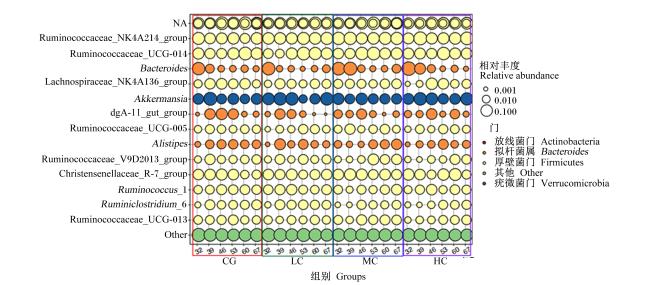
图8所示,统计各组内菌群相对丰度前15的优势菌属,使用气泡图展示添加不同水平丁酸梭菌下不同生长日龄肉兔肠道菌群的动态变化(实际结果图中只展示相对丰度前13的优势菌属)。各菌属相对丰度随肉兔的生长发育出现动态变化,其中变化最明显的有厚壁菌门下的成员瘤胃球菌科UCG-005(Ruminococcaceae_UCG-005)、瘤胃球菌科R-7群(Ruminococcaceae_R-7_group)、罗马尼亚梭菌属6(Ruminiclostridium_6)、瘤胃球菌科UCG-013(Ruminococcaceae_UCG-013),拟杆菌门下的成员拟杆菌属(Bacteroides)、dgA-11肠道群(dgA-11_gut_group)和另枝菌属(Alistipes),疣微菌门下的成员阿克曼氏菌属(Akkermansia)。
图8 不同分组内相对丰度前15菌属动态变化气泡图

NA:未归类 unclassified;Ruminococcaceae_NK4A214_group:瘤胃球菌科NK4A214群;Ruminococcaceae_UCG-014:瘤胃球菌科UCG-014;Bacteroides:拟杆菌属;Lachnospiraceae_NK4A136_group:毛螺菌科NK4A136群;Akkermansia:阿克曼氏菌属;dgA-11_gut_group:dgA-11肠道群;Ruminococcaceae_UCG-005:瘤胃球菌科UCG-005;Alistipes:另枝菌属;Ruminococcaceae_V9D2013_group:瘤胃球菌科V9D2013群;Ruminococcus_1:瘤胃球菌属1;Ruminiclostridium_6:罗马尼亚梭菌6;Ruminococcaceae_UCG-013:瘤胃球菌科UCG-013;Other:其他。

Fig.8 Bubble plot of dynamic changes of relative abundance top10 bacteria in different groups

2.2 饲粮中添加丁酸梭菌对肉兔粪便SCFAs含量的影响

表4可知,虽然53日龄时LC组乙酸和戊酸的P值在0.05以下,但其差异倍数(fold change,FC)>0.5,未满足筛选要求。因此,在各组结果中,仅LC组粪便丁酸含量较CG组显著降低(P<0.05),异丁酸含量出现降低趋势,其余SCFAs含量均出现增加趋势。
表4 各试验组与CG组53日龄粪便SCFAs含量差异

Table 4 Differences of fecal SCFAs contents between each test group and CG group on 53 days of age

项目
Items
LC组较CG组
LC group vs CG group
MC组较CG组
MC group vs CG group
HC组较CG组
HC group vs CG group
P
P-value
差异倍数
Fold change
趋势
Trend
P
P-value
差异倍数
Fold change
趋势
Trend
P
P-value
差异倍数
Fold change
趋势
Trend
乙酸AA 0.007 0.542 0.800 1.036 0.140 1.326
丙酸PA 0.065 0.701 0.281 1.194 0.171 1.247
丁酸BA 0.014 0.371 0.520 0.790 0.505 0.781
异丁酸IBA 0.073 0.458 0.555 0.833 0.725 0.884
戊酸VA 0.001 0.535 0.657 0.878 0.510 0.921
异戊酸IVA 0.088 0.515 0.602 0.840 0.868 1.065
己酸HA 0.560 0.703 0.868 0.866 0.412 0.575
表5可知,67日龄时,LC组粪便异戊酸含量较CG组显著降低(P<0.05),LC组戊酸、己酸和MC组己酸含量较CG组出现降低趋势,其余SCFAs含量均出现增加趋势。
表5 各试验组与CG组67日龄粪便SCFAs含量差异

Table 5 Differences of fecal SCFAs contents between each test group and CG group on 67 days of age

项目
Items
LC组较CG组
LC group vs CG group
MC组较CG组
MC group vs CG group
HC组较CG组
HC group vs CG group
P
P-value
差异倍数
Fold change
趋势
Trend
P
P-value
差异倍数
Fold change
趋势
Trend
P
P-value
差异倍数
Fold change
趋势
Trend
乙酸AA 0.242 0.674 0.767 1.078 0.540 0.874
丙酸PA 0.363 0.760 0.998 1.001 0.104 0.767
丁酸BA 0.478 0.691 0.554 1.319 0.685 0.815
异丁酸IBA 0.086 0.577 0.375 0.770 0.307 0.747
戊酸VA 0.087 0.438 0.947 1.028 0.353 0.698
异戊酸IVA 0.034 0.465 0.411 0.751 0.159 0.647
己酸HA 0.237 0.318 0.367 0.460 0.664 0.741

2.3 SCFAs与盲肠菌群关联性分析

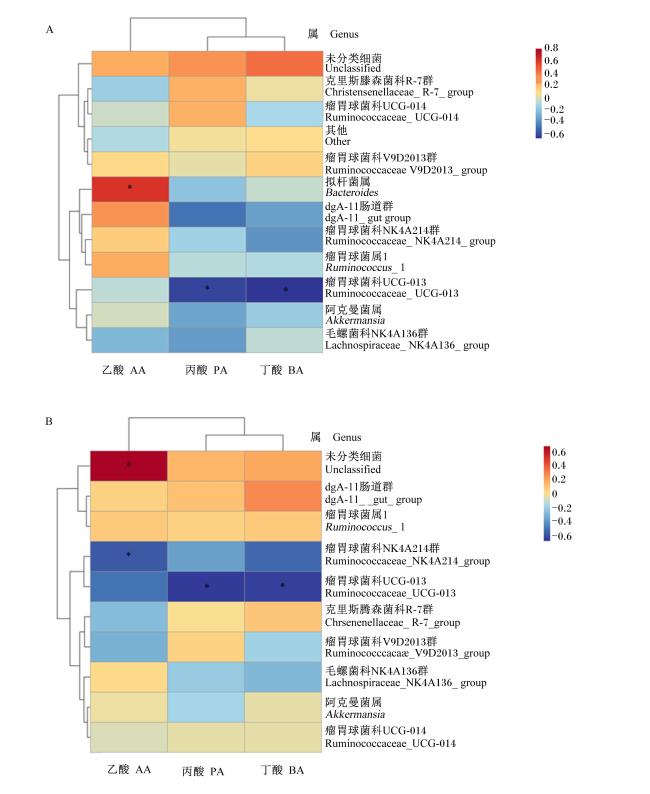
图9可知,在相对丰度排名前10的属水平菌群中,大部分瘤胃球菌科相对丰度与乙酸、丙酸、丁酸含量表现出负相关。其中,53日龄时,Bacteroides相对丰度与乙酸含量呈显著正相关(P<0.05);Ruminococcaceae_UCG-013相对丰度与丙酸含量呈显著负相关(P<0.05),与丁酸含量呈极显著负相关(P<0.01)。67日龄时,瘤胃球菌科NK4A214群(Ruminococcaceae_NK4A214_group)相对丰度与乙酸含量呈显著负相关(P<0.05),Ruminococcaceae_UCG-013相对丰度与丙酸和丁酸含量呈显著负相关(P<0.05)。
图9 肉兔盲肠相对丰度排名前10菌属与主要粪便SCFAs含量关联分析热图

A:53日龄关联分析热图 heat map of correlation analysis at 53 days of age;B:67日龄关联分析热图 heat map of correlation analysis at 67 days of age。

图中颜色深浅表示菌属相对丰度与SCFAs含量相关性大小,其中红色表示正相关,蓝色表示负相关。*表示相关性显著(P<0.05),**表示相关性极显著(P<0.01)。

Fig.9 Heat map of correlation analysis between relative abundance of top 10 bacteria in cecum and content of SCFAs in feces of meat rabbits

The color depth in the figure indicated the correlation between bacteria relative abundance and SCFAs content, red indicated positive correlation, and blue indicated negative correlation. * indicated significant correlation (P<0.05), ** indicated extremely significant correlation (P<0.01).

3 讨论

3.1 饲粮中添加丁酸梭菌对肉兔盲肠菌群结构的影响

肠道生态系统处于动态变化之中[16-17],肠道菌群结构和多样性会随环境、年龄和饮食等因素的变化而变化[18-20]。肠道内的微生物与宿主是共生关系,在帮助宿主消化吸收、维持健康等方面起着不可或缺的作用。目前,有关丁酸梭菌的研究表明,丁酸梭菌可以调节畜禽肠道菌群,促进肠道消化吸收,提高畜禽生长性能,具有较大的开发空间[21-22]。Huang等[23]在肉兔上的研究表明,饲粮中添加丁酸梭菌可以增加肠道有益细菌的相对丰度,以维持肠道屏障的稳态,还能提高平均日增重和平均日采食量,降低料重比。Bassiony等[24]试验也证明,丁酸梭菌可以提高肉兔平均日增重和饲料转化率,改善血清生化指标,促进肉兔生长。López等[25]研究发现,饲粮中添加丁酸梭菌可提高仔猪对于营养物质的消化吸收能力,提高仔猪生长性能。丁酸梭菌在肉鸡[26]和蛋鸡[27]上的研究结果也表明,补充丁酸梭菌有助于增强黏膜屏障功能,稳定盲肠微生物群,并显著提高家禽的平均日增重。杨晓伟等[28]研究表明,添加200 mg/kg的丁酸梭菌(活菌总数≥1010 CFU/g)可以提高畜禽生长性能,改善肠道功能,提高肠道免疫力。在本试验中也有类似发现,饲粮中添加不同水平的丁酸梭菌,LC组肉兔盲肠菌群多样性Chao1指数、Ace指数和Shannon指数普遍高于其他各组,而HC组肉兔盲肠菌群结构相似性与CG组差异较大。以上结果表明,饲粮中添加丁酸梭菌会改变肉兔盲肠菌群结构,且盲肠菌群的多样性存在差异。
对生长期和育肥期肉兔来说,纤维和蛋白质等营养物质的消化吸收会直接影响育肥效果。而丁酸梭菌可以通过促进微生物的生长繁殖[29],改善肠道菌群结构,提高肉兔对营养物质的消化吸收能力,从而提高饲料转化率[30]。许多研究表明,厚壁菌门和拟杆菌门是畜禽肠道内的优势菌门[31-37],添加丁酸梭菌会增加盲肠厚壁菌门相对丰度[38-39],降低拟杆菌门[40]和疣微菌门[41-42]相对丰度。Liu等[43]试验证明,丁酸梭菌可以通过增加有益菌的相对丰度改善断奶獭兔肠道菌群,增强免疫功能和改善肠道微生物群。肖英平等[44]研究表明,丁酸梭菌可以通过增加肠道菌群相对丰度和SCFAs含量增加肉鸡平均日增重,降低料重比。也有学者认为,肠道菌群是通过厚壁菌门中瘤胃球菌属促进SCFAs合成,维护肠道功能的[45-47]。在本试验中,厚壁菌门、拟杆菌门、疣微菌门和放线菌门是肉兔肠道中的优势菌门,添加丁酸梭菌不会改变优势菌门种类,但会改变肉兔盲肠菌群多样性,提高厚壁菌门相对丰度,降低拟杆菌门相对丰度,影响疣微菌门和放线菌门相对丰度。在本试验中,添加丁酸梭菌对放线菌门相对丰度没有造成影响,这可能与放线菌门在菌群中占比较小有关,这也是本试验未在属水平上观察到放线菌门成员的原因。此外,通过LEfSe组间差异我们发现,在属和种水平上计算出的32个OTUs中,包含13个厚壁菌门成员、13个变形菌门成员、4个拟杆菌门成员和2个疣微菌门成员,并且大部分差异显著菌属为厚壁菌门成员,其中有3个瘤胃球菌属成员。这一结果与前人的研究结果相似。因此,我们推测丁酸梭菌是通过改变菌群相对丰度维护肠胃健康,促进肠道吸收营养物质的。
但也有学者认为,添加丁酸梭菌在提高厚壁菌门相对丰度的同时,也会提高拟杆菌门相对丰度[48],这一结果与本试验不同,可能与饲养环境、物种以及丁酸梭菌的生物学特性等有关,需要我们结合动物肠道具体情况进一步探究丁酸梭菌对其生长性能的影响。

3.2 饲粮中添加丁酸梭菌对肉兔粪便SCFAs含量的影响

SCFAs又称挥发性脂肪酸(volatile fatty acid,VFA),是肠道菌群发酵未消化的食物成分产生的代谢产物,主要包括乙酸、丙酸、丁酸、己酸、戊酸、异丁酸和异戊酸等,在促进肠道消化吸收,保持肠道稳态和生理健康等方面具有重要作用[49]。乙酸和丙酸可以促进上皮细胞生长;丁酸是肠上皮细胞重要的能量来源,可以减少肠道内氧气含量,抑制有害菌增生[50];异戊酸可调控发酵从而增加挥发性脂肪酸含量,尤其是乙酸和丁酸[51]。有研究表明,饲粮中添加丁酸梭菌可以有效提高SCFAs含量[38],尤其是增加乙酸、丙酸和丁酸的含量[52]。肖英平等[44]研究发现,丁酸梭菌可以提高肉鸡肠道SCFAs含量,降低料重比。舒均兰等[53]研究表明,丁酸梭菌可以通过发酵将碳水化合物转化为SCFAs,为动物提供营养物质,减少腹泻等问题发生。本试验检测了肉兔53与67日龄的粪便SCFAs含量,以代表肉兔快速生长期和出栏时期的粪便VFA含量,结果显示,各日龄下肉兔粪便SCFAs含量虽然未出现显著差异,但随着丁酸梭菌添加水平的增加,各组肉兔粪便SCFAs含量均出现增加或减少的趋势。出栏期肉兔肠道中,各组肉兔粪便内乙酸、丙酸和丁酸含量随丁酸梭菌添加水平的增加表现出增加趋势。但在快速生长期,LC组丁酸和异丁酸含量随丁酸梭菌添加水平的增加表现出减少趋势;在出栏期,LC组戊酸、异戊酸和己酸以及MC组己酸含量也随丁酸梭菌添加水平的增加表现出减少趋势。因此,我们推测添加600 mg/kg丁酸梭菌可以通过提高肠道SCFAs含量改善动物胃肠道健康。

3.3 SCFAs含量与肠道菌群关联性分析

丁酸梭菌可以通过发酵和代谢等途径合成SCFAs,提高乙酸、丙酸、丁酸等的含量,增加肠道菌群多样性[54];也可以通过调整微生物的相对丰度和肠道微生物区系结构,提高SCFAs的转化效率[50,55]。有学者认为,SCFAs与动物肠道菌群间存在着相互作用的关系[56],肠道菌群能够调节SCFAs含量[57],影响畜禽平均日增重。也有报道称,瘤胃球菌科下成员可将碳水化合物转化为SCFAs[58],从而抑制有害菌增殖,诱导肿瘤细胞分化和凋亡[50]。本试验中,SCFAs含量和盲肠菌群关联性分析的结果也显示,大部分瘤胃菌属相对丰度与SCFAs含量表现出负相关关系。其中,乙酸含量与Ruminococcaceae_NK4A214_group、毛螺菌科NK4A136群(Lachnospiraceae_NK4A136_group)、Ruminococcaceae_UCG-013相对丰度呈负相关关系,与Bacteroides相对丰度呈正相关关系;丙酸含量与Ruminococcaceae_UCG-013相对丰度呈负相关关系,与Ruminococcaceae_NK4A214_group相对丰度呈负相关关系;丁酸含量与Bacteroides相对丰度呈正相关关系,与Ruminococcaceae_NK4A214_group相对丰度呈负相关关系。这一结果与前人的研究结果相类似,均表明丁酸梭菌可以改变瘤胃菌属相关菌群丰度,调整SCFAs含量。

4 结论

① 饲粮中添加丁酸梭菌可改变肉兔盲肠菌群结构、微生物多样性,提高厚壁菌门相对丰度,降低拟杆菌门相对丰度。
② 饲粮中添加600 mg/kg丁酸梭菌可以通过调节SCFAs含量调整微生物的相对丰度和肠道微生物区系结构,在维持机体肠道健康方面具有有益的作用。
[1]
HU S L, WANG L, JIANG Z Y. Dietary additive probiotics modulation of the intestinal microbiota[J]. Protein and Peptide Letters, 2017, 24(5):382-387.

DOI PMID

[2]
DOWARAH R, VERMA A K, AGARWAL N, et al. Effect of swine based probiotic on performance,diarrhoea scores,intestinal microbiota and gut health of grower-finisher crossbred pigs[J]. Livestock Science, 2017, 195:74-79.

DOI

[3]
KAMEL E, MOHAMED L S. Effect of dietary supplementation of probiotics,prebiotics,synbiotics,organic acids and enzymes on productive and economic efficiency of broiler chicks[J]. Alexandria Journal for Veterinary Sciences, 2016, 50(1):8-17.

DOI

[4]
HAGIHARA M, KUROKI Y, ARIYOSHI T, et al. Clostridium butyricum modulates the microbiome to protect intestinal barrier function in mice with antibiotic-induced dysbiosis[J]. iScience, 2020, 23(1):100772.

DOI

[5]
庞敏, 卢庆萍, 夏冰, 等. 酪酸梭菌对断奶仔猪生长性能、肠道组织形态及肠道通透性的影响[J]. 动物营养学报, 2016, 28(7):2113-2121.

DOI

PANG M, LU Q P, XIA B, et al. Effects of Clostridium butyricum on growth performance,intestinal morphology and intestinal permeability of weanling piglets[J]. Journal of Animal Nutrition, 2016, 28(7):2113-2121. (in Chinese)

[6]
CAI L Y, YU J K, HARTANTO R, et al. Dietary supplementation with Saccharomyces cerevisiae,Clostridium butyricum and their combination ameliorate rumen fermentation and growth performance of heat-stressed goats[J]. Animals, 2021, 11(7):2116.

DOI

[7]
徐亚飞, 曾新福, 乐敏, 等. 丁酸梭菌的生物学功能及其在水产养殖中的应用研究进展[J]. 渔业研究, 2018, 40(5):408-412.

XU Y F, ZENG X F, LE M, et al. The biological function of Clostridium butyricum and its application in aquaculture[J]. Journal of Fisheries Research, 2018, 40(5):408-412. (in Chinese)

[8]
ZHANG C R, YU Q Y, WANG J H, et al. Effects of dietary supplementation with Clostridium butyricum on growth performance,apparent digestibility,blood metabolites,ruminal fermentation and bacterial communities of fattening goats[J]. Frontiers in Nutrition, 2022, 9:888191.

DOI

[9]
孙铁虎, 金渭武, 陈影, 等. 低聚果糖、丁酸梭菌对断奶仔猪生长性能、养分消化率和血清指标的影响[J]. 中国饲料, 2022(17):55-58,79.

SUN T H, JIN W W, CHEN Y, et al. Effects of fructooligosaccharides and Clostridium butyricum on growth performance and serum biochemical indexes of breed swine[J]. China Feed, 2022(17):55-58,79. (in Chinese)

[10]
INAGAKI A, SAKATA T. Dose-dependent stimulatory and inhibitory effects of luminal and serosal n-butyric acid on epithelial cell proliferation of pig distal colonic mucosa[J]. Journal of Nutritional Science and Vitaminology, 2005, 51(3):156-160.

PMID

[11]
杨立娜, 李丽, 王胜男, 等. 短链脂肪酸肠道转运吸收研究进展[J]. 中国食品学报, 2022, 22(7):335-344.

YANG L N, LI L, WANG S N, et al. Research progress on transport and absorption of short chain fatty acids in intestine[J]. Journal of Chinese Institute of Food Science and Technology, 2022, 22(7):335-344. (in Chinese)

[12]
FANG S M, CHEN X, YE X X, et al. Effects of gut microbiome and short-chain fatty acids (SCFAs) on finishing weight of meat rabbits[J]. Frontiers in Microbiology, 2020, 11:1835.

DOI PMID

[13]
YANG Z H, AMAL F E, YANG L, et al. Functional characterization of Clostridium tyrobutyricum L319:a promising next-generation probiotic for short-chain fatty acid production[J]. Frontiers in Microbiology, 2022, 13:926710.

DOI

[14]
ARAKI Y, ANDOH A, FUJIYAMA Y, et al. Short-term oral administration of a product derived from a probiotic,Clostridium butyricum induced no pathological effects in rats[J]. International Journal of Molecular Medicine, 2002, 9(2):173-177.

[15]
DE BLAS C, WISEMAN J. Nutrition of the rabbit[M]. Wallingford: CABI Publishing, 2010:235-239.

[16]
JOAT N, VAN T T H, STANLEY D, et al. Temporal dynamics of gut microbiota in caged laying hens:a field observation from hatching to end of lay[J]. Applied Microbiology and Biotechnology, 2021, 105(11):4719-4730.

DOI

[17]
JI B W, SHETH R U, DIXIT P D, et al. Macroecological dynamics of gut microbiota[J]. Nature Microbiology, 2020, 5(5):768-775.

DOI PMID

[18]
HE J, HE Y X, PAN D D, et al. Associations of gut microbiota with heat stress-induced changes of growth,fat deposition,intestinal morphology,and antioxidant capacity in ducks[J]. Frontiers in Microbiology, 2019, 10:903.

DOI

[19]
GROND K, LANCTOT R B, JUMPPONEN A, et al. Recruitment and establishment of the gut microbiome in arctic shorebirds[J]. FEMS Microbiology Ecology, 2017, 93(12):fix142.

[20]
RAULO A, RUOKOLAINEN L, LANE A, et al. Social behaviour and gut microbiota in red-bellied lemurs (Eulemur rubriventer):in search of the role of immunity in the evolution of sociality[J]. Journal of Animal Ecology, 2018, 87(2):388-399.

DOI

[21]
谷子林, 韩守岭, 李兆庆, 等. 丁酸梭菌对母兔生产性能及仔兔成活率的影响[J]. 中国养兔杂志, 2022(1):9-11,25.

GU Z L, HAN S L, LI Z Q, et al. Effects of Clostridium butyricum on performance and survival rate of the female rabbits[J]. Chinese Journal of Rabbit Farming, 2022(1):9-11,25. (in Chinese)

[22]
YE X X, LI K Y, LI Y F, et al. The effects of Clostridium butyricum on Ira rabbit growth performance,cecal microbiota and plasma metabolome[J]. Frontiers in Microbiology, 2022, 13:974337.

DOI

[23]
HUANG P, CUI X M, WANG Z P, et al. Effects of Clostridium butyricum and a bacteriophage cocktail on growth performance,serum biochemistry,digestive enzyme activities,intestinal morphology,immune responses,and the intestinal microbiota in rabbits[J]. Antibiotics, 2021, 10(11):1347.

DOI

[24]
BASSIONY S S, AL-SAGHEER A A, EL-KHOLY M S, et al. Evaluation of Enterococcus faecium NCIMB 11181 and Clostridium butyricum probiotic supplements in post-weaning rabbits reared under thermal stress conditions[J]. Italian Journal of Animal Science, 2021, 20(1):1232-1243.

DOI

[25]
LÓPEZ M, MADRID J, HERNÁNDEZ F, et al. Effect of feed supplementation with Clostridium butyricum,alone or in combination with carob meal or citrus pulp,on digestive and metabolic status of piglets[J]. Animals, 2021, 11(10):2924.

DOI

[26]
XU L P, SUN X L, WAN X H, et al. Dietary supplementation with Clostridium butyricum improves growth performance of broilers by regulating intestinal microbiota and mucosal epithelial cells[J]. Animal Nutrition, 2021, 7(4):1105-1114.

DOI

[27]
WANG W W, WANG J, ZHANG H J, et al. Effects of Clostridium butyricum on production performance and intestinal absorption function of laying hens in the late phase of production[J]. Animal Feed Science and Technology, 2020, 264:114476.

DOI

[28]
杨晓伟. 丁酸梭菌对仔猪生长性能、肠道菌群、抗氧化功能和免疫功能的影响[J]. 饲料研究, 2020, 43(5):44-48.

YANG X W. Effect of Clostridium butyricum on growth performance,intestinal flora,antioxidant function and immune function of piglets[J]. Feed Research, 2020, 43(5):44-48. (in Chinese)

[29]
FERKET P R, SANTOS A A, OVIEDO R E O. Dietary factors that affect gut health and pathogen colonization[J]Medicine, 2005, 15(4):26431.

[30]
孙健, 乔立东, 雷莉辉, 等. 丁酸梭菌对断奶仔猪生长性能及肠道菌群结构的影响[J]. 黑龙江畜牧兽医, 2019(12):103-105.

SUN J, QIAO L D, LEI L H, et al. The effect of Clostridium butyricum on growth performance and intestinal flora structure of weaned piglets[J]. Heilongjiang Animal Science and Veterinary Medicine, 2019(12):103-105. (in Chinese)

[31]
CHEN Z M, CHANG W H, ZHENG A J, et al. Comparison of gut microbial diversity in Beijing oil and arbor acres chickens[J]. Revista Brasileira de Ciência Avícola, 2018, 20(1):37-44.

DOI

[32]
YADAV S, CALIBOSO K D, NANQUIL J E, et al. Cecal microbiome profile of Hawaiian feral chickens and pasture-raised broiler (commercial) chickens determined using 16S rRNA amplicon sequencing[J]. Poultry Science, 2021, 100(7):101181.

DOI

[33]
WANG S M, CHEN L, HE M Z, et al. Different rearing conditions alter gut microbiota composition and host physiology in Shaoxing ducks[J]. Scientific Reports, 2018, 8(1):7387.

DOI

[34]
CHOI J H, KIM G B, CHA C J. Spatial heterogeneity and stability of bacterial community in the gastrointestinal tracts of broiler chickens[J]. Poultry Science, 2014, 93(8):1942-1950.

DOI PMID

[35]
ZHAO L L, YIN H C, LU T F, et al. Application of high-throughput sequencing for microbial diversity detection in feces of specific-pathogen-free ducks[J]. Poultry Science, 2018, 97(7):2278-2286.

DOI PMID

[36]
KYLIE J, WEESE J S, TURNER P V. Comparison of the fecal microbiota of domestic commercial meat,laboratory,companion,and Shelter rabbits (Oryctolagus cuniculi)[J]. BMC Veterinary Research, 2018, 14(1):143.

DOI

[37]
WANG Y J, ZHANG H, ZHU L, et al. Dynamic distribution of gut microbiota in goats at different ages and health states[J]. Frontiers in Microbiology, 2018, 9:2509.

DOI PMID

[38]
LIU Y H, LIU C, AN K Y, et al. Effect of dietary Clostridium butyricum supplementation on growth performance,intestinal barrier function,immune function,and microbiota diversity of Pekin ducks[J]. Animals, 2021, 11(9):2514.

DOI

[39]
杨淑华, 陈帅, 李鹏, 等. 高通量测序研究膨化秸秆生物发酵饲料对辽育白牛肠道菌群的影响[J]. 饲料工业, 2018, 39(7):29-34.

YANG S H, CHEN S, LI P, et al. Effect of extruded straw bio-fermented feed on the intestinal flora of Liaoyu white cattles by high-throughput sequencing[J]. Feed Industry, 2018, 39(7):29-34. (in Chinese)

[40]
LUO X S, KONG Q, WANG Y M, et al. Colonization of Clostridium butyricum in rats and its effect on intestinal microbial composition[J]. Microorganisms, 2021, 9(8):1573.

DOI

[41]
JIN D X, ZOU H W, LIU S Q, et al. The underlying microbial mechanism of epizootic rabbit enteropathy triggered by a low fiber diet[J]. Scientific Reports, 2018, 8(1):12489.

DOI PMID

[42]
GARNER, MICHAEL M. The veterinary clinics of North America.Exotic animal practice[J]. Retour Au Numéro, 2012, 333(7563):321-324.

[43]
LIU L, ZENG D, YANG M Y, et al. Probiotic Clostridium butyricum improves the growth performance,immune function,and gut microbiota of weaning Rex rabbits[J]. Probiotics and Antimicrobial Proteins, 2019, 11(4):1278-1292.

DOI

[44]
肖英平, 杨彩梅, 代兵, 等. 基于高通量测序的丁酸梭菌对肉鸡盲肠菌群结构的影响[J]. 浙江农业学报, 2017, 29(3):373-379.

DOI

XIAO Y P, YANG C M, DAI B, et al. Effect of Clostridium butyricum in feed on structures of cecal microbiota in broilers based on high-throughput sequencing[J]. Acta Agriculturae Zhejiangensis, 2017, 29(3):373-379. (in Chinese)

[45]
LOUIS P, YOUNG P, HOLTROP G, et al. Diversity of human colonic butyrate-producing bacteria revealed by analysis of the butyryl-CoA:acetate CoA-transferase gene[J]. Environmental Microbiology, 2010, 12(2):304-314.

DOI PMID

[46]
CHEN J, HUANG C L, WANG J J, et al. Dysbiosis of intestinal microbiota and decrease in paneth cell antimicrobial peptide level during acute necrotizing pancreatitis in rats[J]. PLoS One, 2017, 12(4):e0176583.

DOI

[47]
ZHAO L, ZHANG Q, MA W N, et al. A combination of quercetin and resveratrol reduces obesity in high-fat diet-fed rats by modulation of gut microbiota[J]. Food & Function, 2017, 8(12):4644-4656.

[48]
王远霞, 邹晓庭, 郑有秀, 等. 丁酸梭菌对断奶仔猪空肠菌群结构的影响[J]. 动物营养学报, 2020, 32(11):5128-5136.

DOI

WANG Y X, ZOU X T, ZHENG Y X, et al. Effects of Clostridium butyricum on microbial community structure in jejunum of weaned piglets[J]. Chinese Journal of Animal Nutrition, 2020, 32(11):5128-5136. (in Chinese)

[49]
尚智援, 李海花, 窦彩霞, 等. 丁酸梭菌调节畜禽肠道菌群机制的研究进展[J]. 中国饲料, 2020(13):1-5.

SHANG Z Y, LI H H, DOU C X, et al. Research progress in the regulatory mechanisms of Clostridium butyricum on livestock and poultry intestinal flora[J]. China Feed, 2020(13):1-5. (in Chinese)

[50]
范秋丽, 马现永. 短链脂肪酸对畜禽肠道生理功能及生长性能的影响[J]. 广东饲料, 2016, 25(8):33-35.

FAN Q L, MA X Y. Effects of short chain fatty acids on intestinal physiological function and growth performance of livestock and poultry[J]. Guangdong Feed, 2016, 25(8):33-35. (in Chinese)

[51]
梁艳, 刘强, 王聪, 等. 异丁酸对犊牛瘤胃及小肠黏膜基因表达的影响[J]. 动物营养学报, 2015, 27(8):2483-2492.

DOI

LIANG Y, LIU Q, WANG C, et al. Effects of isobutyrate on gene expressions of ruminal and small intestinal mucosa of calves[J]. Chinese Journal of Animal Nutrition, 2015, 27(8):2483-2492. (in Chinese)

[52]
陈秋红, 孙梅, 施大林, 等. 益生菌酪酸菌CB-7发酵培养基及培养条件的研究[J]. 饲料研究, 2009(4):7-10,21.

CHEN Q H, SUN M, SHI D L, et al. Study on fermentation medium and culture conditions of probiotic tyrosine bacteria CB-7[J]. Feed Research, 2009(4):7-10,21. (in Chinese)

[53]
舒均兰, 徐娥, 桂国弘, 等. 丁酸梭菌早期干预对大肠杆菌攻毒肉仔鸡肠道菌群和短链脂肪酸的影响[J]. 饲料工业, 2021, 42(11):44-52.

SHU J L, XU E, GUI G H, et al. Effects of early Clostridium butyricum intervention on short-chain fatty acid and microbial community structure in broiler chickens challenged with enterotoxigenic Escherichia coli[J]. Feed Industry, 2021, 42(11):44-52. (in Chinese)

[54]
王康莉. 丁酸梭菌对断奶仔猪生长性能、免疫功能和肠道健康的影响研究[D].硕士学位论文. 杭州: 浙江农林大学, 2020.

WANG K L. Effects of Clostridium butyricum on growth performance,immune function and intestinal health in weaned piglets[D].Master’s Thesis. Hangzhou: Zhejiang A&F University, 2020. (in Chinese)

[55]
张城瑞, 于清源, 王季红, 等. 饲粮添加丁酸梭菌对育肥山羊生长性能和直肠微生物区系的影响[J]. 动物营养学报, 2022, 34(8):5146-5155.

DOI

ZHANG C R, YU Q Y, WANG J H, et al. Effects of dietary supplementation with Clostridium butyricum on growth performance and rectal microflora of fattening goats[J]. Chinese Journal of Animal Nutrition, 2022, 34(8):5146-5155. (in Chinese)

[56]
马露, 刘文慧, 阿拉腾珠拉, 等. 外源添加短链脂肪酸调控断奶前犊牛胃肠道健康发育潜在功能和机制[J]. 动物营养学报, 2019, 31(6):2465-2470.

MA L, LIU W H, A L T Z L, et al. Potential functions and mechanisms of exogenous addition short chain fatty acids regulated gastrointestinal tract healthy development of calves before weaning[J]. Chinese Journal of Animal Nutrition, 2019, 31(6):2465-2470. (in Chinese)

[57]
CHENG C S, WEI H K, WANG P, et al. Early intervention with faecal microbiota transplantation:an effective means to improve growth performance and the intestinal development of suckling piglets[J]. Animal, 2019, 13(3):533-541.

DOI

[58]
CHENG C, WEI H, PENG J. PSVII-40 Maternal soluble fiber diet during pregnancy influences growth performance,intestinal microbiota and intestinal permeability in piglets[J]. Journal of Animal Science, 2018,96 (Suppl.3):329-330.

Outlines

/