RESEARCH PAPER

Effects of Fermented Stomach-Nourishing Traditional Chinese Medicine Powder on Immune Function, Intestinal Volatile Fatty Acids and Microflora of Yellow-Feathered Broilers Challenged with Lipopolysaccharide

  • MA Yanhua , 1 ,
  • ZHAO Guiling 2 ,
  • FENG Jie 3 ,
  • NIU Yu , 2, *
Expand
  • 1 College of Biological and Food Engineering, Puyang 457000, China
  • 2 College of Animal Science and Technology·College of Veterinary Medicine, Zhejiang Agricultural and Forestry University, Hangzhou 311300, China
  • 3 College of Animal Science, Zhejiang University, Hangzhou 310030, China
*lecturer, E-mail:

Received date: 2022-09-14

  Online published: 2023-06-08

Abstract

The aim of this experiment was to investigate the effects of fermented stomach-nourishing traditional Chinese medicine powder (FST) on immune function, intestinal volatile fatty acids and microflora of yellow-feathered broilers challenged with lipopolysaccharide (LPS). A total of 360 one-day-old yellow-feathered broilers were randomly divided into 3 groups, including FST0 group (basal diet), FST1000 group (basal diet+1 000 mg/kg FST) and FST2000 group (basal diet+2 000 mg/kg FST), each group had 8 replicates and each replicate had 15 broilers. The growth performance at different stages (1 to 35 days of age, 36 to 70 days of age and 1 to 70 days of age) was measured. At 70 days of age, eight broilers from each replicate were selected from FST0 group and FST1000 group were intraperitoneally injected with 1 000 μg/kg BW LPS at the 71, 73 and 75 days of age, which were named LPS group and LPS+FST group, respectively; another 7 broilers in FST0 group were intraperitoneally injected with the same amount of normal saline at the 71, 73 and 75 days of age, which was named CON group. After stimulation with LPS for 3 h at the 75 days of age, all the broilers were slaughtered and sampled for determination. The results showed as follows: adding 1 000 mg/kg FST into the diet significantly decreased the feed/gain (F/G) of broilers at 36 to 70 days of age and 1 to 70 days of age (P<0.05), suggesting that 1 000 mg/kg FST was the optimal adding dose in the diet of broilers. 2) Compared with the CON group, the thymus index and bursa of Fabricius index were significantly reduced (P<0.05), the serum interleukin-1β (IL-1β), interleukin-2 (IL-2), interleukin-6 (IL-6) contents were significantly increased (P<0.05), and the serum interleukin-10 (IL-10), immunoglobulin A (IgA), immunoglobulin M (IgM) and immunoglobulin Y (IgY) contents of broilers were significantly decreased in the LPS group (P<0.05). Compared with the LPS group, the serum IL-1β, IL-2 and TNF-α contents were significantly decreased (P<0.05), and the serum IL-10, IgA, IgM and IgY contents of broilers were significantly increased in the LPS+FST group (P<0.05). 3) Compared with the CON group, the contents of isobutyric acid, isovaleric acid and valeric acid in cecal contents of broilers were significantly reduced in the LPS group (P<0.05); the above volatile fatty acid contents in cecal contents of broilers in the LPS+FST group were significantly increased when compared with LPS group (P<0.05). 4) Beta diversity result showed that the cecal microflora of broilers in the LPS+FST group was more similar to that in the CON group. Compared with the CON group, the relative abundances of Prevotellaceae_UCG-001 and cultured_bacterium_g_Prevotellaceae_UCG-001 in the LPS group were significantly increased (P<0.05); the relative abundance of Synergistata was significantly increased (P<0.05), and the relative abundance of unclassified_f_Lachnospiraceae was significantly decreased in the LPS+FST group (P<0.05). In conclusion, 1 000 mg/kg FST can enhance the immune function, increase the contents of volatile fatty acids in cecal contents, and regulate the balance of intestinal microflora of yellow-feathered broilers challenged with LPS.

Cite this article

MA Yanhua , ZHAO Guiling , FENG Jie , NIU Yu . Effects of Fermented Stomach-Nourishing Traditional Chinese Medicine Powder on Immune Function, Intestinal Volatile Fatty Acids and Microflora of Yellow-Feathered Broilers Challenged with Lipopolysaccharide[J]. Chinese Journal of Animal Nutrition, 2023 , 35(6) : 3631 -3643 . DOI: 10.12418/CJAN2023.338

中药养胃粉发酵饲料(fermented stomach-nourishing traditional Chinese medicine powder,FST)是以优选的特定乳酸菌和特定酵母菌为发酵菌种,以黄芪、党参、陈皮、香附、白芍、山药、乌梅、甘草等经典养胃中药组方为发酵底物,通过深度固态发酵而获得的一种新型酵母培养物(yeast culture,YC)[1]。由于具有广泛的生物学功能、绿色环保等优势,酵母培养物逐渐被应用于畜牧生产中。研究发现,饲粮添加25 g/(d·只) YC能够显著提高奶山羊的养分表观消化率、产奶性能,对血清抗氧化指标和免疫功能也具有显著的提高作用[2]。Gao等[3]研究表明,2.5 g/kg YC能够有效提高肉鸡的生长性能,改善肠道绒毛形态,增强机体免疫力。陈脊宇等[4]也发现,在五黑鸡饲粮中添加0.2%~0.8% YC对于提高五黑鸡的生长性能、改善蛋品质和调节血清生化指标均具有较好的效果。Zhang等[5]的研究表明,在热应激生长公牛饲粮中添加40 g/d YC可稳定瘤胃内环境,修复肠道屏障,提高免疫功能,改善机体代谢以及热应激状态。肉鸡由于生长周期短、饲养密度大,易受到多方面的应激,造成机体健康和免疫功能下降。脂多糖(lipopolysaccharide,LPS)又被称为内毒素,是革兰氏阴性菌细胞外壁的主要成分。通过腹腔注射LPS来构建肠道损伤模型已经获得广泛认可,大量研究证实LPS会造成肠道绒毛萎缩、改变肠道菌群、引起肠道炎症及免疫力降低等诸多不利影响[6-7]。然而,中药养胃粉发酵饲料这种新型的YC能否改善LPS应激黄羽肉鸡的生长性能和健康状态尚不清楚。因此,本试验通过构建LPS应激模型来研究中药养胃粉发酵饲料对LPS应激黄羽肉鸡免疫功能和肠道微生物的影响,为应激条件下肉鸡的生长发育及肠道健康的营养调控策略提供理论依据。

1 材料与方法

1.1 试验材料

本试验所使用中药养胃粉发酵饲料为褐色粉末状,发酵用的菌株为酿酒酵母和乳酸菌(总活菌数为1×10⁶ CFU/g),发酵底物为中药养胃粉(由黄芪、党参、陈皮、香附、白芍、山药、乌梅、甘草等组成)、豆粕及谷物副产品(玉米喷浆皮)。该中药养胃粉发酵饲料的营养成分含量如下:粗蛋白质≥16%,小肽30%~40%(占蛋白质的比例),甘露聚糖≥0.5%,总酸≥10%,中药多糖5%,水分≤12%。

1.2 试验设计

试验选取1日龄健康黄羽肉鸡360只,随机分为3个组,每组8个重复,每个重复15只肉鸡。FST0组饲喂参照NRC(1994)营养需要配制而成的基础饲粮,该基础饲粮组成及营养水平见表1。FST1000组和FST2000组分别在基础饲粮基础上添加1 000和2 000 mg/kg 中药养胃粉发酵饲料。饲喂70 d,测定各阶段(1~35日龄、36~70日龄和1~70日龄)生长性能。根据生长性能结果,70日龄时从FST0组和生长性能最佳组(FST1000组)的每个重复中随机选择8只肉鸡,分别记为LPS组和LPS+FST组,在71、73、75日龄腹腔注射1 000 μg/kg BW LPS;FST0组剩余肉鸡(每个重复7只)记为CON组,在71、73、75日龄腹腔注射等量的生理盐水。试验鸡群采用单层笼养方式饲养于封闭鸡舍,饲养管理和免疫程序按常规进行。试验期间保证鸡只自由采食和饮水,每天光照23 h。前3天鸡舍温度保持在32~34 ℃,然后每周降低2~3 ℃直至(22±1) ℃,相对湿度维持在55%~60%。
表1 基础饲粮组成及营养水平(风干基础)

Table 1 Composition and nutrient levels of basal diets (air-dry basis)%

项目
Items
含量 Content
1~35日龄
1 to 35
days of age
36~70日龄
36 to 70
days of age
原料 Ingredients
玉米 Corn 54.00 54.00
豆粕 Soybean meal 23.20 15.00
膨化大豆 Extruded soybean 5.00 3.00
玉米酒糟 Corn distiller’s grains 8.20 8.00
米糠 Rice bran 9.00
玉米麸 Corn gluten 2.00
豆油 Soybean oil 1.60 3.50
石粉 Limestone 2.10 2.40
发酵豆粕
Fermented soybean meal
2.60
磷酸氢钙 CaHPO4 2.00 1.80
氯化钠 NaCl 0.30 0.30
预混料 Premix1) 1.00 1.00
合计 Total 100.00 100.00
营养水平 Nutrient levels2)
代谢能 ME/(MJ/kg) 12.20 12.92
粗蛋白质 CP 20.20 17.10
赖氨酸 Lys 1.20 1.06
蛋氨酸+半胱氨酸 Met+Cys 0.90 0.73
钙 Ca 0.86 0.74
总磷 TP 0.60 0.58

1)预混料为每千克饲粮提供The premix provided the following per kg of diets:VA 10 000 IU,VD3 2 000 IU,VE 30 IU,VK 1.3 mg,VB1 2.2 mg,VB2 8 mg,VB6 4 mg,VB12 13 μg,泛酸 pantothenic acid 10 mg,烟酸 nicotinic acid 1 mg,生物素 biotin 0.04 mg,氯化胆碱 choline chloride 400 mg,Fe 80 mg,Cu 7.5 mg,Mn 110 mg,Zn 65 mg,Se 0.3 mg,I 1.1 mg,载体为沸石 the carrier was zeolite。

2)代谢能为计算值,其余为实测值。ME was a calculated value, while the others were measured values.

1.3 样品采集

75日龄时,在LPS应激处理3 h后,每个重复选择1只肉鸡先进行称重,然后颈部放血并采集5 mL血液,在4 ℃下3 000 r/min离心15 min,收集上层血清置于-20 ℃保存,用于血清免疫指标的测定;剖开腹腔后取胸腺、脾脏、法氏囊,用于计算免疫器官指数;无菌条件下取盲肠内容物,用于挥发性脂肪酸含量和微生物区系的测定。

1.4 指标测定

1.4.1 生长性能

于试验第1、35和70天08:00(断料12 h),分别以重复为单位对肉鸡进行称重,并统计余料量,计算平均日增重(ADG)、平均日采食量(ADFI)和料重比(F/G)。试验期间,每天观察肉鸡的健康状况。如果有鸡只死亡,则立即称余料量和死鸡重,并记录数据,以消除死鸡对试验结果的影响。
ADG=(平均终末体重-平均初始体重)/饲喂天数;
ADFI=平均阶段采食量/饲喂天数;
F/G=平均阶段采食量/平均阶段增重。

1.4.2 免疫器官指数

取胸腺、脾脏、法氏囊进行称重,用以下公式计算免疫器官指数:
免疫器官指数(g/kg)=免疫器官重量(g)/宰前活重(kg)。

1.4.3 血清免疫指标

血清白细胞介素-1β(interleukin-1β,IL-1β)、白细胞介素-2(interleukin-2,IL-2)、白细胞介素-6(interleukin-6,IL-6)、肿瘤坏死因子-α(tumor necrosis factor-α,TNF-α)、白细胞介素-10(interleukin-10,IL-10)、免疫球蛋白A(immunoglobulin A,IgA)、免疫球蛋白Y(immunoglobulin Y,IgY)和免疫球蛋白M(immunoglobulin M,IgM)含量均采用酶联免疫吸附试验(ELISA)法进行测定,测定所用试剂盒购自南京建成生物工程研究所,按照试剂盒说明书进行操作。

1.4.4 盲肠内容物中挥发性脂肪酸含量

盲肠内容物4 ℃解冻后,准确称取0.5 g加入超纯水1 mL,旋涡混匀,5 000 r/min离心10 min。取上清液1 mL,加入0.2 mL 25%偏磷酸,旋涡混匀,并置于冰水浴中30 min,4 ℃下12 000 r/min离心10 min,取上清液。采用安捷伦6890N气相色谱仪测定盲肠内容物中挥发性脂肪酸(乙酸、丙酸、丁酸、异丁酸、戊酸和异戊酸)含量。

1.4.5 盲肠微生物区系

将无菌采集的盲肠内容物送至上海美吉生物医药科技有限公司进行16S rRNA测序。利用Illumina MiSeq测序平台对样品进行质控和过滤,然后根据97%的相似度对序列进行扩增子序列变异(amplicon sequence variants,ASVs)聚类,并进行alpha多样性(Shannon指数、Simpson指数、Ace指数和Chao指数)和beta多样性分析[主成分分析(PCA)],并基于ASVs在门水平、属水平和种水平上分析盲肠内容物中微生物的相对丰度及差异菌群。

1.5 数据处理与分析

试验数据采用SPSS 20.0软件进行单因素方差分析(one-way ANOVA),并用Duncan氏法进行多重比较,结果用平均值±标准误表示。P<0.05表示差异显著。

2 结果与分析

2.1 中药养胃粉发酵饲料对黄羽肉鸡生长性能的影响

表2可知,与FST0组相比,FST1000组36~70日龄和1~70日龄的F/G显著降低(P<0.05)。肉鸡不同阶段的ADG和ADFI在各组间均无显著差异(P>0.05)。
表2 中药养胃粉发酵饲料对黄羽肉鸡生长性能的影响

Table 2 Effects of FST on growth performance of yellow-feathered broilers

项目
Items
组别 Groups P
P-value
FST0 FST1000 FST2000
平均日增重 ADG/(g/d)
1~35日龄 1 to 35 days of age 14.75±0.13 14.97±0.29 14.55±0.29 0.518
36~70日龄 36 to 70 days of age 30.66±0.43 30.85±0.60 30.56±0.31 0.902
1~70日龄 1 to 70 days of age 22.70±0.23 23.24±0.36 22.64±0.11 0.225
平均日采食量 ADFI/(g/d)
1~35日龄 1 to 35 days of age 27.98±0.26 27.82±0.43 28.38±0.73 0.737
36~70日龄 36 to 70 days of age 87.09±0.91 80.19±1.59 83.73±2.78 0.076
1~70日龄 1 to 70 days of age 67.11±2.06 63.54±2.20 63.01±0.99 0.266
料重比 F/G
1~35日龄 1 to 35 days of age 1.90±0.01 1.86±0.03 1.95±0.04 0.127
36~70日龄 36 to 70 days of age 2.89±0.02a 2.58±0.05b 2.74±0.11ab 0.019
1~70日龄 1 to 70 days of age 2.54±0.01a 2.35±0.03b 2.47±0.06ab 0.028

同行数据肩标不同小写字母表示差异显著(P<0.05)。

Values in the same row with different small letter superscripts mean significant difference (P<0.05).

2.2 中药养胃粉发酵饲料对LPS应激黄羽肉鸡免疫器官指数的影响

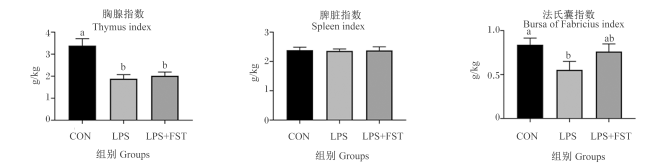
图1可知,与CON组相比,LPS应激显著降低了肉鸡的胸腺指数和法氏囊指数(P<0.05);与LPS相比,饲粮中添加1 000 mg/kg中药养胃粉发酵饲料有提高LPS应激肉鸡法氏囊指数和胸腺指数的趋势,但差异不显著(P>0.05)。
图1 中药养胃粉发酵饲料对LPS应激黄羽肉鸡免疫器官指数的影响

数据柱形标注不同小写字母表示差异显著(P<0.05)。下图同。

Fig.1 Effects of FST on immune organ indexes of yellow-feathered broilers challenged with LPS

Value columns with different small letters mean significant difference (P<0.05). The same as below.

2.3 中药养胃粉发酵饲料对LPS应激黄羽肉鸡血清炎性因子含量的影响

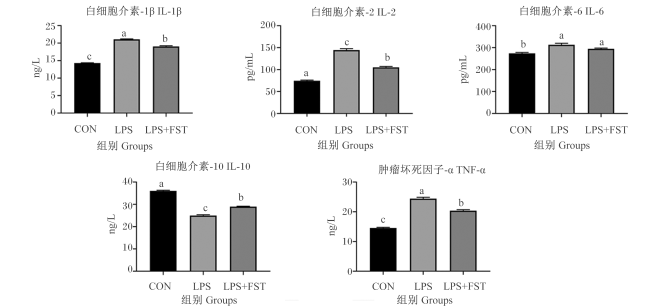
图2可知,与CON组相比,LPS组血清IL-1β、IL-2、IL-6和TNF-α含量显著升高(P<0.05),血清IL-10含量显著降低(P<0.05);与LPS组相比,饲粮中添加1 000 mg/kg 中药养胃粉发酵饲料显著降低了血清IL-1β、IL-2和TNF-α含量(P<0.05),显著升高了血清IL-10含量(P<0.05)。
图2 中药养胃粉发酵饲料对LPS应激黄羽肉鸡血清炎性因子含量的影响

Fig.2 Effects of FST on serum inflammatory factor contents of yellow-feathered broilers challenged with LPS

2.4 中药养胃粉发酵饲料对LPS应激黄羽肉鸡血清免疫球蛋白含量的影响

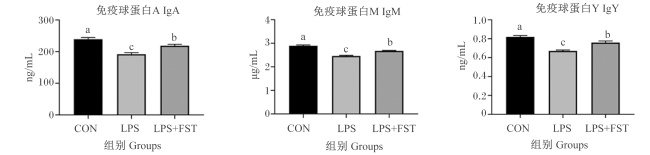
图3可知,与CON组相比,LPS应激显著降低了肉鸡血清IgA、IgM和IgY含量(P<0.05);与LPS组相比,饲粮中添加1 000 mg/kg中药养胃粉发酵饲料能够显著提高LPS应激肉鸡血清IgA、IgM和IgY含量(P<0.05)。
图3 中药养胃粉发酵饲料对LPS应激黄羽肉鸡血清免疫球蛋白含量的影响

Fig.3 Effects of FST on serum immunoglobulin contents of yellow-feathered broilers challenged with LPS

2.5 中药养胃粉发酵饲料对LPS应激黄羽肉鸡盲肠内容物中挥发性脂肪酸含量的影响
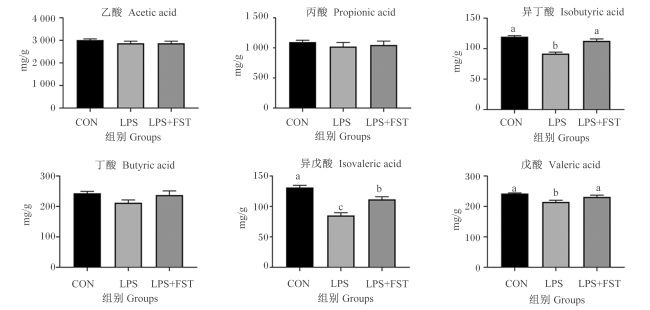
图4可知,与CON相比,LPS应激显著降低了盲肠内容物中异丁酸、异戊酸和戊酸的含量(P<0.05);与LPS组相比,饲粮中添加1 000 mg/kg中药养胃粉发酵饲料显著提高了LPS应激肉鸡盲肠内容物中异丁酸、异戊酸和戊酸的含量(P<0.05)。各组间盲肠内容物中乙酸、丙酸和丁酸的含量均没有显著差异(P>0.05)。
图4 中药养胃粉发酵饲料对LPS应激黄羽肉鸡盲肠内容物中挥发性脂肪酸含量的影响

Fig.4 Effects of FST on volatile fatty acid contents in cecal contents of yellow-feathered broilers challenged with LPS

2.6 中药养胃粉发酵饲料对LPS应激黄羽肉鸡盲肠微生物区系的影响

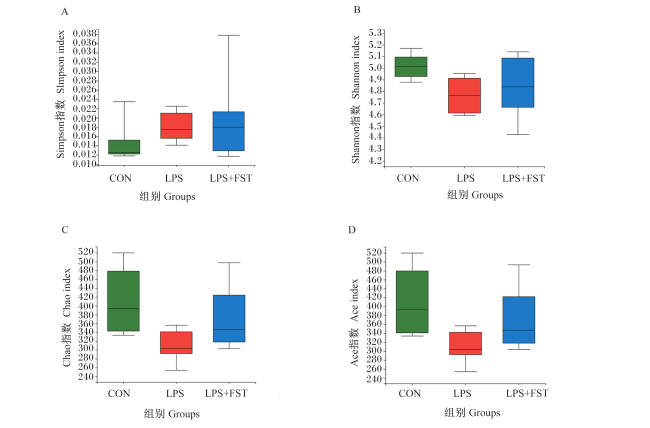
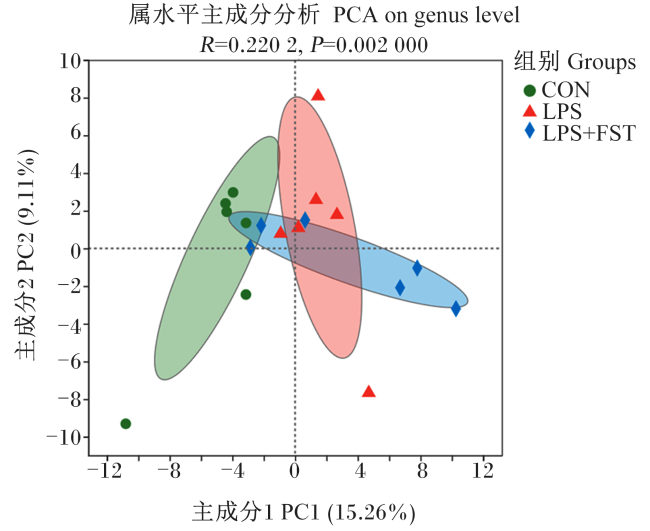
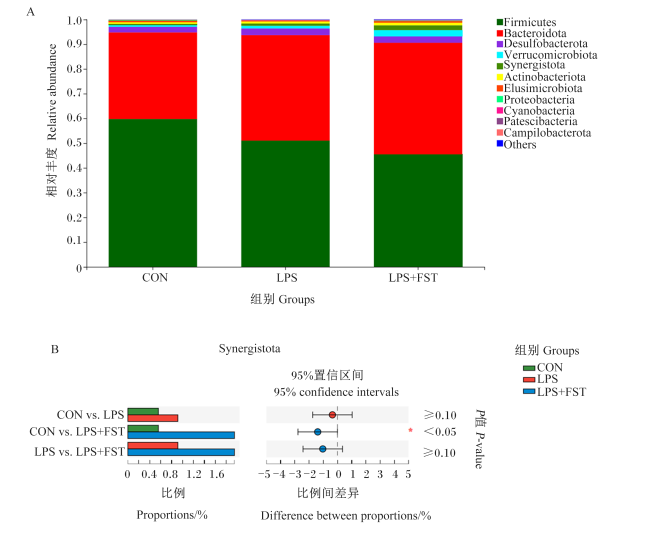
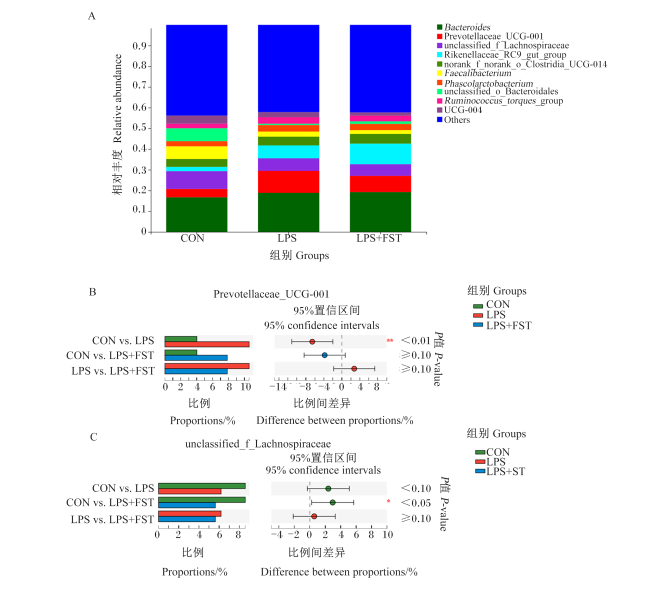
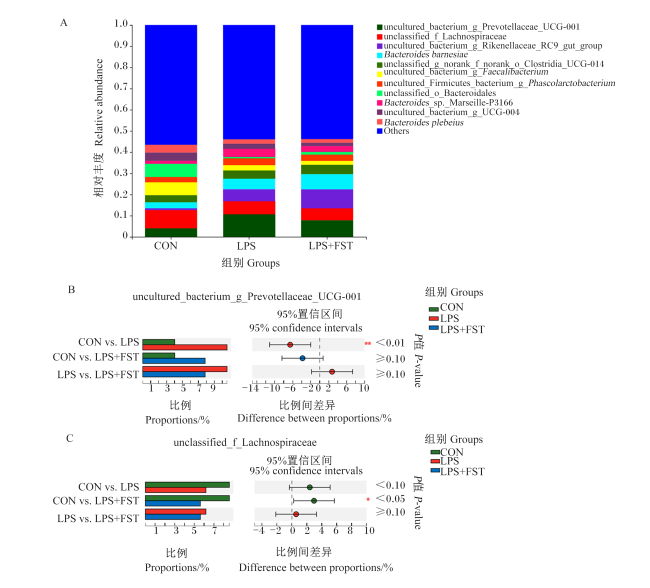
图5可知,各组间Simpson指数、Shannon指数、Ace指数和Chao指数均无显著差异(P>0.05)。PCA表明,LPS+FST组和CON组肉鸡的盲肠微生物组成更相似(图6)。在门水平上,厚壁菌门(Firmicutes)、拟杆菌门(Bacteroidota)、脱硫杆菌门(Desulfobacterota)、疣微菌门(Verrucomicrobiota)是盲肠中的优势菌门(图7-A)。LPS+FST组肉鸡盲肠菌群中互养菌门(Synergistota)的相对丰度显著高于CON组(P<0.05)(图7-B)。在属水平上,拟杆菌属(Bacteroides)、普雷沃氏菌科UCG-001(Prevotellaceae_UCG-001)、未分类的毛螺菌科(unclassified_f_Lachnospiraceae)、理研菌科RC9肠道群(Rikenellaceae_RC9_gut_group)是盲肠中的优势菌属(图8-A)。与CON组相比,LPS组盲肠菌群中Prevotellaceae_UCG-001的相对丰度显著升高(P<0.05)(图8-B),LPS+FST组盲肠菌群中unclassified_f_Lachnospiraceae的相对丰度显著降低(P<0.05)(图8-C)。在种水平上,普雷沃氏菌科UCG-001不可培养细菌(uncultured_bacterium_g_Prevotellaceae_UCG-001)、unclassified_f_Lachnospiraceae、理研菌科RC9肠道群不可培养细菌(uncultured_bacterium_g_Rikenellaceae_RC9_gut_group)、巴恩斯氏拟杆菌(Bacteroides barnesiae)、未分类的梭菌目UCG-014(unclassified_g_norank_f_norank_o_Clostridia_UCG-014)是优势菌种(图9-A)。与CON组相比,LPS组盲肠菌群中uncultured_bacterium_g_Prevotellaceae_UCG-001的相对丰度显著升高(P<0.05)(图9-B),LPS+FST组盲肠菌群中unclassified_f_Lachnospiraceae的相对丰度显著降低(图9-C)。
图5 中药养胃粉发酵饲料对LPS应激黄羽肉鸡盲肠微生物alpha多样性的影响

Fig.5 Effects of FST on cecal microbial alpha diversity of yellow-feathered broilers challenged with LPS

图6 中药养胃粉发酵饲料对LPS应激黄羽肉鸡盲肠微生物beta多样性的影响

Fig.6 Effects of FST on cecal microbial beta diversity of yellow-feathered broilers challenged with LPS

图7 中药养胃粉发酵饲料对LPS应激黄羽肉鸡盲肠微生物门水平上相对丰度及差异菌门的影响

Firmicutes:厚壁菌门;Bacteroidota:拟杆菌门;Desulfobacterota:脱硫杆菌门;Verrucomicrobiota:疣微菌门;Synergistota:互养菌门;Actinobacteriota:放线菌门;Elusimicrobiota:迷踪菌门;Proteobacteria:变形菌门;Cyanobacteria:蓝细菌门;Patescibacteria:髌骨菌门;Campilobacterota:弯曲杆菌门;Others:其他。

Fig.7 Effects of FST on relative abundance of cecal microbiota and different flora at phylum level of yellow-feathered broilers challenged with LPS

图8 中药养胃粉发酵饲料对LPS应激黄羽肉鸡盲肠微生物属水平上相对丰度及差异菌属的影响

Bacteroides:拟杆菌属;Prevotellaceae_UCG-001:普雷沃氏菌科UCG-001;unclassified_f_Lachnospiraceae:未分类的毛螺菌科;Rikenellaceae_RC9_gut_group:理研菌科RC9肠道群;norank_f_norank_o_Clostridia_UCG-014:梭菌目UCG-014;Faecalibacterium:栖粪杆菌属;Phascolarctobacterium:考拉杆菌属;unclassified_o_Bacteroidales:未分类的拟杆菌目;Ruminococcus_torques_group:瘤胃球菌属扭链群;Others:其他。

Fig.8 Effects of FST on relative abundance of cecal microbiota and different flora at genus level of yellow-feathered broilers challenged with LPS

图9 中药养胃粉发酵饲料对LPS应激黄羽肉鸡盲肠微生物种水平上相对丰度及差异菌种的影响

uncultured_bacterium_g_Prevotellaceae_UCG-001:普雷沃氏菌科UCG-001不可培养细菌;unclassified_f_Lachnospiraceae:未分类的毛螺菌科;uncultured_bacterium_g_Rikenellaceae_RC9_gut_group:理研菌科RC9肠道群不可培养细菌;Bacteroides barnesiae:巴恩斯氏拟杆菌;unclassified_g_norank_f_norank_o_Clostridia_UCG-014:未分类的梭菌目UCG-014;uncultured_bacterium_g_Faecalibacterium:栖粪杆菌属不可培养细菌;uncultured_Firmicutes_bacterium_g_Phascolarctobacterium:厚壁菌门考拉杆菌属不可培养细菌;unclassified_o_Bacteroidales:未分类的拟杆菌目;Bacteroides_sp._Marseille-P3166:马赛拟杆菌;uncultured_bacterium_g_UCG-004:UCG-004不可培养细菌;Bacteroides plebeius:平常拟杆菌;Others:其他。

Fig.9 Effects of FST on relative abundance of cecal microbiota and different flora at species level of yellow-feathered broilers challenged with LPS

3 讨论

3.1 中药养胃粉发酵饲料对黄羽肉鸡生长性能的影响

本试验中,饲粮中添加1 000 mg/kg FST显著降低36~70日龄和1~70日龄肉鸡的F/G,提示1 000 mg/kg FST可以提高黄羽肉鸡的生长性能。郭小华等[8]的研究表明,0.2% YC能显著提高1~42日龄爱拔益加(AA)肉鸡的ADG和ADFI,显著降低F/G。Hoque等[9]发现,在罗斯308肉鸡饲粮中添加1%的YC可提高22~35日龄和1~35日龄肉鸡的体增重,提高饲料转化率。以上结果均与本试验结果相一致,这表明饲粮中添加中药养胃粉发酵饲料对于黄羽肉鸡的生长性能有一定的改善作用。

3.2 中药养胃粉发酵饲料对LPS应激黄羽肉鸡免疫器官指数的影响

胸腺、脾脏和法氏囊是肉鸡主要的免疫器官,其发育状况反映了机体免疫水平。免疫器官指数在一定程度上可以评估免疫功能状态,免疫器官指数越大说明机体免疫力越强[10]。本试验中,LPS应激导致了肉鸡胸腺指数和法氏囊指数显著下降,而通过在饲粮中添加中药养胃粉发酵饲料能有效缓解LPS造成的肉鸡免疫器官指数降低。相似的研究结果表明,酿酒酵母培养物组的脾脏指数较对照组显著提高了36.19%[11]。也有研究发现,饲粮中添加0.25%的YC可以提高42日龄肉鸡的胸腺指数、脾脏指数和法氏囊指数[12]。吴涛等[13]研究也证实了YC对于芦花鸡胸腺指数具有显著的提高作用。本试验结果提示,中药养胃粉发酵饲料可以通过提高LPS应激黄羽肉鸡的免疫器官指数来促进免疫机能相关因子的分泌,从而增强肉鸡的免疫力。

3.3 中药养胃粉发酵饲料对LPS应激黄羽肉鸡血清免疫指标的影响

肉鸡由于生长速度快、周期短,容易受到各种应激和损伤。前人研究通常将细菌内毒素LPS用于模拟构建免疫应激和疾病损伤模型[14],已有研究证实LPS会降低肉鸡肠道免疫功能,引起肠道炎症损伤[15-16]。研究表明,饲粮中添加1 g/kg YC显著降低了肉鸡血清中TNF-α、IL-1β和IL-6的含量[17],添加1.25和1.5 g/kg YC均显著提高了肉鸡血清中IgM含量[18]。研究还发现,0.3% YC可显著提高海兰褐蛋鸡26周龄血清中IgG含量以及29周龄血清中IgM和IgG含量,对血清中IgA含量有提高的趋势,但是差异不显著[19]。饲粮中添加10、25和40 g/(d·只)YC显著提高了崂山奶山羊血清中IgM含量,但是各组间血清中IgA和IgG含量差异不显著[2]。以上试验结果均不同程度表明了YC对机体免疫力的提高作用和对炎症的缓解作用。本试验结果表明,饲粮中添加1 000 mg/kg中药养胃粉发酵饲料显著降低了LPS应激肉鸡血清促炎细胞因子(IL-1β、IL-2、IL-6和TNF-α)含量,提高了血清抗炎细胞因子(IL-10)和免疫球蛋白(IgA、IgM和IgY)含量,这与饲粮中添加1 000 mg/kg中药养胃粉发酵饲料对LPS应激肉鸡免疫器官指数的提高作用相一致,进一步表明中药养胃粉发酵饲料对LPS应激肉鸡炎症的缓解作用与其对免疫器官生长发育的促进作用有关。

3.4 中药养胃粉发酵饲料对LPS应激黄羽肉鸡盲肠内容物中挥发性脂肪酸含量的影响

挥发性脂肪酸括乙酸、丙酸、丁酸、异丁酸、戊酸、异戊酸等,其中乙酸、丙酸和丁酸是挥发性脂肪酸的主要形式,约占总挥发性脂肪酸的95%。挥发性脂肪酸在动物体内的基本作用之一是提供能量。挥发性脂肪酸作为能量来源被肠黏膜上皮细胞吸收,可促进胃肠道细胞增殖和成熟,对宿主的养分吸收、免疫应答以及肠道微生物调控具有重要作用[20-21]。本研究发现,LPS应激显著降低了黄羽肉鸡盲肠内容物中异丁酸、异戊酸和戊酸的含量,而在饲粮中添加1 000 mg/kg中药养胃粉发酵饲料可以显著提高黄羽肉鸡盲肠内容物中异丁酸、异戊酸和戊酸的含量。耿明阳等[22]研究表明,饲粮添加YC能提高泌乳奶牛瘤胃中乙酸和异丁酸的含量。在猪上的试验发现,在夏季生长育肥猪饲粮中添加YC能显著降低回肠中乳酸杆菌数量和乳酸含量,提高结肠丁酸产生菌的数量和丁酸含量,为肠道上皮细胞提供更多的能量[23]。研究已证实,挥发性脂肪酸是肠道微生物的代谢产物,因此本试验结果表明,中药养胃粉发酵饲料能通过提高LPS应激肉鸡盲肠微生物发酵产生挥发性脂肪酸的能力,来调节肠道菌群平衡及为肠道供能,从而促进肠道内营养物质的消化吸收,提高生长性能。

3.5 中药养胃粉发酵饲料对LPS应激黄羽肉鸡盲肠微生物区系的影响

肠道内栖息着大量微生物,肠道微生物菌群通过产生短链脂肪酸、胆汁酸等代谢产物参与宿主的免疫反应和代谢,防止有害物质或细菌入侵,对动物肠道健康发挥着重要作用[24]。研究发现,厚壁菌门和拟杆菌门是盲肠中最常见的2种优势菌门[25],这与本试验结果相一致。本研究显示LPS+FST组微生物组成与CON组较为相似。这初步揭示,中药养胃粉发酵饲料能有效调节LPS对肉鸡盲肠微生物区系的影响。Synergistota包括氨基单胞菌属、厌氧棒菌属、梭状芽孢杆菌属、脱硫代硫酸盐弧菌属、互养菌属、嗜热厌氧弧菌属等多个菌属,广泛分布于环境中,是动物正常微生物群的一部分,有稳定肠道稳态的作用[26]。本试验中,FST+LPS组盲肠菌群中Synergistota的相对丰度显著高于CON组,表明中药养胃粉发酵饲料可以调节黄羽肉鸡盲肠微生物区系,改善肠道健康。普雷沃氏菌属(Prevotella)有包括普雷沃氏菌在内的50多个物种,是瘤胃中一种重要的优势菌,有助于降解蛋白质和碳水化合物,在肠道中发挥“益生菌”的作用。潘锋等[27]研究发现,饲粮中添加YC显著提高了肉牛粪便中普雷沃氏菌科UCG-004(Prevotellaceae UCG-004)的相对丰度。然而,最新研究发现,Prevotella相对丰度的增加与局部和全身性疾病密切相关。研究表明,Prevotella可以刺激上皮细胞产生IL-8和IL-6,增加肠道炎症反应,并导致全身自身免疫[28]。本试验中,LPS组普雷沃氏菌的相对丰度在属和种水平均显著高于CON组,提示LPS可能是通过提高普雷沃氏菌的相对丰度引起肠道发生炎症反应。本试验结果说明中药养胃粉发酵饲料可以改变黄羽肉鸡的肠道微生物组成,间接提高肠道消化酶的活性和释放活性物质,从而达到调节肠道菌群平衡和提高生长性能的作用。

4 结论

综上所述,饲粮中添加1 000 mg/kg中药养胃粉发酵饲料能够通过提高免疫器官指数、增强免疫功能、提高盲肠内容物中挥发性脂肪酸含量、调节盲肠微生物区系来改善肠道健康,从而提高LPS应激黄羽肉鸡的生长性能。
[1]
SUN Z, WANG T, DEMELASH N, et al. Effect of yeast culture (Saccharomyces cerevisiae) on broilers:a preliminary study on the effective components of yeast culture[J]. Animals, 2019, 10(1):68.

DOI

[2]
李海滨, 林英庭, 朱风华, 等. 酵母培养物对崂山奶山羊产奶性能、养分表观消化率、抗氧化能力及免疫功能的影响[J]. 动物营养学报, 2022, 34(7):4621-4629.

DOI

LI H B, LIN Y T, ZHU F H, et al. Effects of yeast culture on milk performance,nutrient apparent digestibility,antioxidant capacity and immune function of Laoshan dairy goats[J]. Chinese Journal of Animal Nutrition, 2022, 34(7):4621-4629. (in Chinese)

[3]
GAO J, ZHANG H J, YU S H, et al. Effects of yeast culture in broiler diets on performance and immunomodulatory functions[J]. Poultry Science, 2008, 87(7):1377-1384.

DOI PMID

[4]
陈脊宇, 何航, 王芬, 等. 酵母培养物对五黑鸡生产性能、蛋品质及血清生化指标的影响[J]. 动物营养学报, 2022, 34(4):2314-2323.

DOI

CHEN J Y, HE H, WANG F, et al. Effects of yeast culture on performance,egg quality and serum biochemical indices of Wuhei chickens[J]. Chinese Journal of Animal Nutrition, 2022, 34(4):2314-2323. (in Chinese)

[5]
ZHANG X, LIANG H, XU L J, et al. Rumen fermentative metabolomic and blood insights into the effect of yeast culture supplement on growing bulls under heat stress conditions[J]. Frontiers in Microbiology, 2022, 13:947822.

DOI

[6]
WANG X Y, XIAO K, YU C, et al. Xylooligosaccharide attenuates lipopolysaccharide-induced intestinal injury in piglets via suppressing inflammation and modulating cecal microbial communities[J]. Animal Nutrition, 2021, 7(3):609-620.

DOI PMID

[7]
CHEN J Y, YU Y H. Bacillus subtilis-fermented products ameliorate the growth performance and alter cecal microbiota community in broilers under lipopolysaccharide challenge[J]. Poultry Science, 2021, 100(2):875-886.

DOI

[8]
郭小华, 刘明, 李文辉, 等. 日粮中添加酵母培养物对肉仔鸡生长性能、肉品质和肠道菌群的影响[J]. 中国畜牧兽医, 2017, 44(6):1673-1679.

GUO X H, LIU M, LI W H, et al. Effects of yeast culture on growth performance,meat quality and intestinal microflora of broilers[J]. China Animal Husbandry & Veterinary Medicine, 2017, 44(6):1673-1679. (in Chinese)

[9]
HOQUE M R, JUNG H I, KIM I H. Effect of yeast culture (Saccharomyces cerevisiae) supplementation on growth performance,excreta microbes,noxious gas,nutrient utilization,and meat quality of broiler chicken[J]. The Journal of Poultry Science, 2021, 58(4):216-221.

DOI

[10]
ZHONG Y B, ZHANG X L, HU X F, et al. Effects of repeated lipopolysaccharide treatment on growth performance,immune organ index,and blood parameters of Sprague-Dawley rats[J]. Journal of Veterinary Research, 2018, 62(3):341-346.

DOI

[11]
孙喆, 甄玉国, 赵巍, 等. 酿酒酵母培养物对肉仔鸡生长性能及免疫功能的影响[J]. 中国兽医学报, 2018, 38(6):1222-1227.

SUN Z, ZHEN Y G, ZHAO W, et al. Effects of different fermentation time of yeast culture on growth performance and immunity of broilers[J]. Chinese Journal of Veterinary Science, 2018, 38(6):1222-1227. (in Chinese)

[12]
郭伶, 陈宝利. 酵母培养物对肉仔鸡生长性能及免疫功能的影响[J]. 中国家禽, 2013, 35(7):24-26,30.

GUO L, CHEN B L. Effects of dietary yeast culture on growth performance and immune function of broilers[J]. China Poultry, 2013, 35(7):24-26,30. (in Chinese)

[13]
吴涛, 江小帆, 魏玉明, 等. 单宁酸、抗菌肽及酵母培养物对芦花鸡生长性能、屠宰性能、器官指数的影响[J]. 饲料工业, 2022, 43(7):28-34.

WU T, JIANG X F, WEI Y M, et al. Effects of tannic acid,antimicrobial peptide and yeast culture on growth performance,slaughter performance and organ index of Luhua chickens[J]. Feed Industry, 2022, 43(7):28-34. (in Chinese)

[14]
WANG X Y, WANG W J, WANG L M, et al. Lentinan modulates intestinal microbiota and enhances barrier integrity in a piglet model challenged with lipopolysaccharide[J]. Food & Function, 2019, 10(1):479-489.

[15]
LV Z P, DAI H J, WEI Q W, et al. Dietary genistein supplementation protects against lipopolysaccharide-induced intestinal injury through altering transcriptomic profile[J]. Poultry Science, 2020, 99(7):3411-3427.

DOI PMID

[16]
JIANG Y, ZHANG W H, GAO F, et al. Effect of sodium butyrate on intestinal inflammatory response to lipopolysaccharide in broiler chickens[J]. Canadian Journal of Animal Science, 2015, 95(3):389-395.

DOI

[17]
KIM E, KYOUNG H, HYUNG KOH N, et al. Supplementation of live yeast culture modulates intestinal health,immune responses,and microbiota diversity in broiler chickens[J]. Journal of Animal Science, 2022, 100(5):skac122.

DOI

[18]
FATHI M M, AL-MANSOUR S, AL-HOMIDAN A, et al. Effect of yeast culture supplementation on carcass yield and humoral immune response of broiler chicks[J]. Veterinary World, 2012, 5(11):651-657.

DOI

[19]
仝亚广, 许颖珏, 鲍慧玲, 等. 酵母培养物对蛋鸡生产性能及免疫性能的影响[J]. 中国饲料, 2019(13):31-33.

TONG Y G, XU Y J, BAO H L, et al. Effect of yeast culture on production performance and immune performance of laying hens[J]. China Feed, 2019(13):31-33. (in Chinese)

[20]
HAN J F, WANG Y W, SONG D, et al. Effects of Clostridium butyricum and Lactobacillus plantarum on growth performance,immune function and volatile fatty acid level of caecal digesta in broilers[J]. Food and Agricultural Immunology, 2018, 29(1):797-807.

DOI

[21]
MA J Y, WANG J, MAHFUZ S, et al. Supplementation of mixed organic acids improves growth performance,meat quality,gut morphology and volatile fatty acids of broiler chicken[J]. Animals, 2021, 11(11):3020.

DOI

[22]
耿明阳, 姚闰晨, 范守民, 等. 酵母培养物对泌乳奶牛生产性能、表观消化率及瘤胃发酵参数的影响[J]. 中国饲料, 2022(6):21-24.

GENG M Y, YAO R C, FAN S M, et al. Effect of yeast culture on production performance,apparent digestibility in rumen fermentation parameters in lactating dairy cows[J]. China Feed, 2022(6):21-24. (in Chinese)

[23]
田书会, 李根来, 田文生, 等. 酵母培养物对夏季生长育肥猪肠道菌群结构和发酵能力的影响[J]. 南京农业大学学报, 2013, 36(4):91-98.

TIAN S H, LI G L, TIAN W S, et al. Effects of yeast culture on gut microbial composition and activity of growing-finishing pigs in summer[J]. Journal of Nanjing Agricultural University, 2013, 36(4):91-98. (in Chinese)

[24]
MARTENS E C, NEUMANN M, DESAI M S. Interactions of commensal and pathogenic microorganisms with the intestinal mucosal barrier[J]. Nature Reviews Microbiology, 2018, 16(8):457-470.

DOI PMID

[25]
WU Y P, ZHANG H R, ZHANG R Q, et al. Serum metabolome and gut microbiome alterations in broiler chickens supplemented with lauric acid[J]. Poultry Science, 2021, 100(9):101315.

DOI

[26]
VARTOUKIAN S R, PALMER R M, WADE W G. Diversity and morphology of members of the phylum“Synergistetes”in periodontal health and disease[J]. Applied and Environmental Microbiology, 2009, 75(11):3777-3786.

DOI

[27]
潘锋, 朱彦宾, 王之盛, 等. 酵母培养物和糖蜜对肉牛生长性能、营养物质表观消化率和粪便微生物区系组成的影响[J]. 动物营养学报, 2022, 34(2):1040-1049.

DOI

PAN F, ZHU Y B, WANG Z S, et al. Effects of yeast culture and molasses on growth performance,apparent digestibility of nutrients and fecal microflora composition of beef cattle[J]. Chinese Journal of Animal Nutrition, 2022, 34(2):1040-1049. (in Chinese)

[28]
LARSEN J M. The immune response to Prevotella bacteria in chronic inflammatory disease[J]. Immunology, 2017, 151(4):363-374.

DOI

Outlines

/