RESEARCH PAPER

Safety Evaluation of Urtica cannabina L. and Its Protective Effects on Lipopolysaccharide-Induced Intestinal Inflammatory Changes in Chicks

  • KANG Wei , 1 ,
  • WANG Desheng 1 ,
  • CHEN Hongsong 1 ,
  • CAI Xiaoxu 1 ,
  • YIN Xiaoyu 1 ,
  • LIU Wuyun 2 ,
  • YANG Jingfeng 1 ,
  • DONG Wu , 1, *
Expand
  • 1 Inner Mongolia Key Laboratory of Toxicant Monitoring and Toxicology, Collage of Animal Science and Technology, Inner Mongolia University for Nationalities, Tongliao 028000, China
  • 2 College of Animal Science and Biotechnology, National University of Life Sciences, Ulaanbaatar 17024, Mongolia
*professor, E-mail:

Received date: 2022-10-13

  Online published: 2023-06-08

Abstract

The purpose of this study was to evaluate the safety of Urtica cannabina L. and to investigate its effects on lipopolysaccharide (LPS)-induced intestinal inflammation in chicks. Normal AB zebrafish embryos were selected at 4 h after fertilization. The control group was added with 5 μL 0.1% dimethyl sulfoxide (DMSO), and the experimental groups were added with 5 μL Urtica cannabina L. ethanol extract at concentrations of 0.1, 0.5, 1.0, 5.0, 10.0, 20.0, 40.0 and 80.0 mg/mL, respectively. Then 100 ng/mL LPS treatment solution was added at 72 h after fertilization for inflammation induction until at 120 h after fertilization. A total of 180 Pudong chickens with similar body weight [(100±5) g] of 3-day-old were randomly divided into 6 groups, which were control group, LPS group, 3% Urtica cannabina L. group, 6% Urtica cannabina L. group, 3% Urtica cannabina L.+LPS group and 6% Urtica cannabina L.+LPS group, with 3 replicates per group and 10 chicks per replicate. Chicks in the control group were fed a basal diet, and those in the experimental groups were fed the basal diet supplemented with 3% and 6% Urtica cannabina L., respectively. The experiment lasted for 11 days. On day 8 of the experiment, chicks in Urtica cannabina L.+LPS group were administrated with 0.1 mL LPS of 1 mg/mL for 3 days. The results showed as follows: 1) compared with the control group, at 120 h after fertilization, the survival rate, hatching rate and malformation rate of zebrafish embryos were not significantly affected by Urtica cannabina L. ethanol extract at concentrations 5.0 mg/mL or below (P>0.05). Compared with the control group, the mRNA relative expression levels of interleukin-6 (IL-6) and tumor necrosis factor-α (TNF-α) in juvenile zebrafish in LPS group were significantly increased (P<0.05); compared with LPS group, the mRNA relative expression levels of interleukin-8 (IL-8) and TNF-α in juvenile zebrafish in 5.0 mg/mL Urtica cannabina L.+LPS group were significantly decreased (P<0.05). 2) Compared with the control group, the villus height and villus height to crypt depth ratio in duodenum of chicks in LPS group were significantly decreased (P<0.05), the goblet cell number in duodenum was significantly decreased (P<0.05), and the mRNA relative expression levels of IL-6 and TNF-α in duodenum were significantly increased (P<0.05). Compared with LPS group, the villus height and villus height to crypt depth ratio in duodenum in 3% Urtica cannabina L.+LPS group and 6% Urtica cannabina L.+LPS group were significantly increased (P<0.05), the goblet cell number in duodenum had an increasing trend (P>0.05), and the mRNA relative expression levels of IL-6 and TNF-α in duodenum were significantly decreased (P<0.05), which were no significant differences compared with the control group (P>0.05). In conclusion, Urtica cannabina L. has significant inhibitory effects on developmental disorders and inflammation of zebrafish and chick’s intestine induced by LPS, and can improve the body immunity, but the dietary supplemental level should be controlled below 15 g/kg BW or 6%.

Cite this article

KANG Wei , WANG Desheng , CHEN Hongsong , CAI Xiaoxu , YIN Xiaoyu , LIU Wuyun , YANG Jingfeng , DONG Wu . Safety Evaluation of Urtica cannabina L. and Its Protective Effects on Lipopolysaccharide-Induced Intestinal Inflammatory Changes in Chicks[J]. Chinese Journal of Animal Nutrition, 2023 , 35(6) : 4043 -4056 . DOI: 10.12418/CJAN2023.374

近年来,国家和内蒙古自治区政府对内蒙古畜牧业经济发展提供了有力支持[1-3],但草原天然牧草资源开发不足,尤其是非常规天然牧草没有得到充分高效利用,加上有些天然牧草生物属性特殊,如麻叶荨麻(Urtica cannabina L.)茎叶上有刺导致家畜不能直接采食,尖头叶藜鲜草适口性差等问题使其未能充分利用和开发[4-5],这使得有关荨麻的安全性及可用性都有待深入研究。
麻叶荨麻属于荨麻科(Urticaceae),是一种1年或多年生草本植物,在北半球大部分地域均有分布,在我国主要生长于北方地区,如新疆、内蒙古、辽宁、河北以及青海等地[6-7]。麻叶荨麻具有抗寒、抗旱和耐瘠薄等优良特性[8]。荨麻全株营养期的粗蛋白质含量高达34.39%,粗灰分含量高达25.69%[9],并且荨麻中70%的蛋白质为可消化蛋白质[10]。麻叶荨麻在生长发育前期非必需氨基酸积累较快,后期必需氨基酸积累加快,氨基酸总量维持在24.30%~28.48%[11]。此外,荨麻成熟期粗脂肪含量高达6.13%,高于同期苜蓿中的含量。麻叶荨麻丰富的营养价值及潜在的饲用价值,近年来得到了人们的广泛关注。刘乌云等[5]研究发现,麻叶荨麻干草与尖头叶藜干草以3∶10或1∶1混合后替代粗饲料的全混合日粮(TMR)可以提高蒙古公牛的养分表观消化率和生长性能,促进其骨骼和肌肉的生长发育,使用荨麻能够提高羊、鸡、鹌鹑及兔子的生产性能也有类似的报道。
荨麻除了用于饲料添加,也被用于药物开发。荨麻含有多种具有生物活性的化合物,如组胺、血清素等酚类化合物和黄酮类化合物,1995年荨麻被我国《卫生部药品标准》1995年版(藏药)[12]第1册收录其中,全草或根入药用于抗炎[13-15]。研究发现,不同剂量麻叶荨麻浸膏具有良好的抗炎镇痛作用,效果与阿司匹林相近[15-16]
有关麻叶荨麻提取物的安全性检测不详,麻叶荨麻的抗炎和提高免疫力机制还有待进一步研究。斑马鱼(Danio rerio)是一种经济、敏感性强及容易操作的实验动物模型,胚胎发育期更适合药物的安全评估。因此,本研究旨在采用斑马鱼模型评估麻叶荨麻的安全性,同时使用雏鸡作为研究对象,探索麻叶荨麻用作饲料添加剂对脂多糖(LPS)诱导的雏鸡十二指肠炎性变化的保护作用,为后续麻叶荨麻在家畜饲料中的应用提供支撑。

1 材料与方法

1.1 试验材料

麻叶荨麻叶片乙醇提取液的制备:采集140 g新鲜麻叶荨麻叶片(采自内蒙古锡林郭勒盟西乌珠穆沁旗),清洗表面泥土后将叶片浸泡在100%无水乙醇中2 d,将所得产物用细纱网过滤,之后放置在密闭通风橱内风干5 d,随后加入7 mL二甲基亚砜(DMSO)溶解平皿中所留物质,配制成不同浓度的溶液,并分装于4 ℃下保存。
AB系斑马鱼胚胎由内蒙古民族大学内蒙古自治区毒物监控及毒理学重点实验室提供,饲养于斑马鱼养殖系统中(北京某公司);浦东鸡(九斤黄)购买于上海某家禽养殖基地。

1.2 试验设计

选取受精后4 h的正常AB系斑马鱼胚胎,根据试验要求,随机分为4~9组,每组3个重复,每个重复10枚。受试胚胎采用斑马鱼培养液[林格氏液(ZR)液,其中NaCl 2.264 g、KCl 0.074 5 g、CaCl2 0.266 4 g、H2O 1 L]水洗3遍后转移至无菌6孔板中,加入5 mL ZR液,随后对照组加入5 μL的0.1% DMSO;试验组分别加入5 μL浓度为0.1、0.5、1.0、5.0、10.0、20.0、40.0和80.0 mg/mL的麻叶荨麻乙醇提取液,并于受精后72 h加入5 μL的100 ng/mL LPS处理液用于炎症诱导。受试胚胎放置在恒温保温箱(HERATHER Mincubator,美国)中,每间隔24 h在体式显微镜(M205,Leica,德国)下观察,在进行形态学检测时,记录各组存活率、孵化率、畸形率以及形态学变化等数据,直到受精后120 h。实施组织切片时,用4%多聚甲醛(PFA)固定后备用。进行RNA检测时,在受精后120 h时收集斑马鱼幼鱼,使用TRIzol试剂(Invitrogen,Waltham,美国)提取RNA备用。
挑选个体之间体重[(100±5) g]接近的3日龄浦东鸡180只,随机分为6组,分别是对照组、LPS组、3%麻叶荨麻组、6%麻叶荨麻组、3%麻叶荨麻+LPS组和6%麻叶荨麻+LPS组,每组3个重复,每个重复10只鸡。对照组饲喂商品化基础饲粮,产品标准编号为Q/DLH 001-2019;试验组饲喂在基础饲粮中分别添加3%和6%麻叶荨麻粉的饲粮。试验期11 d。试验第8天18:00给麻叶荨麻+LPS组试验鸡灌服0.1 mL浓度为1 mg/mL的LPS,持续3 d,试验第11天08:00称重解剖。在试验第11天时,进行组织学及免疫组化检查时,收集雏鸡十二指肠固定在4%PFA中备用。进行RNA检测时,收集雏鸡十二指肠,清洗后使用Trizol试剂提取RNA备用。

1.3 饲养管理

正常AB系斑马鱼养殖在斑马鱼养殖系统中,光照∶黑暗时间为14 h∶10 h,水温保持在(28±1) ℃,每天08:00和18:00均饲喂颗粒料和丰年虫,18:30进行公母鱼合缸,黑色幕布遮盖,次日08:30开始掀开幕布并收集胚胎。
雏鸡饲喂采用网上平养模式,试验期间肉鸡自由采食,充足饮水,养殖环境均保持一致。每天观察雏鸡精神状态,采食情况,并称量体重。

1.4 检测指标及方法

1.4.1 存活率、孵化率和畸形率

存活率=胚胎总存活数/胚胎总数;
孵化率=胚胎总孵化数/胚胎总数;
畸形率=胚胎总畸形数/胚胎总数。

1.4.2 斑马鱼切片及肠道杯状细胞数量

在受精后120 h时收集斑马鱼幼鱼,采集肠道并实施包埋和组织切片,然后进行苏木精-伊红(HE)染色并使用Image J软件对相同肠道内杯状细胞数量进行统计。

1.4.3 雏鸡体重

在饲养试验进行到第8天时每天09:00给各组雏鸡称重,连续3 d,监测服用LPS后雏鸡体重的变化。

1.4.4 雏鸡十二指肠的收集及HE染色

在饲养试验第11天,将所有雏鸡处死,解剖取出5 cm十二指肠,装入含有4%PFA溶液的离心管中,过夜。然后用50%酒精脱水30 min,共2次,之后进行系列梯度酒精(70%、80%、90%、95%和100%的酒精)脱水和石蜡包埋。接着制作5 μm的切片并进行HE染色,HE染色时先用二甲苯Ⅰ和Ⅱ脱蜡各5 min,然后经过梯度酒精水合浸染4 min苏木精、10 s盐酸酒精、40 s 0.2%氨水和2.5 min伊红染液,之后再次脱水透明,最后晾干后封片镜检,记录肠道绒毛高度、绒毛宽度、绒毛面积和隐窝深度,并计算绒毛高度/隐窝深度值。

1.4.5 雏鸡十二指肠糖原染色

饲养试验第11天时收集雏鸡十二指肠肠管,用4%PFA固定过夜,经过脱水包埋后制成蜡块用于切片;将切片放入Schiff染色液,置于室温阴暗处浸染10~20 min,之后使用自来水冲洗10 min;再将切片置于苏木素染色液中浸染2 min,酸性分化液2~5 s;自来水冲洗后再用梯度酒精脱水,二甲苯透明,中性树胶封固后镜检观察。记录肠道杯状细胞数量。

1.4.6 总RNA提取、cDNA生成和实时荧光定量PCR

收集受精后120 h时的斑马鱼幼鱼或者饲养试验第11天时的雏鸡十二指肠,采用TRIzol试剂盒提取总RNA,并进行RNA纯度检测(纯度要求A260/A280和A260/A230超过1.8)。并使用High-Capacity cDNA Reverse Transcription Kit(Applied Biosystems,美国)进行反转录,获取cDNA模板。使用Applied Biosystems Setp PlusOne进行PCR检测,基因引物序列见表1,反应溶液总容量为20 μL,分别以18S rRNA和β-肌动蛋白(β-actin)作为内参基因,并使用2-ΔΔCt方法计算目的基因mRNA相对表达量。
表1 引物序列

Table 1 Primer sequences

动物
Animals
基因
Genes
引物序列
Primer sequences (5'—3')
引物序号
Primer number
产物长度
Product length/bp
斑马鱼
Zebrafish
肿瘤坏死因子-α
TNF-α
F:GCTGGATCTTCAAAGTCGGGTGTA
R:TGTGAGTCTCAGCACACTTCCATC
NM_212859.2 138
白细胞介素-8
IL-8
F:TGGCATTTCTGACCATCATTG
R:TCTTCTTAACCCATGGAGCA
XM_009306855.3 222
白细胞介素-6
IL-6
F:GGTGAGAGACGGAGAGATGGAT
R:CACGCTGGAGAAGTTGAACAG
NM_001261449.1 109
18S rRNA F:CGGAGGTTCGAAGACGATCA
R:TAAACGATGCCGACCCGCGA
NR_145818 62
浦东鸡
Pudong chicken
白细胞介素-6
IL-6
F:AAGAAGTTCACCGTGTGCGA
R:TGTAGCACAGAGACTCGACG
NM_204628.2 220
白细胞介素-8
IL-8
F:TGCTCTGTCGCAAGGTAGGA
R:GGGTCCAAGCACACCTCTCT
NM_205498.2 189
肿瘤坏死因子-α
TNF-α
F:CGGTGCGGCCATATAAGCG
R:TTGACGTCGTTCTGAGCGG
MF000729.1 165
β-肌动蛋白
β-actin
F:CCCACACCCCTGTGATGAAA
R:TAGAACTTTGGGGGCGTTCG
NM_205518.1 170

1.5 数据统计分析

本试验数据均采用SPSS 19.0及GraphPad Prism 8软件进行单因素和双因素方差分析,并采用Duncan氏法进行多重比较,结果数据用“平均值±标准差(SD)”表示,P<0.05表示差异显著。

2 结果与分析

2.1 麻叶荨麻对斑马鱼胚胎存活率和孵化率的影响

表2可知,在受精后120 h时,对照组和0.1、0.5、1.0、5.0、10.0、20.0、40.0和80.0 mg/mL麻叶荨麻组斑马鱼胚胎存活率分别为100.00%、96.67%、100.00%、96.67%、86.67%、96.66%、90.00%、50.00%和0;与对照组相比,40.0和80.0 mg/mL麻叶荨麻组胚胎存活率显著降低(P<0.05)。由表3可知,在受精后72 h时,对照组和麻叶荨麻组斑马鱼胚胎孵化率均达到100.00%。此外,本试验通过急性毒性试验估算出麻叶荨麻的半致死浓度(LC50)为39.23 mg/mL。
表2 麻叶荨麻对斑马鱼胚胎存活率的影响

Table 2 Effects of Urtica cannabina L. on embryo survival rate of zebrafish%

时间
Time/h
麻叶荨麻乙醇提取液浓度 Urtica cannabina L. ethanol extract concentration/(mg/mL)
0(对照 Control) 0.1 0.5 1.0 5.0 10.0 20.0 40.0 80.0
4 100.00±0.00 100.00±0.00 100.00±0.00 100.00±0.00 100.00±0.00 100.00±0.00 100.00±0.00 100.00±0.00 100.00±0.00
24 100.00±0.00c 96.67±5.77c 100.00±0.00c 96.67±5.77c 90.00±10.00b 96.66±5.77c 96.66±5.77c 83.33±5.77b 66.66±5.77a
48 100.00±0.00c 96.67±5.77c 100.00±0.00c 96.67±5.77c 86.67±15.27b 96.66±5.77c 96.66±5.77c 80.00±10.00b 33.33±5.77a
72 100.00±0.00c 96.67±5.77c 100.00±0.00c 96.67±5.77c 86.67±15.27c 96.66±5.77c 93.33±11.54c 70.00±10.00b 6.66±11.54a
96 100.00±0.00c 96.67±5.77c 100.00±0.00c 96.67±5.77c 86.67±15.27c 96.66±5.77c 90.00±10.00c 56.66±15.27b 0.00±0.00a
120 100.00±0.00c 96.67±5.77c 100.00±0.00c 96.67±5.77c 86.67±15.27c 96.66±5.77c 90.00±10.00c 50.00±10.00b 0.00±0.00a

同行数据肩标无字母或相同字母表示差异不显著(P>0.05),肩标不同字母表示差异显著(P<0.05)。下表同。

In the same row, values with no letter or the same letter superscripts mean no significant difference (P>0.05), while with different letter superscripts significant difference (P<0.05). The same as below.

表3 麻叶荨麻对斑马鱼胚胎孵化率的影响

Table 3 Effects of Urtica cannabina L. on embryo hatching rate of zebrafish%

时间
Time/h
麻叶荨麻乙醇提取液浓度 Urtica cannabina L. ethanol extract concentration/(mg/mL)
0(对照 Control) 0.1 0.5 1.0 5.0 10.0 20.0
4 0.00±0.00 0.00±0.00 0.00±0.00 0.00±0.00 0.00±0.00 0.00±0.00 0.00±0.00
24 0.00±0.00 0.00±0.00 0.00±0.00 0.00±0.00 0.00±0.00 0.00±0.00 0.00±0.00
48 98.33±2.88b 100.00±0.00b 100.00±0.00b 100.00±0.00b 86.66±5.77a 96.66±5.77b 95.00±5.00b
72 100.00±0.00 100.00±0.00 100.00±0.00 100.00±0.00 100.00±0.00 100.00±0.00 100.00±0.00
96 100.00±0.00 100.00±0.00 100.00±0.00 100.00±0.00 100.00±0.00 100.00±0.00 100.00±0.00
120 100.00±0.00 100.00±0.00 100.00±0.00 100.00±0.00 100.00±0.00 100.00±0.00 100.00±0.00

2.2 麻叶荨麻对斑马鱼胚胎发育的影响

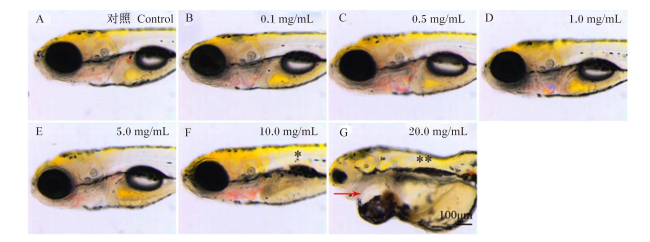
表4可知,麻叶荨麻乙醇提取液浓度在5.0 mg/mL以下时,对斑马鱼胚胎畸形率无显著影响(P>0.05);在受精后72 h时,20.0 mg/mL麻叶荨麻组斑马鱼胚胎畸形率显著提高(P<0.05);在受精后96和120 h时,10.0和20.0麻叶荨麻组斑马鱼胚胎畸形率显著提高(P<0.05)。图1展示了斑马鱼鱼鳔面积、鱼尾弯曲比例和心囊面积。在受精后72 h时,斑马鱼胚胎出现畸形,主要表现为鳔的膨胀不足;在受精后120 h时,除了鳔的膨胀不足和尾部弯曲外,20.0 mg/mL麻叶荨麻组还出现心囊浮肿。由表5可知,与对照组相比,10.0和20.0 mg/mL麻叶荨麻组鱼尾弯曲比例显著升高(P<0.05),鱼鳔面积显著减小(P<0.05);20.0 mg/mL麻叶荨麻组心囊水肿面积显著增大(P<0.05)。
表4 麻叶荨麻对斑马鱼胚胎畸形率的影响

Table 4 Effects of Urtica cannabina L. on embryo malformation rate of zebrafish%

时间
Time/h
麻叶荨麻乙醇提取液浓度 Urtica cannabina L. ethanol extract concentration/(mg/mL)
0(对照 Control) 0.1 0.5 1.0 5.0 10.0 20.0
4 0.00±0.00 0.00±0.00 0.00±0.00 0.00±0.00 0.00±0.00 0.00±0.00 0.00±0.00
24 0.00±0.00 0.00±0.00 0.00±0.00 0.00±0.00 0.00±0.00 0.00±0.00 0.00±0.00
48 0.00±0.00 0.00±0.00 0.00±0.00 0.00±0.00 0.00±0.00 0.00±0.00 0.00±0.00
72 0.00±0.00a 0.00±0.00a 0.00±0.00a 0.00±0.00a 0.00±0.00a 10.00±17.32a 53.33±15.27b
96 0.00±0.00a 0.00±0.00a 0.00±0.00a 0.00±0.00a 0.00±0.00a 33.33±5.77b 60.00±17.32c
120 0.00±0.00a 0.00±0.00a 0.00±0.00a 0.00±0.00a 0.00±0.00a 33.33±5.77b 76.66±15.27c
图1 麻叶荨麻对斑马鱼胚胎发育的影响

A~G分别表示麻叶荨麻乙醇提取液浓度为0、0.1、0.5、1.0、5.0、10.0和20.0 mg/mL;*表示P<0.05,**表示P<0.01。

Fig.1 Effects of Urtica cannabina L. on embryo development of zebrafish (100×)

A to G indicated that Urtica cannabina L. ethanol extract concentrations were 0, 0.1, 0.5, 1.0, 5.0, 10.0 and 20.0 mg/mL, respectively; * mean P<0.05, and ** mean P<0.01.

表5 麻叶荨麻对斑马鱼胚胎发育影响的量化分析

Table 5 Quantitative analysis of effects of Urtica cannabina L. on embryo development of zebrafish

项目
Items
麻叶荨麻乙醇提取液浓度 Urtica cannabina L. ethanol extract concentration/(mg/mL)
0(对照 Control) 0.1 0.5 1.0 5.0 10.0 20.0
鱼尾弯曲比例
Fish tail curve rate/%
0.00±0.00a 0.00±0.00a 0.00±0.00a 0.00±0.00a 0.00±0.00a 33.33±5.77b 50.00±20.00c
鱼鳔面积
Area of swim
bladder/mm2
0.031±0.003b 0.028±0.002b 0.028±0.002b 0.030±0.002b 0.033±0.003b 0.019±0.011a 0.013±0.003a
心囊水肿面积
Area of pericardial
edema/mm2
0.014±0.001a 0.013±0.002a 0.013±0.003a 0.015±0.002a 0.015±0.003a 0.025±0.014a 0.042±0.004b

2.3 麻叶荨麻对LPS诱导斑马鱼肠道发育的影响

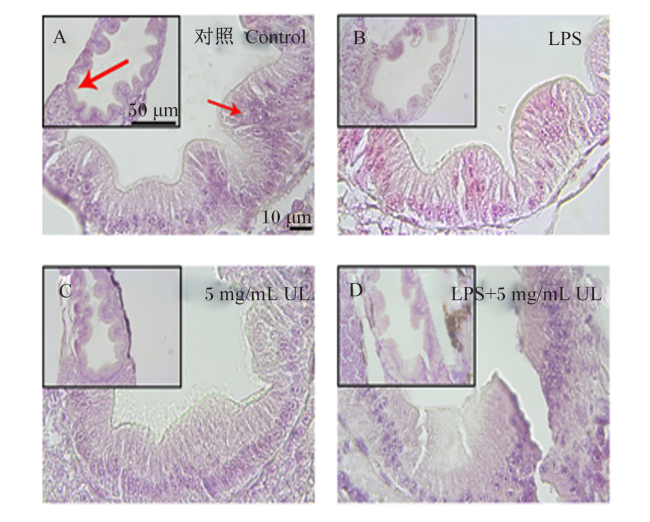
表6图2可知,各组间斑马鱼肠道杯状细胞数量无显著差异(P>0.05),LPS和麻叶荨麻对斑马鱼肠道杯状细胞数量有显著交互作用(P<0.05)。
表6 麻叶荨麻对LPS诱导斑马鱼肠道杯状细胞数量的影响

Table 6 Effects of Urtica cannabina L. on goblet cell number in intestinal tract of zebrafish induced by LPS

项目
Item
未诱导 Without induction LPS诱导 LPS induction PP-value
对照组
Control
group
5.0 mg/mL
麻叶荨麻组
5.0 mg/mL
Urtica
cannabina
L. group
LPS组
LPS
group
5 mg/mL麻叶
荨麻+LPS组
5.0 mg/mL
Urtica
cannabina L.+
LPS group
脂多糖
LPS
麻叶荨麻
Urtica
cannabina L.
脂多糖×
麻叶荨麻
LPS×Urtica
cannabina L.
杯状细胞数量
Goblet cell number/
(个/50 μm2)
66.33±5.50 64.66±3.51 53.33±11.50 71.33±5.13 0.08 0.46 0.04
图2 麻叶荨麻对LPS诱导斑马鱼肠道变化的影响

A~D分别表示对照组、LPS组、5.0 mg/mL麻叶荨麻组和5 mg/mL麻叶荨麻+LPS组。低倍率为400×,高倍率为1 000×。

Fig.2 Effects of Urtica cannabina L. on intestinal changes of zebrafish induced by LPS

A to D indicated control group, LPS group, 5.0 mg/mL Urtica cannabina L. group and 5.0 mg/mL Urtica cannabina L.+LPS group, respectively. Low multiplier was 400×, and high multiplier was 1 000×.

2.4 麻叶荨麻对LPS诱导斑马鱼幼鱼炎症相关基因表达的影响

表7可知,与对照组相比,LPS组斑马鱼幼鱼白细胞介素-6(IL-6)和肿瘤坏死因子-α(TNF-α)mRNA相对表达量显著提高(P<0.05);与LPS组相比,5.0 mg/mL麻叶荨麻+LPS组斑马鱼幼鱼白细胞介素-8(IL-8)和TNF-α mRNA相对表达量显著降低(P<0.05)。
表7 麻叶荨麻对LPS诱导斑马鱼幼鱼炎症相关基因表达的影响

Table 7 Effects of Urtica cannabina L. on expression of genes associated with inflammation in juvenile zebrafish induced by LPS

项目
Items
未诱导 Without induction LPS诱导 LPS induction PP-value
对照组
Control
group
5.0 mg/mL
麻叶荨麻组
5.0 mg/mL
Urtica
cannabina L.
group
LPS组
LPS
group
5.0 mg/mL麻叶
荨麻+LPS组
5.0 mg/mL
Urtica
cannabina L.+
LPS group
脂多糖
LPS
麻叶荨麻
Urtica
cannabina
L.
脂多糖×
麻叶荨麻
LPS×Urtica
cannabina
L.
白细胞介素-6 IL-6 1.00±0.74a 0.74±0.22a 5.12±4.75b 1.10±0.79ab 0.04 0.03 0.07
白细胞介素-8 IL-8 1.00±0.41ab 1.25±0.64ab 5.20±5.60b 0.65±0.18a 0.04 0.11 0.04
肿瘤坏死因子-α
TNF-α
1.00±0.28a 0.87±0.29a 4.77±2.85b 0.72±0.03a 0.03 0.06 0.04

2.5 麻叶荨麻对LPS诱导雏鸡体重的影响

表8可知,第8~10天,各组间雏鸡体重均无显著差异(P>0.05)。
表8 麻叶荨麻对LPS诱导雏鸡体重的影响

Table 8 Effects of Urtica cannabina L. on body weight of chicks induced by LPS

时间
Time
未诱导 Without induction LPS诱导 LPS induction PP-value
对照组
Control
group
3%麻叶
荨麻组
3% Urtica
cannabina L.
group
6%麻叶
荨麻组
6% Urtica
cannabina L.
group
LPS组
LPS
group
3%麻叶荨
麻+LPS组
3% Urtica
cannabina
L.+LPS
group
6%麻叶荨
麻+LPS组
6% Urtica
cannabina
L.+LPS
group
脂多糖
LPS
麻叶
荨麻
Urtica
cannabina
L.
脂多糖×
麻叶荨麻
LPS×
Urtica
cannabina
L.
第8天
Day 8
214.65
±64.93
213.29
±43.01
203.90
±42.15
200.34
±28.84
204.49
±16.15
216.04
±27.95
0.60 0.85 0.98
第9天
Day 9
234.51
±74.45
238.67
±47.19
208.59
±59.09
205.99
±46.68
225.71
±14.42
221.41
±28.69
0.52 0.91 0.91
第10天
Day 10
246.51
±70.21
247.03
±43.71
224.61
±62.54
213.27
±56.22
233.21
±12.22
237.24
±31.22
0.47 0.92 0.89

2.6 麻叶荨麻对LPS诱导雏鸡十二指肠发育的影响

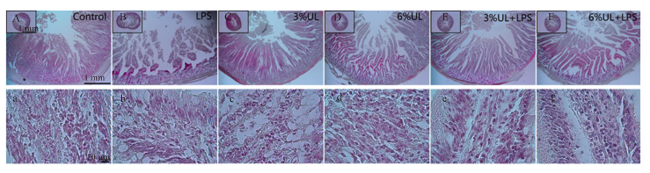
表9图3可知,与对照组相比,LPS组雏鸡十二指肠绒毛高度和绒毛高度/隐窝深度值显著降低(P<0.05);与LPS组相比,3%麻叶荨麻+LPS组和6%麻叶荨麻+LPS组十二指肠绒毛高度和绒毛高度/隐窝深度值显著提高(P<0.05),且与对照组相比均无显著差异(P>0.05)。LPS和麻叶荨麻对雏鸡十二指肠绒毛高度和绒毛高度/隐窝深度值有显著交互作用(P<0.05)。
表9 麻叶荨麻对LPS诱导雏鸡十二指肠发育的影响

Table 9 Effects of Urtica cannabina L. on duodenum development of chicks induced by LPS

项目
Items
未诱导 Without induction LPS诱导 LPS induction PP-value
对照组
Control
group
3%麻叶
荨麻组
3% Urtica
cannabina L.
group
6%麻叶
荨麻组
6% Urtica
cannabina L.
group
LPS组
LPS
group
3%麻叶荨
麻+LPS组
3% Urtica
cannabina
L.+LPS
group
6%麻叶荨
麻+LPS组
6% Urtica
cannabina
L.+LPS
group
脂多糖
LPS
麻叶
荨麻
Urtica
cannabina
L.
脂多糖×
麻叶荨麻
LPS×
Urtica
cannabina
L.
绒毛高度
Villus height/
mm
0.96
±0.21b
0.75
±0.05b
0.88
±0.10b
0.34
±0.07a
0.94
±0.24b
0.85
±0.01b
0.04 0.04 0.01
绒毛宽度
Villus width/
mm
0.08
±0.01
0.11
±0.04
0.07
±0.03
0.07
±0.02
0.09
±0.01
0.11
±0.03
0.86 0.27 0.28
绒毛面积
Villus area/
mm2
0.06
±0.01
0.08
±0.04
0.06
±0.01
0.05
±0.02
0.10
±0.01
0.09
±0.02
0.35 0.10 0.41
隐窝深度
Crypt depth/
mm
0.23
±0.01
0.26
±0.04
0.31
±0.16
0.41
±0.10
0.28
±0.04
0.35
±0.05
0.79 0.51 0.23
绒毛高度/
隐窝深度
Villus height/
crypt depth
4.18
±0.90b
3.18
±0.74b
4.04
±1.03b
0.62
±0.40a
3.46
±1.25b
3.47
±0.32b
0.04 0.02 0.02
图3 麻叶荨麻对LPS诱导雏鸡十二指肠发育的影响

A(a)~F(f)分别表示对照组、LPS组、3%麻叶荨麻组、6%麻叶荨麻组、3%麻叶荨麻+LPS组和6%麻叶荨麻+LPS组。低倍率为40×,中倍率为400×,高倍率为1 000×。

Fig.3 Effects of Urtica cannabina L. on duodenum development of chicks induced by LPS

A (a) to F(f) indicated control group, LPS group, 3% Urtica cannabina L. group, 6% Urtica cannabina L. group 3% Urtica cannabina L. group+LPS group and 6% Urtica cannabina L.+LPS group, respectively. Low multiplier was 40×, medium multiplier was 400×, and high multiplier was 1 000×.

2.7 麻叶荨麻对LPS诱导雏鸡十二指肠杯状细胞数量的影响

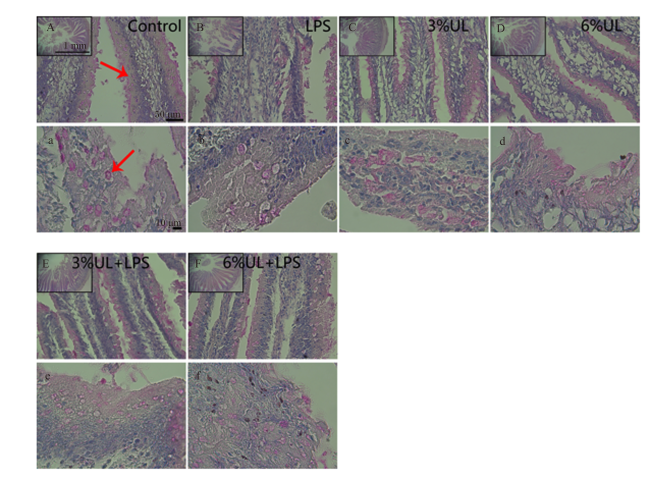
表10图4可知,与对照组相比,LPS组雏鸡十二指肠杯状细胞数量显著减少(P<0.05);与LPS组相比,3%麻叶荨麻+LPS组和6%麻叶荨麻+LPS组十二指肠杯状细胞数量有增加趋势(P>0.05),且与对照组相比无显著差异(P>0.05)。
表10 麻叶荨麻对LPS诱导雏鸡十二指肠杯状细胞数量的影响

Table 10 Effects of Urtica cannabina L. on goblet cell number in duodenum of chicks induced by LPS

项目
Item
未诱导 Without induction LPS诱导 LPS induction PP-value
对照组
Control
group
3%麻叶
荨麻组
3% Urtica
cannabina L.
group
6%麻叶
荨麻组
6% Urtica
cannabina L.
group
LPS组
LPS
group
3%麻叶荨
麻+LPS组
3% Urtica
cannabina
L.+LPS
group
6%麻叶荨
麻+LPS组
6% Urtica
cannabina
L.+LPS
group
脂多糖
LPS
麻叶
荨麻
Urtica
cannabina
L.
脂多糖×
麻叶荨麻
LPS×
Urtica
cannabina
L.
杯状细胞
数量
Goblet cell
number/
(个/mm2)
143.00
±8.54b
159.00
±21.16b
148.00
±13.50b
79.00
±7.81a
135.00
±33.28ab
109.33
±8.62ab
0.03 0.01 0.25
图4 麻叶荨麻对LPS诱导雏鸡十二指肠杯状细胞数量的影响

A(a)~F(f)分别表示对照组、LPS组、3%麻叶荨麻组、6%麻叶荨麻组、3%麻叶荨麻+LPS组和6%麻叶荨麻+LPS组。低倍率为200×,中倍率为400×,高倍率为1 000×。

Fig.4 Effects of Urtica cannabina L. on goblet cell number in duodenum of chicks induced by LPS

A (a) to F(f) indicated control group, LPS group, 3% Urtica cannabina L. group, 6% Urtica cannabina L. group 3% Urtica cannabina L. group+LPS group and 6% Urtica cannabina L.+LPS group, respectively. Low multiplier was 200×, medium multiplier was 400×, and high multiplier was 1 000×.

2.8 麻叶荨麻对LPS诱导雏鸡十二指肠免疫相关基因表达的影响

表11可知,与对照组相比,LPS组雏鸡十二指肠IL-6和TNF-α mRNA相对表达量显著提高(P<0.05);与LPS组相比,3%麻叶荨麻+LPS组和6%麻叶荨麻+LPS组十二指肠IL-6和TNF-α mRNA相对表达量显著降低(P<0.05),且与对照组相比均无显著差异(P>0.05)。
表11 麻叶荨麻对LPS诱导雏鸡十二指肠免疫相关基因表达的影响

Table 11 Effects of Urtica cannabina L. on expression of genes associated with immunity in duodenum induced by LPS in chicks

项目
Items
未诱导 Without induction LPS诱导 LPS induction PP-value
对照组
Control
group
3%麻叶
荨麻组
3% Urtica
cannabina L.
group
6%麻叶
荨麻组
6% Urtica
cannabina L.
group
LPS组
LPS
group
3%麻叶荨
麻+LPS组
3% Urtica
cannabina
L.+LPS
group
6%麻叶荨
麻+LPS组
6% Urtica
cannabina
L.+LPS
group
脂多糖
LPS
麻叶
荨麻
Urtica
cannabina
L.
脂多糖×
麻叶荨麻
LPS×
Urtica
cannabina
L.
白细胞介素-6
IL-6
1.00
±0.24a
1.21
±0.48a
1.03
±0.55a
4.41
±2.19b
0.88
±0.83a
0.75
±0.92a
0.02 0.09 0.01
白细胞介素-8
IL-8
1.00
±0.26
1.12
±0.05
1.19
±0.08
1.65
±1.40
0.80
±0.64
0.86
±0.69
0.65 1.00 0.41
肿瘤坏死因子-α
TNF-α
1.00
±0.23a
1.19
±0.60a
1.34
±0.70a
4.94
±2.82b
0.83
±0.54a
0.96
±0.60a
0.03 0.09 0.01

3 讨论

本研究利用斑马鱼胚胎评估麻叶荨麻的安全性,并利用雏鸡探索了麻叶荨麻作为饲料添加剂的作用。结果发现,高浓度(≥10.0 mg/mL,相当于≥55.0 g/kg BW)麻叶荨麻乙醇提液造成斑马鱼胚胎严重畸形,但低浓度(≤5.0 mg/mL,相当于≤27.5 g/kg BW)麻叶荨麻乙醇提液对LPS诱导的肠道杯状细胞数量降低有一定的抑制趋势;同样,麻叶荨麻对LPS诱导的雏鸡十二指肠绒毛高度和杯状细胞数量降低有一定恢复作用。

3.1 麻叶荨麻的安全性

关于麻叶荨麻乙醇提取物的安全性,有研究学者通过体内注射和喂饲发现,麻叶荨麻都有较高的安全性。当麻叶荨麻提取液注入小鼠腹腔时,麻叶荨麻提取液的半数致死量(LD50)为3.5 g/kg BW[17]。在15 d口服试验中,使用雌性和雄性小鼠(23~37 g)进行急性毒性试验,口服12 g/kg BW的麻叶荨麻叶片粗水提取物也没有造成小鼠死亡及显著的外观变化,表明LD50要高于12 g/kg BW,提示麻叶荨麻对小鼠的毒性作用极低[18]。本研究发现,10.0 mg/mL(相当于55.0 g/kg BW)麻叶荨麻乙醇提取液造成斑马鱼幼鱼的畸形(斑马鱼胚胎鱼鳔膨胀不足、尾部弯曲等畸形),但并没有引起死亡;此时的斑马鱼处于胚胎器官发育期,考虑可能是麻叶荨麻叶片中的多酚羧酸、黄酮、香豆素、甾醇、类胡萝卜素、凝集素、叶绿素、抗坏血酸和单宁等化学成分造成了负面影响[19-20],引起胚胎半数死亡的剂量要接近40 mg/mL(LC50=39.23 mg/mL,相当于215.8 g/kg BW)。此外,通过雏鸡饲养试验发现,在饲粮中添加6%麻叶荨麻(15 g/kg BW)时,没有造成雏鸡死亡,表明LD50要高于30 g/kg BW,以上对比表明麻叶荨麻对雏鸡的毒性作用极低。不过,研究发现,从麻叶荨麻叶中分离出的黄酮类化合物对凝血酶诱导的小鼠血小板聚集产生强烈的抑制作用[18],这提示给妊娠期家畜和幼畜饲粮添加麻叶荨麻时,应注意控制在15 g/kg BW或者6%饲粮以下。

3.2 麻叶荨麻对LPS诱导斑马鱼及雏鸡肠道发育障碍的防护作用

LPS是革兰氏阴性菌外壁的主要成分,能触发促炎细胞因子、血小板活化因子、前列腺素、酶和自由基(如一氧化氮)的增加,导致心肌、肺脏和肠道的炎症反应[21]。迄今为止,LPS已广泛用于炎症疾病的研究和炎症疾病模型的构建[22]。Zhu等[22]用LPS建立斑马鱼肠道炎症模型发现,LPS可诱导杯状细胞数量的显著减少(减少43%),表明肠黏膜受损。在虹鳟鱼饲料中添加3%的麻叶荨麻粉不仅能显著提高虹鳟鱼体重、比生长率和饲料转化率,还能提高鱼体自身免疫力[23]。0.1 g/kg麻叶荨麻甲醇提取物能促进慈鲷鱼生长性能的提高,改善代谢和免疫功能[24]。本研究采用100 ng/mL LPS诱导斑马鱼胚胎肠道发生炎症反应,结果发现引起肠道杯状细胞数量的减少,而添加麻叶荨麻恢复了LPS诱导造成的杯状细胞数量的减少,这与Guo等[25]和Ren等[26]的研究结果相符。
LPS会造成鸡肠道绒毛稀疏,肠腺结构模糊,绒毛膜破裂,甚至肿胀并脱落,以及中央乳糜管狭窄和回肠黏膜变薄;LPS也会降低肠道绒毛高度和绒毛高度/隐窝深度值,同时增加隐窝深度;组织学观察到LPS会导致大量炎性细胞浸润,血管结构断裂,管腔中观察到坏死组织[27-29]。本研究结果同样发现,LPS造成雏鸡十二指肠绒毛高度和绒毛高度/隐窝深度值显著降低,而添加麻叶荨麻会使十二指肠绒毛高度和绒毛高度/隐窝深度值恢复到正常水平。
当促炎因子作用于有机体时,免疫系统将被激活,免疫细胞释放促炎细胞因子,如IL-6和TNF-α等,并触发炎症反应[30-31]。研究发现,在LPS刺激下,斑马鱼活性氧(ROS)水平提高,炎症相关因子[如白细胞介素-1β(IL-1β)、IL-6和TNF-α]表达上调[30]。Zhu等也通过LPS诱导斑马鱼肠道炎症,并诱导炎症因子如IL-6、IL-8、白细胞介素-10(IL-10)和TNF-α的异常高表达[22]。在本试验中,LPS同样诱导斑马鱼幼鱼和雏鸡十二指肠炎症因子IL-6、IL-8和TNF-α表达的异常升高,而添加麻叶荨麻抑制了斑马鱼幼鱼和雏鸡十二指肠炎症因子的异常表达,表明麻叶荨麻能够有效缓解LPS诱导的肠道炎症。
ROS是宿主防御所必需的,由吞噬细胞响应微生物和炎症刺激而产生,在炎症性疾病的进展中发挥重要作用,过量的ROS导致诱导型一氧化氮合酶(iNOS)、环氧合酶-2(COX-2)表达上调,并诱导促炎细胞因子释放。此外,LPS还通过调节核因子-κB(NF-κB)来增加炎症因子的释放,从而诱导斑马胚胎的炎症[32-33]。因此,可以推测麻叶荨麻中的部分活性物质可能是通过调节ROS或NF-κB来降低由LPS引起的炎症相关因子的异常表达,使之恢复到正常水平。

4 结论

① 麻叶荨麻乙醇提取液在5 mg/mL浓度下(27.5 g/kg BW)对斑马鱼胚胎无显著影响,能够恢复由LPS诱导的斑马鱼肠道杯状细胞数量的减少,抑制炎症因子的表达异常升高。
② 麻叶荨麻按照6%(15 g/kg BW)加入到雏鸡饲粮中,可恢复LPS诱导的雏鸡十二指肠形态结构的破坏和杯状细胞数量的减少,抑制炎症因子表达的异常升高,提高雏鸡免疫能力。
[1]
文明, 永海. 内蒙古畜牧业高质量发展现状、面临的挑战及对策研究[J]. 内蒙古社会科学, 2022, 43(2):205-212.

WEN M, YONG H. Study on the current situation,challenges and countermeasures of high-quality development of animal husbandry in Inner Mongolia[J]. Inner Mongolia Social Sciences, 2022, 43(2):205-212. (in Chinese)

[2]
靳延平, 白音, 王建龙, 等. “十三五”内蒙古自治区畜牧业发展新举措——基于“稳羊增牛扩猪禽”发展思路的调查研究[J]. 畜牧与饲料科学, 2017, 38(1):60-69.

JIN Y P, BAI Y, WANG J L, et al. New measures for the development of animal husbandry in Inner Mongolia Autonomous Region during the 13th Five-Year Plan[J]. Animal Husbandry and Feed Science, 2017, 38(1):60-69. (in Chinese)

[3]
贺志雄, 周传社, 王敏, 等. 草食畜牧业乳肉功能性产品发展的战略思考[J]. 中国科学院院刊, 2021, 36(6):685-691.

HE Z X, ZHOU C S, WANG M, et al. Developing strategies of functional milk and meat products from herbivorous animal husbandry[J]. Bulletin of Chinese Academy of Sciences, 2021, 36(6):685-691. (in Chinese)

[4]
李亚楠, 马哈亚·艾斯江, 瞿菁晨, 等. 麻叶荨麻化学成分、药理作用及应用研究进展[J]. 中国野生植物资源, 2022, 41(10):54-59.

LI Y N, AISIJIANG M, ZHAI J C, et al. Research progress on chemical constituents,pharmacological effects and application of Urtica cannabina L.[J]. Chinese Wild Plant Resources, 2022, 41(10):54-59. (in Chinese)

[5]
刘乌云, 萨如拉, 齐澈力木格, 等. 麻叶荨麻与尖头叶藜混合干草替代天然牧草干草对蒙古公牛生长性能、体尺指标和养分表观消化率的影响[J]. 动物营养学报, 2022, 34(5):3023-3031.

DOI

LIU W Y, SA R L, QI C L M G, et al. Effects of replacing natural grass hay with mixed hay of Urtica cannabina L. and Chenopodium acuminata on growth performance,body size indexes and nutrient apparent digestibility of Mongolian bulls[J]. Chinese Journal of Animal Nutrition, 2022, 34(5):3023-3031. (in Chinese)

[6]
中国科学院中国植物志编辑委员会. 中国植物志:第二十三卷第二分册[M]. 北京: 科学出版社, 1995:1-448.

Editorial Committee of Flora of China,Chinese Academy of Sciences. Flora of China:Volume 23,Division 2[M]. Beijing: Science Press, 1995:1-448. (in Chinese)

[7]
何斌. 异株荨麻的生物学特性和栽培技术研究[D]. 硕士毕业论文. 北京: 北京林业大学, 2008.

HE B. Studies on biological characteristics and cultivation techniques of Urtica dioica L.[D]. Master’s Thesis. Beijing: Beijing Forestry University, 2008. (in Chinese)

[8]
敖特根白音, 李运起, 韩艳华, 等. 国内外麻叶荨麻的研究进展[J]. 中国野生植物资源, 2015, 34(1):32-36.

AO T G B Y, LI Y Q, HAN Y H, et al. Research progress of hempleaf nettle (Urtica cannabina L.) both at home and abroad[J]. Chinese wild plant resources, 2015, 34(1):32-36. (in Chinese)

[9]
张晓庆, 李维红, 金艳梅, 等. 麻叶荨麻的养分积累及饲用品质评价[J]. 中国草地学报, 2010, 32(1):116-120.

ZHANG X Q, LI W H, JIN Y M, et al. Accumulation of nutrients and the feed quality evaluation of hempleaf nettle (Urtica cannabina L.)[J]. Chinese journal of grassland, 2010, 32(1):116-120. (in Chinese)

[10]
刘悦秋, 孙向阳. 异株荨麻的活性成分及开发利用[J]. 国外医学(中医中药分册), 2005(3):144-148.

LIU Y Q, SUN X Y. Active components and development and utilization of Urtica dioica[J]. Foreign Medicine (Volume of Traditional Chinese Medicine), 2005(3):144-148. (in Chinese)

[11]
邹林有. 青海高原麻叶荨麻主要营养物质动态变化研究[J]. 辽宁林业科技, 2012(5):20-22.

ZOU L Y. Study on dynamic variation of main nutrients of Urtica cannabina in Qinghai plateau[J]. Liaoning forestry science and technology, 2012(5):20-22. (in Chinese)

[12]
胡剑非, 孙向阳, 陈惠云, 等. 荨麻属植物的化学成分及药理活性研究进展[J]. 宁波农业科技, 2006(2):19-22.

HU J F, SUN X Y, CHEN H Y, et al. Research progress in chemical constituents and pharmacological activities of Urtica[J]. Ningbo Agricultural Science and Technology, 2006(2):19-22. (in Chinese)

[13]
张嫚丽. 麻叶荨麻化学成分及抗炎药理活性初步研究[D]. 石家庄: 河北医科大学, 2004.

ZHANG M L. Study of components in Urtica cannabina L. and it’s anti-inflammation action[D]. Shijiazhuang: Hebei Medical University, 2004. (in Chinese)

[14]
高楠. Ⅰ放线菌1146活性代谢产物跟踪分离及结构鉴定Ⅱ荨麻药材质量研究[D]. 硕士学位论文. 北京: 中国人民解放军军事医学科学院, 2006.

GAO N. Ⅰ isolation and structure identification of active compounds from soil actionmycetes 1146 Ⅱ quality study on medical material of Urtica cannabina L.[D]. Master’s Thesis. Beijing: Academy of Military Medical Sciences, 2006. (in Chinese)

[15]
李喆. 麻叶荨麻叶化学成分、多糖含量测定及抗炎活性的研究[D]. 硕士学位论文. 石家庄: 河北医科大学, 2008.

LI Z. Study of components and the assaying of polysaccharide leaves of Urtica cannabina L. and its anti-inflammation action[D]. Master’s Thesis. Shijiazhuang: Hebei Medical University, 2008. (in Chinese)

[16]
张珩. 麻叶荨麻浸膏的抗炎和镇痛作用[J]. 临床医学研究与实践, 2018, 3(21):50-51,54.

ZHANG H. Anti-inflammatory and analgesic effects of Urtia cannabina L. extract[J]. Clinical Research And Practice, 2018, 3(21):50-51,54. (in Chinese)

[17]
BNOUHAM M, MERHFOUR F Z, ZIYYAT A, et al. Antihyperglycemic activity of the aqueous extract of Urtica dioica[J]. Fitoterapia, 2003, 74(7/8):677-681.

DOI

[18]
EL HAOUARI M, BNOUHAM M, BENDAHOU M, et al. Inhibition of rat platelet aggregation by Urtica dioica leaves extracts[J]. Phytotherapy Research, 2006, 20(7):568-572.

DOI

[19]
EL HAOUARI M, ROSADO J A. Phytochemical,anti-diabetic and cardiovascular properties of Urtica dioica L. (Urticaceae):a review[J]. Mini-Reviews in Medicinal Chemistry, 2019, 19(1):63-71.

DOI

[20]
王晨曦, 王作强, 李育晓, 等. 荨麻叶的化学成分研究[J/OL]. 云南民族大学学报(自然科学版), 2023(5):1-10.(2022-06-15)[2022-09-20]. http://kns.cnki.net/kcms/detail/53.1192.N.20220615.1326.002.html.

WANG C X, WANG Z Q, LI Y X, et al. Studies on chemical constituents of Urtica fissa leaves[J/OL]. Journal of Yunnan Minzu University (Natural Sciences Edition), 2023(5):1-10.(2022-06-15)[2022-09-20]. http://kns.cnki.net/kcms/detail/53.1192.N.20220615.1326.002.html. in Chinese)

[21]
ZHOU M X, XU W M, WANG J Z, et al. Boosting mTOR-dependent autophagy via upstream TLR4-MyD88-MAPK signalling and downstream NF-κB pathway quenches intestinal inflammation and oxidative stress injury[J]. EBioMedicine, 2018, 35:345-360.

DOI PMID

[22]
ZHU H J, WANG Z H, WANG W X, et al. Bacterial quorum-sensing signal DSF inhibits LPS-induced inflammations by suppressing Toll-like receptor signaling and preventing lysosome-mediated apoptosis in zebrafish[J]. International Journal of Molecular Sciences, 2022, 23(13):7110.

DOI

[23]
SAEIDI ASL M R, ADEL M, CAIPANG C M A, et al. Immunological responses and disease resistance of rainbow trout (Oncorhynchus mykiss) juveniles following dietary administration of stinging nettle (Urtica dioica)[J]. Fish & Shellfish Immunology, 2017, 71:230-238.

[24]
JAFARI N, ABDOLLAHPOUR H, KARIMZADEH M, et al. A potential role of nettle (Urtica dioica) extract on growth,biochemical changes and reproductive performance of convict cichlid (Amatitlania nigrofasciata)[J]. Fish Physiology and Biochemistry, 2022, 48(1):133-144.

DOI

[25]
GUO C L, GUO D D, FANG L, et al. Ganoderma lucidum polysaccharide modulates gut microbiota and immune cell function to inhibit inflammation and tumorigenesis in colon[J]. Carbohydrate Polymers, 2021, 267:118231.

DOI

[26]
REN S Q, HUI Y, GOERICKE-PESCH S, et al. Gut and immune effects of bioactive milk factors in preterm pigs exposed to prenatal inflammation[J]. American Journal of Physiology:Gastrointestinal and Liver Physiology, 2019, 317(1):G67-G77.

DOI

[27]
KABAROUDIS A, PAPAZIOGAS B, KOUTELIDAKIS I, et al. Disruption of the small-intestine mucosal barrier after intestinal occlusion:a study with light and electron microscopy[J]. Journal of Investigative Surgery, 2003, 16(1):23-28.

DOI

[28]
CUI Y, QU Y Y, YIN K, et al. Selenomethionine ameliorates LPS-induced intestinal immune dysfunction in chicken jejunum[J]. Metallomics, 2021, 13(3):mfab003.

DOI

[29]
LV Z P, DAI H J, WEI Q W, et al. Dietary genistein supplementation protects against lipopolysaccharide-induced intestinal injury through altering transcriptomic profile[J]. Poultry Science, 2020, 99(7):3411-3427.

DOI PMID

[30]
XIE Y F, MEIJER A H, SCHAAF M J M. Modeling inflammation in zebrafish for the development of anti-inflammatory drugs[J]. Frontiers in Cell and Developmental Biology, 2020, 8:620984.

DOI

[31]
CHEN L L, DENG H D, CUI H M, et al. Inflammatory responses and inflammation-associated diseases in organs[J]. Oncotarget, 2018, 9(6):7204-7218.

DOI PMID

[32]
KO E Y, CHO S H, KWON S H, et al. The roles of NF-κB and ROS in regulation of pro-inflammatory mediators of inflammation induction in LPS-stimulated zebrafish embryos[J]. Fish & Shellfish Immunology, 2017, 68:525-529.

[33]
LEAVY O. Inflammation:regulating ROS[J]. Nature Reviews Immunology, 2014, 14(6):357.

Outlines

/