REVIEW

Regulation of Short Chain Fatty Acids on Glucose and Lipid Metabolism and Intestinal Barrier in Ruminants and Their Application in Production

  • WANG Haibo , 1, 2 ,
  • ZHAN Jinshun 1 ,
  • HUO Junhong , 1, * ,
  • LIU Yuhang 1, 2
Expand
  • 1 Institute of Animal Husbandry and Veterinary, Jiangxi Academy of Agricultural Sciences, Nanchang 330200, China
  • 2 College of Animal Science and Technology, Gansu Agricultural University, Lanzhou 730070, China
* professor, E-mail:

Received date: 2022-11-25

  Online published: 2023-07-11

Abstract

The complex and diverse microbial communities in animal digestive tract metabolize nutrients and produce short chain fatty acids (SCFAs), bioamines and other active substances involved in host physiological regulation. Among them, the SCFAs produced by microbial fermentation are mainly acetic acid, propionic acid and butyric acid, and have various biological functions such as participating in metabolic regulation, promoting gastrointestinal development, alleviating tissue inflammation, enhancing immune function, regulating gastrointestinal microbial community and maintaining intestinal barrier function. In this paper, the involvement of SCFAs in the regulation of glucose and lipid metabolism homeostasis and intestinal barrier in ruminants and their application in animal production were reviewed, providing a theoretical basis for the development of SCFAs as functional feed additives in ruminant production.

Cite this article

WANG Haibo , ZHAN Jinshun , HUO Junhong , LIU Yuhang . Regulation of Short Chain Fatty Acids on Glucose and Lipid Metabolism and Intestinal Barrier in Ruminants and Their Application in Production[J]. Chinese Journal of Animal Nutrition, 2023 , 35(7) : 4127 -4137 . DOI: 10.12418/CJAN2023.382

胃肠道特定微生物群发酵饲料产生的短链脂肪酸(short chain fatty acids,SCFAs)是微生物群和宿主之间互作的桥梁[1]。其中,SCFAs主要是指经胃肠道中的微生物群发酵产生能参与“微生物群落-肠道-大脑轴”(MGB)交流的由1~6个碳原子构成的直链或支链的有机羧酸[2]。其具有重塑肠道菌群结构,通过G蛋白偶联受体(GPCR)/Toll样受体(TLR)信号介导肠道免疫[3],或经MGB通路直接或间接调控机体(消化、神经、内分泌和循环系统)代谢的功能[4-5],并能通过影响组蛋白乙酰化酶和组蛋白去乙酰化酶(HDAC)活性引起表观遗传变化[1]。同时,SCFAs作为饲料添加剂,在促进动物(犊牛[6-7]、猪[8]和肉仔鸡[9])生长、维持肠道屏障[10]和组织形态[7,11-12]、增强机体抗氧化[6]和免疫能力[13]以及改善肉品质[14]等方面发挥重要功能。因此,本文对SCFAs参与动物糖和脂代谢稳态、肠道屏障的调控及其在反刍动物生产中应用研究进展进行综述,为SCFAs开发成功能性饲料添加剂在反刍动物生产中的应用提供理论依据。

1 反刍动物SCFAs的产生与转运

1.1 SCFAs的产生

SCFAs是反刍动物采食碳水化合物后,经瘤胃微生物发酵产生的直链或支链有机羧酸,其主要为乙酸、丙酸和丁酸,是参与维持反刍家畜生命活动和生产的能量来源。胃肠道微生物群发酵产生的SCFAs有50%~80%被瘤胃上皮吸收,其余部分被唾液中和或进入肠道参与机体生理调控[15]。其中,甲酸是最小的单链脂肪酸,能被转化为甲烷排除体外或通过Wood-Ljungdahl通路转化为乙酸发挥生物学功能[16]。同时,机体能够通过乙酰辅酶A途径、琥珀酸途径、丙烯酰酯途径、丙二醛途径和丁酰辅酶A/乙酰辅酶A转移酶途径参与乙酸、丙酸、丁酸、戊酸和己酸的形成;而异戊酸、异己酸等支链SCFAs主要以氨基酸(亮氨酸、异亮氨酸和缬氨酸等)为底物,通过氨基酸代谢途径合成,且氨基酸的降解也会影响乙酸和丙酸的合成[17-20]。乙酸是合成胆固醇和脂肪酸的底物,并在血液中达到最高浓度;丙酸是肝脏中葡萄糖合成的前体,有助于肝脏糖异生;丁酸优先能被肠黏膜作为能量物质;其他SCFAs(甲酸、戊酸和己酸)产生的量较少[21]。SCFAs合成途径见图1。机体产生的SCFAs的组成不仅受到发酵底物调控微生物组成和数量变化影响[20],还取决于胃肠道微生物群落结构(如拟杆菌属、双歧杆菌属、普雷沃菌属、梭菌属、瘤胃球菌属、链球菌属、粪球菌属和鼠李糖乳杆菌等的数量[22])的影响。
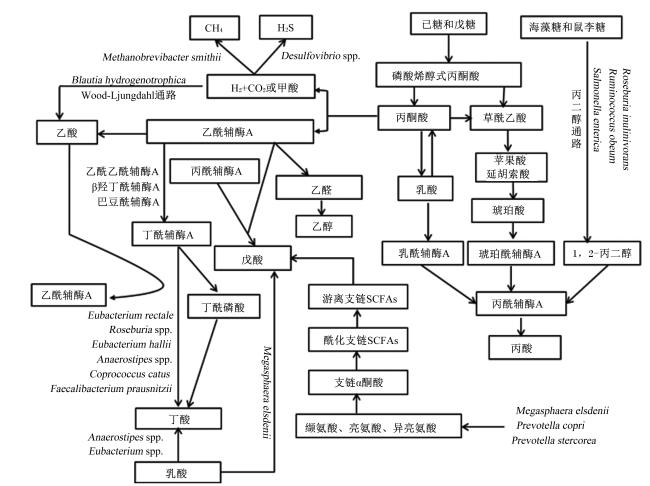
图1 SCFAs合成途径

CH4:甲烷 methane;H2S:硫化氢 sulfuretted hydrogen;H2:氢气 hydrogen;CO2:二氧化碳 carbon dioxide;Methanobrevibacter smithii:史氏甲烷短杆菌;Desulfovibrio spp.:脱硫弧菌属;Blautia hydrogenotrophica:氢营养布劳特氏菌;Eubacterium rectale:直肠真杆菌;Roseburia spp.:罗氏菌属;Eubacterium hallii:霍氏真杆菌;Anaerostipes spp.:厌氧菌属;Coprococcus catus:灵巧粪球菌;Faecalibacterium prausnitzii:普氏栖粪杆菌;Ruminococcus obeum:卵形瘤胃球菌;Salmonella enterica:肠道沙门氏菌;Megasphaera elsdenii:埃氏巨型球菌;SCFAs:短链脂肪酸 short-chain fatty acids。

Fig.1 SCFAs synthesis pathway[1,3,15,17-20]

1.2 SCFAs的转运

微生物发酵产生的SCFAs被分布在胃肠细胞和其他器官或组织中的GPCR或转运载体识别,通过不同的吸收机制进入瘤胃上皮细胞或其他代谢组织中发挥生物学功能[1]。其中,SCFAs受体主要包括G蛋白偶联受体109A[GPR109A,也称为羟基羧酸受体2(HCAR2)],G蛋白偶联受体43[GPR43,也称为游离脂肪酸受体2(FFAR2)]和G蛋白偶联受体41[GPR41,也被称为游离脂肪酸受体3(FFAR3)][1,23]。在反刍动物中,瘤胃上皮可以通过被动扩散、挥发性脂肪酸(VFA)阴离子(VFA-)/碳酸氢根离子($\text{HCO}_{3}^{-}$)离子交换、硝酸根离子($\text{NO}_{3}^{-}$)敏感性VFA吸收、质子耦合VFA-运输以及电介导途径对SCFAs进行转运吸收,但主要是以几乎存在于所有组织中的单羧酸转运体-1(MCT-1)[24]和钠偶联单羧酸转运体-1(SMCT-1)参与的主动转运;不过,当反刍动物发生亚急性瘤胃酸中毒(SARA)时,瘤胃发酵快速产生较高浓度的SCFAs,能抑制转运蛋白(SMCT-1和MCT-1)对SCFAs的转运和吸收,易造成瘤胃pH长时间处于低值,引起瘤胃内环境中嗜酸性微生物繁殖,并触发动物机体炎症的发生[15,25-26]。研究表明,瘤胃上皮乳头状突起数量增多能增加SCFAs的有效吸收面积,促进SCFAs的吸收,且当瘤胃pH维持在4.9~7.0时,有利于瘤胃上皮SCFAs的吸收,但当过高或过低的pH都会降低瘤胃上皮吸收SCFAs的能力;同时,SCFAs在瘤胃中以可解离和非解离SCFAs的形式存在,其可解离的SCFAs占大部分,非解离的SCFAs在瘤胃内环境pH偏低时,可解离SCFAs与氢离子(H+)结合形成非解离的SCFAs,对维持瘤胃pH具有重要意义[15,27]。因此,SCFAs转运易受到饲粮组成、瘤胃液pH以及瘤胃上皮形态等多种因素的共同影响[15]

2 SCFAs参与调控反刍动物糖和脂代谢及肠道屏障功能

胃肠微生物发酵产生具有生物活性的代谢物能与目标受体结合,通过局部和全身效应的代谢途径来维持机体糖和脂代谢稳态及肠道屏障功能。其中,微生物发酵产生的SCFAs被转运到机体各器官或组织对宿主发挥潜在的生理功能,但与宿主蛋白质和受体间的相互作用存在显著差异,对维持机体营养平衡、调节代谢具有重要功能。

2.1 SCFAs参与调控机体糖和脂代谢

SCFAs是肠道血流、电解质平衡和胃肠运动的重要介质和关键的信号分子,参与宿主生理调控,并为糖异生和脂肪生成等代谢途径提供含碳前体分子,通过触发信号通路来调节细胞代谢[28]。SCFAs能够提高骨骼肌组织中的一磷酸腺苷(AMP)浓度和AMP/ATP值,并与GPR41或GPR43结合或使过氧化物酶体增殖物激活受体(PPAR)δ活化,引起单磷酸腺苷酸活化蛋白激酶(AMPK)的激活,促进骨骼肌过氧化物酶体增生物激活受体γ共激活因子1α(PGC1α)的磷酸化,使脂肪酸摄取和氧化增加,葡萄糖摄取和糖生成增加,抑制脂肪生成和糖酵解[29-30],并通过调控FFAR2参与采食调节[28]。其中,丁酸盐不依赖于FFAR2,可直接促进肠细胞内肠道糖异生(IGN)基因的表达,但是丙酸盐作为IGN的底物,需结合门静脉神经中的FFAR3,经门静脉下丘脑神经通路促进IGN基因的表达,且IGN释放的葡萄糖能被门静脉葡萄糖传感器检测到,并通过外周神经系统将其信号传递到大脑[31],共同维持葡萄糖和能量稳态。Li等[32]发现,醋酸盐能提高牛肝细胞的AMP/ATP值和AMPKα磷酸化,增加脂质氧化相关PPARα靶基因的表达,且活化的AMPKα抑制了固醇调节元件结合蛋白-1c(SREBP-1c)和碳水化合物响应元件结合蛋白(ChREBP)的表达和转录活性,进而降低脂肪生成基因的表达,降低甘油三酯含量,从而减少奶牛肝脏脂肪积累。AMPK是一种系统发育上保守的丝氨酸/苏氨酸蛋白激酶,通过调节脂质代谢相关的转录因子表达参与脂质代谢调控,是机体适应环境或营养应激因素的“代谢主开关”[33],其信号通路在肝脏脂质代谢中起着重要作用。同时,丙酸能够作为反刍动物体内产生的重要生糖前体物质,可以直接促进犊牛肝细胞糖异生途径丙酮酸羧化酶(PC)、细胞质磷酸烯醇丙酮酸羧激酶1(PCK1)和线粒体磷酸烯醇丙酮酸羧激酶2(PCK2)相关基因的表达[34],并能显著升高肌内前脂肪细胞中脂肪合成2个关键转录因子PPARγ和CCAAT增强子结合蛋白α(C/EBPα)的表达,并作为信号分子通过信号转导刺激肌内前脂肪细胞的分化,具有类似激素(胰岛素)的第一信使功能[35]。综上可知,SCFAs可以通过下调背最长肌中脂肪酸合成关键酶[脂肪酸合成酶(FAS)和乙酰辅酶A羧化酶(ACC)]的表达,增强肝脏FAS和肉毒碱棕榈酰基转移酶-1a(CPT-1a)mRNA的表达,提高腹部脂肪PPARγ和脂蛋白脂酶(LPL)mRNA的表达,增加脂肪组织中甘油三酯的储存,减少全身游离脂肪酸循环[14,36],调节脂质代谢,减轻肝脏和背最长肌的脂肪沉积,促进糖和脂代谢稳态[14,37]

2.2 SCFAs调控肠道屏障功能

宿主肠道内稳态从根本上受肠道菌群或其衍生的SCFAs控制[3]。SCFAs既是肠道菌群的代谢产物,又是肠道菌群稳态的调节物质,能与受体结合,通过调节肠道pH、产生黏液、为上皮细胞提供能量的方式参与肠道物理、化学、微生物和免疫屏障的调控,促进机体非特异性防御屏障的构建,维持肠道屏障功能。

2.2.1 SCFAs与物理屏障

紧密连接是由多种蛋白组成的复合体,与肠道物理屏障密切相关,通过增加紧密连接相关蛋白的表达,抑制病原物质入侵,对维持动物肠道物理屏障具有重要意义。SCFAs能够提高AMPK的活性,加速紧密连接组装,促进紧密连接相关蛋白的表达,抑制肠道通透性,增强肠黏膜物理屏障功能[38-39]。研究发现,1%丁酸钠能够降低波尔山羊瘤胃上皮丝裂原活化蛋白激酶(MAPK)mRNA表达和磷酸化水平,并抑制蛋白激酶C的表达,通过提高闭锁小带蛋白-1(ZO-1)、闭合蛋白(occludin)、封闭蛋白-1(claudin-1)和封闭蛋白-4(claudin-4)表达减轻瘤胃上皮损伤[40];同时,包膜丁酸钠能够缓解脂多糖(LPS)应激引起的断奶羔羊肠道通透性的增加,降低机体促炎因子含量,改善肠道组织形态,维持肠道健康[41]。综上可知,SCFAs可通过改善肠道形态、降低细胞凋亡率、促进紧密连接蛋白和肠道发育相关基因[胰岛素样生长因子-1(IGF-1)、胰高血糖素样肽-2(GLP-2)等]的表达,促进肠道形态发育[42],降低大肠杆菌对紧密连接蛋白的破坏和分解[43],并提供脂肪生物合成和细胞膜生产过程中的乙酰辅酶A,保证黏膜的完整性[22],进而维持肠黏膜物理屏障。

2.2.2 SCFAs与化学屏障

肠黏膜上皮细胞(IECs)和肠腔内细菌产生的抑菌物质与肠腔内的消化液、黏液以及黏蛋白(MUC)和防御素共同构成肠道化学屏障。MUC能够阻止有害的大分子物质进入上皮细胞层,在肠道化学屏障中起着重要的作用。微生物发酵产生的丁酸盐可以提高并促进MUC2的分泌,降低致病菌黏附作用[44-45];且丁酸能通过MAPK信号通路的激活来参与调控MUC基因的转录和翻译水平,促进黏液蛋白的分泌,进而刺激细菌黏附在黏液层上,促进厚黏液层的形成,增强肠道化学屏障[46-47]。包膜丁酸钠能够通过增加杯状细胞数量,促进黏液层分泌MUC和紧密连接蛋白的表达来增强肠道屏障功能,这可能是肠道内微生物发酵产生的SCFAs通过促进肠上皮MUC2启动子的组蛋白的乙酰化/甲基化,提高MUC2的mRNA表达,增加肠黏膜黏度,促进肠上皮的修复[48]

2.2.3 SCFAs与微生物屏障

肠道中大量的有益菌(乳酸菌和双歧杆菌)能与有害菌(致病性大肠杆菌)通过竞争性抑制方式,减少有害菌对肠道的侵袭,且微生物能通过产生细菌素和SCFAs来提高肠道屏障功能[49]。SCFAs可重塑肠道微生物群落,抑制特定病原菌定植,并通过降低食糜pH,为更多有益细菌的存在提供酸性环境,进一步竞争性地排除有害细菌,维持肠道微生态系统[50];并刺激MUC的产生,抑制肠道致病性微生物(大肠杆菌、沙门氏菌或弯曲杆菌)的生长,促进有益菌的繁殖,保护肠道上皮免受毒素和致病微生物的损伤[51-52],从而改善动物肠道微生物群落结构。研究发现,羔羊断奶会引起胃肠中微生物群落紊乱,当补充丁酸钠后,其水解为丁酸能抑制一些病原菌的生长,促进有益菌的增殖以及肠道消化液的分泌,增强消化酶活性,并能通过抑制去乙酰化酶的活性,刺激巨噬细胞内内源性抗菌肽表达,以增强机体抗菌力,使羔羊紊乱的肠道微生物系统恢复平衡[53]。因此,SCFAs可增加胃肠道有益微生物的数量,抑制有害菌,维持机体代谢和肠道微生态平衡。

2.2.4 SCFAs与免疫屏障

SCFAs能够直接调控中性粒细胞、巨噬细胞、单核细胞和T细胞的分化、招募和激活,从而参与免疫细胞的免疫调节[3,54]。肠道微生物相关的SCFAs起着启动宿主代谢和免疫过程的桥梁作用,如丁酸可调控MAPK和核转录因子-κB(NF-κB)过程的磷酸化,诱导微生物介导的先天免疫,维持肠道微环境稳态[55-56]。微生物源SCFAs可通过FFAR3促进CD4+ T细胞和胰岛样细胞团(ILCs)产生白细胞介素-22(IL-22),并抑制HDAC,通过促进芳香烃受体(AhR)和缺氧诱导因子1α(HIF1α)的表达来促进IL-22的生成;SCFAs通过组蛋白修饰增加了HIF1α与IL-22启动子的结合,保护肠道免受炎症损伤[57]。研究发现,当机体处在SARA状态下,在反刍动物饲粮中添加丁酸钠能降低瘤胃内LPS浓度;同时,丁酸钠可直接抑制转录因子NF-κB活性,并抑制促炎细胞因子白细胞介素-1β(IL-1β)、白细胞介素-6(IL-6)和肿瘤坏死因子-α(TNF-α)的合成等途径,缓解奶山羊瘤胃上皮细胞的炎症反应[58]。且包膜丁酸钠可通过Toll样受体4(TLR4)/髓样分化因子88(MyD88)/NF-κB信号转导通路抑制LPS刺激引起的炎性因子的产生,对肠道损伤发挥保护作用[48]。综上所述,SCFAs主要通过以下途径诱导中性粒细胞向炎症部位趋化,增强其吞噬能力;通过GPCR途径和抑制HDAC调节T细胞功能;调节Th17、Th1和调节性T细胞的分化和功能;通过抑制HDAC抑制肠道巨噬细胞对促炎细胞因子的生成;诱导B细胞产生肠内免疫球蛋白A(IgA)[59]或通过调控促炎/抗炎细胞因子的分泌,调控GPR/TLR介导的NF-κB/MAPK/PPAR级联反应,参与免疫应答调节[3]

3 SCFAs在反刍动物生产中的应用

SCFAs是微生物发酵产生的消化道内营养因子,不仅是为胃肠上皮细胞提供能量的营养物质,还具有调节细胞分化和运动、诱导细胞凋亡、抑制细胞增殖、调控胃肠道微生物群落、控制肠道病原体、缓解组织炎症反应、改善胃肠组织形态、促进胃肠道发育、降低幼龄反刍动物腹泻、缓解断奶应激以及改善生长性能等生物学功能[40,60-64]

3.1 犊牛

反刍动物进化形成了精巧的瘤胃发酵系统,能够转化植物性饲料为机体供能。瘤胃发育不仅受粗饲料引起的机械刺激,更受到微生物发酵形成SCFAs的化学刺激[65],通过采用易发酵的碳水化合物或外源SCFAs,能够促进上皮细胞的增殖,维持上皮组织形态[66]。研究表明,在饲粮中补充丁酸能促进荷斯坦犊牛采食量和平均日增重(ADG)的提高[67],且在酸化奶中加入丁酸能够降低腹泻,缓解断奶应激,提高ADG[68]。同时,丁酸钠可通过提高热休克蛋白(HSP)27和HSP70的水平来增强犊牛的胃肠道防御系统,促进胃肠功能成熟,改善胃肠道组织形态[69]。在饲粮中添加1%丁酸钠能够提高免疫球蛋白含量,增强机体免疫力,降低断奶犊牛血清中代谢物葡萄糖、尿素氮、甘油三酯、急性期蛋白和皮质醇含量,有效缓解犊牛的断奶应激,促进犊牛断奶前后瘤胃绒毛和小肠绒毛发育,提高ADG[7]。通过促进瘤胃SCFAs的产生,可刺激瘤胃黏膜基底层干细胞的有丝分裂,并能够通过降低瘤胃黏膜的凋亡来加速瘤胃上皮的生长和成熟,增加黏膜厚度和绒毛高度,且作为犊牛皱胃、小肠和胰腺发育的有效刺激物,SCFAs能够促进养分的消化吸收[63,70-72]。因此,以促进幼龄反刍动物胃肠发育为目标的营养策略在幼龄反刍动物实践中得到了广泛的应用。

3.2 奶牛

乙酸是奶牛乳腺内乳脂合成的重要前提物,其能够显著提高奶牛乳腺上皮细胞内乳脂合成关键基因FASACC的相对表达量[73]。且通过灌注乙酸发现,乙酸能够改变牛奶乳脂组成,提高乳脂率以及乳脂中C4∶0~C16∶0脂肪酸含量,降低C18脂肪酸含量[74-75]。同时,乙酸能够通过激活AMPKα信号通路,增加牛肝细胞脂质氧化,减少脂质合成,降低奶牛肝脏脂肪积累[32]。研究表明,在饲粮中添加2.9%的乙酸钠能够提高奶牛的乳脂产量和浓度,提高奶牛乳脂合成的能力[76]。同时,丙酸可促进泌乳中期奶牛肝脏糖异生[77],并能在小肠上皮细胞吸收转运,诱导小肠上皮细胞糖异生途径关键基因的表达[78]。通过奶牛瘤胃丁酸盐灌注能够增加产丁酸菌的数量,提高厚壁菌门的丰度[79]。上述研究结果表明,SCFAs具有提高奶牛生产性能、保障奶牛健康的作用[80]

3.3 绵羊

绵羊瘤胃乙酸、丁酸产生速率的提高能够降低瘤胃pH,提高瘤胃吸收速率和瘤胃、十二指肠流通速率,但瘤胃吸收效率下降,且有50%~85%的SCFAs被瘤胃上皮所吸收,仅约15%的SCFAs进入后肠道[81]。研究发现,丁酸可以促进绵羊葡萄糖摄取和糖酵解途径及线粒体功能相关基因的表达[82],在妊娠后期繁殖母羊饲粮中添加丁酸钠能够提高湖羊采食量和养分表观消化率,增强机体抗氧化功能,提高免疫力,并改善羔羊出生重[83]。且丁酸作为反刍动物体内GLP-2释放的主要促进因子,经瘤胃上皮细胞内被氧化为β-羟丁酸,后者具有促进GLP-2释放、改善肠道功能和营养吸收以及改善反刍动物生产性能和健康的作用[84]。在断奶羔羊的研究中发现,饲粮中添加丁酸钠可提高断奶羔羊血液中GLP-2含量和肠道GLP-2蛋白表达量,并提高肠道occludin、封闭蛋白(claudin)和ZO-1蛋白表达量,降低肠道NF-κB蛋白表达量[85];刺激肠道发育相关基因的表达,维持胃肠道形态,提高营养物质表观消化率[53];抑制断奶羔羊血清和肝脏中促炎因子含量,增强抗氧化能力[86];缓解羔羊断奶应激,促进羔羊的生长,并缓解LPS刺激引起的断奶羔羊应激,抑制血清促炎性细胞因子含量升高和肠道通透性增加[41],且适宜的添加量为2~3 g/kg。

3.4 山羊

SCFAs作为炎症反应的调节剂,能够激活中性粒细胞,增强宿主抵御病原微生物的入侵[87]。丙酸可以在山羊小肠细胞中诱导糖异生途径关键基因PCK2、PC和果糖1,6二磷酸酶1(FBP1)的mRNA表达,并且PCK2在山羊小肠上皮细胞糖异生途径中发挥关键作用[88]。瘤胃发酵过程产生的丁酸可以通过抑制组蛋白乙酰基活性,调控NF-κB通路参与抗炎和激活牛中性粒细胞,来调节反刍动物的先天免疫反应[89]。研究发现,饲喂高精料饲粮可诱导哺乳山羊乳腺细胞凋亡,而添加丁酸钠能降低LPS和促炎细胞因子含量,进而减弱NF-κB和半胱氨酸天冬氨酸蛋白酶-3(Caspase-3)的活化,最终抑制乳腺细胞凋亡[90]。同时,丁酸钠可降低泌乳山羊子宫内促炎细胞因子IL-1β、IL-6的含量和基因表达以及炎症信号分子TLR4、NF-κB表达,缓解泌乳山羊子宫炎症反应[91]。SCFAs的吸收速率与其产生速率呈显著相关,当丁酸盐直接注入瘤胃时能通过影响蛋白质转录物的丰度,提高生长山羊瘤胃对SCFAs的吸收效率[92]

4 小结

SCFAs(尤其是乙酸、丙酸和丁酸)作为胃肠道微生物发酵的主要代谢产物,因其具有调控机体代谢、促进胃肠道发育、缓解组织炎症反应、增强免疫功能、调控胃肠道微生物群落、维持肠道屏障功能以及促进动物生长等重要作用,现已被开发为一种新型的绿色饲料添加剂应用在畜牧生产中。然而,饲粮、动物品种、性别、年龄、抗菌素、应激、心理、环境、运动和生长生理阶段等多重因素均能通过影响动物肠道菌群的组成而改变胃肠道微生物发酵产生SCFAs的组成和比例。因此,利用多组学挖掘SCFAs(乙酸、丙酸和丁酸)对机体的生理功能、互作机制以及SCFAs产生的精准调控和混合配伍与微生物的互作效应,对促进SCFAs高效、充分利用和提高反刍动物生产效率具有重要意义。
[1]
VAN DER HEE B, WELLS J M. Microbial regulation of host physiology by short-chain fatty acids[J]. Trends in Microbiology, 2021, 29(8):700-712.

DOI PMID

[2]
SCHÖNFELD P, WOJTCZAK L. Short- and medium-chain fatty acids in energy metabolism:the cellular perspective[J]. Journal of Lipid Research, 2016, 57(6):943-954.

DOI

[3]
AKHTAR M, CHEN Y, MA Z Y, et al. Gut microbiota-derived short chain fatty acids are potential mediators in gut inflammation[J]. Animal Nutrition, 2022, 8:350-360.

DOI PMID

[4]
DALILE B, VAN OUDENHOVE L, VERVLIET B, et al. The role of short-chain fatty acids in microbiota-gut-brain communication[J]. Nature Reviews Gastroenterology & Hepatology, 2019, 16(8):461-478.

[5]
PERRY R J, PENG L, BARRY N A, et al. Acetate mediates a microbiome-brain-β-cell axis to promote metabolic syndrome[J]. Nature, 2016, 534(7606):213-217.

DOI

[6]
LIU W H, LA A L T Z, EVANS A, et al. Supplementation with sodium butyrate improves growth and antioxidant function in dairy calves before weaning[J]. Journal of Animal Science and Biotechnology, 2021, 12(1):2.

DOI PMID

[7]
赵会利, 高艳霞, 李建国, 等. 丁酸钠对断奶犊牛生长、血液生化指标及胃肠道发育的影响[J]. 畜牧兽医学报, 2013, 44(10):1600-1608.

ZHAO H L, GAO Y X, LI J G, et al. Effect of sodium butyrate on growth,serum biochemical parameters and gastrointestinal development of weaning calves[J]. Acta Veterinaria et Zootechnica Sinica, 2013, 44(10):1600-1608. (in Chinese)

[8]
SUN W, SUN J, LI M, et al. The effects of dietary sodium butyrate supplementation on the growth performance,carcass traits and intestinal microbiota of growing-finishing pigs[J]. Journal of Applied Microbiology, 2020, 128(6):1613-1623.

DOI

[9]
LEVY A W, KESSLER J W, FULLER L, et al. Effect of feeding an encapsulated source of butyric acid (ButiPEARL) on the performance of male Cobb broilers reared to 42 d of age[J]. Poultry Science, 2015, 94(8):1864-1870.

DOI PMID

[10]
薛永强, 张辉华, 王达, 等. 短链脂肪酸对肠道健康的调控机制及在动物生产中的应用[J]. 饲料工业, 2020, 41(19):18-22.

XUE Y Q, ZHANG H H, WANG D, et al. Regulation mechanism of short-chain fatty acids on intestinal health and their application in animal production[J]. Feed Industry, 2020, 41(19):18-22. (in Chinese)

[11]
HU Z H, GUO Y M. Effects of dietary sodium butyrate supplementation on the intestinal morphological structure,absorptive function and gut flora in chickens[J]. Animal Feed Science and Technology, 2007, 132(3/4):240-249.

DOI

[12]
GONZÁLEZ-ORTIZ G, DOS SANTOS T T, VIENOLA K, et al. Response of broiler chickens to xylanase and butyrate supplementation[J]. Poultry Science, 2019, 98(9):3914-3925.

DOI

[13]
LUO D, LI J L, XING T, et al. Combined effects of xylo-oligosaccharides and coated sodium butyrate on growth performance,immune function,and intestinal physical barrier function of broilers[J]. Animal Science Journal, 2021, 92(1):e13545.

[14]
JIAO A R, DIAO H, YU B, et al. Infusion of short chain fatty acids in the ileum improves the carcass traits,meat quality and lipid metabolism of growing pigs[J]. Animal Nutrition, 2021, 7(1):94-100.

DOI

[15]
李洋, 高民, 胡红莲, 等. 反刍动物瘤胃挥发性脂肪酸的吸收机制[J]. 动物营养学报, 2018, 30(6):2070-2078.

LI Y, GAO M, HU H L, et al. Ruminal absorption mechanism of volatile fatty acids in ruminants[J]. Chinese Journal of Animal Nutrition, 2018, 30(6):2070-2078. (in Chinese)

[16]
LAYDEN B T, ANGUEIRA A R, BRODSKY M, et al. Short chain fatty acids and their receptors:new metabolic targets[J]. Translational Research, 2013, 161(3):131-140.

DOI

[17]
LOUIS P, HOLD G L, FLINT H J. The gut microbiota,bacterial metabolites and colorectal cancer[J]. Nature Reviews Microbiology, 2014, 12(10):661-672.

DOI

[18]
REICHARDT N, DUNCAN S H, YOUNG P, et al. Phylogenetic distribution of three pathways for propionate production within the human gut microbiota[J]. The ISME Journal, 2014, 8(6):1323-1335.

DOI

[19]
FLINT H J, DUNCAN S H, SCOTT K P, et al. Links between diet,gut microbiota composition and gut metabolism[J]. Proceedings of the Nutrition Society, 2015, 74(1):13-22.

DOI

[20]
钟颂石, 刘亚力, 黄兴国, 等. 短链脂肪酸对宿主肠道免疫的调控机制及其在畜禽生产中的研究进展[J]. 动物营养学报, 2022, 34(5):2820-2830.

DOI

ZHONG S S, LIU Y L, HUANG X G, et al. Research progress in regulation mechanism of short-chain fatty acids on host intestinal immunity and its application in livestock and poultry production[J]. Chinese Journal of Animal Nutrition, 2022, 34(5):2820-2830. (in Chinese)

DOI

[21]
LOUIS P, FLINT H J. Formation of propionate and butyrate by the human colonic microbiota[J]. Environmental Microbiology, 2017, 19(1):29-41.

DOI PMID

[22]
MARKOWIAK-KOPEĆ P, Ć LI Ż EWSKA K. The effect of probiotics on the production of short-chain fatty acids by human intestinal microbiome[J]. Nutrients,2020,12(4):1107.

[23]
YAO Y, CAI X Y, FEI W D, et al. The role of short-chain fatty acids in immunity,inflammation and metabolism[J]. Critical Reviews in Food Science and Nutrition, 2022, 62(1):1-12.

DOI

[24]
VIJAY N, MORRIS M E. Role of monocarboxylate transporters in drug delivery to the brain[J]. Current Pharmaceutical Design, 2014, 20(10):1487-1498.

DOI PMID

[25]
HALESTRAP A P, MEREDITH D. The SLC16 gene family-from monocarboxylate transporters (MCTs) to aromatic amino acid transporters and beyond[J]. Pflügers Archiv, 2004, 447(5):619-628.

DOI

[26]
SEPPONEN K, RUUSUNEN M, PAKKANEN J A, et al. Expression of CD147 and monocarboxylate transporters MCT1,MCT2 and MCT4 in porcine small intestine and colon[J]. Veterinary Journal, 2007, 174(1):122-128.

DOI

[27]
MELO L Q, COSTA S F, LOPES F, et al. Rumen morphometrics and the effect of digesta pH and volume on volatile fatty acid absorption[J]. Journal of Animal Science, 2013, 91(4):1775-1783.

DOI PMID

[28]
SLEETH M L, THOMPSON E L, FORD H E, et al. Free fatty acid receptor 2 and nutrient sensing: a proposed role for fibre,fermentable carbohydrates and short-chain fatty acids in appetite regulation[J]. Nutrition Research Reviews, 2010, 23(1):135-145.

DOI

[29]
MIHAYLOVA M M, SHAW R J. The AMPK signalling pathway coordinates cell growth,autophagy and metabolism[J]. Nature Cell Biology, 2011, 13(9):1016-1023.

DOI

[30]
HONG J, JIA Y M, PAN S F, et al. Butyrate alleviates high fat diet-induced obesity through activation of adiponectin-mediated pathway and stimulation of mitochondrial function in the skeletal muscle of mice[J]. Oncotarget, 2016, 7(35):56071-56082.

DOI PMID

[31]
DE VADDER F, KOVATCHEVA-DATCHARY P, GONCALVES D, et al. Microbiota-generated metabolites promote metabolic benefits via gut-brain neural circuits[J]. Cell, 2014, 156(1/2):84-96.

DOI

[32]
LI X W, CHEN H, GUAN Y, et al. Acetic acid activates the AMP-activated protein kinase signaling pathway to regulate lipid metabolism in bovine hepatocytes[J]. PLoS One, 2013, 8(7): e67880.

[33]
VIOLLET B, FORETZ M, GUIGAS B, et al. Activation of AMP-activated protein kinase in the liver:a new strategy for the management of metabolic hepatic disorders[J]. The Journal of Physiology, 2006, 574(1):41-53.

DOI

[34]
ZHANG Q, KOSER S L, DONKIN S S. Propionate induces mRNA expression of gluconeogenic genes in bovine calf hepatocytes[J]. Journal of Dairy Science, 2016, 99(5):3908-3915.

DOI PMID

[35]
万荣, 周振明, 孟庆翔. 丙酸对肉牛肌内前脂肪细胞分化的影响[J]. 农业生物技术学报, 2021, 29(7):1295-1302.

WAN R, ZHOU Z M, MENG Q X. Effects of propionate on differentiation of bovine (Bos taurus) intramuscular preadipocytes[J]. Journal of Agricultural Biotechnology, 2021, 29(7):1295-1302. (in Chinese)

[36]
LEE K, KERNER J, HOPPEL C L. Mitochondrial carnitine palmitoyltransferase 1a (CPT1a) is part of an outer membrane fatty acid transfer complex[J]. Journal of Biological Chemistry, 2011, 286(29):25655-25662.

DOI PMID

[37]
SOLINI A, BONORA E, BONADONNA R, et al. Protein metabolism in human obesity:relationship with glucose and lipid metabolism and with visceral adipose tissue[J]. The Journal of Clinical Endocrinology & Metabolism, 1997, 82(8):2552-2558.

[38]
PENG L Y, LI Z R, GREEN R S, et al. Butyrate enhances the intestinal barrier by facilitating tight junction assembly via activation of AMP-activated protein kinase in Caco-2 cell monolayers[J]. Journal of Nutrition, 2009, 139(9):1619-1625.

DOI PMID

[39]
XIA Z B, HAN Y J, WANG K, et al. Oral administration of propionic acid during lactation enhances the colonic barrier function[J]. Lipids in Health and Disease, 2017, 16(1):62.

DOI PMID

[40]
ZHANG K, MENG M J, GAO L P, et al. Sodium butyrate improves high-concentrate-diet-induced impairment of ruminal epithelium barrier function in goats[J]. Journal of Agricultural and Food Chemistry, 2018, 66(33):8729-8736.

DOI PMID

[41]
王可鑫, 左丽君, 陈想, 等. 包膜丁酸钠对脂多糖刺激下断奶羔羊血清炎性细胞因子、肠道通透性及肠道组织形态的影响[J]. 动物营养学报, 2021, 33(2):954-964.

DOI

WANG K X, ZUO L J, CHEN X, et al. Effects of coated sodium butyrate on serum inflammatory cytokines,intestinal permeability and intestinal morphology of weaned lambs challenged with lipopolysaccharide[J]. Chinese Journal of Animal Nutrition, 2021, 33(2):954-964. (in Chinese)

[42]
DIAO H, JIAO A R, YU B, et al. Gastric infusion of short-chain fatty acids can improve intestinal barrier function in weaned piglets[J]. Genes and Nutrition, 2019, 14:4.

DOI PMID

[43]
MUZA-MOONS M M, SCHNEEBERGER E E, HECHT G A. Enteropathogenic Escherichia coli infection leads to appearance of aberrant tight junctions strands in the lateral membrane of intestinal epithelial cells[J]. Cellular Microbiology, 2004, 6(8):783-793.

DOI

[44]
ZHUANG M, SHANG W T, MA Q C, et al. Abundance of probiotics and butyrate-production microbiome manages constipation via short-chain fatty acids production and hormones secretion[J]. Molecular Nutrition & Food Research, 2019, 63(23):1801187.

[45]
BURGER-VAN PAASSEN N, VINCENT A, PUIMAN P J, et al. The regulation of intestinal mucin MUC2 expression by short-chain fatty acids:implications for epithelial protection[J]. Biochemical Journal, 2009, 420(2):211-219.

DOI

[46]
JUNG T H, PARK J H, JEON W M, et al. Butyrate modulates bacterial adherence on LS174T human colorectal cells by stimulating mucin secretion and MAPK signaling pathway[J]. Nutrition Research and Practice, 2015, 9(4):343-349.

DOI

[47]
HEDEMANN M S, THEIL P K, BACH KNUDSEN K E.The thickness of the intestinal mucous layer in the colon of rats fed various sources of non-digestible carbohydrates is positively correlated with the pool of SCFA but negatively correlated with the proportion of butyric acid in digesta[J]. British Journal of Nutrition, 2009, 102(1):117-125.

DOI

[48]
王可鑫. 包膜丁酸钠对脂多糖刺激下断奶羔羊肠道损伤的调控作用[D]. 硕士学位论文. 大庆: 黑龙江八一农垦大学, 2021.

WANG K X. Regulatory effect of coated sodium butyrate on intestinal damage induced by lipopolysaccharide in weaned lambs[D]. Master’s Thesis. Daqing: Heilongjiang Bayi Agricultural University, 2021. (in Chinese)

[49]
张德明, 黄嘉訸, 李劲树, 等. 猪肠道微生物及其代谢产物与肠道屏障研究进展[J]. 畜牧兽医学报, 2022, 53(5):1334-1344.

ZHANG D M, HUANG J H, LI J S, et al. Research progress of gut microbiota,metabolites and gut barrier in pigs[J]. Acta Veterinaria et Zootechnica Sinica, 2022, 53(5):1334-1344. (in Chinese)

[50]
DUNCAN S H, LOUIS P, THOMSON J M, et al. The role of pH in determining the species composition of the human colonic microbiota[J]. Environmental Microbiology, 2009, 11(8):2112-2122.

DOI PMID

[51]
HAVENAAR R. Intestinal health functions of colonic microbial metabolites:a review[J]. Beneficial Microbes, 2011, 2(2):103-114.

DOI

[52]
HAMER H M, JONKERS D M A E, RENES I B, et al. Butyrate enemas do not affect human colonic MUC2 and TFF3 expression[J]. European Journal of Gastroenterology & Hepatology, 2010, 22(9):1134-1140.

[53]
左丽君. 丁酸钠对断奶羔羊生长性能、胃肠道发育及肠道微生物的影响[D]. 硕士学位论文. 大庆: 黑龙江八一农垦大学, 2020.

ZUO L J. Effects of sodium butyrate on growth performance,gastrointestinal development and intestinal microorganism of weaned lambs[D]. Master’s Thesis. Daqing: Heilongjiang Bayi Agricultural University, 2020. (in Chinese)

[54]
CORRÊA-OLIVEIRA R. FACHI J L, VIEIRA A, et al. Regulation of immune cell function by short-chain fatty acids[J]. Clinical & Translational Immunology, 2016, 5(4):e73.

[55]
XIAO T F, WU S Y, YAN C, et al. Butyrate upregulates the TLR4 expression and the phosphorylation of MAPKs and NK-κB in colon cancer cell in vitro[J]. Oncology Letters, 2018, 16(4):4439-4447.

[56]
SPILJAR M, MERKLER D, TRAJKOVSKI M. The immune system bridges the gut microbiota with systemic energy homeostasis:focus on TLRs,mucosal barrier,and SCFAs[J]. Frontiers in Immunology, 2017, 8:1353.

DOI

[57]
YANG W J, YU T M, HUANG X S, et al. Intestinal microbiota-derived short-chain fatty acids regulation of immune cell IL-22 production and gut immunity[J]. Nature Communications, 2020, 11(1):4457.

DOI PMID

[58]
DAI H Y, LIU X X, YAN J Y, et al. Sodium butyrate ameliorates high-concentrate diet-induced inflammation in the rumen epithelium of dairy goats[J]. Journal of Agricultural and Food Chemistry, 2017, 65(3):596-604.

DOI PMID

[59]
RUSSO E, GIUDICI F, FIORINDI C, et al. Immunomodulating activity and therapeutic effects of short chain fatty acids and tryptophan post-biotics in inflammatory bowel disease[J]. Frontiers in Immunology, 2019, 10:2754.

DOI PMID

[60]
吴东霖, 徐萍, 邵凯, 等. 丁酸在幼龄反刍动物中的作用机理及其产品应用的研究进展[J]. 动物营养学报, 2020, 32(3):1034-1046.

DOI

WU D L, XU P, SHAO K, et al. Mechanism of butyric acid and application of its products in young ruminants[J]. Chinese Journal of Animal Nutrition, 2020, 32(3):1034-1046. (in Chinese)

[61]
BEDFORD A, GONG J. Implications of butyrate and its derivatives for gut health and animal production[J]. Animal Nutrition, 2018, 4(2):151-159.

DOI PMID

[62]
NIWIÑSKA B, HANCZAKOWSKA E, ARCISZEWSKI M B, et al. Review:exogenous butyrate:implications for the functional development of ruminal epithelium and calf performance[J]. Animal, 2017, 11(9):1522-1530.

DOI

[63]
GÓRKA P, PIETRZAK P, KOTUNIA A, et al. Effect of method of delivery of sodium butyrate on maturation of the small intestine in newborn calves[J]. Journal of Dairy Science, 2014, 97(2):1026-1035.

DOI PMID

[64]
O’HARA E, KELLY A, MCCABE M S, et al. Effect of a butyrate-fortified milk replacer on gastrointestinal microbiota and products of fermentation in artificially reared dairy calves at weaning[J]. Scientific Reports, 2018, 8(1):14901.

DOI PMID

[65]
MORGAVI D P, RATHAHAO-PARIS E, POPOVA M, et al. Rumen microbial communities influence metabolic phenotypes in lambs[J]. Frontiers in Microbiology, 2015, 6:1060.

DOI PMID

[66]
SAKATA T, TAMATE H. Rumen epithelial cell proliferation accelerated by rapid increase in intraruminal butyrate[J]. Journal of Dairy Science, 1978, 61(8):1109-1113.

DOI PMID

[67]
MCCURDY D E, WILKINS K R, HILTZ R L, et al. Effects of supplemental butyrate and weaning on rumen fermentation in Holstein calves[J]. Journal of Dairy Science, 2019, 102(10):8874-8882.

DOI PMID

[68]
SUN Y Y, LI J, MENG Q S, et al. Effects of butyric acid supplementation of acidified milk on digestive function and weaning stress of cattle calves[J]. Livestock Science, 2019, 225:78-84.

DOI

[69]
GUILLOTEAU P, ZABIELSKI R, DAVID J C, et al. Sodium-butyrate as a growth promoter in milk replacer formula for young calves[J]. Journal of Dairy Science, 2009, 92(3):1038-1049.

DOI PMID

[70]
MENTSCHEL J, LEISER R, MÜLLING C, et al. Butyric acid stimulates rumen mucosa development in the calf mainly by a reduction of apoptosis[J]. Archiv für Tierernaehrung, 2001, 55(2):85-102.

DOI

[71]
GÓRKA P, KOWALSKI Z M, ZABIELSKI R, et al. Invited review:use of butyrate to promote gastrointestinal tract development in calves[J]. Journal of Dairy Science, 2018, 101(6):4785-4800.

DOI

[72]
GÓRKA P, KOWALSKI Z M, PIETRZAK P, et al. Is rumen development in newborn calves affected by different liquid feeds and small intestine development?[J]. Journal of Dairy Science, 2011, 94(6):3002-3013.

DOI PMID

[73]
韩慧娜, 闫素梅, 齐利枝, 等. 乙酸对奶牛乳腺上皮细胞乳脂肪酸从头合成相关基因表达量的影响[J]. 动物营养学报, 2015, 27(3):926-931.

HAN H N, YAN S M, QI L Z, et al. Effects of acetic acid on expression levels of genes involved in milk fatty acids de novo synthesis in bovine mammary epithelial cells[J]. Chinese Journal of Animal Nutrition, 2015, 27(3):926-931. (in Chinese)

[74]
MAXIN G, GLASSER F, HURTAUD C, et al. Combined effects of trans-10,cis-12 conjugated linoleic acid,propionate,and acetate on milk fat yield and composition in dairy cows[J]. Journal of Dairy Science, 2011, 94(4):2051-2059.

DOI

[75]
STORRY J E, ROOK J A. Effect in the cow of intraruminal infusions of volatile fatty acids and of lactic acid on the secretion of the component fatty acids of the milk fat and on the composition of blood[J]. Biochemical Journal, 1965, 96(1):210-217.

DOI

[76]
URRUTIA N, BOMBERGER R, MATAMOROS C, et al. Effect of dietary supplementation of sodium acetate and calcium butyrate on milk fat synthesis in lactating dairy cows[J]. Journal of Dairy Science, 2019, 102(6):5172-5181.

DOI PMID

[77]
ZHANG Q, KOSER S L, BEQUETTE B J, et al. Effect of propionate on mRNA expression of key genes for gluconeogenesis in liver of dairy cattle[J]. Journal of Dairy Science, 2015, 98(12):8698-8709.

DOI PMID

[78]
ZHAN K, YANG T Y, CHEN Y Y, et al. Propionate enhances the expression of key genes involved in the gluconeogenic pathway in bovine intestinal epithelial cells[J]. Journal of Dairy Science, 2020, 103(6):5514-5524.

DOI PMID

[79]
LI R W, WU S T, BALDWIN R L Ⅵ, et al. Perturbation dynamics of the rumen microbiota in response to exogenous butyrate[J]. PLoS One, 2012, 7(1):e29392.

[80]
唐文浩, 张养东, 郑楠, 等. 短链脂肪酸的生理功能及其在奶牛生产中的研究进展[J]. 饲料工业, 2021, 42(15):43-48.

TANG W H, ZHANG Y D, ZHENG N, et al. Physiological function of short-chain fatty acids and its application in dairy production[J]. Feed Industry, 2021, 42(15):43-48. (in Chinese)

[81]
杜瑞平, 卢德勋, 高民. 绵羊瘤胃乙酸﹑丁酸产生量的提高对其消化道吸收和流通的影响[J]. 动物营养学报, 2020, 32(1):224-233.

DOI

DU R P, LU D X, GAO M. Effects of increasing ruminal acetate and butyrate production rate on gastrointestinal passage and absorption in sheep[J]. Chinese Journal of Animal Nutrition, 2020, 32(1):224-233. (in Chinese)

[82]
FOOTE A P, ZAREK C M, KUEHN L A, et al. Effect of abomasal butyrate infusion on gene expression in the duodenum of lambs[J]. Journal of Animal Science, 2017, 95(3):1191-1196.

DOI PMID

[83]
张昕妍, 段春辉, 杨若晨, 等. 妊娠后期添加丁酸钠对湖羊母羊生长性能、养分表观消化率、血清抗氧化和免疫指标及羔羊生长性能的影响[J]. 动物营养学报, 2022, 34(10):6550-6564.

DOI

ZHANG X Y, DUAN C H, YANG R C, et al. Effects of sodium butyrate supplementation during late gestation on growth performance,nutrient apparent digestibility,serum antioxidant and immune indices of Hu sheep ewes and growth performance of lambs[J]. Chinese Journal of Animal Nutrition, 2022, 34(10):6550-6564. (in Chinese)

[84]
ELSABAGH M, INABU Y, OBITSU T, et al. Response of plasma glucagon-like peptide-2 to feeding pattern and intraruminal administration of volatile fatty acids in sheep[J]. Domestic Animal Endocrinology, 2017, 60:31-41.

DOI PMID

[85]
邴新帅. 丁酸钠与沙蒿多糖对断奶羔羊肠道发育及胰高血糖素样肽-2的影响[D]. 硕士学位论文. 呼和浩特: 内蒙古农业大学, 2018.

BING X S. Effect of sodium butyrate and artemisia seed polysaccharide on intestinal development and glucagon-like peptide-2 of weaning lambs[D]. Master’s Thesis. Hohhot: Inner Mongolia Agricultural University, 2018. (in Chinese)

[86]
陈想, 左丽君, 王可鑫, 等. 包膜丁酸钠对断奶羔羊免疫和抗氧化指标的影响[J]. 动物营养学报, 2021, 33(7):3949-3958.

DOI

CHEN X, ZUO L J, WANG K X, et al. Effects of coated sodium butyrate on immune and antioxidant indexes of weaned lambs[J]. Chinese Journal of Animal Nutrition, 2021, 33(7):3949-3958. (in Chinese)

[87]
VINOLO M A R, RODRIGUES H G, NACHBAR R T, et al. Regulation of inflammation by short chain fatty acids[J]. Nutrients, 2011, 3(10):858-876.

DOI PMID

[88]
宁丽丽, 詹康, 霍俊宏, 等. 丙酸对山羊小肠上皮细胞糖异生途径关键基因表达的影响[J]. 中国农业大学学报, 2021, 26(3):80-85.

NING L L, ZHAN K, HUO J H, et al. Effects of propionate on the mRNA expressions of key genes in the gluconeogenesis pathway in goat intestinal epithelial cells[J]. Journal of China Agricultural University, 2021, 26(3):80-85. (in Chinese)

[89]
CARRETTA M D, HIDALGO A I, BURGOS J, et al. Butyric acid stimulates bovine neutrophil functions and potentiates the effect of platelet activating factor[J]. Veterinary Immunology and Immunopathology, 2016, 176:18-27.

DOI PMID

[90]
CHANG G J, YAN J Y, MA N N, et al. Dietary sodium butyrate supplementation reduces high-concentrate diet feeding-induced apoptosis in mammary cells in dairy goats[J]. Journal of Agricultural and Food Chemistry, 2018, 66(9):2101-2107.

DOI PMID

[91]
BILAL M S, XU T L, AABDIN Z, et al. Effect of sodium butyrate in combating the negative effects of sub-acute ruminal acidosis induced lipopolysaccharides in the uteri of lactating goats[J]. Pakistan Veterinary Journal, 2017, 37(2):205-209.

[92]
MALHI M, GUI H B, YAO L, et al. Increased papillae growth and enhanced short-chain fatty acid absorption in the rumen of goats are associated with transient increases in cyclin D1 expression after ruminal butyrate infusion[J]. Journal of Dairy Science, 2013, 96(12):7603-7616.

DOI PMID

Outlines

/