REVIEW

Research Progress on Application of Hydroponic Wheat Seedlings in Animal Production

  • TUO Yong , 1, 2 ,
  • GUO Tongjun , 1, * ,
  • AMAT Guzalnur 1 ,
  • ZHANG Zhijun 1
Expand
  • 1 Institute of Feed Research, Xinjiang Academy of Animal Science, Urumqi 830011, China
  • 2 College of Animal Science, Xinjiang Agricultural University, Urumqi 830052, China
* professor, E-mail:

Received date: 2023-01-20

  Online published: 2023-07-11

Abstract

Hydroponic wheat seedlings can be obtained by short-term cultivation of wheat seeds, which is rich in vitamins and other active substances, and has the advantages of good palatability, easy digestion, short growth cycle, stable output and so on. It can be used as a source of green feed in animal husbandry to alleviate the shortage of livestock and poultry feed resources in China. This paper mainly summarized the production technology and nutritional value of hydroponic wheat seedlings and the research progress in the application of hydroponic wheat seedlings as feed resources in animal production, in order to provide theoretical reference for the rational application of hydroponic wheat seedlings in animal production in China.

Cite this article

TUO Yong , GUO Tongjun , AMAT Guzalnur , ZHANG Zhijun . Research Progress on Application of Hydroponic Wheat Seedlings in Animal Production[J]. Chinese Journal of Animal Nutrition, 2023 , 35(7) : 4216 -4223 . DOI: 10.12418/CJAN2023.391

随着我国畜牧业养殖规模的不断扩大,优质粗饲料匮乏已成为畜牧业健康发展的制约性因素之一[1-2]。水培小麦苗作为一种扩充青绿饲料来源的手段,具有适口性好、易于消化、富含维生素、生长周期短和可持续生产等优点。目前,水培小麦苗已在国内外一些缺乏青绿饲草的地方或季节作为畜禽饲料进行应用[3-4]。水培小麦苗是在恒温恒湿条件下,小麦籽粒经短期培育而得到的青绿饲料[4]。研究表明,在温度20 ℃、相对湿度55%、pH 6.5、光照强度4 500 lx、托盘倾斜6.5°条件下,培育7 d生产的水培小麦苗性价比最高[5-9]。相比于水培大麦苗,水培小麦苗具有生产成本低的优势(大麦均价为6.72元/kg,而小麦均价为4.66元/kg)。水培小麦苗在畜牧生产中应用的研究较少,在单胃动物应用研究中,Khatsaeva[10]在鹌鹑饲粮中加入水培小麦苗制备的饲料添加剂促进了肌胃发育;Ali等[11]在饲粮干物质基础上添加15%的水培小麦苗,可提高火鸡的日增重和饲料转化率,降低饲料成本;Harerimana等[12]发现在仔猪饲粮中应限制添加水培小麦苗,否则会降低仔猪的日增重、干物质采食量和饲料转化效率;Francis等[13]用水培小麦苗替代苜蓿干草饲喂竞赛马后对体重和体温无显著影响,具备作为马饲料来源的潜力。在反刍动物应用研究中,Castillo等[14]发现饲喂水培小麦苗的绵羊的日增重不仅高于放牧绵羊,还高于饲喂精料的绵羊;Guerrero-Cervantes等[15]发现用水培小麦苗替代妊娠母羊部分基础饲粮后对其繁殖参数无显著影响;Bari等[16]在奶牛饲粮中添加25%的水培小麦苗(干物质基础)可提高其产奶量和乳脂率。本文通过对水培小麦苗的生产工艺、营养价值、生物学功能及其在畜牧生产中的应用进行综述,旨在为进一步推动其在畜牧生产中的科学利用提供理论参考。

1 水培小麦苗的生产工艺及特点

1.1 水培小麦苗的生产工艺
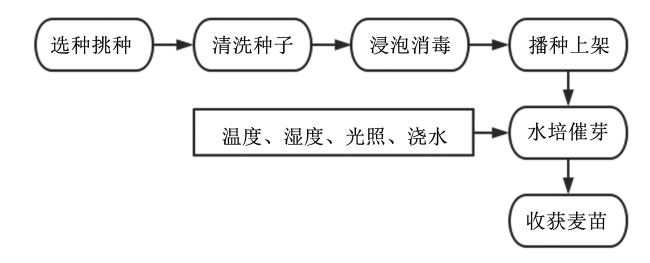
水培小麦苗是在适宜的温度(18~21 ℃)、湿度(相对湿度在55%左右)和光照(4 500 lx)等条件下,将清水或营养液每天2次喷洒在小麦种子上,经7 d培育而收获的小麦嫩苗[13]。目前,生产水培小麦苗的模式分为商用水培系统生产和低成本温棚生产[17-18]。这2种模式均包含种盘、托架、温度控制系统、供水系统、通风系统及照明系统等单元。培育水培小麦苗需经历选种、清洗、消毒、铺种、催芽和收获等步骤,其中选种环节要注意选择饱满均匀的种子,清洗环节要注意洗去种壳、灰尘等异物,清洗异物后用次氯酸钠进行消毒,再将种子浸泡12 h,而后均匀地铺在种盘上放入水培箱,设定参数后进行水培催芽,待7 d后收获(图1)。收获的水培小麦苗其种壳及根系相互交织形成细密根垫,在饲喂草食动物时需经饲草揉丝机处理后再进行生产投喂。
图1 水培小麦苗生产工艺流程

Fig.1 Production process of hydroponic wheat seedlings

1.2 水培小麦苗的优缺点

相较传统土壤种植的小麦草,水培小麦苗适口性好且更易消化,还具有加工过程绿色无污染、生长周期短、土地利用率高、可持续生产等优点[19]。Kalandarov等[20]研究指出,1 kg的小麦种子在水培系统内培育7 d,可产出约7 kg水培小麦苗;Adekeye等[21]研究发现,生产1 kg水培小麦苗只需要不到2 L的水,是传统土壤种植小麦草用水量的2%~3%。王彩虹等[22]指出,一部水培设备(占地空间53 m3)每天可产出水培饲草550 kg,年产约200 t,相当于14 hm2耕地种植传统饲草的产量。在实际生产中合理的利用水培技术,可以通过节约种植饲草所需耕地与用水来缓解我国草场日益退化、牧区水资源短缺及高寒地区冬季饲草供应等问题。相比于水培大麦苗等其他水培饲草,水培小麦苗具有单位产出高、水分利用率高、干物质含量高、粗蛋白质含量高、粗脂肪含量高等特点[23-24]。水分含量太高(≥80%)和单位干基成本高是制约水培小麦苗商业化大规模生产的根本因素[25-27]。从生产效益方面来看,1 kg的小麦种子可产出约7 kg水培牧草,换算成干物质后仅有约1 kg的产出,短期内牺牲淀粉等物质转化为蛋白质、脂肪等物质,完成从能量饲料到青绿饲料的快速转换(表2),实质上,生产的越多,物质损耗的越多。从饲用成本来看,1 kg干物质的苜蓿饲草成本约为2.85元(计算估值),而1 kg干物质的水培小麦苗成本约为5.67元(计算估值),其饲用成本是优质苜蓿草的1.99倍。综上所述,水培小麦苗适口性好易于消化、生长周期短、土地利用率高、可持续生产,但含水量和生产成本较高。
表1 不同饲草营养成分含量比较(干物质基础)

Table 1 Comparison of nutritional component contents of different forage grasses (DM basis) %

项目
Items
水培小麦苗
Hydroponic
wheat
seedlings
小麦
干草
Wheat
hay
苜蓿
干草
Alfalfa hay
小麦
秸秆
Wheat
straw
小麦
青贮
Wheat
silage
玉米
青贮
Corn
silage
水培大麦苗
Hydroponic
barley
seedlings
干物质DM 15.63 90.00 88.00 91.00 33.00 34.00 10.17
粗蛋白质CP 15.67 9.00 13.00 3.00 12.00 8.00 14.98
粗脂肪EE 5.80 2.00 1.30 1.80 3.20 3.10 3.10
粗纤维CF1) 4.57 29.00 38.00 43.00 28.00 21.00 14.93
无氮浸出物NFE 70.14 69.10 59.30 44.20 73.45 67.90 64.37
粗灰分Ash 2.93 8.00 8.00 8.00 8.00 5.00 2.62
钙Ca 0.16 0.21 1.18 0.16 0.40 0.28 0.24
磷P 0.77 0.22 0.19 0.05 0.28 0.23 0.40
粗饲料分级指数GI2) 31.02 3.17 6.33 0.46 5.97 6.78 10.52
肉牛综合净能
Comprehensive net energy of
beef cattle/(MJ/kg)3)
10.53 9.29 7.79 4.49 10.87 8.93 8.84
肉羊代谢能
Metabolizable energy of mutton
sheep/(MJ/kg)4)
14.73 13.99 12.68 8.31 15.93 13.24 13.12
奶牛产奶净能
Net energy for lactating of
dairy cattle/(MJ/kg)5)
9.49 8.99 8.11 5.18 10.29 8.49 8.41
参考文献
References
Francis
[13]
《中国饲料
成分及营
养价值表
(2021年
第32
版)》[28]
《中国饲料
成分及营
养价值表
(2021年
第32
版)》[28]
《中国饲料
成分及营
养价值表
(2021年
第32
版)》[28]
《中国饲料
成分及营
养价值表
(2021年第
32
版)》[28]
《中国饲料
成分及营
养价值表
(2021年
第32
版)》[28]
黄万里[29]

1)水培大麦苗粗纤维含量采用马绍楠等[30]研究结果中的公式计算得出:粗纤维=-2.512+0.838×酸性洗涤纤维。The crude fiber content of hydroponic barley seedlings was calculated using the formula in the research results of Ma, et al[30]: crude fiber=-2.512+0.838×acid detergent fiber.

2)粗饲料分级指数=代谢能×干物质采食量×粗蛋白质/中性洗涤纤维(或酸性洗涤纤维或木质素);代谢能=0.82×消化能[31]。Forage grading index (GI)=metabolizable energy×dry matter intake×crude protein/neutral detergent fiber (or acid detergent fiber or lignin); metabolizable energy=0.82×digestible energy[31].

3)肉牛综合净能参考《肉牛饲养标准》(NY/T 815—2004)[32]计算得出:肉牛综合净能(MJ/kg DM)=消化能(MJ/kg DM)×Kmf;消化能(MJ/kg DM)=0.209×粗蛋白质(%)+0.322×粗脂肪(%)+0.084×粗纤维(%)+0.002×无氮浸出物(%)2+0.046×无氮浸出物(%)-0.627;Kmf=Km×Kf×1.5/(Kf+0.5×Km);Km=0.187 5×(消化能/总能)+0.457 9;Kf=0.523×(消化能/总能)+0.005 89;总能(MJ/kg DM)=0.239 3×粗蛋白质(%)+0.397 5×粗脂肪(%)+0.200 4×粗纤维(%)+0.168 6×无氮浸出物(%)。Comprehensive net energy of beef cattle was calculated according to Feeding Standard of Beef Cattle (NY/T 815—2004)[32]: comprehensive net energy of beef cattle (MJ/kg DM)=digestible energy (MJ/kg DM)×Kmf; digestible energy (MJ/kg DM)=0.209×crude protein (%)+0.322×ether extract (%)+0.084×crude fiber (%)+0.002×non-nitrogen extract (%)2+0.046×non-nitrogen extract (%)-0.627; Kmf=Km×Kf×1.5/(Kf+0.5×Km); Km=0.187 5×(digestible energy/gross energy)+0.457 9; Kf=0.523×(digestible energy/gross energy)+0.005 89; gross energy (MJ/kg DM)=0.239 3× crude protein (%)+0.397 5×ether extract (%)+0.200 4×crude fiber (%)+0.168 6×nitrogen free extract (%).

4)肉羊代谢能参考《肉羊饲养标准》(NY/T 816—2004)[33]计算得出:肉羊代谢能(MJ/kg DM)=消化能(MJ/kg DM)×0.82。Metabolizable energy of mutton sheep was calculated according to Feeding Standard of Mutton Sheep (NY/T 816—2004)[33]: metabolizable energy of mutton sheep (MJ/kg DM) =digestible energy (MJ/kg DM)×0.82.

5)奶牛产奶净能参考《奶牛饲养标准》(NY/T 34—2004)[34]计算得出:奶牛产奶净能(MJ/kg DM)=0.550 1×消化能(MJ/kg DM)-0.395 8。Net energy for lactating of dairy cattle was calculated according to the feeding standard of dairy cattle (NY/T 34—2004)[34]: net energy for lactating of dairy cattle (MJ/kg DM)=0.550 1×digestible energy (MJ/kg DM)-0.395 8.

表2 水培过程中小麦苗营养成分含量变化情况(干物质基础)

Table 2 Changes of nutritional component contents of wheat seedlings during hydroponic process (DM basis)[13]

项目
Items
水培时间Hydroponic time/d
0 1 2 3 4 5 6 7
干物质DM/% 86.96 52.38 44.16 33.45 20.89 20.35 15.79 14.45
粗蛋白质CP/% 11.82 12.71 12.56 13.92 14.07 13.94 14.92 16.41
粗脂肪EE/% 1.76 1.49 1.59 2.03 2.09 4.88 5.31 4.45
粗灰分Ash/% 1.96 2.04 1.74 2.12 2.27 2.21 2.34 2.51
钙Ca/% 0.03 0.04 0.04 0.06 0.06 0.06 0.06 0.07
磷P/% 0.40 0.41 0.43 0.53 0.55 0.52 0.58 0.58
淀粉Starch/% 63.90 60.20 48.50 40.20 24.60 27.20 16.70 17.90
水溶性碳水化合物WSC/% 3.60 4.40 10.00 18.50 23.20 28.70 29.90 27.10
脂溶性碳水化合物ESC/% 2.20 3.40 8.50 16.00 17.90 26.40 25.40 22.70
总能GE/(MJ/kg) 14.02 14.02 13.98 13.47 12.47 12.47 12.18 12.10

2 水培小麦苗的营养价值

2.1 水培小麦苗的营养成分含量

水培小麦苗干物质、粗蛋白质、粗纤维、粗脂肪、钙和磷含量分别为15.63%、15.67%、4.57%、5.80%、0.16%和0.77%,粗蛋白质、粗脂肪和磷含量均高于常规粗饲料,粗纤维和钙含量均低于常规粗饲料(表1)。依据粗饲料分级指数(GI)对比发现,水培小麦苗GI值高于小麦干草、苜蓿干草、小麦秸秆、小麦青贮、玉米青贮及水培大麦苗。综上所述,水培小麦苗具备作为优质畜禽饲料来源的潜力。

2.2 水培过程中小麦苗营养成分含量变化

小麦种子经过7 d的水培生长为幼嫩的小麦苗,营养成分含量有很大的变化。有研究表明,除培育时间以外,种子品种、品质、营养供应、光照、水质等因素都会影响水培小麦苗的营养成分含量[4,35]。水培小麦苗在生长期间,干物质与淀粉含量随着培育时间的增加而降低,粗蛋白质含量随着培育时间的增加而增加(表2),发生这些变化主要归因于麦芽萌发时对水分的吸收和酶的激活消耗了胚乳中的物质储备[35-36]。Hareland[37]研究指出,小麦发芽时胚乳细胞增加对水分的吸收溶出淀粉分子并产生大量的α-淀粉酶,促进淀粉发生水解,产生支链淀粉和可溶性糖类用以支持新陈代谢。Van Hung等[38]研究指出,小麦发芽期间蛋白酶活性增强,促进蛋白质水解生成小肽和游离氨基酸。在发芽过程中,机体内非活性酶的活性增加,有助于分解籽实中植酸等抗营养因子,转化合成为更简单和基本的营养物质进行物质储备[39-40]
与小麦籽粒相比,小麦苗维生素C、α-生育酚、γ-生育酚、β-胡萝卜素、阿魏酸和香草酸的含量分别增加了499.30、6.55、0.59、2.60、352.40和6.50 μg/g[41](表3)。发芽会导致谷物中维生素、黄酮类和酚酸等抗氧化物质的含量增加[42]。Francis等[43]研究指出,小麦最佳发芽时间为7 d,此时其核黄素含量提高9 501%,α-生育酚含量提高256%,总酚含量提高456.3%,自由基清除能力提高673.9%。维生素是动物机体为维持代谢等正常生理功能而必须从食物中获取的一类微量有机化合物,对畜禽健康成长和生产性能至关重要[44]。水培小麦苗生长到10 cm左右时,主要为动物提供天然的B族维生素、维生素C和维生素E,对提高草食家畜的抗应激能力、提高繁殖性能、改善胴体品质以及帮助母畜催乳有一定的积极作用[45-50]。综上所述,相比于小麦籽粒,水培小麦苗有为畜禽提供不同的维生素等抗氧化活性物质的潜力,有利于开发提高幼龄动物免疫力及抗应激能力、种畜繁殖能力、奶畜产奶量以及改善肉品质等家畜功能性饲粮。
表3 小麦籽粒与小麦苗维生素及酚酸含量比较

Table 3 Comparison of contents of vitamins and phenolic acids in wheat grain and wheat sprouts[41]μ g/g

项目Items 小麦籽粒Wheat grain 小麦苗Wheat sprouts
维生素C Vitamin C 0 499.30
α-生育酚α-tocopherol 4.37 10.92
γ-生育酚γ-tocopherol 0.91 1.50
β-胡萝卜素β-carotene 0 2.60
阿魏酸Ferulic acid 580.00 932.40
香草酸Vanillic acid 6.40 12.90

3 水培小麦苗在畜牧生产中的应用

3.1 水培小麦苗在单胃动物生产中的应用

水培小麦苗不仅能作为饲料添加剂应用到部分禽类生产中促进机体消化系统的生长发育,还能将其添加到禽类饲粮中提高采食量、促进其对营养物质的吸收能力以及改善生长发育,但对于仔猪,应限制在饲粮中添加水培小麦苗。研究发现,在法老鹌鹑的饲粮中添加由水培小麦苗+黄芪水溶液制备的饲料添加剂,促进了法老鹌鹑肌胃、腺胃的部分腺体发育及代谢过程[10]。在火鸡饲粮干物质基础上添加不同水平的水培小麦苗,发现添加量为5%、10%和15%时均提高了火鸡的日增重(添加量为15%时最佳)和饲料转化率(添加量为5%时最佳)且降低了饲料成本(添加量为5%时最佳),但添加量为20%时火鸡的日增重显著降低[11]。研究显示,在肉鸡传统饲粮中分别添加2.5%、5%和7.5%的水培小麦苗对采食量和屠宰性能无显著影响,仅有添加5%时提高了肉鸡的日增重,并且还降低了血液中甘油三酯和总胆固醇含量[51]。在断奶仔猪饲粮干物质基础上分别添加15%和30%的水培小麦苗,发现不添加水培小麦苗组仔猪的日增重、干物质采食量和饲料转化效率显著高于15%和30%组,表明饲粮中添加水培小麦苗会降低断奶仔猪的生长性能[12]。用相同干物质基础的水培小麦苗替代50%干草饲喂短途竞赛马,有降低马的干物质采食量的趋势,但对马的体重和蹄温度无不良影响[13]。综上所述,在禽类和马饲粮中适当添加水培小麦苗具有降低饲料成本、提高日增重和饲料转化效率的作用,但在仔猪饲粮中添加水培小麦苗是否具备生产可行性或适宜添加量还有待考究。

3.2 水培小麦苗在反刍动物生产中的应用

水培小麦苗富含蛋白质和氨基酸等成分,适口性好且易于消化,可以提高反刍动物对饲粮中营养物质的消化和吸收,并提高生产性能和畜产品品质。有研究表明,对比绵羊在3种饲喂模式(常规饲粮+矿物质补充剂、与常规饲粮相同干物质基础的水培小麦苗+矿物质补充剂、放牧补饲常规饲粮+矿物质补充剂)下的饲喂效果,水培小麦苗饲喂模式下的绵羊日增重最高[14];用相同干物质基础的水培小麦苗替代妊娠母羊饲粮中的干轧玉米粒(20%)和棉籽粕(10%),对妊娠母羊的干物质采食量、日增重及繁殖参数无显著影响[15]。Bari等[16]在荷斯坦奶牛饲粮中用25%的水培小麦苗替代基础饲粮,可提高奶牛的干物质采食量、日增重以及体况评分,并且还能提高产奶量、乳脂率及乳中总固形物含量。综上所述,在反刍动物饲粮中添加水培小麦苗不仅具有提高日增重和饲料利用率的作用,还能提高母畜的产奶量。

4 水培小麦苗应用前景展望

水培小麦苗作为适口性好、易于消化、生长周期短、土地利用率高、可持续生产的优质青绿饲料,对缓解我国部分高寒地区饲草缺乏、季节性青绿饲料缺乏和补充以农作物秸秆为粗饲料的典型饲粮的青绿饲料的短缺等具有重要意义,但其干物质含量低和生产成本高的问题限制了其在畜牧生产中的大规模应用。因此,后续对水培小麦苗的研究和应用应重点关注:1)降低水培生产成本。研究价格低廉的新型材料或成本更低的生产工艺,减少资金投入,提高大众对水培小麦苗的接受度。2)确定最佳饲喂添加比例及效能。对水培小麦苗在不同畜禽(生长阶段、畜产品需求、饲粮模式、适宜添加量等)养殖生产中的应用开展系统性研究。3)开发水培小麦苗的潜在饲喂价值。依据水培小麦苗的营养价值特点及其所含有的生物活性物质,对其是否具备作为功能性饲料用以提高草食动物免疫力及抗应激能力开展系统性研究。随着我国畜牧业发展规模与饲料供给矛盾的日益突出,科学、合理和高效的利用水培小麦苗对我国畜牧业,尤其是高寒地区、季节性青绿饲料缺乏地区和以农作物秸秆为主要粗饲料地区的畜牧业发展具有重要的青绿饲料补充作用。
[1]
贾云飞, 郑伟程, 何泽军, 等. 我国畜牧业绿色发展:现状、制约与战略应对[J]. 中国畜牧杂志, 2023, 59(1):323-329.

JIA Y F, ZHENG W C, HE Z J, et al. Green development of animal husbandry in China:current situation,constraints and strategic countermeasures[J]. Chinese Journal of Animal Science, 2023, 59(1):323-329. (in Chinese)

[2]
王茂森, 薄玉琨, 李林, 等. 畜牧业产业化经营基本理论与创新发展[M]. 银川: 宁夏人民出版社, 2020.

WANG M S, BO Y K, LI L, et al. Basic theory and innovative development of animal husbandry industrialization management[M]. Yinchuan: Ningxia People’s Publishing House, 2020. (in Chinese)

[3]
ABDULA A H. Contribution of hydroponic feed for livestock production and productivity[J]. Science Frontiers, 2022, 3(1):1-7.

[4]
NAIK P K, SWAIN B K, SINGH N P. Production and utilisation of hydroponics fodder[J]. Indian Journal of Animal Nutrition, 2015, 32(1):1-9.

[5]
KHAEIM H, KENDE Z, BALLA I, et al. The effect of temperature and water stresses on seed germination and seedling growth of wheat (Triticum aestivum L.)[J]. Sustainability, 2022, 14(7):3887.

DOI

[6]
LIU D, MA Y, RUI M M, et al. Is high pH the key factor of alkali stress on plant growth and physiology?A case study with wheat (Triticum aestivum L.) seedlings[J]. Agronomy, 2022, 12(8):1820.

DOI

[7]
GRIGAS A, KEMZŪRAITÖ A, STEPONAVIČIUS D, et al. Impact of slope of growing trays on productivity of wheat green fodder by a nutrient film technique system[J].Water,2020,12(11):3009.

[8]
LANGENFELD N J, BUGBEE B. Germination and seedling establishment for hydroponics:the benefit of slant boards[J]. PLoS One, 2022, 17(10):e0275710.

DOI

[9]
ÇOPUR DOĞRUSÖZ M, BAŞARAN U, MUT H, et al. Hidroponik yeşil yem üretiminde arpa, buğday ve mürdümüğün verim ve kalitelerinin zamana bağli değişimi[J]. Euroasia Journal of Mathematics,Engineering,Natural&Medical Sciences, 2020, 7(9):158-167.

[10]
KHATSAEVA R M. Effect of organic biological additives on the morphology of the digestive tract in quails[J]. IOP Conference Series:Earth and Environmental Science, 2020, 421(5):052019.

DOI

[11]
ALI H S, MIAH A G, SABUZ S H, et al. Dietary effects of hydroponic wheat sprouted fodder on growth performance of turkey[J]. Research in Agriculture,Livestock and Fisheries, 2019, 6(1):101-110.

DOI

[12]
HARERIMANA T, HATUNGIMANA E, HIRWA C D, et al. Effect of hydroponic wheat fodder supplementation on dry matter intake and growth performances of piglets[J]. Scientific African, 2023, 19:e01507.

[13]
FRANCIS J M, APGAR G A, CRANDELL K G, et al. The effects of hydroponic wheat fodder on fecal metabolites in equines[J]. Journal of Equine Veterinary Science, 2018, 70:84-90.

DOI

[14]
CASTILLO F S, MORENO PÉREZ E D C, MAGAÑA E C, et al. Hydroponic wheat and barley fodder yields and their effect on weight gain in sheep[J]. Revista Chapingo Serie Horticultura, 2013, 19(4):35-43.

[15]
GUERRERO-CERVANTES M, CERRILLO-SOTO M A, PLASCENCIA A, et al. Productive and reproductive performance and metabolic profiles of ewes supplemented with hydroponically grown green wheat (Triticum aestivum L.)[J]. Animal Feed Science and Technology, 2016, 221(Part A):206-214.

DOI

[16]
BARI M S, ISLAM M N, ISLAM M M, et al. Effect of feeding hydroponic wheat fodder on milk yield and quality of crossbred dairy cows[C]// Proceedings of the 10th Biennial Conference and Seminar. Mymensingh: Bangladesh Animal Husbandry Association, 2020.

[17]
MOHAPATRA K K, MOHAPATRA S, EKKA R, et al. Variations in round-the-year fodder production in a low-cost hydroponic shed[J]. National Academy Science Letters, 2019, 42(5):383-385.

DOI

[18]
GRIGAS A, KEMZŪRAITŪ A, STEPONAVIČIUS D. Hydroponic devices for green fodder production:a review[C]// Proceedings of the 9th International Scientific Conference Rural Development 2019.Kaunas:Vytautas Magnus University,2019:21-27.

[19]
NAIK P K, SWAIN B K, SINGH N P. Hydroponics:its feasibility as an alternative to cultivated forages[C]// Eco-Responsive Feeding and Nutrition: Linking Livestock and Livelihood. Guwahati: Animal Nutrition Association, 2015:74-87.

[20]
KALANDAROV P I, ABDULLAEVA D A. Innovative approach to the development of hydroponic green feeds[J]. IOP Conference Series:Earth and Environmental Science, 2022, 1043:012012.

DOI

[21]
ADEKEYE A B, ONIFADE O S, AMOLE G T, et al. Water use efficiency and fodder yield of maize (Zea mays) and wheat (Triticum aestivum) under hydroponic condition as affected by sources of water and days to harvest[J]. African Journal of Agricultural Research, 2020, 16(6):909-915.

DOI

[22]
王彩虹, 王新欣, 李卫华. 饲草水培技术[J]. 新疆畜牧业, 2015(6):61-63.

WANG C H, WANG X X, LI W H. Forage hydroponic culture technique[J]. Xinjiang Animal Husbandry, 2015(6):61-63. (in Chinese)

[23]
BASAK S, BHATIA A. Approximate climate analysis for assessing the suitability of Indian climate zones for hydroponic fodder applications[J]. IOP Conference Series:Earth and Environmental Science, 2022, 1084:012012.

DOI

[24]
MAHALE D, DHAGE S A, GAIKWAD U S, et al. Water use efficiency and chemical composition of different forage crops under hydroponic condition[J]. Trends in Biosciences, 2020, 13(13):1003-1012.

[25]
SHIT N. Hydroponic fodder production:an alternative technology for sustainable livestock production in India[J]. Exploratory Animal and Medical Research, 2019, 9(2):108-119.

[26]
NAIK P K, DHURI R B, SWAIN B K, et al. Water management for green fodder production as livestock feed in goa[C]// Proceedings of International Conference on Water Management for Climate Resilient Agriculture. Maharashtra: International Atomic Energy Agency, 2013:126-127.

[27]
KUMAR S, SINGH M, YADAV K K, et al. Opportunities and constraints in hydroponic crop production systems:a review[J]. Environment Conservation Journal, 2021, 22(3):401-408.

DOI

[28]
佚名. 中国饲料成分及营养价值表 (2021年第32版) (续)[J]. 中国饲料, 2021(24):66-71.

Anon. Chinese feed composition and nutrition value table (the 32nd edition in 2021) (continued)[J]. China Feed, 2021(24):66-71. (in Chinese)

[29]
黄万里. 不同水培时间大麦苗的营养价值测定[D]. 硕士学位论文. 洛阳: 河南科技大学, 2019.

HUANG W L. Determination of nutritive value of barley green fodder cultivated in hydroponic system[D]. Master’s Thesis. Luoyang: Henan University of Science and Technology, 2019. (in Chinese)

[30]
马绍楠, 许贵善, 崔凯, 等. 反刍动物常用饲料中CF、NDF、ADF的关联性分析[J]. 饲料工业, 2018, 39(21):52-59.

MA S N, XU G S, CUI K, et al. Correlation analysis of CF,NDF and ADF in ruminant feedstuffs[J]. Feed Industry, 2018, 39(21):52-59. (in Chinese)

[31]
其其格, 金曙光, 刘锋. 内蒙古地区12种牧草的粗饲料分级指数及粗饲料相对值的测定及比较[J]. 内蒙古农业大学学报(自然科学版), 2008, 29(3):19-22.

QI Q G, JIN S G, LIU F. GL and RFV determination and comparison of 12 kinds of pasture grass in Inner Mongolia[J]. Journal of Inner Mongolia Agricultural University (Natural Science Edition), 2008, 29(3):19-22. (in Chinese)

[32]
中华人民共和国农业部.肉牛饲养标准:NY/T 815—2004[S]. 北京: 中国农业出版社, 2004.

Ministry of Agriculture of the PRC.Feeding standard of beef cattle:NY/T 815—2004[S]. Beijing: China Agriculture Press, 2004. (in Chinese)

[33]
中华人民共和国农业部.肉羊饲养标准:NY/T 816—2004[S]. 北京: 中国农业出版社, 2004.

Ministry of Agriculture of the PRC.Feeding standard of meat-producing sheep and goats:NY/T 816—2004[S]. Beijing: China Agriculture Press, 2004. (in Chinese)

[34]
中华人民共和国农业部.奶牛饲养标准:NY/T 34—2004[S]. 北京: 中国农业出版社, 2004.

Ministry of Agriculture of the PRC.Feeding standard of dairy cattle:NY/T 34—2004[S]. Beijing: China Agriculture Press, 2004. (in Chinese)

[35]
SNEATH R, MCINTOSH F. Review of hydroponic fodder production for beef cattle: NBP. 332[R]. Dalby: Department of Primary Industries, 2003:54.

[36]
DUNG D D, GODWIN I R, NOLAN J V. Nutrient content and in sacco degradation of hydroponic barley sprouts grown using nutrient solution or tap water[J]. Journal of Animal and Veterinary Advances, 2010, 9(18):2432-2436.

DOI

[37]
HARELAND G A. Effects of pearling on falling number and α-amylase activity of preharvest sprouted spring wheat[J]. Cereal Chemistry, 2003, 80(2):232-237.

DOI

[38]
VAN HUNG P, MAEDA T, YAMAMOTO S, et al. Effects of germination on nutritional composition of waxy wheat[J]. Journal of the Science of Food and Agriculture, 2012, 92(3):667-672.

DOI PMID

[39]
CHAVAN J K, KADAM S S. Nutritional improvement of cereals by sprouting[J]. Critical Reviews in Food Science and Nutrition, 1989, 28(5):401-437.

DOI PMID

[40]
KOEHLER P, HARTMANN G, WIESER H, et al. Changes of folates,dietary fiber,and proteins in wheat as affected by germination[J]. Journal of Agricultural and Food Chemistry, 2007, 55(12):4678-4683.

DOI

[41]
YANG F, BASU T K, OORAIKUL B. Studies on germination conditions and antioxidant contents of wheat grain[J]. International Journal of Food Sciences and Nutrition, 2001, 52(4):319-330.

PMID

[42]
NIROULA A, KHATRI S, KHADKA D, et al. Total phenolic contents and antioxidant activity profile of selected cereal sprouts and grasses[J]. International Journal of Food Properties, 2019, 22(1):427-437.

DOI

[43]
FRANCIS H, DEBS E, KOUBAA M, et al. Sprouts use as functional foods.Optimization of germination of wheat (Triticum aestivum L.),alfalfa (Medicago sativa L.),and radish (Raphanus sativus L.) seeds based on their nutritional content evolution[J]. Foods, 2022, 11(10):1460.

DOI

[44]
石凤霞, 王继强, 龙强, 等. 维生素C的生理功能及其在畜禽生产中的应用[J]. 中国饲料, 2016(4):36-38,44.

SHI F X, WANG J Q, LONG Q, et al. Physiological function of vitamin C and its application in animal production[J]. China Feed, 2016(4):36-38,44. (in Chinese)

[45]
PEHLIVAN KARAKAS F, KESKIN C N, AGIL F, et al. Profiles of vitamin B and E in wheat grass and grain of einkorn (Triticum monococcum spp. monococcum),emmer (Triticum dicoccum ssp. dicoccum Schrank.),durum (Triticum durum Desf.),and bread wheat (Triticum aestivum L.) cultivars by LC-ESI-MS/MS analysis[J]. Journal of Cereal Science, 2021, 98:103177.

DOI

[46]
潘添博. 日粮中添加维生素C对肉鸭夏季热应激的影响研究[D]. 硕士学位论文. 重庆: 西南大学, 2020.

PAN T B. Study on the effect of adding vitamin C to diet on heat stressed duck in summer[D]. Master’s Thesis. Chongqing: Southwest University, 2020. (in Chinese)

[47]
BELLÉS M, LEAL L N, DÍAZ V, et al. Effect of dietary vitamin E on physicochemical and fatty acid stability of fresh and thawed lamb[J]. Food Chemistry, 2018, 239:1-8.

DOI PMID

[48]
XU C C, ZUO Z Y, LIU K, et al. Transcriptome analysis of the Tan sheep testes:differential expression of antioxidant enzyme-related genes and proteins in response to dietary vitamin E supplementation[J]. Gene, 2016, 579(1):47-51.

DOI

[49]
陈利青. 日粮中添加β-胡萝卜素对奶牛生产性能及抗氧化指标影响的研究[D]. 硕士学位论文. 呼和浩特: 内蒙古农业大学, 2018.

CHEN L Q. Effects of β-carotene supplementation in diet on production performance and antioxidant index of dairy cows[D]. Master’s Thesis. Hohhot: Inner Mongolia Agricultural University, 2018. (in Chinese)

[50]
杨东, 刁其玉, 马涛, 等. 阿魏酸和壳寡糖对蒙古杂交羊生长性能及脂肪沉积的影响[J]. 粮食与饲料工业, 2018(9):43-48.

YANG D, DIAO Q Y, MA T, et al. Effects of ferulic acid and chitosan oligosaccharide on growth performance and fat depositionin of Mongolia hybrid mutton sheep[J]. Cereal & Feed Industry, 2018(9):43-48. (in Chinese)

[51]
SULTANA M, DAS S C, DEY B, et al. Effect of hydroponic wheat sprout on the growth performance,carcass characteristics,and lipid profiles of broilers[J]. Brazilian Journal of Poultry Science, 2022, 24(3): eRBCA-2021-1583.

Outlines

/