RESEARCH PAPER

Effects of Different Rearing Patterns on Slaughter Performance, Organ Indices, Serum Biochemical Indices, Meat Quality and Intestinal Development of Squabs in Winter

  • ZHANG Yanlin , 1, 2 ,
  • MO Wanyi 1, 2 ,
  • ZHANG Suiling 1, 2 ,
  • YANG Menglin 1, 2 ,
  • WANG Ziying 3 ,
  • GAO Hongyan 1, 2 ,
  • LYU Yantao 1, 2 ,
  • WANG Wei 1, 2 ,
  • HUANG Yanhua , 1, 2, ** ,
  • PENG Jie , 1, 2, **
Expand
  • 1 Guangdong Laboratory for Lingnan Modern Agriculture, Guangzhou 510640, China
  • 2 Innovative Institute of Animal Healthy Breeding, Zhongkai University of Agriculture and Engineering, Guangzhou 510225, China
  • 3 Meizhou Golden Green Modern Agriculture Development Company Limited, Meizhou 514500, China
** HUANG Yanhua, professor, E-mail: ;
PENG Jie, associate professor, E-mail:

*Contributed equally

Received date: 2022-10-18

  Online published: 2023-07-11

Abstract

The aim of this experiment was to study the effects of different rearing patterns on slaughter performance, organ indices, serum biochemical indices, meat quality and intestinal development of squabs in winter. A total of 144 pairs of European Mimas white pigeons with similar age and weight and similar reproductive performance were randomly divided into 3 groups with 8 replicates in each group and 6 pairs breeding pigeons in each replicate. Each pair of breeding pigeons in each group reared 2 (2+2 group), 3 (2+3 group) and 4 (2+4 group) squabs. The test period was 21 days. The results showed as follows: 1) the live weight, slaughter weight, half eviscerated weight, eviscerated weight, breast muscle weight, half eviscerated rate, eviscerated rate and breast muscle rate of squabs in 2+4 group were significantly lower than those in 2+2 group and 2+3 group (P<0.05), and there were no significant differences between 2+2 group and 2+3 group (P>0.05). 2) The heart and muscular stomach weights in 2+4 group were significantly lower than those in 2+2 group (P<0.05), and there were no significant differences between 2+2 group and 2+3 group (P>0.05). The heart, liver and glandular stomach indexes in 2+4 group were significantly higher than those in 2+2 group and 2+3 group (P<0.05), and there were no significant differences between 2+2 group and 2+3 group (P>0.05). There were no significant differences in spleen, thymus and bursa of Fabricius weights and indexes among all groups (P>0.05). 3) The breast muscle 24 h pH and brightness (L*) value in 2+4 group were significantly higher than those in 2+2 group (P<0.05), the breast muscle yellowness (b*) value and drip loss were significantly lower than those in 2+2 group (P<0.05), and there were no significant differences between 2+2 group and 2+3 group (P>0.05). 4) The slaughter weight and breast muscle weight of squabs were significantly positively correlated with the breast muscle drip loss (P<0.05), and significantly negatively correlated with the breast muscle L* value and 24 h pH (P<0.05). 5) The jejunal villi height (VH) in 2+3 group was significantly higher than that in 2+2 group (P<0.05), and the villi height/crypt depth (VH/CD) was significantly higher than in 2+2 group and 2+4 group (P<0.05). The ileal epithelial cell thickness (ECT) in 2+3 group and 2+4 group was significantly lower than that in 2+2 group (P<0.05). 6) The total profit in 2+3 group and 2+4 group increased by 36 and 139 RMB compared with the 2+2 group, respectively. It can be seen that the increase of rearing number can improve the economic efficiency of the farm, but the high rearing number will increase the death rate of squabs, and the growth rate and meat quality of squabs will be negatively affected. The above-mentioned indicators suggest the adoption of 2+3 rearing pattern for winter squab production.

Cite this article

ZHANG Yanlin , MO Wanyi , ZHANG Suiling , YANG Menglin , WANG Ziying , GAO Hongyan , LYU Yantao , WANG Wei , HUANG Yanhua , PENG Jie . Effects of Different Rearing Patterns on Slaughter Performance, Organ Indices, Serum Biochemical Indices, Meat Quality and Intestinal Development of Squabs in Winter[J]. Chinese Journal of Animal Nutrition, 2023 , 35(7) : 4541 -4552 . DOI: 10.12418/CJAN2023.422

鸽肉营养丰富,具有低脂肪、高蛋白质、高不饱和脂肪酸和高维生素的特性,20世纪80年代以后,我国的肉鸽养殖业迅速发展[1]。鸽属于禽类,但又具有区别于其他家禽的独特繁殖特性。鸽属于晚成鸟,雏鸽在上市之前需要种鸽分泌鸽乳进行哺育。一般而言,1对种鸽1个繁殖周期可以哺育2只乳鸽,但肉鸽养殖业为提高生产效率,生产上常用1对种鸽哺育3~4只乳鸽的养殖模式,以获取更大的经济效益。然而,带仔数过多可能会造成种鸽哺育压力过大,体重损失增加,影响种鸽繁殖性能,同时也容易造成乳鸽营养不良和生长发育受阻[2]。特别是在寒冷的冬季,由于雏鸽羽毛发育不完全,极易出现乳鸽冻死现象,给肉鸽养殖造成经济损失[3]
在家禽上的研究发现,环境温度低会显著增加家禽的死亡率,同时降低日增重[4-7]。冷应激会降低禽类的免疫力,导致免疫器官发育受阻,抗病力降低[7]。此外,冷应激还会影响禽类肠道发育,造成消化功能紊乱[8]。然而,目前对于冬季种鸽适宜的带仔模式尚不清楚。因此,本研究旨在探索不同带仔模式对乳鸽屠宰性能、器官指数、血清生化指标、肉品质及肠道发育的影响,明确冬季乳鸽适宜的带仔数量,为冬季我国南方气温相似地区肉鸽的科学饲养提供理论依据。

1 材料与方法

1.1 试验动物及饲养管理

试验选取144对年龄和体重相近、繁殖性能相似的欧洲米马斯白鸽,随机分成3组,每组8个重复,每个重复6对种鸽。各组每对种鸽分别哺育2(2+2组)、3(2+3组)、4只(2+4组)乳鸽。所有乳鸽均由同舍种蛋采用孵化机孵化,试验期从种鸽带仔当天至乳鸽屠宰结束,共21 d。
试验于2021年1月份在广东梅州金绿现代农业发展有限公司进行。试验期间,当地白天平均温度为19.9 ℃,夜间平均温度为6.7 ℃,最高温度为28 ℃,最低温度为8 ℃。鸽舍为半开放式鸽舍,室内气温与室外气温相差不大。试验鸽采用50 cm×65 cm×65 cm的3层双列鸽笼饲养,每日07:00投料,11:30、15:00、16:30补料,采用自然光照与人工光照相结合的方法,自由采食、饮水。定期清理料槽和水杯,更换保健砂,每周清理1次鸽粪。试验所用饲粮和饲养管理方案由广东梅州金绿现代农业发展有限公司推荐。种鸽的基础饲粮组成及营养水见表1,采用“50%原粮+50%颗粒料”模式配制,种鸽的保健砂按照河沙∶贝壳=2∶1的比例配制。
表1 基础饲粮组成及营养水平(风干基础)

Table 1 Composition and nutrient levels of the basal diet (air-dry basis) %

项目Items 含量Content
原料Ingredients
玉米Corn 20.70
高粮Sorghum 10.50
小麦Wheat 8.40
豌豆Peas 15.70
颗粒料Pellets1) 44.70
合计Total 100.00
营养水平Nutrient levels2)
粗蛋白质CP 14.92
代谢能ME/(MJ/kg) 12.58
粗脂肪EE 2.96
水分Moisture 12.26
粗灰分Ash 3.45
钙Ca 0.59
磷P 0.42

1)商业复合颗粒饲料(广东惠州华宝饲料有限公司),其组成如下:玉米、豆粕、磷酸氢钙、硫酸铜、硫酸亚铁、硫酸锰、维生素A、维生素D3DL-α-生育酚乙酸酯、维生素B6、维生素B12、蛋氨酸、L-赖氨酸硫酸盐。A commercial compound pellet feed (Guangdong Huizhou Huabao Feed Co., Ltd.), and the composition of it as follows: corn, soybean meal, calcium hydrogen phosphate, copper sulfate, ferrous sulfate, manganese sulfate, vitamin A, vitamin D3, DL-α-tocopherol acetate, vitamin B6, vitamin B12, methionine and L-lysine sulfate.

2)营养水平为实测值。Nutrient levels were measured values.

1.2 样品采集及指标测定

1.2.1 乳鸽屠宰性能和器官指数测定

乳鸽21日龄时,禁食12 h,每组随机选取36只乳鸽屠宰,记录屠体重、半净膛重、全净膛重和胸肌重,并计算屠宰率、半净膛率、全净膛率及胸肌率;记录肝脏、心脏、肾脏、腺胃、肌胃和胰腺的重量,并计算器官指数;记录脾脏、胸腺、法氏囊的重量,计算免疫器官指数。

1.2.2 乳鸽糖血清生化指标测定

乳鸽21日龄时,每组中随机选取12只乳鸽,翅下静脉采血,置于含有肝素钠的抗凝管中,4 ℃、1 500 r/min离心5 min,吸取血清。检测乳鸽血清总胆固醇(total cholesterol,TC)、葡萄糖(glucose,GLU)、甘油三酯(triglyceride,TG)、高密度脂蛋白胆固醇(high density lipoprotein cholesterol,HDL-C)、低密度脂蛋白胆固醇(low density lipoprotein cholesterol,LDL-C)含量。所用试剂盒均购自南京建成生物工程研究所,测定方法均严格按照试剂盒说明书进行。

1.2.3 乳鸽肉品质测定

乳鸽屠宰后,分别取乳鸽胸肌右侧相同部位肌肉。pH测定方法参考Hernández-Castellano等[9]的检测方法,用便捷式酸度计分别测定乳鸽屠宰后45 min和24 h的胸肌样品pH。根据Jiang等[10]的检测方法,将胸肌样品用中性滤纸擦干,在室内自然光照条件下,用全自动色差计测定胸肌贴皮面肌肉肉色[亮度(L*)、红度(a*)、黄度(b*)值],每个样品在不同部位测定3次,取平均值。参考Yang等[11]的检测方法,测定胸肌样品的滴水损失和蒸煮损失,即胸肌去除表面附着的结缔组织和脂肪后,用滤纸擦干,精确称重,用棉线系住使肌纤维垂直向下,悬吊在已编号的自封袋中,吊于4 ℃的冰箱内保存,24 h后取出肉样,用滤纸轻轻擦拭肉样表面汁液后精确称重,计算滴水损失;另取一块胸肌称重后装入自封袋中,于100 ℃恒温水浴中蒸煮5 min,取出冷却至室温,用滤纸擦干表面汁液后精确称重,计算蒸煮损失。

1.2.4 乳鸽肠道形态测定

乳鸽21日龄屠宰后,每组随机选取10只乳鸽,采集同一部位空肠、回肠肠段(约1 cm),置于4%福尔马林溶液中。参照Agazzi等[12]的方法进行苏木精-伊红(HE)染色,并通过显微镜拍照分析绒毛高度(villus height,VH)(从绒毛顶端至隐窝开口处的垂直距离)、隐窝深度(crypt depth,CD)(从隐窝开口至隐窝基部的垂直距离)、上皮细胞厚度(epithelial cell thickness,ECT)(小肠绒毛上皮细胞顶部到底部的垂直距离),计算绒毛高度/隐窝深度(villus height/crypt depth,VH/CD)[13]

1.3 数据统计分析

试验数据采用GraphPad Prism 8.0.1软件进行单因素方差分析(one-way ANOVA),采用Tukey法进行多重比较,并进行线性和二次曲线回归分析。P<0.05为差异显著,数据以平均值和均值标准误(SEM)表示。

2 结果与分析

2.1 不同带仔模式对乳鸽屠宰性能的影响

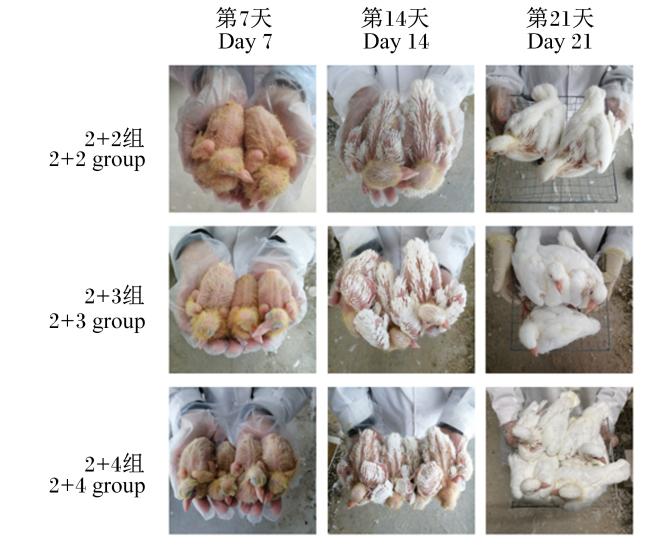
表2可见,2+4组的乳鸽的活重、屠体重、半净膛重、全净膛重和胸肌重均显著低于2+2组和2+3组(P<0.05),2+2组和2+3组之间差异不显著(P>0.05)。2+4组的半净膛率、全净膛率和胸肌率均显著低于2+2组和2+3组(P<0.05),2+2组和2+3组之间差异不显著(P>0.05)。各组之间屠宰率差异不显著(P>0.05)。不同带仔模式下乳鸽第7、14和21天的羽毛发育情况见图1,乳鸽在出壳后7 d内几乎没有羽毛,在出壳后14 d左右才开始长出羽毛。以上结果表明,随着带仔数的增加,乳鸽的屠宰性能下降。
表2 不同带仔模式对乳鸽屠宰性能的影响

Table 2 Effects of different rearing patterns on slaughter performance of squabs

项目
Items
组别Groups SEM PP-value
2+2 2+3 2+4 线性
Linear
二次
Quadratic
方差分析
ANOVA
活重Live weight/g 483.57a 466.44a 417.83b 34.10 <0.000 1 <0.000 1 <0.000 1
屠体重Slaughter weight/g 388.50a 376.04a 338.14b 26.23 <0.000 1 <0.000 1 <0.000 1
半净膛重Half eviscerated weight/g 334.45a 319.65a 283.92b 25.98 <0.000 1 <0.000 1 <0.000 1
全净膛重Eviscerated weight/g 299.63a 284.80a 251.32b 24.75 <0.000 1 <0.000 1 <0.000 1
胸肌重Breast muscle weight/g 53.29a 49.53a 38.08b 7.92 <0.000 1 <0.000 1 <0.000 1
屠宰率Slaughter rate/% 80.37 80.64 80.93 0.28 0.380 6 <0.000 1 0.682 1
半净膛率Half eviscerated rate/% 86.06a 84.99ab 83.88b 1.09 0.002 3 <0.000 1 0.009 8
全净膛率Eviscerated rate/% 77.07a 75.71ab 74.22b 1.43 <0.000 1 <0.000 1 0.000 5
胸肌率Breast muscle rate/% 17.67a 17.36a 15.03b 1.44 <0.000 1 <0.000 1 <0.000 1

同行数据肩标不同小写字母表示差异显著(P<0.05),相同或无字母表示差异不显著(P>0.05)。下表同。

In the same row, values with different small letter superscripts mean significant difference (P<0.05), while with the same or no letter superscripts mean no significant difference (P>0.05). The same as below.

图1 不同带仔模式下乳鸽第7、14和21天的羽毛发育情况

Fig.1 Feather development of squabs on days 7, 14 and 21 under different rearing patterns

2.2 不同带仔模式对乳鸽血清生化指标的影响

表3可见,乳鸽血清TC、HDL-C和LDL-C含量表现为先下降后升高的二次曲线变化(P<0.05),血清TG含量表现为先升高后下降的二次曲线变化(P<0.05)。各组之间血清TC、GLU、TG、HDL-C和LDL-C含量差异不显著(P>0.05)。
表3 不同带仔模式对乳鸽血清生化指标的影响

Table 3 Effects of different rearing patterns on serum biochemical indices of squabs nmol/mL

项目
Items
组别Groups SEM PP-value
2+2 2+3 2+4 线性
Linear
二次
Quadratic
方差分析
ANOVA
总胆固醇TC 7.70 7.41 7.52 0.15 0.743 4 0.000 3 0.879 3
葡萄糖GLU 15.56 15.66 16.43 0.48 0.053 0 0.564 8 0.104 2
甘油三酯TG 3.14 3.41 3.19 0.14 0.868 9 0.000 1 0.792 0
高密度脂蛋白胆固醇HDL-C 3.23 3.12 3.19 0.06 0.705 3 0.000 1 0.596 7
低密度脂蛋白胆固醇LDL-C 3.60 3.15 3.49 0.23 0.704 3 0.004 7 0.403 2

2.3 不同带仔模式对乳鸽器官重量和指数的影响

表4可见,2+4组的心脏和肌胃重量显著低于2+2组(P<0.05),2+2组和2+3组之间差异不显著(P>0.05);2+4组和2+3组的肾脏重量显著低于2+2组(P<0.05);各组之间肝脏、腺胃和胰腺重量差异不显著(P>0.05)。2+4组的心脏、肝脏和腺胃指数显著高于2+2组和2+3组(P<0.05),2+2组和2+3组之间差异不显著(P>0.05);2+2组的肾脏指数显著高于2+3组和2+4组(P<0.05),2+3组和2+4组之间差异不显著(P>0.05);各组之间肌胃和胰腺指数差异不显著(P>0.05)。以上结果表明,随着带仔数的增加,乳鸽的心脏、肾脏、肌胃重量下降,心脏、肝脏和腺胃指数上升。
表4 不同带仔模式对乳鸽器官重量和指数的影响

Table 4 Effects of different rearing patterns on organ weight and index of squabs

项目
Items
组别Groups SEM PP-value
2+2 2+3 2+4 线性
Linear
二次
Quadratic
方差分析
ANOVA
心脏重量Heart weight/g 4.90a 4.68ab 4.49b 0.20 0.006 0 <0.000 1 0.023 1
肝脏重量Liver weight/g 16.47 16.11 16.73 0.31 0.677 7 <0.000 1 0.592 7
肾脏重量Kidney weight/g 4.33a 3.62bc 3.30c 0.53 <0.000 1 <0.000 1 <0.000 1
肌胃重量Muscular stomach weight/g 12.29a 11.63ab 11.23b 0.53 0.011 0 <0.000 1 0.037 2
腺胃重量Glandular stomach weight/g 1.90 1.95 1.95 0.03 0.545 5 0.098 3 0.778 9
胰腺重量Pancreas weight/g 2.77 2.67 2.54 0.12 0.095 4 0.006 8 0.246 6
心脏指数Heart index/% 1.01b 1.01b 1.08a 0.04 0.041 3 0.205 5 0.035 0
肝脏指数Liver index/% 3.42b 3.46b 4.02a 0.34 <0.000 1 <0.000 1 <0.000 1
肾脏指数Kidney index/% 0.90a 0.78b 0.79b 0.07 0.018 0 0.099 6 0.014 4
肌胃指数Muscular stomach index/% 2.55 2.49 2.70 0.11 0.098 9 <0.000 1 0.055 3
腺胃指数Glandular stomach index/% 0.40b 0.42b 0.47a 0.04 0.000 1 0.007 9 0.035 6
胰腺指数Pancreas index/% 0.57 0.58 0.61 0.02 0.197 0 0.283 0 0.355 1

2.4 不同带仔模式对乳鸽免疫器官指数的影响

表5可见,各组之间脾脏、胸腺和法氏囊重量和指数均差异不显著(P>0.05)。随着带仔数的增加,乳鸽的脾脏、法氏囊重量呈下降趋势,胸腺重量、胸腺指数先升高后降低趋势,法氏囊指数先降低后升高趋势。
表5 不同带仔模式对乳鸽免疫器官重量和指数的影响

Table 5 Effects of different rearing patterns on immune organ weight and index of squabs

项目
Items
组别Groups SEM PP-value
2+2 2+3 2+4 线性
Linear
二次
Quadratic
方差分析
ANOVA
脾脏重量Spleen weight/g 0.59 0.55 0.47 0.06 0.110 3 0.453 3 0.259 1
胸腺重量Thymus weight/g 2.60 2.69 2.30 0.20 0.182 0 0.607 0 0.188 8
法氏囊重量Bursa of Fabricius weight/g 0.80 0.65 0.61 0.10 0.006 9 0.364 7 0.193 1
脾脏指数Spleen index/% 0.12 0.12 0.11 0.01 0.581 1 0.054 8 0.851 6
胸腺指数Thymus index/% 0.54 0.58 0.55 0.02 0.822 4 0.070 0 0.673 5
法氏囊指数Bursa of Fabricius index/% 0.17 0.14 0.15 0.02 0.567 5 0.166 8 0.634 2

2.5 不同带仔模式对乳鸽肉品质的影响

表6可见,2+4组的胸肌24 h pH 显著高于2+2组和2+3组(P<0.05),2+3组和2+2组之间差异不显著(P>0.05);2+4组的胸肌L*值显著高于2+2组(P<0.05),2+3组和2+2组之间差异不显著(P>0.05);2+4组的胸肌b*值极显著低于2+2组和2+3组(P<0.05),2+2组和2+3组之间差异不显著(P>0.05);2+4组的胸肌滴水显著低于2+2组(P<0.05),2+2组和2+3组之间差异不显著(P>0.05);各组之间胸肌pH 45 min、a*值和蒸煮损失均差异不显著(P>0.05)。以上结果表明,不同带仔模式会影响乳鸽的肉质品,且2+4的带仔模式下乳鸽胸肌肉品质下降。
表6 不同带仔模式对乳鸽肉品质的影响

Table 6 Effects of different rearing patterns on meat quality of squabs

项目
Items
组别Groups SEM PP-value
2+2 2+3 2+4 线性
Linear
二次
Quadratic
方差分析
ANOVA
pH 45 min 6.25 6.11 6.23 0.07 0.882 0 <0.000 1 0.208 9
24 h pH 5.98b 5.94b 6.05a 0.05 0.004 0 <0.000 1 0.000 6
亮度L* 45.63b 47.09ab 48.81a 1.59 0.001 4 <0.000 1 0.006 3
红度a* 13.81 13.41 13.77 0.22 0.938 8 <0.000 1 0.642 0
黄度b* 9.35a 9.20a 8.07b 0.70 0.002 0 <0.000 1 0.003 2
滴水损失Drip loss/% 5.12a 4.58ab 3.83b 0.65 0.002 4 0.012 0 0.009 8
蒸煮损失Cooking loss/% 39.32 37.79 37.34 1.04 0.021 1 <0.000 1 0.053 9
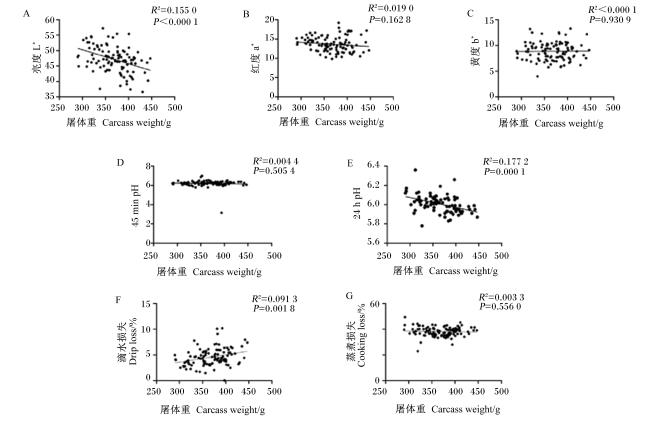
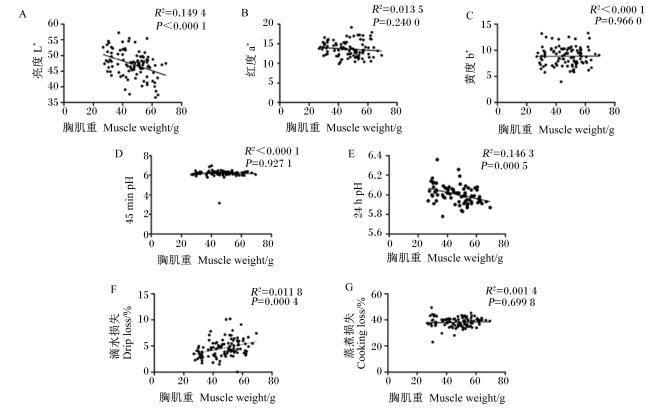
图2图3可见,乳鸽屠体重与胸肌滴水损失呈显著正相关(P<0.05),与胸肌L*值、24 h pH呈显著负相关(P<0.05),相关系数分别为0.091 3、0.155 0、0.177 2。乳鸽胸肌重与胸肌滴水损失呈显著正相关(P<0.05),与胸肌L*值、24 h pH呈显著负相关(P<0.05),相关系数分别为0.011 8、0.149 4、0.146 3。乳鸽屠体重、胸肌重与胸肌a*、b*值及45 min pH、蒸煮损失均没有显著相关性(P>0.05)。
图2 乳鸽屠体重与肉品质指标的相关性分析

Fig.2 Correlation analysis of carcass weight and meat quality indices of squabs

图3 乳鸽胸肌重与肉品质指标的相关性分析

Fig.3 Correlation analysis of breast muscle weight t and meat quality indices of squabs

2.6 不同带仔模式对乳鸽肠道发育的影响

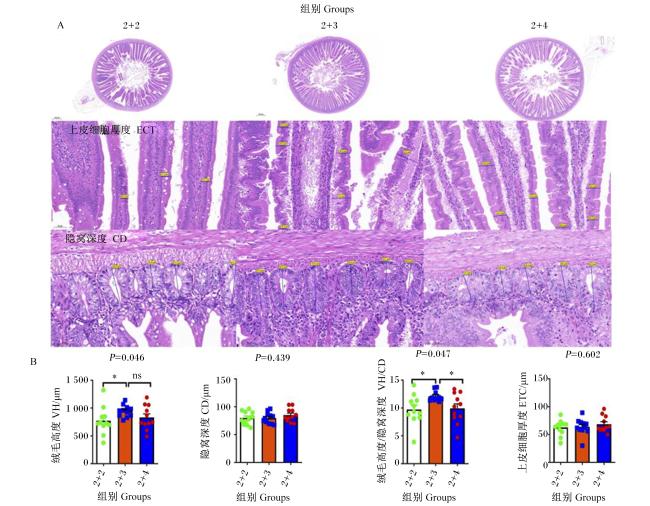
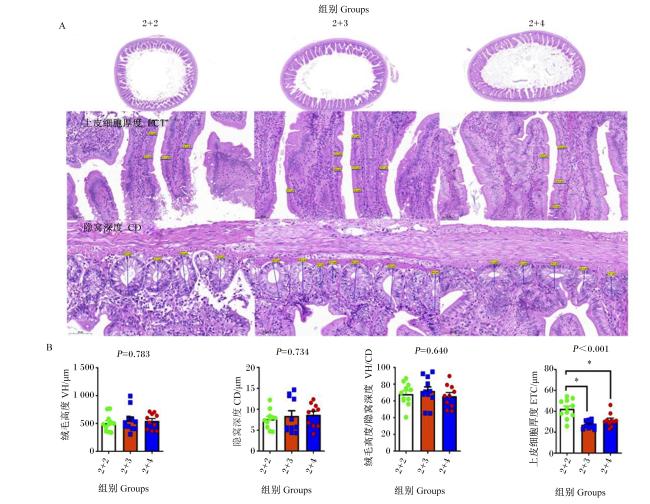
对不同带仔模式下乳鸽空肠和回肠进行HE染色观察,由图4图5可见,不同带仔模式下,乳鸽的空肠VH和VH/CD呈先升高后下降的趋势,CD和ECT则呈上升趋势;其中2+3组的VH最高,且显著高于2+2组(P<0.05),与2+4组没有显著差异(P>0.05);2+3组的VH/CD显著高于2+2组和2+4组(P<0.05)。不同带仔模式对乳鸽的回肠VH、CD和VH/CD均无显著影响(P>0.05);2+2组的ECT显著高于2+3组和2+4组(P<0.05),2+3组和2+4组之间差异不显著(P>0.05)。以上结果表明,不同带仔模式会影响乳鸽的肠道发育。
图4 不同带仔模式对乳鸽空肠发育的影响

A:HE染色;B:统计结果。*表示差异显著(P<0.05),ns表示差异不显著(P>0.05)。下图同。

Fig.4 Effects of different rearing patterns on jejunum development of squabs (40×,n=12)

A: HE stains; B: statistical results. * indicated significant difference (P<0.05), and ns indicated no significant difference (P>0.05). The same as below.

图5 不同带仔模式对乳鸽回肠发育的影响

Fig.5 Effects of different rearing patterns on ileum development of squabs (40×, n=12)

2.7 经济效益分析

根据梅州金绿现代农业有限公司提供的市场价格,对不同带仔模式下的饲料成本和经济效益进行了分析。由表7可见,由于2+3组和2+4组种鸽在一个哺乳期内分别携带了144和192只乳鸽,比2+2组分别多出48和96只,因此饲料成本分别增加了320.87和220.69元。在实际的市场交易中,乳鸽交易是以每只乳鸽为单位出售的。随着带仔数的增加,虽然2+3组和2+4组的总利润比2+2组分别增加了36和139元,但2+4的带仔模式下种鸽的体重损失增加,乳鸽的增重速度较慢,饲养时间需要延长,无法实现快速上市的目的。相比之下,2+3的带仔模式具有较好的经济效益。
表7 1个哺乳期内不同带仔模式的经济效益

Table 7 Economic benefits of different rearing patterns during a lactation period

项目
Items
组别Groups
2+2 2+3 2+4
乳鸽数Pigeon squab number/只 96.00 144.00 192.00
死亡乳鸽数Dead pigeon squab number/只 2.00 35.00 79.00
鸽蛋成本Pigeon egg cost/元1) 294.00 537.00 813.00
饲料成本Feed cost/元2) 512.80 833.67 1 054.36
总成本Total cost/元 806.80 1 370.67 1 867.36
乳鸽单价Pigeon squab unit price/元3) 12.50
总收入Total income/元 1 200 1 800 2 400
总利润Total profit/元 393.20 429.33 532.64

1)鸽蛋成本=(理论饲养总数+死亡乳鸽数)×3。Pigeon egg cost=(theoretical total number of rearing+dead pigeon squab number)×3.

2)饲料成本=(哺乳期种鸽总采食量+死亡乳鸽消耗饲料)×3。Feed cost=(total feed intake of breeding pigeon in the whole period+feed waste of dead squabs)×3.

3)根据市场价格,乳鸽的市场价格为12.5元/只,鸽蛋为3元/个,饲料成本为3元/kg;总收入=市场价格×乳鸽数。According to the market price, the market price of pigeons is 12.5 yuan per pigeon, pigeon eggs are 3 yuan per egg, and the feed cost is 3 yuan/kg; total income=market price×pigeon squab number.

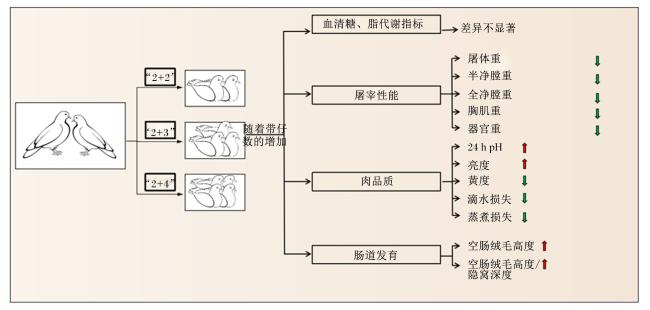
根据以上试验结果,如图6总结如下:不同带仔模式对乳鸽的血清生化指标没有显著影响;但随着带仔数的增加,乳鸽的屠宰性能降低;同时,不同带仔模式会对乳鸽的肉品质和肠道发育产生影响,表现为2+4组的胸肌24 h pH和L*值升高,而肉色b*值、滴水损失和蒸煮损失降低,2+3组的空肠VH和VH/CD升高。
图6 不同带仔模式对乳鸽屠宰性能、血清生化指标、肉品质和肠道发育的影响

Fig.6 Effects of different rearing patterns on slaughter performance, serum biochemical indices, meat quality and intestinal development of squabs

3 讨论

寒冷会对禽类造成各种不利影响,研究表明,长期慢性冷应激会降低肉鸡的生长性能[14]和免疫力[15]。本研究中,随着带仔数的增加,乳鸽的屠宰性能、肉品质、肠道发育均受到影响。冬季死亡乳鸽数明显增加,由2+2组的2只提高至2+4组的79只,这可能与乳鸽独特的生长发育过程有关,一方面由于乳鸽羽毛发育较为迟缓,10日龄之前几乎没有羽毛覆盖,造成其生命早期自身体温调节能力极差,完全依赖于种鸽;另一方面,由于乳鸽早期的快速生长,在高带仔数情况下种鸽不能保证全部的乳鸽能够覆盖在其羽毛之下,且不能保证所有乳鸽均可以获得足够的营养供应,这可能是高带仔数模式下乳鸽死亡数增加的主要原因。
本研究发现,不同带仔模式对乳鸽的血清GLU、TC、TG、HDL-C、LDL-C含量无显著影响,表明带仔数的增加对乳鸽的机体糖、脂代谢影响较小,乳鸽死亡率的升高可能更多的归因于寒冷应激。尽管带仔数升高会降低乳鸽的存活率,然而增加带仔数仍有潜在的的经济效益,比如2+4组乳鸽总出栏数量仍高于2+2组和2+3组。但高带仔模式下寒冷应激以及营养不良可能对乳鸽免疫力和终身的发育造成影响。禽类的主要免疫系统包括胸腺、脾脏、法氏囊,免疫器官指数在一定程度上反映了动物的免疫能力,在健康的前提下,免疫器官指数越大其免疫功能就越强[16]。本研究中,2+4组乳鸽的免疫器官指数有降低的趋势,并且生长性能和屠宰性能明显低于2+2组和2+3组,表明带仔数过高会一定程度影响乳鸽免疫力,并因此降低乳鸽的商品率。
除了屠宰性能外,肉品质是乳鸽养殖的另外一个重要的经济指标,在消费过程中起着关键性作用。本研究发现,2+4组乳鸽肉品质发生改变,其中24 h pH 、滴水损失以及肉色变化最为明显。肌肉的pH是决定肌肉风味的重要因素,通常情况下肌肉的pH主要由肌糖原的含量决定[17],在厌氧条件下肌糖原在ATP酶的作用下经过糖酵解产生乳酸,导致肌肉pH降低[18]。在本研究中,2+4组乳鸽胸肌24 h pH 显著高于2+2组和2+3组,表明带仔数过高可能会造成乳鸽肌肉中肌糖原含量降低,进而造成宰后乳酸生成减少,pH升高。然而并不是pH越低越好,前人研究发现乳鸽在屠宰前的急性热应激会加速肌糖原的分解,增加乳酸浓度,导致肌肉pH迅速下降,肉质变差[19-20]。本试验所测得乳鸽的胸肌pH在5.94~6.25,与前人研究结果[1,21]基本一致,表明鸽肉pH仍在正常范围。此外,本研究发现2+4组乳鸽胸肌滴水损失和肉色也发生改变,通过肉品质指标与屠体重和胸肌重进行相关性分析发现,屠体重和胸肌重与滴水损失呈极显著正相关,而与肉色L*值和24 h pH 呈显著负相关,表明影响肉品质的最主要因素仍然是乳鸽的生长速度。由于乳鸽上市以前基本不会独立摄食和饮水,其营养和水分完全依赖于种鸽晡喂,这很好的解释了为什么2+4组乳鸽肉品质出现明显的下降。
肠道在养分消化吸收和机体健康中发挥了重要作用,其中VH、CD、VH/CD以及ECT是评价肠道功能的重要指标[22-24]。为了进一步评估不同带仔模式对乳鸽生长发育的影响,评估了乳鸽肠道发育情况。研究发现,2+3组乳鸽空肠VH以及VH/CD最高,表明2+3组乳鸽肠道发育较好;同时,研究发现2+3组和2+4组乳鸽回肠ECT极显著低于2+2组,这可能与乳鸽获取营养减少,进而代偿性的降低小肠ECT,以促进营养物质吸收有关。以往的研究表明,小肠ECT的减少可对动物的生长性能产生积极影响[25-26],且可以减少消化系统的代谢需求[27],因此,相对于2+2和2+4,2+3的带仔模式对于乳鸽肠道发育最为有利。

4 结论

带仔数的增加可以提高鸽场的经济效益,但带仔数过高会提高乳鸽死亡率,乳鸽的生长速度和肉品质也会受到负面影响。综合乳鸽屠宰性能、肉品质、肠道发育以及经济效益指标,在不改变种鸽营养水平和保温措施的前提下,2+3的带仔模式更加适合冬季我国南方地区乳鸽生产。
[1]
KOKOSZYŃSKI D, STECZNY K, ŻOCHOWSKA-KUJAWSKA J, et al. Carcass characteristics,physicochemical properties,and texture and microstructure of the meat and internal organs of carrier and king pigeons[J]. Animals,2020,10(8):1315.

[2]
IPEK A, SAHAN U. Effects of cold stress on broiler performance and ascites susceptibility[J]. Asian-Australasian Journal of Animal Sciences, 2006, 19(5):734-738.

DOI

[3]
RENWICK G M, WASHBURN K W. Adaptation of chickens to cool temperature brooding[J]. Poultry Science, 1982, 61(7):1279-1289.

PMID

[4]
MENDES A A, WATKINS S E, ENGLAND J A, et al. Influence of dietary lysine levels and arginine:lysine ratios on performance of broilers exposed to heat or cold stress during the period of three to six weeks of age[J]. Poultry Science, 1997, 76(3):472-481.

PMID

[5]
HANGALAPURA B N, NIEUWLAND M G B, DE VRIES REILINGH G, et al. Effects of cold stress on immune responses and body weight of chicken lines divergently selected for antibody responses to sheep red blood cells[J]. Poultry Science, 2003, 82(11):1692-1700.

PMID

[6]
SHLOSBERG A, BELLAICHE M, ZEITLIN G, et al. Hematocrit values and mortality from ascites in cold-stressed broilers from parents selected by hematocrit[J]. Poultry Science, 1996, 75(1):1-5.

PMID

[7]
OLFATI A, MOJTAHEDIN A, SADEGHI T, et al. Comparison of growth performance and immune responses of broiler chicks reared under heat stress,cold stress and thermoneutral conditions[J]. Spanish Journal of Agricultural Research, 2018, 16(2):e0505.

[8]
ZHAO F Q, ZHANG Z W, YAO H D, et al. Effects of cold stress on mRNA expression of immunoglobulin and cytokine in the small intestine of broilers[J]. Research in Veterinary Science, 2013, 95(1):146-155.

DOI

[9]
HERNÁNDEZ-CASTELLANO L E, MORALES-DELANUEZ A, MORENO-INDIAS I, et al. Carcass and meat quality determination as a tool to promote local meat consumption in outermost regions of Europe[J]. Journal of Applied Animal Research, 2013, 41(3):269-276.

DOI

[10]
JIANG S G, PAN N X, CHEN M J, et al. Effects of dietary supplementation with DL-methionine and DL-methionyl-DL-methionine in breeding pigeons on the carcass characteristics,meat quality and antioxidant activity of squabs[J]. Antioxidants, 2019, 8(10):435.

DOI

[11]
YANG W L, CHEN Y P, CHENG Y F, et al. An evaluation of zinc bearing palygorskite inclusion on the growth performance,mineral content,meat quality,and antioxidant status of broilers[J]. Poultry Science, 2016, 95(4):878-885.

DOI

[12]
AGAZZI A, PERRICONE V, OMODEI ZORINI F, et al. Dietary mannan oligosaccharides modulate gut inflammatory response and improve duodenal villi height in post-weaning piglets improving feed efficiency[J]. Animals, 2020, 10(8):1283.

DOI

[13]
ÖZDOĞAN M, WELLMANN K, PAKSUZ E. Effect of gossypol on blood serum parameters and small intestinal morphology of male broilers[J]. Journal of Animal Physiology and Animal Nutrition,2012,96(1):95-101.

[14]
HENRIKSON Z A, VERMETTE C J, SCHWEAN-LARDNER K, et al. Effects of cold exposure on physiology,meat quality,and behavior of Turkey hens and toms crated at transport density[J]. Poultry Science, 2018, 97(2):347-357.

DOI

[15]
STEENFELDT S, SØRENSEN P, NIELSEN B L. Effects of choice feeding and lower ambient temperature on feed intake,growth,foot health,and panting of fast- and slow-growing broiler strains[J]. Poultry Science, 2019, 98(2):503-513.

DOI

[16]
WANG Y, YI L, ZHAO M L, et al. Effects of zinc-methionine on growth performance,intestinal flora and immune function in pigeon squabs[J]. British Poultry Science, 2014, 55(3):403-408.

DOI

[17]
HENCKEL P, KARLSSON A, JENSEN M T, et al. Metabolic conditions in porcine longissimus muscle immediately pre-slaughter and its influence on peri- and post mortem energy metabolism[J]. Meat Science, 2002, 62(2):145-155.

PMID

[18]
BOWKER B C, GRANT A L, SWARTZ D R, et al. Myosin heavy chain isoforms influence myofibrillar ATPase activity under simulated postmortem pH,calcium,and temperature conditions[J]. Meat Science, 2004, 67(1):139-147.

DOI

[19]
OWENS C M, ALVARADO C Z, SAMS A R. Research developments in pale,soft,and exudative Turkey meat in North America[J]. Poultry Science, 2009, 88(7):1513-1517.

DOI

[20]
ENGLAND E M, MATARNEH S K, SCHEFFLER T L, et al. pH inactivation of phosphofructokinase arrests postmortem glycolysis[J]. Meat Science, 2014, 98(4):850-857.

DOI PMID

[21]
卜柱, 常玲玲, 汤青萍, 等. 不同日龄和性别白羽王鸽肉品质、主要营养成分及肌纤维特性的比较研究[J]. 食品安全质量检测学报, 2018, 9(1):13-18.

BU Z, CHANG L L, TANG Q P, et al. Comparative study of meat quality,conventional nutrition composition and muscle fibre characteristics of White King pigeons between different age and gender[J]. Journal of Food Safety & Quality, 2018, 9(1):13-18. (in Chinese)

[22]
JEURISSEN S H M, LEWIS F, VAN DER KLIS J D, et al. Parameters and techniques to determine intestinal health of poultry as constituted by immunity,integrity,and functionality[J]. Current Issues in Intestinal Microbiology, 2002, 3(1):1-14.

[23]
BRÜMMER M, VAN RENSBURG C J, MORAN C A. Saccharomyces cerevisiae cell wall products:the effects on gut morphology and performance of broiler chickens[J]. South African Journal of Animal Science, 2010, 40(1):14-21.

[24]
PERALTA M F, NILSON A J, MIAZZO R D. Getting better intestinal health through the addition of yeast (Saccharomyces cerevisiae) combined with threonine in broilers diets[J]. Applied Science and Innovative Research, 2018, 2(2):49-62.

DOI

[25]
DIBNER J J, KITCHELL M L, ATWELL C A, et al. The effect of dietary ingredients and age on the microscopic structure of the gastrointestinal tract in poultry[J]. Journal of Applied Poultry Research, 1996, 5(1):70-77.

DOI

[26]
JAMROZ D, WERTELECKI T, HOUSZKA M, et al. Influence of diet type on the inclusion of plant origin active substances on morphological and histochemical characteristics of the stomach and jejunum walls in chicken[J]. Journal of Animal Physiology and Animal Nutrition, 2006, 90(5/6):255-268.

DOI

[27]
VISEK W J. The mode of growth promotion by antibiotics[J]. Journal of Animal Science, 1978, 46(5):1447-1469.

DOI

Outlines

/