RESEARCH PAPER

Effects of Nano-Composites of Copper and Carbon on Growth Performance and Jejunal Mechanical Barrier of Weaned Ira Rabbits

  • DI Bin , 1 ,
  • YANG Guofeng 1 ,
  • LIAO Weilian 2 ,
  • HE Jiayi 1 ,
  • ZHONG Xinyue 1 ,
  • GUO Pingting 1 ,
  • GAO Yuyun , 1, * ,
  • JIN Ling , 3, *
Expand
  • 1 College of Animal Science (School of Apicology), Fujian Agriculture and Forestry University, Fuzhou 350002, China
  • 2 Agricultural Bureau of Jiangle County, Sanming City, Fujian Province, Sanming 353300,China
  • 3 National Research Center of Fungus and Grass Engineering Technology, Fujian Agriculture and Forestry University, Fuzhou 350002, China
* GAO Yuyun, associate professor, E-mail: ;
JIN Ling, assistant researcher, E-mail:

Received date: 2023-01-28

  Online published: 2023-07-11

Abstract

This experiment was conducted to investigate the effects of different levels of nano-composites of copper and carbon (NCCC) on growth performance and jejunal mechanical barrier of weaned Ira rabbits. A total of 240 weaned Ira rabbits at 35 days of age were randomly divided into 5 groups with 6 replicates per group and 8 rabbits per replicate. They were control group (basal diet), low dose group (basal diet+50 mg/kg NCCC), medium dose group (basal diet+100 mg/kg NCCC), high dose group (basal diet+200 mg/kg NCCC) and antibiotic group (basal diet+60 mg/kg salinomycin). The experiment started at 35 days of age and lasted 28 days for the young rabbits. The results showed as follows: 1) compared with the control group, adding 200 mg/kg NCCC significantly increased the average daily gain of weaned Ira rabbits (P<0.05). Adding 100 and 200 mg/kg NCCC significantly decreased the diarrhea rate of weaned Ira rabbits (P<0.05). However, adding different levels of NCCC didn’t significantly affect the eviscerated percentage and semi-eviscerated percentage of weaned Ira rabbits (P>0.05). 2) Compared with the control group, the addition of 50 and 100 mg/kg NCCC significantly decreased the lumbrical index of weaned Ira rabbits (P<0.05), and the addition of different levels of NCCC significantly decreased the thymus index of weaned Ira rabbits (P<0.05). However, addition different levels of NCCC had no significant effects on spleen and cumulus indexes of weaned Ira rabbits (P>0.05). 3) Compared with the control group, addition different levels of NCCC could significantly increase jejunum villus height (P<0.05), and 200 mg/kg of NCCC could significantly increase the jejunum villus height/crypt depth of weaned Ira rabbits (P<0.05). In terms of gene expression level, 200 mg/kg of NCCC could significantly increase the expression levels of zonula occludens protein-1 (ZO-1) in jejunum mucosa of weaned Ira rabbits (P<0.05), while 50 mg/kg of NCCC could significantly increase the expression levels of OCLN in jejunum mucosa of weaned Ira rabbits (P<0.05). In conclusion, dietary NCCC supplementation can increase average daily gain, decrease diarrhea rate and improve jejunum villus height and tight junction protein gene expression levels to repair jejunum mechanical barrier damage of weaned Ira rabbits.

Cite this article

DI Bin , YANG Guofeng , LIAO Weilian , HE Jiayi , ZHONG Xinyue , GUO Pingting , GAO Yuyun , JIN Ling . Effects of Nano-Composites of Copper and Carbon on Growth Performance and Jejunal Mechanical Barrier of Weaned Ira Rabbits[J]. Chinese Journal of Animal Nutrition, 2023 , 35(7) : 4575 -4586 . DOI: 10.12418/CJAN2023.425

现代集约化养殖生产过程中,仔兔断奶时饲粮结构发生改变,失去母乳的保护作用,而此时其消化系统尚未发育完全,无法消化和吸收固体颗粒料中的营养物质,进而引发仔兔断奶应激。特别是断奶后1~2周,仔兔消化道还处于生长发育阶段,容易引发胃肠炎或腹泻,导致仔兔采食量降低、饲料转化率降低、生长速率缓慢、生产性能下降,严重甚至死亡。所以需要开发一种安全无害的新型饲料添加剂来减轻仔兔断奶应激,降低仔兔腹泻率。纳米铜碳复合物(nano-composites of copper and carbon,NCCC)是一种以植物纤维为模板,金属铜离子为原料,通过加温碳化还原方法制备而成的铜/碳-核/壳结构的纳米颗粒[1]。王慧等[2]研究表明,NCCC具有抗双极霉属、木霉属真菌、白腐真菌、蓝变真菌、大肠杆菌、金色葡萄球菌及白色念珠菌等作用,具有广谱性抗菌能力。研究发现,NCCC可以通过供体氧原子来减少稳定的氧自由基1,1-二苯基苦基苯肼(DPPH),并产生了还原型DPPH,证明了NCCC具有清除自由基和抗氧化的能力[3]。目前国内外对于利用铜碳复合材料作为饲料添加剂替代抗生素的研究较少。因此,本试验以断奶伊拉兔作为试验动物,探究NCCC对断奶伊拉兔生长性能、免疫功能、肝脏抗氧化和肠道机械屏障的影响,以期为其作为抗生素的替代品及饲料添加剂的研发应用提供理论依据和技术支持。

1 材料与方法

1.1 试验材料

试验所用的35日龄伊拉兔购自福建省春龙农牧科技公司;NCCC购自厦门某有限公司,其纳米颗粒中核的直径为50~60 nm,碳壳的直径约为5 nm,碳化后的材料被粉碎成千分尺到亚千分尺大小的颗粒,颗粒一般呈球形,大部分颗粒的平均直径为20~50 nm,同时测得铜质量比为11.2%,石墨烯质量比为88.8%;饲料原料购自福建省某饲料有限公司。

1.2 试验设计

本试验采用单因子试验设计,选取体重、日龄、遗传背景相近的健康断奶伊拉公兔240只,随机分为5组,分别为对照组(基础饲粮)、低剂量组(基础饲粮+50 mg/kg NCCC)、中剂量组(基础饲粮+100 mg/kg NCCC)、高剂量组(基础饲粮+200 mg/kg NCCC)和抗生素组(基础饲粮+60 mg/kg盐霉素),每组6个重复,每个重复8只。试验从35日龄开始,并在饲养28 d后屠宰取样。本次动物试验的所有操作严格按照福建农林大学实验动物福利和动物实验伦理管理规定执行。

1.3 试验饲粮

基础饲粮参照《肉兔营养需要量》NY/T 4049—2021[4]进行配制。各组饲粮营养水平保持一致,试验所用基础饲粮组成及营养水平如表1所示。
表1 基础饲粮组成及营养水平(风干基础)

Table 1 Composition and nutrient levels of the basal diet (air-dry basis) %

项目Items 含量Content
原料Ingredients
苜蓿草粉Alfalfa meal 38.00
玉米Corn 9.00
麸皮Wheat bran 16.90
小麦干酒糟及其可溶物Wheat DDGS 6.00
稻壳粉Rice husk powder 9.00
豆粕Soybean meal 5.00
米糠粕Rice bran meal 10.00
次粉Wheat-middling 3.00
石粉Limestone 1.20
蛋氨酸Methionine 0.10
赖氨酸Lysine 0.20
氯化钠NaCl 0.60
预混料Premix1) 1.00
合计Total 100.00
营养水平Nutrient levels2)
消化能DE/(MJ/kg) 9.96
粗蛋白质CP 15.48
粗纤维CF 17.35
中性洗涤纤维NDF 33.56
酸性洗涤纤维ADF 20.51
酸性洗涤木质素ADL 5.90
钙Ca 0.90
总磷TP 0.51
赖氨酸Lys 0.74
蛋氨酸+半胱氨酸Met+Cys 0.51

1) 预混料为每千克饲粮提供 The premix provided the following per kg of the diet:VA 12 000 IU,VD3 900 IU,VE 50 mg,VK3 1 mg,VB1 1 mg,VB2 3 mg,VB6 1 mg,VB12 0.01 mg,烟酸 nicotinic acid 30 mg,D-泛酸 D-pantothenic acid 8 mg,叶酸 folic acid 0.2 mg,生物素biotin 0.08 mg,Cu (as copper sulfate) 10 mg,Fe (as ferrous sulfate) 50 mg,Mn (as manganese sulfate) 8.0 mg,Zn (as zinc sulfate) 50 mg,I (as potassium iodide) 1 mg,Se (as sodium selenite) 0.05 mg,Co (as cobalt sulfate) 0.25 mg,胆碱 choline 100 mg。

2)营养水平均为计算值。Nutrient levels were calculated values.

1.4 饲养管理

本试验在春龙农牧科技公司试验场开展,试验前对兔舍内的兔笼、饮水器、料槽等物品进行彻底清洗,并于试验开始前2周对兔舍及所有物品进行甲醛熏蒸消毒。试验兔饲养于封闭式兔舍,采用3层笼养,严格控制舍内温度、光照和通风。仔兔的免疫程序严格按照常规方法操作,自由采食与饮水,每天观察兔群的生长状态,及时处理死兔。

1.5 样品采集及指标测定

1.5.1 生长性能测定

试验为期28 d,每组每个重复选取1只断奶伊拉兔用于屠宰取样,共30只。以重复为单位记录每天采食量,试验结束前1天18:00断料不断水,统计每个重复饲粮消耗总量,次日06:00分别称取每个重复断奶伊拉兔总重,分别计算各组平均日采食量(ADFI)、平均日增重(ADG)和料重比(F/G),并记录腹泻个体数,最后按不同阶段计算腹泻率。
ADFI=平均阶段采食量/饲喂天数;
ADG=(末重-初重)/饲喂天数;
F/G=每个重复的平均阶段采食量/平均阶段增重;
腹泻率(%)=[腹泻只数×腹泻日数/(试验只数×试验期)]×100。

1.5.2 屠宰性能测定

从每个重复中随机选取1只断奶伊拉兔,称重和心脏采血完后宰杀,对半净膛和全净膛进行称重,并计算半净膛率和全净膛率。
半净膛重:去除头、四肢、尾、气管、食管、移走肠道及内容物和泌尿生殖器官后仅保留心脏、肝脏、肾脏及周围脂肪后的重量。
全净膛重:在半净膛的基础上去除心脏、肝脏、肾脏及周围脂肪后的重量。
半净膛率(%)=[半净膛重/宰前重]×100;
全净膛率(%)=[全净膛重/宰前重]×100。

1.5.3 免疫器官指数测定

取脾脏、圆小囊、蚓突、胸腺免疫器官并用滤纸吸去器官上黏附的血液,用镊子剥离器官上多余的筋膜和脂肪组织,电子天平精确称重(精确至小数点后4位小数),记录免疫器官重并计算相应的免疫器官指数。

1.5.4 空肠形态结构测定

屠宰后取空肠中段5 cm,用生理盐水洗去内容物,置于4%多聚甲醛溶液中固定24 h,用于苏木精-伊红(HE)染色观察;另取3段3 cm左右空肠中段组织,4 ℃生理盐水轻轻冲洗其中内容物,后将组织装入2 mL冻存管,置于液氮罐中冻存,后转移至-80 ℃冰箱中保存,用于紧密连接蛋白基因相对表达量测定。
使用Eclipse Ci-L拍照显微镜选取小肠组织目的区域进行40倍成像,成像时尽量让组织充满整个视野,保证每张照片的背景一致,成像完成后使用Image-Pro Plus 6.0分析软件,统一以微米为标准单位,分别测量每张切片中5根完整肠绒毛高度和对应隐窝深度,并计算绒毛高度和隐窝深度的比值(绒毛高度/隐窝深度)。

1.5.5 空肠黏膜紧密连接蛋白基因表达测定

空肠黏膜组织总RNA利用FastDNA® Spin Kit for Soil试剂盒(普洛麦格北京生物技术有限公司)进行提取,然后根据Reverse Transcription System kit反转录试剂盒(普洛麦格北京生物技术有限公司)进行反转录,然后根据Go Taq® qPCR Master Mix荧光定量试剂盒(普洛麦格北京生物技术有限公司)进行实时荧光定量PCR(qRT-PCR)检测空肠黏膜闭锁蛋白(OCLN)、闭合蛋白1(CLDN1)、闭合蛋白3(CLDN3)、闭合小环蛋白-1(ZO-1)的基因相对表达量。体系反应条件为95 ℃预变性5 min,95 ℃变性10 s,55~65 ℃退火10 s,72 ℃延伸10 s,重复变性至延伸步骤40个循环。试验所需全部基因引物均由福州尚亚生物技术有限公司设计合成,引物序列见表2。以3-磷酸甘油醛脱氢酶(GAPDH)为内参,采用2-△△Ct分析方法,计算基因相对表达量。
表2 引物序列

Table 2 Primer sequences

基因
Genes
引物序列
Primer sequences (5'—3')
登录号
Accession number
3-磷酸甘油醛脱氢酶GAPDH F:GGTAGTGAAGGCTGCTGCTGATG
R:GTCTCGCACTCCAATCTCTGTTCC
NC_013676.1
闭锁蛋白OCLN F:CCGTATCCAGAGAGTCCTACAAGT
R:GTCCGTCTCGTAGTGGTCTT
NC_013679.1
闭合蛋白1 CLDN1 F:ACAGCATGGTATGGCAACAG
R:CGAGGACAAGAACAGCAAAGT
NC_013682.1
闭合小环蛋白-1 ZO-1 F:CCGCTCATACCTTCCTCTCA
R:GTCATTCACCTCCTTCTTGTTCTC
NC_013685.1
闭合蛋白3 CLDN3 F:CCATCATCCAGGACTTCTACAAC
R:AGTAGGCGATCTTGGTGGTC
NW_003159391.1

1.6 数据分析

使用Excel 2019对试验数据进行整理和统计,经SPSS 25.0统计分析,使用one-way ANOVA进行方差分析,并用Duncan氏法进行多重比较;腹泻率和死亡率使用卡方检验进行分析。除腹泻率和死亡率,其他试验结果皆用平均值±标准差(mean±SD)表示,以P<0.05为差异显著,P>0.05为差异不显著。

2 结果

2.1 NCCC对断奶伊拉兔生长性能的影响

表3可知,饲粮中添加不同水平NCCC对断奶伊拉兔的ADFI、F/G、死亡率均无显著影响(P>0.05),但仍能观察到随着NCCC添加水平的提高,ADFI有上升的趋势,而死亡率有下降的趋势。与对照组相比,低、中、高剂量组断奶伊拉兔的ADG显著提高(P<0.05)。高剂量组和抗生素组腹泻率较对照组显著降低(P<0.05)。
表3 NCCC对断奶伊拉兔生长性能的影响

Table 3 Effects of NCCC on growth performance of weaned Ira rabbits

项目
Items
对照组
Control
group
低剂量组
Low dose
group
中剂量组
Medium dose
group
高剂量组
High dose
group
抗生素组
Antibiotic
group
P
P-value
平均日采食
ADFI/(g/d)
98.14±3.26 102.97±3.02 103.97±2.05 104.99±5.18 103.69±3.01 0.094
平均日增重
ADG/(g/d)
24.71±1.33b 27.44±2.34a 27.88±2.89a 28.37±1.19a 27.86±2.17a 0.039
初重IBW/g 698.25±8.89 689.98±12.42 699.73±9.38 704.85±14.70 696.50±7.27 0.238
末重FBW/g 1 390.13±43.25b 1 465.00±54.49a 1 479.22±85.63a 1 489.82±36.07a 1 478.76±52.77a 0.037
料重比FCR 3.99±0.31 3.86±0.76 3.80±0.59 3.72±0.33 3.76±0.39 0.892
死亡率
Death rate/%
29.17 18.75 12.50 8.33 14.58 0.069
腹泻率
Diarrhea rate/%
4.81a 3.15ab 3.14ab 2.54b 2.32b 0.002

同行数据肩标无字母或相同字母表示差异不显著(P>0.05),不同小写字母表示差异显著(P<0.05)。下表同。

In the same row, values with no letter or the same letter superscripts mean no significant difference (P>0.05), while with different small letter superscripts mean significant difference (P<0.05). The same as below.

2.2 NCCC对断奶伊拉兔屠宰性能的影响

表4可知,饲粮中添加不同水平的NCCC对全净膛率、半净膛率均无显著影响(P>0.05)。
表4 NCCC对断奶伊拉兔屠宰性能的影响

Table 4 Effects of NCCC on slaughter performance of weaned Ira rabbits %

项目
Items
对照组
Control
group
低剂量组
Low dose
group
中剂量组
Medium dose
group
高剂量组
High dose
group
抗生素组
Antibiotic
group
P
P-value
全净膛率
Eviscerated yield
percentage
44.85±3.77 45.81±4.97 46.29±3.96 47.81±3.51 45.12±2.76 0.197
半净膛率
Half-eviscerated yield
percentage
48.97±3.88 49.88±5.01 50.16±4.01 50.94±4.27 49.57±2.56 0.405

2.3 NCCC对断奶伊拉兔免疫器官指数的影响

表5可知,与对照组相比,饲粮中添加NCCC对断奶伊拉兔脾脏和圆小囊指数无显著影响(P>0.05)。低、中剂量组蚓突指数较对照组显著降低(P<0.05)。添加不同水平NCCC组胸腺指数较对照组显著降低(P<0.05)。
表5 NCCC对断奶伊拉兔免疫器官指数的影响

Table 5 Effects of NCCC on immune organ indexes of weaned Ira rabbits g/kg

项目
Items
对照组
Control
group
低剂量组
Low dose
group
中剂量组
Medium dose
group
高剂量组
High dose
group
抗生素组
Antibiotic
group
P
P-value
脾脏指数
Spleen index
0.70±0.20 0.66±0.15 0.74±0.16 0.65±0.12 0.65±0.17 0.324
圆小囊指数
Sacculis rotundus
index
0.29±0.13 0.27±0.07 0.26±0.03 0.25±0.08 0.29±0.07 0.382
蚓突指数
Vermiform appendix
index
5.61±0.71a 4.29±0.87b 4.26±0.54b 5.28±0.13ab 5.59±1.04a 0.015
胸腺指数
Thymus index
2.71±0.56a 1.99±0.78bc 1.86±0.51bc 1.79±0.21c 2.42±0.38ab 0.005

2.4 NCCC对断奶伊拉兔空肠形态的影响

表6可知,与对照组相比,饲粮中添加不同水平NCCC和抗生素处理可显著提高断奶伊拉兔空肠绒毛高度(P<0.05);高剂量组断奶伊拉兔空肠绒毛高度/隐窝深度显著提高(P<0.05),但饲粮中添加不同水平NCCC对断奶伊拉兔空肠隐窝深度无显著影响(P>0.05)。
表6 NCCC对断奶伊拉兔空肠形态的影响

Table 6 Effects of NCCC on jejunal morphology of weaned Ira rabbits

项目
Items
对照组
Control
group
低剂量组
Low dose
group
中剂量组
Medium dose
group
高剂量组
High dose
group
抗生素组
Antibiotic
group
P
P-value
绒毛高度
Villi height/μm
627.42±61.32c 681.72±73.56b 719.03±52.68ab 776.75±48.25a 682.70±81.51b 0.020
隐窝深度
Crypt depth/μm
68.87±13.21 61.29±12.22 70.47±4.96 63.73±14.93 71.56±12.47 0.155
绒毛高度/隐窝深度
V/C
9.24±1.98b 11.69±2.92ab 10.47±1.53ab 12.61±2.70a 9.72±1.59ab 0.044
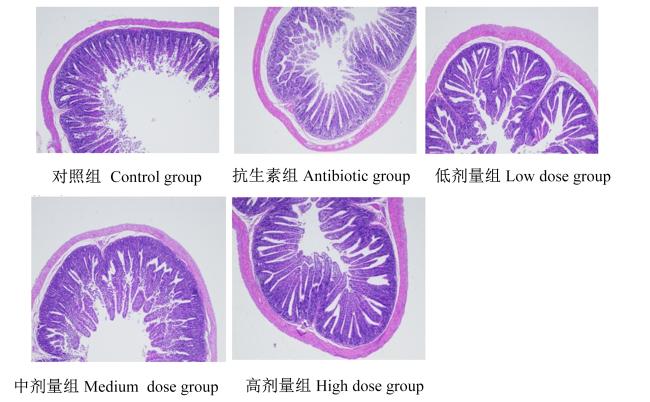
图1可以看出,对照组空肠肠绒毛顶端微绒毛出现了部分脱落、断裂,肠绒毛排列相对最短,肠腺相对较少,隐窝深度最浅,肠道环形肌层最薄;低剂量组和抗生素组顶端也出现了部分脱落、断裂,但明显较对照组少,肠绒毛明显比对照组长,隐窝深度相对对照组较深,肠道环形肌相对对照组较厚;中、高剂量组肠绒毛整体结构完整,肠微绒毛未见明显脱落,肠绒毛排列相对整齐、紧密,肠绒毛最长,隐窝深度相对最深,肠道环形肌层相对最厚。
图1 断奶伊拉兔空肠黏膜组织学观察(HE染色)

Fig.1 Histological observation of jejunal mucosa in weaned Ira rabbits (HE staining,40×)

2.5 NCCC对断奶伊拉兔空肠黏膜紧密连接蛋白基因表达水平的影响

表7可知,与对照组相比,饲粮中添加高剂量NCCC可以显著提高断奶伊拉兔空肠黏膜中ZO-1基因相对表达量(P<0.05);低剂量组和抗生素组断奶伊拉兔空肠黏膜中OCLN基因相对表达量显著提高(P<0.05);添加不同水平NCCC对断奶伊拉兔空肠黏膜中CLDN1基因相对表达量无显著影响(P>0.05);添加中剂量NCCC显著抑制了断奶伊拉兔空肠黏膜中的CLDN3基因相对表达量(P<0.05)。
表7 NCCC对断奶伊拉兔空肠黏膜紧密连接蛋白基因表达水平的影响

Table 7 Effects of NCCC on gene expression levels of tight junction proteins in jejunal mucosa of weaned Ira rabbits

项目
Items
对照组
Control
group
低剂量组
Low dose
group
中剂量组
Medium dose
group
高剂量组
High dose
group
抗生素组
Antibiotic
group
P
P-value
闭合小环蛋白-1
ZO-1
1.00±0.31b 1.09±0.38b 1.51±0.17b 2.78±0.56a 1.80±0.26b 0.002
闭锁蛋白OCLN 1.00±0.15c 4.06±0.41a 1.55±0.26bc 1.43±0.43bc 2.55±0.71b 0.001
闭合蛋白1 CLDN1 1.00±0.29 0.75±0.16 0.55±0.15 0.74±0.21 0.49±0.05 0.055
闭合蛋白3 CLDN3 1.00±0.07ab 2.07±0.83a 0.47±0.11b 1.12±0.25ab 1.33±0.28ab 0.010

3 讨论

3.1 NCCC对断奶伊拉兔生长性能的影响

目前,关于NCCC对动物生长性能的研究较少,而铜对动物机体生长性能的研究结果也不尽相同。常新耀等[5]研究发现,在饲粮中添加2.3、42.3、82.3、122.3、162.3 mg/kg的硫酸铜对肉仔鸡的ADFI、ADG、F/G无显著影响。而对于断奶应激动物而言,晏家友等[6]研究发现,饲粮中添加柠檬酸铜、硫酸铜或碱式氯化铜对断奶仔猪ADFI、ADG、F/G均无显著影响。杨清[7]研究表明,饲粮中添加高水平铜(100、125 mg/kg)可以显著降低断奶小鼠的F/G。这可能是由于铜元素具有一定抑菌作用,维护了肠道微生物环境稳态,促进了肠道营养吸收,从而降低了F/G[8-9]。另外,有研究表明,石墨烯纳米材料可影响干细胞的生物学行为,表现为促进干细胞生长、分化、增殖和黏附,并且认为这些纳米材料可能是通过调节E-钙黏蛋白/Wnt信号通路而影响干细胞的生物学行为[10]。本研究发现,添加高剂量NCCC与对照组相比,显著提高了断奶仔兔的ADG,降低了腹泻率。与上述试验的结果部分一致,这和一定量的铜可以刺激动物下丘脑神经肽γ,提高采食量有关,且随着日龄的增长,残留在动物体内的铜的浓度也会增加[11]。本试验结果显示,饲粮中添加NCCC可以促进断奶伊拉兔的生长发育,而减少腹泻率,提高其生产效益。

3.2 NCCC对断奶伊拉兔屠宰性能的影响

关于饲粮中添加铜对断奶动物屠宰性能影响的研究结果也不尽相同。郭志强等[12]研究表明,与对照组相比,饲粮中添加20 mg/kg柠檬酸铜显著提高了断奶肉兔的全净膛重和半净膛重。祁新梅[13]研究发现,在饲粮中添加16 mg/kg硫酸铜显著提高了70日龄扬州仔鹅的屠宰性能,其中16 mg/kg硫酸铜组的屠宰率、腿肌率、腹脂率相对于空白组均有显著提高。张利环等[14]研究表明,饲粮中添加52 mg/kg纳米铜显著提高了36日龄樱桃谷鸭的屠宰率和全净膛率。并且研究发现铜对于屠宰性能的影响主要是通过诱导生长激素(GH)和胰岛素样生长因子-1(IGF-1)的合成和分泌,进而抑制蛋白质降解、刺激脂肪分解[15]。虽然以上研究都表明不同形式的铜对动物的屠宰性能有提高的作用,但也有研究表明,添加不同水平的硫酸铜对育肥猪的屠宰率没有显著影响[16]。而本试验研究结果也表明虽然添加NCCC使得断奶伊拉兔末重显著高于对照组,但是对于全净膛率和半净膛率无显著影响。

3.3 NCCC对断奶伊拉兔免疫器官指数的影响

免疫器官是动物机体免疫系统发育情况和评价机体抗病能力的重要基础,免疫器官能产生淋巴细胞,并通过其分泌产物参与动物机体内体液免疫和细胞免疫[17-18],因此,其发育程度可体现动物抵抗断奶应激的能力。何海建等[19]研究表明,在饲粮中添加15和30 mg/kg氨基酸螯合铜显著提高了育成鸡的免疫器官指数。张亚丽[20]研究表明,在饲粮中添加100 mg/kg壳聚糖铜可显著提高断奶仔猪的淋巴结指数。朱连勤等[21]研究表明,在饲粮中以纳米氧化铜形式添加8和16 mg/kg铜可以显著提高肉鸡免疫器官指数。但也有研究认为,饲粮中添加纳米铜使得肉仔鸡的免疫器官重量及其指数均无显著影响[22]。更有研究显示,添加纳米铜使得小白鼠的胸腺指数、脾脏指数及肾脏指数下降[23]。蚓突、圆小囊是肉兔特有的免疫器官,能够反映兔机体的免疫能力和抗应激能力[24-26],而铜的添加量过少和过多都会对免疫器官造成损伤,导致免疫器官指数下降[27]。这可能是本试验饲粮中添加NCCC不仅对于脾脏指数和圆小囊指数无显著影响,而且降低了蚓突指数和胸腺指数的原因。

3.4 NCCC对断奶伊拉兔空肠形态的影响

小肠绒毛是肠道机械屏障的重要组成部分,这些绒毛主要富集于小肠黏膜的褶皱中,小肠中的隐窝细胞则可以发育形成新的小肠绒毛[28]。绒毛高度可表征小肠的消化吸收能力,隐窝的深度则可反映肠道组织的增殖能力,绒毛高度/隐窝深度越高,其肠道的吸收能力越强[29]。仔兔断奶后,因饲粮突然从母乳转变为固体饲粮而产生的断奶应激,会导致小肠绒毛萎缩、绒毛高度降低、隐窝加深,促使肠道机械屏障受损,小肠吸收能力减弱,造成仔兔生长性能降低,进而导致腹泻或者死亡[30-32]
研究结果显示,饲粮中添加不同水平铜对动物肠道发育的影响并不相同。梅绍锋等[32]研究表明,饲粮中添加20、50 mg/kg铜可以显著提高断奶仔猪空肠绒毛高度、绒毛高度/隐窝深度,显著降低空肠隐窝深度。刘德琴等[33]研究表明,饲粮中添加330 mg/kg铜显著降低了肉鸡空肠绒毛高度/隐窝深度,修复了肠道屏障损伤。Coble等[34]研究发现,在饲粮中添加50 mg/kg铜可显著提高育肥猪空肠绒毛高度、绒毛高度/隐窝深度,降低隐窝深度,改善了育肥猪空肠形态和绒毛完整性。NCCC具有广谱抗菌能力,在进入胃肠道后,可以杀灭病原菌,吸附内毒素,从而保证肠绒毛和隐窝的正常生长。这与本试验在饲粮中添加中、高剂量NCCC显著提高了断奶伊拉兔空肠绒毛高度和绒毛高度/隐窝深度的结果相证。这说明NCCC的添加对于肉兔肠道发育具有一定促进作用。

3.5 NCCC对断奶伊拉兔空肠黏膜紧密连接蛋白基因表达水平的影响

在肠道机械屏障的结构中,肠上皮细胞之间的空隙由紧密连接填补封闭,紧密连接是阻止内毒素和致病菌侵入的重要防线[35-36]。肠道紧密连接是动态变化的,在断奶仔兔受到应激时可增强细胞适应力,阻止有害菌侵入内循环[37]。研究人员在1963年第1次发现了紧密连接,并研究发现紧密连接是由蛋白复合物构成,主要包括OCLN、CLDN和连接黏附分子(JAM)以及ZO[38]。上述4种蛋白构成了肠道上皮的第1道屏障,可控制肠上皮细胞之间空隙的通透性,筛除有害菌和致病菌[39-41]
Forouzandeh等[42]研究表明,在饲粮中添加250 mg/kg氧化铜(CuO)可以显著提高育肥猪空肠黏膜CLDN1的表达。Leyva-Diaz等[43]研究发现,感染伤寒沙门氏菌的肉鸡饲粮中添加250 mg/kg醋酸铜,可以有效杀灭细菌,修复肠道黏膜损伤,提高CLDN1、OCLN的表达。内源性和外源性因素会影响肠道紧密连接蛋白分泌量的高低,而在饲粮中添加铜可以减少外源性因素对于紧密连接蛋白的抑制[44]。本试验结果表明,在饲粮中添加低、中剂量NCCC可以显著提高断奶伊拉兔空肠OCLNZO-1的基因相对表达量,与上述研究结果一致。但饲粮中添加中剂量NCCC反而降低了断奶伊拉兔CLDN3的基因相对表达量,这与上述研究结果相矛盾,有待进一步研究。

4 结论

在本试验条件下,饲粮中添加纳米NCCC可改善断奶伊拉兔空肠黏膜形态,提高断奶伊拉兔ADG,降低腹泻率。综合本试验结果,添加100和200 mg/kg NCCC对于断奶伊拉兔以上指标都有改善;而添加200 mg/kg NCCC对于断奶伊拉兔ADG的提高和腹泻率的降低效果最为显著。
[1]
连崑, 李维凤, 王小鹏, 等. 具有铜/碳-核/壳结构的铜纳米材料在抗菌方面的应用:CN201110308477.2[P].2012-06-20.

LIAN K, LI W F, WANG X P, et al. Application of copper nanomaterials with copper/carbon-core/shell structure in antibacterial activity:CN201110308477.2[P].2012-06-20. (in Chinese)

[2]
王慧, 连崑, 郑慧萍, 等. 碳和铜的复合纳米粒子的应用:CN201810651277.9[P].2018-10-16.

WANG H, LIAN K, ZHENG H P, et al. Application of carbon and copper composite nanoparticles:CN201810651277.9[P].2018-10-16. (in Chinese)

[3]
BISWAS K, MOHANTA Y K, MISHRA A K, et al. Wet chemical development of CuO/GO nanocomposites:its augmented antimicrobial,antioxidant,and anticancerous activity[J]. Journal of Materials Science:Materials in Medicine, 2021, 32(12):151.

DOI

[4]
中华人民共和国农业农村部. 肉兔营养需要量:NY/T 4049—2021[S]. 北京: 中国农业出版社, 2021.

Ministry of Agriculture and Rural Affairs of the People’s Republic of China. Nutrient requirements of meat rabbit:NY/T 4049—2021[S]. Beijing: China Agriculture Press, 2021. (in Chinese)

[5]
常新耀, 王翠. 日粮中添加铜对肉仔鸡生产性能的影响[J]. 饲料工业, 2007, 28(20):39-41.

CHANG X Y, WANG C. The effect of dietary copper on production performance[J]. Feed Industry, 2007, 28(20):39-41. (in Chinese)

[6]
晏家友, 刁慧, 李书伟, 等. 日粮中添加低铜对断奶仔猪生长性能、抗氧化功能及组织器官铜沉积量的影响[J]. 中国饲料, 2021(19):19-22.

YAN J Y, DIAO H, LI S W, et al. Effect of diet added with low copper on growth performance,antioxidant function,tissue and organs copper concentrations in weaning piglets[J]. China Feed, 2021(19):19-22. (in Chinese)

[7]
杨清. 日粮铜水平对猪和小鼠肠道形态和发育的影响研究[D]. 硕士学位论文. 长沙: 湖南师范大学, 2020.

YANG Q. Effects of dietary copper levels on intestinal morphology and development in pigs and mice[D]. Master’s Thesis. Changsha: Hunan Normal University, 2020. (in Chinese)

[8]
晏家友, 杜亚楠, 李书伟, 等. 饲料级柠檬酸铜对大肠杆菌和沙门氏菌的体外抑菌作用[J]. 中国畜牧杂志, 2022, 58(1):206-208.

YAN J Y, DU Y N, LI S W, et al Bacteriostasis of feed grade copper citrate against Escherichia coli and Salmonella[J]. Chinese Journal of Animal Science, 2022, 58(1):206-208. (in Chinese)

[9]
王龙, 廖业, 孙虹霞, 等. Cu2+胁迫对黑水虻幼虫抗菌肽组分及抑菌活性的影响[J]. 环境昆虫学报, 2019, 41(6):1348-1354.

WANG L, LIAO Y, SUN H X, et al. Effects of dietary copper on the components and antimicrobial activities of antibacterial peptides from the larvae of Hermetia illucens L[J]. Journal of Environmental Entomology, 2019, 41(6):1348-1354. (in Chinese)

[10]
沈佳华, 付勇. 基于石墨烯的纳米材料可否在干细胞领域应用[J]. 中国组织工程研究, 2022, 26(4):604-609.

SHEN J H, FU Y. Application of graphene-based nanomaterials in stem cells[J]. Chinese Journal of Tissue Engineering Research, 2022, 26(4):604-609. (in Chinese)

[11]
LI J K, YAN L Y, ZHENG X, et al. Effect of high dietary copper on weight gain and neuropeptide Y level in the hypothalamus of pigs[J]. Journal of Trace Elements in Medicine and Biology, 2008, 22(1):33-38.

DOI PMID

[12]
郭志强, 胡海强, 谢晓红, 等. 柠檬酸铜对肉兔生产性能和肉品质的影响[J]. 中国畜牧杂志, 2021, 57(11):186-190.

GUO Z Q, HU H Q, XIE X H, et al. Effects of copper citrate on performance and meat quality of meat rabbits[J]. Chinese Journal of Animal Science, 2021, 57(11):186-190. (in Chinese)

[13]
祁新梅. 饲粮铜水平对仔鹅生长性能、屠宰性能、肉品质及血清生化指标的影响[D]. 硕士学位论文. 扬州: 扬州大学, 2016.

QI X M. Effects of dietary copper level on growth performance,slaughter performance,meat quality and serum biochemical indices of green goose[D]. Master’s Thesis. Yangzhou: Yangzhou University, 2016. (in Chinese)

[14]
张利环, 贾浩, 张若男, 等. 纳米铜替代抗生素对肉鸭生产性能和血清生化指标的影响[J]. 畜牧与兽医, 2021, 53(8):56-62.

ZHANG L H, JIA H, ZHANG R N, et al. Effect of nano-copper as an antibiotic substitute on production performance and serum biochemical indexes of meat ducks[J]. Animal Husbandry & Veterinary Medicine, 2021, 53(8):56-62. (in Chinese)

[15]
WANG J G, ZHU X Y, GUO Y Z, et al. Influence of dietary copper on serum growth-related hormone levels and growth performance of weanling pigs[J]. Biological Trace Element Research, 2016, 172(1):134-139.

DOI PMID

[16]
严俊, 杨文艳, 车东升, 等. 粗纤维及铜对育肥猪生长性能、胴体性状和肉品质的影响[J]. 中国畜牧杂志, 2021, 57(10):173-178.

YAN J, YANG W Y, CHE D S, et al. Effects of crude fiber and copper on growth performance,carcass traits and meat quality of fattening pigs[J]. Chinese Journal of Animal Science, 201, 57(10):173-178. (in Chinese)

[17]
MANAFI M, HEDAYATI M, MIRZAIE S. Probiotic Bacillus species and Saccharomyces boulardii improve performance,gut histology and immunity in broiler chickens[J]. South African Journal of Animal Science, 2018, 48(2):379-389.

DOI

[18]
麻名文, 李福昌. 日粮精氨酸水平对2-3月龄肉兔生长性能、免疫、血液生化指标及激素水平的影响[J]. 中国兽医学报, 2010, 30(11):1533-1536.

MA M W, LI F C. Effect of dietary arginine supplement levels on growth performance,immunity indexes and blood metabolites of 2-3 month-old meat rabbits[J]. Chinese Journal of Veterinary Science, 2010, 30(11):1533-1536. (in Chinese)

[19]
何海健, 邢磊, 胡国良. 氨基酸螯合铜对育成蛋鸡免疫功能的影响[C]// 中国畜牧兽医学会2010学术年会暨第二届中国兽医临床大会论文集. 长春: [s.n.], 2010:283-289.

HE H J, XING L, HU G L. Effect of copper amino acid chelate on immune function of fertile hens[C]// Proceedings of the Chinese Association of Animal Husbandry and Veterinary Medicine 2010 Annual Conference and the second Chinese Veterinary Clinical Conference. Changchun: [s.n.], 2010:283-289. (in Chinese)

[20]
张亚丽. 壳聚糖铜的制备及其对断奶仔猪生产性能的影响[D]. 硕士学位论文. 延吉: 延边大学, 2010.

ZHANG Y L. Preparation of copper chitosan and its effect on the production performance of weaned piglets[D]. Master’s Thesis. Yanji: Yanbian University, 2010. (in Chinese)

[21]
朱连勤, 田相迪, 朱风华, 等. 不同剂量纳米氧化铜对肉鸡免疫功能的影响[J]. 中国家禽, 2007, 29(21):20-23.

ZHU L Q, TIAN X D, ZHU F H, et al. Effect of dietary Nano-CuO dosage on immune function in broiler[J]. China Poultry, 2007, 29(21):20-23. (in Chinese)

[22]
刘玉兰, 李德发, 龚利敏, 等. 日粮锌铜水平对肉仔鸡生产性能和免疫器官发育的影响[J]. 饲料工业, 2003, 24(8):16-18.

LIU Y L, LI D F, GONG L M, et al. Effect of diet zinc,copper level on performance and immune organ for broilers[J]. Feed Industry, 2003, 24(8):16-18. (in Chinese)

[23]
张天勇, 王卫国. 纳米级小肽螯合铜对小白鼠生长性能和免疫器官的影响[J]. 饲料与畜牧, 2009(5):20-23.

ZHANG T Y, WANG W G. Effects of nano-sized small peptide chelated copper on growth performance and immune organs of mice[J]. Feed and Animal Husbandry, 2009(5):20-23. (in Chinese)

[24]
MA Q, HOPER M, ANDERSON N, et al. Effect of supplemental L-arginine in a chemical-induced model of colorectal cancer[J]. World Journal of Surgery, 1996, 20(8):1087-1091.

DOI

[25]
CHEN J, CHEN K J, YUAN S B, et al. Effects of aflatoxin B1 on oxidative stress markers and apoptosis of spleens in broilers[J]. Toxicology and Industrial Health, 2016, 32(2):278-284.

DOI PMID

[26]
ANDERSON G, JENKINSON E J, MOORE N C, et al. MHC class Ⅱ-positive epithelium and mesenchyme cells are both required for T-cell development in the thymus[J]. Nature, 1993, 362(6415):70-73.

DOI

[27]
吴建设, 呙于明, 杨汉春, 等. 日粮铜水平对肉仔鸡生长性能和免疫功能影响的研究[J]. 畜牧兽医学报, 1999, 30(5):414-420.

WU J S, GUO Y M, YANG H C, et al. Studies on effects of dietary copper on immune function in broiler chick fed a soybean isolated diet[J]. Acta Veterinaria et Zootechnica Sinica, 1999, 30(5):414-420. (in Chinese)

[28]
杨轶仑, 路晓光. 肠道菌群与肠黏膜机械屏障关系研究进展[J]. 内蒙古医学杂志, 2019, 51(10):1195-1197.

YANG Y L, LU X G. Research progress of intestinal flora and mechanical barrier of intestinal mucosa[J]. Inner Mongolia Medical Journal, 2019, 51(10):1195-1197. (in Chinese)

[29]
方晶, 薛博瑜, 方南元. 肠道细菌与肠黏膜机械屏障损伤关系的研究进展[J]. 东南大学学报(医学版), 2018, 37(2):330-334.

FANG J, XUE B Y, FANG N Y. Research progress on the relationship between intestinal bacteria and intestinal mucosal mechanical barrier damage[J]. Journal of Southeast University (Medical Science Edition), 2018, 37(2):330-334. (in Chinese)

[30]
ABO EL-MAATY H M A. SHERIF S K, FODA L S A. Dietary sugar beet tops and prebiotic effect on nutrient digestibility,caecal activity and organ histology of weaning rabbits[J]. Journal of Agricultural Science, 2018, 10(3):162-177.

[31]
WAFAR R J, YAKUBU B, LALABE B C. Effect of feeding raw kapok (Ceiba pentandra) seed meal on the growth performance,nutrient digestibility,carcass and organ weights of weaner rabbits[J]. Asian Research Journal of Agriculture, 2017, 5(3):1-8.

[32]
梅绍锋. 高铜对断奶仔猪的促生长和微生态效应研究[D]. 博士学位论文. 雅安: 四川农业大学, 2009.

MEI S F. growth-promoting and microecological effects of high level copper in diets for weanling piglets[D]. Ph.D.Thesis. Ya’an: Sichuan Agricultural University, 2009. (in Chinese)

[33]
刘德琴. 基于高通量测序研究高铜对肉鸡盲肠微生物多样性的影响[D]. 硕士学位论文. 广州: 华南农业大学, 2018.

LIU D Q. Effects of high copper cecal microbial diversity in broilers based on high throughput sequencing[D]. Master’s Thesis. Guangzhou: South China Agricultural University, 2018. (in Chinese)

[34]
COBLE K F, BURNETT D D, DEROUCHEY J M, et al. Effect of diet type and added copper on growth performance,carcass characteristics,energy digestibility,gut morphology,and mucosal mRNA expression of finishing pigs[J]. Journal of Animal Science, 2018, 96(8):3288-3301.

DOI

[35]
杨靖源, 蒙俊, 杨堃. 肠紧密连接蛋白与肠道屏障功能[J]. 医学综述, 2022, 28(2):235-239.

YANG J Y, MENG J, YANG K. Intestinal tight junction protein and intestinal barrier function[J]. Medical Recapitulate, 2022, 28(2):235-239. (in Chinese)

[36]
GAO X L, MIAO R X, TAO Y H, et al. Effect of Montmorillonite powder on intestinal mucosal barrier in children with abdominal Henoch-Schonlein purpura:a randomized controlled study[J]. Medicine, 2018, 97(39):e12577.

[37]
ANNUNZIATA P, CIONI C, MASI G, et al. Fingolimod reduces circulating tight-junction protein levels and in vitro peripheral blood mononuclear cells migration in multiple sclerosis patients[J]. Scientific Reports, 2018, 8(1):15371.

DOI

[38]
ZEISEL M B, DHAWAN P, BAUMERT T F. Tight junction proteins in gastrointestinal and liver disease[J]. Gut, 2019, 68(3):547-561.

DOI PMID

[39]
FARQUHAR M G, PALADE G E. Junctional complexes in various epithelia[J]. The Journal of Cell Biology, 1963, 17(2):375-412.

DOI

[40]
HEINEMANN U, SCHUETZ A. Structural features of tight-junction proteins[J]. International Journal of Molecular Sciences, 2019, 20(23):6020.

DOI

[41]
RESENDEZ A, HALIM M A, LANDHAGE C M, et al. Rapid small intestinal permeability assay based on riboflavin and lactulose detected by bis-boronic acid appended benzyl viologens[J]. Clinica Chimica Acta, 2015, 439:115-121.

DOI PMID

[42]
FOROUZANDEH A, BLAVI L, PÉREZ J F, et al. How copper can impact pig growth:comparing the effect of copper sulfate and monovalent copper oxide on oxidative status,inflammation,gene abundance,and microbial modulation as potential mechanisms of action[J]. Journal of Animal Science, 2022, 100(9):skac224.

[43]
LEYVA-DIAZ A A, HERNANDEZ-PATLAN D, SOLIS-CRUZ B, et al. Evaluation of curcumin and copper acetate against Salmonella typhimurium infection,intestinal permeability,and cecal microbiota composition in broiler chickens[J]. Journal of Animal Science and Biotechnology, 2021, 12(1):23.

DOI

[44]
ROGERS D F. The airway goblet cell[J]. The International Journal of Biochemistry & Cell Biology, 2003, 35(1):1-6.

DOI

Outlines

/