REVIEW

Research Progress on Anti-Nutritional Factors in Wheat and Methods Improving Its Feeding Value in Pigs

  • YU Jian , 1, 2 ,
  • FAN Zhiyong 2 ,
  • WANG Li 1 ,
  • LI Ping , 1, *
Expand
  • 1 Maoming Branch of Guangdong Laboratory for Lingnan Modern Agriculture Science and Technology, Guangdong Key Laboratory of Animal Breeding and Nutrition, Key Laboratory of Animal Nutrition and Feed Science in South China, Ministry of Agriculture and Rural Affairs, State Key Laboratory of Livestock and Poultry Breeding, Institute of Animal Science, Guangdong Academy of Agricultural Sciences, Guangdong 510630, China
  • 2 College of Animal Science and Technology, Hunan Agricultural University, Changsha 410128, China
*assistant professor, E-mail:

Received date: 2023-03-02

  Online published: 2023-08-10

Abstract

Wheat is the third largest grain crop in China, and its crude protein content and limiting amino acid contents such as lysine and methionine are higher than corn, which has a good application prospect in pigs’ diets. However, non-starch polysaccharides such as arabinoxylan and β-glucan and phytic acid in wheat have negative effects on the digestion and utilization of nutrients. Therefore, this paper mainly introduced the anti-nutrition factors in wheat and their anti-nutrition mechanism and expounded the principle and research progress of improving wheat feeding value with enzyme preparation and physical and biological processing technologies. It is expected to further promote the understanding of wheat for feedstuff enterprise and provided a reference for formulating pigs’ diets reasonably.

Cite this article

YU Jian , FAN Zhiyong , WANG Li , LI Ping . Research Progress on Anti-Nutritional Factors in Wheat and Methods Improving Its Feeding Value in Pigs[J]. Chinese Journal of Animal Nutrition, 2023 , 35(8) : 4777 -4794 . DOI: 10.12418/CJAN2023.444

能量饲料原料是猪饲料配方的关键组成部分,而小麦作为能量饲料原料之一,在其与玉米差价适宜条件下,是替代玉米的首选饲料原料之一[1]。据国家统计局计算,我国2022年小麦总产量约13 772.3万t,其中饲用消耗约2 300万t,占比17%左右[2]。小麦中的粗蛋白质、赖氨酸、钙和磷等含量均高于玉米,但小麦中的抗营养因子,如阿拉伯木聚糖、β-葡聚糖和纤维素以及植酸等,对营养物质和能量的利用却有着负面作用。然而,小麦通过酶解、发酵、粉碎和膨化等处理后,可以改善猪对其营养物质和能量利用率。因此,本文就小麦中抗营养因子的种类及其抗营养作用机制、小麦型饲粮在猪生产中的应用以及不同加工工艺改善小麦饲用价值进行综述,以期为合理配制猪饲粮提供参考。

1 小麦中的抗营养因子及其抗营养作用机制

小麦中的抗营养因子主要包括非淀粉多糖(non-starch polysaccharides,NSPs)和植酸,其中NSPs是限制小麦营养价值最主要的成分[3]。NSPs又称为结构多糖,是构成植物细胞壁的重要组成成分,包括纤维素、半纤维素和果胶[4]。小麦中的NSPs主要为阿拉伯木聚糖、纤维素和少量的β-葡聚糖,其均不能被动物体内分泌的酶消化利用,对其他营养物质还具有稀释作用。

1.1 NSPs

1.1.1 NSPs的分布、结构和理化特性

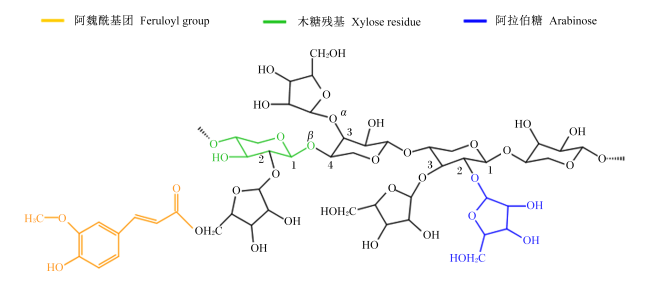
阿拉伯木聚糖又称戊聚糖,由戊糖-阿拉伯糖和木糖组成,是小麦各组织细胞壁的主要成分。根据水溶解性分为水溶性阿拉伯木聚糖(占总阿拉伯木聚糖的25%~30%)和水不溶性阿拉伯木聚糖(占总阿拉伯木聚糖的70%~75%),总阿拉伯木聚糖含量约占小麦籽粒中NSPs的85%[5]。受到基因、土壤和气候等因素影响,不同地区小麦籽粒中阿拉伯木聚糖含量存在差异(表1)。虽然小麦中阿拉伯木聚糖的含量和结构与其他谷物原料存在差异,但其阿拉伯木聚糖的基本结构中均以β-D-吡喃木糖残基经β-1,4-糖苷键连接而成的木聚糖为主链,侧链基团主要为α-呋喃阿拉伯糖,其连接位点多为主链木糖残基的C2、C3位点,这2个位点可单独被取代,也可同时被取代[6](图1)。除此之外,半乳糖、葡萄糖醛酸等也可以为侧链取代基[7]。另外,在某些阿拉伯糖基C5位点上还以酯键方式连接着阿魏酸[5]
表1 不同地区小麦中阿拉伯木聚糖含量变化

Table 1 Variations of arabinoxylan content in wheat from different regions

地区
Regions
样本数量
Sample number
阿拉伯木聚糖含量
Arabinoxylan content/%
参考文献
References
澳大利亚Australia 19 5.40~7.20* [8]
北美North America 12 5.50~6.50* [8]
中国河南省Henan Province of China 9 6.25~8.23* [9]
中国四川省Sichuan Province of China 68 4.39~10.97** [10]
中国西藏自治区Tibet Autonomous Region of China 89 3.10~8.95** [11]
中国China 43 4.25~8.69** [12]
中国安徽省Anhui Province of China 10 7.93~9.99** [13]
中国China 138 5.76~9.69** [14]
中国北部The North of China 77 4.82~7.28** [15]

“*”和“**”分别表示干物质基础和风干基础。

“*” and “**” mean dry matter basis and air-dry basis, respectively.

图1 阿拉伯木聚糖部分结构

Fig.1 Partial structure of arabinoxylan

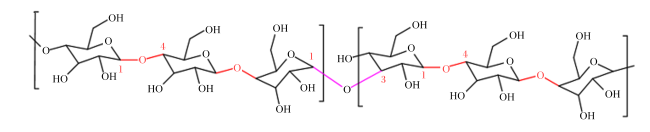
小麦中的β-葡聚糖含量较低,主要存在于胚乳细胞壁中,占整粒的0.4%~1.2%[16]。小麦β-葡聚糖以β-D-吡喃型葡萄糖基单元通过β-1,4-糖苷键连接形成纤维二糖、三糖或四糖片段等纤维寡糖链段,之后再以β-1,3-糖苷键连接组合,形成线性同聚多糖[6](图2)。同时,β-葡聚糖理化特性与其内部β-1,4-糖苷键和β-1,3-糖苷键比例相关。
图2 β-葡聚糖部分结构

Fig.2 Partial structure of β-glucans

纤维素是D-吡喃葡萄糖基残基经β-1,4-糖苷键连接而成的直链聚合物,其在小麦籽粒中的含量约为1.8%,主要存在于小麦种皮和胚乳细胞壁中,并常与阿拉伯木聚糖、β-葡聚糖和果胶等缠连,因单胃动物体内缺乏相应降解酶而不能对其利用[17]
NSPs的理化特性主要包括溶解性、黏性、持水性和可发酵性等[18]。NSPs的溶解性不仅与溶剂极性和溶液温度有关,还受自身分子质量和分支程度影响。NSPs分子质量越大,分支链数越少,其溶解性越低。阿拉伯糖作为阿拉伯木聚糖的侧链基团,其与木糖比例越大,阿拉伯木聚糖溶解性越高[19],其原因在于阿拉伯糖侧链数量的增加增大了与水分子的接触面积,易于水分子渗入,从而使阿拉伯木聚糖的溶解性增强。纤维素和β-葡聚糖均是由葡萄糖聚合而成的线性大分子,但β-葡聚糖中经β-1,3-糖苷键连接的两端纤维寡糖片段可能不在同一平面,而增加了与水分子的接触面积,因此其溶解性高于纤维素[20]。NSPs的黏性指其与溶液混合时,具有形成凝胶或使溶液增稠的特性。NSPs的黏性与分子质量、溶解性、空间结构和电荷集团有关。相比不可溶性NSPs致密的分子结构,可溶性NSPs溶解后更易与水分子相互作用而增加溶液黏度[21]。NSPs持水性是指其结构中的羟基、酯键和醚键具有与水分子以氢键方式结合的能力。研究显示,阿拉伯木聚糖能吸取自身重量10倍左右的水分[22]。除此之外,NSPs还具有发酵性,能被盲肠和结肠微生物发酵产生挥发性脂肪酸,从而为动物机体供能,并改善肠道健康和调节肠道菌群区系,NSPs的发酵性与其微生物酶结合能力和溶解性密切相关[23]

1.1.2 NSPs的抗营养作用机制

1.1.2.1 增加食糜黏度

NSPs的持水性和黏性特性是引起其抗营养作用的关键因素,尤其是可溶性NSPs。玉米和小麦都含有NSPs,但两者的区别在于小麦的可溶性NSPs含量约为玉米的1.8倍(21.7% vs 11.8%),因而玉米在饲粮中大量使用不会表现出明显的抗营养作用[17]。可溶性NSPs与水分子相互作用,使肠道食糜黏度增加,加之与肠道上皮细胞上的糖蛋白结合,导致肠道不流动水层加厚,降低了单位时间内食糜中淀粉、蛋白质和脂肪的消化率和吸收率[24]。此外,食糜黏度的增加犹如隔离屏障,会限制营养物质与内源酶的接触,使内源酶无法充分发挥作用,从而降低肠道对营养物质的消化吸收。同时,NSPs使肠道食糜黏度增加会刺激黏蛋白分泌,加速肠黏膜细胞更新,肠道上皮细胞增殖,并可能导致一些上皮细胞的脱落,从而增加内源氮损失[25]。例如,Schiavon等[26]报道,在断奶仔猪上,肠道食糜黏度的增加会使肠绒毛顶端的细胞脱落增多,导致肠道绒毛萎缩和隐窝深度加深。

1.1.2.2 改变肠道形态和生理功能

在NSPs对肠道形态的影响方面,Serena等[27]研究表明,高NSPs含量的饲粮会显著增加母猪结肠隐窝深度和面积,从而可能减弱猪对营养物质的吸收;Jin等[28]报道,仔猪(约14.3 kg)采食高含量的NSPs饲粮后,空肠和回肠上皮细胞呈现程序性死亡,肠绒毛宽度和隐窝深度也增加。隐窝是肠黏膜细胞增殖的主要部位,也是机体营养物质消化吸收的关键部位,而NSPs会增加胃肠道黏膜细胞的周转率,可能降低机体对能量的利用效率。另外,可溶性NSPs可与内源性消化酶(如胰蛋白酶、脂肪酶和淀粉酶)形成复合物,阻止酶同底物发生反应,从而可能降低养分的消化率[29]。除此之外,可溶性NSPs可通过增加内源性水、蛋白质、电解质和脂类的分泌来影响肠道分泌功能[30]。可溶性NSPs还能与胆汁酸结合,阻碍胆汁酸发挥作用,导致其大量损失而从粪便中排出,从而可能影响脂类的消化和吸收[31]

1.1.2.3 改变肠道菌群结构

肠道中含有大量的微生物,构成了一个复杂的微生态系统。高含量的NSPs造成肠道微生态失衡机理可能与NSPs具有黏性特性有关,其使食糜在肠道内流速减慢,加剧致病菌的繁殖并与宿主争夺养分。同时,当被NSPs包裹的养分进入大肠部位成为微生物发酵繁殖的碳源,会滋生大量生孢梭菌等厌氧菌,而某些生孢梭菌会产生毒素,从而可能造成畜禽腹泻[32]。另外,研究表明,猪肠道菌群对不同类型NSPs的响应存在差异,其中β-葡聚糖能增加梭状芽孢杆菌数量,暗示着动物摄入高含量的β-葡聚糖可能造成肠道炎症的发生[33]
综上可知,NSPs的抗营养作用与其溶解性、持水性和黏性等理化特性密切相关。当饲粮中NSPs含量超过猪的耐受值时,将产生抗营养效应,影响其他营养物质的利用,甚至引发疾病。例如,黄金秀等[34]报道,饲粮中含7.25%木聚糖不会降低仔猪对饲粮中粗蛋白质、有机物、能量以及钙和磷的表观消化率,而当饲粮中含8.44%木聚糖时,则会对饲粮中养分的表观消化率产生负面影响。然而,适量的NSPs也可能具备有益功能。例如,吴希颖[35]研究表明,在半纯合饲粮中添加5%纤维素、5%木聚糖或5% β-葡聚糖能显著提高断奶仔猪空肠中蔗糖酶的活性以及回肠中乙酸的含量。

1.2 植酸

1.2.1 植酸的化学结构和存在形式

植酸又称为肌醇酯六磷酸,分子式为C6H18O23P6,其分子结构中含有6个磷酸基团。植酸的含量受植物的品种、加工程度、气候和土壤等因素影响。小麦粉中含有0.2%~1.0%的植酸,但多以植酸磷形式存在,小麦籽粒中的植酸磷占据了总磷的70%左右[36-37]

1.2.2 植酸的抗营养作用机制

植酸分子中的6个磷酸基团带有极强的负电荷,能螯合带正电荷的阳离子,如Zn2+、Mg2+、Ca2+、Na+和K+,形成稳定的植酸盐,从而降低动物对矿物元素的利用率[38]。除此之外,在酸性条件下,赖氨酸、精氨酸和组氨酸等碱性氨基酸可与植酸螯合,使其溶解性降低,不易被胃蛋白酶降解[39]。同样,植酸可直接与淀粉结合,并以非竞争性抑制α-淀粉酶,降低动物对饲粮中能量的利用率,从而可能导致代谢能降低[40]。另外,植酸可与某些作为酶组成成分或激活剂的矿物元素螯合,影响动物体内某些消化酶(脂肪酶、胰蛋白酶和糜蛋白酶)金属辅助因子的活力,从而可能减弱消化酶的活性,导致一些营养物质消化率降低[41]

2 小麦型饲粮对猪生长性能、营养物质消化率及肠道健康的影响

猪饲粮中使用小麦可部分减少玉米和豆粕的用量,但大量使用可能会降低猪对营养物质的消化率,并且随饲粮中小麦含量的增加,其负面影响增大。例如,余有贵等[42]研究表明,当饲粮中含25%的小麦时,生长猪各营养物质的消化率与玉米组存在差异;当饲粮中小麦含量增至50%时,生长猪对粗纤维、粗蛋白质、干物质和能量的表观消化率与玉米组的差异更大,分别较玉米组降低了23.10%、16.50%、13.14%和8.66%。侯生珍等[43]报道,小麦占饲粮的9%~18%不会对仔猪的生长性能产生负面影响,但饲粮中小麦用量增加至27%时,仔猪平均日增重显著下降,且有排软便现象。出现以上现象的主要原因可能在于小麦中的可溶性NSPs增加了消化道食糜的黏度,导致消化酶作用面积减少,加之已消化的营养物质向肠黏膜扩散的速度也减慢,最终使饲粮中营养物质的消化率和吸收率均降低。
随着饲粮中小麦含量的增加,仔猪直肠的pH升高以及直肠大肠杆菌和沙门氏菌等有害菌数量增加,而乳酸杆菌和双歧杆菌等有益菌数量减少[42]。NSPs使食糜黏性增加,前肠道消化酶不能充分降解营养物质,随之进入后肠成为有害微生物繁殖的适宜养分。由于乳酸杆菌和双歧杆菌数量减少,其代谢产物有机酸产生量降低,从而导致pH升高。除此之外,大量使用小麦有增加后肠氨浓度的趋势,而肠道中氨浓度增加会干扰肠道黏膜的正常发育,降低绒毛高度,并产生毒害作用,以此降低动物生长性能[44]
血液中尿素氮的含量是衡量动物体内蛋白质代谢和氨基酸平衡状况的关键指标,氨基酸组成越平衡,血液中尿素氮含量则越低[45]。由表2可以看出,相比玉米-豆粕型饲粮,饲喂小麦型饲粮的猪血液中尿素氮含量显著升高。由此提示,小麦或者小麦型饲粮可能存在氨基酸不平衡状况,从而影响蛋白质的消化吸收,造成尿素氮等代谢产物增加。
表2 小麦替代玉米对猪生长性能、营养物质消化率和肠道健康的影响

Table 2 Effects of corn replaced by wheat on growth performance, nutrient digestibility and intestinal health of pigs

替代玉米比例
Proportion of
replacing corn
初始体重或日龄
Initial body weight or
days of age
饲粮主要组成原料
Main ingredients
of diets
影响
Effects
参考文献
References
100%(60.6%) 6 kg断奶仔猪 小麦、豆粕、米糠、鱼粉 与玉米-豆粕型饲粮相比,平均日增重降低4.0%;血液中尿素氮含量
极显著升高,四碘甲状腺原氨酸含量显著降低;血液中葡萄糖、
三碘甲状腺原氨酸、胰岛素和白细胞介素-2含量无显著变化
[46]
56%(30%) 6 kg保育猪 小麦、玉米、豆粕、乳清粉、
鱼粉、血粉、油脂
与玉米-豆粕型饲粮相比,试验全期平均日增重有提高趋势;
中性洗涤纤维、酸性洗涤纤维和磷全肠道消化率有降低趋势
[47]
100%(64%) 11 kg断奶仔猪 小麦、麸皮、豆粕、
鱼粉、蚕蛹
与玉米-豆粕型饲粮相比,十二指肠、空肠和回肠内容物黏度显著
提高;盲肠丙酸和丁酸含量显著增加;十二指肠绒毛高度和
绒毛宽度及绒毛高度/隐窝深度有降低的趋势
[48]
70%(50%) 20 kg生长猪 小麦、玉米、
豆粕、麦麸
与玉米-豆粕型饲粮相比,直肠的pH提高了1.54%;直肠中双歧杆菌和
乳酸杆菌的数量分别降低了8.64%和35.46%,大肠杆菌和沙门氏菌的数量
分别提高了57.53%和156.81%;粗纤维、粗蛋白质、干物质和能量的表观消化率
分别降低了23.10%、16.50%、13.14%和8.66%
[42]
71%(50%:第1阶段
the 1st stage)
100%(74.2%:第2阶段
the 2nd stage)
23 kg生长猪 小麦、玉米、
豆粕、麦麸、大豆油
与玉米-豆粕型饲粮相比,试验全期平均日采食量和平均日增重
分别降低了8%和4%;1、2阶段粗蛋白质全肠道消化率
均升高;1、2阶段血清尿素氮含量显著增加,而血清
总胆固醇、甘油三酯、总蛋白和葡萄糖含量无显著变化
[1]
100%(60%) 35 kg生长育肥猪 小麦、麦麸、
豆粕、棉籽粕
与玉米-豆粕型饲粮相比,平均日增重降低了68.3 g;干物质、粗蛋白质和
粗脂肪消化率有降低的趋势;猪肉颜色、保水力、剪切力无显著变化
[49]
80%(48%) 35.3 kg生长育肥猪 小麦、玉米、麸皮、
豆粕、棉籽粕
与玉米-豆粕饲粮相比,平均日增重降低了约9.11% [50]
100%(60%) 54 kg育肥猪 小麦、豆粕、米糠、
麸皮、大豆油
与玉米-豆粕型饲粮相比,1~56 d平均日采食量降低了0.86%;
氮沉积量和粗灰分表观消化率分别降低了6.06%和24.90%;
胸肌蒸煮损失提高了15.76%
[51]
80%(50%) 28日龄断奶仔猪 小麦、玉米、膨化豆粕、
膨化大豆、小麦麸、
乳清粉、鱼粉、大豆油
与玉米-豆粕型饲粮相比,试验1~7 d料重比显著增加,试验
1~14 d平均日增重显著降低;回肠和盲肠乳酸和乙酸等挥发性
脂肪酸有降低的趋势;有增加回肠和盲肠大肠杆菌和降低
乳酸杆菌和双歧杆菌的趋势;有增加盲肠氨浓度的趋势
[44]
40%(24%) 28日龄断奶仔猪 小麦、玉米、豆粕、膨化
大豆、次粉、鱼粉、大豆油
与玉米-豆粕型饲粮相比,平均日采食量有降低的趋势,料重比增加了
4%;血清中葡萄糖、尿素氮和总蛋白含量无显著变化;干物质和粗蛋白质
表观回肠消化率分别降低了2.5%和5.2%,必需氨基酸和非必需氨基酸
表观回肠消化率分别降低了1.6%和4.4%;盲肠内容物中大肠
杆菌数量有上升的趋势,乳酸杆菌数量有下降的趋势
[52]
50%(25%) 30日龄断奶仔猪 小麦、玉米、豆粕、
次粉、膨化大豆、乳清粉
与玉米-豆粕型饲粮相比,平均日增重和平均日采食量显著降低;
粗脂肪表观全肠道消化率显著降低;空肠食糜相对黏度显著增加;
十二指肠脂肪酶活性显著降低,空肠蛋白酶活性极显著增加
[45]

括号内数值表示小麦在小麦型饲粮中所占比例(饲喂基础)。

Values in brackets mean the proportion of wheat in the wheat-type diet (as-fed basis).

表2还可看出,小麦在猪饲粮中的适宜比例取决于猪的生理阶段、饲粮组成和饲喂水平等因素。此外,小麦中油脂含量尤其是亚油酸含量远低于玉米,使用小麦时补充植物性油脂或动物性油脂有利于提高饲粮品质,从而提高小麦替代玉米的比例,并保障猪的正常生长(对仔猪尤其重要)。

3 改善小麦饲用价值的方法

3.1 添加酶制剂

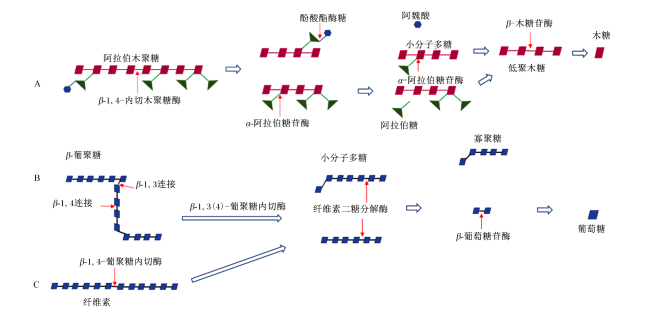
饲用酶制剂是一种特异、高效的功能性生物催化剂。目前市场上小麦饲用酶制剂大致可分为能直接水解营养底物的外源性消化酶(如蛋白酶、淀粉酶和脂肪酶等)和具有去除抗营养因子作用的外源性降解酶(如植酸酶和NSPs酶等),其中NSPs酶又分为半纤维素酶(阿拉伯木聚糖酶、β-葡聚糖酶)、纤维素酶和果胶酶。小麦各组织细胞壁含有阿拉伯木聚糖和β-葡聚糖,犹如一道天然屏障,阻碍内部其他营养物质与动物肠道消化酶的接触。然而,木聚糖酶(主要由β-1,4-内切木聚糖酶、α-阿拉伯糖苷酶和β-木糖苷酶组成)、葡聚糖酶[主要由β-1,3(4)-葡聚糖内切酶、纤维素二糖分解酶和β-葡萄糖苷酶组成]和纤维素酶能使NSPs裂解为小分子多糖,以此破坏细胞壁,释放内部营养物质[5](图3)。同时,可溶性NSPs吸收水分过程中易与食糜混合,增加食糜黏度,而NSPs酶将NSPs特异性降解为寡糖,能降低食糜黏度。例如,Ravn等[53]体外研究表明,从疏棉状嗜热丝孢菌(Thermomyces lanuginosus)获得的木聚糖酶能介导阿拉伯木聚糖的溶解,可将小麦黏度降低约39%;Lærke等[54]报道,添加从枯草芽孢杆菌和里氏木霉(Trichoderma reesei)提取的木聚糖酶能降低饲喂小麦型饲粮的生长猪回肠食糜黏度,最高可降低约46.9%;同样,霍文颖等[48]和Vahjen等[55]均证实,在小麦-豆粕型饲粮中添加NSPs酶能显著降低断奶仔猪空肠和结肠食糜黏性。
图3 木聚糖酶(A)、β-葡聚糖酶(B)和纤维素酶(C)降解小麦中非淀粉多糖的作用机制

Fig.3 Mechanism of xylanase (A), β-glucanase (B) and cellulase (C) degrading non-starch polysaccharides in wheat[56-58]

肠道酶活性是反映畜禽对饲粮中养分消化利用率高低的重要参考指标之一,而酶谱组分和比例也影响酶活性。研究显示,在小麦型饲粮中添加NSPs酶能显著增加断奶仔猪十二指肠淀粉酶和脂肪酶活性[45]。产生这种效果的原因可能与NSPs酶能分解植物细胞壁而增加内容物释放有关。肠道内消化分解产物的增加能反馈性刺激化学感受器诱导促胰酶素的分泌,加速消化酶的分泌,从而导致肠道消化酶活性升高[59]。另有研究表明,在小麦型饲粮中添加NSPs酶显著降低了断奶仔猪空肠末端肠上皮淋巴细胞数量,增加了肠道乳酸杆菌数量和乳酸含量,并降低了回肠中氨的含量[60]。这暗示着添加NSPs酶能将NSPs降解为益生元-低聚木糖,有助于缓解NSPs对肠道的损伤,同时有利于有益菌良好繁殖而改善肠道微生态。
表3表4可知,适当添加酶制剂能改善甚至消除小麦中NSPs的抗营养作用,提高猪只对营养物质的消化率;同时,加酶小麦型饲粮的饲喂效果能与玉米-豆粕型饲粮相似,并达到降本增效的效果。然而,酶制剂的作用效果受多种因素影响,如不同产地小麦中NSPs含量不同,不同年龄段猪分泌内源性消化酶能力的存在差异,各企业生产的酶制剂酶活性不同,以及各酶之间是否具有协同作用等。
表3 在小麦替代玉米的饲粮中添加酶制剂对猪生长性能、营养物质消化率和肠道健康的影响

Table 3 Effects of enzyme preparation supplementation in diets with corn replaced by wheat on growth performance, nutrient digestibility and intestinal health of pigs

小麦型饲粮中小麦
占比(饲喂基础)
Proportion of wheat in
wheat-type diets
(as-fed basis)/%
小麦型饲粮中玉米
占比(饲喂基础)
Proportion of corn
in wheat-type diets
(as-fed basis)/%
初始体重
或日龄
Initial body
weight or
days of age
饲粮主要
组成原料
Main ingredients
of diets
酶制剂种类及添加量
Types and dosages of
enzyme preparations
影响
Effects
参考文献
References
60.6 0
(62.25)
6 kg断奶仔猪 小麦、豆粕、
米糠、鱼粉
0.017%复合酶(木聚
糖酶、β-葡聚糖酶、
果胶酶、纤维素酶)
与玉米-豆粕型饲粮相比,平均日增重提高了
3.4%;血液葡萄糖、白细胞介素-2和尿素氮含量
显著升高,而血液中四碘甲状腺原氨酸、三碘甲
状腺原氨酸和胰岛素含量无显著变化
[46]
30 23.93(53.57) 6 kg保育猪 小麦、玉米、豆粕、
乳清粉、鱼粉、
血粉、油脂
500 U/kg植酸酶+
1 830 U/kg
木聚糖酶
与玉米-豆粕型饲粮相比,试验全期平均日增重、平均
日采食量和料重比无显著变化;粗蛋白质、粗脂肪和
中性洗涤纤维表观全肠道消化率有提高的趋势
[47]
64 0
(64)
11 kg断奶仔猪 小麦、麸皮、豆粕、
鱼粉、蚕蛹
0.025%NSPs酶
(内切-1,4-β-
木聚糖酶、纤维素酶、
半纤维素酶)
与玉米-豆粕型饲粮相比,十二指肠、空肠和回肠内容物
黏度无显著变化;回肠乙酸、丙酸和丁酸以及盲肠
乙酸和丁酸含量显著增加;十二指肠、空肠前段和
空肠后段绒毛高度显著提高
[48]
45 15
(60)
17 kg肥育猪 小麦、玉米、麸皮、
菜籽粕、肉骨粉
0.5~1.0 kg/t复合
酶(木聚糖酶、β-葡聚
糖酶、酸性蛋白酶、
淀粉酶、果胶酶)
与玉米-豆粕型饲粮相比,平均日增重提高了13.33% [61]
25 40.7(62.8) 20 kg生长猪 小麦、玉米、
豆粕、麦麸
0.05%NSPs酶
(木聚糖酶、β-葡
聚糖酶、果胶酶、
纤维素酶)
与玉米-豆粕型饲粮相比,直肠pH无显著变化;直肠
双歧杆菌和乳酸杆菌数量显著提高,直肠沙门氏
菌数量显著降低;粗纤维和干物质的表观消化率显著
提高,而能量和粗蛋白质表观消化率无显著变化
[42]
70.7 0
(56)
30 kg生长猪 小麦、豆粕、
米糠粕、小麦
胚芽粕
0.04%NSPs酶
(木聚糖酶、β-葡
聚糖酶、果胶酶、
纤维素酶、
甘露聚糖酶)
与玉米-豆粕型饲粮相比,平均日增重提高了
3.25%,料重比降低了1.59%;能量、干物质、粗蛋
白质和粗脂肪的表观全肠道消化率分别提高了
1.12%、1.89%、1.15%和1.85%;粗纤维的
表观全肠道消化率显著提高了17.57%
[62]
60 0
(60)
35 kg生长育肥猪 小麦、麦麸、
豆粕、棉籽粕
0.1%复合酶
(木聚糖酶、β-葡
聚糖酶、果胶酶、
纤维素酶)
与玉米-豆粕型饲粮相比,平均日增重和料重比
以及营养物质代谢率无显著变化
[49]
48 12
(60)
35.3 kg
生长育肥猪
小麦、玉米、
麸皮、豆粕、
棉籽粕
0.18%复合酶
(木聚糖酶、β-葡
聚糖酶、果胶酶、
纤维素酶)
与玉米-豆粕型饲粮相比,平均日
增重提高了7.36%
[50]
38 35
(66)
50 kg生长猪 小麦、玉米、豆粕、
麦麸、大豆油
500 FTU/kg植酸
酶、3 000 U/kg
木聚糖酶
与玉米-豆粕型饲粮相比,十二指肠绒毛高度和绒毛高度/
隐窝深度显著提高;结肠食糜中丁酸、丙酸和总挥发性
脂肪酸含量显著提高;苏黎士杆菌属(Turicibacter)、
埃希氏-志贺氏菌属(Escherichia-Shigella)等有害菌
丰度显著下降,双歧杆菌属、乳杆菌属、普雷沃氏菌属和
玫瑰菌属等有益菌丰度显著升高
[3]
50 9.81(62.56) 28日龄
断奶仔猪
小麦、玉米、膨化
豆粕、膨化大豆、
小麦麸、乳清粉、
鱼粉、大豆油
1 000 U/kg
木聚糖酶
与玉米-豆粕型饲粮相比,试验1~7 d和1~14 d
平均日增重显著提高;回肠和盲肠乙酸、丙酸和
丁酸含量无显著变化;回肠和盲肠大肠杆菌和
乳酸杆菌的数量无显著变化
[44]
24 38
(60)
28日龄
断奶仔猪
小麦、玉米、豆粕、
膨化大豆、次粉、
鱼粉、大豆油
0.1%复合酶
(木聚糖酶、
β-甘露聚糖酶)
与玉米+豆粕型饲粮相比,试验全期平均日增重显著
提高,料重比显著降低;干物质和粗蛋白质表观回肠
消化率分别提高了2.4%和2.1%,必需氨基酸和非必需
氨基酸回肠表观消化率分别提高了4.8%和3.6%
[52]
25 32.69(52.80) 30日龄
断奶仔猪
小麦、玉米、豆粕、
次粉、膨化大豆、
乳清粉
0.03%NSPs酶
(木聚糖酶、
β-甘露聚糖酶)
与玉米-豆粕型饲粮相比,平均日增重、平均日采食量和
料重比无显著变化;血清中白蛋白、谷丙转氨酶和尿素氮
等血清生化指标的含量或活性无显著变化
[45]

括号内数值表示玉米在玉米-豆粕型饲粮中所占比例。

Values in brackets mean the proportion of corn in the corn-soybean meal type diet.

表4 酶制剂对饲喂小麦型饲粮猪生长性能、营养物质消化率和肠道健康的影响

Table 4 Effects of enzyme preparation on growth performance, nutrient digestibility and intestinal health of pigs fed with wheat-type diets

小麦型饲粮中小麦
占比(饲喂基础)
Proportion of wheat in
wheat-type diets
(as-fed basis)/%
小麦型饲粮
主要组成原料
Main ingredients of
wheat-type diets
初始体重或日龄
Initial body weight
or days of ages
酶制剂种类及添加量
Types and dosages of
enzyme preparations
影响
Effects
参考文献
References
60.2 小麦、大豆分离蛋白、
脱脂奶粉、蔗糖、
油脂、大豆、麦麸
4.1 kg断奶仔猪 5 600 EXU/kg木聚
糖酶+1 000 IU/kg
磷脂酶
粗蛋白质、粗脂肪、中性洗涤纤维和酸性洗涤纤维以及
必需氨基酸和非必需氨基酸表观回肠消化率均提高;
回肠食糜乳酸和挥发性脂肪酸(除丁酸)含量均提高
[63]
68.5 小麦、豆粕、菜籽油 7.3 kg仔猪 0.2% β-葡聚糖酶
(内切-β-葡聚糖
酶和β-葡萄糖苷酶)
β-葡聚糖表观回肠消化率显著提高,有机物、粗蛋白质
以及氨基酸表观回肠消化率有提高趋势
[64]
50 小麦、玉米、麦麸、
膨化大豆、大豆油、
乳清粉、鱼粉
8.47 kg断奶仔猪 2 000 U/kg
木聚糖酶
平均日增重和增重耗料比显著提高;干物质、粗蛋白质、
中性洗涤纤维、钙和磷表观全肠道消化率提高;结肠食糜中
毛螺菌科和肠杆菌科丰度降低,普雷沃氏菌科丰度增加
[65]
60.22 小麦、次粉、豆粕、
菜籽粕、豌豆、菜籽油
20 kg生长猪 250 FTU/kg植酸酶+
4 000 XU/kg木聚糖酶
干物质、粗蛋白质、钙和磷全肠道消化率
以及消化能均提高
[66]
74.2 小麦、豆粕、麦麸、豆油 23 kg生长猪 500 U/kg
木聚糖酶
试验全期平均日增重有提高的趋势,且料重比显著降低;
干物质、有机物、粗蛋白质和能量表观全肠道消化率
显著提高,组氨酸、赖氨酸、蛋氨酸、苏氨酸和丝氨酸表观
回肠消化率显著提高;粪中大肠杆菌数量显著降低
[67]
97.6 小麦 20 kg生长猪 0.02%木聚糖酶
(11 000 U/kg)
平均日增重和平均日采食量提高,料重比下降;粗蛋白质、
必需氨基酸和非必需氨基酸(除天冬氨酸外)
表观回肠消化率均显著提高
[68]
60.4 小麦、麦麸、豆粕、豌豆、
菜籽粕、大豆油
25 kg生长猪 500 FTU/kg植酸酶或
4 000 XU/kg木聚糖酶
或两者共同添加
植酸酶仅显著提高了钙和磷表观回肠或者全肠道消化率;
木聚糖酶对营养物质消化率无显著影响;两者共同
作用仅显著提高了钙和磷表观全肠道消化率
[69]
70.3 小麦、麦麸、菜油、
豆粕、菜油
28 kg生长猪 500 FTU/kg植酸酶+
4 000 U/kg木聚糖酶
试验22~49 d和1~49 d饲料系数显著降低;干物质、能量、
粗蛋白质以及钙和磷表观全肠道消化率显著提高
[70]
82.26 小麦、豆粕 32.5 kg生长猪 4 000 U/kg木聚糖酶 能量、干物质以及钙和磷回肠和表观全肠道消化率
无显著变化;氨基酸表观回肠消化率无显著变化
[71]
97.84 小麦 35.9 kg生长猪 10 000 U/kg植酸酶+
4 000 U/kg木聚糖酶
钙和磷全肠道消化率显著提高,而干物质、有机物、
粗蛋白质、中性洗涤纤维和酸性洗涤纤维无显著
变化;消化能和代谢能无显著变化
[72]
78 小麦、豆粕 58 kg生长猪 70 g/kg木聚糖酶和
阿拉伯呋喃糖酶
有机物、淀粉、粗蛋白质、粗脂肪、粗纤维、钙和磷以及
赖氨酸、精氨酸等氨基酸表观回肠消化率提高
[73]
59.65 小麦、麦麸、大豆分离蛋白、
油脂、脱脂奶粉、蔗糖
11日龄
断奶仔猪
5 600 EXU/kg
木聚糖酶+1 000 IU/kg
磷脂酶
有机物、能量、粗脂肪和粗蛋白质以及必需氨基酸和非必
需氨基酸表观回肠消化率无显著变化;回肠消化液乙酸、
丙酸和丁酸含量提高(差异不显著);非淀粉多糖单体
表观回肠消化率增加(差异不显著)
[74]
50 小麦、玉米、膨化豆粕、
膨化大豆、小麦麸、
乳清粉、鱼粉、大豆油
28日龄断奶仔猪 1 000 U/kg
木聚糖酶
试验1~14 d平均日增重显著提高;回肠内容物乙酸和
总挥发性脂肪酸含量提高;盲肠内容物双歧杆菌数量增加
[44]

3.2 物理加工处理

小麦的物理加工方法包括去壳、粉碎、膨化和制粒等,这些物理加工方法已被证明可以有效提高小麦营养成分的利用和能量的消化率,从而改善猪的生长性能。小麦外壳中含有大量植酸,经脱壳能极大降低植酸含量。粉碎是促进各饲料原料充分混合,维持成品质量稳定的关键生产工艺,将小麦粉碎旨在破坏纤维结构,降低纤维长度,并增加其他营养物质与胃肠道内消化酶的接触面积[75]。Mavromichalis等[76]在约67 kg的育肥猪上进行试验发现,当小麦粉碎粒度从1 300 μm降到600 μm时,饲粮干物质和氮的表观消化率分别从83.7%和80.4%增加至87.6%和85.5%。Acosta等[77]研究表明,使用碾磨机或锤磨机将小麦粒度从700 μm降至500 μm后,生长猪对饲粮中干物质、总能、粗蛋白质、粗脂肪和中性洗涤纤维的表观全肠道消化率均显著提高,而再将粒度降至300 μm则效果减弱。Bao等[78]报道,小麦粉碎粒径为430~470 μm时,有利于生长猪对干物质和粗蛋白质的消化吸收,并能增加粪便中乳酸菌和双歧杆菌数量,且降低大肠杆菌数量,但当粉碎粒径为330 μm时,却出现与上述相反的结果。由此提示,粉碎能改善小麦的饲用价值,但过度粉碎可能会增加NSPs的溶解度,从而导致肠道食糜黏度增加,不利于猪对养分的消化吸收,并可能诱发胃肠道溃疡等疾病。
挤压膨化是指在膨化腔内施以高温、高压、高剪切力将物料瞬间从出模孔排出,内部水分被迫闪蒸,物料体积迅速膨胀而使其组分和理化性能发生改变,可起到降低抗营养因子含量的作用。挤压膨化使小麦淀粉细胞壁破裂,内部晶体被破坏,双折射现象降低,出现糊状溶液,淀粉糊化率约增加66%,从而提高猪对其消化率[79]。Lundblad等[80]研究得出,以小麦、鱼粉和豆粕等配制成的饲粮经膨化后,断奶仔猪对饲粮有机物、粗蛋白质、能量和淀粉的全肠道消化率无显著改善,但却能降低断奶仔猪的料重比。与之类似,Rodriguez等[81]报道,小麦经膨化后能提高生长猪对淀粉、粗蛋白质和氨基酸的表观或标准回肠消化率以及小麦是消化能和代谢能,但无显著差异。此外,Durmic等[82]研究发现,挤压膨化小麦还可以通过降低饲粮中抗性淀粉的含量,从而减少后肠发酵来降低猪痢疾的发病率和严重程度。
制粒是指饲料在蒸汽、水和压力共同调制下进入膜孔后切断成形的过程。制粒可促进小麦中淀粉发生糊化、蛋白质变性,同时破坏植物的细胞壁,使糊粉层细胞中的营养成分得以释放。但值得注意的是,调制温度过高会使某些热敏感性营养物质效价降低(如赖氨酸与某些还原糖发生美拉德反应)[83]。研究显示,小麦型饲粮颗粒尺寸的减小(770 μm vs 664 μm)对断奶仔猪的生长性能没有显著影响,但会增加断奶仔猪对饲粮中NSPs的消化率和提高消化能[84]。Lahaye等[85]研究显示,小麦-菜籽粕型饲粮制粒对猪的能量消化率没有显著影响,但对蛋白质和氨基酸的标准回肠消化率有明显改善。同样,Yang等[72]研究了2种小麦型饲粮料型(粉状料和颗粒料)营养物质消化率的差异,发现相较于粉状料,饲喂颗粒料有提高粗蛋白质全肠道消化率的趋势,但干物质、有机物、中性洗涤纤维以及钙和磷的消化率两者无显著差异;同时,该文章另一试验结果表明,相较于粉状小麦-豆粕型饲粮,饲喂颗粒小麦+豆粕型饲粮能显著提高其能量全肠道消化率,以及极显著提高饲粮的消化能和代谢能。

3.3 微生物发酵处理

饲料原料可经微生物特定的代谢途径去除或降解其中的抗营养因子,能产生有机酸、可溶性小肽和酚类化合物等有益代谢产物,并降低饲粮pH,激活消化酶活性,从而改善饲粮适口性,增加畜禽对饲粮中营养物质的消化和吸收[86-87]。利用乳酸菌和双歧杆菌等微生物发酵可以降低NSPs含量,这可能与乳酸菌和双歧杆菌对木聚糖和木寡糖表现出广泛的特异性,并可利用木三糖和木四糖有关[88]。Jørgensen等[89]将小麦与水按1∶2.75的比例混合制备液态发酵小麦,发现发酵后小麦的蔗糖、果聚糖、淀粉和NSPs含量降低,并且用于饲喂生长猪后,干物质、有机物和能量回肠消化率提高了约3%,这可能与发酵过程中产生的酸或酶对淀粉颗粒的水解作用有关。研究显示,自然发酵增加了淀粉颗粒的结晶层,减少了无定形区域,以此能提高直链淀粉含量,从而提高动物对能量的利用率[90]。申楠[91]发现,按料水比1∶0.6,菌种比植物乳杆菌∶米根霉=1∶1,在温度35 ℃,活菌数为10×108 CFU/g条件下持续发酵6 d,所得发酵陈化小麦的有机酸含量最高,并且粗蛋白质和还原糖含量显著增加,纤维含量也有所下降,由此提示发酵有助于提高陈化小麦的饲用价值。除此之外,张变英等[92]研究表明,用黑曲霉发酵小麦能降低阿拉伯木聚糖含量,降低率最高约达41.26%,并且添加部分发酵小麦有助于改善整体饲粮的适口性。Cho等[93]报道,饲粮中含20%的发酵小麦有利于提高生长猪对饲粮中粗蛋白质和干物质的消化率。Koo等[94]研究表明,断奶仔猪饲喂含乳酸菌发酵90 d后的小麦能显著提高饲粮中干物质和粗蛋白质以及钙和磷的全肠道消化率,并且含发酵小麦的饲粮代谢能和净能高于不含发酵小麦的饲粮。另外,Hackl等[95]添加乳酸菌对小麦进行180 d青贮,发现青贮后小麦中粗蛋白质含量略有增加,并且生长猪对青贮小麦的赖氨酸、蛋氨酸、苏氨酸、亮氨酸、苯丙氨酸和精氨酸的标准回肠消化率显著高于干小麦。
除此之外,还有研究报道了利用其他一些方法消除NSPs的抗营养作用而改善小麦饲用价值,如水浸泡处理和电子束辐照等[96-97]

4 小结

小麦作为一种优质的饲料原料,其有效能值与玉米近似,且粗蛋白质与赖氨酸和蛋氨酸等限制性氨基酸含量均高于玉米,但小麦含有阿拉伯木聚糖和β-葡聚糖等NSPs以及植酸等抗营养因子,直接大量替代玉米进行饲喂可能会降低猪的生长性能。目前,饲料生产中主要使用酶制剂降解小麦中的抗营养因子,猪饲喂加酶小麦型饲粮的效果与玉米-豆粕型饲粮相似;同时,粉碎、膨化和微生物发酵等方法也可以消除部分抗营养因子,从而实现小麦的高效利用。
[1]
PAN L, AN D. Comparative energy and nitrogen excretion from growing pigs fed on corn,sorghum and wheat-based diets[J]. Animal Feed Science and Technology, 2020, 264:114477.

DOI

[2]
申洪源. 2022年中国小麦市场分析[N]. 粮油市场报. 2023-02-14(B02).

SHEN H Y. Analysis of China’s wheat market in 2022[N]. Grain and oil market newspaper, 2023-02-14(B02). (in Chinese)

[3]
MA X K, LI Z Q, ZHANG Y B. Effects of the partial substitution of corn with wheat or barley on the growth performance,blood antioxidant capacity,intestinal health and fecal microbial composition of growing pigs[J]. Antioxidants(Basel), 2022, 11(8):1614.

[4]
UTHUMPORN U, NADIAH I, IZZUDDIN I, et al. Physicochemical characteristics of non-starch polysaccharides extracted from cassava tubers[J]. Sains Malaysiana, 2017, 46(2):223-229.

DOI

[5]
KISZONAS A M, FUERST E P, MORRIS C F. Wheat arabinoxylan structure provides insight into function[J]. Cereal Chemistry, 2013, 90(4):387-395.

DOI

[6]
IZYDORCZYK M S, BILIADERIS C G. Structural and functional aspects of cereal arabinoxylans and β-glucans[J]. Developments in Food Science, 2000, 41:361-384.

[7]
SCHOONEVELD-BERGMANS M E F, BELDMAN G, VORAGEN A G J. Structural features of (glucurono) arabinoxylans extracted from wheat bran by barium hydroxide[J]. Journal of Cereal Science, 1999, 29(1):63-75.

DOI

[8]
WOOTTON M, ACONE L, WILLS R B H. Pentosan levels in Australian and North American feed wheats[J]. Australian Journal of Agricultural Research, 1995, 46(2):389-392.

DOI

[9]
王修启, 李春喜, 林东康, 等. 小麦戊聚糖含量及添加木聚糖酶对鸡表观代谢能值和养分消化率的影响[J]. 华北农学报, 2002, 17(4):104-107.

DOI

WANG X Q, LI C X, LIN D K, et al. Content of pentosan in wheat grain and xylanase supplementation on measurements of AME and nutrient ingredient digestibility of cocks[J]. Acta Agriculturae Boreali-Sinica, 2002, 17(4):104-107. (in Chinese)

[10]
冯波, 舒守贵, 徐智斌, 等. 四川省区试小麦的戊聚糖含量分析[J]. 西南农业学报, 2006, 19(3):369-372.

FENG B, SHU S G, XU Z B, et al. Analysis of pentosan content of wheat in regional trial of Sichuan province[J]. Southwest China Journal of Agricultural Sciences, 2006, 19(3):369-372. (in Chinese)

[11]
徐智斌, 范瑞英, 冯波, 等. 89份西藏小麦戊聚糖含量和SDS沉淀值的分析[J]. 麦类作物学报, 2007, 27(5):831-835.

XU Z B, FAN R Y, FENG B, et al. Assay of pentosan content and SDS-sedimentation value in Tibetan wheat[J]. Journal of Triticeae Crops, 2007, 27(5):831-835. (in Chinese)

[12]
任霞, 周素梅, 王强. 不同品种小麦籽粒中戊聚糖含量分析[J]. 核农学报, 2010, 24(6):1238-1244,1254.

REN X, ZHOU S M, WANG Q. Analysis of pentosan content of different wheat varieties[J]. Journal of Nuclear Agricultural Sciences, 2010, 24(6):1238-1244,1254. (in Chinese)

DOI

[13]
崔文礼, 周健, 郑文寅, 等. 10个小麦推广品种戊聚糖含量、若干农艺和品质性状的分析[J]. 中国农学通报, 2014, 30(33):85-88.

DOI

CUI W L, ZHOU J, ZHENG W Y, et al. Analysis of the pentosan content and the agronomic and quality characters in ten commercial varieties of winter wheat[J]. Chinese Agricultural Science Bulletin, 2014, 30(33):85-88. (in Chinese)

DOI

[14]
崔文礼, 姚大年, 张文明, 等. 138个小麦品种(系)戊聚糖含量的研究[J]. 中国粮油学报, 2010, 25(2):11-17.

CUI W L, YAO D N, ZHANG W M, et al. Contents of pentosans in wheat grains for 138 wheat varieties[J]. Journal of the Chinese Cereals and Oils Association, 2010, 25(2):11-17. (in Chinese)

[15]
时侠清, 刘冬成, 孙家柱, 等. 我国北方冬小麦籽粒中的戊聚糖含量及其相关分析[J]. 核农学报, 2006, 20(3):225-228.

SHI X Q, LIU D C, SUN J Z, et al. The pentosan content and its correlation with other characters among winter wheat varieties in north China[J]. Journal of Nuclear Agricultural Sciences, 2006, 20(3):225-228. (in Chinese)

[16]
白沙沙, 赵萌, 于佳立, 等. 不同品种小麦籽粒中β-葡聚糖含量的比较研究[J]. 中国食物与营养, 2016, 22(12):69-72.

BAI S S, ZHAO M, YU J L, et al. Content comparison of β-glucan in different varieties of wheat grain[J]. Food and Nutrition in China, 2016, 22(12):69-72. (in Chinese)

[17]
BACH KNUDSEN K E. Fiber and nonstarch polysaccharide content and variation in common crops used in broiler diets[J]. Poultry Science, 2014, 93(9):2380-2393.

DOI PMID

[18]
METZLER-ZEBELI B U, HOODA S, ZIJLSTRA R T, et al. Dietary supplementation of viscous and fermentable non-starch polysaccharides (NSP) modulates microbial fermentation in pigs[J]. Livestock Science, 2010, 133(1/3):95-97.

DOI

[19]
MARCOTULI I, HSIEH Y S Y, LAHNSTEIN J, et al. Structural variation and content of arabinoxylans in endosperm and bran of durum wheat (Triticum turgidum L.)[J]. Journal of Agricultural and Food Chemistry, 2016, 64(14):2883-2892.

DOI

[20]
LI W, CUI S W, KAKUDA Y. Extraction,fractionation,structural and physical characterization of wheat β-D-glucans[J]. Carbohydrate Polymers, 2006, 63(3):408-416.

DOI

[21]
SCHROEDER N, MARQUART L F, GALLAHER D D. The role of viscosity and fermentability of dietary fibers on satiety-and adiposity-related hormones in rats[J]. Nutrients, 2013, 5(6):2093-2113.

DOI

[22]
郑学玲, 蒋清民, 李秀梅, 等. 小麦麸皮戊聚糖理化性质研究[J]. 河南工业大学学报(自然科学版), 2006, 27(6):15-19.

ZHENG X L, JIANG Q M, LI X M, et al. Physicochemical properties of wheat bran pentosans[J]. Journal of Henan University of Technology(Natural Science Edition), 2006, 27(6):15-19. (in Chinese)

[23]
YAO W Z, GONG Y F, LI L H, et al. The effects of dietary fibers from rice bran and wheat bran on gut microbiota:an overview[J]. Food Chemistry:X, 2022, 13:100252.

DOI

[24]
THAVASIAPPAN V, SELVARAJ P, JAYACHANDRAN S, et al. Influence of enzyme supplementation on intestinal physio chemical characteristics and nutrient digestablity in broilers[J]. Journal of Entomology and Zoology Studies, 2020, 8(3):506-509.

[25]
CHEN L, GAO L X, HUANG Q H, et al. Viscous and fermentable nonstarch polysaccharides affect intestinal nutrient and energy flow and hindgut fermentation in growing pigs[J]. Journal of Animal Science, 2017, 95(11):5054-5063.

DOI PMID

[26]
SCHIAVON S, TAGLIAPIETRA F, BAILONI L, et al. Effects of sugar beet pulp on growth and health status of weaned piglets[J]. Italian Journal of Animal Science, 2004, 3(4):337-351.

DOI

[27]
SERENA A, HEDEMANN M S, BACH KNUDSEN K E. Influence of dietary fiber on luminal environment and morphology in the small and large intestine of sows[J]. Journal of Animal Science, 2008, 86(9):2217-2227.

DOI PMID

[28]
JIN L, REYNOLDS L P, REDMER D A, et al. Effects of dietary fiber on intestinal growth,cell proliferation,and morphology in growing pigs[J]. Journal of Animal Science, 1994, 72(9):2270-2278.

DOI

[29]
CHOCT M, HUGHES R J, TRIMBLE R P, et al. Non-starch polysaccharide-degrading enzymes increase the performance of broiler chickens fed wheat of low apparent metabolizable energy[J]. The Journal of Nutrition, 1995, 125(3):485-492.

[30]
LOW, A G. Secretory response of the pig gut to non-starch polysaccharides[J]. Animal Feed Science and Technology, 1989, 23(1/3):55-65.

DOI

[31]
IKEGAMI S, TSUCHIHASHI F, HARADA H, et al. Effect of viscous indigestible polysaccharides on pancreatic-biliary secretion and digestive organs in rats[J]. The Journal of Nutrition, 1990, 120(4):353-360.

[32]
CHOCT M, SINLAE M, AL-JASSIM R A M, et al. Effects of xylanase supplementation on between-bird variation in energy metabolism and the number of Clostridium perfringens in broilers fed a wheat-based diet[J]. Australian Journal of Agricultural Research, 2006, 57(9):1017-1021.

DOI

[33]
TIAN G, WU X Y, CHEN D W, et al. Adaptation of gut microbiome to different dietary nonstarch polysaccharide fractions in a porcine model[J]. Molecular Nutrition&Food Research, 2017, 61(10):1700012.

[34]
黄金秀, 张克英, 陈代文. 仔猪饲粮木聚糖水平与添加木聚糖酶对养分消化率的影响[J]. 中国畜牧杂志, 2006, 42(7):25-29.

HUANG J X, ZHANG K Y, CHEN D W. Effect of dietary xylan level and xylanase supplementation on nutrient digestibities in piglet diets[J]. Chinese Journal of Animal Science, 2006, 42(7):25-29. (in Chinese)

[35]
吴希颖. 不同非淀粉多糖组分对断奶仔猪生长性能和肠道健康的影响及机制[D].硕士学位论文. 雅安: 四川农业大学, 2018.

WU X Y. Effect of different non-starch polysaccharide fractions on growth performance and gut health in weaned pigs[D].Master’s Thesis. Ya’an: Sichuan Agricultural University, 2018. (in Chinese)

[36]
刘世杰, 刘国华, 蔡辉益, 等. 饲用小麦总磷和植酸磷含量变异度的研究[J]. 中国饲料, 2010, 17(3):30-32.

LIU S J, LIU G H, CAI H Y, et al. Study on the variation of total phosphorus and phytic-phosphorus in feed-grade wheat[J]. China Feed, 2010, 17(3):30-32. (in Chinese)

[37]
FEBLES C I, ARIAS A, HARDISSON A, et al. Phytic acid level in wheat flours[J]. Journal of Cereal Science, 2002, 36(1):19-23.

DOI

[38]
董其国. 植酸酶对生长育肥猪生产性能、饲料养分消化率及血液生化指标的影响[D].硕士学位论文. 南京: 南京农业大学, 2009.

DONG Q G. Effects of phytase on the growth performance,nutrients utilization and serum biochemical parameters in growing-finishing pigs[D].Master’s Thesis. Nanjing: Nanjing Agricultural University, 2009. (in Chinese)

[39]
TRAYLOR S L, CROMWELL G L, LINDEMANN M D, et al. Effects of level of supplemental phytase on ileal digestibility of amino acids,calcium,and phosphorus in dehulled soybean meal for growing pigs[J]. Journal of Animal Science, 2001, 79(10):2634-2642.

DOI

[40]
NITRAYOVÁ S, PATRÁŠ P, BRESTENSK$\check{\text{Y}}$ M, et al. Effect of microbial phytase and diet fermentation on ileal and total tract digestibility of nutrients and energy in growing pigs[J]. Czech Journal of Animal Science, 2009, 54(4):163-174.

DOI

[41]
PIEPER R, MARTIN L, SCHUNTER N, et al. Impact of high dietary zinc on zinc accumulation,enzyme activity and proteomic profiles in the pancreas of piglets[J]. Journal of Trace Elements in Medicine and Biology, 2015, 30:30-36.

DOI

[42]
余有贵, 贺建华, 聂新志. 加酶小麦日粮对生长猪消化与微生物的影响[J]. 安徽农业大学学报, 2005(4):444-450.

YU Y G, HE J H, NIE X Z. Effect of enzymes preparation supplementation in diets with wheat on digestion and microflora in growing pigs[J]. Journal of Anhui Agricultural University, 2005(4):444-450.

[43]
侯生珍, 李梅秀. 小麦代替玉米对仔猪增重的影响[J]. 黑龙江畜牧兽医, 2004(12):29-30.

HOU S Z, LI M X. Effect of wheat replacing maize on weight gain of piglets[J]. Heilongjiang Animal Science and Veterinary Medicine, 2004(12):29-30. (in Chinese)

[44]
叶楠, 陈代文, 毛湘冰, 等. 不同木聚糖水平饲粮中添加木聚糖酶对断奶仔猪生长性能及肠道微生态环境的影响[J]. 动物营养学报, 2011, 23(11):1961-1969.

YE N, CHEN D W, MAO X B, et al. Xylanase supplementation of diets containing different levels of xylan for weaned piglets:effects on growth performance and intestinal microecology[J]. Chinese Journal of Animal Nutrition, 2011, 23(11):1961-1969. (in Chinese)

[45]
王金伟. 饲粮中添加非淀粉多糖酶对断奶仔猪及生长猪应用效果研究[D].硕士学位论文. 南宁: 广西大学, 2013.

WANG J W. Effects of non-starch polysaccharides enzyme added in diet on weanling piglet and growing piglet[D].Master’s Thesis. Nanning: Guangxi University, 2013. (in Chinese)

[46]
高峰, 江芸, 周光宏, 等. 小麦基础日粮添加酶制剂对断奶仔猪生长、代谢和血液IL-2水平的影响[J]. 南京农业大学学报, 2002, 25(1):57-60.

GAO F, JIANG Y, ZHOU G H, et al. Effect of wheat based diet supplemented with enzyme preparations on growth,metabolism and the blood interleukin-2 (IL-2) levels in weaning piglets[J]. Journal of Nanjing Agricultural University, 2002, 25(1):57-60. (in Chinese)

[47]
BLOXHAM D J, DOVE C R, AZAIN M. Effect of wheat as a feedstuff in starter diets on nursery pig growth performance and digestibility[J]. Livestock Science, 2018, 207:98-104.

DOI

[48]
霍文颖, 郑立, 王志祥. 不同日粮添加NSP酶对断奶仔猪食糜黏度、挥发性脂肪酸及肠道形态的影响[J]. 中国畜牧杂志, 2013, 49(7):49-52.

HUO W Y, ZHENG L, WANG Z X. Effects of different diets supplemented with NSP enzyme on chyme viscosity,volatile fatty acids and intestinal morphology of weaned piglets[J]. Chinese Journal of Animal Science, 2013, 49(7):49-52. (in Chinese)

[49]
杨俊琦, 张军辉. 全小麦-豆粕日粮添加复合酶对生长育肥猪的影响[J]. 饲料广角, 2013(19):43-44.

YANG J Q, ZHANG J H. Effects of compound enzymes added to whole wheat-soybean meal diet on growing-finishing pigs[J]. Feed China, 2013(19):43-44. (in Chinese)

[50]
王修启, 邢宝松, 张兆敏, 等. 小麦基础日粮添加不同水平木聚糖酶对猪生产性能的影响[J]. 华北农学报, 2003, 18(3):114-116.

DOI

WANG X Q, XING B S, ZHANG Z M, et al. Effect of different level xylananse supplementation in high-wheat-based diets on pig performances[J]. Acta Agriculturae Boreali-Sinica, 2003, 18(3):114-116. (in Chinese)

[51]
易越. 小麦替代玉米对育肥猪生长性能、养分消化、肉品质及经济效益的影响[J]. 中国饲料, 2021(12):62-65.

YI Y. Effects of wheat substitution for corn on growth performance,nutrient digestion,meat quality and economic benefit of finishing pigs[J]. China Feed, 2021(12):62-65. (in Chinese)

[52]
马艳凤. 糙米、小麦代替玉米及添加酶制剂对断奶仔猪生产性能和消化率的影响研究[D].硕士学位论文. 北京: 中国农业科学院, 2002.

MA Y F. Effect of rough rice or wheat to replace dietary corn and enzyme supplementation on performance and digestiblity of weanling piglets[D].Master’s Thesis. Beijing: Chinese Academy of Agricultural Sciences, 2002. (in Chinese)

[53]
RAVN J L, MARTENS H J, PETTERSSON D, et al. A commercial GH 11 xylanase mediates xylan solubilisation and degradation in wheat,rye and barley as demonstrated by microscopy techniques and wet chemistry methods[J]. Animal Feed Science and Technology, 2016, 219:216-225.

DOI

[54]
LÆRKE H N, ARENT S, DALSGAARD S, et al. Effect of xylanases on ileal viscosity,intestinal fiber modification,and apparent ileal fiber and nutrient digestibility of rye and wheat in growing pigs[J]. Journal of Animal Science, 2015, 93(9):4323-4335.

DOI

[55]
VAHJEN W, OSSWALD T, SCHÄFER K, et al. Comparison of a xylanase and a complex of non starch polysaccharide-degrading enzymes with regard to performance and bacterial metabolism in weaned piglets[J]. Archives of Animal Nutrition, 2007, 61(2):90-102.

PMID

[56]
COLLINS T, GERDAY C, FELLER G. Xylanases,xylanase families and extremophilic xylanases[J]. FEMS Microbiology Reviews, 2005, 29(1):3-23.

DOI

[57]
PLANAS A. Bacterial 1,3-1,4-β-glucanases:structure,function and protein engineering[J]. Biochimica et Biophysica Acta:Protein Structure and Molecular Enzymology, 2000, 1543(2):361-382.

DOI

[58]
JUTURU V, WU J C. Microbial cellulase:engineering,production and applications[J]. Renewable and Sustainable Energy Reviews, 2014, 33:188-203.

[59]
EINARSSON S, DAVIES P S, TALBOT C. The effect of feeding on the secretion of pepsin,trypsin and chymotrypsin in the Atlantic salmon,Salmo salar L[J]. Fish Physiology and Biochemistry, 1996, 15(5):439-446.

DOI

[60]
GONG M, LIU J J, ZHAN Z C, et al. Effect of dietary wheat with arabinoxylanase supplementation on intestinal morphology of weaned pigs[J]. Journal of Food,Agriculture & Environment, 2012, 10(1):365-371.

[61]
李占荣, 刘虎守, 兰宏伟, 等. 小麦替代玉米对肥育猪生长表现的影响试验[J]. 养猪, 2004(4):19-20.

LI Z R, LIU H S, LAN H W, et al. Effects of wheat substitution for maize on growth performance of finishing pigs[J]. Swine Production, 2004(4):19-20. (in Chinese)

[62]
王淑云, 张海棠, 王春晓. 小麦加NSP酶完全替代玉米对生长猪饲养效果研究[J]. 广东农业科学, 2013, 40(4):101-103.

WANG S Y, ZHANG H T, WANG C X. Study on the effect of using wheat supplemented with NSP enzyme instead of corn in the diet of growing pigs[J]. Guangdong Agricultural Sciences, 2013, 40(4):101-103. (in Chinese)

[63]
DIEBOLD G, MOSENTHIN R, PIEPHO H P, et al. Effect of supplementation of xylanase and phospholipase to a wheat-based diet for weanling pigs on nutrient digestibility and concentrations of microbial metabolites in ileal digesta and feces[J]. Journal of Animal Science, 2004, 82(9):2647-2656.

DOI PMID

[64]
LI S, SAUER W C, HUANG S X, et al. Effect of beta-glucanase supplementation to hulless barley-or wheat-soybean meal diets on the digestibilities of energy,protein,beta-glucans,and amino acids in young pigs[J]. Journal of Animal Science, 1996, 74(7):1649-1656.

DOI

[65]
DONG B, LIU S S, WANG C L, et al. Effects of xylanase supplementation to wheat-based diets on growth performance,nutrient digestibility and gut microbes in weanling pigs[J]. Asian-Australasian Journal of Animal Sciences, 2018, 31(9):1491-1499.

DOI

[66]
WOYENGO T A, SANDS J S, GUENTER W, et al. Nutrient digestibility and performance responses of growing pigs fed phytase-and xylanase-supplemented wheat-based diets[J]. Journal of Animal Science, 2008, 86(4):848-857.

DOI

[67]
CHENG H, LI Z Q, ZHANG F, et al. Effects of xylanase on growth performance,nutrient digestibility,serum metabolites,and fecal microbiota in growing pigs fed wheat-soybean meal-based diets[J]. Journal of Animal Science, 2022, 100(10):skac270.

DOI

[68]
BARRERA M, CERVANTES M, SAUER W C, et al. Ileal amino acid digestibility and performance of growing pigs fed wheat-based diets supplemented with xylanase[J]. Journal of Animal Science, 2004, 82(7):1997-2003.

PMID

[69]
LINDBERG J E, LYBERG K, SANDS J. Influence of phytase and xylanase supplementation of a wheat-based diet on ileal and total tract digestibility in growing pigs[J]. Livestock Science, 2007, 109(1/3):268-270.

DOI

[70]
KIM J C, SANDS J S, MULLAN B P, et al. Performance and total-tract digestibility responses to exogenous xylanase and phytase in diets for growing pigs[J]. Animal Feed Science and Technology, 2008, 142(1/2):163-172.

DOI

[71]
NORTEY T N, PATIENCE J F, SANDS J S, et al. Effects of xylanase supplementation on the apparent digestibility and digestible content of energy,amino acids,phosphorus,and calcium in wheat and wheat by-products from dry milling fed to grower pigs[J]. Journal of Animal Science, 2008, 86(12):3450-3464.

DOI

[72]
YANG Y Y, FAN Y F, CAO Y H, et al. Effects of exogenous phytase and xylanase,individually or in combination,and pelleting on nutrient digestibility,available energy content of wheat and performance of growing pigs fed wheat-based diets[J]. Asian-Australasian Journal of Animal Sciences, 2017, 30(1):57-63.

DOI

[73]
SUN H, COZANNET P, MA R, et al. Effect of concentration of arabinoxylans and a carbohydrase mixture on energy,amino acids and nutrients total tract and ileal digestibility in wheat and wheat by-product-based diet for pigs[J]. Animal Feed Science and Technology, 2020, 262:114380.

DOI

[74]
DIEBOLD G, MOSENTHIN R, SAUER W C, et al. Supplementation of xylanase and phospholipase to wheat-based diets for weaner pigs[J]. Journal of Animal Physiology and Animal Nutrition, 2005, 89(9/10):316-325.

DOI

[75]
KOROMPOKIS K, DE BRIER N, DELCOUR J A. Differences in endosperm cell wall integrity in wheat (Triticum aestivum L.) milling fractions impact on the way starch responds to gelatinization and pasting treatments and its subsequent enzymatic in vitro digestibility[J]. Food&Function, 2019, 10(8):4674-4684.

[76]
MAVROMICHALIS I, HANCOCK J D, SENNE B W, et al. Enzyme supplementation and particle size of wheat in diets for nursery and finishing pigs[J]. Journal of Animal Science, 2000, 78(12):3086-3095.

PMID

[77]
ACOSTA J A, PETRY A L, GOULD S A, et al. Effects of grinding method and particle size of wheat grain on energy and nutrient digestibility in growing and finishing pigs[J]. Translational Animal Science, 2020, 4(2):682-693.

DOI

[78]
BAO Z, LI Y, ZHANG J, et al. Effect of particle size of wheat on nutrient digestibility,growth performance,and gut microbiota in growing pigs[J]. Livestock Science, 2016, 183:33-39.

DOI

[79]
CHO W T, KIM Y G, KIM J D, et al. Effects of feeding extruded corn and wheat grain on growth performance and digestibility of amino acids in early-weaned pigs[J]. Asian-Australasian Journal of Animal Sciences, 2001, 14(2):224-230.

DOI

[80]
LUNDBLAD K K, ISSA S, HANCOCK J D, et al. Effects of steam conditioning at low and high temperature,expander conditioning and extruder processing prior to pelleting on growth performance and nutrient digestibility in nursery pigs and broiler chickens[J]. Animal Feed Science and Technology, 2011, 169(3/4):208-217.

DOI

[81]
RODRIGUEZ D A, LEE S A, JONES C K, et al. Digestibility of amino acids,fiber,and energy by growing pigs,and concentrations of digestible and metabolizable energy in yellow dent corn,hard red winter wheat,and sorghum may be influenced by extrusion[J]. Animal Feed Science and Technology, 2020, 268:114602.

DOI

[82]
DURMIC Z, PETHICK D W, MULLAN B P, et al. Extrusion of wheat or sorghum and/or addition of exogenous enzymes to pig diets influences the large intestinal microbiota but does not prevent development of swine dysentery following experimental challenge[J]. Journal of Applied Microbiology, 2000, 89(4):678-686.

PMID

[83]
张亮. 制粒和粉碎对肉鸡颗粒饲料品质、营养价值和生长性能的影响[D].硕士学位论文. 泰安: 山东农业大学, 2013.

ZHANG L. Effect of pelleting and grinding on the pellet quality,feed nutritional value and growth performance of the broilers[D].Master’s Thesis. Tai’an: Shandong Agricultural University, 2013. (in Chinese)

[84]
L’ANSON K, CHOCT M, BROOKS P H. The influence of particle size and processing method for wheat-based diets,offered in dry or liquid form,on growth performance and diet digestibility in male weaner pigs[J]. Animal Production Science, 2012, 52(10):899-904.

DOI

[85]
LAHAYE L, GANIER P, THIBAULT J N, et al. Impact of wheat grinding and pelleting in a wheat-rapeseed meal diet on amino acid ileal digestibility and endogenous losses in pigs[J]. Animal Feed Science and Technology, 2008, 141(3/4):287-305.

DOI

[86]
CANIBE N, HØJBERG O, BADSBERG J H, et al. Effect of feeding fermented liquid feed and fermented grain on gastrointestinal ecology and growth performance in piglets[J]. Journal of Animal Science, 2007, 85(11):2959-2971.

PMID

[87]
SHOLLY D M, JØRGENSEN H, SUTTON A L, et al. Effect of fermentation of cereals on the degradation of polysaccharides and other macronutrients in the gastrointestinal tract of growing pigs[J]. Journal of Animal Science, 2011, 89(7):2096-2105.

DOI PMID

[88]
EJBY M, FREDSLUND F, VUJICIC-ZAGAR A, et al. Structural basis for arabinoxylo-oligosaccharide capture by the probiotic Bifidobacterium animalis subsp.lactis Bl-04[J]. Molecular Microbiology, 2013, 90(5):1100-1112.

DOI

[89]
JØRGENSEN H, SHOLLY D, PEDERSEN A Y, et al. Fermentation of cereals-influence on digestibility of nutrients in growing pigs[J]. Livestock Science, 2010, 134(1/3):56-58.

DOI

[90]
ZHAO T, LI X P, ZHU R Z, et al. Effect of natural fermentation on the structure and physicochemical properties of wheat starch[J]. Carbohydrate Polymers, 2019, 218:163-169.

DOI PMID

[91]
申楠. 陈化小麦发酵工艺优化及其在生长育肥猪配合饲料中应用的研究[D].硕士学位论文. 新乡: 河南科技学院, 2021.

SHEN N. Optimization of fermentation technology for aged wheat study on the compound feed of growing finishing pigs and its application[D].Master’s Thesis. Xinxiang: Henan Institute of Science and Technology, 2021. (in Chinese)

[92]
张变英, 王芳, 张红岗, 等. 小麦中非淀粉多糖微生物降解效果的研究[J]. 饲料研究, 2011(1):35-36,51.

ZHANG B Y, WANG F, ZHANG H G, et al. Study on the microbial degradation effect of non-starch polysaccharide in wheat[J]. Feed Research, 2011(1):35-36,51. (in Chinese)

[93]
CHO J H, ZHANG Z F, KIM I H. Effects of fermented grains as raw cereal substitutes on growth performance,nutrient digestibility,blood profiles,and fecal noxious gas emission in growing pigs[J]. Livestock Science, 2013, 154(1/3):131-136.

DOI

[94]
KOO B, BUSTAMANTE-GARCÍA D, NYACHOTI C M. Energy content and nutrient digestibility of diets containing Lactobacillus-fermented barley or wheat fed to weaned pigs[J]. Journal of Animal Science, 2018, 96(11):4802-4811.

[95]
HACKL W, PIEPER B, PIEPER R, et al. Effects of ensiling cereal grains (barley,wheat,triticale and rye) on total and pre-caecal digestibility of proximate nutrients and amino acids in pigs[J]. Journal of Animal Physiology and Animal Nutrition, 2010, 94(6):729-735.

DOI

[96]
L’ANSON K A. CHOCT M, BROOKS P H. Effect of xylanase supplementation of wheat-based liquid diets,for weaner pigs,steeped for 1 or 24 h before feeding[J]. Animal Production Science, 2013, 53(6):540-547.

DOI

[97]
BORNAEI L, SALARI S, ERFANI MAJD N. Effect of electron beam irradiated barley grains on growth performance,blood parameters,nutrient digestibility,microbial population,and intestinal histomorphometry in broiler chickens[J]. Journal of Applied Animal Research, 2022, 50(1):408-419.

DOI

Outlines

/