REVIEW

Research Progress on Tannins Regulated Rumen Biohydrogenation in Ruminants

  • WANG Ying ,
  • YU Shiqiang ,
  • ZHAO Yuchao ,
  • JIANG Linshu , *
Expand
  • Key Laboratory of Dairy Cow Nutrition, College of Animal Science and Technology, Beijing University of Agriculture, Beijing 102206, China
*professor, E-mail:

Received date: 2023-02-27

  Online published: 2023-08-10

Abstract

Tannins are polyphenols widely found in the plant kingdom, with both anti-nutritional properties and nutrient-promoting effects. Tannins have a variety of biological activities such as bacteriostatic, anti-inflammatory, antioxidant and other biological activities, and are potential rumen methane inhibitors in ruminant production. Meanwhile, tannins can regulate the biohydrogenation of rumen microorganisms, thereby changing the fatty acid composition in ruminant products and increasing the proportion of beneficial fatty acids. In this paper, the role and mechanism of tannins in regulating rumen biohydrogenation in ruminants are reviewed, in order to provide reference for the application of dietary tannins to improve the quality of ruminant products.

Cite this article

WANG Ying , YU Shiqiang , ZHAO Yuchao , JIANG Linshu . Research Progress on Tannins Regulated Rumen Biohydrogenation in Ruminants[J]. Chinese Journal of Animal Nutrition, 2023 , 35(8) : 4816 -4826 . DOI: 10.12418/CJAN2023.447

瘤胃脂质代谢与反刍动物肉类和乳制品的脂肪酸组成密切相关。对人类健康有益的不饱和脂肪酸(unsaturated fatty acid,UFA)如α-亚麻酸和亚油酸等在反刍动物饲料中含量丰富,但是在肉类和和乳制品中含量较低,这是由于瘤胃微生物会对UFA进行生物加氢,促使UFA向饱和脂肪酸(saturated fatty acid,SFA)转化[1],造成UFA从饲料到肉和奶产品的转化率较低。瘤胃生物氢化是由瘤胃微生物进行的连续脂肪酸异构化和饱和过程,将碳链上的不饱和双键氢化成饱和单键,从而降低UFA对微生物自身的毒性[2]。而此过程的中间产物如瘤胃酸(c9t11 C18∶2)和异油酸(t11 C18∶1)等对健康具有促进作用[3-4]。因此,通过调控瘤胃生物加氢来增加反刍动物肉类和乳制品中t11 C18∶1和c9t11 C18∶2等有益健康的脂肪酸含量,对提高反刍动物产品品质具有重要意义[5-6]
大量研究发现,单宁可以对反刍动物瘤胃特定的生物加氢步骤和途径进行调节,进而改变牛奶和肉类中的脂肪酸组成,导致对多不饱和脂肪酸(polyunsaturated fatty acid,PUFA)的瘤胃生物氢化的干扰,而不会对牛奶产量和肉类质量产生不利影响[7-8]。因此,本文基于单宁的结构和特性、瘤胃脂质代谢的过程,重点阐述了单宁对瘤胃生物氢化的影响与机制,同时简述了单宁对反刍动物瘤胃发酵和生产性能的影响,旨在为开发单宁这一潜在的绿色添加剂提供新的思路。

1 瘤胃脂肪酸氢化过程及关键微生物

1.1 瘤胃生物氢化过程

反刍动物的对脂肪的消化利用主要发生在瘤胃。反刍动物90%的饲粮脂肪以甘油酯形式存在,饲粮脂肪被动物摄入后,会在瘤胃微生物的作用下发生一系列的生化反应,导致饲粮中的脂肪酸组成和比例与离开瘤胃的脂肪酸之间存在显著差异[1]。饲粮中甘油酯在瘤胃微生物的作用下脂解为甘油和脂肪酸[9-10]。脂解释放的UFA主要是油酸(C18∶1)、亚油酸(C18∶2)和亚麻酸(C18∶3)[11-12]。脂解之后游离的UFA会被瘤胃微生物氢化,氢化是一个非常复杂的过程,涉及许多步骤和途径[13]。研究表明,瘤胃微生物能够氢化C18∶1、C18∶2和C18∶3为硬脂酸(C18∶0)[14]。C18∶2在异构酶的作用下部分转化为共轭亚油酸,主要是c9t11 C18∶2,然后在瘤胃微生物的作用下氢化为t11 C18∶1,最后氢化为C18∶0,在这个过程中伴随着异构体t9t11、t9c12、c9c11、c10c12、t10c12和t10t12 C18∶2等的生成,以及氢化中间产物t4-t9、t11、c12 C18∶1等的生成[12,15];C18∶3的代谢方式与C18∶2类似,过程中会生成c9t11c15、t9、t12、t15 C18∶3,t11、t13 C18∶1和共轭亚油酸等一系列中间产物[16-17];而油酸主要在瘤胃中不经异构化直接氢化为C18∶0[15](图1)。
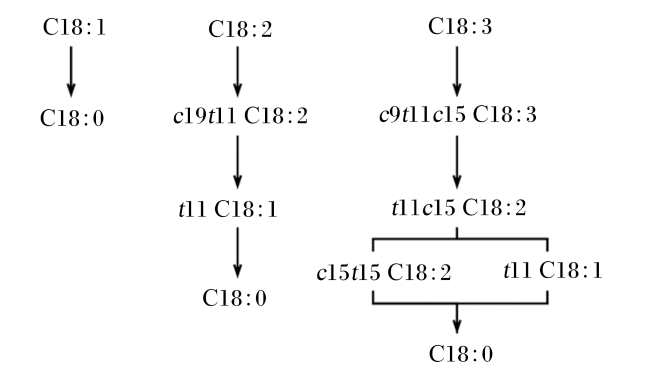
图1 油酸、亚油酸和亚麻酸瘤胃生物氢化主要途径

C18∶0:硬脂酸 stearic acid;C18∶1:油酸 oleic acid;C18∶2:亚油酸 linoleic acid;C18∶3:亚麻酸 linolenic acid。

Fig.1 Main pathways of rumen biohydrogenation of oleic acid, linoleic acid and linolenic acid[12,15-17]

1.2 瘤胃生物氢化相关的关键微生物

瘤胃作为天然的“发酵罐”,栖息着包括细菌、古菌、原虫、真菌等在内的庞大微生物群落[18]。细菌是瘤胃微生物中最丰富的成员,在瘤胃发酵中起着关键作用[19],其次是古菌,而原虫和真菌的数量最少。
参与脂解作用的瘤胃微生物主要是细菌,而原虫和真菌的脂解活性较小。细菌通过产生脂肪酶发挥其脂解作用,最典型的可分泌脂肪酶的细菌是厌氧溶脂弧菌(Anaerovibrio lipolytica),Anaerovibrio lipolytica数量的降低会导致脂肪的分解减少,从而降低可用于生物氢化的UFA含量[20]。丁酸弧菌属(Butyrivibrio)所属的细菌也具有脂解活性[21]。此外,现有研究表明,梭状芽孢杆菌属(Clostridium)、丙酸杆菌属(Propionibacterium)、葡萄球菌属(Staphylococcus)、硒单胞菌属(Selenomonas)和铜绿假单胞菌(Pseudomonas aeruginosa)也参与了瘤胃中脂肪的分解[18,22]
目前,瘤胃中的氢化细菌主要包括溶纤维丁酸弧菌(Butyrivibrio fibrisolvens)、ClostridiumPropionibacterium以及真细菌属(Eubacterium)等。最近发现尚未培养的普氏菌属(Prevotella)、毛螺菌属(Lachnospira)、未分类的拟杆菌目(unclassified Bacteroidales)、梭菌目(Clostridiales)和瘤胃球菌科(Ruminococcaceae)可能在瘤胃生物氢化中发挥主要作用[23]。然而,与细菌相比,真菌和原生动物对脂肪酸生物氢化的能力有限[16]。目前已经证实一些微生物参与生物氢化的具体步骤,如生物氢化的第一步是由Butyrivibrio fibrisolvens异构化,产生t11 UFA;其他细菌可以将C18∶2异构为c9t11 C18∶2,如双歧杆菌属(Bifidobacterium)、Clostridium、乳杆菌属(Lactobacillus)、PropionibacteriumEubacterium、玫瑰菌属(Roseburia)、肠球菌属(Enterococcus)和片球菌属(Pediococcus)等[24-25]。生物氢化的最后一步是将生物氢化中间体转化为C18∶0,在这一过程中起主要作用的细菌有Butyrivibrio fibrisolvens、黄色瘤胃球菌(Ruminococcus flavefaciens)以及白色瘤胃球菌(Ruminococcus albus)等[26]

1.3 瘤胃生物氢化与反刍动物产品脂肪酸组成的关系

反刍动物肉类和乳制品受到全世界消费者欢迎的主要原因之一是含有大量的有益脂肪酸,如共轭亚油酸。这些脂肪酸成分不存在于动物的饲粮中,只能由瘤胃代谢转化而来。因此,研究瘤胃生物氢化与反刍动物产品脂肪酸组成的关系对调控产品品质具有重要意义。正常饲养条件下,反刍动物肉类和乳制品中的脂肪酸主要来源包括血浆中运输的脂肪酸的直接吸收和机体组织中的从头合成[27],其中来源于血浆运输的脂肪酸占40%~60%,主要源自瘤胃对饲粮脂肪的代谢。因此,调控反刍动物肌肉组织与乳脂中脂肪酸的潜力,在很大程度上取决于饲粮中的脂肪在瘤胃内分解和氢化的程度,但瘤胃生物氢化过程通常是不完全的,大量的中间代谢产物到达十二指肠,经肠道吸收后进入组织和乳脂[28]。生物氢化产生的反式脂肪酸主要是t11 C18∶1,反刍动物产品中存在的t11 C18∶1对人体健康有益,同时,t11 C18∶1还是反刍动物乳腺和其他组织合成c9t11 C18∶2的前体物,乳腺上皮细胞以及组织中含有△9-去饱和酶,△9-去饱和酶可以催化氢化中间产物t11 C18∶1发生去饱和作用生成c9t11 C18∶2[29-30]。反刍动物的肉类和乳制品是人类膳食结构中t11 C18∶1和c9t11 C18∶2的主要来源。由此可见,提高肉类或牛奶中c9t11 C18∶2含量的最佳策略是促进瘤胃中t11 C18∶1的形成及其在十二指肠中的吸收。此外,如果目标是提高肉类或牛奶中的c9t11 C18∶2、t11 C18∶1和UFA的含量,则应尝试抑制脂肪分解和早期生物氢化步骤,而不影响C18∶2和C18∶3转化为c9t11 C18∶2和t11 C18∶1[12,31]
大量的实践表明,单宁可改善反刍动物产品的脂肪酸组成,在提升反刍动物肉、奶品质方面展现出较大的应用前景。例如,Ianni等[32]发现在奶牛饲粮中添加葡萄单宁,牛奶中t11 C18∶1和C18∶2含量显著增加。Do Nascimento等[33]报道,饲粮中添加金合欢单宁提高了山羊奶中PUFA以及长链脂肪酸含量,同时提高了乳脂中的动脉粥样硬化指数,提升了山羊乳品质。Cimmino等[34]研究显示,饲粮中添加单宁降低了羔羊肌肉中丙二醛含量,抑制了PUFA氧化,改善了羊肉品质。刘绘汇等[35]研究发现,在羔羊代乳粉中添加0.2%单宁,羔羊背最长肌中C18∶1和PUFA含量显著上升,C18∶0含量显著降低。

2 单宁对瘤胃生物氢化的调控作用

在过去的几十年里,反刍动物养殖环节抗生素滥用引起的生物耐药性问题,以及人工合成化合物在动物和动物产品中应用所引起的生物毒性与残留问题,已经引起人们的广泛重视,养殖企业对天然植物产品的兴趣迅速增长。
单宁又称鞣质、植物多酚,是植物次级代谢产物的一种,广泛分布于植物界,尤其是草本、灌木、谷物和药材中[36-37],许多水果如柑橘、柠檬、苹果和葡萄等也普遍存在单宁[38-40]。目前,已分离和鉴定到大约10 000种不同的单宁衍生物,其结构复杂、种类繁多,既包含非常简单的分子,也包含非常复杂的分子[41-42]。单宁按照化学结构特征主要分为缩合单宁和水解单宁[43]。缩合单宁又称原花青素,是由黄烷-3-醇或黄烷-3,4-二醇缩合而成的低聚或聚合类黄酮,包括儿茶素、表儿茶素、没食子儿茶素和表没食子儿茶素[44-45],缩合单宁分子质量相对较大,在1 900~2 800 Da[46]。水解单宁是由没食子酸或其衍生物与多元醇通过酯键形成的多元醇和酚酸[47],其分子质量相对较小,一般在500~3 000 Da[48]

2.1 单宁对瘤胃生物氢化中微生物的影响

目前已有很多研究表明,在反刍动物饲粮中添加单宁会通过调控瘤胃微生物群而减少UFA的分解。如Mannelli等[49]给母羊饲喂橄榄油果渣单宁,发现瘤胃脂肪关键分解菌Anaerovibrio lipolytica数量显著减少,同时发现C18∶3与Anaerovibrio lipolytica数量之间存在显著的负相关,由此可以推断来源于橄榄油果渣的单宁可抑制脂肪的分解。Cabiddu等[50]也同样发现,结合酚和单宁酸降低了瘤胃脂肪分解。Lee等[51]认为,当单宁存在时,脂肪分解减少可能是由于蛋白质-酚复合物中含有脂质,从而使脂肪分解酶无法完全作用于底物。但单宁对脂解的影响程度及机制有待进一步研究。
反刍动物饲粮中添加单宁也可以通过影响瘤胃微生物进而影响瘤胃生物氢化过程。Jafari等[52]研究发现,与对照组相比,用木瓜单宁提取物进行体外培养不会影响瘤胃细菌Butyrivibrio数量,但C18∶2和C18∶3的瘤胃生物氢化过程受到抑制。Vasta等[53]在羔羊饲粮中添加9.57%白坚木单宁导致瘤胃液中t11 C18∶1和c9t11 C18∶2的积累,增加了参与c9t11 C18∶2形成的Butyrivibrio fibrisolvens数量,并减少了将c9t11 C18∶2转化为C18∶0的蛋白溶解丁酸弧菌(Butyrivibrio proteoclasticus)数量。Ishlak等[54]研究了单宁对生物氢化途径和选定细菌物种的影响,结果表明,白坚木单宁增加了c9t11 C18∶2的积累,也增加了与C18∶1相关的Butyrivibrio丰度,但不影响与C18∶0产生相关的Butyrivibrio丰度。Buccioni等[8]证明,与对照组相比,饲喂母羊白坚木单宁或栗子单宁增加了Butyrivibrio fibrisolvens数量,减少了Butyrivibrio proteoclasticus数量,且白坚木单宁的效果比栗子单宁更为明显。在接下来的试验中对饲喂白坚木和栗子单宁的母羊瘤胃菌群进行分析,结果显示瘤胃球菌属(Ruminococcus)和Eubacterium以及未分类的毛螺菌科(unclassified Lachnospiraceae)的细菌种类与瘤胃生物氢化中涉及的主要中间体之间存在密切关联[55]。由此可见,饲粮中添加单宁会通过对瘤胃微生物进行调控,从而减少脂肪分解和抑制有益脂肪酸向C18∶0的转化。

2.2 单宁对瘤胃生物氢化中主要中间体的影响

研究显示,饲粮中添加单宁会抑制瘤胃生物氢化的最后一步,即t11 C18∶1向C18∶0的转化。体外研究一致认为,单宁对瘤胃消化物中的C18∶0积累具有负面影响,单宁还会导致t11 C18∶1和c9t11 C18∶2含量增加。Jayanegara等[56]研究了高山植物单宁含量与C18∶3生物氢化之间的关系,结果发现,饲喂板栗叶单宁提取物抑制了C18∶2和C18∶3的奶牛瘤胃生物氢化,降低了C18∶0的生成,但不影响c9t11 C18∶2的含量。Kronberg等[57]证明白坚木单宁在体外发酵中保护C18∶3免受瘤胃微生物的氢化,即主要涉及生物氢化的早期步骤。Vasta等[58]通过体外批次培养试验发现,与对照组相比,补充角豆果肉、金合欢叶或白坚木单宁会导致t11 C18∶1和总反式C18∶1脂肪酸的积累。Carreño等[59]在体外培养中发现橡木单宁提取物在20 g/kg干物质(DM)的剂量下,增加了总PUFA、C18∶2、C18∶3和t11 C18∶1含量,并降低了C18∶0含量,且不会对瘤胃发酵产生负面影响。这些结果表明,与之前的反应步骤相比,生物氢化的最后一步,即t11 C18∶1转化为C18∶0,受到单宁的影响程度更大。Buccioni等[60]添加板栗或白坚木单宁提取物,最初观察到c9t11 C18∶2含量降低,随后在培养后期发现与对照组相比,c9t11 C18∶2含量增加了2.0~3.4倍,这2种单宁导致瘤胃液中C18∶0含量更少,这可能是由于共轭亚油酸的形成比反式C18∶1还原为C18∶0更快,单宁可能在较短的培养时间内抑制了共轭亚油酸的产生,进一步证实了单宁对瘤胃生物氢化最后一步的抑制作用。
与大量的体外研究相比,采用反刍动物模型研究单宁对体内瘤胃生物氢化的报道明显较少。如Vasta等[61]在绵羊饲粮中添加白坚木单宁,结果显示瘤胃中t11 C18∶1含量增加,肌肉脂肪中c9t11 C18∶2和UFA含量增加。虽然部分研究没有测定瘤胃液脂肪酸的组成和比例,但关注了产品的脂肪酸谱,因为这些长链脂肪酸可能直接来源于瘤胃代谢,所以一定程度上可以间接反映瘤胃生物氢化的代谢结果。Kamel等[62]在羔羊饲粮中添加白坚木单宁,发现添加20 g/kg DM单宁增加了羔羊肌肉中c9t11 C18∶2含量。Cappucci等[63]发现母羊饲粮中添加0.6 g/kg DM单宁提取物时,乳汁中t11 C18∶1和c9t11 C18∶2含量增加;添加0.8和1.2 g/kg DM橄榄单宁提取物时,乳汁中t11 C18∶1和c9t11 C18∶2含量下降,但会导致更高的C18∶2和C18∶3含量。De Lucena等[64]在山羊基础饲粮中添加不同水平的含羞草单宁提取物,发现乳汁中c9 C18∶1、t11 C18∶1以及c9t11 C18∶2含量显著增加,且单宁含量为28 g/kg DM时改善了脂肪酸含量,不会对干物质采食量和产奶量造成负面影响。综上所述,饲粮中添加单宁可以影响瘤胃生物氢化过程中脂肪酸的含量,且与单宁的添加量有关,但未来需要开展更多的动物试验,分析不同种类和添加量的单宁对瘤胃生物氢化的调控效果,为改善产品品质提供科学支撑。

3 单宁调控瘤胃生物氢化的影响因素

3.1 作用时间

单宁对瘤胃微生物的作用会随时间的变化而产生差异。Natalello等[65]在母羊瘤胃体外发酵中发现,添加石榴单宁发酵24 h时瘤胃液中奇链和支链脂肪酸含量变化比12 h时更显著,这与单宁提取物对t11 C18∶1积累的影响结果[66]一致。此外,某些C18∶1异构体的减少仅在短期内(12 h)显著[65]。Toral等[67]在哺乳母羊中观察到,白坚木单宁提取物对乳汁中t11 C18∶1和c9t11 C18∶2含量的影响仅在第1周内较为显著,从第12天开始,被t10 C18∶1含量的逐渐增加所替代。由此推测,由于对瘤胃微生物群的潜在适应性,单宁对瘤胃生物氢化的一些积极作用可能会随着作用时间而减弱。然而大多数有关单宁的应用研究并没有发现特意关注作用时间对瘤胃和肉、奶脂肪酸组成的影响,未来的试验需要研究单宁作用时间对瘤胃生物氢化的影响,以进一步分析瘤胃微生物对单宁的适应性机制,为建立和优化调控策略提供依据。

3.2 饲粮组成

反刍动物的基础饲粮组成也可能影响单宁对瘤胃生物氢化的作用。Vasta等[61]发现分别在以新鲜牧草和精饲料为基础的饲粮中添加白坚木单宁提取物,均可增加羔羊肌肉中C18∶3含量,但只有当精饲料中含有单宁时,t11 C18∶1和c9t11 C18∶2含量才会增加,这表明饲粮的精粗比可影响瘤胃生物氢化反应。与无植物油补充组相比,在饲粮中添加植物油时,岩蔷薇单宁增加了羔羊肌肉中t11 C18∶1和c9t11 C18∶2含量[68],且肌肉中t10 C18∶1含量大幅增加并达到最高[69-70]。Szczechowiak等[71]研究发现,单宁提取物和鱼油之间的相互作用会抑制最后一个氢化步骤。Kamel等[62]研究发现,饲粮中同时添加单宁和葵花油,两者相互作用增加了总UFA含量,降低了瘤胃微生物的效率,降低了饲粮中SFA的生物氢化。同样,Natalello等[65]研究发现,石榴单宁和共轭亚麻酸在调节瘤胃生物氢化中发挥着不同的作用,石榴单宁有利于总C18∶2、C18∶3和c9t11 C18∶2的积累,而t11 C18∶1含量的增加主要来自共轭亚麻酸异构体的瘤胃生物氢化,总之,两者对瘤胃生物氢化的作用具有相加的效果。

4 单宁对反刍动物瘤胃发酵和生产性能的影响

传统动物营养上,单宁被视为抗营养因子,过度摄入可降低反刍动物的采食量,降低瘤胃中饲粮营养成分的消化,甚至降低生产性能。但大量研究也表明,适量的单宁可发挥促营养作用,如提高过瘤胃蛋白的数量、提高氮利用效率等。如前文所述,诸多研究表明单宁可以调控瘤胃生物氢化,改善产品品质,但单宁对反刍动物瘤胃发酵和生产性能的影响仍不忽视。表1列举了近年来单宁在反刍动物营养上的研究,重点关注了单宁对瘤胃发酵和生产性能的影响。可以看出,大多数试验证明单宁对反刍动物产品和瘤胃液中的脂肪酸有益,但也有试验表明单宁会降低动物的生产性能,有些则报道单宁对动物生产性能没有负面影响。如De Lucena等[64]发现山羊DM、粗蛋白质和水分的摄入量随着单宁摄入量的增加而线性下降,乳汁产量和密度也随着单宁摄入量的增加而线性下降。而Cappucci等[63]发现母羊饲粮中添加单宁提取物时,对母羊的产奶量以及乳成分没有造成负面影响。因此,单宁在调控瘤胃生物氢化的同时,可能对动物生产性能造成不同的影响,导致这些差异的原因可能是使用单宁的来源不同,此外,试验动物、单宁剂量、基础饲粮以及个体瘤胃微生物组成差异等因素,都会对单宁的调控作用产生偏差。但目前对于单宁调控瘤胃生物氢化的体内研究较少,且试验动物的品种较为单一,多集中于羊,在奶牛、肉牛上同时研究单宁对瘤胃生物氢化、瘤胃发酵、生产性能和产品脂肪酸谱影响的研究较少。因此,研究单宁调控瘤胃生物氢化的效果与机制的同时,也需要进一步通过大量动物试验,结合采食量、瘤胃发酵、养分消化率、生产性能等指标体系,明确不同种类单宁的适宜添加量和调控机制。
表1 单宁对相关瘤胃生物氢化、瘤胃发酵和生产性能的影响

Table 1 Effects of tannins on related rumen biohydrogenation, rumen fermentation and performance

试验动物
Experimental
animals
单宁来源
Source of
tannins
添加量
Addition
amount
饲粮组成
Diet
composition
瘤胃生物氢化/肉、
奶脂肪酸组成
Rumen biohydrogenation/
fatty acid composition of
meat or milk
瘤胃发酵/生产性能
Rumen fermentation/
performance
参考文献
Reference
羔羊Lambs 白坚木 9.75% DM 大麦 瘤胃生物氢化↓;瘤胃中
t11 C18∶1、c9t11 C18∶2
含量↑,C18∶0含量=
Butyrivibrio fibrisolvens
数量↑,Butyrivibrio
proteoclasticus数量↓,
干物质摄入量、平均日
增重、体重↓
[53]
母羊Ewes 白坚木和
栗子
52.8 g/kg DM 干草+
精饲料
瘤胃生物氢化↓;
乳汁中t11 C18∶1、
c9t11 C18∶2含量↓
Butyrivibrio fibrisolvens
数量↑,Butyrivibrio
proteoclasticus数量↓,
产奶量=
[8]
羔羊Lambs 白坚木 4% DM 新鲜牧草
或精饲料
瘤胃生物氢化↓;肌肉、
瘤胃中t11 C18∶1、
c9t11 C18∶2、C18∶2、C18∶3
含量↑,C18∶0含量↓
[61]
羔羊Lambs 白坚木 0、20和
40 g/kg DM
20 g/kg DM组的肌肉中
c9t11 C18∶2含量↑
总采食量、总增重、平均
日增重和饲料转化率=
[62]
母羊Ewes 橄榄 0、0.6、0.8和
1.2 g/kg DM
苜蓿+
大麦
瘤胃生物氢化↓;乳汁、瘤
胃中C18∶3含量↑,C18∶2、
c9t11 C18∶2含量↑
产奶量、乳成分= [63]
山羊Goats 含羞草 11、28、36和
44 g/kg DM
玉米+豆
粕+木薯叶
乳汁中c9 C18∶1、
t11 C18∶1、c9t11 C18∶2、
c9t11c15 C18∶3含量↑
DM、粗蛋白质和水
分的摄入量↓,乳汁
产量和乳密度↓
[64]
羔羊Lambs 岩蔷薇 0、1.25%
和2.5% DM
大豆油+
苜蓿
瘤胃生物氢化=;瘤胃中
t11 C18∶1、C18∶2、C18∶3、
总PUFA含量=,C18∶0含量↑
TVFA含量↑ [72]
羔羊Lambs 岩蔷薇 250 g/kg DM 苜蓿+
麦麸
瘤胃中C18∶0含量↓;肌肉中
t11 C18∶1、c9t11 C18∶2含量↑
平均日采食量=,
平均日日增重↑
[68]
母羊Ewes 橡皮树和
单宁酸
4 g/kg DM 干草+大
麦粉+豆粕
瘤胃生物氢化↓;单宁酸组
瘤胃中C18∶2、C18∶3
含量↑,c9t11 C18∶2含量=
平均日采食量↑ [73]
奶牛Cows 金合欢 0、5、10、15和
20 g/kg DM
精饲料 消化率↑,产奶量、牛奶氧化
特性=,牛奶酪蛋白含量↓
[74]
奶牛Cows 板栗 10 g/kg DM TMR 采食量、体重、体况评分、
产奶量和牛奶成分=
[75]
肉牛Cattle 白坚木 0、1.5%、
3.0%和
4.5% DM
粗饲料 采食量↑,ADF和
水分摄入量=
[76]

DM:干物质 dry matter;TMR:全混合日粮 total mixed ration;TVFA:总挥发性脂肪酸 total volatile fatty acids;ADF:酸性洗涤纤维 acid detergent fiber;Butyrivibrio fibrisolvens:溶纤维丁酸弧菌;Butyrivibrio proteoclasticus:蛋白溶解丁酸弧菌;↑:升高 increase;↓:下降 decrease;=:无影响 no effect;—:未检测 not detected。

5 小结与展望

反刍动物饲粮中添加单宁能调节瘤胃生物氢化,提高C18∶3、c9t11 C18∶2、t11 C18∶1和共轭亚油酸等有益脂肪酸的含量,降低C18∶0的含量,从而改变反刍动物肉类和乳制品中的脂肪酸组成。然而,由于瘤胃微生态系统的复杂性,瘤胃生物氢化中涉及的特定微生物及相关生化过程仍未完全阐明;且单宁来源、分子质量、添加量等诸多因素都会给瘤胃生物氢化的调控过程带来不确定性,甚至对瘤胃发酵和生产性能造成不同的影响。未来应进一步研究不同饲粮和瘤胃环境下单宁调控瘤胃生物氢化的作用效果,明确应用条件和最适添加剂量,同时采用培养组学、宏基因组学、宏转录组学等技术进一步揭示单宁调控生物氢化的分子机制,为应用单宁改善反刍动物产品脂肪酸组成、提升畜产品品质提供理论基础。
[1]
JENKINS T C, WALLACE R J, MOATE P J, et al. Board-invited review:recent advances in biohydrogenation of unsaturated fatty acids within the rumen microbial ecosystem[J]. Journal of Animal Science, 2008, 86(2):397-412.

DOI

[2]
MAIA M R G, CHAUDHARY L C, BESTWICK C S, et al. Toxicity of unsaturated fatty acids to the biohydrogenating ruminal bacterium,Butyrivibrio fibrisolvens[J]. BMC Microbiology, 2010, 10:52.

DOI

[3]
BENJAMIN S, SPENER F. Conjugated linoleic acids as functional food:an insight into their health benefits[J]. Nutrition & Metabolism, 2009, 6:36.

[4]
TYBURCZY C, MAJOR C, LOCK A L, et al. Individual trans octadecenoic acids and partially hydrogenated vegetable oil differentially affect hepatic lipid and lipoprotein metabolism in golden Syrian hamsters[J]. The Journal of Nutrition, 2009, 139(2):257-263.

DOI

[5]
SERRA A, MELE M, LA COMBA F, et al. Conjugated linoleic acid (CLA) content of meat from three muscles of Massese suckling lambs slaughtered at different weights[J]. Meat Science, 2009, 81(2):396-404.

DOI PMID

[6]
CORREDDU F, GASPA G, PULINA G, et al. Grape seed and linseed,alone and in combination,enhance unsaturated fatty acids in the milk of Sarda dairy sheep[J]. Journal of Dairy Science, 2016, 99(3):1725-1735.

DOI

[7]
IANNI A, MARTINO G. Dietary grape pomace supplementation in dairy cows:effect on nutritional quality of milk and its derived dairy products[J]. Foods, 2020, 9(2):168.

DOI

[8]
BUCCIONI A, PAUSELLI M, VITI C, et al. Milk fatty acid composition,rumen microbial population,and animal performances in response to diets rich in linoleic acid supplemented with chestnut or quebracho tannins in dairy ewes[J]. Journal of Dairy Science, 2015, 98(2):1145-1156.

DOI

[9]
BUCCIONI A, DECANDIA M, MINIERI S, et al. Lipid metabolism in the rumen:new insights on lipolysis and biohydrogenation with an emphasis on the role of endogenous plant factors[J]. Animal Feed Science and Technology, 2012, 174(1/2):1-25.

DOI

[10]
HOBSON P N, MANN S O. The isolation of glycerol-fermenting and lipolytic bacteria from the rumen of the sheep[J]. Journal of General Microbiology, 1961, 25:227-240.

PMID

[11]
FERLAY A, BERNARD L, MEYNADIER A, et al. Production of trans and conjugated fatty acids in dairy ruminants and their putative effects on human health:a review[J]. Biochimie, 2017, 141:107-120.

DOI

[12]
MORALES R, UNGERFELD E M. Use of tannins to improve fatty acids profile of meat and milk quality in ruminants:a review[J]. Chilean Journal of Agricultural Research, 2015, 75(2):239-248.

DOI

[13]
FRUTOS P, HERVÁS G, NATALELLO A, et al. Ability of tannins to modulate ruminal lipid metabolism and milk and meat fatty acid profiles[J]. Animal Feed Science and Technology, 2020, 269:114623.

DOI

[14]
LOOR J J, FERLAY A, OLLIER A, et al. High-concentrate diets and polyunsaturated oils alter trans and conjugated isomers in bovine rumen,blood,and milk[J]. Journal of Dairy Science, 2005, 88(11):3986-3999.

DOI

[15]
DEWANCKELE L, TORAL P G, VLAEMINCK B, et al. Invited review:role of rumen biohydrogenation intermediates and rumen microbes in diet-induced milk fat depression:an update[J]. Journal of Dairy Science, 2020, 103(9):7655-7681.

DOI

[16]
LOOR J J, UEDA K, FERLAY A, et al. Short communication:diurnal profiles of conjugated linoleic acids and trans fatty acids in ruminal fluid from cows fed a high concentrate diet supplemented with fish oil,linseed oil,or sunflower oil[J]. Journal of Dairy Science, 2004, 87(8):2468-2471.

DOI

[17]
SUN X G, WANG Y, MA X Y, et al. Producing natural functional and low-carbon milk by regulating the diet of the cattle-the fatty acid associated rumen fermentation,biohydrogenation,and microorganism response[J]. Frontiers in Nutrition, 2022, 9:955846.

DOI

[18]
ENJALBERT F, COMBES S, ZENED A, et al. Rumen microbiota and dietary fat:a mutual shaping[J]. Journal of Applied Microbiology, 2017, 123(4):782-797.

DOI

[19]
FERNANDO S C, PURVIS H T 2ND, NAJAR F Z, et al. Rumen microbial population dynamics during adaptation to a high-grain diet[J]. Applied and Environmental Microbiology, 2010, 76(22):7482-7490.

DOI PMID

[20]
HARFOOT C G. Lipid metabolism in the rumen[J]. Progress in Lipid Research, 1978, 17(1):21-54.

PMID

[21]
VASTA V, DAGHIO M, CAPPUCCI A, et al. Invited review:plant polyphenols and rumen microbiota responsible for fatty acid biohydrogenation,fiber digestion,and methane emission:experimental evidence and methodological approaches[J]. Journal of Dairy Science, 2019, 102(5):3781-3804.

DOI

[22]
VAN DE VOSSENBERG J L, JOBLIN K N. Biohydrogenation of C18 unsaturated fatty acids to stearic acid by a strain of Butyrivibrio hungatei from the bovine rumen[J]. Letters in Applied Microbiology, 2003, 37(5):424-428.

DOI

[23]
BAINBRIDGE M L, CERSOSIMO L M, WRIGHT A D G, et al. Rumen bacterial communities shift across a lactation in Holstein,Jersey and Holstein×Jersey dairy cows and correlate to rumen function,bacterial fatty acid composition and production parameters[J]. FEMS Microbiology Ecology, 2016, 92(5):fiw059.

DOI

[24]
VERHULST A, SEMJEN G, MEERTS U, et al. Biohydrogenation of linoleic acid by Clostridium sporogenes,Clostridium bifermentans,Clostridium sordellii and Bacteroides sp.[J]. FEMS Microbiology Letters, 1985, 31(4):255-259.

DOI

[25]
DEVILLARD E, MCINTOSH F M, DUNCAN S H, et al. Metabolism of linoleic acid by human gut bacteria:different routes for biosynthesis of conjugated linoleic acid[J]. Journal of Bacteriology, 2007, 189(6):2566-2570.

DOI

[26]
GUDLA P, ABUGHAZALEH A A, ISHLAK A, et al. The effect of level of forage and oil supplement on biohydrogenation intermediates and bacteria in continuous cultures[J]. Animal Feed Science and Technology, 2012, 171(2/4):108-116.

DOI

[27]
PALMQUIST D L. Milk fat:origin of fatty acids and influence of nutritional factors thereon[M]// FOXP F, MCSWEENEYP L H. Advanced dairy chemistry volume 2:lipids.Boston:Springer, 2006:43-92.

[28]
SHINGFIELD K J, BONNET M, SCOLLAN N D. Recent developments in altering the fatty acid composition of ruminant-derived foods[J]. Animal, 2013,7 (Suppl.1):132-162.

[29]
GRIINARI J M, CORL B A, LACY S H, et al. Conjugated linoleic acid is synthesized endogenously in lactating dairy cows by delta(9)-desaturase[J]. The Journal of Nutrition, 2000, 130(9):2285-2291.

DOI

[30]
陈博. 新鲜黑麦草取代粗饲料对奶山羊乳脂肪酸组成和瘤胃脂肪酸代谢的影响研究[D].硕士学位论文. 杨凌: 西北农林科技大学, 2016.

CHEN B. Effect of replacing roughage with fresh ryegrass on milk fatty acid composition and ruminal fatty acid metabolism of dairy goats[D].Master’s Thesis. Yangling: Northwest A&F University, 2016. (in Chinese)

[31]
KHIAOSA-ARD R, SOLIVA C R, KREUZER M, et al. Influence of alpine forage either employed as donor cow’s feed or as incubation substrate on in vitro ruminal fatty acid biohydrogenation[J]. Livestock Science, 2011, 140(1/2/3):80-87.

DOI

[32]
IANNI A, INNOSA D, MARTINO C, et al. Short communication:compositional characteristics and aromatic profile of caciotta cheese obtained from Friesian cows fed with a dietary supplementation of dried grape pomace[J]. Journal of Dairy Science, 2019, 102(2):1025-1032.

DOI

[33]
DO NASCIMENTO S P O, DA SILVA A P R, DE SANT’ANA A S, et al. Condensed tannins to increase bioactive fatty acids in the milk from Canindé,Repartida,and Saanen goats[J]. Tropical Animal Health and Production, 2022, 54(5):318.

DOI

[34]
CIMMINO R, BARONE C M A, CLAPS S, et al. Effects of dietary supplementation with polyphenols on meat quality in Saanen goat kids[J]. BMC Veterinary Research, 2018, 14(1):181.

DOI PMID

[35]
刘绘汇, 孙康, 范慧玉, 等. 代乳粉中添加单宁酸对湖羊羔羊生长性能、养分表观消化率和肌肉脂肪酸组成的影响[J]. 动物营养学报, 2021, 33(8):4520-4532.

DOI

LIU H H, SUN K, FAN H Y, et al. Effects of tannic acid addition in milk replacer on growth performance,nutrient apparent digestibility and muscle fatty acid composition of Hu lambs[J]. Chinese Journal of Animal Nutrition, 2021, 33(8):4520-4532. (in Chinese)

[36]
BERARD N C, WANG Y, WITTENBERG K M, et al. Condensed tannin concentrations found in vegetative and mature forage legumes grown in western Canada[J]. Canadian Journal of Plant Science, 2011, 91(4):669-675.

DOI

[37]
ZHANG Z H, LI X J, SANG S Y, et al. Polyphenols as plant-based nutraceuticals:health effects,encapsulation,nano-delivery,and application[J]. Foods, 2022, 11(15):2189.

DOI

[38]
牟春堂, 郝小燕, 刘笑梅, 等. 葡多酚对绵羊瘤胃体外发酵参数及微生物区系的影响[J]. 动物营养学报, 2020, 32(1):302-309.

DOI

MU C T, HAO X Y, LIU X M, et al. Effects of grape polyphenols on in vitro rumen fermentation parameters and microflora of sheep[J]. Chinese Journal of Animal Nutrition, 2020, 32(1):302-309. (in Chinese)

[39]
PONTIFEX M G, MALIK M M A H, CONNELL E, et al. Citrus polyphenols in brain health and disease:current perspectives[J]. Frontiers in Neuroscience, 2021, 15:640648.

DOI

[40]
LÓPEZ-FERNÁNDEZ O, BOHRER B M, MUNEKATA P E S, et al. Improving oxidative stability of foods with apple-derived polyphenols[J]. Comprehensive Reviews in Food Science and Food Safety, 2022, 21(1):296-320.

DOI

[41]
ABBAS M, SAEED F, ANJUM F M, et al. Natural polyphenols:an overview[J]. International Journal of Food Properties, 2017, 20(8):1689-1699.

DOI

[42]
CHIORCEA-PAQUIM A M, ENACHE T A, DE SOUZA GIL E, et al. Natural phenolic antioxidants electrochemistry:towards a new food science methodology[J]. Comprehensive Reviews in Food Science and Food Safety, 2020, 19(4):1680-1726.

DOI

[43]
KHANBABAEE K, VAN REE T. Tannins:classification and definition[J]. Natural Product Reports, 2001, 18(6):641-649.

DOI

[44]
MCSWEENEY C S, PALMER B, MCNEILL D M, et al. Microbial interactions with tannins:nutritional consequences for ruminants[J]. Animal Feed Science and Technology, 2001, 91(1/2):83-93.

DOI

[45]
彭凯, 黄文, 戴文因. 缩合单宁的生物活性及构效关系研究进展[J]. 饲料工业, 2021, 42(24):55-59.

PENG K, HUANG W, DAI W Y. Research progress on biological activity and structure-function relationship of condensed tannins[J]. Feed Industry, 2021, 42(24):55-59. (in Chinese)

[46]
李杰, 刘巧玲, 孙红先, 等. 植物单宁营养生理功能及其在反刍动物生产中的应用研究进展[J]. 畜牧兽医杂志, 2021, 40(6):79-82.

LI J, LIU Q L, SUN H X, et al. Research progress on the nutritional and physiological functions of plant tannin and its application in ruminantia[J]. Journal of Animal Science and Veterinary Medicine, 2021, 40(6):79-82. (in Chinese)

[47]
DÍAZ CARRASCO J M, CABRAL C, REDONDO L M, et al. Impact of chestnut and quebracho tannins on rumen microbiota of bovines[J]. BioMed Research International, 2017, 2017:9610810.

[48]
ABOAGYE I A, BEAUCHEMIN K A. Potential of molecular weight and structure of tannins to reduce methane emissions from ruminants:a review[J]. Animals, 2019, 9(11):856.

DOI

[49]
MANNELLI F, CAPPUCCI A, PINI F, et al. Effect of different types of olive oil pomace dietary supplementation on the rumen microbial community profile in Comisana ewes[J]. Scientific Reports, 2018, 8(1):8455.

DOI PMID

[50]
CABIDDU A, SALIS L, TWEED J K S, et al. The influence of plant polyphenols on lipolysis and biohydrogenation in dried forages at different phenological stages:in vitro study[J]. Journal of the Science of Food and Agriculture, 2010, 90(5):829-835.

DOI

[51]
LEE M R F, TWEED J K S, COOKSON A, et al. Immunogold labelling to localize polyphenol oxidase (PPO) during wilting of red clover leaf tissue and the effect of removing cellular matrices on PPO protection of glycerol-based lipid in the rumen[J]. Journal of the Science of Food and Agriculture, 2010, 90(3):503-510.

DOI PMID

[52]
JAFARI S, MENG G Y, RAJION M A, et al. Manipulation of rumen microbial fermentation by polyphenol rich solvent fractions from papaya leaf to reduce green-house gas methane and biohydrogenation of C18 PUFA[J]. Journal of Agricultural and Food Chemistry, 2016, 64(22):4522-4530.

DOI PMID

[53]
VASTA V, YÁÑEZ-RUIZ D R, MELE M, et al. Bacterial and protozoal communities and fatty acid profile in the rumen of sheep fed a diet containing added tannins[J]. Applied and Environmental Microbiology, 2010, 76(8):2549-2555.

DOI PMID

[54]
ISHLAK A, GÜNAL M, ABUGHAZALEH A A. The effects of cinnamaldehyde,monensin and quebracho condensed tannin on rumen fermentation,biohydrogenation and bacteria in continuous culture system[J]. Animal Feed Science and Technology, 2015, 207:31-40.

DOI

[55]
BUCCIONI A, PALLARA G, PASTORELLI R, et al. Effect of dietary chestnut or quebracho tannin supplementation on microbial community and fatty acid profile in the rumen of dairy ewes[J]. BioMed Research International, 2017, 2017:4969076.

[56]
JAYANEGARA A, KREUZER M, LEIBER F. Ruminal disappearance of polyunsaturated fatty acids and appearance of biohydrogenation products when incubating linseed oil with alpine forage plant species in vitro[J]. Livestock Science, 2012, 147(1/2/3):104-112.

DOI

[57]
KRONBERG S L, SCHOLLJEGERDES E J, BARCELÓ-COBLIJN G, et al. Flaxseed treatments to reduce biohydrogenation of alpha-linolenic acid by rumen microbes in cattle[J]. Lipids, 2007, 42(12):1105-1111.

DOI PMID

[58]
VASTA V, MAKKAR H P S, MELE M, et al. Ruminal biohydrogenation as affected by tannins in vitro[J]. British Journal of Nutrition, 2009, 102(1):82-92.

DOI

[59]
CARREÑO D, HERVÁS G, TORAL P G, et al. Ability of different types and doses of tannin extracts to modulate in vitro ruminal biohydrogenation in sheep[J]. Animal Feed Science and Technology, 2015, 202:42-51.

DOI

[60]
BUCCIONI A, MINIERI S, RAPACCINI S, et al. Effect of chestnut and quebracho tannins on fatty acid profile in rumen liquid- and solid-associated bacteria:an in vitro study[J]. Animal, 2011, 5(10):1521-1530.

DOI

[61]
VASTA V, MELE M, SERRA A, et al. Metabolic fate of fatty acids involved in ruminal biohydrogenation in sheep fed concentrate or herbage with or without tannins[J]. Journal of Animal Science, 2009, 87(8):2674-2684.

DOI PMID

[62]
KAMEL H E M, AL-DOBAIB S N, SALEM A Z M, et al. Influence of dietary supplementation with sunflower oil and quebracho tannins on growth performance and meat fatty acid profile of Awassi lambs[J]. Animal Feed Science and Technology, 2018, 235:97-104.

DOI

[63]
CAPPUCCI A, ALVES S P, BESSA R J B, et al. Effect of increasing amounts of olive crude phenolic concentrate in the diet of dairy ewes on rumen liquor and milk fatty acid composition[J]. Journal of Dairy Science, 2018, 101(6):4992-5005.

DOI PMID

[64]
DE LUCENA A R F, MENEZES D R, DE CARVALHO D T Q, et al. Effect of commercial tannin and a pornunça (Manihot spp.) silage-based diet on the fatty acid profile of Saanen goats’ milk[J]. International Journal of Dairy Technology, 2018, 71(3):613-620.

DOI

[65]
NATALELLO A, HERVÁS G, TORAL P G, et al. Bioactive compounds from pomegranate by-products increase the in vitro ruminal accumulation of potentially health promoting fatty acids[J]. Animal Feed Science and Technology, 2020, 259:114355.

DOI

[66]
ABO-DONIA F M, YANG L Y, HRISTOV A N, et al. Effects of tannins on the fatty acid profiles of rumen fluids and milk from lactating goats fed a total mixed ration containing rapeseed oil[J]. Livestock Science, 2017, 204:16-24.

DOI

[67]
TORAL P G, HERVÁS G, BELENGUER A, et al. Effect of the inclusion of quebracho tannins in a diet rich in linoleic acid on milk fatty acid composition in dairy ewes[J]. Journal of Dairy Science, 2013, 96(1):431-439.

DOI PMID

[68]
JERÓNIMO E, ALVES S P, DENTINHO M T P, et al. Effect of grape seed extract,Cistus ladanifer L.,and vegetable oil supplementation on fatty acid composition of abomasal digesta and intramuscular fat of lambs[J]. Journal of Agricultural and Food Chemistry, 2010, 58(19):10710-10721.

DOI

[69]
FRANCISCO A, ALVES S P, PORTUGAL P V, et al. Effect of feeding lambs with a tanniferous shrub (rockrose) and a vegetable oil blend on fatty acid composition of meat lipids[J]. Animal, 2016, 10(12):2061-2073.

PMID

[70]
FRANCISCO A, DENTINHO M T, ALVES S P, et al. Growth performance,carcass and meat quality of lambs supplemented with increasing levels of a tanniferous bush (Cistus ladanifer L.) and vegetable oils[J]. Meat Science, 2015, 100:275-282.

DOI

[71]
SZCZECHOWIAK J, SZUMACHER-STRABEL M, EL-SHERBINY M, et al. Rumen fermentation, methane concentration and fatty acid proportion in the rumen and milk of dairy cows fed condensed tannin and/or fish-soybean oils blend[J]. Animal Feed Science and Technology, 2016, 216:93-107.

DOI

[72]
GUERREIRO O, ALVES S P, SOLDADO D, et al. Inclusion of the aerial part and condensed tannin extract from Cistus ladanifer L. in lamb diets-effects on growth performance,carcass and meat quality and fatty acid composition of intramuscular and subcutaneous fat[J]. Meat Science, 2020, 160:107945.

DOI

[73]
MAJEWSKA M P, MILTKO R, BEŁŻECKI G, et al. Comparison of the effect of synthetic (tannic acid) or natural (oak bark extract) hydrolysable tannins addition on fatty acid profile in the rumen of sheep[J]. Animals, 2022, 12(6):699.

DOI

[74]
AVILA A S, ZAMBOM M A, FACCENDA A, et al. Black wattle (Acacia mearnsii) condensed tannins as feed additives to lactating dairy cows[J]. Animals, 2020, 10(4):662.

DOI

[75]
LIU H W, ZHOU D W, LI K. Effects of chestnut tannins on performance and antioxidative status of transition dairy cows[J]. Journal of Dairy Science, 2013, 96(9):5901-5907.

DOI PMID

[76]
NORRIS A B, CROSSLAND W L, TEDESCHI L O, et al. Inclusion of quebracho tannin extract in a high-roughage cattle diet alters digestibility,nitrogen balance,and energy partitioning[J]. Journal of Animal Science, 2020, 98(3):skaa047.

DOI

Outlines

/