REVIEW

Effects of Mixed Ensiling on Nutritional Quality of Whole Plant Maize Silage

  • ZHENG Linfeng , 1 ,
  • REN Hongyang 1 ,
  • WANG Hongliang , 1, * ,
  • WANG Zili 2
Expand
  • 1 Key Laboratory of Plant-Soil Interaction, Ministry of Education, National Academy of Agricultural Green Development, College of Resources and Environmental Sciences, China Agricultural University, Beijing 100193, China
  • 2 Hangjinhou Comprehensive Protection Center for Agriculture and Animal Husbandry, Bayannur 015400, China
*associate professor, E-mail:

Received date: 2023-03-06

  Online published: 2023-08-10

Abstract

In recent years, with the expanded development of cattle, sheep and other livestock production, the demand for silage increased accordingly. When the whole plant maize is mixed ensiling with other crops, by-products or some ingredients with low nutritional value or difficulty to ensiling, the nutritional quality of silage can be balanced through the complementarity of nutrients in ingredients and the interaction effect of microorganisms, and then improves the utilization potential of local forage resources. However, the nutritional quality of whole plant maize after mixed ensiling with different ingredients is inconsistent. Based on the domestic and abroad research progress, this paper reviewed the changes of nutritional quality of mixed silage obtained from whole plant maize and leguminous crops, graminaceous crops, processing by-products, agricultural by-products and other crops, respectively, and their influencing factors, so as to provide scientific guidance for the efficient utilization of forage in China

Cite this article

ZHENG Linfeng , REN Hongyang , WANG Hongliang , WANG Zili . Effects of Mixed Ensiling on Nutritional Quality of Whole Plant Maize Silage[J]. Chinese Journal of Animal Nutrition, 2023 , 35(8) : 4827 -4839 . DOI: 10.12418/CJAN2023.448

近年来,随着我国畜牧业规模程度和管理水平的逐步提高,养殖从业者对饲料营养的认识不断深入,市场对饲料或牧草的品质要求也随之提高,然而国内饲草的供应尤其是优质牧草的供应却远远不能满足需求[1]。青贮饲料是一种适口性好、存储时间长且可供全年使用的饲料。全株玉米是我国常见的反刍动物饲料,具有高产量、高能量、鲜嫩多汁、适口性好和营养丰富等特点,被称为“粗饲料之王”[2]。此外,我国尚有大量的非常规饲料资源如秸秆、糟渣等未得到充分利用[3]。混合青贮能够将营养价值低、适口性差或难以单独青贮的原料利用微生物的相互作用使其营养均衡、适口性提升,从而避免资源浪费与环境污染且能有效缓解我国饲草资源短缺的压力[4]。目前,关于全株玉米与不同作物或者副产物混贮对其营养品质影响的相关研究很多,但不同混贮对象的适宜混合比例以及其对青贮饲料营养品质的提升效果并不一致。因此,本文系统梳理了全株玉米与不同类型作物或副产物的最优混贮比例及其对青贮饲料营养品质的影响,以明确其他非常规饲料资源的青贮潜力与价值,为促进我国农副产品的高效利用以及缓解我国饲草资源不足提供参考。

1 我国常见混贮原料的营养成分

除全株玉米外,用于混合青贮的原料种类十分丰富,主要分为豆科作物、禾本科作物、农业副产物以及加工副产物等几类,但各原料间的营养成分存在较大差异(表1)[5-33]。整体来看,各类青贮饲料原料的干物质(dry matter,DM)含量在20%以上,但高粱和菊苣的DM含量相对较低(<15%);大多数原料的粗脂肪(ether extract,EE)含量在0.5%~3.7%,但酒糟类副产物EE含量可达16%[34-35]。豆科作物如苜蓿、大豆和豌豆等粗蛋白质(crude protein,CP)含量普遍较高,一般在10%~23%[8,14,20]。禾本科作物如高粱、象草等以及农业副产物如向日葵秸秆、甘蔗梢及花生秧等的CP含量相对较低,在5%~14%,但其中性洗涤纤维(neutral detergent fiber,NDF)和酸性洗涤纤维(acid detergent fiber,ADF)含量普遍较高,一般均在40%以上[24,26-28]。此外,一些加工副产物如苹果渣和柑橘渣等还含有较高的水溶性碳水化合物(water soluble carbohydrate,WSC)含量(45%~66%),青贮饲料中的WSC可促进反刍动物瘤胃快速发酵并有利于微生物蛋白合成[36]
表1 常见混合青贮原料营养成分(干物质基础)

Table 1 Nutrient contents of common ingredients for mixed silage (DM basis) %

项目
Items
干物质(鲜重)
DM
(fresh weight)
粗蛋白质
CP
粗脂肪
EE
水溶性碳
水化合物
WSC
中性洗
涤纤维
NDF
酸性洗
涤纤维
ADF
粗灰分
Ash
参考文献
References
苜蓿Alfalfa 20.5~36.5 18.0~22.9 0.5~2.4 2.7~6.9 26.3~49.4 24.2~34.6 10.4~11.0 [5-13]
大豆Soybean 24.2~34.9 10.1~19.7 3.7 14.3~3.5 43.6~47.9 25.8~31.4 [14-17]
扁豆Lablab bean 27.7 19.0 42.6 30.7 [18]
菜豆Common bean 31.1 12.9 6.2 31.5 20.1 6.1 [19]
豌豆Vine peas 28.4 23.3 4.0 47.7 30.8 [20]
沙打旺
Erect milkvetch
18.3 40.1 19.2 [21]
白三叶
White sweetclover
21.2~24.4 16.4~19.7 3.1~4.9 34.8~45.1 26.8~31.3 [22-23]
高粱Sorghum 14.0 9.5 6.2 67.1 43.4 [24]
糯玉米Waxy maize 24.6 8.2 8.9 65.5 28.1 [25]
象草Napier grass 22.0 8.9 8.1 68.8 40.3 [26]
向日葵秸秆
Sunflower straw
27.3 6.1 2.2 12.7 56.9 47.7 15.5 [27]
甘蔗梢Sugarcane top 28.2 5.6 1.3 7.8 75.8 45.1 [28]
花生秧Peanut vine 19.3~30.1 9.8~20.3 2.0~2.6 3.5~4.0 46.5~51.6 36.5~39.7 12.7 [29-30]
柠檬渣Lemon pulp 23.8 7.6 2.8 21.6 19.5 [31]
橙子渣Orange pulp 20.1 4.6 0.8 15.5 14.4 [31]
橘子渣Tangerine pulp 21.5 4.8 1.0 14.8 13.2 [31]
湿酒糟
Wet distillers grain
25.1~33.9 30.8~33.4 15.5 37.8~51.9 4.4 [32-33]
菊苣Chicory 10.8 26.5 1.0 27.4 20.6 [32]
籽粒苋Amaranth 28.4 15.4 3.6 56.2 34.7 [33]

2 全株玉米混贮对其营养成分的影响

本文依据混贮原料所属类别,将国内外研究的常见混贮原料划分为豆科作物、禾本科作物、加工副产物、农业副产物以及其他科属作物等5类,全面综述了全株玉米与此不同类型原料混贮后对DM、CP、NDF和ADF等主要营养成分以及相对饲喂质量(relative feeding quality,RFQ)的影响。

2.1 与豆科作物混贮混合青贮

豆科作物作为优质牧草拥有较高的CP含量,但由于豆科作物糖分含量低、水分含量高和缓存能力高等的特性,导致其单独青贮较难成功[15],而全株玉米含有丰富的糖类和纤维素等养分,但CP含量较低。因此,利用全株玉米与豆科作物混合青贮,既可有效提高青贮玉米的蛋白质含量,又可解决豆科牧草青贮难的问题,对饲草资源的开发及提高青贮饲料品质具有重要意义。全株玉米与豆科作物混贮对其营养品质的影响如表2[5-23,37-53]所示。全株玉米与豆科作物混贮后青贮饲料的CP含量基本表现为增加,但由于作物种类、混贮比例和青贮时间等因素导致增幅变异较大(3.9%~135.6%)。研究显示,豆科牧草如苜蓿、野葛、沙打旺和太阳麻等对青贮玉米的CP含量有较大提升效果,而大豆、扁豆和秣食豆等豆科作物混贮后对青贮玉米CP含量的提升相对较低[48-50]。豆科作物的WSC含量低于玉米[17],因此青贮玉米与多数豆科作物混贮后会降低其WSC含量[20,23];然而,Zeng等[16]研究报道,玉米-大豆间作体系作物混合青贮后WSC含量较单贮升高,可能是间作模式改变了青贮原料的微生物组成,使得青贮发酵过程中消耗的WSC较少。全株玉米与苜蓿混贮后,其纤维(NDF和ADF)含量会明显降低,但也研究表明会提高NDF或者ADF含量,这可能与混贮比例以及青贮条件等有关[10]。此外,玉米与大豆混贮后EE含量普遍提高,而与苜蓿混贮后EE含量明显降低[7,41,44]。全株玉米与大豆在50∶50比例下混贮,其纤维(NDF和ADF)含量变化无明显规律,这可能与大豆品种、水肥管理措施以及青贮条件等有关[43-45]。总体来讲,全株玉米与豆科作物混贮能够实现养分的互补,提高青贮饲料CP含量,降低NDF和ADF含量,从而提升青贮饲料品质。
表2 全株玉米与豆科作物混贮对其营养品质的影响

Table 2 Effects of silage mixed with whole plant maize and leguminous crops on its nutritional quality %

混贮类型
Mixed silage
types
混合
比例
Mixed
ratio1)
营养指标相对变化Relative changes in nutritional indices 参考文献
References3)
干物质
DM
粗蛋
白质
CP
粗脂肪
EE
水溶性碳
水化合物
WSC
中性洗
涤纤维
NDF
酸性洗
涤纤维
ADF
粗灰分
Ash
相对饲
喂质量
RFQ2)
玉米/苜蓿
Maize/alfalfa
40/60 +28.1 +55.2 -6.0 -37.9 -17.7 -28.4 +46.2 [5]
20/80 -11.2 +97.0 -5.6 -32.5 -2.2 -3.5 +3.3 [6]
50/50 -5.8 +81.9 -19.0 -46.4 -3.1 +26.4 -2.1 [7]
30/70 -8.2 +116.3 -19.4 -55.7 -5.0 +40.5 -3.0 [7]
20/80 -20.5 +135.6 -58.9 [8]
60/40 -9.6 +43.0 -1.0 +8.9 +57.5 -1.5 [9]
60/40 -1.4 +93.9 +1.7 +4.7 +15.6 -2.9 [10]
49/51 +1.6 +72.8 -4.3 -0.8 +14.4 +4.7 [10]
60/40 +5.0 -3.5 [11]
70/30 +84.3 +53.2 +15.8 -39.9 -13.1 -4.8 +37.5 +18.0 [12]
75/25 +3.8 +36.5 -12.1 -0.2 +11.3 +24.4 -3.0 [13]
67/33 +4.8 +49.4 -16.7 -0.5 +15.2 +31.9 -3.7 [13]
40/60 -15.0 +93.8 -33.5 [37]
玉米/大豆
Maize/soybean
50/50 -0.7 +40.1 -11.1 -5.5 0.0 +4.9 +5.8 [14]
40/60 +3.9 +26.8 +37.5 -0.1 +2.5 -0.6 [15]
40/60 +7.7 +30.2 +16.6 +5.0 +9.2 -7.4 [15]
40/60 +3.9 +23.6 +22.1 -1.5 -1.5 +2.0 [16]
40/60 +7.7 +20.0 +9.1 -0.5 -1.1 +0.9 [16]
70/30 -3.6 +33.7 -17.5 +5.7 +12.7 -8.4 [17]
50/50 -3.7 +30.0 -1.7 +8.8 -8.4 -4.8 [38]
25/75 +14.0 +51.2 +15.0 -1.0 -2.7 -3.0 +1.7 [39]
60/40 -13.2 +18.6 +13.0 +8.6 +12.3 +16.1 -11.1 [40]
40/60 -25.2 +45.7 +3.0 +15.1 +33.3 +47.1 -21.3 [40]
25/75 +24.6 +27.6 +10.0 -13.6 -6.7 -0.4 - +7.3 [41]
75/25 +1.7 +40.8 +31.6 -7.3 -2.6 +0.1 +8.7 [42]
50/50 -3.3 +9.4 -10.8 -9.5 +16.7 [43]
25/75 -4.5 +30.0 -15.9 -14.7 +26.5 [43]
50/50 -15.8 +22.6 +90.1 +1.3 -14.0 +4.0 [44]
67/33 -17.9 +37.2 +105.4 +6.1 -10.8 -1.7 [44]
50/50 -7.5 +45.3 -1.7 +15.9 -4.4 [45]
玉米/扁豆 50/50 -12.4 +63.9 +1.3 +14.3 -5.2 [18]
Maize/lablab bean 50/50 -6.9 +13.0 +13.8 +19.8 -15.5 [46]

玉米/秣食豆

70/30

+4.1

+35.8

-6.8

-13.3

+15.1

[47]
Maize/forage bean 50/50 -4.3 +10.9 -0.3 -26.4 +0.8 +12.2 -3.2 [48]
玉米/野葛
Maize/kudzu
67/33 +90.7 +14.9 +36.7 [49]
玉米/菜豆 50/50 +21.7 +26.0 0.0 -2.5 -11.5 -1.1 +5.5 [19]
Maize/common bean 25/75 +17.2 +37.6 -0.5 -20.2 -13.6 -4.3 +29.6 [19]
玉米/豌豆
Maize/vine peas
67/33 +1.5 +54.8 -23.7 -0.5 +5.3 -2.1 [20]

玉米/沙打旺
25/75 +82.1 -16.1 -22.0 +27.3 [21]
Maize/erect milkvetch 50/50 +9.2 +101.8 -39.5 -22.7 -14.3 -1.5 +36.4 [50]
玉米/太阳麻
Maize/sun hemp
20/80 -15.0 +81.0 +11.0 +26.4 +11.8 -19.6 [51]
玉米/豇豆 50/50 -17.4 +22.9 -10.9 -9.7 +16.9 [43]
Maize/cowpea 25/75 -25.8 +36.1 -11.6 -12.4 +19.3 [43]

玉米/白三叶草
30/70 -35.7 +63.0 -56.9 -24.8 -38.8 +64.8 [22]
Maize/white
sweetclover
80/20 -1.3 +3.9 -20.2 -1.6 +23.4 -3.8 [52]
玉米/红三叶草 70/30 -12.8 +11.2 -71.3 -20.5 -47.2 +62.5 [23]
Maize/red
sweetclover
50/50 -23.1 +29.5 -67.7 -25.4 -47.8 +73.7 [23]

1)仅列举参考文献的推荐混合比例,表3~表6同。Only recommended mixed ratios in references were listed, the same as Table 3 to Table 6.

2)相对饲喂质量=(82.38-0.751 5×酸性洗涤纤维)×120/中性洗涤纤维/1.23[53],表3表6同。RFQ=(82.38-0.751 5×ADF)×120/NDF/1.23[53], the same as Table 3 to Table 6.

3)参考文献[14]、[15]、[16]、[39]、[41]、[42]和[49]的混合比例为间作行数比。Mixed ratios in references [14], [15], [16], [39], [41], [42] and [49] were intercropping row ratio.

2.2 与禾本科作物混贮

青贮玉米具备生物产量高、淀粉含量高、能值高、适口性好和纤维含量低等特点[54],但在实际生产中也面临成本高、需水量大以及对自然条件要求较高等问题。因此,其他禾本科作物,如高粱具备如抗旱、耐涝、耐盐碱和抗病虫害等特性[55],或者象草在热带和亚热带地区具有生长速度快、生物产量高和营养价值丰富等优势[56],在实际生产中也被广泛应用于青贮饲料。全株玉米与其他禾本科作物混贮,在一定程度上能弥补其单贮的部分缺陷,从而改善其青贮品质,但与不同类型禾本科作物混贮后对全株玉米的青贮品质的影响(表3)[24-26,57-58]却不尽相同。郭婷等[57]研究了不同燕麦品种与全株玉米在不同混贮比例下对青贮饲料品质的影响,结果显示品种对青贮饲料品质影响较大,且燕麦与玉米的最优混合比例为3∶7。柳茜等[24]研究发现,高粱与全株玉米混贮会降低玉米单贮的营养品质,但在混贮比例为1∶1时,相较高粱单贮能够显著提升DM、CP和WSC含量,同时降低NDF和ADF含量。然而,王思伟等[58]研究发现,在高粱与全株玉米在1∶1混合时相较高粱单贮并未明显提升其营养品质,原因可能与高粱品种、青贮条件等因素有关。胡远彬等[26]研究指出,象草与全株玉米以2∶8比例混贮时效果最好,青贮饲料品质与全株玉米单贮接近;尽管CP含量有所降低(降低了7.7%),但NDF和ADF含量也分别降低了6.6%和7.2%,且RFQ提高了8.9%。此外,有研究显示糯玉米与普通玉米相比蛋白质、赖氨酸和色氨酸等含量较高[59];与普通玉米按3∶7的比例混贮后相较于普通玉米单贮CP含量提高了15.3%,但会导致WSC含量显著降低和ADF显著升高[25]。总之,全株玉米与禾本科类饲草混贮对其青贮营养品质的影响差异较大,可能与其他饲草自身的营养特性有关。因此,全株玉米与其他禾本科饲草混贮时,要注意选取适当的混贮比例以确保能弥补其他饲草单贮的不足,同时不明显降低青贮玉米的营养品质。
表3 全株玉米与禾本科作物混贮对其营养品质的影响

Table 3 Effects of silage mixed with whole plant maize and gramineous crops on its nutritional quality %

混贮类型
Mixed silage
types
混合
比例
Mixed
ratio
营养指标相对变化Relative changes in nutritional indices 参考文献
References
干物质
DM
粗蛋
白质
CP
粗脂肪
EE
水溶性碳
水化合物
WSC
中性洗
涤纤维
NDF
酸性洗
涤纤维
ADF
粗灰分
Ash
相对饲
喂质量
RFQ

玉米/燕麦
70/30 -10.6 -23.1 +24.7 -6.6 [57]

Maize/oat
70/30 -15.8 -27.0 0.0 +2.5 [57]
30/70 +47.7 -26.7 +60.7 +27.3 [57]
70/30 -23.0 +1.1 -63.1 +4.1 +7.2 -6.7 [24]

玉米/高粱
50/50 -16.5 -3.2 -58.6 +2.6 +3.0 -3.7 [24]

Maize/sorghum
75/25 -20.4 +1.2 -14.2 -19.0 -17.7 +0.8 +31.1 [58]
50/50 -27.9 +9.2 -22.0 -22.3 -5.4 +11.4 +31.1 [58]
玉米/糯玉米
Maize/waxy maize
70/30 -15.7 +15.3 -33.3 +5.1 +14.9 -8.6 [25]
玉米/象草
Maize/napier grass
80/20 +0.7 -7.7 -4.6 -6.6 -7.2 +8.9 [26]

2.3 与农业副产物混贮

当前,我国农业生产带来的作物秸秆和茎叶等农业副产物存量巨大,但其利用效率的不足造成了资源浪费和环境污染等问题[36]。农业副产物一般具有蛋白质含量低和纤维含量高等特点,采用合理的开发手段可将其转化成畜禽饲料用于动物生产[60]。研究表明,农业副产物与全株玉米混贮后可以改善其纤维含量高、适口性差和营养价值不平衡等缺点,从而有效缓解我国饲料原料短缺的压力[61]。全株玉米中丰富的糖类养分可以为微生物活动提供能量,能够促进农业副产物(如秸秆)中纤维素和蛋白质等养分的降解,在一定程度上改善粗饲料的营养品质。全株玉米与农业副产物混贮对其营养品质的影响如表4[27-30,61-62]所示。于杰等[27]以向日葵秸秆与全株玉米为原料进行不同比例混贮,结果显示以4∶6的比例混贮后青贮饲料的品质较佳(相较于向日葵秸秆单贮);但相较于玉米单贮,青贮饲料的CP和EE含量显著降低,ADF和粗灰分含量显著提高。蒋金娟等[28]研究显示,全株玉米与甘蔗梢以7∶3混贮效果最佳,混贮之后青贮饲料CP含量有所提升(提高0.7%),EE和WSC含量分别显著提升了67.0%和63.3%,但ADF也显著提升了13.8%。这可能与甘蔗梢较高的可溶性糖和ADF含量有关。杨宇为等[61]研究发现,将油菜秸秆与全株玉米以6∶4混贮可获得较优的青贮饲料品质,与全株玉米单贮营养成分相近但有所降低。花生秧也是一种常见的农业副产物,其CP含量高且质地松软,但WSC含量低,通常将其与全株玉米混贮可使青贮饲料营养更加均衡[30]。王思伟等[62]研究显示,全株玉米与花生秧混合比例为3∶1时青贮品质最优,与青贮玉米相似;这与Carvalho等[29]用30%花生秧替代玉米进行青贮的结论一致。综上所述,农业副产物与青贮玉米混贮能够提升其自身的营养价值,但同时会不同程度地降低青贮玉米的营养品质,在生产中需根据副产物原料的营养特性选择适宜的混合比例以获取较优的青贮饲料。
表4 全株玉米与农业副产物混贮对其营养品质的影响

Table 4 Effects of silage mixed with whole plant maize and agricultural by-products on its nutritional quality %

混贮类型
Mixed silage
types
混合
比例
Mixed
ratio
营养指标相对变化Relative changes in nutritional indices 参考文献
References
干物质
DM
粗蛋
白质
CP
粗脂肪
EE
水溶性碳
水化合物
WSC
中性洗
涤纤维
NDF
酸性洗
涤纤维
ADF
粗灰分
Ash
相对饲
喂质量
RFQ
玉米/向日葵秸秆 60/40 -0.6 -12.1 -2.7 -5.6 +0.5 +44.1 +32.2 -14.0 [27]
Maize/sunflower 50/50 -4.4 -14.3 -4.6 -5.2 +0.5 +48.0 +37.0 -15.2 [27]
straw 40/60 -8.1 -15.3 -5.3 -6.2 +1.1 +56.1 +36.4 -18.2 [27]
玉米/甘蔗梢
Maize/sugarcane top
70/30 +1.7 +0.7 +67.0 +63.3 +1.8 +13.8 +2.4 -6.8 [28]
玉米/油菜秸秆
Maize/rape straw
40/60 +3.5 -17.2 -18.6 -29.4 +10.1 +24.6 -8.6 -19.7 [61]

玉米/花生秧
70/30 -19.1 +60.1 -30.9 -29.7 +11.5 +11.7 -13.5 [29]

Maize/peanut
80/20 -2.4 +4.5 +7.0 -11.3 -5.2 +2.7 +4.4 [30]

vine
60/40 -0.8 +10.3 +19.7 -43.6 -3.4 +2.5 +2.5 [30]
75/25 +7.3 +7.8 -29.0 -11.3 -3.4 +16.3 +41.2 -1.7 [62]

2.4 与加工副产物混贮

农产品加工副产品诸如水果渣、湿酒糟和中草药渣等含有较为丰富的蛋白质、矿物质和维生素等营养物质,是优质的粗饲料来源,但其水分含量通常较高,在高温时易腐败,难以长期保存[4]。在生产中,可通过将农产品加工副产品与全株玉米混贮制成青贮饲料,不但能够降低饲料生产成本,提高此类副产品的循环利用效率,而且还能使青贮饲料营养和风味口感更加丰富。全株玉米与加工副产物混贮对其营养品质的影响如表5[31,34-35,63-64]所示。Ülger等[31]比较了柠檬渣、橙子渣、橘子渣和苹果渣等4种果渣与全株玉米混贮后的品质特性,结果发现果渣均能提高WSC含量,降低纤维(NDF和ADF)含量,但对CP和EE含量的影响不一致;柠檬渣和橘子渣能提高青贮饲料的CP含量,而橙子渣和苹果渣却明显降低了青贮饲料的CP含量,这可能与水果养分特征和加工工艺有关。全株玉米与湿酒槽以50∶50比例混合青贮后CP和EE含量分别提高了1.2倍和2倍,且NDF和ADF含量分别降低了5.3%和23.4%,但同时WSC含量也降低了将近50%[34]。此外,有报道指出,中药渣中含有大量的EE、CP、NDF和ADF等营养物质,且价格低廉,将其应用于玉米青贮中能够改善青贮饲料的营养品质[65]。蒋苏苏等[64]将多种药渣(白芍、太子参、牛蒡、党参和川芎)逐一与全株玉米进行混贮,结果发现以上药渣混贮均能提高青贮玉米的DM和CP含量,除太子参以外均会降低NDF和ADF含量;此外,太子参和党参在5%的添加比例下对青贮品质的提升较优,而白芍和川芎在10%的添加比例下添加效果较好,这可能与不同中药渣所含的生物碱、多糖、萜类及皂苷类等生物活性物质和一些未知生长因子有关,而这些成分能够影响青贮过程的微生物活动从而改变发酵效果[66]。综上所述,全株玉米与大多数加工副产物混贮能够提高青贮饲料的CP含量,并降低NDF和ADF含量。因此,在实际生产中应充分利用此类副产品进行青贮饲料生产以提高其资源利用效率,减少浪费与污染等问题。
表5 全株玉米与加工副产物混贮对其营养品质的影响

Table 5 Effects of silage mixed with whole plant maize and processing by-products on its nutritional quality %

混贮类型
Mixed silage
types
混合
比例
Mixed
ratio
营养指标相对变化Relative changes in nutritional indices 参考文献
References
干物质
DM
粗蛋
白质
CP
粗脂肪
EE
水溶性碳
水化合物
WSC
中性洗
涤纤维
NDF
酸性洗
涤纤维
ADF
粗灰分
Ash
相对饲
喂质量
RFQ
玉米/柠檬渣
Maize/lemon pulp
50/50 -21.7 +19.1 +9.1 +82.1 -25.6 -13.9 +44.6 [31]
玉米/橙子渣
Maize/orange pulp
50/50 -33.6 -8.5 -19.1 +24.2 -29.6 -19.4 +57.2 [31]
玉米/橘子渣
Maize/tangerine pulp
50/50 -37.5 +28.2 -14.5 +0.2 -23.4 -16.7 +42.4 [31]
玉米/苹果渣
Maize/apple residue
50/50 -26.9 -19.3 +24.5 -6.9 +9.9 -25.0 +3.7 [63]
玉米/湿酒糟 50/50 +8.4 +122.2 +205.7 -48.8 -5.3 -23.4 -25.9 +13.8 [34]
Maize/wet
distillers grain
60/40 -26.1 +8.5 +11.3 -10.9 [35]
玉米/白芍
Maize/white
peony root
90/10 +12.0 +33.2 -29.3 -20.3 -5.9 -19.9 +17.0 [64]
玉米/太子参
Maize/false
starwort
95/5 +18.6 +2.4 -44.0 -49.2 +6.3 +12.2 -11.8 [64]
玉米/牛蒡
Maize/greater
burdock
93/7 +24.3 +43.2 -1.1 -35.6 -12.3 -25.9 +29.0 [64]
玉米/党参
Maize/bellflower
95/5 +23.5 +39.7 -16.2 +61.9 -1.7 -2.6 +3.1 [64]
玉米/川芎
Maize/chuanxiong
90/10 +37.2 +36.6 +49.5 +11.0 -5.7 -12.6 +12.8 [64]

2.5 与其他作物混贮

除上述常见混贮类型外,也有一些其他科属作物如菊苣、藜麦和桑叶等与全株玉米进行混贮的研究报道[67-68]。全株玉米与其他作物混贮对青贮品质的影响如表6[32-33,67-69]所示。梁小玉等[32]研究发现,全株玉米和菊苣以50∶50比例混合青贮后可显著提高CP含量(提高62.9%),并显著降低NDF和ADF含量(分别降低14.6%和17.0%)。郑霞等[69]将饲用苎麻与全株玉米混合青贮,结果显示苎麻占比为20%和40%时青贮效果较好,混贮后CP含量显著提高了28.5%~43.7%。路平乐等[67]将全株藜麦和全株玉米以不同比例混合青贮发现,全株藜麦与全株玉米混合比例为90∶10时CP和EE含量高于其他混贮比例,但相较于玉米单贮,CP和EE含量分别显著降低了41.6%和57.4%。Jiménez-Guillén等[68]研究发现,与玉米单贮相比,玉米与桑叶比例为40∶60时使得DM和CP含量分别提高了18.5%和26.9%,NDF和ADF含量分别降低了42.9%和35.8%。陶雅等[33]研究发现,当籽粒苋与青贮玉米混贮,且全株玉米比例在50%以上时青贮效果良好,能显著提高青贮饲料的CP含量,可作为籽粒苋青贮利用的有效途径。总体来看,此类作物与全株玉米在选择适宜的混贮比例后,能够提升青贮饲料中某些养分(如CP、EE等)含量,在一定程度上改善饲料品质。
表6 全株玉米与其他作物混贮对其营养品质的影响

Table 6 Effects of silage mixed with whole plant maize and other crops on its nutritional quality %

混贮类型
Mixed silage
types
混合
比例
Mixed
ratio
营养指标相对变化Relative changes in nutritional indices 参考文献
References
干物质
DM
粗蛋
白质
CP
粗脂肪
EE
水溶性碳
水化合物
WSC
中性洗
涤纤维
NDF
酸性洗
涤纤维
ADF
粗灰分
Ash
相对饲
喂质量
RFQ
玉米/菊苣
Maize/chicory
50/50 -22.5 +62.9 -2.3 -14.6 -17.0 +24.3 [32]
玉米/籽粒苋 70/30 -8.3 +39.3 -15.5 +1.6 +9.8 -4.6 [33]
Maize/amaranth 50/50 -11.3 +48.2 -30.7 +1.7 +8.2 -4.2 [33]
玉米/苎麻 80/20 +28.5 +21.0 -6.5 +0.5 +45.1 +6.8 [69]
Maize/ramie 60/40 +43.7 +29.2 -7.3 +7.3 +74.6 +5.8 [69]
玉米/藜麦
Maize/quinoa
10/90 -9.6 +71.3 +134.5 -9.6 +18.7 +151.2 +4.5 [67]
玉米/桑叶
Maize/mulberry
40/60 +18.5 +26.9 -42.9 -35.8 +32.2 +93.4 [68]

3 全株玉米混贮对粗饲料分级指数的影响

在实际生产中,粗饲料的营养价值往往难以用单一指标进行准确评价。因此,卢德勋2001年提出来粗饲料分级指数(GI),该分级指数综合了蛋白质和纤维含量、泌乳净能以及饲草干物质采食量,能够解决粗饲料评定指标的单一性与脱离生产实践的问题,从而更好地反映粗饲料实际饲用价值。对奶牛而言,其计算公式为:
GI(MJ/d)=NEL(MJ/kg)×DMI(kg/d)×CP(%DM)/NDF(%DM);
NEL(MJ/kg)=[1.044-0.012 4×ADF(%DM)]×9.29;
DMI(kg/d)=[120/NDF(%DM)×BW(kg)]/100;
式中:GI为粗饲料分级指数;NEL为粗饲料泌乳净能;DMI为粗饲料随意采食量;BW为奶牛体重,选取奶牛标准体重(600 kg)计算。
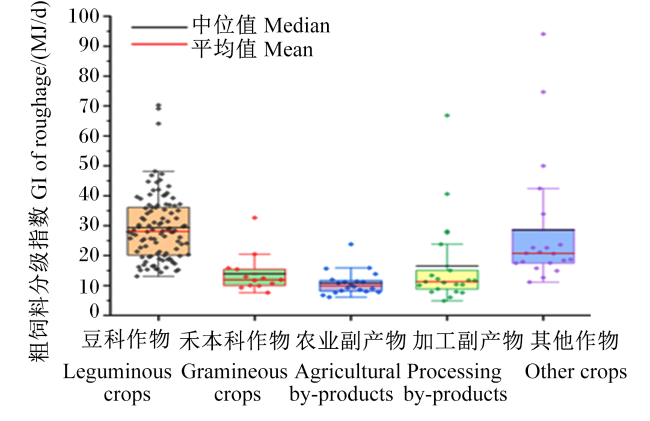
本文基于不同原料与全株玉米混合青贮后的营养品质,归纳了其混贮后的GI,结果如图1所示。其中,豆科作物与青贮玉米混贮后的GI平均值和中位值最高,分别为28.1和29.4,这主要是因为苜蓿、大豆等豆科作物CP含量较高[12,35]。其他作物(如菊苣、籽粒苋和桑叶等)主要得益于其自身的CP含量较高且NDF和ADF含量也较低,因此与全株玉米混贮后的GI也相对较高[32-33]。禾本科作物与青贮玉米混贮后的GI变化不大。农业副产物和加工副产物与全株玉米混贮后的GI较低,其主要原因是此类副产物大多营养品质较差,表现在纤维含量通常较高而蛋白质含量普遍偏低,限制了其在粗饲料方面的应用潜力[26-27,31]
图1 不同类型原料与全株玉米混合青贮后粗饲料分级指数

Fig.1 GI of roughage after silage mixed with different types of ingredients and whole plant maize

4 小结

青贮饲料是我国反刍动物生产重要的饲草资源,其青贮品质的高低直接关系到畜牧业的可持续发展。混合青贮是一种发展潜力较大的饲料制备技术,能够通过不同青绿饲料的搭配使用实现养分互补和微生物群落结构优化,进而提高青贮品质。同时,混合青贮能够扩大一些非常规饲料资源的利用效率和减少环境污染。然而,混贮原料的营养特性、青贮时间和混贮比例等因素都会极大地影响青贮饲料的品质。因此,在实际生产中需要根据青贮原料类型选择适宜的比例、发酵时间或者匹配适宜的青贮添加剂以保证良好的发酵效果。
[1]
郭莹, 杜久元, 张雪婷, 等. 我国饲草生产现状及发展对策[J]. 畜牧与饲料科学, 2021, 42(2):85-90.

GUO Y, DU J Y, ZHANG X T, et al. Production status and development strategies of forage grass in China[J]. Animal Husbandry and Feed Science, 2021, 42(2):85-90. (in Chinese)

[2]
KHAN N A, YU P Q, ALI M, et al. Nutritive value of maize silage in relation to dairy cow performance and milk quality[J]. Journal of the Science of Food and Agriculture, 2015, 95(2):238-252.

DOI PMID

[3]
耿爽, 王斯佳. 非常规饲料资源开发的思路与方法[J]. 饲料研究, 2020, 43(5):97-100.

GENG S, WANG S J. Research ideas and methods on development of unconventional feed resource[J]. Feed Research, 2020, 43(5):97-100. (in Chinese)

[4]
SI Q, WANG Z J, LIU W, et al. Influence of cellulase or Lactiplantibacillus plantarum on the ensiling performance and bacterial community in mixed silage of alfalfa and Leymus chinensis[J]. Microorganisms, 2023, 11(2):426.

DOI

[5]
赵苗苗, 王显国, 玉柱. 苜蓿与全株玉米的混合青贮[J]. 中国畜牧杂志, 2015, 51(21):20-24.

ZHAO M M, WANG X G, YU Z. Silage scoring of mixed alfalfa and corn silages[J]. Chinese Journal of Animal Science, 2015, 51(21):20-24. (in Chinese)

[6]
ZHANG Q, ZHAO M M, WANG X G, et al. Ensiling alfalfa with whole crop corn improves the silage quality and in vitro digestibility of the silage mixtures[J]. Grassland Science, 2017, 63(4):211-217.

DOI

[7]
TAO Y, SUN Q Z, LI F, et al. Comparative analysis of ensiling characteristics and protein degradation of alfalfa silage prepared with corn or sweet sorghum in semiarid region of Inner Mongolia[J]. Animal Science Journal, 2020, 91(1):e13321.

DOI

[8]
WANG M S, FRANCO M, CAI Y M, et al. Dynamics of fermentation profile and bacterial community of silage prepared with alfalfa,whole-plant corn and their mixture[J]. Animal Feed Science and Technology, 2020, 270:114702.

DOI

[9]
OZTURK D, KIZILSIMSEK M, KAMALAK A, et al. Effects of ensiling alfalfa with whole-crop maize on the chemical composition and nutritive value of silage mixtures[J]. Asian-Australasian Journal of Animal Sciences, 2006, 19(4):526-532.

DOI

[10]
唐莉娟, 张振, 王连群, 等. 苜蓿和全株玉米混合青贮效果研究[J]. 黑龙江畜牧兽医, 2016(19):157-159.

TANG L J, ZHANG Z, WANG L Q, et al. Study on the effect of mixed silage of alfalfa and whole corn[J]. Heilongjiang Animal Science and Veterinary Medicine, 2016(19):157-159. (in Chinese)

[11]
辛鹏程, 黄建华, 原现军, 等. 紫花苜蓿和全株玉米混合青贮研究[J]. 畜牧与兽医, 2019, 51(4):39-42.

XIN P C, HUANG J H, YUAN X J, et al. Research on mixed ensiling of alfalfa (Medicago sativa L.) and whole plant corn (Zea mays L.)[J]. Animal Husbandry and Veterinary Medicine, 2019, 51(4):39-42. (in Chinese)

[12]
王林, 孙启忠, 张慧杰. 苜蓿与玉米混贮质量研究[J]. 草业学报, 2011, 20(4):202-209.

WANG L, SUN Q Z, ZHANG H J. A study on quality of mixed silage of alfalfa and corn[J]. Acta Prataculturae Sinica, 2011, 20(4):202-209. (in Chinese)

[13]
王凤欣. 全株玉米与紫花苜蓿拉伸膜裹包混合青贮的研究[J]. 现代畜牧兽医, 2019(10):25-30.

WANG F X. Study on mixed ensiling of whole-crop maize and alfalfa by stretch film wrapping[J]. Modern Journal of Animal Husbandry and Veterinary Medicine, 2019(10):25-30. (in Chinese)

[14]
BOLSON D C, JACOVACI F A, GRITTI V C, et al. Intercropped maize-soybean silage:effects on forage yield,fermentation pattern and nutritional composition[J]. Grassland Science, 2022, 68(1):3-12.

DOI

[15]
ZENG T R, LI X L, GUAN H, et al. Dynamic microbial diversity and fermentation quality of the mixed silage of corn and soybean grown in strip intercropping system[J]. Bioresource Technology, 2020, 313:123655.

DOI

[16]
ZENG T R, WU Y S, XIN Y F, et al. Silage quality and output of different maize-soybean strip intercropping patterns[J]. Fermentation, 2022, 8(4):174.

DOI

[17]
文兴金, 杨继芝, 肖启银, 等. 川西北高原全株玉米和大豆混贮比例对青贮品质的影响[J]. 中国草地学报, 2022, 44(8):115-120.

WEN X J, YANG J Z, XIAO Q Y, et al. Effect of mixed silage ratio of whole plant corn and soybean on silage quality in northwest Sichuan plateau[J]. Chinese Journal of Grassland, 2022, 44(8):115-120. (in Chinese)

[18]
CONTRERAS-GOVEA F, MARSALIS M, ANGADI S, et al. Fermentability and nutritive value of corn and forage sorghum silage when in mixture with lablab bean[J]. Crop Science, 2011, 51(3):1307-1313.

DOI

[19]
SOE HTET M N, WANG H L, YADAV V, et al. Legume integration augments the forage productivity and quality in maize-based system in the loess plateau region[J]. Sustainability, 2022, 14(10):6022.

DOI

[20]
ZHU Y, BAI C S, GUO X S, et al. Nutritive value of corn silage in mixture with vine peas[J]. Animal Production Science, 2011, 51(12):1117-1122.

DOI

[21]
刘世超, 王志锋, 于晓东, 等. 沙打旺与青贮玉米,饲用高粱混贮饲料的营养价值分析[J]. 东北农业科学, 2022, 47(2):93-95,133.

LIU S C, WANG Z F, YU X D, et al. Nutritive value analysis for silage of Astragalus adsurgens Pall. mixed with Zea mays L. and Sorghum bicolor (L.) Moench[J]. Journal of Northeast Agricultural Sciences, 2022, 47(2):93-95,133. (in Chinese)

[22]
柳茜, 孙启忠, 刘晓波, 等. 白三叶与全株玉米混合青贮的效果研究[J]. 四川畜牧兽医, 2017, 44(1):20-22.

LIU Q, SUN Q Z, LIU X B, et al. Study on the effect of mixed silage of Trifolium repens L. and whole corn[J]. Sichuan Animal&Veterinary Sciences, 2017, 44(1):20-22. (in Chinese)

[23]
柳茜, 孙启忠, 刘晓波, 等. 红三叶与全株玉米混合比例对青贮品质的影响[J]. 草学, 2018(3):22-26.

LIU Q, SUN Q Z, LIU X B, et al. Effects of mixing ratio of red clover and wholeplant corn on quality of mixed silage[J]. Journal of Grassland and Forage Science, 2018(3):22-26. (in Chinese)

[24]
柳茜, 程晓, 孙启忠, 等. 玉米与高粱混合青贮的研究[J]. 中国奶牛, 2016(5):1-4.

LIU Q, CHENG X, SUN Q Z, et al. Study of corn mixed with sorghum silage[J]. China Dairy Cattle, 2016(5):1-4. (in Chinese)

[25]
那亚, 陶雅, 渠晖, 等. 糯玉米和普玉米混贮效果研究[J]. 中国饲料, 2020(5):75-78.

NA Y, TAO Y, QU H, et al. Fermentation quality and chemical composition in the mixed silage of waxy corn and common corn[J]. China Feed, 2020(5):75-78. (in Chinese)

[26]
胡远彬, 梁小玉, 易军, 等. 混合比例和添加剂对象草和全株玉米混合青贮品质的影响[J]. 草业科学, 2022, 39(4):778-786.

HU Y B, LIANG X Y, YI J, et al. Effects of mixing ratio and additives on the quality of napier grass and whole-plant corn mixed silage[J]. Pratacultural Science, 2022, 39(4):778-786. (in Chinese)

[27]
于杰, 郑琛, 李发弟, 等. 向日葵秸秆与全株玉米混合青贮饲料品质评定[J]. 草业学报, 2013, 22(5):198-204.

DOI

YU J, ZHENG C, LI F D, et al. An evaluation of mixed-ensiling sunflower straw and whole corn on silage quality[J]. Acta Prataculturae Sinica, 2013, 22(5):198-204. (in Chinese)

DOI

[28]
蒋金娟, 王鸿发, 马向丽, 等. 全株玉米与甘蔗梢不同混合比例青贮效果研究[J]. 养殖与饲料, 2022, 21(2):16-21.

JIANG J J, WANG H F, MA X L, et al. Study on the effect of silage in different mixing ratios of whole maize and sugarcane tips[J]. Animals Breeding and Feed, 2022, 21(2):16-21. (in Chinese)

[29]
CARVALHO W G, DE PINHO COSTA K A, EPIFANIO P S, et al. Silage quality of corn and sorghum added with forage peanuts[J]. Revista Caatinga, 2016, 29(2):465-472.

DOI

[30]
王洋, 姚权, 孙娟娟, 等. 玉米与花生秧混合青贮饲料发酵品质和营养成分评定[J]. 中国奶牛, 2018(3):5-9.

WANG Y, YAO Q, SUN J J, et al. Evaluation of fermentation quality and nutritional component of mixed silage of peanut seedling and whole corn[J]. China Dairy Cattle, 2018(3):5-9. (in Chinese)

[31]
ÜLGER Ī, BEYZI S B, KALIBER M, et al. Chemical,nutritive,fermentation profile and gas production of citrus pulp silages,alone or combined with maize silage[J]. South African Journal of Animal Science, 2020, 50(1):161-169.

DOI

[32]
梁小玉, 季杨, 易军, 等. 混合比例和添加剂对菊苣与青贮玉米混合青贮品质的影响[J]. 草业学报, 2018, 27(2):173-181.

DOI

LIANG X Y, JI Y, YI J, et al. Effects of mixing ratio and additives on ensilage efficiency of mixed chicory and silage maize[J]. Acta Prataculturae Sinica, 2018, 27(2):173-181. (in Chinese)

[33]
陶雅, 李峰, 高凤芹, 等. 籽粒苋与青贮玉米混贮品质及微生物特性研究[J]. 草业学报, 2016, 25(12):119-129.

DOI

TAO Y, LI F, GAO F Q, et al. Fermentation quality and microbial characteristics of Amaranthus hypochondriacus-corn mixed silage[J]. Acta Prataculturae Sinica, 2016, 25(12):119-129. (in Chinese)

DOI

[34]
MJOUN K, KALSCHEUR K F, GARCIA A D. Fermentation characteristics and aerobic stability of wet corn distillers grains with solubles ensiled in combination with whole plant corn[J]. Journal of the Science of Food and Agriculture, 2011, 91(7):1336-1340.

DOI PMID

[35]
MOYO R M, VAN NIEKERK W A, HASSEN A, et al. Ensiling quality of maize as influenced by the addition of wet distillers grains with soluble[J]. South African Journal of Animal Science, 2016, 46(1):21-28.

DOI

[36]
杨春涛, 屠焰, 刁其玉. 经济作物副产物饲用价值提升及在牛羊饲粮中的应用[J]. 动物营养学报, 2022, 34(10):6314-6326.

DOI

YANG C T, TU Y, DIAO Q Y. Feeding value enhancement of cash crop by-products and its application in cattle and sheep diet[J]. Chinese Journal of Animal Nutrition, 2022, 34(10):6314-6326. (in Chinese)

DOI

[37]
MAO K, YU Z, HUANG S, et al. Effect of storage period on the fermentation profile and bacterial community of silage prepared with alfalfa,whole-plant corn and their mixture[J]. Fermentation, 2022, 8(10):486.

DOI

[38]
BAGHDADI A, HALIM R A, RADZIAH O, et al. Fermentation characteristics and nutritive value of corn silage intercropped with soybean under different crop combination ratios[J]. The Journal of Animal&Plant Sciences, 2016, 26(6):1710-1717.

[39]
SOE HTET M N, SOOMRO R N, HAI J B. Effect of different planting structure of maize and soybean intercropping on fodder production and silage quality[J]. Current Agriculture Research Journal, 2016, 4(2):125-130.

DOI

[40]
KIZILSIMSEK M, OZTURK C, YANAR K, et al. Associative effects of ensiling soybean and corn plant as mixtures on the nutritive value,fermentation and methane emission[J]. Fresenius Environmental Bulletin, 2017, 26(10):5754-5760.

[41]
SOE HTET M N, HAI J B, BO P T, et al. Evaluation of nutritive values through comparison of forage yield and silage quality of mono-cropped and intercropped maize-soybean harvested at two maturity stages[J]. Agriculture, 2021, 11(5):452.

DOI

[42]
ERDAL S, PAMUKCU M, CUREK M, et al. Silage yield and quality of row intercropped maize and soybean in a crop rotation following winter wheat[J]. Archives of Agronomy and Soil Science, 2016, 62(11):1487-1495.

DOI

[43]
GÜLÜMSER E, MUT H, BAŞARAN U, et al. An assessment of ensiling potential in maize×legume (soybean and cowpea) binary mixtures for yield and feeding quality[J]. Turkish Journal of Veterinary and Animal Sciences, 2021, 45(3):547-555.

DOI

[44]
MARQUES K O, JAKELAITIS A, GUIMARÃES K C, et al. Production,fermentation profile,and nutritional quality of silage from corn and soybean intercropping[J]. Semina:Ciências Agrárias, 2019, 40(6Supl2):3143-3156.

DOI

[45]
PARRA C S, BOLSON D C, JACOVACI F A, et al. Influence of soybean-crop proportion on the conservation of maize-soybean bi-crop silage[J]. Animal Feed Science and Technology, 2019, 257:114295.

DOI

[46]
CONTRERAS-GOVEA F E, MUCK R E, ARMSTRONG K L, et al. Nutritive value of corn silage in mixture with climbing beans[J]. Animal Feed Science and Technology, 2009, 150(1/2):1-8.

DOI

[47]
顾雪莹, 玉柱, 郭艳萍, 等. 全株玉米与秣食豆单贮混贮效果的研究[J]. 草地学报, 2011, 19(1):132-136.

DOI

GU X Y, YU Z, GUO Y P, et al. Fermentation quality and chemical composition in the mixed silage of whole crop corn and soybean[J]. Acta Agrestia Sinica, 2011, 19(1):132-136. (in Chinese)

[48]
连露, 胡国富, 李冰, 等. 青贮玉米种植密度及与秣食豆混播比例对青贮品质的影响[J]. 草地学报, 2017, 25(1):178-183.

DOI

LIAN L, HU G F, LI B, et al. Effects of planting densities and mixed sowing ratios of silage corn and fodder soybean on silage quality[J]. Acta Agrestia Sinica, 2017, 25(1):178-183. (in Chinese)

DOI

[49]
ZHANG X, ZHANG Y, LI B, et al. Silage production with intercropped Pueraria lobata and Zea may L.[J]. Legume Research, 2017, 40(2):319-324.

[50]
冯鹏, 孙启忠. 不同比例玉米与沙打旺混贮营养成分及有毒有害物质分析[J]. 畜牧兽医学报, 2011, 42(9):1264-1270.

FENG P, SUN Q Z. Nutrient composition and content of poisonous substances in corn and Astragalus adsurgens mixed silage[J]. Acta Veterinaria Et Zootechnica Sinica, 2011, 42(9):1264-1270. (in Chinese)

[51]
TOPÇU G D. ÖZKAN Ş S. Quality properties of sunn hemp (Crotalaria juncea L.) and maize (Zea mays L.) silages[J]. Tropical Grasslands-Forrajes Tropicales, 2021, 9(3):315-320.

DOI

[52]
KINTL A, ELBL J, VÍTĚZ T, et al. Possibilities of using white sweetclover grown in mixture with maize for biomethane production[J]. Agronomy, 2020, 10(9):1407.

DOI

[53]
FLEISCHER P, METZNER M, BEYERBACH M, et al. The relationship between milk yield and the incidence of some diseases in dairy cows[J]. Journal of Dairy Science, 2001, 84(9):2025-2035.

PMID

[54]
WANG C, HAN H Y, SUN L, et al. Bacterial succession pattern during the fermentation process in whole-plant corn silage processed in different geographical areas of northern China[J]. Processes, 2021, 9(5):900.

DOI

[55]
REGASSA T H, WORTMANN C S. Sweet sorghum as a bioenergy crop:literature review[J]. Biomass and Bioenergy, 2014, 64:348-355.

DOI

[56]
FARRELL G, SIMONS S A, HILLOCKS R J. Pests, diseases and weeds of napier grass,Pennisetum purpureum:a review[J]. International Journal of Pest Management, 2002, 48(1):39-48.

DOI

[57]
郭婷, 杨雪娇, 张越利, 等. 燕麦品种及其与全株玉米质量比对青贮效果的影响[J]. 西北农林科技大学学报(自然科学版), 2014, 42(9):27-32.

GUO T, YANG X J, ZHANG Y L, et al. Effects of oat cultivars and their mass ratios to whole corn on mixed silage[J]. Journal of Northwest A&F University (Natural Science Edition), 2014, 42(9):27-32. (in Chinese)

[58]
王思伟, 刘高坤, 李魁英, 等. 不同比例全株玉米与高粱混贮对青贮发酵品质的影响[J]. 饲料研究, 2022, 45(17):111-114.

WANG S W, LIU G K, LI K Y, et al. Effect of different proportions of whole corn and sorghum mixed storage on fermentation quality of silage[J]. Feed Research, 2022, 45(17):111-114. (in Chinese)

[59]
AKAY V, JACKSON J A,JR. Effects of NutriDense and waxy corn hybrids on the rumen fermentation,digestibility and lactational performance of dairy cows[J]. Journal of Dairy Science, 2001, 84(7):1698-1706.

DOI

[60]
SELIM A S M, HASAN M N, RAHMAN M A, et al. Nutrient content and in vitro degradation study of some unconventional feed resources of Bangladesh[J]. Heliyon, 2022, 8(5):e09496.

DOI

[61]
杨宇为, 马吉锋, 于洋, 等. 不同处理对油菜秸秆-全株玉米混合青贮品质影响的研究[J]. 中国动物保健, 2021, 23(7):49-51.

YANG Y W, MA J F, YU Y, et al. Study on the effect of different treatments on the quality of rapeseed straw-whole plant corn mixed silage[J]. China Animal Health, 2021, 23(7):49-51. (in Chinese)

[62]
王思伟, 李魁英, 张海娜, 等. 花生秧、全株玉米不同混合比例及添加剂对青贮发酵品质和营养价值的影响[J]. 草业科学, 2019, 36(9):2413-2422.

WANG S W, LI K Y, ZHANG H N, et al. Mixed ratios and additives affect the quality of peanut vines and whole-plant corn in mixed silages[J]. Pratacultural Science, 2019, 36(9):2413-2422. (in Chinese)

[63]
ÜLGER I, KALIBER M, AYAŞAN T, et al. Chemical composition,organic matter digestibility and energy content of apple pomace silage and its combination with corn plant,sugar beet pulp and pumpkin pulp[J]. South African Journal of Animal Science, 2018, 48(3):497-503.

DOI

[64]
蒋苏苏, 金丽娜, 敬淑燕, 等. 添加中药渣对全株玉米青贮感官和发酵品质及营养成分的影响[J]. 草业科学, 2017, 34(9):1947-1954.

JIANG S S, JIN L N, JING S Y, et al. Effect of herbal medicine residues addition on the sensory evaluation,fermentation quality,and nutritional composition of whole corn silage[J]. Pratacultural Science, 2017, 34(9):1947-1954. (in Chinese)

[65]
HUANG C, LI Z X, WU Y, et al. Treatment and bioresources utilization of traditional Chinese medicinal herb residues:recent technological advances and industrial prospect[J]. Journal of Environmental Management, 2021, 299:113607.

DOI

[66]
胡元亮. 中药饲料添加剂的开发与应用[M]. 北京: 化学工业出版社, 2005.

HU Y L. Development and application of Chinese herbal feed additives[M]. Beijing: Chemical Industry Press, 2005. (in Chinese)

[67]
路平乐, 魏玉明, 杨发荣, 等. 体外产气法评价全株藜麦与全株玉米混合青贮饲料饲用价值[J]. 草地学报, 2021, 29(11):2391-2398.

DOI

LU P L, WEI Y M, YANG F R, et al. Feeding value ealuation of mixed silage of whole plant green quinoa and green corn by using an in vitro gas production technique[J]. Acta Agrestia Sinica, 2021, 29(11):2391-2398. (in Chinese)

[68]
JIMÉNEZ-GUILLÉN R, NORIEGA-CANTÚ D H, ROJAS-HERNÁNDEZ S, et al. Chemical composition and ruminal digestion of corn silage with Morus alba L. foliage[J]. Ecosistemas y Recursos Agropecuarios, 2020, 7(1):e2228.

[69]
郑霞, 侯振平, 戴求仲, 等. 饲用苎麻与饲用玉米不同比例混合青贮的研究[J]. 中国农学通报, 2019, 35(33):137-140.

DOI

ZHENG X, HOU Z P, DAI Q Z, et al. Mixed silage of forage ramie and maize silage with different proportions[J]. Chinese Agricultural Science Bulletin, 2019, 35(33):137-140. (in Chinese)

DOI

Outlines

/