REVIEW

Research Progress of Physicochemical Property of Indole Propionic Acid and Its Regulation of Animal Intestinal Health

  • YANG Yong , 1, 2 ,
  • LIU Jingbo 2 ,
  • QI Renli , 1, 3, *
Expand
  • 1 Chongqing Academy of Animal Sciences, Chongqing 402460, China
  • 2 School of Life Science and Engineering, Southwest University of Science and Technology, Mianyang 621010, China
  • 3 National Center of Technology Innovation for Pigs, Chongqing 402460, China
*professor, E-mail:

Received date: 2023-02-27

  Online published: 2023-08-10

Abstract

Intestinal bacteria produce a variety of metabolites that play an important role in the regulation of animal intestinal health and physiological homeostasis. Indole propionic acid (IPA) is an indole derivative derived from the bacterial metabolism of tryptophan in the gut, which has antioxidant, anti-inflammatory and immunomodulatory effects, has been extensively researched in the prevention and treatment of metabolic and neurological diseases. Recently, several studies have reported that IPA has a positive effect on intestinal health by regulating the structure of intestinal bacteria, improving intestinal barrier function and enhancing intestinal immunity, and is expected to be developed and applied as a novel green feeding additive. This article reviews the physicochemical property, synthetic and metabolic characteristics of IPA, as well as its main mechanisms of regulating animal intestinal health, to provide reference for the application of IPA in regulating animal intestinal health and preventing or treating intestinal diseases.

Cite this article

YANG Yong , LIU Jingbo , QI Renli . Research Progress of Physicochemical Property of Indole Propionic Acid and Its Regulation of Animal Intestinal Health[J]. Chinese Journal of Animal Nutrition, 2023 , 35(8) : 4883 -4890 . DOI: 10.12418/CJAN2023.453

吲哚丙酸(indole propionic acid,IPA)又名3-吲哚丙酸、吲哚-3-丙酸、氮茚基丙酸,于1923年首次被发现。作为一种色氨酸经由肠道细菌代谢产生的功能性吲哚衍生物,IPA在动物体内的生成完全依赖于肠道菌群。IPA具有抗炎、抗氧化和免疫调节等多种有益的生物学功能,在代谢性和神经类疾病的治疗方面受到了广泛的关注[1-2]。以10 mg/kg剂量经腹腔注射IPA显著降低了糖尿病模型小鼠的血糖水平和胰岛素敏感性,有效改善了小鼠的认知功能障碍和胰岛素抵抗[3]。连续8周灌胃IPA(100 mg/kg BW·d)显著降低了高脂饮食(HFD)诱导的肥胖小鼠体重和血清总胆固醇(TC)含量,表明IPA具有较强的抗肥胖和抗高脂血症能力[4]。基于体外细胞试验和医学临床研究发现,IPA在体外(1 mmol/L)或体内(10 mg/kg BW·d)均能降低脑细胞中β-淀粉样蛋白的聚集,保护神经元免受氧化损伤[1],这对阿尔兹海默症等神经疾病的治疗具有极大的帮助。此外,近年来一些研究表明,IPA对于维持和改善肠道健康也有积极的影响[5-9],能够通过调控肠道菌群稳态、肠道屏障通透性和肠道免疫等多种方式来保护动物肠道健康,具有较好的开发和应用价值。本文综述了IPA的合成、代谢及其调控动物肠道健康的主要作用机制,以期为IPA在动物肠道疾病治疗或预防上的应用提供参考。

1 IPA的理化特性
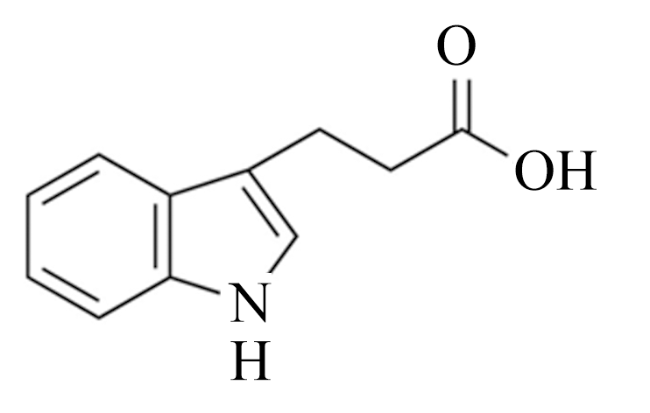
IPA分子式为C11H11NO2(图1),是一种白色片状晶体,在空气中会逐渐变色,熔点134~135 ℃,相对分子质量188.202 6,易溶于乙醇、乙醚、丙酮、苯、氯仿和乙酸乙酯,难溶于水。人和动物体内的IPA依赖肠道细菌代谢产生,但是在个体间的水平存在很大差异。IPA对生物机体没有明显毒害,通过测定细胞活力发现,IPA浓度在100 μmol/L时没有表现出肝细胞毒性;在其他类型的细胞中,如心肌细胞,在IPA浓度高达1 mmol/L时也有较好的耐受性[10-11]
图1 IPA的化学结构

Fig.1 Structural formula of IPA

2 IPA的合成与代谢

2.1 IPA的合成

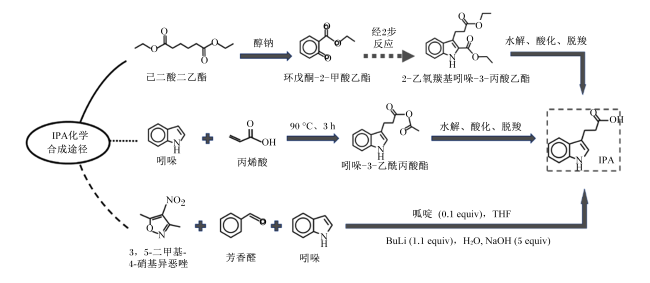
目前,IPA的化学合成途径主要有3种(图2):1)以己二酸二乙酯为原料的合成方法。该法合成路径长,操作繁琐,产率较低,仅有12.9%[12-13]。2)以吲哚和丙烯酸为原料的合成方法。该方法相对较为成熟,石蔚云等[14]与Farlow等[15]对此方法进行改进,都经两步合成IPA,产率分别为57.1%和78.3%,但是后者反应所需试剂Meldrum酸的制备非常困难,难以投入实际应用。3)以吲哚、异恶唑和芳香醛为原料的合成方法。该方法又称“一锅法”(one-pot synthesis),即所有反应在一个反应器中连续进行。通过该方法可以将廉价的材料合成IPA,且产率较高,达79%[16]
图2 IPA化学合成途径

IPA:吲哚丙酸 indole propionic acid;THF:四氢呋喃 tetrahydrofuran;BuLi:丁基锂 butyllithium;NaOH:氢氧化钠 sodium hydroxide;equiv:当量。

Fig.2 Chemical synthesis pathway of IPA

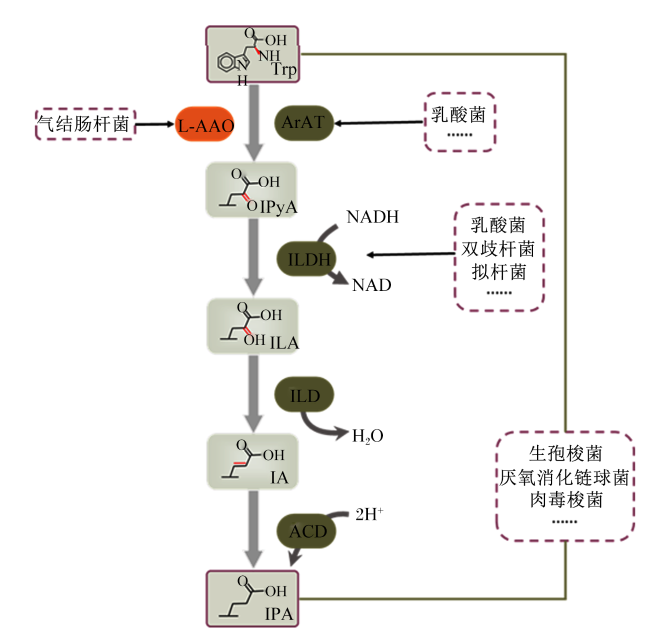
在人和动物体内,IPA全部是由色氨酸经肠道细菌代谢产生。色氨酸是必需氨基酸之一,主要从食物中获取,小部分由肠道细菌合成[17]。据报道,有2%~4%的色氨酸通过肠道细菌代谢产生色胺、吲哚和多种吲哚衍生物[18]。拥有不同色氨酸代谢酶的肠道细菌能够将色氨酸分解为不同类型的代谢物,且不同细菌的代谢能力存在巨大差异。研究表明,能够独立完成色氨酸代谢并产生IPA的细菌主要来自梭菌属(Clostridium)和消化链球菌属(Peptostreptococcus),包括生孢梭菌(C. sporogenes)、肉毒梭菌(C. botulinum)和厌氧消化链球菌(P. anaerobius)[19-22]。它们主要通过芳香族氨基酸转氨酶(aromatic amino acid aminotransferase,ArAT)催化色氨酸生成吲哚丙酮酸(indole-3-pyruvic acid,IPyA),IPyA再经吲哚乳酸脱氢酶(indolelactate dehydrogenase,ILDH)、吲哚乳酸脱水酶(indolelactate dehydratase,ILD)和酰基辅酶A脱氢酶(acyl-CoA dehydrogenase,ACD)的催化反应生成IPA。除了上述能单独产生IPA的细菌,还有许多肠道细菌可能参与IPA产生的部分步骤。例如,乳酸菌能通过ArAT和ILDH代谢色氨酸产生IPyA和吲哚乳酸(indole-lactic acid,ILA)[23-25];一些双歧杆菌和拟杆菌也能代谢色氨酸产生ILA[26-27]。气结肠杆菌(Lechevalieria aerocolonigenes)则通过L-氨基酸氧化酶(L-amino-acid oxidase,L-AAO)代谢色氨酸产生IPyA[28]。显然,生物体内IPA的产生由多种细菌共同作用和调控(图3)[19-30]
图3 肠道IPA的合成途径

Trp:色氨酸 tryptophan;IPyA:吲哚丙酮酸 indole-3-pyruvic acid;ILA:吲哚乳酸 indole-lactic acid;IA:吲哚丙烯酸 indoleacrylic acid;IPA:吲哚丙酸 indole propionic acid;ArAT:芳香族氨基酸转氨酶aromatic amino acid aminotransferase;ILDH:吲哚乳酸脱氢酶 indolelactate dehydrogenase;ILD:吲哚乳酸脱水酶 indolelactate dehydratase;ACD:酰基辅酶A脱氢酶 acyl-CoA dehydrogenase;NADH:还原型烟酰胺腺嘌呤二核苷酸 reduced nicotinamide adenine dinucleotide;NAD:烟酰胺腺嘌呤二核苷酸 nicotinamide adenine dinucleotide;L-AAO:L-氨基酸氧化酶 L-amino-acid oxidase。

Fig.3 Biosynthetic pathway of IPA

2.2 IPA的代谢

Wikoff等[22]给无菌(germ free,GF)小鼠腹腔注射IPA后检测发现,其血清IPA浓度在注射后1 h达到最高,但在5 h内下降了90%以上,表明IPA在动物体内的代谢速度较快。有研究报道,IPA在动物体内代谢时,其吡咯环上的α-碳原子可能发生氧化,形成α-羟基吲哚化合物,该化合物以烯醇或酮的形式存在[31],具体代谢过程有待进一步研究。Menni等[9]与Shin等[32]基于对人的研究发现,线粒体中脂酰辅酶A中链家族2A(ACSM2A)基因突变抑制了血清IPA浓度的降低,表明该基因与IPA代谢存在紧密联系。进一步研究证实,当血液中IPA到达肾脏或肝脏时,经由ACSM2A基因编码的中链脂肪酸辅酶A连接酶的催化生成了IPA-辅酶A,后者在甘氨酸-N-酰基转移酶的作用下与甘氨酸偶联,生成缀合物,并通过尿液直接排出体外[2,33-34]

3 IPA对肠道健康的调控作用及机制

3.1 IPA对肠道菌群的调节作用

基于对人和动物的研究表明,IPA对肠道菌群稳态具有积极调控作用。在医学临床上的研究发现,血液IPA浓度与肠道微生物的多样性呈紧密正相关[9],提示增加血液循环IPA浓度可以改善肠道菌群结构。对大鼠的研究发现,通过灌胃补充IPA能明显改善HFD造成的肠道菌群紊乱,逆转厚壁菌门与拟杆菌门比值(Firmicutes/Bacteroidetes,F/B)的增加,提升颤杆菌克属(Oscillibacter)和异味杆菌属(Odoribacter)的丰度[35],后者可以代谢产生丁酸盐改善肠道微生态环境。厚壁菌门(Firmicutes)和拟杆菌门(Bacteroidetes)在哺乳动物肠道菌群中占主导地位,F/B往往随着肠道菌群失调发生变化[35-38]。因此,F/B可以作为哺乳动物肠道菌群失调的指标。葡聚糖硫酸钠(DSS)和四氯化碳(CCl4)等化学药品会造成动物肠道的炎症损伤、细菌多样性降低和F/B的明显提高;反之,灌胃IPA能够显著恢复或逆转化学药品对小鼠肠道菌群的影响,提高微生物多样性,降低F/B[5,39]
IPA还可以定向促进有益菌的增殖,减少致病菌的生长。艾克曼菌属(Akkermansia)是一种受到广泛关注的益生菌,已被证实可以治疗和减轻糖尿病、肥胖等多种代谢疾病。Yin等[40]在嗜黏蛋白艾克曼菌(Akkermansia muciniphila)BAA-835T的培养基中添加IPA(5~50 μmol/L)后37 ℃厌氧培养24 h,明显促进了该菌的生长,且当IPA浓度在25 μmol/L时效果最好;该研究指出,IPA可能通过影响艾克曼菌的分裂来促进其生长。另外,Mandelbaum-Shavit等[41]与Chelala等[42]分别通过体外试验研究证实,IPA能够抑制嗜肺军团菌(Legionella pneumophila)和鼠伤寒沙门氏菌(Salmonella typhimurium)等多种有害菌的生长。除此之外,Negatu等[43]通过基因文库筛选和动物试验研究分析表明,灌胃IPA(100 mg/kg BW·d)能够显著降低小鼠体内由呼吸感染导致的结核分岐杆菌(Mycobacterium tuberculosis)的丰度提高,表明IPA具有抗结核分岐杆菌的活性。持续HFD会造成动物肠道健康问题,其中包括肠道内微生态环境改变和致病菌的明显增加。基于对大鼠的研究发现,连续灌胃8周IPA(20 mg/kg BW·d)可以显著降低HFD造成的肠道损伤和肠道内致病拟杆菌和链球菌的丰度[35]。目前,关于IPA在体内和体外抑制和清除有害菌的机制还不完全清楚。推测认为IPA的工作机制可能类似于吲哚,通过影响群体感应表型或抑制毒力因子产生来抑制有害菌的生长。关于IPA调控和改善肠道菌群的具体机制还有待进一步深入研究。

3.2 IPA调控肠道屏障功能

IPA可以通过改善肠道通透性,提高紧密连接蛋白表达等多种方式调控肠道屏障功能。有研究发现,IPA能够抑制促炎细胞因子干扰素-γ(IFN-γ)诱导T84单层细胞通透性的增加;进一步的动物试验表明,灌胃IPA(20 mg/kg BW·d)显著减少HFD饲喂小鼠血液中循环异硫氰酸荧光素(FITC)-右旋糖苷和脂多糖(LPS)含量[44],这标志着肠道通透性得到了改善。孕烷X受体(pregnane X receptor,PXR)是一种核受体超家族成员,在胃、肠道、肝脏和肌肉等多种组织均有表达。PXR通过调节其下游靶基因的表达,直接影响机体脂质、胆固醇和糖代谢,维持机体内环境稳态[45]。Venkatesh等[46]使用吲哚美辛(IN)诱导小鼠空肠炎症,通过追踪肠道内荧光标记的FITC-葡聚糖发现PXR基因敲除小鼠出现典型的“肠漏”现象,且小肠绒毛隐窝比和消化酶活性明显降低;反之,正常小鼠灌胃IPA能够激活肠道细胞中的PXR受体,并显著降低小鼠肠道通透性,阻止“肠漏”现象发生。这些结果表明,IPA是肠道细胞中PXR的重要配体,可以通过激活PXR信号通路在肠道细胞中发挥生理调控功能,保护肠道免受化学药物造成的结构损伤。
在另一项研究中,Li等[8]基于Caco-2/HT29共培养细胞模型的研究发现,IPA增加了紧密连接蛋白封闭蛋白-1(Claudin-1)、闭合蛋白(Occludin)和闭锁小带蛋白-1(ZO-1)的表达和上皮细胞间电阻,降低了细胞旁通透性;此外,IPA还可以增加黏蛋白2(MUC2)、黏蛋白4(MUC4)和杯状细胞分泌物[三叶因子3(TFF3)和抵抗素样分子β(RELMβ)]的表达来提高黏膜层厚度,增强黏液屏障,保护肠道细胞结构。Zhao等[35]研究表明,灌胃IPA(20 mg/kg BW·d)能够增加HFD条件下大鼠肠道紧密连接蛋白(ZO-1和Occludin)的表达,减少细菌内毒素进入循环系统。这些不同的研究反映了IPA可通过增加肠道上皮紧密连接蛋白表达、刺激上皮细胞黏蛋白分泌来保护肠道屏障,降低肠道通透性,抑制炎症因子进入循环系统。
肠道簇细胞在寄生虫引起的2型免疫反应中发挥重要作用。基于动物试验和体外细胞试验研究证实,IPA可促进肠道簇细胞增殖,进而通过游离脂肪酸受体3(free fatty acid receptor 3,FFAR3)刺激簇细胞产生白细胞介素-25(IL-25);IL-25能够显著抑制HFD诱导的“肠漏”现象,增强肠道中紧密连接蛋白OccludinClaudin-1的表达[47]。由于簇细胞被认为是肠道中IL-25的唯一来源[48],所以IPA增加肠道内紧密连接蛋白表达,降低肠道的通透性,其可能是通过激活肠道簇细胞并产生IL-25实现的。
上述不同的研究表明,IPA可能通过调控不同的信号分子,经由不同的机制维持肠上皮完整性、降低肠道通透性、增强黏液层等多种措施保护肠道屏障,减少肠道内有害菌及其产生和释放的有害因子对机体造成伤害。

3.3 IPA对肠道免疫的调节作用

基于对人和动物的多个研究表明,IPA在肝脏、大脑和神经等多个器官都有很好的抗炎和免疫调节作用。研究和揭示IPA在肠道细胞免疫和炎症反应中调控作用及其机制,对于改善肠道健康具有重要帮助。一项利用DSS诱导结肠炎小鼠模型的研究表明,灌胃IPA(200 mg/kg BW·d)明显削弱了小鼠肠道炎症反应,改变了肠道细胞中炎症相关因子的表达和丰度,包括降低促炎因子IFN-γ、肿瘤坏死因子-α(TNF-α)、白细胞介素-1β(IL-1β)和白细胞介素-6(IL-6)含量,提高抗炎因子白细胞介素-10(IL-10)和白细胞介素-4(IL-4)含量[5]。这些分子的改变抑制了过度炎症反应及其对肠道细胞的损伤。
另一项研究发现,IPA可以促进LPS诱导的巨噬细胞炎症模型免疫抑制因子IL-10的大量生成[19]。白细胞介素-10受体(IL-10R)是IL-10靶向结合的主要细胞膜受体,包括2个受体链IL-10R1和IL-10R2。IL-10与IL-10R结合后通过调控激酶[Janus激酶1(JAK1)和酪氨酸激酶2(TYK2)],以及转导和转录激活因子[信号传导转录激活因子1(STAT1)和信号传导转录激活因子2(STAT2)]的活性介导IL-10家族因子对不同细胞的生理功能调控,特别是抑制单核巨噬细胞释放炎症因子和降低抗原呈递作用[49]。Alexeev等[50]基于体外培养的肠道上皮细胞T84的试验研究表明,IPA显著上调了小肠上皮细胞(IEC)中IL-10R1的转录水平,并减少了TNF-α的表达。所以,IPA可通过IL-10/IL-10R途径控制细胞炎症因子的水平及免疫反应程度。
芳香烃受体(aryl hydrocarbon receptor,AhR)是一种配体依赖性转录因子,也称作二噁英受体。除了二噁英,AhR还是色氨酸代谢物在肠道中的重要受体,对肠上皮内淋巴细胞(IEL)的发育、代谢和功能的调控具有重要意义。包括IPA在内的多种色氨酸代谢物都可以激活AhR并促进先天淋巴样细胞和T细胞分泌抗炎细胞因子,从而调节黏膜免疫,缓解化学药物诱导的结肠炎症[25,51-52];诱导调节性T细胞分化,限制促炎性T细胞的活性,并产生抗炎介质,调节自身免疫反应[6,53]。Hubbard等[54]对HepG2细胞进行荧光素酶报告系统研究发现,低浓度IPA(1 μmol/L)对AhR具有显著的激活作用。另一项研究中,将AhR的竞争性抑制剂CH223191和IPA联合灌胃,显著降低了IPA对脓毒症小鼠存活率和巨噬细胞吞噬活性的影响[55]
研究证实,Toll样受体4(TLR4)是PXR在肠道细胞行使抗炎功能的重要信号介质[46]。所以,除了前边所述对肠道屏障结构的保护作用,IPA还可以通过激活PXR,然后经由TLR4/核因子-κB(NF-κB)炎症信号通路调控肠道细胞炎症反应[56]。Zhao等[35]试验研究证实,灌胃IPA(20 mg/kg BW·d)能够缓解HFD诱导的肠道炎症,抑制NF-κB信号通路,并伴随着促炎细胞因子TNF-αIL-1βIL-6的表达降低。
综上所述,IPA对动物肠道免疫调节具有积极影响,具体作用机制可能是以下多方面的:IPA通过调节肠道炎症相关因子的表达直接抑制炎症反应;通过IL-10/IL-10R信号通路参与肠道免疫细胞的功能调控;通过AhR信号通路影响先天淋巴样细胞和T细胞活性,调节肠道黏膜免疫;通过PXR/TLR4/NF-κB信号通路抑制肠道促炎因子的表达。

4 小结和展望

综上所述,IPA可通过优化肠道菌群、维护肠道屏障功能和强化肠道免疫等多种途径改善动物肠道健康。在饲用抗生素全面禁用以后,挖掘和开发新型添加剂是保障畜禽健康高效生产的重要策略。IPA调控功能明确,理化性质稳定,无明显毒害副作用,具有作为新型饲用添加剂开发和使用的潜力。但是目前关于IPA改善肠道健康的研究多集中在小鼠、大鼠和细胞模型上,在畜禽上还缺乏深入系统的研究。针对畜禽不同肠道结构和菌群组成特点,深入研究和明确IPA的作用机制及其使用方式、应用剂量、作用时间等是当前需要解决的问题。此外,开发专用工具菌株经由生物合成途径生产IPA也是未来的研究方向。
[1]
HWANG I K, YOO K Y, LI H, et al. Indole-3-propionic acid attenuates neuronal damage and oxidative stress in the ischemic hippocampus[J]. Journal of Neuroscience Research, 2009, 87(9):2126-2137.

DOI PMID

[2]
SEHGAL R, DE MELLO V D, MÄNNISTÖ V, et al. Indolepropionic acid,a gut bacteria-produced tryptophan metabolite and the risk of type 2 diabetes and non-alcoholic fatty liver disease[J]. Nutrients, 2022, 14(21):4695.

DOI

[3]
LIU Z G, DAI X S, ZHANG H B, et al. Gut microbiota mediates intermittent-fasting alleviation of diabetes-induced cognitive impairment[J]. Nature Communications, 2020, 11(1):855.

DOI PMID

[4]
LI Y G, XU W Y, ZHANG F, et al. The gut microbiota-produced indole-3-propionic acid confers the antihyperlipidemic effect of mulberry-derived 1-deoxynojirimycin[J]. mSystems, 2020, 5(5):e00313-20.

[5]
FU Y W, GAO H, HOU X H, et al. Pretreatment with IPA ameliorates colitis in mice:colon transcriptome and fecal 16S amplicon profiling[J]. Frontiers in Immunology, 2022, 13:1014881.

DOI

[6]
TEUNIS C, NIEUWDORP M, HANSSEN N. Interactions between tryptophan metabolism,the gut microbiome and the immune system as potential drivers of non-alcoholic fatty liver disease (NAFLD) and metabolic diseases[J]. Metabolites, 2022, 12(6):514.

DOI

[7]
ZHANG B B, JIANG M J, ZHAO J N, et al. The mechanism underlying the influence of indole-3-propionic acid:a relevance to metabolic disorders[J]. Frontiers in Endocrinology, 2022, 13:841703.

DOI

[8]
LI J J, ZHANG L, WU T, et al. Indole-3-propionic acid improved the intestinal barrier by enhancing epithelial barrier and mucus barrier[J]. Journal of Agricultural and Food Chemistry, 2021, 69(5):1487-1495.

DOI PMID

[9]
MENNI C, HERNANDEZ M M, VITAL M, et al. Circulating levels of the anti-oxidant indoleproprionic acid are associated with higher gut microbiome diversity[J]. Gut Microbes, 2019, 10(6):688-695.

DOI PMID

[10]
GESPER M, NONNAST A B H, KUMOWSKI N, et al. Gut-derived metabolite indole-3-propionic acid modulates mitochondrial function in cardiomyocytes and alters cardiac function[J]. Frontiers in Medicine, 2021, 8:648259.

DOI

[11]
SEHGAL R, ILHA M, VAITTINEN M, et al. Indole-3-propionic acid,a gut-derived tryptophan metabolite,associates with hepatic fibrosis[J]. Nutrients, 2021, 13(10):3509.

DOI

[12]
KALB L, SCHWEIZER F, SCHIMPF G. Ein neuer Weg zur Darstellung der Indol-3-propionsäure[J]. Berichte Der Deutschen Chemischen Gesellschaft (A and B Series), 1926, 59(8):1858-1860.

[13]
MANSKE R H F, ROBINSON R. The decomposition of β-3-indolylpropionic azide[J]. Journal of the Chemical Society (Resumed), 1927, 33:240-242.

[14]
石蔚云, 王国喜. 吲哚-3-丙酸的合成[J]. 精细石油化工, 2003(4):15-16.

SHI W Y, WANG G X. Synthesis of indole-3-propanoic acid[J]. Speciality Petrochemicals, 2003(4):15-16. (in Chinese)

[15]
FARLOW D S, FLAUGH M E, HORVATH S D, et al. Two efficient syntheses of indole-3-propionic esters and acids.Further applications of Meldrum’s acid[J]. Organic Preparations and Procedures International, 1981, 13(1):39-48.

DOI

[16]
ADAMO M F, KONDA V R. Multicomponent synthesis of 3-indolepropionic acids[J]. Organic Letters, 2007, 9(2):303-305.

PMID

[17]
O’MAHONY S M, CLARKE G, BORRE Y E, et al. Serotonin,tryptophan metabolism and the brain-gut-microbiome axis[J]. Behavioural Brain Research, 2015, 277:32-48.

DOI

[18]
林俊, 杜蕾, 齐仁立. 色氨酸及其代谢物调控肌肉生长发育的研究进展[J]. 中国畜牧杂志, 2022, 58(6):21-25.

LIN J, DU L, QI R L. Research progress of tryptophan and its metabolites in regulating muscle growth and development[J]. Chinese Journal of Animal Science, 2022, 58(6):21-25. (in Chinese)

[19]
WLODARSKA M, LUO C W, KOLDE R, et al. Indoleacrylic acid produced by commensal Peptostreptococcus species suppresses inflammation[J]. Cell Host & Microbe, 2017, 22(1):25-37.e6.

[20]
DODD D, SPITZER M H, VAN TREUREN W, et al. A gut bacterial pathway metabolizes aromatic amino acids into nine circulating metabolites[J]. Nature, 2017, 551(7682):648-652.

DOI

[21]
ELSDEN S R, HILTON M G, WALLER J M. The end products of the metabolism of aromatic amino acids by Clostridia[J]. Archives of Microbiology, 1976, 107(3):283-288.

DOI

[22]
WIKOFF W R, ANFORA A T, LIU J, et al. Metabolomics analysis reveals large effects of gut microflora on mammalian blood metabolites[J]. Proceedings of the National Academy of Sciences of the United States of America, 2009, 106(10):3698-3703.

DOI PMID

[23]
CERVANTES-BARRAGAN L, CHAI J N, TIANERO M D, et al. Lactobacillus reuteri induces gut intraepithelial CD4+CD8αα+ T cells[J]. Science, 2017, 357(6353):806-810.

DOI

[24]
WILCK N, MATUS M G, KEARNEY S M, et al. Salt-responsive gut commensal modulates TH17 axis and disease[J]. Nature, 2017, 551(7682):585-589.

DOI

[25]
ZELANTE T, IANNITTI R G, CUNHA C, et al. Tryptophan catabolites from microbiota engage aryl hydrocarbon receptor and balance mucosal reactivity via interleukin-22[J]. Immunity, 2013, 39(2):372-385.

DOI PMID

[26]
RUSSELL W R, DUNCAN S H, SCOBBIE L, et al. Major phenylpropanoid-derived metabolites in the human gut can arise from microbial fermentation of protein[J]. Molecular Nutrition & Food Research, 2013, 57(3):523-535.

[27]
ARAGOZZINI F, FERRARI A, PACINI N, et al. Indole-3-lactic acid as a tryptophan metabolite produced by Bifidobacterium spp.[J]. Applied and Environmental Microbiology, 1979, 38(3):544-546.

DOI

[28]
NISHIZAWA T, ALDRICH C C, SHERMAN D H. Molecular analysis of the rebeccamycin L-amino acid oxidase from Lechevalieria aerocolonigenes ATCC 39243[J]. Journal of Bacteriology, 2005, 187(6):2084-2092.

DOI

[29]
O’NEIL S R, DEMOSS R D. Tryptophan transaminase from Clostridium sporogenes[J]. Archives of Biochemistry and Biophysics, 1968, 127(1):361-369.

DOI

[30]
JEAN M, DEMOSS R D. Indolelactate dehydrogenase from Clostridium sporogenes[J]. Canadian Journal of Microbiology, 1968, 14(4):429-435.

DOI

[31]
WARD F W. The fate of indolepropionic acid in the animal organism[J]. The Biochemical Journal, 1923, 17(6):907-915.

DOI

[32]
SHIN S Y, FAUMAN E B, PETERSEN A K, et al. An Atlas of genetic influences on human blood metabolites[J]. Nature Genetics, 2014, 46(6):543-550.

DOI

[33]
KOSHIBA S, MOTOIKE I N, SAIGUSA D, et al. Identification of critical genetic variants associated with metabolic phenotypes of the Japanese population[J]. Communications Biology, 2020, 3(1):662.

DOI PMID

[34]
KNIGHTS K M, SYKES M J, MINERS J O. Amino acid conjugation:contribution to the metabolism and toxicity of xenobiotic carboxylic acids[J]. Expert Opinion on Drug Metabolism & Toxicology, 2007, 3(2):159-168.

[35]
ZHAO Z H, XIN F Z, XUE Y Q, et al. Indole-3-propionic acid inhibits gut dysbiosis and endotoxin leakage to attenuate steatohepatitis in rats[J]. Experimental & Molecular Medicine, 2019, 51(9):1-14.

[36]
SHIN N R, WHON T W, BAE J W. Proteobacteria:microbial signature of dysbiosis in gut microbiota[J]. Trends in Biotechnology, 2015, 33(9):496-503.

DOI

[37]
AUFFRET M D, DEWHURST R J, DUTHIE C A, et al. The rumen microbiome as a reservoir of antimicrobial resistance and pathogenicity genes is directly affected by diet in beef cattle[J]. Microbiome, 2017, 5(1):159.

DOI PMID

[38]
MIR R A, KLEINHENZ M D, COETZEE J F, et al. Fecal microbiota changes associated with dehorning and castration stress primarily affects light-weight dairy calves[J]. PLoS One, 2019, 14(1):e0210203.

DOI

[39]
LIU F, SUN C F, CHEN Y F, et al. Indole-3-propionic acid-aggravated CCl4-induced liver fibrosis via the TGF-β1/Smads signaling pathway[J]. Journal of Clinical and Translational Hepatology, 2021, 9(6):917-930.

[40]
YIN J, SONG Y J, HU Y Z, et al. Dose-dependent beneficial effects of tryptophan and its derived metabolites on Akkermansia in vitro:a preliminary prospective study[J]. Microorganisms, 2021, 9(7):1511.

DOI

[41]
MANDELBAUM-SHAVIT F, BARAK V, SAHEB-TAMIMI K, et al. Susceptibility of Legionella pneumophila grown extracellularly and in human monocytes to indole-3-propionic acid[J]. Antimicrobial Agents and Chemotherapy, 1991, 35(12):2526-2530.

DOI

[42]
CHELALA C A, MARGOLIN P. Bactericidal photoproducts in medium containing riboflavin plus aromatic compounds and MnCl2[J]. Canadian Journal of Microbiology, 1983, 29(6):670-675.

PMID

[43]
NEGATU D A, LIU J J J, ZIMMERMAN M, et al. Whole-cell screen of fragment library identifies gut microbiota metabolite indole propionic acid as antitubercular[J]. Antimicrobial Agents and Chemotherapy, 2018, 62(3):e01571-17.

[44]
JENNIS M, CAVANAUGH C R, LEO G C, et al. Microbiota-derived tryptophan indoles increase after gastric bypass surgery and reduce intestinal permeability in vitro and in vivo[J]. Neurogastroenterology and Motility, 2018, 30(2):e13178.

DOI

[45]
赵博闻, 刘雨晴, 吴海歌. 海洋天然产物及其抗炎活性的研究进展[J]. 天然产物研究与开发, 2017, 29(7):1248-1255.

ZHAO B W, LIU Y Q, WU H G. Research progress on marine natural products and their anti-inflammation activity[J]. Natural Product Research and Development, 2017, 29(7):1248-1255. (in Chinese)

[46]
VENKATESH M, MUKHERJEE S, WANG H W, et al. Symbiotic bacterial metabolites regulate gastrointestinal barrier function via the xenobiotic sensor PXR and Toll-like receptor 4[J]. Immunity, 2014, 41(2):296-310.

DOI PMID

[47]
CHEN L, YANG Y X, SUN S Y, et al. Indolepropionic acid reduces obesity-induced metabolic dysfunction through colonic barrier restoration mediated via tuft cell-derived IL-25[J]. The FEBS Journal, 2022, 289(19):5985-6004.

DOI

[48]
HARRIS N. The enigmatic tuft cell in immunity[J]. Science, 2016, 351(6279):1264-1265.

DOI

[49]
王慧, 吴长有. 白细胞介素10免疫调节功能的研究进展[J]. 国际免疫学杂志, 2010, 33(4):315-319.

WANG H, WU C Y. Advances in the study of the immunological functions of interleukin-10[J]. International Journal of Immunology, 2010, 33(4):315-319. (in Chinese)

[50]
ALEXEEV E E, LANIS J M, KAO D J, et al. Microbiota-derived indole metabolites promote human and murine intestinal homeostasis through regulation of interleukin-10 receptor[J]. The American Journal of Pathology, 2018, 188(5):1183-1194.

DOI

[51]
WANG X T, OTA N, MANZANILLO P, et al. Interleukin-22 alleviates metabolic disorders and restores mucosal immunity in diabetes[J]. Nature, 2014, 514(7521):237-241.

DOI

[52]
LOWE M M, MOLD J E, KANWAR B, et al. Identification of cinnabarinic acid as a novel endogenous aryl hydrocarbon receptor ligand that drives IL-22 production[J]. PLoS One, 2014, 9(2):e87877.

DOI

[53]
SU X M, GAO Y H, YANG R C. Gut microbiota-derived tryptophan metabolites maintain gut and systemic homeostasis[J]. Cells, 2022, 11(15):2296.

DOI

[54]
HUBBARD T D, MURRAY I A, BISSON W H, et al. Adaptation of the human aryl hydrocarbon receptor to sense microbiota-derived indoles[J]. Scientific Reports, 2015, 5(1):12689.

DOI

[55]
HUANG Z B, HU Z, LU C X, et al. Gut microbiota-derived indole 3-propionic acid partially activates aryl hydrocarbon receptor to promote macrophage phagocytosis and attenuate septic injury[J]. Frontiers in Cellular and Infection Microbiology, 2022, 12:1015386.

DOI

[56]
DVOŘÁK Z, SOKOL H, MANI S. Drug mimicry:promiscuous receptors PXR and AhR,and microbial metabolite interactions in the intestine[J]. Trends in Pharmacological Sciences, 2020, 41(12):900-908.

DOI

Outlines

/