RESEARCH PAPER

Effects of Diets Supplemented with Cottonseed Meal at Different Growth Stages on Growth Performance, Nutrient Apparent Metabolic Rates and Fecal Score of Fast-Growing Broilers

  • LIU Youyou , 1, 2 ,
  • ZHANG Ying 2 ,
  • HAN Mingxia 1, 2 ,
  • FENG Yujing 2 ,
  • ZHAO Feng 2 ,
  • SA Renna 2 ,
  • WANG Yuming 2 ,
  • LI Yunyu , 1, * ,
  • XIE Jingjing , 2, *
Expand
  • 1 Key Laboratory of Preventive Veterinary Medicine in Hebei Province, Hebei Normal University of Science & Technology, Qinhuangdao 066604, China
  • 2 State Key Laboratory of Animal Nutrition, Institute of Animal Sciences, Chinese Academy of Agricultural Sciences, Beijing 100193, China
*LI Yunyu, professor, E-mail: ;
XIE Jingjing, associate professor, E-mail:

Received date: 2023-02-07

  Online published: 2023-08-10

Abstract

This experiment investigated the growth performance, nutrients apparent metabolic rates and fecal score in fast-growing broilers when diets added small amounts of cottonseed meal (CSM), with an aim to provide scientific evidence for appropriate usage of CSM. A 2×2 split-plot design was adopted in the experiment. Eighty Arbor Acres (AA) male broiler chicks were individually caged and randomly divided into two groups (n=40), fed with corn-soybean meal basal diet and experimental diet supplemented with 4% CSM from 1 to 10 days of age, respectively. On 10 days of age, each group was randomly divided into 2 subgroups, fed with basal diet and the CSM-added experimental diet until 42 days of age, respectively. The results found a significant interaction between starter period (1 to 10 days of age) dietary treatment and grow-out period (11 to 42 days of age) dietary treatment on body weight at 21 days of age and nitrogen retention (P<0.05), where inclusion of 4% CSM in diets at the starter period or grow-out period significantly lowered body weight at 21 days of age and nitrogen retention (P<0.05). The body weight at 10 days of age was significantly lower in chicks receiving 4% CSM-added experimental diet during the starter period than those receiving the basal diet (P<0.05); the body weight at 42 days of age, average daily gain at 21 to 42 days of age were significantly lower in chicks receiving 4% CSM-added experimental diet during the grow-out period than those receiving the basal diet (P<0.05), and trended to decrease the average daily feed intake and feed/gain (0.05≤P<0.10). There were no significant differences in the apparent metabolic rates of dry matter, gross energy, ether extract and crude protein among all treatments (P>0.05), but inclusion of 4% CSM in the diet at the grow-out period significantly increased the crude fiber apparent metabolic rate (P<0.05), and tended to decrease the ash apparent metabolic rate (0.05≤P<0.10). Diet supplemented with 4% CSM at the starter period significantly increased the relative weight of gizzard (P<0.05), while diet supplemented with 4% CSM at the grow-out period significantly increased the relative length of small intestine and cecum (P<0.05). Data of fecal score showed that the texture of feces was improved in broilers fed 4% CSM-added experimental diet (0.05≤P<0.10), and the incidence of bloody stools was significantly decreased in broilers fed 4% CSM-added experimental diet during the starter period (P<0.05). In conclusion, although inclusion of 4% CSM in the diet at the starter period can improve the gut health, it still has adverse effects on growth performance of fast-growing broilers.

Cite this article

LIU Youyou , ZHANG Ying , HAN Mingxia , FENG Yujing , ZHAO Feng , SA Renna , WANG Yuming , LI Yunyu , XIE Jingjing . Effects of Diets Supplemented with Cottonseed Meal at Different Growth Stages on Growth Performance, Nutrient Apparent Metabolic Rates and Fecal Score of Fast-Growing Broilers[J]. Chinese Journal of Animal Nutrition, 2023 , 35(8) : 5085 -5094 . DOI: 10.12418/CJAN2023.471

棉籽粕的粗蛋白质含量与豆粕接近,是一种廉价的蛋白质饲料原料。农业农村部畜牧兽医局发布的《饲粮中玉米豆粕减量替代工作方案》中,就提出使用棉籽粕等我国常见的饲料原料替代豆粕,从而节约饲料资源。由于棉籽粕氨基酸组成不平衡,赖氨酸的含量仅为1.3%~1.5%,蛋氨酸含量仅为0.6%,粗纤维含量高(10%~14%),同时棉籽粕中还含有游离棉酚、环丙烯脂肪酸等抗营养因子,游离棉酚会与赖氨酸氨基结合,影响肉鸡对蛋白质的消化[1],这限制了棉籽粕在快大型肉鸡饲粮中的大量使用。近几年,快大型肉鸡在养殖中“过料”现象普遍发生,生产中通过添加棉籽粕在一定程度上可以改善“过料”现象。本实验室前期研究也证实,在生长后期饲粮中添加5%~16%的棉籽粕替代部分豆粕对快大型白羽肉鸡的生长性能无显著影响[2],生长早期饲粮中添加棉籽粕可以减少28日龄肉鸡粪便粒径,降低腹泻和血便的发生率[3]。育雏期(1~10日龄)是快大型肉鸡消化道发育成熟的关键窗口期[4-5]。近年来,一些研究表明育雏期在饲粮中添加高纤维饲料原料可以促进肉鸡肌胃和肠道微生物区系的发育,从而提高肉鸡后期的消化能力、肠道健康和生长性能[6]。因此,本试验旨在研究不同生长阶段饲粮添加少量棉籽粕对快大型肉鸡生长性能、营养物质表观代谢率以及粪便评分的影响,为合理使用棉籽粕提供科学依据。

1 材料与方法

1.1 试验动物管理及饲粮

从孵化场购进1日龄爱拔益加(AA)肉鸡公雏,选取80只体重(42.8±0.6) g的公雏单笼饲养于3层代谢笼中。孵化场卵内(肉鸡0日龄)时接种马立克氏病疫苗,7日龄时滴眼液接种新城疫和传染性支气管炎疫苗。鸡舍内通风及温度控制按照《AA肉鸡管理手册》进行,期间自由采食和饮水。每日观察记录肉鸡精神状态、采食及粪便状态,每日清粪和消毒。根据《AA肉鸡营养水平》推荐营养需要量配制玉米-豆粕型基础饲粮。试验饲粮的配制基于等能等氮原则,用4%棉籽粕部分替代豆粕。棉籽粕购自北京三元禾丰牧业有限公司,测定其粗蛋白质含量为52.62%,总能为18.95 MJ/kg,游离棉酚含量为1 160 mg/kg(以干物质基础计)。各饲粮组成及营养水平见表1
表1 饲粮组成及营养水平

Table 1 Composition and nutrient levels of diets %

项目
Items
1~21日龄
1 to 21 days of age
22~42日龄
22 to 42 days of age
基础饲粮
Basal diet
试验饲粮
Test diet
基础饲粮
Basal diet
试验饲粮
Test diet
原料(风干基础) Ingredients (air-dry basis)
玉米Corn 54.03 53.24 57.82 57.00
豆粕Soybean meal 35.36 31.34 28.68 24.71
棉籽粕CSM 4.00 4.00
玉米蛋白粉Corn gluten meal 3.00 3.00 5.00 5.00
大豆油Soybean oil 3.57 4.33 4.89 5.63
DL-蛋氨酸DL-Met 0.16 0.16 0.05 0.06
L-赖氨酸盐酸盐L-Lys·HCl 0.11 0.14 0.11 0.14
苏氨酸Thr 0.01 0.03 0.01
食盐NaCl 0.30 0.30 0.30 0.30
石粉Limestone 1.08 1.10 1.02 1.04
磷酸氢钙CaHPO4 1.88 1.86 1.63 1.61
预混料Premix1) 0.50 0.50 0.50 0.50
合计Total 100.00 100.00 100.00 100.00
营养水平(干物质基础) Nutrient levels (DM basis)2)
总能GE/(MJ/kg) 19.02 19.14 19.48 19.67
粗蛋白质CP 24.78 24.94 20.39 20.52
代谢能ME/(MJ/kg) 14.20 14.15 15.11 15.05
赖氨酸Lys 1.36 1.36 1.19 1.19
蛋氨酸Met 0.59 0.59 0.48 0.48
苏氨酸Thr 0.96 0.96 0.87 0.87
色氨酸Trp 0.28 0.28 0.25 0.25

1)1~21日龄,预混料为每千克饲粮提供From 1 to 21 days of age, the premix provided the following per kg of diets:VA 9 000 IU,VB1 2 mg,VB2 10 mg,VB6 5 mg,VB12 0.02 mg,VD3 2 000 IU,VE 30 IU,VK3 1.0 mg,生物素 biotin 0.3 mg,叶酸 folic acid 1.0 mg,泛酸 pantothenic acid 15 mg,烟酸 nicotinic acid 50 mg,Cu (as copper sulfate) 10 mg,Fe (as ferrous sulfate) 120 mg,Mn (as manganese sulfate) 120 mg,Zn (as zinc sulfate) 100 mg,I (as potassium iodide) 0.7 mg,Se (as sodium selenite) 0.3 mg,氯化胆碱 choline chloride 1 500 mg。22~42日龄,预混料为每千克饲粮提供 From 22 to 42 days of age, the premix provided the following per kg of diets:VA 8 000 IU,VB1 2 mg,VB2 8 mg,VB6 4 mg,VB12 0.02 mg,VD3 1 000 IU,VE 15 IU,VK3 0.8 mg,生物素 biotin 0.2 mg,叶酸 folic acid 0.55 mg,泛酸 pantothenic acid 10 mg,烟酸 nicotinic acid 40 mg,Cu (as copper sulfate) 8 mg,Fe (as ferrous sulfate) 80 mg,Mn (as manganese sulfate) 100 mg,Zn (as zinc sulfate) 80 mg,I (as potassium iodide) 0.7 mg,Se (as sodium selenite) 0.3 mg,氯化胆碱 choline chloride 1 300 mg。

2)总能和粗蛋白质均为实测值,其余为计算值。GE and CP were measured values, while the others were calculated values.

1.2 试验设计

试验采用裂区试验设计,将80只1日龄肉鸡随机分为2组(n=40),给予添加维生素饮水3 h后,分别饲喂玉米-豆粕型基础饲粮和添加4%棉籽粕的试验饲粮;10日龄时,将每个组再随机分为2组(n=20),分别饲喂基础饲粮和试验饲粮,饲喂至42日龄。1~10日龄为育雏期,11~42日龄为育成期。

1.3 检测指标

1.3.1 生长性能

分别在10和21日龄时对每只肉鸡进行称重,于42日龄12:00试验结束后结料,禁食3 h后称重,计算21~42日龄的平均日采食量(ADFI)、平均日增重(ADG)和料重比(F/G)。

1.3.2 肉鸡代谢试验

代谢试验于17日龄09:00开始,直至21日龄09:00结束。将排泄物中的羽毛、皮屑剔除干净后进行收集,每天收集3次。将收集的排泄物放入-20 ℃冰箱保存,并同期记录采食量。全部收集完毕后,转入65 ℃鼓风干燥箱中烘干,回潮24 h,将每个笼位的排泄物全部合并后进行称重、粉碎并过网孔径为0.425 mm的滤筛后进行化学分析。

1.3.3 肉鸡消化器官指数

42日龄对肉鸡结料称重后,采用二氧化碳窒息法处死试验鸡只,分离肉鸡消化道,剥除多余脂肪及胃内食糜,对腺胃和肌胃进行称重。以十二指肠U型后端1 cm处作为十二指肠和回肠的分界点,以卵黄囊憩室处作为空肠和回肠的分界点,以回盲交界处作为回肠终点,量取小肠各段及盲肠长度。计算消化器官指数,其中肉鸡腺胃和肌胃相对重量分别为腺胃和肌胃重与体重的比值,小肠和盲肠相对长度分别为小肠和盲肠长度与体重的比值。

1.3.4 粪便评分

试验期间,以每个动物个体为试验单元,每天09:00对肉鸡粪便的形态、粪便中有无饲料颗粒及血便情况进行评分记录并拍照,记录完毕后进行清粪,确保粪便评分的准确性,粪便评分标准见表2
表2 粪便评分标准

Table 2 Standard for fecal score

项目
Items
评分标准Score standard
0 1 2
形态Texture 不成形,有稀便,含水量多 松软成形,表面略湿 干燥成形
未消化饲料颗粒
Undigested feed granule
未消化饲料颗粒覆盖粪球表面 肉眼可见松散的饲料颗粒 饲料颗粒零星分布
血便Bloody stools

1.4 化学分析

排泄物和饲粮干物质含量参照GB/T 6435—2006方法进行测定;总能参照ISO 9831—1998方法,使用Parr-6400全自动绝热式氧弹计测定;粗蛋白质含量参照GB/T 6432—2018方法,使用KDY-9820凯氏定氮仪(山东海能科学仪器有限公司)测定;粗纤维含量参照GB/T 6434—2006方法,使用SLQ-200粗纤维测定仪(上海纤检仪器有限公司)测定;粗脂肪含量参照GB/T 6433—2006方法,使用SOX-406脂肪测定仪(山东海能科学仪器有限公司)测定;粗灰分含量参照GB/T 6438—2007方法,使用SX-G 16103马弗炉(天津中环电炉股份有限公司)测定。

1.5 营养物质表观代谢率和氮沉积量

营养物质表观代谢率和氮沉积量按照如下公式计算:
某营养物质表观代谢率(%)=(1-该营养物质排出量/该营养物质摄入量)×100;
氮沉积量(g/d)=(粗蛋白质摄入量-粗蛋白质排出量)/(6.25×试验天数)。

1.6 数据统计与分析

试验所有数据均采用平均值和均值标准误(SEM)表示。采用JMP 16.0进行裂区方差分析,其中育雏期饲粮处理为主区,育成期饲粮处理为副区,当处理效应显著时,采用最小显著差异(LSD)法进行处理间多重比较。粪便评分数据通过Excel进行汇总,使用JMP 16.0进行卡方检验。设P<0.05为差异显著,0.05≤P<0.10为存在显著趋势。

2 结果

2.1 肉鸡生长性能

表3可知,育雏期饲粮添加4%棉籽粕显著降低了10日龄肉鸡体重(P=0.022);育雏期和育成期饲粮处理对21日龄肉鸡体重有显著的交互效应(P=0.049),其中育雏期和育成期一直饲喂基础饲粮的肉鸡21日龄体重显著高于各期饲喂过试验饲粮的肉鸡(P<0.05),而各期饲喂过试验饲粮的肉鸡21日龄体重无显著差异(P>0.05)。育雏期饲粮添加4%棉籽粕对肉鸡的42日龄体重以及21~42日龄ADG、ADFI及F/G没有影响(P>0.05),但育成期饲粮添加4%棉籽粕显著降低了肉鸡42日龄体重(P=0.020)、21~42日龄ADG(P=0.003),并且有降低21~42日龄肉鸡ADFI(P=0.064)和提高F/G(P=0.080)的趋势。
表3 不同生长阶段饲粮添加棉籽粕对肉鸡生长性能的影响

Table 3 Effects of diets supplemented with CSM at different growth stages on growth performance of broilers

育雏期
Starter
period
育成期
Grow-out
period
10日龄体重
BW at 10
days of
age/g
21日龄体重
BW at 21
days of
age/g
42日龄体重
BW at 42
days of
age/g
21~42日龄21 to 42 days of age
平均
日增重
ADG/
(g/d)
平均日
采食量
ADFI/
(g/d)
料重比
F/G
基础饲粮 基础饲粮Basal diet 300.0a 885.6a 2 852.3 90.8 146.6 1.59
Basal diet 试验饲粮Test diet 763.1b 2 592.0 83.5 133.6 1.61
试验饲粮 基础饲粮Basal diet 279.0b 789.5b 2 681.1 90.1 140.8 1.57
Test diet 试验饲粮Test diet 779.8b 2 530.7 83.4 135.2 1.63
SEM 6.2 28.3 88.2 3.7 5.0 0.01
育成期Grow-out period
基础饲粮Basal diet 837.6a 2 773.2a 90.5a 143.7 1.58
试验饲粮Test diet 771.4b 2 560.6b 83.5b 134.4 1.62
PP-value
育雏期Starter period 0.022 0.176 0.204 0.269 0.660 0.862
育成期Grow-out period 0.022 0.020 0.003 0.064 0.080
育雏期×育成期
Starter period×grow-out period
0.049 0.467 0.403 0.452 0.332

同列数据肩标无字母或相同字母表示差异不显著(P>0.05),肩标不同小写字母表示差异显著(P<0.05)。下表同。

In the same column, values with no letter or the same letter superscripts mean no significant difference (P>0.05), while with different small letter superscripts mean significant difference (P<0.05). The same as below.

2.2 肉鸡营养物质表观代谢率和氮沉积量

表4可知,育雏期饲粮添加4%棉籽粕对干物质、总能、粗蛋白质、粗脂肪、粗纤维、粗灰分表观代谢率未产生显著影响(P>0.05);育成期饲粮添加4%棉籽粕显著提高了粗纤维表观代谢率(P=0.005),有降低粗灰分表观代谢率的趋势(P=0.051),但对干物质、总能、粗蛋白质和粗脂肪表观代谢率无显著影响(P>0.05)。育雏期和育成期饲粮处理对肉鸡氮沉积量有显著的交互效应(P=0.004),其中育雏期和育成期一直饲喂基础饲粮的肉鸡,其氮沉积量显著高于各期饲喂过试验饲粮的肉鸡(P<0.05),而各期饲喂过试验饲粮的肉鸡氮沉积量无显著差异(P>0.05)。
表4 不同生长阶段饲粮添加棉籽粕对17~21日龄肉鸡营养物质表观代谢率和氮沉积量的影响(干物质基础)

Table 4 Effects of diets supplemented with CSM at different growth stages on nutrient apparent metabolic rates and retained N of broilers at 17 to 21 days of age (DM basis)

育雏期
Starter
period
育成期
Grow-out
period
营养物质表观代谢率Apparent metabolic rates of nutrients/% 氮沉积量
Retained
N/(g/d)
干物质
DM
总能
GE
粗蛋白质
CP
粗脂肪
EE
粗纤维
CF
粗灰分
Ash
基础饲粮 基础饲粮Basal diet 72.58 76.62 62.61 91.37 4.85 40.92 2.77a
Basal diet 试验饲粮Test diet 71.75 75.88 61.32 90.55 7.62 38.41 2.28b
试验饲粮 基础饲粮Basal diet 72.69 76.64 63.24 91.36 3.81 41.44 2.46b
Test diet 试验饲粮Test diet 72.17 76.30 62.10 92.00 7.46 40.54 2.49b
SEM 0.50 0.48 0.78 0.82 0.59 0.66 0.27
育成期Grow-out period
基础饲粮Basal diet 72.64 76.63 62.92 91.37 4.33b 41.18 2.62
试验饲粮Test diet 71.96 76.09 61.71 91.27 7.54a 39.48 2.38
PP-value
育雏期Starter period 0.641 0.680 0.387 0.295 0.709 0.240 0.604
育成期Grow-out period 0.133 0.240 0.113 0.918 0.005 0.051 0.009
育雏期×育成期
Starter period×grow-out period
0.723 0.663 0.921 0.419 0.689 0.345 0.004

2.3 肉鸡消化器官指数

表5可知,育雏期饲粮添加4%棉籽粕显著提高了42日龄肉鸡肌胃的相对重量(P=0.034),但对腺胃相对重量、小肠和盲肠相对长度没有显著影响(P>0.05);育成期饲粮添加4%棉籽粕显著提高了42日龄肉鸡小肠(P=0.006)和盲肠相对长度(P=0.001),对腺胃和肌胃相对重量无显著影响(P>0.05)。
表5 不同生长阶段饲粮添加棉籽粕对42日龄肉鸡消化器官指数的影响

Table 5 Effects of diets supplemented with CSM at different growth stages on digestive organ indices of 42-day-old broilers

育雏期
Starter period
育成期
Grow-out period
消化器官指数Digestive organ indices
腺胃
Proventriculus
肌胃
Gizzard
小肠
Small intestine
盲肠
Cecum
基础饲粮 基础饲粮Basal diet 3.53 7.36 56.99 6.36
Basal diet 试验饲粮Test diet 4.06 7.88 65.10 7.82
试验饲粮 基础饲粮Basal diet 4.09 8.49 60.49 6.90
Test diet 试验饲粮Test diet 3.76 8.34 66.70 7.40
SEM 0.60 0.76 2.66 0.03
育雏期Starter period
基础饲粮Basal diet 3.81 7.63b 66.09 7.12
试验饲粮Test diet 3.92 8.42a 68.80 7.15
育成期Grow-out period
基础饲粮Basal diet 3.83 7.97 63.56b 6.63b
试验饲粮Test diet 3.90 8.11 71.27a 7.64a
PP-value
育雏期Starter period 0.662 0.034 0.252 0.888
育成期Grow-out period 0.723 0.655 0.006 0.001
育雏期×育成期Starter period×grow-out period 0.104 0.398 0.633 0.079

2.4 肉鸡粪便评分

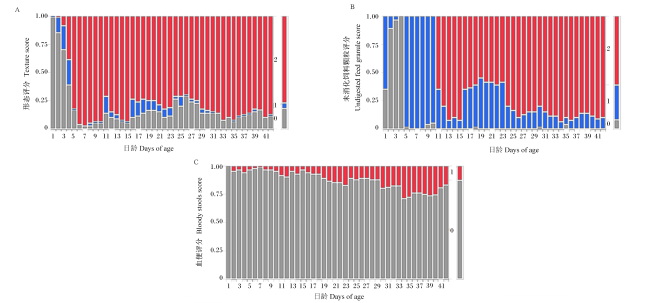
整个饲养周期中肉鸡粪便形态、未消化饲料颗粒和和血便发生率存在较大的变化(图1)。由图1-A可见,1~5日龄雏鸡粪便含水量比较高,随着日龄增加稀便发生率迅速下降,之后粪便开始干燥成形;16~28日龄,产生稀便、松软潮湿粪便的肉鸡比例均有所增加,而产生干燥成形粪便的肉鸡比例有所下降;随后,产生稀便的肉鸡比例下降,维持在20%左右直至42日龄。由图1-B可见,1~4日龄肉鸡粪便中含有大量未消化饲料颗粒,5~10日龄粪便中饲料颗粒有所减少,绝大多数粪便中还有较多未消化饲料颗粒;10日龄后,粪便中未消化饲料颗粒迅速下降,但在16~23日龄粪便中存在饲料颗粒的肉鸡比例又增加至40%左右,随后有所下降,比例下降至15%。由图1-C可见,4~10日龄肉鸡血便发生率很低;随着日龄的增加,肉鸡发生血便的比例逐渐增加,形成了16~28日龄、29~42日龄2个增加阶段。
图1 1~42日龄肉鸡粪便评分

Fig.1 Fecal scores in broilers at 1 to 42 days of age

表6所示,饲粮添加4%棉籽粕对11~42日龄肉鸡血便发生比例有显著影响(P<0.001),育雏期饲粮添加4%棉籽粕可以降低血便发生情况;从粪便形态来看,育雏期或育成期饲粮添加4%棉籽粕有降低11~42日龄肉鸡稀便的趋势,从而提高粪便成形率(P=0.095);从粪便中未消化饲料颗粒出现情况来看,各处理间差异不显著(P=0.105)。
表6 不同生长阶段饲粮添加棉籽粕对11~42日龄肉鸡粪便评分的影响

Table 6 Effects of diets supplemented with CSM at different growth stages on fecal score of broilers at 11 to 42 days of age %

育雏期
Starter period
育成期
Grow-out period
未消化饲料颗粒评分
Undigested feed granule score
形态评分
Texture score
血便评分
Bloody stools score
0 1 2 0 1 2 0 1
基础饲粮 基础饲粮Basal diet 0.31 21.19 78.50 17.27 3.45 79.28 92.50 7.50
Basal diet 试验饲粮Test diet 0.00 18.47 81.53 12.58 5.10 82.32 95.00 5.00
试验饲粮 基础饲粮Basal diet 0.00 21.25 78.75 12.34 4.69 82.97 99.50 0.50
Test diet 试验饲粮Test diet 0.47 18.12 81.41 12.34 4.38 83.28 99.00 1.00
PP-value 0.105 0.095 <0.001

同一列数字代表此评分发生的概率。

Numbers of the same column represented the probability of this score occurring.

3 讨论

3.1 不同生长阶段饲粮添加棉籽粕对肉鸡营养物质表观代谢率和生长性能的影响

肉鸡饲粮添加棉籽粕会显著降低蛋白质的回肠末端消化率[7-9]。棉籽粕中游离棉酚与赖氨酸氨基结合影响胰蛋白酶的酶解位点,同时棉酚与胃蛋白酶原结合抑制胃蛋白酶的活化,影响动物体对蛋白质的消化[1]。通过补充赖氨酸中和游离棉酚、满足肉鸡营养需要量,棉籽粕的添加量在20%以内可以保证肉鸡生长性能[8,10-14]。尽管本研究中试验饲粮配制采用了等能等氮的原则并平衡了赖氨酸含量,但未添加酶制剂,结果显示饲粮添加4%棉籽粕对肉鸡生长性能有一定的负面影响,降低了肉鸡的氮沉积量、ADG和体重。Abdallh等[9-10]研究表明,添加复合酶制剂可以提高肉鸡对棉籽粕的总能和蛋白质的消化、利用和沉积,可以将棉籽粕对豆粕的替代比例提高至90%。由于试验饲粮中干物质、总能、粗蛋白质和粗脂肪表观代谢率与基础饲粮无显著差异,因此采食量下降可能是棉籽粕造成肉鸡增重减缓的最重要原因。本研究还发现育雏期(4~10日龄)和育成期(11~42日龄)饲粮添加棉籽粕对肉鸡的生长存在交互效应。育雏期饲粮添加4%棉籽粕对肉鸡体重影响的效应可以维持到21日龄;育成期饲粮添加4%棉籽粕对肉鸡体重、ADFI、ADG以及F/G的影响更为显著。

3.2 不同生长阶段饲粮添加棉籽粕对肉鸡消化器官发育的影响

棉籽粕粗纤维、中性洗涤纤维和酸性洗涤纤维含量均高于豆粕,在肉鸡饲粮中使用棉籽粕还需考虑纤维的影响。近些年研究表明,肉鸡饲粮中添加少量纤维性原料有利于肌胃发育,提高肉鸡对纤维的消化能力[15-19]。本研究中发现育雏期饲粮添加4%棉籽粕显著增加了出栏肉鸡肌胃的相对重量,而育成期饲粮添加4%棉籽粕显著增加了出栏肉鸡小肠和盲肠的相对长度。Abdallh等[10]研究发现,饲粮添加棉籽粕会降低雏鸡的肌胃和腺胃重量,但增加了出栏肉鸡肌胃和腺胃重量。这些结果表明,饲粮中添加少量棉籽粕能够促进肉鸡消化器官的发育。此外,消化代谢试验结果显示,育成期饲粮添加少量棉籽粕时肉鸡对试验饲粮中粗纤维的表观代谢率显著高于基础饲粮,可以推测肉鸡对粗纤维的消化能力有所提高。

3.3 不同生长阶段饲粮添加棉籽粕对肉鸡粪便评分的影响

粪便评分是反映动物体消化状况最直观的指标。本研究单笼饲养肉鸡,便于对个体进行全生长周期的粪便监测,发现肉鸡粪便形态、未消化饲料颗粒以及血便评分在一定程度可以反映肉鸡消化器官的发育情况。1~4日龄雏鸡主要依赖卵黄囊提供能量和营养物质,同时消化酶分泌不足、消化道发育不完全[20],因此雏鸡粪便中未消化饲料颗粒很多、粪便含水量高;随着肠上皮细胞的增殖和迁移加速[21-22],肠道中淀粉酶、胰蛋白酶和脂肪酶的分泌也急剧增加[23],在10日龄时肉鸡肠道发育基本完全,能够比较好地实现消化和吸收功能,因此而粪便含水量降低。从整个生长周期来看,21日龄前后(15~23日龄)粪便中未消化饲料颗粒增加、稀便发生率增加,提示肉鸡在这期间出现消化不良的问题。这一时间段与先前报道的肉鸡肠道菌群失调(dysbacteriosis)的发生时间段十分吻合[24-25]。由于鸡群整体生长性能、粪便形态并未发生剧烈变化,排除了由于球虫感染和梭菌引起的坏死性肠炎,可能是非感染性原因造成的肠道菌群失调。
本试验发现饲喂玉米-豆粕型基础饲粮和饲喂添加4%棉籽粕的试验饲粮的肉鸡粪便形态差异较大,前者粪便为黄色、较蓬松,而后者粪便黑且干燥,粪便形态评分也可见饲粮添加4%棉籽粕可以提高粪便的成形度。这可能是生产中使用棉籽粕解决垫料潮湿的重要原因。由于采食棉籽粕造成粪便发黑,会掩盖一些未消化饲料颗粒的颜色,造成评分差异不显著。通过显微镜下观察,饲喂添加4%棉籽粕的试验饲粮的肉鸡粪便中也有未消化饲料颗粒。同时,在采集样品时发现饲喂玉米-豆粕型基础饲粮肉鸡的肠道充血严重、普遍出现出血点,肠道和粪便中有橘色黏液;而饲喂添加4%棉籽粕的试验饲粮肉鸡的肠道相对细而长,充血和橘色内容物较少。与之相对应的,饲喂试验饲粮的肉鸡血便评分较饲喂基础饲粮的肉鸡降低,特别是在育雏期,使肉鸡的血便发生率从5%~7%降至0.5%~1.0%。由此可见,饲粮中少量添加棉籽粕可以改善肉鸡的肠道健康状况。目前关于棉籽粕对肉鸡肠道微生物和肠道屏障功能影响的研究较少,饲粮中添加棉籽粕改善肉鸡肠道健康的机理有待深入研究。

4 结论

在育雏期和育成期饲粮中添加4%棉籽粕不会影响肉鸡干物质、总能、粗脂肪以及粗蛋白质的表观代谢率,但会影响肉鸡的采食,对生长性能有一定的负面影响。在育雏期饲粮中添加4%棉籽粕能够促进肉鸡肌胃发育,降低血便和稀便的发生率,提高肉鸡肠道健康状况。
[1]
ŚWIATKIEWICZ S, ARCZEWSKA-WŁOSEK A, JÓZEFIAK D. The use of cottonseed meal as a protein source for poultry:an updated review[J]. World’s Poultry Science Journal, 2016, 72(3):473-484.

DOI

[2]
孙晓晓, 邓生青, 叶晓梦, 等. 棉籽粕替代豆粕对28-42日龄肉鸡生长性能以及血清生化、抗氧化和免疫指标的影响[J]. 动物营养学报, 2022, 34(9):5691-5701.

DOI

SUN X X, DENG S Q, YE X M, et al. Effects of cottonseed meal replaced soybean meal on growth performance and serum biochemical,antioxidant and immune indices of broilers aged from 28 to 42 days[J]. Chinese Journal of Animal Nutrition, 2022, 34(9):5691-5701. (in Chinese)

[3]
孙晓晓. 蛋白质源性饲料导致肉鸡消化不良的研究[D].硕士学位论文. 北京: 中国农业科学院, 2022.

SUN X X. Study on dyspepsia of broilers induced by protein-derived feed[D].Master’s Thesis. Beijing: Chinese Academy of Agricultural Sciences, 2022. (in Chinese)

[4]
UNI Z, NOY Y, SKLAN D. Posthatch development of small intestinal function in the poult[J]. Poultry Science, 1999, 78(2):215-222.

PMID

[5]
UNI Z, SMIRNOV A, SKLAN D. Pre- and posthatch development of goblet cells in the broiler small intestine:effect of delayed access to feed[J]. Poultry Science, 2003, 82(2):320-327.

DOI

[6]
RODRIGUES I, CHOCT M. The foregut and its manipulation via feeding practices in the chicken[J]. Poultry Science, 2018, 97(9):3188-3206.

DOI PMID

[7]
BATONON-ALAVO D I, BASTIANELLI D, LESCOAT P, et al. Simultaneous inclusion of sorghum and cottonseed meal or millet in broiler diets:effects on performance and nutrient digestibility[J]. Animal, 2016, 10(7):1118-1128.

DOI

[8]
FERNANDEZ S R, ZHANG Y, PARSONS C M. Dietary formulation with cottonseed meal on a total amino acid versus a digestible amino acid basis[J]. Poultry Science, 1995, 74(7):1168-1179.

PMID

[9]
ABDALLH M E, AHIWE E U, MUSIGWA S, et al. Energy and protein utilisation by broiler chickens fed diets containing cottonseed meal and supplemented with a composite enzyme product[J]. British Poultry Science, 2020, 61(4):424-432.

DOI PMID

[10]
ABDALLH M E, MUSIGWA S, AHIWE E U, et al. Replacement value of cottonseed meal for soybean meal in broiler chicken diets with or without microbial enzymes[J]. Journal of Animal Science and Technology, 2020, 62(2):159-173.

DOI PMID

[11]
AZMAN M A, YILMAZ M. The growth performance of broiler chicks fed with diets containing cottonseed meal supplemented with lysine[J]. Revue de Medecine Veterinaire, 2005, 156(2):104-106.

[12]
HENRY M H, PESTI G M, BAKALLI R, et al. The performance of broiler chicks fed diets containing extruded cottonseed meal supplemented with lysine[J]. Poultry Science, 2001, 80(6):762-768.

DOI PMID

[13]
STERLING K G, COSTA E F, HENRY M H, et al. Responses of broiler chickens to cottonseed- and soybean meal-based diets at several protein levels[J]. Poultry Science, 2002, 81(2):217-226.

PMID

[14]
GAMBOA D A, CALHOUN M C, KUHLMANN S W, et al. Use of expander cottonseed meal in broiler diets formulated on a digestible amino acid basis[J]. Poultry Science, 2001, 80(6):789-794.

PMID

[15]
JHA R, MISHRA P. Dietary fiber in poultry nutrition and their effects on nutrient utilization,performance,gut health,and on the environment:a review[J]. Journal of Animal Science and Biotechnology, 2021, 12(1):51.

DOI

[16]
BAUTIL A, BEDFORD M R, BUYSE J, et al. Reduced-particle size wheat bran and endoxylanase supplementation in broiler feed affect arabinoxylan hydrolysis and fermentation with broiler age differently[J]. Animal Nutrition, 2023, 12:308-320.

DOI PMID

[17]
MORGAN N K, WALLACE A, BEDFORD M R. Improving sorghum digestion in broilers by targeting fermentation of xylan[J]. Animal Nutrition, 2022, 10:198-206.

DOI PMID

[18]
JIMÉNEZ-MORENO E, DE COCA-SINOVA A, GONZÁLEZ-ALVARADO J M, et al. Inclusion of insoluble fiber sources in mash or pellet diets for young broilers.1.Effects on growth performance and water intake[J]. Poultry Science, 2016, 95(1):41-52.

DOI

[19]
POURAZADI Z, SALARI S, TABANDEH M R, et al. Effect of particle size of insoluble fibre on growth performance,apparent ileal digestibility and caecal microbial population in broiler chickens fed barley-containing diets[J]. British Poultry Science, 2020, 61(6):734-745.

DOI

[20]
VAN DER WAGT I, DE JONG I C, MITCHELL M A, et al. A review on yolk sac utilization in poultry[J]. Poultry Science, 2020, 99(4):2162-2175.

DOI PMID

[21]
IJI P A, SAKI A, TIVEY D R. Body and intestinal growth of broiler chicks on a commercial starter diet.1.Intestinal weight and mucosal development[J]. British Poultry Science, 2001, 42(4):505-513.

DOI

[22]
NOY Y, SKLAN D. Posthatch development in poultry[J]. Journal of Applied Poultry Research, 1997, 6(3):344-354.

DOI

[23]
NOY Y, SKLAN D. Digestion and absorption in the young chick[J]. Poultry Science, 1995, 74(2):366-373.

DOI PMID

[24]
CAEKEBEKE N, RINGENIER M, DE MEYER F, et al. A study on risk factors for macroscopic gut abnormalities in intensively reared broiler chickens[J]. Avian Pathology, 2020, 49(2):193-201.

DOI PMID

[25]
TEIRLYNCK E, GUSSEM M D E, DEWULF J, et al. Morphometric evaluation of “dysbacteriosis” in broilers[J]. Avian Pathology, 2011, 40(2):139-144.

DOI

Outlines

/