RESEARCH PAPER

Effects of Small Peptide on Rumen Fermentability and Colostrum Quality of Perinatal Dairy Cows

  • LIU Liping , 1 ,
  • ZHANG Zhili 2 ,
  • XUE Fuguang 3 ,
  • DU Chuanlai , 1, *
Expand
  • 1 Anhui Science and Technology University, Chuzhou 233100, China
  • 2 Modern Farming (Wuhe) Co., Ltd., Bengbu 233300, China
  • 3 Key Laboratory of Animal Health and Safety in Nanchang, College of Animal Science and Technology, Jiangxi Agricultural University, Nanchang 330045, China
*professor, E-mail:

Received date: 2023-03-06

  Online published: 2023-08-10

Abstract

The objective of this study was to explore the effects of small peptide on the rumen fermentability and colostrum quality of perinatal dairy cows. Twelve healthy perinatal dairy cows with the similar parity, birth time and body weight were selected and randomly allotted into control group (fed the conventional diet) and small peptide group (fed the conventional diet, and supplemented with 100 g small peptide per day per cow), and each group had 6 cows. The trial lasted from the 15th before farrowing to the 3rd day after farrowing, followed by the collection of rumen fluid and colostrum at the last day of the trial. Rumen fermentation parameters, rumen bacterial communities and colostrum quality were following measured. The results showed that, compared with the control group, small peptide significantly increased the contents of acetate, butyrate and total volatile fatty acids (P<0.05), however, it had no significant effects on pH, and the contents of ammonia nitrogen, microprotein, propionate, isobutyrate, valetate and isovaletate (P>0.05). Further, the ACE index, one of α-diversity indexes of bacterial community, in small peptide group was significantly increased compared with the control group (P<0.05), and meanwhile, the relative abundances of Prevotella, Shuttleworthia, Acetitomaculum, Saccharofermentans, Butyrivibrio, Lachnospira, Bifidobacterium and Succinivibrio were significantly increased (P<0.05), while the relative abundances of Ruminococcus, Rikenella, Ruminococcus, Pseudobutyrivibrio and Selenomonas were significantly decreased (P<0.05). Compared with the control group, milk fat percentage showed a significant enhancement in small peptide group, but no significant changes were observed in the milk protein percentage, milk lactose percentage and bio-active substances such as lactoferrin, lactoglobulin, lactalbumin and casein (P>0.05). In conclusion, under the condition of this experiment, after feeding perinatal dairy cows with small peptide, the small peptide can increase the fat content in colostrum through improving the rumen bacterial community structure and promoting the rumen fermentability.

Cite this article

LIU Liping , ZHANG Zhili , XUE Fuguang , DU Chuanlai . Effects of Small Peptide on Rumen Fermentability and Colostrum Quality of Perinatal Dairy Cows[J]. Chinese Journal of Animal Nutrition, 2023 , 35(8) : 5191 -5199 . DOI: 10.12418/CJAN2023.480

牛初乳富含细胞因子和乳铁蛋白等生物活性物质[1-2],对促进机体生长、调节机体免疫、改善肠道环境和功能、延缓衰老、抵抗病原微生物等方面发挥重要作用[3-4]。因此,探究合理有效的方法提高牛初乳品质,对促进犊牛健康及人体机能具有重要意义。
围产期是奶牛饲养管理最关键的时期,对促进奶牛产后身体机能的恢复和提高初乳品质具有显著影响[5]。生产中常通过提高饲粮能量水平及添加过瘤胃葡萄糖的方法来缓解由于产犊所引起的奶牛能量负平衡状态。然而,过多的能量摄入极易打破瘤胃的能氮平衡,从而影响瘤胃的发酵功能,甚至引起瘤胃酸中毒[6]。瘤胃是奶牛营养物质供应的根本来源,通过平衡碳源和氮源来维持瘤胃微生物生态系的稳态并发挥生理功能。过高的能量摄入破坏了瘤胃能氮平衡,致使瘤胃菌群紊乱,造成瘤胃发酵能力下降[7]。尽管生产中应用了豆粕和其他富含蛋白质的材料,但瘤胃可降解蛋白质的供应仍低于平衡能量需求的要求,需要更多的可降解蛋白质来平衡能量。
在瘤胃条件下,瘤胃微生物通过利用瘤胃可降解蛋白质,满足奶牛生命活动的氮源基本需求。研究证实,饲粮中添加尿素等非蛋白氮(NPN)或可通过激发瘤胃非蛋白氮利用菌的丰度可生成更多可利用的微生物蛋白(MCP)[8]。然而,氨和尿素等非蛋白氮的用量需要严格把控,过量补充易造成瘤胃中毒,从而影响瘤胃机能。作为一种易于降解和利用的氮源,小肽可为微生物增殖提供更多的可降解氮,从而有助于在高精料饲粮饲喂条件下重建瘤胃碳氮平衡,并促进纤维素分解菌和淀粉分解菌的增殖[9]。小肽可被瘤胃微生物(如瘤胃链球菌)在二肽酶作用下直接用于微生物蛋白合成,或是先被降解为氨基酸,随后进一步合成微生物蛋白,再或是在脱氨基作用下生成挥发性脂肪酸(VFA)、二氧化碳(CO2)和氨[10-11]。由此推测,小肽或可有效提高瘤胃发酵能力,从而提高围产期奶牛的身体机能。因此,本试验给围产期奶牛补饲小肽,探究小肽对围产期奶牛瘤胃发酵功能及初乳品质的影响,以期为小肽在围产期奶牛饲粮中的应用提供理论依据。

1 材料与方法

1.1 试验设计

采用完全随机试验设计,将12头围产期奶牛随机分为2组:对照组和小肽添加组,每组6头。对照组饲喂常规饲粮,小肽组在饲喂常规饲粮的基础上按每头每天补饲100 g小肽,小肽的补饲量参考文献[12]确定。所用小肽由成都某生物技术有限公司提供,主要成分为酶解脱酚棉籽蛋白,肽段分布情况为:<1 000 Da,68.4%;1 000~2 000 Da,16.7%;>2 000~5 000 Da,8.3%;>5 000 Da,5.6%。试验于产前15 d开始至产后3 d结束,试验期间自由采食和饮水。

1.2 饲粮配制

本试验所饲喂常规饲粮组成及营养水平如表1所示。饲粮中干物质、粗蛋白质、粗脂肪、中性洗涤纤维及酸性洗涤纤维含量依据GB/T 18868—2002[13]进行测定,淀粉含量依据GB/T 20194—2018[14]进行测定,泌乳净能(NEL)根据NRC(2001)[15]数据计算获得。
表1 常规饲粮组成及营养水平(干物质基础)

Table 1 Composition and nutrient levels of conventional diets (DM basis) %

项目
Items
围产前期
Pre-perinatal
period
围产后期
Post-perinatal
period
原料Ingredients
玉米青贮Corn silage 20.00 24.50
玉米粉Ground corn 15.70
蒸汽压片玉米
Steam-flaked corn
11.80 8.50
豆粕Soybean meal 11.00 12.00
玉米蛋白粉Corn gluten meal 3.00
进口燕麦Imported oats 49.20
棉籽粕Cottonseed meal 3.40
苜蓿干草Alfalfa hay 14.50
羊草Chinese wildrye 10.20
干啤酒糟
Brewers’dried grains
3.10
甜菜粕Beet pulp 4.50
胆碱Choline 0.45
蛋氨酸Met 0.15
预混料Premix 4.401) 3.002)
食盐NaCl 0.60
合计Total 100.00 100.00
营养水平Nutrient levels
干物质DM 50.00 51.20
泌乳净能NEL/(MJ/kg) 6.32 7.13
粗脂肪EE 3.93 4.56
粗蛋白质CP 14.90 17.10
酸性洗涤纤维ADF 24.00 18.60
中性洗涤纤维NDF 38.80 31.70
淀粉Starch 17.50 28.90
钙Ca 0.49 0.69
磷P 0.38 0.44

1)预混料为每千克围产前期饲粮提供 Premix provided the following for per kg of the diet of pre-perinatal period:Mn 550 mg,Zn 625 mg,Se 55 mg,Fe 280 mg,Cu 320 mg,I 100 mg,Co 40 mg,VA 125 000 IU,VD 19 000 IU,VE 1 500 IU。

2)预混料为每千克围产后期饲粮提供 Premix provided the following for per kg of the diet of post-perinatal period:Mn 955 mg,Zn 1 000 mg,Se 20 mg,Fe 350 mg,Cu 250 mg,I 98 mg,Co 40 mg,VA 125 000 IU,VD 9 000 IU,VE 1 500 IU。

1.3 样品采集和指标测定

1.3.1 瘤胃液采集

于试验最后1 d通过瘤胃口腔采液器采集瘤胃液,并将每头牛采集到的瘤胃液平均分成2份,一份用于测定瘤胃液pH、挥发性脂肪酸(乙酸、丙酸、丁酸、异丁酸、戊酸、异戊酸)、氨态氮(NH3-N)和微生物蛋白(MCP)含量,另一部分用液氮迅速冷却后,转移至-80 ℃冰箱保存,用于测定瘤胃菌群多样性和结构。

1.3.2 瘤胃发酵参数测定

瘤胃液采集完成后,迅速测定pH[Testo 206-pH1 pH计,Testo国际仪器设备(上海)有限公司]。随后通过气相色谱法[16](GC-2010气相色谱仪,Shimadzu,日本)测定瘤胃液中挥发性脂肪酸含量,采用靛酚法[17](UV-2600紫外分光光度计,上海天美科学仪器有限公司)进行NH3-N含量的测定。MCP含量参考文献[17]的方法测定,具体操作如下:将待测样本16 mL滤液分别加入2个10 mL离心管中,每管8 mL。以500×g离心15 min,吸取6 mL上清液,加入2 mL 77.6%的三氯乙酸,使三氯乙酸最终浓度达到19.4%,冰浴静置45 min;其中一管经27 000×g离心15 min,取上清液采用凯氏定氮法进行粗蛋白质含量测定,未离心的另一管整管液体采用凯氏定氮法进行粗蛋白质含量测定,两者差值即为MCP含量。

1.3.3 瘤胃微生物测定

利用细菌基因组DNA提取试剂盒[DP302,TIANGEN,天根生化科技(北京)有限公司)]提取瘤胃液DNA,随后通过使用通用引物520F(5'-GTGCCAGCCMGCCGGTAA-3')和802R(5'-GGACTACHVGGGTWTCTAAT-3')扩增16S rRNA基因V4区域并使用Qiagen凝胶提取试剂盒(Qiagen,Hilden,德国)纯化PCR产物混合物。利用TruSeq® DNA试剂盒(Illumina,美国)生成测序文库,随后使用Illumina HiSeq 4000平台(Illuminia Inc.,美国)进行测序。质量控制标准依据根据QIIME, V1.7.0执行,并在特定过滤条件下对原始数据进行质量过滤,以序列相似度>97%定义为同一操作分类单元(OTU),并进行后续分析。

1.3.4 初乳品质测定

对初乳的检测指标主要包括乳成分(乳脂率、乳蛋白率、乳糖率以及游离脂肪酸含量)和生物活性物质(乳铁蛋白、乳球蛋白、乳清蛋白和酪蛋白)含量。乳成分采用乳成分分析仪(MilkoScan FT1,FOSS,丹麦)进行检测,每个样品重复测定3次,取3次测定平均值作为测定结果进行后续分析。乳铁蛋白含量测定采用牛乳铁蛋白检测试剂盒,乳清蛋白含量测定采用牛乳清蛋白酶联免疫吸附测定(ELISA)试剂盒,乳球蛋白测定采用牛α-乳球蛋白ELISA试剂盒,酪蛋白含量测定采用牛酪蛋白ELISA试剂盒,上述试剂盒均购自上海酶联生物科技有限公司,操作流程均按试剂盒说明进行。

1.4 数据统计与分析

瘤胃发酵参数、初乳品质指标的原始数据首先通过Excel 2016进行简单整理,数据以平均值和均值标准误(SEM)表示,随后采用SPSS 22.0软件中的t检验方法进行差异显著性分析,P<0.05认为统计学上差异显著。

2 结果

2.1 小肽对围产期奶牛瘤胃发酵参数的影响

表2可知,与对照组相比,补饲小肽显著提高了瘤胃液乙酸、丁酸和总挥发性脂肪酸含量(P<0.05),对瘤胃液pH以及氨态氮、微生物蛋白、丙酸、异丁酸、戊酸和异戊酸含量和乙丙比无显著影响(P>0.05)。
表2 小肽对围产期奶牛瘤胃发酵参数的影响

Table 2 Effects of small peptide on rumen fermentation parameters of perinatal dairy cows (n=6)

项目
Items
小肽组
Small peptide group
对照组
Control group
均值标准误
SEM
P
P-value
pH 6.18 6.24 0.08 0.351
氨态氮NH3-N/(mg/dL) 11.08 10.49 1.04 0.089
微生物蛋白MCP/(mg/dL) 24.91 23.16 1.35 0.067
乙酸Acetate/(mmol/L) 63.37 58.29 2.97 0.047
丙酸Propionate/(mmol/L) 21.79 20.44 1.65 0.054
异丁酸Isobutyrate/(mmol/L) 0.97 0.65 0.26 0.104
丁酸Butyrate/(mmol/L) 13.52 12.25 0.58 0.049
戊酸Valetate/(mmol/L) 1.95 2.07 0.37 0.744
异戊酸Isovaletate/(mmol/L) 2.14 2.31 0.34 0.915
总挥发性脂肪酸TVFA/(mmol/L) 109.92 102.25 3.88 0.035
乙丙比A/P 2.91 2.85 0.09 0.622

2.2 小肽对围产期奶牛初乳品质的影响

表3可知,小肽组初乳中乳脂率显著高于对照组(P<0.05),但游离脂肪酸含量与乳蛋白率、乳糖率与对照组相比无显著变化(P>0.05)。对初乳中生物活性物质含量的测定结果显示,小肽组初乳中乳铁蛋白、乳球蛋白、乳清蛋白和酪蛋白含量相对于对照组差异并不显著(P>0.05)。
表3 小肽对围产期奶牛初乳品质的影响

Table 3 Effects of small peptide on colostrum quality of perinatal dairy cows (n=6)

项目
Items
小肽组
Small peptide group
对照组
Control group
均值标准误
SEM
P
P-value
乳脂率Milk fat percentage/% 5.78 5.12 0.23 0.027
乳蛋白率Milk protein percentage/% 4.37 4.52 0.31 0.268
乳糖率Lactose percentage/% 1.97 2.03 0.21 0.664
游离脂肪酸Free fatty acids/% 0.48 0.47 0.06 0.563
乳铁蛋白Lactoferrin/(mg/mL) 0.37 0.34 0.05 0.234
乳球蛋白Lactoglobulin/(mg/mL) 10.23 9.87 0.43 0.139
乳清蛋白Lactalbumin/(mg/mL) 0.68 0.61 0.09 0.251
酪蛋白Casein/(mg/mL) 8.76 8.52 0.27 0.221

2.3 小肽对围产期奶牛瘤胃菌群的影响

根据OTU的聚类原则及过滤方法,总共鉴定到4 523个OTU,随后经过质量控制及数据库比对,共鉴定出15个门和2 400多个属的菌群。将所有经过鉴定的菌群进一步进行α-多样性分析,然后进行β-多样性分析,最后对瘤胃菌群相对丰度进行差异显著性分析。
α-多样性指数分析结果(表4)显示,小肽组ACE指数显著高于对照组(P<0.05),而香农指数、辛普森指数和Chao1指数与对照组相比没有显著变化(P>0.05)。
表4 小肽对围产期奶牛瘤胃菌群α-多样性指数的影响

Table 4 Effects of small peptide on α-diversity indexes of bacterial community of perinatal dairy cows (n=6)

项目
Items
小肽组
Small peptide group
对照组
Control group
均值标准误
SEM
P
P-value
香农指数Shannon index 8.06 8.04 0.15 0.582
辛普森指数Simpson index 0.98 0.98 0.01 0.342
ACE指数ACE index 2 156.5 2 103.4 22.4 0.018
Chao1指数Chao1 index 2 076.3 2 031.4 31.2 0.162
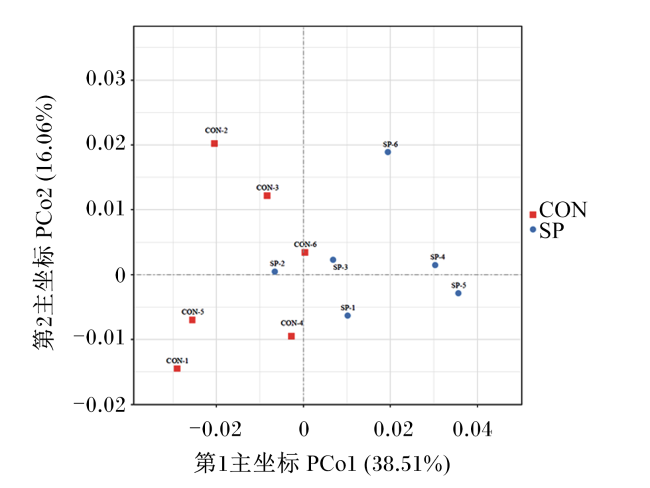
利用主坐标分析(PCoA)法对2组奶牛瘤胃菌群整体群落组成进行分析,结果如图1所示。由图可知,第1和第2主坐标分别对瘤胃菌群的结构差异提供了38.51%和16.06%的贡献率;除SP-2(小肽组的1个样本)外,小肽组与对照组样本可以通过第1和第2主坐标显著分离,说明补饲小肽后奶牛瘤胃菌群结构发生了显著变化。
图1 主坐标分析法分析小肽对围产期奶牛瘤胃菌群结构的影响

CON:对照组;SP:小肽组。CON-1、CON-2、CON-3、CON-4、CON-5和CON-6为对照组的6个样本,SP-1、SP-2、SP-3、SP-4、SP-5和SP-6为小肽组的6个样本。

Fig.1 Effects of small peptide on rumen bacterial community structure of perinatal dairy cows analyzed by PCoA method

CON:control group; SP: small peptide group. CON-1, CON-2, CON-3, CON-4, CON-5 and CON-6 were six samples in control group, and SP-1, SP-2, SP-3, SP-4, SP-5 and SP-6 were six samples in small peptide group.

表5可知,普氏菌属(Prevotella)、瘤胃球菌属(Ruminococcus)和解琥珀酸菌属(Succiniclasticum)为瘤胃中相对丰度最高的3个菌属,占瘤胃菌群的40%以上。与对照组相比,小肽显著提高了瘤胃中Prevotella的相对丰度(P<0.05),同时显著降低了Ruminococcus的相对丰度(P<0.05);此外,小肽还显著提高了沙特尔沃思菌属(Shuttleworthia)、乙酸肠菌属(Acetitomaculum)、产乙酸糖发酵菌属(Saccharofermentans)、丁酸弧菌属(Butyrivibrio)、毛螺菌属(Lachnospira)、双歧杆菌属(Bifidobacterium)以及琥珀酸弧菌属(Succinivibrio)的相对丰度(P<0.05),同时显著降低了理研菌属(Rikenella)、假丁酸弧菌属(Pseudobutyrivibrio)和月形单胞菌属(Selenomonas)的相对丰度(P<0.05)。
表5 小肽对围产期奶牛瘤胃菌群属水平相对丰度的影响

Table 5 Effects of small peptide on relative abundances of ruminal bacteria communities at genus level of perinatal dairy cows (n=6) %

项目
Items
小肽组
Small peptide group
对照组
Control group
均值标准误
SEM
P
P-value
普氏菌属Prevotella 20.12 17.34 1.39 0.044
瘤胃球菌属Ruminococcus 10.94 13.70 1.89 0.005
解琥珀酸菌属Succiniclasticum 10.79 10.51 0.82 0.291
毛螺菌属Lachnospira 5.22 5.28 0.28 0.623
真杆菌属Eubacterium 4.84 3.97 0.21 0.141
理研菌属Rikenella 2.77 3.14 0.25 0.015
沙特尔沃思菌属Shuttleworthia 2.72 1.34 0.52 0.032
乙酸肠菌属Acetitomaculum 1.28 0.73 0.33 0.023
丹毒丝菌属Erysipelothrix 1.11 0.86 0.33 0.137
泪囊梭菌属Lachnoclostridium 0.66 0.73 0.22 0.995
产乙酸糖发酵菌属Saccharofermentans 0.63 0.45 0.11 0.008
丁酸弧菌属Butyrivibrio 0.48 0.40 0.05 0.048
瘤胃梭菌属Ruminiclostridium 0.21 0.28 0.08 0.503
假丁酸弧菌属Pseudobutyrivibrio 0.11 0.18 0.03 0.009
氨基酸球菌属Acidaminococcus 0.13 0.07 0.07 0.167
月形单胞菌属Selenomonas 0.04 0.11 0.04 0.001
乳杆菌属Lactobacillus 0.05 0.06 0.05 0.936
假支杆菌属Pseudoramibacter 0.04 0.02 0.03 0.089
双歧杆菌属Bifidobacterium 0.05 0.03 0.01 0.027
埃希氏菌-志贺氏菌属Escherichia-Shigella 0.01 0.01 0.00 0.680
拟杆菌属Bacteroides 0.01 0.02 0.01 0.571
琥珀酸弧菌属Succinivibrio 0.03 0.01 0.00 0.001
链球菌属Streptococcus 0.01 0.01 0.01 0.083
丁酸球菌属Butyricicoccus 0.01 0.01 0.01 0.969
其他Others 31.63 30.72 1.45 0.211

3 讨论

在瘤胃环境下,小肽可被瘤胃微生物直接或间接用于微生物蛋白的合成,从而有效维持瘤胃内的碳氮平衡,为瘤胃微生物增殖和发酵提供稳定的物质供应及环境保证。更为丰富的瘤胃菌群可有效降解饲粮中的营养物质,从而为围产期奶牛提供能量及营养保证,有效预防产犊引起的代谢疾病,提高初乳品质。

3.1 小肽对围产期奶牛瘤胃发酵及菌群的影响及作用机制

本研究结果显示,给围产期奶牛补饲小肽后,瘤胃液中挥发性脂肪酸,特别是乙酸和丁酸的含量显著提高。这与Valkeners等[7]的研究结果一致,表明小肽对瘤胃碳水化合物的降解具有显著的促进作用。
碳水化合物主要包括纤维素和淀粉,在瘤胃条件下通过微生物的发酵作用降解为乙酸盐、丙酸盐和丁酸盐,为反刍动物的生长和代谢提供了主要的碳源和能量。补饲小肽后瘤胃液中挥发性
脂肪酸含量增加的主要原因可能归因于以下2个方面:一方面是小肽使瘤胃内细菌多样性增加,尤其是淀粉降解菌的丰度增加,另一方面是碳源和能量的充足供应为瘤胃提供了更加稳定的内环境。小肽作为一种易于微生物吸收利用的氮源,为瘤胃菌群的增殖和多样性增强提供了额外的可降解氮,并显著提高了瘤胃菌群的α-多样性[18]。瘤胃菌群的增加进一步增强了降解能力,从而将更多碳水化合物降解为易于利用的挥发性脂肪酸,并用于机体的营养供应。研究显示,在高精料饲喂过程中补饲小肽有效增加了瘤胃菌群中PrevotellaSuccinivibrio等淀粉降解菌的相对丰度[8,19],从而能更加高效地利用碳水化合物,并为机体提供充足的挥发性脂肪酸,而挥发性脂肪酸尤其是乙酸为生理活性底物的合成提供了主要资源。BifidobacteriumSaccharofermentansAcetitomaculum是瘤胃中主要的乙酸生成菌[20-21]。在本研究中,给围产期奶牛补饲小肽后,瘤胃中BifidobacteriumSaccharofermentansAcetitomaculum的相对丰度显著增加,进一步促进了碳水化合物降解生成乙酸,并为瘤胃代谢提供主要的碳源和能量。

3.2 小肽对围产期奶牛初乳品质的影响及作用机制

本研究结果显示,给围产期奶牛补饲小肽后,初乳中乳脂率显著增加,其原因与脂肪酸合成过程紧密相关。在哺乳动物中,脂肪酸的从头合成需要以乙酸和丁酸作为底物,这些物质主要由瘤胃微生物发酵产生,并通过血液循环运输到乳腺组织[22]。补饲小肽后瘤胃菌群多样性和乙酸产生菌相对丰度的增加有助于乙酸的生成,并进一步为脂肪酸合成提供底物[23-24]。此外,乙酸不仅是乳脂合成过程中的重要底物,同时乙酸含量的变化促进脂肪合成酶——乙酰辅酶A羧化酶(ACACA)、脂肪酸合成酶(FASN)和酰基辅酶A合成酶短链家族成员2(ACSS2)等的激活[25-27],进一步促进了乳脂合成。脂肪酸的合成还是一个能量消耗过程,需要更多的ATP来催化合成过程。挥发性脂肪酸为奶牛的营养代谢过程提供了主要能量,补饲小肽后瘤胃液中挥发性脂肪酸含量的增加为乳脂合成提供了更多的ATP,从而增加了乳脂率。
除从头合成外,乳脂的另一个重要来源是水解和吸收饲粮中脂肪。饲粮中的脂肪在进入瘤胃后,经革兰氏阴性菌(尤其是Butyrivibrio)分泌的脂肪酶水解,并穿越瘤胃壁经血液循环进入乳腺[28]。本研究发现,给围产期奶牛补饲小肽后,瘤胃液中Butyrivibrio的相对丰度显著增加,这会将更多的脂质水解成脂肪酸,并进一步输送到乳腺,从而提高乳脂率。

4 结论

本研究结果证实,给围产期奶牛补饲小肽后,小肽可通过改善围产期奶牛瘤胃菌群结构、提高瘤胃发酵功能,进而促进初乳中乳脂的合成,但对初乳中生物活性物质含量无显著提高作用。
[1]
杨洋. 牛初乳功能特性及应用研究进展[J]. 中国奶牛, 2022(10):45-50.

YANG Y. Research progress on the functional properties and application of bovine colostrum[J]. China Dairy Cattle, 2022(10):45-50. (in Chinese)

[2]
韩立华, 朱师晨, WEISER M, 等. 牛初乳营养组成和功能特性研究进展[J/OL]. 食品科学:1-16. http://kns.cnki.net/kcms/detail/11.2206.TS.20221020.1252.016.html.

HAN L H, ZHU S C, WEISER M, et al. Research progress on nutrients composition and functional characteristics of colostrum[J]. Food Science:1-16. http://kns.cnki.net/kcms/detail/11.2206.TS.20221020.1252.016.html. (in Chinese)

[3]
REITER B, BROCK J H, STEEL E D. Inhibition of Escherichia coli by bovine colostrum and post-colostral milk.Ⅱ.The bacteriostatic effect of lactoferrin on a serum susceptible and serum resistant strain of E. coli[J]. Immunology, 1975, 28(1):83-95.

[4]
BLÄTTLER U, HAMMON H M, MOREL C, et al. Feeding colostrum,its composition and feeding duration variably modify proliferation and morphology of the intestine and digestive enzyme activities of neonatal calves[J]. The Journal of Nutrition, 2001, 131(4):1256-1263.

DOI

[5]
郑晓妍, 张志刚. 浅析奶牛围产期代谢型趴卧不起综合征[J]. 中国奶牛, 2022(10):34-37.

ZHENG X Y, ZHANG Z G. Discussion on metabolic lying prone syndrome of dairy cows in perinatal period[J]. China Dairy Cattle, 2022(10):34-37. (in Chinese)

[6]
郭启勇, 柳国锁, 吴心华. 奶牛围产期能量负平衡的研究进展[J]. 中国奶牛, 2021(11):1-5.

GUO Q Y, LIU G S, WU X H. Research progress of negative energy balance in dairy cows during perinatal period[J]. China Dairy Cattle, 2021(11):1-5. (in Chinese)

[7]
VALKENERS D, THÉWIS A, AMANT S, et al. Effect of various levels of imbalance between energy and nitrogen release in the rumen on microbial protein synthesis and nitrogen metabolism in growing double-muscled Belgian Blue bulls fed a corn silage-based diet[J]. Journal of Animal Science, 2006, 84(4):877-885.

PMID

[8]
YANG K, TIAN X Z, MA Z F, et al. Feeding a negative dietary cation-anion difference to female goats is feasible,as indicated by the non-deleterious effect on rumen fermentation and rumen microbial population and increased plasma calcium level[J]. Animals (Basel), 2021, 11(3):664.

[9]
WALLACE R J, NEWBOLD C J, MCKAIN N. Inhibition by 1,10-phenanthroline of the breakdown of peptides by rumen bacteria and protozoa[J]. The Journal of Applied Bacteriology, 1996, 80(4):425-430.

DOI

[10]
DEPARDON N, DEBROAS D, BLANCHART G. Breakdown of peptides from a soya protein hydrolysate by rumen bacteria.Simultaneous study of enzyme activities and of two physico-chemical parameters:molecular weight and hydrophobicity[J]. Journal of the Science of Food and Agriculture, 1995, 68(1):25-31.

DOI

[11]
WALLACE R J, ESCHENLAUER S, NEWBOLD C J, et al. Rumen bacteria capable of growth on peptides and amino acids as sole source of energy:numbers and their role in ammonia production[J]. Annales de Zootechnie, 1995,44 (Suppl.1):141-147.

[12]
LIU E, XIAO W W, PU Q J, et al. Microbial and metabolomic insights into the bovine lipometabolic responses of rumen and mammary gland to zymolytic small peptide supplementation[J]. Frontiers in Veterinary Science, 2022, 9:875741.

DOI

[13]
中华人民共和国国家质量监督检验检疫总局. 饲料中水分、粗蛋白质、粗纤维、粗脂肪、赖氨酸、蛋氨酸快速测定近红外光谱法:GB/T 18868—2002[S]. 北京: 中国标准出版社, 2002.

General Administration of Quality Supervision,Inspection and Quarantine of the People’s Republic of China. Method for determination of moisture,crude protein,crude fat,crude fibre,lysine and methinione in feeds-near infrared reflectance spectroscopy:GB/T 18868—2002[S]. Beijing: Standards Press of China, 2002. (in Chinese)

[14]
国家市场监督管理总局, 中国国家标准化管理委员会. 动物饲料中淀粉含量的测定旋光法:GB/T 20194—2018[S]. 北京: 中国标准出版社, 2018.

State Administration for Market Regulation, Standardization Administration of the People’s Republic of China. Determination of starch in feeds-polarimetry:GB/T 20194—2018[S]. Beijing: Standards Press of China, 2018. (in Chinese)

[15]
NRC. Nutrient requirements of dairy cattle[S]. Washington,D.C.: The National Academies Press, 2001.

[16]
宁夏化学分析测试协会. 瘤胃液中挥发性脂肪酸的测定气相色谱法:T/NAIA 005-2020[S/OL]. http://www.ttbz.org.cn/StandardManage/Detail/39043/.

Ningxia Association of Chemical Analysis and Testing. Determination of volatile fatty acids in rumen fluid gas chromatography:T/NAIA 005-2020[S/OL]. http://www.ttbz.org.cn/StandardManage/Detail/39043/. (in Chinese)

[17]
王加启. 反刍动物营养学研究方法[M]. 北京: 现代教育出版社, 2011.

WANG J Q. Methods in Ruminant Nutrition Research[M]. Beijing: Modern Education Press, 2011. (in Chinese)

[18]
WEI Z H, XIE X, XUE M Y, et al. The effects of non-fiber carbohydrate content and forage type on rumen microbiome of dairy cows[J]. Animals(Basel), 2021, 11(12):3519.

[19]
ZHOU M, GHOSHAL B, STOTHARD P, et al. Distinctive roles between rumen epimural and content bacterial communities on beef cattle feed efficiency:a combined analysis[J]. Current Research in Microbial Sciences, 2021, 2:100085.

DOI

[20]
ZHANG B, LINGGA C, BOWMAN C, et al. A new pathway for forming acetate and synthesizing ATP during fermentation in bacteria[J]. Applied and Environmental Microbiology, 2021, 87(14):e0295920.

DOI

[21]
COZZONE A J. Regulation of acetate metabolism by protein phosphorylation in enteric bacteria[J]. Annual Review of Microbiology, 1998, 52:127-164.

PMID

[22]
LE VAN T D, ROBINSON J A, RALPH J, et al. Assessment of reductive acetogenesis with indigenous ruminal bacterium populations and Acetitomaculum ruminis[J]. Applied and Environmental Microbiology, 1998, 64(9):3429-3436.

DOI

[23]
KONG F L, GAO Y X, TANG M Q, et al. Effects of dietary rumen-protected Lys levels on rumen fermentation and bacterial community composition in Holstein heifers[J]. Applied Microbiology and Biotechnology, 2020, 104(15):6623-6634.

DOI PMID

[24]
URRUTIA N, HARVATINE K J. Effect of conjugated linoleic acid and acetate on milk fat synthesis and adipose lipogenesis in lactating dairy cows[J]. Journal of Dairy Science, 2017, 100(7):5792-5804.

DOI PMID

[25]
YADAV P, KUMAR P, MUKESH M, et al. Kinetics of lipogenic genes expression in milk purified mammary epithelial cells (MEC) across lactation and their correlation with milk and fat yield in buffalo[J]. Research in Veterinary Science, 2015, 99:129-136.

DOI PMID

[26]
BERGMAN E N. Energy contributions of volatile fatty acids from the gastrointestinal tract in various species[J]. Physiological Reviews, 1990, 70(2):567-590.

DOI PMID

[27]
ENJALBERT F, COMBES S, ZENED A, et al. Rumen microbiota and dietary fat:a mutual shaping[J]. Journal of Applied Microbiology, 2017, 123(4):782-797.

DOI

[28]
LAZZARI G, POPPI A C O, MACHADO J, et al. Effects of protein source and lipid supplementation on conservation and feed value of total mixed ration silages for finishing beef cattle[J]. Journal of Animal Science, 2021, 99(2):skab032.

DOI

Outlines

/