RESEARCH PAPER

Study on Growth Performance, Nutrient Apparent Digestibility and Rumen Methane Emission Rule of Holstein Heifers at Different Physiological Stages

  • LIU Zhuofan , 1, 2 ,
  • LI Bowei 3 ,
  • XU Guishan , 1, * ,
  • GAO Yanhua 3 ,
  • JIAO Haopeng 4 ,
  • DIAO Qiyu 2 ,
  • DONG Lifeng , 2, *
Expand
  • 1 College of Animal Science and Technology, Tarim University, Alar 843300, China
  • 2 Sino-US Joint Lab on Nutrition and Metabolism of Ruminants, Chinese Academy of Agricultural Sciences, Beijing 100081, China
  • 3 College of Life Science and Technology, Southwest Minzu University, Chengdu 610041, China
  • 4 New Hope Agricultural and Livestock Technology Co., Ltd., Chengdu 610023, China
*XU Guishan, professor, E-mail: ;
DONG Lifeng, associate professor, E-mail:

Received date: 2023-03-21

  Online published: 2023-08-10

Abstract

This experiment aims to study the growth performance, apparent nutrient digestibility and rumen methane (CH4) emission rule of Holstein heifers at different physiological stages (18, 21 and 24 months of age). Thirty healthy Holstein heifers were selected and divided into three groups (10 cows per group) based on month of age and weight: the 18 months of age group, the body weight was (512.2±11.9) kg; the 21 months of age group, the body weight was (548.0±6.6) kg; the 24 months of age group, the body weight was (608.1±6.0) kg. The experimental period for each stage was 28 days, with a pre-experimental period of 7 days and an experimental period of 21 days. The body weight of each cow on the 1st, 14th and 28th days of each experimental period was measured, and continuously collected the feed and fecal samples on the 26th, 27th and 28th days for routine nutrient analysis and calculation of nutrient apparent digestibility; the GreenFeed measurement system was used to measure the rumen CH4 and carbon dioxide (CO2) emissions of each cow. The results showed as follows: 1) the body weight, dry matter intake and total energy intake of Holstein heifers at 18, 21 and 24 months of age were significantly increased with the month of age increased (P<0.05), while the average daily gain was significantly decreased with the month of age increased e (P<0.05). 2) The dry matter apparent digestibility of Holstein heifers at 18, 21 and 24 months of age was significantly increased with the month of age increased (P<0.05). 3) The rumen CH4 emission, CH4/metabolic body weight, methane energy and methane energy/total energy intake of Holstein heifers were significantly increased with the month of age increased (P<0.05). In summary, with the physiological stage of Holstein heifers progresses (18, 21 and 24 months of age), their rumen CH4 emission significantly increase, the main reason may be that the increase in body weight and dry matter intake promotes CH4 synthesis.

Cite this article

LIU Zhuofan , LI Bowei , XU Guishan , GAO Yanhua , JIAO Haopeng , DIAO Qiyu , DONG Lifeng . Study on Growth Performance, Nutrient Apparent Digestibility and Rumen Methane Emission Rule of Holstein Heifers at Different Physiological Stages[J]. Chinese Journal of Animal Nutrition, 2023 , 35(8) : 5200 -5208 . DOI: 10.12418/CJAN2023.481

畜牧养殖业是关系国计民生的基础性产业,在保障民众的食物安全、促进农民增收等方面发挥着关键作用。畜牧养殖业也是温室气体排放的主要责任方,其中反刍动物养殖是非二氧化碳(CO2)温室气体[甲烷(CH4)和一氧化二氮(N2O)]排放源[1]。2013年联合国粮农组织(Food and Agriculture Organization of the United Nations,FAO)报告指出,以CO2当量计算,畜牧业温室气体排放量高达71亿t,占人类活动温室气体排放量的14.5%[2]。2020年联合国政府间气候变化专门委员会(Intergovernmental Panel on Climate Change,IPCC)报告,测算发现畜牧及食品行业贡献21%~37%的温室气体排放量[3]。随着生活水平的提高以及居民饮食结构的变化,人们对作为优质动物蛋白质源的牛奶的需求量逐年增加。预测2030年我国的肉蛋奶总产量将比2018年增长24%,增加到1.77亿t,将导致畜牧业温室气体排放量的进一步增加[4]。据统计,我国荷斯坦牛的存栏量在2021年为561.2万头,牛奶产量为3 683万t[5]。2018年我国畜牧业温室气体排放量为29 800万t;2019年我国奶业生产系统温室气体排放量达到4 490万t,占畜牧业总量的15%[6]
前期研究表明,不同生理阶段的奶牛瘤胃CH4排放量存在差异。王贝[7]研究发现,泌乳前期(泌乳天数<100 d)、泌乳中期(泌乳天数101~200 d)和泌乳后期(泌乳天数>200 d)荷斯坦奶牛的瘤胃CH4排放量存在显著差异,相应的CH4排放因子分别为121.3、126.6和120.0 kg/年。Cunha等[8]研究表明,荷斯坦青年奶牛瘤胃内甲烷短杆菌属(Methanobrevibacter)的相对丰度显著低于妊娠期奶牛,但其瘤胃内甲烷球形菌属(Methanosphaera)的相对丰度显著高于妊娠期奶牛,瘤胃内产甲烷菌相对丰度的显著差异可能是造成不同生理阶段奶牛瘤胃CH4排放量不同的重要原因。Jia等[9]采用GreenFeed测定系统对111头荷斯坦泌乳奶牛瘤胃CH4排放量进行测定,发现其平均产奶量为38.1 kg/d,瘤胃平均CH4排放量为332.2 g/d(最小值215.7 g/d,最大值447.6 g/d)。目前,我国有关后备奶牛瘤胃CH4排放规律的研究较少,还缺乏系统性的CH4排放数据,无法支撑不同生理阶段的奶牛瘤胃甲烷排放量的准确核算。李斌昌[10]采用六氟化硫示踪技术对9、12和15月龄的荷斯坦后备奶牛瘤胃CH4排放量进行了研究,在饲粮中精饲料比例为40%时,瘤胃CH4排放量分别为107.1、133.2和214.9 g/d,对应的CH4/干物质采食量分别为16.56、18.85和19.94 g/kg。Jiao等[11]研究发现,12月龄的荷斯坦奶牛的瘤胃CH4排放量为99.18 g/d,CH4排放因子为36.2 kg/年;荷斯坦奶牛从13月龄成长到24月龄期间,每头奶牛平均产生的CH4排放因子为64.3 kg/年。目前,许多研究采用国际组织或国外研究机构的推荐值来计算后备奶牛瘤胃CH4排放量时,但由于动物品种和遗传性能、饲粮来源和组成等因素的差异,容易造成测算值与实际排放数据存在较大的误差。因此,为了进一步完善我国荷斯坦奶牛瘤胃CH4排放测算方法体系,探明后备奶牛CH4排放规律,本试验通过采用GreenFeed测定系统,研究18、21、24月龄荷斯坦后备奶牛生长性能、营养物质表观消化率和瘤胃CH4排放规律,旨在为建立荷斯坦后备奶牛瘤胃CH4排放测算方法体系、研发减排调控措施提供基础数据和科学支撑。

1 材料与方法

1.1 试验时间和试验地点

本试验于四川省成都市青白江区新希望智慧牧场进行。试验根据荷斯坦奶牛的生理阶段,分成3个试验期,即18、21和24月龄试验期。试验期间采用温湿度计记录温度和湿度,其中最高温度42.3 ℃,最低温度31.5 ℃,平均温度35.7 ℃;最高相对湿度83.5%,最低相对湿度61.2%,平均相对湿度73.5%。

1.2 试验动物与试验设计

本试验选取30头健康状况良好的荷斯坦后备奶牛。根据月龄、体重分成3组(每组10头):18月龄组,体重为(512.2±11.9) kg;21月龄组,体重为(548.0±6.6) kg;24月龄组,体重为(608.1±6.0) kg。根据我国《奶牛饲养标准》(NY/T 34—2004)配制荷斯坦后备奶牛的饲粮,基础饲粮组成及营养水平见表1。每个阶段的试验期为28 d,其中预试期7 d,正试期21 d。
表1 基础饲粮组成及营养水平(干物质基础)

Table 1 Composition and nutrient levels of the basal diet (DM basis) %

项目Items 含量Content
原料Ingredients
燕麦草Oat hay 5.49
小麦草Wheat grass 19.78
青贮玉米Corn silage 57.69
精料补充料Concentrate supplement1) 17.04
合计Total 100.00
营养水平Nutrient levels2)
干物质Dry matter 92.32
有机物Organic matter 91.39
粗蛋白质Crude protein 12.58
粗脂肪Ether extract 1.85
粗灰分Crude ash 8.61
中性洗涤纤维Neutral detergent fiber 61.58
酸性洗涤纤维Acid detergent fiber 37.52
总能Gross energy/(MJ/kg) 5.81
钙Calcium 0.77
磷Phosphorus 0.42
非结构性碳水化合物
Non-fibrous carbohydrate
15.38
中性洗涤纤维/非结构性碳水化合物
Neutral detergent fiber/non-fibrous
carbohydrate
4.00

1)精料补充料主要成分:麦麸、豆粕、菜籽粕、玉米蛋白粉、石粉和氯化钠,其粗蛋白质含量≥35%,粗纤维含量≤22%,粗灰分含量≤9%,钙含量0.5%~1.0%,磷含量0.7%~0.9%,氯化钠含量1%~2%。The main ingredients of the concentrate supplement: wheat bran, soybean meal, rapeseed meal, corn gluten meal, limestone and sodium chloride, with its crude protein content ≥ 35%. crude fiber content ≤ 22%, crude ash content ≤ 9%, calcium content 0.5% to 1.0%, phosphorus content 0.7% to 0.9%, sodium chloride content 1% to 2%.

2)非纤维性碳水化合物和中性洗涤纤维/非结构性碳水化合物为计算值,非纤维性碳水化合物=1-(中性洗涤纤维+粗蛋白质+粗脂肪+粗灰分),其他营养水平为实测值。Non-fibrous carbohydrate and neutral detergent fiber/non-fibrous carbohydrate were calculated values, non-fibrous carbohydrate=1-(neutral detergent fiber+crude protein+ether extract+crude ash), while the other nutrient levels were measured values.

1.3 饲养管理

试验中的18、21、24月龄荷斯坦后备奶牛采食相同饲粮,料车每天09:00和15:00进行投料,每天06:00清理剩料并称重。牛只自由饮水,保持水源干净。舍内设有红外温度感应摄像头,根据温度启动淋浴喷头,防止奶牛出现热应激。每天08:00、18:00查看温度与相对湿度,并做好记录。

1.4 样品采集与指标测定

1.4.1 饲粮样品采集与营养成分含量测定

在正试期的第26、27、28天连续收集饲料和粪便样品,分别进行充分混合后测定其常规营养成分含量。干物质(DM)含量参考GB/T 6435—2014测定,粗蛋白质(CP)含量参考GB/T 6432—2018采用全自动凯氏定氮仪(Ketuo KDY-9830)测定,粗脂肪(EE)含量参考GB/T 6433—2006采用索氏脂肪提取器测定,中性洗涤纤维(NDF)和酸性洗涤纤维(ADF)含量采用使用半自动纤维分析仪(ANKOM 200 Fiber Analyzer)测定,钙(Ca)含量参考GB/T 6436—2018采用高锰酸钾滴定法[12]测定,磷(P)含量参考GB/T 6437—2018采用分光光度法[13]测定,粗灰分(Ash)含量参考GB/T 6438—2007测定,总能(GE)采用全自动氧弹量热仪(Parr 6400)测定。

1.4.2 生长性能测定

在每个阶段的试验过程中记录每头奶牛的喂料量和剩料量,计算每头奶牛的干物质采食量。根据每头奶牛的干物质采食量和饲料中总能含量计算总能摄入量。同时,在每个阶段的第1、14、28天对每头奶牛进行空腹称重,计算平均日增重(ADG)。

1.4.3 营养物质表观消化率测定

试验采用酸不溶灰分法[14]测定18、21、24月龄荷斯坦后备奶牛的营养物质表观消化率。在每个阶段的第26、27、28天,每头奶牛取100 g粪样,加入10 mL浓度为10%的盐酸进行固氮,放入-20 ℃冰箱保存。在测量样品时,放入65 ℃烘箱中48 h烘干后粉碎,并过40目筛,计算营养物质表观消化率,计算公式如下:
某营养物质表观消化率(%)=100×[1-(A×D)/(B×C)]。
式中:A为饲粮中酸不溶灰分含量;B为饲粮中该营养物质含量;C为粪便中酸不溶灰分含量;D为粪中该营养物质的含量。

1.4.4 瘤胃气体排放量测定

试验采用GreenFeed测定系统对3个阶段荷斯坦后备奶牛瘤胃的CH4和CO2排放量进行测定,方法参照刘志豪等[15]。该测定系统配置有奶牛瘤胃气体采样器、浓度传感器、气体流量计、电子耳标读取器以及料仓等。测定的基本原理是:当安装有电子耳标的奶牛靠近该系统时,该系统可根据电子耳标编号进行信息读取,并通过料仓自动投料以保证奶牛瘤胃气体持续被测定。该系统以20~40 L/s的速度将奶牛呼出的气体吸入到气体收集管道,并通过非色散红外分析仪检测后获取气体的浓度,同时经气体流量计检测管道中气体流量,从而计算出奶牛瘤胃CH4和CO2排放量。测定过程中,为保证气体收集的连续性和测定数据的准确性,每头奶牛每天最多可访问测定系统4次,每次持续测定的有效时间为5~6 min。系统测定过程中收集的数据包括奶牛的测定次数、每次测定的有效时间、背景环境中CH4和CO2的浓度以及温度和湿度等[16]。在每个阶段的试验过程中,正试期的第7天开始测定每头奶牛的瘤胃气体排放量,为保证数据准确性,每头奶牛需测定30次以上,以其平均值为瘤胃CH4排放量[17]

1.5 数据统计分析

试验数据使用Excel 2010进行处理,采用SPSS 23.0统计软件进行单因素方差分析(one-way ANOVA)和LSD多重比较,结果用平均值±标准误表示,以P<0.05表示差异显著。

2 结果

2.1 不同生理阶段(18、21、24月龄)荷斯坦后备奶牛的生长性能

表2可知,18、21、24月龄组之间荷斯坦后备奶牛初始体重、终末体重、平均日增重、干物质采食量和总能摄入量有显著差异(P<0.05),初始体重、终末体重、干物质采食量和总能摄入量随着月龄的增大而显著升高(P<0.05),平均日增重随着月龄的增大而显著降低(P<0.05)。
表2 不同生理阶段(18、21、24月龄)荷斯坦后备奶牛的生长性能

Table 2 Growth performance of Holstein heifers at different physiological periods (18, 21 and 24 months of age)

项目
Items
组别Groups P
P-value
18月龄
18 months of age
21月龄
21 months of age
24月龄
24 months of age
初始体重Initial body weight/kg 512.2±11.9c 548.0±6.9b 608.1±6.0a <0.01
终末体重Final body weight/kg 526.2±11.8c 554.7±6.5b 614.5±6.0a <0.01
平均日增重Average daily gain/(kg/d) 0.50±0.02a 0.24±0.01b 0.23±0.01c <0.01
干物质采食量Dry matter intake/(kg/d) 9.59±0.13c 10.23±0.04b 12.18±0.06a <0.01
总能摄入量Gross energy intake/(MJ/d) 205.09±1.30c 218.61±0.83b 260.46±2.76a <0.01

2.2 不同生理阶段(18、21、24月龄)荷斯坦后备奶牛的营养物质表观消化率

表3可知,18、21、24月龄组之间荷斯坦后备奶牛干物质表观消化率有差异显著(P<0.05),干物质表观消化率随着月龄的增大而显著升高(P<0.05)。18、21、24月龄组之间荷斯坦后备奶牛有机物、粗蛋白质、粗脂肪、中性洗涤纤维和酸性洗涤纤维表观消化率无显著差异(P>0.05)。
表3 不同生理阶段(18、21、24月龄)荷斯坦后备奶牛的营养物质表观消化率

Table 3 Nutrient apparent digestibility of Holstein heifers at different physiological periods (18, 21 and 24 months of age) %

项目
Items
组别Groups P
P-value
118月龄
18 months of age
21月龄
21 months of age
24月龄
24 months of age
干物质Dry matter 69.58±0.11c 74.07±0.10b 75.38±0.17a <0.01
有机物Organic matter 73.22±0.08 77.67±0.07 77.49±0.66 0.76
粗蛋白质Crude protein 76.81±0.56 80.32±0.26 76.16±0.39 0.28
粗脂肪Ether extract 81.17±1.29 82.08±1.71 84.95±1.19 0.17
中性洗涤纤维Neutral detergent fiber 68.25±1.54 72.24±1.31 73.51±0.87 0.63
酸性洗涤纤维Acid detergent fiber 60.34±1.21 63.57±1.08 64.31±0.96 0.72

2.3 不同生理阶段(18、21、24月龄)荷斯坦后备奶牛的瘤胃CH4和CO2排放

表4可知,18、21、24月龄组之间荷斯坦奶牛瘤胃CH4排放量、CO2排放量、CH4/代谢体重、CH4/干物质采食量、CH4/有机物采食量、CH4/中性洗涤纤维采食量和CH4/二氧化碳有差异显著(P<0.05),瘤胃CH4排放量、CO2排放量、CH4/代谢体重和CH4/二氧化碳随着月龄的增大而显著升高(P<0.05)。
表4 不同生理阶段(18、21、24月龄)荷斯坦后备奶牛的瘤胃CH4和CO2排放

Table 4 Ruminal CH4 and CO2 emissions of Holstein heifers at different physiological periods (18, 21 and 24 months of age)

项目
Items
组别groups P
P-value
18月龄
18 months of age
21月龄
21 months of age
24月龄
24 months of age
甲烷排放量CH4 emission/(g/d) 207.8±8.5c 275.1±25.2b 321.1±31.8a <0.01
二氧化碳排放量CO2 emission/(g/d) 5 636.3±221.1c 6 559.3±106.7b 7 267.7±122.1a <0.01
甲烷/代谢体重
CH4/metabolizable body weight/(g/kg)
1.91±0.09c 2.40±0.17b 2.61±0.24a <0.01
甲烷/干物质采食量
CH4/dry matter intake/(g/kg)
21.67±0.28c 26.90±0.78a 26.36±0.83b <0.01
甲烷/有机物采食量
CH4/organic matter intake/(g/kg)
29.61±0.38c 34.64±1.00a 34.01±1.07b <0.01
甲烷/中性洗涤纤维采食量
CH4/neutral detergent fiber intake/(g/kg)
51.69±0.45c 60.46±0.87a 58.28±1.53b <0.01
甲烷/二氧化碳CH4/CO2 0.037±0.002c 0.042±0.001b 0.044±0.001a <0.01
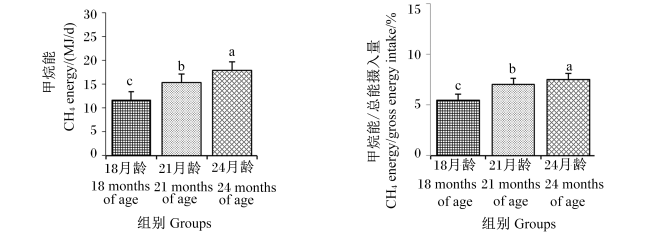
图1可知,18、21、24月龄组之间荷斯坦奶牛瘤胃甲烷能和甲烷能/总能摄入量有差异显著(P<0.05),甲烷能和甲烷能/总能摄入量随着月龄的增大而显著升高(P<0.05)。瘤胃甲烷能分别为11.57、15.31、17.87 MJ/d,甲烷能/总能摄入量分别为5.47%、7.04%、7.49%。
图1 不同生理阶段(18、21、24月龄)荷斯坦后备奶牛的瘤胃甲烷能和甲烷能/总能摄入量

数据柱形标注不同小写字母表示差异显著(P<0.05)。

Fig.1 Ruminal CH4 energy and CH4 energy/gross energy intake of Holstein heifers at different physiological periods (18, 21 and 24 months of age)

Value columns with different small letters mean significant difference (P<0.05).

3 讨论

3.1 不同生理阶段(18、21、24月龄)荷斯坦后备奶牛的生长性能

后备奶牛发育特点体现在体型与体重的变化上。王志刚等[18]在荷斯坦奶牛杂交效果中研究表明,18月龄的荷斯坦后备奶牛的体重为(497.63±5.52) kg;与本试验中18月龄荷斯坦后备奶牛体重[(512.2±11.9) kg]相比,其数值偏低。在理想情况下,21月龄奶牛的体重在525~569 kg,24月龄奶牛的体重在595~645 kg,与本试验中的奶牛体重基本一致。18、21、24月龄龄荷斯后备奶牛平均日增重分别为0.50、0.24、0.23 kg/d,体重增长速度减缓。黄文明等[19]对西安地区170头荷斯坦后备奶牛调查发现,随着后备奶牛月龄的增长,体尺不断增加,0~6月龄生长速度最快,6月龄后生长速度放缓。同时通过饲养调控减缓奶牛的生长速度,防止奶牛过度肥胖,影响奶牛的后期生长性能[20]。成年荷斯坦母牛平均体重在650~750 kg,24月龄奶牛是第1次产犊,体重会低于经产奶牛的体重。

3.2 不同生理阶段(18、21、24月龄)荷斯坦后备奶牛的营养物质表观消化率

反刍动物的营养物质消化率受到如动物品种和生理阶段、饲料组成和结构等诸多因素的影响。饲粮中纤维水平被认为是影响营养物质消化率的主要因素。Zhang等[21]研究发现,荷斯坦后备奶牛饲粮中精饲料的比例由20%增加至80%时,其干物质表观消化率由73.08%增加至80.88%,而中性洗涤纤维和酸性洗涤纤维表观消化率则分别由61.75%和60.74%下降至49.19%和46.28%。在本试验中,3个阶段的荷斯坦后备奶牛的精料比例保持一致,均低于20%,其干物质消化率则分别为69.58%、74.07%和75.38%,与Zhang等[21]的研究结构一致。史仁煌等[22]研究了饲粮中不同中性洗涤纤维水平对荷斯坦泌乳奶牛营养物质表观消化率的影响,发现随饲粮中性洗涤纤维水平的升高,中性洗涤纤维和酸性洗涤纤维表观消化率显著增加,原因可能是纤维水平的升高延长了奶牛咀嚼和反刍时间,从而有助于瘤胃内纤维分解菌的大量繁殖,纤维酶活性提高,增加了中性洗涤纤维和酸性洗涤纤维表观消化率。Jiao等[11]比较了6、12、18和22月龄荷斯坦后备奶牛的营养物质表观消化率,发现4个阶段的干物质表观消化率没有显著差异,分别为0.79%、0.78%、0.78%和0.74%,略高于本试验中的结果;但其4个阶段的平均中性洗涤纤维和酸性洗涤纤维表观消化率分别为0.76%和0.78%,显著高于本试验结果(0.71%和0.62%),原因可能与动物的类型以及饲粮中饲料原料来源等有关。

3.3 不同生理阶段(18、21、24月龄)荷斯坦后备奶牛的瘤胃CH4排放规律

瘤胃CH4是饲料有机物经过微生物的降解作用以及产甲烷菌的合成作用产生的副产物,是饲料能量的损失,也是重要的温室气体之一。目前发现瘤胃中的CH4来源有3条途径,82%的CH4是通过甲酸脱氢酶催化CO2-氢气(H2)还原产生,还有一部分以甲酸、乙酸和丁酸等挥发性脂肪酸为底物发酵产生,同时也发现部分由果胶发酵产物分解而来[5]。根据联合国政府间气候变化专门委员会2006年报告显示,西欧地区每头后备奶牛的瘤胃CH4排放量为57 kg/年[23],而我国平均每头奶牛瘤胃CH4排放量为110~182 kg/年[5]。奶牛的瘤胃CH4排放量与采食量和体重有显著相关,随着年龄的增长,到5岁时到达最大值后开始降低[24]。在本试验中,18、21、24月龄荷斯坦后备奶牛瘤胃CH4排放量分别为207.80、275.10、321.10 g/d。李斌昌[10]在使用六氟化硫示踪方法研究9、12、15月龄后备奶牛瘤胃CH4排放量分别为117.7、159.7、229.6 g/d,后备奶牛的甲烷排放量随着月龄增长而增加[25]。18、21、24的甲烷能/总能摄入量分别为5.47%、7.04%、7.49%。Morrison等[26]在放牧状态下测定5~10月龄、12~17月龄和18~23月龄荷斯坦奶牛甲烷能/总能摄入量分别为5.9%、6.9%、6.6%。Jiao等[27]研究6、12、18、22月龄荷斯坦奶牛的消化代谢与瘤胃发酵特征,发现不同月龄的甲烷能/总能摄入量存在差异,分别为6.8%、6.7%、6.45%、6.35%。

4 结论

18、21、24月龄荷斯坦后备奶牛的平均日增重分别为0.50、0.24、0.23 kg/d,干物质表观消化率分别为69.58%、74.07%、75.38%,瘤胃CH4排放量分别为207.8、275.1、321.1 g/d,CH4/干物质采食量分别为21.67、26.90、26.36 g/kg,甲烷能/总能摄入量分别为5.47%、7.04%、7.49%。18、21、24月龄荷斯坦后备奶牛瘤胃CH4排放量随着月龄的增大而显著升高。
[1]
苏健, 梁英波, 丁麟, 等. 碳中和目标下我国能源发展战略探讨[J]. 中国科学院院刊, 2021, 36(9):1001-1009.

SU J, LIANG Y B, DING L, et al. Research on China’s energy development strategy under carbon neutrality[J]. Bulletin of Chinese Academy of Sciences, 2021, 36(9):1001-1009. (in Chinese)

[2]
胡婉玲, 黄玛兰, 王红玲. 低碳背景下畜牧业甲烷排放现状与减排策略研究[J]. 华中农业大学学报, 2022, 41(3):115-123.

HU W L, HUANG M L, WANG H L. Methane emission and mitigation strategy of animal husbandry under low carbon background[J]. Journal of Huazhong Agricultural University, 2022, 41(3):115-123. (in Chinese)

[3]
周艳, 邓凯东, 董利锋, 等. 反刍家畜肠道甲烷的产生与减排技术措施[J]. 家畜生态学报, 2018, 39(4):6-10,54.

ZHOU Y, DENG K D, DONG L F, et al. Intestinal tract methane production and emission reduction measures in ruminants[J]. Acta Ecologae Animalis Domastici, 2018, 39(4):6-10,54. (in Chinese)

[4]
中国农业年鉴编辑委员会. 中国农业年鉴-2017[M]. 北京: 中国农业出版社, 2018:126-127.

China Agricultural Yearbook Editorial Committee. China agriculture yearbook-2017[M]. Beijing: China Agriculture Press, 2018:126-127. (in Chinese)

[5]
刁其玉. 反刍动物甲烷生成与营养调控减排措施[J]. 畜牧产业, 2023(1):39-43.

DIAO Q Y. Methanogenesis and nutrient regulation emission reduction measures in ruminants[J]. Animal Agriculture, 2023(1):39-43. (in Chinese)

[6]
周怿, 刁其玉. 反刍动物瘤胃甲烷气体生成的调控[J]. 草食家畜, 2008(4):21-24.

ZHOU Y, DIAO Q Y. Manipulation for the methane production in rumen[J]. Grass-Feeding Livestock, 2008(4):21-24. (in Chinese)

[7]
王贝. 饲粮NDF/NFC对不同泌乳阶段奶牛瘤胃甲烷排放量、营养物质表观消化率及生产性能的影响[D].硕士学位论文. 阿拉尔: 塔里木大学, 2019.

WANG B. Effects of dietary NDF/NFC on rumen methane emissions,nutrient apparent digestibility and production performance of dairy cows during different lactating stages[D].Master’s Thesis. Alaer: Tarim University, 2019. (in Chinese)

[8]
CUNHA C S, MARCONDES M I, VELOSO C M, et al. Compositional and structural dynamics of the ruminal microbiota in dairy heifers and its relationship to methane production[J]. Journal of the Science of Food and Agriculture, 2019, 99(1):210-218.

DOI PMID

[9]
JIA P, TU Y, LIU Z H, et al. Characterization and mitigation option of greenhouse gas emissions from lactating Holstein dairy cows in East China[J]. Journal of Animal Science and Biotechnology, 2022, 13(1):88.

DOI PMID

[10]
李斌昌. 日粮精粗比对不同月龄后备奶牛甲烷排放与生长性能和营养物质消化的影响[D].硕士学位论文. 兰州: 甘肃农业大学, 2019.

LI B C. Effects of dietary concentrate to roughage ratio on methane emission, growth performance and nutrient digestion of reserve cows at different ages[D].Master’s Thesis. Lanzhou: Gansu Agricultural University, 2019. (in Chinese)

[11]
JIAO H P, YAN T H, WILLS D A, et al. Development of prediction models for quantification of total methane emission from enteric fermentation of young Holstein cattle at various ages[J]. Agriculture,Ecosystems & Environment, 2014, 183:160-166.

DOI

[12]
中华人民共和国国家质量监督检验检疫总局, 中国国家标准化管理委员会. 饲料中钙的测定:GB/T 6436—2018[S]. 北京: 中国标准出版社, 2018.

General Administration of Quality Supervision, Inspection and Quarantine of the China, Standardization Administration of China. Determination of calcium in feed: GB/T 6436—2018[S]. Beijing: China Standards Press, 2018. (in Chinese)

[13]
中华人民共和国国家质量监督检验检疫总局, 中国国家标准化管理委员会. 饲料中磷的测定: GB/T 6437—2018[S]. 北京: 中国标准出版社, 2018.

General Administration of Quality Supervision, Inspection and Quarantine of the China, Standardization Administration of China. Determination of phosphorus in feed: GB/T 6437—2018[S]. Beijing: China Standards Press, 2018. (in Chinese)

[14]
中华人民共和国国家质量监督检验检疫总局, 中国国家标准化管理委员会. 饲料中盐酸不溶灰分的测定:GB/T 23742—2009[S]. 北京: 中国标准出版社, 2009.

General Administration of Quality Supervision,Inspection and Quarantine of the People’s Republic of China, Standardization Administration of the People’s Republic of China. Animal feeding stuffs-determination of ash insoluble in hydrochloric acid:GB/T 23742—2009[S]. Beijing: Standards Press of China, 2009. (in Chinese)

[15]
刘志豪, 贾鹏, 赖琦, 等. 泌乳牛不同胎次干奶期瘤胃发酵指标与甲烷产量的特征[J]. 畜牧兽医学报, 2022, 53(12):4296-4305.

LIU Z H, J P, L Q, et al. Characteristics of rumen fermentation indexes and methane production of lactating cows in different parity dry milk periods[J]. Journal of Animal Husbandry and Veterinary Medicine, 2022, 53(12):4296-4305. (in Chinese)

[16]
JONKER A, MOLANO G, ANTWI C, et al. Enteric methane and carbon dioxide emissions measured using respiration chambers,the sulfur hexafluoride tracer technique,and a GreenFeed head-chamber system from beef heifers fed alfalfa silage at three allowances and four feeding frequencies[J]. Journal of Animal Science, 2016, 94(10):4326-4337.

DOI

[17]
HRISTOV A N, KEBREAB E, NIU M, et al. Symposium review:uncertainties in enteric methane inventories,measurement techniques,and prediction models[J]. Journal of Dairy Science, 2018, 101(7):6655-6674.

DOI

[18]
王志刚, 常瑶, 邱小田, 等. 德系西门塔尔牛与荷斯坦牛杂交效果分析[J]. 中国奶牛, 2017(12):26-30.

WANG Z G, CHANG Y, QIU X T, et al. The analysis of efficiency of crossbred cows between German Simmental and Holstein[J]. China Dairy Cattle, 2017(12):26-30. (in Chinese)

[19]
黄文明, 张勇, 郭海明, 等. 荷斯坦后备奶牛生长发育规律的研究进展[J]. 畜牧与兽医, 2016, 48(5):131-135.

HUANG W M, ZHANG Y, GUO H M, et al. Research advance of growth and development of Holstein calf[J]. Animal Husbandry & Veterinary Medicine, 2016, 48(5):131-135. (in Chinese)

[20]
李胜利. 奶牛营养学[M]. 北京: 科学出版社, 2020:432-436.

LI S L. Nutriology of dairy cattle[M]. Beijing: Science Press, 2020:432-436.. (in Chinese)

[21]
ZHANG J, SHI H, WANG Y, et al. Effects of limit-feeding diets with different forage-to-concentrate ratios on nutrient intake, rumination, ruminal fermentation, digestibility, blood parameters and growth in Holstein heifers[J]. Animal Science Journal, 2018, 89(3):527-536.

DOI PMID

[22]
史仁煌, 董双钊, 付瑶, 等. 饲粮中性洗涤纤维水平对泌乳高峰期奶牛生产性能、营养物质表观消化率及血清指标的影响[J]. 动物营养学报, 2015, 27(8):2414-2422.

DOI

SHI R H, DONG S Z, FU Y, et al. Effects of dietary neutral detergent fiber level on production performance, apparent digestibility of nutrients and serum indicators of dairy cows during peak lactation[J]. Journal of Animal Nutrition, 2015, 27(8):2414-2422. (in Chinese)

[23]
贾鹏, 董利锋, 屠焰, 等. 反刍动物瘤胃甲烷产生与排放的主要生物学特征[J]. 动物营养学报, 2022, 34(6):3411-3417.

DOI

JIA P, DONG L F, TU Y, et al. Main biological characteristics of methane production and emission in ruminants[J]. Chinese Journal of Animal Nutrition, 2022, 34(6):3411-3417. (in Chinese)

DOI

[24]
GRANDL F, AMELCHANKA S L, FURGER M, et al. Biological implications of longevity in dairy cows:2.Changes in methane emissions and efficiency with age[J]. Journal of Dairy Science, 2016, 99(5):3472-3485.

DOI

[25]
DONG H M, MANDINO J, MCALLISTER T A, et al. Chapter 10:emissions from livestock and manure management[M]// EGGELSTONS, BUENDIAL, MIWAK, et al. 2006 IPCC Guidelines for National Greenhouse Gas Inventories. Kamiyamaguchi: The Institute for Global Environmental Strategies, 2006:10.1-10.87.

[26]
MORRISON MCBRIDE GORDONA W. et al. Methane emissions from grazing Holstein-Friesian heifers at different ages estimated using the sulfur hexafluoride tracer technique[J]. Engineering, 2017, 3(5):753-759.

DOI

[27]
JIAO H P, YAN T H, WILLS D A, et al. Development of prediction models for quantification of total methane emission from enteric fermentation of young Holstein cattle at various ages[J]. Agriculture,Ecosystems&Environment, 2014, 183:160-166.

Outlines

/