RESEARCH PAPER

Effects of Propionic Acid on Silage Quality and Microbial Community of Hybrid Pennisetum Silage

  • ZHOU Yi , 1 ,
  • ZHANG Juan 1 ,
  • LIU Yijia 1, 2 ,
  • LING Wenqing 1 ,
  • LI Jue 1 ,
  • YANG Fulin , 1, ** ,
  • ZHOU Jing , 2, **
Expand
  • 1 College of Animal Sciences (College of Bee Science), Fujian Agriculture and Forestry University, Fuzhou 350002, China
  • 2 China National Engineering Research Center of Juncao Technology, Fujian Agriculture and Forestry University, Fuzhou 350002, China
**YANG Fulin, professor, E-mail: ;
ZHOU Jing, assistant professor, E-mail:

*Contributed equally

Received date: 2023-02-21

  Online published: 2023-08-10

Abstract

This experiment aimed to study the effects of different concentrations of propionic acid on the nutritional quality, fermentation quality and fermentation indexes and microbial number after aerobic exposure of hybrid Pennisetum silage, and selected the appropriate concentration of propionic acid for microbial diversity analysis. The propionic acid concentrations of hybrid Pennisetum silage in each group were 0 (control group, CK group), 0.1% (T1 group),0.5% (T2 group) and 1.0% (T3 group), respectively. After 60 days of silage, the nutritional quality, fermentation quality and fermentation indexes and microbial number after aerobic exposure of hybrid Pennisetum silage were measured, selected the appropriate propionic acid group (PA group) by referring to various indexes and membership function method, and analyzed its microbial diversity. The results showed as follows: 1) after 60 days of silage, compared with the CK group, the dry matter (DM) and crude protein (CP) contents of T1, T2 and T3 groups were significantly increased (P<0.05), the water soluble carbohydrate (WSC) content of T2 and T3 groups was significantly increased (P<0.05), the neutral detergent fiber (NDF) and acid detergent fiber (ADF) contents of T1 and T2 groups were significantly decreased (P<0.05), the lactic acid (LA) content of T2 and T3 groups was significantly increased (P<0.05), and the pH and acetic acid (AA), butyric acid (BA) contents and ammonia nitrogen/total nitrogen of T2 and T3 groups were significantly decreased (P<0.05). 2) During aerobic exposure, compared with the CK group, the pH at aerobic exposure 0, 3, 6 and 9 days of T2 and T3 groups was significantly decreased (P<0.05), the LA content at aerobic exposure 0, 3 and 9 days of T1, T2 and T3 groups was significantly increased (P<0.05), the ammonia nitrogen content at aerobic exposure 0, 3, 6 and 9 days of T1, T2 and T3 groups was significantly increased (P<0.05), the lactic acid bacteria (LAB) number at aerobic exposure 6 and 9 days of T2 and T3 groups was significantly decreased (P<0.05), the yeast number at aerobic exposure 0, 3, 6 and 9 days of T2 and T3 groups was significantly decreased (P<0.05), and the aerobic bacteria (AB) number at aerobic exposure 6 and 9 days of T2 and T3 groups was significantly decreased (P<0.05). 3) The comprehensive value evaluation value of T2 group was the highest. 4) At the phylum level, the dominant bacteria of hybrid Pennisetum silage were Firmicutes and Proteobacteria; at the genus level, the dominant bacteria of hybrid Pennisetum silage were Lactobacillus and Delftia. Compared with the CK group, the Firmicutes relative abundance of PA group was decreased, and the Proteobacteria relative abundance was increased; the relative abundances of Lactobacillus, Weissella and Enterobacter of PA group were decreased, and the Delftia relative abundance was increased. In conclusion, adding appropriate concentration of propionic acid can improve the nutritional value, fermentation quality, aerobic stability and microbial community composition of hybrid Pennisetum silage, among which adding 0.5% propionic acid has the best effect.

Cite this article

ZHOU Yi , ZHANG Juan , LIU Yijia , LING Wenqing , LI Jue , YANG Fulin , ZHOU Jing . Effects of Propionic Acid on Silage Quality and Microbial Community of Hybrid Pennisetum Silage[J]. Chinese Journal of Animal Nutrition, 2023 , 35(8) : 5404 -5417 . DOI: 10.12418/CJAN2023.498

近年来,狼尾草属牧草因其广泛适应性、高生物产量、高蛋白质含量等特性,受到了世界各国农业部门以及众多学者专家的高度关注[1]。杂交狼尾草(hybrid Pennisetum)根系发达,大多数具有直立茎,水溶性糖含量高,生长速度快,分蘖能力强[2]。目前,我国杂交狼尾草多种植于南方等潮湿多雨地区,导致干草调制比较困难;另外,杂交狼尾草产量集中,利用期短,存在季节不平衡的问题[3]。青贮在保存杂交狼尾草等牧草上卓有成效。青贮是利用原料上附着的乳酸菌(lactic acid bacteria,LAB)在厌氧环境下发酵,使当中的可溶性糖转化为以乳酸(lactic acid,LA)为基础的有机酸,青贮后的牧草不但可以更高效地保存营养物质,还增加了适口性和饲料利用率[4]
有机酸能够抑制好氧微生物和腐败细菌的活性,从而保存营养物质和提高发酵品质,在青贮饲料中起着举足轻重的作用[5]。丙酸(propionic acid)是一种重要的有机酸,在工业尤其是在食品工业中具有广泛的应用,目前也越来越多的应用在畜牧业中[6]。据报道,丙酸可通过在微生物表面保持活性同时与氨基酸竞争酶活性位点上的空间,促使生物的细胞渗透性改变,从而保持抗真菌的特性[7]。青贮中添加丙酸可以降低青贮饲料的pH,阻止有害微生物对蛋白质的降解和水溶性碳水化合物(WSC)的利用,以保留更多的发酵底物,从而提高青贮饲料的发酵品质[8]。陈雷等[9]研究表明,丙酸在抑制有害微生物的同时会抑制LAB的活性,但其对于改善青贮饲料有氧稳定性具有一定的作用。利用高通量测序技术,可以从微观层次深入了解微生物群落结构的变化,例如从微生物的种类组成、相对丰度等方面阐述其多样性[10]。目前,大多数学者聚焦在研究丙酸对老麦芒等其他牧草基础营养品质和发酵品质的影响[11-12],也有不少相关研究人员探索了丙酸对动物脂肪细胞代谢沉积的影响[13-14],同时还有部分学者对于丙酸作为饲料防霉剂的效果展开了剖析[15-16]。然而,鲜有人深入研究丙酸对杂交狼尾草的青贮品质、有氧暴露后发酵特性以及微生物群落结构组成的影响。
因此,本试验探究了不同浓度丙酸对杂交狼尾草青贮品质、有氧暴露后发酵特性以及微生物数量的影响,筛选出适宜的丙酸浓度,再研究其微生物群落结构组成,以期为提高杂交狼尾草青贮品质、延缓有氧暴露阶段的腐败以及改善微生物群落结构提供科学依据与实践参考。

1 材料与方法

1.1 试验材料

杂交狼尾草青贮原料于2021年5月采自福建省南平市延平区长富牧场,位于东经119度北纬26度。杂交狼尾草株高为3 m左右,在距离地面8~10 cm处进行刈割,将其萎焉过夜后,再使用铡刀切至1~2 cm备用。丙酸(分析纯,≥99.5%)由福州某生物科技有限公司提供。杂交狼尾草化学特性与微生物组成见表1
表1 杂交狼尾草化学特性与微生物组成

Table 1 Chemical characteristics and microbial composition of hybrid Pennisetum

项目Items 含量Content
干物质DM/(g/kg FM) 181.33
pH 6.22
水溶性碳水化合物WSC/(g/kg DM) 96.35
粗蛋白质CP/(g/kg DM) 143.00
中性洗涤纤维NDF/(g/kg DM) 635.00
酸性洗涤纤维ADF/(g/kg DM) 343.00
乳酸菌LAB/[lg(CFU/g FM)] 6.24
酵母菌Yeast/[lg(CFU/g FM)] 6.27
好氧菌AB/[lg(CFU/g FM)] 6.42

FM:鲜物质 fresh matter;DM:干物质 dry matter。

1.2 试验设计

各组杂交狼尾草青贮中丙酸浓度分别为0(对照组,CK组)、0.1%(T1组)、0.5%(T2组)和1.0%(T3组)。试验前,先使用无菌水将称取对应量的丙酸,配制为10 mL的溶液,均匀喷洒于杂交狼尾草表面,混合均匀后装于24 cm×35 cm青贮袋中,每袋400 g,每组6个重复,用真空机进行密封,再放置于室温进行厌氧发酵60 d。在青贮60 d后对杂交狼尾草青贮品质进行测定,以确定适宜的丙酸添加浓度,再将CK组和筛选出来的适宜浓度丙酸组(PA组)青贮样品于-80 ℃保存,用于微生物多样性的测定。

1.3 指标测定

1.3.1 原料特性和青贮品质

干物质(DM)含量采用65 ℃烘干衡重法测定[16]。青贮样品(10 g)加入无菌水(90 mL)混合,于4 ℃浸泡24 h,用双层滤纸过滤后的液体静置0.5 h备用,再使用pH计测定pH[17]。WSC含量采用蒽酮-硫酸比色法测定[18]。粗蛋白质(CP)含量采用Lee[19]的方法的测定。中性洗涤纤维(NDF)、酸性洗涤纤维(ADF)含量采用ANKOM半自动纤维分析仪测定。总氮(TN)含量采用K9840凯氏定氮仪测定。氨态氮(NH3-N)含量采用苯酚-次氯酸钠法测定[20]。有机酸含量采用高效液相仪(CT0-10AS,日本岛津公司)测定[21],色谱柱为岛津WondaSil C18 Superb液相色谱柱(250 mm×4.6 mm,5 μm),流动相A/B(甲醇/0.02 mol/L NaH2PO4),使用硫酸调节流动相B至2.70;等梯度洗脱,A、B流动相分别占14%、86%,检测波长为210 nm,一次循环测定时间为25 min,柱温为30 ℃,流速1 mL/min,进样体积为20 μL。

1.3.2 有氧暴露后发酵指标和微生物数量

杂交狼尾草青贮样品经发酵60 d开袋,然后进行有氧暴露,于开袋后0、3、6和9 d分别取青贮样品,各组不同时间点取3个重复。同时,测定有氧暴露后的pH及LA、NH3-N含量,LAB、酵母菌(yeast)和好氧菌(AB)数量分别采用MRS培养基、麦芽糖浸粉琼脂培养基(potato dextrose agar,PDA)和平板计数琼脂培养基(plate count agar,PCA)进行培养,然后进行平板计数。

1.3.3 综合价值评价

参考冯启贤等[22]的方法,用隶属函数法综合评价青贮后杂交狼尾草的营养品质、发酵特性以及有氧暴露9 d后的发酵指标和微生物数量,共17项指标。将DM、CP、WSC、LA、AA、PA、有氧暴露9 d后指标(LA、LAB)定义为正向指标,NDF、ADF、pH、NH3-N/TN、BA、有氧暴露9 d后指标(pH、NH3-N、Yeast、AB)定义为负向指标。每组各隶属度分别求平均值后排序,公式如下:
UX=(Xij-Ximin )∕(Ximax-Ximin);
UX=1-(Xij-Ximin)∕(Ximax-Ximin);
( U - X )= 1 n n ( j = 1 )UX
式中:UXUX分别为某一指标的正向、负向隶属度;( U - X )为各个隶属度的平均值;XimaxXimin分别为各指标测定的最大值和最小值;Xij为各指标测定的实际值;i表示不同组别;j表示青贮指标;n为总指标数。

1.3.4 微生物多样性

对CK组和PA组青贮样品进行高通量测序,每组3个重复。用于DNA提取的冷冻溶液在4 ℃下解冻,然后用十六烷基三甲基溴化铵(CTAB)与十二烷基硫酸钠(SDS)进行总DNA的提取,再用1%琼脂糖凝胶进行DNA的浓缩与纯化。用引物序列315F(5'-CCTAYGGGR BGCASCAG-3')与806R(5'-GGACTACNNGGGTATCTAAT-3')对16S rRNA基因V3~V4高变区进行PCR扩增。利用琼脂糖凝胶电泳对PCR扩增产物进行鉴定,再使用NEXTFLEX® Rapid DNA-Seq Kit进行构建MiSeq文库并测序。测序工作于上海美吉生物科技医药有限公司完成。本研究的测序数据已存入NCBI高通量测序数据库,登录号为PRJNA 945806。

1.4 数据统计分析

利用Excel 2016软件进行基础数据统计与初步分析。使用SPSS 26.0软件对数据进行单因素方差分析和双因素方差分析,采用Duncan氏法对数据进行多重比较,结果用平均值±标准差表示,P<0.05为差异显著。使用GraphPad Prism 8软件进行绘图。

2 结果与分析

2.1 不同浓度丙酸对杂交狼尾草青贮营养品质的影响

表2可以看出,青贮60 d后,T1、T2、T3组的DM含量均显著高于CK组(P<0.05),且T2组的DM含量显著高于T1、T3组(P<0.05)。T1、T2、T3组的CP含量均显著高于CK组(P<0.05),且T2、T3组的CP含量显著高于T1组(P<0.05)。T1组的WSC含量显著低于CK组(P<0.05),T2、T3组的WSC含量显著高于CK组(P<0.05)。T1、T2组的NDF和ADF含量显著低于CK组(P<0.05),T3组的NDF和ADF含量与CK组无显著差异(P>0.05)。
表2 不同丙酸浓度对杂交狼尾草青贮营养品质的影响

Table 2 Effects of different concentrations of propionic acid on nutritional quality of hybrid Pennisetum silage g/kg DM

组别
Groups
干物质
DM
粗蛋白质
CP
可溶性碳水化合物
WSC
中性洗涤纤维
NDF
酸性洗涤纤维
ADF
CK 207.00±1.50d 82.52±5.11c 13.66±1.02c 570.48±13.09a 342.61±2.25a
T1 220.50±0.70c 98.21±5.05b 9.47±0.70d 492.53±25.71b 290.55±19.85b
T2 239.50±2.10a 122.96±7.18a 23.81±0.29b 521.85±12.21b 300.57±1.60b
T3 226.00±0.10b 124.12±4.98a 28.46±1.07a 593.47±15.61a 368.06±21.98a

同列数据肩标不同小写字母表示差异显著(P<0.05),相同或无字母表示差异不显著(P>0.05)。表3同。

In the same column, values with different small letter superscripts mean significant difference (P<0.05), while with the same or no letter superscripts mean no significant difference (P>0.05). The same as Table 3.

2.2 不同浓度丙酸对杂交狼尾草青贮发酵品质的影响

表3可以看出,T2、T3组的pH显著低于CK组(P<0.05),T1组的pH显著高于CK组(P<0.05)。T2、T3组的LA含量显著高于CK组(P<0.05),且T2组的LA含量显著高于T1、T3组(P<0.05)。T1组的AA含量显著高于CK组(P<0.05),T2、T3组的AA含量显著低于CK组(P<0.05)。T2组的PA含量显著高于CK组(P<0.05),T1、T3组的PA含量显著低于CK组(P<0.05)。T1、T2、T3组的BA含量均显著低于CK组(P<0.05),且T2、T3组的BA含量显著低于T1组(P<0.05)。T1组的NH3-N/TN显著高于CK组(P<0.05),T2、T3组的NH3-N/TN显著低于CK组(P<0.05)。
表3 不同丙酸浓度对杂交狼尾草青贮发酵品质的影响

Table 3 Effects of different concentrations of propionic acid on fermentation quality of hybrid Pennisetum silage

组别
Groups
pH 乳酸
LA/(g/kg DM)
乙酸
AA/(g/kg DM)
丙酸
PA/(g/kg DM)
丁酸
BA/(g/kg DM)
氨态氮/总氮
NH3-N/TN/%
CK 4.30±0.03b 8.64±0.13cd 0.17±0.02b 2.17±0.04b 0.50±0.02a 42.63±3.27b
T1 4.34±0.02a 10.01±0.22c 0.30±0.03a 1.75±0.03c 0.28±0.01b 50.02±2.77a
T2 3.49±0.01d 17.18±0.53a 0.01±0.00c 2.60±0.07a 0.03±0.01c 7.14±0.49c
T3 3.55±0.01c 13.38±0.47b 0.02±0.00c 1.77±0.01c 0.02±0.01c 6.85±0.29c

2.3 不同浓度丙酸对杂交狼尾草青贮有氧暴露后发酵指标和微生物数量的影响

2.3.1 有氧暴露后发酵指标

表4可以看出,丙酸浓度对pH及LA、NH3-N含量的影响显著(P<0.05),有氧暴露时间对pH及LA、NH3-N含量的影响显著(P<0.05),丙酸浓度和有氧暴露时间交互作用对pH及LA、NH3-N含量的影响显著(P<0.05)。
表4 不同浓度丙酸对杂交狼尾草青贮有氧暴露后发酵指标的影响

Table 4 Effects of different concentrations of propionic acid on fermentation indexes of hybrid Pennisetum silage after aerobic exposure

项目
Items
组别
Groups
有氧暴露时间Aerobic exposure time/d 标准误
SE
PP-value
0 3 6 9 丙酸浓度
Propionic acid
concentration
有氧暴露时间
Aerobic exposure
time
丙酸浓度×
有氧暴露时间
Propionic acid
concentration×
aerobic exposure
time
CK 4.30±0.03Ca 5.12±0.00Cb 7.14±0.00Bb 7.75±0.00Aa 1.43 <0.001 <0.001 <0.001
pH T1 4.32±0.00Da 5.93±0.00Ca 7.77±0.00Aa 7.57±0.00Bb
T2 3.48±0.00Dc 3.91±0.00Bd 3.86±0.00Cd 4.67±0.00Ad
T3 3.54±0.00Db 4.45±0.00Bc 3.95±0.00Cc 6.20±0.00Ac
CK 8.64±0.13Ad 8.44±0.03Bd 0.76±0.04Cc 0.18±0.04Dc 5.16 <0.001 <0.001 <0.001
乳酸 T1 10.01±0.22Ac 8.84±0.25Bc 0.37±0.08Cd 0.31±0.08Cb
LA/(g/kg DM) T2 17.18±0.53Aa 9.73±0.10Ba 5.45±0.13Cb 1.59±0.11Da
T3 13.38±0.46Ab 9.14±0.25Bb 6.17±0.21Ca 0.33±0.02Db
CK 9.74±0.35Ca 18.60±0.18Aa 11.21±0.11Ba 5.29±0.03Da 4.99 <0.001 <0.001 <0.001
氨态氮 T1 7.84±0.28ABb 7.70±0.14Bb 8.06±0.03Ab 4.35±0.06Cb
NH3-N/(g/kg DM) T2 1.41±0.18Ac 1.57±0.01Ac 1.02±0.07Bc 0.39±0.03Cd
T3 1.36±0.06Bd 1.63±0.02Ac 1.12±0.23Cc 0.81±0.01Dc

同行数据肩标不同大写字母表示不同有氧暴露时间之间差异显著(P<0.05),同列数据肩标不同小写字母表示不同组别之间差异显著(P<0.05)。

Values in the same row with different capital letter superscripts mean significant difference in different aerobic exposure times (P<0.05), and values in the same column with different small letter superscripts mean significant difference in different groups (P<0.05).

CK组有氧暴露6、9 d的pH显著高于有氧暴露0、3 d(P<0.05),T1、T2、T3组有氧暴露3、6、9 d的pH显著高于有氧暴露0 d(P<0.05)。与CK组相比,T1组有氧暴3、6 d的pH显著升高(P<0.05),T2、T3组有氧暴露0、3、6、9 d的pH显著降低(P<0.05)。
CK、T1、T2、T3组有氧暴露3、6、9 d的LA含量显著低于有氧暴露0 d(P<0.05)。与CK组相比,T1、T2、T3组有氧暴露0、3、9 d的LA含量显著升高(P<0.05),T2、T3组有氧暴露6 d的LA含量显著升高(P<0.05)。
CK组有氧暴露3、6、9 d的NH3-N含量显著高于有氧暴露0 d(P<0.05),T1组有氧暴露9 d的NH3-N含量显著低于有氧暴露0 d(P<0.05),T2、T3组有氧暴露6、9 d的NH3-N含量显著低于有氧暴露0 d(P<0.05)。与CK组相比,T1、T2、T3组有氧暴露0、3、6、9 d的NH3-N含量显著降低(P<0.05)。

2.3.2 微生物数量

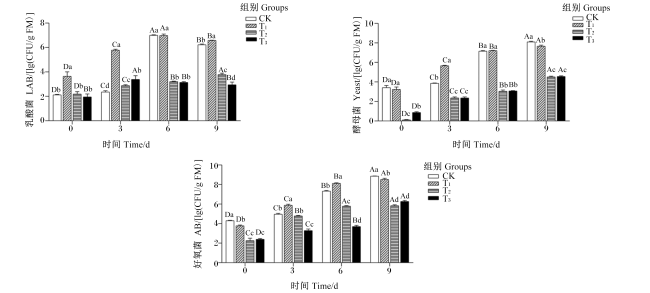
图1可以看出,CK、T1、T2组有氧暴露3、6、9 d的LAB数量显著高于有氧暴露0 d(P<0.05),T3组有氧暴露3 d的LAB数量显著高于有氧暴露0、6、9 d(P<0.05)。与CK组相比,T1组有氧暴露0、3、9 d的LAB数量显著升高(P<0.05),T2、T3组有氧暴露6、9 d的LAB数量显著降低(P<0.05)。
图1 不同浓度丙酸对杂交狼尾草青贮有氧暴露后微生物数量的影响

数据柱形标注不同小写字母表示不同组别之间差异显著(P<0.05),不同大写字母表示不同有氧暴露时间之间差异显著(P<0.05)。

Fig.1 Effects of different concentrations of propionic acid on microbial number of hybrid Pennisetum silage after aerobic exposure

Value columns with different small letter superscripts mean significant difference in different groups (P<0.05), and with different capital letter superscripts mean significant difference in different aerobic exposure times (P<0.05).

随着有氧暴露天数增加,CK、T1、T2、T3组的Yeast数量显著升高(P<0.05)。与CK组相比,T2、T3组有氧暴露0、3、6、9 d的Yeast数量显著降低(P<0.05),且T1组有氧暴露0、3、6、9 d的Yeast数量显著高于T2、T3组(P<0.05),T2组与T3组有氧暴露3、6、9 d的Yeast数量无显著差异(P>0.05)。
随着有氧暴露天数增加,CK、T1、T2、T3组的AB数量显著升高(P<0.05)。与CK组相比,T1、T2、T3组有氧暴露0 d的AB数量显著降低(P<0.05),T3组有氧暴露3 d的AB数量显著降低(P<0.05),T2、T3组有氧暴露6、9 d的AB数量显著降低(P<0.05)。

2.4 综合价值评价和排序

通过隶属函数分析了17项指标并求出隶属度平均值后进行排序,综合评价不同浓度丙酸处理杂交狼尾草的青贮效果。由表5可以看出,T2组的综合价值评定值最高,排序为:T2组(0.85)>T3组(0.56)>T1组(0.35)>CK组(0.17)。
表5 综合价值评价和排序

Table 5 Comprehensive value evaluation and rank

项目
Items
组别Groups
CK T1 T2 T3
青贮60 d Silage 60 d
干物质DM 0.00 0.42 1.00 0.58
粗蛋白质CP 0.00 0.38 0.97 1.00
可溶性碳水化合物WSC 0.22 0.00 0.76 1.00
中性洗涤纤维NDF 0.23 1.00 0.71 0.00
酸性洗涤纤维ADF 0.33 1.00 0.87 0.00
pH 0.05 0.00 1.00 0.93
乳酸LA 0.00 0.16 1.00 0.56
乙酸AA 0.55 1.00 0.00 0.03
丙酸PA 0.49 0.00 1.00 0.02
丁酸BA 0.00 0.46 0.98 1.00
氨态氮/总氮NH3-N/TN 0.17 0.00 0.99 1.00
有氧暴露9 d Aerobic exposure 9 d
pH 0.00 0.06 1.00 0.50
乳酸LA 0.00 0.09 1.00 0.11
氨态氮NH3-N 0.00 0.19 1.00 0.91
乳酸菌LAB 0.90 1.00 0.23 0.00
酵母菌Yeast 0.00 0.12 1.00 0.99
好氧菌AB 0.00 0.11 1.00 0.86
综合价值评定值Comprehensive value evaluation value 0.17 0.35 0.85 0.56
排序Rank 4 3 1 2

2.5 丙酸对杂交狼尾草青贮微生物多样性的影响

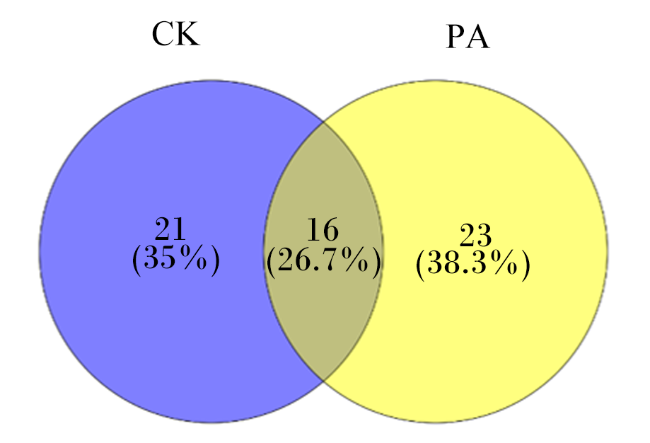
图2可以看出,本研究测定了CK和PA组的微生物群落,在97%的序列相似性的标准下,共得到60个操作分类单元(OTU)数目,其中CK组特有的OTU数目为21个,占总数的35%;PA组特有的OTU数目为23个,占总数的38.3%;2组共有的OTU数目为16个,占总数的26.7%。
图2 微生物OTU韦恩图

韦恩图中不同颜色的圈表示不同分组,图中的数字分别代表了每个分组共有或特有的OTU数目。CK:对照组;PA:适宜浓度丙酸组。

Fig.2 Microbial OTU Venn diagram

The colored circles in Venn diagram represented different groups, and the numbers in the diagram represented the number of OTU that common or unique in each group. CK: control group; PA: appropriate concentration propionic acid group.

2.5.1 Alpha多样性分析

表6可以看出,CK组和PA组的ACE指数、Chao1指数、Shannon指数和Simpson指数无显著差异(P>0.05)。与CK组相比,PA组的ACE指数、Chao1指数有所升高,Shannon指数有所降低。
表6 Alpha多样性指数分析

Table 6 Alpha diversity index anaiysis

项目
Items
组别Groups P
P-value
CK PA
ACE指数ACE index 210.17±14.17 226.37±11.14 0.19
Chao1指数Chao1 index 206.83±24.78 228.33±4.95 0.22
Shannon指数Shannon index 1.68±0.10 1.54±0.08 0.13
Simpson指数Simpson index 0.37±0.03 0.37±0.03 0.89
覆盖度Coverage 1.00±0.00 1.00±0.00 0.15

2.5.2 基于门水平的微生物群落结构分析

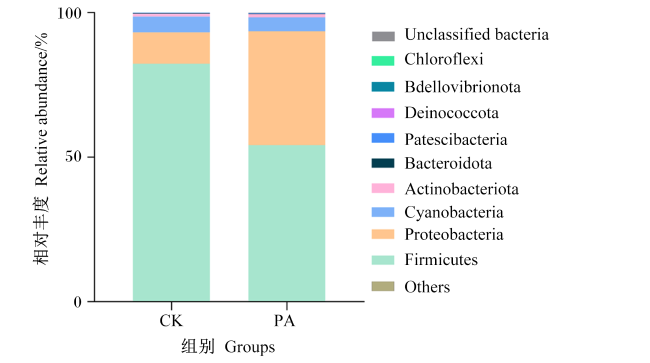
图3可以看出,在门水平上,杂交狼尾草青贮的优势菌门为厚壁菌门和变形菌门。与CK组相比,PA组的厚壁菌门相对丰度明显降低,变形菌门相对丰度明显升高,蓝藻菌门、放线菌门等无明显差异。
图3 杂交狼尾草青贮门水平的细菌相对丰度

Unclassified bacteria:未分类的细菌;Chloroflexi:绿弯菌门;Bdellovibrionota:蛭弧菌门;Deinococcota:脱氨基可卡因菌门;Patescibacteria:髌骨细菌门;Bacteroidota:拟杆菌门;Actinobacteriota:放线菌门;Cyanobacteria:蓝藻菌门;Proteobacteria:变形菌门;Firmicutes:厚壁菌门;Others:其他。

Fig.3 Relative abundance of bacteria at phylum level of hybrid Pennisetum silage

2.5.3 基于属水平的微生物群落结构分析

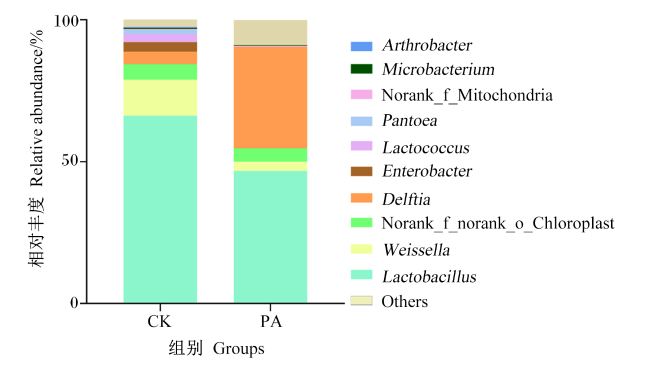
图4可以看出,在属水平上,杂交狼尾草青贮的优势菌属为乳杆菌属和代尔夫特菌属。与CK组相比,PA组的乳杆菌属、魏斯氏菌属和肠杆菌属相对丰度明显降低,代尔夫特菌属相对丰度明显升高。
图4 杂交狼尾草青贮属水平的细菌相对丰度

Arthrobacter:节杆菌属;Microbacterium:微杆菌属;Norank_f_Mitochondria:未被定义线粒体;Pantoea:泛菌属;Lactococcus:乳球菌属;Enterobacter:肠杆菌属;Delftia:代尔夫特菌属;Norank_f_norank_o_Chloroplast:未被定义叶绿体;Weissella:魏斯氏菌属;Lactobacillus:乳杆菌属;Others:其他。

Fig.4 Relative abundance of bacteria at genus level of hybrid Pennisetum silage

3 讨论

3.1 不同浓度丙酸对杂交狼尾草青贮营养品质的影响

杂交狼尾草水分含量高,茎秆中空不易压实,将鲜草晒制成干草的方法在我国南方多雨潮湿的夏季不便实现。因此,对狼尾草进行青贮不仅可以改善饲料的适口性,反季节供应提高其利用效率,还可进一步保证牧草的营养品质[23]。青贮饲料中DM的损失源于细胞的呼吸作用,好氧微生物可将碳水化合物转化为水、二氧化碳等,使营养成分分解[24]。本试验中,3个丙酸浓度组DM含量均提高,丙酸的添加抑制了一些AB等有害微生物的生长,因此更好地保存了发酵原料,使得DM损耗率降低,这与张佳伟等[25]研究结果相似。与青贮前相比,青贮后各组的CP含量下降,这可能是源于梭菌等有害菌及蛋白水解酶的活动,造成了不同程度的蛋白质降解[26]。青贮发酵后,与CK组相比,添加不同浓度丙酸均提高了CP含量。Zhao等[27]在苋菜青贮发酵中加入丙酸迅速降低青贮饲料的pH,防止CP被不良微生物分解从而减少CP的损失,这与本研究结果相似。本杂交狼尾草原料WSC含量为96.35 g/kg DM,远超WSC为60~70 g/kg DM作为优良青贮原料的最低要求[28]。青贮后,T2、T3组WSC含量显著升高,这与陈雷等[9]研究结果相似。这表明添加适宜浓度丙酸在杂交狼尾草青贮中对保存发酵底物行之有效。与CK组相比,T1、T2组的NDF、ADF含量下降,而T3组的NDF、ADF含量则升高,这与Zhang等[29]研究结果不一致。其原因可能是青贮原料不同,再者丙酸超过一定浓度虽然能有效地抑制青贮有害微生物增殖,减少营养物质损耗,但青贮体系中降解纤维素的微生物也可能受到抑制[30]。综合来看添加0.5%丙酸青贮60 d后的营养品质最好。

3.2 不同浓度丙酸对杂交狼尾草青贮发酵特性的影响

丙酸等有机酸的抗菌作用依赖于未解离的酸穿过细菌的细胞膜并释放质子,使细胞质酸化从而杀死或抑制微生物,对于青贮品质的改善具有显著效果[31]。优质的青贮饲料往往存在较低的pH以及较高的LA含量。本研究中,3个丙酸浓度组pH降低,LA含量增加,与王雁等[32]报道的结果一致。这可能是源于丙酸自身的酸性直接降低了青贮饲料pH,另外在青贮过程LAB将WSC转化为以LA,不断累积也使得pH降低。Oliveira等[33]认为青贮饲料中AA等抗真菌成分能有效抑制Yeast生长,但因在瘤胃中AA没有LA易于吸收,且过量的AA会减少动物的采食量[34]。本试验中,T2和T3的AA含量显著降低,这可能是因为较低的pH抑制了杂交狼尾草青贮过程中的肠杆菌及异型LAB的发酵活动。通过添加丙酸可以减少青贮饲料发酵产物中AA含量,提高LA含量,从而潜在的提高动物的生长性能。本试验结果表明, T1、T3组的PA浓度降低,但T2组的PA浓度升高。这与Chen等[35]添加0.4%丙酸显著提高了青贮桑叶PA浓度的结果相似,这可能是丙酸浓度在0.4%~0.5%时是促进青贮饲料PA产生的范围,也可能由于本试验T2组的LA含量高于其他组,LA会厌氧转化为AA和1,2-丙二醇,而后者又会转化为PA[36]。保存不良的潮湿青贮饲料通常含有较高的BA和NH3-N含量,这与梭状芽孢杆菌的活性密切相关,BA主要是由梭菌发酵活动产生,酪酸菌可将LA转化为BA,且酪酸菌的大量繁殖会分解CP而产生氨和胺类化合物[37]。在本试验中,添加丙酸降低了BA含量,同时降低了NH3-N/TN,可以说明丙酸能够有效抑制梭菌发酵。Jia等[38]在燕麦中添加丙酸抑制了BA生成,改善了燕麦青贮发酵品质。Kung等[7]添加0.1%和0.2%的丙酸分别对高水分玉米和全株大麦进行青贮,发现改善了全株大麦的发酵品质,提高了LA/AA和DM回收率,抑制了BA的产生。辛鹏程等[39]对添加丙酸的青稞秸秆和多年生黑麦草混合青贮进行研究,表明添加0.4%以上的丙酸可以改善混合青贮饲料的发酵品质,与本研究中添加0.5%的丙酸最大程度地提高了杂交狼尾草的发酵品质结果相符合。

3.3 不同浓度丙酸对杂交狼尾草有氧暴露期间发酵指标和微生物数量的影响

pH是衡量青贮饲料有氧暴露过程中腐败变质情况的重要指标。本试验中,T2、T3组的pH降低,各组有氧暴露9 d时pH均高于0 d。其主要原因可能是有氧暴露后,好氧微生物得以生长繁殖,如白地霉等进行脱羧作用,将有机物转化为二氧化碳、热量等,酸性环境被破坏后使得pH升高[40]。随着有氧暴露天数的增加,各组NH3-N含量均呈现先增加后减少的趋势,上升阶段可能是由于pH的升高、有害微生物活动增强致使氨基酸降解,而后续达到一定阈值后下降,这与Wang等[41]研究结果一致,说明添加丙酸可以减少青贮饲料暴露在空气中时脱氨产生的氨基酸和多肽。与此同时,与CK组相比,不同浓度丙酸组NH3-N含量均降低。青贮饲料存在高NH3-N含量不仅可能降低饲料适口性和DM摄入量,还可能导致动物脑组织能量失衡[33]。此外,各组LA含量随着有氧暴露天数增加在不断减少,其原因可能是在有氧暴露过程中,LA会被Yeast利用从而导致青贮二次发酵,且异型LAB会将LA转化为AA,导致LA含量降低[42]。Chen等[35]和Zhang等[43]研究发现,添加0.2%~0.4%丙酸可以提高有氧暴露0~8 d青贮饲料的LA含量,与本试验T2组在有氧暴露期间LA含量显著高于CK组的结果相似。本试验结果显示,T2组的pH在暴露期间上升的程度最小及pH最低,LA含量最高,NH3-N含量最低,说明添加0.5%丙酸在杂交狼尾草青贮有氧暴露后的发酵品质以及稳定效果最好。
青贮中Yeast和AB与青贮饲料变质情况密切相关。丙酸是一种好氧微生物抑制剂,可以有效地抑制霉菌和Yeast的活性[44]。有氧暴露环境下,休眠的Yeast等好氧微生物会利用青贮发酵产生的糖类、有机酸、氨基酸等物质,使青贮pH、NH3-N含量增加,DM严重损失,加剧青贮饲料好氧腐败[45]。本试验结果表明,添加丙酸后有氧暴露期间Yeast和AB数量有效降低。这与王保平等[46]研究结果类似,丙酸可抑制真菌、梭菌、Yeast等微生物生长繁殖,明显改善有氧暴露后的青贮饲料品质。Carvalho等[47]研究表明,添加1%丙酸显著抑制了甘蔗青贮中Yeast活性,这与本试验研究结果一致。

3.4 丙酸对杂交狼尾草青贮微生物多样性的影响

通过添加不同浓度丙酸对杂交狼尾草进行青贮,了解其对于青贮品质的影响再筛选出适宜添加浓度,因此本试验选择0.5%的丙酸以探究青贮后丙酸对杂交狼尾草青贮微生物群落的影响。本试验结果表明,PA组ACE指数以及Chao1指数有所提高,同时Shannon指数有所降低,但差异不显著。添加丙酸改变了细菌群落组成,但厚壁菌门和变形菌门始终是优势门,这与Wang等[28]、Wu等[48]研究结果一致。本试验中添加丙酸改变了厚壁菌门(83.4% vs. 54.1%)和变形菌门(10.8% vs. 38.5%)的相对丰度,这说明其可以抑制厚壁菌门微生物繁殖,而变形菌门可能对丙酸具有耐受性,丙酸的添加利于它们的生长繁殖。厚壁菌门和变形菌门具有降解纤维的作用,可以为青贮中微生物的活动提供更多发酵底物[49]。有研究报道,热带牧草在发酵过程中蓝藻菌门会转化为乳杆菌属和肠杆菌属[50]。肠杆菌属利用青贮饲料中的碳水化合物和LA,产生BA、NH3-N等不良发酵产物,阻止LAB生长,对青贮饲料品质有很大的损害[51]。本试验显示,肠杆菌属相对丰度从3.40%下降到0.07%,这可能是因为肠杆菌属对pH下降很敏感,其活性低于4.5时被显著抑制[52],而本研究添加丙酸导致pH下降到3.49。同时,Li等[50]研究表明,热带青贮饲料AA产生的主要原因是由于乳杆菌属和肠杆菌属的活动,因此本研究中PA组的AA含量也随着乳杆菌属和肠杆菌属相对丰度的减少而下降。Dong等[53]首次发现了代尔夫特菌属在高粱-苏丹草混合青贮中的优势地位,除此之外,很少有代尔夫特菌属在青贮饲料中作为优势菌属的相关报道。而在本研究中,添加丙酸的杂交狼尾草青贮后代尔夫特菌属的相对丰度从4.4%显著上升到35.7%,成为了优势菌属。目前,研究发现代尔夫特菌属可以作为植物生长促进细菌,它通过固氮作用提供氮然后再吸收植物根表面积的养分产生植物激素,为寄主植物提供养分[54]。此外,代尔夫特菌属可以降解受污染的土壤和水中的酚类化合物和苯胺[55],有利于碳氢化合物污染土壤的生物修复和重金属的固定[56]。基于本研究,生产实践可以考虑在杂交狼尾草青贮或其他牧草青贮中添加丙酸,以获取更多的代尔夫特菌属,此方法有望进一步的开发与利用。

4 结论

与CK组相比,添加0.1%、0.5%、1.0%丙酸对杂交狼尾草青贮60 d,均能不同程度地提高杂交狼尾草青贮品质,延缓有氧腐坏。通过隶属函数法综合评定,筛选出品质最佳时为添加0.5%丙酸,对该组进行高通量测序,发现其改善了青贮微生物群落组成。综上所述,在实际生产过程中,丙酸适宜添加浓度为0.5%。
[1]
WANG J F, XIN D L, HOU X C, et al. Structural properties and hydrolysabilities of Chinese Pennisetum and hybrid Pennisetum:effect of aqueous ammonia pretreatment[J]. Bioresource Technology, 2016, 199:211-219.

DOI

[2]
路桂聪, 许辉, 玉永雄, 等. 不同添加物和密度对杂交狼尾草青贮效果的影响[J]. 草业科学, 2021, 38(11):2191-2199.

LU G C, XU H, YU Y X, et al. Effects of different additives and densities on silage quality of hybrid Pennisetum[J]. Pratacultural Science, 2021, 38(11):2191-2199. (in Chinese)

[3]
冼振宇, 李苏敏, 池宙, 等. 葡萄糖和苹果酸对杂交狼尾草青贮发酵品质和营养成分的影响[J]. 中国草地学报, 2022, 44(2):116-120.

XIAN Z Y, LI S M, CHI Z, et al. Effects of glucose and malic acid on fermentation quality and nutrients of hybrid Pennisetum silage[J]. Chinese Journal of Grassland, 2022, 44(2):116-120. (in Chinese)

[4]
任付平. 复合微生物菌剂在全株玉米青贮中的应用与研究[D].硕士学位论文. 西安: 西北大学, 2007.

REN F P. Application and research of compound microbial inoculant in whole corn silage[D]. Master’s thesis. Xi’an: Northwest University, 2007. (in Chinese)

[5]
FENG Q X, SHI W J, CHEN S Q, et al. Addition of organic acids and Lactobacillus acidophilus to the leguminous forage Chamaecrista rotundifolia improved the quality and decreased harmful bacteria of the silage[J]. Animals, 2022, 12(17):2260.

DOI

[6]
AMMAR E M, PHILIPPIDIS G P. Fermentative production of propionic acid: prospects and limitations of microorganisms and substrates[J]. Applied Microbiology and Biotechnology, 2021, 105(16/17):6199-6213.

DOI

[7]
KUNG L JR, ROBINSON J R, RANJIT N K, et al. Microbial populations,fermentation end-products,and aerobic stability of corn silage treated with ammonia or a propionic acid-based preservative[J]. Journal of Dairy Science, 2000, 83(7):1479-1486.

DOI

[8]
彭凯, 王国霞, 黄燕华, 等. 丙酸对高水分紫色达利菊干草贮藏稳定性的影响[J]. 草业学报, 2020, 29(8):179-187.

DOI

PENG K, WANG G X, HUANG Y H, et al. Effect of propionic acid on the storage stability of high moisture purple prairie clover (Dalea purpurea) hay[J]. Acta Prataculturae Sinica, 2020, 29(8):179-187. (in Chinese)

DOI

[9]
陈雷, 原现军, 郭刚, 等. 添加乳酸菌制剂和丙酸对全株玉米全混合日粮青贮发酵品质和有氧稳定性的影响[J]. 畜牧兽医学报, 2015, 46(1):104-110.

CHEN L, YUAN X J, GUO G, et al. The effects of lactic acid bacteria and propionic acid on the fermentation quality and aerobic stability of total mixed ration silages prepared with whole-crop corn in Tibet[J]. Acta Veterinaria et Zootechnica Sinica, 2015, 46(1):104-110. (in Chinese)

[10]
DONG Z H, YUAN X J, WEN A Y, et al. Effects of calcium propionate on the fermentation quality and aerobic stability of alfalfa silage[J]. Asian-Australasian Journal of Animal Sciences, 2017, 30(9):1278-1284.

DOI PMID

[11]
李平, 肖冰雪, 郑群英, 等. 乳酸菌及丙酸对老芒麦青贮品质的影响[J]. 草学, 2017(2):28-32.

LI P, XIAO B X, ZHENG Q Y, et al. Effects of lactic acid bacteria and proponic acid as additives on the quality of Elymus sibiricus L. silage[J]. Journal of Grassland and Forage Science, 2017(2):28-32. (in Chinese)

[12]
张晴晴, 梁庆伟, 杨秀芳, 等. 添加有机酸对燕麦青贮发酵和营养品质的影响[J]. 饲料研究, 2019, 42(4):84-86.

ZHANG Q Q, LIANG Q W, YANG X F, et al. Effect of adding organic acids on fermentation and nutritional quality of oat silage[J]. Feed Research, 2019, 42(4):84-86. (in Chinese)

[13]
LI H F, ZHAO L Q, LIU S, et al. Propionate inhibits fat deposition via affecting feed intake and modulating gut microbiota in broilers[J]. Poultry Science, 2021, 100(1):235-245.

DOI PMID

[14]
万荣, 周振明, 孟庆翔. 丙酸对肉牛肌内前脂肪细胞分化的影响[J]. 农业生物技术学报, 2021, 29(7):1295-1302.

WAN R, ZHOU Z M, MENG Q X. Effects of propionate on differentiation of bovine (Bos taurus) intramuscular preadipocytes[J]. Journal of Agricultural Biotechnology, 2021, 29(7):1295-1302. (in Chinese)

[15]
孙春华, 杨青, 邵冰玉, 等. 不同环境条件下防霉剂对饲料防霉效果的影响[J]. 中国畜牧杂志, 2023, 59(1):241-246.

SUN C H, YANG Q, SHAO B Y, et al. Effects of fungicides on feed mildew control under different environmental conditions[J]. Chinese Journal of Animal Science, 2023, 59(1):241-246. (in Chinese)

[16]
刘秦华, 李湘玉, 李君风, 等. 温度和添加剂对象草青贮发酵品质、α-生育酚和β-胡萝卜素的影响[J]. 草业学报, 2015, 24(7):116-122.

DOI

LIU Q H, LI X Y, LI J F, et al. Effect of temperature and additives on fermentation and α-tocopherol and β-carotene content of Pennisetum purpureum silage[J]. Acta Prataculturae Sinica, 2015, 24(7):116-122. (in Chinese)

[17]
宗成, 张健, 邵涛, 等. 添加剂对紫花苜蓿青贮饲料发酵品质的影响[J]. 草业学报, 2020, 29(12):180-187.

DOI

ZONG C, ZHANG J, SHAO T, et al. Effects of additives on fermentation quality of alfalfa silage[J]. Acta Prataculturae Sinica, 2020, 29(12):180-187. (in Chinese)

DOI

[18]
PLAYNE M J, MCDONALD P. The buffering constituents of herbage and of silage[J]. Journal of the Science of Food and Agriculture, 1966, 17(6):264-268.

DOI

[19]
LEE M H. Official methods of analysis of AOAC international (16th ed)[J]. Trends in Food Science&Technology, 1995, 6(11):382.

[20]
POLETAEV M L, ANDREEVA N A. Colorimetric method of determination of ammonia in air with phenol&sodium hypochlorite[J]. Gigiena I Sanitariia, 1959, 24(6):73-74.

PMID

[21]
柳俊超, 姜俊芳, 宋雪梅, 等. 青贮饲料中主要有机酸的高效液相色谱分离分析[J]. 畜牧与兽医, 2015, 47(10):47-52.

LIU J C, JIANG J F, SONG X M, et al. High performance liquid chromatographic separation analysis of major organic acids in silage[J]. Animal Husbandry&Veterinary Medicine, 2015, 47(10):47-52. (in Chinese)

[22]
冯启贤, 张磊, 李妍, 等. 甲酸处理对苜蓿青贮品质及瘤胃降解率的影响[J]. 草地学报, 2023, 31(4):1264-1272.

DOI

FENG Q X, ZHANG L, LI Y, et al. Effects of formic acid treatment on the quality and rumen degradation rate of alfalfa silage[J]. Acta Agrestia Sinica, 2023, 31(4):1264-1272. (in Chinese)

[23]
黄勤楼, 钟珍梅, 黄秀声, 等. 纤维素降解菌的筛选及在狼尾草青贮中使用效果评价[J]. 草业学报, 2016, 25(4):197-203.

DOI

HUANG Q L, ZHONG Z M, HUANG X S, et al. Screening of cellulose-degrading bacteria and evaluation of silage performance of Pennisetum[J]. Acta Prataculturae Sinica, 2016, 25(4):197-203. (in Chinese)

[24]
WILLIAMS S D, SHINNERS K J. Farm-scale anaerobic storage and aerobic stability of high dry matter sorghum as a biomass feedstock[J]. Biomass and Bioenergy, 2012, 46:309-316.

DOI

[25]
张佳伟, 贾玉山, 格根图, 等. 不同丙酸浓度对天然牧草青贮品质及有氧稳定性的影响[J]. 草地学报, 2022, 30(9):2522-2528.

DOI

ZHANG J W, JIA Y S, GE G T, et al. Effects of different propionic acid concentration on the quality and aerobic stability of natural forage silage[J]. Acta Agrestia Sinica, 2022, 30(9):2522-2528. (in Chinese)

[26]
WANG C, HE L W, XING Y Q, et al. Effects of mixing Neolamarckia cadamba leaves on fermentation quality, microbial community of high moisture alfalfa and stylo silage[J]. Microbial Biotechnology, 2019, 12(5):869-878.

DOI

[27]
ZHAO M Q R, WANG Z J, DU S, et al. Lactobacillus plantarum and propionic acid improve the fermentation quality of high-moisture amaranth silage by altering the microbial community composition[J]. Frontiers in Microbiology, 2022, 13:1066641.

DOI

[28]
WANG C, ZHENG M Y, WU S, et al. Effects of gallic acid on fermentation parameters,protein fraction,and bacterial community of whole plant soybean silage[J]. Frontiers in Microbiology, 2021, 12:662966.

DOI

[29]
ZHANG Y C, LI D X, WANG X K, et al. Fermentation quality and aerobic stability of mulberry silage prepared with lactic acid bacteria and propionic acid[J]. Animal Science Journal, 2019, 90(4):513-522.

DOI

[30]
KUNG L JR, RANJIT N K. The effect of Lactobacillus buchneri and other additives on the fermentation and aerobic stability of barley silage[J]. Journal of Dairy Science, 2001, 84(5):1149-1155.

DOI

[31]
GHELLER L S, GHIZZI L G, TAKIYA C S, et al. Different organic acid preparations on fermentation and microbiological profile,chemical composition,and aerobic stability of whole-plant corn silage[J]. Animal Feed Science and Technology, 2021, 281:115083.

DOI

[32]
王雁, 张新全, 杨富裕. 添加丙酸和乳酸菌对杂交狼尾草青贮发酵品质的影响[J]. 草业科学, 2012, 29(9):1468-1472.

WANG Y, ZHANG X Q, YANG F Y. Effect of adding propionic acid and lactic acid bacteria on fermentation quality of hybrid Pennisetum silage[J]. Pratacultural Science, 2012, 29(9):1468-1472. (in Chinese)

[33]
OLIVEIRA A S, WEINBERG Z G, OGUNADE I M, et al. Meta-analysis of effects of inoculation with homofermentative and facultative heterofermentative lactic acid bacteria on silage fermentation,aerobic stability,and the performance of dairy cows[J]. Journal of Dairy Science, 2017, 100(6):4587-4603.

DOI

[34]
YANG C M J, HUANG S C, CHANG T, et al. Fermentation acids,aerobic fungal growth,and intake of napiergrass ensiled with nonfiber carbohydrates[J]. Journal of Dairy Science, 2004, 87(3):630-636.

DOI

[35]
CHEN L, GUO G, YUAN X J, et al. Effect of applying molasses and propionic acid on fermentation quality and aerobic stability of total mixed ration silage prepared with whole-plant corn in Tibet[J]. Asian-Australasian Journal of Animal Sciences, 2014, 27(3):349-356.

DOI PMID

[36]
OUDE ELFERINK S J, KROONEMAN J, GOTTSCHAL J C, et al. Anaerobic conversion of lactic acid to acetic acid and 1,2-propanediol by Lactobacillus buchneri[J]. Applied and Environmental Microbiology, 2001, 67(1):125-132.

DOI

[37]
ZHENG M L, NIU D Z, JIANG D, et al. Metagenome analyses reveal the role of Clostridium perfringens in alfalfa silage anaerobic deterioration[J]. FEMS Microbiology Letters, 2020, 367(8):fnaa052.

DOI

[38]
JIA T T, YUN Y, YU Z. Propionic acid and sodium benzoate affected biogenic amine formation,microbial community,and quality of oat silage[J]. Frontiers in Microbiology, 2021, 12:750920.

DOI

[39]
辛鹏程, 原现军, 郭刚, 等. 添加丙酸对青稞秸秆和多年生黑麦草混合青贮发酵品质及有氧稳定性的影响[J]. 草地学报, 2015, 23(3):594-600.

DOI

XIN P C, YUAN X J, GUO G, et al. Effects of adding propionic acid on fermentation quality and aerobic stability of mixed silage of hullessbarley straw and perennial ryegrass in Tibet[J]. Acta Agrestia Sinica, 2015, 23(3):594-600. (in Chinese)

[40]
WOOLFORD M K. The detrimental effects of air on silage[J]. Journal of Applied Bacteriology, 1990, 68(2):101-116.

PMID

[41]
WANG M S, YU Z, WU Z, et al. Effect of Lactobacillus plantarum‘KR107070’ and a propionic acid-based preservative on the fermentation characteristics,nutritive value and aerobic stability of alfalfa-corn mixed silage ensiled with four ratios[J]. Grassland Science, 2018, 64(1):51-60.

DOI

[42]
张玉琳, 杨泽毅, 李超程, 等. 植物乳杆菌对全株杂交构树青贮品质、有氧稳定性及瘤胃体外产气特性的影响[J]. 动物营养学报, 2021, 33(11):6320-6329.

DOI

ZHANG Y L, YANG Z Y, LI C C, et al. Effects of Lactobacillus plantarum on fermentation quality,aerobic stability and rumen in vitro gas production characteristics of whole-plant hybrid Broussonetia papyrifera silage[J]. Chinese Journal of Animal Nutrition, 2021, 33(11):6320-6329. (in Chinese)

[43]
ZHANG Q, YU Z, NA R S. Effects of different additives on fermentation quality and aerobic stability of Leymus chinensis silage[J]. Grass and Forage Science, 2018, 73(2):413-419.

DOI

[44]
CHEN L, YUAN X J, LI J F, et al. Effect of lactic acid bacteria and propionic acid on conservation characteristics,aerobic stability and in vitro gas production kinetics and digestibility of whole-crop corn based total mixed ration silage[J]. Journal of Integrative Agriculture, 2017, 16(7):1592-1600.

DOI

[45]
KLEINSCHMIT D H, SCHMIDT R J, KUNG L Jr. The effects of various antifungal additives on the fermentation and aerobic stability of corn silage[J]. Journal of Dairy Science, 2005, 88(6):2130-2139.

PMID

[46]
王保平, 董晓燕, 董宽虎, 等. 有机酸对全株玉米青贮有氧稳定性的影响[J]. 草地学报, 2013, 21(5):991-997.

DOI

WANG B P, DONG X Y, DONG K H, et al. Effects of organic acid on the aerobic stability of whole-crop corn silage[J]. Acta Agrestia Sinica, 2013, 21(5):991-997. (in Chinese)

[47]
CARVALHO B F, ÁVILA C L S, PINTO J C, et al. Effects of propionic acid and Lactobacillus buchneri (UFLA SIL 72) addition on fermentative and microbiological characteristics of sugar cane silage treated with and without calcium oxide[J]. Grass and Forage Science, 2012, 67(4):462-471.

DOI

[48]
WU P W, LI L H, JIANG J F, et al. Effects of fermentative and non-fermentative additives on silage quality and anaerobic digestion performance of Pennisetum purpureum[J]. Bioresource Technology, 2020, 297:122425.

DOI

[49]
乔江涛, 郭荣波, 袁宪正, 等. 玉米秸秆厌氧降解复合菌系的微生物群落结构[J]. 环境科学, 2013, 34(4):1531-1539.

QIAO J T, GUO R B, YUAN X Z, et al. Phylogenetic analysis of methanogenic corn stalk degrading microbial communities[J]. Environmental Science, 2013, 34(4):1531-1539. (in Chinese)

[50]
LI D X, NI K K, ZHANG Y C, et al. Fermentation characteristics,chemical composition and microbial community of tropical forage silage under different temperatures[J]. Asian-Australasian Journal of Animal Sciences, 2019, 32(5):665-674.

DOI

[51]
GRAF K, ULRICH A, IDLER C, et al. Bacterial community dynamics during ensiling of perennial ryegrass at two compaction levels monitored by terminal restriction fragment length polymorphism[J]. Journal of Applied Microbiology, 2016, 120(6):1479-1491.

DOI PMID

[52]
MUCK R E. Silage microbiology and its control through additives[J]. Revista Brasileira de Zootecnia, 2010, 39:183-191.

[53]
DONG Z H, LI J F, WANG S R, et al. Time of day for harvest affects the fermentation parameters,bacterial community,and metabolic characteristics of Sorghum-sudangrass hybrid silage[J]. mSphere, 2022, 7(4):e0016822.

DOI

[54]
UBALDE M C, BRAÑA V, SUEIRO F, et al. The versatility of Delftia sp.isolates as tools for bioremediation and biofertilization technologies[J]. Current Microbiology, 2012, 64(6):597-603.

DOI

[55]
MOHAMMADI M, BURBANK L, ROPER M C. Biological role of pigment production for the bacterial phytopathogen Pantoea stewartii subsp.stewartii[J]. Applied and Environmental Microbiology, 2012, 78(19):6859-6865.

DOI

[56]
BHAT S V, MAUGHAN H, CAMERON A D S, et al. Phylogenomic analysis of the genus Delftia reveals distinct major lineages with ecological specializations[J]. Microbial Genomics, 2022, 8(9):mgen000864.

Outlines

/