REVIEW

Physiological Functions of Akkermansia muciniphila and Its Application Prospects in Animal Production

  • WANG Xianghuang ,
  • DU Wenjuan ,
  • XU Le ,
  • XU Qingbiao , *
Expand
  • College of Animal Science and Technology, Huazhong Agricultural University, Wuhan 430070, China
* associate professor, E-mail:

Received date: 2023-03-13

  Online published: 2023-09-13

Abstract

Akkermansia muciniphila (A. muciniphila) as the next generation probiotics studied in recent years, has a wide range of application prospects. Studies have shown that A. muciniphila can improve diseases including fatty liver, obesity and inflammatory bowel disease. However, the research on A. muciniphila mainly focuses on humans and model animals, while the research on livestock and poultry is still not in-depth enough, this paper focus on the mechanism of A. muciniphila in recent years in metabolic diseases such as fatty liver disease, obesity, diabetes, intestinal barrier destruction and intestinal inflammation, aiming to promote the research and application of A. muciniphila in livestock and poultry production metabolic disorders and intestinal diseases to provide reference.

Cite this article

WANG Xianghuang , DU Wenjuan , XU Le , XU Qingbiao . Physiological Functions of Akkermansia muciniphila and Its Application Prospects in Animal Production[J]. Chinese Journal of Animal Nutrition, 2023 , 35(9) : 5598 -5610 . DOI: 10.12418/CJAN2023.516

2004年,Derrien等[1]首次分离出一种革兰氏阴性、严格厌氧、不运动、无形成孢子的椭圆形细菌,该菌可以单独或成对生长,是属于阿克曼氏菌属(Akkermansia)的新细菌,称为嗜黏蛋白阿克曼菌(Akkermansia muciniphila,AKK)。众多研究表明,AKK在肠道中的相对丰度与代谢疾病和肠道疾病呈现显著负相关[2-6]。近年来,国内外深入研究了AKK对代谢疾病及肠道疾病的影响,然而畜禽作为代谢疾病及肠道疾病的重灾区,AKK在畜禽方面的研究却寥寥无几。本文综述了AKK的生物学功能及其在脂肪肝病、肥胖、糖尿病等代谢性疾病以及肠道疾病方面的研究,为推进AKK在控制畜禽疾病的研究及应用中提供参考。

1 AKK的生物学功能

1.1 调节脂质代谢

脂肪肝和肥胖都属于脂质代谢疾病,在人类和动物群体中经常发生并导致严重的健康问题。预计到2030年,肥胖及脂肪肝可能会影响超过85%的人口和70%~80%的马和牛;目前,有60%以上的哺乳期奶牛发生脂肪肝,导致奶牛产奶量下降;40%~60%的高泌乳奶牛在产犊后2~4周内肥胖,导致中度至重度脂肪肝,患病奶牛的死亡率达25%;这类疾病将对全球奶业造成了巨大影响[7-8]。传统治疗奶牛脂肪肝的药物有糖皮质激素(地塞米松和去氢氧化可的松等)和葡萄糖前体物质(乳酸铵、丙酸镁、乳酸钙等)等[9],治疗时需要耗费大量人力物力,且伴随着奶牛水盐代谢紊乱、免疫力下降等副作用。研究发现,脂肪肝患者肠道AKK的相对丰度显著低于健康对照组,脂肪肝发病率与AKK的相对丰度呈负相关关系[2];Everard等[3]观察到AKK的相对丰度与小鼠及人类体重呈负相关关系。研究AKK对调节脂质代谢的机制将为AKK作为饲料添加剂治疗奶牛围产期发生的脂肪肝提供指导,进而改善奶牛泌乳期因脂肪肝产生的产奶量下降。

1.1.1 AKK对脂肪肝的治疗作用

AKK作为下一代益生菌(next-generation probiotics,NGPs)[10-11],可以保护肠道屏障进而防止细菌成分通过Toll样受体(Toll-like receptors,TLRs)转移到门静脉刺激巨噬细胞、激活芳香烃受体(aryl hydrocarbon receptor,AhR)途径信号,防止脂质积累和肝脏细胞死亡来缓解脂肪肝[12-14]。过氧化物酶体增殖物激活受体α(peroxisome proliferators activated receptor α,PPARα)在脂肪酸摄取和氧化、脂质代谢和胰岛素敏感性的调节中起关键作用,AKK和槲皮素共同作用能上调PPARα的表达[15],进而调节肝脏中的脂肪酸合成。AKK治疗上调饲喂高脂饲粮(high fat diet,HFD)的脂肪肝小鼠L-天冬氨酸转运体基因的表达,促进了L-天冬氨酸从肠道运输到肝脏,进而激活肝脏激酶B1(liver kinase B1,LKB1)-腺苷酸激活蛋白激酶(adenosine 5'-monophosphate activated protein kinase,AMPK)通路,刺激脂质氧化,抑制氧化应激及诱导的肝脏细胞损伤;AKK治疗的小鼠显示出线粒体拷贝数增加,肝脏能量代谢调节因子过氧化物酶体增殖物激活受体γ辅激活因子-1α(peroxisome proliferators-activated receptor γ coactivator-1α,PGC-1ɑ)、肉碱脂酰转移酶-1β(carnitine palmityl transferase-1β,CPT-1β)和线粒体复合物的表达增加,参与葡萄糖和脂质运输的基因被激活,肝脏中脂质代谢得到改善;此外,AKK治疗还下调了脂肪生成酶乙酰辅酶A羧化酶(acetyl-CoA carboxylase,ACC)、脂肪酸合成酶(fatty acid synthase,FAS)的表达,增加了肝脏中游离脂肪酸移位酶(fatty acid translocase,FAT/CD36)活性和脂肪酸转运蛋白4(fatty acid transport protein 4,FATP4)含量,氧化肝脏内积累的脂质,从而改善小鼠的脂肪肝,通过AKK治疗的肥胖小鼠消除了肝脂肪变性、炎症和肝脏损伤[16]

1.1.2 AKK对肥胖的治疗作用

在肥胖人群中,巴氏杀菌的AKK显著降低血浆中总胆固醇含量,降低肥胖人群的胰岛素水平和敏感性,显著降低血浆脂多糖(lipopolysaccharide,LPS)含量,进而减少胰岛素抵抗[17],抑制肥胖。在肥胖小鼠中,AKK恢复了血浆中1-棕榈酰-甘油和2-棕榈酰-甘油含量,导致PPARα表达的上调,进而改善肥胖[18],下调诱导脂肪形成的过氧化物酶体增殖物激活受体γ(peroxisome proliferator activated receptor γ,PPARγ)的表达,提高脂肪酸氧化和能量代谢[15]。AKK及其外膜囊泡增加血管生成素样4(angiopoietin-like 4,angptl4)基因表达,减小脂肪细胞的大小,上调低密度脂蛋白受体表达,减少体内三酰甘油的含量[19-20]。AKK上调饲喂HFD小鼠的回肠末端中胰高血糖素样肽-1(glucagon-like peptide-1,GLP-1)分泌和葡萄糖稳态,诱导褐色脂肪产热来改善小鼠肥胖,该研究还证明了从AKK中分离纯化的P9蛋白在白细胞介素-6(interleukin-6,IL-6)存在的条件下与细胞间黏附分子-2(intercellular adhesion molecule-2,ICAM-2)结合能激活GLP-1受体通路[21]。在体外细胞试验中,AKK裂解液下调3T3-L1脂肪细胞中脂肪生成标记物PPARγ、CCAAT/增强子结合蛋白(CCAAT/enhancer-binding protein α,C/EBPα)、脂肪酸结合蛋白4(fatty acid-binding protein 4,FABP4)的表达,减少脂肪酸代谢蛋白、脂肪形成蛋白的表达,从而降低了脂肪细胞中脂肪酸和三酰甘油的产生,其中AKK裂解液能上调丝氨酸蛋白酶抑制因子3G(serpin peptidase inhibitory factor 3G,SERPINA3G)的表达,并证明了SERPINA3G是脂肪细胞中一种有效的抗脂肪生成分子[22]。在模型动物秀丽隐杆线虫中,巴氏杀菌的AKK一方面上调了脂肪水解酶和脂肪酸β氧化相关基因表达,加速了血管紧张素转化酶-2(angiotensin converting enzyme-2,ACE-2)的积累,增加了脂肪酰辅酶A脱氢酶的产生,进而增加了脂质氧化;另一方面通过抑制长链脂肪酸延伸蛋白等抑制脂质的合成[23]

1.2 改善肝脏纤维化

肝脏纤维化是慢性刺激和持续炎症导致慢性肝脏损伤过程中出现的一种病理变化,是以肝脏星状细胞激活为中心环节,由多种细胞信号转导通路共同参与调控的复杂病变,具有修复和损伤双重性,并最终可能进一步发展为肝硬化、肝衰竭,甚至肝癌[24]。片吸虫病在我国的32个省、市、自治区均有发生,羊的一般感染率为30%~50%,严重的羊群可高达100%;牛感染率一般为30%~60%,个别严重牧场可达90%以上[25]。研究发现,肝脏片吸虫数量与肝脏纤维化发生可能性呈正相关[26]。AKK既有改善肝脏纤维化的作用,也有促进寄生虫(蠕虫)排出的作用,每日口服补充巴氏杀菌的AKK比活细菌具有更强的驱虫作用[27],极可能为治疗肝脏片吸虫疾病提供新的方法,研究AKK治疗肝脏纤维化机制,可为降低畜牧中与肝脏纤维化有关疾病提供新的思路。
肝脏损伤是导致肝脏纤维化的原因之一,AKK通过增加抗凋亡因子B细胞淋巴瘤/白血病-2(B-cell lymphoma/leukaemia-2,Bcl-2)的表达,降低细胞毒性基因Fas和死亡受体5(death receptor 5,DR5)的表达来减少肝脏细胞凋亡,稳定菌群结构,并释放细胞因子从而改善伴刀豆球蛋白A诱导的小鼠肝脏损伤[28]。AKK还可以通过减少正常饮食小鼠中肝脏损伤相关酶(如丙氨酸氨基转移酶和天冬氨酸氨基转移酶)活性来降低肝脏损伤[29]。AKK及其外膜囊泡改善肝脏组织炎症细胞浸润并抑制α-平滑肌肌动蛋白(α-smooth muscle actin,α-SMA)、血小板衍生生长因子(Platelet derived growth factor,PDGF)、组织金属蛋白酶抑制剂(tissue inhibitor of metalloproteinase,TIMP)和Ⅰ型胶原α1(collagen type Ⅰ alpha 1,COL1a1)的表达,使血糖、脂质谱和肝脏损伤相关酶正常化,通过抑制结肠中肝脏纤维化基因标记物、改善菌群结构来减轻肝脏纤维化[30]
肝脏星状细胞作为肝脏衰竭发生和形成的最重要的细胞,肝脏星状细胞活化可导致肝脏衰竭和肝脏纤维化,AKK能够抑制肝脏星状细胞的活化,进而抑制肝脏纤维化[24,31]。如AKK及其外囊泡处理显著降低在LPS刺激下的人肝脏星状细胞(LX-2细胞)的TLR2、TLR4的表达,减少TLRs数量,进而减少LPS进入肝脏损伤肝脏组织[30]。TLR4可以与LPS发生相互作用并通过转化生长因子-β(transforming growth factor-β,TGF-β)诱导的信号级联反应促进肝脏星状细胞的活化,活化的星状细胞上调α-SMATIMP的表达,促使肝脏纤维化的发生,PPARγ在正常星状细胞中高表达,并在星状细胞活化过程中下调。灭活的AKK下调了TLR4的表达,下调了LX-2细胞中α-SMATIMP的表达,显著降低了TGF-β含量,恢复了PPARγ的表达,表现出对星状细胞活化的抑制作用[24,31]

1.3 改善糖代谢

随着我国人民生活水平的提高,宠物糖代谢疾病如宠物糖尿病逐渐出现,并逐渐成为威胁宠物的主要疾病[32]。宠物猫一般患Ⅱ型糖尿病[33],宠物犬一般患Ⅰ型糖尿病[34]。研究发现AKK具有改善Ⅰ型或Ⅱ型糖尿病的潜力。
AKK能促进Ⅰ型糖尿病小鼠微生物群重塑,促进小鼠结肠杯状细胞产生黏液,减少隐窝深度,拮抗炎性肠道病原体定植,降低胰岛中的LPS、TLR2和TLR4含量,增加抗菌肽再生胰岛衍生蛋白3γ(regenerating islet-derived protein 3γ,Reg3γ)的表达,促进调节免疫,并以此来延缓Ⅰ型糖尿病的发展[35]
胰岛素抵抗是Ⅱ型糖尿病发病的主要环节[36],胰岛素抑制了关键的糖异生酶、磷酸烯醇式丙酮酸羧激酶(phosphoenolpyruvate carboxy kinase,PEPCK)和葡萄糖-6-磷酸酶(glucose-6-phosphatase,G6P)的表达[37],补充AKK后小鼠肝脏G6PPEPCK表达显著降低,说明肝脏中胰岛素敏感性增加,胰岛素抵抗降低,Ⅱ型糖尿病得到改善[3,38]。AKK能诱导饲喂HFD的糖尿病小鼠产生调节性T细胞和抑制内脏脂肪组织中促炎细胞因子产生来减轻炎症,从而导致胰岛素信号增加,改善胰岛素抵抗,改善Ⅱ型糖尿病[39]

1.4 改善肠道屏障与肠道炎症

肠道屏障主要包括外黏液层与共生的肠道微生物群、抗菌肽和分泌性免疫球蛋白A分子、中央单细胞层与特殊的上皮细胞和内部固有层[40]。肠道屏障功能的破坏及肠道炎症导致幼龄动物腹泻,改善肠道屏障及肠道炎症对幼龄动物腹泻的改善具有重要意义。幼龄动物腹泻给畜牧业造成巨大的损失,传统治疗方法一般为抗生素治疗,但是容易引起病原微生物产生抗药性,且在全面禁抗的大环境下,寻找新的治疗方法迫在眉睫[41]。有研究发现,腹泻犊牛直肠中AKK的相对丰度与健康犊牛相比显著降低,表明两者存在相关关系[4]。而在另一项研究中,对照组仔猪肠道AKK的相对丰度比病毒性腹泻仔猪多2.3倍,说明仔猪的腹泻率与AKK的相对丰度呈负相关[5]。在前期的研究中,AKK被发现具有保护肠道屏障及缓解肠道炎症的作用。

1.4.1 改善肠道屏障功能

肠道屏障与动物健康成长息息相关,多种疾病的发病伴随着肠道屏障功能的破坏,包括但是不限于:仔猪断奶应激[42]、仔猪断奶腹泻[43]、热应激[44]、肠道炎症、犊牛腹泻[44]等。
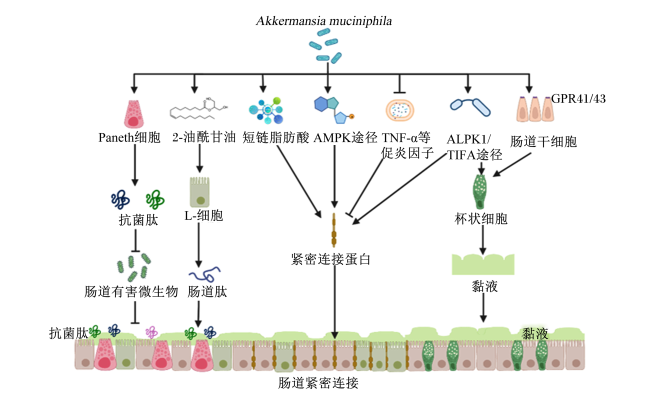
肠道黏液捕获细菌并防止上皮细胞损伤作为宿主防御的第1道防线,而肠道的紧密连接屏障抑制了细菌抗原从管腔渗漏到上皮组织,潘氏(Paneth)细胞产生的抗菌肽维持先天免疫进而维持肠道屏障的完整性[45-46]。因此,肠道黏液和紧密连接是肠道发挥屏障功能的重要位点。Chelakkot等[47]研究表明,嗜黏蛋白阿克曼菌的细胞外囊泡(Akkermansia muciniphila extracellular vesicle,AmEVs)在AKK调节肠道屏障方面具有重要作用,并证实了AmEVs通过激活AMPK途径调控紧密连接蛋白闭合蛋白(occludin),进而对肠道通透性起调节作用。此外AKK外膜分离的Amuc_1100蛋白处理过的小鼠肠道中封闭蛋白-3(claudin-3)的表达高于未处理的饲喂HFD的小鼠[47-48],表明AKK通过调节紧密连接蛋白claudin-3和occludin来调控肠道屏障。在体外研究中,AKK处理增大了人克隆结肠癌细胞(Caco-2细胞)的跨上皮细胞电阻,表现为肠上皮屏障功能的增强[49]。Ashrafian等[20]研究证明,在饲喂HFD的小鼠肠道中,屏障相关基因闭锁小带蛋白-1(zonula occludens protein-1,ZO-1)、occludin和封闭蛋白-1(claudin-1)以及封闭蛋白-2(claudin-2)的表达水平较低,而AKK或其外膜囊泡能够上调ZO-1、occludin、claudin-1以及claudin-2的表达,说明AKK通过增加肠道屏障相关基因表达来调控肠道屏障。相关研究证明,AKK还能增加小鼠回肠中酰基甘油(内源性大麻素)含量,而酰基甘油中的2-油酰甘油能通过刺激肠道L细胞来增加肠道肽的释放,进而改善肠道屏障功能[3]。也有研究表明,AKK能降低小鼠空肠中大麻素受体1(cannabinoid receptor 1,CB1)的表达,阻断CB1会降低肠道通透性[50],CB1的表达水平降低意味着肠道屏障的改善[48]
已有研究证明,肿瘤坏死因子-α(tumor necrosis factor-α,TNF-α)能增加肌凝蛋白轻链激酶转录和紧密连接的活性,导致occludin内吞,进而增强渗漏通路的通透性[51],AKK能够减少葡聚糖硫酸钠(dextran sodium sulfate,DSS)诱导结肠炎小鼠释放的TNF-α等促炎细胞因子含量[52],改善肠道的通透性。除此之外,AKK将黏液中难以消化的寡糖链降解和释放,供产丁酸菌使用,增加肠道中丁酸盐含量[53]。研究证明,丁酸盐通过上调紧密连接蛋白claudin-1的转录来增强肠上皮屏障功能,这无疑是AKK作用于肠道屏障的一种途径[53-55]。AKK增加小鼠肠道中短链脂肪酸含量,增加DSS处理后慢性约束应激小鼠中每根绒毛中杯状细胞(作用为释放黏液)的数量,说明AKK改善了肠道屏障[39,56]。还有研究发现,AKK能黏附在肠上皮细胞,增强单层肠上皮细胞完整性,表明其具有强化受损肠道屏障的能力[57]。肠道干细胞(intestinal stem cell,ISC)可以分化为杯状细胞等细胞,AKK一方面利用肠道黏液,另一方面以G蛋白偶联受体41/43(G protein-coupled receptor 41/43,GPR41/43)依赖的方式增强ISC增殖,通过激活Wnt信号通路,促进分泌肠上皮细胞的分化而增加了黏液的产生,并增加肠道中乙酸、丙酸含量,保证ISC的增殖分化环境[58]。高果糖饮食和约束应激加重了对小鼠空肠黏膜屏障的损伤,增加了肠道细胞的凋亡,降低了紧密连接蛋白表达,破坏Paneth细胞分泌抗菌肽,降低了核苷酸结合寡聚化结构域样受体蛋白6(nucleotide-binding oligomerization domain-like receptor protein 6,NLRP6)的表达,促进自噬能力,促进炎症细胞因子的表达。AKK定植通过维持Paneth细胞的数量及抗菌肽的分泌,增加NLRP6的表达,促进紧密连接蛋白的表达,负调控核因子-κB(nuclear factor-κB,NF-κB)信号通路,降低肠道细胞凋亡,抑制炎症细胞因子的表达,从而增强了黏膜屏障的防御功能[46]。此外,最近的一项研究发现,AKK的LPS中间产物二磷酸腺苷-七聚糖通过α蛋白激酶1(alpha protein kinase 1,ALPK1)/具有叉头相关结构域的TRAF相互作用蛋白[TNF receptor associated factor (TRAF)-interacting protein with a Forkhead-associated (FHA) domain,TIFA]途径调节与肠道屏障有关基因,包括黏蛋白2(mucin 2,MUC2)及紧密连接蛋白基因claudin-3、occludin的表达[59]。AKK保护肠道屏障机制如图1所示,AKK对肠道屏障的保护作用的主要结果及文献来源如表1所示。
图1 AKK保护肠道屏障机制示意图

Akkermansia muciniphila:嗜黏蛋白阿克曼菌;AMPK:腺苷酸激活蛋白激酶 adenosine 5'-monophosphate activated protein kinase;TNF-α:肿瘤坏死因子-α tumor necrosis factor-α;ALPK1:α蛋白激酶1 alpha protein kinase 1;TIFA:具有叉头相关结构域的TRAF相互作用蛋白 TNF receptor associated factor (TRAF)-interacting protein with a Forkhead-associated (FHA) domain;GPR41/43:G蛋白偶联受体41/43 G protein-coupled receptor 41/43。

Fig.1 Schematic diagram of mechanism of AKK protecting intestinal barrier[3,45-59]

表1 AKK对肠道屏障的保护作用

Table 1 Protective effect of AKK on intestinal barrier

项目
Items
处理方式
Treatment method
主要结果
Main result
文献来源
Reference
source
C57BL/6小鼠、Caco2细胞
C57BL/6 mice, Caco2 cells
灌胃AmEVs给饲喂HFD的小鼠2周;
AmEVs处理LPS处理的Caco-2单层细胞
改善紧密连接,改善肠道
通透性,激活AMPK通路
[47]
C57BL/6J小鼠
C57BL/6J mice
灌胃活的或巴氏杀菌后的AKK或
Amuc_1100蛋白给饲喂
HFD的小鼠5周
恢复LPS含量,下调CB1表达,激活
TLR2上调紧密连接蛋白的表达,增加
抗菌肽相关基因的表达
[48]
外周血单个核细胞、Caco-2细胞
Peripheral blood mononuclear
cells, Caco-2 cells
热杀死或活的AKK处理外周血
单个核细胞24 h;测量Caco-2
细胞跨上皮细胞电阻
诱导细胞因子IL-1βIL-6、IL-8、
IL-10和TNF-α的表达,通过
TLR4和TLR2激活NF-κB通路
[49]
C57BL/6小鼠
C57BL/6 mice
灌胃活的或巴氏杀菌后的AKK及
外膜蛋白给HFD小鼠
预防肠道屏障紊乱,上调ZO-1、
occludin、claudin-1、claudin-2的表达
[20]
C57BL/6小鼠
C57BL/6 mice
灌胃活的或巴氏杀菌后的AKK
给饲喂HFD和基因诱导的
肥胖小鼠
抵消黏液层减少,上调抗菌
肽相关基因Reg3g的表达,通过2-
油酰甘油增加肠道肽的分泌
[3]
C57BL/6小鼠
C57BL/6 mice
灌胃活的AKK给
DSS结肠炎小鼠
上调了claudin-4的表达,减少了
抗炎因子TNF-α的表达
[52]
嗜黏蛋白阿克曼菌与产丁酸菌
AKK and butyrate-
producing bacterium
AKK与产丁酸菌共培养 降解寡糖链供能产丁酸菌,
增加肠道中丁酸盐含量
[53]
C57BL/6小鼠
C57BL/6 mice
灌服AKK给高饮食
小鼠6周
恢复了每个绒毛杯状
细胞数量和密度
[39]
C57BL/6N小鼠
C57BL/6N mice
灌胃AKK给结肠炎粪菌
移植受体小鼠
增加绒毛中杯状细胞数量 [56]
Caco-2细胞、HT29细胞
Caco-2 cells, HT29 cell
测定AKK与细胞的结合能力,
测定跨膜电阻
AKK与细胞显著结合,提高
单层细胞完整性
[57]
C57BL/6J小鼠
C57BL/6J mice
灌胃AKK给抗生素、约束应激、
高果糖共同产生的肠道
屏障受损小鼠
上调claudin-1、claudin-3、ZO-1
基因表达,上调抗菌肽相关基因表达,
减轻空肠细胞凋亡和自噬,恢复炎症
小体NLRP6的表达
[46]
C57BL/6小鼠;类器官、
无菌小鼠;
C57BL/6 mice;
organoid, GF mice
灌胃AKK给正常的无特定病原体
小鼠;AKK处理类器官小鼠;灌胃
AKK给无菌小鼠、辐射和甲氨蝶呤
处理的肠道屏障受损小鼠
增加隐窝高度,增加杯状细胞数量、
潘氏细胞数量,上调溶菌酶1基因表
达,增加分化相关细胞因子含量,激活
Wnt信号,产生乙酸和丙酸
[58]

Akkermansia muciniphila:嗜黏蛋白阿克曼菌;AmEVs:嗜黏蛋白阿克曼菌的细胞外囊泡 Akkermansia muciniphila extracellular vesicle;HFD:高脂饲粮 high fat diet;AMPK:腺苷酸激活蛋白激酶 adenosine 5'-monophosphate activated protein kinase;LPS:脂多糖 lipopolysaccharide;CB1:大麻素受体1 cannabinoid receptor 1;TLR2:Toll样受体2 Toll-like receptor 2;IL-1β:白细胞介素-1β interleukin-1β;IL-6:白细胞介素-6 interleukin-6;IL-8:白细胞介素-8 interleukin-8;IL-10:白细胞介素-10 interleukin-10;TNF-α:肿瘤坏死因子-α tumor necrosis factor-α;TLR4:Toll样受体4 Toll-like receptor 4;NF-κB:核因子-κB nuclear factor-κB;ZO-1:闭锁小带蛋白-1 zonula occludens protein-1;occludin:闭合蛋白;claudin-1:封闭蛋白-1;claudin-2:封闭蛋白-2;DSS:葡聚糖硫酸钠 dextran sodium sulfate;Reg3g:再生胰岛衍生蛋白3g regenerating islet-derived protein 3g;claudin-4:封闭蛋白-4;NLRP6:核苷酸结合寡聚化结构域样受体蛋白6 nucleotide-binding oligomerization domain-like receptor protein 6。表2同 the same as Table 2

1.4.2 缓解肠道炎症

已有研究表明,AKK对代谢性炎症[38]及肠道炎症[52]具有显著改善作用。其中急性或慢性胃肠道炎症是威胁仔猪、犊牛等幼龄动物成长及健康的重要因素[60],AKK治疗炎症机制为解决幼龄动物肠道炎症提供新的治疗思路和理论指导。
AKK首先被发现具有缓解组织炎症的功能,Schneeberger等[6]在小鼠研究中发现,饲喂HFD的肥胖小鼠肠道中AKK的相对丰度显著减少,通过实时荧光定量PCR(RT-qPCR)测量发现,16周的代谢性炎症标记物、巨噬细胞炎症标志物、LPS结合蛋白表达水平均显著升高,而IL-6、白细胞介素-1β(interleukin-1β,IL-1β)表达水平没有显著升高,表明AKK可能与代谢炎症相关。口服AKK一方面改善肠道屏障,减少LPS及其受体的相互作用,从而抑制NF-κB和c-Jun氨基末端激酶(c-Jun N-terminal kinases,JNK)通路,激活炎症级联反应;另一方面降低肝脏中JNK磷酸化水平,增加NF-κB抑制蛋白水平,进而降低代谢性炎症[38]。AKK产生短链脂肪酸,其中的丁酸盐已被证明通过抑制NF-κB通路和减少促炎基因表达来诱导抗炎反应[53,61]。TLRs通过胞外区感应组织中的危险信号,AKK通过激活细胞表达TLR2,而不激活细胞表达TLR5、TLR9和核苷酸结合寡聚化域蛋白2(nucleotide-binding oligomerization domain-containing protein 2,NOD2)受体,经相应接头蛋白进行信号传导,激活相关的核内基因,从而诱导感染性炎症和非感染性炎症,且在体外试验中,AKK中分离到的外膜蛋白Amuc_1100或AKK本体也被证明通过激活TLR2通路来诱导特定细胞因子如IL-1β、IL-6、白细胞介素-8(interleukin-8,IL-8)、白细胞介素-10(interleukin-10,IL-10)和TNF-α的产生,进而改善炎症[48-49,57,62-63]。此外,AKK还可以分泌P9蛋白[21],通过细胞间黏附分子2(intercellular adhesion molecule 2,ICAM2)促进L细胞分泌GLP-1或调节内源性大麻素来调节肠道肽,进而减轻代谢性炎症[3,64]。Shen等[19]发现增加AKK在特定小鼠中的定植,抑制了促炎因子转录因子JNK1和JNK2的表达,减轻炎症反应。给小鼠灌服AKK还被证明能够通过诱导内脏脂肪组织中叉头框蛋白P3(Forkhead box protein P3,Foxp3)调节性T细胞,而CD4+ Foxp3调节性T细胞能通过抑制M1巨噬细胞和CD8+T细胞的浸润来控制局部炎症,从而防止脂肪组织炎症[39]
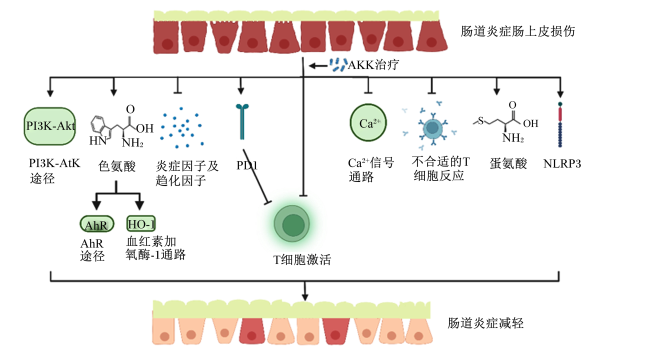
AKK治疗肠道炎症的研究中发现,DSS诱导的小鼠结肠炎导致小肠溃疡,破坏肠隐窝和肠壁导致炎症浸润,使得肠黏膜结构几乎不完整,而在用AKK治疗小鼠后,小肠组织学损伤得到改善,小肠黏膜显示出轻度/中度黏膜炎症浸润[52]。此外,该研究还证明,在肠道炎症的小鼠中观察到肠道促炎细胞因子TNF-α、白细胞介素-1α(interleukin-1α,IL-1α)、IL-6和白细胞介素-12α(interleukin-12α,IL-12α)以及趋化因子巨噬细胞炎性蛋白-1α(macrophage inflammatory protein 1α,MIP-1α)、粒细胞集落刺激因子(granulocyte colony stimulating factor,G-CSF)和角化细胞源性生长因子(keratinocyte-derived cytokine,KC)含量增加,而在饲喂AKK的小鼠上促炎因子和趋化因子含量均有显著下降,说明AKK改善炎症水平与减少促炎因子及趋化因子含量有关[52]。还有研究表明,对于结肠炎小鼠,Amuc_1100蛋白通过上调程序性死亡受体-1(programmed cell death-1,PD-1)或直接抑制细胞毒性T淋巴细胞的激活,进而减少结肠内巨噬细胞浸润,表明AKK调节小鼠CD8+T细胞来改善DSS诱导的结肠炎,AKK能够减小炎症细胞大小,进而改善炎症[20,65]。对微生物群的不适当T细胞反应被认为是炎症性肠病的发病机制之一,而AKK能够诱导小鼠免疫球蛋白G1抗体和抗原特异性T细胞反应,进而减轻炎症性肠病[66]
AKK改善微生物群落,被证明通过微生物-宿主相互作用改善DSS诱导的结肠炎[52]。一项研究表明,核苷酸结合寡聚化结构域样受体蛋白3(nucleotide-binding oligomerization domain-like receptor protein 3,NLRP3)缺失小鼠消除了AKK对急性结肠炎的保护作用,证明AKK通过激活炎症小体NLRP3缓解DSS诱导的急性结肠炎或AKK对结肠炎的保护作用依赖于NLRP3的激活[67]。膳食色氨酸通过AhR减轻了DSS诱导的小鼠结肠炎,AKK上调AhR靶向基因细胞色素P4501A1(CYP1A1)、IL-10、白细胞介素-22(interleukin-22,IL-22)的表达,增加微生物色氨酸代谢途径中吲哚乙酸(IAA)和吲哚丙烯酸的含量,进而激活AhR信号,从而缓解结肠炎症[13]。在非AhR途径中,AKK可将色氨酸代谢为吲哚、IAA、吲哚乳酸等,IAA可以上调血红素加氧酶-1(heme oxygenase-1,HO-1)通路,抑制RAW264.7细胞系中LPS诱导的炎症和氧化应激[68]。AKKFSDLZ36M5菌株含有metE基因,metE基因负责蛋氨酸的形成,蛋氨酸是一种支持蛋白质合成和调节肠道黏膜免疫反应和屏障功能的必需氨基酸,补充FSDLZ36M5菌株显著增加了黏蛋白的含量,降低了炎症细胞因子的表达[69]。在重组TNF-α诱导的猪小肠上皮细胞(IPEC-J2细胞)炎症模型中,活性AKK下调钙信号通路中一些关键基因的表达,如L型钙通道α1亚基(calcium channel, voltage-dependent, L type, alpha 1S subunit,CACNA1S)、嘌呤能受体P2X1(purinergic receptor P2X1,P2RX1)和嘌呤能受体P2X(purinergic receptor P2X,P2RX);非活性AKK通过下调细胞周期基因细胞周期蛋白依赖性激酶抑制剂1C(cyclin dependent kinase inhibitor 1C,CDKN1C)的表达减少细胞凋亡;两者均下调了磷脂酰肌醇3-激酶(phosphatidylinositol 3-kinase,PI3K)-蛋白激酶B(protein kinase B,Akt)信号通路上游受体的表达,从而直接降低TNF-αIL-8、IL-1βIL-6等细胞因子的表达[60],进而降低细胞炎症水平,表明AKK对仔猪的腹泻存在潜在的治疗作用。AKK缓解肠道炎症机制如图2所示,AKK对肠道炎症的缓解作用的主要结果及文献来源如表2所示。
图2 AKK缓解肠道炎症机制示意图

AKK:嗜黏蛋白阿克曼菌 Akkermansia muciniphila;PI3K:磷脂酰肌醇3-激酶 phosphatidylinositol 3-kinase;Akt:蛋白激酶B protein kinase B;PD-1:程序性死亡受体-1 programmed cell death-1;NLRP3:核苷酸结合寡聚化结构域样受体蛋白3 nucleotide-binding oligomerization domain-like receptor protein 3;AhR:芳香烃受体 aryl hydrocarbon receptor;HO-1:血红素加氧酶-1 heme oxygenase-1。

Fig.2 Schematic diagram of mechanism of AKK alleviating intestinal inflammation[13,20,60,65-67,69]

表2 AKK对肠道炎症的缓解作用

Table 2 Alleviative effect of AKK on intestinal inflammation

项目
Items
处理方式
Treatment method
主要结果
Main result
文献来源
Reference
source
C57BL/6小鼠
C57BL/6 mice
灌胃AKK给DSS诱导的
结肠炎小鼠
改善了肠组织学损伤,恢复了促炎
细胞因子、趋化因子含量,改善了
肠道微生物混乱
[52]
炎症性肠病患者、
C57BL/6J小鼠
IBD patients, C57BL/6J mice
测量炎症性肠病患者粪便微生物
组成,灌胃活的或巴氏杀菌AKK、
外膜蛋白给DSS结肠炎小鼠
炎症性肠病患者AKK的相对丰度
下降,改善了DSS诱导的结肠炎,显著
降低促炎因子干扰素-γ、IL-1β、IL-6
含量,减少浸润性巨噬细胞和CD8+
细胞毒性T淋巴细胞
[65]
C57BL/6小鼠
C57BL/6 mice
灌胃活的或巴氏杀菌AKK及
外膜蛋白给HFD小鼠
下调TNF-α的表达,
上调IL-10、angptl4的表达
[20]
C57BL/6小鼠
C57BL/6 mice
灌胃AKK给C57BL/6小鼠 诱导特异性免疫球蛋白G抗体反应,
诱导抗原特异性T细胞反应
[66]
溃疡性结肠炎患者、C57BL/6
小鼠、NLRP3敲除小鼠
UC patients, C57BL/6 mice, NLRP3 knockout mice
患者粪便微生物分析,AKK处理
结肠炎小鼠,NLRP3敲除小鼠
溃疡性结肠炎患者中AKK的相对
丰度下降,减轻了结肠炎,诱导NLRP3
体外表达,NLRP3的激活参与了结
肠炎的减轻,NLRP3缺失消除了
AKK在结肠炎中的保护作用
[67]
C57BL/6J小鼠
C57BL/6J mice
灌胃活的或非活性的AKK及
外膜蛋白给DSS结肠炎小鼠
正常化色氨酸和犬尿氨酸含量,
上调AhR靶向基因表达,调节色
氨酸微生物代谢
[13]
C57BL/6小鼠
C57BL/6 mice
灌胃AKK给DSS结肠炎小鼠 FSDLZ36M5菌株下调促炎因子TNF-α
IL-1βIL-6的表达,上调抑炎
因子IL-10的表达,增加黏蛋白含量
[69]
IPEC-J2细胞
IPEC-J2 cells
活的或非活性AKK处理
TNF-α诱导细胞炎症
降低细胞凋亡速率,减少炎症因子TNF-α、
IL-1β、IL-8的产生,下调钙信号通路,
调节细胞凋亡,调节PI3K-Akt信号通路
[60]

NLRP3:核苷酸结合寡聚化结构域样受体蛋白3 nucleotide-binding oligomerization domain-like receptor protein 3;angptl4:血管生成素样4 angiopoietin-like 4;AhR:芳香烃受体 aryl hydrocarbon receptor;PI3K:磷脂酰肌醇3-激酶 phosphatidylinositol 3-kinase;Akt:蛋白激酶B protein kinase B。

2 AKK在动物生产中的应用前景

在最新的研究中,AKK能够改善脂质代谢,减轻了饲喂HFD鸡的脂肪肝出血性综合征,从而促进蛋鸡的健康、蛋品质和营养价值,并表示AKK有作为添加剂提高蛋鸡生产的潜力[70]。在另一项研究中,AKK通过Wnt信号通路增加黏蛋白的分泌,增加肠道干细胞的增殖,减轻沙门氏菌诱导的雏鸡肠道损伤,包括结肠黏膜损伤指数,显著减少炎症因子TNF-α和IL-1β含量及体重、肠黏膜评分[71],表明AKK具有改善雏鸡腹泻的潜力。这些研究结果表明,AKK有作为饲料添加剂改善家禽脂质代谢与肠道疾病的潜力,但在其他动物上的研究并不深入,今后应深入研究AKK对不同养殖动物的影响,明确其对动物各类疾病的治疗作用。

3 小结与展望

综上所述,AKK作为下一代益生菌,通过调节PPARαL-天冬氨酸、GLP-1的表达改善脂质代谢[72];通过调节TGF-β信号级联反应、肝脏损伤相关酶活性、TLRs通路改善肝脏纤维化;通过调节抗菌肽Reg3γG6PPEPCK的表达改善糖代谢;通过改善紧密连接蛋白、黏液、肠道肽保护肠道屏障;通过T细胞、PI3K-Akt途径、色氨酸代谢等改善肠道炎症。AKK作为下一代益生菌在动物试验与临床研究表现出安全性,但其产品的开发应用需要更多的投入与研究。推进AKK作为饲料添加剂在畜牧业的应用及研究,可为畜禽疾病防控提供潜在的解决方案。
[1]
DERRIEN M, VAUGHAN E E, PLUGGE C M, et al. Akkermansia muciniphila gen. nov.,sp. nov.,a human intestinal mucin-degrading bacterium[J]. International Journal of Systematic and Evolutionary Microbiology, 2004, 54(Pt 5):1469-1476.

DOI

[2]
钟兴伟, 宋金东, 黄韶辉, 等. 非酒精性脂肪肝病患者肠道AKK与肝功能指标的变化及其影响[J]. 中国微生态学杂志, 2020, 32(11):1297-1300.

ZHONG X W, SONG J D, HUANG S H, et al. The changes of intestinal AKK bacteria and liver function in patients with nonalcoholic fatty liver disease[J]. Chinese Journal of Microecology, 2020, 32(11):1297-1300. (in Chinese)

[3]
EVERARD A, BELZER C, GEURTS L, et al. Cross-talk between Akkermansia muciniphila and intestinal epithelium controls diet-induced obesity[J]. Proceedings of the National Academy of Sciences of the United States of America, 2013, 110(22):9066-9071.

[4]
WHON T W, KIM H S, SHIN N R, et al. Calf diarrhea caused by prolonged expansion of autochthonous gut Enterobacteriaceae and their lytic bacteriophages[J]. mSystems, 2021, 6(2):e00816-20.

[5]
LIU S Y, ZHAO L L, ZHAI Z X, et al. Porcine epidemic diarrhea virus infection induced the unbalance of gut microbiota in piglets[J]. Current Microbiology, 2015, 71(6):643-649.

DOI PMID

[6]
SCHNEEBERGER M, EVERARD A, GÓMEZ-VALADÉS A G, et al. Akkermansia muciniphila inversely correlates with the onset of inflammation,altered adipose tissue metabolism and metabolic disorders during obesity in mice[J]. Scientific Reports, 2015, 5:16643.

DOI

[7]
WHITE H M. The role of TCA cycle anaplerosis in ketosis and fatty liver in periparturient dairy cows[J]. Animals, 2015, 5(3):793-802.

DOI PMID

[8]
DARADICS Z, CRECAN C M, RUS M A, et al. Obesity-related metabolic dysfunction in dairy cows and horses:comparison to human metabolic syndrome[J]. Life, 2021, 11(12):1406.

DOI

[9]
孙建军. 奶牛脂肪肝病因及防治措施探究[J]. 中国畜禽种业, 2018, 14(5):116-117.

SUN J J. Study on causes and prevention measures of fatty liver in dairy cows[J]. The Chinese Livestock and Poultry Breeding, 2018, 14(5):116-117. (in Chinese)

[10]
ZHANG T, LI Q Q, CHENG L, et al. Akkermansia muciniphila is a promising probiotic[J]. Microbial Biotechnology, 2019, 12(6):1109-1125.

DOI

[11]
CANI P D, DE VOS W M. Next-generation beneficial microbes:the case of Akkermansia muciniphila[J]. Frontiers in Microbiology, 2017, 8:1765.

DOI

[12]
MIURA K, OHNISHI H. Role of gut microbiota and Toll-like receptors in nonalcoholic fatty liver disease[J]. World Journal of Gastroenterology, 2014, 20(23):7381-7391.

DOI PMID

[13]
GU Z Y, PEI W L, SHEN Y H, et al. Akkermansia muciniphila and its outer protein Amuc_1100 regulates tryptophan metabolism in colitis[J]. Food & Function, 2021, 12(20):10184-10195.

[14]
SHI Z J, LEI H H, CHEN G, et al. Impaired intestinal Akkermansia muciniphila and aryl hydrocarbon receptor ligands contribute to nonalcoholic fatty liver disease in mice[J]. mSystems, 2021, 6(1):e00985-20.

[15]
JUÁREZ-FERNÁNDEZ M, PORRAS D, PETROV P, et al. The synbiotic combination of Akkermansia muciniphila and quercetin ameliorates early obesity and NAFLD through gut microbiota reshaping and bile acid metabolism modulation[J]. Antioxidants, 2021, 10(12):2001.

DOI

[16]
RAO Y, KUANG Z Q, LI C, et al. Gut Akkermansia muciniphila ameliorates metabolic dysfunction-associated fatty liver disease by regulating the metabolism of l-aspartate via gut-liver axis[J]. Gut Microbes, 2021, 13(1):1927633.

DOI

[17]
DEPOMMIER C, EVERARD A, DRUART C, et al. Supplementation with Akkermansia muciniphila in overweight and obese human volunteers:a proof-of-concept exploratory study[J]. Nature Medicine, 2019, 25(7):1096-1103.

DOI

[18]
DEPOMMIER C, VITALE R M, IANNOTTI F A, et al. Beneficial effects of Akkermansia muciniphila are not associated with major changes in the circulating endocannabinoidome but linked to higher mono-palmitoyl-glycerol levels as new PPARα agonists[J]. Cells, 2021, 10(1):185.

DOI

[19]
SHEN J, TONG X D, SUD N, et al. Low-density lipoprotein receptor signaling mediates the triglyceride-lowering action of Akkermansia muciniphila in genetic-induced hyperlipidemia[J]. Arteriosclerosis,Thrombosis,and Vascular Biology, 2016, 36(7):1448-1456.

DOI

[20]
ASHRAFIAN F, KESHAVARZ AZIZI RAFTAR S, LARI A, et al. Extracellular vesicles and pasteurized cells derived from Akkermansia muciniphila protect against high-fat induced obesity in mice[J]. Microbial Cell Factories, 2021, 20(1):219.

DOI

[21]
YOON H S, CHO C H, YUN M S, et al. Akkermansia muciniphila secretes a glucagon-like peptide-1-inducing protein that improves glucose homeostasis and ameliorates metabolic disease in mice[J]. Nature Microbiology, 2021, 6(5):563-573.

DOI

[22]
LEE J S, SONG W S, LIM J W, et al. An integrative multiomics approach to characterize anti-adipogenic and anti-lipogenic effects of Akkermansia muciniphila in adipocytes[J]. Biotechnology Journal, 2022, 17(2):e2100397.

[23]
WU Z Q, XIAO Y, ZHOU F, et al. Pasteurized Akkermansia muciniphila reduces fat accumulation via nhr-49-mediated nuclear hormone signaling pathway in Caenorhabditis elegans[J]. Molecules, 2022, 27(19):6159.

DOI

[24]
邓羊羊, 葛善飞, 余燕青, 等. 肝纤维化相关细胞信号转导通路及潜在治疗策略[J]. 临床肝胆病杂志, 2020, 36(5):1141-1145.

DENG Y Y, GE S F, YU Y Q, et al. Cell signaling pathways associated with liver fibrosis and potential therapeutic strategies[J]. Journal of Clinical Hepatology, 2020, 36(5):1141-1145. (in Chinese)

[25]
徐怀英, 朱瑞良, 赵宏坤. 肝片吸虫病诊断与防治研究进展[J]. 中国兽医寄生虫病, 2000, 8(4):49-51.

XU H Y, ZHU R L, ZHAO H K. Studies advances on diagnosis,prevention and cure of fasciolasis[J]. Chinese Journal of Veterinary Parasitology, 2000, 8(4):49-51. (in Chinese)

[26]
MARCOS L A, YI P, MACHICADO A, et al. Hepatic fibrosis and Fasciola hepatica infection in cattle[J]. Journal of Helminthology, 2007, 81(4):381-386.

DOI

[27]
JIN X M, LIU Y, WANG J Q, et al. β-Glucan-triggered Akkermansia muciniphila expansion facilitates the expulsion of intestinal helminth via TLR2 in mice[J]. Carbohydrate Polymers, 2022, 275:118719.

DOI

[28]
WU W R, LV L X, SHI D, et al. Protective effect of Akkermansia muciniphila against immune-mediated liver injury in a mouse model[J]. Frontiers in Microbiology, 2017, 8:1804.

DOI

[29]
ASHRAFIAN F, KESHAVARZ AZIZI RAFTAR S, SHAHRYARI A, et al. Comparative effects of alive and pasteurized Akkermansia muciniphila on normal diet-fed mice[J]. Scientific Reports, 2021, 11(1):17898.

DOI

[30]
KESHAVARZ AZIZI RAFTAR S, ASHRAFIAN F, YADEGAR A, et al. The protective effects of live and pasteurized Akkermansia muciniphila and its extracellular vesicles against HFD/CCl4-induced liver injury[J]. Microbiology Spectrum, 2021, 9(2):e0048421.

DOI

[31]
KESHAVARZ AZIZI RAFTAR S, ABDOLLAHIYAN S, AZIMIRAD M, et al. The anti-fibrotic effects of heat-killed Akkermansia muciniphila MucT on liver fibrosis markers and activation of hepatic stellate cells[J]. Probiotics and Antimicrobial Proteins, 2021, 13(3):776-787.

DOI

[32]
吴朋, 赵龙. 犬糖尿病的研究进展[J]. 山东畜牧兽医, 2018, 39(2):77-78.

WU P, ZHAO L. Research progress of canine diabetes[J]. Shandong Journal of Animal Science and Veterinary Medicine, 2018, 39(2):77-78. (in Chinese)

[33]
RIEDER J, SEIPEL J, BIERMANN K, et al. Canine and feline diabetes mellitus:a retrospective epidemiological study (1996-2006)[J]. Tierärztliche Praxis Ausgabe K:Kleintiere/Heimtiere, 2008, 36(3):169-175.

[34]
RHEW S Y, PARK S M, LI Q, et al. Efficacy and safety of allogenic canine adipose tissue-derived mesenchymal stem cell therapy for insulin-dependent diabetes mellitus in four dogs:a pilot study[J]. The Journal of Veterinary Medical Science, 2021, 83(4):592-600.

DOI

[35]
HÄNNINEN A, TOIVONEN R, PÖYSTI S, et al. Akkermansia muciniphila induces gut microbiota remodelling and controls islet autoimmunity in NOD mice[J]. Gut, 2018, 67(8):1445-1453.

DOI

[36]
田滋润, 王烨, 韩雪, 等. 高脂诱导下胰岛素抵抗和非胰岛素抵抗小鼠糖脂代谢及肠道AKK的变化[J]. 新疆医科大学学报, 2019, 42(8):984-987,993.

TIAN Z R, WANG Y, HAN X, et al. Changes of glucose and lipid metabolism and intestinal AKK bacteria in mice with insulin resistance and non-insulin resistance induced by hyperlipidemia[J]. Journal of Xinjiang Medical University, 2019, 42(8):984-987,993. (in Chinese)

[37]
LOCHHEAD P A, SALT I P, WALKER K S, et al. 5-Aminoimidazole-4-carboxamide riboside mimics the effects of insulin on the expression of the 2 key gluconeogenic genes PEPCK and glucose-6-phosphatase[J]. Diabetes, 2000, 49(6):896-903.

DOI PMID

[38]
ZHAO S Q, LIU W, WANG J Q, et al. Akkermansia muciniphila improves metabolic profiles by reducing inflammation in chow diet-fed mice[J]. Journal of Molecular Endocrinology, 2017, 58(1):1-14.

DOI

[39]
SHIN N R, LEE J C, LEE H Y, et al. An increase in the Akkermansia spp. population induced by metformin treatment improves glucose homeostasis in diet-induced obese mice[J]. Gut, 2014, 63(5):727-735.

DOI

[40]
VANCAMELBEKE M, VERMEIRE S. The intestinal barrier:a fundamental role in health and disease[J]. Expert Review of Gastroenterology & Hepatology, 2017, 11(9):821-834.

[41]
CAFFARENA R D, CASAUX M L, SCHILD C O, et al. Causes of neonatal calf diarrhea and mortality in pasture-based dairy herds in Uruguay:a farm-matched case-control study[J]. Brazilian Journal of Microbiology, 2021, 52(2):977-988.

DOI

[42]
TANG X P, XIONG K N, FANG R J, et al. Weaning stress and intestinal health of piglets:a review[J]. Frontiers in Immunology, 2022, 13:1042778.

DOI

[43]
SU W F, GONG T, JIANG Z P, et al. The role of probiotics in alleviating postweaning diarrhea in piglets from the perspective of intestinal barriers[J]. Frontiers in Cellular and Infection Microbiology, 2022, 12:883107.

DOI

[44]
LIEBLER-TENORIO E M. Alterations of the intestinal barrier in calf diarrhoea[J]. Cattle Practice, 2010, 18(2):123-126.

[45]
SI J, KANG H, YOU H J, et al. Revisiting the role of Akkermansia muciniphila as a therapeutic bacterium[J]. Gut Microbes, 2022, 14(1):2078619.

DOI

[46]
YU J Y, LIU T L, GAO Z H, et al. Akkermansia muciniphila colonization alleviating high fructose and restraint stress-induced jejunal mucosal barrier disruption[J]. Nutrients, 2022, 14(15):3164.

DOI

[47]
CHELAKKOT C, CHOI Y, KIM D K, et al. Akkermansia muciniphila-derived extracellular vesicles influence gut permeability through the regulation of tight junctions[J]. Experimental & Molecular Medicine, 2018, 50(2):e450.

[48]
PLOVIER H, EVERARD A, DRUART C, et al. A purified membrane protein from Akkermansia muciniphila or the pasteurized bacterium improves metabolism in obese and diabetic mice[J]. Nature Medicine, 2017, 23(1):107-113.

DOI

[49]
OTTMAN N, REUNANEN J, MEIJERINK M, et al. Pili-like proteins of Akkermansia muciniphila modulate host immune responses and gut barrier function[J]. PLoS One, 2017, 12(3):e0173004.

DOI

[50]
MUCCIOLI G G, NASLAIN D, BÄCKHED F, et al. The endocannabinoid system links gut microbiota to adipogenesis[J]. Molecular Systems Biology, 2010, 6:392.

DOI PMID

[51]
ODENWALD M A, TURNER J R. The intestinal epithelial barrier:a therapeutic target?[J]. Nature Reviews.Gastroenterology & Hepatology, 2017, 14(1):9-21.

[52]
BIAN X Y, WU W R, YANG L Y, et al. Administration of Akkermansia muciniphila ameliorates dextran sulfate sodium-induced ulcerative colitis in mice[J]. Frontiers in Microbiology, 2019, 10:2259.

DOI

[53]
BELZER C, CHIA L W, AALVINK S, et al. Microbial metabolic networks at the mucus layer Lead to diet-independent butyrate and vitamin B12 production by intestinal symbionts[J]. mBio, 2017, 8(5):e00770-17.

[54]
OUYANG J, LIN J, ISNARD S, et al. The bacterium Akkermansia muciniphila:a sentinel for gut permeability and its relevance to HIV-related inflammation[J]. Frontiers in Immunology, 2020, 11:645.

DOI

[55]
WANG H B, WANG P Y, WANG X, et al. Butyrate enhances intestinal epithelial barrier function via up-regulation of tight junction protein Claudin-1 transcription[J]. Digestive Diseases and Sciences, 2012, 57(12):3126-3135.

DOI

[56]
CHEN T, WANG R, DUAN Z L, et al. Akkermansia muciniphila protects against psychological disorder-induced gut microbiota-mediated colonic mucosal barrier damage and aggravation of colitis[J]. Frontiers in Cellular and Infection Microbiology, 2021, 11:723856.

DOI

[57]
REUNANEN J, KAINULAINEN V, HUUSKONEN L, et al. Akkermansia muciniphila adheres to enterocytes and strengthens the integrity of the epithelial cell layer[J]. Applied and Environmental Microbiology, 2015, 81(11):3655-3662.

DOI

[58]
KIM S, SHIN Y C, KIM T Y, et al. Mucin degrader Akkermansia muciniphila accelerates intestinal stem cell-mediated epithelial development[J]. Gut Microbes, 2021, 13(1):1892441.

DOI

[59]
MARTIN-GALLAUSIAUX C, GARCIA-WEBER D, LASHERMES A, et al. Akkermansia muciniphila upregulates genes involved in maintaining the intestinal barrier function via ADP-heptose-dependent activation of the ALPK1/TIFA pathway[J]. Gut Microbes, 2022, 14(1):2110639.

DOI

[60]
LUO Y H, LAN C, XIE K H, et al. Active or autoclaved Akkermansia muciniphila relieves TNF-α-induced inflammation in intestinal epithelial cells through distinct pathways[J]. Frontiers in Immunology, 2021, 12:788638.

DOI

[61]
LEE J G, LEE J, LEE A R, et al. Impact of short-chain fatty acid supplementation on gut inflammation and microbiota composition in a murine colitis model[J]. The Journal of Nutritional Biochemistry, 2022, 101:108926.

DOI

[62]
孙午, 熊莺, 傅颖媛. Toll样受体的研究进展[J]. 实验与检验医学, 2008, 26(4):413-416.

SUN W, XIONG Y, FU Y Y. Research progress of Toll-like receptor[J]. Experimental and Laboratory Medicine, 2008, 26(4):413-416. (in Chinese)

[63]
贺雅静, 谢勇. Toll样受体信号通路与TAM受体在炎症性肠病中的作用[J]. 中国免疫学杂志, 2021, 37(10):1271-1273,1278.

HE Y J, XIE Y. Role of toll-like receptor signaling pathway and TAM receptor in inflammatory bowel disease[J]. Chinese Journal of Immunology, 2021, 37(10):1271-1273,1278. (in Chinese)

[64]
CANI P D, EVERARD A, DUPARC T. Gut microbiota,enteroendocrine functions and metabolism[J]. Current Opinion in Pharmacology, 2013, 13(6):935-940.

DOI

[65]
WANG L J, TANG L, FENG Y M, et al. A purified membrane protein from Akkermansia muciniphila or the pasteurised bacterium blunts colitis associated tumourigenesis by modulation of CD8+ T cells in mice[J]. Gut, 2020, 69(11):1988-1997.

DOI

[66]
ANSALDO E, SLAYDEN L C, CHING K L, et al. Akkermansia muciniphila induces intestinal adaptive immune responses during homeostasis[J]. Science, 2019, 364(6446):1179-1184.

DOI

[67]
QU S W, FAN L N, QI Y D, et al. Akkermansia muciniphila alleviates dextran sulfate sodium (DSS)-induced acute colitis by NLRP3 activation[J]. Microbiology Spectrum, 2021, 9(2):e00730-21.

[68]
YIN J, SONG Y J, HU Y Z, et al. Dose-dependent beneficial effects of tryptophan and its derived metabolites on Akkermansia in vitro:a preliminary prospective study[J]. Microorganisms, 2021, 9(7):1511.

DOI

[69]
LIU Q, LU W W, TIAN F W, et al. Akkermansia muciniphila exerts strain-specific effects on DSS-induced ulcerative colitis in mice[J]. Frontiers in Cellular and Infection Microbiology, 2021, 11:698914.

DOI

[70]
WEI F X, YANG X Y, ZHANG M H, et al. Akkermansia muciniphila enhances egg quality and the lipid profile of egg yolk by improving lipid metabolism[J]. Frontiers in Microbiology, 2022, 13:927245.

DOI

[71]
ZHU L D, LU X X, LIU L, et al. Akkermansia muciniphila protects intestinal mucosa from damage caused by S. pullorum by initiating proliferation of intestinal epithelium[J]. Veterinary Research, 2020, 51(1):34.

DOI

[72]
CANI P D, KNAUF C. A newly identified protein from Akkermansia muciniphila stimulates GLP-1 secretion[J]. Cell Metabolism, 2021, 33(6):1073-1075.

DOI

Outlines

/