RESEARCH PAPER

Effects of Crushed Grain Size and Addition Amount of Wheat on Growth Performance, Intestinal Morphology and Intestinal Enzyme Activities of White-Feathered Broilers

  • QIU Ting , 1 ,
  • CHEN Zhiyong 1 ,
  • CEN Mingzhu 1 ,
  • OU Jiancun 1 ,
  • ZHENG Chaojun 1 ,
  • CHEN Datu 2 ,
  • CHEN Jie 2 ,
  • ZHANG Huihua , 1, *
Expand
  • 1 School of Life Science and Engineering, Foshan University of Science and Technology, Foshan 528225, China
  • 2 Foshan Guangmuxing Feed Co., Ltd., Foshan 528137, China
* professor, E-mail:

Received date: 2023-03-06

  Online published: 2023-09-13

Abstract

The experiment was conducted to investigate the effects of crushing grain size and addition amount of wheat in pellet feed on growth performance, intestinal morphology and intestinal digestive enzyme activities of 817 white-feathered broilers from 20 to 50 days of age. A 2×3 two-factor experimental design was adopted, in which the wheat addition amount was 35% and 55%, and the wheat crushing sieve aperture was 1.5, 2.5 and 3.5 mm, respectively. A total of 720 healthy male 817 fast-growing white-feathered broilers of 20-day-old were randomly divided into 6 groups with 6 replicates per group and 20 broilers per replicate according to the principle of similar body weight. The experiment lasted for 31 days and was divided into two stages as medium chickens (20 to 34 days of age) and large chickens (35 to 50 days of age). The results showed as follows: 1) there was no significant difference in growth performance of broilers among all groups at each stage of the experiment (P>0.05). The main-effect analysis showed that the ratio of feed to gain (F/G) from 35 to 50 days of age in 2.5 mm crushing sieve aperture group was significantly lower than that in the other 2 groups (P<0.05). 2) At 35 days of age, the results of main-effect analysis showed that the villus height in duodenum and jejunum of broilers in 1.5 mm crushing sieve aperture group was significantly higher than that in 2.5 mm crushing sieve aperture group (P<0.05), the ratio of villus height to crypt depth (V/C) in duodenum and jejunum and the villus height in ileum were significantly higher than those in the other 2 groups (P<0.05), and the V/C in ileum was significantly higher than that in 3.5 mm crushing sieve aperture group (P<0.05); the villus height and V/C in ileum in 35% addition amount group were significantly higher than those in 55% addition amount group (P<0.05). At 50 days of age, the crypt depth in duodenum of broilers in 2.5 mm crushing sieve aperture group was significantly lower than that in the other 2 groups (P<0.05), and the V/C in duodenum was significantly higher than that in the other 2 groups (P<0.05); the crypt depth in jejunum and ileum in 55% addition amount group was significantly lower than that in 35% addition amount group (P<0.05). 3) At 35 days of age, the activity of trypsin and lipase in duodenum and the amylase activity in jejunum of broilers in 35% addition amount group were significantly higher than that in 55% addition amount group (P<0.05); the amylase activity in duodenum in 1.5 and 2.5 mm crushing sieve aperture groups was significantly higher than that in 3.5 mm crushing sieve aperture group (P<0.05), and the amylase activity in jejunum in 1.5 mm crushing sieve aperture group was significantly higher than that in the other 2 groups (P<0.05). At 50 days of age, the activities of trypsin and amylase in jejunum of broilers in 2.5 mm crushing sieve aperture group was significantly higher than those in the other 2 groups (P<0.05), and the trypsin activity in jejunum in 55% addition amount group was significantly higher than that in 35% addition amount group (P<0.05). In conclusion, in the medium stage of 817 white-feathered broilers, the appropriate crushing grain size and additive amount of wheat are 1.5 mm and 35%, respectively; while in the large stage, the appropriate crushing grain size and additive amount of wheat are 2.5 mm and 55%, respectively.

Cite this article

QIU Ting , CHEN Zhiyong , CEN Mingzhu , OU Jiancun , ZHENG Chaojun , CHEN Datu , CHEN Jie , ZHANG Huihua . Effects of Crushed Grain Size and Addition Amount of Wheat on Growth Performance, Intestinal Morphology and Intestinal Enzyme Activities of White-Feathered Broilers[J]. Chinese Journal of Animal Nutrition, 2023 , 35(9) : 5674 -5685 . DOI: 10.12418/CJAN2023.523

饲料粉碎粒度对动物生产性能和饲粮营养物质的消化吸收有着重要影响,合适的粉碎粒度可增加肠道消化酶与饲粮作用的机会,提高饲粮的消化利用率和动物生产性能[1]。细粒度的饲粮可以增加与消化酶的接触面积,利于营养物质的消化,但过细的饲粮也会增加食糜的黏度,堵塞动物的消化道,影响营养物质的消化吸收[2]。由此可知,饲料的粒度不是越小越好,这与家禽肌胃的生理特点有关[3]。粗粒度饲粮可以延长食糜在消化道的停留时间,增加对肌胃和胃壁的刺激,并使得胃腺分泌更多的盐酸[4-5];但粒度过粗又会使得食糜与消化酶的接触面积减小,从而降低营养物质的吸收,故而寻找合适的饲料粉碎粒度是饲料加工的重要课题。小麦已是肉鸡常用的饲料原料,但以前的研究主要集中于酶制剂对小麦型饲粮的影响,对于小麦粉碎粒度与添加量之间互作效应的研究较少。因此,本文旨在研究小麦粉碎粒度与添加量对817肉鸡生长性能、肠道形态和肠道消化酶活性的影响,为小麦在817肉鸡生产中的合理利用提供依据。

1 材料与方法

1.1 试验设计及动物分组

采用2×3两因素试验设计,其中小麦添加量分别为35%和55%(小麦为1年内的小麦),小麦粉碎筛片孔径分别为1.5、2.5和3.5mm。选取720只20日龄、健康的817快大型白羽肉仔鸡(全公苗),按照体重相近的原则随机分成6组,每组6个重复,每个重复20只鸡。各组之间初始体重无显著差异(P>0.05)。试验期31 d,分中鸡(20~34日龄)和大鸡(35~50日龄)2个阶段进行。

1.2 试验饲粮

试验饲粮分20~34日龄和35~50日龄2个阶段进行配制,其营养水平参考《鸡饲养标准》(NY/T 33—2004),饲粮组成及营养水平见表1
表1 饲粮组成及营养水平(风干基础)

Table 1 Composition and nutrient levels of diets (air-dry basis)%

项目
Items
20~34日龄 20 to 34 days of age 35~50日龄 35 to 50 days of age
35%小麦添加饲粮
35% wheat
supplemental diet
55%小麦添加饲粮
55% wheat
supplemental diet
35%小麦添加饲粮
35% wheat
supplemental diet
55%小麦添加饲粮
55% wheat
supplemental diet
原料 Ingredients
玉米 Corn 30.100 13.915 29.300 12.715
小麦 Wheat 35.000 55.000 35.000 55.000
豆粕 Soybean meal 23.000 19.000 21.000 17.500
玉米蛋白粉 Corn protein meal 5.000 5.000 5.000 5.000
石粉 Limestone 1.390 1.410 1.250 1.270
磷酸氢钙 CaHPO4 0.920 0.980 1.060 1.010
L-赖氨酸盐酸盐 L-Lys·HCl 0.630 0.700 0.530 0.610
DL-蛋氨酸 DL-Met 0.250 0.250 0.190 0.190
L-苏氨酸 L-Thr 0.140 0.170 0.100 0.130
预混料 Premix1) 0.500 0.500 0.500 0.500
植酸酶 Phytase 0.010 0.010 0.010 0.010
非淀粉多糖酶 NSP enzyme2) 0.060 0.065 0.060 0.065
猪油 Lard 3.000 3.000 6.000 6.000
合计Total 100.000 100.000 100.000 100.000
营养水平 Nutrient levels3)
代谢能 ME/(MJ/kg) 12.72 12.69 13.44 13.39
粗蛋白质 CP 20.59 20.58 19.58 19.56
钙 Ca 0.85 0.85 0.80 0.80
总磷 TP 0.54 0.54 0.53 0.53
赖氨酸 Lys 1.34 1.34 1.21 1.21
蛋氨酸 Met 0.57 0.56 0.50 0.49
半胱氨酸 Cys 0.30 0.31 0.29 0.30
蛋氨酸+半胱氨酸 Met+Cys 0.86 0.86 0.78 0.78
苏氨酸 Thr 0.85 0.85 0.78 0.77

1)预混料为每千克饲粮提供 The premix provided the following per kilogram of diets:VA 12 000 IU,VD3 3 000 IU,VE 10 IU,VK3 2 mg,VB1 1 mg,VB2 3 mg,VB6 2 mg,VB12 0.01 mg,烟酸 nicotinic acid 20 mg,泛酸钙 calcium pantothenate 4 mg,叶酸 folic acid 0.5 mg,生物素 biotin 0.05 mg,Fe 100 mg,Cu 20 mg,Mn 100 mg,Zn 80 mg,I 3 mg,Se 0.5 mg。

2)每克非淀粉多糖酶含有木聚糖酶≥30 000 U,纤维素酶≥20 000 U,葡聚糖酶≥100 000 U。Each gram of NSP enzyme contained xylanase≥30 000 U, cellulase≥20 000 U, and glucanase≥100 000 U.

3)粗蛋白质为实测值,其余为计算值。CP was a measured value, while the others were calculated values.

1.3 试验设备及制粒粒径

试验所用粉碎机型号为丰尚超越粉碎机SWFP66×100,锤片规格为厚5 mm×宽52 mm×长175 mm。小麦经粉碎后分别过孔径为1.5、2.5和3.5 mm的粉碎筛片,制粒机型号为CPM3022-8,制粒调质温度为80 ℃,调制时间为180 s。20~34日龄阶段的饲料制粒粒径为2.5 mm,35~50日龄阶段的饲料制粒粒径为4.0 mm。

1.4 饲养管理

试验肉鸡采用笼养,自由采食和饮水,每重复20只鸡饲养于1个笼子中。进鸡前2周对鸡舍进行彻底清洗、消毒和熏蒸,试验鸡进来前1天将鸡舍温度保持在27 ℃左右,此后温度每周下降2~3 ℃,直至保持在23~24 ℃,鸡舍相对湿度保持在55%~65%,定时通风换气,保持鸡舍内环境卫生良好。

1.5 测定指标及方法

1.5.1 小麦粉碎粒度测定

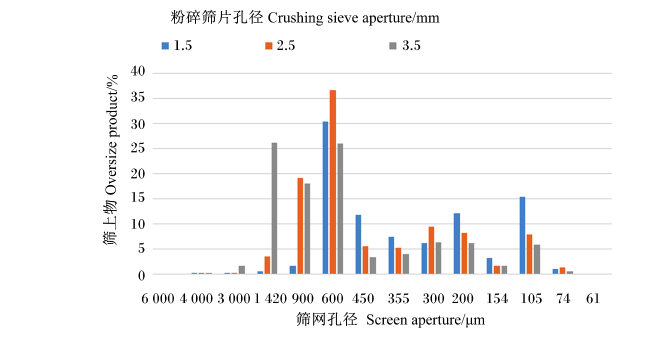
在锤片粉碎机中,分别用1.5、2.5和3.5 mm孔径的筛片将试验小麦粉碎,各取100 g样品进行小麦几何平均粒度的测定,每种样品测3次,取平均值作为最后结果。小麦粉碎粒度测定方法参考《饲料粉碎机试验方法》(GB/T 6971—2007)中的粒度测定方法,测定所用筛网的孔径规格分别为6 000、4 000、3 000、1 430、900、600、450、355、300、200、154、105、74和61 μm,对应的筛号分别为4、6、8、14、20、30、40、50、60、80、100、140、200和250目。

1.5.2 肉鸡生长性能测定

分别于20、35和50日龄早晨对肉鸡进行空腹12 h称重,每天记录各重复鸡只采食量和死亡数。统计各阶段肉鸡平均日采食量(ADFI)、平均日增重(ADG)和料重比(F/G)。

1.5.3 肉鸡肠道形态测定

分别于35和50日龄,每个重复随机抽取接近平均体重的1只白羽肉鸡进行安乐处死,取十二指肠、空肠和回肠相同部位约3 cm,用磷酸盐缓冲液(phosphate buffer saline,PBS)冲洗净后放入10%的福尔马林溶液中固定,置于4 ℃冰箱中保存待测。对肠道样品进行苏木素-伊红(HE)染色制片,并在电子显微镜4倍物镜×10倍目镜下观察,选取4~5个不同的视野,用显微测微尺测量绒毛高度、隐窝深度,并计算绒毛高度/隐窝深度(V/C)值。

1.5.4 肉鸡肠道消化酶活性测定

分别于35和50日龄,每个重复随机抽取接近平均体重的1只白羽肉鸡进行安乐处死,采集十二指肠和空肠内容物于1.5 mL离心管(2管)中,置于-80 ℃冰箱保存待测。采用南京建成生物工程研究试剂盒检测十二指肠和空肠内容物中的胰蛋白酶、α-淀粉酶和脂肪酶活性,测定方法参照试剂盒说明书进行。

1.6 数据统计与分析

试验数据采用SPSS 26.0统计软件以重复为单位先进行单因素方差分析(one-way ANOVA)和LSD法多重比较,再进行一般线性模型双因素分析,主效应包括小麦添加量(35%和55%)、小麦粉碎筛片孔径(1.5、2.5和3.5 mm)以及小麦添加量与小麦粉碎筛片孔径的互作效应。P<0.05为差异显著,P<0.01为差异极显著。

2 结果与分析

2.1 小麦粉碎粒度测定结果

本试验采用锤片粉碎机分别用1.5、2.5和3.5 mm孔径粉碎筛片对试验小麦进行粉碎,实测小麦几何平均粒度分别为(374.09±0.58) μm、(543.96±1.15) μm和(800.13±1.73) μm,具体粉碎粒度分布见图1
图1 小麦粉碎粒度分布

Fig.1 Crushed grain size distribution of wheat

2.2 小麦粉碎粒度与添加量对肉鸡生长性能的影响

小麦粉碎粒度与添加量对肉鸡生长性能的影响见表2。在20~34日龄阶段,各组间肉鸡ADG、ADFI和F/G均无显著性差异(P>0.05)。主效应分析结果表明,随着小麦粉碎粒度(粉碎筛片孔径)的增大,肉鸡ADG、ADFI呈下降趋势,1.5 mm粉碎筛片孔径组ADG和ADFI最高,F/G最低;35%添加量组生长性能与55%添加量组相比无显著性差异(P>0.05)。在35~50日龄阶段,各组间肉鸡ADG、ADFI和F/G均无显著性差异(P>0.05)。主效应分析结果表明,2.5 mm粉碎筛片孔径组ADG最高,F/G最低,且F/G相比其他2个粉碎筛片孔径组显著降低(P<0.05);2个添加量组之间生长性能无显著性差异(P>0.05)。
表2 小麦粉碎粒度与添加量对肉鸡生长性能的影响

Table 2 Effects of crushed grain size and addition amount of wheat on growth performance of broilers

粉碎筛片孔径
Crushing sieve
aperture/mm
添加量
Addition
amount/%
20~34日龄 20 to 34 days of age 35~50日龄 35 to 50 days of age
平均日采食量
ADFI/(g/d)
平均日增重
ADG/(g/d)
料重比
F/G
平均日采食量
ADFI/(g/d)
平均日增重
ADG/(g/d)
料重比
F/G
1.5 35 69.78 34.24 2.03 110.17 46.76 2.35
1.5 55 70.23 33.85 2.07 107.03 45.40 2.36
2.5 35 68.86 33.62 2.05 108.31 46.67 2.32
2.5 55 70.26 33.71 2.08 110.84 47.69 2.33
3.5 35 68.63 32.88 2.08 110.60 46.75 2.36
3.5 55 67.85 33.09 2.05 111.55 47.03 2.37
SEM 1.34 0.69 0.03 1.94 0.89 0.01
PP-value 0.750 0.754 0.804 0.571 0.631 0.061
主效应分析 Main-effect analysis
粉碎筛片孔径 1.5 70.01 34.04 2.05 108.60 46.08 2.36b
Crushing sieve 2.5 69.56 33.66 2.06 109.58 47.18 2.32a
aperture/mm 3.5 68.24 32.98 2.06 111.08 46.89 2.36b
添加量 35 69.09 33.58 2.05 109.70 46.73 2.34
Addition amount/% 55 69.45 33.55 2.07 109.81 46.71 2.35
PP-value
粉碎筛片孔径
Crushing sieve aperture
0.403 0.316 0.921 0.450 0.454 0.007
添加量 Addition amount 0.746 0.957 0.623 0.943 0.981 0.764
粉碎筛片孔径×添加量
Crushing sieve aperture×addition
amount
0.720 0.900 0.407 0.338 0.410 0.989

同列数据肩标不同字母表示差异显著(P<0.05),相同字母或无字母表示差异不显著(P>0.05)。下表同。

In the same column, values with different letter superscripts mean significant difference (P<0.05), while with the same letter or no letter superscripts mean no significant difference (P>0.05). The same as below.

2.3 小麦粉碎粒度与添加量对肉鸡肠道形态的影响

小麦粉碎粒度与添加量对35日龄肉鸡肠道形态的影响见表3。1.5 mm粉碎筛片孔径+55%添加量组肉鸡十二指肠绒毛高度最高,显著高于除1.5 mm粉碎筛片孔径+35%添加量组外的其他各组(P<0.05);1.5 mm粉碎筛片孔径+35%添加量组十二指肠V/C值最高,显著高于其他各组(P<0.05)。1.5 mm粉碎筛片孔径+35%添加量组和1.5 mm粉碎筛片孔径+55%添加量组空肠绒毛高度显著高于其他各组(P<0.05),且3.5 mm粉碎筛片孔径+35%添加量组空肠绒毛高度显著高于2.5 mm粉碎筛片孔径+35%添加量组和2.5 mm粉碎筛片孔径+55%添加量组(P<0.05);1.5 mm粉碎筛片孔径+35%添加量组和1.5 mm粉碎筛片孔径+55%添加量组空肠V/C值显著高于其他各组(P<0.05),且后者显著高于前者(P<0.05)。1.5 mm粉碎筛片孔径+35%添加量组回肠绒毛高度和V/C值最高,显著高于其他各组(P<0.05)。主效应分析结果表明,1.5 mm粉碎筛片孔径组肉鸡十二指肠绒毛高度显著高于2.5 mm粉碎筛片孔径组(P<0.05),十二指肠V/C值显著高于其他2组(P<0.05);1.5和3.5 mm粉碎筛片孔径组空肠绒毛高度显著高于2.5 mm粉碎筛片孔径组(P<0.05),且1.5 mm粉碎筛片孔径组空肠V/C值显著高于其他2组(P<0.05);1.5 mm粉碎筛片孔径组回肠绒毛高度显著高于其他2组(P<0.05),回肠V/C值显著高于3.5 mm粉碎筛片孔径组(P<0.05)。35%添加量组肉鸡回肠绒毛高度和V/C值显著高于55%添加量组(P<0.05)。小麦粉碎筛片孔径和添加量对肉鸡十二指肠V/C值、空肠绒毛高度和V/C值以及回肠隐窝深度和V/C值有显著互作效应(P<0.05)。
表3 小麦粉碎粒度与添加量对35日龄肉鸡肠道形态的影响

Table 3 Effects of crushed grain size and addition amount of wheat on intestinal morphology of broilers at 35 days of age (n=6)

粉碎筛片孔径
Crushing sieve
aperture/mm
添加量
Addition
amount/%
十二指肠 Duodenum 空肠 Jejunum 回肠 Ileum
绒毛高度
Villus
height/μm
隐窝深度
Crypt
depth/μm
绒毛高度/
隐窝深度
V/C
绒毛高度
Villus
height/μm
隐窝深度
Crypt
depth/μm
绒毛高度/
隐窝深度
V/C
绒毛高度
Villus
height/μm
隐窝深度
Crypt
depth/μm
绒毛高度/
隐窝深度
V/C
1.5 35 1 701.90bc 176.95 9.62c 1 156.46d 155.29 7.45c 988.94d 130.03ab 7.60e
1.5 55 1 707.04c 191.86 8.89b 1 141.20d 161.75 7.79d 909.45abc 138.55bc 6.56c
2.5 35 1 566.02a 182.98 8.55ab 942.80a 152.67 7.05b 876.93ab 121.51a 7.21d
2.5 55 1 596.76a 185.59 8.60ab 1 010.65b 156.14 6.47a 876.71ab 139.14bc 6.30b
3.5 35 1 616.64a 195.16 8.28a 1 082.36c 153.52 7.05b 916.45bc 158.42d 5.78a
3.5 55 1 624.29ab 189.95 8.55ab 1 061.08bc 151.97 6.98b 862.23a 144.35c 5.97a
SEM 42.97 5.36 0.17 19.84 6.45 0.11 15.65 4.48 0.09
PP-value 0.004 0.100 <0.001 <0.001 0.195 <0.001 <0.001 <0.001 <0.001
主效应分析 Main-effect analysis
粉碎筛片孔径 1.5 1 704.84b 182.91 9.29b 1 149.92b 158.52 7.62b 954.87b 133.68a 7.08b
Crushing sieve 2.5 1 582.41a 184.28 8.72a 976.72a 154.41 6.76a 876.82a 130.33a 6.75b
aperture/mm 3.5 1 620.17ab 193.08 8.43a 1 075.27b 152.86 7.01a 893.21a 151.38b 5.87a
添加量 35 1 628.19 185.15 8.82 1 061.26 153.80 7.18 927.44b 136.65 6.86b
Addition amount/% 55 1 642.69 188.86 8.81 1 064.10 156.62 7.08 882.19a 140.87 6.27a
PP-value
粉碎筛片孔径
Crushing sieve aperture
<0.001 0.305 <0.001 <0.001 0.616 <0.001 0.002 <0.001 <0.001
添加量 Addition amount 0.528 0.164 0.990 0.713 0.572 0.276 <0.001 0.287 <0.001
粉碎筛片孔径×添加量
Crushing sieve aperture×
addition amount
0.875 0.131 0.007 0.034 0.791 0.002 0.055 0.003 <0.001
小麦粉碎粒度与添加量对50日龄肉鸡肠道形态的影响见表4。1.5 mm粉碎筛片孔径+35%添加量组和3.5 mm粉碎筛片孔径+55%添加量组肉鸡十二指肠隐窝深度显著高于其他各组(P<0.05),十二指肠V/C值显著低于其他各组(P<0.05);3.5 mm粉碎筛片孔径+35%添加量组空肠V/C值显著低于其他组(P<0.05),且其他各组之间均无显著性差异(P>0.05);2.5 mm粉碎筛片孔径+55%添加量组回肠V/C值显著高于除3.5 mm粉碎筛片孔径+35%添加量组外的其他各组(P<0.05),且其他各组之间均无显著性差异(P>0.05)。主效应分析结果表明,2.5 mm粉碎筛片孔径组肉鸡十二指肠隐窝深度显著低于其他2组(P<0.05),十二指肠V/C值显著高于其他2组(P<0.05);1.5 mm粉碎筛片孔径组回肠隐窝深度显著高于其他2组(P<0.05)。55%添加量组肉鸡空肠和回肠隐窝深度显著低于35%添加量组(P<0.05)。小麦粉碎筛片孔径和添加量对肉鸡十二指肠隐窝深度和V/C值以及空肠绒毛高度和V/C值有显著互作效应(P<0.05)。
表4 小麦粉碎粒度与添加量对50日龄肉鸡肠道形态的影响

Table 4 Effects of crushed grain size and addition amount of wheat on intestinal morphology of broilers at 50 days of age (n=6)

粉碎筛片孔径
Crushing sieve
aperture/mm
添加量
Addition
amount/%
十二指肠 Duodenum 空肠 Jejunum 回肠 Ileum
绒毛高度
Villus
height/μm
隐窝深度
Crypt
depth/μm
绒毛高度/
隐窝深度
V/C
绒毛高度
Villus
height/μm
隐窝深度
Crypt
depth/μm
绒毛高度/
隐窝深度
V/C
绒毛高度
Villus
height/μm
隐窝深度
Crypt
depth/μm
绒毛高度/
隐窝深度
V/C
1.5 35 1 751.83 273.42b 6.46a 1 277.94 183.09 7.00b 1 027.09 169.06 6.08a
1.5 55 1 889.89 224.49a 8.46c 1 203.78 181.53 6.64b 1 036.24 165.75 6.30a
2.5 35 1 863.03 216.85a 8.69c 1 257.21 191.69 6.58b 1 030.49 166.91 6.20a
2.5 55 1 840.80 212.35a 8.72c 1 202.53 182.39 6.64b 1 050.72 151.41 6.96b
3.5 35 1 830.26 222.40a 8.26c 1 187.57 200.14 5.96a 1 023.23 159.28 6.45ab
3.5 55 1 874.17 250.14b 7.55b 1 275.10 183.97 7.00b 990.58 155.36 6.41a
SEM 35.95 8.09 0.25 30.39 4.84 0.20 20.80 4.15 0.19
PP-value 0.189 <0.001 <0.001 0.077 0.077 0.010 0.475 0.243 0.048
主效应分析 Main-effect analysis
粉碎筛片孔径 1.5 1 820.86 248.96b 7.46a 1 240.86 182.31 6.82 1 031.67 167.40b 6.19
Crushing sieve 2.5 1 851.92 214.60a 8.70c 1 229.87 187.04 6.61 1 040.60 159.16a 6.58
aperture/mm 3.5 1 849.08 234.29b 7.96b 1 231.34 192.05 6.48 1 006.91 157.32a 6.43
添加量 35 1 815.04 237.56 7.80 1 240.91 191.64b 6.52 1 026.94 165.08b 6.24
Addition amount/% 55 1 867.75 227.08 8.31 1 227.14 182.63a 6.76 1 025.85 157.51a 6.56
PP-value
粉碎筛片孔径 Crushing sieve aperture 0.635 <0.001 <0.001 0.904 0.171 0.238 0.274 0.046 0.148
添加量 Addition amount 0.095 0.196 0.051 0.529 0.035 0.151 0.951 0.032 0.058
粉碎筛片孔径×添加量
Crushing sieve aperture×
addition amount
0.108 <0.001 <0.001 0.007 0.364 0.004 0.433 0.269 0.121

2.4 小麦粉碎粒度与添加量对肉鸡肠道消化酶活性的影响

小麦粉碎粒度与添加量对肉鸡肠道消化酶活性的影响见表5
表5 小麦粉碎粒度与添加量对肉鸡肠道消化酶活性的影响

Table 5 Effects of crushed grain size and addition amount of wheat on intestinal digestive enzyme activities of broilers

粉碎筛片孔径
Crushing sieve
aperture/mm
添加量
Addition
amount/%
35日龄 35 days of age 50日龄 50 days of age
十二指肠 Duodenum 空肠 Jejunum 十二指肠 Duodenum 空肠 Jejunum
胰蛋白酶
Trypsin/
(U/mg
prot)
脂肪酶
Lipase/
(U/g
prot)
淀粉酶
/(U/mg
prot)
胰蛋白酶
Trypsin/
(U/mg
prot)
脂肪酶
Lipase/
(U/g
prot)
淀粉酶
/(U/mg
prot)
胰蛋白酶
Trypsin/
(U/mg
prot)
脂肪酶
Lipase/
(U/g
prot)
淀粉酶
/(U/mg
prot)
胰蛋白酶
Trypsin/
(U/mg
prot)
脂肪酶
Lipase/
(U/g
prot)
淀粉酶
/(U/mg
prot)
1.5 35 2 493.21bc 44.16b 137.01 15 959.99 180.32 324.74c 2 214.00a 70.67 153.24 8 798.01a 123.68 328.84ab
1.5 55 1 905.18a 39.59b 144.14 15 366.13 179.20 308.05bc 2 669.94bc 65.71 142.94 9 259.81bc 131.53 300.50a
2.5 35 2 740.60c 42.01ab 135.73 15 621.58 178.69 277.89ab 2 608.17bc 70.87 161.56 9 312.43c 131.56 359.77b
2.5 55 1 971.19a 42.85ab 129.96 14 812.29 175.29 258.22a 2 730.12bc 72.37 160.11 9 378.62c 136.79 354.48b
3.5 35 2 348.50b 44.18b 107.03 14 679.50 176.76 292.81b 2 624.50bc 69.80 150.28 8 755.07a 130.15 306.32a
3.5 55 1 841.25a 38.41a 100.13 14 656.56 173.17 255.84a 2 446.43ab 69.58 138.28 8 927.16ab 129.21 292.45a
SEM 123.97 1.15 11.79 406.87 2.90 8.46 101.84 1.48 7.54 128.32 3.32 15.70
PP-value <0.001 0.014 0.055 0.316 0.288 <0.001 0.008 0.051 0.161 0.007 0.192 0.013
主效应分析 Main-effect analysis
粉碎筛片孔径 1.5 2 157.19 41.88 141.09b 15 630.07 179.70 316.40b 2 441.97 68.19 148.09 9 028.91a 179.70 314.67a
Crushing sieve 2.5 2 301.36 42.49 132.12b 15 261.89 176.99 269.15a 2 677.85 71.62 160.84 9 345.53b 176.99 357.12b
aperture/mm 3.5 2 094.88 41.71 103.58a 14 688.03 175.17 276.38a 2 535.47 69.69 144.27 8 841.12a 175.17 298.38a

添加量
35 2 509.54b 43.58b 124.64 15 435.83 178.47 298.48b 2 470.77 70.45 155.02 8 955.17a 178.47 331.64
Addition
amount/%
55 1 906.12a 40.45a 125.15 14 977.39 176.08 276.65a 2 615.50 69.22 147.11 9 188.53b 176.08 315.81
PP-value
粉碎筛片孔径
Crushing sieve aperture
0.118 0.803 <0.001 0.077 0.311 <0.001 0.121 0.099 0.113 0.002 0.311 0.004
添加量 Addition amount <0.001 0.032 0.748 0.169 0.282 0.003 0.131 0.329 0.231 0.027 0.282 0.218
粉碎筛片孔径×添加量
Crushing sieve aperture×
addition amount
0.547 0.145 0.555 0.625 0.903 0.488 0.019 0.111 0.771 0.252 0.903 0.749
35日龄时,2.5 mm粉碎筛片孔径+35%添加量组肉鸡十二指肠胰蛋白酶活性显著高于除1.5 mm粉碎筛片孔径+35%添加量组外的其他各组(P<0.05),1.5 mm粉碎筛片孔径+35%添加量组十二指肠胰蛋白酶活性显著高于1.5 mm粉碎筛片孔径+55%添加量组、2.5 mm粉碎筛片孔径+55%添加量组和3.5 mm粉碎筛片孔径+55%添加量组(P<0.05),且3.5 mm粉碎筛片孔径+35%添加量组十二指肠胰蛋白酶活性显著高于3.5 mm粉碎筛片孔径+55%添加量组(P<0.05);1.5 mm粉碎筛片孔径+35%添加量组、1.5 mm粉碎筛片孔径+55%添加量组和3.5 mm粉碎筛片孔径+35%添加量组十二指肠脂肪酶活性显著高于3.5 mm粉碎筛片孔径+55%添加量组(P<0.05)。1.5 mm粉碎筛片孔径+35%添加量组肉鸡空肠淀粉酶活性最高,显著高于除1.5 mm粉碎筛片孔径+55%添加量组外的其他各组(P<0.05),且1.5 mm粉碎筛片孔径+55%添加量组空肠淀粉酶活性显著高于2.5 mm粉碎筛片孔径+55%添加量组和3.5 mm粉碎筛片孔径+55%添加量组(P<0.05),3.5 mm粉碎筛片孔径+35%添加量组空肠淀粉酶活性显著高于3.5 mm粉碎筛片孔径+55%添加量组(P<0.05)。主效应分析结果表明,35%添加量组肉鸡十二指肠胰蛋白酶和脂肪酶活性显著高于55%添加量组(P<0.05),1.5和2.5 mm粉碎筛片孔径组十二指肠淀粉酶活性显著高于3.5 mm粉碎筛片孔径组(P<0.05);1.5 mm粉碎筛片孔径组空肠淀粉酶活性显著高于其他2组(P<0.05),35%添加量组空肠淀粉酶活性显著高于55%添加量组(P<0.05)。
50日龄时,1.5 mm粉碎筛片孔径+35%添加量组肉鸡十二指肠胰蛋白酶活性最低,显著低于除3.5 mm粉碎筛片孔径+55%添加量组外的其他各组(P<0.05);2.5 mm粉碎筛片孔径+35%添加量组和2.5 mm粉碎筛片孔径+55%添加量组空肠胰蛋白酶活性显著高于除1.5 mm粉碎筛片孔径+55%添加量组外的其他各组(P<0.05),空肠淀粉酶活性显著高于除1.5 mm粉碎筛片孔径+35%添加量组外的其他各组(P<0.05)。主效应分析结果表明,2.5 mm粉碎筛片孔径组空肠胰蛋白酶和淀粉酶活性显著高于其他2组(P<0.05),55%添加量组空肠胰蛋白酶活性显著高于35%添加量组(P<0.05)。小麦粉碎筛片孔径和添加量对肉鸡十二指肠胰蛋白酶活性有显著互作效应(P<0.05)。

3 讨论

3.1 小麦粉碎粒度与添加量对肉鸡生长性能的影响

肉鸡的生长性能是判断肉鸡饲养水平及经济效益的重要标准,是肉鸡发育是否良好的最直观指标。小麦相比于玉米含有大量阿拉伯木聚糖等抗营养因子,因此在使用小麦过程中需加入适量的非淀粉多糖(NSP)酶。有研究发现,在不添加酶制剂的情况下,小麦在肉鸡饲粮中添加量不超过15%时,对肉鸡的生长性能无显著影响[6-7]。牛竹叶等[8]研究发现,在加入NSP酶后,小麦添加量在60%以下时,对肉鸡生长性能的影响与玉米组相比无显著差异。本试验结果同样表明,加入NSP酶后,在肉鸡中大阶段,35%添加量组肉鸡生长性能与55%添加量组相比无显著差异。
大量研究表明,饲料原料的粉碎粒度对肉鸡生长性能有着很重要的影响,粉碎粒度过大或者过小都不利于肉鸡的生长。同时,粉碎粒度对生长性能的影响与料型有很大关系。饲料经过制粒后,粉碎粒度就主要取决于颗粒饲料在嗉囊内溶化破碎后的粒度[9]。饲料原料经过粉碎后,其在消化道内与消化酶的接触面积增大,有利于消化酶与营养物质结合,从而促进营养物质的消化吸收[10]。在肉鸡生长前中期,肠道上皮细胞的吸收机制尚未完善,对饲料粉碎粒度的大小较为敏感,合适粉碎粒度的饲料可以促进肉鸡对营养物质的吸收[11]。有大量研究表明,饲料原料的粉碎粒度会对肉鸡的生长性能产生影响。Wondra等[12]研究发现,在玉米粒度从1 200 μm减至400 μm时,粒径大小每减小100 μm,饲料利用率提高1.0%~1.5%。钟丽梅[13]研究发现,饲喂肉鸡小麦颗粒饲料,整个试验期(1~42日龄)的F/G随着小麦粉碎粒度的增大而线性递增。本试验结果表明,在中鸡阶段(20~34日龄),1.5 mm粉碎筛片孔径组肉鸡生长性能优于2.5和3.5 mm粉碎筛片孔径组。出现此种结果的可能原因为,在肉鸡生长前中期,消化器官发育不完善,各种消化酶分泌不足,故而粒度降低可以增大饲粮与消化酶的接触面积,提高食糜与消化酶的混合度,提高饲料的消化率,具体表现为F/G降低[14]。Lott等[15]研究发现,肉鸡前中期阶段(1~42日龄),中等粒度(716 μm)玉米相比粗粒度(1 100 μm)玉米能够提高肉鸡的ADG,690~974 μm粒度的玉米对肉鸡ADG和ADFI无显著影响,大于1 100 μm粒度的玉米不能很好地被肉鸡利用。Nir等[9]研究报道,肉鸡饲料谷物的粉碎粒度为中粒度即700~900 μm时,肉鸡的生长性能最佳。本试验也证明,在大鸡阶段(35~50日龄),2.5 mm粉碎筛片孔径组肉鸡F/G显著低于1.5和3.5 mm粉碎筛片孔径组。这可能原因在于肉鸡生长后期消化器官发育完善,消化酶分泌充足,且粗粒度饲粮相比于细粒度饲粮可以延长食糜在消化道的停留时间,增加对肌胃和胃壁的刺激,并使得胃腺分泌更多的盐酸[4-5],从而促进营养物质的吸收,但过粗的粒度还是会减少饲粮与消化酶的接触面积,影响饲料利用率。

3.2 小麦粉碎粒度与添加量对肉鸡肠道形态的影响

小肠是肉鸡消化吸收营养物质的主要场所,维持其正常的结构与功能可以保证肉鸡对营养物质能够顺利吸收,而肠道形态是判断肠道健康的重要依据之一,其中V/C值能够反映小肠上皮细胞的更新程度。Röhe等[16]研究发现,细粉碎组肉鸡的肠道绒毛高度要高于粗粉碎组。本试验结果表明,在中鸡阶段(35日龄),小麦粉碎粒度减小可以促进肉鸡肠道绒毛的发育,且35%添加量组回肠绒毛高度及V/C值显著高于55%添加量组。这说明在肉鸡生长前中期,细粒度和低添加量的小麦组肉鸡有着更好的肠道发育,与前人研究一致。在大鸡阶段(50日龄),小麦粉碎粒度对肉鸡肠道绒毛高度无显著影响,中粒度组(2.5 mm)肉鸡十二指肠V/C值显著高于其他粒度组,说明该阶段中,中粒度组肉鸡十二指肠上皮细胞更新程度更高,肠道消化功能更强;55%添加量组空肠和回肠中隐窝深度都显著低于35%添加量组,这说明在肉鸡生长后期,中粒度和高添加量的小麦组肉鸡肠道健康状况更好。

3.3 小麦粉碎粒度与添加量对肉鸡肠道消化酶活性的影响

机体通过体内各种消化酶对食物中营养物质进行催化分解,以达到消化吸收的目的,消化酶活性的高低直接影响到肉鸡对饲粮中营养物质的消化吸收。畜禽小肠内的消化酶与动物日龄有关,其活性随畜禽日龄及采食量增加而增强,也因畜禽品种及饲粮组成不同而变化[17-18]。本试验结果表明,35日龄时,相比于3.5 mm粉碎筛片孔径组,1.5 mm粉碎筛片孔径组肉鸡十二指肠和空肠淀粉酶活性显著提高;与55%添加量组相比,35%添加量组十二指肠胰蛋白酶和脂肪酶活性以及空肠淀粉酶活性显著提高。由此可见,此阶段细粒度和低添加量小麦饲粮更好地促进了肉鸡肠道消化酶活性的提高。50日龄时,相比于1.5和3.5 mm粉碎筛片孔径组,2.5 mm粉碎筛片孔径组肉鸡空肠胰蛋白酶和淀粉酶活性显著提高;与35%添加量组相比,55%添加量组空肠胰蛋白酶活性显著提高。由此可见,此阶段中粒度和高添加量的小麦饲粮能够更好地提高肠道消化酶活性。
综上所述,在肉鸡生长发育前中期,细粒度和低添加量的小麦能够更好地提高肉仔鸡肠道消化酶活性,可能与该阶段肉鸡肠道消化道发育尚未完善,细粒度的小麦能够更好地与消化酶结合。在生长后期,中粒度及高添加量的小麦显著提高了肉鸡肠道消化酶的活性,该阶段肉鸡各器官发育完善,消化酶分泌充足,粗粒度饲粮相比细粒度饲粮可以延长食糜在消化道的停留时间,增加对肌胃和胃壁的刺激,并使得胃腺分泌更多的盐酸[4-5],从而促进营养物质的吸收,但过粗的粒度会减少饲粮与消化酶的接触面积,影响饲料利用率,故而中粒度小麦更适合该阶段肉鸡。

4 结论

在本试验条件下,在中鸡阶段,1.5 mm粉碎筛片孔径和35%添加量能够显著改善817白羽肉鸡肠道绒毛发育,增强肠道消化酶活性;在大鸡阶段,2.5 mm粉碎筛片孔径组817白羽肉鸡F/G显著降低,且2.5 mm粉碎筛片孔径和55%添加量能够显著改善肠道绒毛发育,增强肠道消化酶活性。
[1]
王卫国. 饲料粉碎粒度对营养价值、动物生产性能的影响及粉碎成本的控制[J]. 饲料工业, 1999(10):9-13.

WANG W G. The influence of feed crushing particle size on nutritional value,animal production performance and control of crushing cost[J]. Feed Industry, 1999(10):9-13. (in Chinese)

[2]
张变英, 王芳. 小麦的饲用价值及小麦替代玉米在饲料中的应用前景[J]. 中国畜牧兽医文摘, 2015(2):196-198.

ZHANG B Y, WANG F. Feed value of wheat and application prospect of wheat instead of maize infeed[J]. Chinese Abstracts of Animal Husbandry and Veterinary Medicine, 2015(2):196-198. (in Chinese)

[3]
贾建英. 饲料粉碎粒度在畜禽生产中的研究进展[J]. 畜禽业, 2020, 31(4):18-19.

JIA J Y. Research progress of feed crushing particle size in livestock and poultry production[J]. Livestock and Poultry Industry, 2020, 31(4):18-19. (in Chinese)

[4]
ENGBERG R M, HEDEMANN M S, JENSEN B B. The influence of grinding and pelleting of feed on the microbial composition and activity in the digestive tract of broiler chickens[J]. British Poultry Science, 2002, 43(4):569-579.

PMID

[5]
GABRIEL I, MALLET S, LECONTE M. Differences in the digestive tract characteristics of broiler chickens fed on complete pelleted diet or on whole wheat added to pelleted protein concentrate[J]. British Poultry Science, 2003, 44(2):283-290.

PMID

[6]
吴灵英, 朱惠玲, 胡奇伟. 全粒小麦替代玉米粉对肉鸡增重效果的研究[J]. 饲料工业, 1999(12):18-19.

WU L Y, ZHU H L, HU Q W. Study on the effect of whole grain wheat instead of corn flour onbroiler weight gain[J]. Feed Industry, 1999(12):18-19. (in Chinese)

[7]
周维仁, 李优琴, 薛飞, 等. 在小麦替代部分玉米的日粮中添加复合酶对肉仔鸡生产性能的影响[J]. 动物科学与动物医学, 2001, 18(2):57-60.

ZHOU W R, LI Y Q, XUE F, et al. Effects of adding complex enzymes to the diet of wheat instead of some maize on the production performance of broiler chickens[J]. Animal Science&Veterinary Medicine, 2001, 18(2):57-60. (in Chinese)

[8]
牛竹叶, 刘福柱, 吴艳丽, 等. 小麦型日粮中添加酶制剂对肉仔鸡生产性能的影响[J]. 中国粮油学报, 2008, 23(2):155-158.

NIU Z Y, LIU F Z, WU Y L, et al. Effect of adding enzyme preparation in wheat-based diets on performance of broilers[J]. Journal of the Chinese Cereals and Oils Association, 2008, 23(2):155-158. (in Chinese)

[9]
NIR I, HILLEL R, PTICHI I, et al. Effect ofparticle size on performance:3.grinding pelleting interactions[J]. Poultry Science, 1995, 74(5):771-783.

DOI

[10]
王卫国, 李石强, 张磊, 等. 六种饲料原料粉碎粒度与蛋白质溶解度关系研究[J]. 饲料工业, 2002, 23(5):6-8.

WANG W G, LI S Q, ZHANG L, et al. A study on the relatipnship between grinding particle sizes of feed ingredients and protein solubility[J]. Feed Industry, 2002, 23(5):6-8. (in Chinese)

[11]
郭广伦, 袁中彪, 李俊波, 等. 不同粉碎粒度的饲料对断奶仔猪生长性能及蛋白质体外消化率的影响[J]. 中国畜牧杂志, 2011, 47(1):49-51.

GUO G L, YUAN Z B, LI J B, et al. Effects of feed with different crushed particlesizes on growth performance and in vitro digestibility of weaned piglets[J]. Chinese Journal of Animal Science, 2011, 47(1):49-51. (in Chinese)

[12]
WONDRA K J, HANCOCK J D, BEHNKE K C, et al. Effects of mill type and particle size uniformity on growth performance,nutrient digestibility,and stomach morphology in finishing pigs[J]. Journal of Animal Science, 1995, 73(9):2564-2573.

DOI

[13]
钟丽梅. 不同饲料形态下小麦粉碎粒度对肉鸡生长性能和肠道健康的影响[D].硕士学位论文. 雅安: 四川农业大学, 2016.

ZHONG L M. Effects of wheat particle size on the growth performance and gastrointestinal tract traits of broilers based on different feed form[D].Master’s Thesis. Ya’an: Sichuan Agricultural University, 2016. (in Chinese)

[14]
段海涛. 高效调质低温制粒畜禽饲料加工工艺及其对生长育肥猪生长性能的影响研究[D].博士学位论文. 北京: 中国农业科学院, 2018.

DUAN H T. Study on the high-efficiency condition and low-temperature pelleted processing technology and effects on growth performance of growing and fattening pigs[D].Ph.D. Thesis Beijing: Chinese Academy of Agricultural Sciences, 2018. (in Chinese)

[15]
LOTT B D, DAY E J, DEATON J W, et al. The effect of temperature,dietary energy level,and corn particle size on broiler performance[J]. Poultry Science, 1992, 71(4):618-624.

DOI

[16]
RÖHE I, RUHNKE I, KNORR F, et al. Effects of grinding method,particle size,and physical form of the diet on gastrointestinal morphology and jejunal glucose transport in laying hens[J]. Poultry Science, 2014, 93(8):2060-2068.

DOI

[17]
张英杰, 刘月琴, 孙洪新, 等. 羔羊小肠pH及主要消化酶发育规律的研究[J]. 畜牧兽医学报, 2005, 36(2):149-152.

ZHANG Y J, LIU Y Q, SUN H X, et al. Study on the development of digesta pH and main digestive enzymes of small intestine in lamb[J]. Acta Veterinaria Et Zootechnica Sinica, 2005, 36(2):149-152. (in Chinese)

[18]
植石全. 不同纤维源对马岗肉鹅生长性能,肠道组织结构和养分消化率的影响[D].硕士学位论文. 佛山: 佛山科学技术学院, 2017.

ZHI S Q. Effects of different fiber sources on growth performance,intestinal tissue structure andnutrient digestibility of Magang meat goose[D].Master’s Thesis. Foshan: Foshan University, 2017. (in Chinese)

Outlines

/