RESEARCH PAPER

Effects of Rosmarinic Acid on Growth Performance, Immune Function and Inflammatory Response of Broilers Challenged with Eimeria acervulina

  • YOU Jiamin , 1 ,
  • YANG Xizi 1 ,
  • GONG Jiatai 1 ,
  • HE Chenpeng 1 ,
  • JIANG Yixuan 2 ,
  • HE Jianhua 1 ,
  • WU Shusong , 1, *
Expand
  • 1 College of Animal Science and Technology, Hunan Agricultural University, Changsha 410128, China
  • 2 Hunan Delore Group Co., Ltd., Changsha 410100, China
* professor, E-mail:

Received date: 2023-03-17

  Online published: 2023-09-13

Abstract

This study aimed to investigate the effects of rosmarinic acid (RA) on growth performance immune function and inflammatory response of broilers challenged with Eimeria acervulina (E. acervulina). Three hundred and sixty 1-day-old health yellow broilers were randomly divided into six groups with six repetitions per group and ten chicken per repetition. Broilers in control group and challenged control group were fed a basal diet, those in positive control group were fed the basal diet supplemented with 20 mg/kg diclazuril, and those in experimental groups were fed the basal diet supplemented with 40, 80 and 160 mg/kg RA, respectively. Broilers in the challenged control group, positive control group and experimental groups were challenged with E. acervulina at day 14. The experimental period was 56 days. The results showed as follows: 1) compared with the control group, the oocysts per gram of feces (OPG) of days 4, 7 and 10, liver index, spleen index, serum alanine transaminase (ALT) activity, and the serum and liver contents of complement 3 (C3), complement 4 (C4), interleukin-1β (IL-1β), interleukin-6 (IL-6), tumor necrosis factor-α (TNF-α) at 21 days of age were increased significantly after the E. acervulina challenge (P<0.05), while the average daily gain (ADG) at 15 to 21 days of age, serum immunoglobulin M (IgM) and liver immunoglobulin A (IgA) contents at 21 days of age were decreased significantly after the E. acervulina challenge (P<0.05). 2) Compared with the challenged control group, supplementation of 160 mg/kg RA decreased significantly the OPG) of days 4, 7 and 10, liver index, serum ALT activity and the contents of C3, C4, IL-1β, IL-6, TNF-α in serum and liver at 21 days of age for broilers challenged with E. acervulina (P<0.05), but increased significantly the ADG at 15 to 21 days of age, serum IgA and IgM contents at 21 days of age for broilers challenged with E. acervulina (P<0.05). In conclusion, dietary supplementation of 160 mg/kg RA can alleviate the growth retardation caused by E. acervuline infection, improve the immune function and inhibit the hepatitis in broilers.

Cite this article

YOU Jiamin , YANG Xizi , GONG Jiatai , HE Chenpeng , JIANG Yixuan , HE Jianhua , WU Shusong . Effects of Rosmarinic Acid on Growth Performance, Immune Function and Inflammatory Response of Broilers Challenged with Eimeria acervulina[J]. Chinese Journal of Animal Nutrition, 2023 , 35(9) : 5696 -5707 . DOI: 10.12418/CJAN2023.525

家禽生产是畜牧业增长最快的产业之一,为全球提供大量蛋白质。球虫病是家禽生产中最常见的寄生虫病,每年给家禽生产造成超过8亿美元的损失[1]。艾美耳虫属(Eimeria)是球虫病的主要病原体,可引起肠道炎症,其代谢产生的毒素还可引起全身性中毒症状与炎症[2]。在过去的几十年里,通常采用在饲粮中添加抗球虫药物(如氨溴铵、脱奎宁、双青尿尔和盐霉素)的方式来预防和控制球虫,然而长期使用这些药物往往伴随着耐药性的产生[3-4]。在全面“饲料禁抗”时代,开发可防治家禽球虫病的新型绿色饲料添加剂显得尤为迫切。
迷迭香酸(RA)是迷迭香、牛至、百里香等中药材的主要活性成分之一,具有抑菌、抗炎、抗氧化等生物活性[5]。有研究报道,RA可以抑制乙醇诱导的肿瘤坏死因子-α(TNF-α)和白细胞介素-6(IL-6)的mRNA表达,阻止乙醇诱导的山梨醇的增加,进而缓解酒精性肝炎[6]。在大肠杆菌K88(ETEC K88)诱导断奶仔猪模型中,饲粮添加RA可以改善ETEC K88攻毒断奶仔猪结肠炎症反应,缓解断奶仔猪腹泻[7]。在硫酸葡聚糖钠(DDS)诱导的结肠炎模型中,RA通过降低IL-6、白细胞介素-1β(IL-1β)、白细胞介素-22(IL-22)、环氧化酶-2(COX-2)和诱导型一氧化氮合成酶(iNOS)的蛋白表达水平,抑制核因子-κB(NF-κB)的激活,发挥对结肠炎的改善作用[8]。基于生物信息学的分析表明,RA可调控炎症及氧化应激相关基因表达[9]。此外,研究显示,饲粮中添加富含RA的草本植物(迷迭香、百里香、牛至和大蒜)可改善家禽免疫机能和抗氧化能力,降低家禽的发病率和死亡率[10-11]。本研究以堆型艾美耳球虫(Eimeria acervulina,E. acervulina)攻毒黄羽肉鸡作为模型,探究RA对堆型艾美耳球虫攻毒肉鸡生长性能、免疫机能以及炎症反应的影响,以期为RA在家禽生产中进一步的研究与应用提供参考。

1 材料与方法

1.1 试验动物与分组

选择健康的1日龄黄羽肉鸡360羽,随机分为6个组,每组6个重复,每个重复10羽。对照组和攻毒对照组饲喂基础饲粮,阳性对照组在基础饲粮中添加20 mg/kg地克珠利,3个试验组在基础饲粮中分别添加40、80、160 mg/kg RA(由湖南某公司提供)。攻毒对照组、阳性对照组和试验组雏鸡在14日龄时灌喂孢子化的堆型艾美耳球虫卵悬液1 mL(孢子数量不低于4×10⁴个/mL),对照组灌喂相同体积的生理盐水。试验期为8周(56 d)。

1.2 饲养管理

所有试验肉鸡采用笼养,每笼10羽,通过水壶式饮水器(1~14日龄)或乳头式饮水器(14~56日龄)全天无限制供应,每日07:30和16:30各投喂1次饲粮,自由采食,每2~3 d采用传粪带清粪的方式清粪1次,随着鸡日龄增加清粪频率也随之增加。试验前1周鸡舍采取锅炉增温,维持温度在33 ℃,并随着肉鸡日龄增加逐步降低鸡舍内温度至23 ℃。试验期全程进行常规免疫和消毒程序,保证鸡舍内环境卫生质量。

1.3 试验饲粮

试验用基础饲粮为玉米-豆粕型,根据《鸡饲养标准》(NY/T 33—2004)中肉鸡营养需要,分为0~4周龄与5~8周龄2个阶段配制,基础饲粮组成及营养水平见表1
表1 基础饲粮组成及营养水平(风干基础)

Table 1 Composition and nutrient levels of basal diets (air-dry basis)%

项目
Items
0~4周龄
0 to 4 weeks of age
5~8周龄
5 to 8 weeks of age
原料 Ingredients
玉米 Corn 58.00 66.62
豆粕 Soybean meal 33.13 25.04
鱼粉 Fish meal 1.70 3.00
大豆油 Soyabean oil 3.20 1.69
DL-蛋氨酸 DL-Met 0.17 0.17
磷酸氢钙 CaHPO4 1.50 1.14
石粉 Limestone 1.00 1.04
食盐 NaCl 0.30 0.30
预混料 Premix1) 1.00 1.00
合计 Total 100.00 100.00
营养水平 Nutrient levels2)
代谢能 ME/(MJ/kg) 12.54 12.54
粗蛋白质 CP 20.93 18.97
赖氨酸 Lys 1.11 0.98
蛋氨酸 Met 0.50 0.49
蛋氨酸+半胱氨酸 Met+Cys 0.84 0.80
钙 Ca 1.00 0.94
有效磷 AP 0.47 0.42

1)预混料为每千克饲粮提供 The premix provided the following per kg of diets:VA 12 000 IU,VD3 2 500 IU,VE 20.0 mg,VK3 3.0 mg,VB1 3.0 mg,VB2 8.0 mg,VB6 7.0 mg,VB12 0.03 mg,泛酸 pantothenic acid 20.0 mg,烟酸 nicotinic acid 50.0 mg,生物素 biotin 0.1 mg,叶酸 folic acid 1.5 mg,Fe (as ferrous sulfate) 96 mg,Cu (as copper sulfate) 25 mg,I (as potassium iodide) 0.9 mg,Zn 98 mg,Mn (as manganese sulfate) 105.4 mg,Se (as sodium selenite) 0.04 mg。

2)营养水平为计算值。Nutrient levels were calculated values.

1.4 样品采集与指标测定

1.4.1 生长性能与死亡率

以重复为单位记录1、14、21和56日龄鸡体重以及每日的采食量和鸡死亡数,并计算鸡1~14日龄、15~21日龄和22~56日龄3个阶段的平均日采食量、平均日增重、料重比和死亡率。如存在死亡淘汰鸡只,平均日采食量和料重比需要及时进行校对。

1.4.2 球虫计数

在堆型艾美耳球虫攻毒后第4、7、10天采用五点法收集每个重复肉鸡的粪便3~4 g,装于5 mL离心管中,在-20 ℃冰箱保存。用麦克马斯特法进行球虫卵囊计数。取2 g新鲜鸡粪便置于干净的100 mL烧杯内,先加入8 mL饱和食盐溶液,用玻璃棒捣碎混匀,再加入50 mL饱和食盐溶液,混匀后立即用60目筛网过滤,然后立即吸取滤液充满2个计数室,在显微镜载物台上静置3~5 min,在10倍物镜下镜检计数,每个计数室内有100个方格,其体积为1 cm×1 cm×0.15 cm=0.15 mL,分别查完2个计数室100个方格内的卵囊数量,最后按照如下公式计算每克粪便中卵囊数量(OPG):
OPG=[(n1+n2)/(2×0.15)]×60/2。
式中:n1、n2分别为上、下计数室卵囊数量。

1.4.3 血清生化指标

在堆型艾美耳球虫攻毒后第1周(21日龄)每个重复随机抽取1只肉鸡,翅静脉采血5 mL于10 mL离心管中,静置10 min后3 000 r/min离心,取上层血清分装于数个1.5 mL EP管中,-20 ℃保存。采用科华全自动生化仪(卓越450,上海)按说明方法检测血清生化指标。

1.4.4 免疫器官指数

在21、28、56日龄每个重复随机抽取1只肉鸡,称重后处死、解剖,取脾脏、肝脏、法氏囊、胸腺称重,并计算肝脏、脾脏、法氏囊、胸腺指数。
肝脏指数(%)=[肝脏重(g)/活体重(g)]×100;
脾脏指数(%)=[脾脏重(g)/活体重(g)]×100;
法氏囊指数(%)=[法氏囊重(g)/活体重(g)]×100;
胸腺指数(%)=[胸腺重(g)/活体重(g)]×100。

1.4.5 血清、肝脏炎性因子与免疫学指标

采用上海优选生物公司生产的酶联免疫吸附测定(ELISA)试剂盒,按照试剂盒说明检测血清和肝脏中TNF-α、IL-1β、IL-6、补体3(C3)、补体4(C4)、免疫球蛋白A(IgA)、免疫球蛋白G(IgG)、免疫球蛋白M(IgM)含量。

1.5 数据处理与分析

试验数据初步整理剔出离群值后,采用SPSS 23.0 软件进行单因素方差分析,并采用Duncan氏法进行组间多重比较,P<0.05为差异显著,P<0.01为差异极显著。试验数据采用平均值±标准差表示。

2 结果

2.1 RA对堆型艾美耳球虫攻毒肉鸡粪便卵囊数量的影响

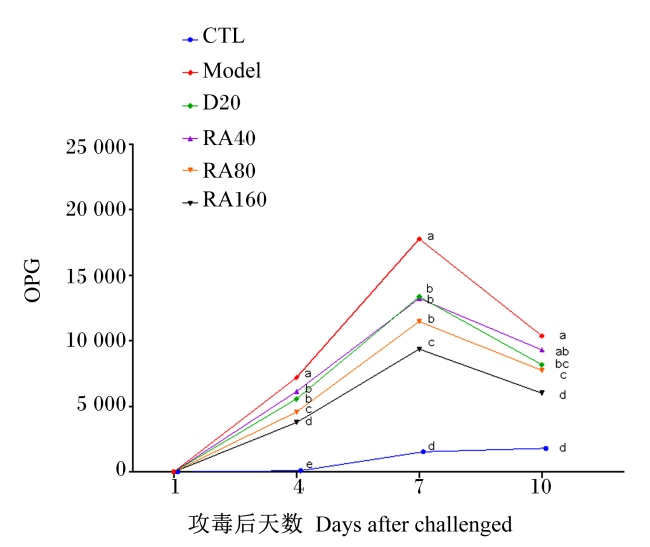
图1可知,堆型艾美耳球虫攻毒后第4、7、10天,攻毒对照组肉鸡OPG均较对照组显著上升(P<0.05);而与攻毒对照组相比,添加40(攻毒后第10天除外)、80、160 mg/kg RA或20 mg/kg地克珠利均显著降低了肉鸡的OPG(P<0.05)。
图1 RA对堆型艾美耳球虫攻毒肉鸡OPG的影响

CTL:对照组;Model:攻毒对照组;D20:阳性对照组;RA40:40 mg/kg迷迭香酸组;RA80:80 mg/kg迷迭香酸组;RA160:160 mg/kg迷迭香酸组;OPG:每克粪便中卵囊数量。同一时间数据点标注不同字母表示差异显著(P<0.05)。

Fig.1 Effects of RA on OPG of broilers challenged with E. acervulina

CTL: control group; Model: challenge control group; D20: positive control group; RA40: 40 mg/kg rosmarinic acid group; RA80: 80 mg/kg rosmarinic acid group; RA160: 160 mg/kg rosmarinic acid group; OPG: oocysts per gram of feces. Data points of the same time with different letters differ significantly (P<0.05).

2.2 RA对堆型艾美耳球虫攻毒肉鸡生长性能与死亡率的影响

表2可知,各组间肉鸡1~14日龄平均日增重、平均日采食量和料重比均无显著差异(P>0.05)。与对照组相比,堆型艾美耳球虫攻毒显著降低了肉鸡15~21日龄平均日增重(P<0.05);与攻毒对照组相比,添加160 mg/kg RA显著提高了堆型艾美耳球虫攻毒肉鸡15~21日龄平均日增重(P<0.05);各组间肉鸡15~21日龄平均日采食量和料重比均无显著差异(P>0.05)。各组间肉鸡22~56日龄平均日增重、平均日采食量和料重比均无显著差异(P>0.05)。
表2 RA对堆型艾美耳球虫攻毒肉鸡生长性能和死亡率的影响

Table 2 Effects of RA on growth performance and MR of broilers challenged with E. acervulina

时间
Time
指标
Indices
CTL Model D20 RA40 RA80 RA160 P
P-value
1~14日龄
1 to 14
days of age
平均日增重
ADG/g
11.26±0.75 11.80±0.60 11.11±0.70 10.80±1.05 11.44±1.08 11.15±1.04 0.051
平均日采食量
ADFI/g
19.23±1.14 19.83±1.33 18.71±0.39 18.52±0.74 20.22±0.48 19.82±1.03 0.068
料重比 F/G 1.72±0.18 1.76±0.12 1.69±0.16 1.69±0.09 1.67±1.78 1.78±0.09 0.757
死亡率 MR/% 0.00 1.67 1.67 1.67 1.67 1.67
15~21日龄
15~21
days of age
平均日增重
ADG/g
29.46±0.29a 24.92±3.75c 24.09±1.80bc 25.94±1.96ab 27.30±0.50bc 29.69±1.75a 0.001
平均日采食量
ADFI/g
55.50±1.15 52.24±2.14 51.99±3.88 52.89±2.52 53.44±3.68 54.23±5.10 0.590
料重比 F/G 1.88±0.11 2.06±0.16 2.17±0.16 2.02±0.24 2.08±0.33 1.87±0.19 0.178
死亡率 MR/% 3.33 6.85 3.33 3.33 1.67 3.33
22~56日龄
22~56
days of age
平均日增重
ADG/g
40.25±6.23 35.16±3.37 37.05±4.84 39.55±4.42 38.18±4.20 37.29±4.11 0.073
平均日采食量
ADFI/g
90.98±17.96 92.24±3.05 89.85±15.06 92.15±9.17 91.64±11.83 87.64±6.12 0.075
料重比 F/G 2.25±0.10 2.63±0.57 2.42±0.21 2.33±0.06 2.40±0.06 2.36±0.21 0.129
死亡率 MR/% 4.27 10.85 6.01 5.79 3.70 0.00

CTL:对照组;Model:攻毒对照组;D20:阳性对照组;RA40:40 mg/kg迷迭香酸组;RA80:80 mg/kg迷迭香酸组;RA160:160 mg/kg迷迭香酸组。同行数据肩标不同字母表示差异显著(P<0.05)。下表同。

CTL: control group; Model: challenge control group; D20: positive control group; RA40: 40 mg/kg rosmarinic acid group; RA80: 80 mg/kg rosmarinic acid group; RA160: 160 mg/kg rosmarinic acid group. Values in the same row with different letter superscripts differ significantly (P<0.05). The same as below.

表2可知,与对照组相比,攻毒对照组15~21日龄肉鸡死亡率上升了3.52%;与攻毒对照组相比,阳性对照组、40 mg/kg RA组、80 mg/kg RA组和160 mg/kg RA组肉鸡死亡率分别降低了3.52%、3.52%、5.18%、3.52%。与对照组相比,攻毒对照组22~56日龄肉鸡死亡率上升了6.58%;与攻毒对照组相比,阳性对照组、40 mg/kg RA组、80 mg/kg RA组和160 mg/kg RA组肉鸡死亡率分别降低了4.84%、5.06%、7.15%、10.85%。

2.3 RA对堆型艾美耳球虫攻毒肉鸡免疫器官指数的影响

表3可知,与对照组相比,堆型艾美耳球虫攻毒显著提高了肉鸡21日龄肝脏指数和脾脏指数(P<0.05),但对法氏囊指数与胸腺指数无显著影响(P>0.05);与攻毒对照组相比,添加160 mg/kg RA显著降低了堆型艾美耳球虫攻毒肉鸡21日龄肝脏指数(P<0.05)。
表3 RA对堆型艾美耳球虫攻毒肉鸡21日龄免疫器官指数的影响

Table 3 Effects of RA on immune organ indexes at 21 days of age for broilers challenged with E. acervuline%

项目
Items
CTL Model D20 RA40 RA80 RA160 P
P-value
肝脏指数
Liver index
1.92±0.09c 2.21±0.15ab 2.38±0.35a 2.30±0.07a 2.23±0.25ab 2.00±0.11c 0.004
脾脏指数
Spleen index
0.07±0.02b 0.11±0.01a 0.09±0.01ab 0.12±0.04a 0.10±0.03ab 0.09±0.02ab 0.026
胸腺指数
Thymus index
0.22±0.06 0.22±0.06 0.22±0.05 0.18±0.03 0.23±0.05 0.21±0.02 0.733
法氏囊指数
Bursal of Fabricius index
0.23±0.04 0.21±0.05 0.19±0.03 0.22±0.01 0.22±0.04 0.20±0.01 0.639
表4可知,与对照组相比,堆型艾美耳球虫攻毒对肉鸡28日龄法氏囊指数、肝脏指数、脾脏指数、胸腺指数均无显著影响(P>0.05);与攻毒对照组相比,添加40、80、160 mg/kg RA或20 mg/kg地克珠利对堆型艾美耳球虫攻毒肉鸡28日龄法氏囊指数、肝脏指数、脾脏指数、胸腺指数均无显著影响(P>0.05)。
表4 RA对堆型艾美耳球虫攻毒肉鸡28日龄免疫器官指数的影响

Table 4 Effects of RA on immune organ indexes at 28 days of age for broilers challenged with E. acervulina%

项目
Items
CTL Model D20 RA40 RA80 RA160 P
P-value
肝脏指数
Liver index
2.57±0.07 2.72±0.31 2.73±0.55 2.71±0.22 2.38±0.09 2.51±0.22 0.355
脾脏指数
Spleen index
0.18±0.07 0.15±0.03 0.15±0.02 0.17±0.05 0.14±0.03 0.14±0.02 0.512
胸腺指数
Thymus index
0.38±0.17 0.40±0.14 0.40±0.05 0.37±0.09 0.39±0.06 0.42±0.09 0.981
法氏囊指数
Bursal of Fabricius index
0.55±0.18a 0.39±0.04ab 0.37±0.03b 0.33±0.05b 0.39±0.17ab 0.36±0.09b 0.042
表5可知,与对照组相比,堆型艾美耳球虫攻毒对56日龄肉鸡肝脏指数、脾脏指数、胸腺指数法氏囊指数无显著影响(P>0.05);与攻毒对照组相比,添加160 mg/kg RA显著增加了56日龄肉鸡法氏囊指数(P>0.05)。
表5 RA对堆型艾美耳球虫攻毒肉鸡56日龄免疫器官指数的影响

Table 5 Effects of RA on immune organ indexes at 56 days of age for broilers challenged with E. acervulina%

项目
Items
CTL Model D20 RA40 RA80 RA160 P
P-value
肝脏指数
Liver index
1.53±0.27 1.58±0.12 1.37±0.10 1.24±0.61 1.77±0.45 1.70±0.13 0.161
脾脏指数
Spleen index
0.19±0.04 0.20±0.01 0.20±0.04 0.13±0.08 0.17±0.02 0.32±0.22 0.077
胸腺指数
Thymus index
0.33±0.13 0.30±0.14 0.37±0.19 0.21±0.03 0.29±0.03 0.39±0.23 0.612
法氏囊指数
Bursal of Fabricius index
0.16±0.07b 0.22±0.06b 0.16±0.05b 0.17±0.03b 0.18±0.04b 0.32±0.10a 0.001

2.4 RA对堆型艾美耳球虫攻毒肉鸡血清与肝脏免疫学指标的影响

表6可知,与对照组相比,堆型艾美耳球虫攻毒显著提高了肉鸡21日龄血清中C3、C4含量(P<0.05),显著降低了21日龄肉鸡血清IgM含量(P<0.05),但对血清中IgA、IgG含量无显著影响(P>0.05);与攻毒对照组相比,添加40、80、160 mg/kg RA或20 mg/kg地克珠利均显著降低了堆型艾美耳球虫攻毒肉鸡21日龄血清中C3、C4含量(P<0.05),添加80、160 mg/kg RA显著提高了血清中IgA含量(P<0.05),添加40、160 mg/kg RA显著降低了血清中IgG含量(P<0.05),添加160 mg/kg RA或20 mg/kg地克珠利显著提高了血清中IgM含量(P<0.05)。
表6 RA对堆型艾美耳球虫攻毒肉鸡21日龄血清与肝脏免疫学指标的影响

Table 6 Effects of RA on immunological indexes in serum and liver at 21 days of age for broilers challenged with E. acervulina

项目
Items
CTL Model D20 RA40 RA80 RA160 P
P-value
血清 Serum
补体3
C3/(mg/L)
493.65±71.14f 1 078.99±17.80a 628.30±24.52e 941.85±37.65b 792.08±51.79c 707.66±39.37d <0.001
补体4
C4/(mg/L)
152.00±14.61f 338.63±16.27a 185.35±5.56e 288.50±12.80b 260.47±2.96c 238.04±9.55d <0.001
免疫球蛋白A
IgA/(mg/L)
134.73±21.37c 157.99±26.35bc 179.20±25.69b 180.63±25.40b 240.87±6.24a 272.09±19.17a <0.001
免疫球蛋G
IgG/(g/L)
22.39±2.12ab 24.36±2.44a 23.30±2.58ab 18.78±2.94c 21.52±2.50abc 20.61±2.36bc 0.010
免疫球蛋白M
IgM/(mg/L)
584.03±5.54b 419.38±55.76c 853.50±14.39a 409.98±84.60c 436.86±14.22c 531.39±61.52b <0.001
肝脏 Liver
补体3
C3/(μg/g)
396.68±61.93d 742.90±70.80a 515.50±75.17c 653.30±68.90ab 596.44±51.64abc 546.52±85.84bc <0.001
补体4
C4/(μg/g)
142.02±5.41f 267.45±11.92a 162.64±8.17e 236.00±13.03b 211.00±13.12c 196.00±14.33d <0.001
免疫球蛋白A
IgA/(μg/g)
292.12±22.45a 181.09±22.52b 189.84±7.25b 177.80±23.72b 263.53±26.96a 147.60±26.66c <0.001
免疫球蛋G
IgG/(mg/g)
24.10±90.00ab 23.72±2.53b 24.74±1.28ab 21.09±1.95c 24.16±2.02ab 26.07±1.25a 0.001
免疫球蛋白M
IgM/(μg/g)
499.35±31.15cd 476.73±73.47d 739.2±68.99a 587.39±53.30bc 673.95±53.00b 774.66±67.21a <0.001
与对照组相比,堆型艾美耳球虫攻毒显著提高了肉鸡21日龄肝脏中C3、C4含量(P<0.05),显著降低了肝脏中IgA含量(P<0.05),但对肝脏中IgG和IgM含量无显著影响(P>0.05);与攻毒对照组相比,添加160 mg/kg RA或20 mg/kg地克珠利显著降低了肝脏中C3含量(P<0.05),添加40、80、160 mg/kg RA或20 mg/kg地克珠利均显著降低了肝脏中C4含量(P<0.05),添加80 mg/kg RA显著提高了肝脏中IgA含量(P<0.05),添加160 mg/kg RA显著提高了肝脏中IgG含量(P<0.05),添加40、80、160 mg/kg RA或20 mg/kg地克珠利均显著提高了肝脏中IgM含量(P<0.05)。

2.5 RA对堆型艾美耳球虫攻毒肉鸡血清与肝脏炎性因子含量的影响

表7可知,与对照组相比,堆型艾美耳球虫攻毒显著提高了21日龄肉鸡血清与肝脏IL-1β、IL-6、TNF-α含量(P<0.05);与攻毒对照组相比,添加20 mg/kg地克珠利或40、80、160 mg/kg RA均显著降低了21日龄肉鸡血清与肝脏IL-1β、IL-6、TNF-α含量(P<0.05)。
表7 RA对堆型艾美耳球虫攻毒肉鸡21日龄血清与肝脏炎性因子含量的影响

Table 7 Effects of RA on inflammatory factor contents in serum and liver at 21 days of age for broilers challenged with E. acervulina

项目
Items
CTL Model D20 RA40 RA80 RA160 P
P-value
血清 Serum/(pg/mL)
白细胞介素-1β
IL-1β
75.54±8.42c 116.64±7.76a 97.18±7.83b 53.25±7.76e 59.33±15.59d 38.17±7.56f <0.001
白细胞介素-6
IL-6
36.09±2.37c 45.89±1.37a 40.90±1.44b 27.31±1.82d 29.04±1.82d 21.17±2.63e <0.001
肿瘤坏死因子-α
TNF-α
88.07±7.05c 122.58±0.73a 104.27±1.59b 58.27±5.23e 73.55±5.20d 39.29±4.35f <0.001
肝脏 Liver/(pg/g)
白细胞介素-1β
IL-1β
63.65±9.14c 86.95±7.06a 70.53±6.10b 42.01±7.77e 51.71±7.58de 33.16±11.15ef <0.001
白细胞介素-6
IL-6
28.21±1.96b 34.21±1.93a 28.88±2.30b 21.94±2.98d 25.20±2.51c 19.61±2.54d <0.001
肿瘤坏死因子-α
TNF-α
72.97±6.82c 95.73±6.82a 83.35±4.26b 49.11±3.73e 63.51±3.73d 43.15±6.67e <0.001

2.6 RA对堆型艾美耳球虫攻毒肉鸡血清生化指标的影响

表8可知,与对照组相比,堆型艾美耳球虫攻毒显著提高了肉鸡21日龄血清中谷丙转氨酶(ALT)活性(P<0.05),对其他血清生化指标无显著影响(P>0.05);与攻毒对照组相比,添加20 mg/kg地克珠利或40、80、160 mg/kg RA显著降低了堆型艾美耳球虫攻毒肉鸡21日龄血清中ALT活性(P<0.05),添加40、80 mg/kg RA显著降低了血清中尿素氮(UN)含量(P<0.05),添加40 mg/kg RA显著降低了血清中总胆固醇(TC)含量(P<0.05)。
表8 RA对堆型艾美耳球虫攻毒肉鸡21日龄血清生化指标的影响

Table 8 Effects of RA on serum biochemical indexes at 21 days of age for broilers challenged with E. acervulina

项目
Items
CTL Model D20 RA40 RA80 RA160 P
P-value
谷丙转氨酶
ALT/(U/L)
15.33
±0.67b
21.52
±2.99a
11.30
±7.77b
13.68
±5.22b
15.33
±2.27b
12.85
±0.83b
0.036
谷草转氨酶
AST/(U/L)
278.78
±37.43
354.14
±70.11
343.11
±69.17
306.33
±30.13
417.29
±265.59
311.40
±35.65
0.476
碱性磷酸酶
ALP/(U/L)
3 605.49
±647.88ab
3 402.97
±882.64ab
3 218.39
±911.81abc
4 319.24
±207.27a
2 027.03
±782.10ab
2 888.57
±1 670.85c
0.023
尿素氮
UN/(mmol/L)
0.66
±0.20ab
0.80
±0.24a
0.98
±0.48a
0.44
±0.08b
0.48
±0.25b
0.90
±0.22a
0.011
尿酸
UA/(μmol/L)
502.50
±188.79
343.00
±127.51
388.17
±102.31
391.83
±232.26
324.60
±87.99
337.50
±114.84
0.396
甘油三酯
TG/(mmol/L)
0.65
±0.17
0.88
±0.35
1.05
±0.44
0.66
±0.17
1.09
±0.76
0.53
±0.18
0.155
总胆固醇
TC/(mmol/L)
4.32
±0.96a
4.48
±0.70a
3.71
±0.15ab
3.24
±0.44b
3.61
±1.02ab
4.65
±0.87a
0.026

3 讨论

3.1 堆型艾美耳球虫攻毒对肉鸡生长性能与OPG的影响

球虫病的发生与发展十分复杂,通常是由多种不同种类艾美尔球虫共同感染的结果。不同的艾美尔球虫致病性与典型症状不尽相同[12],例如,毒害艾美尔球虫与柔嫩艾美尔球虫毒性最大,导致肠绒毛完全破坏,产生出血和死亡;布氏艾美耳球虫和巨型艾美尔球虫导致肠壁肿胀、瘀点和上皮细胞松动;而堆型艾美耳球虫和变位艾美尔球虫感染的典型症状是导致水分流失和营养吸收减少,进而导致日增重降低、料重比增加[13-15]。本试验中,堆型艾美耳球虫攻毒使肉鸡平均日增重显著降低,死亡率增加,与堆型艾美耳球虫感染的典型症状一致,且从堆型艾美耳球虫攻毒肉鸡的粪便检测到大量堆型艾美耳球虫虫卵,表明本研究成功建立了肉鸡的堆型艾美耳球虫攻毒模型。

3.2 RA对堆型艾美耳球虫攻毒肉鸡生长性能的影响

Bozkurt等[16]研究表明,在饲粮中添加12或24 mg/kg牛至精油可以提高堆型艾美耳球虫攻毒肉鸡的体增重。Alp等[17]研究表明,在饲粮中添加300或600 mg/kg牛至精油可以缓解柔嫩艾美尔球虫与堆型艾美耳球虫攻毒引起的平均日增重下降,并降低攻毒肉鸡的料重比。Fotea等[18]研究表明,当迷迭香精油添加量为0.5%时,可提高育肥期肉鸡的生长性能和饲料利用率。本试验中,在饲粮中添加160 mg/kg RA显著提高了堆型艾美耳球虫攻毒肉鸡15~21日龄平均日增重,这与前人的研究结果一致,说明饲粮中添加RA对堆型艾美耳球虫攻毒导致的肉鸡生长性能下降有一定的缓解效果。

3.3 RA对堆型艾美耳球虫攻毒肉鸡OPG的影响

在生产中,通常采用OPG衡量球虫感染严重程度[19-21]。在进行堆型艾美耳球虫攻毒的第4天,各攻毒组的粪便中均检测到球虫的排出,在第7天OPG达到高峰,随后OPG缓慢下降。这说明堆型艾美耳球虫进入肉鸡消化道7 d内快速地繁殖导致数量上巨大增长,使得通过粪便排出的球虫卵囊数量增加。Arczewska-Włosek等[21]研究表明,在饲粮中添加1 000 mg/kg植物精油混合物(迷迭香、百里香、紫雏菊、丹参、牛至)可有效减少巨型艾美尔球虫、柔嫩艾美尔球虫攻毒肉鸡OPG。本试验中,饲粮中添加40、80、160 mg/kg RA或20 mg/kg地克珠利均减少了攻毒4、7、10 d肉鸡粪便OPG。体外研究表明,4 mg/mL富含RA的植物精油可以破坏85%~90%的艾美尔球虫卵囊[22]。这可能是饲粮中添加RA显著降低肉鸡OPG的原因之一。

3.4 RA对堆型艾美耳球虫攻毒肉鸡免疫器官指数的影响

免疫器官指数常用来评价鸡的免疫状态[23]。脾脏是禽类最大的外周免疫器官,参与机体的细胞免疫与体液免疫。法氏囊是禽类特有的中枢免疫器官,主导机体的体液免疫。胸腺为T淋巴细胞分化、发育和成熟提供场所。肝脏是体内最大的网状内皮细胞吞噬系统,对抗原的过滤、清除、吞噬和调节和免疫反应的作用。在早期研究中,去除法氏囊的鸡对继发性艾美球虫感染产生保护性免疫的能力没有显著影响[24],而切除胸腺的大鼠对原发性和继发性球虫感染的抵抗力均显著降低[25]。有研究报道,球虫感染会损害肉鸡肝脏组织结构[26]。宋鸿雁等[27]的研究表明,斯氏艾美耳球虫感染导致新西兰兔肝脏严重受损,且血清中ALT、谷草转氨酶(AST)、乳酸脱氢酶(LDH)、ALP活性与总胆红素(T-BIL)含量极显著增高。本试验中,堆型艾美耳球虫攻毒导致肉鸡脾脏指数、肝脏指数显著增加,但对法氏囊指数、胸腺指数无显著影响,这与前人的研究结果基本一致。进一步对血清生化指标进行分析发现,血清中ALT活性在堆型艾美耳球虫攻毒后显著增加,而血清中ALT活性升高是肝脏炎症或肝细胞受损的表现[28]。前人研究发现,在对乙酰氨基酚诱导的小鼠急性肝损伤模型中,小鼠血清ALT活性显著升高,RA可以降低血清ALT活性,缓解对乙酰氨基酚诱导的小鼠急性肝损伤[29]。本试验中,饲粮中添加160 mg/kg RA显著降低了堆型艾美耳球虫攻毒肉鸡21日龄的肝脏指数与血清中ALT活性,说明RA对肉鸡肝脏损伤有一定的修复作用。

3.5 RA对堆型艾美耳球虫攻毒肉鸡血液与肝脏免疫学指标的影响

前人研究表明堆型艾美耳球虫攻毒可使鸡血清补体含量升高[30]。本试验结果表明,堆型艾美耳球虫攻毒显著提高了肉鸡血清、肝脏中C3、C4含量。体外研究表明,RA可以特异性连接到C3b的a9-链上,抑制补体的激活[31]。本试验中,饲粮添加RA降低了堆型艾美耳球虫攻毒肉鸡肝脏中C3、C4含量。研究显示,鸡感染艾美尔球虫后,会产生大量的特异性IgA、IgG、IgM,这些抗体主要分布在血清、胆汁和肠道分泌物中;雏鸡初次感染毒害艾美耳球虫后,血清中IgA、IgG、IgM含量显著升高[32]。本试验中,堆型艾美耳球虫攻毒提高了肉鸡血清中IgA、IgM含量,降低了肝脏中IgA、IgM含量。台瑞青[33]的研究表明,在饲粮中添加200 mg/kg RA可以提高育肥猪血清中IgM含量。Sanbongi等[34]研究发现,RA可显著抑制过敏原特异性IgG。而Farouk等[35]给感染大肠杆菌的肉鸡饲喂添加了迷迭香的饲粮后,血清中IgG含量增加。Al Sheyab等[36]研究表明,迷迭香提取物增加了小鼠血清中IgM和IgG含量。本试验中,RA提高了堆型艾美耳球虫攻毒肉鸡血清中IgM含量,而使IgG含量下降,这与Sanbongi等[34]的研究结果一致。

3.6 RA对堆型艾美耳球虫攻毒肉鸡血清与肝脏炎性细胞因子含量的影响

TNF-α作为炎症中主要的细胞因子,是在细菌、病毒、免疫复合物、补体因子、细胞因子等刺激下产生,能够激活适应性免疫系统、其他促炎细胞因子(IL-1β和IL-6)和生长因子的转录,以及活化单核细胞和巨噬细胞[37]。鸡外周血白细胞来源的巨噬细胞在受到柔嫩艾美耳球虫孢子和裂殖子刺激时,TNF-α的产生呈现剂量与时间依赖性[38-39]。IL-1β是参与初始炎症反应的重要细胞因子,它诱导趋化因子的产生,从而促进炎症细胞在炎症部位的募集[40],且在感染球虫的肉鸡体内检测到它的表达上调[41]。IL-6负责B细胞最终成熟并产生抗体,并在感染堆型艾美耳球虫、巨大艾美尔和柔嫩艾美尔球虫的鸡的上皮内淋巴细胞中表达增强,这表明IL-6在适应性免疫中发挥作用[42]。这些研究表明炎性细胞因子在球虫病的发病机制中扮演重要角色。本试验中,进行堆型艾美耳球虫攻毒后,肉鸡血清、肝脏中TNF-α、IL-1β和IL-6含量显著上升,说明堆型艾美耳球虫球虫攻毒激活了肉鸡适应性免疫系统并引起肝脏炎症。研究表明,RA显著降低大鼠肝脏中TNF-αIL-1β的mRNA表达水平,缓解缺血再灌注引起的肝脏急性炎症[43]。最近的研究发现,RA与百里香酚复配能够降低脂多糖攻毒小鼠空肠黏膜中IL-6含量[44]。在本试验中,在饲粮中添加RA显著降低了堆型艾美耳球虫攻毒肉鸡血清和肝脏中TNF-α、IL-1β、IL-6含量,说明RA缓解了堆型艾美耳球虫攻毒引起的炎症与肝脏损伤。信号转导和转录激活因子3(STAT3)和NF-κB协同调控多个靶基因,并协同调控相关细胞因子和趋化因子,STAT3直接与p65和p50相互作用,促进NF-κB募集到STAT3启动子,反之亦然[45]。研究表明,RA在DDS诱导的慢性结肠炎小鼠模型中可以抑制NF-κB和STAT3核转位[8]。因此,RA可能是通过抑制NF-κB和STAT3核转位,下调下游的炎性细胞因子(TNF-α、IL-1β、IL-6),进而缓解由堆型艾美耳球虫感染引起的肝脏炎症。值得注意的是,在一项早期的研究中发现,抑制肿瘤坏死因子使得苏赛斯鸡在感染球虫时体重下降减缓[42],因此,球虫攻毒后,机体发生炎症反应,导致基础代谢增快和能量消化增加,这可能是攻毒对照组15~21日龄肉鸡平均日增重显著降低的原因之一。

4 结论

综上所述,在本试验条件下,饲粮添加160 mg/kg RA可提高堆型艾美耳球虫攻毒1周后肉鸡的平均日增重和血清中免疫球蛋白(IgA、IgM)含量,降低肝脏指数和血清、肝脏中补体(C3、C4)和炎症细胞因子(IL-1β、IL-6、TNF-α)含量,其效果优于20 mg/kg地克珠利或40~80 mg/kg RA。以上结果表明,饲粮添加160 mg/kg RA可有效缓解堆型艾美耳球虫引起的肉鸡生长缓慢、免疫失衡与肝脏炎症。
[1]
SWAGGERTY C L, GENOVESE K J, HE H, et al. Broiler breeders with an efficient innate immune response are more resistant to Eimeria tenella[J]. Poultry Science, 2011, 90(5):1014-1019.

DOI

[2]
GRENIER B, DOHNAL I, SHANMUGASUNDARAM R, et al. Susceptibility of broiler chickens to coccidiosis when fed subclinical doses of deoxynivalenol and fumonisins-special emphasis on the immunological response and the mycotoxin interaction[J]. Toxins, 2016, 8(8):231.

DOI

[3]
COX C M, SUMNERS L H, KIM S, et al. Immune responses to dietary beta-glucan in broiler chicks during an Eimeria challenge[J]. Poultry Science, 2010, 89(12):2597-2607.

DOI

[4]
ZHANG J J, WANG L X, RUAN W K, et al. Investigation into the prevalence of coccidiosis and maduramycin drug resistance in chickens in China[J]. Veterinary Parasitology, 2013, 191(1/2):29-34.

DOI

[5]
HITL M, KLADAR N, GAVARIĆ N, et al. Rosmarinic acid-human pharmacokinetics and health benefits[J]. Planta Medica, 2021, 87(4):273-282.

DOI PMID

[6]
GUO C, SHANGGUAN Y, ZHANG M R, et al. Rosmarinic acid alleviates ethanol-induced lipid accumulation by repressing fatty acid biosynthesis[J]. Food&Function, 2020, 11(3):2094-2106.

[7]
雷铭康, 李润林, 李盼盼, 等. 饲粮添加迷迭香酸对产肠毒素大肠杆菌K88攻毒断奶仔猪结肠菌群组成、屏障功能及炎症反应的影响[J]. 动物营养学报, 2022, 34(8):4944-4958.

DOI

LEI M K, LI R L, LI P P, et al. Effects of dietary rosmarinic acid on colonic microbiota composition,barrier function and inflammatory response in weaned piglets challenged with enterotoxigenic Escherichia coli K88[J]. Chinese Journal of Animal Nutrition, 2022, 34(8):4944-4958. (in Chinese)

[8]
JIN B R, CHUNG K S, CHEON S Y, et al. Rosmarinic acid suppresses colonic inflammation in dextran sulphate sodium (DSS)-induced mice via dual inhibition of NF-κB and STAT3 activation[J]. Scientific Reports, 2017, 7:46252.

DOI

[9]
GUAN M L, GUO L, MA H L, et al. Network pharmacology and molecular docking suggest the mechanism for biological activity of rosmarinic acid[J]. Evidence-Based Complementary and Alternative Medicine, 2021, 2021:5190808.

[10]
LAHLOU R A, BOUNECHADA M, MOHAMMEDI A, et al. Dietary use of Rosmarinus officinalis and Thymus vulgaris as anticoccidial alternatives in poultry[J]. Animal Feed Science and Technology, 2021, 273:114826.

DOI

[11]
ALAGAWANY M, EL-HACK M E A. The effect of rosemary herb as a dietary supplement on performance,egg quality,serum biochemical parameters,and oxidative status in laying hens[J]. Journal of Animal and Feed Sciences, 2015, 24(4):341-347.

DOI

[12]
TEWARI A K, MAHARANA B R. Control of poultry coccidiosis:changing trends[J]. Journal of Parasitic Diseases:Official Organ of the Indian Society for Parasitology, 2011, 35(1):10-17.

DOI

[13]
ADAMS C, VAHL H A, VELDMAN A. Interaction between nutrition and Eimeria acervulina infection in broiler chickens:development of an experimental infection model[J]. British Journal of Nutrition, 1996, 75(6):867-873.

DOI

[14]
CHAPMAN H D. Milestones in avian coccidiosis research:a review[J]. Poultry Science, 2014, 93(3):501-511.

DOI

[15]
JOYNER L P, LONG P L. The specific characters of the Eimeria,with special reference to the coccidia of the fowl[J]. Avian Pathology:Journal of the W. V.P.A, 1974, 3(3):145-157.

[16]
BOZKURT M, AYSUL N, KÜÇÜKYILMAZ K, et al. Efficacy of in-feed preparations of an anticoccidial,multienzyme,prebiotic,probiotic,and herbal essential oil mixture in healthy and Eimeria spp.-infected broilers[J]. Poultry Science, 2014, 93(2):389-399.

DOI

[17]
ALP M, MIDILLI M, KOCABAĞLI N, et al. The effects of dietary oregano essential oil on live performance,carcass yield,serum immunoglobulin G level,and oocyst count in broilers[J]. Journal of Applied Poultry Research, 2012, 21(3):630-636.

DOI

[18]
FOTEA L, COSTǍCHESCU E, Hoha G. The effect of essential oil of rosemary (Rosmarinus officinalis) on to the broilers growing performance[J]. Lucrări Ştiintifice-Universitatea de Ştiinte Agricole şi Medicină Veterinară,Seria Zootehnie, 2009, 52:111-113.

[19]
李豪, 郭雨佳, 刘超, 等. 我国部分地区奶牛球虫病流行病学调查[J]. 中国畜牧杂志, 2016, 52(14):35-38,44.

LI H, GUO Y J, LIU C, et al. The epidemiological investigation of dairy coccidiosis in parts of our country[J]. Chinese Journal of Animal Science, 2016, 52(14):35-38,44. (in Chinese)

[20]
郝桂英, 杨应东, 徐睿, 等. 盐边县山羊球虫感染情况的调查[J]. 畜牧与兽医, 2018, 50(8):69-72.

HAO G Y, YANG Y D, XU R, et al. Investigation of caprine coccidial infection in Yanbian county[J]. Animal Husbandry&Veterinary Medicine, 2018, 50(8):69-72. (in Chinese)

[21]
ARCZEWSKA-WŁOSEK A, ŚWIATKIEWICZ S, KOWAL J, et al. The effect of increased crude protein level and/or dietary supplementation with herbal extract blend on the performance of chickens vaccinated against coccidiosis[J]. Animal Feed Science and Technology, 2017, 229:65-72.

DOI

[22]
REMMAL A, ACHAHBAR S, BOUDDINE L, et al. Oocysticidal effect of essential oil components against chicken eimeria oocysts[J]. International Journal of Veterinary Medicine:Research&Reports, 2013, 2013:599816.

[23]
RAJI A A, MOHAMMED B, OLADELE S B. Bursa body index as a visual indicator for the assessment of bursa of fabricius[J]. Journal of Veterinary Medicine and Animal Health, 2017, 9(2):32-38.

DOI

[24]
PIERCE A E, LONG P L. Studies on acquired immunity to coccidiosis in bursaless and thymectomized fowls[J]. Immunology, 1965, 9(5):427-439.

PMID

[25]
ROSE M E, HESKETH P. Immunity to coccidiosis:T-lymphocyte- or B-lymphocyte-deficient animals[J]. Infection and Immunity, 1979, 26(2):630-637.

DOI

[26]
李文超, 顾有方, 陈会良, 等. 堆型艾美耳球虫感染后组织抗氧化功能的变化[J]. 中国兽医学报, 2010, 30(4):465-468.

LI W C, GU Y F, CHEN H L, et al. Change of anti-oxidation in tissues of chicken infected with Eimeria.acervulina[J]. Chinese Journal of Veterinary Science, 2010, 30(4):465-468. (in Chinese)

[27]
宋鸿雁, 景瑾, 蒋荧梅, 等. 斯氏艾美耳球虫感染兔血常规及肝脏功能分析[J]. 中国兽医杂志, 2017, 53(1):27-29.

SONG H Y, JING J, JIANG Y M, et al. Routine blood tests and liver function analysis of Eimeria stiedai-infected rabbits[J]. Chinese Journal of Veterinary Medicine, 2017, 53(1):27-29. (in Chinese)

[28]
NGUYEN L H, CHAO D, LIM J K, et al. Histologic changes in liver tissue from patients with chronic hepatitis B and minimal increases in levels of alanine aminotransferase:a meta-analysis and systematic review[J]. Clinical Gastroenterology and Hepatology, 2014, 12(8):1262-1266.

DOI

[29]
吕利. 迷迭香酸对APAP致小鼠急性肝损伤的保护作用及机制[D].硕士学位论文. 南宁: 广西大学, 2020.

LV L. Protective effect and mechanism of rosmarinik acid on acute liver injury induced by APAP in mice[D].Master’s Thesis. Nanning: Guangxi University, 2020. (in Chinese)

[30]
KOINARSKI V, SOTIROV L. Lysozyme and complement activities in broiler-chickens with coccidiosis[J]. Revue de Médecine Vétérinaire, 2005, 154(12):780-784.

[31]
SAHU A, RAWAL N, PANGBURN M K. Inhibition of complement by covalent attachment of rosmarinic acid to activated C3b[J]. Biochemical Pharmacology, 1999, 57(12):1439-1446.

PMID

[32]
郑世民, 刘晶, 胡京友, 等. 毒害艾美耳球虫初次感染对雏鸡外周血液免疫功能的影响[J]. 中国家禽, 2006, 28(7):9-11.

ZHENG S M, LIU J, HU J Y, et al. Influence of Eimeria necatrix primarily infection on immune function of peripheral blood of chickens[J]. China Poultry, 2006, 28(7):9-11. (in Chinese)

[33]
台瑞青. 迷迭香酸对育肥猪抗氧化水平与脂肪代谢的影响[D].硕士学位论文. 咸阳: 西北农林科技大学, 2022.

TAI R Q. Effects of rosmarinic acid on antioxidant level and fat metabolism in finishing pigs[D].Master’s Thesis. Xianyang: Northwest A&F University, 2022. (in Chinese)

[34]
SANBONGI C, TAKANO H, OSAKABE N, et al. Rosmarinic acid in perilla extract inhibits allergic inflammation induced by mite allergen,in a mouse model[J]. Clinical&Experimental Allergy, 2004, 34(6):971-977.

[35]
FAROUK S M, ABDEL-RAHMAN H G, ABDALLAH O A, et al. Comparative immunomodulatory efficacy of rosemary and fenugreek against Escherichia coli infection via suppression of inflammation and oxidative stress in broilers[J]. Environmental Science and Pollution Research, 2022, 29(26):40053-40067.

DOI

[36]
AL SHEYAB F M, ABUHARFEIL N, SALLOUM L, et al. The effect of rosemary (Rosmarinus officinalis.L) plant extracts on the immune response and lipid profile in mice[J]. Journal of Biology and Life Science, 2012, 3(1):37-58.

[37]
WENDLING D, PRATI C. Paradoxical effects of anti-TNF-α agents in inflammatory diseases[J]. Expert Review of Clinical Immunology, 2014, 10(1):159-169.

DOI PMID

[38]
ZHANG S, LILLEHOJ H S, RUFF M D. Chicken tumor necrosis-like factor:Ⅰ.In vitro production by macrophages stimulated with Eimeria tenella or bacterial lipopolysaccharide[J]. Poultry Science, 1995, 74(8):1304-1310.

DOI

[39]
李润林, 赵道远, 李盼盼, 等. 百里香酚与迷迭香酸组合对脂多糖攻毒大鼠生长性能、炎症反应和肠道健康的影响[J]. 动物营养学报, 2022, 34(3):2009-2022.

DOI

LI R L, ZHAO D Y, LI P P, et al. Effects of thymol and rosmarinic acid combination on growth performance,inflammatory response and intestinal health of lipopolysaccharide-challenged rats[J]. Chinese Journal of Animal Nutrition, 2022, 34(3):2009-2022. (in Chinese)

[40]
YAMADA T, FUJIEDA S, YANAGI S, et al. IL-1 induced chemokine production through the association of Syk with TNF receptor-associated factor-6 in nasal fibroblast lines[J]. Journal of Immunology, 2001, 167(1):283-288.

DOI PMID

[41]
DALLOUL R A, BLISS T W, HONG Y H, et al. Unique responses of the avian macrophage to different species of Eimeria[J]. Molecular Immunology, 2007, 44(4):558-566.

DOI

[42]
HONG Y H, LILLEHOJ H S, LILLEHOJ E P, et al. Changes in immune-related gene expression and intestinal lymphocyte subpopulations following Eimeria maxima infection of chickens[J]. Veterinary Immunology and Immunopathology, 2006, 114(3/4):259-272.

DOI

[43]
RAMALHO L N Z, PASTA Â A C, TERRA V A, et al. Rosmarinic acid attenuates hepatic ischemia and reperfusion injury in rats[J]. Food and Chemical Toxicology, 2014, 74:270-278.

PMID

[44]
ZHANG S, LILLEHOJ H S, RUFF M D. In vivo role of tumor necrosis-like factor in Eimeria tenella infection[J]. Avian Diseases, 1995, 39(4):859-866.

DOI

[45]
HOESEL B, SCHMID J A. The complexity of NF-κB signaling in inflammation and cancer[J]. Molecular Cancer, 2013, 12:86.

DOI PMID

Outlines

/