RESEARCH PAPER

Effects of Marigold Extract on Growth Performance, Carcass Performance, Meat Quality and Serum Biochemical Indexes of Broilers Suffered from Heat Stress

  • SUN Jinzhi , 1 ,
  • SONG Zhigang 2 ,
  • ZHU Qidong 2 ,
  • ZHAO Pengyu 3 ,
  • SONG Weiguang 3 ,
  • ZHAO Jian , 1, *
Expand
  • 1 Hebei Plant Extraction Innovation Center Co., Ltd., Handan 057250, China
  • 2 Key Laboratory of Efficient Utilization of Non-Grain Feed Resource, College of Animal Science and Technology, Shandong Agricultural University, Tai’an 271018, China
  • 3 Hebei Province Plant Source Animal Health Products Technology Innovation Center, Handan 057250, China

Received date: 2023-04-24

  Online published: 2023-10-12

Abstract

The objective of this trial was to study effects of marigold extract on growth performance, carcass performance, meat quality and serum biochemical indexes of broilers reared under heat stress. The experiment lasted for 36 days, which was divided into two stages: days 1 to 28 and days 29 to 36. During days 1 to 28, 576 one-day-old AA chickens were equally arranged into 3 groups with 6 replicates and 32 broilers in each replicate. Chickens were randomly fed: a basal diet (control group), the basal diet adding 125 or 250 mg/kg marigold extract. On day 29, each replicate was equally split into 2 groups with similar average body weight. One group was kept in optimum ambient temperature, and the other was suffered from heat stress at 32 ℃ for 7 days. Diets were unchanged in each replicate. The results showed as follows: 1) compared with the control group, dietary 250 mg/kg marigold extract significantly decreased the feed/gain of broilers from days 1 to 28 (P<0.05), but had no significant effects on average daily gain and average daily feed intake of broilers at this stage (P>0.05). 2) Compared with the control group, the body weight, average daily gain, average daily feed intake, feed/gain, percentage of leg muscle yield, and serum triglyceride content decreased significantly by heat stress (P<0.05), while mortality and serum uric acid content significantly increased (P<0.05). 3) Under heat stress, the addition of marigold extract significantly increased the evisceration rate and semi-evisceration rate (P<0.05), and significantly decreased the abdominal fat rate, serum total triglyceride and uric acid contents (P<0.05), but had no significant effects on growth performance indexes and meat quality indexes (P>0.05). In conclusion, there is an adverse effect of heat stress on broiler production. However, broiler carcass yield can benefit from marigold extract in the condition of heat stress.

Cite this article

SUN Jinzhi , SONG Zhigang , ZHU Qidong , ZHAO Pengyu , SONG Weiguang , ZHAO Jian . Effects of Marigold Extract on Growth Performance, Carcass Performance, Meat Quality and Serum Biochemical Indexes of Broilers Suffered from Heat Stress[J]. Chinese Journal of Animal Nutrition, 2023 , 35(10) : 6340 -6348 . DOI: 10.12418/CJAN2023.582

根据美国农业部预测,2023年中国鸡肉产量将保持在1 430万t,位居世界第3位。在中国,大多数肉鸡养殖场处于亚热带季风区和温带季风区,其气候特点是夏季高温多雨,易造成肉鸡的热应激。一方面,全球气候变暖使这些地区将更频繁地受到高温的影响;另一方面,为提高生长速度和饲料效率进行的持续选育,使现代肉鸡对热应激更加敏感[1]。热应激会导致肉鸡生长性能和肉品质下降[2]。缓解热应激的营养性策略有添加维生素、电解质和植物源化合物[3-4]等。基础饲粮中添加一定量的黄酮类化合物对热应激状态下的肉鸡生长性能和屠宰性能有一定的改善作用[5]。万寿菊提取物是农业农村部新批准的饲料添加剂,其有效成分槲皮万寿菊素,化学结构为六羟基黄酮,适用范围为肉仔鸡。黄酮类化合物被认为具有缓解热应激的功效[4]。但万寿菊提取物对热应激下肉仔鸡的作用效果鲜见报道。因此,本试验研究万寿菊提取物对热应激下肉鸡生长性能、屠宰性能、肉品质和血清生化指标的影响,旨在为万寿菊提取物在肉鸡养殖中的应用提供基础数据和参考。

1 材料与方法

1.1 试验设计

试验在山东农业大学动物科技学院试验动物基地进行。试验期36 d,分成第1~28天和第29~36天2个阶段。在第1~28天,576只健康的1日龄爱拔益加(AA)肉雏鸡被均分为3个组,分别饲喂基础饲粮(对照组)、基础饲粮中添加125 mg/kg万寿菊提取物的试验饲粮(低剂量组)、基础饲粮中添加250 mg/kg万寿菊提取物的试验饲粮(高剂量组),每组6个重复,每个重复32只鸡。在第29天,每个重复又均分成鸡数一致且体重接近的2个组,其中一组继续保持适宜的环境温度,而另一组的环境温度全天保持在32 ℃,持续7 d,各处理分别为适温对照、适温低剂量、适温高剂量、热应激对照、热应激低剂量、热应激高剂量。各处理饲粮不变。除温度外,其他管理条件如光照和通风都保持一致。试验期间肉鸡自由采食和饮水。
万寿菊提取物有效成分槲皮万寿菊素含量>80%(由河北某生物科技集团股份有限公司生产)。基础饲粮参考《鸡饲养标准》(NY/T 33—2004)设计,粉料,分0~3周和4~6周2个阶段,其组成及营养水平见表1
表1 基础饲粮组成及营养水平(干物质基础)

Table 1 Composition and nutrient levels of basal diets (DM basis)%

项目
Items
含量 Content
0~3周
0 to 3 weeks
4~6周
4 to 6 weeks
原料 Ingredients
玉米 Corn 52.84 58.21
豆粕 Soybean meal 35.15 28.30
玉米蛋白粉 Corn gluten meal 2.50 2.70
氯化钠 NaCl 0.30 0.28
石粉 Limestone 1.75 1.62
磷酸氢钙 CaHPO4 1.55 1.40
豆油 Soybean oil 4.10 5.90
维生素预混料 Vitamin premix1) 0.05 0.04
微量元素预混料
Trace element premix1)
0.20 0.20
胆碱 Choline 0.10 0.10
蛋氨酸 Met 0.31 0.27
赖氨酸 Lys 0.90 0.75
苏氨酸 Thr 0.20 0.18
植酸酶 Phytase 0.05 0.05
合计 Total 100.00 100.00
营养水平 Nutrient levels2)
代谢能 ME/(MJ/kg) 12.55 13.18
粗蛋白质 CP 21.50 19.00
钙 Ca 1.00 0.90
有效磷 AP 0.50 0.45
赖氨酸 Lys 1.39 1.20
蛋氨酸+半胱氨酸 Met+Cys 0.95 0.85
苏氨酸 Thr 0.90 0.80
色氨酸 Trp 0.24 0.20

1)维生素预混料和微量元素预混料为每千克饲粮提供The vitamin premix and trace element premix provided the following per kg of diets:VA 8 000 IU,VD 1 000 IU,VE 20 IU,VK 0.5 mg,硫胺素 thiamine 2.0 mg,核黄素 riboflavin 8 mg,泛酸 pantothenic acid 10 mg,烟酸 nicotinic acid 35 mg,吡哆醛 pyridoxal 3.5 mg,生物素 biotin 0.18 mg,叶酸 folic acid 0.55 mg,VB12 0.01 mg,Fe 100 mg,Cu 8 mg,Mn 120 mg,Zn 100 mg,I 0.7 mg,Se 0.3 mg。

2) 代谢能和有效磷为计算值。粗蛋白质、钙、氨基酸(赖氨酸、蛋氨酸、半胱氨酸、苏氨酸、色氨酸)为实测值,测定方法分别依据GB/T 6432—2018、GB/T 6436—2018、GB/T 18246—2019。ME and AP were calculated values. CP, Ca and amino acids (Lys, Met, Cys, Thr and Try) were measured values, and determination methods were based on GB/T 6432—2018, GB/T 6436—2018 and GB/T 18246—2019, respectively.

1.2 检测指标和方法

1.2.1 生长性能

肉鸡按重复分别在试验的第1、28和36天称取空腹体重(BW),称量剩余饲粮重量,计算饲粮消耗,计算各阶段的平均日增重(ADG)、平均日采食量(ADFI)、料重比(F/G)和死淘率。

1.2.2 屠宰性能

在第36天,每个重复选取1只体重接近该重复平均体重的肉鸡(共36只),采血后放血致死。按《家禽生产性能名词术语和度量计算方法》(NY/T 823—2020)测定半净膛率(SEP)、全净膛率(EP)、胸肌率(PBM)、腿肌率(PLM)、腹脂率(PAF)。

1.2.3 肉品质

各屠宰肉鸡取相同部位的胸肌或腿肌,参考《猪肉品质测定技术规程》(NY/T 821—2019)测定亮度(L*)、红度(a*)、黄度(b*)值以及pH24、滴水损失。参考《肉嫩度的测定剪切力测定法》(NY/T 1180—2006)测定胸肌和腿肌剪切力。

1.2.4 血清生化指标

采集的血液凝固后分离血清,使用全自动生化分析系统(Biobase BK1200)测定血清中甘油三酯(TG)、总胆固醇(TC)、尿酸(UA)含量和谷草转氨酶(AST)活性。

1.3 数据统计与分析

试验结果用平均值±标准差表示。第1~28天生长性能数据使用SPSS 21.0软件进行单因素方差分析,当P<0.05为显著差异,并采用LSD法进行两两比较。当0.05<P<0.10为有差异显著的趋势。第29~36天生长性能数据、屠宰性能、肉品质、血清生化指标等数据使用一般线性模型单变量进行分析环境温度和万寿菊提取物的主效应,及两者交互作用,以P<0.05为显著差异,当0.05<P<0.10为有差异显著的趋势。

2 结果与分析

2.1 万寿菊提取物对第1~28天肉鸡生长性能的影响

表2可知,单因素方差分析结果显示,基础饲粮中添加万寿菊提取物对第28天肉鸡的体重、平均日增重没有显著影响(P>0.05),但添加万寿菊提取物有降低平均日采食量的趋势(P=0.092),且能显著降低料重比(P<0.05)。LSD比较结果显示,与对照组相比,添加250 mg/kg万寿菊提取物显著降低料重比(P<0.05),而添加125 mg/kg有降低料重比的趋势(P=0.076)。
表2 万寿菊提取物对第1~28天肉鸡生长性能的影响

Table 2 Effects of marigold extract on growth performance of broilers during days 1 to 28

项目
Items
对照组
Control group
低剂量组
Low dose group
高剂量组
High dose group
P
P-value
初重 IBW/g 47.63±0.50 47.71±0.50 47.67±0.50 0.921
第28天体重 BW at day 28/g 1 574.54±53.52 1 584.02±63.78 1 574.14±53.44 0.899
平均日增重 ADG/g 56.55±1.99 56.90±2.36 56.54±1.98 0.899
平均日采食量ADFI/g 82.44±4.20 79.56±5.59 77.87±4.85 0.092
料重比 F/G 1.46±0.06a 1.40±0.08ab 1.38±0.09b 0.048

同行数据肩标不同字母表示差异显著(P<0.05)。

In the same row, values with different letter superscripts mean significant difference (P<0.05).

2.2 环境温度和万寿菊提取物对肉鸡生长性能的影响

表3可见,热应激引起肉鸡死亡率显著升高(P<0.05)。而在热应激条件下,添加万寿菊提取物对肉鸡的生长性能和死亡率没有显著影响(P>0.05)。环境温度和万寿菊提取物之间也没有表现出显著的交互作用(P>0.05)。
表3 环境温度和万寿菊提取物对肉鸡生长性能的影响

Table 3 Effects of ambient temperature and marigold extract on growth performance of broilers

项目
Items
初重
IBW/g
第36天体重
BW at day 36/g
平均日增重
ADG/g
平均日采食量
ADFI/g
料重比
F/G
死亡率
Mortality/%
处理 Treatments
适温对照 OT+C 1 567.13±57.39 1 986.77±76.59 59.95±11.76 141.19±15.24 2.42±0.46 0.00±0.00
适温低剂量 OT+L 1 578.26±38.03 1 999.94±64.98 60.24±8.53 128.99±13.78 2.17±0.36 0.00±0.00
适温高剂量 OT+H 1 571.11±64.47 2 011.88±45.83 62.97±7.75 146.47±11.06 2.36±0.39 0.00±0.00
热应激对照 HS+C 1 581.95±53.63 1 873.40±48.60 41.64±9.65 115.95±28.67 2.82±0.51 1.85±4.54
热应激低剂量 HS+L 1 590.93±90.85 1 939.31±77.25 49.77±6.57 119.91±11.58 2.44±0.34 2.22±4.97
热应激高剂量 HS+H 1 577.78±43.74 1 869.00±106.27 41.60±9.43 119.08±10.09 2.99±0.72 2.00±4.47
PP-value
环境温度
Ambient temperature
0.584 <0.001 <0.001 0.001 0.014 0.033
万寿菊提取物
Marigold extract
0.900 0.405 0.547 0.514 0.160 0.220
交互作用 Interaction 0.986 0.404 0.370 0.383 0.676 0.862

2.3 环境温度和万寿菊提取物对肉鸡屠宰性能的影响

表4可知,热应激只显著降低了肉鸡的腿肌率(P<0.05),而万寿菊提取物则显著提高了肉鸡的半净膛率和全净膛率(P<0.05),同时显著降低了肉鸡腹脂率(P<0.05)。但二者之间没有显著的交互作用(P>0.05)。
表4 环境温度和万寿菊提取物对肉鸡屠宰性能的影响

Table 4 Effects of ambient temperature and marigold extract on carcass yield of broilers%

项目
Items
半净膛率
Semi-eviscerated
percentage
全净膛率
Eviscerated
percentage
腹脂率
Percentage of
abdominal fat
腿肌率
Percentage of
leg muscle
胸肌率
Percentage of
breast muscle
处理 Treatments
适温对照 OT+C 85.80±1.81 78.92±2.18 1.57±0.45 14.51±1.00 18.53±1.74
适温低剂量 OT+L 85.98±1.86 79.44±1.77 1.22±0.31 15.18±1.50 19.97±1.58
适温高剂量 OT+H 88.37±2.24 80.82±2.15 1.20±0.24 16.04±2.19 18.83±1.58
热应激对照 HS+C 85.21±1.88 77.88±1.47 1.37±0.34 13.76±1.37 18.51±1.50
热应激低剂量 HS+L 86.81±1.43 79.42±1.72 1.13±0.24 13.99±1.08 19.39±1.76
热应激高剂量 HS+H 86.63±0.48 79.97±1.39 1.10±0.39 14.20±1.56 19.22±1.83
PP-value
环境温度 Ambient temperature 0.383 0.275 0.256 0.017 0.901
万寿菊提取物 Marigold extract 0.027 0.028 0.048 0.291 0.251
交互作用 Interaction 0.201 0.749 0.911 0.672 0.775

2.4 环境温度和万寿菊提取物对肉鸡胸肌和腿肌肉品质的影响

表5表6可知,热应激和万寿菊提取物对胸肌或腿肌的失水率、剪切力、肉色、pH24的影响都不显著(P>0.05),且二者交互作用不显著(P>0.05)。但热应激有降低腿肌剪切力和L*值的趋势(P=0.086和P=0.068)。
表5 环境温度和万寿菊提取物对肉鸡胸肌肉品质的影响

Table 5 Effects of ambient temperature and marigold extract on breast muscle quality of broilers

项目
Items
失水率
Drip loss/%
剪切力
Shear force/N
亮度
L*
红度
a*
黄度
b*
pH24
处理 Treatments
适温对照 OT+C 2.39±0.55 41.98±7.26 52.60±3.28 4.07±1.38 9.78±1.21 6.75±0.12
适温低剂量 OT+L 2.52±0.85 42.01±10.52 51.95±4.43 3.97±0.66 9.80±1.60 6.72±0.09
适温高剂量 OT+H 2.51±0.68 42.30±13.16 48.65±1.81 4.07±0.37 9.98±0.79 6.78±0.08
热应激对照 HS+C 2.39±0.64 41.50±10.97 49.87±4.76 3.77±0.63 9.58±1.65 6.75±0.14
热应激低剂量 HS+L 2.33±0.45 43.12±13.12 51.57±3.70 3.90±1.01 9.70±1.36 6.69±0.09
热应激高剂量 HS+H 2.61±0.80 40.57±16.64 51.75±3.28 3.82±0.94 9.97±1.93 6.69±0.10
PP-value
环境温度 Ambient temperature 0.901 0.929 0.996 0.495 0.831 0.274
万寿菊提取物 Marigold extract 0.817 0.973 0.577 0.998 0.879 0.499
交互作用 Interaction 0.870 0.961 0.164 0.945 0.988 0.542
表6 环境温度和万寿菊提取物对肉鸡腿肌肉品质的影响

Table 6 Effects of ambient temperature and marigold extract on leg muscle quality of broilers

项目
Items
失水率
Drip loss/%
剪切力
Shear force/N
亮度
L*
红度
a*
黄度
b*
pH24
处理 Treatments
适温对照 OT+C 2.62±0.64 22.75±6.94 51.67±3.05 5.60±1.20 7.85±1.57 6.81±0.12
适温低剂量 OT+L 2.88±0.66 22.27±5.31 49.25±2.98 5.25±1.08 7.37±2.77 6.74±0.09
适温高剂量 OT+H 2.53±0.75 22.44±7.68 51.63±3.44 5.50±1.19 8.23±2.73 6.77±0.15
热应激对照 HS+C 2.76±0.69 29.84±8.47 53.83±3.34 5.08±1.35 9.88±3.02 6.73±0.08
热应激低剂量 HS+L 2.60±0.68 25.02±5.17 52.38±4.39 5.50±1.11 8.05±3.71 6.83±0.06
热应激高剂量HS+H 2.54±0.63 24.02±3.69 52.52±1.80 5.90±1.62 7.92±2.28 6.71±0.10
PP-value
环境温度 Ambient temperature 0.837 0.086 0.068 0.917 0.391 0.604
万寿菊提取物 Marigold extract 0.742 0.456 0.350 0.750 0.552 0.486
交互作用 Interaction 0.734 0.548 0.701 0.643 0.548 0.112

2.5 环境温度和万寿菊提取物对肉鸡血清生化指标的影响

表7可知,热应激显著降低了血清中甘油三酯含量(P<0.05),显著提高了尿酸含量(P<0.05),有提高谷草转氨酶活性的趋势(P=0.090),而对总胆固醇含量没有显著影响(P>0.05)。添加万寿菊提取物显著降低了血清中甘油三酯和尿酸含量(P<0.05),但对谷草转氨酶活性和总胆固醇含量的影响不显著(P>0.05)。环境温度和万寿菊提取物对这些指标的交互作用均不显著(P>0.05)。
表7 环境温度和万寿菊提取物对肉鸡血清生化指标的影响

Table 7 Effects of ambient temperature and marigold extract on serum biochemical indexes of broilers

项目
Items
甘油三酯
TG/(mmol/L)
谷草转氨酶
AST/(U/L)
尿酸
Uric acid/
(mmol/L)
总胆固醇
Total cholesterol/
(mmol/L)
处理 Treatments
适温对照 OT+C 0.66±0.21 283.17±43.06 238.83±55.00 3.42±0.47
适温低剂量 OT+L 0.53±0.12 287.67±24.84 208.67±61.50 3.65±0.27
适温高剂量 OT+H 0.55±0.19 295.33±102.95 209.50±48.43 3.60±0.38
热应激对照 HS+C 0.59±0.18 327.17±26.24 301.83±33.97 3.56±0.33
热应激低剂量 HS+L 0.42±0.13 326.33±79.21 237.67±57.29 3.35±0.41
热应激高剂量HS+H 0.33±0.07 324.00±64.61 229.33±42.45 3.24±0.46
PP-value
环境温度 Ambient temperature 0.016 0.090 0.035 0.188
万寿菊提取物 Marigold extract 0.022 0.985 0.035 0.868
交互作用 Interaction 0.493 0.956 0.553 0.262

3 讨论

3.1 万寿菊提取物对肉鸡生长性能的影响

万寿菊提取物是从万寿菊花中提取纯化的黄酮类物质,其主要成分是槲皮万寿菊素,另含有少量的槲皮素、万寿菊素、山奈酚等,是农业农村部公告第614号批准的新饲料添加剂。据报道,肉鸡饲粮添加万寿菊提取物可以显著降低肉鸡第1~21天的料重比。其有效剂量在罗斯308肉鸡中为1.25~5.00 mg/kg[6-7],而在AA肉鸡中为50或100 mg/kg[8]。本试验结果显示,添加250 mg/kg的万寿菊提取物显著降低第1~28天AA肉鸡的料重比。这些研究结果提示,万寿菊提取物降低料重比的效果可能与其添加剂量、肉鸡品种、养殖阶段以及饲粮配方等有关。

3.2 热应激对肉鸡的影响

热应激是指肉鸡的产热和散热失衡引起的生理应激反应,肉鸡养殖场的环境温度超过25 ℃时,即会造成热应激[1,3]。热应激会造成肉鸡行为改变,如采食减少、饮水增多、喘息,从而显著降低体重和增加料重比[3,9]。热应激对肉鸡半净膛率和全净膛率没有显著影响[10-11],但热应激下肉鸡的胸肌率和腿肌率都有降低的趋势[11]。本研究也发现,热应激显著降低了肉鸡的生长性能,并引起死亡率升高,显著降低了腿肌率。
热应激会造成鸡肉品质下降。研究认为,家禽热应激会引起细胞氧化应激,产生过量的活性氧簇自由基(ROS)导致氧化损伤。此外,儿茶酚胺和皮质酮水平的变化使肌肉和糖原分解增加,导致肌肉的pH降低、肉色苍白、滴水损失增加[3,12-13]。热应激对肌肉剪切力的影响研究结果还不一致。钟光[14]报道,热应激对黄鸡胸肌剪切力没有显著影响,但其测定的是新鲜胸肌的剪切力。Hashizawa等[15]试验结果显示,热应激导致罗斯肉鸡胸肌剪切力降低了30%。相反,Zhang等[16]和冯京海[17]的研究结果却表明,热应激显著提高了肉鸡胸肌和腿肌的剪切力。在本研究中,只发现热应激有提高肉色L*值和腿肌剪切力的趋势。推测这些结果与试验环境有关,虽然环境温度是热应激中最主要的因素,但湿度和空气流速等会影响肉鸡散热,从而影响热应激的程度,造成不同的试验结果。
热应激会导致肉鸡代谢的变化。热应激降低了肉鸡的采食量,即降低了能量和蛋白质摄入,同时热应激促进机体蛋白质分解并减少合成,造成机体氮负平衡[18]。在本研究中则发现,热应激造成肉鸡血清尿酸含量显著升高,与Luo等[19]、王乙茹等[20]的研究结果一致。
热应激对脂肪代谢的影响结果不一。Kpomasse等[1]和Nawaz等[12]综述认为热应激增加脂肪沉积,但郝婧宇等[21]的研究认为持续热应激会造成肉鸡脂肪沉积和血清甘油三酯含量显著下降,原因是热应激导致机体胰岛素水平升高促进了脂肪代谢。王松波等[22]也报道,慢性热应激显著降低了血清中甘油三酯的含量,认为与热应激导致肉鸡脂肪消化吸收障碍有关。热应激对脂质代谢的影响与热应激对肝脏的影响也有关系[23]。热应激引发氧化应激,会造成肝细胞损伤,表现为血清中谷草转氨酶活性升高[14,20],肝细胞合成甘油三酯的能力受到影响。本试验结果显示,热应激显著降低了血清中甘油三酯含量,显著提高了尿酸含量,谷草转氨酶活性升高。

3.3 万寿菊提取物对热应激下肉鸡屠宰性能和血清生化指标的影响

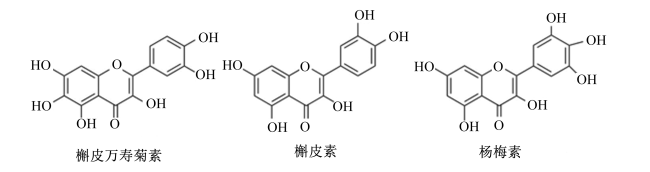
万寿菊提取物的有效成分是槲皮万寿菊素,化学结构为3,3',4',5,6,7-六羟基黄酮,与槲皮素、杨梅素等结构类似(图1)。据报道,添加槲皮万寿菊素能提高肉鸡的半净膛率和全净膛率[6-7],而槲皮万寿菊素的类似物槲皮素可显著降低肉鸡的腹脂率,其作用机理是通过调节肠道菌群和调节腺苷酸活化蛋白激酶/过氧化物酶体增殖物激活受体(AMPK/PPAR)信号通路来影响脂质代谢[24]
图1 3种黄酮的分子结构式

Fig.1 Molecular structure of three kinds of flavonoids

但黄酮对热应激下肉鸡屠宰性能等影响的研究数量较少。本研究发现,添加万寿菊提取物显著提高了热应激下肉鸡的半净膛率和净膛率,显著降低了腹脂率,且显著降低了血清总甘油三酯和尿酸含量。推测在热应激下,肉鸡的行为变化(摄食减少)和激素水平变化导致肉鸡主要通过糖酵解和分解蛋白质供能[18],而添加槲皮万寿菊素则通过上调过氧化物酶体增殖活化受体α(PPARα)基因表达来提高脂质分解代谢改变供能途径[24],从而改善肉鸡的屠宰性能。

4 结论

① 饲粮中添加250 mg/kg万寿菊提取物显著降低第1~28天肉鸡料重比。
② 热应激引起肉鸡死亡率升高,显著降低肉鸡生长性能、腿肌率、血清总甘油三酯含量,显著提高血清尿酸含量。
③ 在热应激下,添加万寿菊提取物显著提高了肉鸡的半净膛率和全净膛率,显著降低肉鸡腹脂率、血清甘油三酯和尿酸含量,但对生长性能指标及肉品质指标都没有显著的改善作用。
④ 由此可见,热应激给肉鸡生产造成不利影响,而添加万寿菊提取物可改善热应激下肉鸡的屠宰性能。
[1]
KPOMASSE C C, OKE O E, HOUNDONOUGBO F M, et al. Broiler production challenges in the tropics:a review[J]. Veterinary Medicine and Science, 2021, 7(3):831-842.

DOI

[2]
ZABOLI G, HUANG X, FENG X, et al. How can heat stress affect chicken meat quality?-a review[J]. Poultry Science, 2019, 98(3):1551-1556.

DOI

[3]
WASTI S, SAH N, MISHRA B. Impact of heat stress on poultry health and performances,and potential mitigation strategies[J]. Animals, 2020, 10(8):1266.

DOI

[4]
杨硕, 徐元庆, 邢媛媛, 等. 植物源黄酮类化合物对动物免疫和抗氧化功能影响的研究进展[J]. 动物营养学报, 2019, 31(7):2958-2964.

YANG S, XU Y Q, XING Y Y, et al. Research advances on effects of plant-based flavonoids on immune and antioxidative functions in animals[J]. Chinese Journal of Animal Nutrition, 2019, 31(7):2958-2964. (in Chinese)

[5]
杨奇, 杨宇生, 曾妮, 等. 竹叶黄酮对持续高温状态下肉鸡生长性能和屠宰性能的影响[J]. 饲料工业, 2014, 35(8):6-8.

YANG Q, YANG Y S, ZENG N, et al. The effects of bamboo-leaf-flavonoid on the growth and slaughter performance in broilers under the continued heat stress[J]. Feed Industry, 2014, 35(8):6-8. (in Chinese)

[6]
张毅峰. 槲皮万寿菊素对肉鸡生长性能、抗氧化能力、免疫性能及血清生化指标影响[D]. 硕士学位论文. 邯郸: 河北工程大学, 2020.

ZHANG Y F. Effects of quercetagetin on growth performance,antioxidant capacity,immune performance and serum biochemical indexes of broilers[D]. Master’s Thesis. Handan: Hebei University of Engineering, 2020. (in Chinese)

[7]
王浩男. 槲皮万寿菊素对肉鸡生长性能、免疫及抗氧化影响研究[D]. 硕士学位论文. 保定: 河北农业大学, 2021.

WANG H N. Effect of quercetagetin on growth performance,immune and antioxidant related indexes in broilers[D]. Master’s Thesis. Baoding: Agricultural University of Hebei, 2021. (in Chinese)

[8]
郑旭, 饶志勇, 孟春颜, 等. 饲粮中添加槲皮万寿菊素对肉鸡生长性能、养分表观消化率和抗氧化能力的影响[J]. 动物营养学报, 2022, 34(7):4271-4282.

DOI

ZHENG X, RAO Z Y, MENG C Y, et al. Effects of dietary quercetagetin on growth performance,nutrient apparent digestibility and antioxidant capacity of broilers[J]. Chinese Journal of Animal Nutrition, 2022, 34(7):4271-4282. (in Chinese)

DOI

[9]
张柏海, 叶茂, 潘子意, 等. 热应激对肉鸡生产性能的影响[J]. 家禽科学, 2019(5):50-54.

ZHANG B H, YE M, PAN Z Y, et al. Effect of heat stress on productive performance of broilers[J]. Poultry Science, 2019(5):50-54. (in Chinese)

[10]
李乃宾, 杨芬霞, 陈洁波, 等. 热应激对12周龄麒麟鸡屠宰性能和肉品质的影响[J]. 家禽科学, 2013(8):11-15.

LI N B, YANG F X, CHEN J B, et al. Effects of heat stress on slaughtering performance and meat quality of 12 week old Qilin chickens[J]. Poultry Science, 2013(8):11-15. (in Chinese)

[11]
张德祥, 罗庆斌, 赖晓丹, 等. 慢性热应激对不同品种肉鸡生长发育的影响[J]. 中国家禽, 2016, 38(15):37-42.

ZHANG D X, LUO Q B, LAI X D, et al. Effect of chronic heat stress on growth in different broiler chickens[J]. China Poultry, 2016, 38(15):37-42. (in Chinese)

[12]
NAWAZ A H, AMOAH K, LENG Q Y, et al. Poultry response to heat stress:its physiological,metabolic,and genetic implications on meat production and quality including strategies to improve broiler production in a warming world[J]. Frontiers in Veterinary Science, 2021, 8:699081.

DOI

[13]
热依赛·斯提瓦尔地, 郑耀辉, 朱勇文. 热应激影响鸡肉品质的研究进展[J]. 广东饲料, 2021, 30(6):46-48.

SITIWAERDI R Y S, ZHENG Y H, ZHU Y W. Research progress on the effects of heat stress on chicken quality[J]. Guangdong Feed, 2021, 30(6):46-48. (in Chinese)

[14]
钟光. 精氨酸、γ-氨基丁酸、有机铬和硒对热应激黄羽肉鸡的作用研究[D]. 硕士学位论文. 泰安: 山东农业大学, 2019.

ZHONG G. Effects of arginine,gamma-aminobutyric acid,organic chromium and selenium on heat stress in yellow-feathered broilers[D]. Master’s Thesis. Tai’an: Shandong Agricultural University, 2019. (in Chinese)

[15]
HASHIZAWA Y, KUBOTA M, KADOWAKI M, et al. Effect of dietary vitamin E on broiler meat qualities,color,water-holding capacity and shear force value,under heat stress conditions[J]. Animal Science Journal, 2013, 84(11):732-736.

DOI

[16]
ZHANG Z Y, JIA G Q, ZUO J J, et al. Effects of constant and cyclic heat stress on muscle metabolism and meat quality of broiler breast fillet and thigh meat[J]. Poultry Science, 2012, 91(11):2931-2937.

DOI PMID

[17]
冯京海. 环境高温对肉鸡线粒体功能及胸肌品质的影响[D]. 博士学位论文. 北京: 中国农业科学院, 2006.

FENG J H. The effects of high ambient temperature on mitochondrial function and breast meat quality of broilers[D]. Ph.D.Thesis. Beijing: Chinese Academy of Agricultural Science, 2006. (in Chinese)

[18]
DE SOUZA L F A, ESPINHA L P, DE ALMEIDA E A, et al. How heat stress (continuous or cyclical) interferes with nutrient digestibility,energy and nitrogen balances and performance in broilers[J]. Livestock Science, 2016, 192:39-43.

DOI

[19]
LUO J X, SONG J, LIU L Z, et al. Effect of epigallocatechin gallate on growth performance and serum biochemical metabolites in heat-stressed broilers[J]. Poultry Science, 2018, 97(2):599-606.

DOI PMID

[20]
王乙茹, 柳成东, 白华毅, 等. 凝结芽孢杆菌对热应激肉鸡生长性能及血清指标的影响[J]. 动物营养学报, 2020, 32(5):2148-2157.

DOI

WANG Y R, LIU C D, BAI H Y, et al. Effects of bacillus coagulans on growth performance and serum indices of broiler chickens under heat stress[J]. Chinese Journal of Animal Nutrition, 2020, 32(5):2148-2157. (in Chinese)

[21]
郝婧宇, 卢庆萍, 张宏福. 持续高温对不同性别北京油鸡脂肪代谢及血液脂肪细胞因子水平的影响[C]//第五届中国畜牧科技论坛论文集. 北京: 中国农业出版社,

2011: 5. HAOJ Y, LUQ P, ZHANGH F, et al. Chronic heat exposure affects lipid metabolism and blood adipocytokine levels in male and female Beijing-You chickens[C]//Proceedings of the 5th China Animal Science and Technology Forum. Beijing: China Agriculture Press, 2011:5. (in Chinese)

[22]
王松波, 邓琳, 赵婕, 等. 热应激对肉鸡抗氧化能力及腓肠肌纤维类型的影响[J]. 华南农业大学学报, 2015, 36(6):23-28.

WANG S B, DENG L, ZHAO J, et al. Effects of heat stress on antioxidant capacity and gastrocnemius musclefiber types of broilers[J]. Journal of South China Agricultural University, 2015, 36(6):23-28. (in Chinese)

[23]
EMAMI N K, JUNG U, VOY B, et al. Radical response:effects of heat stress-induced oxidative stress on lipid metabolism in the avian liver[J]. Antioxidants, 2020, 10(1):35.

DOI

[24]
WANG M, WANG B, WANG S S, et al. Effect of quercetin on lipids metabolism through modulating the gut microbial and AMPK/PPAR signaling pathway in broilers[J]. Frontiers in Cell and Developmental Biology, 2021, 9:616219.

DOI

Outlines

/