RESEARCH PAPER

Comparative Studies on Developmental Patterns of Gastrointestinal Microbiota of Different Breed Lambs

  • LIU Jie , 1 ,
  • LI Wei 1 ,
  • LI Xin 1 ,
  • REN Erjun 1 ,
  • LIU Jinjun 1 ,
  • WANG Pengran 1 ,
  • HAN Xueliang 1 ,
  • ZHANG Yingjie , 2, *
Expand
  • 1 Shijiazhuang Academy of Agriculture and Forestry Sciences, Shijiazhuang 050041, China
  • 2 College of Animal Science and Technology, Hebei Agricultural University, Baoding 071000, China
*professor, E-mail:

Received date: 2023-05-04

  Online published: 2023-10-12

Abstract

This experiment was conducted to investigate the differences of bacteria and fungi in the rumen and rectum of different breed lambs (Dorset lambs, Hu lambs and small tail Han lambs) under the same feeding conditions, to provide basic data for developmental patterns of gastrointestinal microbiota and precise feeding and management of different breed lambs. Thirty 1-day-old lambs with same fetal times and gender and born in the same maternity barn were selected, among them, there were 10 Dorset lambs, 10 Hu lambs and 10 small tail Han lambs, feeding for 120 days under the same feeding management mode. Rumen fluid and feces were collected, to determine the bacterial and fungal flora. The results showed as follows: 1) the PD whole tree index of rumen bacteria of small tail Han lambs was significantly higher than that of Hu sheep (P<0.05), and the Simpson index of rectal fungal of Hu sheep was significantly higher than that of Dorset lambs (P<0.05). 2) The principal coordinates analysis (PCoA) and analysis of similarities (ANOSIM) showed that there were significant differences in the communities of rumen bacteria at 20 and 90 days of age, rectal bacteria at 70 days of age, rumen fungi at 20, 70 and 90 (P<0.05) days of age, and rectal fungi at 90 and 120 days of age among different breed lambs (P<0.05). 3) The relative abundances of Spirochaetes and Treponema in rectal bacteria of Dorset lambs showed an increasing trend (P=0.086). The relative abundances of Rikenellaceae_RC-9_gut_group and Christensenellaceae_R-7_group in rumen bacteria of small tail Han lambs were significantly higher than those of Doset lambs and Hu lambs (P<0.05), the relative abundance of Ascomycetes in rumen fungi was significantly lower than that of Doset lambs and Hu lambs (P<0.05), and the relative abundance of Prevotella in rumen bacteria showed a lower trend (P=0.063). In conclusion, under the same feeding conditions, there are differences in the diversity and composition of gastrointestinal microbiota among the three breed lambs, the Small tail Han lambs have higher rumen bacterial diversity, the Hu lambs have higher rectal fungal diversity, the Dorset lambs have higher relative abundances of Spirochaetes and Treponema in rectal bacteria, the small tail Han lambs have lower relative abundance of Prevotella and higher relative abundances of Rikenellaceae_RC-9_gut_group and Christensenellaceae_R-7_group in rumen bacteria. The differences in the structure of gastrointestinal microbial flora might be one of the reasons for the differences in performance of different breed lambs.

Key words: breed; lambs; rumen; rectum; bacteria; fungi

Cite this article

LIU Jie , LI Wei , LI Xin , REN Erjun , LIU Jinjun , WANG Pengran , HAN Xueliang , ZHANG Yingjie . Comparative Studies on Developmental Patterns of Gastrointestinal Microbiota of Different Breed Lambs[J]. Chinese Journal of Animal Nutrition, 2023 , 35(10) : 6475 -6496 . DOI: 10.12418/CJAN2023.593

动物的胃肠道定植着复杂和多样的微生物菌群,共生微生物对宿主健康在平衡免疫反应、消化营养物质和调节宿主生理等方面有着至关重要的作用。遗传背景对胃肠道微生物的结构和组成具有较大影响,每个动物机体胃肠道都含有属于自己的微生物组。胃肠道微生物对于植物纤维的消化、动物生产性能和健康都具有重要作用,但是微生物特征的遗传性、宿主遗传成分与瘤胃微生物的关联,以及这些遗传成分与宿主生产性能的关联目前还是未知。研究表明,动物胃肠道微生物菌群差异的原因主要包括宿主基因型、宿主年龄、宿主饲粮等[1-8]。宿主基因型的多样性可引起胃肠道菌群不同,每个动物机体胃肠道都含有属于自己的微生物组,遗传背景对胃肠道微生物的结构和组成的具有非常大的影响[9-10]。不同物种间胃肠道菌群多样性差异显著[11-12]。在同一饮食和管理条件下的同一物种,不同品种的动物胃肠道微生物菌群结构和组成也存在一定差异[13-17]
道赛特羊属肉用型绵羊引入品种,原产于澳大利亚和新西兰,具有生长发育快、体型大、肉用性能好、常年发情、适应性强等特点[18]。湖羊原产于太湖流域的浙江和江苏一带,具有性成熟早、繁殖力高、四季发情、前期生长速度较快、耐湿热、耐粗饲、宜舍饲、适应性强等优良性状[19]。小尾寒羊原产于黄河流域的山东、河北及河南一带,具有性成熟早、繁殖率高、生长发育快、屠宰率高、肉质细嫩、裘用价值高、适应性强、耐粗饲等优良特点[20]。湖羊和小尾寒羊均是我国著名的绵羊品种,优点是繁殖性能高、产羔多,但生长速度相对国外引进专门化肉羊品种较慢。从开食到断奶前后是羔羊生长和消化系统发育的关键阶段,虽然羔羊抗病力差,易发生腹泻等疾病,但不同品种羔羊在补料和断奶等关键环节表现出的生长潜力和抗逆性不同。微生物参与动物的生长、发育、消化、吸收、营养、免疫、生物拮抗等方面的过程。研究表明,不同品种的动物胃肠道微生物的种类虽然有可能具有一定的相似性,但其胃肠道内的菌群的分布及数量仍然有一定的差异性,可能是导致不同品种具有不同生产特性的原因[21-28]。因此,本研究以道赛特羊、湖羊和小尾寒羊为研究对象,在相同饲养管理条件下,通过高通量测序技术分析比较不同品种绵羊羔羊瘤胃和直肠菌群结构的差异性,揭示不同品种羔羊胃肠道微生物发育规律,为研究羔羊胃肠道菌群和宿主关系及健康养殖提供理论基础。

1 材料与方法

1.1 试验设计和饲粮

试验于2020年10月至2021年1月在河北省衡水市志豪牧业有限公司进行。试验羔羊均来自同一批次开展同期发情和人工授精的纯种繁育母羊,选取同一产房、胎次和性别相同的1日龄不同品种羔羊各10窝,均为单羔,其中道赛特羊、湖羊和小尾寒羊公羔各10只。15日龄从产房转入母子圈,并开始补饲相同商品羔羊料(购自联英饲料有限公司,主要由玉米、豆粕、玉米胚芽粕、石粉、氯化钠等组成;营养水平为总能16.72 MJ/kg,粗蛋白质18.03%,中性洗涤纤维23.16%,酸性洗涤纤维11.99%)。75日龄一次性断奶,母羊转移,羔羊留在母子圈,饲喂全混合日粮(total mixed ration,TMR),直至120日龄试验结束。TMR组成及营养水平见表1。试验期内,所有试验羊均由固定人员进行专门饲养,每日分别在07: 00和16: 00各饲喂1次,自由采食和饮水。
表1 全混合日粮组成及营养水平(干物质基础)

Table 1 Composition and nutrient levels of the TMR (DM basis)%

项目 Items 含量 Content
原料 Ingredients
玉米青贮 Corn silage 12.50
花生秧 Peanut vine 37.50
玉米 Corn 20.00
麸皮 Wheat bran 3.30
玉米胚芽饼 Corn germ meal 8.00
豆粕 Soybean meal 6.70
干酒糟及其可溶物 DDGS 8.00
食盐 NaCl 0.75
小苏打 NaHCO3 0.75
预混料 Premix1) 2.50
合计 Total 100.00
营养水平 Nutrient levels2)
总能 GE/(MJ/kg) 16.97
粗蛋白质 CP 12.27
中性洗涤纤维 NDF 49.29
酸性洗涤纤维 ADF 32.70
钙 Ca 0.86
磷 P 0.33

1)预混料为每千克全混合日粮提供 The premix provided the following per kg of the TMR:VA 7 650 IU,VD 2 750 IU,VE 40 mg,Fe 30 mg,Zn 50 mg,Mn 20 mg,Cu 6 mg,Se 0.30 mg,I 0.40 mg,Co 0.2 mg。

2)营养水平均为实测值。Nutrient levels were all measured values.

1.2 样品采集及测序分析

在羔羊出生后20(转圈补料后)、70(断奶前)、90(断奶后)和120日龄(4月龄),晨饲前每组采集5只体重相近羔羊的瘤胃液和粪便样品,瘤胃液采用瘤胃导管从口腔采集,粪便样品通过佩戴一次性手套从直肠采集,迅速装入2 mL无菌离心管中,置于液氮速冻,存放于-80 ℃冰箱保存待测。
瘤胃和直肠微生物区系分析采用高通量测序Illumina MiSeq PE300平台(北京奥维森基因科技有限公司)。细菌16S rRNA基因V3~V4区选用引物338F(5'-ACTCCTACGGGAGGCAGCAG-3')和806R(5'-GGACTACNNGGGTATCTAAT-3')扩增。真菌内转录间隔区(ITS)选用引物ITS1(5'-CTTGGTCATTTAGAGGAAGTAA-3')和ITS2(5'-TGCGTTCTTCATCGATGC-3')扩增。绘制韦恩图分析共有操作分类单元(OTU)和特有OTU数量。采用Chao1指数、覆盖度、观测到的物种数、PD whole tree指数、香农指数和辛普森指数分析Alpha多样性。采用主坐标分析(PCoA)方法评价Beta多样性,并用相似性分析(ANOSIM)方法进行OTU数量的组间差异检验。比较相对丰度>1.0%的菌群在门水平和属水平的组间差异。

1.3 数据统计分析

试验数据采用Excel 2019初步整理,采用SPSS 22.0统计软件进行双因素方差分析(two-way ANOVA),差异显著者采用Duncan氏法分析进行多重比较检验。结果用平均值和均值标准误(SEM)表示,P<0.05为差异显著,P>0.05为差异不显著,0.05≤P<0.10为有显著趋势。

2 结果与分析

2.1 不同品种羔羊的瘤胃细菌区系

2.1.1 不同品种羔羊的瘤胃细菌特异性分析
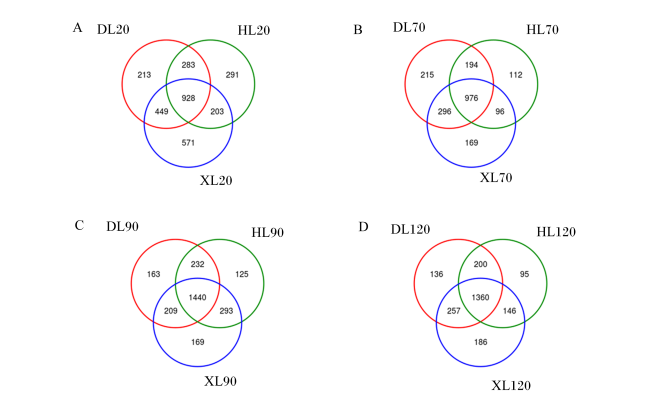
图1可知,20日龄时,3个品种羔羊瘤胃细菌共计2 938个OTU,共有OTU为928个,占总OTU的31.59%;道赛特羊、湖羊和小尾寒羊OTU分别为1 873、1 705和2 151个,特有OTU分别为213、291和571个;小尾寒羊OTU和特有OTU数量最多(图1-A)。70日龄时,3个品种羔羊瘤胃细菌共计2 058个OTU,共有OTU为976个,占总OTU的47.42%;道赛特羊、湖羊和小尾寒羊OTU分别为1 681、1 378和1 537个,特有OTU分别为215、112和169个;道赛特羊OTU和特有OTU数量最多(图1-B)。90日龄时,3个品种羔羊瘤胃细菌共计2 631个OTU,共有OTU为1 440个,占总OTU的54.73%;道赛特羊、湖羊和小尾寒羊OTU分别为2 044、2 090和2 111个,特有OTU分别为163、125和169个;小尾寒羊OTU和特有OTU数量最多(图1-C)。120日龄时,3个品种羔羊瘤胃细菌共计2 380个OTU,共有OTU为1 360个,占总OTU的57.14%;道赛特羊、湖羊和小尾寒羊OTU分别为1 953、1 801和1 949个,特有OTU分别为136、95和186个;道赛特羊OTU数量最多,小尾寒羊特有OTU数量最多(图1-D)。
图1 不同品种羔羊瘤胃细菌韦恩图

DL20:20日龄道赛特羊;HL20:20日龄湖羊;XL20:20日龄小尾寒羊;DL70:70日龄道赛特羊;HL70:70日龄湖羊;XL70:70日龄小尾寒羊;DL90:90日龄道赛特羊;HL90:90日龄湖羊;XL90:90日龄小尾寒羊;DL120:120日龄道赛特羊;HL120:120日龄湖羊;XL120:120日龄小尾寒羊。下图同。

Fig.1 Venn graph of rumen bacteria of different breed lambs

DL20: Dorset lambs at 20 days of age; HL20: Hu lambs at 20 days of age; XL20: small tail Han lambs at 20 days of age; DL70: Dorset lambs at 70 days of age; HL70: Hu lambs at 70 days of age; XL70: small tail Han lambs at 70 days of age; DL90: Dorset lambs at 90 days of age; HL90: Hu lambs at 90 days of age; XL90: small tail Han lambs at 90 days of age; DL120: Dorset lambs at 120 days of age; HL120: Hu lambs at 120 days of age; XL120: small tail Han lambs at 120 days of age. The same as below.

2.1.2 不同品种羔羊的瘤胃细菌Alpha多样性分析

表2可知,小尾寒羊瘤胃细菌PD whole tree指数显著高于湖羊(P<0.05),与道赛特羊之间差异不显著(P>0.05)。日龄对瘤胃细菌Alpha多样性指数无显著影响(P>0.05)。
表2 不同品种羔羊的瘤胃细菌Alpha多样性分析

Table 2 Alpha diversity indices analysis of ruminal bacteria of different breed lambs

项目
Items
品种 Breed 日龄 Day of age SEM PP-value
道赛特羊
Dorset
lambs
湖羊
Hu
lambs
小尾寒羊
Small tail
Han lambs
20 70 90 120 品种
Breed
日龄
Day of
age
品种×日龄
Breed×
day of
age
Chao1指数
Chao1 index
1 368.15 1 240.99 1 434.88 1 263.89 1 268.45 1 459.17 1 400.51 48.338 0.255 0.386 0.430
覆盖度
Goods coverage
0.99 0.99 0.99 0.99 0.99 0.99 0.99 0.001 0.292 0.069 0.861
观测到的物种数
Observed species
951.16 843.21 1 005.88 903.99 856.79 1 003.48 969.40 35.045 0.157 0.444 0.384
PD whole
tree指数
PD whole
tree index
107.24ab 97.61b 114.71a 107.13 102.39 107.97 108.57 2.920 0.037 0.836 0.022
香农指数
Shannon index
6.44 6.07 6.49 6.52 6.20 6.42 6.19 0.113 0.277 0.676 0.592
辛普森指数
Simpson index
0.95 0.94 0.94 0.95 0.94 0.95 0.93 0.005 0.808 0.378 0.591

同行数据肩标不同小写字母表示差异显著(P<0.05),相同或无字母表示差异不显著(P>0.05)。下表同。

In the same row, values with different small letter superscripts mean significant difference (P<0.05), while with the same or no letter superscripts mean no significant difference (P>0.05). The same as below.

2.1.3 不同品种羔羊的瘤胃细菌Beta多样性分析

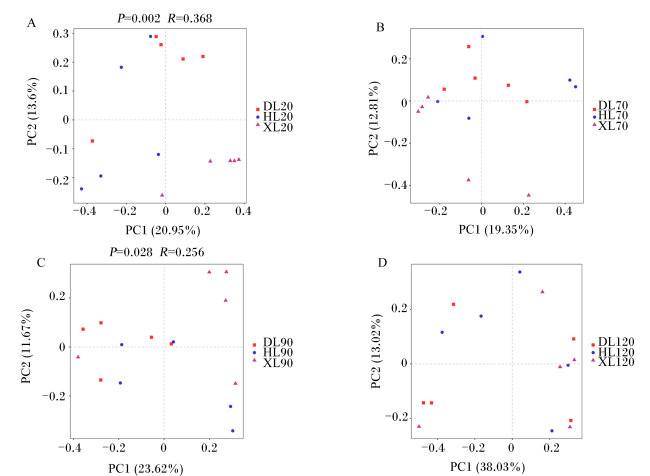
图2可知,基于Bray-Curtis的主坐标分析联合相似性分析结果表明,20和90日龄时,不同品种之间瘤胃细菌群落差异显著(P<0.05);其他日龄时,不同品种之间瘤胃细菌群落差异不显著(P>0.05)。
图2 不同品种羔羊的瘤胃细菌基于Bray-Curtis的主坐标分析

PC1:主坐标1;PC2:主坐标2。图4图6图8同。

Fig.2 PCoA based on Bray-Curtis of rumen bacteria of different breed lambs

PC1: principal coordinate 1; PC2: principal coordinate 2. The same as Fig.4, Fig.6 and Fig.8.

2.1.4 不同品种羔羊的瘤胃细菌结构分析

表3可知,在瘤胃细菌门水平上(相对丰度>1.0%),道赛特羊和湖羊的互养菌门相对丰度显著高于小尾寒羊(P<0.05),道赛特羊和湖羊之间差异不显著(P>0.05)。日龄显著影响羔羊的拟杆菌门、厚壁菌门、放线菌门和互养菌门相对丰度(P<0.05),对变形菌门相对丰度无显著影响(P>0.05)。
表3 不同品种羔羊的瘤胃细菌门水平的相对丰度(相对丰度>1.0%)

Table 3 Relative abundance of ruminal bacteria at phylum level of different breed lambs (relative abundance>1.0%)%

项目
Items
品种 Breed 日龄 Day of age SEM PP-value
道赛特羊
Dorset
lambs
湖羊
Hu
lambs
小尾寒羊
Small tail
Han
lambs
20 70 90 120 品种
Breed
日龄
Day of
age
品种×日龄
Breed×
day of
age
拟杆菌门
Bacteroidetes
62.54 61.43 57.07 69.46a 47.22b 61.67a 63.02a 1.923 0.373 <0.001 0.549
厚壁菌门
Firmicutes
31.50 33.47 34.98 22.55c 42.59a 34.54b 33.59b 1.687 0.603 <0.001 0.160
放线菌门
Actinomycetes
2.08 1.88 1.05 0.64b 3.62a 1.50b 0.93b 0.386 0.489 0.027 0.549
互养菌门
Synergistota
0.42a 0.32a 0.08b 0.94b 2.90a 0.19b 0.35b 0.419 0.013 0.022 0.001
变形菌门
Proteobacteria
0.94 0.90 1.44 1.03 1.92 0.71 0.72 0.216 0.486 0.125 0.076
表4可知,在瘤胃细菌属水平上(相对丰度>1.0%),小尾寒羊理研菌科RC-9肠道群和克里斯滕森菌科R-7群相对丰度显著高于道赛特羊和湖羊(P<0.05),道赛特羊和湖羊之间差异不显著(P>0.05);小尾寒羊瘤胃球菌科NK4A214群和厌氧弧菌属相对丰度显著高于湖羊(P<0.05),与道赛特羊之间差异不显著(P>0.05);不同品种之间其他菌属相对丰度均差异不显著(P>0.05),小尾寒羊普雷沃氏菌属相对丰度表现出降低的趋势(P=0.063)。日龄显著影响羔羊的普雷沃氏菌属、解琥珀酸菌属、瘤胃球菌属、普雷沃氏菌科NK3B31群、克里斯滕森菌科R-7群、毛螺菌科NK3A20群相对丰度(P<0.05),对其他菌属相对丰度无显著影响(P>0.05)。
表4 不同品种羔羊的瘤胃细菌属水平的相对丰度(相对丰度>1.0%)

Table 4 Relative abundance of rumen bacteria at genus level of different breed lambs (relative abundance>1.0%)%

项目
Items
品种 Breed 日龄 Day of age SEM PP-value
道赛特羊
Dorset
lambs
湖羊
Hu
lambs
小尾寒羊
Small tail
Han
lambs
20 70 90 120 品种
Breed
日龄
Day of
age
品种×日龄
Breed×
day of
age
普雷沃氏菌属
Prevotella
45.95 43.00 36.01 38.01bc 30.87c 46.76ab 50.99a 2.123 0.063 0.001 0.033
普雷沃菌科_
UCG-001
Prevotellaceae_
UCG-001
4.57 3.82 2.81 2.76 5.52 4.28 2.39 0.530 0.351 0.106 0.098
月形单胞菌属
Selenomonas
1.73 3.79 4.64 0.11 3.70 5.76 3.99 0.837 0.286 0.077 0.053
理研菌科RC-9
肠道群
Rikenellaceae_
RC-9_gut_group
2.35b 2.21b 5.47a 4.84 2.67 2.50 3.35 0.480 0.001 0.112 0.001
解琥珀酸菌属
Succiniclasticum
3.79 2.92 2.89 1.24c 4.70a 4.05ab 2.81b 0.286 0.182 <0.001 0.100
瘤胃球菌属
Ruminococcus
3.43 3.38 2.63 2.27b 5.21a 3.30a 1.80b 0.379 0.579 0.005 0.304
毛螺菌科
NK3A20群
Lachnospiraceae_
NK3A20_group
2.12 2.87 1.61 1.65b 3.82a 1.86b 1.47b 0.311 0.224 0.025 0.628
普雷沃菌科
UCG-003
Prevotellaceae_
UCG-003
1.44 1.61 2.13 2.26 1.79 1.69 1.16 0.183 0.202 0.126 0.008
普雷沃氏菌科
NK3B31群
Prevotellaceae_
NK3B31_group
1.51 2.09 0.82 5.03a 0.45b 0.32b 0.08b 0.418 0.270 <0.001 0.122
克里斯滕森菌科
R-7群
Christensenellaceae_
R-7_group
1.09b 1.13b 2.07a 2.25a 1.65ab 0.85b 0.96b 0.186 0.016 0.006 0.010
瘤胃球菌科
NK4A214群
Ruminococcaceae_
NK4A214_group
0.98ab 0.81b 1.37a 1.48 0.96 0.91 0.87 0.114 0.045 0.076 0.001
厌氧弧菌属
Anaerovibrio
0.85ab 0.50b 1.67a 0.07 1.78 1.12 1.04 0.237 0.103 0.074 0.496

2.2 不同品种羔羊瘤胃真菌区系

2.2.1 瘤胃真菌特异性分析

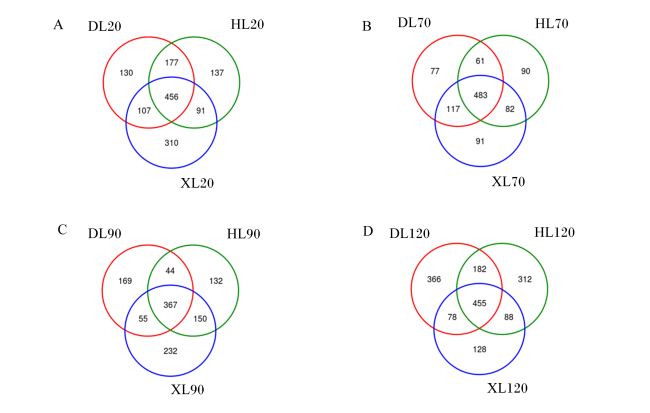
图3可知,20日龄时,3个品种羔羊瘤胃真菌共计1 408个OTU,共有OTU为456个,占总OTU的32.39%;道赛特羊、湖羊和小尾寒羊OTU分别为870、861和964个,特有OTU分别为130、137和310个;小尾寒羊OTU和特有OTU数量最多(图3-A)。70日龄时,3个品种羔羊瘤胃真菌共计1 001个OTU,共有OTU为483个,占总OTU的48.25%;道赛特羊、湖羊和小尾寒羊OTU分别为738、716和773个,特有OTU分别为77、90和91个;小尾寒羊OTU和特有OTU数量最多(图3-B)。90日龄时,3个品种羔羊瘤胃真菌共计1 149个OTU,共有OTU为367个,占总OTU的31.94%;道赛特羊、湖羊和小尾寒羊OTU分别为635、693和804个,特有OTU分别为169、132和232个;小尾寒羊OTU和特有OTU数量最多(图3-C)。120日龄时,3个品种羔羊瘤胃真菌共计1 609个OTU,共有OTU为455个,占总OTU的28.28%;道赛特羊、湖羊和小尾寒羊OTU分别为1 081、1 037和749个,特有OTU分别为366、312和128个;道赛特羊OTU和特有OTU数量最多(图3-D)。
图3 不同品种羔羊瘤胃真菌韦恩图

Fig.3 Venn graph of ruminal fungi of different breed lambs

2.2.2 瘤胃真菌Alpha多样性分析

表5可知,不同品种羔羊瘤胃真菌Alpha多样性指数均差异不显著(P<0.05)。日龄显著影响Chao1指数、观测到的物种数、PD whole tree指数、香农指数和辛普森指数(P<0.05),对覆盖度无显著影响(P>0.05)。
表5 不同品种羔羊的瘤胃真菌Alpha多样性指数分析

Table 5 Alpha diversity indices analysis of ruminal fungi of different breed lambs

项目
Items
品种 Breed 日龄 Day of age SEM PP-value
道赛特羊
Dorset
lambs
湖羊
Hu
lambs
小尾寒羊
Small tail
Han
lambs
20 70 90 120 品种
Breed
日龄
Day of
age
品种×日龄
Breed×
day of
age
Chao1指数
Chao1 index
658.03 623.46 683.44 667.11ab 735.24a 587.78b 629.78b 18.431 0.384 0.033 0.511
覆盖度
Goods coverage
0.99 0.99 0.99 0.99 0.99 0.99 0.99 <0.001 0.689 0.109 0.891
观测到的物种数
Observed species
428.78 425.05 461.94 443.13ab 459.71a 338.39b 463.12a 11.208 0.268 0.042 0.056
PD whole tree指数
PD whole
tree index
90.75 83.17 90.80 87.52ab 95.42a 77.90b 92.11a 2.115 0.178 0.012 0.161
香农指数
Shannon index
4.53 4.75 4.56 5.30a 3.71c 4.16b 5.29a 0.122 0.407 <0.001 <0.001
辛普森指数
Simpson index
0.82 0.86 0.81 0.91a 0.70c 0.81b 0.90a 0.015 0.082 <0.001 0.001

2.2.3 瘤胃真菌Beta多样性分析

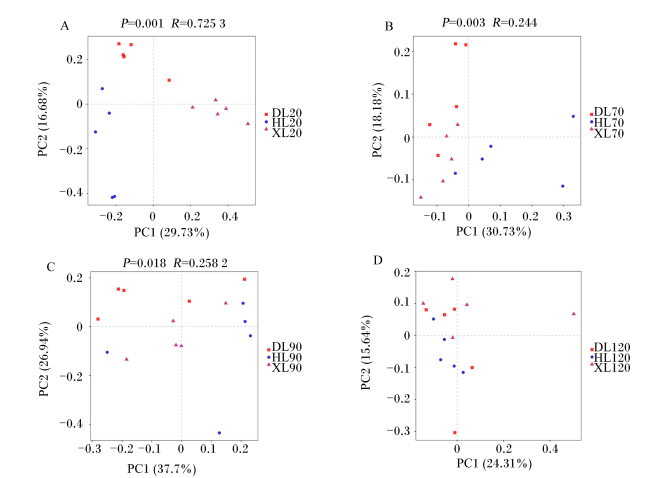
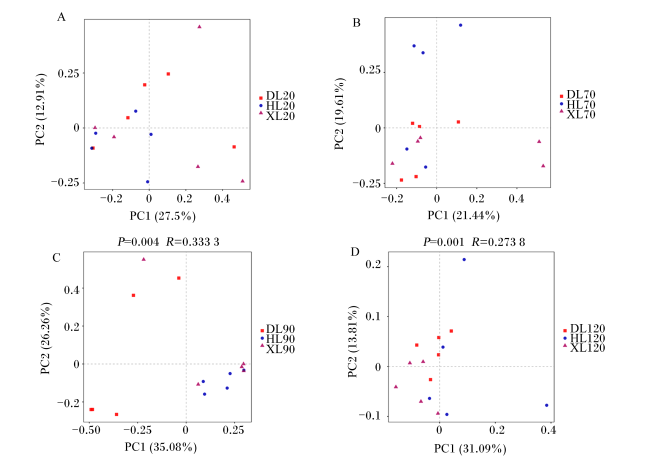
图4可知,基于Bray-Curtis的主坐标分析联合相似性分析结果表明,20、70和90日龄时,不同品种之间瘤胃真菌群落差异显著(P<0.05);120日龄时,不同品种之间瘤胃真菌群落差异不显著(P>0.05)。
图4 不同品种羔羊瘤胃真菌基于Bray-Curtis的主坐标分析

Fig.4 PCoA based on Bray-Curtis of rumen fungi of different breed lambs

2.2.4 瘤胃真菌结构分析

表6可知,在瘤胃真菌门水平上(相对丰度>1%),道赛特羊和湖羊子囊菌门相对丰度显著高于小尾寒羊(P<0.05),道赛特羊和湖羊之间差异不显著(P>0.05);小尾寒羊新美鞭菌门相对丰度显著高于道赛特羊和湖羊(P<0.05),道赛特羊和湖羊之间差异不显著(P>0.05);湖羊担子菌门相对丰度表现出降低的趋势(P=0.088)。日龄显著影响羔羊的子囊菌门、担子菌门和新美鞭菌门相对丰度(P<0.05)。
表6 不同品种羔羊的瘤胃真菌门水平相对丰度(相对丰度>1.0%)

Table 6 Relative abundance of ruminal fungi at phylum level of different breed lambs (relative abundance>1.0%)%

项目
Items
品种 Breed 日龄 Day of age SEM PP-value
道赛特羊
Dorset
lambs
湖羊
Hu
lambs
小尾寒羊
Small tail
Han
lambs
20 70 90 120 品种
Breed
日龄
Day of
age
品种×日龄
Breed×
day of
age
子囊菌门
Ascomycota
85.33a 88.88a 73.32b 62.42b 91.35a 91.01a 85.25a 2.337 <0.001 <0.001 <0.001
担子菌门
Basidiomycota
8.55 5.31 9.65 11.67a 2.84b 5.71ab 11.12a 1.096 0.088 0.001 <0.001
新美鞭菌门
Neocallimastigomycota
2.65b 2.21b 12.84a 18.82a 3.46b 1.17b 0.15b 1.980 <0.001 <0.001 <0.001
表7可知,在瘤胃真菌属水平上(相对丰度>1.0%),道赛特羊和小尾寒羊酵母菌属和Symmetrospora相对丰度显著高于湖羊(P<0.05),曲霉菌属和念珠菌属相对丰度显著低于湖羊(P<0.05),道赛特羊和小尾寒羊之间差异不显著(P>0.05);小尾寒羊盲肠菌属和瘤胃壶菌属相对丰度显著高于道赛特羊和湖羊(P<0.05),道赛特羊和湖羊之间差异不显著(P>0.05)。日龄显著影响羔羊的酵母菌属、青霉菌属、Pseudoascochyta、曲霉菌属、盲肠菌属、镰刀菌属、篮状菌属、瘤胃壶菌属、小囊菌属、Symmetrospora、节丹菌属和念珠菌属相对丰度(P<0.05)。
表7 不同品种羔羊的瘤胃真菌属水平的相对丰度(相对丰度>1.0%)

Table 7 Relative abundance of ruminal fungi at genus level of different breed lambs (relative abundance>1.0%)%

项目
Items
品种 Breed 日龄 Day of age SEM PP-value
道赛特羊
Dorset
lambs
湖羊
Hu
lambs
小尾寒羊
Small tail
Han
lambs
20 70 90 120 品种
Breed
日龄
Day of
age
品种×日龄
Breed×
day of
age
酵母菌属
Saccharomyces
23.61a 15.23b 21.92a 0.93c 51.91a 23.97b 4.21c 2.947 0.012 <0.001 0.020
青霉菌属
Penicillium
8.88 10.41 9.71 1.60c 1.66c 5.13b 30.28a 1.652 0.567 <0.001 0.917
Pseudoascochyta 9.71 8.59 8.35 1.17b 1.22b 28.58a 4.56b 1.747 0.835 <0.001 0.900
曲霉菌属
Aspergillus
5.05b 12.51a 4.25b 11.42a 5.78ab 8.35ab 3.52b 1.007 <0.001 0.001 <0.001
盲肠菌属
Caecomyces
2.02b 0.22b 7.95a 12.78a 0.71b 0.10b 0.00b 1.485 0.014 <0.001 0.001
镰刀菌属
Fusarium
2.97 2.99 2.65 1.83b 6.40a 1.98b 1.29b 0.403 0.890 <0.001 0.635
篮状菌属
Talaromyces
3.24 2.50 2.26 2.00b 1.09b 1.74b 5.85a 0.348 0.203 <0.001 0.014
节丹菌属
Wallemia
2.54 2.73 1.85 3.42a 0.77b 3.57a 1.72ab 0.381 0.543 0.013 0.063
念珠菌属
Candida
1.22b 3.02a 0.68b 0.32b 1.93ab 2.21a 2.10a 0.304 0.001 0.027 0.021
瘤胃壶菌属
Piromyces
0.27b 1.21b 2.79a 3.29a 1.52ab 0.87b 0.02b 0.418 0.003 0.002 <0.001
小囊菌属
Microascus
0.65 1.92 0.97 4.00a 0.24b 0.33b 0.15b 0.360 0.202 <0.001 0.440
Symmetrospora 1.51a 0.28b 1.47a 2.30a 0.44b 0.61b 0.98ab 0.254 0.018 0.005 <0.001

2.3 不同品种羔羊直肠细菌区系

2.3.1 直肠细菌特异性分析

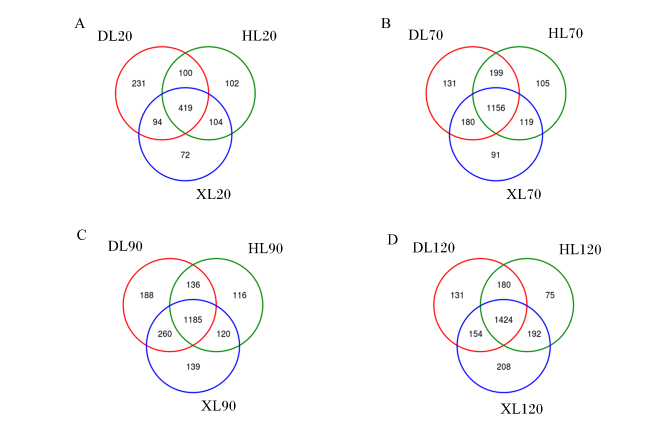
图5可知,20日龄时,3个品种羔羊直肠细菌共计1 122个OTU,共有OTU为419个,占总OTU的37.34%;道赛特羊、湖羊和小尾寒羊OTU分别为844、725和689个,特有OTU分别为231、102和72个;道赛特羊OTU和特有OTU数量最多(图5-A)。70日龄时,3个品种羔羊直肠细菌共计1 981个OTU,共有OTU为1 156个,占总OTU的58.35%;道赛特羊、湖羊和小尾寒羊OTU分别为1 666、1 579和1 546个,特有OTU分别为131、105和91个;道赛特羊OTU和特有OTU数量最多(图5-B)。90日龄时,3个品种羔羊直肠细菌共计2 144个OTU,共有OTU为1 185个,占总OTU的55.27%;道赛特羊、湖羊和小尾寒羊OTU分别为1 769、1 557和1 704个,特有OTU分别为188、116和139个;道赛特羊OTU和特有OTU数量最多(图5-C)。120日龄时,3个品种羔羊直肠细菌共计2 364个OTU,共有OTU为1 424个,占总OTU的60.24%;道赛特羊、湖羊和小尾寒羊OTU分别为1 889、1 871和1 978个,特有OTU分别为131、75和208个;小尾寒羊OTU和特有OTU数量最多(图5-D)。
图5 不同品种羔羊直肠细菌韦恩图

Fig.5 Venn graph of rectal bacteria of different breed lambs

2.3.2 直肠细菌Alpha多样性指数分析

表8可知,不同品种羔羊间直肠细菌Alpha多样性指数均差异不显著(P>0.05)。日龄显著影响Chao1指数、观测到的物种数、PD whole tree指数、香农指数和辛普森指数(P<0.05),对覆盖度无显著影响(P>0.05)。
表8 不同品种羔羊的直肠细菌Alpha多样性指数分析

Table 8 Alpha diversity indices analysis of rectum bacteria of different breed lambs

项目
Items
品种 Breed 日龄 Day of age SEM PP-value
道赛特羊
Dorset
lambs
湖羊
Hu
lambs
小尾寒羊
Small tail
Han
lambs
20 70 90 120 品种
Breed
日龄
Day of
age
品种×日龄
Breed×
day of
age
Chao1指数
Chao1 index
1 272.41 1 163.86 1 180.79 723.78c 1 346.36ab 1 273.22b 1 479.40a 48.206 0.339 <0.001 0.852
覆盖度
Goods coverage
0.99 0.99 0.99 0.99 0.99 0.99 0.99 <0.001 0.478 0.058 0.864
观测到的物种数
Observed species
936.44 859.75 871.22 438.85c 1 019.12b 945.69b 1 152.86a 41.395 0.357 <0.001 0.948
PD whole tree指数
PD whole
tree index
101.89 93.05 93.63 60.24c 106.02ab 103.21b 115.29a 3.357 0.133 <0.001 0.788
香农指数
Shannon index
6.89 6.83 6.63 4.69c 7.59ab 7.07b 7.79a 0.182 0.495 <0.001 0.970
辛普森指数
Simpson index
0.96 0.95 0.95 0.88a 0.99b 0.97b 0.98b 0.008 0.967 <0.001 0.996

2.3.3 直肠细菌Beta多样性分析

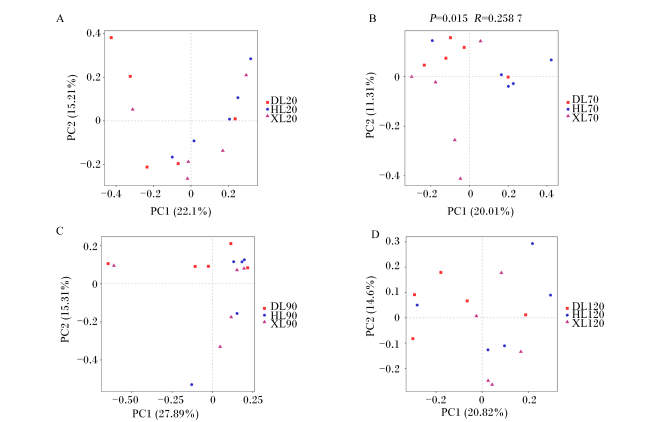
图6可知,基于Bray-Curtis的主坐标分析联合相似性分析表明,70日龄时,不同品种之间直肠细菌群落差异显著(P<0.05);其他日龄时,不同品种之间直肠细菌群落差异不显著(P>0.05)。
图6 不同品种羔羊直肠细菌基于Bray-Curtis的主坐标分析

Fig.6 PCoA based on Bray-Curtis of rectum bacteria of different breed lambs

2.3.4 直肠细菌结构分析

表6可知,在直肠细菌门水平上(相对丰度>1.0%),不同品种羔羊之间各菌门相对丰度均差异不显著(P>0.05),道赛特羊螺旋体门相对丰度表现出升高的趋势(P=0.086)。日龄显著影响羔羊的变形菌门、螺旋体门相对丰度(P<0.05),对厚壁菌门、拟杆菌门、放线菌门和弯曲杆菌门相对丰度无显著影响(P>0.05)。
表9 不同品种羔羊的直肠细菌门水平的相对丰度(相对丰度>1.0%)

Table 9 Relative abundance of rectal bacteria at phylum level of different breed lambs (relative abundance>1.0%)%

项目
Items
品种 Breed 日龄 Day of age SEM PP-value
道赛特羊
Dorset
lambs
湖羊
Hu
lambs
小尾寒羊
Small tail
Han
lambs
20 70 90 120 品种
Breed
日龄
Day of
age
品种×日龄
Breed×
day of
age
厚壁菌门
Firmicutes
60.98 66.35 63.71 58.27 67.95 62.51 65.99 1.680 0.399 0.167 0.157
拟杆菌门
Bacteroidetes
24.82 21.11 21.33 18.16 21.80 23.34 26.40 1.142 0.327 0.087 0.744
变形菌门
Proteobacteria
4.31 7.61 6.59 20.88a 1.29b 1.86b 0.65b 1.570 0.492 <0.001 0.428
放线菌门
Actinomycetes
3.04 1.96 2.65 1.01 3.44 3.41 2.33 0.400 0.529 0.109 0.510
螺旋体门
Spirochaetes
3.29 1.25 1.46 0.02b 1.96ab 3.18a 2.83a 0.433 0.086 0.036 0.474
弯曲杆菌门
Campilobacterota
1.49 0.26 2.80 0.15 1.81 3.92 0.19 0.677 0.309 0.168 0.610
表10可知,在直肠细菌属水平上(相对丰度>1.0%),不同品种羔羊之间各菌属相对丰度均差异不显著(P>0.05);道赛特羊密螺旋体属相对丰度表现出升高的趋势(P=0.086)。日龄显著影响羔羊的UCG-005菌属、拟杆菌属、大肠杆菌-志贺菌属、布劳特氏菌属、克里斯滕森菌科R-7群、理研菌科RC-9肠道群、瘤胃球菌属、普雷沃菌科UCG-003、普雷沃氏菌属、泰勒菌属、Monoglobus、密螺旋体属和毛螺菌科NK4A136群相对丰度(P<0.05),对其他菌属相对丰度无显著影响(P>0.05)。
表10 不同品种羔羊的直肠细菌属水平的相对丰度(相对丰度>1.0%)

Table 10 Relative abundance of rectum bacteria at genus level of different breed lambs (relative abundance>1.0%)%

项目
Items
品种 Breed 日龄 Day of age SEM PP-value
道赛特羊
Dorset
lambs
湖羊
Hu
lambs
小尾寒羊
Small tail
Han
lambs
20 70 90 120 品种
Breed
日龄
Day of
age
品种×日龄
Breed×
day of
age
UCG-005 8.55 9.67 9.71 2.81b 13.01a 10.98a 10.46a 0.692 0.519 <0.001 0.113
拟杆菌属
Bacteroides
6.86 4.81 7.55 12.17a 5.04b 5.72b 2.69b 0.859 0.326 0.001 0.854
大肠杆菌-
志贺菌属
Escherichia_
Shigella
3.50 6.63 5.69 19.17a 0.51b 1.37b 0.03b 1.535 0.535 <0.001 0.457
布劳特氏菌属
Blautia
2.44 3.98 3.61 8.45a 2.47b 1.69b 0.77b 0.567 0.338 <0.001 0.963
克里斯滕森菌科
R-7群
Christensenellaceae_
R-7_group
3.21 2.72 3.36 0.79b 3.69a 3.80a 4.11a 0.314 0.613 <0.001 0.709
理研菌科RC-9
肠道群
Rikenellaceae_
RC-9_gut_group
2.22 2.48 2.57 0.06b 3.45a 2.80a 3.38a 0.287 0.827 <0.001 0.813
瘤胃球菌属
Ruminococcus
2.45 2.81 1.90 0.38c 2.92ab 2.31b 3.92a 0.252 0.163 <0.001 0.696
密螺旋体属
Treponema
3.28 1.24 1.46 0.02b 1.95ab 3.17a 2.83a 0.432 0.086 0.036 0.477
普雷沃菌科
UCG-003
Prevotellaceae_
UCG-003
0.90 2.06 2.37 0.03b 0.34b 2.05ab 4.69a 0.514 0.411 0.003 0.476
普雷沃氏菌属
Prevotella
2.28 1.48 1.34 0.51b 1.21b 1.62b 3.46a 0.312 0.321 0.003 0.126
毛螺菌科
NK4A136群
Lachnospiraceae_
NK4A136_group
1.42 2.18 1.27 0.91b 1.73ab 1.45ab 2.41a 0.187 0.075 0.028 0.365
泰勒菌属
Yzzerella
1.41 0.91 2.51 5.66a 0.24b 0.34b 0.20b 0.543 0.344 <0.001 0.258
另枝菌属
Alistipes
1.60 1.61 1.35 0.99 1.86 1.76 1.46 0.172 0.786 0.276 0.172
乳杆菌属
Lactobacillus
2.79 0.59 1.00 4.79 1.04 0.01 0.00 0.763 0.434 0.080 0.368
弯曲杆菌属
Campylobacter
1.02 0.25 2.80 0.15 1.80 3.29 0.18 0.613 0.224 0.219 0.628
考拉杆菌属
Phascolarctobacterium
1.46 1.10 1.36 1.54 1.43 1.07 1.19 0.151 0.648 0.722 0.948
Monoglobus 1.19 1.47 1.20 0.03c 1.34b 1.11b 2.67a 0.165 0.463 <0.001 0.008
普雷沃氏菌科
NK3B31群
Prevotellaceae_
NK3B31_group
0.75 1.91 0.64 0.04 0.88 1.41 2.07 0.398 0.357 0.324 0.366
毛螺菌科
NK3A20群
Lachnospiraceae_
NK3A20_group
1.01 1.23 0.97 0.73 1.58 1.35 0.60 0.178 0.788 0.123 0.070

2.4 不同品种羔羊直肠真菌区系

2.4.1 直肠真菌特异性分析

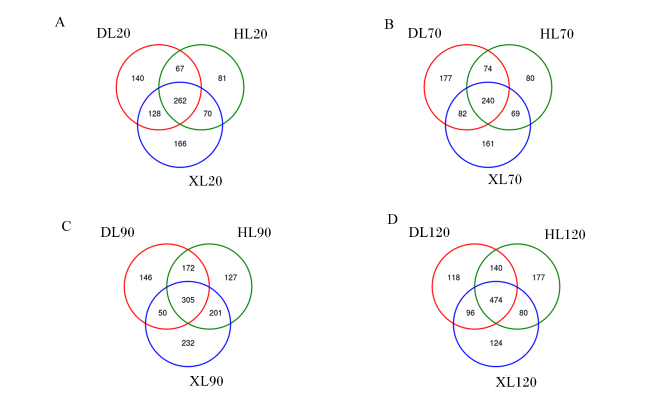
图7可知,20日龄时,3个品种羔羊直肠真菌共计914个OTU,共有OTU为262个,占总OTU的28.67%;道赛特羊、湖羊和小尾寒羊OTU分别为597、480和626个,特有OTU分别为140、81和166个;小尾寒羊OTU和特有OTU数量最多(图7-A)。70日龄时,3个品种羔羊直肠真菌共计883个OTU,共有OTU为240个,占总OTU的27.18%;道赛特羊、湖羊和小尾寒羊OTU分别为573、463和552个,特有OTU分别为177、80和161个;道赛特羊OTU和特有OTU数量最多(图7-B)。90日龄时,3个品种羔羊直肠真菌共计1 233个OTU,共有OTU为305个,占总OTU的24.74%;道赛特羊、湖羊和小尾寒羊OTU分别为673、805和788个,特有OTU分别为146、127和232个;小尾寒羊OTU和特有OTU数量最多(图7-C)。120日龄时3个品种羔羊直肠真菌共计1 209个OTU,共有OTU为474个,占总OTU的39.21%;道赛特羊、湖羊和小尾寒羊OTU分别为828、871和774个,特有OTU分别为118、177和124个;湖羊OTU和特有OTU数量最多(图7-D)。
图7 不同品种羔羊直肠真菌韦恩图

Fig.7 Venn graph of rectum fungi of different breed lambs

2.4.2 直肠真菌Alpha多样性指数分析

表11可知,湖羊直肠真菌的辛普森指数显著高于道赛特羊(P<0.05),与小尾寒羊之间差异不显著(P>0.05);不同品种羔羊之间其他Alpha多样性指数均差异不显著(P>0.05)。日龄显著影响Chao1指数、观测到的物种数、覆盖度、香农指数和辛普森指数(P<0.05),对PD whole tree指数影响不显著(P>0.05)。
表11 不同品种羔羊的直肠真菌Alpha多样性指数分析

Table 11 Alpha diversity indices analysis of rectal fungi of different breed lambs

项目
Items
品种 Breed 日龄 Day of age SEM PP-value
道赛特羊
Dorset
lambs
湖羊
Hu
lambs
小尾寒羊
Small tail
Han
lambs
20 70 90 120 品种
Breed
日龄
Day of
age
品种×日龄
Breed×
day of
age
Chao1指数
Chao1 index
464.62 505.86 466.72 401.01b 425.13b 563.85a 526.27a 17.706 0.516 0.002 0.860
覆盖度
Goods coverage
1.00 1.00 1.00 1.00a 1.00a 0.99b 1.00a 0.001 0.788 0.003 0.595
观测到的物种数
Observed species
302.13 320.84 303.25 261.65b 269.67b 348.20a 355.43a 11.058 0.699 0.001 0.699
PD whole tree指数
PD whole tree
index
72.46 70.68 69.81 63.79 74.15 77.04 68.94 2.405 0.901 0.233 0.413
香农指数
Shannon index
4.50 4.76 4.63 5.09a 4.33b 4.37b 4.73ab 0.087 0.357 0.002 0.038
辛普森指数
Simpson index
0.85b 0.91a 0.88ab 0.94a 0.87b 0.83b 0.87b 0.011 0.049 0.001 0.120

2.4.3 直肠真菌Beta多样性分析

图8可知,基于Bray-Curtis的主坐标分析联合相似性分析结果表明,90和120日龄时,不同品种之间直肠真菌群落差异显著(P<0.05);其他日龄差异不显著(P>0.05)。
图8 不同品种羔羊直肠真菌基于Bray-Curtis的主坐标分析

Fig.8 PCoA based on Bray-Curtis of rectum fungi of different breed lambs

2.4.4 直肠真菌结构分析

表12可知,在直肠真菌门水平上(相对丰度>1.0%),不同品种羔羊之间子囊菌门和担子菌门相对丰度均差异不显著(P>0.05)。日龄显著影响羔羊的子囊菌门相对丰度(P<0.05),对担子菌门相对丰度无显著影响(P>0.05)。
表12 不同品种羔羊的直肠真菌门水平的相对丰度(相对丰度>1.0%)

Table 12 Relative abundance of rectum fungi at phylum level of different breed lambs (relative abundance>1.0%)%

项目
Items
品种 Breed 日龄 Day of age SEM PP-value
道赛特羊
Dorset
lambs
湖羊
Hu
lambs
小尾寒羊
Small tail
Han
lambs
20 70 90 120 品种
Breed
日龄
Day of
age
品种×日龄
Breed×
day of
age
子囊菌门
Ascomycota
82.53 79.28 82.80 75.57b 77.47b 81.69b 91.41a 1.510 0.487 <0.001 0.442
担子菌门
Basidiomycota
9.38 8.99 11.03 13.27 10.45 8.64 6.84 0.909 0.595 0.068 0.206
表13可知,在直肠真菌属水平上(相对丰度>1.0%),小尾寒羊青霉菌属相对丰度显著高于道赛特羊和湖羊(P<0.05),道赛特羊和湖羊之间差异不显著(P>0.05);湖羊曲霉菌属显著高于道赛特羊和小尾寒羊(P<0.05),道赛特羊和小尾寒羊之间差异不显著(P>0.05);不同品种羔羊之间其他菌属均差异不显著(P>0.05)。日龄显著影响羔羊的青霉菌属、曲霉菌属、酵母菌属、篮状菌属、红曲霉属、Tausonia、小囊菌属、枝孢属和假壳二孢属相对丰度(P<0.05),对节丹菌属和木霉菌属相对丰度均无显著影响(P>0.05)。
表13 不同品种羔羊的直肠真菌属水平的相对丰度(相对丰度>1.0%)

Table 13 Relative abundance of rectum fungi at genus level of different breed lambs (relative abundance>1.0%)%

项目
Items
品种 Breed 日龄 Day of age SEM PP-value
道赛特羊
Dorset
lambs
湖羊
Hu
lambs
小尾寒羊
Small tail
Han
lambs
20 70 90 120 品种
Breed
日龄
Day of
age
品种×日龄
Breed×
day of
age
青霉菌属
Penicillium
12.17b 12.61b 16.77a 5.91b 5.40b 6.86b 37.22a 1.891 0.009 <0.001 0.119
曲霉菌属
Aspergillus
11.18b 17.54a 10.42b 22.86a 14.15b 10.97b 4.21c 1.462 0.032 <0.001 0.724
酵母菌属
Saccharomyces
9.33 10.73 13.94 0.49b 22.25a 17.97a 4.63b 1.958 0.480 <0.001 0.231
篮状菌属
Talaromyces
3.51 2.74 3.65 2.41b 1.37b 2.10b 7.32a 0.474 0.575 <0.001 0.566
节丹菌属
Wallemia
3.32 3.40 2.48 5.08 1.41 4.13 1.66 0.636 0.802 0.115 0.471
红曲霉属
Monascus
3.21 1.43 0.92 0.37b 6.96a 0.04b 0.05b 0.702 0.255 <0.001 0.230
木霉菌属
Trichoderma
1.91 1.01 1.79 0.12 2.17 1.51 2.49 0.391 0.590 0.154 0.465
枝孢属
Cladosporium
1.44 2.06 0.82 3.16a 1.50ab 1.05ab 0.06b 0.415 0.404 0.039 0.047
假壳二孢属
Pseudoascochyta
2.40 0.32 1.28 0.23b 0.48b 4.39a 0.23b 0.551 0.259 0.012 0.400
Tausonia 1.00 1.45 1.46 0.58b 0.27b 0.49b 3.87a 0.233 0.252 <0.001 0.111
小囊菌属
Microascus
0.64 1.85 1.28 4.43a 0.18b 0.24b 0.18b 0.475 0.534 0.002 0.846

3 讨论

3.1 不同品种羔羊胃肠道微生物多样性

胃肠道微生物主要由细菌、古生菌和真核生物(真菌和原虫)构成,随着宿主的成长而不断变化,在此过程中,微生物会受到如饲粮、日龄、宿主生活环境、抗生素以及亲缘关系等多种因素的影响。宿主基因型是影响胃肠道微生物多样性的因素之一。微生物多样性对于维持稳定的微生物群落起着至关重要的作用。崔浩然等[29]比较了35 kg体重的湖羊与卡拉库尔羊瘤胃菌群结构的差异性,发现2个品种瘤胃细菌的特有OTU数量及占比不同,卡拉库尔羊瘤胃菌群多样性和丰富度极显著高于湖羊。这与本试验结果相似,道赛特羊、湖羊和小尾寒羊3个品种羔羊瘤胃细菌特有OTU数量及占比不同,小尾寒羊具有较高的瘤胃细菌多样性。研究表明,瘤胃细菌的Alpha多样性指数与饲料效率有关,低饲料效率的个体拥有更复杂和多样化的微生物群落[30-34]。Li等[35]对安格斯牛、夏洛莱牛和Kinsella牛3个品种肉牛瘤胃微生物组的影响及其与饲料效率的关系的研究表明,更多样化的瘤胃微生物群落能够发酵更广泛的底物,但饲料转化率较低,而“简单瘤胃”可能会产生更多有效被宿主吸收和利用的产物。Shabat等[36]对奶牛饲料效率研究也得出了类似的结果,表明微生物组基因含量和类群丰富度越低,饲料效率越高。微生物多样性可能成为一种新的生物标志物或健康指标,虽然不同类型的微生物多样性在宿主健康中的作用仍有待确定,但微生物多样性可能与羔羊的生产性能有关[37]。在本试验中,小尾寒羊具有较高的瘤胃细菌多样性,可能是在相同饲养管理条件下,小尾寒羊羔羊在3个品种中表现出较低生长速度、消化能和代谢能的原因。
Chang等[38]对1岁道赛特羊、小尾寒羊、西藏羊和杜泊羊4个不同品种绵羊的肠道细菌群落进行研究,表明4个品种绵羊的OTU数量存在差异,西藏羊具有较低的OTU数量,而且细菌群落丰度和多样性显著低于其他3个品种绵羊。在本试验中,不同品种肠道菌群Alpha多样性差异不显著,70日龄时主坐标分析差异显著,这可能与羊只年龄有关,本试验中羔羊均为4月龄内羔羊,且肠道细菌多样性受日龄显著影响,可能是造成直肠细菌未表现出明显的品种差异的原因。研究表明,胃肠道微生物多样性指数随动物年龄的增长而升高[39]。微生物多样性对维持稳定的微生物群落起着至关重要的作用,较高的微生物多样性与对环境较强适应性和抵抗力密切相关[37]。Yin等[40]对0~4月龄湖羊羔羊粪便中细菌群落演替及其与血清免疫指标相关性进行研究,表明日龄显著影响羔羊的生产性能、血清参数、粪便细菌群落和功能。本试验对胃肠道微生物多样性的研究也得出相似结果,瘤胃和直肠细菌和真菌多样性总体上随日龄增长而增加,并且通过主坐标分析和相似性分析表明不同品种羔羊瘤胃细菌和真菌群落在20、90日龄均存在显著差异,这可能是造成不同品种羔羊在20(补料后)、90日龄(断奶后)2个饲养关键阶段免疫指标和腹泻率存在差异的原因。研究表明,幼龄反刍动物瘤胃微生物群落具有很强可塑性[41],提示在补料和断奶应激状态下,可以通过外部干预进行调控,引导瘤胃微生物菌群有序定植和健康发酵,以降低羔羊发病率和提高健康水平及后续生产性能。

3.2 不同品种羔羊胃肠道微生物群落组成

瘤胃微生物对植物纤维消化、动物生产性能和健康都具有重要作用,肠道微生态系统与宿主的营养、代谢和免疫等方面密切相关,反刍动物胃肠道微生物能够将饲粮中营养物质转化为可供反刍动物吸收利用的营养物质,同时对动物代谢和健康也发挥着重要作用。研究表明,胃肠道中菌群的建立除受到饲粮、环境和疫病等因素影响外,宿主肠道微生物菌群结构与动物的遗传背景密切相关,具有个体特异性,会因为动物品种遗传学差异引起微生物群落相对丰度的差异[42-45]。张瑜等[46]比较了3~4岁都安山羊和努比亚山羊母羊的瘤胃微生物区系特征及品种之间的差异,结果表明都安山羊和努比亚山羊的瘤胃微生物优势菌群相似,但努比亚山羊隶属于厚壁菌门的菌群相对丰度更高。Langda等[47]比较相同高原牧场的藏山羊和藏绵羊瘤胃微生物多样性和组成的差异,发现2个物种的瘤胃细菌、真菌和原生动物中厚壁菌门、拟杆菌门、新美鞭菌门和纤毛菌门相对丰度最高,但在多个分类水平上存在显著差异,绵羊中新丽鞭菌科(Neocallimastigaceae)和后毛属(Metadinium)相对丰度较高,山羊中则Saccharofermentans和毛螺菌科XPB1014(Lachnospiraceae_XPB1014)相对丰度较高。本试验与以上研究结果类似,3个品种羔羊的胃肠道菌群结构具有相似性,瘤胃细菌和直肠细菌优势菌门均为拟杆菌门和厚壁菌门,瘤胃真菌优势菌门为子囊菌门、担子菌门和新美鞭菌门,直肠真菌优势菌门为子囊菌门和担子菌门,但在一些特异性门属的相对丰度上存在差异,道赛特羊的直肠细菌螺旋体门和密螺旋体属相对丰度较高,螺旋体门属于有益菌,可以有效降解纤维素、果胶和磷酸酯,发酵形成挥发性脂肪酸,为动物机体提供能量[48-49],这可能是道赛特羊表现出较好生产性能的原因。
本试验中,小尾寒羊瘤胃细菌中普雷沃氏菌属相对丰度较低,理研菌科RC-9肠道群和克里斯滕森菌科R-7群相对丰度较高。普雷沃氏菌属作为反刍动物的核心菌群,主要承担发酵功能,不仅可以消化利用淀粉,还能降解非结构性的碳水化合物和蛋白质[50],理研菌科RC-9肠道群相对丰度与挥发性脂肪酸中丙酸含量和挥发性脂肪酸转运基因表达量呈负相关[51-52]。丙酸作为反刍动物碳水化合物代谢中一种重要的挥发性脂肪酸,通过糖异生作用生成葡萄糖或者进入三羧酸循环氧化供能。克里斯滕森菌科R-7群与宿主体重指数呈负相关[53],本试验中,小尾寒羊瘤胃细菌中普雷沃氏菌属相对丰度较低,理研菌科RC-9肠道群和克里斯滕森菌科R-7群相对丰度较高,以及瘤胃真菌中具有分解纤维功能的子囊菌门相对丰度较低,意味着小尾寒羊对营养物质的利用率较低,提示可能是小尾寒羊在生产中表现出相对较低生产性能的原因。研究表明,日龄是影响反刍动物胃肠道微生物菌群结构的重要因素,随日龄增长,拟杆菌门、厚壁菌门、普雷沃氏菌属、瘤胃球菌属、密螺旋体菌属等相对丰度逐渐升高,变形菌门、埃希氏菌属、乳酸杆菌属等相对丰度逐渐降低[54-56]。本试验对不同品种羔羊胃肠道微生物发育规律研究结果与以上研究相似,表明微生物群落组成受日龄显著影响,部分菌群表现出随日龄增长的规律变化,其中螺旋体门、子囊菌门、普雷沃氏菌属、密螺旋体属和青霉菌属相对丰度随日龄增长显著增加,变形菌门、新美鞭菌门、大肠杆菌-志贺菌属、克里斯滕森菌科R-7群、曲霉菌属、盲肠菌属相对丰度随日龄增长显著降低。胃肠道微生物相对丰度会随着日龄增长而发生变化,其主要原因是幼龄动物胃肠道处于逐渐发育的过程。本试验中,小尾寒羊胃肠道中普雷沃氏菌属和子囊菌门相对丰度较低,新美鞭菌门和克里斯滕森菌科R-7群相对丰度较高,意味着小尾寒羊胃肠道发育相对较慢,提示这也可能是影响小尾寒羊生长和消化性能的因素。

4 结论

小尾寒羊、湖羊和道赛特羔羊的胃肠道菌群多样性和结构具有相似性,也存在一定差异。小尾寒羊具有较高的瘤胃细菌多样性,湖羊具有较高的直肠真菌多样性,道赛特羊直肠细菌中螺旋体门和密螺旋体属相对丰度较高,小尾寒羊瘤胃细菌中普雷沃氏菌属相对丰度较低以及理研菌科RC-9肠道群和克里斯滕森菌科R-7群相对丰度较高。胃肠道微生物区系差异可能是导致不同品种羔羊生产性能差异的原因之一。
[1]
ZHUANG Y M, CHAI J M, CUI K, et al. Longitudinal investigation of the gut microbiota in goat kids from birth to postweaning[J]. Microorganisms, 2020, 8(8):1111.

DOI

[2]
MOHAMMED R, BRINK G E, STEVENSON D M, et al. Bacterial communities in the rumen of Holstein heifers differ when fed orchard grass as pasture vs. hay[J]. Frontiers in Microbiology, 2014, 5:689.

[3]
HENDERSON G, COX F, GANESH S, et al. Rumen microbial community composition varies with diet and host,but a core microbiome is found across a wide geographical range[J]. Scientific Reports, 2015, 5:14567.

DOI

[4]
ZHANG J, SHI H T, WANG Y J, et al. Effect of dietary forage to concentrate ratios on dynamic profile changes and interactions of ruminal microbiota and metabolites in Holstein heifers[J]. Frontiers in Microbiology, 2017, 8:2206.

DOI PMID

[5]
WEIMER P J. Redundancy,resilience,and host specificity of the ruminal microbiota:implications for engineering improved ruminal fermentations[J]. Frontiers in Microbiology, 2015, 6:296.

[6]
WEIMER P J, STEVENSON D M, MANTOVANI H C, et al. Host specificity of the ruminal bacterial community in the dairy cow following near-total exchange of ruminal contents[J]. Journal of Dairy Science, 2010, 93(12):5902-5912.

DOI PMID

[7]
LI Y, WANG X F, WANG X Q, et al. Life-long dynamics of the swine gut microbiome and their implications in probiotics development and food safety[J]. Gut Microbes, 2020, 11(6):1824-1832.

DOI PMID

[8]
刘亚丹, 左周, 秦军军, 等. 仔猪不同生长阶段粪便微生物多样性分析[J]. 国外畜牧学(猪与禽), 2020, 40(6):22-29.

LIU Y D, ZUO Z, QIN J J, et al. Analysis of fecal microbial diversity in piglets at different growth stages[J]. Animal Science Abroad (Pigs and Poultry), 2020, 40(6):22-29. (in Chinese)

[9]
GUAN L L, NKRUMAH J D, BASARAB J A, et al. Linkage of microbial ecology to phenotype:correlation of rumen microbial ecology to cattle’s feed efficiency[J]. FEMS Microbiology Letters, 2008, 288(1):85-91.

DOI

[10]
曾燕. 成年健康绵羊胃肠道菌群的研究[D]. 硕士学位论文. 雅安: 四川农业大学, 2015.

ZENG Y. Analysis of the diversity of bacteria communities along the gastrointestinal tract of adult healthy sheep[D]. Master’s Thesis. Ya’an: Sichuan Agricultural University, 2015. (in Chinese)

[11]
LEE J E, LEE S, SUNG J, et al. Analysis of human and animal fecal microbiota for microbial source tracking[J]. The ISME Journal, 2011, 5(2):362-365.

DOI

[12]
CHAUDHARY P P, DAGAR S S, SIROHI S. Comparative quantification of major rumen microbial population in Indian cattle and buffalo fed on wheat straws based diet[J]. Prime Journal of Microbiology Research, 2012, 2(3):105-108.

[13]
LI F Y, LI C X, CHEN Y H, et al. Host genetics influence the rumen microbiota and heritable rumen microbial features associate with feed efficiency in cattle[J]. Microbiome, 2019, 7(1):92.

DOI PMID

[14]
CHANTHAKHOUN V, WANAPAT M, KONGMUN P, et al. Comparison of ruminal fermentation characteristics and microbial population in swamp buffalo and cattle[J]. Livestock Science, 2012, 143(2/3):172-176.

DOI

[15]
彭洪洋. 杜寒杂交羊与小尾寒羊生长、肉质相关基因表达及瘤胃菌群差异研究[D]. 硕士学位论文. 长春: 吉林大学, 2022.

PENG H Y. Study on the difference of rumen microflora structure and expression level related on growth and meat quality between small tailed Han and Dorper×small-tailed Han sheep[D]. Master’s Thesis. Changchun: Jilin University, 2022. (in Chinese)

[16]
YANG G L, ZHANG S H, LI Z Q, et al. Comparison between the gut microbiota in different gastrointestinal segments of large-tailed Han and small-tailed Han sheep breeds with high-throughput sequencing[J]. Indian Journal of Microbiology, 2020, 60(4):436-450.

DOI

[17]
ZHANG Y W, LI F Y, CHEN Y H, et al. Metatranscriptomic profiling reveals the effect of breed on active rumen eukaryotic composition in beef cattle with varied feed efficiency[J]. Frontiers in Microbiology, 2020, 11:367.

DOI PMID

[18]
周喜荣, 玛尔孜亚·亚森, 阿米妮古丽·阿不来孜, 等. 引进肉羊品种资源利用与生产适应性研究概况[J]. 草食家畜, 2022(3):6-11.

ZHOU X R, YASEN M E Z Y, ABULAIZI A M N G L, et al. Study on resource utilization and production adaptability of imported mutton sheep breeds[J]. Grass-Feeding Livestock, 2022(3):6-11. (in Chinese)

[19]
何茂昌, 董和, 杨军祥, 等. 湖羊杂交组合筛选试验研究[J]. 畜牧与兽医, 2022, 54(1):22-26.

HE M C, DONG H, YANG J X, et al. Screening hybrid combinations of Hu sheep[J]. Animal Husbandry&Veterinary Medicine, 2022, 54(1):22-26. (in Chinese)

[20]
渠珂, 许晓彤, 范敬常, 等. 浅析小尾寒羊品种发展问题与建议[J]. 山东畜牧兽医, 2022, 43(12):28-31.

QU K, XU X T, FAN J C, et al. Analysis of variety development problem and suggestions of small tail Han sheep[J]. Shandong Journal of Animal Science and Veterinary Medicine, 2022, 43(12):28-31. (in Chinese)

[21]
梁佶宇, 范瑞诚. 猪肠道微生物及其营养调控技术[J]. 畜牧兽医科技信息, 2019(10):13-14.

LIANG J Y, FAN R C. Intestinal microorganisms and their nutritional regulation techniques of pig[J]. Chinese Journal of Animal Husbandry and Veterinary Medicine, 2019(10):13-14. (in Chinese)

[22]
罗玉衡, 余冰, 何军, 等. 猪肠道微生物及其营养调控[J]. 饲料工业, 2019, 40(5):56-60.

LUO Y H, YU B, HE J, et al. Gut microbes of pig and nutritional regulation[J]. Feed Industry, 2019, 40(5):56-60. (in Chinese)

[23]
李江凌, 赵素君, 王秋实, 等. 猪肠道微生物的多样性及影响因素[J]. 中国畜禽种业, 2020, 16(4):89-90.

LI J L, ZHAO S J, WANG Q S, et al. Diversity and influencing factors of intestinal microorganisms in pigs[J]. The Chinese Livestock and Poultry Breeding, 2020, 16(4):89-90. (in Chinese)

[24]
DIAO H, YAN H L, XIAO Y, et al. Intestinal microbiota could transfer host gut characteristics from pigs to mice[J]. BMC Microbiology, 2016, 16(1):238.

PMID

[25]
PAJARILLO E A B, CHAE J P, BALOLONG M P, et al. Pyrosequencing-based analysis of fecal microbial communities in three purebred pig lines[J]. Journal of Microbiology, 2014, 52(8):646-651.

DOI PMID

[26]
LUO Y H, SU Y, WRIGHT A D G, et al. Lean breed Landrace pigs harbor fecal methanogens at higher diversity and density than obese breed Erhualian pigs[J]. Archaea, 2012, 2012:605289.

[27]
杨利娜. 不同猪种间肠道微生物菌群以及生长相关指标的比较[D]. 硕士学位论文. 南京: 南京农业大学, 2014.

YANG L N. Comparison on microbial community and growth relevant indicators in different pig breeds[D]. Master’s Thesis. Nanjing: Nanjing Agricultural University, 2014. (in Chinese)

[28]
孙国雷. 基于16S rRNA基因的喜马拉雅塔尔羊、岩羊和欧洲盘羊的肠道微生态研究[D]. 硕士学位论文. 曲阜: 曲阜师范大学, 2017.

SUN G L. Intestinal microecology of Himalayan Thar sheep,Bharal and Moufflon based on 16S rRNA gene[D]. Master’s Thesis. Qufu: Qufu Normal University, 2017. (in Chinese)

[29]
崔浩然, 白天天, 赵林波, 等. 湖羊与卡拉库尔羊瘤胃菌群结构差异性比较分析[J]. 动物营养学报, 2022, 34(3):1721-1729.

DOI

CUI H R, BAI T T, ZHAO L B, et al. Comparison and analysis of rumen microflora structure difference between Hu sheep and Karakul sheep[J]. Chinese Journal of Animal Nutrition, 2022, 34(3):1721-1729. (in Chinese)

[30]
CARBERRY C A, KENNY D A, HAN S, et al. Effect of phenotypic residual feed intake and dietary forage content on the rumen microbial community of beef cattle[J]. Applied and Environmental Microbiology, 2012, 78(14):4949-4958.

DOI PMID

[31]
HERNANDEZ-SANABRIA E, GUAN L L, GOONEWARDENE L A, et al. Correlation of particular bacterial PCR-denaturing gradient gel electrophoresis patterns with bovine ruminal fermentation parameters and feed efficiency traits[J]. Applied and Environmental Microbiology, 2010, 76(19):6338-6350.

DOI

[32]
JEWELL K A, MCCORMICK C A, ODT C L, et al. Ruminal bacterial community composition in dairy cows is dynamic over the course of two lactations and correlates with feed efficiency[J]. Applied and Environmental Microbiology, 2015, 81(14):4697-4710.

DOI PMID

[33]
MYER P R, SMITH T P L, WELLS J E, et al. Rumen microbiome from steers differing in feed efficiency[J]. PLoS One, 2015, 10(6):e0129174.

DOI

[34]
ZHOU M, HERNANDEZ-SANABRIA E, GUAN L L. Assessment of the microbial ecology of ruminal methanogens in cattle with different feed efficiencies[J]. Applied and Environmental Microbiology, 2009, 75(20):6524-6533.

DOI PMID

[35]
LI F Y, HITCH T C A, CHEN Y H, et al. Comparative metagenomic and metatranscriptomic analyses reveal the breed effect on the rumen microbiome and its associations with feed efficiency in beef cattle[J]. Microbiome, 2019, 7(1):6.

DOI PMID

[36]
SHABAT S K B, SASSON G, DORON-FAIGENBOIM A, et al. Specific microbiome-dependent mechanisms underlie the energy harvest efficiency of ruminants[J]. The ISME Journal, 2016, 10(12):2958-2972.

DOI

[37]
YIN X J, DUAN C H, JI S K, et al. Average daily gain in lambs weaned at 60 days of age is correlated with rumen and rectum microbiota[J]. Microorganisms, 2023, 11(2):348.

DOI

[38]
CHANG J J, YAO X T, ZUO C X, et al. The gut bacterial diversity of sheep associated with different breeds in Qinghai province[J]. BMC Veterinary Research, 2020, 16(1):254.

DOI

[39]
JAMI E, ISRAEL A, KOTSER A, et al. Exploring the bovine rumen bacterial community from birth to adulthood[J]. The ISME Journal, 2013, 7(6):1069-1079.

DOI

[40]
YIN X J, JI S K, DUAN C H, et al. The succession of fecal bacterial community and its correlation with the changes of serum immune indicators in lambs from birth to 4 months[J]. Journal of Integrative Agriculture, 2023, 22(2):537-550.

DOI

[41]
李科南, 杜海东, 史彬林, 等. 幼龄反刍动物瘤胃微生物的定植过程及早期调控[J]. 动物营养学报, 2022, 34(6):3418-3426.

DOI

LI K N, DU H D, SHI B L, et al. Colonization process and early regulation of rumen microorganisms in young ruminants[J]. Chinese Journal of Animal Nutrition, 2022, 34(6):3418-3426. (in Chinese)

DOI

[42]
CAMPBELL J H, FOSTER C M, VISHNIVETSKAYA T, et al. Host genetic and environmental effects on mouse intestinal microbiota[J]. The ISME Journal, 2012, 6(11):2033-2044.

DOI

[43]
GOODRICH J K, WATERS J L, POOLE A C, et al. Human genetics shape the gut microbiome[J]. Cell, 2014, 159(4):789-799.

DOI PMID

[44]
GARCIA-MAZCORRO J F, DOWD S E, POULSEN J, et al. Abundance and short-term temporal variability of fecal microbiota in healthy dogs[J]. MicrobiologyOpen, 2012, 1(3):340-347.

DOI

[45]
YIN X J, JI S K, DUAN C H, et al. Dynamic change of fungal community in the gastrointestinal tract of growing lambs[J]. Journal of Integrative Agriculture, 2022, 21(11):3314-3328.

DOI

[46]
张瑜, 张叁保, 申玉建, 等. 2个品种山羊瘤胃菌群结构比较及其功能预测分析[J]. 南方农业学报, 2022, 53(6):1724-1733.

ZHANG Y, ZHANG S B, SHEN Y J, et al. Rumen microbial community structure comparison and function prediction of two goat breeds[J]. Journal of Southern Agriculture, 2022, 53(6):1724-1733. (in Chinese)

[47]
LANGDA S, ZHANG C G, ZHANG K, et al. Diversity and composition of rumen bacteria,fungi,and protozoa in goats and sheep living in the same high-altitude pasture[J]. Animals, 2020, 10(2):186.

DOI

[48]
郭威, 郭晓军, 周贤, 等. 复合菌剂发酵玉米秸秆对绵羊瘤胃液细菌多样性的影响[J]. 畜牧兽医学报, 2018, 49(4):736-745.

GUO W, GUO X J, ZHOU X, et al. Effect of corn stalk fermented by complex bacterial on rumen bacteria diversity in sheep[J]. Acta Veterinaria et Zootechnica Sinica, 2018, 49(4):736-745. (in Chinese)

[49]
郝凌魁, 刘世雄, 李冬芳, 等. 酵母发酵饲料对瘤胃菌群数量及多样性的影响[J]. 中国畜牧杂志, 2021, 57(2):116-124.

HAO L K, LIU S X, LI D F, et al. Effects of yeast fermented feed on quantity and diversity of rumen microorganism[J]. Chinese Journal of Animal Science, 2021, 57(2):116-124. (in Chinese)

[50]
MOHAMMADZADEH H, YÁÑEZ-RUIZ D R, MARTÍNEZ-FERNANDEZ G, et al. Molecular comparative assessment of the microbial ecosystem in rumen and faeces of goats fed alfalfa hay alone or combined with oats[J]. Anaerobe, 2014, 29:52-58.

DOI PMID

[51]
CHENG J B, ZHANG X X, XU D, et al. Relationship between rumen microbial differences and traits among Hu sheep,Tan sheep,and Dorper sheep[J]. Journal of Animal Science, 2022, 100(9):skac261.

DOI

[52]
AHMAD A A, YANG C, ZHANG J B, et al. Effects of dietary energy levels on rumen fermentation,microbial diversity,and feed efficiency of yaks (Bos grunniens)[J]. Frontiers in Microbiology, 2020, 11:625.

DOI

[53]
WATERS J L, LEY R E. The human gut bacteria Christensenellaceae are widespread,heritable,and associated with health[J]. BMC Biology, 2019, 17(1):83.

DOI

[54]
崔浩然, 郭雪峰, 金巍. 反刍动物瘤胃微生物菌群结构影响因素的研究进展[J]. 中国畜牧杂志, 2021, 57(11):6-11.

CUI H R, GUO X F, JIN W. Research progress on factors affecting rumen microbial flora structure[J]. Chinese Journal of Animal Science, 2021, 57(11):6-11. (in Chinese)

[55]
LI B B, ZHANG K, LI C, et al. Characterization and comparison of microbiota in the gastrointestinal tracts of the goat (Capra hircus) during preweaning development[J]. Frontiers in Microbiology, 2019, 10:2125.

DOI

[56]
JIAO J Z, HUANG J Y, ZHOU C S, et al. Taxonomic identification of ruminal epithelial bacterial diversity during rumen development in goats[J]. Applied and Environmental Microbiology, 2015, 81(10):3502-3509.

DOI PMID

Outlines

/