REVIEW

Research Progress of Scorpion Venom Antimicrobial Peptides and Its Application Prospect in Animal Breeding

  • Aorigele , 1, 2 ,
  • BAO Zhiquan 1, 2 ,
  • Huhezhula 1, 3 ,
  • Huyiligeqi 1, 3
Expand
  • 1 School of Mongolian Medicine, Inner Mongolia Minzu University, Tongliao 028043, China
  • 2 Key Laboratory of Quality Control of Traditional Chinese Medicine (Mongolian Medicine), National Medical Products Administration, Tongliao 028043, China
  • 3 Key Laboratory of Mongolian Medicine Research and Development Engineering of Ministry of Education, Tongliao 028043, China

Aorigele, lecturer, E-mail:

Received date: 2023-05-02

  Online published: 2023-11-12

Abstract

Antibacterial peptides (AMPs), also known as antimicrobial peptides, are a class of small molecular peptides with various biological activities that widely exist in nature. AMPs typically have a broad-spectrum antibacterial activity against pathogens such as bacteria, fungi, viruses, parasites and tumor cells as a key component of the natural innate immune system of organisms. In addition, AMPs as an antibiotic feed additive alternative to prevention and control of pathogenic diseases in raised animals, due to their unique antibacterial mechanisms and no drug resistance. In recent years, AMPs whose application prospects require further research have been widely reported in scorpions. In this article, the research status, biological activity and mechanism of action of scorpion venom AMPs at home and abroad are reviewed, and their application prospects in animal breeding industry are also prospected.

Cite this article

Aorigele , BAO Zhiquan , Huhezhula , Huyiligeqi . Research Progress of Scorpion Venom Antimicrobial Peptides and Its Application Prospect in Animal Breeding[J]. Chinese Journal of Animal Nutrition, 2023 , 35(11) : 6810 -6829 . DOI: 10.12418/CJAN2023.620

使用抗生素饲料添加剂可对养殖业带来经济效益的同时,还导致产生耐药性细菌等日益严峻的问题。据报道,许多病原生物,如细菌、真菌、病毒和寄生虫等都对多种抗生素产生耐药性[1]。特别是近年来,耐甲氧西林金黄色葡萄球菌(methicillin-resistant Staphylococcus aureus,MRSA)等多重耐药菌的出现给传统抗生素的使用带来了极大的挑战。尽快开发或筛选出一种绿色、安全、高效的抗生素替代药物已是刻不容缓。抗菌肽作为生物体天然免疫系统的重要组成部分,具有独特的抗菌机制、毒性低且不易使病原生物产生耐药性等特点,并对细菌、真菌、病毒和寄生虫等各种病原生物具有广谱抗菌活性[2-3]。因此,抗菌肽被认为是具有潜在的抗病原生物活性的,绿色、安全、高效的新型饲料添加剂,其广泛应用于畜牧业生产、渔业生产等养殖业中预防和治疗动物疫病。
蝎(scorpions)是最古老的蛛形纲动物之一,素有“活化石”之称。在4亿多年的进化过程中,蝎为适应生存环境,其尾部毒腺可分泌毒液,用以抵抗病原菌的侵袭。蝎毒液(scorpion venom)中富含多种生物活性物质,是新型抗菌药物研发的重要天然资源[4]。蝎种类繁多,分布广泛,现今被鉴别的种类约为17个科,233个属,2 762个种(https://www.ntnu.no/ub/scorpion-files/)。其中,钳蝎科是蝎目中最大的一个科,已知有99个属,1 357个种。据报道,对人有害且具有医学意义的蝎有近50个种,它们几乎都属于钳蝎科。因此,蝎毒研究主要集中在钳蝎科,利用蛋白质组学分离的多肽数量在整个蝎种中占60%以上[5]。目前,蝎毒液已被证明是一个丰富的抗菌肽来源,每种蝎毒液中至少含有100多种活性多肽。其中,多数抗菌肽对细菌、真菌、病毒和寄生虫等病原生物具有较好的抑制或杀伤作用。此外,部分抗菌肽还具有抗肿瘤细胞、免疫调节以及调控炎症反应等活性。本文综述了国内外蝎毒素抗菌肽的最新研究现状、生物活性及其作用机理等,为开发绿色、安全、高效的新型饲料添加剂提供参考,并展望了其在动物养殖中的潜在应用前景。

1 抗菌肽的分类和结构特征

截至2023年6月,抗菌肽数据库ADP3(http://aps.unmc.edu/AP/)中收录的抗菌肽基因序列已达3569个,其中来源于蝎毒素的抗菌肽有93个。根据氨基酸残基数、净电荷、蛋白质结构特征和来源的不同(表1),可将抗菌肽分为阴离子型抗菌肽(anionic AMPs)、阳离子α-螺旋型抗菌肽(cationic α-helical AMPs)、阳离子β-折叠型抗菌肽(cationic β-sheet AMPs)和延伸阳离子型抗菌肽(extended cationic AMPs)4类[6-8]
表1 抗菌肽的分类和结构特征

Table 1 Classification and structural characteristics of AMPs[6-8]

分类
Classification
氨基酸序列
Amino acid sequence
净电荷
Net charge
结构
Structure
来源
Source
阴离子型抗菌肽
Anionic AMPs
由5~70个氨基酸
残基组成
-1~-8 结构特征包括来自一些
两栖类动物的α-螺旋型肽和
环形胱氨酸结多肽
在两栖动物、牛、
羊及人体内
广泛存在
阳离子α-螺旋型抗菌肽
Cationic α-helical AMPs
长度小于40个氨基酸残基 2~9 在水溶液中是无序的,但
一旦与生物膜接触,就呈现
两亲性α-螺旋结构
生物界中广泛存在
阳离子β-折叠型抗菌肽
Cationic β-sheet AMPs
含有2~8个半胱氨酸
残基,形成1~4对分子内
二硫键
正电荷 在水溶液中有序排列,并含有
保守的半胱氨酸残基,形成
二硫键,增强结构稳定性,
减少蛋白质降解
在海洋无脊椎
动物、两栖类和
植物中广泛存在
延伸阳离子型抗菌肽
Extended cationic AMPs
由精氨酸、脯氨酸、色氨酸、
甘氨酸和组氨酸等高比例的
特定氨基酸残基组成
正电荷 缺乏规则的二级结构,有些
抗菌肽可以形成环状结构,
但本质上结构是线性的
生物界中广泛存在

1.1 阴离子型抗菌肽

阴离子型抗菌肽除了一部分是由基因编码的小分子多肽以外,大多数是由蛋白质水解后产生的肽片段。此类抗菌肽净电荷范围为-1~-8,通常由5~70个氨基酸残基组成。它们通过利用金属离子与带负电荷的细胞膜之间形成离子键,从而与微生物相互作用。例如,绵羊肺的表面活化剂中的阴离子肽(SAAP)是最早发现的含有5~7个天门冬氨酸和天门冬酰胺残基的阴离子型抗菌肽,在锌离子(Zn2+)存在下,对羊病原体溶血性曼氏杆菌(Mannheimia haemolytica)具有较高的抗菌活性;当表面活化剂中加入0.14 mol/L的氯化钠(NaCl)和乙二胺四乙酸(EDTA)时,其杀菌活性被抑制;而补充氯化锌(ZnCl2)后则恢复其抗菌活性[9]

1.2 阳离子α-螺旋型抗菌肽

此类抗菌肽是长度小于40个氨基酸残基的小分子多肽,通常携带2~9的净电荷,并且肽链C末端被酰胺化,在水溶液中是无规则的,但在一定浓度的三氟乙醇(TFE)溶液中,其分子结构全部或部分被诱导形成α-螺旋结构。此外,其疏水性氨基酸比例通常高于亲水性氨基酸比例,这使得当与靶细胞相互作用时能够形成典型的两亲性拓扑结构。来源于蝎毒素的抗菌肽大多数不含半胱氨酸,通常带有2~7的净电荷,属于两亲性α-螺旋型阳离子多肽。例如,最近从斑尾戾蝎(Tityus stigmurus)的毒素中分离得到的抗菌肽Stigmurin是一个含有2个净电荷的、具有典型的两亲性α-螺旋结构的抗菌肽分子。在水溶液中以无规则卷曲结构形式存在,而模拟的膜相环境(40% TFE)中,形成70%的α-螺旋结构,亲水性和疏水性氨基酸位于分子的对立面,形成较强的两亲性拓扑结构[10]

1.3 阳离子β-折叠型抗菌肽

此类抗菌肽通常含有2~8个半胱氨酸残基,并形成1~4对二硫键。这些二硫键在多肽分子中起着稳定肽链空间结构的作用,同时对多肽行使其生物学功能必不可少。例如,当其半胱氨酸突变为疏水氨基酸(除丙氨酸和亮氨酸以外)时,多肽会保持生物活性;而被酸性氨基酸取代时,多肽会失活[11]。蝎毒素除了广泛含有阳离子α-螺旋型抗菌肽之外,还含有β-折叠型结构的毒素多肽。例如,CSαβ防御素和HAP-1是从东亚钳蝎(Mesobuthus martensii)中分离得到的蝎毒素β-折叠型抗菌肽。其中,HAP-1是含有19个氨基酸残基的酸性肽,酸性氨基酸残基占整个分子的33.3%。二级结构预测结果表明,HAP-1包含1个β-折叠区域(第9~17氨基酸残基)和2个末端(第1~8氨基酸残基和第18~19氨基酸残基),分别形成一段卷曲螺旋(coiled coil)区域[12]

1.4 延伸阳离子型抗菌肽

延伸阳离子型抗菌肽缺乏规则的二级结构,其结构仅通过与膜脂相互作用的氢键和范德华力稳定。虽然有些延伸阳离子型抗菌肽可以形成环状结构,但本质上结构是线性的。此类抗菌肽的主要特点是富含脯氨酸(Pro)、精氨酸(Arg)、苯丙氨酸(Phe)、甘氨酸(Gly)和色氨酸(Trp)等氨基酸。例如,从猪小肠组织和外周血嗜中性粒细胞中分离得到的抗菌肽PR-39富含Pro(49%)和Arg(24%),从猪白细胞中分离得到的抗菌肽Prophenin-1(PF-1)富含Pro(53.2%)和Phe(19%),从牛中性粒细胞胞质颗粒中分离得到的抗菌肽Indolicidin富含Trp(38%)和Pro(23%)等[13-15]

2 蝎毒素抗菌肽研究进展

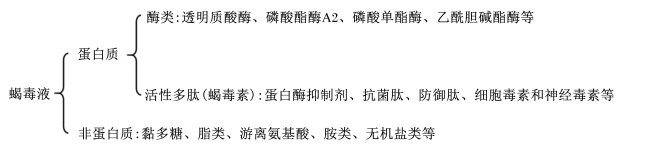
蝎毒液是一类复杂的混合物,主要由黏蛋白类、脂类、酶类、无机盐类、胺类和多肽类等物质组成(图1),其中多肽类是蝎毒液中最主要的活性物质,被称为蝎毒素[16]。蝎毒素是新型抗菌药物开发的重要源泉,主要包含蛋白酶抑制剂、防御肽、抗菌肽、细胞毒素和神经毒素等,其中对神经毒素和抗菌肽的研究最多。神经毒素主要作用于神经细胞离子通道,是一类研究细胞膜上离子通道结构差异的“分子探针”。抗菌肽是蝎天然免疫系统的重要组成部分,也是进行天然药物筛选和开发的重要前体物质,具有广谱抗细菌、抗真菌、抗病毒、抗肿瘤细胞和免疫调节等生物活性。此外,蝎毒素抗菌肽不仅种类多、分子质量小、热稳定性好,而且还具有独特的抗菌机制、不易使病原生物产生耐药性等特点,是最理想的新型抗菌剂,具有重要的理论研究意义和应用开发价值[17]
图1 蝎毒液主要成分

Fig.1 Main components of scorpion venom

2.1 抗细菌活性

蝎毒素抗菌肽一般是由10~100个氨基酸残基组成的阳离子α-螺旋型小分子无二硫键多肽,对革兰氏阳性细菌、革兰氏阴性细菌以及耐药性细菌具有高效的抑制活性。蝎毒素抗菌肽的抗菌活性分析结果(表2)显示,多数抗菌肽对革兰氏阳性细菌和革兰氏阴性细菌都具有很强的抗菌活性,并对革兰氏阳性细菌的抗菌活性强于革兰氏阴性细菌,这可能是因为2种细菌细胞壁的构造和化学组成不同导致的。天然抗菌肽的杀菌机制不同于传统抗生素,它可以与细菌质膜上脂质组分靶向结合,先破坏细菌细胞壁、细胞膜完整性,进而抑制细菌核酸、蛋白质等的生物合成来达到快速有效抑菌效果,对宿主细胞无毒副作用,且不易使细菌产生耐药性。Song等[18]研究发现,蝎毒素衍生肽GK-19表现出很强的抗细菌活性,与其母肽AamAP1[最小抑菌浓度(MIC)值>20.0 μmol/L]相比,对革兰氏阴性细菌大肠杆菌(Escherichia coli)、肺炎克雷伯菌(Klebsiella pneumoniae)和铜绿假单胞菌(Pseudomonas aeruginosa)的MIC值分别为3.0、5.0和5.0 μmol/L;对革兰氏阳性细菌粪肠球菌(Enterococcus faecalis)和MRSA的MIC值分别为3.0和5.0 μmol/L。同时,GK-19对哺乳动物细胞几乎无毒性、溶血活性低,并在血浆中稳定性高。此外,在MRSA诱导的小鼠皮肤烫伤模型中,GK-19显示出显著的抗菌和愈合作用,认为它是一种很有前途的抗耐药细菌感染的候选药物。如表2所示,目前仅有50多种蝎毒素抗菌肽被鉴定具有抗细菌活性,然而2 700多种蝎中仍有许多蝎毒素抗菌肽未被分离和研究。
表2 蝎毒素抗菌肽的抗细菌活性

Table 2 Antibacterial activities of scorpion AMPs

抗菌肽
AMPs
来源
Venom species
氨基酸
残基数
AA residues
number/个
最小抑菌浓度MIC 耐药性细菌
MDR
bacteria
溶血活性
Haemolytic
activity
参考文献
References
革兰氏
阳性菌
G+ bacteria
革兰氏
阴性菌
G- bacteria
AaeAP1 英雄杀人蝎
Androctonus aeneas
19 16 mg/L >512 mg/L ND + [19]
AaeAP2 英雄杀人蝎
Androctonus aeneas
19 16 mg/L >512 mg/L ND + [19]
AamAP1 阿氏杀人蝎
Androctonus amoreuxi
18 20 μmol/L 150 μmol/L ND + [20]
AamAP2 阿氏杀人蝎
Androctonus amoreuxi
18 48 μmol/L 120 μmol/L ND + [20]
AcrAP1 肥尾杀人蝎
Androctonus crassicauda
18 8 μmol/L >250 μmol/L ND + [21]
AcrAP2 肥尾杀人蝎
Androctonus crassicauda
18 8 μmol/L >250 μmol/L ND + [21]
Androctonin 南方杀人蝎
Androctonus australis
25 0.25~
1.00 μmol/L
4~
64 μmol/L
ND - [22]
BmKb1 东亚钳蝎
Mesobuthus martensii
18 16.0~
81.5 μg/mL
18.1~
90.8 μg/mL
ND ND [23]
BmKbpp 东亚钳蝎
Mesobuthus martensii
47 5.7~
70.0 μmol/L
2.3~
68.2 μmol/L
ND + [24]
BmKn2 东亚钳蝎
Mesobuthus martensii
13 10 μg/mL >80 μg/mL MRSA、
MRSE
+ [25]
Css54 腥红似刺尾蝎
Centruroides suffusus
25 2 μmol/L 2~4 μmol/L ND + [26]
Ctri9594 三肋寇里蝎
Chaerilus tricostatus
14 12.5~
25.0 μg/mL
>100 μg/mL ND ND [27]
Ctriporin 三肋寇里蝎
Chaerilus tricostatus
19 5~
10 μg/mL
>100 μg/mL MRSA、PRSE、
MRCNS
ND [28]
Hadrurin 阿兹特克后尾蝎
Hadrurus aztecus
41 10~
50 μmol/L
10~
50 μmol/L
ND + [29]
Hp1404 佩氏异距蝎
Heterometrus petersii
14 3.13~
12.50 μmol/L
3.13~
12.50 μmol/L
MRAB + [30]
HsAp 携刺异距蝎
Heterometrus spinifer
29 11.8~
46.5 μmol/L
23.8~
51.2 μmol/L
ND + [31]
Im-1 斑等蝎
Isometrus maculatus
56 0.8~
25.0 μmol/L
0.4~
0.8 μmol/L
ND ND [32]
Imcroporin 斑等蝎
Isometrus maculatus
17 20~
50 μg/mL
>100 μg/mL MRSA、PRSE、
MRCNS
+ [33]
IsCT 马达加斯加后棘蝎
Opisthacanthus madagascariensis
13 0.7~
16.6 μmol/L
3.3~
150.0 μmol/L
ND + [34]
IsCT2 马达加斯加后棘蝎
Opisthacanthus madagascariensis
13 0.7~
17.1 μmol/L
3.4~
150.0 μmol/L
ND + [34]
La39 南亚滑螯蝎
Liocheles australasiae
18 50 μg/mL >200 μg/mL ND + [35]
Marcin-18 东亚钳蝎
Mesobuthus martensii
18 1.5~
23.4 μmol/L
5.9~
11.7 μmol/L
MRSA、
PRSA
ND [36]
Megicin-18 隆背爱琴杀牛蝎
Mesobuthus gibbosus
18 1.5~
48.3 μmol/L
12.1~
48.3 μmol/L
MRSA、
PRSA
ND [36]
Meucin-13 兵士中杀牛蝎
Mesobuthus eupeus
13 0.25~
2.90 μmol/L
6.2~
50.0 μmol/L
ND + [37]
Meucin-18 兵士中杀牛蝎
Mesobuthus eupeus
18 1.5~
47.5 μmol/L
11.9~
23.7 μmol/L
MRSA、
PRSA
+ [36-37]
Meucin-49 兵士中杀牛蝎
Mesobuthus eupeus
49 0.33~
8.28 μmol/L
0.54~
16.95 μmol/L
MRCNS、
MRSA
+ [38]
Mucroporin 尖刺信使蝎
Lychas mucronatus
17 25~
50 μg/mL
>100 μg/mL MRCNS ND [39]
Opisin 秃额后目蝎
Opistophthalmus glabrifrons
19 4~
10 μmol/L
20~
38 μmol/L
MRSA、VRE + [40]
Opistoporin 1 具棱后目蝎
Opistophthalmus
carinatus
44 12.5~
50.0 μmol/L
1.6~
50.0 μmol/L
ND + [41]
Pandinin 1 统治者惧蝎
Pandinus imperator
44 1.3~
5.2 μmol/L
>20.8 μmol/L ND + [42]
Pandinin 2 统治者惧蝎
Pandinus imperator
24 2.4~
4.8 μmol/L
19.1~
38.2 μmol/L
ND + [42]
Pantinin-1 统治者惧蝎
Pandinus imperator
14 8~
32 μmol/L
62~
87 μmol/L
MRSA、VRE + [43]
Pantinin-2 统治者惧蝎
Pandinus imperator
13 18~
48 μmol/L
48~
87 μmol/L
MRSA、VRE + [43]
Pantinin-3 统治者惧蝎
Pandinus imperator
13 4~
16 μmol/L
36~
87 μmol/L
MRSA、VRE + [43]
Parabutoporin 施氏副杀牛蝎
Parabuthus schlechteri
45 6.3~
50.0 μmol/L
1.6~
50.0 μmol/L
ND + [41]
StCT1 西藏类蝎
Scorpiops tibetanus
14 12.5~
100.0 μg/mL
>100 μg/mL MRSA、MRCNS、
PREF、PRSA
+ [44]
StCT2 西藏类蝎
Scorpiops tibetanus
14 6.25~
50.00 μg/mL
50~
100 μg/mL
PRSA、PRSE、
MRSA、MRCNS、
MSSE
+ [45]
StigA25 斑尾戾蝎
Tityus stigmurus
17 1.2~
4.7 μmol/L
2.3~
18.8 μmol/L
ND + [46]
StigA31 斑尾戾蝎
Tityus stigmurus
17 1.2~
2.3 μmol/L
1.2~
4.7 μmol/L
ND + [46]
Stigmurin 斑尾戾蝎
Tityus stigmurus
17 9.4~
150 μmol/L
>150 μmol/L ND + [10,46]
TsAP-1 锯齿戾蝎
Tityus serrulatus
17 120 μmol/L 160 μmol/L ND + [47]
TsAP-2 锯齿戾蝎
Tityus serrulatus
17 5 μmol/L >320 μmol/L ND + [47]
UyCT1 夏氏螫尾蝎
Urodacus yaschenkoi
14 4 μmol/L 10~
32 μmol/L
金黄色葡萄球
菌、大肠杆菌、
阴沟肠杆菌、
肺炎克雷伯菌、
铜绿假单胞菌、
鲍曼不动杆菌
+ [48]
UyCT2 夏氏螫尾蝎
Urodacus yaschenkoi
13 32 μmol/L 32~
45 μmol/L
+ [48]
UyCT3 夏氏螫尾蝎
Urodacus yaschenkoi
13 8 μmol/L 25~
32 μmol/L
+ [48]
UyCT5 夏氏螫尾蝎
Urodacus yaschenkoi
13 4 μmol/L 25~32 μmol/L + [48]
Vejovine 墨西哥愈神蝎
Vaejovis mexicanus
47 ND 4.4~
50 μmol/L
肺炎克雷伯菌、
阴沟肠杆菌、
铜绿假单胞菌、
大肠杆菌、
鲍曼不动杆菌
+ [49]
VmCT1 墨西哥愈神蝎
Vaejovis mexicanus
13 10~
20 μmol/L
5~
25 μmol/L
ND + [50]
VmCT2 墨西哥愈神蝎
Vaejovis mexicanus
13 10~
20 μmol/L
10~
20 μmol/L
ND + [50]

VpAmp1.0
斑点中墨愈神蝎
Vaejovis punctatus
19 2.5 μmol/L 2.5~
24 μmol/L
结核分枝杆菌 + [51]
VpAmp2.0 斑点中墨愈神蝎
Vaejovis punctatus
25 10~
15 μmol/L
15~
24 μmol/L
结核分枝杆菌 + [51]

ND:未检测;+:有活性;-:无活性;VRE:耐万古霉素肠球菌;MRAB:多重耐药鲍曼不动杆菌;MRCNS:耐甲氧西林凝固酶阴性葡萄球菌;MRSA:耐甲氧西林金黄色葡萄球菌;PREF:耐青霉素粪肠球菌;PRSA:耐青霉素金黄色葡萄球菌;PRSE:耐青霉素表皮葡萄球菌。

ND: not determined; +: positive activity; -: negative activity; VRE: vancomycin-resistant Enterococcus; MRAB: Multidrug-resistant Acinetobacter baumannii; MRCNS: methicillin-resistant coagulase-negative Staphylococcus; MRSA: methicillin-resistant Staphylococcus aureus; PREF: penicillin-resistant Enterococcus faecalis; PRSA: penicillin-resistant Staphylococcus aureus; PRSE: penicillin-resistant Staphylococcus epidermidis.

2.2 抗真菌活性

蝎毒素抗菌肽能够抑制有害真菌感染,具有高效、低毒、安全和广谱抗真菌活性,且其独特的抗真菌机制破解真菌耐药性的难题。不同于细菌,真菌细胞结构比较复杂,故对细菌的作用机理研究不能完全涵盖对真菌的作用。抗菌肽主要通过破坏真菌细胞壁,改变膜通透性,以及与核酸、蛋白质和酶等胞内大分子单独作用或共同作用来达到抑制或杀死真菌的作用。据研究报道,Meucin-13、Meucin-18、HsAP、Pantinin-1、Pantinin-2和Pantinin-3等蝎毒素抗菌肽对真菌具有显著的抗真菌活性,其中Meucin-13对粗糙脉孢菌(Neurospora crassa)有较强的抗真菌活性,其MIC值为18.3 μmol/L[37];Meucin-18对Neurospora crassa、白地霉(Geotrichum candidum)、烟曲霉(Aspergillus fumigatus)和白僵菌(Beauveria spp.)表现出强的抑制能力,其MIC值分别为5.2、3.5、8.3和1.9 μmol/L[37];HsAP、Pantinin-1、Pantinin-2和Pantinin-3均对热带假丝酵母(Candida tropicalis)有抗真菌活性,其MIC值分别为48.6、16.0、16.0和17.0 μmol/L[31,43]。其他具有抗真菌活性的蝎毒素抗菌肽见表3
表3 蝎毒素抗菌肽的抗真菌活性

Table 3 Antifungal activities of scorpion AMPs

抗菌肽
AMPs
来源
Venom
species
氨基酸残基数
AA residues
number/个
真菌
Fungi
最小抑菌浓度
MIC
参考文献
References
AaeAP1 英雄杀人蝎
Androctonus aeneas
19 白色假丝酵母
Candida albicans
32 mg/L [19]
AaeAP2 英雄杀人蝎
Androctonus aeneas
19 白色假丝酵母
Candida albicans
32 mg/L [19]
AamAP1 阿氏杀人蝎
Androctonus amoreuxi
18 白色假丝酵母
Candida albicans
64 μmol/L [20]
AamAP2 阿氏杀人蝎
Androctonus amoreuxi
18 白色假丝酵母
Candida albicans
64 μmol/L [20]
AcrAP1 肥尾杀人蝎
Androctonus crassicauda
18 白色假丝酵母
Candida albicans
16 μmol/L [21]
AcrAP2 肥尾杀人蝎
Androctonus crassicauda
18 白色假丝酵母
Candida albicans
16 μmol/L [21]
Androctonin 南方杀人蝎
Androctonus australis
25 茄链格孢菌
Alternaria dauci
8~16 μmol/L [52]
甘蓝黑斑菌
Alternaria brassicola
3~6 μmol/L
匍柄霉菌
Stemphylium
4~8 μmol/L
黄色镰孢菌
Fusarium culmorum
3~6 μmol/L
尖孢镰刀菌
Fusarium oxysporum
6~12 μmol/L
尖孢镰刀菌
Fusarium oxysporum M.
2~4 μmol/L
尖孢镰刀菌
Fusarium oxysporum L.
2~4 μmol/L
粗糙脉孢菌
Neurospora crassa
6~12 μmol/L
灰葡萄孢菌
Botrytis cinerea
6~12 μmol/L
矮牵牛灰霉菌
Botrytis petunia
4~8 μmol/L
丛赤壳菌
Nectria haematococca
6~12 μmol/L
绿色木霉菌
Trichoderma viride
6~12 μmol/L
黄萎病菌
Verticilium toreilis
2~4 μmol/L
烟曲霉
Aspergillus fumigatus
25~50 μmol/L
BmKbpp 东亚钳蝎
Mesobuthus martensii
47 粗糙脉孢菌
Neurospora crassa
2 μmol/L [24]
灰葡萄孢菌
Botrytis cinerea
3.1 μmol/L
黄色镰孢菌
Fusarium culmorum
0.2 μmol/L
Con10 卡雅布后棘蝎
Opisthacanthus cayaporum
27 白色假丝酵母
Candida albicans
100 μmol/L [53]
热带假丝酵母
Candida tropicalis
12.5 μmol/L
近平滑假丝酵母
Candida parapsilosis
200 μmol/L
光滑假丝酵母
Candida glabrata
200 μmol/L
新型隐球菌
Cryptococcus neoformans
25~50 μmol/L
Ctri9594 三肋寇里蝎
Chaerilus tricostatus
14 白色假丝酵母
Candida albicans
>100 μg/mL [27]
Ctriporin 三肋寇里蝎
Chaerilus tricostatus
19 白色假丝酵母
Candida albicans
20 μg/mL [28]
HsAP 携刺异距蝎
Heterometrus spinifer
29 热带假丝酵母
Candida tropicalis
48.6 μmol/L [31]
Hypotensin
(TistH)
斑尾戾蝎
Tityus stigmurus
25 白色假丝酵母
Candida albicans
128.0~178.5 μg/mL [54-55]
热带假丝酵母
Candida tropicalis
128.0~178.5 μg/mL
黄曲霉菌
Aspergillus flavus
128 μg/mL
近平滑假丝酵母
Candida parapsilosis
>178.5 μg/mL
光滑假丝酵母
Candida glabrata
>178.5 μg/mL
克鲁斯假丝酵母
Candida krusei
>178.5 μg/mL
都柏林念珠菌
Candida dubliniensis
>178.5 μg/mL
褶皱假丝酵母
Candida rugosa
>178.5 μg/mL
Meucin-13 兵士中杀牛蝎
Mesobuthus eupeus
13 烟曲霉
Aspergillus fumigatus
>50 μmol/L [37]
白僵菌
Beauveria spp.
14.1 μmol/L
白地霉
Geotrichum candidum
>50 μmol/L
粗糙脉孢菌
Neurospora crassa
18.3 μmol/L
Meucin-18 兵士中杀牛蝎
Mesobuthus eupeus
18 烟曲霉
Aspergillus fumigatus
8.3 μmol/L [37]
白僵菌
Beauveria spp.
1.9 μmol/L
白地霉
Geotrichum candidum
3.5 μmol/L
粗糙脉孢菌
Neurospora crassa
5.2 μmol/L
NDBP-5.7
(OcyC1)
卡雅布后棘蝎
Opisthacanthus cayaporum
13 白色假丝酵母
Candida albicans
25 μmol/L [53]
热带假丝酵母
Candida tropicalis
25 μmol/L
近平滑假丝酵母
Candida parapsilosis
>400 μmol/L
光滑假丝酵母
Candida glabrata
>400 μmol/L
新型隐球菌
Cryptococcus neoformans
12.5~
25.0 μmol/L
Opisin 秃额后目蝎
Opistophthalmus glabrifrons
19 热带假丝酵母
Candida tropicalis
20 μmol/L [40]
Opistoporin 1 具棱后目蝎
Opistophthalmus carinatus
34 粗糙脉孢菌
Neurospora crassa
0.8 μmol/L [41]
灰葡萄孢菌
Botrytis cinerea
3.1 μmol/L
黄色镰孢菌
Fusarium culmorum
0.8 μmol/L
酿酒酵母
Saccharomyces cerevisiae
2 μmol/L
Parabutoporin 施氏副杀牛蝎
Parabuthus schlechteri
45 粗糙脉孢菌
Neurospora crassa
2.5 μmol/L [41]
灰葡萄孢菌
Botrytis cinerea
3.5 μmol/L
黄色镰孢菌
Fusarium culmorum
0.3 μmol/L
酿酒酵母
Saccharomyces cerevisiae
2 μmol/L
Pandinin-1 统治者惧蝎
Pandinus imperator
44 白色假丝酵母
Candida albicans
>20.8 μmol/L [42]
Pandinin-2 统治者惧蝎
Pandinus imperator
24 白色假丝酵母
Candida albicans
19.1 μmol/L [42]
Pantinin-1 统治者惧蝎
Pandinus imperator
14 热带假丝酵母
Candida tropicalis
16 μmol/L [43]
Pantinin-2 统治者惧蝎
Pandinus imperator
13 热带假丝酵母
Candida tropicalis
16 μmol/L [43]
Pantinin-3 统治者惧蝎
Pandinus imperator
13 热带假丝酵母
Candida tropicalis
17 μmol/L [43]
StigA25 斑尾戾蝎
Tityus stigmurus
17 白色假丝酵母
Candida albicans
9.4 μmol/L [46]
光滑假丝酵母
Candida glabrata
9.4 μmol/L
克鲁斯假丝酵母
Candida krusei
9.4 μmol/L
StigA31 斑尾戾蝎
Tityus stigmurus
17 白色假丝酵母
Candida albicans
4.7 μmol/L [46]
光滑假丝酵母
Candida glabrata
4.7 μmol/L
克鲁斯假丝酵母
Candida krusei
4.7 μmol/L
Stigmurin 斑尾戾蝎
Tityus stigmurus
17 白色假丝酵母
Candida albicans
37.5 μmol/L [10]
光滑假丝酵母
Candida glabrata
>150 μmol/L
克鲁斯假丝酵母
Candida krusei
>150 μmol/L
ToAP1 黯色戾蝎
Tityus obscurus
17 白色假丝酵母
Candida albicans
50 μmol/L [53]
热带假丝酵母
Candida tropicalis
12.5 μmol/L
近平滑假丝酵母
Candida parapsilosis
200 μmol/L
光滑假丝酵母
Candida glabrata
>400 μmol/L
新型隐球菌
Cryptococcus neoformans
12.5~25 μmol/L
ToAP2 黯色戾蝎
Tityus obscurus
26 白色假丝酵母
Candida albicans
12.5 μmol/L [53]
热带假丝酵母
Candida tropicalis
3.12 μmol/L
近平滑假丝酵母
Candida parapsilosis
50 μmol/L
光滑假丝酵母
Candida glabrata
200 μmol/L
新型隐球菌
Cryptococcus neoformans
6.25~
12.5 μmol/L
ToAP3 黯色戾蝎
Tityus obscurus
17 白色假丝酵母
Candida albicans
25 μmol/L [53]
热带假丝酵母
Candida tropicalis
12.5 μmol/L
近平滑假丝酵母
Candida parapsilosis
200 μmol/L
光滑假丝酵母
Candida glabrata
>400 μmol/L
新型隐球菌
Cryptococcus neoformans
25~100 μmol/L
TsAP-1 锯齿戾蝎
Tityus serrulatus
17 白色假丝酵母
Candida albicans
160 μmol/L [47]
TsAP-2 锯齿戾蝎
Tityus serrulatus
17 白色假丝酵母
Candida albicans
10 μmol/L [47]
VpAmp1.0 斑点中墨愈神蝎
Vaejovis punctatus
19 白色假丝酵母
Candida albicans
6.25 μmol/L [51]
光滑假丝酵母
Candida glabrata
>50 μmol/L
VpAmp2.0 斑点中墨愈神蝎
Vaejovis punctatus
25 白色假丝酵母
Candida albicans
12.5 μmol/L [51]
光滑假丝酵母
Candida glabrata
50 μmol/L
VpCT1 杂色中墨愈神蝎
Mesomexovis variegatus
13 白色假丝酵母
Candida albicans
25 μmol/L [56]
光滑假丝酵母
Candida glabrata
12.5 μmol/L
VpCT2 杂色中墨愈神蝎
Mesomexovis variegatus
13 白色假丝酵母
Candida albicans
25 μmol/L [56]
光滑假丝酵母
Candida glabrata
25 μmol/L
VpCT3 杂色中墨愈神蝎
Mesomexovis variegatus
13 白色假丝酵母
Candida albicans
>200 μmol/L [56]
光滑假丝酵母
Candida glabrata
>200 μmol/L
VpCT4 杂色中墨愈神蝎
Mesomexovis variegatus
16 白色假丝酵母
Candida albicans
100 μmol/L [56]
光滑假丝酵母
Candida glabrata
100 μmol/L

2.3 抗病毒活性

抗菌肽可作为抗病毒药物的替代品,用于一些病毒引起的疾病的治疗,如流感、登革热、丙型肝炎、单纯疱疹和艾滋病等。研究报道,蝎毒素抗菌肽显示出良好的抗病毒活性,且不易使病毒产生耐药性。此类抗菌肽直接识别病毒,因为它们直接作用于病毒的包膜、糖蛋白和衣壳。同时,有些抗菌肽与病毒受体结合而阻止它们与病毒的相互作用或抑制其复制。抗菌肽还可以激活宿主的免疫反应,从而抑制病毒生命周期的1个或多个阶段。例如,来源于佩氏异距蝎(Heterometrus petersii)的毒素多肽Hp1090是第1个从蝎子中分离并鉴定为具有抗病毒活性的抗菌肽。Yan等[57]研究发现,Hp1090直接与丙型肝炎病毒(HCV)颗粒相互作用,降低病毒的传染性,抑制HCV的感染,其半数抑制浓度(IC50)值约为7.6 μg/mL;同时抑制HCV在Huh7.5.1细胞中的RNA扩增;它还可以通过与病毒颗粒结合扰乱病毒的结构完整性的方式杀死HCV。El-Bitar等[58]研究发现,阔掌蝎(Scorpio maurus palmatus)和南方杀人蝎(Androctonus australis)毒液具有抗HCV活性,其IC50值分别为(6.3±1.6) μg/mL和(88.3±5.8) μg/mL。其他具有抗病毒活性的蝎毒素抗菌肽见表4
表4 蝎毒素抗菌肽的抗病毒活性

Table 4 Antiviral activities of scorpion AMPs

抗菌肽
AMPs
来源
Venom
species
氨基酸残基数
AA residues
number/个
病毒
Viruses
半数抑制浓度及作用
IC50 and action
参考文献
References
BmKDfsin4 东亚钳蝎
Mesobuthus martensii
37 HBV 1.26 μmol/L,抑制HBV复制以及
抗菌和钾离子通道Kv1.3阻断活性
[59]
Ctry2459 忒氏寇里蝎
Chaerilus tryznai
9 HCV 1.84 μg/mL,可以抑制病毒与细胞的
结合,降低HCV早期感染
[60]
Eval418 壮真蝎
Euscorpiops validus
13 HSV-1 2.48 μg/mL [61]
Hp1036 佩氏异距蝎
Heterometrus petersii
13 HSV-1 (0.43±0.09) μmol/L,抑制病毒感
染入侵、病毒进入细胞后的复制过程
[62]
Hp1090 佩氏异距蝎
Heterometrus petersii
13 HCV 7.62 μg/mL,可以与病毒结合并破坏
其包膜,从而抑制其感染
[57]
Hp1239 佩氏异距蝎
Heterometrus petersii
13 HSV-1 (0.41±0.06) μmol/L,抑制病毒感染
入侵、病毒进入细胞后的复制过程
[62]
Kn2-7
(variant
peptide)
东亚钳蝎
Mesobuthus martensii
13 HIV-1 可以通过与病毒颗粒的直接相互
作用来抑制HIV-1的感染
[63]
Mucroporin 尖刺信使蝎
Lychas mucronatus
17 MeV 1 μg/mL [64]
Mucroporin M-1
(variant
peptide)
尖刺信使蝎
Lychas mucronatus
17 MeV 7.15 μg/mL 破坏病毒结构的
稳定性,从而
抑制其感染
[64-65]
SARS-CoV 14.46 μg/mL
H5N1 2.10 μg/mL
rEv37 壮真蝎
Euscorpiops validus
18 HSV-1、DENV-2、
HCV、ZIKV
rEv37是一种广谱抗病毒肽,
具有特定的分子机制
[66]
scorpine (RScp) 统治者惧蝎
Pandinus imperator
75 DENV-2 抑制登革热-2病毒在C6/36
蚊子细胞中的复制
[67]
蝎毒液
Scorpion
venom
五线滑尾蝎
Leiurus quinquestriatus
HCV >100 μg/mL [58]
阿氏杀人蝎
Androctonus amoreuxi
HCV >100 μg/mL
南方杀人蝎
Androctonus australis
HCV (88.30±5.80) μg/mL
双色杀人蝎
Androctonus bicolor
HCV >100 μg/mL
阔掌蝎
Scorpio maurus palmatus
HCV (6.30±1.60) μg/mL

DENV:登革热病毒;HBV:乙型肝炎病毒;HCV:丙型肝炎病毒;HIV:人类免疫缺陷病毒;HSV:单纯疱疹病毒;H5N1:甲型禽流感病毒;MeV:麻疹病毒;SARS-CoV:SARS冠状病毒;ZIKV:寨卡病毒。

DENV: dengue virus; HBV: hepatitis B virus; HCV: hepatitis C virus; HIV: human immunodeficiency virus; HSV: herpes simplex virus; H5N1: avian influenza A virus; MeV: measles virus; SARS-CoV: SARS coronavirus; ZIKV: Zika virus.

2.4 抗寄生虫活性

蝎毒素抗菌肽可有效抑制寄生虫增殖,其作用机制主要为破环寄生虫细胞膜结构,进而改变细胞膜电位,影响细胞膜的完整性,最终导致寄生虫死亡。同时抗菌肽改变寄生虫线粒体膜电位,诱导细胞凋亡及影响其核酸。Uzair等[68]研究发现,蝎毒素抗菌肽Meucin-24和Meucin-25对恶性疟原虫(Plasmodium falciparum)具有选择性抗寄生虫活性,而对细菌和真菌没有毒性;它们可以先黏附到红细胞膜上后,经亲和力驱动下从红细胞膜转移到寄生虫细胞膜,从而不破坏健康红细胞的情况下选择性抑制红细胞内的Plasmodium falciparum的生长。Borges等[69]对委内瑞拉特有的戾蝎(Tityus)属10个种蝎和锯齿戾蝎(Tityus serrulatus)的毒液进行抗寄生虫活性测定,其中,异戾蝎(Tityus discrepans)、冈氏戾蝎(Tityus gonzalespongai)和佩里哈戾蝎(Tityus perijanensis)的蝎毒液具有较高的抗寄生虫活性,其致死率>80%;格纹戾蝎(Tityus clathratus)、硕螯戾蝎A(Tityus falconensis A)、东北戾蝎(Tityus nororientalis)、医研所戾蝎(Tityus imei)和苏利亚戾蝎(Tityus zulianus)的蝎毒液具有中等的抗寄生虫活性,其致死率在40%~80%;硕螯戾蝎B(Tityus falconensis B)、荹氏戾蝎(Tityus breweri)、萨纳雷戾蝎(Tityus sanarensis)和Tityus serrulatus的蝎毒液具有较低的抗寄生虫活性,其致死率<40%。其他具有抗寄生虫活性的蝎毒素抗菌肽见表5
表5 蝎毒素抗菌肽的抗寄生虫活性

Table 5 Antiparasitic activities of scorpion AMPs

抗菌肽
AMPs
来源
Venom
species
氨基酸残基数
AA residues
number/个
寄生虫
Parasites
半数抑制浓度
IC50
参考文献
References
HgeD 哲氏霍氏厚尾蝎
Hoffmannihadrurus gertschi
45 肥头带绦虫囊尾蚴
Taenia crassiceps cysticerci
(65±10) nmol/L [70]
变形虫
Amoebas
(2.6±0.2) nmol/L
Hge36 哲氏霍氏厚尾蝎
Hoffmannihadrurus gertschi
48 肥头带绦虫囊尾蚴
Taenia crassiceps cysticerci
(167±16) nmol/L [70]
变形虫
Amoebas
(16.4±1.3) nmol/L
Meucin-24 兵士中杀牛蝎
Mesobuthus eupeus
24 伯氏疟原虫动合子
Plasmodium berghei ookinete
10~20 μmol/L [71]
恶性疟原虫滋养体
Plasmodium falciparum trophozoite
10 μmol/L
Meucin-25 兵士中杀牛蝎
Mesobuthus eupeus
25 伯氏疟原虫动合子
Plasmodium berghei ookinete
10~20 μmol/L [71]
恶性疟原虫滋养体
Plasmodium falciparum trophozoite
10 μmol/L
Pep 1 锯齿戾蝎
Tityus serrulatus
11 弓形体
Toxoplasma gondii
50 μg/mL [72]
Pep 2a 锯齿戾蝎
Tityus serrulatus
10 弓形体
Toxoplasma gondii
50 μg/mL [72]
Scorpine 统治者惧蝎
Pandinus imperator
75 伯氏疟原虫动合子
Plasmodium berghei
ookinete
对疟原虫动合子和配子
具有明显的抑制作用,浓度
分别为0.7和10.0 μmol/L
[73]
StigA25 斑尾戾蝎
Tityus stigmurus

17
克氏锥虫的上鞭毛体
Epimastigote forms of
Trypanosoma cruzi
12.5 μmol/L [46]
StigA31 斑尾戾蝎
Tityus stigmurus
17 克氏锥虫的上鞭毛体
Epimastigote forms of
Trypanosoma cruzi
25 μmol/L [46]
VmCT1 墨西哥愈神蝎
Vaejovis mexicanus
13 克氏锥虫
Trypanosoma cruzi
1.37 μmol/L [74]

2.5 免疫调节活性

蝎毒素抗菌肽可作为信号传递分子调控细胞的免疫反应。抗菌肽可通过调节白细胞介素(IL)、肿瘤坏死因子(TNFs)、干扰素(IFNs)、趋化因子等细胞因子,以及树突状细胞(DCs)、单核细胞、巨噬细胞、粒细胞和淋巴细胞等免疫细胞的活性来维持免疫微环境的动态平衡。Willems等[75]研究发现,在高浓度的条件下,蝎毒素抗菌肽Opsitoporin-1、Parabutoporin和BmKbpp作为细胞膜去稳定剂,表现出强效的抗靶细胞活性;而在亚微摩尔浓度条件下,能够改变人中性粒细胞的活性。人的粒细胞的脱粒过程由钙离子(Ca2+)信号传递介导的,而Opsitoporin-1和Parabutoporin直接与G-蛋白相互作用诱导HL-60细胞内钙池Ca2+(G-蛋白依赖性)的释放和Ca2+内流[76]。此外,低浓度的Parabutoporin诱导中性粒细胞Rac途径的激活由蛋白激酶C/磷脂酶C(PKC/PLC)途径介导,其诱导效应强于传统诱导促进因子N-甲酰甲硫氨酰-亮氨酰-苯丙氨酸(fMLP)和豆蔻酰佛波醇乙酯(PMA);也可以通过抑制粒细胞中还原型烟酰胺腺嘌呤二核苷酸磷酸氧化酶(NADPH oxidase,NOX)的活性,减少超氧化物的产生[77]

2.6 抗肿瘤细胞活性

蝎毒素抗菌肽除了上述活性之外,也具有抗肿瘤细胞活性。Almaaytah等[78]研究发现,蝎毒素抗菌肽Mauriporin能对前列腺癌细胞系PC-3、LNCaP和DU145具有抗增殖活性,其IC50值在4.4~7.8 μmol/L,但对正常的人脐静脉内皮细胞(HUVECs)和非洲绿猴肾细胞(Vero)都没有抑制作用。Nguyen等[79]研究发现,蝎毒素抗菌肽Smp24对A549细胞的抗肿瘤作用与线粒体功能障碍诱导细胞凋亡、减少线粒体自噬、细胞周期阻滞以及活性氧(ROS)积累有关。此外,Chlorotoxin[80]、TsAP-1[47]、TsAP-2[47]和Smp43[81]等蝎毒素抗菌肽均被证实具有抗肿瘤细胞活性。

3 抗菌肽在动物养殖中的应用前景

3.1 渔业生产

现今,我国已成为世界第一渔业大国,也是世界水产品进出口贸易大国。水产养殖动物病害问题是制约渔业高质量发展的主要原因之一。抗菌肽作为机体天然免疫系统的重要组成部分,其广谱抗菌活性、独特的抗菌机制且不易使病原生物产生耐药性等特点为水产养殖动物的抗病害问题提供了新的解决方案。房媛等[82]研究发现,天蚕素抗菌肽(Cecropins)显著提高南美白对虾的生长发育速度、增重率和特定生长率,从而增强机体免疫力,提高南美白对虾的抗病能力。董晓庆等[83]研究发现,在鲤鱼饲料中添加抗菌肽时,其生长状态良好,能够提高建鲤鱼种肌肉中蛋白质、脯氨酸、半胱氨酸、二十碳五烯酸(EPA)和二十二碳六烯酸(DHA)的含量,认为抗菌肽值得在渔业生产中推广使用。这些研究说明抗菌肽在渔业生产中拥有广泛的应用前景。

3.2 畜牧业生产

在畜牧业生产中,霉菌、细菌以及其产生的毒素对饲料造成的污染和畜禽类病原菌感染等问题,给生产带来极大危害。然而,传统抗生素饲料添加剂具有药物残留和毒副作用,长期使用易使病原菌产生耐药性,已不能满足动物饲养的需求。天然抗菌肽以其广谱的抗病原生物活性及不易产生耐药性等优点被广泛应用于畜牧业生产中,可作为牛、羊、猪、鸡、鸭和兔等的饲料添加剂,有效抑制病原菌繁殖,改善动物肠道菌群结构,提高动物生产性能。Park等[26]研究发现,从腥红似刺尾蝎(Centruroides suffusus)毒液中分离得到的蝎毒素抗菌肽Css54对引起人畜共患疾病的病原体,如单核细胞增生李斯特菌(Listeria monocytogenes)、猪链球菌(Streptococcus suis)、空肠弯曲菌(Campylobacter jejuni)和鼠伤寒沙门菌(Salmonella typhimurium)均表现出良好的抗菌活性,并其细胞毒性和溶血活性低于从蜂毒中分离出的蜂毒肽(melittin),认为Css54可作为抗生素替代品用于畜牧业生产中。张清娟等[84]研究发现,抗菌肽NZ2114对奶牛乳房炎源停乳链球菌(Streptococcus dysgalactiae)杀菌活性强,可直接作用于胞内的基因组DNA并改变其二级结构,表明抗菌肽对奶牛乳房炎有较好的治疗效果。秦龙等[85]在羔羊饲粮中添加家蝇抗菌肽(Cec Md)衍生肽,改善了肠道组织形态结构,提高了肠道菌群的丰富性和多样性,抑制了有害菌的增殖,增强了肠道屏障,有利于羔羊的健康。梁秀丽等[86]研究认为,在仔猪饲粮中添加抗菌肽B-13,不仅可以提高仔猪的平均日增重,也可提高仔猪的生长性能,极显著降低腹泻。李平等[87]研究发现,抗菌肽可提高断奶仔猪的生长性能,促进营养物质的消化吸收,改善胃肠组织形态。郑雪玥等[88]研究发现,饲粮中添加抗菌肽可以显著提高麻黄肉鸡生长性能,降低血清D-乳酸含量,同时改善小肠形态结构。以上研究表明,抗菌肽在畜牧业生产中拥有广泛的应用前景。

4 小结与展望

近年来,随着对蝎毒素抗菌肽的深入研究,其广谱抗菌活性和独特的抗菌机制引起了高度重视。蝎是世界上最为古老的生物之一,迄今已有4亿多年的历史,有“活化石”之称。蝎种类多,广泛分布于世界各地。蝎毒液含有丰富的活性多肽类物质,是开发新型天然抗菌药物的重要资源。蝎毒素抗菌肽具有热稳定好、水溶性好、分子质量小、序列短、结构简单、易于合成等特点。此外,蝎毒素抗菌肽还具有广谱抗菌活性、杀菌快速有效且不易使病原生物产生耐药性等优势,有望成为替代抗生素的新型抗菌药物。蝎毒素抗菌肽广泛的生物学功能具有无限的应用潜力,也必将对动物养殖、农林生产、医药和食品等诸多领域产生深远影响。随着对于蝎毒素抗菌肽的研究的逐步加深、生物技术的不断进步以及生物产业的深化与改进,蝎毒素抗菌肽的价值将会越来越多的展现。
[1]
MAKWANA P, RAHUL K, ITO K, et al. Diversity of antimicrobial peptides in silkworm[J]. Life, 2023, 13(5):1161.

DOI

[2]
AMORIM-CARMO B, PARENTE A M S, SOUZA E S, et al. Antimicrobial peptide analogs from scorpions:modifications and structure-activity[J]. Frontiers in Molecular Biosciences, 2022, 9:887763.

DOI

[3]
WU R, PATOCKA J, NEPOVIMOVA E, et al. Marine invertebrate peptides:antimicrobial peptides[J]. Frontiers in Microbiology, 2021, 12:785085.

DOI

[4]
ORTIZ E, GURROLA G B, SCHWARTZ E F, et al. Scorpion venom components as potential candidates for drug development[J]. Toxicon, 2015, 93:125-135.

DOI PMID

[5]
ABDEL-RAHMAN M A, HARRISON P L, STRONG P N. Snapshots of scorpion venomics[J]. Journal of Arid Environments, 2015,112 (Pt.B):170-176.

[6]
KOEHBACH J, CRAIK D J. The vast structural diversity of antimicrobial peptides[J]. Trends in Pharmacological Sciences, 2019, 40(7):517-528.

DOI PMID

[7]
VASILCHENKO A S, ROGOZHIN E A. Sub-inhibitory effects of antimicrobial peptides[J]. Frontiers in Microbiology, 2019, 10:1160.

DOI PMID

[8]
ZHANG Q Y, YAN Z B, MENG Y M, et al. Antimicrobial peptides:mechanism of action,activity and clinical potential[J]. Military Medical Research, 2021, 8(1):48.

DOI

[9]
MILLER A, MATERA-WITKIEWICZ A, MIKOLAJCZYK A, et al. Zn-enhanced Asp-rich antimicrobial peptides:N-terminal coordination by Zn (Ⅱ) and Cu (Ⅱ),which distinguishes Cu (Ⅱ) binding to different peptides[J]. International Journal of Molecular Sciences, 2021, 22(13):6971.

DOI

[10]
DE MELO E T, ESTRELA A B, SANTOS E C G, et al. Structural characterization of a novel peptide with antimicrobial activity from the venom gland of the scorpion Tityus stigmurus:Stigmurin[J]. Peptides, 2015, 68:3-10.

DOI

[11]
ZHAO H X. Mode of action of antimicrobial peptides[D]. Ph.D.Thesis. Helsinki: University of Helsinki, 2003.

[12]
SHI W X, HE P C, ZENG X C, et al. Inhibitory effect of an acidic peptide on the activity of an antimicrobial peptide from the scorpion Mesobuthus martensii karsch[J]. Molecules, 2018, 23(12):3314.

DOI

[13]
HOLANI R, SHAH C, HAJI Q, et al. Proline-arginine rich (PR-39) cathelicidin:structure,expression and functional implication in intestinal health[J]. Comparative Immunology,Microbiology and Infectious Diseases, 2016, 49:95-101.

DOI

[14]
HERNANDEZ-FLORES J L, RODRIGUEZ M C, GASTELUM ARELLANEZ A, et al. Effect of recombinant prophenin 2 on the integrity and viability of Trichomonas vaginalis[J]. BioMed Research International, 2015, 2015:430436.

[15]
SMIRNOVA M P, KOLODKIN N I, KOLOBOV A A, et al. Indolicidin analogs with broad-spectrum antimicrobial activity and low hemolytic activity[J]. Peptides, 2020, 132:170356.

DOI

[16]
吴文澜, 李钟杰, 李军波, 等. 蝎毒素药用价值研究进展[J]. 中国中药杂志, 2017, 42(17):3294-3304.

WU W L, LI Z J, LI J B, et al. Research progress on medicinal values of scorpion venom components[J]. China Journal of Chinese Materia Medica, 2017, 42(17):3294-3304. (in Chinese)

[17]
RINCÓN-CORTÉS C A, BAYONA-ROJAS M A, REYES-MONTAÑO E A, et al. Antimicrobial activity developed by scorpion venoms and its peptide component[J]. Toxins, 2022, 14(11):740.

DOI

[18]
SONG C H, WEN R C, ZHOU J X, et al. Antibacterial and antifungal properties of a novel antimicrobial peptide GK-19 and its application in skin and soft tissue infections induced by MRSA or Candida albicans[J]. Pharmaceutics, 2022, 14(9):1937.

DOI

[19]
DU Q, HOU X J, WANG L, et al. AaeAP1 and AaeAP2:novel antimicrobial peptides from the venom of the scorpion,Androctonus aeneas:structural characterisation,molecular cloning of biosynthetic precursor-encoding cDNAs and engineering of analogues with enhanced antimicrobial and anticancer activities[J]. Toxins, 2015, 7(2):219-237.

DOI

[20]
ALMAAYTAH A, ZHOU M, WANG L, et al. Antimicrobial/cytolytic peptides from the venom of the North African scorpion,Androctonus amoreuxi:biochemical and functional characterization of natural peptides and a single site-substituted analog[J]. Peptides, 2012, 35(2):291-299.

DOI

[21]
DU Q, HOU X J, GE L L, et al. Cationicity-enhanced analogues of the antimicrobial peptides,AcrAP1 and AcrAP2,from the venom of the scorpion,Androctonus crassicauda,display potent growth modulation effects on human cancer cell lines[J]. International Journal of Biological Sciences, 2014, 10(10):1097-1107.

DOI

[22]
HETRU C, LETELLIER L, OREN Z, et al. Androctonin,a hydrophilic disulphide-bridged non-haemolytic anti-microbial peptide:a plausible mode of action[J]. Biochemical Journal, 2000,345 (Pt.3):653-664.

[23]
ZENG X C, WANG S X, ZHU Y, et al. Identification and functional characterization of novel scorpion venom peptides with no disulfide bridge from Buthus martensii Karsch[J]. Peptides, 2004, 25(2):143-150.

DOI

[24]
ZENG X C, WANG S X, NIE Y, et al. Characterization of BmKbpp,a multifunctional peptide from the Chinese scorpion Mesobuthus martensii Karsch:gaining insight into a new mechanism for the functional diversification of scorpion venom peptides[J]. Peptides, 2012, 33(1):44-51.

DOI

[25]
LUO X D, YE X D, DING L, et al. Fine-tuning of alkaline residues on the hydrophilic face provides a non-toxic cationic α-helical antimicrobial peptide against antibiotic-resistant ESKAPE pathogens[J]. Frontiers in Microbiology, 2021, 12:684591.

DOI

[26]
PARK J, OH J H, KANG H K, et al. Scorpion-venom-derived antimicrobial peptide Css54 exerts potent antimicrobial activity by disrupting bacterial membrane of zoonotic bacteria[J]. Antibiotics, 2020, 9(11):831.

DOI

[27]
HE D G, CAO Z J, ZHANG R H, et al. Molecular cloning and functional identification of the antimicrobial peptide gene Ctri9594 from the venom of the scorpion Chaerilus tricostatus[J]. Antibiotics, 2021, 10(8):896.

DOI

[28]
FAN Z, CAO L Y, HE Y W, et al. Ctriporin,a new anti-methicillin-resistant Staphylococcus aureus peptide from the venom of the scorpion Chaerilus tricostatus[J]. Antimicrobial Agents and Chemotherapy, 2011, 55(11):5220-5229.

DOI

[29]
TORRES-LARIOS A, GURROLA G B, ZAMUDIO F Z, et al. Hadrurin,a new antimicrobial peptide from the venom of the scorpion Hadrurus aztecus[J]. European Journal of Biochemistry, 2000, 267(16):5023-5031.

DOI

[30]
HONG M J, KIM M K, PARK Y. Comparative antimicrobial activity of Hp404 peptide and its analogs against Acinetobacter baumannii[J]. International Journal of Molecular Sciences, 2021, 22(11):5540.

DOI

[31]
NIE Y, ZENG X C, YANG Y, et al. A novel class of antimicrobial peptides from the scorpion Heterometrus spinifer[J]. Peptides, 2012, 38(2):389-394.

DOI

[32]
MIYASHITA M, SAKAI A, MATSUSHITA N, et al. A novel amphipathic linear peptide with both insect toxicity and antimicrobial activity from the venom of the scorpion Isometrus maculatus[J]. Bioscience,Biotechnology,and Biochemistry, 2010, 74(2):364-369.

DOI

[33]
ZHAO Z H, MA Y B, DAI C, et al. Imcroporin,a new cationic antimicrobial peptide from the venom of the scorpion Isometrus maculatus[J]. Antimicrobial Agents and Chemotherapy, 2009, 53(8):3472-3477.

DOI

[34]
DAI L, CORZO G, NAOKI H, et al. Purification,structure-function analysis,and molecular characterization of novel linear peptides from scorpion Opisthacanthus madagascariensis[J]. Biochemical and Biophysical Research Communications, 2002, 293(5):1514-1522.

DOI

[35]
朱晨刚, 贾庭. 蝎毒素抗菌肽La39的序列分析及功能鉴定[J]. 生物学杂志, 2022, 39(1):33-36.

ZHU C G, JIA T. Functional identification and bioinformation analysis of antimicrobial peptide from scorpion venom[J]. Journal of Biology, 2022, 39(1):33-36. (in Chinese)

[36]
LIU G M, YANG F, LI F F, et al. Therapeutic potential of a scorpion venom-derived antimicrobial peptide and its homologs against antibiotic-resistant gram-positive bacteria[J]. Frontiers in Microbiology, 2018, 9:1159.

DOI PMID

[37]
GAO B, SHERMAN P, LUO L, et al. Structural and functional characterization of two genetically related meucin peptides highlights evolutionary divergence and convergence in antimicrobial peptides[J]. The FASEB Journal, 2009, 23(4):1230-1245.

DOI

[38]
GAO B, DALZIEL J, TANZI S, et al. Meucin-49,a multifunctional scorpion venom peptide with bactericidal synergy with neurotoxins[J]. Amino Acids, 2018, 50(8):1025-1043.

DOI

[39]
DAI C, MA Y B, ZHAO Z H, et al. Mucroporin,the first cationic host defense peptide from the venom of Lychas mucronatus[J]. Antimicrobial Agents and Chemotherapy, 2008, 52(11):3967-3972.

DOI

[40]
BAO A, ZHONG J, ZENG X C, et al. A novel cysteine-free venom peptide with strong antimicrobial activity against antibiotics-resistant pathogens from the scorpion Opistophthalmus glabrifrons[J]. Journal of Peptide Science, 2015, 21(10):758-764.

DOI

[41]
MOERMAN L, BOSTEELS S, NOPPE W, et al. Antibacterial and antifungal properties of alpha-helical,cationic peptides in the venom of scorpions from southern Africa[J]. European Journal of Biochemistry, 2002, 269(19):4799-4810.

DOI

[42]
CORZO G, ESCOUBAS P, VILLEGAS E, et al. Characterization of unique amphipathic antimicrobial peptides from venom of the scorpion Pandinus imperator[J]. Biochemical Journal, 2001,359 (Pt.1):35-45.

[43]
ZENG X C, ZHOU L L, SHI W X, et al. Three new antimicrobial peptides from the scorpion Pandinus imperator[J]. Peptides, 2013, 45:28-34.

DOI

[44]
YUAN W Y, CAO L Y, MA Y B, et al. Cloning and functional characterization of a new antimicrobial peptide gene StCT1 from the venom of the scorpion Scorpiops tibetanus[J]. Peptides, 2010, 31(1):22-26.

DOI

[45]
CAO L Y, LI Z J, ZHANG R H, et al. StCT2,a new antibacterial peptide characterized from the venom of the scorpion Scorpiops tibetanus[J]. Peptides, 2012, 36(2):213-220.

DOI

[46]
AMORIM-CARMO B, DANIELE-SILVA A, PARENTE A M S, et al. Potent and broad-spectrum antimicrobial activity of analogs from the scorpion peptide stigmurin[J]. International Journal of Molecular Sciences, 2019, 20(3):623.

DOI

[47]
GUO X X, MA C B, DU Q, et al. Two peptides,TsAP-1 and TsAP-2,from the venom of the Brazilian yellow scorpion,Tityus serrulatus:evaluation of their antimicrobial and anticancer activities[J]. Biochimie, 2013, 95(9):1784-1794.

DOI

[48]
LUNA-RAMÍREZ K, SANI M A, SILVA-SANCHEZ J, et al. Membrane interactions and biological activity of antimicrobial peptides from Australian scorpion[J]. Biochimica et Biophysica Acta-Biomembranes, 2014, 1838(9):2140-2148.

DOI

[49]
HERNÁNDEZ-APONTE C A, SILVA-SANCHEZ J, QUINTERO-HERNÁNDEZ V, et al. Vejovine,a new antibiotic from the scorpion venom of Vaejovis mexicanus[J]. Toxicon, 2011, 57(1):84-92.

DOI

[50]
RAMÍREZ-CARRETO S, QUINTERO-HERNÁNDEZ V, JIMÉNEZ-VARGAS J M, et al. Gene cloning and functional characterization of four novel antimicrobial-like peptides from scorpions of the family Vaejovidae[J]. Peptides, 2012, 34(2):290-295.

DOI

[51]
RAMÍREZ-CARRETO S, JIMÉNEZ-VARGAS J M, RIVAS-SANTIAGO B, et al. Peptides from the scorpion Vaejovis punctatus with broad antimicrobial activity[J]. Peptides, 2015, 73:51-59.

DOI

[52]
EHRET-SABATIER L, LOEW D, GOYFFON M, et al. Characterization of novel cysteine-rich antimicrobial peptides from scorpion blood[J]. Journal of Biological Chemistry, 1996, 271(47):29537-29544.

DOI

[53]
GUILHELMELLI F, VILELA N, SMIDT K S, et al. Activity of scorpion venom-derived antifungal peptides against planktonic cells of Candida spp. and Cryptococcus neoformans and Candida albicans biofilms[J]. Frontiers in Microbiology, 2016, 7:1844.

[54]
MACHADO R J A, ESTRELA A B, NASCIMENTO A K L, et al. Characterization of TistH,a multifunctional peptide from the scorpion Tityus stigmurus:structure,cytotoxicity and antimicrobial activity[J]. Toxicon, 2016, 119:362-370.

DOI

[55]
TORRES-RÊGO M, GLÁUCIA-SILVA F, ROCHA SOARES K S, et al. Biodegradable cross-linked chitosan nanoparticles improve anti-Candida and anti-biofilm activity of TistH,a peptide identified in the venom gland of the Tityus stigmurus scorpion[J]. Materials Science and Engineering:C, 2019, 103:109830.

DOI

[56]
JIMÉNEZ-VARGAS J M, RAMÍREZ-CARRETO S, CORZO G, et al. Structural and functional characterization of NDBP-4 family antimicrobial peptides from the scorpion Mesomexovis variegatus[J]. Peptides, 2021, 141:170553.

DOI

[57]
YAN R, ZHAO Z H, HE Y W, et al. A new natural α-helical peptide from the venom of the scorpion Heterometrus petersii kills HCV[J]. Peptides, 2011, 32(1):11-19.

DOI

[58]
EL-BITAR A M H, SARHAN M M H, AOKI C, et al. Virocidal activity of Egyptian scorpion venoms against hepatitis C virus[J]. Virology Journal, 2015, 12:47.

DOI

[59]
ZENG Z Y, ZHANG Q, HONG W, et al. A scorpion defensin BmKDfsin4 inhibits hepatitis B virus replication in vitro[J]. Toxins, 2016, 8(5):124.

DOI

[60]
HONG W, ZHANG R H, DI Z Y, et al. Design of histidine-rich peptides with enhanced bioavailability and inhibitory activity against hepatitis C virus[J]. Biomaterials, 2013, 34(13):3511-3522.

DOI PMID

[61]
ZENG Z Y, ZHANG R H, HONG W, et al. Histidine-rich modification of a scorpion-derived peptide improves bioavailability and inhibitory activity against HSV-1[J]. Theranostics, 2018, 8(1):199-211.

DOI PMID

[62]
HONG W, LI T, SONG Y, et al. Inhibitory activity and mechanism of two scorpion venom peptides against herpes simplex virus type 1[J]. Antiviral Research, 2014, 102:1-10.

DOI PMID

[63]
CAO L Y, DAI C, LI Z J, et al. Antibacterial activity and mechanism of a scorpion venom peptide derivative in vitro and in vivo[J]. PLoS One, 2012, 7(7):e40135.

DOI

[64]
LI Q L, ZHAO Z H, ZHOU D H, et al. Virucidal activity of a scorpion venom peptide variant mucroporin-M1 against measles,SARS-CoV and influenza H5N1 viruses[J]. Peptides, 2011, 32(7):1518-1525.

DOI

[65]
DE ANDRADE SANTOS I, GROSCHE V R, BERGAMINI F R G, et al. Antivirals against coronaviruses:candidate drugs for SARS-CoV-2 treatment?[J]. Frontiers in Microbiology, 2020, 11:1818.

DOI

[66]
LI F F, LANG Y G, JI Z L, et al. A scorpion venom peptide Ev37 restricts viral late entry by alkalizing acidic organelles[J]. Journal of Biological Chemistry, 2019, 294(1):182-194.

DOI PMID

[67]
CARBALLAR-LEJARAZÚ R, RODRÍGUEZ M H, DE LA CRUZ HERNÁNDEZ-HERNÁNDEZ F, et al. Recombinant scorpine:a multifunctional antimicrobial peptide with activity against different pathogens[J]. Cellular and Molecular Life Sciences, 2008, 65(19):3081-3092.

DOI

[68]
UZAIR B, BINT-E-IRSHAD S, KHAN B A, et al. Scorpion venom peptides as a potential source for human drug candidates[J]. Protein and Peptide Letters, 2018, 25(7):702-708.

DOI PMID

[69]
BORGES A, DELGADO O, SILVA S, et al. Isolation and characterization of a peptide from the venom of Tityus gonzalespongai (scorpiones,buthidae) with activity against Leishmania (Leishmania) mexicana promastigotes[J]. Saber, 2013, 25(4):399-413.

[70]
FLORES-SOLIS D, TOLEDANO Y, RODRÍGUEZ-LIMA O, et al. Solution structure and antiparasitic activity of scorpine-like peptides from Hoffmannihadrurus gertschi[J]. FEBS Letters, 2016, 590(14):2286-2296.

DOI

[71]
GAO B, XU J, RODRIGUEZ M D C, et al. Characterization of two linear cationic antimalarial peptides in the scorpion Mesobuthus eupeus[J]. Biochimie, 2010, 92(4):350-359.

DOI

[72]
DE ASSIS D R R, DE OLIVEIRA PIMENTEL P M, DOS REIS P V M, et al. Tityus serrulatus (scorpion):from the crude venom to the construction of synthetic peptides and their possible therapeutic application against Toxoplasma gondii infection[J]. Frontiers in Cellular and Infection Microbiology, 2021, 11:706618.

DOI

[73]
CONDE R, ZAMUDIO F Z, RODRÍGUEZ M H, et al. Scorpine,an anti-malaria and anti-bacterial agent purified from scorpion venom[J]. FEBS Letters, 2000, 471(2/3):165-168.

DOI

[74]
PEDRON C N, FREIRE K A, TORRES M D T, et al. Arg-substituted VmCT1 analogs reveals promising candidate for the development of new antichagasic agent[J]. Parasitology, 2020, 147(14):1810-1818.

DOI

[75]
WILLEMS J, NOPPE W, MOERMAN L, et al. Cationic peptides from scorpion venom can stimulate and inhibit polymorphonuclear granulocytes[J]. Toxicon, 2002, 40(12):1679-1683.

PMID

[76]
MOERMAN L, VERDONCK F, WILLEMS J, et al. Antimicrobial peptides from scorpion venom induce Ca2+ signaling in HL-60 cells[J]. Biochemical and Biophysical Research Communications, 2003, 311(1):90-97.

DOI

[77]
WILLEMS J, MOERMAN L, BOSTEELS S, et al. Parabutoporin-an antibiotic peptide from scorpion venom-can both induce activation and inhibition of granulocyte cell functions[J]. Peptides, 2004, 25(7):1079-1084.

DOI

[78]
ALMAAYTAH A, TARAZI S, MHAIDAT N, et al. Mauriporin,a novel cationic α-helical peptide with selective cytotoxic activity against prostate cancer cell lines from the venom of the scorpion androctonus mauritanicus[J]. International Journal of Peptide Research and Therapeutics, 2013, 19(4):281-293.

DOI

[79]
NGUYEN T, GUO R Y, CHAI J W, et al. Smp24,a scorpion-venom peptide,exhibits potent antitumor effects against hepatoma HepG2 cells via multi-mechanisms in vivo and in vitro[J]. Toxins, 2022, 14(10):717.

DOI

[80]
SHRESTHA A, LAHOOTI B, MIKELIS C M, et al. Chlorotoxin and lung cancer:a targeting perspective for drug delivery[J]. Pharmaceutics, 2022, 14(12):2613.

DOI

[81]
CHAI J W, YANG W R, GAO Y H, et al. Antitumor effects of scorpion peptide Smp43 through mitochondrial dysfunction and membrane disruption on hepatocellular carcinoma[J]. Journal of Natural Products, 2021, 84(12):3147-3160.

DOI PMID

[82]
房媛, 董林娟, 王孟, 等. 饲料中添加天蚕素抗菌肽对南美白对虾免疫功能、抗病力的影响[J]. 中国饲料, 2022(4):73-76.

FANG Y, DONG L J, WANG M, et al. The effects of diet supplemented with cecropin antimicrobial peptide on the immune function and disease resistance of the white shrimp Litopenaeus vannamei[J]. China Feed, 2022(4):73-76. (in Chinese)

[83]
董晓庆, 张东鸣, 陈玉珂, 等. 饲料添加抗菌肽对建鲤肌肉中氨基酸和脂肪酸含量的影响[J]. 中国畜牧杂志, 2017, 53(1):79-84.

DONG X Q, ZHANG D M, CHEN Y K, et al. Effects of antimicrobial peptides on muscle amino acid and fatty acid composition in common carp (Cyprinus carpio)[J]. Chinese Journal of Animal Science, 2017, 53(1):79-84. (in Chinese)

[84]
张清娟, 马炫炫, 滕达, 等. 抗菌肽NZ2114对奶牛乳房炎源停乳链球菌的杀菌作用研究[J]. 中国畜牧兽医, 2020, 47(8):2603-2614.

DOI

ZHANG Q J, MA X X, TENG D, et al. Study on antibacterial effect of antimicrobial peptide NZ2114 against Streptococcus dysgalactiae isolated from bovine mastitis[J]. China Animal Husbandry & Veterinary Medicine, 2020, 47(8):2603-2614. (in Chinese)

[85]
秦龙, 姜宁, 张爱忠, 等. Cec Md衍生肽对羔羊盲肠组织、黏膜形态及腹泻的影响[J]. 黑龙江畜牧兽医, 2019(1):96-99,181.

QIN L, JIANG N, ZHANG A Z, et al. Effect of Cec Md derived peptide on caecal tissue,mucosal morphology and diarrhea in lambs[J]. Heilongjiang Animal Science and Veterinary Medicine, 2019(1):96-99,181. (in Chinese)

[86]
梁秀丽, 马发顺, 韩方方, 等. 抗菌肽B-13对初生仔猪生长性能、小肠结构及盲肠微生物的影响[J]. 中国畜牧杂志, 2020, 56(1):153-158.

LIANG X L, MA F S, HAN F F, et al. Antimicrobial peptide B-13 on newborn piglet growth performance,small intestinal structure and effects of cecal microorganisms[J]. Chinese Journal of Animal Science, 2020, 56(1):153-158. (in Chinese)

[87]
李平, 孙玉龙, 廖吉林. 抗菌肽对断奶仔猪生长性能、养分消化率、 肠道微生物含量及绒毛结构的影响[J]. 中国饲料, 2019(8):68-72.

LI P, SUN Y L, LIAO J L. Effects of antimicrobial peptide on growth performance,nutrient digestibility,intestinal microflora and intestinal morphology of weaning pigs[J]. China Feed, 2019(8):68-72. (in Chinese)

[88]
郑雪玥, 黄熠, 贺海桥, 等. 抗菌肽和中草药添加剂对肉鸡生长性能、血清生化指标和肠道形态的影响[J]. 动物营养学报, 2023, 35(1):230-239.

DOI

ZHENG X Y, HUANG Y, HE H Q, et al. Effects of antimicrobial peptides and Chinese herbal medicine additives on growth performance,serum biochemical indices and intestinal morphology of broilers[J]. Chinese Journal of Animal Nutrition, 2023, 35(1):230-239. (in Chinese)

Outlines

/