Original article

Study on Nutritional Value Change and in Vitro Rumen Fermentation Characteristics of Chemically Treated Hedysarum scoparium

  • LIANG Xiaowei , 1 ,
  • SHEN Yanjun 1 ,
  • YANG Shuangming 1 ,
  • SUN Bin 2 ,
  • TANG Peifeng 2 ,
  • YANG Ping 2 ,
  • SHEN Yan 3 ,
  • XU Xiaofeng , 1, *
Expand
  • 1 College of Animal Science and Technology, Ningxia University, Yinchuan 750021, China
  • 2 Erkehashhasumu Comprehensive Support and Technology Extension Center, Alxa Left Banner 750316, China
  • 3 College of Forestry and Prataculture, Ningxia University, Yinchuan 750021, China
* professor, E-mail:

Received date: 2023-05-04

  Online published: 2023-11-12

Abstract

This experiment was conducted to investigate the effects of different chemical treatments on the nutritional value and in vitro rumen fermentation characteristics of Hedysarum scoparium. A single-factor experimental design was used in the experiment, which was set as control group (without any substance added into Hedysarum scoparium), ammonification group (urea added into Hedysarum scoparium with the dose of 4% dry matter weight of Hedysarum scoparium) and alkalization group (calcium hydroxide added into Hedysarum scoparium with the dose of 4% dry matter weight of Hedysarum scoparium), with 6 replicates in each group. The relevant indexes were determined after 30 days of storage at room temperature. The results were as follows: 1) the electron microscopic images showed that the Hedysarum scoparium in the control group presented a complete fiber structure, and the cell wall fiber structure was basically not damaged. The cell wall fiber structure and morphology of the Hedysarum scoparium in the ammonification group and alkalization group had been damaged, and the degree of damage was in the order of alkalization group>ammonification group>control group. In terms of dry matter content, the ammonification group was significantly lower than the control group (P<0.05), and the alkalization group was significantly higher than the control group (P<0.05). In terms of crude protein content, the ammonification group was significantly higher than the control group and the alkalization group (P<0.05). In terms of neutral detergent fiber content, both ammonification group and alkalization group was significantly decreased compared with the control group (P<0.05). In terms of acid detergent fiber content, the alkalization group was significantly lower than the ammonification group and control group (P<0.05). The contents of hemicellulose and cellulose in the alkalization group was significantly lower than those of the control group and the ammonification group (P<0.05). In terms of calcium and ash contents, the alkalization group was significantly higher than the control group and the ammonification group (P<0.05). 2) Tannin content in the ammonification group and the alkalization group was significantly lower than those of the control group (P<0.05), and the alkalization group was significantly lower than the ammonification group (P<0.05). The contents of proanthocyanidins and total phenols in the ammonification group and alkalization group were significantly lower than those in the control group (P<0.05). Moreover, the yield of reducing sugar in the ammonification group and the alkalization group was significantly increased compared with the control group (P<0.05). 3) There was no significant difference in gas production at 3, 6, 9 and 12 h after in vitro culture among 3 groups (P>0.05). At 24, 36, 48 and 72 h after in vitro culture, the gas production in the alkalization group was significantly higher than that in the control group and the ammonification group (P<0.05). After 72 h in vitro culture, fermentation broth pH of the alkalization group and ammonification groups were not significantly different compared with the control group (P>0.05); compared with the control group, there was no significant difference in the concentration of ammonia nitrogen (NH3-N) in fermentation broth in the alkaline group (P>0.05), while the ammonification group was significantly increased (P<0.05); compared with the control group, the concentration of microbial protein (MCP) in fermentation broth in the ammonification group and the alkalization group was significantly increased (P<0.05); the concentration of total volatile fatty acids (TVFA) in fermentation broth in the alkalization group was significantly higher than that in the control group and the ammonification group (P<0.05). In conclusion, ammoniated treatment and alkaline treatment both can improve the nutritional value of Hedysarum scoparium, reduce the contents of phenols and improve the in vitro rumen fermentation state, among which the effect of alkaline treatment is better than that of ammoniated treatment.

Cite this article

LIANG Xiaowei , SHEN Yanjun , YANG Shuangming , SUN Bin , TANG Peifeng , YANG Ping , SHEN Yan , XU Xiaofeng . Study on Nutritional Value Change and in Vitro Rumen Fermentation Characteristics of Chemically Treated Hedysarum scoparium[J]. Chinese Journal of Animal Nutrition, 2023 , 35(11) : 7461 -7471 . DOI: 10.12418/CJAN2023.678

饲草资源的缺乏严重制约我国畜牧业的发展,在我国西北地区灌木类植物资源丰富,具有巨大的生态效益和经济效益潜力。灌木植物资源量大、生长快、占地面积广,是改善环境和治理荒漠化的主要植物,但其饲用价值没有得到充分利用。灌木植物平茬收获,可以充分挖掘灌木植物的潜在饲用价值。其中,柠条锦鸡儿、花棒、羊柴在7月平茬,沙柳在7月或9月平茬,华北驼绒藜在5月平茬时,饲用价值最大。另外,将花棒等灌木植物进行平茬收获,使新发枝条的生长势变好、变壮的同时,既可使起到保持水土,保护生态平衡的生态效益,又可以通过增加饲料来源,促进畜牧业的发展和农牧民增收,实现区域可持续发展[1-2]。此外,有研究报道灌木植物可以使生长地土壤的pH降低并提高有机质的含量,增加土壤中养分含量[3]。灌木饲草除了木质化程度较高之外,酚类物质的含量也较高,影响其适口性,对其进行适当的加工处理不仅可以提高适口性,还可以提高营养价值,利于反刍动物的消化吸收。因此,对花棒等灌木进行加工处理,提高其饲用价值具有重要的学术意义和实用价值,不仅可以有效缓解粗饲料资源不足的问题,减少畜牧业对牧草的需求量,而且可以发挥保持水土、防风固沙的生态效应。
针对灌木资源的资源存量较多、利用不充分等问题。本研究通过化学处理对花棒进行预处理后测定评估其营养价值,结合体外产气试验,研究不同的化学处理对花棒营养价值的影响,并观察对体外瘤胃发酵特性的影响,以求发掘和提高花棒的饲用价值,使其得到科学合理的开发利用。

1 材料与方法

1.1 花棒的化学处理

在花棒开花期(5月中旬)进行刈割,对所采花棒进行揉丝粉碎至2 cm左右,使用塑料袋贮法,将揉丝粉碎好的花棒放入塑料盆中,分别加入花棒干物质重量4%的尿素(氨化组)和6%的氢氧化钙(碱化组),加水调兑至40%的含水量,对照组花棒不添加任何物质。将调制好的花棒装入规格为23 cm×30 cm、厚度为20丝的发酵袋,密封之后抽出空气真空包装,最后将处理好的花棒全部放在避光的环境中,每组设6个重复,室温下贮存30 d后取部分花棒于-20 ℃冷冻保存,待观察超微结构,剩余花棒65 ℃烘干制成风干样,待测营养成分与酚类物质含量及用作体外发酵底物。
试验用尿素(含量≥95%)、氢氧化钙(含量≥99%)均购自国药集团化学试剂有限公司。处理前花棒营养成分含量见表1
表1 处理前花棒营养成分含量(风干基础)

Table 1 Nutritional component contents of Hedysarum scoparium before treatment (air-dry basis) %

项目
Item
干物质
DM
粗蛋
白质
CP
粗脂肪
EE
中性洗
涤纤维
NDF
酸性洗
涤纤维
ADF
酸性洗
涤木质素
ADL
半纤
维素
HCEL
纤维素
CEL
粗灰分
Ash

Ca

P
花棒
Hedysarum scoparium
95.04 6.06 1.54 71.68 62.90 25.24 8.78 36.66 2.95 0.61 0.72

1.2 扫描电镜分析

每个组选取有代表性的茎,用刀片切割为0.3 cm×0.1 cm的横断面,先经过2.5%戊二醛溶液固定,再用浓度为30%、50%、70%、85%、95%、无水乙醇脱水处理后,用导电胶固定在铜台上,MC1000离子溅射仪喷金4次,用SU8100扫描电子显微镜观察,放大倍数为500倍。

1.3 营养成分与酚类物质含量测定

干物质含量采用烘箱干燥法测定,粗蛋白质含量采用全自动凯氏定氮仪测定,中性洗涤纤维、酸性洗涤纤维含量参照Van Soest[4]的方法测定,粗灰分含量采用马弗炉灰化法测定,钙含量采用高锰酸钾滴定法测定,还原糖产量采用3,5-二硝基水杨酸(DNS)法测定,半纤维素、纤维素及酸性洗涤木质素含量按照如下公式计算:
半纤维素(%)=中性洗涤纤维(%)-酸性洗涤纤维(%);
纤维素(%)=酸性洗涤纤维(%)-经72%硫酸处理后的残渣(%);
酸性洗涤木质素(%)=经72%硫酸处理后的残渣(%)-粗灰分(%)。
单宁、总酚(TP)、原花青素(OPC)含量采用试剂盒(苏州梦犀生物医药科技有限公司产品)测定。

1.4 体外瘤胃发酵特性研究

1.4.1 瘤胃液供体动物的饲养管理

选用3头体重为(500±24) kg装有永久性瘤胃瘘管的中国荷斯坦奶牛作为瘤胃液供体动物。饲粮参照宁夏农垦贺兰山奶业奶牛场的日常饲粮配方配制,其组成及营养水平见表2。预试期为14 d,从第15天开始对3头瘘管牛进行瘤胃液采集。
表2 饲粮组成及营养水平(干物质基础)

Table 2 Composition and nutrient levels of the diet (DM basis) %

项目Items 含量Content
原料Ingredients
玉米青贮Corn silage 45.06
苜蓿青贮Alfalfa silage 4.12
啤酒糟Brewer's grains 1.53
压片玉米Flaked corn 22.50
苜蓿Alfalfa 10.32
浓缩料Concentrate 14.30
甜菜颗粒Beet granules 2.00
小苏打NaHCO3 0.17
合计Total 100.00
营养水平Nutrient levels
粗蛋白质CP 11.69
产奶净能NEL/(MJ/kg) 5.94
中性洗涤纤维NDF 30.74
钙Ca 0.67
磷P 0.28

产奶净能为计算值,其他为实测值。

NEL was a calculated value, while the others were measured values.

1.4.2 人工瘤胃液的制备

参照Menke等[5]推荐的方法配制人工培养液,将配好的人工培养液按照比例加入到1 000 mL的容量瓶内并混匀,然后放入39 ℃水浴锅中持续通入二氧化碳(CO2),使溶液褪至完全无色后备用。然后将过滤好的新鲜瘤胃液与人工培养液按1∶2的配比混匀后迅速转移至已预热好且通有CO2的培养瓶内,加入数滴0.1%刃天青溶液作为指示剂,混合培养液边加热边用玻璃棒进行搅拌,同时通入CO2直至溶液变为无色。

1.4.3 体外培养产气量和瘤胃发酵参数的测定

准确称取200 mg不同处理的花棒作为发酵底物,置入100 mL玻璃注射器底部,然后用量筒准确量取30 mL人工瘤胃液,迅速排出注射器中气体,用胶管和夹子密封玻璃注射器前端,记录产气管初始刻度,然后放入39 ℃的恒温水浴锅中开始培养。每组6个重复,同时做3个未加底物的空白组用于矫正产气量,测定72 h内在不同培养时间点的产气量;在72 h时终止发酵,取出注射器,将样品分别用离心管分装,放入冷水中使其冷却并停止发酵;然后用pH818型便携式酸度计测定发酵液pH,将发酵液在-20 ℃条件下保存用于测定其他指标,其中氨态氮(NH3-N)浓度采用比色法测定,微生物蛋白(MCP)浓度采用考马斯亮蓝法测定,总挥发性脂肪酸(TVFA)浓度采用日本岛津GC-2030气相色谱仪测定。

1.5 数据统计与分析

所有数据用Excel 2013初步整理后,用SPSS 24.0软件进行单因素方差分析,再用LSD法进行多重比较。结果以平均值±标准差表示,P<0.05表示差异显著,P>0.05表示差异不显著。

2 结果与分析

2.1 不同化学处理对花棒超微结构的影响

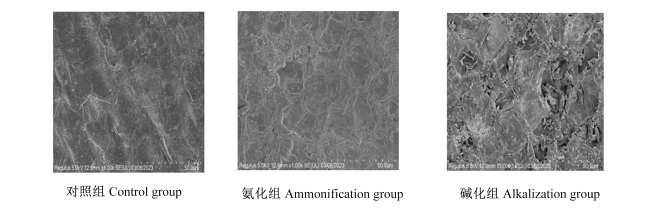
图1可知,对照组花棒呈现出了完整的纤维结构,其表面光滑、轮廓清晰、被蜡质成分紧密包裹、结构完整,同时纤维素结构之间紧密相连,这表明对照组花棒细胞壁纤维结构基本没有被破坏;氨化组和碱化组花棒细胞壁纤维结构形态己经被破坏,同时出现不同程度的塌陷、脱落和溶解等情况。处理方式不同,花棒纤维结构的破坏程度也不相同,破坏程度为碱化组>氨化组>对照组。
图1 不同化学处理对花棒超微结构的影响

Fig.1 Effects of different chemical treatments on ultrastructure of Hedysaru scoparium

2.2 不同化学处理对花棒营养成分含量的影响

表3可知,在干物质含量方面,氨化组显著低于对照组(P<0.05),碱化组显著高于对照组(P<0.05)。在粗蛋白质含量方面,氨化组显著高于对照组和碱化组(P<0.05)。在中性洗涤纤维含量方面,氨化组和碱化组均显著低于对照组(P<0.05)。在酸性洗涤纤维含量方面,碱化组显著低于氨化组和对照组(P<0.05)。在半纤维素、纤维素含量方面,碱化组显著低于对照组和氨化组(P<0.05)。在酸性洗涤木质素含量方面,各组间差异均不显著(P>0.05)。在还原糖产量方面,氨化组和碱化组均显著高于对照组(P<0.05)。在钙和粗灰分含量方面,碱化组显著高于对照组和氨化组(P<0.05)。
表3 不同化学处理对花棒营养成分含量的影响(风干基础)

Table 3 Effects of different chemical treatments on nutritional component contents of Hedysaru scoparium (air-dry basis) %

项目
Items
对照组
Control group
氨化组
Ammonification group
碱化组
Alkalization group
P
P-value
干物质DM/% 93.39±0.17b 92.37±0.23c 94.67±0.15a <0.001
粗蛋白质CP/% 6.19±0.18b 11.37±0.49a 5.76±0.12c <0.001
中性洗涤纤维NDF/% 70.88±1.54a 67.32±1.06b 58.43±1.62c <0.001
酸性洗涤纤维ADF/% 56.73±2.38a 56.04±0.87a 52.57±1.14b 0.001
纤维素CEL/% 36.89±1.37a 34.18±4.14ab 31.24±0.75c 0.006
半纤维素HCEL/% 14.56±2.10a 10.81±1.49b 5.81±1.58c <0.001
酸性洗涤木质素ADL/% 20.81±2.18 21.99±4.57 21.33±0.66 0.791
还原糖Reducing sugar/(mg/g) 108.48±2.15c 125.72±3.03b 155.29±4.53a <0.001
钙Ca/% 0.61±0.04b 0.63±0.05b 2.87±0.29a <0.001
粗灰分Ash/% 2.98±0.32b 3.16±0.06b 10.64±0.14a <0.001

同行数据肩标不同小写字母表示差异显著(P<0.05),相同或无字母表示差异不显著(P>0.05)。下表同。

In the same row, values with different small letter superscripts mean significant difference (P<0.05), while with the same or no letter superscripts mean no significant difference (P>0.05). The same as below.

2.3 不同化学处理对花棒酚类物质含量的影响

表4可知,在单宁含量方面,氨化组和碱化组显著低于对照组(P<0.05),且碱化组显著低于氨化组(P<0.05)。在原花青素、总酚含量方面,氨化组和碱化组显著低于对照组(P<0.05)。
表4 不同化学处理对花棒酚类物质含量的影响(风干基础)

Table 4 Effects of different chemical treatments on contents of phenols in Hedysaru scoparium (air-dry basis) mg/g

项目
Items
对照组
Control group
氨化组
Ammonification group
碱化组
Alkalization group
P
P-value
单宁Tannin 2.37±0.04a 1.81±0.18b 1.10±0.15c 0.006
原花青素OPC 1.00±0.18a 0.54±0.04b 0.42±0.11b 0.035
总酚TP 8.77±1.44a 4.39±0.88b 3.33±0.73b 0.028

2.4 不同化学处理对花棒体外瘤胃发酵参数的影响

表5可知,体外培养3、6、9、12 h时,各组间产气量差异不显著(P>0.05);体外培养24、36、48、72 h时,碱化组产气量显著高于对照组和氨化组(P<0.05)。体外培养72 h时,碱化组和氨化组发酵液pH与对照组差异均不显著(P>0.05);与对照组相比,碱化组发酵液中NH3-N浓度无显著变化(P>0.05),氨化组则显著升高(P<0.05);氨化组和碱化组发酵液中MCP浓度均显著高于对照组(P<0.05);碱化组发酵液中TVFA浓度显著高于对照组和氨化组(P<0.05)。
表5 不同化学处理对花棒体外瘤胃发酵参数的影响

Table 5 Effects of different chemical treatments on rumen fermentation parameters in vitro of Hedysaru scoparium

项目
Items
对照组
Control group
氨化组
Ammonification group
碱化组
Alkalization group
P
P-value
产气量GP/mL
3 h 3.70±1.30 3.67±0.98 3.33±0.75 0.798
6 h 8.20±1.64 8.33±0.52 7.83±1.60 0.802
9 h 9.80±2.05 9.33±0.52 9.67±1.03 0.826
12 h 11.80±1.64 12.17±0.98 13.17±1.47 0.258
24 h 17.10±1.52b 16.17±1.86b 19.17±2.06a 0.039
36 h 19.60±0.51b 18.67±1.86b 22.00±1.67a 0.013
48 h 22.60±1.95b 22.50±1.38b 27.20±1.30a <0.001
72 h 28.00±1.58b 27.00±1.09b 32.20±1.30a <0.001
pH 6.86±0.02 6.88±0.03 6.86±0.01 0.451
氨态氮NH3-N/(mg/dL) 12.23±0.85b 13.79±0.44a 11.27±0.38b 0.044
微生物蛋白MCP/(μg/mL) 2.69±0.29c 6.71±0.35a 4.06±0.44b <0.001
总挥发性脂肪酸TVFA/(mmol/L) 42.36±0.85b 43.72±1.73b 46.50±0.71a 0.028

3 讨论

3.1 不同化学处理对花棒超微结构的影响

在植物性饲料中,通常将难以被动物消化利用的部分称为纤维,纤维在一定程度上类似于植物的细胞壁[6]。苏小红等[7]对玉米秸秆黄贮预处理后,发现玉米秸秆表面结构变得粗糙、破损,说明表层腊质结构受到一定程度的破坏。Thulluri等[8]研究认为,尿素和石灰均可以溶解秸秆茎和叶片表面的少部分角质蜡硅层。贾柔等[9]用尿素和氯化铵为氮源复合化学处理稻草,发现稻草的纤维结构被破坏,内表面纤维暴露,外表面蜡质层被破坏。上述研究结果与本试验所得结果基本一致,由于花棒纤维化程度较高,对照组花棒细胞壁纤维结构基本没有被破坏,但氨化组和碱化组花棒细胞壁纤维结构形态己经被破坏,同时出现不同程度的塌陷、脱落和溶解等情况,这说明化学处理对灌木植物降解纤维有一定的作用。

3.2 不同化学处理对花棒营养成分含量的影响

化学处理是提高秸秆营养价值最有效的办法[10],其中氨化和碱化处理效果较好。吕芳璐等[11]研究发现,经过氨化处理的秸秆干物质含量下降的原因是氨源与秸秆中的成分发生了化学反应所致。本试验中,氨化组花棒干物质含量显著低于对照组,碱化组则显著高于对照组,氨化组粗蛋白质含量显著高于对照组,这一结果与Fadel Elseed[12]和Al-Shami[13]的试验结果一致。Kundu等[14]研究发现,碱化组小麦秸秆粗脂肪含量显著低于对照组与尿素组,与本试验结果基本一致。中性洗涤纤维和酸性洗涤纤维是秸秆细胞壁的主要组成成分,尿素与氢氧化钙的使用破坏了半纤维素和纤维素的结构,而半纤维素和纤维素是中性洗涤纤维和酸性洗涤纤维的主要成分,故导致花棒中的中性洗涤纤维和酸性洗涤纤维含量降低[15]。本试验中,氨化和碱化处理均显著降低了花棒中中性洗涤纤维的含量,这与Levy等[16]研究结果一致。
木质素是一种天然聚合物,是地球上最丰富的可再生芳烃资源[17]。木质素主要沉积在植物次生细胞壁中,在植物生长发育、保护植物免受生物和非生物胁迫等方面发挥着重要作用[18]。Louhaichi等[19]对国外4种牧草和8种灌木植物进行体外有机质消化率测定来评估其营养价值,研究发现灌木植物酸性洗涤木质素含量高于牧草。Ali等[20]用尿素和碳酸氢铵处理小麦秸秆,与对照组相比,尿素和碳酸氢铵处理显著降低了小麦秸秆纤维素和半纤维素的含量。Nguyen等[21]研究发现,用尿素和石灰处理稻草均可以降低稻草中纤维素的含量。上述研究结果与本试验结果基本一致,在半纤维素、纤维素含量方面,碱化组显著低于对照组和氨化组,这与文佐时[22]和Moura等[23]的试验结果也一致。在木质素含量方面,氨化组和碱化组与对照组相比差异均不显著,出现这一结果的原因可能是由于木质素的去除效率受到反应条件和样品种类的影响,通常而言,碱液预处理对木质素含量高的植物的作用效果较差[24]。李天沛等[25]研究发现,高粱秸秆经氨水低温冻融联合预处理后,还原糖得率提高了30.29%。樊世漾[26]在40 ℃用磷酸钠处理玉米秸秆,得到玉米秸秆酶水解的还原糖得率为90.9%。上述研究结果与本试验结果基本一致,氨化处理和碱化处理均显著提高了花棒酶解还原糖产量。在粗灰分和钙含量方面,碱化组显著高于对照组及氨化组,出现这一结果主要是因为氢氧化钙中钙含量的增加所致。

3.3 不同化学处理对花棒酚类物质含量的影响

灌木植物作为粗饲料营养价值较高,但这类饲料的利用存在一定的局限性,即含有单宁等抗营养因子[27],影响动物对养分的摄入及代谢过程,通过适当的加工调制可以降低单宁、生物碱等抗营养因子的含量[28]。王馨等[29]研究发现,用0.5%的石灰水处理香蕉茎叶青贮后单宁含量极显著降低。Ben Salem等[30]研究发现,用含2、3和4 g尿素/100 mL水的尿素溶液处理高粱籽粒,单宁含量降低了31%,总酚含量降低了46.7%。上述研究结果与本试验结果基本一致,本试验中氨化组和碱化组花棒中单宁、原花青素、总酚含量均显著低于对照组。王馨等[29]研究发现,0.5%的石灰水处理香蕉茎叶青贮后单宁含量降幅大于1%、2%的石灰水,这与本试验结果不符,这可能是由于产品及添加方式的不同所致,王馨等[29]添加的是石灰水的上清液,本试验使用是纯的氢氧化钙。

3.4 不同化学处理对花棒体外瘤胃发酵参数的影响

体外产气过程可大致模拟瘤胃消化情况,是反映瘤胃发酵程度的综合指标,是一种评估反刍动物饲用秸秆预处理效果的可行方法[31]。郭彦军等[32]利用体外产气法测定了2种含有缩合单宁牧草的48 h产气量,发现牧草中缩合单宁含量与产气量以及干物质消失均呈负相关。于满满等[33]研究发现,苜蓿和氨化秸秆组合体外发酵48 h时,20%苜蓿+80%氨化秸秆组的体外产气量显著高于对照组。本试验中,体外培养72 h时,碱化组产气量显著高于对照组和氨化组。徐晓锋等[34]通过体外产气法研究了不同处理玉米秸秆的产气量,结果发现发酵6、24 h时氨化组、碱化组产气量差异不显著,其余各发酵时间点碱化组产气量均显著高于氨化组。Shi等[35]用不同水平(0~7%)的氧化钙处理玉米秸秆,发现7%添加水平组的产气量最高。上述研究结果与本试验结果基本一致,说明碱化处理可提高花棒的产气量。
瘤胃液pH是反映瘤胃环境内部稳态的主要指标,并且能够反映饲粮发酵的程度和模式。因此,维持稳定的瘤胃液pH对于确保最佳的瘤胃生态、发酵和微生物生长至关重要[36]。Sumadong等[37]研究发现,新鲜木薯根中添加尿素、单质硫等厌氧发酵后均对体外发酵液pH无显著影响。刘培剑等[38]通过体外研究发现,不同厌氧碱化处理鲜麦秸对其体外发酵液pH无显著影响。上述研究结果与本试验结果基本一致,与对照组相比,碱化组和氨化组发酵液pH均无显著变化。
瘤胃液中的NH3-N是瘤胃氮代谢过程的重要产物,也是合成MCP的主要氮源,NH3-N浓度变化是衡量瘤胃微生物对饲粮中氮的利用和MCP合成是否平衡的重要指标[39]。MCP是反刍动物最主要的氮源,也是表征瘤胃微生物对底物中氮的利用效率的重要指标[40]。李大彪等[41]研究发现,聚乙二醇处理柠条能够提高体外发酵累积产气量,增加MCP的合成量。Cherdthong等[42]通过体外研究发现,在优质饲料中添加尿素-硫酸钙混合物可显著提高发酵液MCP浓度。Saminathan等[43]用1%~5%的尿素处理油棕叶并用山羊瘤胃液进行体外发酵,与对照组相比,尿素处理显著提高了发酵液NH3-N浓度。本试验中,体外培养72 h时,与对照组相比,氨化组发酵液NH3-N浓度显著升高,但碱化组无显著变化,这与刘培剑等[38]的研究结果一致;此外,与对照组相比,氨化组和碱化组发酵液MCP浓度均显著提高,且氨化组显著高于碱化组。
挥发性脂肪酸主要包括乙酸、丙酸、丁酸,是饲粮被瘤胃微生物降解的主要终产物,它们被瘤胃上皮吸收并为反刍动物提供70%~80%的能量[44]。Phesatcha等[45]在青贮饲料中补充糖蜜和尿素,通过体外研究发现补充糖蜜和尿素可以增加发酵液中TVFA和丙酸浓度,对乙酸、丁酸浓度和甲烷产量没有显著影响。肖敏敏等[46]研究发现,高粱单宁抑制碳水化合物在体外瘤胃中的发酵,降低了TVFA浓度。Foiklang等[47]用3%尿素处理水稻秸秆并补充葡萄渣粉,显著提高了发酵液中TVFA浓度。Ma等[48]研究发现,氨化处理有效地增加了水稻秸秆粗蛋白质含量,降低了中性洗涤纤维含量,并提高了发酵液中TVFA浓度。由于单宁抑制碳水化合物在体外瘤胃中的发酵,降低TVFA浓度,本试验中氨化组和碱化组花棒单宁含量较对照组显著降低;并且,在氨化或碱化处理下,电镜图显示其纤维结构均已被破坏,中性洗涤纤维含量显著降低,故被瘤胃微生物利用的可消化纤维含量增加,因此氨化组和碱化组发酵液中TVFA浓度高于对照组。

4 结论

本试验结果表明,氨化或碱化处理均可以破坏花棒的纤维结构及外表面蜡质层,降低中性洗涤纤维、酸性洗涤纤维、单宁、原花青素、总酚、半纤维素和纤维素的含量,提高花棒的营养价值,改善瘤胃的发酵状态。本试验条件下,碱化处理效果优于氨化处理。
[1]
王超, 金海, 李长青, 等. 内蒙古沙生灌木资源饲料化利用的生态和经济效应[J]. 畜牧与饲料科学, 2021, 42(1):78-82.

WANG C, JIN H, LI C Q, et al. Ecological and economic effects of forage utilization of desert shrub resources[J]. Animal Husbandry and Feed Science, 2021, 42(1):78-82. (in Chinese)

[2]
孟军萍, 宋志云, 张祯. 河西地区花棒林平茬复壮技术研究[J]. 现代农业科技, 2014(20):140-140,152.

MENG J P, SONG Z Y, ZHANG Z. Study on flat stubble rejuvenation technology of Huachuanlin in Hexi area[J]. Modern Agricultural Science and Technology, 2014(20):140-140,152. (in Chinese)

[3]
王涛, 司万童, 闫瑞强, 等. 花棒 (Hedysarum scoparium) 对雅鲁藏布江中游山坡流动沙地土壤理化性质的影响[J]. 生态与农村环境学报, 2020, 36(12):1619-1625.

WANG T, SI W T, YAN R Q, et al. The effects of Hedysarum scoparium restoration on physical and chemical properties of soil in hillside shifting sandy land in middle reaches of Yarlung Zangbo River,China[J]. Journal of Ecology and Rural Environment, 2020, 36(12):1619-1625. (in Chinese)

[4]
MENKE K H, STEINGASS H. Estimation of the energetic feed value obtained from chemical analysis and in vitro gas production using rumen fluid[J]. Animal Research and Development, 1988, 28:7-55.

[5]
VAN SOEST P J. Development of a comprehensive system of feed analyses and its application to forages[J]. Journal of Animal Science, 1967, 26(1):119-128.

DOI

[6]
高巍. 瘤胃微生物对植物细胞壁降解的相对贡献及其附着与降解的关系研究[D]. 博士学位论文. 北京: 中国农业大学, 2004.

GAO W. Relative contributions of rumen microorganisms to degradation of plant cell walls and the relationship between their adhesion and degradation[D]. Ph.D.Thesis. Beijing: China Agricultural University, 2004. (in Chinese)

[7]
苏小红, 王欣, 王玉鹏, 等. 亚硫酸氢盐预处理对黄贮玉米秸秆产甲烷潜力机理研究[J]. 中国沼气, 2022, 40(3):50-57.

SU X H, WANG X, WANG Y P, et al. Effect of bisulfite on methane production potential of dry corn straw with pretreatment by yellow silage[J]. China Biogas, 2022, 40(3):50-57. (in Chinese)

[8]
THULLURI C, GOLUGURI B R, KONAKALLA R, et al. The effect of assorted pretreatments on cellulose of selected vegetable waste and enzymatic hydrolysis[J]. Biomass and Bioenergy, 2013, 49:205-213.

DOI

[9]
贾柔, 周玉香, 吴爽, 等. 不同氮源复合化学处理稻草对其营养价值和滩羊尿液理化指标的影响[J]. 饲料研究, 2021, 44(9):1-6.

JIA R, ZHOU Y X, WU S, et al. Effect of compound chemical treatment of straw with different nitrogen sources on its nutritional value and physical and chemical index of urine of Tan sheep[J]. Feed Research, 2021, 44(9):1-6. (in Chinese)

[10]
徐芳, 降磊, 张元庆, 等. 不同厌氧处理方式对鲜麦秸品质、活体外瘤胃发酵及甲烷产量的影响[J]. 中国饲料, 2019(11):69-74.

XU F, JIANG L, ZHANG Y Q, et al. Effects of different anaerobic treatments of wheat straw on its quality,in vitro rumen fermentation and methane production[J]. China Feed, 2019(11):69-74. (in Chinese)

[11]
吕芳璐, 李想, 张明焕, 等. 压力对氨化秸秆反应前后营养成分变化的影响[J]. 黑龙江畜牧兽医, 2010(9):80-81.

LV F L, LI X, ZHANG M H, et al. Effects of stress on nutrient composition of ammoniated straw before and after reaction[J]. Heilongjiang Animal Science and Veterinary Medicine, 2010(9):80-81. (in Chinese)

[12]
FADEL ELSEED A N M A. Performance of sheep offered ammonia,or urea-calcium hydroxide treated rice straw as an only feed[J]. Animal Science Journal, 2004, 75(5):411-415.

DOI

[13]
AL-SHAMI S A. Effect of treating wheat straw with urea on its crude protein content[J]. Journal of Animal & Veterinary Advances, 2006, 5(5):440-442.

[14]
KUNDU S S, SHARMA D D. Influence of oxidizing and alkali treatments on wheat straw composition,in sacco degradability,feed intake and nutrient utilization in growing riverine buffaloes[J]. Buffalo Journal, 2003, 19(2):225-236.

[15]
刘凯玉, 张永根, 辛杭书, 等. 不同处理水稻秸秆营养成分及其瘤胃降解特性研究[J]. 中国畜牧杂志, 2014, 50(7):57-61,101.

LIU K Y, ZHANG Y G, XIN H S, et al. Studies on different processing rice straw nutrients and rumen degradability[J]. Chinese Journal of Animal Science, 2014, 50(7):57-61,101. (in Chinese)

[16]
LEVY D, HOLZER Z, FOLMAN Y. Chemical processing of wheat straw and cotton by-products for fattening cattle 3.Performance of animals receiving material in complete feeds[J]. Animal Production, 1980, 31(1):27-33.

[17]
WU Y H, HUANG Z C, LV K Q, et al. Producing methyl p-coumarate from herbaceous lignin via a “clip-off” strategy[J]. Journal of Agricultural and Food Chemistry, 2022, 70(18):5624-5633.

DOI

[18]
WEIDENER D, HOLTZ A, KLOSE H, et al. Lignin precipitation and fractionation from OrganoCat pulping to obtain lignin with different sizes and chemical composition[J]. Molecules, 2020, 25(15):3330.

DOI

[19]
LOUHAICHI M, GAMOUN M, HASSAN S, et al. Characterizing biomass yield and nutritional value of selected indigenous range species from arid Tunisia[J]. Plants, 2021, 10(10):2031.

DOI

[20]
ALI A, KHAN M F, AYAZ M. Feeding completely mixed rations based on untreated,urea or ammonium bicarbonate treated wheat straw to buffalo calves[J]. Pakistan Veterinary Journal, 2002, 22(3):131-136.

[21]
NGUYEN V T, WANAPAT M, KHEJORNSART P, et al. Nutrient digestibility and ruminal fermentation characteristic in swamp buffaloes fed on chemically treated rice straw and urea[J]. Tropical Animal Health and Production, 2012, 44(3):629-636.

DOI PMID

[22]
文佐时. 化学处理和生物处理对农作物秸秆降解特性的影响[D]. 硕士学位论文. 长沙: 湖南农业大学, 2017.

WEN Z S. Effects of chemical and biological treatments on the degradation of crop straw[D]. Master's Thesis. Changsha: Hunan Agricultural University, 2017. (in Chinese)

[23]
MOURA L M L, DA SILVA PEREIRA F D, DE LIMA P R, et al. Sodium hydroxide or urea pretreatment of acerola (Malpighia emarginata) fruit residue increases dry matter degradability and reduces methane production in in vitro rumen fermentation[J]. Tropical Animal Health and Production, 2020, 52(5):2433-2441.

DOI PMID

[24]
DE CARVALHO D M, SEVASTYANOVA O, DE QUEIROZ J H, et al. Cold alkaline extraction as a pretreatment for bioethanol production from eucalyptus,sugarcane bagasse and sugarcane straw[J]. Energy Conversion and Management, 2016, 124:315-324.

DOI

[25]
李天沛, 丁为民, 熊佳定, 等. 氨水低温冻融联合预处理对高粱秸秆酶解产糖的影响[J]. 华南农业大学学报, 2020, 41(4):104-110.

LI T P, DING W M, XIONG J D, et al. Effect of pretreatment using ammonia water combined with freezing and thawing on enzymatic hydrolysis and sugar production of sorghum straw[J]. Journal of South China Agricultural University, 2020, 41(4):104-110. (in Chinese)

[26]
樊世漾. 水热预处理及酸/碱-水热预处理对玉米秸秆酶解产糖及厌氧发酵的影响[D]. 硕士学位论文. 北京: 北京林业大学, 2016.

FAN S Y. Effects of hydrothermal and acid/alkali-hydrothermal pretreatment on hydrolysis and anaerobic digestion of corn[D]. Master's Thesis. Beijing: Beijing Forestry University, 2016. (in Chinese)

[27]
薛树媛. 灌木类植物单宁对绵羊瘤胃发酵影响及其对瘤胃微生物区系、免疫和生产指标影响的研究[D]. 博士学位论文. 呼和浩特: 内蒙古农业大学, 2011.

XUE S Y. The effect of shrub tannin on rumen fermentation and rumen microflora,immunity and production performance in sheep[D]. Ph.D.Thesis. Hohhot: Inner Mongolia Agricultural University, 2011. (in Chinese)

[28]
武海雯, 陈军华, 吴亚琦, 等. 我国盐生饲料植物资源与营养价值分析[J]. 中国饲料, 2022(19):104-115.

WU H W, CHEN J H, WU Y Q, et al. Review of plant resources and nutritional value of fodder halophytes in China[J]. China Feed, 2022(19):104-115. (in Chinese)

[29]
王馨, 高月娥, 刘建勇, 等. 物理与化学处理对香蕉茎叶单宁含量的影响[J]. 养殖与饲料, 2016(6):9-12.

WANG X, GAO Y E, LIU J Y, et al. Effects of physical and chemical treatments on tannin content of banana stem and leaf[J]. Animals Breeding and Feed, 2016(6):9-12. (in Chinese)

[30]
BEN SALEM H, SAGHROUNI L, NEFZAOUI A. Attempts to deactivate tannins in fodder shrubs with physical and chemical treatments[J]. Animal Feed Science and Technology, 2005, 122(1/2):109-121.

DOI

[31]
肖雷, 顿耀豪, 杨曼, 等. 新型体外产气法 (非瘤胃液) 的建立及对两种预处理玉米秸秆饲用价值的评估[J]. 饲料工业, 2022, 43(10):34-40.

XIAO L, DUN Y H, YANG M, et al. Establishment of a novel in vitro gas production method (non-rumen fluid) and the evaluation of the feeding value of two pretreated corn straw[J]. Feed Industry, 2022, 43(10):34-40. (in Chinese)

[32]
郭彦军, 龙瑞军, 张德罡, 等. 利用体外产气法测定高山牧草和灌木的干物质降解率[J]. 草业学报, 2003, 12(2):54-60.

GUO Y J, LONG R J, ZHANG D G, et al. Determination of dry matter degradation of feeding shrubs and forages by gas production method[J]. Acta Prataculturae Sinica, 2003, 12(2):54-60. (in Chinese)

[33]
于满满, 姜雨轩, 张美美, 等. 利用体外产气法评定不同比例氨化秸秆替代苜蓿的组合效应[J]. 中国畜牧兽医, 2017, 44(12):3497-3504.

DOI

YU M M, JIANG Y X, ZHANG M M, et al. Evaluation of associative effects of alfalfa meal and ammoniated corn straw by gas production technique in vitro[J]. China Animal Husbandry & Veterinary Medicine, 2017, 44(12):3497-3504. (in Chinese)

[34]
徐晓锋, 张力莉. 体外产气法研究不同处理对玉米秸秆营养价值的影响[J]. 饲料研究, 2015(20):1-4.

XU X F, ZHANG L L. Effects of different treatments on nutritional value of corn straw by in vitro gas production[J]. Feed Research, 2015(20):1-4. (in Chinese)

[35]
SHI M J, MA Z X, TIAN Y J, et al. Effects of maize straw treated with various levels of CaO and moisture on composition,structure,and digestion by in vitro gas production[J]. Animal Bioscience, 2021, 34(12):1940-1950.

DOI

[36]
PHESATCHA K, PHESATCHA B, WANAPAT M, et al. Roughage to concentrate ratio and Saccharomyces cerevisiae inclusion could modulate feed digestion and in vitro ruminal fermentation[J]. Veterinary Sciences, 2020, 7(4):151.

DOI

[37]
SUMADONG P, CHERDTHONG A, SO S, et al. Sulfur,fresh cassava root and urea independently enhanced gas production,ruminal characteristics and in vitro degradability[J]. BMC Veterinary Research, 2021, 17(1):304.

DOI

[38]
刘培剑, 曹玉芳, 朱风华, 等. 不同厌氧碱化处理对鲜麦秸营养成分、超微结构和体外发酵参数的影响[J]. 动物营养学报, 2018, 30(8):3229-3238.

LIU P J, CAO Y F, ZHU F H, et al. Effects of different anaerobic alkalization treatments on nutrients,ultrastructure and in vitro fermentation parameters of fresh wheat straw[J]. Chinese Journal of Animal Nutrition, 2018, 30(8):3229-3238. (in Chinese)

[39]
徐振松, 瞿明仁, 宋小珍, 等. 体外法研究不同水平苍术精油对肉牛瘤胃发酵和养分降解率的影响[J]. 中国饲料, 2013(15):10-13.

XU Z S, QU M R, SONG X Z, et al. Effects of different levels of Atractylodes essential oil on rumen fermentation and nutrient degradation rates of beef cattle by in vitro method[J]. China Feed, 2013(15):10-13. (in Chinese)

[40]
陈小连, 贾亚红, 赵国琦. 影响反刍动物瘤胃微生物生长效率及蛋白产量的因素[J]. 中国饲料, 2003(17):4-7.

CHEN X L, JIA Y H, ZHAO G Q. The influential factors of the growth efficiency and protein production of rumen microorganism in ruminant[J]. China Feed, 2003(17):4-7. (in Chinese)

[41]
李大彪, 张梅梅, 塔娜, 等. 聚乙二醇对柠条体外发酵特性及干物质降解率的影响[J]. 内蒙古农业大学学报(自然科学版), 2014, 35(3):7-12.

LI D B, ZHANG M M, TA N, et al. Effect of polyethylene glycol on fermentation and dry matter degradation of Caragana in vitro[J]. Journal of Inner Mongolia Agricultural University (Natural Science Edition), 2014, 35(3):7-12. (in Chinese)

[42]
CHERDTHONG A, WANAPAT M. In vitro gas production in rumen fluid of buffalo as affected by urea-calcium mixture in high-quality feed block[J]. Animal Science Journal, 2014, 85(4):420-426.

DOI

[43]
SAMINATHAN M, WAN MOHAMED W N, MD NOH ’A, et al. Effects of urea-treated oil palm frond on nutrient composition and in vitro rumen fermentation using goat rumen fluid[J]. Journal of Animal Physiology and Animal Nutrition, 2022, 106(6):1228-1237.

DOI

[44]
BERGMAN E N. Glucose metabolism in ruminants as related to hypoglycemia and ketosis[J]. Cornell Veterinarian, 1973, 63(3):341-382.

[45]
PHESATCHA K, WANAPAT M. Improvement of nutritive value and in vitro ruminal fermentation of Leucaena silage by molasses and urea supplementation[J]. Asian-Australasian Journal of Animal Sciences, 2016, 29(8):1136-1144.

DOI

[46]
肖敏敏, 解彪, 杨潇, 等. 高粱单宁提取物与聚乙二醇对体外瘤胃发酵参数及营养物质消化率的影响[J]. 动物营养学报, 2021, 33(3):1576-1583.

DOI

XIAO M M, XIE B, YANG X, et al. Effects of sorghum tannin extract and polyethylene glycol on in vitro rumen fermentation parameters and nutrient digestibilities[J]. Chinese Journal of Animal Nutrition, 2021, 33(3):1576-1583. (in Chinese)

[47]
FOIKLANG S, WANAPAT M, NORRAPOKE T. In vitro rumen fermentation and digestibility of buffaloes as influenced by grape pomace powder and urea treated rice straw supplementation[J]. Animal Science Journal, 2016, 87(3):370-377.

DOI

[48]
MA Y L, CHEN X, ZAHOOR KHAN M, et al. The impact of ammoniation treatment on the chemical composition and in vitro digestibility of rice straw in Chinese Holsteins[J]. Animals, 2020, 10(10):1854.

DOI

Outlines

/