REVIEW

Effects of Particulate Matter on Gut-Lung Axis in Animals and Mitigation Strategies

  • ZHOU Ying ,
  • LI Shaoyu , *
Expand
  • Institute of Animal Science, Henan Academy of Agricultural Sciences, Zhengzhou 450002, China
* professor, E-mail:

Received date: 2023-06-13

  Online published: 2023-12-11

Abstract

Particulate matter (PM) in livestock and poultry houses severely damages the respiratory system of animals and workers, and the smaller the particle size, the greater the harm. Particulate matter damages the lung tissue structure, induces lung inflammation and damage, and changes the composition of lung microbiota. In addition, particulate matter can also lead to gut microbiota disorder, increase intestinal permeability, resulting in gut microbiota to shift easily or gut derived metabolites affecting the development of lung injury through the gut-lung axis. Reducing the harm of particulate matter in livestock and poultry houses can be achieved through installing filtration systems, ventilation and air ionization, as well as feed processing and adding green additives. This article mainly reviews the impact of particulate matter on the gut-lung axis of animals, and explores the mitigation strategies of particulate matter on animal health such as physical methods, feed processing and nutritional regulation methods, in order to find effective measures to alleviate the impact of particulate matter on animal health.

Cite this article

ZHOU Ying , LI Shaoyu . Effects of Particulate Matter on Gut-Lung Axis in Animals and Mitigation Strategies[J]. Chinese Journal of Animal Nutrition, 2023 , 35(12) : 7530 -7540 . DOI: 10.12418/CJAN2023.683

颗粒物(particulate matter,PM)严重危害动物和人的健康,特别是细颗粒物(PM2.5,空气动力学直径≤2.5 μm)。现代化集约化畜牧业的发展进一步加剧颗粒物的污染,并增加了动物和农场工人的健康负担[1]。据报道,畜禽产生的可吸入颗粒物(PM10,空气动力学直径≤10 μm)和PM2.5分别占大气中PM10和PM2.5的8%和4%。集约型家禽饲养系统约占农业颗粒物总排放量的50%[2]。研究报告称,颗粒物暴露与肺部疾病的发生之间存在很强的相关性[3-4];来自欧洲的研究发现,农业工人和居住在农场附近的居民患肺炎[5]、慢性阻塞性肺病[6]和哮喘[7]等呼吸道疾病的风险更高。畜禽舍内高浓度的颗粒物也会降低动物的免疫性能和体重[8-9],增加肉鸡的呼吸道疾病和死亡率[10],从而造成经济损失。然而,迄今为止,缺乏有效的方法来治疗此类疾病。近年来,肠道微生物组因其与呼吸道疾病密切相关而备受关注,称之为肠-肺轴[11]。因此,本文主要综述颗粒物对动物肠-肺轴的影响,并从物理方法、饲料加工和营养调控方法等方面阐述颗粒物对动物健康影响的缓解策略,以期寻找有效的解决颗粒物对动物和人类危害的措施。

1 畜禽舍颗粒物的产生来源及含量

颗粒物不是单一的污染物,而是多种污染物的混合物。美国环境保护局(environmental protection agency,EPA)将颗粒物一词定义为具有不同物理、化学和生物特性的悬浮颗粒的复杂混合物,这些特性决定了其行为以及对环境和健康的影响[12]。颗粒物是由固体微粒或液滴悬浮在气相介质中形成的多项混合物,也称为气溶胶。颗粒物的空气动力学直径一般在0~100 μm,称之为总可悬浮颗粒物(total suspended particulates,TSP);其中,直径在10 μm以下称为PM10,直径在2.5 μm以下称为PM2.5
畜禽舍中的饲料微颗粒、动物粪便和毛皮、垫料、微生物等是畜禽舍中颗粒物的主要来源[1]。在禽舍中,颗粒物的主要来源是家禽羽毛、尿液中的矿物晶体和废料[13]。此外,与无垫料饲养的家禽相比,在有垫料饲养的禽舍中,垫料是颗粒物重要的来源之一[14]。在猪舍中,颗粒物主要来源于粪尿、饲料、垫料、皮屑、毛发和脱落的上皮细胞等[15]
由于颗粒物的特性,畜禽舍内颗粒物来源多且复杂,粉碎的饲料颗粒、动物皮屑、粪便颗粒构成了颗粒物的初级结构,这些初级结构会吸附大量的病原微生物和有害气体,形成成分复杂的生物复合体。Ni等[16]研究发现,高层鸡舍和有粪带的蛋鸡舍内颗粒物浓度在0.42~0.76 mg/m3。Shen等[17-18]研究发现,蛋种鸡舍、保育猪舍、育肥猪舍内TSP浓度分别为0.24、0.64和0.78 mg/m3,且蛋种鸡舍、保育猪舍、育肥猪舍中PM2.5分别占TSP的29.17%、32.81%和17.95%,PM10分别占TSP的54.17%、60.94%和43.59%。黄凯等[19]研究发现,母猪舍和保育舍内颗粒物会附着大量的细菌,且母猪舍内细菌数量更高。表1概述了配备机械通风系统的猪舍和禽舍中空气污染物及其浓度范围[20]
表1 猪舍和禽舍中空气污染物及其浓度范围

Table 1 Air pollutants and their concentration range in pig and poultry houses

项目Items 猪舍Pig house 禽舍Poultry house
总可悬浮颗粒物TSP 220~8 500 μg/m3 0.168~9.610 mg/m3
可吸入颗粒物PM10 110~4 960 μg/m3 0~4 290 μg/m3
细颗粒物PM2.5 70~240 μg/m3 40~2 530 μg/m3
总细菌Total bacteria 1.74×10~2.34×10⁸ CFU/m3 1 670~44 840 CFU/m3
总真菌Total fungi 8.13~7.59×10⁴ CFU/m3 236~4 735 CFU/m3
总挥发性有机化合物Total VOC 35~1 000 μg/m3
根据与颗粒物相关的危害,我国《畜禽场环境质量标准》(NT/T 388—1999)将鸡舍的TSP和PM10浓度分别限制在不超过8和4 mg/m3。综上可知,畜禽舍中颗粒物的浓度比较高,且有些畜禽舍中颗粒物的浓度甚至超出国家标准。

2 颗粒物对动物呼吸道和肠道的影响

2.1 颗粒物对动物呼吸道的影响

颗粒物诱发动物呼吸道黏膜结构损伤及炎症反应。颗粒物对呼吸道的危害主要与肺部炎症相关。研究发现,从肉鸡舍收集的颗粒物暴露1周能显著降低肉鸡平均日增重,增加肺部炎症因子水平,导致肉鸡明显的肺脏损伤。基于多组学分析,肉鸡肺部的菌群和代谢紊乱,且这二者存在显著的相互作用[21]。另外,体外试验研究也发现,鸡舍中的颗粒物能够显著增加肺泡上皮细胞内活性氧含量以及细胞焦亡相关基因[核苷酸结合寡聚化结构域样受体蛋白3(nucleotide-binding oligomerization domain-like receptor protein 3,NLRP3)、白细胞介素-18(interleukin-18,IL-18)、白细胞介素-1β(interleukin-1β,IL-1β)]和坏死相关基因[受体相互作用丝氨酸苏氨酸激酶3(receptor interacting serine threonine kinase 3,RIPK3)]的表达水平[22]。在模式动物小鼠上的研究表明,PM2.5暴露会引起肺部菌群的变化和代谢图谱的变化[23]、支气管上皮细胞外体miRNA表达的变化[24]以及支气管肺泡灌洗液细胞、嗜酸性粒细胞、巨噬细胞数量的变化,进而导致肺部损伤[25]、肺部菌群紊乱;且这些紊乱与机体代谢异常相关[26],降低肺脏功能并通过磷脂酰肌醇3-激酶(phosphatidylinositol 3-kinase,PI3K)/蛋白激酶B(protein kinase B,Akt)/哺乳动物雷帕霉素靶蛋白(mammalian target of rapamycin,mTOR)信号通路,诱导小鼠支气管上皮细胞自噬介导的细胞凋亡[27];通过靶向Notch1下调miRNA-139-5p,并在细支气管上皮细胞中诱导上皮间质转化[28];活化巨噬细胞可上调肺癌血管生成细胞因子的表达而增强肺癌的发生[29]和肺部上皮细胞坏死性凋亡[22]。颗粒物能够破坏肺部组织结构,诱导肺部炎症,进一步扰乱肺部代谢。
颗粒物对动物呼吸道健康的危害程度与颗粒物的粒径有关。颗粒物主要通过直接刺激呼吸道、降低呼吸道免疫力、感染呼吸道(携带的病原体)3种方式影响动物机体呼吸道健康[30]。颗粒物对呼吸道的危害取决于其粒径大小[31]。Corbanie等[32]研究发现,颗粒物粒径大小与其在呼吸道内的沉积量成反比,PM10可以到达4周龄鸡的下呼吸道,可入肺颗粒物(PM1,空气动力学直径≤1 μm)在鸡肺脏中的沉积量是PM10的5.67倍。Michiels等[33]研究发现,育肥猪肺炎和胸膜炎的发病率与猪舍内PM10浓度成正比。颗粒物粒径越小,沉积量越多,对动物的危害越大。
颗粒物影响动物呼吸道健康可能与改变呼吸道微生物组成有关。随着微生物分析技术手段的突破,以前被认为是无菌的肺部其实拥有丰富的微生物[34]。在健康状态下,肺部菌群是动态平衡的[35];在疾病情况下,肺部菌群发生变化[36],并可预测肺部疾病[37]。肺纤维化、哮喘、慢性阻塞性肺病和其他慢性呼吸道疾病伴随着与疾病表型相关的肺部菌群的特征性变化[38]。先前发表的研究报告称,大气中的PM2.5会导致人类[39]、小鼠[23]和大鼠[40]的肺部微生物紊乱。在肉鸡上的研究发现,与之前的研究报道一致,颗粒物改变肺部菌群,增加肺部菌群的α多样性;另外,在属水平上,颗粒物暴露组的肺部菌群由比对照组更多的潜在致病菌组成,如幽门螺杆菌、肠杆菌、绿脓杆菌[21]
以上研究发现,PM2.5诱导的肺脏损伤机制可能更多的是探究肺脏组织的变化情况,但是像现在的喷雾疗法、滴鼻等,只是暂时缓解呼吸系统不适症状,达不到根本的治疗目的。随着肠道菌群的研究深入,越来越多的研究表明肠道菌群在机体的许多病理生理过程中均发挥作用,特别是肠-肺轴的提出,肠道菌群可能通过肠-肺轴影响肺脏损伤的发展。

2.2 颗粒物对动物肠道的影响

肠道微生物组是一个复杂的群落,由来自不同细菌、真菌、原生生物、古生菌和病毒的微生物组成。数十年的研究揭示了肠道微生物组在生理过程中的重要性,包括最初在调节营养和新陈代谢[41]以及最近在呼吸、胃肠道和神经系统疾病的发病机制中[42-46]。这些研究表明,肠道微生物组的扰动会对疾病进程和结果产生急性和慢性影响。因此,维持肠道菌群的稳态平衡对人类健康至关重要。
颗粒物诱发动物消化道黏膜结构损伤及炎症反应。摄入颗粒物后,小肠通透性增加,并伴有炎症反应。尿液中乳果糖和/或甘露醇排泄的分析显示,与对照组相比,颗粒物增加了渗透性[47]。Mutlu等[48]研究表明,颗粒物引起的上皮屏障降低与上皮紧密连接蛋白的重排有关。进一步研究发现,颗粒物质诱导的屏障破坏与上皮细胞产生的自由基氧有关。这些观察结果表明,颗粒物直接或间接地增加肠道通透性。因此,暴露于空气中的颗粒物可能通过上皮屏障的破坏在导致胃肠道疾病中发挥致病作用。在白细胞介素-10(interleukin-10,IL-10) -/-小鼠中,摄入颗粒物增加了肠道通透性,加剧了结肠炎症[49]。此外,几项研究表明,免疫细胞在体外暴露于颗粒物会导致促炎细胞因子分泌增加,部分原因是氧化应激水平增加和髓样分化因子88(myeloid differentiation protein 88,MyD88)的激活[50-51]。另外,由于微生物产物从肠道无限制地流入系统循环,颗粒物诱导的肠道通透性增加引起肠道炎症和系统炎症增加。
颗粒物影响动物消化道健康可能与改变微生物组成有关。研究发现,颗粒物能够改变小鼠肠道菌群的组成和功能[49]。具体来说,柴油PM2.5[柴油PM2.5是从专门为柴油动力叉车设计的过滤系统中收集的,主要由4种非金属元素和36种多环芳烃(PAHs)组成,其中7种为硝基PAHs同源物,氟烷占多环芳烃的大部分,其次是菲和萘]能够显著改变无特定病原体(specific pathogen free,SPF)小鼠肠道菌群的结构和组成,如在门水平上,降低拟杆菌门的丰度,在属水平上,显著增加大肠杆菌、副杆菌属、阿克曼氏菌和颤螺菌属的丰度[52]。也有研究发现,PM2.5暴露显著增加小鼠小肠、结肠和粪便的α多样性,并且这种变化似乎在粪便中最为明显[53]。另外也有研究表明,PM2.5暴露显著增加大鼠肠道菌群的丰富度和多样性,且在属水平上,普雷沃氏菌属的丰度升高而拟杆菌属的丰度降低,进一步分析发现PM2.5暴露组富含幽门螺杆菌、脱硫弧菌和毛螺菌科_G-2,这些菌分别属于变形菌门和厚壁菌门[54]。但是也有研究发现,PM2.5显著降低小鼠和大鼠粪便中细菌的丰富度(Chao指数)[26,55-56],厚壁菌门的丰度降低而拟杆菌门的丰度增加[26]。研究表明,口服PM10、超细颗粒物(PM0.1,空气动力学直径≤0.1 μm)或环境PM2.5中存在的化学物质足以改变小鼠肠道菌群[57-58]。另外,IL-10-/-小鼠吸入PM10后显示出拟杆菌门、厚壁菌门和疣菌门的丰度发生了显著变化,且微生物丰度的这些变化与短链脂肪酸丁酸盐的含量减少有关[49],而丁酸是结肠细胞和黏膜免疫细胞的必需脂肪酸,丁酸的消耗通常与屏障功能的降低和对黏膜炎症的易感性增加有关[59]。颗粒物诱导的微生物组成变化的机制仍有待研究;然而,综合来看,这些结果表明,颗粒物可以显著改变肠道微生物组成和代谢过程。这些改变不仅会对肠道中的消化过程产生不利影响,还会对肠黏膜的结构和功能产生不利影响。

2.3 颗粒物可能通过肠-肺轴影响呼吸道健康

综上可知,颗粒物诱导肠道菌群紊乱,改变肠道菌群组成;进一步发现颗粒物可以诱导肠道中某些特定菌属(变形菌门)的变化,如显著增加肠道中变形菌门的丰度(如大肠杆菌、普雷沃氏菌属等);另外,颗粒物也可以增加肠道通透性,导致肠道菌群移位或肠源性代谢产物进入系统循环中,进而可能通过肠-肺轴到达肺部,影响肺脏损伤的发展,而这些菌属的变化与肺脏损伤的关系仍需进一步的研究。
近年来,肠道微生物组因其与各种疾病密切相关而备受关注,包括被称为肠-肺轴的呼吸道疾病[60-61]。肠道微生物衍生的代谢产物可以远端减弱屋内颗粒物诱导的过敏性气道反应[62]。调控肠道菌群,如粪便菌群移植、蠕虫治疗、确定的微生物群落和具有抗炎特性的纯化代谢产物,可能用于对抗呼吸道疾病[61]。此外,植物来源的多糖可以被微生物发酵成代谢产物,如短链脂肪酸(short chain fatty acids,SCFAs),以减少卵清蛋白诱导的过敏性气道炎症反应[63]。对于颗粒物诱导的肺部炎症,吸入暴露和气管内滴注颗粒物都改变了小鼠整个胃肠道和粪便菌群[52-53]。此外,研究发现,红茶能够通过肠-肺轴减轻颗粒物诱导的小鼠肺脏损伤[64],这可能是由于红茶的提取物能够重塑肠道菌群,并且菌群移植进一步证明红茶对肺部的保护作用是由肠道微生物介导的。综上可知,植物提取物可能通过重塑肠道菌群缓解颗粒物诱导的肺脏损伤,这也为我们缓解颗粒物诱导的呼吸道损伤提供一种策略,但是肠道菌群通过肠-肺轴缓解颗粒物诱导的肺脏损伤的具体途径仍需进一步研究。

3 减少畜禽舍内颗粒物的控制策略

3.1 物理方法

3.1.1 安装过滤系统

为了限制禽流感和其他病原体的空气传播,入口空气过滤系统已被用于减少家禽和牲畜饲养中的颗粒物(病原体的载体)[65],为防止空气传播微生物提供了一种有效的方法。这些是减少房屋之间空气传播疾病风险的主要措施[66]
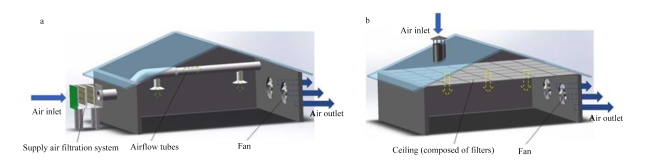
用于机械通风畜禽饲养场的进气净化措施主要包括供气过滤系统(supply air filtration system,SAFS)和天花板空气过滤系统(ceiling air filtration system,CAFS)。SAFS由过滤器和气流管组成(图1-a)。过滤器安装在侧墙上,通过空气流管将过滤后的空气送入室内。过滤器由挡风玻璃、预过滤器、二级过滤器和绝热冷却装置组成[20]。每个房子都可以配备多个SAFS。CAFS安装在畜禽养殖场的阁楼上,天花板由粗过滤器或亚高效过滤器组成(图1-b)。新鲜空气通过烟囱进气口供应给房子。此外,可以安装蒸发冷却垫来降低进气温度,也可以作为湿式洗涤器来减少夏季进气污染物的数量[66]
图1 供气过滤系统(a)和天花板空气过滤系统(b)

Air inlet:进气口;Supply air filtration system:供气过滤系统;Airflow tubes:空气导管;Fan:风扇;Air outlet:排风口;Ceiling (composed of filters):天花板(由过滤器组成)。

Fig.1 Supply air filtration system (a) and ceiling air filtration system (b)[20]

3.1.2 通风

通风不仅具有降低需氧微生物和氨气浓度的作用,还是一种传统的降尘方式,其主要通过增加舍内通风换气以达到除尘的目的。
黄藏宇[67]研究发现,新风系统可以降低封闭猪舍内60%以上的颗粒物(如PM1、PM2.5、PM10、TSP)浓度;Kwon等[68]研究发现,相比于温度、密度、活动水平,通风是影响TSP和PM10浓度的最主要因素;汪开英等[69]研究也发现,通风速率与TSP、PM10、PM2.5浓度成反比,且对PM2.5浓度影响最大。因此,通过调节通风可以有效降低舍内颗粒物浓度。
尽管通风效率与畜舍内微生物气溶胶含量成反比,但寒冷的冬季过度通风会造成温度下降过多,进而影响动物健康和生长性能[70]

3.1.3 空气电离技术

空气电离技术主要使颗粒物带电,带电后的颗粒物在高压电场的作用下向同一个方向聚集,进而达到颗粒物减排的目的[71];利用电离等离子技术产生的空气离子试验发现其可以有效地降低猪舍内PM2.5和PM1浓度[72]。Cambra-Lopez等[73]研究也发现,静电除尘可以有效减少鸡舍颗粒物浓度。
静电空间电荷系统(electrostatic space charge system,ESCS)被广泛应用于猪舍和鸡舍中用于去除颗粒物。刘滨疆等[74]采用ESCS对仔猪保育舍与笼养蛋鸡舍进行影响评估,结果表明,ESCS能去除70%~94%的粉尘与50%~93%的微生物。而在大型密闭鸡舍中,ESCS能减少肉鸡舍内43%的灰尘[75],且净化效率与ESCS功率密切相关[76],也可以使蛋鸡舍内粉尘的浓度降低35.9%[77]。张开臣等[71]研究发现,ESCS可以去除平养肉鸡舍内97.8%的粉尘和90%的微生物。焦洪超等[78]研究发现,ESCS释放的负离子对粒径大于0.5 μm的粉尘有显著的清除效果。李永明等[79]在保育猪舍内安装ESCS也得到了相似的结果;王树华等[80]在猪舍天花板安装ESCS(3DDF-450型号)发现,其可以降低猪舍内72.59%的TSP浓度;吴新[81]也发现ESCS可以去除猪舍内70%的粉尘。

3.2 饲料加工和营养调控方法

3.2.1 饲料加工控制

程京甫等[82]指出,饲料是畜禽舍内颗粒物的主要来源之一。研究普遍认为,饲料能影响舍内的颗粒物浓度,而使用颗粒饲料、饲料添加剂与饲料涂层都能降低颗粒物浓度[83]。张庆振等[84]研究发现,用10%菌肽蛋白替代8%豆粕可使保育猪舍内PM10和PM2.5浓度降低20.34%和8.09%。吴胜等[85]研究发现,植物精油可以降低断奶仔猪舍内微生物气溶胶浓度,且降低程度与植物精油的添加量成正比。另有研究表明,在饲料中加入水或者油脂会降低畜禽舍内粉尘的含量[86],改进饲喂设备也能起到降低舍内粉尘含量的作用[87]

3.2.2 绿色添加剂(改善环境空气质量)

马彦博等[88]在21日龄肉仔鸡饲粮中添加250 mg/kg的丝兰属植物提取物,结果表明舍内氨气浓度降低了74.9%。另有试验表明,丝兰、一串红、桂花、樟科植物提取物均可以减低鸡舍内氨气浓度[89]。喻洋等[90]通过试验证明,在仔猪饲粮中添加腐殖酸能有效降低粪样脲酶活性,降低氨气挥发。饲粮添加新鲜发酵豆粕不仅提高了仔猪的生长性能,而且降低了猪舍内氮转化引起的氨气浓度,降低了猪圈内PM10和PM2.5浓度[91]
综上可知,植物提取物可以有效降低畜舍中氨气的排放,从而改善环境空气质量,进而减轻颗粒物的危害。

4 小 结

畜禽舍内颗粒物严重损害动物和工作人员的呼吸系统,破坏肺部组织结构,诱导肺部炎症损伤,改变肺部菌群组成;并且还会导致肠道菌群紊乱,增加肠道通透性,造成肠道菌群容易移位或肠源性代谢产物通过肠-肺轴影响肺损伤的发展。可以通过安装过滤系统、通风、空气电离等物理方法或通过饲料加工控制和添加绿色添加剂的营养调控方法,降低畜禽舍中颗粒物的危害。未来应重点研究解决颗粒物诱导的肠道菌群的核心菌属变化与呼吸道损伤发展的关系,这有助于我们针对性的研发和选取绿色添加剂替代抗生素来缓解畜禽呼吸道损伤的发展。
[1]
CAMBRA-LÓPEZ M, AARNINK A J A, ZHAO Y, et al. Airborne particulate matter from livestock production systems:a review of an air pollution problem[J]. Environmental Pollution, 2010, 158(1):1-17.

DOI

[2]
European Environment Agency. Emep/CORINAIR emission inventory guidebook[EB/OL].(2007-12-06)[2023-06-01]. https://www.eea.europa.eu/publications/EMEPCORINAIR5.

[3]
FASOLA S, MAIO S, BALDACCI S, et al. Effects of particulate matter on the incidence of respiratory diseases in the Pisan longitudinal study[J]. International Journal of Environmental Research and Public Health, 2020, 17(7):2540.

DOI

[4]
ZHANG Z Y, CHAI P F, WANG J B, et al. Association of particulate matter air pollution and hospital visits for respiratory diseases:a time-series study from China[J]. Environmental Science and Pollution Research International, 2019, 26(12):12280-12287.

DOI

[5]
HEDELIN A S, SUNDBLAD B M, SAHLANDER K, et al. Comparing human respiratory adverse effects after acute exposure to particulate matter in conventional and particle-reduced swine building environments[J]. Occupational and Environmental Medicine, 2016, 73(10):648-655.

DOI PMID

[6]
AUDI C, BAÏZ N, MAESANO C N, et al. Serum cytokine levels related to exposure to volatile organic compounds and PM2.5 in dwellings and workplaces in French farmers-a mechanism to explain nonsmoking COPD[J]. International Journal of Chronic Obstructive Pulmonary Disease, 2017, 12:1363-1374.

DOI

[7]
VIEGAS S, MATEUS V, ALMEIDA-SILVA M, et al. Occupational exposure to particulate matter and respiratory symptoms in portuguese swine barn workers[J]. Journal of Toxicology and Environmental Health,Part A, 2013, 76(17):1007-1014.

DOI

[8]
LAI H T L, NIEUWLAND M G B, AARNINK A J A, et al. Effects of 2 size classes of intratracheally administered airborne dust particles on primary and secondary specific antibody responses and body weight gain of broilers:a pilot study on the effects of naturally occurring dust[J]. Poultry Science, 2012, 91(3):604-615.

DOI

[9]
ALMUHANNA E A, AHMED A S, AL-YOUSIF Y M. Effect of air contaminants on poultry immunological and production performance[J]. International Journal of Poultry Science, 2011, 10(6):461-470.

DOI

[10]
AL HOMIDAN A, ROBERTSON J F, PETCHEY A M. Review of the effect of ammonia and dust concentrations on broiler performance[J]. World’s Poultry Science Journal, 2003, 59(3):340-349.

DOI

[11]
MARSLAND B J, TROMPETTE A, GOLLWITZER E S. The gut-lung axis in respiratory disease[J]. Annals of the American Thoracic Society, 2015,12 (Suppl.2):S150-S156.

[12]
EPA. Air quality criteria for particulate matter,volume Ⅱ of Ⅱ[M]. Washington,D.C.: United States Environmental Protection Agency, 2004:1148.

[13]
AMADOR I R, PINTO J P, SOLCI M C. Concentration and size distribution of particulate matter in a broiler house ambient air[J]. Orbital:The Electronic Journal of Chemistry, 2016, 8(3):189-193.

[14]
刘雪兰, 张燕, 阎佩佩, 等. 不同垫料对肉鸡舍空气质量以及肉鸡生理指标的影响[J]. 农业科学与技术, 2015, 16(12):2764-2769.

LIU X L, ZHANG Y, YAN P P, et al. Effects of different padding on air quality in broiler house and growth physiological index of broilers[J]. Agricultural Science & Technology, 2015, 16(12):2764-2769. (in Chinese)

[15]
WINKEL A, MOSQUERA J, GROOT KOERKAMP P W G, et al. Emissions of particulate matter from animal houses in the Netherlands[J]. Atmospheric Environment, 2015, 111:202-212.

DOI

[16]
NI J Q, CHAI L L, CHEN L D, et al. Characteristics of ammonia,hydrogen sulfide,carbon dioxide,and particulate matter concentrations in high-rise and manure-belt layer hen houses[J]. Atmospheric Environment, 2012, 57:165-174.

DOI

[17]
SHEN D, WU S, DAI P Y, et al. Distribution of particulate matter and ammonia and physicochemical properties of fine particulate matter in a layer house[J]. Poultry Science, 2018, 97(12):4137-4149.

DOI PMID

[18]
SHEN D, WU S, LI Z J, et al. Distribution and physicochemical properties of particulate matter in swine confinement barns[J]. Environmental Pollution, 2019, 250:746-753.

DOI PMID

[19]
黄凯, 唐倩, 沈丹, 等. 冬季不同类型猪舍内颗粒物与微生物气溶胶浓度分布规律研究[J]. 农业环境科学学报, 2019, 38(7):1616-1623.

HUANG K, TANG Q, SHEN D, et al. Distribution of particulate matter and microbial aerosol concentration in different types of pig houses in winter[J]. Journal of Agro-Environment Science, 2019, 38(7):1616-1623. (in Chinese)

[20]
GUO L, ZHAO B, JIA Y Y, et al. Mitigation strategies of air pollutants for mechanical ventilated livestock and poultry housing-a review[J]. Atmosphere, 2022, 13(3):452.

DOI

[21]
SHEN D, GUO Z D, HUANG K, et al. Inflammation-associated pulmonary microbiome and metabolome changes in broilers exposed to particulate matter in broiler houses[J]. Journal of Hazardous Materials, 2022, 421:126710.

DOI

[22]
XI M X, SHEN D, DAI P Y, et al. TBHQ alleviates pyroptosis and necroptosis in chicken alveolar epithelial cells induced by fine particulate matter from broiler houses[J]. Poultry Science, 2022, 101(2):101593.

DOI

[23]
LI J L, HU Y R, LIU L J, et al. PM2.5 exposure perturbs lung microbiome and its metabolic profile in mice[J]. Science of the Total Environment, 2020, 721:137432.

DOI

[24]
WANG Y X, ZHONG Y J, SUN K Y, et al. Identification of exosome miRNAs in bronchial epithelial cells after PM2.5 chronic exposure[J]. Ecotoxicology and Environmental Safety, 2021, 215:112127.

DOI

[25]
YANG Y H, LI A A, AN X Y, et al. Continuous exposure of PM2.5 exacerbates ovalbumin-induced asthma in mouse lung via a JAK-STAT6 signaling pathway[J]. Advances in Clinical and Experimental Medicine:Official Organ Wroclaw Medical University, 2020, 29(7):825-832.

[26]
RAN Z H, AN Y P, ZHOU J, et al. Subchronic exposure to concentrated ambient PM2.5 perturbs gut and lung microbiota as well as metabolic profiles in mice[J]. Environmental Pollution, 2021, 272:115987.

DOI

[27]
HAN X M, ZHUANG Y. PM2.5 induces autophagy-mediated cell apoptosis via PI3K/AKT/mTOR signaling pathway in mice bronchial epithelium cells[J]. Experimental and Therapeutic Medicine, 2021, 21(1):1.

[28]
WANG Y X, ZHONG Y J, ZHANG C, et al. PM2.5 downregulates MicroRNA-139-5p and induces EMT in bronchiolar epithelium cells by targeting Notch1[J]. Journal of Cancer, 2020, 11(19):5758-5767.

DOI

[29]
LI R Y, YANG L Q, JIANG N, et al. Activated macrophages are crucial during acute PM2.5 exposure-induced angiogenesis in lung cancer[J]. Oncology Letters, 2020, 19(1):725-734.

[30]
WANG K, SHEN D, DAI P Y, et al. Particulate matter in poultry house on poultry respiratory disease:a systematic review[J]. Poultry Science, 2023, 102(4):102556.

DOI

[31]
DENG Q H, DENG L J, MIAO Y F, et al. Particle deposition in the human lung:health implications of particulate matter from different sources[J]. Environmental Research, 2019, 169:237-245.

DOI

[32]
CORBANIE E A, MATTHIJS M G R, VAN ECK J H H, et al. Deposition of differently sized airborne microspheres in the respiratory tract of chickens[J]. Avian Pathology, 2006, 35(6):475-485.

PMID

[33]
MICHIELS A, PIEPERS S, ULENS T, et al. Impact of particulate matter and ammonia on average daily weight gain,mortality and lung lesions in pigs[J]. Preventive Veterinary Medicine, 2015, 121(1/2):99-107.

DOI

[34]
DICKSON R P, ERB-DOWNWARD J R, MARTINEZ F J, et al. The microbiome and the respiratory tract[J]. Annual Review of Physiology, 2016, 78:481-504.

DOI PMID

[35]
DICKSON R P, ERB-DOWNWARD J R, FALKOWSKI N R, et al. The lung microbiota of healthy mice are highly variable,cluster by environment,and reflect variation in baseline lung innate immunity[J]. American Journal of Respiratory and Critical Care Medicine, 2018, 198(4):497-508.

DOI

[36]
HILTY M, BURKE C, PEDRO H, et al. Disordered microbial communities in asthmatic airways[J]. PLoS One, 2010, 5(1):e8578.

DOI

[37]
DICKSON R P, SCHULTZ M J, VAN DER POLL T, et al. Lung microbiota predict clinical outcomes in critically ill patients[J]. American Journal of Respiratory and Critical Care Medicine, 2020, 201(5):555-563.

DOI PMID

[38]
BUDDEN K F, SHUKLA S D, REHMAN S F, et al. Functional effects of the microbiota in chronic respiratory disease[J]. The Lancet. Respiratory Medicine, 2019, 7(10):907-920.

DOI

[39]
WANG L P, CHENG H X, WANG D B, et al. Airway microbiome is associated with respiratory functions and responses to ambient particulate matter exposure[J]. Ecotoxicology and Environmental Safety, 2019, 167:269-277.

DOI PMID

[40]
LI N J, HE F, LIAO B L, et al. Exposure to ambient particulate matter alters the microbial composition and induces immune changes in rat lung[J]. Respiratory Research, 2017, 18(1):143.

DOI PMID

[41]
NIEUWDORP M, GILIJAMSE P W, PAI N, et al. Role of the microbiome in energy regulation and metabolism[J]. Gastroenterology, 2014, 146(6):1525-1533.

DOI PMID

[42]
DALILE B, VAN OUDENHOVE L, VERVLIET B, et al. The role of short-chain fatty acids in microbiota-gut-brain communication[J]. Nature Reviews Gastroenterology & Hepatology, 2019, 16(8):461-478.

[43]
FUNG T C, OLSON C A, HSIAO E Y. Interactions between the microbiota,immune and nervous systems in health and disease[J]. Nature Neuroscience, 2017, 20(2):145-155.

DOI

[44]
SILVA Y P, BERNARDI A, FROZZA R L. The role of short-chain fatty acids from gut microbiota in gut-brain communication[J]. Frontiers in Endocrinology, 2020, 11:25.

DOI PMID

[45]
SMITH P M, HOWITT M R, PANIKOV N, et al. The microbial metabolites,short-chain fatty acids,regulate colonic Treg cell homeostasis[J]. Science, 2013, 341(6145):569-573.

DOI

[46]
STIEMSMA L T, TURVEY S E. Asthma and the microbiome:defining the critical window in early life[J]. Allergy,Asthma & Clinical Immunology, 2017, 13:3.

[47]
SALIM S Y, KAPLAN G G, MADSEN K L. Air pollution effects on the gut microbiota:a link between exposure and inflammatory disease[J]. Gut Microbes, 2014, 5(2):215-219.

DOI

[48]
MUTLU E A, ENGEN P A, SOBERANES S, et al. Particulate matter air pollution causes oxidant-mediated increase in gut permeability in mice[J]. Particle and Fibre Toxicology, 2011, 8:19.

DOI PMID

[49]
KISH L, HOTTE N, KAPLAN G G, et al. Environmental particulate matter induces murine intestinal inflammatory responses and alters the gut microbiome[J]. PLoS One, 2013, 8(4):e62220.

DOI

[50]
SAWYER K, MUNDANDHARA S, GHIO A J, et al. The effects of ambient particulate matter on human alveolar macrophage oxidative and inflammatory responses[J]. Journal of Toxicology and Environmental Health,Part A, 2010, 73(1):41-57.

DOI

[51]
JALAVA P I, HIRVONEN M R, SILLANPÄÄ M, et al. Associations of urban air particulate composition with inflammatory and cytotoxic responses in RAW 246.7 cell line[J]. Inhalation Toxicology, 2009, 21(12):994-1006.

DOI PMID

[52]
LIU Y, WANG T, SI B, et al. Intratracheally instillated diesel PM2.5 significantly altered the structure and composition of indigenous murine gut microbiota[J]. Ecotoxicology and Environmental Safety, 2021, 210:111903.

DOI

[53]
MUTLU E A, COMBA I Y, CHO T, et al. Inhalational exposure to particulate matter air pollution alters the composition of the gut microbiome[J]. Environmental Pollution, 2018, 240:817-830.

DOI PMID

[54]
SHAN S, XIONG Y, GUO J G, et al. Effect of an inulin-type fructan from Platycodon grandiflorum on the intestinal microbiota in rats exposed to PM2.5[J]. Carbohydrate Polymers, 2022, 283:119147.

DOI

[55]
WANG W J, ZHOU J, CHEN M J, et al. Exposure to concentrated ambient PM2.5 alters the composition of gut microbiota in a murine model[J]. Particle and Fibre Toxicology, 2018, 15(1):17.

DOI

[56]
CHEN D M, XIAO C L, JIN H R, et al. Exposure to atmospheric pollutants is associated with alterations of gut microbiota in spontaneously hypertensive rats[J]. Experimental and Therapeutic Medicine, 2019, 18(5):3484-3492.

DOI PMID

[57]
LI R S, YANG J P, SAFFARI A, et al. Ambient ultrafine particle ingestion alters gut microbiota in association with increased atherogenic lipid metabolites[J]. Scientific Reports, 2017, 7:42906.

DOI PMID

[58]
ROSENFELD C S. Gut dysbiosis in animals due to environmental chemical exposures[J]. Frontiers in Cellular and Infection Microbiology, 2017, 7:396.

DOI PMID

[59]
BACH KNUDSEN K E, LÆRKE H N, HEDEMANN M S, et al. Impact of diet-modulated butyrate production on intestinal barrier function and inflammation[J]. Nutrients, 2018, 10(10):1499.

DOI

[60]
UBAGS N D J, MARSLAND B J. Mechanistic insight into the function of the microbiome in lung diseases[J]. The European Respiratory Journal, 2017, 50(3):1602467.

DOI

[61]
WYPYCH T P, WICKRAMASINGHE L C, MARSLAND B J. The influence of the microbiome on respiratory health[J]. Nature Immunology, 2019, 20(10):1279-1290.

DOI PMID

[62]
WYPYCH T P, PATTARONI C, PERDIJK O, et al. Microbial metabolism of L-tyrosine protects against allergic airway inflammation[J]. Nature Immunology, 2021, 22(3):279-286.

DOI

[63]
PERDIJK O, MARSLAND B J. The microbiome:toward preventing allergies and asthma by nutritional intervention[J]. Current Opinion in Immunology, 2019, 60:10-18.

DOI

[64]
ZHAO Y L, CHEN X, SHEN J M, et al. Black tea alleviates particulate matter-induced lung injury via the gut-lung axis in mice[J]. Journal of Agricultural and Food Chemistry, 2021, 69(50):15362-15373.

DOI PMID

[65]
ZHAO Y, CHAI L, RICHARDSON B, et al. Field evaluation of an electrostatic air filtration system for reducing incoming particulate matter of a hen house[J]. Transactions of the ASABE, 2018, 61(1):295-304.

DOI

[66]
LI Z G, ZHENG W C, WEI Y X, et al. Prevention of particulate matter and airborne culturable bacteria transmission between double-tunnel ventilation layer hen houses[J]. Poultry Science, 2019, 98(6):2392-2398.

DOI PMID

[67]
黄藏宇. 猪场微生物气溶胶扩散特征及舍内空气净化技术研究[D]. 硕士学位论文. 金华: 浙江师范大学, 2012.

HUANG C Y. Study on microbiological aerosol transmission and air purification in pig house[D]. Master’s Thesis. Jinhua: Zhejiang Normal University, 2012. (in Chinese)

[68]
KWON K S, LEE I B, HA T. Identification of key factors for dust generation in a nursery pig house and evaluation of dust reduction efficiency using a CFD technique[J]. Biosystems Engineering, 2016, 151:28-52.

DOI

[69]
汪开英, 李开泰, 李王林娟, 等. 保育舍冬季湿热环境与颗粒物CFD模拟研究[J]. 农业机械学报, 2017, 48(9):270-278.

WANG K Y, LI K T, LI W L J, et al. CFD simulation of indoor hygrothermal environment and particle matter of weaned pig building[J]. Transactions of the Chinese Society for Agricultural Machinery, 2017, 48(9):270-278. (in Chinese)

[70]
郭子立, 郝晓霞, 宋威臻, 等. 半开放式猪舍内不同饲养阶段空气颗粒物的质量浓度分布及其影响因素研究[J]. 中国猪业, 2019, 14(7):95-100,105.

GUO Z L, HAO X X, SONG W Z, et al. Study on mass concentration of particulate matters and its influencing factors of semi-opened swine barns during different pig breeding stages[J]. China Swine Industry, 2019, 14(7):95-100,105. (in Chinese)

[71]
张开臣, 刘滨疆, 钱宏光. 鸡舍空气中粉尘与微生物的电净化技术及其应用[J]. 养禽与禽病防治, 2004(6):36-37,29.

ZHANG K C, LIU B J, QIAN H G. Electric purification technology for dust and microorganisms in the air of chicken coops and its application[J]. Poultry Husbandry and Disease Control, 2004(6):36-37,29. (in Chinese)

[72]
CHO M S, KO H J, KIM D, et al. On-site application of air cleaner emitting plasma ion to reduce airborne contaminants in pig building[J]. Atmospheric Environment, 2012, 63:276-281.

DOI

[73]
CAMBRA-LOPEZ M, WINKEL A, VAN HARN J, et al. Ionization for reducing particulate matter emissions from poultry houses[J]. Transactions of the ASABE, 2009, 52(5):1757-1771.

DOI

[74]
刘滨疆, 钱宏光, 李旭英, 等. 空间电场对封闭型畜禽舍空气微生物净化作用的监测[J]. 中国兽医杂志, 2005, 41(8):20-22.

LIU B J, QIAN H G, LI X Y, et al. Monitoring the catharsis effect of space electric field on air microorganisms in enclosed livestock and poultry houses[J]. Chinese Journal of Veterinary Medicine, 2005, 41(8):20-22. (in Chinese)

[75]
RITZ C W, MITCHELL B W, FAIRCHILD B D, et al. Improving in-house air quality in broiler production facilities using an electrostatic space charge system[J]. Journal of Applied Poultry Research, 2006, 15(2):333-340.

DOI

[76]
孙利. 空气电离与植物提取物对鸡舍空气质量改善作用研究[D]. 硕士学位论文. 泰安: 山东农业大学, 2016.

SUN L. Air ionization and the plant extracts improve the air environment of hen houses[D]. Master’s Thesis. Tai’an: Shandong Agricultural University, 2016. (in Chinese)

[77]
徐鑫, 卢真真, 刘继军, 等. 自动防疫系统对冬季鸡舍空气净化的效果[J]. 农业工程学报, 2010, 26(5):263-268.

XU X, LU Z Z, LIU J J, et al. Effects of the automatic epidemic prevention system on air quality of henhouse in the winter[J]. Transactions of the Chinese Society of Agricultural Engineering, 2010, 26(5):263-268. (in Chinese)

[78]
焦洪超, 孙利, 崔灿, 等. 人工负离子对鸡舍空气环境净化作用研究[J]. 畜牧兽医学报, 2017, 48(8):1543-1550.

JIAO H C, SUN L, CUI C, et al. Effects of artificial anion on purificating indoor air of poultry house[J]. Acta Veterinaria et Zootechnica Sinica, 2017, 48(8):1543-1550. (in Chinese)

[79]
李永明, 陈绍孟, 徐子伟. 高压静电场对猪舍空气净化作用的影响[J]. 养殖与饲料, 2017(12):13-15.

LI Y M, CHEN S M, XU Z W. Influence of high-voltage electrostatic field on catharsis of pig house air[J]. Animals Breeding and Feed, 2017(12):13-15. (in Chinese)

[80]
王树华, 段栋梁, 程晓亮, 等. 空气智能净化系统对密闭猪舍空气质量的影响[J]. 黑龙江畜牧兽医, 2017(13):113-117.

WANG S H, DUAN D L, CHENG X L, et al. The effect of air intelligent purification system on the air quality in enclosed pig house[J]. Heilongjiang Animal Science and Veterinary Medicine, 2017(13):113-117. (in Chinese)

[81]
吴新. 畜禽舍环境控制及防疫系统试验[J]. 农业工程, 2019, 9(1):38-40.

WU X. Test of livestock and poultry house environment control and epidemic prevention system[J]. Agricultural Engineering, 2019, 9(1):38-40. (in Chinese)

[82]
程京甫, 李保明, 何玉书. 粉尘多点测试技术在冬季育雏鸡舍内的应用与结果分析[J]. 家禽科学, 2006(3):9-11,15.

CHENG J F, LI B M, HE Y S. Application of multi-point dust sampling technology for poultry housing in winter[J]. Poultry Science, 2006(3):9-11,15. (in Chinese)

[83]
GUARINO M, JACOBSON L D, JANNI K A. Dust reduction from oil-based feed additives[J]. Applied Engineering in Agriculture, 2007, 23(3):329-332.

DOI

[84]
张庆振, 严海波, 吕梦园, 等. 菌肽蛋白对保育猪舍氨气和颗粒物浓度的影响[J]. 中国畜牧杂志, 2016, 52(1):59-63.

ZHANG Q Z, YAN H B, LV M Y, et al. Effects of fresh fermented soybean meal on concentration of ammonia and particulate matter in nursey pig house[J]. Chinese Journal of Animal Science, 2016, 52(1):59-63. (in Chinese)

[85]
吴胜, 彭艳. 植物精油制剂对断奶仔猪生长性能及舍内空气中微生物气溶胶、氨气浓度的影响[J]. 动物营养学报, 2019, 31(10):4729-4736.

DOI

WU S, PENG Y. Effects of plant essential oil preparation on growth performance of weaned piglets and concentration of microbial aerosol and ammonia in air in house[J]. Chinese Journal of Animal Nutrition, 2019, 31(10):4729-4736. (in Chinese)

[86]
张伟. 饲用油脂在动物营养中的应用[J]. 饲料研究, 1999(7):15-20.

ZHANG W. The application of feed oils in animal nutrition[J]. Feed Research, 1999(7):15-20. (in Chinese)

[87]
GORE A M, KORNEGAY E T, VEIT H P. The effects of soybean oil on nursery air quality and performance of weanling pigs[J]. Journal of Animal Science, 1986, 63(1):1-7.

DOI

[88]
马彦博, 白东英, 朱松波, 等. 丝兰属植物提取物降低鸡舍氨气浓度的研究[J]. 畜禽业, 2003(10):14-15.

MA Y B, BAI D Y, ZHU S B, et al. The study of yucca shidigera eztrace reduce the concentration of ammonia gas in chicken bouse[J]. Livestock and Poultry Industry, 2003(10):14-15. (in Chinese)

[89]
周霞, 张海滨, 周明东, 等. 4种植物提取物对肉鸡氨气散发、生长性能及血液生化指标的影响[J]. 中国兽医学报, 2012, 32(5):793-797,804.

ZHOU X, ZHANG H B, ZHOU M D, et al. Effects of the four plant extracts on ammonia emission,growth performance and the biochemical parameters in serum of broilers[J]. Chinese Journal of Veterinary Science, 2012, 32(5):793-797,804. (in Chinese)

[90]
喻洋, 李晓燕, 王旭平, 等. 樟科提取物、腐植酸及其复合添加对仔猪粪尿中氨排放的影响[J]. 中国畜牧杂志, 2011, 47(9):61-64.

YU Y, LI X Y, WANG X P, et al. Effects of bacillus subtilis on growth performance,antioxidant capacity and immunity of intestinal mucosa in broilers[J]. Chinese Journal of Animal Science, 2011, 47(9):61-64. (in Chinese)

[91]
CHENG S S, LI Y, GENG S J, et al. Effects of dietary fresh fermented soybean meal on growth performance,ammonia and particulate matter emissions,and nitrogen excretion in nursery piglets[J]. Journal of Zhejiang University Science B, 2017, 18(12):1083-1092.

DOI

Outlines

/