REVIEW

Research Progress on Effects of Nutrition on Sexual Development and Fertility of Breeding Bulls

  • ZHOU Xiaoting ,
  • LI Shengli ,
  • LONG Shenfei ,
  • WANG Yajing , *
Expand
  • Beijing Engineering Technology Research Center of Raw Milk Quality and Safety Control, State Key Laboratory of Animal Nutrition, College of Animal Science and Technology, China Agricultural University, Beijing 100193, China
* senior engineer, E-mail:

Received date: 2023-05-24

  Online published: 2023-12-11

Abstract

The widespread implementation of genomic selection in recent years has meant that sires used in artificial insemination are selected at younger ages than was previously possible through traditional progeny testing. Although this has the potential to accelerate genetic gain by reducing the generation interval, it has led to increased demand for semen from sires at a young age. However, the reproductive potential of these young bulls is limited by the quantity and quality of semen that they can produce. Enhancing early nutrition of bulls stimulates a complex biochemical interplay, enhances testicular growth and development and earlier onset of sexual maturation, there is little evidence for latent effects on semen traits post-puberty, meanwhile much of the neuronal mechanisms regulating these developmental processes remain to be elucidated. Calving- puberty of bulls to achieve normal body condition is the goal of their feeding, and proper nutritional restriction does not reverse the advantages of improved nutrition during calving, while compensatory growth with enhanced nutrition cannot overcome the nutritional restrictions of the earlier period. The effect of general nutritional status on the reproductive capacity of adult bulls is not known, although excessive body fatness, leanness, clinical or even subclinical metabolic disorders can undoubtedly affect normal sexual function. Minerals, vitamins, polyunsaturated fatty acids and plant-based antioxidant supplementation above a certain dose can have a negative effect on semen production. This paper provides a review of the literature on bull nutrition at home and abroad with regard to the effects of nutrients and bioactive substances on the sexual development and fertility of breeding bulls, with a view to providing references for the management of breeding bulls and the improvement of reproductive performance in production.

Cite this article

ZHOU Xiaoting , LI Shengli , LONG Shenfei , WANG Yajing . Research Progress on Effects of Nutrition on Sexual Development and Fertility of Breeding Bulls[J]. Chinese Journal of Animal Nutrition, 2023 , 35(12) : 7571 -7583 . DOI: 10.12418/CJAN2023.687

种公牛的繁殖力是一项重要的经济性状,它直接影响着母牛的生产性能和繁殖效率[1]。随着基因组选择逐渐成为育种中占据主导地位的技术,具有良好遗传物质和繁殖能力的潜在父本在它们出生后几周内就有可能被识别出。然而这些潜在高繁殖力公牛的数量有限,同时其繁殖潜力受到它们所能产生精液数量和质量的限制,无法满足冷冻精液不断增长的需求[2]
种公牛精液生产受众多因素影响。据现代繁殖学理论,公畜射精量、精液品质属于中等偏低遗传力[3],而营养素作为维持生命机能和生精能力的物质基础,是影响繁殖力的主要因素,可能有助于缓解冻精需求和生产之间的不平衡。有研究表明,改善早期营养状况以刺激涉及代谢、神经内分泌信号复杂相互作用的方式,促进睾丸生长和青春期提前[4],通过缩短世代间隔来加速遗传增益;而随后的营养状况对种公牛精子生成、精液品质、性欲方面至关重要。但是,目前种公牛的饲养管理并没有得到足够的重视。本文针对营养对各发育阶段种公牛繁殖性能的影响做一综述,以期为生产中种公牛饲养管理提供参考。

1 代谢激素对种公牛性发育和繁殖力的影响
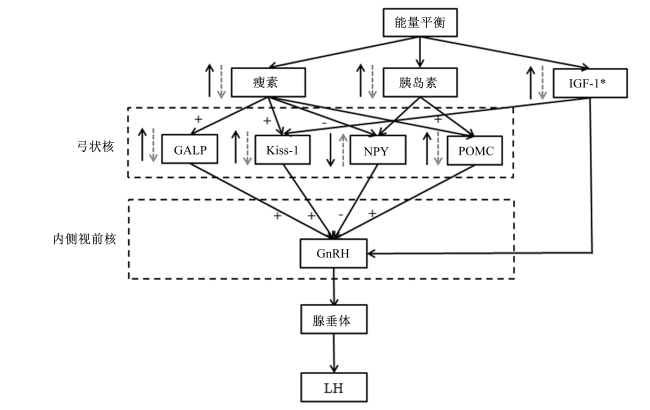
营养通过代谢激素等影响种公牛的性发育和繁殖力,代谢激素通过靶向下丘脑信号传导来调节促性腺激素释放激素(GnRH)的分泌,代谢激素参与促性腺激素神经内分泌调节如图1。青春期的开始依赖于GnRH脉冲发生器的启动,腺垂体接收到信号后,促进促性腺激素的分泌。犊牛早期促黄体生成素(LH)短暂性升高通常发生在8~20周龄。研究表明,犊牛期LH浓度对公牛性发育、到达青春期年龄具有决定性作用[2]。LH、卵泡刺激素(FSH)对睾丸支持细胞与间质细胞的增殖和分化、输精管延长以及睾酮的分泌至关重要,早期促性腺激素的浓度可能影响着公牛睾丸发育的起始时间和发育程度[5]。公牛进入青春期(射出的精子数>50×106个,精液中>10%的运动性,阴囊围≥28 cm[6])的平均年龄为320 d,性成熟(射出的精液中含有≥30%直线前进的精子和≥70%正常形态的精子[7])与青春期的时间间隔为45~50 d。研究表明,增强公牛早期能量、蛋白质水平会改善公牛的代谢状态,进而刺激促性腺激素分泌增加,并提前进入青春期和性成熟期。
图1 胰岛素、胰岛素样生长因子-1、瘦素参与促黄体生成素神经内分泌调节

+,-:激素对神经递质合成或释放的刺激或抑制作用 stimulating or inhibitory effect of the hormone on the synthesis or release of the neurotransmitter;↓↑:外周胰岛素、胰岛素样生长因子-1和瘦素浓度低或高,半乳糖蛋白样肽、神经中枢吻素-1、神经肽Y、促黑色素皮质激素表达降低或增加 low or high concentrations of peripheral insulin, IGF-1 and leptin, reduced or increased expression of GALP, Kiss-1, NPY and POMC;*:在在能量正平衡时,胰岛素样生长因子-1浓度上升,直接刺激促性腺激素释放激素、神经中枢吻素-1合成与分泌 when the energy balance is positive, the IGF-1 concentration increases and directly stimulates the synthesis and secretion of GnRH and Kiss-1;虚线:当能量平衡为负时 when energy balance is negative;连续线:当能量平衡为正时 when the balance of energy is positive;IGF-1:胰岛素样生长因子-1 insulin-like growth factor-1;GALP:半乳糖蛋白样肽 galanin-like peptide;Kiss-1:神经中枢吻素-1 kisspeptin-1;NPY:神经肽Y neuropeptide Y;POMC:促黑色素皮质激素 proopiomelanocortin;GnRH:促性腺激素释放激素 gonadotropin releasing hormone;LH:促黄体生成素 luteinizing hormone。

Fig.1 Insulin, IGF-1 and leptin involved in LH neuroendocrine regulation[15]

胰岛素样生长因子-1(insulin-like growth factor-1,IGF-1)调节荷斯坦公牛促性腺激素分泌及IGF-1和LH的时间分泌模式[8],此外,在GnRH神经元中IGF-1和IGF-1 mRNA转录物的发现,表明IGF-1在公牛生殖发育中起着重要作用,并可能调节GnRH的分泌。有研究报道,公牛在12~18周龄时IGF-1浓度伴随着LH分泌增加[8];6月龄前自由采食精料组较精料限制组血液IGF-1、胰岛素浓度增加,从而导致GnRH/LH分泌增加[4]。这些时间相关性有力地表明,IGF-1在GnRH分泌中发挥调节作用。
瘦素在畜禽生殖激素分泌调节中的作用已被综述[9]。瘦素在能量摄入和饱腹感中起着重要作用,其分泌随着体内脂肪的沉积而增加。与胰岛素一样,在哺乳期大鼠中输注瘦素可降低神经肽Y(neuropeptide Y,NPY)mRNA的表达,增加促黑色素皮质激素(proopiomelanocortin,POMC)mRNA的表达[10]。在大鼠禁食48 h后输注瘦素可增加半乳糖蛋白样肽(galanin-like peptide,GALP)mRNA的表达[11]。在营养压力条件下,在鼠科动物上的试验表明瘦素似乎是神经中枢吻素(kisspeptin)的主要调节因子,然而这尚未在公牛上得到证实。瘦素对繁殖的影响与动物代谢状态有关,只有在禁食或长期负能量平衡状态下,外源性瘦素才能引起显著的促性腺激素反应。研究发现,6月龄前提供不同粗蛋白质水平、精料量和能量的饲粮,公牛血液中瘦素浓度差异不显著,可能与此阶段脂肪组织相对较少有关[8,12-13];6月龄后提供高营养水平的公牛,瘦素浓度更高,这与其背部脂肪沉积更多的结果[12]一致。
抵抗素是一种由白色、棕色脂肪及其他外周组织产生的一种分泌蛋白,在下丘脑-垂体-性腺轴中存在并活跃。在荷斯坦公牛精原细胞、支持细胞、睾丸间质细胞中发现了抵抗素抗原,这些细胞产生的抵抗素可以调节性腺甾体生成和配子发生[14]。抵抗素参与代谢状态的信号传递,下丘脑具有反映营养可利用性的受体,抵抗素可能成为能量平衡和生殖新型的内分泌整合器。但抵抗素在公牛下丘脑、垂体中的作用仍有待进一步的研究。

2 蛋白质、能量对各生长阶段种公牛性发育和精子生成的影响

2.1 犊牛

表1可知,在种公牛促性腺激素分泌短暂增加的时期,改善犊牛的蛋白质、能量水平,LH浓度早期上升的时间更早、更明显。这有助于促进公牛性发育,表现在提前进入青春期、睾丸增大,具有精子产量增加的潜力。然而,结果并不完全一致。Harstine等[16]对58~230 d的荷斯坦犊牛饲喂高能量[平均日增重(ADG)1.50 kg/d)]和对照饲粮(ADG 0.75 kg/d),不同处理之间进入青春期年龄无明显差异。这可能与230 d后公牛被转移到不同的地点和不同的饲粮有关,同时Byrne等[12]使用生长特征数据的各种组合建立逐步回归模型,发现2周龄至青春期的ADG对青春期年龄变化也有统计学意义上的进一步影响,与Dance等[8]、Byrne等[4]、Brito等[17]的试验相比,他们的试验饲粮处理开始于8周龄,并非2周龄。因此,有必要进行进一步的研究以确定开始饲喂高营养水平饲粮的周龄以及不同的饲养方案对种公牛青春期的影响。早期营养状况的改善对精子质量的潜在影响非常有限。对奶牛的研究报道表明,提供高营养水平饲粮至30周龄左右,青春期后精子总量、精液质量、精子功能无显著提高[4,16,18-19]。虽然在之前的研究中,增强早期营养对种公牛进入青春期时间和睾丸大小产生积极影响,但在当前研究背景下,它对青春期后精子产量、质量的影响未得到很好的表征[18]
表1 早期营养对种公牛青春期和精液生成的影响

Table 1 Effects of early nutrition on puberty and semen production of breeding bulls

品种
Breeds
处理
Treatments
周龄
Weeks of age
结果
Results
参考文献
Reference
安格斯
Angus
采食量 8~26 高营养水平组(粗蛋白质水平为13.2%,自由采食)较
75%采食量限制组青春期早38 d,睾丸更大,早期
胰岛素样生长因子-1浓度更高
[13]
荷斯坦
Holstein
精料采食量 2~24 高营养水平组到达青春期时间约为290 d,
较精料采食量限制组早30 d,阴囊温度和阴囊围都较高
[4]
荷斯坦
Holstein
蛋白质 2~31 高蛋白质水平组(20.0%)到达青春期时间为
324 d,较低蛋白水平组(12.2%)提前45 d,且睾丸更大
[8]
荷斯坦
Holstein
能量 8~33 高能量水平组(平均日增重1.5 kg/d)促进了
性成熟,增加了睾丸的大小
[16]
荷斯坦
Holstein
能量、蛋白质 2~31 高营养水平组(所需能量、蛋白质的130%)
较低营养水平组(所需能量、蛋白质的70%)有可能会
产生更多精子,但精液质量、精子功能
无显著性差异
[18]
荷斯坦
Holstein
精料采食量 3~49 高营养水平组公牛对促性腺激素释放激素浓度有较高的
促黄体生成素浓度的响应,睾酮浓度较高,青春期提前
[20]
荷斯坦
Holstein
能量 0~208 80周龄时低营养水平组精子运动性较低,
但这种差异随着公牛性成熟而消除
[21]

2.2 6月龄至青春期种公牛

此阶段蛋白质、能量限制对种公牛性成熟、精子生成及精液品质影响很小,但对体重、交配速度、性欲影响较大。有研究对2~24周龄的荷斯坦犊牛进行高、低营养处理,随后公牛处理重新分配,继续保持相同或转换到相反饲粮,直到青春期。发现前期营养改善(ADG 1.18 kg/d)、后期低营养组(ADG 0.70 kg/d)与一直高营养组到达青春期的时间、射精量、精子活力无统计学差异,但体重相差了100 kg[4]。Meacham等[22]对8~12月龄的安格斯、赫里福德公牛提供蛋白质缺乏(8.09%、5.01%、1.35%)和充足(14.75%)饲粮,后期蛋白质缺乏组采食量较低时补充矿物质、维生素,研究发现,初期蛋白质摄入不足的牛精液生成不受影响,但交配速度较蛋白质充足组显著降低;直到蛋白质水平降到1.35%,精子总数才显著减少,但性欲严重下滑,初始体重已经降低了40%。
此阶段改善营养潜在的有益影响尚不明确,但高能量饲粮可能通过增加阴囊脂肪沉积使其绝缘,阻止睾丸热交换机制的有效运作而对精子产量和品质带来有害影响。有研究发现,6月龄后公牛高营养水平组较营养限制组阴囊围(SC)增大,但配对睾丸重量无差异,即可能是由于脂肪致SC增加[23]。Coulter等[24]关于6~24月龄营养水平对安格斯、赫里福德牛睾丸发育、精液质量等做了一系列研究,发现与饲喂中等营养水平组相比,高营养水平组(80%谷物+20%草料)背部脂肪沉积更厚,每日精子产量和附睾储备均显著减少。研究发现,日增重超过1.75 kg/d影响赫里福德牛精子活力和形态[25];1.60 kg/d的日增重对6~12月龄的荷斯坦奶公牛精子产量和质量无显著影响[4];1~1.60 kg/d的日增重不会使6~16月龄的安格斯牛阴囊脂肪过多沉积,从而降低精液品质[17]
综合以上研究结果,适度的营养水平使公牛生长达到正常的体况是该阶段饲养的目标。6月龄前的营养水平是决定青春期年龄的关键因素,早期营养改善的优势并不会因为之后适当的营养限制而被逆转,同时后期营养加强的补偿性生长并不能克服前期的营养限制。高营养水平可能会通过增加阴囊皮肤厚度(SST)干扰睾丸温度调控,从而影响精液质量,但能对精液质量产生有害作用所需的SST未得到很好的定义。

2.3 青春期后种公牛

公牛的繁殖力主要反映在精子生成、精液质量、性欲及其与母畜交配的能力。性欲是公牛发生交配行为的驱动力,影响着公牛爬跨假台畜的积极性和射精的成功与否。长期过高或过低的营养水平都会降低性欲。Persson等[26]在对不育公牛的研究发现,后肢无力影响性欲是导致公牛不育的原因之一。能量摄入过多可能导致蹄炎,而含硫氨基酸供给不足也会提高跛足的发生率[27]。性欲受一系列因素的影响,而如何提高性欲是一个具有挑战性的课题。
能量和蛋白质对种公牛精子生成和精液品质的影响较大。青春期后公牛的体况评分应在5.5~6.5分(9分制)[28],过高的能量供给使得公牛过肥,可能会造成阴囊脂肪堆积,从而在精子生成过程中引起热应激[29]。有研究以成年摩拉水牛为试验对象,饲喂110% NRC(2001)能量组的公牛鲜精活力及解冻后活力、顶体完整性显著高于100%和120% NRC(2001)能量组[30]。种公牛的能量需要一般由维持、生长、交配活动、精子产生、保持体温需要5部分构成。我国奶牛饲养标准建议种公牛的能量需要量用0.398×代谢体重(W0.75)来计算[31]
饲粮蛋白质水平对采精公畜非常关键,直接影响着精液品质。有研究发现,比对照组粗蛋白质水平高80.5 g的试验组,精子数量更多[32]。但过多的蛋白质也会使得机体内有机酸大量产生,从而影响精子生成和精液质量,反而导致公牛繁育能力降低。种公牛对可消化蛋白质的需要(g)一般可按4.0×W0.75计算[31],奶用成年公牛饲粮粗蛋白质水平为12%,最好不低于11%,700 kg左右公牛每日粗蛋白需要量约为1 952 g[33]

3 矿物质对种公牛精子生成和精液品质的影响

根据目前的研究,对种公牛繁殖有较明显影响的矿物元素有钙(Ca)、磷(P)、铜(Cu)钴(Co)、碘(I)、锰(Mn)、锌(Zn)、硒(Se)。Ca加强精子活动并为其提供能量,Ca、P不足会导致精子发育受阻,精子活力下降,种公牛饲粮中的Ca∶P通常在1.33∶1左右为宜[31]。田全召等[34]研究发现,在饲粮中补充0.25 g/(头·d)含98.1%碳酸钙的Penergetic-T添加剂,可显著提高种公牛的精液品质与冻精产量。
Se参与精子发生,并且是许多硒蛋白[如谷胱甘肽过氧化物酶4(GPX4)]的重要组成部分,而GPX4活性较低将导致过氧化物含量较高,引起氧化损伤[35]。此外,GPX4对牛精子的发育和功能至关重要,Se缺乏可能导致精子发生受损[36]。我国农业农村部2625号公告(2017)规定,亚硒酸钠和酵母硒在所有养殖动物饲粮中添加量为0.1~0.3 mg/kg,最高限量为0.5 mg/kg[37]。由于有机硒在动物机体内需20 d左右才能达到睾丸发挥作用,因而至少在采精或配种前20 d补充Se[38]
Zn大量存在于雄性动物的睾丸和副性腺中,作为间质细胞分泌睾酮的激素受体调节剂,从而维持精子生成[39]。美国国家科学、工程和医学研究院(NASEM)给出干奶牛、高产牛Zn需求量分别为28、60 mg/kg DMI[40];有研究给出种公牛Zn的推荐量为60[41]、110 mg/kg DM[42]。Fe参与过氧化氢酶等酶的合成过程[43],血清Fe含量与精子活力呈正相关,与精子顶体缺陷和DNA断裂的比例呈负相关。Fe在公畜生殖系统中发挥有利或有害的作用取决于其含量[44]。Mn参与胆固醇合成,而胆固醇是合成性激素的主要原料,因而Mn缺乏公牛表现为睾丸退化、性欲衰退[45]。Cu能够提高前列腺素与受体的结合力,从而促进LH浓度的提高并使睾酮分泌增加。庄怀飞[45]对荷斯坦种公牛的研究发现,饲粮中Cu、Mn添加水平应为4~8 mg/kg、50~125 mg/kg。Cu、Mn的添加量不能过高,有研究报道在牛饲粮中添加4~5倍需要量的Cu,就可能导致慢性中毒[46];Mn添加量超过540 mg/kg对放牧的内洛尔公牛血浆和顶体精子膜的完整性有害[47]
充足的矿物元素对种公牛繁殖性能至关重要,而不同的添加形式也对精子生成和精液品质有所影响。由于矿物元素几乎完全以有机复合物或螯合物的形式存在于动物体内,因此饲粮中有机来源的矿物质可能通过减少影响其生理活性转化效率的负面作用来提高生物利用率[48]。同时矿物元素对动物的影响是把双刃剑,产生的作用取决于其补充的剂量,因此要在饲养标准和此前研究的基础上严格限制添加量,在添加过程中也要注意搅拌均匀。

4 维生素对种公牛精子生成和精液品质的影响

维生素A、维生素D、维生素E在调控繁殖方面具有重要作用。β-胡萝卜素是最具有生物活性的维生素A原,通过分子中的共轭多烯双键与自由基发生不可逆反应,降低公牛体内脂质过氧化物含量,从而提高抗氧化能力[49]。研究发现,饲粮中补充β-胡萝卜素对射精量、鲜精品质及冻精活力有积极的影响[50-51]。公畜维生素A缺乏与睾丸生殖上皮变性有关,导致精子发生减少或停止,公牛饲粮缺乏维生素A会推迟青春期,降低性欲,减少精子生成[52]。维生素E是目前被发现的与动物繁殖性能联系最紧密的维生素之一,与维持生殖系统结构和功能有关,是精子抗氧化防御系统中的主要成员[53]。维生素E缺乏将导致精原细胞退化,活性氧积累引起膜通透性、细胞结构改变及膜上生物分子相互作用[54]。反刍动物无法合成α-生育酚,必须通过饲粮供给。研究发现,维生素E能显著提高公畜精液浓度、改善鲜精和冻精质量[55],维生素E与Se联合补充对精液质量提升和机体抗氧化性能协同效果优于单独添加[56]。矿物质、维生素对种公牛精液品质及抗氧化能力的影响见表2
表2 矿物质、维生素对种公牛精液品质及抗氧化能力的影响

Table 2 Effects of minerals and vitamins on semen quality and antioxidant capacity of breeding bulls

品种
Breeds
处理
Treatments
剂量
Dosage
结果
Results
参考文献
Reference
摩拉水牛
Murrah buffalo
有机硒(1.6 mg/d) 提高精子活力 [57]
荷斯坦
Holstein
铜、锰 铜(4 mg/kg DM)+
锰(125 mg/kg DM)
提高精液品质 [45]
荷斯坦
Holstein
锌、锰 蛋氨酸锌(120 mg/kg)+
蛋氨酸锰(105 mg/kg)
较硫酸锌、硫酸锰,血清睾酮
浓度和精液品质提高
[58]
杂种牛
Crossbred cattle
铜、锌 碱性氯化铜+羟基氯化锌
(75% NRC推荐量)
较硫酸铜和硫酸锌,精子顶体的
完整性改善
[59]
荷斯坦
Holstein
25-羟维生素D3 300 IU/kg DM 较维生素D3,改善了精液
品质和抗氧化能力
[60]
荷斯坦
Holstein
维生素E 330~410 IU/kg精料 提高精液量、活力、密度,
提高抗氧化性能
[61]
荷斯坦
Holstein
维生素E、
β-胡萝卜素、
维生素E(300 mg/kg DM)+
β-胡萝卜(60 mg/kg DM)+
锌(100 g/kg DM)
提高精液品质,增强抗氧化性 [51]

5 饲料添加剂对种公牛精液品质和冷冻保存的影响

5.1 多不饱和脂肪酸(PUFA)对种公牛精液品质和冷冻保存的影响

哺乳动物精子细胞膜中PUFA含量非常高,因此PUFA影响精子质量的主要机制与膜生理特性有关。有研究报道,PUFA在精子脂质代谢、精子活力和与卵母细胞融合等方面起着重要作用[62],老年公牛精子脂质中n-3 PUFA百分比的下降伴随着精子数量和射精活力的下降。一般来说,精子中的PUFA是亚油酸(C18∶2n-6)和亚麻酸(C18∶3n-3)的衍生物,这2种脂肪酸通常存在于饲料中,葵花籽油、红花油、大豆油等植物油常作为n-6 PUFA来源,鱼油、亚麻籽油被认为是理想的n-3 PUFA来源。研究发现,公牛饲粮中添加PUFA可改变生殖组织(如精子膜)中脂肪酸谱,提高精液质量[63]
Esmaeili等[64]对山羊的研究发现,饲喂鱼油组血液中睾酮浓度较葵花籽油组高,表明饲粮中添加高n-3 PUFA的鱼油可能影响了睾丸细胞膜磷脂组成,改变了促性腺激素受体的表达和亲和力,影响了睾丸激素的合成速度。但也有研究发现,饲粮中补充大豆油和鱼油对睾酮浓度无显著影响,然而添加鱼油组睾丸生长参数、生精小管管腔直径、支持细胞及睾丸间质细胞数等显著增加[65]。这说明高n-3 PUFA水平饲料对性腺发育有积极影响,且二十二碳六烯酸(DHA)水平越高,性腺发育越好。Tran等[66]也研究发现,饲喂富含n-3 PUFA亚麻籽油的水牛较喂食富含n-6 PUFA大豆油的水牛睾酮浓度、精液品质明显提高。Moallem等[67]研究发现,补充84.2 g/(头·d)α-亚麻酸的荷斯坦公牛较补充含8.7 g/(头·d)二十碳五烯酸(DPA)、6.5 g/(头·d)DHA鱼油的公牛冻融精液的运动性强,尽管饲喂鱼油的公牛DHA含量更高,但其精液品质并无提高。这可能是由于鱼油组精子中DHA含量超过了防止氧化损伤的最佳水平,从而阻碍了其精液参数的改善[68]
许多研究评估了PUFA对公牛繁殖性能的影响,然而关于最佳n-6∶n-3 PUFA比值对公牛的影响却知之甚少。有研究发现,对公牛精液质量有积极影响的n-6∶n-3 PUFA比值为2.01[67]和2.39[69];Moallem等[67]研究发现n-6∶n-3 PUFA比值2.01优于3.96。因此,有必要对公牛开展进一步的研究以对此问题进行阐明。
众所周知,PUFA和胆固醇是活性氧自由基(ROS)损伤的主要目标,且脂质过氧化物与精子活力成反比关系[70]。因此,在饲粮中同时补充维生素E、维生素C等抗氧化剂有利于平衡活性氧的产生和抗ROS对精子质膜PUFA的损伤,从而改善精液质量,在公羊上的试验证实了这一点[56,71]。精子蛋白质组学研究发现,抗氧化相关蛋白如谷胱甘肽过氧化物酶(GPX)、超氧化物歧化酶(SOD)和过氧化氢酶等与精子活力和繁殖能力存在一定的关系,这可能与PUFA有关[72]。也有研究在公牛精子中发现了一些与繁殖能力相关的蛋白质,如烯醇化酶1(ENO1)、电压依赖性阴离子通道2(VDAC2)和泛醌细胞色素C还原酶复合物核心蛋白2(UQCRC2)等[73],但部分蛋白质标记与PUFA在调节精子氧化应激和获能中的作用需要进一步的研究予以阐明。
饲粮中添加PUFA对睾酮分泌,鲜精、解冻后精液品质有积极的影响,但也存在一些相互矛盾的结果(表3)。这可能与公牛脂肪酸来源、剂量、n-6∶n-3 PUFA比值、饲粮组成及精液脂肪酸构成的差异有关。同时,研究发现,n-3 PUFA在添加6周后首次融入荷斯坦公牛精子脂质,因此饲粮中补充PUFA必须在精子发生的早期阶段[67]
表3 饲粮中补充PUFA对种公牛鲜精质量及冷冻保存的影响

Table 3 Effects of PUFA supplementation in diets on fresh semen quality and cryopreservation of breeding bulls

品种
Breeds
来源
Source
剂量
Dosage
结果
Results
参考文献
Reference
荷斯坦
Holstein
亚麻籽油 100 g/(头·d) 对鲜精质量无显著影响,但显著提高了解冻后
精子的运动参数、膜完整性和活性,并减少了畸形率
[74]
荷斯坦
Holstein
鱼油 1.2% DM 增加了精液量、精子密度,提高了鲜精和解冻后
精子活力、运动性,改变了精子脂肪酸组成
[69]
荷斯坦
Holstein
α-亚麻酸 400 g/(头·d) 对血浆抗氧化指标无显著影响,但改善了
解冻后精液质量
[75]
荷斯坦
Holstein
α-亚麻酸 84.2 g/(头·d) 与添加8.7 g/d二十碳五烯酸和6.5 g/d二十二碳
六烯酸的鱼油组相比,鲜精和解冻后精子活力、
运动性均显著改善
[67]
荷斯坦
Holstein
鱼油添加剂 100 g/(头·d) 添加10 g二十二碳六烯酸、6 g二十碳五烯酸可改善
鲜精质量和运动学参数,但这种效果在冷冻后并不明显
[76]
泽西
Jersey
共轭亚油酸 50 g/(头·d) 增加了精子浓度及冷冻-解冻后的精子活率,
并降低了氧化应激
[77]
水牛
Buffalo
大豆亚麻籽油 4.7% DM
4.7% DM
添加亚麻籽油组(富含n-3多不饱和脂肪酸)
较大豆组(富含n-6多不饱和脂肪酸)血浆中
胰岛素样生长因子-1、睾酮浓度增加,青春期提前,
鲜精、解冻后精液品质改善
[68]

5.2 植物性饲料添加剂对种公牛精液品质和冷冻保存的影响

许多天然植物或其提取物富含多酚、类黄酮、胡萝卜素、没食子酸、单宁和精油,现作为动物抗氧化剂的替代策略已被证实有效且广泛应用。酚类化合物的抗氧化活性是由于它们的结构,特别是向脂质过氧化产生的过氧自由基提供氢离子的能力[78]。研究发现,饲粮中补充玛卡粉、白藜芦醇能提高种公牛精液数量和质量[79-80];精子、精液稀释液中添加迷迭香、赫蒙阿魏、东革阿里、海藻提取物、鸡毛蕨提取物、白藜芦醇、表儿茶素、石榴汁、姜黄素可以改善公牛解冻后精液品质及体内繁殖成功率[81-87]
中草药由于富含萜类、黄酮、多酚、生物碱、蒽醌、香豆素类等化合物,也对公畜繁殖性能有所影响。有研究在种公牛饲粮中补充中草药(包含山楂、神曲、阳起石等)添加剂后,精子活力、密度、形态正常率显著提高[88]。接骨木、金盏花、薰衣草对牛新鲜精液品质提升的有益作用也已被报道[89-91]。植物性饲料添加剂对动物繁殖也具有双刃剑作用,但其具体机制尚不清楚。因而需要进一步研究植物提取物对不同品种的剂量依赖性及单个抗氧化剂特性和与其他代谢产物的协同作用。

6 小结与展望

总体而言,近20年基于种公牛的营养研究进展不大,随着分子育种技术的发展,现在的种公牛对营养、饲养环境等有了更高的要求,根据过去的研究成果来指导目前的公牛饲养具有很大的限制性。
今后的科学研究需聚焦3个方面:1)研究精确、细化种公牛各生长发育阶段的营养需要及饲养管理技术;2)研究PUFA、植物提取物等生物活性物质对种公牛精液品质的调控作用机制;3)深入探究营养如何介导神经内分泌和睾丸之间的生化相互作用,以不断科学优化饲养方案,改善精液生产,缓解高质量冻精的供需不平衡。未来还需要在种公牛饲养标准和饲养规范、加速优质公牛性成熟、营养素影响性发育机制等方面进一步探索研究,为种公牛科学饲养、生殖潜力提升提供更详细的理论指导。
[1]
ABDOLLAHI-ARPANAHI R, MOROTA G, PEÑAGARICANO F. Predicting bull fertility using genomic data and biological information[J]. Journal of Dairy Science, 2017, 100(12):9656-9666.

DOI

[2]
RAWLINGS N, EVANS A C, CHANDOLIA R K, et al. Sexual maturation in the bull[J]. Reproduction in Domestic Animals, 2008, 43(S2):295-301.

DOI

[3]
SARAKUL M, ELZO M A, KOONAWOOTRITTRIRON S, et al. Genetic parameters,predictions,and rankings for semen production traits in a Thailand multi-breed dairy population using genomic-polygenic and polygenic models[J]. Animal Reproduction Science, 2018, 195:71-79.

DOI

[4]
BYRNE C J, FAIR S, ENGLISH A M, et al. Plane of nutrition before and after 6 months of age in Holstein-Friesian bulls:Ⅰ.Effects on performance,body composition,age at puberty,and postpubertal semen production[J]. Journal of Dairy Science, 2018, 101(4):3447-3459.

DOI

[5]
BOLLWEIN H, JANETT F, KASKE M. Effects of nutrition on sexual development of bulls[J]. Animal Reproduction, 2017, 14(3):607-613.

DOI

[6]
WOLF F R, ALMQUIST J O, HALE E B. Prepuberal behavior and puberal characteristics of beef bulls on high nutrient allowance[J]. Journal of Animal Science, 1965, 24(3):761-765.

DOI

[7]
GALLOWAY D. Abnormal morphology of bovine spermatozoa[J]. Australian Veterinary Journal, 1992, 69(1):22.

DOI

[8]
DANCE A, THUNDATHIL J, WILDE R, et al. Enhanced early-life nutrition promotes hormone production and reproductive development in Holstein bulls[J]. Journal of Dairy Science, 2015, 98(2):987-998.

DOI PMID

[9]
BARB C R, KRAELING R R. Role of leptin in the regulation of gonadotropin secretion in farm animals[J]. Animal Reproduction Science, 2004, 82/83:155-167.

DOI

[10]
XU J, KIRIGITI M A, GROVE K L, et al. Regulation of food intake and gonadotropin-releasing hormone/luteinizing hormone during lactation:role of insulin and leptin[J]. Endocrinology, 2009, 150(9):4231-4240.

DOI

[11]
JURÉUS A, CUNNINGHAM M J, MCCLAIN M E, et al. Galanin-like peptide (GALP) is a target for regulation by leptin in the hypothalamus of the rat[J]. Endocrinology, 2000, 141(7):2703-2706.

PMID

[12]
BYRNE C J, FAIR S, ENGLISH A M, et al. Plane of nutrition before and after 6 months of age in Holstein-Friesian bulls:Ⅱ.Effects on metabolic and reproductive endocrinology and identification of physiological markers of puberty and sexual maturation[J]. Journal of Dairy Science, 2018, 101(4):3460-3475.

DOI

[13]
BRITO L F C, BARTH A D, RAWLINGS N C, et al. Effect of feed restriction during calfhood on serum concentrations of metabolic hormones,gonadotropins,testosterone,and on sexual development in bulls[J]. Reproduction, 2007, 134(1):171-181.

DOI

[14]
RAK A, MELLOUK N, FROMENT P, et al. Adiponectin and resistin:potential metabolic signals affecting hypothalamo-pituitary gonadal axis in females and males of different species[J]. Reproduction, 2017, 153(6):R215-R226.

DOI

[15]
SÁNCHEZ A G, ROSALES-TORRES A M, GUTIÉRREZ AGUILAR C G. Neuroendocrine effects of insulin,IGF-1 and leptin on the secretion of the gonadotropin-releasing hormone (GnRH)[J]. Tropical and Subtropical Agroecosystems, 2012, 15(S1):S79-S90.

[16]
HARSTINE B R, MAQUIVAR M, HELSER L A, et al. Effects of dietary energy on sexual maturation and sperm production in Holstein bulls[J]. Journal of Animal Science, 2015, 93(6):2759-2766.

DOI PMID

[17]
BRITO L F C, BARTH A D, WILDE R E, et al. Effect of growth rate from 6 to 16 months of age on sexual development and reproductive function in beef bulls[J]. Theriogenology, 2012, 77(7):1398-1405.

DOI PMID

[18]
DANCE A, THUNDATHIL J, BLONDIN P, et al. Enhanced early-life nutrition of Holstein bulls increases sperm production potential without decreasing postpubertal semen quality[J]. Theriogenology, 2016, 86(3):687-694.e2.

DOI PMID

[19]
DE BRITO L F C. Nutrition,metabolic hormones,and sexual development in bulls[D]. Ph.D.Thesis. Saskatoon: University of Saskatchewan, 2006.

[20]
BYRNE C J, FAIR S, ENGLISH A M, et al. Effect of breed,plane of nutrition and age on growth,scrotal development,metabolite concentrations and on systemic gonadotropin and testosterone concentrations following a GnRH challenge in young dairy bulls[J]. Theriogenology, 2017, 96:58-68.

DOI

[21]
FLIPSE R J, ALMQUIST J O. Effect of total digestible nutrient intake from birth to four years of age on growth and reproductive development and performance of dairy bulls[J]. Journal of Dairy Science, 1961, 44(5):905-914.

DOI

[22]
MEACHAM T N, CUNHA T J, WARNICK A C, et al. Influence of low protein rations on growth and semen characteristics of young beef bulls[J]. Journal of Animal Science, 1963, 22(1):115-120.

DOI

[23]
COULTER G H, FOOTE R H. Bovine testicular measurements as indicators of reproductive performance and their relationship to productive traits in cattle:a review[J]. Theriogenology, 1979, 11(4):297-311.

DOI

[24]
COULTER G H, KOZUB G C. Testicular development,epididymal sperm reserves and seminal quality in two-year-old Hereford and Angus bulls:effects of two levels of dietary energy[J]. Journal of Animal Science, 1984, 59(2):432-440.

DOI

[25]
SKINNER J D. Nutrition and fertility in pedigree bulls[M]// GILMORED, COOKB. Environmental Factors in Mammal Reproduction. London: Palgrave Macmillan, 1981:160-168.

[26]
PERSSON Y, SÖDERQUIST L, EKMAN S. Joint disorder;a contributory cause to reproductive failure in beef bulls?[J]. Acta Veterinaria Scandinavica, 2007, 49(1):31.

DOI

[27]
LEAN I J, WESTWOOD C T, GOLDER H M, et al. Impact of nutrition on lameness and claw health in cattle[J]. Livestock Science, 2013, 156(1/2/3):71-87.

DOI

[28]
WALKER J, PERRY G, DALY R, et al. Bull management and nutrition[C]//Proceedings,The Range Beef Cow Symposium ⅩⅪ.Casper, WY:IANR, 2009:1-9.

[29]
BROWN B W. A review of nutritional influences on reproduction in boars,bulls and rams[J]. Reproduction Nutrition Development, 1994, 34(2):89-114.

DOI

[30]
KUMAR A, SINGH P, BHAKAT M, et al. Effect of feed energy levels on semen quality and freezability of young murrah buffalo bulls[J]. Buffalo Bulletin, 2017, 36(2):415-426.

[31]
中华人民共和国农业部. 奶牛饲养标准:NY/T 34—2004[S]. 北京: 中国农业出版社, 2004:17.

The Ministry of Agriculture of the People’s Republic of China. Feeding standard of dairy cattle:NY/T 34—2004[S]. Beijing: China Agriculture Press, 2004:17. (in Chinese)

[32]
张黎黎, 李元浩, 刘爱国, 等. 饲养管理水平与种公牛精液质量的关系[J]. 吉林畜牧兽医, 2013, 34(4):51-52.

ZHANG L L, LI Y H, LIU A G, et al. Relationship between feeding management level and semen quality of breeding bulls[J]. Jilin Animal Husbandry and Veterinary Medicine, 2013, 34(4):51-52. (in Chinese)

[33]
Agricultural Research Council UK. The nutrient requirements of ruminant livestock[M]. Slough, UK: Commonwealth Agricultural Bureaux,1980.

[34]
田全召, 高汉婷, 刘修生, 等. 饲料中添加Penergetic-T对种公牛精液品质的影响[J]. 中国畜牧杂志, 2019, 55(6):120-123.

TIAN Q Z, GAO H T, LIU X S, et al. Effect of diet supplemented with Penergetic-T on semen quality of breed bull[J]. Chinese Journal of Animal Science, 2019, 55(6):120-123. (in Chinese)

[35]
LASOTA B, BLASZCZYK B, SEREMAK B, et al. Selenium status and GSH-Px activity in semen and blood of boars at different ages used for artificial insemination[J]. Reproduction in Domestic Animals, 2004, 39(5):309-314.

PMID

[36]
PARILLO F, SYLLA L, PALOMBI C, et al. Immunocytochemical localisation of phospholipid hydroperoxide glutathione peroxidase in bull’s spermatogenic cells[J]. Italian Journal of Animal Science, 2014, 13(3):3483.

DOI

[37]
中华人民共和国农业农村部. 中华人民共和国农业部公告:第2625号[R]. 北京:[s.n.]2017.

Ministry of Agriculture and Rural Affairs of the People’s Republic of China. Announcement of the Ministry of Agriculture of the People’s Republic of China:No. 2625[R].Beijing:[s.n.], 2017. (in Chinese)

[38]
危克周, 潘志雄, 吴宗万, 等. 添加适量有机硒对种公牛精子活力的影响[J]. 山地农业生物学报, 2004, 23(6):539-540.

WEI K Z, PAN Z X, WU Z W, et al. Influence of dietary organic selenium on the sperm vitality of breeding bulls[J]. Journal of Mountain Agriculture and Biology, 2004, 23(6):539-540. (in Chinese)

[39]
Kaliky N A P S B, SETIAWATI M, CARMAN O, et al. Effect of zinc (Zn) supplementation on quality and quantity of striped catfish Pangasianodon hypophthalmus sperm[J]. Jurnal Akuakultur Indonesia, 2019, 18(1):46-53.

DOI

[40]
National Academies of Sciences,Engineering,and Medicine. Nutrient requirements of dairy cattle[S]. 8th ed.Washington,D.C.:The National Academies Press, 2021.

[41]
ARTHINGTON J D, CORAH L R, HILL D A. The effects of dietary zinc concentration and source on yearling bull growth and fertility[J]. The Professional Animal Scientist, 2002, 18(3):282-285.

DOI

[42]
信富钰, 李文立, 侯明海, 等. 不同锌水平对荷斯坦种公牛精液品质及血液理化指标的影响[J]. 中国农学通报, 2007, 23(6):47-51.

XIN F Y, LI W L, HOU M H, et al. Effects of different levels of zinc on semen quality and blood biochemical parameters in Holstein bulls[J]. Chinese Agricultural Science Bulletin, 2007, 23(6):47-51. (in Chinese)

DOI

[43]
MASSÁNYI P, TRANDZIK J, NAD P, et al. Seminal concentrations of trace elements in various animals and their correlations[J]. Asian Journal of Andrology, 2003, 5(2):101-104.

PMID

[44]
ZAKOŠEK PIPAN M, ZRIMŠEK P, JAKOVAC STRAJN B, et al. Macro- and microelements in serum and seminal plasma as biomarkers for bull sperm cryotolerance[J]. Acta Veterinaria Scandinavica, 2021, 63(1):25.

DOI PMID

[45]
庄怀飞. 铜和锰对种公牛精液品质及抗氧化性能的影响[D]. 硕士学位论文. 青岛: 青岛农业大学, 2009:19-34.

ZHUANG H F. Effects of copper and manganese on semen quality and antioxygenic property in stud Holstein bulls[D]. Master’s Thesis. Qingdao: Qingdao Agricultural University, 2009:19-34. (in Chinese)

[46]
AUZA N J, OLSON W G, MURPHY M J, et al. Diagnosis and treatment of copper toxicosis in ruminants[J]. Journal of the American Veterinary Medical Association, 1999, 214(11):1624-1628.

[47]
REIS L S L S, RAMOS A A, CAMARGOS A S, et al. Effect of manganese supplementation on the membrane integrity and the mitochondrial potential of the sperm of grazing Nelore bulls[J]. Animal Reproduction Science, 2014, 150(1/2):1-6.

DOI

[48]
EL-SHARAWY M, EID E, DARWISH S, et al. Effect of organic and inorganic selenium supplementation on semen quality and blood enzymes in buffalo bulls[J]. Animal Science Journal, 2017, 88(7):999-1005.

DOI

[49]
UPRITCHARD J E, SCHUURMAN C R W C, WIERSMA A, et al. Spread supplemented with moderate doses of vitamin E and carotenoids reduces lipid peroxidation in healthy,nonsmoking adults[J]. American Journal of Clinical Nutrition, 2003, 78(5):985-992.

DOI

[50]
KEOGH L M, BYRNE P G, SILLA A J. Effect of long-term dietary beta-carotene supplementation on sperm concentration and motility in an endangered amphibian[J]. Animal Reproduction Science, 2018, 195:259-265.

DOI PMID

[51]
李秋凤. 日粮营养调控对奶牛养分消化代谢、泌乳及精液品质的影响[D]. 博士学位论文. 保定: 河北农业大学, 2012:62-81.

LI Q F. Effects of dietary nutrition regulation on nutrient metabolism,lactation and semen quality in Holstein cattle[D]. Ph.D.Thesis. Baoding: Hebei Agricultural University, 2012:62-81. (in Chinese)

[52]
GANGULY J, SARADA K, JAYARAM M, et al. On the systemic mode of action of vitamin A[J]. World Review of Nutrition and Dietetics, 1978, 31:59-64.

PMID

[53]
SURAI P, KOSTJUK I, WISHART G, et al. Effect of vitamin E and selenium supplementation of cockerel diets on glutathione peroxidase activity and lipid peroxidation susceptibility in sperm,testes,and liver[J]. Biological Trace Element Research, 1998, 64(1/2/3):119-132.

DOI

[54]
HONG Z, HAILING L, HUI M, et al. Effect of vitamin E supplementation on development of reproductive organs in Boer goat[J]. Animal Reproduction Science, 2009, 113(1/2/3/4):93-101.

DOI

[55]
LOSANO J D A, ANGRIMANI D S R, DALMAZZO A, et al. Effect of vitamin E and polyunsaturated fatty acids on cryopreserved sperm quality in Bos taurus bulls under testicular heat stress[J]. Animal Biotechnology, 2018, 29(2):100-109.

DOI

[56]
金海峰. 硒和维生素E对波尔山羊繁殖及公羔羊GPX基因表达的影响[D]. 博士学位论文. 延吉: 延边大学, 2019:34-62.

JIN H F. Effects of dietary selenium and vitamin E on reproduction and GPX gene expression in Boer goats[D]. Ph.D.Thesis. Yanji: Yanbian University, 2019:34-62. (in Chinese)

[57]
程园, 危克周, 潘志雄, 等. 有机硒对种公牛精子活力、免疫力和血液生化指标的影响[J]. 饲料研究, 2005(10):9-10.

CHENG Y, WEI K Z, PAN Z X, et al. Influence of dietary organic selenium on sperm vigor,immunity and blood biochemical indices of breeding bulls[J]. Feed Research, 2005(10):9-10. (in Chinese)

[58]
张力妮. 微量元素锌和锰的添加形式及添加量对种公牛精液品质的影响研究[D]. 硕士学位论文. 杨凌: 西北农林科技大学, 2020:17-22.

ZHANG L N. Study on the effect of the addition form and amount of trace elements zinc and manganese on semen quality of bull[D]. Master’s Thesis. Yangling: Northwest A&F University, 2020:17-22. (in Chinese)

[59]
ZEZESKI A L, VAN EMON M, WATERMAN R C, et al. Impacts of zinc,manganese,and copper source on mature bull trace mineral status and spermatozoa characteristics[J]. Journal of Animal Science, 2016, 94(suppl.5):609.

[60]
XU H J, FENG G Z, WANG L H, et al. Fresh and cryopreserved semen,minerals,hormones and health characteristics in response to reciprocal combinations of vitamin D3 and 25-hydroxyvitamin D3 in the mature and prepubertal Holstein bulls’ diet[J]. Animal Feed Science and Technology, 2021, 281:115094.

DOI

[61]
郎海芳. VE添加水平对荷斯坦种公牛精液品质、血清抗氧化性能及SOD基因mRNA表达的影响[D]. 硕士学位论文. 青岛: 青岛农业大学, 2010:19-49.

LANG H F. Effects of different additional levels of vitamin E on semen quality,serum antioxidant properties,cloning and mRNA expression of SOD gene in Holstein bulls[D]. Master’s Thesis. Qingdao: Qingdao Agricultural University, 2010:19-49. (in Chinese)

[62]
VAN TRAN L, MALLA B A, KUMAR S, et al. Polyunsaturated fatty acids in male ruminant reproduction-a review[J]. Asian-Australasian Journal of Animal Sciences, 2017, 30(5):622-637.

DOI

[63]
AHMAD S, ALI S, ABBAS A, et al. Effects of dietary supplementation of linseed oil (omega-3) on quality parameters of Nili Ravi bull spermatozoa[J]. Livestock Science, 2019, 224:57-59.

DOI

[64]
ESMAEILI V, SHAHVERDI A H, ALIZADEH A R, et al. Saturated,omega-6 and omega-3 dietary fatty acid effects on the characteristics of fresh,frozen-thawed semen and blood parameters in rams[J]. Andrologia, 2014, 46(1):42-49.

DOI

[65]
ADIBMORADI M, NAJAFI M H, ZEINOALDINI S, et al. Effect of dietary soybean oil and fish oil supplementation on blood metabolites and testis development of male growing kids[J]. Egyptian Journal of Sheep and Goat Sciences, 2012, 7(1):19-25.

DOI

[66]
TRAN L V, MALLA B A, SHARMA A N, et al. Effect of omega-3 and omega-6 polyunsaturated fatty acid enriched diet on plasma IGF-1 and testosterone concentration,puberty and semen quality in male buffalo[J]. Animal Reproduction Science, 2016, 173:63-72.

DOI

[67]
MOALLEM U, NETA N, ZERON Y, et al. Dietary α-linolenic acid from flaxseed oil or eicosapentaenoic and docosahexaenoic acids from fish oil differentially alter fatty acid composition and characteristics of fresh and frozen-thawed bull semen[J]. Theriogenology, 2015, 83(7):1110-1120.

DOI PMID

[68]
LYBERG A M, FASOLI E, ADLERCREUTZ P. Monitoring the oxidation of docosahexaenoic acid in lipids[J]. Lipids, 2005, 40(9):969-979.

DOI

[69]
KHOSHVAGHT A, TOWHIDI A, ZARE-SHAHNEH A, et al. Dietary n-3 PUFAs improve fresh and post-thaw semen quality in Holstein bulls via alteration of sperm fatty acid composition[J]. Theriogenology, 2016, 85(5):807-812.

DOI PMID

[70]
LEITE R F, DE AGOSTINI LOSANO J D, KAWAI G K V, et al. Sperm function and oxidative status:effect on fertility in Bos taurus and Bos indicus bulls when semen is used for fixed-time artificial insemination[J]. Animal Reproduction Science, 2022, 237:106922.

DOI

[71]
JAFAROGHLI M, ABDI-BENEMAR H, ZAMIRI M J, et al. Effects of dietary n-3 fatty acids and vitamin C on semen characteristics,lipid composition of sperm and blood metabolites in fat-tailed Moghani rams[J]. Animal Reproduction Science, 2014, 147(1/2):17-24.

DOI

[72]
KWON W S, OH S A, KIM Y J, et al. Proteomic approaches for profiling negative fertility markers in inferior boar spermatozoa[J]. Scientific Reports, 2015, 5:13821.

DOI

[73]
PARK Y J, KWON W S, OH S A, et al. Fertility-related proteomic profiling bull spermatozoa separated by percoll[J]. Journal of Proteome Research, 2012, 11(8):4162-4168.

DOI

[74]
KHOSHNIAT M T, TOWHIDI A, REZAYAZDI K, et al. Dietary omega-3 fatty acids from linseed oil improve quality of post-thaw but not fresh sperm in Holstein bulls[J]. Cryobiology, 2020, 93:102-108.

DOI PMID

[75]
GÜRLER H, CALISICI O, CALISICI D, et al. Effects of feeding omega-3-fatty acids on fatty acid composition and quality of bovine sperm and on antioxidative capacity of bovine seminal plasma[J]. Animal Reproduction Science, 2015, 160:97-104.

DOI PMID

[76]
GHOLAMI H, CHAMANI M, TOWHIDI A, et al. Effect of feeding a docosahexaenoic acid-enriched nutriceutical on the quality of fresh and frozen-thawed semen in Holstein bulls[J]. Theriogenology, 2010, 74(9):1548-1558.

DOI PMID

[77]
LIMAN M S, FRANCO V, CARDOSO C L, et al. Effects of dietary supplementation of conjugated linoleic acids and their inclusion in semen extenders on bovine sperm quality[J]. Animals, 2021, 11(2):483.

DOI

[78]
BISBY R H, BROOKE R, NAVARATNAM S. Effect of antioxidant oxidation potential in the oxygen radical absorption capacity (ORAC) assay[J]. Food Chemistry, 2008, 108(3):1002-1007.

DOI PMID

[79]
赵宪林. 多种抗氧化剂对动物精子品质影响的研究[D]. 博士学位论文. 杨凌: 西北农林科技大学, 2015:12-26.

ZHAO X L. The effect of antioxidants on animal sperm quality[D]. Ph.D.Thesis. Yangling: Northwest A&F University, 2015:12-26. (in Chinese)

[80]
CLÉMENT C, KNEUBÜHLER J, URWYLER A, et al. Effect of maca supplementation on bovine sperm quantity and quality followed over two spermatogenic cycles[J]. Theriogenology, 2010, 74(2):173-183.

DOI PMID

[81]
MALO C, GIL L, CANO R, et al. Antioxidant effect of rosemary (Rosmarinus officinalis) on boar epididymal spermatozoa during cryopreservation[J]. Theriogenology, 2011, 75(9):1735-1741.

DOI PMID

[82]
SABERIVAND A, SARVARZADEH F, PEIGHAMBARZADEH S Z, et al. The effect of Caulerpa sertularioides extract on bull sperm freezablity and subsequent embryo development[J]. Theriogenology, 2022, 189:167-176.

DOI

[83]
BAIEE F H, WAHID H, ROSNINA Y, et al. Impact of Eurycoma longifolia extract on DNA integrity,lipid peroxidation,and functional parameters in chilled and cryopreserved bull sperm[J]. Cryobiology, 2018, 80:43-50.

DOI

[84]
LI C Y, ZHAO Y H, HAO H S, et al. Resveratrol significantly improves the fertilisation capacity of bovine sex-sorted semen by inhibiting apoptosis and lipid peroxidation[J]. Scientific Reports, 2018, 8(1):7603.

DOI

[85]
TVRDA E, STRAKA P, GALBAVY D, et al. Epicatechin provides antioxidant protection to bovine spermatozoa subjected to induced oxidative stress[J]. Molecules, 2019, 24(18):3226.

DOI

[86]
EL-SHESHTAWY R I, EL-SISY G A, EL-NATTAT W S. Effects of pomegranate juice in tris-based extender on cattle semen quality after chilling and cryopreservation[J]. Asian Pacific Journal of Reproduction, 2016, 5(4):335-339.

DOI

[87]
COJKIC A, HANSSON I, JOHANNISSON A, et al. Effect of some plant-based substances on microbial content and sperm quality parameters of bull semen[J]. International Journal of Molecular Sciences, 2023, 24(4):3435.

DOI

[88]
赵四霞. 中草药添加剂在提升种公牛种用价值中的效果探讨[J]. 畜牧兽医科学(电子版), 2017(10):7.

ZHAO S X. Exploring the effect of herbal additives in enhancing the breeding value of breeding bulls[J]. Graziery Veterinary Sciences (Electronic Version), 2017(10):7. (in Chinese)

[89]
ABDRAMANOV A, MASSANYI P, SARSEMBAYEVA N, et al. The in vitro effect of elderberry (Sambucus nigra) extract on the activity and oxidative profile of bovine spermatozoa[J]. Journal of Microbiology,Biotechnology and Food Sciences, 2017, 6(6):1319-1322.

DOI

[90]
BENKO F, PALKOVIČOVÁ V, ĎURAČKA M, et al. Antioxidant effects of marigold (Calendula officinalis) flower extract on the oxidative balance of bovine spermatozoa[J]. Contemporary Agriculture, 2019, 68(3/4):92-102.

DOI

[91]
TVRDÁ E, VARGA A, SLÁVIK M, et al. Levisticum officinale and its effects on bovine spermatozoa activity[J]. Journal of Microbiology,Biotechnology and Food Sciences, 2019, 8(5):1212-1216.

DOI

Outlines

/