REVIEW

Extraction Methods, Biological Function of Tea Polysaccharides and Their Application in Livestock and Poultry Production

  • DENG Donghua ,
  • WANG Yue ,
  • WU Miaomiao , *
Expand
  • College of Animal Science and Technology, Hunan Agricultural University, Changsha 410128, China
* professor, E-mail:

Received date: 2023-06-08

  Online published: 2023-12-11

Abstract

As a healthy, natural beverage, tea is a unique cultural product. Tea polysaccharides, a class of polysaccharide complexes extracted from tea and its by-products, possess various biological functions such as antioxidant, anti-tumor properties, immune regulation, and modulation of intestinal microbiota. They are widely used in the food and pharmaceutical industries. This article provides a comprehensive review of tea polysaccharides, including their different sources, compositions, preparation processes, biological functions, and applications in animal production. The objective is to enhance the effectiveness of tea polysaccharides in livestock and poultry farming and provide guidance for their application in animal production.

Cite this article

DENG Donghua , WANG Yue , WU Miaomiao . Extraction Methods, Biological Function of Tea Polysaccharides and Their Application in Livestock and Poultry Production[J]. Chinese Journal of Animal Nutrition, 2023 , 35(12) : 7605 -7616 . DOI: 10.12418/CJAN2023.690

中国茶叶产量居世界第1位,据统计,2022年中国茶叶产量为335万t。茶叶含有蛋白质、氨基酸、碳水化合物、脂类化合物等营养物质,以及一定量的生物活性成分,包括茶多酚、茶氨酸以及茶多糖等[1-2]。其中,茶多糖是一类酸性多糖的总称,具有抗氧化、抗肿瘤、增加免疫力和调节肠道微生物等多种生物活性功能,在食品行业中被广泛应用[3]。饲用抗生素能够保护畜禽健康,提高畜禽生长性能,但滥用抗生素会导致畜产品抗生素残留、细菌产生耐药性等诸多问题的产生。随着饲料“禁抗令”的全面施行,新型替抗产品的研发已成为饲料行业的研究热点。因此,茶多糖作为一种能够提高动物的生产性能和抗病能力的饲料添加剂,有望成为一种新型替抗产品添加到畜禽饲料中。本文综述了茶多糖的不同来源及组成成分、提取方法、生物学功能以及其在畜禽生产中的应用。尽管茶多糖现在主要用于肉仔鸡养殖,期待随着提取方法的改进和成本的降低,茶多糖能在更多动物养殖中发挥作用。

1 茶多糖的不同来源及组成成分

根据加工工艺和发酵程度的不同,茶叶可分为绿茶、白茶、黄茶、乌龙茶、红茶和黑茶[4]。其中,绿茶属于未发酵茶;白茶和黄茶属于微发酵茶;乌龙茶属于半发酵茶;红茶属于发酵茶;黑茶属于发酵后茶[4]。茶叶中多糖含量与品种相关,并随着茶叶的成熟度增加而增加[5],且呈现黑茶>绿茶>红茶的规律[6]。有研究表明,普洱茶多糖经过渥堆发酵后提取率最高[7]。此外,茶叶中多糖的含量也与产地、提取方法、茶树上的生长位置和树龄等有关[8-10]
茶多糖主要由中性糖、糖醛酸和蛋白质3个部分组成,还包含单糖、少量的无机元素和多酚等物质[5]。其中,单糖主要包括葡萄糖、半乳糖、阿拉伯糖、鼠李糖、木糖、半乳糖醛酸、甘露糖和葡萄糖醛酸等[11]。不同来源的茶多糖主要组成成分存在一定差异[12](表1)。同时茶多糖的单糖组成及摩尔比也会受茶叶种类、发酵程度、提取方法等因素的影响(表2)。
表1 不同来源茶多糖主要组成成分

Table 1 Main component of tea polysaccharides of different sources of tea %

来源
Sources
中(总)性糖
Neutral (total) sugar
糖醛酸
Uronic acid
蛋白质
Protein
参考文献
References
绿茶Green tea 39.8b 51.8 4.0 [13]
黄茶Yellow tea 63.51±0.40a 41.43±0.33 9.58±0.12 [14]
黑茶Dark tea 82.14±3.25a 4.45±0.35 0.97±0.30 [15]
红茶Black tea 18.8±0.8b 16.1±0.7 38.0±1.7 [16]
乌龙茶Oolong tea 26.5±1.3b 25.4±1.3 32.7±1.6 [16]
白茶White tea 81.83±1.65a 27.68±0.63 3.60±0.39 [7]

a表示总糖含量;b表示中性糖含量。

a represents the total sugar content; b represents neutral sugar content.

表2 不同品种茶叶中茶多糖分子质量及单糖组成

Table 2 Molecular weight and monosaccharide composition of tea polysaccharide in different tea varieties[7,17]

品种
Variety
茶类
Teas
分子质量
Molecular
weight/
×104 ku
单糖组成(摩尔比) Composition of monosaccharide (molar ratio)
甘露糖
Man
鼠李糖
Rha
葡萄糖
醛酸
GlcA
半乳糖
醛酸
GalA
葡萄糖
Glc
半乳糖
Gal
木糖
Xyl
阿拉
伯糖
Ara
滇红工夫红茶
Dianhong Congou
black tea
红茶 21.20 0.17 0.26 0.21 0.82 0.30 1.05 0.04 1
宜昌工夫红茶
Yichang Congou black tea
红茶 23.88 0.19 0.28 0.24 1.01 0.28 1.23 0.05 1
茯砖茶
Fuzhuan brick tea
黑茶 27.69 0.19 0.39 0.15 3.71 0.90 1.26 - 1
普洱茶
Pu-erh tea
黑茶 20.24 0.39 0.51 0.12 2.41 0.34 1.49 - 1
凤凰水仙茶
Fenghuang Shuixian tea
乌龙茶 9.16 0.18 0.41 0.11 7.41 0.56 1.24 0.06 1
武夷岩茶
Wuyi rock tea
乌龙茶 12.48 0.18 0.37 0.12 5.49 0.38 1.17 - 1
滇青茶
Dianqing tea
绿茶 23.29 0.21 0.25 0.19 2.33 0.24 1.07 0.05 1
庐山云雾茶
Lushan Yunwu tea
绿茶 16.73 0.17 0.23 0.20 2.42 0.22 1.17 0.05 1
白牡丹茶
White peony tea
白茶 49.13 0.20 0.28 0.22 2.20 0.31 1.38 0.07 1
微山毛尖茶
Weishan Maojian tea
黄茶 43.06 0.35 0.46 0.30 5.04 0.46 1.32 - 1
远安绿源茶
Yuanan Luyuan tea
黄茶 22.47 0.08 0.18 0.14 0.97 0.09 0.86 0.02 1

2 茶多糖的提取方法

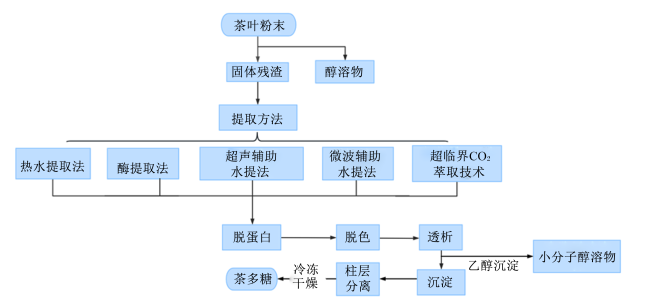
茶多糖最常见的提取方法有热水提取法[15]、酶提法[18]、超声提取法[19]、微波提取法[20]和超临界二氧化碳(CO2)萃取技术[21]等(图1),其中热水提取法成本低,操作简单,不易破坏多糖的生物活性[22]。酶提法主要使用的酶有纤维素酶、水解酶、果胶酶和复合酶等[23],其提取率相对于热水提取法较高。此外,复合酶法提取多糖的效果优于单酶法[24]。超声提取法利用超声波的高频振动使植物细胞壁破裂,活性成分迅速被浸出,特点是提取率高,时耗少[25]。微波提取法通过高能量微波使细胞壁破裂,释放多糖等物质,特点是萃取时间短、速度快、得率高、操作简单、萃取剂用量少和污染小[26-27]。超临界CO2萃取技术提取率高、纯度高、提取时间短、活性破坏小,但成本较高而未被广泛应用[28]。高压均质法[14]、碱性水提法[15]、脉冲电场超声波辅助提取法[29]和超声辅助深度共晶溶剂提取法[30]等新颖的提取方法也被应用于茶多糖研究中(表3)。Zhu等[31]比较了热水提取法、超声辅助提取法、微波辅助提取法和酶提取法的粗茶提取率,分别为3.98%、4.31%、4.17%和4.52%。这表明茶多糖的提取率、理化性质和生物活性等都与提取方法密切相关[13]。另外,协同提取方法比单一方法提取率高[32]。综上所述,茶多糖的单糖组成、理化性质和生物活性都与茶多糖提取方法存在密切联系,但关系尚未明确。
图1 茶多糖主要的提取方法流程图

Fig.1 Flowchart of main extraction methods of tea polysaccharides

表3 茶多糖的提取方法

Table 3 Extraction methods of tea polysaccharides

提取方法
Extraction methods
最佳工艺
Optimal process
提取率
Extraction rate/%
参考文献
References
超声辅助深度共晶溶剂提取法
Ultrasound-assisted deep eutectic
solvent extraction method
料液比1∶30(g/mL),氯化胆碱和1,6-
己二二醇摩尔比1∶2,温度25 ℃,
超声功率(35 kHz,50 W)
19.18 [30]
热水提取法
Hot water extraction method
料液比1∶50(g/mL),温度94 ℃,
时间210 min
2.16 [33]
脉冲电场超声波辅助提取法
Pulsed electric fields and ultrasonic-
assisted extraction method
料液比1∶30(g/mL),脉冲电场强度
10 kV/cm,超声功率400 W,时间60 min
41.53 [29]
超声波辅助提取法
Ultrasound-assisted extraction method
料液比1∶22(g/mL),温度80 ℃,超声
功率400 W,时间60 min
4.65±0.29 [34]
微波-超声协同萃取法
Microwave-ultrasonic synergistic
extraction method
料液比1∶20(g/mL),微波功率250 W,超声
功率250 W,温度60 ℃,时间210 s
4.56 [32]
微波辅助提取法
Microwave-assisted extraction method
料液比1∶8(g/mL),微波功率600 W,
温度50°C,时间30 min
4.31 [31]
超临界CO2萃取技术
Supercritical CO2 extraction technology
粒径380 μm,乙醇20%,压力35 MPa,
温度45 ℃,时间2 h
92.50 [21]
高压均质萃取法
High-pressure homogenization extraction method
料液比1∶20(g/mL),压力20 MPa,
室温进行,时间小于0.5 h
15.40 [35]
酶提取法
Enzymatic extraction method
料液比1∶80(g/mL),5%(m/v)戊聚糖复合
酶溶液pH 5.5,温度45 ℃,时间2 h
4.08 [36]

3 茶多糖的生物学功能

3.1 抗氧化

动物体内呼吸代谢会产生一系列活性氧(ROS)如:超氧阴离子($\mathrm{O}_2^{-}$)、过氧化氢(H2O2)、羟基自由基(·OH)以及一氧化氮(NO)等。正常情况下,机体的吞噬细胞可产生适量的ROS来对抗微生物的入侵[37]。当机体内ROS平衡被打破时,过量的ROS会造成细胞膜以及DNA的损伤,最终导致疾病的产生[38]。大量研究表明,茶多糖具有抗氧化生物活性,能够减轻机体内的氧化损伤[13,39-42]。·OH是机体内氧化活性最强的自由基,能诱导生物膜的氧化损伤[43]。茶多糖的酸性多糖含有羧基提供的活泼氢,能够与·OH结合生成水,并经过一系列的氧化反应,最后分解为无害产物[44]。$\mathrm{O}_2^{-}$是一类会引起脂质过氧化的ROS[45],绿茶茶多糖的中性多糖和酸性多糖能协同降低$\mathrm{O}_2^{-}$对机体的氧化损伤[13]。富硒茶含硒茶多糖能有效缓解H2O2诱导的DNA损伤[42]。此外,在小鼠体内试验中,紫阳绿茶新型多糖偶联物可以提高肌肉中谷胱甘肽过氧化物酶(GSH-Px)活性,降低骨骼肌丙二醛(MDA)含量,从而减低力竭运动所引致的氧化应激,改善运动性疲劳[46]。同时,英山云雾茶多糖也能提高体内血清中超氧化物歧化酶(SOD)、过氧化氢酶(CAT)的活性,并且降低MDA含量以抑制脂质过氧化,降低细胞的损伤[47]。普洱茶含有茶褐素、多糖和咖啡因,尽管尚不清楚哪种成分与NO水平的下调有关,但是普洱茶可通过Toll样受体4(TLR4)信号通路抑制脂多糖诱导的一氧化氮合酶(iNOS)表达,从而降低NO的产生,缓解机体氧化应激损伤[48]

3.2 免疫调节

免疫器官、免疫细胞和免疫分子构成的多层免疫屏障,是免疫系统的重要组成部分。免疫系统的紊乱会导致多种疾病的产生[49-50],免疫活性降低易引起免疫缺陷以及各种严重感染疾病。另外,当免疫活性过强时,会导致自身免疫病等疾病的产生。巨噬细胞是一种吞噬病原体和呈递抗原的免疫细胞。有研究表明,茶多糖能够活化巨噬细胞并增强吞噬活性[51]。除增强免疫细胞活性外,茶多糖还能增加血清中免疫球蛋白A、免疫球蛋白G和免疫球蛋白M的含量[52],增加胸腺和脾脏的指数,提高免疫应答能力,增强机体免疫力,达到抑制肿瘤的作用[53]。在环磷酰胺(CTX)诱导的免疫抑制模型中,茯砖茶多糖可以促进RAW264.7增殖,恢复CTX处理小鼠免疫活性,显著增加肠道黏蛋白2、闭合蛋白(Occludin)和闭锁小带蛋白-1(ZO-1)分泌和表达,修复肠道屏障功能[15]
茶多糖也能抑制过强的免疫反应。巨噬细胞极化有2种方向——M1和M2型,M1型可释放促炎因子,具有促炎作用;M2型主要参与组织修复和免疫调节,具有抗炎作用[54]。茶多糖可以调节巨噬细胞极化方向,促进巨噬细胞M2极化,保护机体免受炎症的损伤。在体外试验中,大叶黄茶多糖(LYP-S3)能够显著降低M1巨噬细胞标志物肿瘤坏死因子-α(TNF-α)、白细胞介素-1β(IL-1β)、iNOS、白细胞介素-12(IL-12)和白细胞介素-6(IL-6)等mRNA的表达,并且存在剂量依赖性[55]。同时,LYP-S3可显著抑制3T3-L1脂肪细胞的分化和脂肪生成,并阻止巨噬细胞向3T3-L1脂肪细胞迁移,有效降低脂肪细胞的炎症,从而保护脂肪组织[55]。1型糖尿病是一种免疫因子紊乱的自身免疫病,茶多糖能够促进脾细胞中白细胞介素-2(IL-2)的产生,抑制体内白细胞介素-1(IL-1)的产生[56]。其中,IL-2不仅能引起调节性T细胞的增殖,还能补偿与1型糖尿病相关的遗传缺陷,IL-1的活性封锁常被用于自身免疫性疾病的治疗[57]
研究表明,茶多糖被细胞膜上的TLR4识别后,可以通过促分裂原活化蛋白激酶(MAPK)、磷脂酰肌醇-3-激酶/丝苏氨酸蛋白激酶和核因子-κB(NF-κB)等信号通路调控巨噬细胞的激活,促进小鼠巨噬细胞RAW264.7分泌NO、TNF-α、IL-1β、IL-6等细胞因子并适当地提高机体免疫力[58]。同时,茯砖茶多糖能增加乳杆菌数量和代谢物[59],促进白细胞介素-22(IL-22)的分泌,促进肠道屏障的修复[60]

3.3 抗肿瘤

在体内和体外试验表明,茶多糖对肝癌、宫颈癌、前列腺癌等多种癌细胞的生长均具有抑制作用。Liu等[61]在体外试验中发现,天山绿茶多糖对人肝癌细胞(HepG2)的增殖具有显著抑制作用。茯砖茶多糖也可以抑制宫颈癌患者癌细胞系(HeLa)细胞的增殖[62]。有研究指出,茶多糖和茶多酚结合物的抗肿瘤效果要强于单独使用多糖或者多酚,乌龙茶中多酚和多糖结合物在体内外试验中均表现出协同抑制肝细胞癌的增殖[63]
研究显示,茶多糖通过多种途径引起癌细胞的凋亡,从而达到抑癌的作用。茶多糖降低细胞周期蛋白、基质金属蛋白酶-2(MMP-2)和基质金属蛋白酶-9(MMP-9)的表达水平,从而抑制癌细胞的增殖[64]。绿茶多糖还能增加失效同系物2蛋白表达,抑制蛋白激酶B和细胞外调节蛋白激酶1/2信号通路,从而诱导前列腺癌细胞凋亡[65]。富硒茶多糖通过上调肿瘤抑制蛋白表达,抑制G2/M期乳腺癌细胞(MCF-7)的增殖,促进其凋亡[17,66],同时显著提高凋亡调控蛋白(Bax)/B淋巴细胞瘤-2(Bcl-2)蛋白比值,激活半胱氨酸蛋白酶触发线粒体凋亡通路,进而有效抑制癌细胞[17]。此外,Zhou等[67]研究指出,茶多糖能通过哺乳动物雷帕霉素靶蛋白-转录因子EB(mTOR-TFEB)信号通路靶向溶酶体诱导细胞毒性自噬抑制癌细胞(HCT116)的增殖。
研究发现,茯砖茶多糖能增加肠道中微生物代谢物短链脂肪酸(SCFA)的产量[68]。SCFA是肠道菌群-宿主交互作用的重要信息分子[69],SCFA被受体G蛋白偶联受体(GPCR)识别后进入细胞中,丁酸盐和丙酸盐会抑制组蛋白脱乙酰酶(HDAC)活性,而HDAC的抑制是促进大肠癌细胞凋亡的机制之一,被广泛应用于癌症的治疗[70]

3.4 调节肠道微生物

微生物对维持肠道-宿主健康起重要的作用。许多代谢疾病以及炎症反应都和肠道微生物的紊乱有关如糖尿病等。研究显示,多糖作为一种益生元,能够满足益生菌代谢需要,调节肠道微生物菌群,并治疗相关代谢疾病[71]。茶多糖可通过改善宿主中肠道微生物菌群结构,治疗并预防肥胖等代谢疾病。在糖尿病患者肠道中,拟杆菌门与厚壁菌门比值降低并和糖耐量降低呈正相关[72]。补充武夷岩茶茶多糖后,显著降低2型糖尿病大鼠的血糖水平,改善高血糖大鼠的糖代谢异常和肠道菌群紊乱[73]。在CTX模型中,茶多糖能改善CTX诱导的肠道菌群失调,增加产生SCFA的毛螺菌科、普雷沃氏菌科和瘤胃球菌科的丰度,同时减少致病微生物脱硫弧菌科和幽门螺杆菌的丰度[15]。Du等[68]采用了粪便微生物移植技术来研究砖茯茶多糖的抗肥胖作用,发现茯砖茶多糖可以增强肠道微生物群来源的脂肪燃烧和能量消耗,从而预防饮食诱导的肥胖以及相关代谢并发症。
茶多糖除了能缓解肠道菌群紊乱外,还能增加有益的微生物代谢产物。英山云雾绿茶多糖结合物能够增加肠道中拟杆菌属和瘤胃球菌属等益生菌的丰度[74],其中瘤胃球菌属最主要的功能是产生丁酸或丙酸[75],而丁酸盐是上皮细胞优质的能量来源。SCFA是宿主营养与肠道相互交流的桥梁,具有维护肠道健康和调节免疫功能[76]。据报道,SCFA能促进肠上皮L细胞的分化,分泌更多的胰高血糖素样肽-1、肽YY和血清素等物质,能够预防和治疗糖尿病及高血糖症[77]。同时,SCFA也可通过调节肠道上皮细胞分泌抗菌肽来增强上皮免疫屏障功能。例如,丁酸盐在体内外试验中均能增加结肠抗菌肽LL-37的水平,促进肠道黏膜细胞的再生和修复,保护肠道屏障健康[78-79]。此外,茯砖茶多糖能改变色氨酸代谢,提高粪便中吲哚-3-乙醛和吲哚-3-乙酸的含量[59],而吲哚类化合物能够促进芳香烃受体和IL-22的表达,并促进小肠紧密连接蛋白ZO-1和Occludin的表达,增强肠道上皮屏障功能,保护机体免受有害微生物的侵害[80]

3.5 其他生物学作用

溃疡性结肠炎是一种全球发病率逐年上升的炎症性肠病,其主要症状为腹泻、腹痛和体重减轻[81]。茯砖茶多糖的添加可以使乳杆菌数量和SCFA含量增加,促进肠道紧密连接蛋白ZO-1和Occludin的表达,恢复肠道屏障,缓解结肠炎症状[59]。富硒茶多糖能够降低促炎因子水平并增强结肠组织的抗氧化能力,从而有效缓解葡聚糖硫酸钠诱导的小鼠结肠炎症状[82]。缺血性脑中风是导致脑血流中断的主要原因之一,也是全球范围内导致死亡和残疾的重要因素。茶多糖通过调节miR-375/硫氧还蛋白1(SRXN1)轴减少氧-葡萄糖剥夺/复氧诱导的缺血性中风模型中的星形胶质细胞凋亡,减轻缺血性脑中风的症状[83]。糖尿病是全球性代谢疾病,高血糖是该病的特征之一。茶多糖可通过抑制钠-葡萄糖共转运蛋白1或葡萄糖转运体2的表达,减少葡萄糖的吸收来控制餐后血糖水平,从而降低肥胖概率[39]。茶多糖对α-葡萄糖苷酶的抑制也是其抗肥胖和降血糖的作用机制之一[84]。此外,茶多糖还具有保肝作用,连续2周口服黄山毛峰绿茶多糖后用四氯化碳处理,能够显著降低四氯化碳毒性以及对肝脏损伤的血清标志物丙氨酸转氨酶、天门冬氨酸转氨酶活性及总胆固醇和甘油三酯含量,显著抑制MDA和异前列腺素引起的肝脂质过氧化形成,并提高肝脏GSH-Px和SOD活性[85]
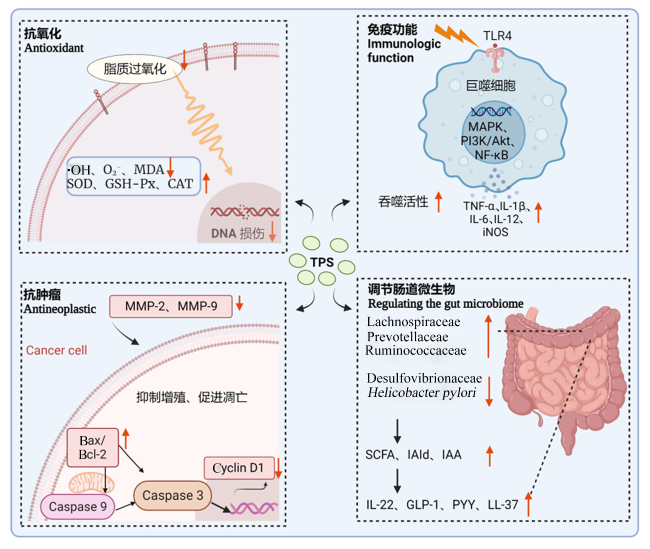
综上所述,茶多糖具有抗氧化、抗肿瘤、增加免疫力和调节肠道微生物等功能(图2),具有潜在的应用价值。
图2 茶多糖生物学功能

TPS:茶多糖 tea polysaccharide;·OH:羟基自由基 hydroxyl radical;$\mathrm{O}_2^{-}$:超氧阴离子 superoxide anion;MDA:丙二醛malondialdehyde;SOD:超氧化物歧化酶 superoxide dismutase;GSH-Px:谷胱甘肽过氧化物酶 glutathione peroxidase;CAT:过氧化氢酶 catalase;MAPK:促分裂原活化蛋白激酶 mitogen-activated protein kinase;PI3K/Akt:磷脂酰肌醇-3-激酶/丝苏氨酸蛋白激酶 phosphatidylinositol-3-kinase/Akt serine/threonine kinase;NF-κB:核因子-κB nuclear factor-kappa B;iNOS:诱导型一氧化氮合酶 inducible nitric oxide synthase;TNF-α:肿瘤坏死因子-α tumor necrosis factor-alpha;IL-1β:白细胞介素-1β interleukin-1 beta;IL-6:白细胞介素-6 interleukin-6;IL-12:白细胞介素-12 interleukin-12;MMP-2:基质金属蛋白酶-2 matrix metalloproteinase-2;MMP-9:基质金属蛋白酶-9 matrix metalloproteinase-9;Bax:凋亡调控蛋白 apoptosis regulatory proteins; Bcl-2:B 淋巴细胞瘤-2 lymphoma-2;Cyclin D1:细胞周期蛋白D1;Caspase 3:激活半胱氨酸蛋白酶3;Caspase 9:激活半胱氨酸蛋白酶9;Lactobacillaceae:乳酸杆菌科;Prevotellaceae:普雷沃氏菌科;Ruminococcaceae:瘤胃球菌科;Desulfurobacteriaceae:脱硫弧菌科;Helicobacter pylori:幽门螺杆菌;SCFA:短链脂肪酸 short-chain fatty acid;IAId:吲哚-3-乙醛 indole-3-acetaldehyde;IAA:吲哚-3-乙酸 indole-3-acetic acid;IL-22:白细胞介素-22 interleukin-22;GLP-1:胰高血糖素样肽-1 glucagon-like peptide-1;PYY:肽YY peptide YY;LL-37:抗菌肽LL-37 antimicrobial peptide LL-37。

Fig.2 Biological functions of tea polysaccharide

4 茶多糖在畜禽生产中的应用

在现代规模化集约化养殖生产中,生产力不断提高,畜牧的养殖周期和出栏天数日益缩短。与此同时,“禁抗”时代的来临,畜牧业也出现了抗病力和肉品质下降等问题。茶多糖作为一种天然的植物提取物,具有多种生物活性和功能,可以提高动物的生长性能、缓解氧化应激、提升畜产品质量和改善肉质口感。Li等[86]分别使用200、400和800 mg/kg的茶多糖喂养肉鸡,发现英山云雾茶多糖能增加肉鸡的日增重、日采食量以及鸡肉中游离氨基酸的总量,并提高组氨酸、亮氨酸、丝氨酸、谷氨酸和丙氨酸的含量;此外,英山云雾茶多糖还能改善鸡肉的风味,增加影响肉质关键风味的肌苷单磷酸盐和瓜尼单磷酸盐的含量。在爱拔益加(AA)肉鸡的饮水中分别添加0.2%和0.4% 的茶多糖后,显著提高肉仔鸡血清中SOD、GSH-Px和CAT的活性,并且显著降低血清中MDA含量,减少肉仔鸡的氧化应激损伤[87]。同时,茶多糖能促进肉仔鸡胸腺的生长发育,提高血清中免疫球蛋白G的含量,提高T淋巴细胞数和淋巴细胞转化率,增强白细胞吞噬功能,从而增强肉仔鸡免疫能力[87]。在崇仁麻鸡饲粮中添加英山云雾茶多糖,不仅提高血清SOD和GSH-Px等酶活性,而且提高了核因子E2-相关因子2、血红素氧化酶-1和纤维连接蛋白1的蛋白以及mRNA水平;另外,茶多糖能显著改善鸡肠道菌群结构,提高α和β多样性指数,增加肠道乳酸杆菌丰富度;英山云雾绿茶多糖能够提高28和56日龄时胸肌pH,其中高剂量组的pH显著高于对照组,在56日龄时,高剂量组的肌肉硬度、韧性和黏附性均显著改善[74]。目前,茶多糖在蛋鸡以及其他动物的生产应用研究开展较少,只停留在茶叶及其提取物研究与应用。在奶牛泌乳中期研究中,王冬凯等[88]在饲粮中添加茶叶提取物,有效地保护乳腺细胞,提高产奶性能和奶品质,奶牛的生产性能和机体的抗氧化能力得到改善。在饲粮中添加250和500 g/t茶叶提取物均能降低育肥猪的料重以及提高肌肉抗氧化能力,添加500 g/t的茶叶提取物能够明显降低系水力和滴水损失[89]
综上所述,茶多糖在畜牧业中已经取得一定的研究成果,但局限于肉鸡上的研究应用。期待更多的相关领域研究应用结果的发表,为该领域的发展奠定基础。

5 小结

茶多糖通过TLR4、mTOR-TFEB、NF-κB和MAPK等途径发挥抗氧化、抗肿瘤和调节免疫等生理功能,可作为一种新型替抗饲料添加剂,在肉鸡应用中表现出提高生产性能、改善产品品质和调节肠道菌群结构等作用,具有广泛的开发利用价值和应用前景。但过去的几十年里专注于研究茶叶中小分子的活性成分,如茶多酚、儿茶素和咖啡因等,而对茶叶中的大分子酸性杂多糖研究的较少,因此该领域还存在许多问题有待解决,如茶多糖复杂的结构与理化性质、提取纯化技术和生物学功能关系有待进一步研究;茶多糖发挥生物学功能以及内在机制需要进一步研究探讨。此外,茶多糖相关的应用研究主要集中在小鼠和细胞上,在畜禽上的研究相对有限,不同物种、不同性别和不同阶段的适宜剂量尚不清楚。在今后应进一步加强茶多糖在猪、鸡、牛、羊等动物生产应用中的研究,为茶多糖作为一种绿色饲料添加剂应用于动物生产提供新的理论依据。
[1]
TANG G Y, MENG X, GAN R Y, et al. Health functions and related molecular mechanisms of tea components:an update review[J]. International Journal of Molecular Sciences, 2019, 20(24):6196.

DOI

[2]
HU Y, LIN L, LIU K H, et al. L-theanine alleviates heat stress-induced impairment of immune function by regulating the p38 MAPK signalling pathway in mice[J]. Food & Function, 2023, 14(1):335-343.

[3]
CHEN G J, CHEN R S, CHEN D, et al. Tea polysaccharides as potential therapeutic options for metabolic diseases[J]. Journal of Agricultural and Food Chemistry, 2019, 67(19):5350-5360.

DOI PMID

[4]
余立平. 茶叶的分类与品质特点探讨[J]. 种子科技, 2019, 37(3):85-86.

YU L P. Discussion on classification and quality characteristics of tea[J]. Seed Science & Technology, 2019, 37(3):85-86. (in Chinese)

[5]
CHEN G J, YUAN Q X, SAEEDUDDIN M, et al. Recent advances in tea polysaccharides:extraction,purification,physicochemical characterization and bioactivities[J]. Carbohydrate Polymers, 2016, 153:663-678.

DOI

[6]
宋励修, 秦建. 茶叶中茶多糖含量的比较分析[J]. 安徽农业科学, 2016, 44(23):35-36,71.

SONG L X, QIN J. Comparative analysis of tea polysaccharides in different types of teas[J]. Journal of Anhui Agricultural Sciences, 2016, 44(23):35-36,71. (in Chinese)

[7]
GUO H, FU M X, WU D T, et al. Structural characteristics of crude polysaccharides from 12 selected Chinese teas,and their antioxidant and anti-diabetic activities[J]. Antioxidants, 2021, 10(10):1562.

DOI

[8]
YANG X B, LV Y, TIAN L M, et al. Composition and systemic immune activity of the polysaccharides from an herbal tea (Lycopus lucidus Turcz)[J]. Journal of Agricultural and Food Chemistry, 2010, 58(10):6075-6080.

DOI

[9]
CHEN X Q, WU X F, ZHANG K, et al. Purification,characterization,and emulsification stability of high- and low-molecular-weight fractions of polysaccharide conjugates extracted from green tea[J]. Food Hydrocolloids, 2022, 129:107667.

DOI

[10]
杨伟丽, 肖文军, 邓克尼. 加工工艺对不同茶类主要生化成分的影响[J]. 湖南农业大学学报(自然科学版), 2001, 27(5):384-386.

YANG W L, XIAO W J, DENG K N. Effects of processing technology of different teas on the main biochemistry components[J]. Journal of Hunan Agricultural University(Natural Sciences), 2001, 27(5):384-386. (in Chinese)

[11]
LV Y, YANG X B, ZHAO Y, et al. Separation and quantification of component monosaccharides of the tea polysaccharides from Gynostemma pentaphyllum by HPLC with indirect UV detection[J]. Food Chemistry, 2009, 112(3):742-746.

DOI

[12]
FAN M H, ZHU J X, QIAN Y L, et al. Effect of purity of tea polysaccharides on its antioxidant and hypoglycemic activities[J]. Journal of Food Biochemistry, 2020, 44(8):e13277.

[13]
CHEN H X, ZHANG M, QU Z S, et al. Antioxidant activities of different fractions of polysaccharide conjugates from green tea (Camellia sinensis)[J]. Food Chemistry, 2008, 106(2):559-563.

DOI

[14]
CHEN H, HUANG Y Z, ZHOU C C, et al. Effects of ultra-high pressure treatment on structure and bioactivity of polysaccharides from large leaf yellow tea[J]. Food Chemistry, 2022, 387:132862.

DOI

[15]
SUN Y J, WANG F, LIU Y, et al. Comparison of water- and alkali-extracted polysaccharides from Fuzhuan brick tea and their immunomodulatory effects in vitro and in vivo[J]. Food & Function, 2022, 13(2):806-824.

[16]
CHEN H X, QU Z S, FU L L, et al. Physicochemical properties and antioxidant capacity of 3 polysaccharides from green tea,oolong tea,and black tea[J]. Journal of Food Science, 2009, 74(6):C469-C474.

[17]
HE N W, SHI X L, ZHAO Y, et al. Inhibitory effects and molecular mechanisms of selenium-containing tea polysaccharides on human breast cancer MCF-7 cells[J]. Journal of Agricultural and Food Chemistry, 2013, 61(3):579-588.

DOI PMID

[18]
CHANG B, KIM T, KIM S, et al. Polysaccharides from pectinase digests of green tea enhances host immune defence through Toll-like receptor 4[J]. Food and Agricultural Immunology, 2018, 29(1):870-885.

DOI

[19]
TSUBAKI S, IIDA H, SAKAMOTO M, et al. Microwave heating of tea residue yields polysaccharides,polyphenols,and plant biopolyester[J]. Journal of Agricultural and Food Chemistry, 2008, 56(23):11293-11299.

DOI

[20]
WU D T, FU M X, GUO H, et al. Microwave-assisted deep eutectic solvent extraction, structural characteristics,and biological functions of polysaccharides from sweet tea (Lithocarpus litseifolius) leaves[J]. Antioxidants, 2022, 11(8):1578.

DOI

[21]
CHEN M, XIONG L Y. Supercritical extraction technology in tea polysaccharide extracting application[J]. Advanced Materials Research, 2011, 347/353:1683-1688.

DOI

[22]
WEI X L, MAO F F, CAI X, et al. Composition and bioactivity of polysaccharides from tea seeds obtained by water extraction[J]. International Journal of Biological Macromolecules, 2011, 49(4):587-590.

DOI PMID

[23]
CHEN X Q, XIE J C, WEI H, et al. Comparative analysis of physicochemical characteristics of green tea polysaccharide conjugates and its decolored fraction and their effect on HepG2 cell proliferation[J]. Industrial Crops and Products, 2019, 131:243-249.

DOI

[24]
FAN Y M, ZHOU X F, HUANG G L. Preparation,structure,and properties of tea polysaccharide[J]. Chemical Biology & Drug Design, 2022, 99(1):75-82.

[25]
WANG H S, CHEN J R, REN P F, et al. Ultrasound irradiation alters the spatial structure and improves the antioxidant activity of the yellow tea polysaccharide[J]. Ultrasonics Sonochemistry, 2021, 70:105355.

DOI

[26]
ESKILSSON C S, BJÖRKLUND E. Analytical-scale microwave-assisted extraction[J]. Journal of Chromatography A, 2000, 902(1):227-250.

PMID

[27]
MENG H H, WU J J, SHEN L, et al. Microwave assisted extraction,characterization of a polysaccharide from Salvia miltiorrhiza Bunge and its antioxidant effects via ferroptosis-mediated activation of the Nrf2/HO-1 pathway[J]. International Journal of Biological Macromolecules, 2022, 215:398-412.

DOI

[28]
ESSIEN S O, YOUNG B, BAROUTIAN S. Recent advances in subcritical water and supercritical carbon dioxide extraction of bioactive compounds from plant materials[J]. Trends in Food Science & Technology, 2020, 97:156-169.

[29]
GAO W L, ZHANG N, LI S Y, et al. Polysaccharides in selenium-enriched tea:extraction performance under innovative technologies and antioxidant activities[J]. Foods, 2022, 11(17):2545.

DOI

[30]
XIA B, LIU Q, SUN D, et al. Ultrasound-assisted deep eutectic solvent extraction of polysaccharides from Anji white tea:characterization and comparison with the conventional method[J]. Foods, 2023, 12(3):588.

DOI

[31]
ZHU J X, CHEN Z Y, ZHOU H, et al. Effects of extraction methods on physicochemical properties and hypoglycemic activities of polysaccharides from coarse green tea[J]. Glycoconjugate Journal, 2020, 37(2):241-250.

DOI PMID

[32]
WANG T, LI W, LI T X. Microwave-ultrasonic synergistic extraction of crude se-polysaccharides from se-enriched tea[J]. Key Engineering Materials, 2017, 737:360-366.

DOI

[33]
YANG W, CHEN T T, YU S, et al. Optimization of extraction process of Yingshan cloud tea polysaccharides by response surface methodology[J]. Agricultutural Blotechnology, 2019, 8(6):106-109,137.

[34]
KARADAG A, PELVAN E, DOGAN K, et al. Optimisation of green tea polysaccharides by ultrasound-assisted extraction and their in vitro antidiabetic activities[J]. Quality Assurance and Safety of Crops & Foods, 2019, 11(5):479-490.

[35]
ZHOU C C, HUANG Y Z, CHEN J L, et al. Effects of high-pressure homogenization extraction on the physicochemical properties and antioxidant activity of large-leaf yellow tea polysaccharide conjugates[J]. Process Biochemistry, 2022, 122(Part 2):87-94.

DOI

[36]
WANG Y F, YANG Z W, WEI X L. Sugar compositions,α-glucosidase inhibitory and amylase inhibitory activities of polysaccharides from leaves and flowers of Camellia sinensis obtained by different extraction methods[J]. International Journal of Biological Macromolecules, 2010, 47(4):534-539.

DOI

[37]
CURI R, NEWSHOLME P, MARZUCA-NASSR G N, et al. Regulatory principles in metabolism-then and now[J]. Biochemical Journal, 2016, 473(13):1845-1857.

DOI PMID

[38]
SHIELDS H J, TRAA A, VAN RAAMSDONK J M. Beneficial and detrimental effects of reactive oxygen species on lifespan:a comprehensive review of comparative and experimental studies[J]. Frontiers in Cell and Developmental Biology, 2021, 9:628157.

DOI

[39]
OH J H, CHUNG J O, LEE C Y, et al. Characterized polysaccharides from green tea inhibited starch hydrolysis and glucose intestinal uptake by inducing microstructural changes of wheat starch[J]. Journal of Agricultural and Food Chemistry, 2021, 69(47):14075-14085.

DOI

[40]
WANG Y F, YANG Z W, WEI X L. Antioxidant activities potential of tea polysaccharide fractions obtained by ultra filtration[J]. International Journal of Biological Macromolecules, 2012, 50(3):558-564.

DOI PMID

[41]
ALMAJANO M P, CARBÓ R, JIMÉNEZ J A L, et al. Antioxidant and antimicrobial activities of tea infusions[J]. Food Chemistry, 2008, 108(1):55-63.

DOI

[42]
GU Y G, QIU Y, WEI X, et al. Characterization of selenium-containing polysaccharides isolated from selenium-enriched tea and its bioactivities[J]. Food Chemistry, 2020, 316:126371.

DOI

[43]
REITER R J, MELCHIORRI D, SEWERYNEK E, et al. A review of the evidence supporting melatonin's role as an antioxidant[J]. Journal of Pineal Research, 1995, 18(1):1-11.

DOI PMID

[44]
张明珠, 秦华光, 穆丹, 等. 茶多糖的抗氧化活性及对细胞氧化损伤的保护机制[J]. 植物学报, 2022, 57(4):444-456.

DOI

ZHANG M Z, QIN H G, MU D, et al. Antioxidant activity of tea polysaccharide and its protective mechanism against oxidative damage[J]. Chinese Bulletin of Botany, 2022, 57(4):444-456. (in Chinese)

[45]
YAN Y T, REN Y F, LI X M, et al. A polysaccharide from green tea (Camellia sinensis L.) protects human retinal endothelial cells against hydrogen peroxide-induced oxidative injury and apoptosis[J]. International Journal of Biological Macromolecules, 2018, 115:600-607.

DOI

[46]
CHI A P, LI H, KANG C Z, et al. Anti-fatigue activity of a novel polysaccharide conjugates from Ziyang green tea[J]. International Journal of Biological Macromolecules, 2015, 80:566-572.

DOI

[47]
LI X, CHEN S, LI J E, et al. Chemical composition and antioxidant activities of polysaccharides from Yingshan cloud mist tea[J]. Oxidative Medicine and Cellular Longevity, 2019, 2019:1915967.

[48]
XU Y, WANG G, LI C J, et al. Pu-erh tea reduces nitric oxide levels in rats by inhibiting inducible nitric oxide synthase expression through Toll-like receptor 4[J]. International Journal of Molecular Sciences, 2012, 13(6):7174-7185.

DOI PMID

[49]
KAWANO Y, EDWARDS M, HUANG Y M, et al. Microbiota imbalance induced by dietary sugar disrupts immune-mediated protection from metabolic syndrome[J]. Cell, 2022, 185(19):3501-3519.e20.

DOI PMID

[50]
CHEN Y Y, TIAN Z G. HBV-induced immune imbalance in the development of HCC[J]. Frontiers in Immunology, 2019, 10:2048.

DOI PMID

[51]
MONOBE M, EMA K, TOKUDA Y, et al. Enhancement of the phagocytic activity of macrophage-like cells with a crude polysaccharide derived from green tea (Camellia sinensis) extract[J]. Bioscience,Biotechnology,and Biochemistry, 2010, 74(6):1306-1308.

DOI

[52]
YANG J J, CHEN B, GU Y. Pharmacological evaluation of tea polysaccharides with antioxidant activity in gastric cancer mice[J]. Carbohydrate Polymers, 2012, 90(2):943-947.

DOI PMID

[53]
CHENG L Z, CHEN L, YANG Q Q, et al. Antitumor activity of Se-containing tea polysaccharides against sarcoma 180 and comparison with regular tea polysaccharides and Se-yeast[J]. International Journal of Biological Macromolecules, 2018,120(Pt.A):853-858.

[54]
ORECCHIONI M, GHOSHEH Y, PRAMOD A B, et al. Macrophage polarization:different gene signatures in M1(LPS+) vs. classically and M2(LPS-) vs. alternatively activated macrophages[J]. Frontiers in Immunology, 2019, 10:1084.

DOI

[55]
CHEN G J, BAI Y X, ZENG Z Q, et al. Structural characterization and immunostimulatory activity of heteropolysaccharides from Fuzhuan brick tea[J]. Journal of Agricultural and Food Chemistry, 2021, 69(4):1368-1378.

DOI PMID

[56]
DU L L, FU Q Y, XIANG L P, et al. Tea polysaccharides and their bioactivities[J]. Molecules, 2016, 21(11):1449.

DOI

[57]
DWYER C J, WARD N C, PUGLIESE A, et al. Promoting immune regulation in type 1 diabetes using low-dose interleukin-2[J]. Current Diabetes Reports, 2016, 16(6):46.

DOI PMID

[58]
REN D Y, ZHAO Y, ZHENG Q, et al. Immunomodulatory effects of an acidic polysaccharide fraction from herbal Gynostemma pentaphyllum tea in RAW264.7 cells[J]. Food & Function, 2019, 10(4):2186-2197.

[59]
YANG W Q, REN D Y, ZHAO Y, et al. Fuzhuan brick tea polysaccharide improved ulcerative colitis in association with gut microbiota-derived tryptophan metabolism[J]. Journal of Agricultural and Food Chemistry, 2021, 69(30):8448-8459.

DOI

[60]
TENG Y, REN Y, SAYED M, et al. Plant-derived exosomal microRNAs shape the gut microbiota[J]. Cell Host & Microbe, 2018, 24(5):637-652.e8.

[61]
LIU J B, LIN J, HUANG Z H, et al. Chemical characterization of Tianshan green tea polysaccharides and its protective effects on cell oxidative injury[J]. Journal of Food Biochemistry, 2022, 46(1):e14000.

[62]
XIAO H, FU X, CAO C L, et al. Sulfated modification, characterization, antioxidant and hypoglycemic activities of polysaccharides from Sargassum pallidum[J]. International Journal of Biological Macromolecules, 2019, 121:407-414.

DOI

[63]
WANG J Y, LIU W, CHEN Z Q, et al. Physicochemical characterization of the oolong tea polysaccharides with high molecular weight and their synergistic effects in combination with polyphenols on hepatocellular carcinoma[J]. Biomedicine & Pharmacotherapy, 2017, 90:160-170.

DOI

[64]
LIU L Q, LI H S, NIE S P, et al. Tea polysaccharide prevents colitis-associated carcinogenesis in mice by inhibiting the proliferation and invasion of tumor cells[J]. International Journal of Molecular Sciences, 2018, 19(2):506.

DOI

[65]
YANG K, GAO Z Y, LI T Q, et al. Anti-tumor activity and the mechanism of a green tea (Camellia sinensis) polysaccharide on prostate cancer[J]. International Journal of Biological Macromolecules, 2019, 122:95-103.

DOI PMID

[66]
XU A A, LAI W Y, CHEN P, et al. A comprehensive review on polysaccharide conjugates derived from tea leaves:composition,structure,function and application[J]. Trends in Food Science & Technology, 2021, 114:83-99.

[67]
ZHOU Y J, ZHOU X T, HUANG X J, et al. Lysosome-mediated cytotoxic autophagy contributes to tea polysaccharide-induced colon cancer cell death via mTOR-TFEB signaling[J]. Journal of Agricultural and Food Chemistry, 2021, 69(2):686-697.

DOI PMID

[68]
DU H P, SHI L, WANG Q, et al. Fu brick tea polysaccharides prevent obesity via gut microbiota-controlled promotion of adipocyte browning and thermogenesis[J]. Journal of Agricultural and Food Chemistry, 2022, 70(43):13893-13903.

DOI

[69]
MAR J S, OTA N, POKORZYNSKI N D, et al. IL-22 alters gut microbiota composition and function to increase aryl hydrocarbon receptor activity in mice and humans[J]. Microbiome, 2023, 11(1):47.

DOI PMID

[70]
HE J, ZHANG P W, SHEN L Y, et al. Short-chain fatty acids and their association with signalling pathways in inflammation,glucose and lipid metabolism[J]. International Journal of Molecular Sciences, 2020, 21(17):6356.

DOI

[71]
ZHU W, ZHOU S X, LIU J H, et al. Prebiotic,immuno-stimulating and gut microbiota-modulating effects of Lycium barbarum polysaccharide[J]. Biomedicine & Pharmacotherapy, 2020, 121:109591.

DOI

[72]
FAN Y, PEDERSEN O. Gut microbiota in human metabolic health and disease[J]. Nature Reviews Microbiology, 2021, 19(1):55-71.

DOI

[73]
WU Z, ZENG W Z, ZHANG X, et al. Characterization of acidic tea polysaccharides from yellow leaves of Wuyi rock tea and their hypoglycemic activity via intestinal flora regulation in rats[J]. Foods, 2022, 11(4):617.

DOI

[74]
XIANG X L, SI S C, ZHAO Z T, et al. Effects of polysaccharides from Yingshan Yunwu tea on meat quality,immune status and intestinal microflora in chickens[J]. International Journal of Biological Macromolecules, 2020, 155:61-70.

DOI

[75]
XIE J, LI L F, DAI T Y, et al. Short-chain fatty acids produced by Ruminococcaceae mediate α-linolenic acid promote intestinal stem cells proliferation[J]. Molecular Nutrition & Food Research, 2022, 66(1):e2100408.

[76]
MARTIN-GALLAUSIAUX C, MARINELLI L, BLOTTIÈRE H M, et al. SCFA:mechanisms and functional importance in the gut[J]. Proceedings of the Nutrition Society, 2021, 80(1):37-49.

DOI

[77]
SAMUEL B S, SHAITO A, MOTOIKE T, et al. Effects of the gut microbiota on host adiposity are modulated by the short-chain fatty-acid binding G protein-coupled receptor,Gpr41[J]. Proceedings of the National Academy of Sciences of the United States of America, 2008, 105(43):16767-16772.

[78]
RAQIB R, SARKER P, BERGMAN P, et al. Improved outcome in shigellosis associated with butyrate induction of an endogenous peptide antibiotic[J]. Proceedings of the National Academy of Sciences of the United States of America, 2006, 103(24):9178-9183.

DOI PMID

[79]
HASE K, ECKMANN L, LEOPARD J D, et al. Cell differentiation is a key determinant of cathelicidin LL-37/human cationic antimicrobial protein 18 expression by human colon epithelium[J]. Infection and Immunity, 2002, 70(2):953-963.

DOI PMID

[80]
LAMAS B, RICHARD M L, LEDUCQ V, et al. CARD9 impacts colitis by altering gut microbiota metabolism of tryptophan into aryl hydrocarbon receptor ligands[J]. Nature Medicine, 2016, 22(6):598-605.

DOI PMID

[81]
CHASSAING B, AITKEN J D, MALLESHAPPA M, et al. Dextran sulfate sodium (DSS)-induced colitis in mice[J]. Current Protocols in Immunology, 2014, 104:15.25.1-15.25.14.

[82]
ZHAO Y N, CHEN H, LI W T, et al. Selenium-containing tea polysaccharides ameliorate DSS-induced ulcerative colitis via enhancing the intestinal barrier and regulating the gut microbiota[J]. International Journal of Biological Macromolecules, 2022,209(Pt.A):356-366.

[83]
JIANG Y, SUN H M, YIN Z Q, et al. Tea polysaccharide (TPS) reduces astrocytes apoptosis induced by oxygen-glucose deprivation/reoxygenation by regulating the miR-375/SRXN1 axis[J]. Advances in Polymer Technology, 2020, 2020:1308081.

[84]
FAN M H, SUN X, QIAN Y L, et al. Effects of metal ions in tea polysaccharides on their in vitro antioxidant activity and hypoglycemic activity[J]. International Journal of Biological Macromolecules, 2018, 113:418-426.

DOI

[85]
LU X S, ZHAO Y, SUN Y F, et al. Characterisation of polysaccharides from green tea of Huangshan Maofeng with antioxidant and hepatoprotective effects[J]. Food Chemistry, 2013, 141(4):3415-3423.

DOI

[86]
LI X, CHEN S, OUYANG K H, et al. Effects of polysaccharides from Yingshan Yunwu tea on free amino acids,flavor nucleotides and antioxidant abilities in chickens[J]. Research in Veterinary Science, 2022, 149:11-20.

DOI

[87]
胡忠泽, 金光明, 王立克, 等. 茶多糖对肉仔鸡免疫功能和抗氧化能力的影响[J]. 茶叶科学, 2005, 25(1):61-64.

HU Z Z, JIN G M, WANG L K, et al. Effect of tea polysaccharides on immune functions and antioxdative activity in broilers[J]. Journal of Tea Science, 2005, 25(1):61-64. (in Chinese)

[88]
王冬凯, 费兆生. 茶叶提取物对奶牛生产性能及血液抗氧化指标的影响[J]. 中国奶牛, 2014(7):33-36.

WANG D K, FEI Z S. Effects of different tea extract on milk performance and blood antioxidant index in dairy cows[J]. China Dairy Cattle, 2014(7):33-36. (in Chinese)

[89]
王玉龙, 费兆生. 茶叶提取物对肉猪生产性能、肌肉品质及肌肉抗氧化指标的影响[J]. 畜牧与兽医, 2014, 46(12):50-52.

WANG Y L, FEI Z S. Effects of tea extract on performance,muscle quality and antioxidant indices of meat pigs[J]. Animal Husbandry & Veterinary Medicine, 2014, 46(12):50-52. (in Chinese)

Outlines

/