RESEARCH PAPER

Effects of Modified Palygorskite on Performance, Egg Quality and Body Mineral Element Contents of Hy-Line Brown Laying Hens

  • LIU Hui ,
  • LI Lu ,
  • ZHONG Qi ,
  • ZHOU Yanmin ,
  • LIU Qiang ,
  • ZHUANG Su , *
Expand
  • College of Animal Science and Technology, Nanjing Agricultural University, Nanjing 210095, China
* professor, E-mail:

Received date: 2023-06-26

  Online published: 2023-12-11

Abstract

This experiment was conducted to study the effects of modified palygorskite (MPal) on performance, egg quality, body mineral element content, mineral element related protein content and enzyme activity of Hy-Line Brown laying hens. A total of 448 Hy-Line Brown laying hens of 38-week-old were randomly divided into 4 groups with 8 replicates per group and 14 hens per replicate. The hens were fed the basal diet supplemented with 0 (control), 250, 500 and 1 000 mg/kg MPal, respectively, which was the same in the early experiment (1 to 37 weeks of age). The pre-trial period was 2 weeks, and the trial period was 7 weeks. The results showed as follows: 1) with the increase of dietary MPal level, the laying rate of laying hens had a quadratic change (P<0.05). Compared with the control group, dietary 250 mg/kg MPal significantly increased the laying rate (P<0.05). 2) With the increase of dietary MPal level, the eggshell strength of laying hens had a quadratic change (P<0.05), the mammillary knob width and palisade layer thickness of eggshell had linear and quadratic changes (P<0.05), and the mammillary layer thickness of eggshell had a quadratic change (P<0.05). Compared with the control group, dietary 250 and 500 mg/kg MPal significantly increased the eggshell strength and palisade layer thickness (P<0.05). 3) With the increase of dietary MPal level, the manganese (Mn) content in egg yolk and the contents of iron (Fe), Mn and phosphorus (P) in tibia of laying hens had linear and quadratic changes (P<0.05), and the zinc (Zn) content in egg yolk, P content in plasma, Fe content in liver and calcium (Ca) content in tibia had quadratic changes (P<0.05); the metallothionein (MT) Ⅰ mRNA relative expression level in liver of laying hens had a linear change (P<0.05), and the MTⅣ mRNA relative expression level in ileum had a quadratic change (P<0.05). Compared with the control group, dietary 250 and 500 mg/kg MPal significantly increased the contents of Fe and Ca in tibia, the MTⅠ mRNA relative expression level relative expression level in liver and the MTⅣ mRNA relative expression level in ileum (P<0.05). 4) With the increase of dietary MPal level, the transferritin (TRF) content in plasma and liver of laying hens had linear and quadratic changes (P<0.05), and the activities of alkaline phosphatase (AKP) and copper zinc superoxide dismutase (Cu/Zn-SOD) in liver had quadratic changes (P<0.05); the manganese superoxide dismutase (Mn-SOD) activity of in eggshell gland of laying hens had a linear change (P<0.05). Compared with the control group, dietary 250 mg/kg MPal significantly increased the activities of AKP and Cu/Zn-SOD in liver (P<0.05). In conclusion, long-term supplementation of MPal with appropriate level can improve the performance of laying hens, improve the submicroscopic structure of eggshell, enhance the eggshell strength, and increase the content of related proteins and enzyme activities by increasing the mineral element contents in the body. Under the conditions of this experiment, the optimal supplemental level of MPal in diets for Hy-Line Brown laying hens is 250 mg/kg.

Cite this article

LIU Hui , LI Lu , ZHONG Qi , ZHOU Yanmin , LIU Qiang , ZHUANG Su . Effects of Modified Palygorskite on Performance, Egg Quality and Body Mineral Element Contents of Hy-Line Brown Laying Hens[J]. Chinese Journal of Animal Nutrition, 2023 , 35(12) : 7735 -7747 . DOI: 10.12418/CJAN2023.703

矿物元素对动物的生长发育和生产至关重要,铜(Cu)、铁(Fe)、锌(Zn)、锰(Mn)、钙(Ca)和磷(P)等矿物元素作为各种酶的激活剂,参与体内代谢和生长发育过程,包括抗氧化反应、生殖过程和骨骼生长等[1-3]。矿物元素对于蛋鸡生产性能、蛋品质、蛋壳亚显微结构和机体酶活性具有积极作用,在家禽饲粮中往往需要补充矿物质添加剂来满足家禽对矿物元素的需要。矿物元素的利用是一个复杂的过程,与动物的品种和年龄、矿物质的生物利用率以及矿物元素间的协同和拮抗作用等有关[4]。凹凸棒石(palygorskite,Pal)又称坡缕石,为链层状硅酸盐结构,具有较大的表面积、离子交换性、吸附性和催化等特性。研究表明,平均每克凹凸棒石的内、外表面积分别为600和300 m2,但是比表面积仅为150 m2/g,通过加热或酸处理等改性的方法可以增加其比表面积,从而增加其活性吸附位点[5-7]。改性凹凸棒石(modified palygorskite,MPal)作为霉菌毒素吸附剂应用于饲料生产已有许多报道,饲粮中添加MPal可以改善霉菌毒素对肉鸡免疫和肠道完整性产生的不利影响[8]。最新的研究发现,凹凸棒石-蒙脱石复合物可作为一种有效的霉菌毒素吸附剂应用于饲料行业[9]。以Pal为基质的抗菌剂可作为抗生素的替代品改善肉鸡肠道屏障功能,提高生长性能,增强免疫力[10]。家禽饲粮中添加MPal可显著降低肌肉和蛋黄中铅(Pb)的含量,对肠道抗氧化和完整性具有积极作用[11-12]。Pal可以提高β-葡萄糖苷酶的活性,但是过量的Pal会抑制该酶的活性[13]。由此可见,MPal作为霉菌毒素吸附剂对于矿物元素和酶的活性均有影响,但在蛋鸡常规饲粮中长期添加MPal对于蛋壳亚显微结构以及体内矿物元素含量的影响鲜有报道。因此,本试验旨在研究在饲粮中长期添加MPal对海兰褐蛋鸡生产性能、蛋品质、机体矿物元素含量以及矿物元素相关蛋白含量和酶活性的影响,为其在实际养殖中生产优质蛋产品、提高饲料利用率的应用提供理论依据。

1 材料与方法

1.1 试验材料

MPal为某公司提供,由天然Pal经甲基氯化铵壳寡糖改性而得,其主要成分为:52.3%二氧化硅(SiO2),12.29%三氧化二铝(Al2O3),8.65%三氧化二铁(Fe2O3),5.67%氧化镁(MgO),2.59%氧化钙(CaO),2.38%氧化钾(K2O)和0.18%氧化钠(Na2O)。
利用电感耦合等离子体发射光谱仪(ICP-OES,赛默飞)测得MPal在pH 3.0溶液中的矿物元素溶出量分别为:Cu 0.05 mg/kg,Fe 0.28 mg/kg,Zn 0.04 mg/kg,Mn 0.56 mg/kg,Ca 4.04 g/kg,P 0.02 g/kg。

1.2 试验动物和试验设计

选取448只38周龄的健康海兰褐蛋鸡(该批海兰褐蛋鸡自1日龄至37周龄均按此试验设计进行饲喂),随机分为4组,每组8个重复,每个重复14只鸡。4组蛋鸡分别饲喂在基础饲粮中添加0(对照)、250、500和1 000 mg/kg MPal的饲粮。预试期2周,正试期7周。基础饲粮为粉料,参照《海兰褐商品代蛋鸡饲养管理手册》推荐营养水平配制,其组成及营养水平见表1
表1 基础饲粮组成及营养水平(风干基础)

Table 1 Composition and nutrient levels of the basal diet (air-dry basis) %

项目Items 含量Content
原料Ingredients
玉米Corn 62.68
豆粕Soybean meal 24.87
大豆油Soybean oil 0.50
DL-蛋氨酸DL-Met 0.05
磷酸氢钙CaHPO4 1.20
石粉Limestone 9.95
氯化钠NaCl 0.25
预混料Premix1) 0.50
合计Total 100.00
营养水平Nutrient levels2)
代谢能ME/(MJ/kg) 11.08
粗蛋白质CP 16.18
赖氨酸Lys 0.76
蛋氨酸Met 0.32
蛋氨酸+半胱氨酸Met+Cys 0.61
钙Ca 3.85
有效磷AP 0.32

1)预混料为每千克基础饲粮提供 The premix provided the following per kg of the basal diet:VA 8 800 IU,VD3 4 400 IU,VE 30 mg,VK3 2 mg,VB1 2.80 mg,VB2 5 mg,VB6 3.40 mg,硫胺素 thiamin 2 mg,核黄素 riboflavin 5 mg,泛酸 pantothenic acid 11.52 mg,生物素 biotin 0.04 mg,烟酸 nicotinic acid 25 mg,氯化胆碱 choline chloride 400 mg,Cu (as copper sulfate) 12 mg,Fe (as ferrous sulfate) 200 mg,Mn (as manganese sulfate) 106 mg,Zn (as zinc sulfate) 85.60 mg,Se (as sodium selenite) 0.44 mg,I (as potassium iodide) 0.80 mg。

2)代谢能为计算值,其余为实测值。ME was a calculated value, while the others were measured values.

1.3 饲养管理

本试验海兰褐蛋鸡采用双层笼养方式,每7只鸡1个鸡笼(80 cm×40 cm×42 cm),每2笼(14只鸡)为1个重复。试验期间蛋鸡自由采食和饮水,每天08:00和16:00分别人工喂料1次,采用人工光照16 h∶8 h(白天∶黑夜),室内温度(25±3) ℃,每天09:00传送带清粪。其他饲养管理要求及常规免疫程序按照鸡场要求进行。

1.4 样品采集及处理

试验结束时,每重复收集4枚鸡蛋,用于蛋品质和蛋壳亚显微结构分析。试验蛋鸡空腹12 h后,每重复随机抽取1只鸡进行颈静脉采血5 mL置于肝素抗凝管中,3 000 r/min离心10 min得到上层血浆,分装后于-80 ℃冰箱保存。蛋鸡称重后迅速采用颈椎脱臼法安乐死,分离采集肝脏、蛋壳腺和胫骨保存在-80 ℃冰箱中。分离空肠和回肠,剪开肠腔,使用载玻片刮取肠黏膜置于冻存管,保存在-80 ℃冰箱中待测。

1.5 测定指标及方法

1.5.1 生产性能

试验期间,每天10:00定时收集鸡蛋并记录每重复蛋重和产蛋数,每2周统计1次耗料量,用于计算产蛋率、平均蛋重、平均日产蛋量、平均日采食量以及料蛋比。

1.5.2 不合格蛋率和蛋品质

试验期内,每天记录每重复不合格蛋(包括软壳蛋、破壳蛋和畸形蛋)数,计算不合格蛋率。试验结束时,每重复收集3枚鸡蛋,利用蛋品测定仪(EMT-5200)测定蛋白高度、蛋黄颜色、哈夫单位和鸡蛋重量;利用蛋壳强度测定仪(Model-Ⅱ)测定蛋壳强度;利用螺旋测微器测定蛋壳厚度;最后将蛋黄分离并称重,计算蛋黄比:
蛋黄比=蛋黄重(g)/蛋重(g)。

1.5.3 蛋壳亚显微结构

试验结束时,每组随机收集3枚鸡蛋,在赤道部取约0.5 cm×0.5 cm大小的蛋壳碎片,干燥48 h后,进行喷金处理,在扫描电镜仪(SU-8010,日立)下观察蛋壳亚显微结构。

1.5.4 矿物元素含量

分别取0.5 mL血浆、0.5 g蛋黄和0.5 g胫骨置于消解管中,加入10 mL浓硝酸,静置12 h后放入消解仪,设置消解程序:90 ℃保持15 min,120 ℃保持20 min,160 ℃保持35 min,180 ℃保持65 min进行消解,消解完成后置于电热炉180 ℃赶酸至消解液剩余约1 mL,最后用去离子水定容至25 mL容量瓶。称取1.5 g肝脏置于坩埚中,炭化至无烟,置于马弗炉灰化(550 ℃、5 h),然后在坩埚中加入10 mL盐酸(1∶1)溶解,最后定容于25 mL容量瓶。利用ICP-OES(赛默飞)测定血浆、蛋黄、胫骨和肝脏中矿物元素含量。

1.5.5 矿物元素相关蛋白含量和酶活性

血浆中转铁蛋白(transferrin,TRF)含量和碱性磷酸酶(alkaline phosphatase,AKP)活性采用试剂盒进行测定。肝脏和蛋壳腺中相关蛋白含量和酶活性测定:取肝脏(0.2 g)和蛋壳腺(0.2 g)样品与生理盐水按质量体积比1∶9匀浆,3 000 r/min离心15 min,取上清液进行相关指标的测定。肝脏中TRF含量及AKP、铜锌超氧化物歧化酶(copper and zinc superoxide dismutase,Cu/Zn-SOD)和锰超氧化物歧化酶(manganese superoxide dismutase,Mn-SOD)活性,蛋壳腺中Cu/Zn-SOD和Mn-SOD活性均采用试剂盒进行测定。所用试剂盒均购自南京建成生物工程研究所,测定步骤严格按照试剂盒说明书进行操作。

1.5.6 金属硫蛋白(metallothionein,MT)mRNA相对表达量

取肝脏、空肠和回肠黏膜(0.05 g)测定MT mRNA相对表达量。样品总RNA的提取使用Trizol试剂(TaKaRa,大连),反转录使用All-In-One 5×RT MasterMix试剂盒,然后按照BlasTaqTM 2×qPCR MasterMix试剂盒加样进行实时荧光定量PCR(qRT-PCR)定量目的基因,以β-肌动蛋白(β-actin)作为内参基因,mRNA相对表达量使用2-ΔΔCt法进行计算。所用试剂盒购自南京宏昇生物科技有限公司,引物序列见表2
表2 qRT-PCR引物序列

Table 2 Primer sequences for qRT-PCR

基因
Genes
登录号
Accession No.
引物序列
Primer sequence (5'—3')
产物大小
Product size/bp
β-肌动蛋白β-actin NM_205518.1 F:TGCTGTGTTCCCATCTATCG
R:TTGGTGACAATACCGTGTTCA
150
金属硫蛋白Ⅰ MT NM_001097538.1 F:CTGCACGTGTGGAGACAACTG
R:GTGCACACTTGGCACATCCTG
101
金属硫蛋白Ⅳ MT NM_205275.1 F:TTGTGCTGCTGGTGACTCCTG
R:TATTTACAGGCGAGGCGGGC
195

1.6 数据统计分析

试验数据经Excel 2019初步整理,采用SPSS 26.0软件进行单因素方差分析(one-way ANOVA),然后采用GraphPad Prism 8对数据进行绘图,组间差异采用Duncan氏法进行多重比较,不同梯度间的试验效果采用多项式中的线性和二次效应进行分析。P<0.05表示差异显著,0.05≤P<0.10表示差异有显著趋势。数据结果用平均值和均值标准误(SEM)进行表示。

2 结果与分析

2.1 饲粮添加不同水平MPal对海兰褐蛋鸡生产性能的影响

表3可知,随着饲粮中MPal添加水平的提高,蛋鸡产蛋率呈二次变化(P<0.05),平均日产蛋量(P=0.072)和料蛋比(P=0.091)呈二次变化的趋势。与对照组相比,饲粮添加250 mg/kg MPal显著提高产蛋率(P<0.05),但饲粮添加不同水平MPal对生产性能其他指标均无显著影响(P>0.05)。
表3 饲粮添加不同水平MPal对海兰褐蛋鸡生产性能的影响

Table 3 Effects of different dietary levels of MPal on laying performance of Hy-Line Brown laying hens

项目
Items
MPal添加水平
MPal supplemental levels/(mg/kg)
均值
标准误
SEM
PP-value
处理
Treatment
线性
Linear
二次
Quadratic
0 250 500 1 000
产蛋率Laying rate/% 83.84b 89.66a 87.14ab 87.33ab 0.66 0.013 0.135 0.021
平均蛋重Average egg weight/g 61.96 62.43 61.92 62.25 0.21 0.828 0.857 0.879
平均日产蛋量ADEM/g 51.15 55.44 53.20 52.59 0.68 0.162 0.728 0.072
平均日采食量ADFI/g 120.99 121.43 120.72 120.43 0.74 0.973 0.732 0.815
料蛋比F/E 2.40 2.23 2.34 2.34 0.03 0.107 0.791 0.091

同行数据肩标相同字母或无字母表示差异不显著(P>0.05),不同字母表示差异显著(P<0.05)。下表同。

In the same row, values with the same letter or no letter superscripts mean no significant difference (P>0.05), while with different letter superscripts mean significant difference (P<0.05). The same as below.

2.2 饲粮添加不同水平MPal对海兰褐蛋鸡蛋品质的影响

表4可知,随着饲粮中MPal添加水平的提高,蛋鸡蛋壳强度呈二次变化(P<0.05),不合格蛋率呈二次变化趋势(P=0.052)。与对照组相比,饲粮添加250和500 mg/kg MPal显著提高蛋壳强度(P<0.05),但饲粮添加不同水平MPal对蛋品质其他指标均无显著影响(P>0.05)。
表4 饲粮添加不同水平MPal对海兰褐蛋鸡蛋品质的影响

Table 4 Effects of different dietary levels of MPal on egg quality of Hy-Line Brown laying hens

项目
Items
MPal添加水平
MPal supplemental levels/(mg/kg)
均值
标准误
SEM
PP-value
处理
Treatment
线性
Linear
二次
Quadratic
0 250 500 1 000
蛋白高度Albumen height/mm 6.32 6.77 6.44 6.42 0.17 0.826 0.981 0.519
蛋黄颜色Yolk color 5.63 6.29 5.88 5.87 0.11 0.198 0.761 0.129
哈氏单位Haugh unit/U 79.66 80.34 78.98 75.02 1.32 0.506 0.211 0.393
蛋壳厚度Eggshell thickness/μm 425.96 438.23 426.98 437.19 2.48 0.159 0.302 0.830
蛋壳强度Eggshell strength/N 44.83b 50.11a 49.25a 47.54ab 0.73 0.045 0.233 0.014
蛋黄比Egg yolk ratio/% 26.09 26.25 25.44 25.71 0.22 0.567 0.336 0.897
不合格蛋率
Unqualified egg rate/%
0.45 0.25 0.21 0.58 0.07 0.227 0.566 0.052

2.3 饲粮添加不同水平MPal对海兰褐蛋鸡蛋壳亚显微结构的影响

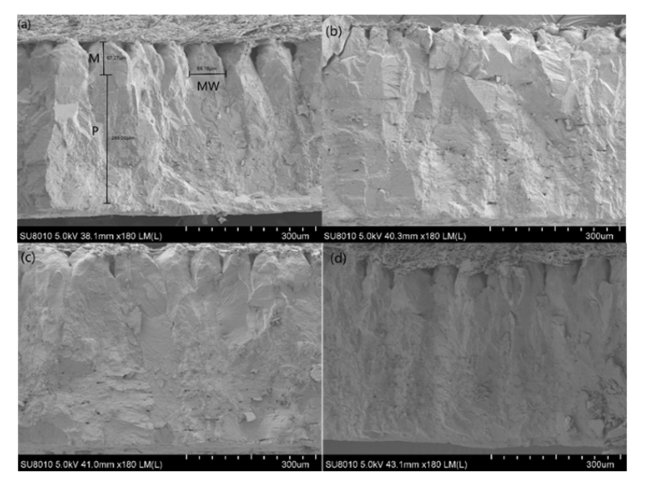
图1表5可以看出,随着饲粮中MPal添加水平的提高,蛋鸡蛋壳乳突宽度和栅栏层厚度呈线性和二次变化(P<0.05),蛋壳乳突层厚度呈二次变化(P<0.05)。与对照组相比,饲粮添加不同水平MPal均可显著降低蛋壳乳突宽度(P<0.05),显著提高蛋壳栅栏层厚度(P<0.05),其中250 mg/kg MPal添加组蛋壳乳突宽度还显著低于其他MPal添加组(P<0.05),并且其蛋壳乳突层厚度低于1 000 mg/kg MPal添加组(P<0.05);此外,250和500 mg/kg MPal添加组蛋壳栅栏层厚度显著高于其他组(P<0.05)。
图1 蛋壳横截面扫描电镜图

P为栅栏层,M为乳突层,MW为乳突宽度;(a)为对照组,(b)为250 mg/kg MPal添加组,(c)为500 mg/kg MPal添加组,(d)为1 000 mg/kg MPal添加组。

Fig.1 Scanning electron microscopy image of eggshell cross section

P mean palisade layer, M mean mammillary layer, and MW mean mammillary knob width (MW); (a) was the control group, (b) was 250 mg/kg MPal supplemental group, (c) was 500 mg/kg MPal supplemental group, and (d) was 1 000 mg/kg MPal supplemental group.

表5 饲粮添加不同水平MPal对海兰褐蛋鸡蛋壳亚显微结构的影响

Table 5 Effects of different dietary levels of MPal on eggshell submicroscopic structure of Hy-Line Brown laying hens μm

项目
Items
MPal添加水平
MPal supplemental levels/(mg/kg)
均值
标准误
SEM
PP-value
处理
Treatment
线性
Linear
二次
Quadratic
0 250 500 1 000
乳突宽度
Mammillary knob width
87.71a 56.93c 70.45b 66.63b 2.56 <0.001 <0.001 <0.001
乳突层厚度
Mammillary layer thickness
56.97a 38.38c 45.29bc 52.11ab 2.10 0.003 0.601 <0.001
栅栏层厚度
Palisade layer thickness
258.64c 384.51a 380.52a 361.52b 10.85 <0.001 <0.001 <0.001

2.4 饲粮添加不同水平MPal对海兰褐蛋鸡血浆和蛋黄中矿物元素含量的影响

表6可知,随着饲粮中MPal添加水平的提高,蛋鸡蛋黄中Mn含量呈线性和二次变化(P<0.05),蛋黄中Zn含量和血浆中P含量呈二次变化(P<0.05)。与对照组相比,饲粮添加250 mg/kg MPal显著提高蛋黄中Zn和Mn含量(P<0.05);250 mg/kg MPal添加组血浆中P含量最高,并显著高于1 000 mg/kg MPal添加组(P<0.05);饲粮添加不同水平MPal对血浆和蛋黄中其他矿物元素含量均无显著影响(P>0.05)。
表6 饲粮添加不同水平MPal对海兰褐蛋鸡血浆和蛋黄中矿物元素含量的影响

Table 6 Effects of different dietary levels of MPal on mineral element contents in plasma and yolk of Hy-Line Brown laying hens

项目
Items
MPal添加水平
MPal supplemental levels/(mg/kg)
均值
标准误
SEM
PP-value
处理
Treatment
线性
Linear
二次
Quadratic
0 250 500 1 000
血浆Plasma
铜Cu/(mg/L) 0.42 0.45 0.40 0.39 0.01 0.148 0.105 0.372
铁Fe/(mg/L) 7.70 7.36 7.36 7.63 0.10 0.475 0.806 0.125
锌Zn/(mg/L) 5.40 5.01 5.33 5.30 0.10 0.534 0.979 0.368
锰Mn/(mg/L) 0.31 0.24 0.22 0.24 0.01 0.937 0.987 0.754
钙Ca/(g/L) 0.18 0.18 0.19 0.17 0.00 0.869 0.630 0.600
磷P/(g/L) 0.68ab 0.74a 0.69ab 0.63b 0.01 0.032 0.096 0.017
蛋黄Yolk
铜Cu/(mg/kg) 1.67 1.70 1.61 1.69 0.02 0.586 0.934 0.598
铁Fe/(mg/kg) 52.82 55.02 49.80 52.68 0.69 0.057 0.330 0.792
锌Zn/(mg/kg) 35.36b 40.69a 35.93b 34.76b 0.65 0.001 0.167 0.004
锰Mn/(mg/kg) 1.93b 2.79a 1.69b 1.94b 0.09 <0.001 0.024 0.005
钙Ca/(g/kg) 1.13 1.13 1.11 1.09 0.02 0.781 0.339 0.739
磷P/(g/kg) 8.75 9.19 8.84 8.77 0.10 0.405 0.754 0.223

2.5 饲粮添加不同水平MPal对海兰褐蛋鸡肝脏和胫骨中矿物元素含量的影响

表7可知,随着饲粮中MPal添加水平的提高,蛋鸡胫骨中Fe、Mn和P含量呈线性和二次变化(P<0.05),肝脏中Fe含量和胫骨中Ca含量呈二次变化(P<0.05)。与对照组相比,饲粮添加不同水平MPal显著提高胫骨中Mn和P含量(P<0.05),饲粮添加250和500 mg/kg MPal显著提高胫骨中Fe和Ca含量(P<0.05);此外,500 mg/kg MPal添加组肝脏中Fe含量显著高于其他各组(P<0.05);饲粮添加不同水平MPal对肝脏和胫骨中其他矿物元素含量均无显著影响(P>0.05)。
表7 饲粮添加不同水平MPal对海兰褐蛋鸡肝脏和胫骨中矿物元素含量的影响

Table 7 Effects of different dietary levels of MPal on mineral element contents in liver and tibia of Hy-Line Brown laying hens

项目
Items
MPal添加水平
MPal supplemental levels/(mg/kg)
均值
标准误
SEM
PP-value
处理
Treatment
线性
Linear
二次
Quadratic
0 250 500 1 000
肝脏Liver
铜Cu/(mg/kg) 9.74 10.31 9.2 9.58 0.15 0.072 0.229 0.729
铁Fe/(mg/kg) 76.09b 75.95b 80.87a 74.84b 0.62 0.001 0.791 0.005
锌Zn/(mg/kg) 40.26 36.75 39.18 37.85 0.69 0.309 0.438 0.434
锰Mn/(mg/kg) 4.54 4.01 4.44 4.28 0.09 0.138 0.639 0.266
钙Ca/(g/kg) 0.1 0.11 0.12 0.11 0 0.666 0.953 0.24
磷P/(g/kg) 4.5 4.75 4.65 4.64 0.06 0.56 0.542 0.301
胫骨Tibia
铜Cu/(μg/kg) 0.37 0.42 0.43 0.38 0.01 0.401 0.871 0.094
铁Fe/(μg/kg) 1.20b 1.77a 1.80a 1.51ab 0.06 0.001 0.044 <0.001
锌Zn/(μg/kg) 80.13 85.39 78.68 79.35 1.56 0.425 0.522 0.468
锰Mn/(μg/kg) 1.11b 1.51a 1.58a 1.48a 0.56 0.007 0.008 0.014
钙Ca/(g/kg) 120.57b 137.56a 137.66a 128.55ab 1.99 0.002 0.104 <0.001
磷P/(g/kg) 64.02b 87.69a 85.11a 82.68a 2.1 <0.001 <0.001 <0.001

2.6 饲粮添加不同水平MPal对海兰褐蛋鸡血浆和肝脏中TRF含量和AKP活性的影响

表8可知,随着饲粮中MPal添加水平的提高,蛋鸡血浆和肝脏中TRF含量呈线性和二次变化(P<0.05),肝脏中AKP活性呈二次变化(P<0.05)。与对照组相比,饲粮添加不同水平显著降低血浆和肝脏中TRF含量(P<0.05);此外,250 mg/kg MPal添加组肝脏中AKP活性显著高于对照组和1 000 mg/kg MPal添加组(P<0.05);饲粮添加不同水平MPal对血浆中AKP活性无显著影响(P>0.05)。
表8 饲粮添加不同水平MPal对海兰褐蛋鸡血浆和肝脏中TRF含量和AKP活性的影响

Table 8 Effects of different dietary levels of MPal on TRF content and AKP activity in plasma and liver of Hy-Line Brown laying hens

项目
Items
MPal添加水平
MPal supplemental levels/(mg/kg)
均值
标准误
SEM
PP-value
处理
Treatment
线性
Linear
二次
Quadratic
0 250 500 1 000
血浆Plasma
转铁蛋白TRF/(μg/mL) 3.92a 3.20b 3.30b 3.25b 0.08 0.002 0.003 0.016
碱性磷酸酶AKP/(U/mL) 62.55 60.45 66.35 69.28 3.41 0.817 0.415 0.724
肝脏Liver
转铁蛋白TRF/(μg/g prot) 297.33a 238.77b 221.97b 238.02b 8.54 0.005 0.005 0.015
碱性磷酸酶AKP/(U/g prot) 21.58b 28.43a 22.55ab 19.74b 1.18 0.048 0.248 0.034

2.7 饲粮添加不同水平MPal对海兰褐蛋鸡肝脏和蛋壳腺中分型超氧化物歧化酶(superoxide dismutase,SOD)活性的影响

表9可知,随着饲粮中MPal添加水平的提高,蛋鸡蛋壳腺中Mn-SOD活性呈线性变化(P<0.05),肝脏中Cu/Zn-SOD活性呈二次变化(P<0.05)。与对照组相比,饲粮添加500 mg/kg MPal显著提高蛋壳腺中Mn-SOD活性(P<0.05),饲粮添加250 mg/kg MPal显著提高肝脏中Cu/Zn-SOD活性(P<0.05),饲粮添加不同水平MPal对肝脏中Mn-SOD和蛋壳腺中Cu/Zn-SOD活性无显著影响(P>0.05)。
表9 饲粮添加不同水平MPal对海兰褐蛋鸡肝脏和蛋壳腺中分型SOD活性的影响

Table 9 Effects of different dietary levels of MPal on typing SOD activity in liver and eggshell gland of Hy-Line Brown laying hensU/g prot

项目
Items
MPal添加水平
MPal supplemental levels/(mg/kg)
均值
标准误
SEM
PP-value
处理
Treatment
线性
Linear
二次
Quadratic
0 250 500 1 000
肝脏Liver
铜锌超氧化物歧化酶
Cu/Zn-SOD
542.45b 618.14a 599.41ab 540.16b 12.31 0.041 0.800 0.005
锰超氧化物歧化酶Mn-SOD 155.20 149.61 143.99 156.52 5.06 0.826 0.972 0.395
蛋壳腺Eggshell gland
铜锌超氧化物歧化酶
Cu/Zn-SOD
212.36 231.87 222.30 203.85 5.67 0.341 0.491 0.103
锰超氧化物歧化酶Mn-SOD 58.93b 59.67b 74.63a 68.10ab 2.16 0.021 0.020 0.352

2.8 饲粮添加不同水平MPal对海兰褐蛋鸡肝脏和肠道MT mRNA相对表达量的影响

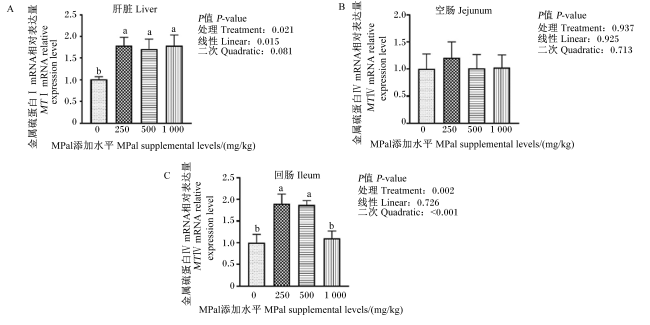
图2可知,随着饲粮中MPal添加水平的提高,蛋鸡肝脏中MTⅠ mRNA相对表达量呈线性变化(P<0.05),回肠中MTⅣ mRNA相对表达量呈二次变化(P<0.05)。与对照组相比,饲粮添加不同水平MPal显著提高肝脏中MTⅠ mRNA相对表达量(P<0.05),250和500 mg/kg MPal添加组回肠中MTⅣ mRNA相对表达量显著高于其他组(P<0.05),饲粮添加不同水平MPal对空肠中MTⅣ mRNA相对表达量无显著影响(P>0.05)。
图2 饲粮添加不同水平MPal对海兰褐蛋鸡肝脏和肠道MT mRNA相对表达量的影响

Fig.2 Effects of different dietary levels of MPal on MT mRNA relative expression levels in liver and intestine of Hy-Line Brown laying hens

3 讨论

3.1 饲粮添加不同水平MPal对海兰褐蛋鸡生产性能的影响

Chalvatzi等[14]研究发现,Pal应用于蛋鸡饲粮是安全的,饲粮添加1% Pal使得蛋鸡产蛋率显著提高了2.6%,饲料转化率显著提高了4.6%。Zhang等[15]研究表明,肉鸡饲粮中添加Pal可显著提高肉鸡的平均日增重。Wang等[16]研究发现,饲粮添加Pal显著提高了肉鸭平均日增重和平均日采食量,改善了肉鸭的生长性能。本试验结果发现,饲粮中长期添加MPal提高了蛋鸡产蛋率,趋势性的提高了平均日产蛋量以及降低了料蛋比。这可能是因为MPal是一种镁铝硅酸盐矿物质,含有多种动物所必须的微量和常量矿物元素,在胃肠道酸性环境下溶出被蛋鸡吸收利用,从而提高生产性能。此外,MPal具有较大的比表面积,可以吸附饲粮中的有毒有害物质(如霉菌毒素、重金属等),从而降低饲粮中低剂量的有毒有害物质对蛋鸡机体的损伤,所以在饲粮中长期添加MPal可以保证蛋鸡良好的生殖和胃肠道环境。综上可知,饲粮中长期添加MPal可达到提高蛋鸡生产性能的目的。

3.2 饲粮添加不同水平MPal对海兰褐蛋鸡蛋品质和蛋壳亚显微结构的影响

蛋品质和蛋壳质量是影响蛋鸡产业经济效益和孵化率的重要因素。本试验中,与对照组相比,饲粮添加250和500 mg/kg MPal显著提高蛋壳强度,并降低了不合格蛋率。这与Chalvatzi等[14]研究饲粮添加1%的Pal显著提高了蛋鸡蛋壳厚度和蛋壳强度的结果相似。不过,Qiao等[17]和Su等[11]研究发现,饲粮添加MPal对蛋品质无显著影响。这可能与饲喂时间的长短和饲喂时期有关。通常认为,蛋壳厚度可侧面评价蛋壳强度,但是本研究中发现,与对照组相比,在蛋壳厚度没有显著增加的情况下,蛋壳强度却显著性增强。因此,为了探究其中可能的原因,本试验进一步观察了蛋壳亚显微结构。蛋壳层由内到外依次分为乳突层(内部)、栅栏层(中间)和表面晶体层(外部)[18]。本试验中,与对照组相比,MPal添加组栅栏层厚度显著提高,有研究表明蛋壳的强度主要受栅栏层的厚度及其组织结构的影响[19]。所以,本试验中蛋壳栅栏层厚度的提高可能是蛋壳强度增加的主要原因。Stefanello等[20]研究发现,饲粮添加Mn、Zn和Cu对蛋鸡产蛋率和料蛋比无显著影响,但可改善蛋壳亚显微结构,提高蛋壳强度。更有Zhang等[21]研究发现,饲粮添加微量Mn可以提高蛋壳乳头层密度,降低乳头层厚度,改善蛋壳亚显微结构,增强蛋壳强度。因此推测,饲粮中长期添加250和500 mg/kg MPal可能通过补充矿物元素来提高蛋壳栅栏层厚度,从而提高蛋壳强度。

3.3 饲粮添加不同水平MPal对海兰褐蛋鸡机体矿物元素含量的影响

矿物元素是动物体内数百种酶和转录因子的重要辅因子,参与体内组织和骨骼的发育,促进机体抗氧化应激保护,是蛋鸡产蛋过程中蛋壳和蛋壳膜形成时关键酶的组成部分,影响蛋壳质量[22-23]。在家禽生产中,Zn缺乏会导致其生长迟缓、羽毛发育不良,高产蛋鸡饲粮中Zn含量不足会降低产蛋率和孵化率[24]。有研究发现,Pal含有大量的镁(Mg)、铝(Al)和Fe离子,且对镉(Cd)离子具有较强的吸附性[25]。本研究体外试验发现,MPal在模拟蛋鸡胃环境pH的条件下,MPal均有一定量矿物元素的溶出。在蛋鸡试验中发现,与对照组相比,饲粮添加不同水平MPal会不同程度地提高蛋黄、肝脏和胫骨中矿物元素含量。与本研究相似,Tada等[26]研究发现,天然沸石可以释放Ca、Mg离子。Yang等[27]研究发现,在肉鸡饲粮中添加含Zn的Pal可提高肌肉中Fe和Mg含量,且Cu和Zn之间存在拮抗作用。MPal作为霉菌毒素吸附剂,对于霉菌毒素和营养物质具有吸附选择性,水溶性霉菌毒素具有强极性,水溶性营养物质具有弱极性,而对于不溶于水的霉菌毒素和营养物质来说,霉菌毒素是弱极性,营养物质是非极性,极性的差异以及MPal独特的结构决定了MPal对霉菌毒素和营养物质吸附选择性上的差异[28]。另外,有研究发现,Pal对于金属元素的吸附存在竞争性,并与金属离子类型和浓度相关,其中Pal对Cu的吸附性强于Zn[29]。Liang等[13]研究发现,Pal通过离子交换性吸附铵根离子(NH4+)的同时,可以释放出Ca、Mg、钾(K)和Fe离子,进而提高酶的活性。同时,本研究发现,MPal在模拟蛋鸡胃环境pH的条件下矿物元素溶出量较低,由此推测在长期饲喂MPal的条件下,一方面,MPal在吸附霉菌毒素的同时可能会为蛋鸡补充部分矿物元素;另一方面,MPal可能对矿物离子的活性具有催化作用,进而促进离子的吸收利用,但是存在二次曲线剂量效应,这可能是因为随着矿物元素含量的升高,MPal催化矿物离子的活性会降低。

3.4 饲粮添加不同水平MPal对海兰褐蛋鸡矿物元素相关蛋白含量和酶活性的影响

TRF是由肝脏产生的大分子糖蛋白,在体内具有转移Fe的功能,对Fe代谢具有重要作用。有肉鸡试验研究中发现,当饲粮中Fe的含量不足时,血清中TRF含量会迅速增加,以加快Fe的运输[30-31]。本试验中,与对照组相比,MPal添加组蛋鸡血浆和肝脏中TRF含量显著降低。这表明,对照组蛋鸡Fe含量摄入低,MPal可以为高产蛋鸡补充Fe离子。该结果与前人研究结果相似,有大鼠试验研究中发现,饲粮中低水平的Fe可上调TRF mRNA的表达,进而导致血浆中Fe结合能力的相应增加[32]。AKP是一种Zn依赖性酶,参与骨骼的生长和发育,其活性的提高在骨钙化过程中起着重要作用[33]。同时,有研究发现,AKP的活性受多种矿物元素含量的影响,如Zn和Mn等[34-35]。本试验结果发现,饲粮中长期添加MPal对蛋鸡血浆中AKP活性无显著影响,但可以提高肝脏中AKP活性,这可能是因为在饲粮中长期添加MPal提高了肝脏中Fe的含量,进而提高了肝脏中AKP活性。该结果与前人研究结果相似,即Fe可以提高AKP的活性[36]。SOD在保护生物体免受氧化损伤方面发挥着至关重要的作用,是一种抗氧化酶,以多种形式存在于动植物体中,主要以Cu、Zn、Mn及Fe作为辅因子,其中Cu/Zn-SOD存在于动物、植物以及革兰氏阴性菌的胞浆中,Mn-SOD存在于动物和大肠杆菌中,铁超氧化物歧化酶(iron superoxide dismutase,Fe-SOD)存在于厌氧原核生物中[37],所以矿物元素含量会影响SOD的活性。有研究发现,随着饲粮Fe添加水平的升高,蛋鸡血清Cu/Zn-SOD和Mn-SOD活性也会升高[30]。蛋壳腺是蛋壳形成的场所,蛋壳腺中抗氧化酶活性的提高,对于蛋鸡蛋壳质量至关重要。本研究结果显示,饲粮中长期添加MPal使得蛋鸡肝脏中Cu/Zn-SOD和蛋壳腺中Mn-SOD有一定程度的提高。该结果与Yang等[38]研究结果相似,即含Zn的Pal提高了空肠黏膜中总超氧化物歧化酶(total superoxide dismutase,T-SOD)和Cu/Zn-SOD的活性。这可能是因为MPal通过离子交换补充矿物元素,提高了抗氧化酶的活性,进而提高了蛋壳质量。

3.5 饲粮添加不同水平MPal对海兰褐蛋鸡矿物元素相关基因表达的影响

MT是最丰富的细胞内金属结合蛋白,其功能之一是保护细胞免受自由基侵害,是真核生物中一种多功能应激蛋白[39]。MT家族主要包括MTⅠ、MTⅡ、MTⅢ和MTⅣ。其中,MTⅠ和MTⅡ具有高度同源性,主要存在于哺乳动物内脏器官中,能够调节金属内环境稳态,对机体抗氧化和免疫具有重要作用;MTⅢ主要存在大脑的神经细胞中,在保护大脑细胞程序性凋亡具有重要作用;MTⅣ主要在消化道、上皮层细胞和皮肤中表达,起到修复氧化损伤的作用[40-42]。所以本研究选择测定蛋鸡肝脏中MTⅠ以及空肠和回肠中MTⅣ mRNA相对表达量。MT的高表达可以保护细胞免受自由基诱导的DNA损伤和脂质过氧化,具有抗氧化的作用[43]。本研究结果发现,饲粮中长期添加MPal上调了蛋鸡肝脏中MTⅠ mRNA相对表达量,且饲粮添加250和500 mg/kg MPal上调了回肠中MTⅣ mRNA相对表达量,这说明饲粮中长期添加MPal可以启动MT基因的高转录水平,这可能与MPal补充了矿物元素有关。Fleet等[44]研究发现,Fe可以快速诱导雏鸡肝脏中MT mRNA表达,该结果与本研究结果相似。另外有研究发现,随着肝脏和胫骨中Zn沉积量的增加,肝脏MT mRNA相对表达量提高[45]。所以,饲粮中长期添加MPal可能通过补充矿物元素,从而上调肝脏和肠道中MT mRNA相对表达量。

4 结论

饲粮中长期添加适宜水平的MPal可以提高蛋鸡生产性能,改善蛋壳亚显微结构,提高蛋壳强度,且通过提高机体矿物元素含量进而提高相关蛋白含量和酶活性。在本试验条件下,海兰褐蛋鸡饲粮中MPal的适宜添加水平为250 mg/kg。
[1]
MUHAMMAD S A, BILBIS L S, SAIDU Y, et al. Effect of antioxidant mineral elements supplementation in the treatment of hypertension in albino rats[J]. Oxidative Medicine and Cellular Longevity, 2012, 2012:134723.

[2]
KUMAR S, PANDEY A K, ABDUL RAZZAQUE W A, et al. Importance of micro minerals in reproductive performance of livestock[J]. Veterinary World, 2011, 4(5):230-233.

[3]
GAFFNEY-STOMBERG E. The impact of trace minerals on bone metabolism[J]. Biological Trace Element Research, 2019, 188(1):26-34.

DOI

[4]
YANG K L, HU S J, MU R, et al. Effects of different patterns and sources of trace elements on laying performance,tissue mineral deposition,and fecal excretion in laying hens[J]. Animals, 2021, 11(4):1164.

DOI

[5]
SERNA C J, VANSCOYOC G E. Infrared study of sepiolite and palygorskite surfaces[M]//MORTLAND M M,FARMER V C.Developments in sedimentology.Amsterdam:Elsevier, 1979:197-206.

[6]
GALAN E. Properties and applications of palygorskite-sepiolite clays[J]. Clay Minerals, 1996, 31(4):443-453.

DOI

[7]
VICENTE RODRIGUEZ M A, DE D LOPEZ GONZALEZ J, BAÑARES MUÑOZ M A. Acid activation of a Spanish sepiolite:physico-chemical characterization,free silica content and surface area of products obtained[J]. Clay Minerals, 1994, 29(3):361-367.

DOI

[8]
CHENG Y F, XU Q, CHEN Y P, et al. Modified palygorskite improves immunity,antioxidant ability,intestinal morphology,and barrier function in broiler chickens fed naturally contaminated diet with permitted feed concentrations of Fusarium mycotoxins[J]. Toxins, 2018, 10(11):482.

DOI

[9]
ZHAO Y, HAN X Y, ZHANG N, et al. Removal of aflatoxin B1 and zearalenone in mixed aqueous solution by palygorskite-montmorillonite materials in situ prepared from palygorskite mineral[J]. Langmuir, 2023, 39(7):2797-2807.

DOI

[10]
ZHA P P, CHEN Y P, WANG S Q, et al. Dietary palygorskite-based antibacterial agent supplementation as an alternative to antibiotic improves growth performance,intestinal mucosal barrier function,and immunity in broiler chickens[J]. Poultry Science, 2022, 101(5):101640.

DOI

[11]
SU Y, CHEN Y P, CHENG Y F, et al. Effects of modified palygorskite supplementation on egg quality and mineral element content,and intestinal integrity and barrier function of laying hens[J]. Biological Trace Element Research, 2018, 186(2):529-537.

DOI

[12]
CHENG Y F, CHEN Y P, LI X H, et al. Effects of palygorskite inclusion on the growth performance,meat quality,antioxidant ability,and mineral element content of broilers[J]. Biological Trace Element Research, 2016, 173(1):194-201.

DOI

[13]
LIANG Y G, XU L, BAO J, et al. Attapulgite enhances methane production from anaerobic digestion of pig slurry by changing enzyme activities and microbial community[J]. Renewable Energy, 2020, 145:222-232.

DOI

[14]
CHALVATZI S, ARSENOS G, TSERVENI-GOUSSI A, et al. Tolerance and efficacy study of palygorskite incorporation in the diet of laying hens[J]. Applied Clay Science, 2014, 101:643-647.

DOI

[15]
ZHANG L, YAN R, ZHANG R Q, et al. Effect of different levels of palygorskite inclusion on pellet quality,growth performance and nutrient utilization in broilers[J]. Animal Feed Science and Technology, 2017, 223:73-81.

DOI

[16]
WANG Y Y, WANG B Z, LIU Q, et al. Palygorskite supplementation improves growth performance,oxidative status,and intestinal barrier function in cherry valley ducks[J]. The Journal of Poultry Science, 2019, 56(3):186-194.

DOI

[17]
QIAO L H, CHEN Y P, WEN C, et al. Effects of natural and heat modified palygorskite supplementation on the laying performance,egg quality,intestinal morphology,digestive enzyme activity and pancreatic enzyme mRNA expression of laying hens[J]. Applied Clay Science, 2015, 104:303-308.

DOI

[18]
ROBERTS J R. Factors affecting egg internal quality and egg shell quality in laying hens[J]. The Journal of Poultry Science, 2004, 41(3):161-177.

DOI

[19]
RADWAN L M, FATHI M M, GALAL A, et al. Mechanical and ultrastructural properties of eggshell in two Egyptian native breeds of chicken[J]. International Journal of Poultry Science, 2010, 9(1):77-81.

DOI

[20]
STEFANELLO C, SANTOS T C, MURAKAMI A E, et al. Productive performance,eggshell quality,and eggshell ultrastructure of laying hens fed diets supplemented with organic trace minerals[J]. Poultry Science, 2014, 93(1):104-113.

DOI

[21]
ZHANG Y N, ZHANG H J, WU S G, et al. Dietary manganese supplementation modulated mechanical and ultrastructural changes during eggshell formation in laying hens[J]. Poultry Science, 2017, 96(8):2699-2707.

DOI PMID

[22]
FERNANDES J I M, MURAKAMI A E, SAKAMOTO M I, et al. Effects of organic mineral dietary supplementation on production performance and egg quality of white layers[J]. Brazilian Journal of Poultry Science, 2008, 10(1):59-65.

DOI

[23]
RICHARDS J D, ZHAO J M, HARRELL R J, et al. Trace mineral nutrition in poultry and swine[J]. Asian-Australasian Journal of Animal Sciences, 2010, 23(11):1527-1534.

DOI

[24]
SOETAN K O, OLAIYA C O, OYEWOLE O E. The importance of mineral elements for humans,domestic animals and plants-a review[J]. African Journal of Food Science, 2010, 4(5):200-222.

[25]
ÁLVAREZ-AYUSO E, GARCÍA-SÁNCHEZ A. Removal of cadmium from aqueous solutions by palygorskite[J]. Journal of Hazardous Materials, 2007, 147(1/2):594-600.

DOI

[26]
TADA C K, YANG Y N, HANAOKA T, et al. Effect of natural zeolite on methane production for anaerobic digestion of ammonium rich organic sludge[J]. Bioresource Technology, 2005, 96(4):459-464.

PMID

[27]
YANG W L, CHEN Y P, CHENG Y F, et al. An evaluation of zinc bearing palygorskite inclusion on the growth performance,mineral content,meat quality,and antioxidant status of broilers[J]. Poultry Science, 2016, 95(4):878-885.

DOI

[28]
ZHOU H T. Mixture of palygorskite and montmorillonite (Paly-Mont) and its adsorptive application for mycotoxins[J]. Applied Clay Science, 2016, 131:140-143.

DOI

[29]
SHEIKHHOSSEINI A, SHIRVANI M, SHARIATMADARI H. Competitive sorption of nickel,cadmium,zinc and copper on palygorskite and sepiolite silicate clay minerals[J]. Geoderma, 2013, 192:249-253.

DOI

[30]
XIE C, ELWAN H A M, ELNESR S S, et al. Effects of iron glycine chelate on laying performance,antioxidant activities,serum biochemical indices,iron concentrations and transferrin mRNA expression in laying hens[J]. Journal of Animal Physiology and Animal Nutrition, 2019, 103(2):547-554.

DOI

[31]
MCKNIGHT G S, LEE D C, HEMMAPLARDH D, et al. Transferrin gene expression.Effects of nutritional iron deficiency[J]. Journal of Biological Chemistry, 1980, 255(1):144-147.

DOI

[32]
IDZERDA R L, HUEBERS H, FINCH C A, et al. Rat transferrin gene expression:tissue-specific regulation by iron deficiency[J]. Proceedings of the National Academy of Sciences, 1986, 83(11):3723-3727.

DOI

[33]
HURWITZ S, GRIMINGER P. The response of plasma alkaline phosphatase, parathyroids and blood and bone minerals to calcium intake in the fowl[J]. The Journal of Nutrition, 1961, 73(2):177-185.

DOI

[34]
SARKER M, SATOH S. Effect of dietary phosphorus and zinc levels on hematocrit value,plasma mineral content and plasma alkaline phosphatase activity of fingerling rainbow trout,Oncorhynchus mykiss[J]. Progressive Agriculture, 2009, 20(1/2):183-192.

DOI

[35]
YAMAGUCHI M, YAMAGUCHI R. Action of zinc on bone metabolism in rats:increases in alkaline phosphatase activity and DNA content[J]. Biochemical Pharmacology, 1986, 35(5):773-777.

DOI

[36]
DE OLIVEIRA ORNELA P H, GUIMARÃES L H S. Purification and characterization of an iron-activated alkaline phosphatase produced by Rhizopus microsporus var. microsporus under submerged fermentation using rye flour[J]. Journal of Applied Biology & Biotechnology, 2020, 8(4):16-25.

[37]
RILEY D P. Functional mimics of superoxide dismutase enzymes as therapeutic agents[J]. Chemical Reviews, 1999, 99(9):2573-2588.

DOI PMID

[38]
YANG W L, CHEN Y P, CHENG Y F, et al. Effects of zinc bearing palygorskite supplementation on the growth performance,hepatic mineral content,and antioxidant status of broilers at early age[J]. Asian-Australasian Journal of Animal Sciences, 2017, 30(7):1006-1012.

DOI

[39]
ANDREWS G K. Regulation of metallothionein gene expression by oxidative stress and metal ions[J]. Biochemical Pharmacology, 2000, 59(1):95-104.

DOI PMID

[40]
MOCCHEGIANI E, COSTARELLI L, BASSO A, et al. Metallothioneins,ageing and cellular senescence:a future therapeutic target[J]. Current Pharmaceutical Design, 2013, 19(9):1753-1764.

[41]
SABOLIĆ I, BRELJAK D, ŠKARICA M, et al. Role of metallothionein in cadmium traffic and toxicity in kidneys and other mammalian organs[J]. Biometals, 2010, 23(5):897-926.

DOI PMID

[42]
VAŠÁK M, MELONI G. Chemistry and biology of mammalian metallothioneins[J]. Journal of Biological Inorganic Chemistry, 2011, 16(7):1067-1078.

DOI PMID

[43]
YOU H J, LEE K J, JEONG H G. Overexpression of human metallothionein-Ⅲ prevents hydrogen peroxide-induced oxidative stress in human fibroblasts[J]. FEBS Letters, 2002, 521(1/3):175-179.

DOI

[44]
FLEET J C, ANDREWS G K, MCCORMICK C C. Iron-induced metallothionein in chick liver:a rapid,route-dependent effect independent of zinc status[J]. The Journal of Nutrition, 1990, 120(10):1214-1222.

DOI

[45]
MIN Y N, LIU F X, QI X, et al. Effects of organic zinc on tibia quality,mineral deposit,and metallothionein expression level of aged hens[J]. Poultry Science, 2019, 98(1):366-372.

DOI

Outlines

/