RESEARCH PAPER

Effects of Grape Seed Proanthocyanidins on Growth Performance and Antioxidant Capacity of Sichuan White Geese

  • REN Jiwu , 1 ,
  • CHEN Zhexiu 2 ,
  • QIAO Junyi 1 ,
  • DENG Chao 2 ,
  • HAO Ruirong , 2, *
Expand
  • 1 Cash Crop Research Institute, Shanxi Agricultural University, Taiyuan 030031, China
  • 2 College of Animal Science, Shanxi Agricultural University, Taigu 030801, China
* professor, E-mail:

Received date: 2023-07-03

  Online published: 2023-12-11

Abstract

This experiment was conducted to investigate the effects of dietary grape seed proanthocyanidins (GSPs) on growth performance and antioxidant capacity of Sichuan White geese. A total of 160 healthy Sichuan White geese of 14-day-old with similar body weight were randomly divided into 4 groups with 5 replicates per group and 8 geese per replicate. Geese in the control group were fed a basal diet, and those in the three GSPs groups were fed the basal diets supplemented with 25, 50 and 75 mg/kg GSPs in stage 1 (21 to 42 days of age), and 50, 100 and 150 mg/kg GSPs in stage 2 (43 to 63 days of age), respectively. The pre-test period lasted for 7 days, and the experimental period lasted for 43 days. The results showed as follows: 1) compared with the control group, dietary GSPs with different levels had no significant effects on growth performance indices of Sichuan White geese (P>0.05). 2) At 42 days of age, compared with the control group, dietary GSPs with different levels significantly increased the total antioxidant capacity (T-AOC) and the glutathione peroxidase (GSH-Px) activity in serum and kidney (P<0.05), and significantly decreased the malondialdehyde (MDA) content in serum and liver (P<0.05); dietary 75 mg/kg GSPs significantly increased the T-AOC and activities of GSH-Px and catalase (CAT) in liver (P<0.05), and significantly decreased the MDA content in kidney (P<0.05); dietary 50 and 75 mg/kg GSPs significantly increased the mRNA relative expression levels of superoxide dismutase 1 (SOD1) and GSH-Px4 in liver (P<0.05); dietary 75 mg/kg GSPs significantly increased the mRNA relative expression levels of SOD1, SOD2, GSH-Px4 and CAT in kidney (P<0.05). 3) At 63 days of age, dietary GSPs with different levels significantly increased the T-AOC and CAT activity in serum (P<0.05), significantly increased the T-AOC and SOD activity in liver (P<0.05), and significantly decreased the MDA content in serum and kidney (P<0.05); dietary 100 and 150 mg/kg GSPs significantly increased the GSH-Px activity in serum and liver (P<0.05), but significantly decreased the GSH-Px activity in kidney (P<0.05). In conclusion, the appropriate dietary level of GSPs can improve the antioxidant capacity of Sichuan White geese to varying degrees, but has no significant effect on their growth performance. From 21 to 42 days of age, dietary 75 mg/kg GSPs has a good effect on improving antioxidant capacity.

Cite this article

REN Jiwu , CHEN Zhexiu , QIAO Junyi , DENG Chao , HAO Ruirong . Effects of Grape Seed Proanthocyanidins on Growth Performance and Antioxidant Capacity of Sichuan White Geese[J]. Chinese Journal of Animal Nutrition, 2023 , 35(12) : 7817 -7827 . DOI: 10.12418/CJAN2023.710

鹅作为一种经济型水禽,能提供优质的肉、蛋和鹅绒,在中欧和亚洲,尤其是在中国,市场需求逐年增加[1]。在市场需求和环境保护压力的双重推动下,鹅养殖体系正从传统的水陆养殖向现代集约化陆地养殖转变[2]。在现代高密度圈养条件下,鹅群应激增加,而应激通常会导致免疫力下降,抗氧化能力减弱,消化能力受损,饲料转化率降低,以及发病率和死亡率提高等。因此,采用适度的抗氧化营养调控策略提高鹅的抗应激能力引起人们的广泛关注。多酚是天然抗氧化剂,对于改善鹅的抗氧化能力有显著作用。研究表明,饲粮添加500 mg/kg茶多酚提高了28日龄马岗鹅空肠谷胱甘肽过氧化物酶(GSH-Px)和超氧化物歧化酶(SOD)活性,降低了空肠丙二醛(MDA)含量和乳酸脱氢酶活性[3]。葡萄籽原花青素(grape seed proanthocyanidins,GSPs)是天然多酚类化合物,具有强大的清除自由基的能力。GSPs的酚羟基结构是极好的供氢体,这是其形成超强抗氧化活性的结构原因[4]。研究发现,饲粮添加50和100 mg/kg GSPs显著提高了21~42日龄四川白鹅盲肠总抗氧化能力(T-AOC)以及SOD和过氧化氢酶(CAT)活性[5]。GSPs可激活核因子E2相关因子2(Nrf2)/血红素氧合酶-1(HO-1)信号通路,上调抗氧化和细胞保护相关基因的表达[6-7]。本课题组前期研究表明,GSPs可以显著提升仔猪血清抗氧化酶活性[8],提高断奶仔猪肠道抗氧化能力,表现为空肠SOD活性升高,空肠SOD1和CAT mRNA相对表达量升高,以及空肠MDA含量降低[9]。对肉鸡的研究也表明,饲粮添加GSPs显著改善了肉仔鸡的免疫力和抗氧化能力[10];缓减了黄曲霉毒素B1诱导的免疫器官组织病变和氧化损伤[11];提高了肉仔鸡肝脏中还原型谷胱甘肽含量,降低了鸡肉中的MDA含量[12];改善了肉鸡免疫力,提高了生长性能[13]。鉴于GSPs的抗氧化特性以及鹅的抗氧化应激需求,本试验旨在研究饲粮添加不同水平GSPs对四川白鹅生长性能和抗氧化能力的影响,为改善鹅的健康提供营养策略。

1 材料与方法

1.1 试验材料

试验所用GSPs纯度为95%,含79.28%的低聚原花青素。

1.2 试验设计

试验选取14日龄健康且体重相近的四川白鹅160只,随机分为4组,每组5个重复,每个重复8只鹅。预试期7 d;正试期43 d,分为21~42日龄和43~63日龄2个阶段。对照组饲喂基础饲粮;3个GSPs组试验第1阶段(21~42日龄)在基础饲粮中分别添加25、50和75 mg/kg GSPs,第2阶段(43~63日龄)在基础饲粮中分别添加50、100和150 mg/kg GSPs。
试验在山西农业大学经济作物研究所进行,动物试验由山西农业大学实验动物伦理委员会审核通过(许可证号:SXAU-EAW-2021G0305001)。基础饲粮参照NRC(1994)鹅的营养需要配制,其组成及营养水平见表1
表1 基础饲粮组成及营养水平(风干基础)

Table 1 Composition and nutrient levels of the basal diet (air-dry basis) %

项目Items 含量Content
原料Ingredients
玉米Corn 59.80
豆粕Soybean meal 25.10
稻壳Rice hull 7.50
小麦麸Wheat bran 4.00
石粉Limestone 0.80
磷酸氢钙CaHPO4 1.30
DL-蛋氨酸DL-Met 0.10
氯化胆碱Choline chloride 0.10
氯化钠NaCl 0.30
预混料Premix1) 1.00
合计Total 100.00
营养水平Nutrient levels2)
代谢能ME/(MJ/kg) 11.65
粗蛋白质CP 16.58
粗纤维CF 6.72
钙Ca 0.80
有效磷AP 0.43
赖氨酸Lys 0.84
蛋氨酸Met 0.55

1)预混料为每千克饲粮提供 The premix provided the following per kilogram of the diet:VA 1 500 IU,VD3 200 IU,VE 10 IU,VK 1.5 mg,VB1 2.5 mg,VB2 5.0 mg,烟酸 nicotinic acid 65 mg,叶酸 folic acid 0.6 mg,生物素 biotin 0.2 mg,D-泛酸 D-pantothenic acid 11.0 mg,Fe 90 mg,Mn 75 mg,Cu 5 mg,Zn 60 mg,I 0.3 mg,Se 0.3 mg。

2)粗蛋白质和钙为实测值,其余为计算值。CP and Ca were measured values, while the others were calculated values.

1.3 检测指标及方法

1.3.1 生长性能

分别于21、42和63日龄对试验鹅禁食12 h(断料不断水),以重复为单位,称量鹅的体重,计算平均日增重(ADG);试验期间每天记录采食量,计算平均日采食量(ADFI)和料重比(F/G)。计算公式如下:
ADG=(结束称重-开始称重)/试验天数/鹅数量;
ADFI=总耗料量/试验天数/鹅数量;
F/G=总耗料量/总增重。

1.3.2 抗氧化能力

分别于42和63日龄,每个重复随机选取2只鹅采血并屠宰。从前腔静脉采血10 mL,在室温下放置30 min,然后3 000×g离心10 min,取上清液,于-20 ℃保存待测血清抗氧化指标。屠宰后取新鲜肝脏和肾脏各2份于冻存管中,于-80 ℃冷冻保存待测。
血清、肝脏和肾脏中T-AOC和SOD、GSH-Px、CAT活性以及MDA含量采用试剂盒(上海酶联生物科技有限公司)检测。

1.3.3 肝脏和肾脏抗氧化相关基因表达

采用实时定量PCR(RT-qPCR)方法检测肝脏和肾脏抗氧化相关基因表达。参照Trizol法提取42日龄试验鹅肝脏和肾脏RNA,利用PrimeScriptTM RT Master Mix将RNA逆转录为cDNA,具体操作参考文献[14],每个样品测量3次。以β-肌动蛋白(β-actin)为内参基因,采用2-ΔΔCt方法计算目的基因SOD1、SOD2、GSH-Px4和CAT的mRNA相对表达量,引物序列见表2
表2 引物序列

Table 2 Primer sequences

基因
Genes
引物序列
Primer sequences (5'—3')
产物长度
Product length/bp
GenBank登录号
GenBank accession
number
超氧化物歧化酶1
SOD1
F:ATCCTGAGGGCAAGAAGCA
R:TTTACCCAGGTCATCGCTTT
188 XM_013192917.1
超氧化物歧化酶2
SOD2
F:CTTCCTGACCTGCCGTATGA
R:CCTTTTGCCAGTGCCTCTTT
146 XM_013186750.1
谷胱甘肽过氧化物酶4
GSH-Px4
F:TTACGCATCCTGGGCTTTC
R:GCTGCTCCTTCATCCACTTC
169 XM_013200057.1
过氧化氢酶
CAT
F:TGTAGAGGAAGCAGGAAGGC
R:AAGACCAGGATGGGTAGTTGC
98 XM_013194546.1
β-肌动蛋白
β-actin
F:CCATTGGCAATGAGAGGTTC
R:TGGATACCGCAGGACTCCATA
144 XM_013174886.1

1.4 数据的统计与分析

采用SPSS 26.0软件对试验数据进行单因素方差分析(one-way ANOVA)和Duncan氏多重比较,分析鹅饲粮中添加GSPs的作用效果;采用正交多项式法分析GSPs添加水平的线性和二次效应。试验结果用平均值和均值标准误(SEM)表示,P<0.05为差异显著。

2 结果

2.1 饲粮添加GSPs对四川白鹅生长性能的影响

表3可知,与对照组相比,饲粮添加不同水平GSPs对四川白鹅ADG、ADFI和F/G均无显著影响(P>0.05)。21~42日龄,ADFI随饲粮GSPs添加水平的提高呈先提高后降低的二次变化(P<0.05);43~63日龄,ADFI随饲粮GSPs添加水平的提高呈线性提高(P<0.05)。
表3 饲粮添加GSPs对四川白鹅生长性能的影响

Table 3 Effects of dietary GSPs on growth performance of Sichuan White geese

项目
Items
对照组
Control
group
GSPs添加水平
GSPs supplemental levels/(mg/kg)
SEM PP-value
处理
Treatment
线性
Linear
二次
Quadratic
25/50 50/100 75/150
21日龄平均体重
Average BW at 21 days of age/g
1 050.83 1 016.67 1 075.83 1 120.00 16.57 0.147 0.068 0.204
42日龄平均体重
Average BW at 42 days of age/g
2 285.00 2 284.58 2 384.17 2 282.50 25.00 0.440 0.691 0.341
63日龄平均体重
Average BW at 63 days of age/g
3 543.33 3 591.11 3 415.56 3 511.11 36.52 0.424 0.426 0.751
平均日增重
ADG/(g/d)
59.62 59.44 58.80 57.60 1.11 0.946 0.389 0.071
21~42日龄
21 to 42 days
of age
平均日采食量
ADFI/(g/d)
179.02 190.58 190.44 186.74 2.60 0.345 0.373 0.048
料重比F/G 3.00 3.42 3.24 3.29 0.11 0.638 0.528 0.442
平均日增重
ADG/(g/d)
33.69 25.96 26.16 22.28 3.74 0.800 0.384 0.822
43~63日龄
43 to 63 days
of age
平均日采食量
ADFI/(g/d)
239.68 234.21 290.14 280.63 9.95 0.079 0.034 0.900
料重比F/G 11.29 10.26 12.27 14.42 1.83 0.905 0.556 0.711

同行数据肩标不同字母表示差异显著(P<0.05),无字母或相同字母表示差异不显著(P>0.05)。下表同。

In the same row, values with different letter superscripts mean significantly different (P<0.05), while with no letter or the same letter superscripts mean not significantly different (P>0.05). The same as below.

2.2 饲粮添加GSPs对42日龄四川白鹅抗氧化能力的影响

表4可知,42日龄,与对照组相比,各GSPs组血清T-AOC和GSH-Px活性均显著提高(P<0.05),血清MDA含量均显著降低(P<0.05);饲粮添加50 mg/kg GSPs显著提高血清SOD活性(P<0.05);饲粮添加25 mg/kg GSPs显著提高血清CAT活性(P<0.05)。与对照组相比,饲粮添加75 mg/kg GSPs显著提高肝脏T-AOC及GSH-Px和CAT活性(P<0.05);饲粮添加25和50 mg/kg GSPs则显著降低肝脏T-AOC和SOD活性(P<0.05);各GSPs组肝脏MDA含量均显著降低(P<0.05)。与对照组相比,各GSPs组肾脏T-AOC和GSH-Px活性均显著提高(P<0.05);饲粮添加50和75 mg/kg GSPs显著提高肾脏SOD活性(P<0.05);饲粮添加75 mg/kg GSPs显著降低肾脏MDA含量(P<0.05)。
表4 饲粮添加GSPs对42日龄四川白鹅抗氧化能力的影响

Table 4 Effects of dietary GSPs on antioxidant capacity of Sichuan White geese at 42 days of age

项目
Items
对照组
Control
group
GSPs添加水平
GSPs supplemental levels/(mg/kg)
SEM PP-value
处理
Treatment
线性
Linear
二次
Quadratic
25 50 75
总抗氧化能力
T-AOC/(U/mL)
2.86c 3.57a 3.55a 3.16b 0.09 <0.001 0.022 <0.001
超氧化物歧化酶
SOD/(U/mL)
7.68b 4.43c 12.04a 5.32c 0.93 <0.001 0.085 0.024
血清
Serum
谷胱甘肽过氧化物酶
GSH-Px/(U/mL)
73.36b 77.43a 76.96a 77.77a 0.65 0.027 0.013 0.106
过氧化氢酶
CAT/(U/mL)
22.32b 26.46a 21.87b 24.05ab 0.65 0.019 0.875 0.282
丙二醛
MDA/(nmol/mL)
7.82a 7.42b 7.35c 6.60d 0.13 <0.001 <0.001 <0.001
总抗氧化能力
T-AOC/(U/mg prot)
3.51b 3.27c 2.98d 4.44a 0.16 <0.001 <0.001 <0.001
超氧化物歧化酶
SOD/(U/mg prot)
20.71a 9.38c 15.05b 21.25a 1.51 <0.001 0.113 <0.001
肝脏
Liver
谷胱甘肽过氧化物酶
GSH-Px/(U/mg prot)
56.93b 49.06c 57.05b 69.80a 2.28 <0.001 <0.001 <0.001
过氧化氢酶
CAT/(U/mg prot)
24.37b 27.53ab 24.88b 29.53a 0.74 0.014 0.015 0.447
丙二醛
MDA/(nmol/mg prot)
8.34a 8.02b 7.22c 8.10b 0.13 <0.001 <0.001 <0.001
总抗氧化能力
T-AOC/(U/mg prot)
2.81c 4.36a 3.50b 3.63b 0.17 <0.001 0.001 <0.001
超氧化物歧化酶
SOD/(U/mg prot)
13.58c 14.26c 22.44b 28.40a 1.87 <0.001 <0.001 0.004
肾脏
Kidney
谷胱甘肽过氧化物酶
GSH-Px/(U/mg prot)
48.01c 58.75b 66.51a 68.34a 2.46 <0.001 <0.001 0.004
过氧化氢酶
CAT/(U/mg prot)
26.63a 25.32ab 26.34a 22.63b 0.60 0.041 0.022 0.203
丙二醛
MDA/(nmol/mg prot)
9.62a 9.61a 9.59a 8.15b 0.07 <0.001 <0.001 <0.001

2.3 饲粮添加GSPs对63日龄四川白鹅抗氧化能力的影响

表5可知,63日龄,与对照组相比,各GSPs组血清T-AOC和CAT活性均显著提高(P<0.05),血清MDA含量均显著降低(P<0.05);饲粮添加50 mg/kg GSPs显著提高血清SOD活性(P<0.05);饲粮添加100和150 mg/kg GSPs显著提高血清GSH-Px活性(P<0.05)。与对照组相比,各GSPs组肝脏T-AOC和SOD活性均显著提高(P<0.05);饲粮添加100和150 mg/kg GSPs显著提高肝脏GSH-Px活性(P<0.05),显著降低肝脏MDA含量(P<0.05)。与对照组相比,饲粮添加100和150 mg/kg GSPs显著提高肾脏T-AOC(P<0.05),但显著降低肾脏GSH-Px活性(P<0.05);各GSPs组肾脏MDA含量均显著降低(P<0.05)。
表5 饲粮添加GSPs对63日龄四川白鹅抗氧化能力的影响

Table 5 Effects of dietary GSPs on antioxidant capacity of Sichuan White geese at 63 days of age

项目
Items
对照组
Control
group
GSPs添加水平
GSPs supplemental levels/(mg/kg)
SEM PP-value
处理
Treatment
线性
Linear
二次
Quadratic
50 100 150
总抗氧化能力
T-AOC/(U/mL)
2.48b 3.38a 3.49a 3.29a 0.12 <0.001 <0.001 <0.001
超氧化物歧化酶
SOD/(U/mL)
3.96bc 11.00a 5.00b 1.91c 1.06 <0.001 0.003 <0.001
血清
Serum
谷胱甘肽过氧化物酶
GSH-Px/(U/mL)
68.58c 62.13d 73.78b 81.71a 2.20 <0.001 <0.001 <0.001
过氧化氢酶
CAT/(U/mL)
21.47b 25.08a 25.72a 25.44a 0.66 0.041 0.018 0.074
丙二醛
MDA/(nmol/mL)
8.13a 6.73c 7.60b 5.93d 0.25 <0.001 <0.001 <0.001
总抗氧化能力
T-AOC/(U/mg prot)
2.43c 3.04a 3.02a 2.68b 0.08 <0.001 0.014 0.005
超氧化物歧化酶
SOD/(U/mg prot)
19.71b 26.76a 25.35a 24.86a 0.88 0.002 0.001 0.062
肝脏
Liver
谷胱甘肽过氧化物酶
GSH-Px/(U/mg prot)
41.22b 43.24ab 45.51a 47.16a 0.85 0.037 0.006 0.879
过氧化氢酶
CAT/(U/mg prot)
27.41a 25.08ab 23.18b 23.90b 0.59 0.025 0.008 0.091
丙二醛
MDA/(nmol/mg prot)
10.15a 10.20a 9.85b 9.72b 0.06 <0.001 0.060 <0.001
总抗氧化能力
T-AOC/(U/mg prot)
2.66c 2.54c 3.33b 3.76a 0.15 <0.001 0.003 <0.001
超氧化物歧化酶
SOD/(U/mg prot)
13.79b 22.00a 20.35a 15.73b 0.75 <0.001 <0.001 0.001
肾脏
Kidney
谷胱甘肽过氧化物酶
GSH-Px/(U/mg prot)
63.84b 66.92a 56.68d 60.83c 1.21 <0.001 0.002 0.577
过氧化氢酶
CAT/(U/mg prot)
29.43a 29.71a 29.26a 26.38b 0.48 0.016 0.008 0.032
丙二醛
MDA/(nmol/mg prot)
9.79a 8.15c 8.02c 8.65b 0.21 <0.001 <0.001 <0.001

2.4 饲粮添加GSPs对四川白鹅肝脏抗氧化相关基因表达的影响

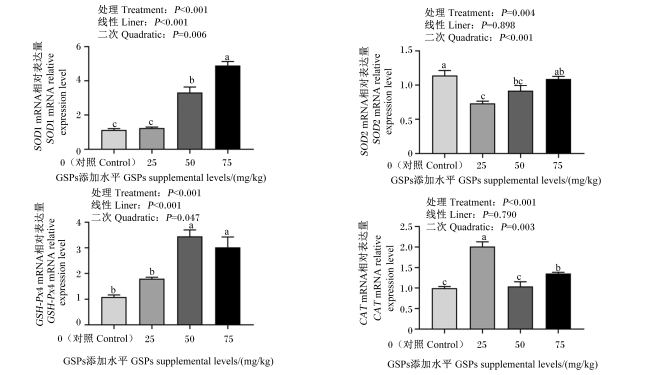
图1所示,与对照组相比,饲粮添加50和75 mg/kg GSPs显著提高肝脏SOD1和GSH-Px4 mRNA相对表达量(P<0.05);饲粮添加25和50 mg/kg GSPs显著降低肝脏SOD2 mRNA相对表达量(P<0.05);饲粮添加25和75 mg/kg GSPs显著提高肝脏CAT mRNA相对表达量(P<0.05)。
图1 饲粮添加GSPs对四川白鹅肝脏抗氧化相关基因表达的影响

数据柱标注不同字母表示差异显著(P<0.05),相同字母表示差异不显著(P>0.05)。图2同。

Fig.1 Effects of dietary GSPs on antioxidant-related gene expression in liver of Sichuan White geese

Value columns with different letter superscripts mean significantly different (P<0.05), while with the same letter superscripts mean not significantly different (P>0.05). The same as Fig.2.

2.5 饲粮添加GSPs对四川白鹅肾脏抗氧化相关基因表达的影响

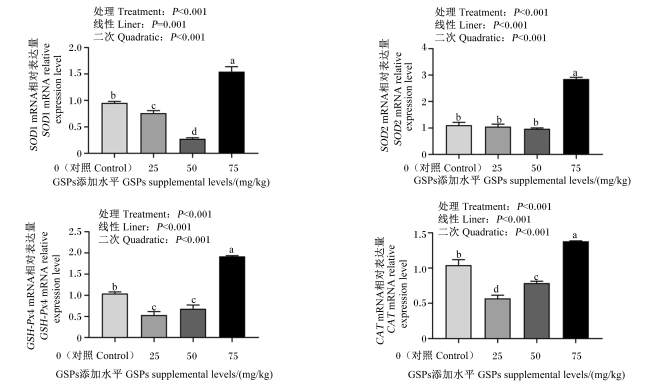
图2所示,与对照组相比,饲粮添加75 mg/kg GSPs显著提高肾脏SOD1、SOD2、GSH-Px4和CAT的mRNA相对表达量(P<0.05),而饲粮添加25和50 mg/kg GSPs则显著降低肾脏SOD1、GSH-Px4和CAT的mRNA相对表达量(P<0.05)。
图2 饲粮添加GSPs对四川白鹅肾脏抗氧化相关基因表达的影响

Fig.2 Effects of dietary GSPs on antioxidant-related gene expression in kidney of Sichuan White geese

3 讨论

3.1 饲粮添加GSPs对四川白鹅生长性能的影响

ADG、ADFI和F/G是体现动物生长性能的最直接指标。本试验表明,饲粮添加GSPs对21~63日龄四川白鹅生长性能指标均未产生显著影响。目前有关在饲粮中添加GSPs或葡萄籽原花青素提取物(GSPE)对畜禽生长性能的作用已有研究。左晟希[15]研究发现,在肉鸡饲粮添加100和150 mg/kg GSPs后,ADG显著提高。Cao等[16]研究也表明,GSPE通过增强抗氧化能力、促进免疫及增加盲肠短链脂肪酸合成,从而改善了肉鸡的生长性能。但是,Hao等[8]和孙晓江[17]分别在断奶仔猪和生长猪饲粮中添加GSPs对其生长性能没有显著改善作用。包括GSPs在内的大多数多酚类物质在小肠内消化率极低,90%左右的多酚类物质与大分子有机物结合成复合物(如蛋白质-多酚复合物)进入大肠,然后被微生物降解[18]。GSPs对动物体的影响是多方面且复杂的。一方面,GSPs能提高动物的抗氧化能力和免疫力,减少疾病的发生,比如缓解幼龄动物腹泻等。本课题组前期的研究也证实GSPs提高了仔猪的抗氧化能力和免疫力[8],促进了仔猪肠道发育[19],降低了仔猪腹泻[8],维护了肠道免疫屏障,提高了养分的吸收率。另一方面,GSPs在调节肠道菌群方面有重要作用[20],能够提高菌群多样性,促进一些有益菌群的繁殖,如普雷沃氏菌科NK3B31群和普雷沃氏菌属,抑制有害菌群,如厌氧弧菌属。从这2方面讲,GSPs理论上应该能够促进动物生长性能的提高。但是,GSPs对动物生长性能也存在不利影响,如GSPs等多酚类物质会与大分子有机物聚合,产生的聚合物降解率低,影响有机物的消化[18]。因此,GSPs对生长性能的影响可能与GSPs的添加水平以及动物的生理状态等综合因素有关。

3.2 饲粮添加GSPs对四川白鹅抗氧化能力的影响

氧化还原反应是机体最基本的化学反应。在正常代谢过程中,机体会产生大量的活性氧,同时又具有强大的抗氧化损伤能力[21]。在正常生理状态下,体内自由基不断产生,也不断被清除,维持在一个正常生理水平。当机体处于应激状态下,体内自由基的产生就会超过机体对自由基的清除能力,动物就会处于亚健康状态甚至发病。T-AOC反映总体抗氧化能力,用于综合评价机体非酶抗氧化防御和酶促抗氧化防御能力。SOD、GSH-Px和CAT是机体内主要的抗氧化酶。SOD通过将超氧自由基降解为过氧化氢来保护细胞免受超氧自由基的侵害,GSH-Px和CAT将过氧化氢分解成水。MDA是脂质过氧化的产物,MDA含量反映机体氧化损伤的程度,MDA含量的提高是细胞膜损伤的结果。
血清抗氧化指标可以反映机体整体的抗氧化应激程度。在本试验中,在四川白鹅饲粮中添加不同水平的GSPs均显著提高了血清T-AOC活性,降低了MDA含量。Yang等[22]在肉鸡饲粮中添加GSPs显著提高了肉鸡血清抗氧化酶活性,降低了血清MDA含量。高世乐等[23]研究表明,原花青素可以提高大鼠血清SOD和GSH-Px活性,并降低血清MDA含量。这与本试验研究结果基本一致。
肝脏是畜禽机体的重要器官,在动物体内的消化吸收、物质代谢及免疫反应中起关键作用。肝脏暴露在由门静脉输送的内源性毒素中,因此是发生氧化应激的主要场所。王新财等[24]研究表明,GSPs通过降低氧化应激和炎症反应,发挥对小鼠酒精性肝脏损伤的保护作用。GSPs通过激活Nrf2/HO-1信号通路,促进下游抗氧化酶的表达,抑制酒精性肝损伤大鼠核因子-κB(NF-κB)信号通路的激活,从而缓减大鼠的酒精性肝损伤[25]。本试验结果表明,42日龄,饲粮添加75 mg/kg GSPs显著提高肝脏T-AOC及GSH-Px和CAT活性,各GSPs组肝脏MDA含量均显著降低;63日龄,饲粮添加100和150 mg/kg GSPs对于提高肝脏抗氧化指标的效果显著。为了从基因水平进一步探讨GSPs的抗氧化作用,本试验第1阶段结束后测定了肝脏和肾脏中抗氧化相关基因的mRNA相对表达量,结果表明GSPs对肝脏抗氧化相关基因表达量的影响与抗氧化酶活性的影响趋势基本一致,即与对照组相比,饲粮添加75 mg/kg GSPs显著提高肝脏SOD1、GSH-Px4和CAT的mRNA相对表达量。
肾脏是机体重要的排泄器官,极易遭受氧化应激的损伤从而影响肾脏功能。丁玉松等[26]研究发现,GSPs可以通过提高机体内抗氧化能力,缓解糖尿病小鼠的肾脏损害。本课题组之前的研究也表明,饲粮添加GSPs可以显著提高断奶仔猪肾脏抗氧化性能[27]。本试验中,42日龄,饲粮添加75 mg/kg GSPs显著提高肾脏T-AOC及GSH-Px和SOD活性;GSPs对肾脏抗氧化相关基因表达的影响与抗氧化酶活性的影响基本一致,即与对照组相比,饲粮添加75 mg/kg GSPs显著肾脏SOD1、SOD2和CAT的mRNA相对表达量。63日龄,不同添加水平的GSPs对肾脏抗氧化酶活性的影响差异比较大,但各GSPs组肾脏MDA含量均显著降低。作为多酚类化合物,GSPs可能通过激活Nrf2/HO-1通路,上调抗氧化基因表达,发挥抗氧化作用[6]。另有报道,GSPs通过抗氧化和抑制丝裂原活化蛋白激酶(MAPK)信号通路对睾丸和肠道产生辐射防护作用[28]。此外,GSPs的酚羟基结构使其具有良好的供氢能力,赋予GSPs超强的抗氧化和清除自由基的能力。

4 结论

① 饲粮添加适宜水平GSPs能够不同程度改善四川白鹅机体抗氧化能力,但对其生长性能无显著影响。
② 饲粮添加75 mg/kg GSPs对于改善21~42日龄四川白鹅抗氧化能力的效果较好。
[1]
GAO G A, ZHAO X Z, LI Q, et al. Genome and metagenome analyses reveal adaptive evolution of the host and interaction with the gut microbiota in the goose[J]. Scientific Reports, 2016, 6:32961.

DOI PMID

[2]
LIU H W, ZHOU D W. Influence of pasture intake on meat quality,lipid oxidation,and fatty acid composition of geese[J]. Journal of Animal Science, 2013, 91(2):764-771.

DOI

[3]
王育川, 林桐, 陈艾玲, 等. 饲粮添加茶多酚对马岗鹅空肠组织形态、抗氧化能力及紧密连接蛋白相关基因表达的影响[J]. 动物营养学报, 2022, 34(12):7833-7843.

DOI

WANG Y C, LIN T, CHEN A L, et al. Effects of dietary tea polyphenols on jejunum morphology,antioxidant capacity and expression of tight junction protein-related genes in Magang geese[J]. Chinese Journal of Animal Nutrition, 2022, 34(12):7833-7843. (in Chinese)

[4]
CHUANG C C, MCINTOSH M K. Potential mechanisms by which polyphenol-rich grapes prevent obesity-mediated inflammation and metabolic diseases[J]. Annual Review of Nutrition, 2011, 31:155-176.

DOI

[5]
DENG C, ZHAI Y, YANG X, et al. Effects of grape seed procyanidins on antioxidant function,barrier function,microbial community,and metabolites of cecum in geese[J]. Poultry Science, 2023, 102(9):102878.

DOI

[6]
SCAPAGNINI G, VASTO S, ABRAHAM N G, et al. Modulation of Nrf2/ARE pathway by food polyphenols:a nutritional neuroprotective strategy for cognitive and neurodegenerative disorders[J]. Molecular Neurobiology, 2011, 44(2):192-201.

DOI

[7]
CHENG Y T, WU C H, HO C Y, et al. Catechin protects against ketoprofen-induced oxidative damage of the gastric mucosa by up-regulating Nrf2 in vitro and in vivo[J]. The Journal of Nutritional Biochemistry, 2013, 24(2):475-483.

DOI

[8]
HAO R R, LI Q H, ZHAO J Q, et al. Effects of grape seed procyanidins on growth performance,immune function and antioxidant capacity in weaned piglets[J]. Livestock Science, 2015, 178:237-242.

DOI

[9]
WEI X X, LI L X, YAN H S, et al. Grape seed procyanidins improve intestinal health by modulating gut microbiota and enhancing intestinal antioxidant capacity in weaned piglets[J]. Livestock Science, 2022, 264:105066.

DOI

[10]
刘守业. 葡萄籽原花青素对肉仔鸡免疫功能和抗氧化功能的影响[J]. 畜禽业, 2017, 28(8):15-16,19.

LIU S Y. Effects of grape seed proanthocyanidins on immune function and antioxidant function in broilers[J]. Livestock and Poultry Industry, 2017, 28(8):15-16,19. (in Chinese)

[11]
ALI S. 葡萄籽原花青素提取物抵御黄曲霉毒素B1对肉仔鸡危害的作用及机制[D]. 博士学位论文. 武汉: 华中农业大学, 2019.

ALI S. Therapeutic effects and mechanism of grape seed proanthocyanidins extract against aflatoxin B1 toxicity in broiler chickens[D]. Ph.D. Thesis. Wuhan: Huazhong Agricultural University, 2019. (in Chinese)

[12]
FARAHAT M H, ABDALLAH F M, ALI H A, et al. Effect of dietary supplementation of grape seed extract on the growth performance,lipid profile,antioxidant status and immune response of broiler chickens[J]. Animal, 2017, 11(5):771-777.

DOI

[13]
田跃, 董红刚, 沈泽锋. 葡萄籽原花青素对肉鸡生长性能、免疫功能和经济效益的影响[J]. 饲料研究, 2022, 45(12):28-31.

TIAN Y, DONG H G, SHEN Z F. Effect of grape seed proanthocyanidins on growth performance,immune function and economic benefit of broilers[J]. Feed Research, 2022, 45(12):28-31. (in Chinese)

[14]
WEI X X, LI N, WU X Y, et al. The preventive effect of Glycyrrhiza polysaccharide on lipopolysaccharide-induced acute colitis in mice by modulating gut microbial communities[J]. International Journal of Biological Macromolecules, 2023, 239:124199.

DOI

[15]
左晟希. 原花青素和茶多酚对AA肉鸡生长性能、肌肉品质及血液生化指标的影响[D]. 硕士学位论文. 南昌: 江西农业大学, 2017.

ZUO S X. Effect of Pu-sheng-yuan on growth performance and quality of muscle and blood biochemical index of AA broilers[D]. Master’s Thesis. Nanchang: Jiangxi Agricultural University, 2017. (in Chinese)

[16]
CAO G T, ZENG X F, LIU J S, et al. Change of serum metabolome and cecal microflora in broiler chickens supplemented with grape seed extracts[J]. Frontiers in Immunology, 2020, 11:610934.

DOI

[17]
孙晓江. 葡萄籽原花青素对生长猪结肠形态、细胞凋亡及微生物的影响[D]. 硕士学位论文. 晋中: 山西农业大学, 2021.

SUN X J. Effects of grape seed procyanidins on colon morphology,cell apoptosis and microorganisms in growing pigs[D]. Master’s Thesis. Jinzhong: Shanxi Agricultural University, 2021. (in Chinese)

[18]
LI Q H, YAN H S, LI H Q, et al. Effects of dietary supplementation with grape seed procyanidins on nutrient utilisation and gut function in weaned piglets[J]. Animal, 2020, 14(3):491-498.

DOI PMID

[19]
YAN H S, GAO W W, LI Q H, et al. Effect of grapeseed procyanidins on small intestinal mucosa morphology and small intestinal development in weaned piglets[J]. Animal Production Science, 2020, 60(16):1894-1901.

DOI

[20]
HAN M, SONG P X, HUANG C, et al. Dietary grape seed proanthocyanidins (GSPs) improve weaned intestinal microbiota and mucosal barrier using a piglet model[J]. Oncotarget, 2016, 7(49):80313-80326.

DOI PMID

[21]
VALKO M, LEIBFRITZ D, MONCOL J, et al. Free radicals and antioxidants in normal physiological functions and human disease[J]. The International Journal of Biochemistry & Cell Biology, 2007, 39(1):44-84.

DOI

[22]
YANG J Y, ZHANG H J, WANG J, et al. Effects of dietary grape proanthocyanidins on the growth performance,jejunum morphology and plasma biochemical indices of broiler chicks[J]. Animal, 2017, 11(5):762-770.

DOI

[23]
高世乐, 宋金熠, 吴菲, 等. 原花青素对放射性心脏损伤大鼠血清cTn-Ⅰ、SOD、MDA、GSH-Px的影响[J]. 重庆医科大学学报, 2021, 46(8):903-907.

GAO S L, SONG J Y, WU F, et al. Effects of proanthocyanidins on serum cTn-Ⅰ,SOD,MDA,GSH-Px in rats with radiation-induced heart injury[J]. Journal of Chongqing Medical University, 2021, 46(8):903-907. (in Chinese)

[24]
王新财, 杨和. 葡萄籽原花青素对酒精性肝损伤小鼠的保护作用[J]. 中国现代应用药学, 2018, 35(7):1054-1057.

WANG X C, YANG H. Protective effects of grape seed procyanidin on alcoholic liver injury in mice[J]. Chinese Journal of Modern Applied Pharmacy, 2018, 35(7):1054-1057. (in Chinese)

[25]
余维微, 曾耀明, 郑伟伟, 等. 基于Nrf-2/OH-1/NF-κB通路探讨葡萄籽原花青素对大鼠酒精性肝损伤的保护作用[J]. 中国中医急症, 2019, 28(6):1021-1024.

YU W W, ZENG Y M, ZHENG W W, et al. The investigation on protective effects of grape seed proanthocyanidins on alcoholic liver injury in rats based on Nrf2/OH-1/NF-κB pathway[J]. Journal of Emergency in Traditional Chinese Medicine, 2019, 28(6):1021-1024. (in Chinese)

[26]
丁玉松, 冉珊珊, 毛磊, 等. 葡萄籽原花青素对糖尿病小鼠肾脏氧化应激的作用及对HO-1的影响[J]. 石河子大学学报(自然科学版), 2019, 37(4):519-523.

DING Y S, RAN S S, MAO L, et al. Effects of grape seed proanthocyanidin extract on renal oxidative stress in diabetic mice and the expression of HO-1[J]. Journal of Shihezi University (Natural Science), 2019, 37(4):519-523. (in Chinese)

[27]
张俊兰. 葡萄籽原花青素对断奶仔猪抗氧化功能的影响[D]. 硕士学位论文. 晋中: 山西农业大学, 2019.

ZHANG J L. Effects of grape seed procyanidins on antioxidant function of weaned piglets[D]. Master’s Thesis. Jinzhong: Shanxi Agricultural University, 2019. (in Chinese)

[28]
SHEN H, HAN J, LIU C L, et al. Grape seed proanthocyanidins exert a radioprotective effect on the testes and intestines through antioxidant effects and inhibition of MAPK signal pathways[J]. Frontiers in Medicine, 2022, 8:836528.

DOI

Outlines

/